This is a repository copy of The Evolution of Private Equity: Corporate Restructuring in the UK, c.1945-2010.
White Rose Research Online URL for this paper: http://eprints.whiterose.ac.uk/79396/
Article:
Toms, S, Wilson, N and Wright, M (2015) The Evolution of Private Equity: Corporate Restructuring in the UK, c.1945-2010. Business History, 57 (5). pp. 736-768. ISSN 0007-6791
https://doi.org/10.1080/00076791.2014.977262
[email protected] https://eprints.whiterose.ac.uk/
Reuse
Unless indicated otherwise, fulltext items are protected by copyright with all rights reserved. The copyright exception in section 29 of the Copyright, Designs and Patents Act 1988 allows the making of a single copy solely for the purpose of non-commercial research or private study within the limits of fair dealing. The publisher or other rights-holder may allow further reproduction and re-use of this version - refer to the White Rose Research Online record for this item. Where records identify the publisher as the copyright holder, users can verify any specific terms of use on the publisher’s website.
Takedown
If you consider content in White Rose Research Online to be in breach of UK law, please notify us by
Electronic copy available at: http://ssrn.com/abstract=2145445
0
The Evolution of Private Equity: Corporate Restructuring in the UK, c.1945-2010
By Steven Toms*
Accounting and Finance Division Leeds University Business School
Nick Wilson
Credit Management Research Centre Leeds University Business School
Mike Wright
Centre for Management Buy-out Research Imperial College Business School
And
University of Ghent
Word count: 10,100 (excluding tables and notes)
*Correspondence:
J.S. Toms
Professor of Accounting and Finance
Leeds University Business School Room 2.09, Maurice Keyworth Building University of Leeds
Leeds LS2 9JT
Tel: 44(113)-3434456
Email: [email protected]
Electronic copy available at: http://ssrn.com/abstract=2145445
1
The Evolution of Private Equity: Corporate Restructuring in the UK, c.1945-2010.
Abstract
The paper analyses the role of private equity in restructuring the UK corporate economy. It
develops a theoretical synthesis to show that the evolution of the PE industry and firms in
which it invested were governed by the relations of corporate governance between investor
and investee companies. Effective governance relations were a necessary condition for
success and complement firm specific resources to create competitive advantage. Four case
studies are used to show the contrasting effects of these determining factors, ICFC and Slater
Walker, and the two waves of buy-out centred restructuring that developed with the
maturity of the PE industry after 1980. In contrast to the evolutionary approach, the
periodisations utilised in this study show that structural breaks associated with points of
institutional reform are also necessary to make firm specific resource and governance
2
Introduction
This paper analyses the radical impact of private equity (PE)1
in restructuring the British
corporate economy in the period 1945-2010. A historical approach is particularly useful
because several contrasting models of industry financing and governance have been used
since the Second World War resulting in differing performance outcomes. It is therefore
possible to use these contrasts to examine the critical success factors associated with the
provision of financial services to industry. To examine these contrasts the paper covers
three periods. The first up to around 1980 featured attempts to mobilise venture capital by
government backed initiatives on the one hand and aggressive speculative buying and
selling of companies on the other, both of which were relatively unsuccessful. Second, the
post 1980 period saw the rapid emergence of the PE industry and associated management
buy-outs, the first wave of deals lasting until the late 1980s. The third period is the
subsequent second PE wave in the early 2000s, with different characteristics, reflecting the
greater maturity of the industry, and which lasted up to the financial crisis of 2007-08. By
examining the determinants of success and failure in these three periods, the paper aims to
identify critical success factors in corporate governance likely to assist practitioners and
policy makers.
1P
3
Although the traditional business history style objective of using evidence from
multiple sources to test period and context specific necessary conditions and cause and
effect relationships is important, another aim is to show how the insights offered by
evolutionary theory might be complemented. In evolutionary theory, the firm is normally
taken as the unit of analysis, or variable whose evolution is to be theorised and whose
behaviour is governed by capabilities, decision rules and routines. The variable set is
governed by some inertial tendencies, but also subject to dynamic and systematic
winnowing mechanisms and random variations.2
Examining the role of PE provides an innovative opportunity to theorise a new
evolving variable set: the relations between the PE firm and investee firm.3
These relations
are essentially the governance and accountability structures that are enforced in return for
the provision of financial resources.4
Systematic winnowing mechanisms arise from market
and non-market institutions, principally the market for corporate control (MCC) 5
and the
institutions of political regulation respectively. At the same time, governance and
accountability relations are subject to random variations, for example arising from
continuous asset revaluations determined by trading or speculative activities and the impact
on risk and return of claims associated with those assets. They are also subject to forms of
inertia, for example where economic relations become embedded in social ties or through
2N ‘ E T
pp.54, 68. Nelson and Winter, An Evolutionary Theory, p.4.
3
In the fashion of Nelson and Winter (An evolutionary theory, p.47), this variable is used for the
4
Such an approach complements studies that have examined the dynamics of large shifts in governance structure, such as the impact of deregulation Kole, and Lehn, D
5
The MCC refers to the existence of conditions, for example liquid share markets, transparent and flexible managerial labour markets, appropriate institutions of financial inter-mediation, promoting
4
contractual lock-in effects, managerial entrenchment and rent-seeking behaviour.6
Because
the relations of governance and accountability are the key variables, rent seeking is defined
here as a function of human activity and the creation of knowledge assets, that might arise
for example from R&D routines. Insofar as value arises from these routines through
innovation, the rents can be captured purely by the individuals creating them where
governance mechanisms are ineffective. Where governance is more effective, the profits of
innovation are captured in the form of profits as an index of observable competitive
advantage for the capital market.
Utilising a set of governance relation variables, the paper contributes in several
ways. First, it enhances the strategic management literature by advancing a theoretically
consistent explanation of how governance relationships might enhance competitive
advantage. Second, by examining the creation of value through the possession of
knowledge used in business relationships,7
it provides a vehicle for improving our
understanding of the symbiotic development of business organisations and the MCC. Rather
than studying the MCC as an economic institution, this approach concentrates instead on
examining the acquisition and application of knowledge by market participants. Financial
services firms, such as merchant banks, venture capital and PE firms are of equal importance
vis-a-vis firms producing goods and services, which are often the principal or sole focus of
analysis in both the business history and strategic management literatures. Third, it adds to
the business history literature by examining the strategic role of intermediate organisations
and how they have contributed to the evolution of capitalist institutions, business
organisations and their performance. In doing so it updates our knowledge of the
6
On embedded relations, see Granovetter, E A
7
5
development of the market for corporate control since 1980, up to and including the recent
financial crisis.
To achieve these objectives the paper introduces a conceptual framework relating
knowledge assets, financial resources and governance relationships to competitive
advantage, set out in the next section. To assess the implied relationships, the paper then
presents an empirical case study of the UK PE market 1950-2010 in three parts. The first
deals with two contrasting case studies, the government backed Industrial and Commercial
Finance Corporation (ICFC) and its successor organisation, Investors in Industry (3i) and the
creation and downfall of the Slater Walker empire based on the speculative buying and
selling of companies. The second examines the features of the first wave of PE. The third
deals with the second PE wave. A final section draws conclusions.
Literature review and conceptual framework
In 1950 the governance and accountability relation between capital markets and industry
was characterised by block shareholdings of family and managerial groups as a consequence
of earlier phases of economic development.8
The MCC promoted amalgamations of firms
into industrial federations, encouraging director interlocks and limiting the influence of
outside and institutional investors. Hostile takeovers became more prevalent in the 1960s
as firms used the stock market to raise new capital and a more active market in company
shares developed.9
The development of diversified, decentralised managerially controlled
firms proceeded in the period up to 1980, but was truncated by the subsequent institutional
changes, characterise
8
Chandler, Scale and Scope
9
6
globalisation, and emphasis on higher and short term returns on financial investments as
performance measures.10
The emergence of the PE industry and associated restructuring provides a strong
contrast to the characteristics of family, insider and managerial capitalism adopted in some
UK economic sectors in the period 1950-1980.11
Its development has been associated with
the evolution of deeper financial markets, more transparent corporate governance and a
breaking down of monopoly rents in relational banking and in industrial sectors hitherto
controlled by large firms.12
“
logic which has resulted in
increased dividend payments and share repurchases and reductions in the workforces of
large US and UK corporations, driven by financial market deregulation and the emergence of
the MCC.13
Contrasting these trends, prior business history literature has documented the
development of the buy-out market, the emergence of PE funded buy-outs in the UK as a
C B an explanation of the
historic differences between the role of PE in the US and UK contexts.14 The emergence of PE and other capital market intermediaries has been characterised as comparable to the
managerial revolution in terms of its effect on business organisation and the distribution of
10L I “ F C
W “
11
Toms and Wright 'Corporate governa T W “
12‘ ) T
13L O “ M
14
Respectively, W C ‘ A T of an organisational
T W C T W
7
surplus away from traditional stakeholders, including shareholders, in favour of a new
elite.15
Observing these developments, as early as 1989, Jensen argued that the public
corporation was being eclipsed by the emergence of PE and that this was a positive
development. Business performance he argued was inhibited by embedded agency costs in
the traditional diversified publicly quoted conglomerate. PE backed firms by contrast were
able to embed capital market mentalities into managerial behaviour and incentives, whilst
using high levels of debt to restrict access to free cash flow.16
In contrast, Lazonick and
O “
option based incentive packages for senior executives successfully created alignment of
managerial behaviour in favour of shareholder value maximisation.17
However, the use of
these incentives has often led to opportunistic behaviour by managers at the expense of
shareholders and internal stakeholders.18
Private ownership and executive incentives may
therefore be substitutes and act as necessary but not sufficient conditions for competitive
advantage and the creation of shareholder value.
To build on this literature, we propose that the governance skills offered by PE
investors can create competitive advantage, particularly through the application of specialist
knowledge of capital market functions. Resource based view (RBV) theorists have argued
that value arises from acquiring or merging with firms that possess different but
complementary resource mixes, thereby creating synergistic complementarities.19 Such
15F W W W W
16J T
17L O “ M
18B H C ‘ M
8
resources might include both production and governance skills20
, which in turn are
complementary within and between firms.21
For PE firms, these might consist of financial
and governance engineering.22M
23
However where competitive advantage and value is created
through complementary resource mixes, it follows that governance skills must arise from
the sharing of knowledge between corporate managers and the owners of capital, and
cannot be fully internalised or appropriated by the firm, but must also be possessed to some
extent b I M ‘BV
approaches in this fashion because it removes the problem of reification suggested by the
If a dynamic capability is defined as the fi
24
then effective
governance processes are necessarily implicated in what is required to create competitive
advantage on this basis. The role of PE, as outlined by Jensen, also matches these processes
in that all can be linked to strategic value creation. For Jensen, this is effective because
capital market mentalities are ingrained into managerial decision making. However this only
follows insofar as capital market rationalities can be translated into clear decision making
criteria for managers.25
Where idiosyncratic knowledge is embedded in firm or asset specific
processes, there are problems translating process specific probabilities and lead times into
20
Barney, Ketchen W T F ‘ - T
21M ‘
22K “ L
23M ‘
-546.
24E M D
25
Where production is performed by teams and individual contributions are unknown, the
9
parameters for capital market valuation models. For these reasons, PE firms rely on signals
that go beyond the content of business plans, relying on sound ideas and social contacts,
such that social capital ties are a necessary condition for the creation of dynamic
capability.26
Intermediaries occupying a network position between otherwise unconnected
actors, accrue rents by brokering information or resources, so that network centrality might
put an intermediary in a better position to accrue rents.27 For example, PE investors act as
gatekeepers for their portfolio companies, facilitating information flows through their
network.28 Analogously, in a capital market informed individuals accrue abnormal returns
through differential access to information.29
Although the end result is similar, firms and capital markets create rents in different
ways. The firm, and firm level actors, create rents through the development of innovative
resource combinations. In capital markets, rents arise from mispricing and adjustments
towards equilibrium. Where new information reaches the market in the form of a generic
shock, for example a sudden change in the oil price, it is more effective at processing
information than individuals, and adjusting corporate valuations accordingly. Conversely,
where new information reaches the market from within the firm, for example an investment
in a process likely to lead to an R&D breakthrough, firm insiders will be better placed than
the market to evaluate its likely effect. In the knowledge-based view, these directions of
information arrival impact who appropriates surplus and the character of the surplus. Firm
level knowledge where linked to discovery is value creating non-zero sum rent. Firm insiders
26B C D “ C N “ T
27
Burt Structural Holes B C D , p.683.
28L V
10
are in a good position to appropriate the gains from discovery where there is causal
ambiguity of contribution or the knowledge is idiosyncratic.30 Market engendered
knowledge on the other hand arises from circulation of capital and in its purest form is a
transaction cost driven zero sum game.
However, capital can never engage in pure circulation; at some point capital that has
arisen from the productive sphere must re-enter it in the form of reinvestment. It is at
these points of entry and exit that governance skills can be important and value adding.31 Value creation arises from knowledge sharing; for example PE firms create competitive
advantage through rigorous due diligence procedures.32
Because firms have different levels
of absorptive capacity, defined as the ability to identify, accumulate, process and use the
new knowledge gained from external sources,33
they will assimilate knowledge at different
rates. Even in a fairly efficient market, abnormal returns accrue to relatively informed
investors at the expense of the uninformed.34
It follows that specialist capital market
participants can create capital market based competitive advantage where knowledge
processes are linked to technical market operations, for example derivative trading. Indeed
evidence suggests that PE investors are better monitors with better incentives than public
shareholders, especially in firms with significant derivative trading activity and derivative
contract positions.35
PE investors, as financial specialists, are often involved in further fund
raising and M&A-operations.36
30B C
D p.682.
31
Secondary and derivative markets are more likely to resemble a pure zero sum game (Telser, W
O F M
32W J F P UK
33
Zahra, Filatotchev an W How do threshold fi
34G “ O
35
Masulis and Thomas, D P E C W
11
The joint determinants of competitive advantage that follow from this linkage, firm
resources and governance skills, are set out in figure 1. These physical, knowledge and
financial resources are used to categorise specific aspects of the relations between the
investee firm and the portfolio firm investor, set out in the second and third columns. These
are the critical success factors that if positive will be linked to strategic outcomes for the
partner on each side of the relation. Following the above review, the framework
hypothesises that rent accrual to insiders will be reduced by due diligence and related
monitoring processes. PE firms will use their network to access external economies of scale
and scope, e.g. cheaper and multiple sources of finance, and can add value through
governance skills, e.g. due diligence, new forms of financing, technical knowledge of capital
market operations, incentive alignment etc. In the cases below, empirical evidence is
analysed according to the sub-sections in figure 1.
Figure 1 about here
Success and failure in corporate finance and restructuring pre 1980
For long periods, the British economy developed without the benefit of institutions focused
on providing structured finance to industry, particularly small and medium sized enterprises
(SMEs). As a consequence, historians have characterised the banking system as having
B 37 A
development of the London money market to support government and international
37
Committee on Finance and Industry (Macmillan Committee): Report of Committee (Cmd. 3897),
1931 T
G F ; Capie, and Collins, Have the Banks Failed
12
ation.38
In the latter half of the nineteenth century, Gladstonian balanced budget finance created a
demand for private sector bond finance and structured debt in the form of preference
shares and debentures.39
By the early twentieth century, banks had evolved into an
oligopolistic risk-averse cartel, reluctant to lend start up capital to smaller businesses.40
As a
consequence, British firms were used to relying on banks for working capital finance, and
regional stock markets for long term sources of funding. Established firms relied on their
own resources, reinforcing family and insider control, whilst new risky ventures attracted
funds from syndicates of wealthy investors.41
In 1931, policy makers identified the lack of
finance for industrial growth, in the range of £5000- M M
this came to dominate the policy agenda for the next 70 years.
Against this background, the period 1945-1980 is worthy of more detailed analysis,
as it provides a series of contrasts, at institutional, policy and firm levels, to the conditions
that typically prevailed after 1980 and which facilitated the emergence of a substantial PE
industry. These contrasts allow the sufficient and necessary conditions for the development
of financial support for innovation and enterprise to be identified.
Two cases are chosen, ICFC and Slater Walker. For many years, ICFC was the only
dedicated source of tailored PE finance for SMEs, which in contrast to the post 1980 PE
industry was closely controlled by the banking institutions, including the Bank of England. Its
achievements were modest until the mid 1970s, reflecting the conflicting objectives of its
shareholders and providing a useful illustration of governance constraints on resource use.
The activities of Slater Walker on the other hand typified the wave of conglomerate based
38
Michie, Guilty Money.
39C D
-279.
40C T F V C
-263.
41M O C “
13
reconstruction arising from the development of the MCC in the 1960s. Other firms, such as
Lonrho, Hanson and GEC, were also leading cases, although their acquisitions could be
related to their core industrial strategy or longer run investments.42
For Slater Walker, the
object was buying companies for purely financial investment purposes, so that the firm
better typified the wasteful and ultimately ineffective corporate restructuring of the pre
1980 period. These organisations represent different aspects of venture capitalism,
characterised by portfolio holdings of high risk businesses in need of expertise and finance.43
ICFC/3i
ICFC was set up by the government with enforced participation by the clearing banks in
1945. Its objective was to provide medium and long term finance to SMEs, with the Finance
Corporation for Industry (FCI) providing finance for larger enterprises.44
Owned and
controlled by the clearing banks, ICFC replicated many of the traditions of British finance,
notwithstanding its apparent venture capitalist role. There is little prior research evidence
on the ICFC, and the histories that have been written credit it with limited success based on
firm specific long run investments, including risky sectors that might have been ignored by
the banks, and note that it was held back by the restrictive attitudes of its owners, the
commercial banks. As a consequence, ICFC did not experience the same pressures for
delivering short term returns as the standard venture capital model based on a closed end
limited partnership.45
42
For example Hanson claimed it was only interested in buying companies for long term investment and not for selling on. Economist, 29th October 1977,
43M T G G A
44
Coopey and Clark, 3i; Economist, 2nd November, 1974, p.91.
45
14
ICFC slowly built up its resource base and investment selection skills in the period
1945-1975. In the style of the traditional bank, it exercised careful scrutiny and
conscientiously investigated funding applications.46
It attracted criticism for its cautious
lending policy, being overly selective and preferring larger firms in adverse economic
conditions.47
ICFC also provided expertise in new stock issues for firms wishing to float on
the market, including provision of expertise in the allotment process.48
There was also an
emphasis on working capital finance and a reluctance to take up equity stakes.49
In 1952,
only 8% of funds were invested in equity, with 38% in secured loans and 22% in unsecured
loans, reflected in a general reduction in bad debt provisions.50
As selection criteria were
tightened further in the credit squeeze of the 1950s, only 15% of cases supported were
entirely new ventures.51
ICFC did not always successfully screen potential investors and was
‘ H T “ H
lack of integrity and accounting manipulations.52
From the outset, ICFC was able to provide bespoke financial services giving firms
access to lines of credit. Its lending policy was created to directly address the Macmillan
gap, providing loans in the £5000 to £200,000 range.53
As ICFC progressively introduced
more specialist subsidiary operations, its client organisations could access additional
46“ C
The First
V C ICFC F P Economist, 14th May, 1955; p. 596.I
C F C Economist, 14th May, 1955, p. 628
47 ICFC A V
Economist, 20th November, 1948, p. 847.For example theWD Evans
G P “ O “ 6thMay 1961, p. 57.
48
In doing so, it attracted criticism for assisting established businesses rather than addressing the M M The Role of ICFC Economist, 5th April, 1947, p. 509.CFC N I 27thMarch, 1948, p. 519.
49
The ICFC In A H E Economist, 20th May, 1950.
50 ICFC “ E
Economist, 17th May 17, 1952; p. 470.
51
Economist, 7th July, 1956; p. 89.
52 ICFC A B H ‘
Michael Lafferty, Financial Times, 17th September, 1976; p. 34.
53
15
bespoke financial services. These included the Estates Duties Investment Trust Company Ltd
E Technical Development Capital (TDC) in 1966, which were established
for very different purposes and only enjoyed moderate success.54
ICFC engaged throughout
the build up of the Ship Mortgage Finance Company, up to and including its public flotation
by a £4m debenture issue, but the amounts involved were insufficient to develop the ability
to win contracts.55
The ICFC Venture Capital Fund was used inter alia to rescue strategic
companies in difficulty.56
As the MCC developed in the 1960s, ICFC became a more
aggressive, merchant bank type organisation, and set up its Industrial Mergers Ltd
subsidiary charging commission where it had previously offered informal advice. It thereby
became involved in 33 successful mergers in its first year.57
Notwithstanding these apparent successes, a major limitation arose from ICFC
network relationship with financial institutions. The shareholding clearing banks deliberately
ICFC58
potentially undermining its ability to perform due
diligence. They treated ICFC as a rival, which took business from them in times of tight
credit.59 U ICFC requently squeezed when its
shareholding banks restricted capital or increased its cost.60
This was overcome to some
extent by an ICFC debenture issue in 1959. The £10m issue was a measure of lending
54
Edith assisted family firms to market their shares and retain control in the face of capital
W
minority interests or non-voting preference shares, avoiding direct ma E “ O Economist ,28th March 1953; p. 892;E C O Economist 29th May, 1954; p.731;
TDC
C The First Venture C .
55 M “
Economist, “ H A Economist, 7th
October, 1961, p. 72.
56 M
Economist 27th January, 1973; p.68
57 F
Economist, 24th June, 1967; Modest t Economist, 15th June, 1968, p.67;
58C T F V C
Coopey and Clark, 3i.
59I E F
Economist, 4th November, 1961, p. 475; M K Economist, 9th
D New Role Needed Economist, 21st May, 1966, p. 874
16
success, albeit at rates commensurate with commercial lending during the credit squeeze.61 Even so, in the 1960s ICFC lending reached another plateau, with commercial banks better
able to lend due to tax allowances on borrowed funds.62
Ultimate oversight by the Bank of
England also meant that ICFC reflected the po I
tax investment allowances, and specifically backed export orientated ventures.63
Even after
it became involved in the buyout market, ICFC maintained a low profile. As Robert Smith,
ICFC
to maintain a fairly low profile for pretty obvious reasons. Active promotion of financial
services for MBOs risks the charge of enticing management to break away from their
64
ICFC
- 65
ICFC protected its investment by maintaining client contact, insisting on the
plough-
Fluidrive, a company specialising in clutches and gears, which was fostered through a 150k
debenture.66
Formal managerial incentive packages were not used, and managerial free cash
flow limited through the use of participating dividends. Portfolio management executives
61 T F T F
Economist, 13thJ ICFC Economist,13th June, 1970, p. 63;
62 T G F
Economist, 13th July, 1963, p.156.
63 ICFC A T C M
Economist , 16th May, 1953; p. 462.I A C
F C L ICFC Economist, 1st July, 1961, p. 80. Policy oriented lending was advocated by the Chairman, Lord Piercy, but opposed by the commercial bank shareholders. Merlin Jones, The Industrial and Commercial Finance Corporation, p.7.
64“ M B “ I
this conference either did not wish to be named or gave a fictitious name (e.g. Mickey Mouse,
D D
65“ W A UK H
- V C F
66 “ F C P
Economist, Saturday, 29thJ Fluidrive
17
monitored portfolio companies through comparing monthly accounts with the budget. They
typically would not take a board seat, notwithstanding contractual rights, leaving this to
non-executive directors appointed from their networks. Portfolio management executives
(investment controllers) were typically involved in monitoring considerably more investees
than would be the case for PE firms in later periods. Informal contact with investees
amounted to 11 hours per year, about a tenth of that for hands-on investors. This human
capital resource constraint meant that the allocation of attention to individual firms was
quite limited. Further, portfolio companies were typically minority investments, so avoiding
subsidiaries reporting requirements.67
Unlike closed end fund PE firms, ICFC was not
time-constrained in the investee holding period. Rather, minority holdings made it difficult to
force a realisation. Returns were therefore obtained through redeemable preference
shares, and cumulative and participating dividends. Once redeemable preference shares
were redeemed, ICFC were left with a small equity stake that effectively cost them very
little. Participating dividends enabled ICFC to capture surplus cash once profits exceeded a
predetermined level, also had a monitoring role. They pressured management to consider
exiting or financial restructuring to avoid substantial cash flows which might otherwise be
used for investment from being paid out to investors.68
This whole approach stored up
major challenges when 3i became a listed corporation and subsequently needed to
restructure and exit much of its vast portfolio of investee companies many of which had
been held for decades.
The performance outcomes were mixed, but generally improved through time as
governance and policy constraints were relaxed. A commentator in the Economist
67“ M B
68
18
summarised the strategy as y useful function in a moderately
69
There were other modest signs of success. ICFC backed firms had higher
growth rates and percentage net profit before interest than average for quoted companies
(13.5% compared to 12.3% in the three years to 1968).70
Some profits came from access to
privileged information, for example, ICFC and Hambros Commercial Finance Corporation
investment in the share issue of Shipton Automation.71
There were also some headline cases
of even the most promising innovative projects not being financed by ICFC.72
In short, prior to 1973, ICFC achieved limited results, held back by conflicts of
interest with the banks and lacking resources required to offer significant financial services
to industry. A watershed was reached in 1973, when ICFC and FCI were merged to create
Finance for Industry (FFI).73 A FFI B E
bank backed funding in response to the financial crisis of 1973, the ICFC became one of the
largest lending institutions in Europe.74
Demand for ICFC loans rose steeply in the wake of
the financial crisis, which created interest rate volatility, so that ICFC loans were attractive
to entrepreneurs.75 The merger effectively doubled the lending capacity of ICFC.76
In summary, ICFC was slowed by constraints on resources as a result of its own
governance arrangements and position within the wider financial institutional network and
69 T ICFC I A H E
Economist, 20thM ICFC And R C
Economist, 12thM I L P
ICFC And
I Economist, 15th May, 1954, p. 562
70L
Economist , 28th November, 1970, p. 80.
71 T C
Economist, 2nd May, 1964; p.524.
72
No whizz- B Economist , 5th August, 1978, p. 73.
73
Subsequently renamed Investors in Industry (3i).
74 F FFI
Economist N T
Economist, 9th August, 1975, p.8
75 “ B K B M ICFC
Nicholas Colchester. Financial Times, 7th December, 1977, p.7.
76
19
linkages to the policy agenda. These constraints were progressively removed, particularly
after 1973, when its expanded resource base was used more explicitly for venture capital,
restructuring and buy-out finance, thereby laying the foundations for the expansion of these
facilities in the 1980s.
Slater Walker
Slater Walker (SW) was established in 1963 by the entrepreneur, Jim Slater. The history of
SW is well documented,77 although it has attracted little attention in the literature. Slater
W UK
institutions (banks, pension funds, insurance funds) which adopted an "eyes-on, hands-off"
approach to their investments, monitoring them, but having little or involvement in their
management.78
Firm specific resources were not consistently well used by SW or its portfolio
companies. For example “ P tofoam
following its takeover was a failure due to technical problems.79
On the other hand, another
“W G I ‘ C Q A
in mining technology in 1968.80 At Greengate, Slater retained Marshall, the previous CEO to
run the companies until a buyer could be found.81 SW backed Greengate with investment in
a new factory at Trafford Park for the Cable division in 1969, and rationalised a string of
acquired rubber companies into Allied Polymer, which it sold at a profit in a public offer in
77
For a chronology of the rise and fall of Slater Walker and narratives of takeover transactions, see Raw, Slater Walker.
78‘ V UK
79
Raw, Slater Walker p.157.
80C “ “ W “ A ‘ A
81
20
1971.82 Frequently, incumbent managers were cast aside and their knowledge of the
business ignored.83 Following the Crittall Hope takeover in 1968, John Crittall, Michael Hope
and other incumbent managers were excluded from the specialist investigation teams of
commissioned by Slater and staffed by external advisers.84
Crittall Hope was a family run
firm of 5000 employees founded in 1818, earning consistent profits from an international
portfolio of metal window frame manufacturing businesses. It was the product of a recent
defensive merger between Crittall and Hope designed to protect market share from
predatory pricing following the break-up of the Standard Metal Window price agreement by
the Restrictive Practices Court in 1962, and was under pressure from the mid 60s slump in
the UK building industry.85 “
informed by interest in growing the assets.
According to one reviewer in the Economist, Slater possessed strong skills, based on
scrutiny of balance sheets, for the effective selection of investee firms.86 Slater looked for
target companies that were badly managed or with a mix of good and bad operating
divisions where poor performing units could be sold.87 In many leading cases however, SW
“W
with financial journalists, determining real estate values for potentially surplus factories and
offices, and technical calculations establishing the minimum value of compensation for
82
Raw, Slater Walker pp.219-220.
83
Although because SW typically offered a high premium, most transactions occurred with the support of incumbent management Eg Productofoam, Thomas Brown, Crittall Hope; Raw, Slater Walker pp.101-102, 183. 225-226.
84 H O
-172. Subsidiaries were sold without consulting their managing directors, ibid, p.172.
85H O
-66.
86 M “ H
far the balance sheet reflects asset values and the chances of making them work harder for their
Text- Economist, 23rd Sept. 1967, p.1134.
87 F D
21
redundant employees.88 M K “W E
Africa to Lonrho in a deal negotiated in just 90 minutes. As an afterthought, Tiny Rowland
asked: "By the way, what is wat J “ W E A 89
‘ K B B “ B
he decided the job of reorganisation was not for him and within three months the company
had been resold 90 Although the purchase and subsequent asset sale of Cork
M “W P
capital profits, these were significantly reduced by subsequent undisclosed liabilities.91 Prior
C H “W C H
German subsidiary. The discovery of these losses inflated the takeover premium further,
and underpinned the decision of the Crittall Hope board to accept the offer.92
Over-optimistic profit forecasts, first from the old board £1.4m (exit P/E = 24) and then from
Slater (£2.5m).93 A subsequent analysis showed the corresponding actual profit for 1969 to
be £635,000.94 F “W P oductofoam and George
Wilson, also proved over-optimistic.95 Productoform reported a profit in line with forecast in
88H O
- A H W
profitable US subsidiary for £3.2m cash in 1969 (Raw, Slater Walker, p.229).
89
Damien Reece, Business Comment, Daily Telegraph, 5th July, 2006.
90
Raw, Slater Walker p.203.
91
These included pre-acquisition losses, construction work necessary to realise the sale of the Chingford site and lower disposal values of subsidiaries than previously indicated. Raw, Slater Walker pp.175-177.
92
Raw, Slater Walker “ “
he would only require full details in the event of re-negotiation for a more favourable deal (Hope, O
93
Gwinner, Christopher. "Crittall-Hope Profit Forecast out by £500,000." Financial Times 8 Aug. 1968: 13. Financial Times. Web. 9 Mar. 2012.“ W C C -H , Lex. Financial Times, Monday, May 13, 1968.
94
Raw, Slater Walker, p.235.
95
22
1966, but from share-dealing, not from the core laminating business.96 At the time of the
Crittall deal (May 1968), Slater put out a profit forecast of £2.1m for SW itself, giving a
prospective PE of 33. The high value of SW shares meant that the Keith Blackman takeover
and subsequent disposal for cash created a surplus on the transaction.97
M “W s, rapidly built up reserves of
cash and credibility with City institutions.98 The company was therefore in a good position to
offer access to capital and lines of credit to its portfolio companies and invest capital where
needed. In 1969, SW acquired Ralli Brothers, an established and licensed bank, which
subsequently became the groups banking division.99 Notwithstanding these facilities,
financial restructuring in subsidiaries was undertaken to benefit SW, rather than the
investee company. For example Green
replaced with an overdraft and a substantial inter-company debt.100
Governance and accountability mechanisms were imposed in terms of financial
targets rather than strategic involvement. SW businesses were run on the basis of
maximising cash flow, for example by reviewing supplier credit terms, cutting employee
benefits and raising customer prices.101
Profits from deals accrued to SW nominees, rather
than as incentives for managers to achieve performance targets. At Crittall Hope, Slater
installed himself as Chairman. He dismissed the non-executives, replacing them with his
96 P H L
Financial Times, Tuesday, 1st February, 1966; pg. 4; Raw, Slater Walker, pp.158-158.
97
Raw, Slater Walker p.203.
98 F “
annual g “ W “ Economist, 17th June 1967, p.1277.Credibility in
the City increased for example following I
M “ “ I Economist, 14th Sept. 1968: 75.
99 O
Economist 10th May 1969: 78
100
Raw, Slater Walker, pp.209, 218-219.
101G O ‘ T V
23
nominees and although the two family directors, Crittall and Hope, kept their board
positions their roles became nominal.102
“W buy poorly performing firms that were in need of capital and
reorganisation. There is no evidence however that the firms acquired were successfully
turned around or that the resources were successfully repackaged to create competitive
advantage for the investee firms. Productofoam and George Wilson both lost money after
acquisition, and Crittall Hope suffered significant declines in profit, return on sales, return
on capital and sales per employee, notwithstanding significant redundancies. Indeed almost
all “W 103
SW offered 16s per share
for Crittall Hope, valuing it at £18m on an earnings multiple of 100, acquiring the firm on
18th June, 1968.104
The premium over the market price was 25%. However the subsequent
sale to Butterley (a public company already owned by SW) in 1971 only realised £9.25m.105 There were nonetheless successful rationalisations, for example Greengate and
Allied Polymers, which resulted in significant exit profits for Slater Walker. Generally though,
increases in portfolio value were mythical, and arose from subsidiary and asset sales within
the group at unrealistic valuations. In 1976, SW collapsed, requiring a multi million pound
bail out by the Bank of England.106
A particular reason for the collapse was bad debts in the
102 H O
-172. Slater centralised power in similar fashion following other takeovers, for example Greengate, by installing himself as CEO and dismissing other directors. Raw, Slater Walker pp. 208, 216-217.
103
Raw, Slater Walker pp.203, 205, 235-239.
104
Raw, Slater Walker pp.225-226.C -H “ T “ W “ Christopher
Gwinner. Financial Times, Wednesday, 8th May, 1968, p.17. The P/E of 100 was based on latest CH profits factoring the German losses. The forecast Slater Walker Cum Crittall-H Lex. Financial Times, Monday, 13th May, 1968.
105
Raw, Slater Walker p.225& 236.
106
A Treasury note, dated 2nd December 1975, estimated the required facility to protect depositors at £70m, and further notes by Treasury officials (S. Wood and J. Bridgeman), dated 5th December 1975 estimated the upper end of the potential liability to be £50m and £20-40m respectively.
24
Banking division, which had a small number of large loans to SW portfolio companies and
had also loaned extensively to finance mortgages for SW employees and associates.107
Emergence and development of Private Equity, post 1980
Private equity: the first wave of development
The late 1970s witnessed the emergence of the modern PE industry, as a consequence of
legislative and institutional changes that had a dramatic effect on the structure and
performance of firms in the UK economy. New investment in ICFC provided the initial
impetus. It expanded its resource base and consequently the scope of its activities, including
marketing, head office staff and cash management and analysis functions.108
An important aspect of the reformed and refinanced ICFC, previously undocumented
in the literature, was its support for management buy-outs.109
Although small in relation to
the subsequent development of the buyout market discussed below, it was a turnaround in
strategy post the 1973 FFI merger for ICFC. It commenced this strategy in 1976, reporting in
1978 that it had in the past two years loaned £3.4m secured on the equity of 23
management buy-outs.110
Other banking institutions also began to enter the buy-out market
in this period.111
Smith quotes the following deal number figures: 10 years to 1977 = 43,
107 W “ W
Economist, 18th Sept. 1976
108 UK B F T “ A P H ICFC E
Richard Lambert. Financial Times, 1st September, 1980.
109W
The -out transactions
110
Colchester, Nicholas. "ICFC Provides £3.4m. For Deals." Financial Times [London, England] 18 Sept. 1978: 4
111 UK B F T “ A P H ICFC E
25
1977/78 = 10, 1979/80 = 49, 1980/81 = 69.112
Following the merger, only about a quarter of
capital was provided as participating equity, with the rest as structured loan finance on high
gearing multiples.113
ICFC in particular was able to offer expertise to overcome legal
obstacles to such transactions prior to the change in the law in 1981.114
Section 54 of the
Companies Act 1948 prevented companies using their assets as security to buy their own
shares. The rule was modified in Companies Act 1981,115
by which time ICFC had already
B -outs. In the
period 1977-1981, ICFC organised 150 deals, giving de facto control to incumbent managers
on debt equity ratios ranging between 5 and 10 to 1. Despite apparent high risk, losses to
buy-outs were lower than for conventional lending activities.116
Restrictions on free cash
flow arising from high structured debt levels, attention to cash management and planning,
representing a change on the pre 1973 policy, and provision of specialist legal advice were
the important aspects contributing to the success of this early buy-out wave.
The beginning of the 1980s was a decisive turning point. Legislative changes, the
development of more liquid capital markets and the willingness of firms to divest previously
over-diversified holdings, provided strong impetus for what might be termed the first wave
112“ M B
113
Through a £17.1m rights issue and gearing up to a total of £85m. T “ F W G , Financial Times, 21st November, 1973, p.19.
114
Wright, Norman and Robbie, Management buy-outs, p.4.
115
Repealed provisions were re-enacted with modifications in Companies Act 1985, ss151-154, based on the Second EC Company Law Directive, EEC77/91, 31st Jan 1977. Although the law remained ambiguous, the courts began to discriminate between transactions with a genuine commercial purpose and those designed to defraud creditors, c.f. Belmont Finance Corporation v Williams Furniture (No.2) [1980] and Charterhouse Investment Trust ltd v Tempest Diesels Ltd [1986]
116 M
26
of PE deals, which lasted until the late 1980s.117 The UK deal value of private equity and buy
outs reached £1bn for the first time in 1986.118
The synergistic properties set out in figure 1, that were almost completely absent in
the SW empire, and only partially present in ICFC/3i, were now more fully realised.
Incumbent subsidiary managers initiated many deals, taking advantage of their specialist
and tacit knowledge, particularly in hi-tech sectors, to develop more radical entrepreneurial
strategies than the previous ownership and control structure allowed.119 When applying due
diligence, managerial experience and marketing ability were the principal criteria used by PE
firms and venture capital funds.120 Internal rate of return became the most important
measure, as prospective capital gain was the most important component of the pay-off
from the investment.121 Post deal they used systems of active monitoring, for example
through board seats, requirements for regular provision of management accounts,
bolstered by the provision and surveillance of debt covenants by loan providers.122 Strong
performance of PE firms was driven by capital restructuring, changes to managerial
incentives, and relatively short time to exit, often through an initial public offering.123
117 T W C
-108. Although the number of deals slowed, the UK PE market was not simultaneously affected by the junk bond crisis in the US in the late 1980s, partly because up to that point whole company LBOs had not been a
significant part of the UK T W D
118
CMBOR database. The database comprises the population of management buy-outs and buy-ins in the UK, whether private equity backed or not. Data is captured from a twice-yearly survey of private equity firms, intermediaries and banks, with press and corporations annual reports are also used to identify and check further deals. For further details see www.cmbor.org.
119
Wright, et al., Management Buy-ins and Buy-outs W F ‘ ‘ H
-tech Management Buy- T W C
120
Cary, The Venture Capital Report D V I
1980s the overwhelming majority of proposals were rejected by VC funds which refused to modify their criteria to increase acceptance rates (Dixon, ibid)
121D V 122
On covenants see, Citron, et al, L
123K F C P W J F
27
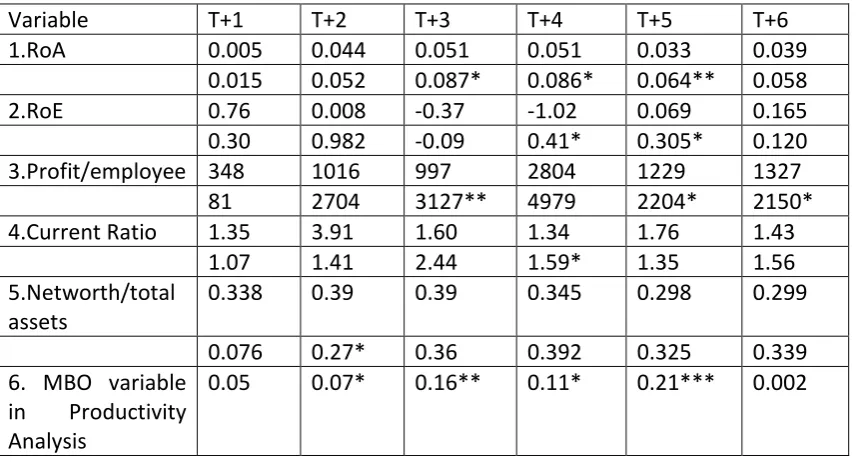
Table 1 about here
In view of the increasing frequency of transactions after 1980, it is appropriate to examine
their systematic impact on economic performance, using large sample approaches, and in
contrast to the case studies of leading firms in the earlier years.124
Evidence from the first
wave of UK buyouts in the mid-1980s shows significant improvements in profitability,
productivity and liquidity compared to matched non-buyouts. Table 1 compares the
performance of buy-outs originating between 1982 and 1984 with a matched sample of
non-buyout firms using a portfolio of financial and efficiency indicators over a period of six
years after the buy-out transaction. In particular, out-performance of buyouts is notable
from the second year post buyout to the fifth year in terms of profitability and productivity.
By year 6, significant out-performance seems to disappear; this may be either because the
benefits of efficiency gains through cost reductions are exhausted or because the higher
performing firms have exited the buy-out structure and been acquired and so no longer
figure in the sample.
Private equity: the second wave of development
In the second wave, which developed from the late 1990s up to the crisis of 2008, the scale
and scope of PE increased dramatically. Deal value reached £10bn by 1996 and £26bn by
2006. Notwithstanding the relative lull in the early 1990s, by 1992 buy-outs accounted for
57% of all takeover transactions.125
PE funds have diversified internationally to take
advantage of the lower competition for deals outside the UK and US markets. Service and
124
The multiple method approach in business history contrasts with evolutionary approaches which more typically offer explanatory power only in situations where there is a population of firms.
125
28
infrastructure firms became notable targets for buy-outs in the period 2000-2004.126
At the
same time they have become increasingly attractive to institutional investors, mobilising
significant capital from global financial institutions.127
As a consequence, there was a trend
away from divisional level buy-outs, in a context of completion of many corporate
divestment programmes, to more public to private (PTP) whole company buy-outs including
more strategic level management buy-ins and investor-led public to private and secondary
buy-out transactions.128
Correspondingly, exits from PE deals in this period saw a marked
shift away from IPOs to secondary buyouts.129
The year 2007 witnessed the peak of buy-out
activity in terms of deal value, with most of the hitherto largest scale bids occurring in that
year and deal value totalling £42.2bn.130
Value of bids reflect cyclical trends in the stock
market, with a slump in deal values post 2007.
As a consequence of increased scale and scope of their activities, existing PE firms
expanded their resource bases to accommodate more expertise and greater specialised
knowledge. Specialised and complex resource bases have also become more important for
investee firms as the UK has continued to shift towards a more knowledge based economy.
There is much evidence, that experienced PE investors have become more adept at
identifying target companies that are underperforming but nonetheless are cash generative
with potential for profitability/productivity improvement via restructuring, refinancing and
126K “ L
127K “ L
128W C ‘ A T
W U - W J F P
UK
129
Evidence suggests that on average the returns to secondary buyouts are lower than for primary
buyouts (Nikoskelainen W T , suggesting that although
incoming PE firms may seek to bring new skills and introduce new strategies, the value creation mechanisms already adopted during first buyouts make it hard for incoming PE firms to generate
J W E M Agency, Strategic
E .
130
29
the changing of governance arrangements.131
Experienced PE investors also became more
involved in intensive post deal involvement to set the new strategic direction for the firm in
132
In contrast, this period also saw entry by
inexperienced PE firms, attracted by previous high returns in the sector, with deals being
completed with little if any due diligence.133
As with the first wave, and notwithstanding the expanded scale and scope of activity,
the evidence suggests that the complementary effects of resource bases in investee firms
and PE firms and governance skills also played an important part in sustaining the more
recent second wave. A number of recent studies of the relative performance of PE backed
buyouts over the second wave (1995-2011) have analysed the pre-buyout characteristics of
PE investor target companies; the relative accounting performance of PE backed
companies, looking at accounting ratios, against control samples of buyouts and
non-buyouts; the relative productivity and profitability performance of company types in the
context of multivariate econometric models; and the propensity to fail via insolvency of PE
backed buyouts versus other buyout types and non-buyouts.134
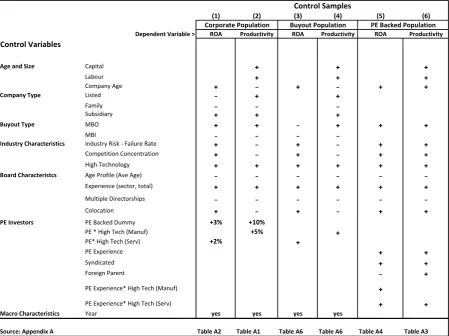
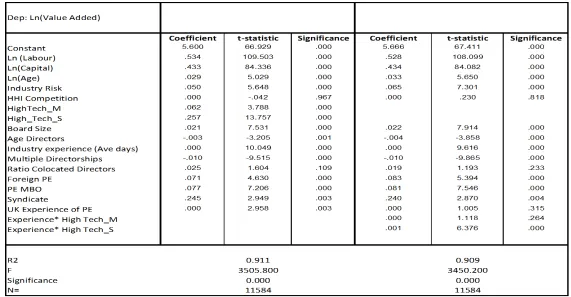
To develop these analyses further and to examine the resource and governance
complementarities implied in figure 1, Table 2 summarises results from multivariate
regression models determining profitability and productivity for a novel dataset compiled by
the authors comprising the population of PE backed buyouts for which data were available
and control samples in the period 1995-2011.135
Columns 1 and 3 summarise the
determinants of profitability (return on assets, ROA) is specified as a function of industry
131W W P
132W J F P UK
133
Ibid.
134G W P E D U
135
30
risk, age, competition, company types. To capture governance effects, the models are
inclusive of director/board characteristics. The regressions isolate the effects of PE relative
to other company types in column 1 and buyout types in column 3. The models are reported
inclusive of time dummies and are estimated for the whole period.136
The coefficients on the
PE dummy variables are significant and positive in all specifications, implying a positive
profitability differential for PE over other company types of between 2 and 3%. Co-location
is weakly significant and positive in the period prior to recession. Board size and director
experience are positively associated with profitability whereas the average age of directors
and multiple directorships have negative signs, suggesting that in line with figure 1,
concentrations of experienced, younger directors are performance enhancing features of PE
investment.
Table 2 about here
Columns 2 and 4 summarise the results from production function estimates for the
two samples, all companies and buyout only. To examine differences in productive
efficiency, production function models are specified. In these models total output (value
added) is related to labour and capital inputs, together with controls for sector and
competition to isolate productivity differentials for PE-backed companies versus other
company types. 137
Capital and labour inputs were strongly significant, and their coefficients,
136
The models appear to be well specified. Note that industry risk and company age are positively related to ROA, while industry concentration increases profits.
137
31
or elasticities, imply constant returns to scale. Meanwhile, the signs on the PE dummy
variables are positive and significant in all specifications and time periods. The results
therefore suggest a positive productivity differential of PE firms over other company types,
which is actually stronger in the recession period. The differential is around 10% above the
control sample and the interaction between PE and technology (high tech manufacturing) is
positive. Results for the buyout sample show a superior performance of PE buyouts versus
other management buy-ins.
Columns 5 and 6 of Table 2 summarise the factors determining variations in
performance (profitability and productivity) amongst the sample of PE-backed companies.138
The specification of the productivity and profit equations is the same, but to examine
further the relationship between experience and performance implied in figure 1, for this
subsample a range of variables reflecting the characteristics and experience of the PE
investor are included. Variables are included to measure PE experience in terms of prior
deals and orientation to specialist sectors.139 The PE experience variable is positive and significant in both models. Interactions between the PE experience variable and technology
are positive and significant, implying support for the complementarities between resource
and governance suggested in figure 1.
The presence of a syndicate of PE firms leads to an improvement in performance,
while foreign PE firms have a more significant impact on productivity. Controlling by type of
PE buyout with a dummy variable for MBO shows that MBOs have superior performance.140 Column 5 reports the estimates of the profitability equation. Again the PE experience
instrument matrix when controlling for the endogeneity of inputs. “ J K P
138
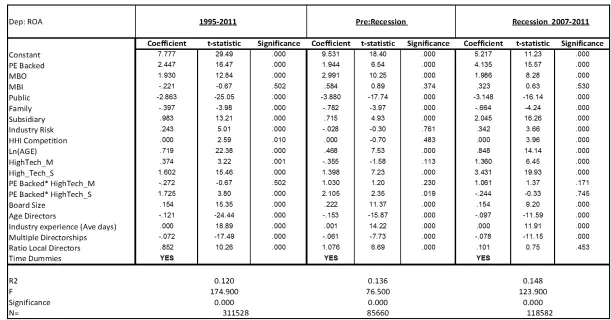
Full results are reported in Appendix A (A3 and A4).
139
The number of UK deals that the investor has been involved in prior to the current buyout (PE experience).
140