Indexing Techniques for Real-Time
Entity Resolution
Banda Ramadan
A thesis submitted for the degree of
Doctor of Philosophy in Computer Science
The Australian National University
c
Except where otherwise indicated, this thesis is my own original work.
Acknowledgments
I grant all my gratitude to Almighty Allah, for guiding me and giving me the
strength to finish this research. I also would like to give my tribute to a group of
great people for their endless support that enabled me to achieve my goal.
First, I would like to give my gratitude to my main supervisor Peter
Chris-ten who offered me an invaluable assistance, motivation, support and guidance
throughout the life of this research. Peter is a knowledgeable, dedicated and
mo-tivating supervisor and I have learned greatly from him. Thanks Peter for all the
effort you have put throughout the years to help me produce this research.
Grat-itude is also due to my supervisory panel Huizhi Liang, David Hawking, Ross
Gayler and Peter Strazdins who always provided me with support and valuable
feedback whenever it is needed.
I wish to express my love and gratitude to my beloved parents, sisters, and
sons for their support and endless love through the duration of this work. I am
very lucky to have you as my family and I love you all. I cannot thank my lovely
friends Dinusha Vatsalan and Minkoung Kim enough for all their encouragement
and emotional support, saying thank you is never enough. I also cannot forget all
my friends, who with their kindness, prayers, and support pushed me to achieve
my goal, and kept me going while I am away from my family. I always thank
Allah for giving me this precious gift of having you all around me.
In addition, I thank all my colleagues and the staff in the school of
Engineer-ing and Computer Science at The Australian National University for creatEngineer-ing a
pleasant atmosphere for us students throughout the years. Finally I would like to
thank the Australian Research Council (ARC), Veda, and Funnelback Pty. Ltd.,
for funding my research under Linkage Project LP100200079.
Abstract
Entity resolution (ER), which is the process of identifying records in one or several data set(s) that refer to the same real-world entity, is an important task in improving data quality and in data integration. In general, unique entity identifiers are not available in real-world data sets. Therefore, identifying attributes such as names and addresses are required to perform the ER process using approximate matching techniques. Since many services in both the private and public sectors are moving on-line, organizations increasingly require to perform real-time ER (with sub-second response times) on query records that need to be matched with existing data sets.
Indexing is a major step in the ER process which aims to group similar records together using a blocking key criterion to reduce the search space. Most existing indexing techniques that are currently used with ER are static and can only be em-ployed off-line with batch processing algorithms. A major aspect of achieving ER in real-time is to develop novel efficient and effective dynamic indexing techniques that allow dynamic updates and facilitate real-time matching.
In this thesis, we focus on the indexing step in the context of real-time ER. We propose three dynamic indexing techniques and a blocking key learning algorithm to be used with real-time ER. The first index (named DySimII) is a blocking-based technique that is updated whenever a new query record arrives. We reduce the size of DySimII by proposing a frequency-filtered alteration that only indexes the most frequent attribute values. The second index (named DySNI) is a tree-based dynamic indexing technique that is tailored for real-time ER. DySNI is based on the sorted neighborhood method that is commonly used in ER. We investigate several static and adaptive window approaches when retrieving candidate records. The third index (named F-DySNI) is a multi-tree technique that uses multiple distinct trees in the index data structure where each tree has a unique sorting key. The aim of F-DySNI is to reduce the effects of errors and variations at the beginning of attribute values that are used as sorting keys on matching quality. Finally, we propose an unsupervised learning algorithm that automatically generates optimal blocking keys for building indexes that are adequate for real-time ER.
We experimentally evaluate the proposed approaches using various real-world data sets with millions of records and synthetic data sets with different data char-acteristics. The results show that, for the growing sizes of our indexing solutions, no appreciable increase occurs in both record insertion and query times. DySNI is the fastest amongst the proposed solutions, while F-DySNI achieves better matching quality. Compared to an existing indexing baseline, our proposed techniques achieve better query times and matching quality. Moreover, our blocking key learning algo-rithm achieves an average query time that is around two orders of magnitude faster than an existing learning baseline while maintaining similar matching quality. Our proposed solutions are therefore shown to be suitable for real-time ER.
List of Publications
1. Major Contributions:
(a) Dynamic Sorted Neighborhood Indexing for Real-Time Entity Resolu-tion: Banda Ramadan, Peter Christen, Huizhi Liang and Ross Gayler. Pub-lished in the ACM Journal of Data and Information Quality (JDIQ), 2015, Volume 6, Number 4. (Corresponds to Chapters 6 and 7 of this thesis)
(b) Unsupervised Blocking Key Selection for Real-Time Entity Resolution:
Banda Ramadan and Peter Christen. In proceedings of the 19th Pacific-Asia Conference on Knowledge Discovery and Data Mining (PAKDD’15), Ho Chi Minh City, Vietnam, May 2015. In Springer Lecture Notes in Com-puter Science, Volume 9078, Pages 574-585. (Corresponds to Chapter 8 of this thesis).
(c) Forest-Based Dynamic Sorted Neighborhood Indexing for Real-Time Entity Resolution: Banda Ramadan, Peter Christen. In proceedings of the 23rd ACM International Conference on Information and Knowledge Man-agement (CIKM’14), Shanghai, China, November 2014. In ACM Digital Library, ISBN: 978-1-4503-2598-1, Pages 1787-1790. (Corresponds to Chap-ter 7 of this thesis)
(d) Dynamic Sorted Neighborhood Indexing for Real-Time Entity Resolu-tion: Banda Ramadan, Peter Christen and Huizhi Liang. In proceedings of the 25th Australian Database Conference (ADC’14), Brisbane, Australia, July 2014. In Springer Lecture Notes in Computer Science, Volume 8506, Pages 1-12. (Corresponds to Chapter 6 of this thesis)
(e) Dynamic Similarity-Aware Inverted Indexing for Real-Time Entity Res-olution: Banda Ramadan, Peter Christen, Huizhi Liang, Ross Gayler, and David Hawking. In proceedings of the International Workshop on Data Mining Applications in Industry and Government (DMApps 2013), held at the 17th Pacific-Asia Conference on Knowledge Discovery and Data Min-ing (PAKDD’13), Gold Coast, Australia, April 2013. In SprMin-inger Lecture Notes in Computer Science, Volume 7867, Pages 47-58. (Corresponds to Chapter 5 of this thesis).
2. Minor Contribution:
(a) Two Stage Similarity-aware Indexing for Large-scale Real-time Entity Resolution: Shouheng Li, Huizhi Liang and Banda Ramadan. In Pro-ceedings of the 11th Australasian Data Mining Conference (AusDM’13), Canberra, Australia, 2013.
Contents
Acknowledgments vii
Abstract ix
List of Publications xi
1 Introduction 1
1.1 Research Problem . . . 1
1.2 Real-Time ER Problem . . . 3
1.3 Research Objectives . . . 4
1.4 Research Methodology . . . 5
1.5 Contributions of this Research . . . 6
1.6 Thesis Outline . . . 8
1.7 Notation and Abbreviation . . . 8
2 Background 11 2.1 Entity Resolution Overview . . . 11
2.1.1 Entity Resolution Definition . . . 11
2.1.2 Benefits of Entity Resolution . . . 12
2.1.3 Applications of Entity Resolution . . . 13
2.1.4 Challenges of Entity Resolution . . . 15
2.2 The Entity Resolution Process . . . 15
2.2.1 Data Cleaning . . . 16
2.2.2 Indexing . . . 17
2.2.3 Comparison . . . 18
2.2.4 Classification . . . 20
2.2.5 Evaluation . . . 22
2.3 Real-Time Entity Resolution . . . 23
2.3.1 Real-Time Entity Resolution Overview . . . 23
2.3.2 Real-Time Entity Resolution Process . . . 24
2.4 Summary . . . 26
3 Related work 27 3.1 Introduction . . . 27
3.2 Blocking Based Indexing . . . 28
3.2.1 Traditional Blocking . . . 28
3.2.2 Q-gram Indexing . . . 31
xiv Contents
3.2.3 Canopy Clustering . . . 32
3.2.4 Mapping Based Indexing . . . 32
3.2.5 Hashing Based Indexing . . . 33
3.3 Sorting Based Indexing . . . 34
3.3.1 Sorted Neighborhood Method . . . 34
3.3.2 Adaptive Sorted Neighborhood Method . . . 35
3.3.3 Progressive Sorted Neighborhood Method . . . 36
3.3.4 Sorted Blocks . . . 37
3.3.5 Suffix Arrays . . . 37
3.4 Meta-Blocking Techniques . . . 38
3.5 Techniques for Real-Time Entity Resolution . . . 39
3.6 Automatic Techniques for Learning Blocking Keys . . . 41
3.7 Summary . . . 44
4 Evaluation Framework 45 4.1 Evaluation Measures . . . 45
4.2 Record Pair Comparison and Classification . . . 47
4.3 Baseline Approaches . . . 48
4.4 Implementation Environment . . . 50
4.5 Data Sets . . . 50
4.6 Summary . . . 52
5 Dynamic Similarity-Aware Inverted Index for Real-Time Entity Resolution 53 5.1 Introduction . . . 53
5.2 Terminology and Notation . . . 54
5.3 Overview of the Approach . . . 55
5.3.1 Index Data Structure . . . 56
5.3.2 Building the Index . . . 57
5.3.3 Querying the Index . . . 59
5.4 Frequency-Based Similarity-Aware Inverted Index (DySimII-F) . . . 60
5.4.1 Building the Frequency-Based Index . . . 62
5.4.2 Querying the Frequency-Based Index . . . 62
5.5 Estimating the Required Number of Comparisons . . . 64
5.6 Experimental Evaluation . . . 66
5.6.1 Scalability of the Proposed Solution . . . 67
5.6.2 Effects of Having Corrupted Attributes on Quality . . . 68
5.6.3 Required Memory Size . . . 69
5.6.4 Effects of the DySimII-F Approach on Index Coverage . . . 69
5.6.5 Effects of the DySimII-F Approach on Matching Quality . . . 70
5.6.6 Effects of the DySimII-F Approach on Memory Requirements . . 71
Contents xv
6 Dynamic Sorted Neighborhood Index for Real-Time Entity Resolution 73
6.1 Introduction . . . 73
6.2 Terminology and Notation . . . 74
6.3 Overview of the Approach . . . 76
6.3.1 Index Data Structure . . . 76
6.3.2 Building the Index . . . 78
6.3.3 Querying the Index . . . 79
6.4 Generating the Window of Neighboring Nodes . . . 80
6.4.1 Fixed Window Size (DySNI-f) . . . 80
6.4.2 Candidate-Based Adaptive Window (DySNI-c) . . . 81
6.4.3 Similarity-Based Adaptive Window (DySNI-s) . . . 82
6.4.4 Duplicate-Based Adaptive Window (DySNI-d) . . . 83
6.5 Similarity-Based Dynamic Sorted Neighborhood Index . . . 86
6.5.1 Build and Similarity Calculation Phases . . . 86
6.5.2 Query phase . . . 87
6.6 Estimating the Required Number of Comparisons . . . 89
6.7 Experimental Evaluation . . . 92
6.7.1 Efficiency of Different Tree Data Structures . . . 92
6.7.2 Estimation of the Number of Candidate Records . . . 93
6.7.3 Effects of Using Different Sorting Keys on Index Size . . . 94
6.7.4 Scalability of the Proposed Solutions . . . 94
6.7.5 Effects of Using Different Thresholds . . . 95
6.7.6 Effects of Having Different Number of Duplicates . . . 97
6.7.7 Effects of Pre-calculating Similarities on Comparison Time . . . . 98
6.7.8 Required Memory Size . . . 99
6.7.9 General Discussion . . . 99
6.8 Summary . . . 100
7 Forest-Based Dynamic Sorted Neighborhood Index for Real-Time Entity Resolution 103 7.1 Introduction . . . 103
7.2 Terminology and Notation . . . 104
7.3 Overview of the Approach . . . 105
7.3.1 Index Data Structure . . . 106
7.3.2 Building the Index . . . 106
7.3.3 Querying the Index . . . 107
7.4 Estimating the Required Number of Comparisons . . . 109
7.5 Experimental Evaluation . . . 109
7.5.1 Effects of Using Multiple Trees on Quality and Efficiency . . . . 110
7.5.2 Effects of Having Corrupted Attributes on Quality . . . 112
7.5.3 Scalability of the Proposed Solution . . . 112
7.5.4 Required Memory Size . . . 114
xvi Contents
8 Unsupervised Blocking Key Selection for Real-Time Entity Resolution 117
8.1 Introduction . . . 117
8.2 Terminology and Notation . . . 118
8.3 Overview of the Approach . . . 119
8.3.1 Generating Candidate Keys . . . 120
8.3.2 Generating Training Data Sets . . . 121
8.3.3 Learning Optimal Keys . . . 124
8.4 Experimental Evaluation . . . 126
8.4.1 Efficiency of Selected Blocking Keys . . . 128
8.4.2 Effectiveness of Selected Blocking Keys . . . 131
8.5 Summary . . . 132
9 Comparative Evaluation 137 9.1 Introduction . . . 137
9.2 Comparative Evaluation Setup . . . 138
9.3 Indexing Techniques . . . 139
9.3.1 Scalability . . . 139
9.3.2 Effectiveness and Efficiency . . . 141
9.4 Blocking Key Learning Technique . . . 149
9.5 Summary . . . 151
10 Conclusions and Future Directions 153 10.1 Conclusions . . . 153
10.2 Contribution Summary . . . 154
10.3 Future Directions . . . 156
10.4 Closing Remarks . . . 158
List of Figures
1.1 The proposed research methodology . . . 6
2.1 Steps in the entity resolution process . . . 16
2.2 Number of comparisons required in traditional entity resolution . . . . 18
2.3 Number of comparisons required in real-time entity resolution . . . 24
3.1 Indexing techniques . . . 30
4.1 Types of errors in the entity resolution process . . . 46
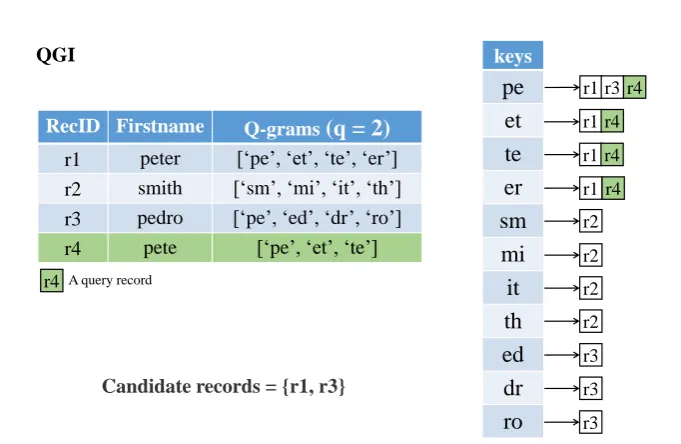
4.2 The Q-gram index (QGI) that is used as a baseline in Chapter 9. . . 49
5.1 The framework for the proposed dynamic similarity-aware inverted indexing (DySimII) . . . 55
5.2 The data structure for the proposed DySimII technique . . . 56
5.3 Frequency distribution of attribute values of the NC data set . . . 60
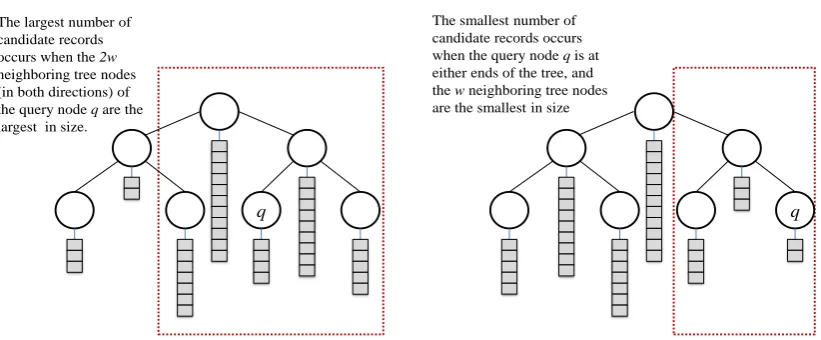
5.4 Illustration of the maximum and minimum number of candidate records generated using the DySimII approach . . . 66
5.5 Average insertion, and query times required by the DySimII approach for the NC data set . . . 67
5.6 Average query time required by the DySimII approach for the different CCA subsets . . . 68
5.7 Recall for the different query sets using DySimII . . . 68
5.8 The required memory to index x% of the most frequent attribute val-ues using the DySimII-F. . . 71
6.1 The static sorted neighborhood method (SNM) . . . 74
6.2 The proposed dynamic sorted neighborhood index (DySNI) . . . 78
6.3 Candidate records generated using the proposed fixed size window approach (DySNI-f) . . . 80
6.4 Candidate records generated using the proposed candidate-based adap-tive window approach (DySNI-c) . . . 81
6.5 Candidate records generated using the proposed similarity-based adap-tive window approach (DySNI-s) . . . 82
6.6 Candidate records generated using the proposed duplicate-based adap-tive window approach (DySNI-d) . . . 84
6.7 The proposed similarity-based dynamic sorted neighborhood indexing (SimDySNI) . . . 86
xviii LIST OF FIGURES
6.8 Number of records in tree nodes generated using different SKVs for the NC data set . . . 90 6.9 Illustration of the maximum and minimum number of candidate records
generated using the DySNI approach . . . 91 6.10 An estimation of the minimum, average, maximum number of
candi-date records generated by the DySNI approach . . . 91 6.11 Average time required to generate candidate records for different types
of search trees . . . 93 6.12 A comparison between the estimated and the real number of candidate
records generated by the DySNI approach . . . 93 6.13 Average insertion, and query times required by the DySNI approach . . 95 6.14 Recall and time measures achieved by the different DySNI window
approaches using OZ-1 data set . . . 96 6.15 Recall and time measures achieved by the DySNI-s and the DySNI-d
window approaches using Febrl data sets . . . 97 6.16 The average times required to compare a query record with a single
candidate record for the SimDySNI approach . . . 98
7.1 The proposed forest-based sorted neighborhood index (F-DySNI) . . . . 105 7.2 Recall and query times achieved by the F-DySNI using different
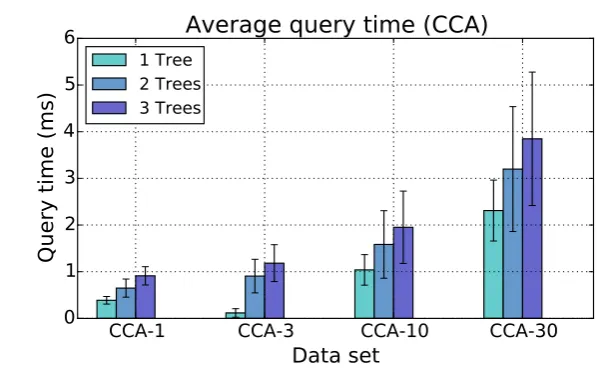
num-bers of trees . . . 111 7.3 Recall for the different OZ data sets with different corruption ratio . . . 112 7.4 Average insertion, and query times required by the F-DySNI approach . 113 7.5 Average query time required for the different CCA subsets . . . 114
8.1 Framework of the proposed automatic blocking key selection approach 120 8.2 Generating training data sets for the proposed automatic blocking key
selection approach. . . 122 8.3 Generating blocking key vectors for the proposed automatic blocking
key selection approach . . . 123 8.4 The indexing technique used in the experimental evaluation of the
proposed automatic blocking key selection approach . . . 129 8.5 Query time measures for the proposed automatic blocking key
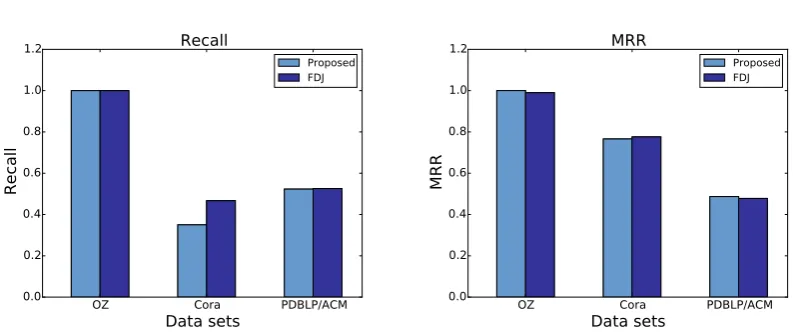
selec-tion approach . . . 130 8.6 Recall and MRR measures for the proposed automatic blocking key
selection approach compared to the baseline . . . 131 8.7 An example on how to calculate the overall score for blocking keys . . . 133
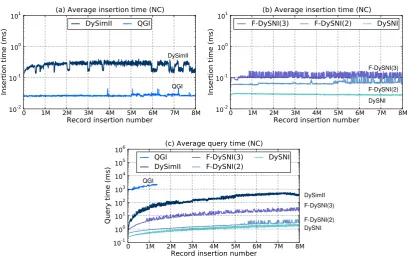
9.1 Average insertion, and query times required for all compared techniques140 9.2 Recall values for all compared indexing techniques using the OZ-x
data sets . . . 142 9.3 MRR values for all compared indexing techniques using the OZ-x data
sets . . . 143 9.4 Query times for all compared indexing techniques using the OZ-x data
LIST OF FIGURES xix
9.5 Summary of the average recall, MRR, query time values for the differ-ent techniques using the OZ-x data sets . . . 145 9.6 Recall and MRR values for all compared approaches using the Febrl
data sets . . . 147 9.7 Average query times for all compared approaches on the Febrl data sets 148 9.8 Summary of the average recall, MRR, query time values for the
List of Tables
1.1 A summary of general notations and abbreviations used in this thesis . 9
4.1 Summary of the data sets used in the experimental evaluation . . . 51
5.1 Summary of main notations used in Chapter 5 . . . 54
5.2 Top 10 most frequent first names and surnames in the NC data set . . . 61
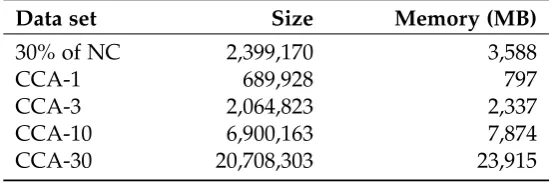
5.3 Summary of data sets used to evaluate the DySimII . . . 67
5.4 Required memory for the DySimII . . . 69
5.5 The coverage of the DySimII-F . . . 70
5.6 Recall for the DySimII-F . . . 71
6.1 Summary of main notations used in Chapter 6 . . . 75
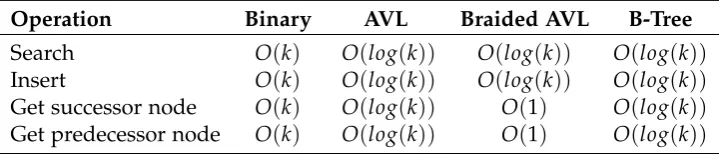
6.2 Worst case complexities achieved using different search trees . . . 77
6.3 Summary of data sets used to evaluate the DySNI . . . 92
6.4 Number of nodes generated using various sorting keys with the DySNI 94 6.5 Average query time for indexed queries using the DySNI . . . 99
6.6 Required memory using various sorting keys for the DySNI . . . 100
7.1 Summary of main notations used in Chapter 7 . . . 104
7.2 Summary of data sets used to evaluate the F-DySNI . . . 110
7.3 Required memory for the F-DySNI . . . 114
8.1 Summary of the main notations used in Chapter 8 . . . 118
8.2 Summary of data sets used to evaluate our learning approach . . . 128
8.3 Keys selected by the proposed and the FDJ approaches . . . 128
8.4 Number of candidate records generated using the blocking keys se-lected by the proposed and the baseline approaches . . . 130
8.5 List of candidate keys and their coverage, average block size, variance, and overall score for the OZ-1 data set . . . 135
9.1 Summary of the abbreviations used in Chapter 9 . . . 138
9.2 Summary of data sets used to conduct the comparative evaluation . . . 138
Chapter1
Introduction
In this chapter we provide an introduction to the work presented in this thesis. We describe the research problem in Sections 1.1 and 1.2, the research objectives in Sec-tion 1.3, the methodology used to address the research problem in SecSec-tion 1.4, and the contributions of this research in Section 1.5. We then provide an outline of this thesis in Section 1.6.
1
.
1
Research Problem
Massive amounts of data are being collected by most business and government or-ganizations. Given that many of these organizations rely on information in their day-to-day operations, the quality of the collected data has a direct impact on the quality of the produced outcomes [10, 57, 82]. One important practice in improving data quality is the task of identifying all records that refer to the same real-world entity [33, 57, 82, 113]. This process is commonly known as entity resolution, data matching, orrecord linkage, among other names [33, 82]. It can be applied to a single or to multiple data sources. When applied to a single data source the process is calledde-duplicationor duplicate detection[57, 113]. For the rest of this thesis we will use the term entity resolution (ER).
A real-world entity can be a person, a product, a business, or any other object that exists in the real world. Examples of multiple records in a data set representing a single entity include a patient who is represented several times in a hospital data set, a product that is inserted many times into an inventory list, or a voter who is registered more than once in an election roll. These duplicates, if not removed or merged, can lead to serious consequences for organizations or individuals. A patient’s information could for example be dispersed between duplicated records leaving medical staff unaware of the patient’s overall condition which can potentially affect diagnosis and treatment, businesses could end up sending the same house hold several copies of advertisement mail which leads to increased costs and annoyance to customers receiving multiple copies, while duplicate records in an election roll can lead to voting irregularities.
ER is related to general similarity search approaches, which involve finding sim-ilar entities from unstructured data sets (such as emails, news articles, or scientific publications) based on a collection of relevant features that are represented as points
2 Introduction
in high-dimensional attribute spaces [66]. However, such approaches are less suited for structured data sets that contain well defined attributes with short values. If unique entity identifiers (such as passport or social security numbers) are available for structured data sets, matching records (detecting duplicates) can be achieved us-ing SQL join statements. However, such identifiers are commonly not available, and therefore ER approaches need to be employed [57, 113].
In general, the ER process (described below and in Chapter 2) is challenging because unique entity identifiers are not available in the data sets that are to be matched. In this case identifying attribute values (like first names, surnames, or ad-dresses) need to be used to perform the matching process. Such attribute values are often of low quality, as they can contain errors, or they might change over time [33]. Therefore, approximate similarity functions (like the edit distance, Jaccard, Jaro, and Jaro-Winkler string similarity functions) are generally required to perform the ER process [33, 57, 113].
ER aims at classifying pairs or groups of records into matches (records that are as-sumed to correspond to the same entity) and non-matches (records that are asas-sumed to correspond to different entities). The ER process encompasses several steps [33]: data preprocessing, which cleans and standardizes the data to be used;indexing, which reduces the number of candidate records to be compared in detail;record comparison, which compares candidate records in detail using a set of similarity functions; clas-sification, where pairs or groups of compared records are classified into matches and non-matches ; and finally,evaluation, where the efficiency and effectiveness of the ER process are evaluated. This process is further described in Section 2.2.
Since many services in both the private and public sectors are moving on-line, organizations increasingly require real-time ER (with sub-second response times) on query records that need to be matched with existing data sets [51]. Example ap-plications that could benefit from real-time ER include government social services which need to identify individuals on the spot even if their social security number is not available, police officers who need to identify suspect individuals within seconds when they conduct an identity check using the suspect’s personal details, or applica-tions for consumer credit where an individual’s credit history needs to be retrieved and evaluated before a new loan can be approved.
Data sets used by most organizations are often not static, but rather dynamic, as queries generally result in a record being modified, added, or even removed from the data set. However, most current ER techniques are based on batch algorithms that are only suitable for static data sets. Such algorithms compare and resolve all records in one or more data set(s) rather than resolving those relating to a single query record, and thus they are not suitable for real-time ER. Therefore, there is a need to develop new techniques that support ER for large dynamic data sets that can resolve streams of query records in real-time.
§1.2 Real-Time ER Problem 3
is to develop novel efficient and effective dynamic indexing techniques that allow dynamic updates and that facilitate real-time matching by generating a small number of high-quality candidate records that are to be compared with a query record. Such indexing techniques must consider both scalability and matching quality aspects [36].
• Efficiency and Scalability: This aspect ensures the ability of an ER technique to match and resolve query records in sub-second times and to adapt with the growing size of large data sets. This is challenging, since the potential number of comparisons needed to match a query record with a data set is equal to the size of that data set. These comparisons require computationally expensive similarity functions [31, 82] which makes it challenging to employ ER technique with larger data sets. Thus, indexing techniques need to address the fact that real-world data sets are getting constantly larger every day.
• Effectiveness (or matching quality): Real-world data sets can contain errors and variations, can change over time, or they can be incomplete [10, 36]. The noise in the data makes the ER process more challenging. Indexing techniques, which aim at bringing similar records closer to each other to reduce the search space, are affected by such noise within the data. If an indexing technique is not designed to consider noise within the data it can end up brining dissimilar records closer to each other which will drop the quality of the results produced in the ER process. Therefore, indexing techniques need to consider the fact that real-world data sets are noisy, and they should address this issue to improve the quality of their record matching capabilities.
In this study we focus on the indexing step of the ER process (see Chapter 2), and develop novel dynamic indexing techniques that consider the efficiency and the effectiveness aspects to allow matching of a query record with records in an existing data set in real-time. Section 1.3 describes the objectives of our research in more details, while the following section describes the formal definition of the real-time ER problem.
1
.
2
Real-Time ER Problem
We assume that data setR= {r1,r2, . . . ,r|R|}contains records of known entities. Each ri ∈ Rhas a unique record identifier ri.idand an entity identifier ri.eid. Note that an
entity in R can be represented by one or several records. To indicate that record(s) in R correspond to the same entity, they are given the same entity identifier. On the other hand, to distinguish all records in R that represent a single entity, each record is given a unique record identifier. A record ri in R is described by a set
of attributes, denoted as A = {a1,a2, . . . ,a|A|}. All records in R are assumed to have the same attribute structure. We also assume that a stream of query records
Q = {q1,q2, . . . ,q|Q|} is to be matched with R. Each qj ∈ Q is given a unique
4 Introduction
in R. In addition, we assume that qj is given a new entity identifier if it has no
matching record(s) inR(i.e. no records that correspond to the same entity as qj). On
the other hand, ifqj has matching record(s) inR, it is given the same entity identifier
as the matching record(s). We also assume that qj is to be added to R after it has
been resolved. The problem of real-time ER is defined as:
[Definition] 1.1 Real-time ER: For each query record qj in a query stream Q, find the records in R that belong to the same entity as qj, denoted as the set Mqj, in sub-second time, whereMqj ={ri |ri.eid=qj.eid, ri ∈ R}, Mqj ⊆R, qj ∈Q.
All steps in the traditional static ER process (described in Chapter 2) need to be modified to allow real-time ER. Our focus is to address the indexing step of the ER process.
1
.
3
Research Objectives
As described in the previous section, one of the main challenges of real-time ER is the growing size of the collected data by many organizations. Performing a query matching with such large data sets is challenging in real-time since the query po-tentially has to be compared with all records in the data set. Indexing techniques reduce the number of comparisons required in this matching process. The way in-dexing techniques work is important and affects both the quality of the matching results and the efficiency of the matching process.
Most indexing approaches proposed for ER in the literature fall into two main categories: blocking-based approaches and sorting-based approaches (described in Chapter 3). The majority of these techniques are not designed to work with real-time ER [35, 33]. Therefore, the primary aim of this research concentrates on indexing techniques that can be used for real-time ER. The following is a list of issues that this study aims to address.
1. Blocking-based indexing techniques for real-time ER: Blocking-based index-ing techniques are used widely in ER to reduce the comparison space required to do the matching. Blocking-based techniques are based on inserting records into blocks according to a blocking key criterion and only comparing records that are in the same block. However, most of these techniques in their current form assume static data sets and do not support query matching with dynamic data sets in real-time. There is a need for blocking-based indexing techniques that can be used with real-time ER. We address this issue in Chapter 5.
§1.4 Research Methodology 5
sets and do not support query matching with dynamic data sets in real-time. Thus, new sorting-based indexing techniques need to be proposed to allow their use with real-time ER. We address this issue in Chapter 6.
3. Improve matching quality of indexing techniques: Producing high quality matching results is as important for real-time ER as is the efficiency of the pro-posed indexing techniques. The quality of matching results is affected by how an index technique works and what sorting/blocking keys are selected. For example, sorting-based indexing techniques are sensitive to errors that occur at the beginning of attribute values which affect the quality of the produced results. Thus, it is important to consider how indexing techniques work and aim to improve the quality of the produced results while considering efficiency when proposing new indexing techniques. We address this issue in Chapter 7.
4. Automatic selection of blocking/sorting keys: Indexing aims at bringing sim-ilar records closer to each other using a blocking/sorting key criterion (see Chapter 2). Selecting blocking/sorting keys is crucial for the effectiveness and efficiency of the real-time ER process. Traditional indexing techniques require domain knowledge for optimal key selection. However, to make the ER process less dependent on human domain knowledge, automatic selection of optimal blocking keys is required. We address this issue in Chapter 8.
1
.
4
Research Methodology
An experimental methodology is followed in conducting our research by applying the following steps (shown in Figure 1.1):
1. Initial exploration:In this step a general understanding of the ER process was achieved by reading broadly in the literature which helped in recognizing the research problem.
2. Problem definition: In this step a definition of the research problem was de-veloped based on the preliminary study that was conducted in the initial ex-ploration step.
3. Literature review: In this step an extensive exploration and examination of the literature was conducted to better understand the area of the identified problem and to review current approaches. This step helped in refining the problem, identifying the aim of the research, and planning for possible solutions.
4. Solution design: Based on the problem definition and based on the review of the literature, possible solutions were proposed. New algorithms were de-signed to address the identified research problem.
6 Introduction
2) Problem Definition
3) Literature Review
4) Solution Design
6) Prototype Development 1) Initial
Exploration
5) Conceptual Analysis
7) Evaluation
Conduct Experiments
Design Experiments
Figure1.1: The proposed research methodology
6. Prototype development: Prototypes of the proposed solutions were developed to be used in the experimental evaluation.
7. Evaluation: The developed prototypes were experimentally evaluated using real-world, and synthetic data sets to validate proposed algorithms.
1
.
5
Contributions of this Research
This thesis is concerned with real-time ER. It focuses on the indexing step of the ER process (described in Chapter 2) and proposes several dynamic indexing techniques that can be used for real-time ER. The thesis encompasses six main contributions:
§1.5 Contributions of this Research 7
frequent ones, leading to only a slight drop in the quality of the matched query records. This contribution is published in a workshop paper [131] and a revised version is described in Chapter 5.
2. A dynamic sorted neighborhood indexing technique for real-time ER: The sorted neighborhood method (described in Chapter 3), which sorts a data set and compares records within a sliding window, has been successfully used for ER of large static data sets. However, because it is based on static sorted arrays and is designed for batch ER, it is not suitable for real-time ER on dynamic data sets which are updated constantly. We propose a tree-based technique which facilitates dynamic indexing based on the sorted neighborhood method that can be used for real-time ER. We investigate several static and adaptive window ap-proaches when retrieving candidate records. We also improve query matching times by pre-calculating the similarities of attribute values between neighbor-ing tree nodes, resultneighbor-ing in a reduction in matchneighbor-ing times. The combined pro-posed techniques lead to an effective dynamic indexing that works well with real-time ER. This contribution is published in a conference paper [130] and a revised version is described in Chapter 6.
3. A forest-based sorted neighborhood indexing technique for real-time ER:As will be described in Chapter 3, sorting-based indexing techniques are sensitive to changes and errors that occur at the beginning of attribute values that are used as sorting keys. To overcome this problem we propose a forest-based in-dexing technique that uses multiple distinct trees (as described in Chapter 7) in the index data structure where each tree has a unique sorting key. We investi-gate using single attribute values and concatenation of multiple attribute values as sorting keys to examine which sorting keys are more suitable for real-time ER. This technique showed a noticeable improvement in matching quality for both single and concatenated sorting keys when using multiple trees with only a small increase in query time. Our results show that multiple trees built using concatenated attributes as sorting keys are more suitable for real-time ER than single attribute values. This contribution is published in a conference poster paper [128] and a revised version is described in Chapter 7.
4. A conceptual analysis of the three proposed indexing techniques: All pro-posed indexing techniques are theoretically analyzed with regard to estimating the expected number of record comparisons required by each technique. The conceptual analysis for each technique can be found before the experimental evaluation section in its corresponding chapter.
8 Introduction
make the ER process less dependent on human domain knowledge, automatic selection of optimal blocking keys is required. We propose an unsupervised learning technique that automatically selects optimal blocking keys for build-ing indexes that can be used in real-time ER. We specifically learn multiple keys to be used with the multi-tree sorted neighborhood indexing as described in Chapter 7. This contribution is published in a conference paper [129] and a revised version is described in Chapter 8.
6. A comprehensive evaluation for the proposed techniques: We conduct an experimental evaluation of our proposed techniques using multiple large real-world data sets and multiple synthetic data sets in terms of quality and effi-ciency. We provide a comparative evaluation between our indexing approaches and an existing indexing technique that is commonly used with ER [11, 34, 107]. Our unsupervised learning technique is also compared with a recently pro-posed blocking key learning algorithm [89].
1
.
6
Thesis Outline
This thesis is structured as the following: In Chapter 2 we provide the background about ER. Then, in Chapter 3, we present a review of the literature of existing index-ing techniques that are used in the ER process. We describe the evaluation framework that we use to evaluate the proposed approaches in Chapter 4. In Chapter 5 we pro-pose a dynamic indexing technique that is based on standard blocking to be used with real-time ER. Next, in Chapter 6 we propose a second indexing technique that is based on the sorted neighborhood method to be used with real-time ER. We pro-pose a third indexing technique in Chapter 7 that improves the matching quality of the real-time ER process by using multiple trees and keys in the index data struc-ture, and in Chapter 8 we propose an unsupervised learning technique that learns blocking/sorting keys used for building indexes that are suitable for real-time ER. In Chapter 9 we provide a comparative evaluation between the proposed algorithms and several existing indexing techniques. Finally, Chapter 10 concludes the study, summarizes the achieved results, and discusses the follow-on future work of this research work.
1
.
7
Notation and Abbreviation
§1.7 Notation and Abbreviation 9
Table1.1: A summary of general notations and abbreviations used in this thesis
R A data set of know entities
A A set of attributes{a1,a2, . . . ,a|A|}for eachri∈R
Q A stream of query records
C A list of candidate records for a queryqj
D An inverted index or disk-based data set table
Mqj A set of all records inRthat belong to the same entity of a queryqj
ri A record inR
qj A query inQ
n The size of data setR
sim(., .) A function used to calculate the similarity between two values (0≤sim(., .)≤1)
w Window size used to generate candidate records SK A sorting key
SKV A sorting key value BK A blocking key BKV A blocking key value
DySimII A dynamic indexing technique that is based on the similarity aware inverted index (proposed on Chapter 5)
DySimII-f A frequency-based DySimII that index only most frequent attribute values (proposed in Chapter 5)
DySNI A dynamic indexing technique that is based on the sorted neighborhood method (proposed in Chapter 6)
DySNI-f A DySNI that uses a fixed window approach to generate candidate records (proposed in Chapter 6)
DySNI-s A DySNI that uses an adaptive window approach to generate candidate records, it is based on using similarities between key values of nodes (proposed in Chapter 6)
DySNI-d A DySNI that uses an adaptive window approach to generate candidate records, it is based on using number of duplicates within nodes (proposed in Chapter 6)
DySNI-c A DySNI that uses an adaptive window approach to generate candidate records, it is based on using a controlled number of candidate records (proposed in Chapter 6)
F-DySNI A forest-based dynamic sorted neighborhood index that is based on using multiple distinct trees in the index data structure (proposed in Chapter 7)
QGI A q-gram based index [11, 34, 107] that is used in ER (described in Chapter 4).
Chapter2
Background
In this chapter we present the basic background knowledge needed to understand the research problem addressed in this thesis. We provide an overview of entity resolution in Section 2.1, describe the different steps in the entity resolution process in Section 2.2, and define real-time entity resolution problem in Section 2.3.
2
.
1
Entity Resolution Overview
Entity resolution (ER) is the process of identifying real world objects based on a group of features [145]. Humans used ER techniques long time ago, even before computers were invented. For example, hunters used animal footprints to identify which animals are living in a certain region, doctors used bone shapes of some body parts (like jaws and elbows) to determine the race of a human, and clerks used information on records (in their hard copy format) to perform a manual cleaning to remove duplicated records. However, since the development of computers, automatic ER techniques started to rise and flourish.
In 1959, Howard Borden Newcombe [115] established the foundation for proba-bilistic ER, which was then mathematically formalized for the first time by Fellegi and Sunter [62] in 1969. In the middle of the twentieth century, people started using computerized ER techniques in various fields [145]. Statistical and health organiza-tions were among the first to use ER techniques extensively to enhance their opera-tions [33, 165]. Since then, a substantial amount of research has been conducted in the area of ER, and various ER techniques have been developed [57, 82, 33, 166]. In this section we provide a brief overview of ER, its definition, benefits, applications, and challenges.
2.1.1 Entity Resolution Definition
In the last decade, researchers from different fields have studied the problem of ER. Statisticians and researchers in the health domain refer to the problem as record or data linkage [1, 83, 112]. In the database domain it is referred to as merge/purge [79, 78, 80], data de-duplication [14, 76, 144], and instance identification [38, 108, 155]. In the computer science domain it is referred to as data matching [33, 97, 140], record
12 Background
matching [28, 61, 151], reference reconciliation [49, 136, 137], entity resolution [22, 101, 142], andduplicate detection [81, 113, 120] or de-duplication [34, 93, 138]. We will use the term entity resolution (ER) for the rest of this thesis.
Various scholars have defined the ER problem as follows. Newcombe et al. [115] defined ER as bringing together two or more separately recorded pieces of infor-mation concerning a particular individual or family, while Fellegi and Sunter [62] described ER as the problem of recognizing those records in two files which rep-resent identical persons, objects, or events. ER was also defined by Winkler [167] as the methodology of bringing together corresponding records from two or more files or finding duplicates within files, and by Elmagramid et al. [57] asto identify records in the same or different data sets that refer to the same real-world entity, even if the records are not identical. Usually, when the terms duplicate detection or de-duplication are used, this refers to finding matches (duplicates) in a single data set [33, 113].
We refer to ER as the problem of identifying different records in multiple data sets that represent the same real-world entity. An entity could be any object that exists in the real-world like a person, a product, a business or an organization. Having duplicate records within data sets of businesses and organizations can affect the quality of their provided services and outcomes [10, 57, 82]. Therefore, businesses and organizations in various areas are increasingly using ER techniques to merge duplicates and clean data sets to improve the quality of the data sets they are using. More benefits of using ER are described next.
2.1.2 Benefits of Entity Resolution
Given that the process of collecting data is growing enormously within most organi-zations, it is important for such organizations to manage and analyze their data to accomplish their daily business operations effectively. Various data analysis, man-agement, and mining tools are currently used to assist businesses and organizations to better understand, perform, and improve their business operations [71]. Providing such tools with dirty data (that contain errors and duplicates) could generate incor-rect and misleading output [82]. ER techniques can be used to remove duplicate records from data sets to improve the achieved benefits of such tools.
§2.1 Entity Resolution Overview 13
2.1.3 Applications of Entity Resolution
Matching records that correspond to the same entities from different data sets has been intensively used in various areas including health, national censuses, crime and fraud prevention, and national elections. The following is a list of the main application areas that use ER to improve their operations:
• Health services:Health services is one of the main areas that had an early start in matching data between multiple resources [33]. In health services, personal and medical information is collected each time a person comes into contact with any health services (such as a doctor, a clinic, or an emergency department of a hospital). If such information is matched between various health services, it can be analyzed to improve the health system [148].
Matching records from different health services provides researchers with bet-ter quality data, patients with improved services, and policy makers with more reliable evidence to support their decision making [124]. Moreover, matching health data improves the ability to detect adverse health trends, identify disease outbreaks, detect health service problems (such as procedural or managerial is-sues), and improve clinical practice [125].
Australia is one of the world leaders in health data matching. It established the Health Services Research Linked Database program in Western Australia in 1995 [47]. Until 2003, this program has supplied data for 258 projects, which produced 708 research outputs, including 172 journal articles. Moreover, the matched data from the Western Australian data matching program was directly responsible for various changes to policies and clinical practices [25]. In 2008 a study was conducted to evaluate the research output based on using matched health data from the Western Australian data matching program. It concluded that matching data between different services in the heath domain can make a substantial and quantifiable contribution to population health and policy devel-opment [24]. Similar health data matching programs were founded in different counties as well, including the UK, Canada, US and New Zealand [148].
• National statistical agencies: National statistical agencies (NSAs) are respon-sible for collecting and publishing data related to various areas such as popu-lation, economy, health, education, culture or politics [33]. Statistical data gen-erated by NSAs are provided to governments, organizations or communities to improve decision making, evaluation, and assessment procedures [33]. NSAs have a long history of matching records when conducting statistical surveys and developing data collections [163].
Matching records allows the reuse of existing data. For example, in 2006 the Australian Bureau of Statistics1 required to produce an estimation about the number of interstate migrations. However, there were no direct data sources that could be used to measure interstate migrations and it was expensive to
14 Background
conduct a survey for that purpose [147]. Therefore, the Australian Bureau of Statistics used a number of indirect administrative data sources to estimate the number of interstate migrations, including electoral roll registration, fam-ily allowance payments, and Medicare registration data from Medicare Aus-tralia [147]. Matching existing data reduces costs, improves data quality, and reduces the burden of conducting surveys [163].
The US Census Bureau was one of the first to adopt data matching techniques, and it also had a key role in ER research [126, 161, 164]. Currently, most bureaus of census, including the Australian Bureau of Statistics, apply data matching techniques to improve the quality for their collected data.
• Fraud detection: Fraud is defined in the Oxford Dictionary ascriminal decep-tion; the use of false representations to gain an unjust advantage [116]. With the rapid and enormous growth of modern technology, and with the fast com-munication means currently available, fraud is increasing dramatically leading to the loss of billions of dollars worldwide [21]. Many fraud detection prob-lems involve very large data sets. For example, in the period of November 2011 to November 2012, around 1.9 billion credit card transactions were carried out in Australia [132]. This large number of transactions shows the importance of fraud detection. Assume that only 0.1% of these transactions were fraudulent, this means that 1.9 million transactions will be affected by fraudsters only in that year.
Currently, various information systems, statistics applications, and data mining techniques are used for fraud detection in numerous businesses and organiza-tions [30, 121]. ER techniques can be used to improve the quality of the data used to enhance the performance of such data mining and statistical tools. Moreover, ER can be used to match known fraudsters to other individuals in the data. This should improve fraud detection since fraudsters rarely work in isolation from each other [21].
§2.2 The Entity Resolution Process 15
2.1.4 Challenges of Entity Resolution
The aim of ER techniques is to identify all records in multiple data sources that refer to the same real-world entity. In order to conduct the matching process between data sets, ER has to compare all records within the data sets to find matching (duplicate) records. Applying ER techniques involves two main challenges:
• Efficiency and scalability to large data sets: In order to match records from multiple data sources all record pairs from the data sets have to be compared in detail to identify matching records. The complexity of such comparisons is quadratic in the size of the compared data sets and therefore not feasible. More-over, the comparison process has to be conducted using approximate compari-son functions to address the data quality challenge. Such comparicompari-son functions are often computationally expensive and some have a computational complex-ity that is quadratic in the length of the compared attribute values [33].
• Quality of the matching results: Most data sets do not have reliable unique identifiers to distinguish different entities. To overcome this issue, ER tech-niques use identifying attributes, like names and addresses, to identify differ-ent records that represdiffer-ent the same real-world differ-entity. However, such attributes often contain variations and typographical errors [10] which makes distinguish-ing different entities across data sets more challengdistinguish-ing, and in turn affects the quality and accuracy of the matching process.
ER techniques should aim to address the above challenges and provide effective and efficient algorithms that produce high quality matching results efficiently, and they should also scale to large data sets.
2
.
2
The Entity Resolution Process
16 Background
Data set A Data set B Data Cleaning
Evaluation Indexing
Classification Comparison
Non Matches
Matches Potential Matches
Clerical Review
Figure2.1: The steps of the ER process (taken from [33]).
2.2.1 Data Cleaning
Data quality was defined by Tayi and Ballou [146] asfitness for use which suggests that data of a certain quality that is appropriate for one use could potentially not be appropriate for another use. Many data quality dimensions have been identified in previous research [10, 139, 154]. However, the data quality dimensions that have the most influence on the ER process are: accuracy,consistency, andcompleteness[33, 113]. Accuracy is the extent to which data are correct, reliable, and free of error [113]; consistency is the extent to which several data are consistent and can be combined without problems [82]; andcompletenessis the extent to which the data are complete and have no missing values [33].
§2.2 The Entity Resolution Process 17
• Standardization: As discussed earlier, real-world data sets usually do not have unique identifiers, which requires the use of identifying attributes like names and addresses to perform the ER process. Before attribute values are used in the matching process these attributes have to be converted into a standard form. This standardization process is performed before carrying out the ER process to improve the probability of finding matching records. Standardization usually consists of removing unwanted characters, correcting spelling errors, expand-ing abbreviations, and ensurexpand-ing that the same codexpand-ing systems and measurexpand-ing units are used across data sets [33, 127, 163].
• Parsing: Parsing aims at identifying and isolating individual components in the standardized attribute values from the previous step into well-defined and consistent components. One example of parsing would be to split personal names into title, given name, and family name. Another example is to split phone number into country code, area code, and phone number. Paring should improve the process of data matching because it allows comparing individual components rather than complex and long attribute values [33, 57, 163].
• Data transformation: In this step parsed and standardized attribute values are converted into their proper and correct form. Common conversions in this step include decoding encoded attribute values to their original form, range check-ing, and dependency checking. Range checkcheck-ing, examines attribute values and ensures that they fall within the expected range. Dependency checking, makes sure that attribute values are consistent and have no conflict with others. An example of dependency checking is to validate the name of a city and its post-code if they are consistent, or if the street name and type are consistent. If values are not consistent, this usually would be a data entry error and needs to be corrected by changing one attribute value to be consistent. Data conversions can either be automatically completed or it could be flagged to indicate that the record contains some inconsistent values [33, 57, 127].
2.2.2 Indexing
After conducting cleaning and standardization in the previous step, the data sets are ready to be matched. Assume that we need to perform the matching process for data setsRA andRB. Each record fromRApotentially has to be compared in detail with
all records from RB. The number of record pair comparisons required to complete
the matching process is equal to the product of the number of records in RA and
RB, as seen in Figure 2.2. The total number of record pair comparisons therefore
18 Background
Data set RA Data set RB
Number of comparisons = |RA| x |RB|
Figure2.2:The number of comparisons required to match two data sets in the traditional ER process.
One way to overcome this problem is to reduce the number of compared record pairs using indexing techniques [34]. The idea behind indexing is to bring similar records closer to each other in order to compare only those that are more likely to be a match, and avoid comparing records that are more likely to be a non-match. There are two general forms of indexing techniques used with ER: blocking-based [34] and sorting-based [79] techniques.
In blocking-based techniques, records are inserted into blocks according to a blocking key criterion and subsequently only records that are in the same block are compared. In the sorting-based techniques, all records are sorted using a sort-ing key criterion, and then a window slides over the sorted records, comparsort-ing only those records that are within the sliding window at any one time. Both blocking and sorting keys are usually based on one or a concatenation of attribute values (e.g. the concatenation of first name and surname values). More details about indexing will be provided in Chapter 3. The output of the indexing step is a group of similar records that are brought together in order to be compared in detail in the comparison step, which is described next.
2.2.3 Comparison
§2.2 The Entity Resolution Process 19
• Exact comparison: An exact comparison between two attributes gives a result of 0 or 1, based on the values of the compared attributes. If the values of the compared attributes are exactly the same, the similarity of those attributes will be 1. On the other hand if the values of the compared attributes are not exactly the same this will give 0. This type of comparison is generally used when the data is clean and contain no typos and errors (which is not the case in most real-world data sets).
• Approximate comparison: An approximate comparison between attribute val-ues can be achieved by using either similarity measures (that measure how much two values are similar to each other) or distance measures (that measure how close two values are to each other). The normalized similarity between two attribute valuess1 ands2, denoted assim(s1,s2), can have a value between 0 and 1. The higher the similarity between the compared values the more likely these values are a match. Having a similarity ofsim(s1,s2) =1 indicates thats1 ands2 are exactly the same, whilesim(s1,s2) =0 indicates that the two values are totally different. Moreover, the normalized distance between two values, denoted as dis(s1,s2), has a value between 0 and 1. The larger the distance between two values, the less likely they are a match. This means that a value of dis(s1,s2) =1 indicates that the compared values are different from each other, whiledis(s1,s2) = 0 indicates that the compared values are exactly the same. There is an association between the distance and the similarity represented by sim = 1−dis. For a similarity measure to be associated with the distance measure it has to fulfill the following properties of distance functions [33]:
dis(i,i) =0.0 The distance from an object to itself is zero dis(i,j)≥0.0 The distance between two objects is non-negative dis(i,j) =d(j,i) The distance between two objects is symmetric dis(i,j)≤d(i,k) +d(k,j) Fulfill the triangular inequality
The triangular inequality states that the direct distance between two objects is never greater than the combined distance when going through a third ob-ject [35].
Since real-world data is dirty and often contain typographical errors and variations, using exact comparison measures to perform the ER process likely causes the missing of true matches. Therefore, approximate comparison functions should be used to overcome the problem of finding matching records that have errors or variations in their attribute values [31]. Various approximate comparison functions are used with ER for the different data types, some are described below [33, 82, 113].
val-20 Background
ues differs, for example when comparing'John Smith'and'Peter John Smith'[113]. Various extensions and modifications for the original edit distance function were de-veloped to improve its efficiency and to allow different weights of different types of edits. Extensions on the basic edit distance function can be found in [39, 70, 172]
Q-gram based function [11] compares two strings by first splitting the compared strings into sub-strings of lengthq, which are called q-grams. For example, the gen-erated q-grams for the string`dawoud', whereq=2, are: [`da',`aw',`wo',`ou',`ud']. When comparing two attribute values, the generated q-gram sets for the two values are compared with each other to find the number of common q-grams. The number of common q-grams can be converted into a similarity using a coefficient method like the Jaccard coefficient, Dice coefficient, and the Overlap coefficient [31].
Jaro [87] introduced an approximate comparison function that considers the lengths of the two strings, the number of common characters, and the types of errors in those strings (i.e. insertions, omissions, or transpositions). Transposition means two adja-cent characters are swapped in the two strings, for example, in the strings`Sydney' and `Sydeny' the `ne' from the first string is swapped in the second string to `en'. Common characters between two strings are those that are equal and have positions within the two strings that do not differ by more than half of the length of the shorter string [113].
Winkler [162] improved Jaro’s comparison function, where he gives more im-portance to agreement on the initial characters of the compared strings than to the agreement on later characters. His idea was based on the results in [122] which con-clude that the most reliable characters of a string are those at the beginning. Various enhancements of the Jaro-Winkler function were proposed. A comparison between variations is found in [171]. More approximate comparison functions are described in [33, 113].
To summarize, all records that are grouped together within the same block (gen-erated in the indexing step) are compared in the comparison step. This comparison process includes comparing several attribute values for each record pair in the same block. Each attribute will be given a numerical similarity value (using one of the approximate comparison functions). The result will be a vector of similarity values for each record pair in a block. These comparison vectors are the input for the classi-fication step described next, where a decision will be made on whether a compared record pair is a match or a non-match.
2.2.4 Classification
§2.2 The Entity Resolution Process 21
• Threshold-based classification: In this classification technique, the similarity values (i.e. comparison vector) for the attributes of a record pair are summed into an overall similarity for the pair [33]. This overall similarity is then used for classifying the pair into one of the three matching classes based on an upper (u) and a lower (l) threshold. Record pairs with an overall similarity greater than u are classified as matches, record pairs with an overall similarity less than l are classified as non-matches, while record pairs with an overall similarity in between the two thresholds are classified as potential matches.
A major drawback of this technique is that it does not consider how informative each attribute is, and how each individual attribute can affect the classification process. For example, the `first name' attribute might be more informative to the matching process than the `suburb' attribute, but this technique treats both attributes the same in regarding to classifying the record pair, and the importance of each individual attribute is lost in the summation of all attributes similarities. This drawback can be handled by giving weights to each individual attribute before summing the similarities.
• Probabilistic classification: Since real-world data is dirty and contain typo-graphical errors, missing values or variations it will affect the quality of the matching process. To resolve this issue, the probabilistic approach considers assigning different weights for different attributes when they are used to clas-sify records into a match or non-match [33]. The likelihood of two records to be classified as a match, non-match, or a potential match is based on the accumu-lative weight of agreement or disagreement among attribute values of the com-pared records. Assigning such weights generally depends on the characteristics of the attribute values, their frequencies, and their approximate similarities. For example, an attribute with a value that has high frequency in a data set (like the first name `peter' for instance), is generally less discriminative than other attribute values which are not frequent (like the surname`schwarzenegger'for instance) and therefore, agreement weights should be adjusted according to the frequencies of attribute values, and lower weights should be given for more frequent attribute values [33].
22 Background
• Supervised and unsupervised classification: Data mining and machine learn-ing are well researched areas. Many classification and clusterlearn-ing techniques have been developed in the last decade [71]. These techniques can be used in the classification step of the ER process. Classification techniques are grouped into two major categories: supervised and unsupervised techniques. Super-vised classification uses a training data set that contains record pairs and their true classification status. This training data is used to train the classification model to be able to classify the remaining unlabeled record pairs. The main drawback with supervised classification is that generating training data sets is difficult and costly. Unsupervised techniques, like clustering, do not require training data sets. In clustering, similar record pairs that refer to the same entity are grouped together in one cluster. [107]. Various supervised and unsu-pervised classification techniques are detailed in [71, 168].
• Collective classification: The previously described techniques perform the classification process based only on the similarities of the compared records independently from all other records in the data set. However, collective clas-sification techniques [15, 16, 81] also take the characteristics of other records in the data set into consideration. These techniques are used for data sets that have some relational information between its records, for example people who share the same workplace, or articles that share the same co-authors. The idea of these techniques is to use the relational information between the records when building the decision model. Entity resolution that uses this technique is known ascollective entity resolution[15, 16]. Although classification that consid-ers relational information gives better matching quality it is computationally expensive and is currently not suitable for large data sets [33].
The output of the classification step is record pairs that are classified as matches, non-matches, or potential matches. The records that are classified as potential matches still need a clerical review to be given a final classification result. The quality of the classified record pairs needs to be evaluated to observe how well the classification model performed. The following section describes the evaluation of the ER process in more details.
2.2.5 Evaluation