Adiabatic Quantum Search in Open Systems
The Harvard community has made this
article openly available. Please share how
this access benefits you. Your story matters
Citation
Wild, Dominik S., Sarang Gopalakrishnan, Michael Knap, Norman Y.
Yao, and Mikhail D. Lukin. 2016. “Adiabatic Quantum Search in Open
Systems.” Physical Review Letters 117 (15). https://doi.org/10.1103/
physrevlett.117.150501.
Citable link
http://nrs.harvard.edu/urn-3:HUL.InstRepos:41461278
Terms of Use
This article was downloaded from Harvard University’s DASH
repository, and is made available under the terms and conditions
applicable to Other Posted Material, as set forth at
http://
Adiabatic Quantum Search in Open Systems
Dominik S. Wild,1 Sarang Gopalakrishnan,2,3Michael Knap,4Norman Y. Yao,5 and Mikhail D. Lukin1 1
Department of Physics, Harvard University, Cambridge, Massachusetts 02138, USA
2
Department of Physics and Walter Burke Institute, California Institute of Technology, Pasadena, California 91125, USA
3
Department of Engineering Science and Physics, CUNY College of Staten Island, Staten Island, New York 10134, USA
4
Department of Physics, Walter Schottky Institute, and Institute for Advanced Study, Technical University of Munich, 85748 Garching, Germany
5
Department of Physics, University of California, Berkeley, California 94720, USA
(Received 11 June 2016; revised manuscript received 28 August 2016; published 6 October 2016) Adiabatic quantum algorithms represent a promising approach to universal quantum computation. In isolated systems, a key limitation to such algorithms is the presence of avoided level crossings, where gaps become extremely small. In open quantum systems, the fundamental robustness of adiabatic algorithms remains unresolved. Here, we study the dynamics near an avoided level crossing associated with the adiabatic quantum search algorithm, when the system is coupled to a generic environment. At zero temperature, we find that the algorithm remains scalable provided the noise spectral density of the environment decays sufficiently fast at low frequencies. By contrast, higher order scattering processes render the algorithm inefficient at any finite temperature regardless of the spectral density, implying that no quantum speedup can be achieved. Extensions and implications for other adiabatic quantum algorithms will be discussed.
DOI:10.1103/PhysRevLett.117.150501
The adiabatic theorem provides a powerful tool to characterize the evolution of a quantum system under a time-dependent Hamiltonian. It underlies theoretical con-cepts ranging from Landau-Zener transitions [1]to Berry phase accumulation and experimental techniques such as adiabatic passage[2]. Adiabatic evolution can also serve as a platform for quantum information processing[3–8]. This paradigm bears some resemblance to simulated annealing: computation proceeds via smoothly varying a parameter to hone in on a solution encoded in the ground state of a specific Hamiltonian. Thus, a generic adiabatic quantum computation (AQC) proceeds in three steps. A physical system is first prepared in the known ground state of a simple initial Hamiltonian. The Hamiltonian is then adia-batically transformed into the desired one. Finally, the state of the system is measured and, assuming adiabaticity, represents the solution to the encoded question.
Nearly a decade ago, it was shown that AQC and the canonical circuit model of quantum computation are equiv-alent in computational power[9–11]. While the two models can provably solve the same problems, their physical implementation and thus their susceptibility to errors differ significantly. For instance, imperfections of individual gates will reduce the fidelity of a computation in the circuit model. In AQC, by contrast, errors may arise due to nonadiabatic transitions. Furthermore, AQC is affected by noise present in any realistic implementation. It has been suggested that AQC may be inherently robust against noise[12,13]and that the presence of an environment may even improve performance [14]. Adiabatic evolution is particularly susceptible to noise when the gap between the ground state and the excited states is small. A thorough understanding of the effect of noise on
small gaps is therefore desirable. In this Letter, we study the effect of an environment on the adiabatic quantum search (AQS) algorithm[3,15], the adiabatic equivalent of Grover’s algorithm[16]. While the AQS algorithm in open systems has been the subject of numerous studies, a complete understanding of its scalability is missing[14,17–25].
[image:2.612.317.559.447.591.2]Although the AQS algorithm involves a highly nonlocal Hamiltonian, we utilize it as a convenient example of an
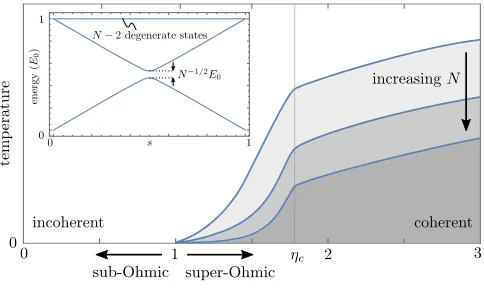
FIG. 1. Qualitative dynamics of the adiabatic quantum search algorithm in an open system. The evolution of the system is coherent below the critical temperatureT(indicated by the solid curves) and a quantum speedup is available in this regime. The three curves correspond to different sizesNof the search space. The parameterη characterizes the noise spectral density at low frequency∝ωη, withη¼1corresponding to an Ohmic bath. The dependence ofTonηchanges qualitatively atηcdue to scattering
processes contributing significantly whenη>ηc. The inset shows
algorithm exhibiting a single avoided level crossing. In realistic systems withk-local interactions (k≤2typically), small gaps often arise due to avoided level crossings between macroscopically distinct states. In this case, an environment that also acts locally is incapable of inducing transitions between the two states involved in the crossing, and it predominantly leads to dephasing. To this end, in our model for the AQS algorithm, the environment only couples to the dephasing channel. We show that under these assumptions the problem of determining the scal-ability of the algorithm can be cast into an implementation-independent form, parametrized by the minimum gap at the avoided level crossing. Thus, we expect our conclusions to generalize beyond the AQS algorithm.
To understand the main result of our work, it is helpful to consider the different ways in which the environment influences the algorithm. One naively expects that a thermal bath will degrade performance whenever the temperature exceeds the smallest gap encountered during the computa-tion. However, this is not necessarily the case if the number of thermally accessible states is small [14]. In the AQS algorithm, there exist two low-energy states, separated by a large gap from higher excited states. These two low-lying states undergo an avoided level crossing (see inset of Fig.1). It is thus natural to assume that the environment can thermally mix these two states but does not give rise to higher excitations. Thermalization may then reduce the success probability by at most 50%, which can be compen-sated for by repeating the algorithm multiple times[14].
Apart from leading to thermalization, the environment also renormalizes the gap at the avoided crossing. The effect is best understood by appealing to an analogy with a double-well system. In this picture, the two low-energy states of the AQS algorithm are spanned by the ground states of two wells, which are detuned from each other by a bias εand connected by a tunneling rate Δ. The avoided crossing occurs at zero bias (s¼1=2in Fig.1), for which the energy gap is equal to the tunneling rate. As mentioned above, a local environment predominantly gives rise to dephasing between the wells, whereas environment-induced transitions from one well to another are negligible. This dephasing suppresses coherent tunneling, which in turn results in a decrease of the minimum gap. Equivalently, this mechanism may be viewed as a consequence of the quantum Zeno effect, where the environment tends to localize the system in one of the wells by gaining information about its current state[26]. Coherent tunneling may vanish entirely if the coupling to the environment is sufficiently strong. We refer to this as the incoherent regime, as opposed to the coherent regime, where tunneling persists. The terminology reflects the fact that coherent Rabi oscillations can, in principle, be observed in the coherent regime, whereas the oscillations are overdamped if the system is incoherent. Any potential quantum speedup is lost in the incoherent regime, as discussed in detail
below. Conversely, a quantum speedup is always available in the coherent regime provided the gap retains the same scaling with problem size as in a closed system.
In order to identify the relevant regimes, we compare the tunneling rate with the coupling rate to the environment. At zero temperature, the coupling rate is given by the noise spectral density of the environmentJðωÞ evaluated at the gap frequency. The noise spectral density is assumed to obey a power law at low frequencies, JðωÞ∝ωη, where we distinguish between sub-Ohmic (η<1), Ohmic (η¼1), and super-Ohmic (η>1) environments. For a sub-Ohmic environment, the ratioJðΔÞ=Δdiverges in the limitΔ→0, suggesting that the system is incoherent at the avoided level crossing for large search spaces. If the environment is super-Ohmic, the same reasoning predicts that even large systems remain coherent. This simple argument is indeed correct at zero temperature, while at finite temperature, bosonic enhancement and two-boson processes lead to significant modifications. We demonstrate that even for a super-Ohmic environment, a quantum speedup can only be achieved below a certain critical temperature, whose depend-ence onη and the size of the search space is summarized in TableIand Fig.1. Notably, the critical temperature decays as a power law with the size of the search space, such that the AQS algorithm offers no improvement over a classical algorithm for large search spaces at finite temperature.
We now proceed with detailed calculations. The AQS algorithm in a closed system is described by the Hamiltonian
HðsÞ¼E0ð1−sÞðI−jψ0ihψ0jÞþE0sðI−jmihmjÞ, whereE0
sets the energy scale of the system,jψ0i¼ð1=pffiffiffiffiNÞPN x¼1jxi
is an equal superposition of all states in the search space, and jmidenotes the marked element to be found. The parameters
is increased monotonically from its initial values¼0to its final value s¼1. The Hamiltonian HðsÞ can be exactly diagonalized in the two-level subspace spanned byjmiand jm⊥i ¼ ð1=pffiffiffiffiffiffiffiffiffiffiffiffiN−1ÞPx≠mjxi, where
HðsÞ ¼E0
2 I− 1
2½εðsÞτzþΔðsÞτx: ð1Þ Here, τi are the Pauli matrices acting on fjmi;jm⊥ig,
εðsÞ=E0¼2s−1þ2ð1−sÞ=N, andΔðsÞ=E0¼2ðpffiffiffiffiffiffiffiffiffiffiN−1=NÞ
ð1−sÞ. The orthogonal subspace is degenerate with constant
TABLE I. Scaling of the critical temperatureTwith the size of the search spaceN for a given coupling strengthαbetween the system and the environment. The scaling of T is evaluated separately for processes involving one and two bosons of the bath. For a sub-Ohmic environment, the one-boson processes render the dynamics incoherent even at zero temperature such that two-boson processes are never relevant.
Single-boson processes Two-boson processes
η<1 αT¼0
η>1 αT¼OðNðη−2Þ=2Þ α2=ð2ηþ1ÞT¼OðN−1=ð4ηþ2ÞÞ
energy E0 (see inset of Fig. 1). The spectrum exhibits an avoided level crossing ats¼1=2, where the gap is of order
OðN−1=2Þ for large N. As anticipated, the low-energy Hamiltonian is equivalent to one describing two wells connected by a tunneling rate Δ and detuned from each other by a biasε. Classically, the computation time scales linearly with the size of the search spaceN, whereas both Grover’s algorithm and the AQS algorithm achieve a quadratic quantum speedup, scaling asOðN1=2Þ. The latter
scaling, set by the inverse of the minimum gap, is provably optimal[15,27].
To specify the environment, we envision that the AQS Hamiltonian is implemented using L qubits, where
N¼2L. Each qubit is coupled to an independent, bosonic
bath. We assume throughout that the temperature
T≪E0=L, which ensures that the dynamics of the system are restricted to the two lowest-lying levels. Under these conditions[28], the environment couples to the low-energy subspace through an effective interaction of the form
V¼τzX k
gkðbkþb†kÞ þτzX k;l
gkgl
E ðbkþb †
kÞðblþb†lÞ;
ð2Þ
where bk and b†k are bosonic annihilation and creation
operators,gkis a coupling strength, andEan energy scale
proportional to E0. The first term in Eq. (2) describes absorption or emission of a single boson, while the second term corresponds to boson processes, such as two-boson emission or two-boson scattering. Higher-order terms, which depend on specifics of the higher excited states, have been neglected since they do not affect our results quali-tatively [28]. We have also dropped terms that couple to
τx;y, representing environment-induced transitions between
jmiandjm⊥i, as they are strongly suppressed in the limit of large N [28].
The bath is characterized by the noise spectral density,
JðωÞ ¼Pkgk2δðω−ωkÞ, which follows a power law at low
frequencies, JðωÞ ¼αωη. The parameter α sets the cou-pling strength to the environment. Our analysis is restricted toη>0because the effective two-level description breaks down otherwise [28]. Furthermore, we assume that the weak-coupling conditionJðωÞ≪E0 is satisfied for allω. We emphasize that coupling is only weak compared to the overall energy scale of the system but may be strong compared to the gap between the low-energy states.
In order to explore the coherence properties of the system, we employ a procedure known as adiabatic renormalization, which has been widely put to use in the context of the spin-boson model[35]. The method is particularly powerful as it is valid even for nonperturbative and non-Markovian environ-ments. Adiabatic renormalization proceeds by eliminating modes of the environment that are fast compared to the tunneling rate. To a good approximation these oscillators adiabatically follow the system, thereby reducing the bare
tunneling rateΔto a renormalized tunneling rateΔ~. The case ~
Δ¼0 corresponds to the incoherent regime introduced above, while in the coherent regime, Δ~ >0. To compute
~
Δ, we first determine the energy eigenstates in the absence of tunneling. For the moment, we only consider single-boson processes and limit ourselves to the region near the avoided crossing, where εðsÞ≈0. The eigenstates are given by jτ;ni¼e−iτzS1jτiQ
kjnki, whereS1¼i P
kðgk=ωkÞðbk−b†kÞ, τ¼m; m⊥ (corresponding to τz¼ 1), and n
k are the
occupation numbers of the bosonic modes. Physically speaking, the system is dressed by oscillators, whose dis-placements depend on the state of the system. Oscillators with frequencies much greater than the tunneling rate will adjust to the state of the system almost instantaneously, while slower oscillators must be accounted for more carefully. We hence define the renormalized tunneling rate between the statesjm;niandjm⊥;niasΔ~n¼Δhm;njτxjm
⊥;ni0, where the prime denotes that only oscillators with frequencies satisfyingωk>Ωshould be taken into account. Here,Ωis a low-frequency cutoff, which may be self-consistently deter-mined asΩ¼pΔ~n. The exact value ofpis irrelevant in what follows, provided thatp≫1. Because of the dependence of
~
Δnon the occupation numbers, it is only possible to define a
unique renormalized tunneling rate at zero temperature. Nevertheless, we can define a typical rate Δ~ by taking a thermal expectation value, yielding
~
Δ¼Δexp
−2
Z ∞
Ω dω
JðωÞ ω2 coth2ωT
: ð3Þ
We first consider the above expression at T¼0. For a super-Ohmic environment, the integral in the exponent remains finite asΩ→0. For largeN, we may setΩto zero to a very good approximation such thatΔ~ is proportional to
Δ. If the environment is Ohmic or sub-Ohmic, the integral exhibits an infrared divergence. There exists a critical coupling strength α∝Δ1−η such that Δ~ ¼0 for all
α>α. For α<α, the renormalized tunneling rate remains finite [28]. The critical coupling strength tends to zero asN→∞, showing that the dynamics are incoher-ent in the limit of large search spaces, consistincoher-ent with the discussion above.
The results at finite temperature can be obtained by very similar arguments. In short, one obtains that Δ~ is always finite and proportional toΔforη>2, while for1<η≤2
there exists a critical coupling strength of the form
α∝Δ2−η=T, where we assumed that T≫Δ~. If the
coupling constant is fixed, the expression can be interpreted as an expression for a critical temperature:
T∝Δ 2−η
This is consistent provided η>1. In the sub-Ohmic regime, T cannot be taken much greater thanΔ~ and we find instead that the dynamics are always incoherent for a fixed αin the limit of large search spaces. At η¼1, the existence of a nonzero critical temperature depends on the value of α. We note that these results, summarized in the first column of TableI, are in agreement with previous work by Tiersch and Schützhold[22].
Two-boson processes may be treated similarly, although they affect the system in a qualitatively different manner [36]. There are two kinds of two-boson processes: those in which a pair of bosons is absorbed or emitted, and those in which a boson is scattered between two modes. Conservation of energy requires that in two-boson emission or absorption processes both modes have energies ≲Δ. By contrast, the scattering processes can involve pairs of modes with arbitrarily high energy, provided their energy difference is small. Crucially, the phase space for boson scattering is independent of Δ for large N and remains nonzero as Δ→0. The two-boson coupling strength at finite temperature is thus expected to be always large compared to Δfor large N.
To support this argument, we again perform adiabatic renormalization [28]. We focus on super-Ohmic environ-ments since single-boson processes already prevent a quan-tum speedup in the sub-Ohmic case. We further extend the weak coupling approximation to include bosonic enhance-ment, i.e.,JðωÞ½1þNðωÞ≪E0for allω, whereNðωÞis the Bose-Einstein distribution. Under these assumptions, two-boson processes only weakly renormalize the tunneling rate at zero temperature and do not render the dynamics incoherent. IfT >0, there exists a critical coupling strength, which is given byα∝EΔ1=2=Tηþ1=2, such that the
dynam-ics are incoherent for anyα>α. Clearly, α vanishes as
N→∞ regardless of η. This is in stark contrast to the renormalization due to single-boson processes alone, where the system remains coherent if η>2. At fixed coupling strength, we thus predict a critical temperature,
T∝Δ 1=ð2ηþ1Þ
α2=ð2ηþ1Þ ¼OðN−1=ð4ηþ2ÞÞ; ð5Þ
for two-boson processes.
In addition to coherent tunneling, there exist incoherent transitions, during which the system exchanges energy with the environment and thermalizes. We argued above that in the case of the AQS algorithm these processes merely give rise to constant overhead. In fact, thermalization may even improve the performance if it occurs sufficiently fast[14]. By letting the system thermalize, one can obtain the ground state with a probability of at least 50%, since only the lowest two energy states may be significantly populated. In order to exclude the possibility of a quantum speedup in the incoherent regime, it is therefore necessary to ensure that the thermalization rate decreases with system size at least as
fast as OðN−1Þ. Indeed, the thermalization rate always scales as OðN−1Þ in the incoherent regime [28].
In the coherent regime, the thermalization rate can exceed this scaling near the avoided level crossing. This is an intriguing result since it implies that quantum computation can proceed through thermalization alone. This may be accomplished, for instance, by initializing the system in its ground at s¼0 (large bias) before rapidly decreasing the bias to zero. The system is then left to thermalize before being measured in the computational basis. Repeating this procedure several times will yield the ground state with high probability. We note, however, that this approach does not lead to an improved scaling compared to adabatic evolution, which always offers a quantum speedup in the coherent regime.
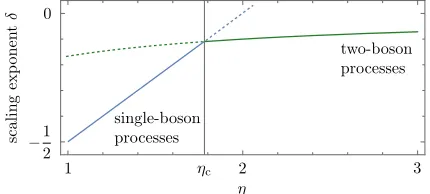
We summarize our results by discussing the combined effect of single-boson and two-boson processes. In the parameter regime considered, the two processes decouple and their combined effect can be deduced from the results presented above[28]. In particular, for the dynamics to be incoherent it is sufficient that one of the processes renorm-alizes the tunneling rate to zero. We thus conclude that the system is always incoherent at finite temperature in the limit of large N and the algorithm does not provide a quantum speedup. We observe that the critical temperature associated with the coherent-incoherent transition scales differently for the two processes; see Fig. 2. Only the smaller critical coupling is physically significant; thus, two-boson processes dominate for η>ηc, and single-boson processes otherwise. At ηc¼ ð3þ
ffiffiffiffiffi
17 p
Þ=4 the critical temperatures scale identically and model-dependent pre-factors determine which process dominates.
[image:5.612.330.545.531.628.2]Owing to the generic nature of the system-bath inter-action discussed here, we expect that our results extend to a wide range of adiabatic algorithms involving avoided level crossings. The interaction Hamiltonian in Eq.(2), involving only dephasing, arises naturally in such situations because small gaps generically correspond to macroscopically distinct states that are not connected by a local
FIG. 2. Dependence of the critical temperatureTon the search space size N. The critical temperature follows a power law
T¼OðNδÞ. AboveT, the system evolves incoherently, while below, quantum coherence is retained. The qualitative change at ηc is due to competition between single- and two-boson
processes. Forη<1, the dynamics are incoherent even at zero temperature in the limit of largeN.
environment. The nonlocal interactions in the AQS algo-rithm lead to a spectrum in which the N−2 states not involved in the level crossing are extensively separated in energy (i.e., their excitation gap is proportional to the full energy bandwidth of the system). A more realistic model with few-body interactions will instead have an intensive excitation gap. As long as the temperature is much lower than this excitation gap, our reduced model of the avoided crossing continues to apply, and so do our conclusions. Moreover, our findings should be broadly relevant for adiabatic quantum algorithms that involve many-body tunneling [37–39]. For the AQS algorithm, we were able to draw a direct correspondence between tunneling and speedup, whereas the general significance of tunneling in AQC algorithms is an open question. Future work may explore the applicability of our results to algorithms offering an exponential speedup, where the role of many-body tunneling is particularly unclear[40]. Finally, our work highlights the need for quantum error correction to render AQC scalable at finite temperature[41–48].
We thank E. Demler, V. Oganesyan, J. H. Wilson, and L. Zhou for insightful discussions. Financial support was provided by the NSF, the Center for Ultracold Atoms, and the NSSEFF program. S. G. is supported by the Walter Burke Institute. M. K. acknowledges support from the Technical of University of Munich—Institute for Advanced Study, funded by the German Excellence Initiative and the European Union FP7 under Grant Agreement 291763. N. Y. Y. is supported by the Miller Institute for Basic Research in Science.
[1] S. Shevchenko, S. Ashhab, and F. Nori,Phys. Rep.492, 1 (2010).
[2] K. Bergmann, H. Theuer, and B. W. Shore,Rev. Mod. Phys. 70, 1003 (1998).
[3] E. Farhi, J. Goldstone, S. Gutmann, and M. Sipser,arXiv: quant-ph/0001106.
[4] E. Farhi, J. Goldstone, S. Gutmann, J. Lapan, A. Lundgren, and D. Preda,Science292, 472 (2001).
[5] A. Das and B. K. Chakrabarti, Rev. Mod. Phys.80, 1061 (2008).
[6] V. Bapst, L. Foini, F. Krzakala, G. Semerjian, and F. Zamponi,Phys. Rep.523, 127 (2013).
[7] G. E. Santoro and E. Tosatti, J. Phys. A39, R393 (2006). [8] C. Laumann, R. Moessner, A. Scardicchio, and S. Sondhi,
Eur. Phys. J. Spec. Top.224, 75 (2015). [9] M. S. Siu,Phys. Rev. A71, 062314 (2005).
[10] D. Aharonov, W. van Dam, J. Kempe, Z. Landau, S. Lloyd, and O. Regev,SIAM J. Comput.37, 166 (2007).
[11] A. Mizel, D. A. Lidar, and M. Mitchell,Phys. Rev. Lett.99, 070502 (2007).
[12] A. M. Childs, E. Farhi, and J. Preskill, Phys. Rev. A 65, 012322 (2001).
[13] T. Albash and D. A. Lidar, Phys. Rev. A 91, 062320 (2015).
[14] M. H. S. Amin, P. J. Love, and C. J. S. Truncik,Phys. Rev. Lett.100, 060503 (2008).
[15] J. Roland and N. J. Cerf, Phys. Rev. A 65, 042308 (2002).
[16] L. K. Grover,Phys. Rev. Lett.79, 325 (1997).
[17] N. Shenvi, K. R. Brown, and K. B. Whaley,Phys. Rev. A68, 052313 (2003).
[18] J. Åberg, D. Kult, and E. Sjöqvist,Phys. Rev. A71, 060312 (2005).
[19] J. Åberg, D. Kult, and E. Sjöqvist,Phys. Rev. A72, 042317 (2005).
[20] J. Roland and N. J. Cerf, Phys. Rev. A 71, 032330 (2005).
[21] S. Ashhab, J. R. Johansson, and F. Nori,Phys. Rev. A74, 052330 (2006).
[22] M. Tiersch and R. Schützhold, Phys. Rev. A 75, 062313 (2007).
[23] A. Pérez,Phys. Rev. A79, 012314 (2009).
[24] J. E. Avron, M. Fraas, G. M. Graf, and P. Grech,Phys. Rev. A82, 040304 (2010).
[25] I. de Vega, M. C. Bañuls, and A. Pérez,New J. Phys.12, 123010 (2010).
[26] B. Misra and E. C. G. Sudarshan,J. Math. Phys. (N.Y.)18, 756 (1977).
[27] The proof of optimality in Ref. [15] straightforwardly generalizes to open systems, assuming that the environment contains no information about the marked state.
[28] See Supplemental Material at http://link.aps.org/ supplemental/10.1103/PhysRevLett.117.150501, which in-cludes Refs. [29–34], for a derivation of the effective interaction Hamiltonian, details of the adiabatic renormal-ization procedure, and calculation of the thermalrenormal-ization rate. [29] C. Cohen-Tannoudji, J. Dupont-Roc, and G. Grynberg,
Atom-Photon Interactions (Wiley-VCH Verlag GmbH, Weinheim, Germany, 1998).
[30] A. T. S. Wan, M. H. S. Amin, and S. X. Wang, Int. J. Quantum. Inform.07, 725 (2009).
[31] S. K. Kehrein and A. Mielke, Phys. Lett. A 219, 313 (1996).
[32] R. Bulla, N.-H. Tong, and M. Vojta,Phys. Rev. Lett.91, 170601 (2003).
[33] C. W. Gardiner and P. Zoller, Quantum Noise, 3rd ed. (Springer-Verlag, Berlin, 2004).
[34] J.-P. Blaizot,Quantum Theory of Finite Systems, edited by G. Ripka (MIT Press, Cambridge, MA, 1986).
[35] A. Leggett, S. Chakravarty, A. Dorsey, M. P. A. Fisher, A. Garg, and W. Zwerger, Rev. Mod. Phys. 59, 1 (1987).
[36] Y. Kagan and N. V. Prokof’ev, Zh. Eksp. Teor. Fiz.96, 2209 (1989) [Sov. Phys. JETP69, 1250 (1989)].
[37] A. P. Young, S. Knysh, and V. N. Smelyanskiy,Phys. Rev. Lett.104, 020502 (2010).
[38] V. S. Denchev, S. Boixo, S. V. Isakov, N. Ding, R. Babbush, V. Smelyanskiy, J. Martinis, and H. Neven,Phys. Rev. X6, 031015 (2016).
[39] S. Boixo, V. N. Smelyanskiy, A. Shabani, S. V. Isakov, M. Dykman, V. S. Denchev, M. H. Amin, A. Y. Smirnov, M. Mohseni, and H. Neven, Nat. Commun. 7, 10327 (2016).
[40] E. Crosson and A. W. Harrow,arXiv:1601.03030.
[42] D. Gottesman,arXiv:quant-ph/9705052.
[43] E. Knill, R. Laflamme, and L. Viola, Phys. Rev. Lett.84, 2525 (2000).
[44] S. P. Jordan, E. Farhi, and P. W. Shor, Phys. Rev. A 74, 052322 (2006).
[45] D. A. Lidar,Phys. Rev. Lett.100, 160506 (2008).
[46] K. C. Young, M. Sarovar, and R. Blume-Kohout,Phys. Rev. X3, 041013 (2013).
[47] K. L. Pudenz, T. Albash, and D. A. Lidar,Nat. Commun.5, 84 (2014).
[48] A. D. Bookatz, E. Farhi, and L. Zhou,Phys. Rev. A 92, 022317 (2015).