This is a repository copy of Clean Agents in Explosion Inerting.
White Rose Research Online URL for this paper: http://eprints.whiterose.ac.uk/105086/
Version: Accepted Version
Proceedings Paper:
Gatsonides, J, Andrews, GE, Phylaktou, HN et al. (1 more author) (2014) Clean Agents in Explosion Inerting. In: Proceedings. Tenth International Symposium on Hazard, Prevention and Mitigation of Industrial Explosions (X ISHPMIE), 10-14 Jun 2014, Bergen, Norway. . ISBN 978-82-999683-0-0
[email protected] https://eprints.whiterose.ac.uk/ Reuse
Unless indicated otherwise, fulltext items are protected by copyright with all rights reserved. The copyright exception in section 29 of the Copyright, Designs and Patents Act 1988 allows the making of a single copy solely for the purpose of non-commercial research or private study within the limits of fair dealing. The publisher or other rights-holder may allow further reproduction and re-use of this version - refer to the White Rose Research Online record for this item. Where records identify the publisher as the copyright holder, users can verify any specific terms of use on the publisher’s website.
Takedown
If you consider content in White Rose Research Online to be in breach of UK law, please notify us by
Gatsonides, J., Andrews, G.E., Phylaktou, H.N. and Chattaway, A., Clean agents in explosion inerting.
Tenth International Symposium on Hazards, Prevention, and Mitigation of Industrial Explosions (XISHPMIE)
Bergen, Norway, 10-14 June 2014.
Clean agents in explosion inerting
Josephine G. Gatsonides a,b, Gordon E. Andrews b ,Herodotos N. Phylaktou b & Adam Chattaway a a
UTC Aerospace Systems, Mathisen Way, Colnbrook, Slough, SL3 0HB, UK b
Energy Research Institute, University of Leeds, Leeds, LS2 9JT, UK
Corr.: J Gatsonides, Dept. Engineering & Technology, UTC Aerospace Systems, Mathisen Way, Colnbrook, Slough, SL3 0HB, UK
E-mail: [email protected] tel.no.: +44 (0)1753 766292 E-mail: [email protected]
E-mail:[email protected]
E-mail: [email protected] tel.no.: +44 (0)1753 766190
Highlights
Single component fluorinated halon replacements enhance fuel lean explosions, but mitigate fuel rich explosions
Adding N2 does not improve performance; a full N2 concentration is needed to suppress explosions
A Halon 1301 / N2 mix shows synergistic performance at sub-inert concentrations
Testing candidate agents at below inerting concentrations provides a good indication for behaviour in real life situations.
Abstract
qualification tests for new agents the stoichiometric concentration of a fuel is deemed to be the worst case scenario and the baseline against which agents are tested. The above described test results show that this assumption may need to be reconsidered. This work shows that contrary to common assumption the agents investigated did not act chemically at the flame front, but mainly cooled the flame and changed the stoichiometry, i.e. the ratio of components of the flammable mixture.
Keywords: gaseous suppressants, clean agents, inerting, mitigation, gas vapour explosions 1. Introduction
The Montreal Protocol banned the production of Halon 1301 (CF3Br) and Halon 1211 (CF2ClBr) and limited their use to critical areas including aerospace applications [1]. A number of halon replacement agents have been developed as acceptable alternatives for industrial fire
protection applications. Some of these alternatives have been subjected to tests to assess their suitability for use in aerospace applications. During qualification tests at the test facilities of the US Federal Aviation Administration (FAA) unexpected agent behaviour occurred [2]. It was observed during simulated aerosol can explosion testing that at low concentrations certain candidate agents increased the explosion severity instead of mitigating the event. CF3Br mitigated these explosions at all tested concentrations.
1.1. Previous research into flammability of halon replacement agents
The US National Institute for Standards & Technology (NIST) carried out significant amounts of fundamental work on various halon replacements. Several of their publications refer to
observed unusual behaviour. Experimental research into the efficacy of halon alternatives showed unusually high pressure ratios for a mixture containing CH2F2 and C2HF5 (HFC-125) and significant pressure increases at lean ethane/air mixtures[3]. Further investigation into
suppression of high speed flames led to the conclusion that the tested agents could either enhance or suppress combustion, depending on their volumetric concentration. C2HF5 at concentrations of 5 vol% showed the highest increase in severity of deflagration [4].
The All-Russian Research Institute for Fire Protection (VNIIPO) investigated the influence of various fluorinated halocarbons on the combustion of gaseous fuel/air mixtures in closed vessel experiments. In some tests with lean fuel mixtures and low concentrations of fluorinated halocarbon an increase of explosion pressure was observed[5].
Theoretical research into the possible causes for these phenomena included development of calculation models to describe and predict the mechanisms of the specific explosion events related to the simulated aerosol can explosion test[6][7]. This provided some possible explanations about the chemistry involved. More practical test work was required to
investigate specific properties of the subject agents and verify calculation models as existing experimental test results did not provide information relevant for the specific conditions. The fire protection industry was requested to develop a test method to rapidly screen the
exothermic reaction of candidate agents in the presence of a hydrocarbon flame[8].
The FAA has defined a minimum performance standard for cargo compartment protection[9]. The specific conditions of aircraft fire protection during flight are subject to altitude changes and ventilation losses. The consequence is that the agent concentration can vary over a prolonged period of time, in which a number of fire scenarios can occur. Requirements for the performance of aviation agents can differ from what is required from suppression agents in fixed ground-based industrial systems.
The simulated aerosol can explosion test procedure consists of a heated mixture of propane (C3H8), ethanol (C2H6O) and water (H2O) being discharged across sparking electrodes, whereby the occurring combustion / explosion pressure is being measured.
At UTC Aerospace Systems a test program was developed based on previous test results and research performed by the FAA and NIST. The subject of investigation was the behaviour of alternative agents at values below their established inerting concentration against various concentrations of gaseous fuel.
The two agents selected for the tests were HFC-125 (C2HF5 N (C6F12O).
The fuel selected was C3H8, being the most volatile component in the FAA test fuel mix.
The test apparatus selected was a standard spherical explosion test vessel.
2. Experimental
2.1. Test materials
The following materials were used: Propane, C3H8, (99.5%) supplied by BOC. Nitrogen, N2, (99.9%) supplied by BOC. Halon 1301, CF3Br, (Recycled: 99.6% minimum) supplied by Kidde Graviner. HFC-125, C2HF5, (99.9%) supplied by K A N C6F12O, (99.9%) supplied by Kidde Fire Protection. Air, in-house compressed, filtered, dried to laboratory standard.
2.2. Methodology
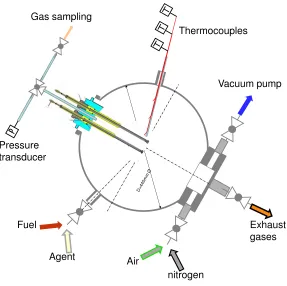
The test method was based on European standard EN 1839:2012[10], following the protocol as set out in European standard EN 15967:2011[11] , to ensure a recognised and reproducible test set-up. The test apparatus used in this program was a spherical 43 l explosion test vessel, fitted with a spark ignition unit with tungsten electrodes positioned at the centre of the vessel. The spark discharge time was 0.5 s during all tests. The apparatus was fitted with pressure sensors and thermocouples to measure pressure rise and flame propagation during explosion tests, shown schematically in Figure 1. The positioning of the three thermocouples in the vessel in line above the ignition source gave the advantage of measuring flame propagation during explosion in the vessel, and signs of flame detachment at incomplete combustion events.
In the charts in this work the temperatures are expressed in °C (0 °C 273.15 K); the pressures are expressed in P
2.3. Measuring equipment
The pressure was monitored with piezoresistive transducers, Kistler type 4045 A2, for low pressure (0-200 kPa) during filling of the apparatus and type 4045 A20, for high pressure (0-2000 kPa) during the explosion event. The signal from the transducers was conditioned via a Kistler type 4603 amplifier to the data acquisition equipment. The measuring accuracy of the combination was better than 1% of the full scale output. All tests were performed at an initial absolute pressure of 103 kPa ( 1.03 bar).
[image:5.612.92.379.200.486.2]Figure 1: Schematic test vessel
2.3.2. Temperature
The internal temperature measurement was provided by three thermocouples, inserted 65 mm apart in a 6 mm stainless steel tube into the vessel. A fourth thermocouple was placed on the outside wall to monitor the skin temperature and regulate the heating. The vessel was fitted with a 270 W trace heating element for temperature control. All tests were performed with a start temperature of 307 K ± 4 K. The thermocouples used were Type K; mineral insulated, metal sheathed thermocouples with 0.5 mm sheath diameter and compliant with BS EN 60584-2 with a tolerance value according class 60584-2 [12] . The overall diameter of 0.5 mm of the
thermocouples ensures a typical response time of 0.03 s to achieve a value of 63% of the actual temperature when subjected to an instantaneous step change in temperature.
D= 44
0m m Ø
Fuel
Agent
nitrogen Air
Vacuum pump
Exhaust gases Gas sampling
Thermocouples
2.3.3. Data acquisition
Data logging was provided by a Dell PC, Type Optiplex 780 with Dual CPUs E8500 @ 3.16 GHz, in combination with a Data Translation module DT9805. The data acquisition software was a LabVIEW derived datalogging application. During this test series the data were captured at a frequency of 1 kHz.
2.3.4. Gas composition analysis
The gases were introduced into a vacuum vessel using their partial pressure during filling as a measure of the volumetric percentage of the components.
The portable containers with individual gases were weighed before and after use to measure the consumed mass of gas.
After filling, gas samples of the mixture were taken. These gas samples were analysed with:
FTIR analysis, Bruker Equinox 55 Fourier Transform Infrared Spectrometer
Oxygen analyser, Servomex Xentra 4100 paramagnetic oxygen analyser
The data of the partial pressures, mass of gas and gas analysis were collected in a spreadsheet. The combination of the three methods provided a good control mechanism to establish the accurate gas ratios.
2.3.5. Data analysis
The captured data were transferred to a self-developed MS-E
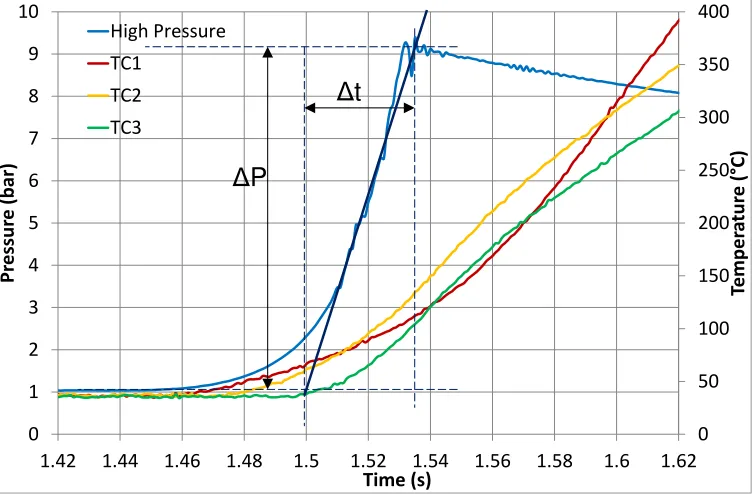
analyse the data per test. An example of data measured during an explosion test can be found in figure 2. Significant data such as explosion pressure rise (F = Pmax/P0), dP/dt, rate of pressure rise (Kg) etc. were transferred to a summary spreadsheet with the collected test results.
[image:6.612.76.452.442.689.2]
Figure 2: test result unsuppressed 4.15 vol% C3H8 explosion
0 50 100 150 200 250 300 350 400 0 1 2 3 4 5 6 7 8 9 10
1.42 1.44 1.46 1.48 1.5 1.52 1.54 1.56 1.58 1.6 1.62
3. Test results
Note: All points depicted in the graphs and charts showed signs of combustion, i.e. a pressure increase or heat generation more than produced by the ignition source alone.
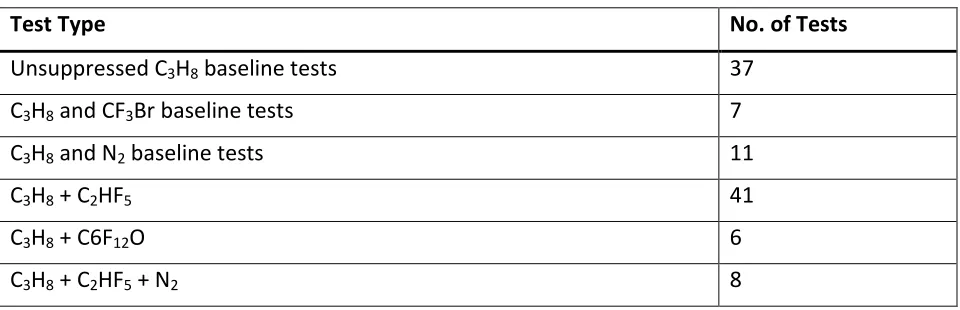
[image:7.612.67.547.251.406.2]Baseline C3H8/ air unsuppressed explosions were used to characterise and validate the test apparatus. Further validation was carried out using CF3Br and N2, two well-known gaseous suppressants with documented inerting concentrations. Two candidate agents were then evaluated: C2HF5, and C6F12O. In addition, tests were carried out with mixtures of C2HF5 and N2. Table 1 provides an overview of the amount and type of tests performed.
Table 1, Overview Test series
Test Type No. of Tests
Unsuppressed C3H8 baseline tests 37
C3H8 and CF3Br baseline tests 7
C3H8 and N2 baseline tests 11
C3H8 + C2HF5 41
C3H8 + C6F12O 6
C3H8 + C2HF5 + N2 8
3.1. Validation Experiments
The baseline unsuppressed results agreed with published values, see Table 2. Figure 3 and 4 show graphs of the results. Inerting with N2 provided the limiting oxygen concentration (LOC). The differences between the lower explosion limits (LEL) and the upper explosion limits (UEL) from the various sources can be explained by the differences in test standards, methods and
apparatus used by the data sources. U
method
measure a sufficiently high pressure rise to meet the requirements [10]. Other factors are related to the dimensions of the test vessel, sensitivity of the pressure transducers and threshold for pressure increase applied. At values near the flammability limits the actual achieved pressure increase is strongly dependent on the size of the vessel. Under influence of buoyancy the flame will rise to the top of the vessel and will be quenched upon contact with the vessel wall. With increase of the size of the vessel the volume of gas mixture consumed relative to the total mixture available will diminish. The result in a larger vessel is a lower pressure rise than in a small vessel, with the same near limit fuel concentration.
Table 2, Overview C3H8 explosion baseline data
Data Source vol% vol% bar(abs) bar m/s vol% O2
GESTIS substance database [13] 1.7 10.8 9.4 9.8
Senecal and Beaulieu [14] 8.2 76
Bartknecht [15] 2.4 8.5 8.9 100
Kuchta [16] 2.1 9.5 11.5
This work 2.1 10.0 9.4 92 11.3
[image:8.612.68.546.68.475.2]Figure 3: Pressure rise (F) unsuppressed C3H8 explosions
0 1 2 3 4 5 6 7 8 9 10 11
1 2 3 4 5 6 7 8 9 10 11
F p
re
ss
u
re
r
is
e
(Pm
a
x
/P
0
)
Fuel concentration (vol.%)
Figure 4: Rate of pressure rise (Kg) unsuppressed C3H8 explosions
3.2. Tests at sub-inerting concentrations
3.2.1. CF3Br and N2
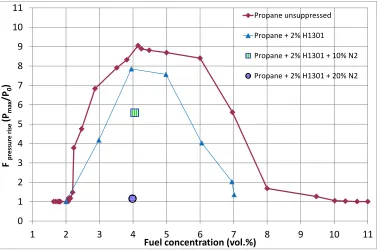
Inerting concentration CF3Br against C3H8 = 6.1 vol% (Coll, NFPA 12A, 2004) [17][17] Inerting concentration N2 against C3H8 = 42 vol% (Zabetakis, NFPA 2001, 2004) [18] [18] CF3Br or N2 when below inerting concentrations mitigated the explosion pressure in all test configurations. A combination of 2 vol% CF3Br and 10 or 20 vol% N2 resulted in enhanced suppression, as shown in figure 5.
0
10 20 30 40 50 60 70 80 90 100
1 2 3 4 5 6 7 8 9 10 11
Kg
-v
a
lu
e
(
B
a
r
m
s
-1)
Fuel concentration (vol.%)
Figure 5: Pressure rise (F) partial inerting with 2 vol% CF3Br
3.2.2. C2HF5 with C3H8
3.2.2.1. C2HF5 at 5%
Inerting concentration C2HF5 against C3H8 = 15.7 vol% (Senecal, NFPA 2001, 2004) [19][19] C2HF5 was tested in a concentration of 5 vol% against C3H8. At fuel rich concentrations the explosion was mitigated, at fuel lean mixtures the explosion was enhanced, as shown in figure 6.
0 1 2 3 4 5 6 7 8 9 10 11
1 2 3 4 5 6 7 8 9 10 11
F p
re
ss
u
re
r
is
e
(Pm
a
x
/P
0
)
Fuel concentration (vol.%)
Propane unsuppressed Propane + 2% H1301
Figure 6: Pressure rise (F) partial inerting with 5 vol% C2HF5
3.2.2.2. C3H8 at 4% and 2%
N2 and C2HF5 varying from 0.1x up to 0.9x of their full inerting concentration were tested against C3H8/air mixtures with 4 vol% (stoichiometric) C3H8 and 2 vol%
(2.1 vol% = Lower Explosion Limit) C3H8.
In the tests with 4 vol% C3H8, the addition of 4 - 5 vol% C2HF5 resulted in a slight increase of explosion pressure, see figure 7, but at the same time a gradual decrease in the rate of pressure rise (Kg), see figure 8. The combustion process was slowed down. It was noticed that both N2 and C2HF5 needed at least 0.6x of the full inerting concentration to achieve significant explosion mitigation.
0 1 2 3 4 5 6 7 8 9 10 11
1 2 3 4 5 6 7 8 9 10 11
F p
re
ss
u
re
r
is
e
(Pm
a
x
/P
0
)
Fuel concentration (vol.%)
Figure 7: Pressure rise (F) partial inerting of 4 vol% C3H8
Figure 8: Rate of pressure rise (Kg) partial inerting of 4 vol% C3H8
In the tests with 2 vol% C3H8 a completely different behaviour was observed. The addition of various concentrations of C2HF5 turned a non-explosive C3H8/air mixture into a very reactive mixture with explosion overpressures up to 5 bar. The highest overpressures and rate of pressure rise were measured between 4 and 7 vol% C2HF5. See figure 9 and figure 10.
0 1 2 3 4 5 6 7 8 9 10
0.0 0.1 0.2 0.3 0.4 0.5 0.6 0.7 0.8 0.9 1.0
Fpres
su
re
rise
(P
max
/ P
0
)
Ratio Cagent/Cinert
4% propane
4% propane & N2
4% propane & HFC 125
0 10 20 30 40 50 60 70 80 90
0.0 0.1 0.2 0.3 0.4 0.5 0.6 0.7 0.8 0.9 1.0
KG
-v
alue (
bar
m s
-1)
Ratio Cagent/Cinert
4% propane
4% propane + N2
Figure 9: Pressure rise (F) partial inerting of 2 vol% C3H8
Figure 10: Rate of pressure rise (Kg) partial inerting of 2 vol% C3H8
Additional tests were performed to investigate the influence of N2 on the explosion severity of the mixture of 2 vol% C3H8 with 5 vol% C2HF5. N2 provided again significant mitigation of the event when used in concentrations of at least 0.6x of the full inerting concentration of 42 vol%. See figure 9 and figure 10.
3.2.3. C6F12O 0
1 2 3 4 5 6 7 8 9 10
0.0 0.1 0.2 0.3 0.4 0.5 0.6 0.7 0.8 0.9 1.0
Fpres
su
re
rise
(P
max
/ P
0
)
Ratio Cagent/Cinert
2% propane
2% propane + HFC125
2% propane +5% HFC125 + N2
0.0 0.2 0.4 0.6 0.8 1.0 1.2 1.4 1.6 1.8 2.0
0.0 0.1 0.2 0.3 0.4 0.5 0.6 0.7 0.8 0.9 1.0
Kg
-v
alue (
bar
m
s
-1)
Ratio Cagent/Cinert
2% propane
2% propane + HFC125
Inerting concentration C6F12O against C3H8 = 8.1 vol% (Schmeer, NFPA 2001, 2004)
A final test series was performed with a low concentration, 2.5 vol% C6F12O against C3H8/air mixtures at various concentrations. This showed similar behaviour to that observed with the C2HF5 tests. At rich fuel/air mixtures (above stoichiometric concentrations) the C6F12O
[image:14.612.73.455.170.421.2]mitigated the explosion pressure; at lean fuel/air mixtures the agent exacerbated the explosion. See figure 11.
Figure 11: Pressure rise (F) partial inerting with 2.5 vol% C6F12O
4. Discussion
The fire suppressing property of fluorinated agents is mainly based on heat absorption, thereby cooling the flammable mixture[20]. During this process the agent decomposes and the fluorine reacts with the hydrogen component of the fuel in an exothermic reaction, replacing the hydrogen-oxygen reaction with a hydrogen-fluorine reaction. Effectively this means that a low concentration hydrocarbon fuel combined with low concentration fluorine based suppression agent can result in a reactive flammable mixture. This was clearly demonstrated with the tests with 5 vol% C2HF5 and the tests with C2HF5 against 2 vol% C3H8 and further confirmed with the results of the tests with 2.5 vol% C6F12O. At fuel concentrations from stoichiometric and
upward a low concentration fluorinated agent will aid in creating an over-rich fuel mixture with diminished combustion as a result. In this scenario the agent shows a similar suppression behaviour as an inert gas which solely acts by cooling the flammable mixture, this can be seen when comparing both N2 and C2HF5 against 4 vol% C3H8.
One of the objectives of this work was to develop a laboratory scale experiment to investigate specific agent properties at critical limits to provide data for validation of calculation models and to provide a rapid screening tool for candidate agents for aviation applications. The chosen test methodology and apparatus can fulfil this requirement.
0 1 2 3 4 5 6 7 8 9 10 11
1 2 3 4 5 6 7 8 9 10 11
F p
re
ss
u
re
r
is
e
(Pm
a
x
/P
0
)
Fuel concentration (vol%)
Propane unsuppressed
5. Conclusions
Normally during qualification tests for new agents, the stoichiometric concentration of a fuel is deemed to be the worst case scenario and the baseline against which agents are tested. The above described test results show that this assumption may need to be reconsidered.
Testing candidate agents in the controlled environment of a standard spherical explosion test vessel against various fuel ratios, at a range of low agent concentrations and in combinations provides a good indication for possible behaviour in non-ideal / real life situations.
In real fire scenarios fuel air mixtures are rarely homogeneous. This means that during
discharge of alternative agents in an enclosure with flammable vapours a situation may occur where the agent enhances the fire. A critical situation may occur as well when a protected enclosure is vented after successful suppression of a fire involving a fuel rich mixture.
It is important to keep this in mind during the design of a fire suppression and smoke venting system.
Acknowledgements
Support in provision of test facilities and materials was received from UTC Aerospace Systems, Colnbrook, UK.
References
[1]Ozone Secretariat (2012). Handbook for the Montreal Protocol on Substances that Deplete the Ozone Layer. (9th ed.) Nairobi: United Nations Environment Programme (UNEP), 168-173.
[2]Reinhardt, J.W. (2004). Behaviour of Bromotrifluoropropene and Pentafluoroethane When Subjected to a
Simulated Aerosol Can Explosion, DOT/FAA/AR-TN04/04. Springfield: National Technical Information Service (NTIS).
[3]Gmurczyk G.W., Grosshandler W.L., Lowe D.L. (1994). Suppression Effectiveness of Extinguishing Agents Under
Highly Dynamic Conditions. Fire Safety Science, 4, 925-936.
[4]Grosshandler W.L., Gmurczyk G.W. (1997). Suppression of High Speed Flames and Quasi-detonations. Fire Safety
Science, 5, 853-864.
[5]Shebeko Y.N., Azatyan V.V., Bolodian I.A., Navzenya V.Y., Kopylov S.N., Shebeko D.Y., Zamishevski E.D. (2000).
The influence of fluorinated hydrocarbons on the combustion of gaseous mixtures in a closed vessel. Combustion and Flame, 121(3), 542-547.
[6]Linteris, G.T., Takahashi F., Katta V., Chelliah H., Meier O.C. (2011) Thermodynamic Analysis of
Suppressant-Enhanced Overpressure in the FAA Aerosol Can Simulator. Fire Safety Science, 10, 307-320.
[7]Babushok, V.I. Linteris G.T., Meier O.C. (2012). Combustion properties of halogenated fire suppressants.
Combustion and Flame, 159, 12: 3569-3575.
[8]Linteris, G.T. (2013). Alternative Agent Research Opportunities. Alternatives to Halon for Aviation Meeting,
Chicago, June 2013.
[9] Reinhardt, J.W. (2012). Minimum Performance Standard for Aircraft Cargo Compartment Halon Replacement
Fire Suppression Systems(2012 Update). DOT/FAA/TC-TN12/11 Springfield: National Technical Information Service
(NTIS).
[10]EN 1839 (2012). Determination of explosion limits of gases and vapours. Brussels, Technical Committee CEN/TC
305.
[11]EN 15967 (2011). Determination of maximum explosion pressure and the maximum rate of pressure rise of
gases and vapours. Brussels, Technical Committee CEN/TC 305.
[13]Gestis Database on hazardous substances, German Social Accident Insurance,
www.dguv.de/ifa/gestis-database.
[14]Senecal, J.A. & Beaulieu, P.A. (1998). Kg: New data and analysis. Process Safety Progress, 17(1), 9-15. [15]Bartknecht, W. (1993). Explosionsschutz, Grundlagen und Anwendung. Berlin Heidelberg: Springer Verlag. [16]Kuchta, J.M. (1985). Investigation of Fire and Explosion Accidents in the Chemical, Mining, and Fuel-Related
Industries- A Manual. (pp. 25) US Bureau of Mines, Bulletin 680.
[17]Coll, J.P. NFPA 12A (2004). Halon 1301 Fire Extinguishing Systems. (Table 5.4.1.1.1) National Fire Protection
Association, Batterymarch Park, Quincy, MA.
[18]Zabetakis, M.G. NFPA 2001 (2004). Clean Agent Fire Extinguishing Systems. (Table A.5.4.3) National Fire
Protection Association, Batterymarch Park, Quincy, MA.
[19]Senecal, J.A. NFPA 2001 (2004). Clean Agent Fire Extinguishing Systems. ((Table A.5.4.3)) National Fire
Protection Association, Batterymarch Park, Quincy, MA.
[20] Linteris, G.T. (1995) Effect of inhibitor concentration on the inhibition mechanism of fluoromethanes in
premixed methane-air flames. In A.W. Miziolek, & W. Tsang (Eds.), Halon Replacements, Technology and Science,