Nanostructured Lead Dioxide
Hassan Karami1*, , Bita Kafi1, Seyed Najmmadin Mortazavi2
1 Electrochemistry laboratory, Department of chemistry, Payame Noor University (PNU), P. O. Box:
97, Abhar, Iran
2 Department of Horticulture, Faculty of Science, Zanjan University, Zanjan, Iran *E-mail: [email protected]
Received: 23 December 2008 / Accepted: 6 February 2009 / Published: 1 March 2009
Effect of nanosized particles of lead dioxide on the potential and current of cyclic voltammetry peaks in sulfuric acid media was studied. Nanomaterial was synthesized by pulsed current electrochemical method. Material characterization was done by XRD, SEM and ICP. Electrochemical characterization was carried out by cyclic voltammetry in sulfuric acid solutions. The electrochemical parameters of -PbO2 on the lead substrate were further calculated by cyclic voltammetry. Under the selected
conditions the anodic and cathodic peak currents were linear with lead dioxide particle size over the range lower than 100 nm by cyclic voltammetry. The obtained results also showed a good linear relation between anodic peak potential with particle size. Smaller particles increase the currents of reduction and oxidation peaks and, decrease the oxidation potential for lead dioxide formation. It was not seen a regular relationship between particle size and potential of reduction peak. An attempt to understand the particle size effect on the shift of electrochemical parameters based on the particle size and morphology of lead dioxide.
Keywords: Pulsed current; Nanostructure; Lead dioxide; Particle size; Electrochemical behavior; Cyclic voltammetry
1. INTRODUCTION
Nanomaterial has received increasing attention in various fields of science and technology [4-7]. A variety of physicochemical methods, including metal evaporation [7], spray pyrolysis [8], sol-gel [9] and electrochemical methods [10], have been used to produce nanometer-sized materials.
Lead dioxide is an attractive material, which has been used in variety of electrochemical and industrial applications, including its use as a positive active material in lead acid batteries [11-13], as an electrocatalyst for salicylic acid [14], 2-naphtol [15], and trans-3,4-dihydroxycinnamic acid [17], in the oxidation of organic compounds [14-17], oxidation of phenol [16,17], Cr3+ [18], and glucose [19],
and evolution of ozone [20].
Because of lead dioxide importance in various application, in this work, we tried to find a correlation between lead dioxide particle size and cyclic voltammetry parameters including anodic peak current ( a
p
I ), cathodic peak current ( c p
I ), anodic peak potential ( a p
E ) and cathodic peak potential ( c
p
E ).
2. EXPERIMENTAL PART
2.1. Materials
Analytical grade sulfuric acid, HNO3 (Merck) was used without any purification. In all of the
experiments, double-distilled water was used. Pure lead substrate was purchased from the National Iranian Lead-Zinc Company (NILZ Co., Zanjan, Iran).
2.2. Instrumentals
The morphology and diameter of lead dioxide samples were studied by a Philips scanning electron microscopy (XL30 model). X-ray powder diffraction (Philips X’pert diffractometer) with Cu(K ) radiation ( = 0.15418 nm) were used to study the phase composition of the prepared samples.
MPS-3010L model of a power source, made by the Taiwan Matrix company was used for making a constant current. A home-made electrical pulse apparatus was applied to make the reproducible current pulses. Electrochemical behavior of the synthesized lead dioxide nanoparticles was studied by an electrochemical apparatus known as Auto Lab (model 102). The temperature of the synthesis solution was kept constant by water bath (Optima, Tokyo, Japan).
2.3. Procedure
2.3.1. Electrode preparation
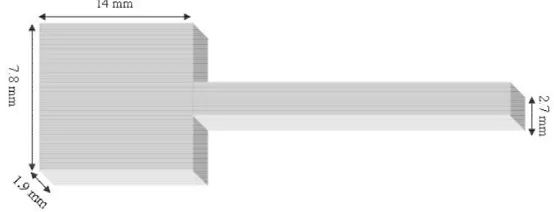
Figure 1. Scheme and dimensions of the used electrode
2.3.2. Lead dioxide synthesis
Before each deposition, the lead electrode was placed in the concentrated HNO3 for 30s and
then rinsed with double-distillated water to remove any surface oxidized species in contact with air. Two graphite cathodes coupled with the prepared lead electrode as anode of the electrochemical cell. The electrodes were put in sulfuric acid solution. Different rates of the pulsed current were applied for oxidizing of the lead substrate. For conversion of the different synthesized species (PbO, PbSO4, PbO.4H2O and Pb4O3SO4·H2O) to lead dioxide, one charge stage was used after
pulse stage. The charge process was performed by constant voltage method (2.48 V) for at least 2 h. After performing charge process, all synthesized species at pulsed current stage were converted to lead dioxide. By applying pulse synthesis and charge steps, nanostructured lead dioxide was directly covered on the surface of the lead electrode (anode) by oxidation of the lead substrate. Morphology and particle size of each sample was determined by Scanning electron microscopy (SEM) and X-ray diffraction (XRD).
For the investigation of cyclic voltammetric behavior of the nanostructured lead dioxide, the prepared electrode was used as a working electrode which coupled with a platinum counter electrode and an Ag/AgCl reference electrode equipped with 1 M H2SO4 solution in double-junction vessel.
Correlation between lead dioxide particle size and cyclic voltammetry parameters including anodic peak current ( a
p
I ), cathodic peak current ( c p
I ), anodic peak potential ( a p
E ) and cathodic peak potential ( c
p
E ) was in MATLAB and Excel software. The initial modeling showed that the linear correlation is comfortable for the system therefore; next studies were performed by Excel.
3. RESULTS AND DISCUSSION
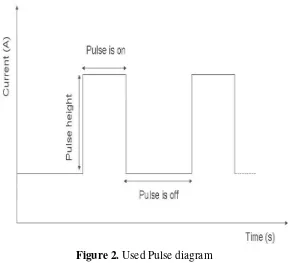
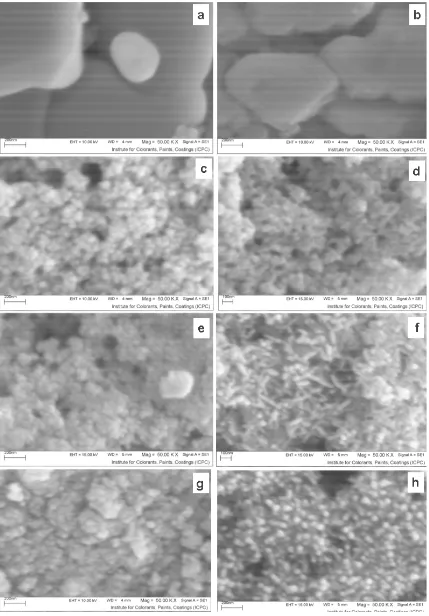
pulsed direct current as it is shown in Fig. 2. According to Fig. 2, there are 4 variable parameters for pulse system including pulse height, pulse time, relaxation time and pulse frequency. The results of our initial experiments indicated the desirability of relaxation time/pulse time ratio of 3 for majority of syntheses; therefore, the ratio of 3 was selected for further experiments. At a constant ratio of relaxation time to pulse time, a pulse system has 2 effective parameters including pulse height (current amplitude) and pulse frequency (controlling of pulse time). Additional to pulse variables, sulfuric acid concentration and solution temperature can affect on the particle size of synthesized lead dioxide. Our initial studies showed that different sized lead dioxide nanoparticles can be synthesized by varying of the above-mentioned four parameters. Therefore, 20 synthesizes were performed in the different conditions by varying of the effective parameters. The morphology and average particle size of each sample were investigated by SEM and XRD. Among of these samples, 8 samples were selected so that average size of their particles was significantly different. Table 1 presents summary of synthesis conditions and average particle size of the selected samples. As it is obvious in Table 1, particles sizes were distributed in the range of 30 to 600 nm. Figure 3 shows the SEM images of the selected samples. As it is seen from Fig. 3, the used samples have different particles in diameter. It was tried to select samples which have same morphology.
Figure 2. Used Pulse diagram
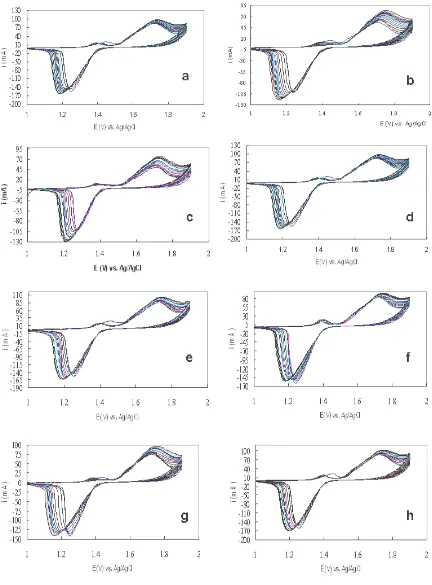
Each sample of Table 1 was studied by cyclic voltammetry in sulfuric acid media. Figure 4 shows the cyclic volatammographs of the selected samples during 15 cycles. Cyclic voltammetry parameters including anodic peak current ( a
p
I ), cathodic peak current ( c p
I ), anodic peak potential ( a p
E ) and cathodic peak potential ( c
p
E ) were calculated for each sample at 15th cycle. The amounts of the
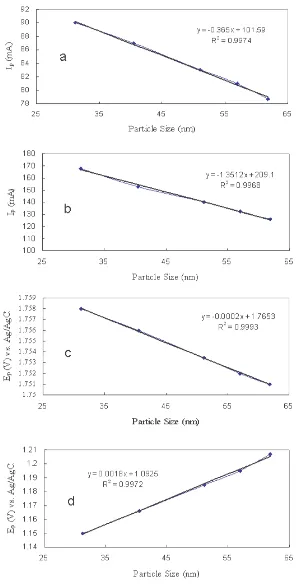
Figure 5. Modeling of cyclic voltammetry parameters versus particle size including anodic peak current ( a
p
I ; a), cathodic peak current ( c p
I ; b), anodic peak potential ( a p
E ; c) and cathodic peak potential ( c
p
Figure 6. Modeling of cyclic voltammetry parameters versus particle size including anodic peak current ( a
p
I ; a), cathodic peak current ( c p
I ; b), anodic peak potential ( a p
E ; c) and cathodic peak potential ( c
p
[image:8.612.158.454.74.660.2]particles.
Table 1. summary of synthesis conditions and average particle size of the selected samples
Synthesis conditions Sample Pulse
frequency (Hz)
Current amplitude (mA/cm2)
Sulfuric acid concentration
(M)
Temperature
(ºC) Average Particle size (nm)
1 12 0.1 4.8 20 600
2 12 0.4 4.5 45 172
3 12 0.2 4.5 45 88.8
4 12 0.1 4.5 45 61.9
5 12 0.4 1 45 57
6 0 0.4 4.8 45 51.13
7 12 0.4 3.7 45 40.5
8 18 0.4 4.8 45 31.2
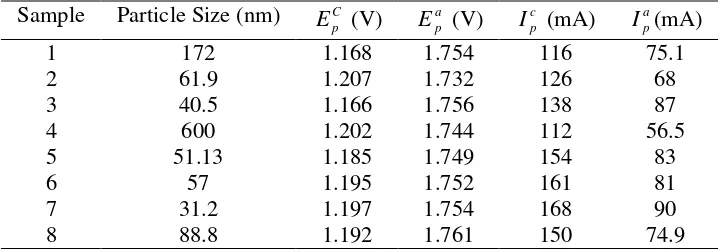
Table 2. The amounts of the calculated parameters from cyclic voltammetry technique Sample Particle Size (nm) C
p
E (V) a p
E (V) c p
I (mA) a p
I (mA)
1 172 1.168 1.754 116 75.1
2 61.9 1.207 1.732 126 68
3 40.5 1.166 1.756 138 87
4 600 1.202 1.744 112 56.5
5 51.13 1.185 1.749 154 83
6 57 1.195 1.752 161 81
7 31.2 1.197 1.754 168 90
8 88.8 1.192 1.761 150 74.9
[image:9.612.126.486.465.591.2]As it is seen in Figs. 6c, anodic (oxidation of lead sulfate to form lead dioxide) peak potential is linearly decreased when particle diameter increased. On the other hand, cathodic peak potential (reduction of lead sulfate to metallic lead) is linearly increased when particle diameter increased. The observed results indicate that the decreasing of nanoparticle size can facilitate oxidation and reduction reactions. The observed results can be related to this that the smaller nanoparticles are more sensitive and reactive than bigger particles.
4. CONCLUSIONS
In summary, lead dioxide nanoparticles can be synthesized directly on the lead substrate in sulfuric acid media by the pulsed current electrochemical method. Cyclic voltammetry parameters ( a
p
I ,
c p
I , a p
E and c p
E ) have good linear correlation with particle size in the nanometric range ( lower than 100 nm). The linear models show that the decreasing of nanoparticle size cases to increase the oxidation and reduction currents. Smaller lead dioxide nanoparticles take part in oxidation and reduction reactions more easily than bigger particles.
ACKNOWLEDGEMENTS
We gratefully acknowledge the support of this work by Abhar Payame Noor University Research Council.
References
1. A. P. Alivisatos, Science 271 (1996) 933. 2. R. S. Berry, Nature 393 (1998) 212. 3. A. D. Yoffe, Adv. Phys. 42 (1993) 173.
4. L. Tosheva, V. P. Valtchev, Chem. Master. 17 (2005) 2494.
5. E. Manova, T. Tsoncheva, D. Paneva, I. Mitov, K. Tenchev, L. Petrov, Appl. Catal. A: Gen 277 (2004) 119.
6. Mao-Sung Wu, Pin-Chi J. Chiang, Jyh-Tsung Lee, Jung-Cheng Lin, J. Phys. Chem. B 109 (2005) 23279.
7. L. Carbone, S. Kudera, E. Carlino, W. J. Parak, C. Giannini, R. Cingolani, L. Manna, J. Am. Chem. Soc. 128 (2006) 748
8. M. Regragui, M. Addou, A. Outzourhit, J. C. Bernede, E. E. Idrissi, E. Benseddik, A. Kachiuane, Thin Solid Films 358 (2000) 40.
9. J. Xie, X. Cao, J. Li, H. Zhan, Y. Xia, Y. Zhou, Ultrason. Sonochem. 12 (2005) 289. 10. Kh. Ghanbari, M. F. Mousavi, M. Shamsipur, Electrochim. Acta 52 (2006) 1514. 11. I. Petersson, B. Berghult, E. Ahlberg, J. Power Sources 74 (1998) 68.
12. H. Andesson, I. Petersson, E. Ahlberg, J. Appl. Electrochem. 31 (2001) 1.
13. H. Karami, M. Shamsipur, S. Ghasemi, M. F. Mousavi, J. Power Sources 164 (2007) 896. 14. D. Devilliers, M. Dinh Thi, E. Mahe ´, Q. Le Xuan, Electrochim. Acta 48 (2003) 4301. 15. M.Y. Hyde, R.M.J. Jacobs, R.G. Compton, J. Phys. Chem. B 108 (2004) 6381.