< •
Brussels,
29.07.1998
COM( 1998) 483
fin'l.l
. { . '
)
!
l
(JOINT RESEARCH CENTRE
1997ANNUAL REPORT
(presented
by
~heCommission) . ·
/
II
}
1-2
FOREWORD
- - '
· Eveiy year the Commission presents an Annual Report for the Joint Research Centre (JRC), describing ttie entire .spectrum of JRC activities during the year and giving information on the human and fin'ancial
· /resources which have been available for the executi~n of the work. · - ·
_,"'-The Annual Report, accompanied by the Observations of the -Board of Governors of the JRC, is transmitted by the Commission to the Council, the European Parliament and the Economic and Social
Committee.
--· The present report covers activities in 1997' and is issued in fulfilment of the reporting requirements set out in the Council decisions on the JRC specific programmes (1995-1998) for the EC (European Comrnunity) 1 and _the EAEC (European Atomic Energy _ Communities)2 respectively, and the · _supplementaiy High Flux Reactor programme 1996-1999 for the EAEC3.
At the same time, the 1997 Annual Report constitutes a contribution to the reporting on Community RTD (Research and Technological Development) activities which is required by Article 130P of the EC Treaty.
2
OJ L361/114 31.12~1994 0 J L 361/132 31,12.1994 OJ L 172/23 11.7;1996
\
TABLE OF CONTENTS
INTRODUCTION ... : ... 5 ·.
THE JOINT RESEARCH CENTRE .. ~ ... : ... : ... : ... 6
OBSERVATIONS OF THE BOARD OF GOVERNORS ... 7
JRC HIGHLIGHTS OF 1997 ... .' ... · ... : ... 9
1. THE JOINT RESEARCH CENTRE IN 1997 ... 12
1.1 INSTITUTIONAL ACTIVITIES: JRC SPECIFIC RESEARCH PROGRAMMES 1.1.1 Institutional Research Activities 1.1.2 Institutional Scientific and Technical Support for Community Policies I 1.2 COMPETITIVE ACTIVITIES ... : ... 19
1.3 JRC INFORMATION DAYS, PUBLICATIONS, AND CONFERENCES ... 21
1.4 HUMAN RESOURCES ... · ... 23
1.5 FINANCES ... : ... 26
' '
· 2.
ACTIVITIES OF THE JRC INSTITUTES IN 1997 ... -... , ... : ... .' ... 272.1 THE INSTITUTE FOR REFERENCE MATERIALS AND MEASUREMENTS ... 27
2.2 THE INSTITUTE FOR TRANSURANIUM ELEMENTS ... 30
2.3 THE INSTITUTE FOR ADVANCED MATERIALS ... : ... : ... 33
2.4 THE INSTITUTE FOR SYSTEMS, INFORMATICS AND SAfETY ... 35
2.5 THE ENVIRONMENT INSTITUTE ... 40
2.6 THE SPACE APPLICATIONS INST1TUTE ... : ... 43
I.
•,
INTRODUCTION
1997 ·was a year of evolution towards· a more customer-driven approach in JRC institutional activities and was characterized by several scientific achievements in various research fields. These achievements .are highlighted in-the report. In particular, it should be mentioned. that, for the firSt time, an innovative form of . radiotherapy was tested on- patients suffering from a very aggre~sive type of brain cancer,· and that
preliminary clinical trials have shown promising results }n treating leukemia with alpha-immunotherapy. ·
During the year, the JRC continued its sucfessful performance as a neutral organisation at the service of the Commission within the frame of the objectives of the Council decisions on the JRC Specific . Programmes for the period 1994-1998. In addition, JRC contributed to the preparation of the 5th Framework Programme with a proposal for the Centre's research in future years. In so doing, the Centre undertook an overall analysis of the demand for S&T assistance from the different customer Directorates General--of the Commission. As a result of this analysis, a stronger emphasis is given to life sciences topics related to consumer protection, anti-fraud, prospeCtive technological studies, sustainable growth and environment high on the Commission's agenda. The new orientation of the Centre is characterize.d by greater emphasis on socio-economic activities, reflecting the general orientation to "Research at the service of the individual and the citizen" given to future European Union's programmes.
A particular effort was also made to improve the image of the JRC through a more determined communications policy~. The visit in September of the Members of the European Parliament from the Committee on flesearch Technological Development and Energy, allowed for the presentation of future strategy and projects and to .highlight the relevance of the Institutes scientific work to the European citizen. Additional efforts were made to ·open the .Centre, in a more user-friendly approach, to the scientific press in
order to render the JRC better known by the general public. '
A new technology transfer initiative was also approved by the Commission in eariy 1998, departing from earlier ideas for the creation of a technology park on ·the traditional model. Such a model was deemed not appropriate for the JRC in view of the need to preserv~ the independence and neutrality associated with its institutional role. Instead, an integrated set of flexible access mechanisms is foreseen through collaborative agreements with users for the sharing of large installations, as well as a technology transfer
capital-fund, a virtual technology park and training and education initiatives. - ·
JRC de~el9ped diverse collaborations with other research organisations, both in Member States and in the· rest of the world, by participating in various networks to ur:idertake different research and development initiatives. Competitive activities, such as participation in shared cost actions and work for external clients, continued to be obtained by JRC at a very significant pace, making the achievement of the four year objectives to appear attainable by t~e end of the programme. · · ·
By capitalising on .its multidisciplinarity, the JRC has maintained a high level of quality· in its activities.· together with a continuous thrust to achieve better overall performance; efforts continued to render the internal organisation more flexible; these will be pursued and-extended in 1998.
THE JOINT RESEARCH CENTRE
The Joint Research Centre is the European Union's scientific· and technical research laboratory, esta_blished by the European Commission, with headquarters in Brussels. Five separate sites, located in Belgium, Germany, Italy, the Netherlands and Spain, house seven different institutes, each with its own· focus of expertise.
These institutes are:
•
IRMM The Institute for Reference Materials and Measurements GEEL (B)
ITU The Institute for Transuranium Elements KARLSRUHE (D)
. .
lAM The Institute for Advanced Materials PETTEN (NL) and ISPRA (I)
ISIS The Institute for Systems, Informatics and Safety ISPRA (I)
El The Environment Institute · ISPRA (I)
SAl The Space Applications Institute ISPRA (I)
'IPTS The Institute for Prospective Technological Studies SEVILLE (E)
· The Joint Research Centre is an integral part of the Community research and technological development system, and has developed over the years special skills and unique tools to provide neutral and Europe-wide expertise, in order to get a better understanding of the links between technology, the economy and society. JRC aims to carry out the specific Community research programmes, decided upon by the Council and funded by the European Union budget; provide customer-driven research as scientific and technical support 'for other Community policies, such as those on the environment, agriculture or nuclear safety; and engage itself ever more successfully in competitive activities, i.e. participating on a par with industry, research organisations and universities of the ·Member States or associated 'countries in Community programmes, including shared-cost actions under the Framework Programmes, or providing paid services to private and. public customers.
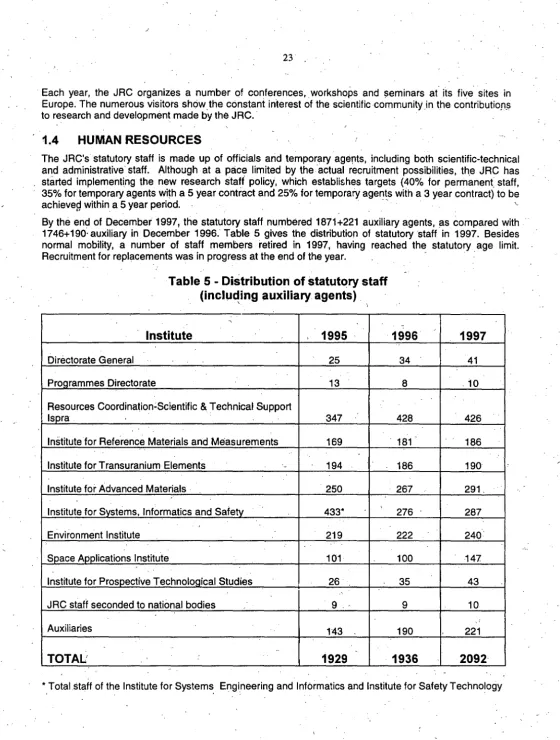
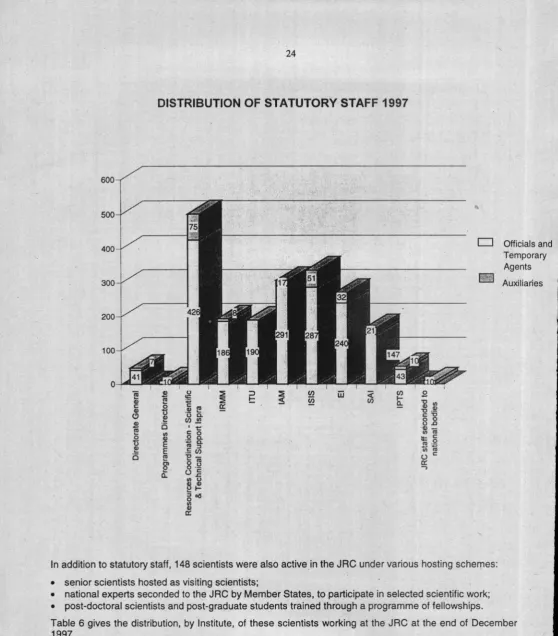
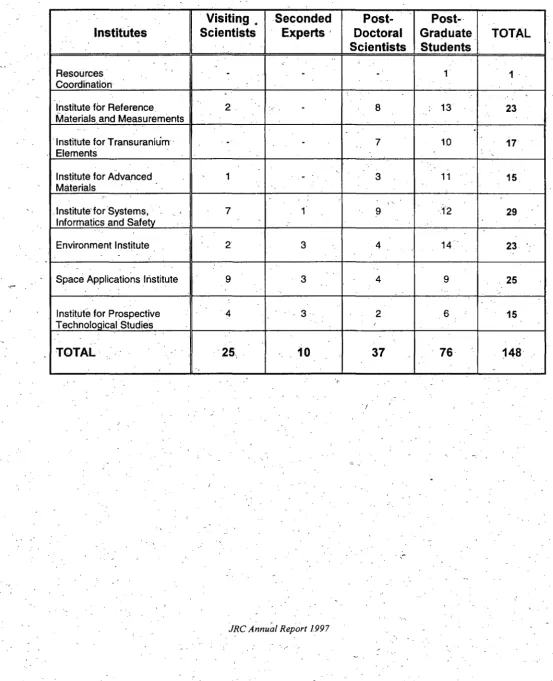
The statutory staff, comprising officials, temporary and auxiliary agents, was 2 092 at the end of-1997.To this number one must add 148 scientists who were active in the Centre and were paid by the JRC _under
various hosting schemes. ·
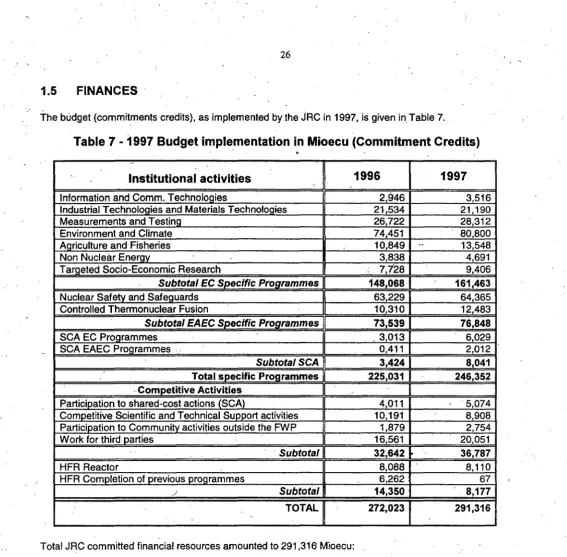
The global financial appropriations committed.by ~he J RC in 1997 were around 291 ,316 Mioecu.
This Annual Report is intended to give a general overview of JRC activities in 1997.
The seven Institutes of the JRC produce their own Annual Reports. Readers may find more details in these Annual Reports. The JRC also publishes numerous scientific reports, presents papers to conferences and in scientific journals,· and organizes workshops, seminars and conferences to disseminate its scientific output.
"oBSERVATIONS BY THE BOARD OF GOVERNORS
ON THE JRC ANNUAL REPORT 1997
I·. :'
. The Board of Governors is pleased to note that ttie p~ogress recorded in the 1996 Annual Report was . sustained ano consolidated during 1997. In particular the progress recorded in fulfilment of the mission of the JRC notably in support to EU Policies. The year saw a series of significant achievements which are highlighted in the present report. Competitive a?tivities too are now an integral part of the JRCs working life - in particular together with its national partners the JRC has demonstrated success in obtaining contracts· for participation in the shared-cost action programmes.
Exploitation_ of Knowledge
The Board of Governors is pleased that the JRC is moving positively to useand develop its knowledge and / expertise for the benefit of the citizens of the European Union. The Board expects the JRC to continue to
adapt its reservoir of knowledge· as a resource for relevant and commercial exploitation. . )
As highlighted in the report, the JRC is collaborating iri the development of an innovative form of radiotherapy which is now undergoing clinical trials, and which could hold out hope for thousands of brain tumour sufferers. The JRC has also been involved in the development of an alpha emitting radioisotope . adapted to a new kind of immunotherapy against cancer which i~f now und-ergoing various clinical trials at.
the Memorial Sloan-Kettering Cancer Centre in NewYo~k and in European hospitals.
Technology Transfer
On a broader front, the JRC is developing a coherent set of initiatives to stimulate technology transfer, collaborative research and networking across Europe. An integrated setof mechanisms is being explored which should allow flexible access to JRC facilities, results, intellectual property, expertise and know-how. This is targeted at companies, large and sm.all, research centres and individuals across Europe. The JRC is also addressing how best to exploit the significant range of intellectual_ property ideas residing in its
various institutes. ·
The Board of Governors sees all of this as a continuous process of trying to create better linkages between the JRC and its clientele in the Membe'r States, and of creating networks and synergies of ~relevant grou.pings for the benefit of E~ropean industry and its citizens. The ~oard intends to follow these
developments closely.
Evolution of the JRC status
In 1996 the Commission . took a significant step when it decided to give the JRC the status of an .. autonomous Directorate General; a step which was welcomed by the Board of Governors.
The Board has always strongly advocated giving the JRC the necessary freedom to play a fuller role and realise its full potential. In 1997 the Board issued a favourable opinion on a draft proposal to endow_ the JRC with legal personality. This move, properly executed, could help to enable the JRC to respond more ·fully to the.competitive environment in which it is increasingly expected to operate.
• • • I . '
Evaluations
.
.
During 1997 the Board continued to assess and supervise the implementation of the recommendations from the detailed and horizontal evaluations of the JRC activities carried out in late 1996 by Professor J.
M.
-Rojo and the Visiting Groups. During 1997, the institutes systematically implemented detailed plans designed to give effect to these recommendations; for example addressing the· spread of activities and how better to focus and conc~ntrate resources. This isto.be·welcomed.
sthFramework Programme
The Board of Governors noted with keen interest the Commission's Proposal· for the 51h Framework
· Programme. The Board has followed and has participated in th~ ensuing discussions at various levels ...:.
addressing the CERT {Committee on Research, Technological Development and Energy) of the European Parliament, preparing a submission to and addressing members of CREST (Scientific and Technical Research Committee), and in developing its own thinking concerning inter alia the compatibility of the programme and the capacity of the Centre. It adopted an Opinion in October 1997 emphasising the JRC mission on the basis of its neutrality, impartility and competencies necessary to underpin European policies. The opinion further stated that the Institutional budget in the 51h Framework Programme should be
similar in real terms to that of the 41h Framework Programme and that a target for the competitive activities
should be in addition 15% of the institutional budget.
The Board believes that, as a result of solid progress made by the institutes over the past 5 years, the JRC is in a much stronger position to contribute to achieving the aims of the 51tl Framework Programme.
Staff
The Board of Governors learned with regret that Director General Jean-Pierre Contzen would leave his position from July 1997. The. Board would like to place on record its debt to him for the excellent . contribution he made to building up the JRC and taking it ·into its new competitive role. The responsibilities of Director General during the second half of 1997 fell on the Deputy Director General, Mr.
Hugh Richardson. ·
_After the ·period covered by the present Annual Report, the Commission in January 1998 selected and appointed Mr. Herbert Allgeier as Director General of the JRC. Mr. Allgeier is well familiar with the JRC which he, in a previous period served as the first Director of the Institute for Prospective Technological
Studies in Seville. ·
Acknowledgements
The Board was pleased to have the opportunity in December 1997 of a detailed exchange of views with Cof'llmissioner Cresson on a range of pertinent issues, including the future orientation of the JRC. The Board.looks forward to continuing a constructive dialogue with her in the future.
The Board would also like to thank all o.f the staff
o"f
the JRC for their services and for the way .they are responding to the new directions being charted out for the JRC .JRC HIGHLIGHTS OF 1997
The JRC's scientific and technical work is mostly interdisciplinary and covers a large number of projects.
The following few selected examples of work from the JRC Institutes illustrate variou~ areas of acti~ity and
varied funding arrangements elaborated for'JRC work in 1997. · ·
THE :apRON. NEI)TRON CAPTURE · THERAPY (BNCT): . EXPLORATION·
·oF
AN
INNOVATIVE tREATMENTFOR ·MALIGNANT BRAIN TUMOURS
,.,_:-.·; ___ :._._,~-;.:-. . . . __ -·;:_ . :_,.:_
...
~,(.~:.·~- . ' ___ ... ;_.·:~···'.: . ' . •·· . . . . .. 'Approxima-tely 15000 J~urri.tiearis are'affected:eacb year by glioblastoma, an extremely malignant type of brain tpmo:l1f:',' ·L,;tt/~·p[C)gres~ 1'1~~: P.f1~il f11i!lde during try~:~~st
.1P.
yeats in thi~ field, and the average survival time ·of patients, has not.charlg~'P Co/l$/d~rabJY, diieJo the }ow effectiveness of. conventional treatmen,ts. An ·innovative forrri ofta'dlotherapyjs·totd!Jfi''fiist time being tested in Etfrope .at the ·HFR reactor in the JRC (F?etten- The Netherlands).;Fivepatieht~
have alreadybeentreatedin the framework of clinical tests.ihat beganin ·october1997.
c\The boroijneOfron
capfu~t!J~fapy'(B'f./C;Tf/S
carried out shorlly after the patifmfs swgical operation in his/her o~n COU(Jtl}'; it replacesponyi:J.~ticma(fadi~thefapy. . The principle of this neW treatrhentis to destroy onlythe.cancerous cells,·leC)ving healt/Jycells unfl,armed. · .· · ·. •. • · .... · . .lttshoJid be. noted
t~<ilhih~:aeJ~Ibpm~iit6rthf~ •th~~PY
is only at the~ta~~
otdlinical trials. The tests should make itpossi/)lfJ,to det~Jjfline the.dptimallfJvetpf irradiation forthe brain-- varying the time, the dose, and the. ·ruJrhberof
exp0Silre~ :Jo:;t~e· i'J~~· llel.(tf9n, beljJ(rl/+
.Jfis
the. first r:nulti-nat{onal clinical application in Europe,Whete;patient~ fr'ohJ. onecEitropeai'J coimtry,are treated in another country by physicians from a third country.· This opehs(hii'Way)o,:organi'ze C/iritcal schemes' that would tise sophisticated and unique facilities to treat . patle~ts siifferlng frorn>this :~ggte~sive ·type of brain cancer. . . . . . .
'ANTI·:.f:UERS.ONNEt.~;fiAINE:DE-TECT/ON
SYSTEMS AND STRATEGIES .. ; ·
1-i1~ 'S~~h~: ;,.~~lid~J~'iis ,;,~,itut~
(sitb
·is .gaining.;e~ogniti~n
as .a
;~cal
centre ior mine detection and. identiflcaiio.fi.lts workis continuing fnclf>s£~:col[a/)Q[8fion'withnational gloups from EU.Member States as well as with 'NGOs; iepresenta.tives from rhine-infected qouotries, and mine clearance teams.SA/ set· up an . putdoor test
:,~nge f~r ·estabti~h(ng
standards· to validate lhe;(fJfforma~ce
o.f mine deteCtion sensors (e.g. metaldetecto!§, gf()unqpi;net(8tif1g rada~ and thermal iflfra~red sensors). This «benchmarking»_action began in October
199f
witha
worl{s'Qop att~ndeqtw
the Qnited Na,tions -Oeparlment forPeace Keeping Operations (UNDPKO),. ·non-gpvemrrientar·organisalion,s, mine clearance organisations, .. mine detector producers (SMEs), national resear(jh prg~nisations, universities, and pth~r Commission services concerned with mine clearance. "(he facility l]as bi:Jen used by various mine-deter;tion sensor producers, and in feasibility studies ofa multi-:Sensor systerry for.
a~ti~pefsonnel mine. detection ancJ identification. The. standards obtained will be applied to subsequent'SA/
~tests, as well as to mine clearance projects supported by the EuropeanCommission in mine-infected countries. . . I .
NETWORK LABORATORY FOR ENVIRONMENTAL SAMPLING
The discovery of the
;~eci'et
iraqin~clear we~pons
programme has led tq. a substantial strengthening of the safeguards system ofthe lfltemational Atomic Energy Agency (IAEA) in Vienna. It became evident, that it is necessary to provide assurance that no undeclared nuclear activities are taking place in $fates having signed the Non-Proliferation Treaty~ ·• . .. · . . · ·.Ultra-sensitive environmental sampling techniques are one of the key new developments to help· to detect the presence of clandestine activities. . · · · . · •. . · · · . . . . · . Following .the agreement signed in July
1997
between the lntemationa/Atomic Energy /J.gency (IAEA) and the JRC, the Institute for ,Transuranf.uin Elem.ents (ITU)has become one, ofthe .;networlclab~ratories for the analysis of environmental ·samples, In this·· way·. ~he Institute is actively contributing to the policy of the European Union to support and strengthe_n the International Atomic Energy Agency'~ •activities in nuclear safeguards. The Institute is also closely collaborating with and providing similar supporl to the Commission's Euratom Safeguards Directorate (ESD) in the area of High Performance Trace. Analysis (HPTA). ESD is. providing financial support for increased automation of measurement technology. .TECHNOLOGY TRANSFER, INTELLECTUAL PROPERTY AND NETWORKING AT THE
JRC
--
:-· ._--·
.
-
-
-
-Developing at the JRC :a coi)erent set of aCtivities to stimulate technolqgy
trn~sier,
collaborative research and networking acri)ss Europe should be an indispensabfe'•·and desirable complement lo institutional activities. A feasibility, study 'was thus _carried out I() define how thls potential can best be exploited, taking into account, however, the need to preser:V_e the institutional role of the JRC. with its inherent neutrality and subsidiarity. As a result,·an
integrated ~·set of-- mechanisms· 'has·-_ been ·proposed -for flexible-· access_ to- JRC facilities, results, intellectual piqperly, ·experlise .·and know-:how, ·, targete9 at companies big and small, res'earch centres and individuals across Europe. The objective is .to_achieve results across Europe and, therefore, to offer flexible options· such as collaboration agreements :and iru1ovation-oriented actions.All
components aim at facilitating aceiess from _geographically dlstantloc_atio.!JswiihoUt havini;i: to invest in.premises on the· JRC sites~ The proP.cised concept is thus a ·radicaldep~rtt.ire :rroin-'trB_ditional ·«technology,parks»,; which aim_ at attracting . investmeritandinclude a'highpropoitionof ptj:Jpeity'developrrient.' : ', ' . . . "; .. ' ' .' ·~ ·~· _:, ·.<!.·. : <:....:' :: . . . . '•. ~ ·:.y.:_, -~ !; : : · · : . --<" ·_·_·. "'-. ::;:,·-~- .: -~- ... ·-=.-. ·.". • •
A
particular effort was madeiri '1997 to 'incr:ease the. ~we~reries$ of the .JRC ·staff. on intellectual property issues. A special leaflet explaining the.f1eed to prote_ctimientii?_nsanrj the means to do so has been distributed-to all staff. This message was:amplified by a poster·«Pateri_t,FIRST, then Publish». P.a'tent cpordinators have followed special training ciJurses and have received aceess to $pecialised patent databases. _ALPHA -IMMUNOTHERAPY: -·
Alpha-immunotherapy
is'~ spin.:.offactivzyofth~·a_asicactinipe resea~h
work carriec[ out·at:the Institute for Transuianium:Eiements -(/TU). ·:It :.bas gained increasing interest and attention. asa
therapy for cancer troatment... _ _ · :·: "; ·.· , · ·. _· _- · · · ·- · · · _ _ · ·The· unique experlise ofthi31nstitute for TraiJ~_uranit~m .Elements (ITU) iri the nuclear field allowed it to prepare an alpha-erriftt(ng radicrisotope,: Bismuth~213, adapted to a new kin(! of immunotherapy against cancer. A by.;product ofni.iclear energy and derived from nuclear waste, Bismuth-213 is easier to handle than other alpha-emitters and decays rapidly into a .non-radioactive substance.
Early clinical trials carried out at the Memorial Sloan-Kettering Cancer Center in New~ York,_ USA, on leukemia patien_ts showed for the first time that alpha-:-P£Jrlicle therapy .could be feasible and appears safe:· no significant
uptake 'of the isotope was registered outside of (he taiflet-areas of bone marrow, liver and spleen . .
Similar studies sponsored :by the European Commission .are being carried out at Nantes, France, and Heidelberg, Germany. The French research focuses
on
an ex vivo bone-marrow purging feasibility study; the German one,- on the oth~rhand, is looking into the treatment of non-Hodgkin's lymphomas (NHL) with in vitro tests. Bismuth-213_ is being studied for cancers such as leukemias and lymphomas as well as for micrometastatic carcinomas. ,IJ.Ipha-parlicle therapy is a/so being investigated with the first in vitro tests for prostate cancer. IT_U is already developing· an additiqnal production of Bismuth-213. in· collai;Joration with the cyclotron department of the Forschungszentrum far Technik und Umwelt in Karlsruhe. - · ·STANDARDS AND NORMS IN THE MATF;RIALS FIELD
.COLLABORATION .ON IMPR.(JVING SAFETY AND :WASTETREATMENT
To support the sa;e eCOf70mlc
'pri>dudti~rl'
of4mergy,.e~tensive:studies
.ori the interaction of neutrons with matte/and experiments were performed using the uriiqu~ accel~ratois_<of the JRC at IRMM. . .· The collaboration with CEA (Coininissariata f·'Energie.Atornigl1e), .on data needed for waste transmutation stuaies; was continued with the a!J.alysis of the meas,ured ctos'Ssecti9ns of99Tc. Measurements of mNp in the resonance region have also been ·started. SimilliJrly, in.the cbntextbf a concerted action for the same goal, . resolution measurements .·of the :inelastic· scattering cross se.ctions .-on 208Pb have been initiated .. The · international. collaboration .on ,th~ Doppleltfroadening ,9fileutr.oif reso;.,an'ces, also with CEA, was continued with measurements on(,J03,
.NPP2''t:Jnd Hg2CI2. 'fo4easu113g data :for in~tallic .U andU0
2 were 'successfully analysed with simple solid ·state,. IJI()del; '. th,e~e, data are iinpoftf!nt }or the calculation of the temperature cdefficient.ofreactivit}t, espeqtalliforhigh fue,l bt.itn..,up. · · . . · · · ·.. '. ';'!.:'
.·.¥,.·:..-.
lndust;y
~orkecrclosely
.\Vith/SIS usi17gth~LEif#e;{?y'n?mi9festfE1cility
(LDTF), firstly to understand better the ·behaviour. of material. at ./lighs1rairi ri1te~ :(in,:pri;JerJ9. :ci:Jlib.rate_)pom,put~r·codes that :simulate crashes). and. secondly to test the cra~li.iesist~nqe..ptnew:Jig~!fr~fg~'t-:rpateija(s;:tn{s;XMII.help·the ind~stry meet European crash-test standards with;~ehi,cles<'th,~t weigh lf~~S. an(j ·'Cons~me":le,ss. :cDqri_ng 1997 new understanding was reached on the behaviour o(coinijlorily used: a;utofijotive. steef.f:.:DTf can ·now be used .also for crash energy absorption studies of. train and helicoptercompolfents. ·. > ! ·• .' . ' . . ' 'THE EUROPEAN INTEGRATED POLLUTION,PRIEVENT/ON AND CONTROL BUREAU
(Eii'pcr:<
, -.;. ' .\; , ·:." . · ·
:
. '-
< : . - ·'The
Europearil~tegrated Poll~tionP~v~ntlon
and Contrpl (EIPf'C)Bureau, was born out of the directive 9f the same name, adopted by the EnvirOnment Council in 'September 199,6. The directive aims at a high level of overaii enJiroilmerital protection forwllich'the objective is•to se{()uthigh standards of practice, based on "Best Available Techniques" (BAT), and to reduce f]missioris apd the imp~c(of such emissions on the environmentas a whole; · · · ·
,.
The institute for Prospective Technological Studies (IPTS) operates .the EIPPC' bureau and is responsible for formulating and distributing the' BA
i
ReferenceDocuin€mts, o;ganizing the exchange of information on the achievement of these standards, ·and,informing :authoritiei(;o{:M,ember,States of-any developments and changes in policy implementation. The Bureau is_ also establishing_a
dedicated electronic information management system to facilitate immediate broadcasts. _ -., . ·During 19g7 the. EIPPC's work, programme ·has concentrated
0~·
the .following four sectors: paper arid pulp; ·cement and lime; iron and steel; and cooling and vacuum systems.1. THE JOINT RESEARCH CENTRE IN 1997
1.1
INSTITUTIONAL ACTIVITIES
1.1.1 INSTITUTIONAL RESEARCH ACTIVITIES
The JRC research activities contribute to several lines of the Community Framework Programmes through the JRC specific programmes 1995-1998:
#The Industrial Technologies and Materials Technologies programme was carried out by the Institute for Advanced Materials (lAM), and encompasses research projects on advanced materials, on surface engineering, and on non-destructive evaluation techniques for the inspection of industrial structural components.·
#The .-Measurements and Testing programme encompassed research projects on reference
measurements and materials - carried out by the Institute for Reference Materials and Measurements (IRMM) -and on the assessment of the reliability of buildings and civil engineering structures, carried . out by the Institute for Systems, Informatics and Safety (ISIS).
11he Environment and Climate programme included: research projects on the atmosphere, soil, water, and waste pollution, executed by the Environment Institute (EI); the setting up of the Centre for Earth Observation (CEO), a decentralized European data management and information system; applications of remote sensing techniques, carried out by the Space Applications Institute (SAl); and industrial hazards studies carried out by the Institute for Systems, Informatics and Safety (ISIS).
#The Non-Nuclear Energy programme consisted of research projects related to materials for clean technologies and to the standardization of photovoltaic devices - carried out by the Institute for Advanced Materials (lAM).
#The Targeted Socio-Economic Research programme included the Science and Technology
Observatory function and prospective work carried out by the Institute for Prospective Technological Studies (IPTS). The essential role of the Institute is to harvest the available contributions from experts, consultants, res.earch organisations and institutes in Member States, and when possible in third countries, in order to analyse, process and integrate them impartially and in depth and, more importantly, to distil clear trends or needs for action in a usable form for decision makers.
#The Nuclear Fission Safety programme encompassed a number of research activities ranging from studies on reactor safety- carried out by the Institute ·tor Systems, Informatics and Safety (ISIS) and the Institute for Advanced Materials (lAM) -to research activities on nuclear safeguards and fissile materials management, executed by the Institute for Systems, Informatics and Safety (ISIS) and the Institute for· Transuranium Elements (ITU). ITU carried out research on the safety of nuclear fuels and actinides.
#The Controlled Thermonuclear Fusion programme (Technology and Safety) was carried out by the · Institute for Systems, Informatics and Safety (ISIS) and the Institute for Advanced Materials (lAM).
Table 1 - JRC Research Activities
FRAMEWORK PROGRAMME LINES IRMM ITU, lAM ISIS El SAl IPTS Industrial Technologies and Materials Technologies
Advanced Materials and Standards for Industrial Innovation X -Surface Engineering for Improved Properties and· for New X
Industrial Applications
-Non-Destructive Evaluation, Testing and Inspection of industrial X . '
Structural Components Measurements and Testing
Prenormative Research in Support of Construction Norms and ·x Standards, includingSeismic Design Codes (Eurocodes)
Measurement and Testing for Car Safety X
Reference Materials X
Reference Measurements X
Environment and Climate
-•
Global ChangeCentre for Earth Observation (CEO) X X
Atmospheric Processes over European Regions X
Remote Sensing for Terrestrial Biosphere (Land Degradation in X the Mediterranean Region, Forest Monitoring)
Remote- Sensing for Marine Biosphere (Nortp _Atlantic Ocean, X Mediterranean Sea)
Advanced Earth Observation Techniques (Environment and X
-Road Conditions Monitoring and Land Mine Detection)
•
Environmental QualityTechniques & Equipment for Environmental Quality Monitoring X
•
Innovative Environmental Technologies-High Perforrt1ance Information Technologies for Environmental X Protection
Natural Hazards I Seismic Research . X -Integrated Environmental Assessment X
Natural Hazards I Flooding, Droughts X
Non-Nuclear Energy
Photovoltaic Energy and Electrici-ty Storage X Materials for Clean Combustion Engines X Targeted Socio-Economic Research
Technology Watch I Technology-Employment-Competitiveness X
Nuclear Safety and Safe'guards
-•
Reactor Safety 7European Netwo"rks on Component Ageing, Inspection X
Techniques & Structural Integrity
Severe Accidents Including Probabilistic Studies X
•
Fuel Cycle Safety ..Basic Actinide Research X
--Safety of Nuclear Fuels X
Mitigation of Long-lived Actinides and Fission Products X
-Spent-Fuel Characterisation in view of Long-Term Storage X
•
Safeguards and Fissile Materials ManagementSafeguards R&D X X ~
Controlled Thermonuclear Fusion
Fluid Separation and Analysis X
Fusion Materials · X
Remote Handling X
Hydrogen Materials Interaction X
A more detailed description of these research activities ii'J 1997, per institute, will be provided in Part Two of this document. However, some significant results . have been highlighted in this first chapter: they illustrate how research has enabled the JRC to contribute to the advancement of science and technology for the benefit of European industry and the well-being of the European.population.
*
*
*
The agreement concluded in 1996 between the Institute for Reference Materials and Measurements
(IRMM) and the International Federation of Clinical Chemistry (IFCC) for the preparation of Certified
Reference Materials (CAMs} has led to projects aimed at preparing bio-medical, environmental and public health protection materials. Such CRMs are needed to achieve accuracy and world wide comparability in clinical diagn~stics of human diseases .. The activity thus supports the improvement of health standards.
Certified- reference materials· of foodstuffs were prepared, to assist ·in the. enforcement of European legislation on quality control. The analysis of cosmetics and a data bank on product safety were· further developed. The production of CAMs of genetically modified organisms was· a topic of particular interest. Negotiations with industry have been concluded and the work has started. These CRMs will enable the validation of analytical methods to be applied in the enforcement of the Regulation on Novel Food (EC
258/97}. .
IRMM focused also on quality health care with, as a new project, the validation of a· 13C isotopic measurement method applicable to the diagnosis of stomach disease by a non-invasive and inexpensive technique. This technique will allow a substantially more cost-effective and less intrusive diagnosis of internal diseases, avoiding the risk of Helicobacter Pylor.i infection, a major cause for ulcers and stomach cancer.
Following the agreement signed in July 1997 between the International Atomic Energy Agency (IAEA) and
the Institute, for Transuranium Elements (ITU), the Institute is now part of the network of laboratories
dealing with the analysis of environmental samples. In this way the Institute is actively contributing to the European Union's policy to support and strengthen the International Atomic Energy Agency's activities in nuclear safeguards. The Institute is also closely collaborating with, and providing similar support to, the Commission's Euratom Safeguards Directorate (ESD) in the area of high performance trace analysis (HPTA). Ultra-sensitive environmental sampling techniques are part of the key new developments to help to detect the presence of clandestine activities. ·
In the field of basic actinide research, the work focused P?rticularly on elucidating the electronic structure of those actinide elements and compounds which attract increasing interest, due to their peculiar chemical and· solid-state properties. Actinide research as a whole is important in the framework of applications on fuel cycle, waste management and nuclear medicine.
The Institute is also actively working on further reducing radiotoxicity in highly active wastes. For the first time, a closed partitioning and transmutation cycle was experimentally demonstrated, and shows that it'is technically feasible to reduce the radiotoxicity of minor actinides by a factor of 100 .
. The Institute was also involved in the development and application of the alpha nuclide Bi-213, used in a promising alpha-immunotherapy against cancer.
The Institute for Advanced Materials (lAM) directed its research towards the development of innovative
processing and testing methods for advanced materials. The emphasis was put on cost efficiency, performance improvement and the potential for standardization, for the benefit of industry competitiveness.
methods (thermo-mechanical fatigue, damage tolerance of ceramic
composit~s.
residual stress), or for the improvement of existing standards. This work helps to develop the European Standards System. · ·· To the beAefit of the environment and human health, lAM continued to develop multiphase Ti-B-MoS2 ·
permanent coatings for cutting tools; this could lead
fO
phasing out in most machining processes the synthetic, lubricating cutting fluids which are non bio-degradable and can produce allergies.The Institute runs the European Network for Inspection Qualification (ENIQ), the Network for Evaluation of Steel Components (NESC) and the Network on Ageing Materials Evaluation and Studies (AMES), In which industries, service vendors, licensing bodies and R&D institutions participate. These networks aim at the· safety and integrity of nuclear fission reactors for the benefit of the. citizen and the environment.
The Institute for Systems, Informatics and Safety (ISIS) contributes to improving safety in industry and . to the well-being of the European
popul~tion.
The .Institute develops and applies its expertise in many fields, including: nuclear safety and safeguarding of nuclear materials; ·industrial and transport safety; seismic protection qf buildings and civil engineering works; natural resource and environment management; support to antifraud measures, cons!Jmer protection, and the preservation of cultural heritage. In 1997, the Institute increased its efforts in the regulation of biotechnology in industry and on theevaluation of the potential risks of transge~ic manipulations. ·
As part of the Centre for Earth Observation (CEO) project, and complementary to the activities of the Space Applications Institute, ISIS cor)tinued to operate and update information systems to promote the use· of satellite-based Earth observation data. The work included: updating the European Wide Service Exchange (EWSE), now recognized as the leading source of information regarding Earth observation in Europe; enhancing the G7 Environment arid Natural Resource Monitoring (ENRM) server by integrating it . with 20 environmental databases across the world; developing· the CEOS Information Locator System (CILS) on behalf of Third World countries; and developing a n~w Internet protocol for remote searching of geospatial databases.
The major part of the Environment Institute (EI) activities provides scientific and technical support to . other Commission Services in designing and implementing European Union policies, in the fields of
environment protection,, and food and drug consumer protection. ·
However, institutional research activities continued in the areas of water and soil, including the use' of AMAL (Advanced Mobile Laboratory) to assess industrial sites and landfill contamination. Four in situ
campaigns ·were performed in ttie subalpine ecoregion to contribute to setting up algorithms ·describing lake water quality and to compare different methods for the determination of phytoplankton pigments.
Research activities have continued with the objectives of developing cost-effective tools for monitoring the . state of European lakes and for the optimization of w~ter-resource planning and management. The harmonization and development of analytical methods which is a basic requirement for the implementation of EC directives on water quality, has continued with AQUACON (Analytical Quality Control) project. .
In the. field of atmospheric processes, research activities were mainly focused on tropospheric ozone, which affects human health, ·Crops and vegetation, and on atmospheric aerosols, which are of major importance in evaluating and predicting climate trends. An understanding of this is a key element in the
design and implementation of EU environmental policy. · ·
The Space ·Applications Institute (SAl) concentrated. on possible applications of remote earth observation, sensing and detection. The Institute's mission is to maximise the use of space systems for the benefit of Europe's policy makers, industry, scientists ahd citizens. SAl's .institutional. research on environment and climate covers the terrestrial and marine biospheres, the lithosphere and the atmosphere, · resulting in a <;:omprehensive approach to uses of earth observation.
Significant progress was made towards establishing standards formine detector performance and sensor validation: these standards wil( be applied to mine clearance projects supported by the European Commission in mine infected countries. The feasibility of a multi-sensor system for anti-personnel mine detection and identification was also studied.
SAl's work on the improved management of natural hazards focused on developing the Space Techniques for Risk Management (STRIM), a joint venture with ESA and the Council for Europe, and on liaison with . the DGXII task force on Natural Hazards. Work on forest fires saw links to the European Community Humanitarian Office (ECHO) and DG VI (Standing Forest Committee on Forest Fires). An inventory of existing techniques and models to assess flood risk and flood damage was completed, and work on drought indicators was developed in co-ordination with the Mediterranean Observatory.
The Institute for Prospective Technological Studies (IPTS) addressed priority subjects in various
technological fields, ensuring a neutral, Europe-wide assessment of scientific and technological change,. It attempts to gain a better understanding of the impact of technology on the socio-economic environment, in particular on employment and competitiveness. The· fields covered were · «Mobility and ·Transport
Research», «Environment»; and «Energy». ·
Through the· ESTO
(Europ~an
Science and Technology Observatory) network, made up of 14 European national S& T organisations which share. the responsibility of providing timely access to information on scientific and technological change of socio-economic relevance, IPTS has direct access to a very large number of specialists. Information obtained through the Observatory contributed to studies and, the "IPTS Report", which is the main "broadcasting" journal of the Institute, directed towards European decisionmakers. ·
The European Integrated Pollution Prevention Control Bureau (EIPPC) was created to support the European Union policy for a high level of overall environmental protection. Its objective is to sef high standards of practice, and to reduce emissions and their impact on the environment as a whole. It. is responsible for the formulation and the distribution of the Best Available Techniques (BAT) Reference Documents.
1.1.2. INSTITUTIONAL . SCIENTIFIC
COMMUNITY POLICIES
AND
TECHNICAL
SUPPORT
FOR
The JRC scientific and technicai.(S&T) expertise was directly available to the various Directorates General of the Commission in order to support the formulation and implementation of Community policies. The Institutional support activities fall under the Community Framework Programmes and accounted for 35% of the JRC's programme activities in 1_997. They were related to the follo!Ving Framework Programme lines: Information Technologies; Environment and Climate, Agriculture and Fisheries, Targeted Socio-Economic Research and Nuclear Safety and Safeguards through the JRC specific programmes 1995,-1998.
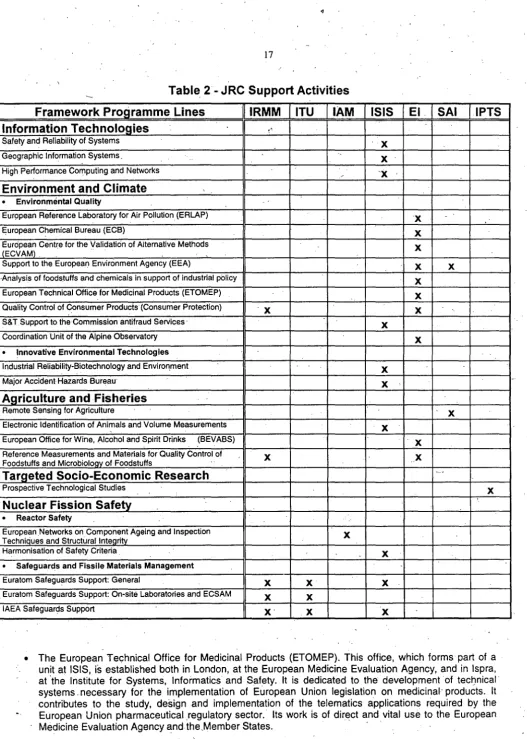
The support activities are customer driven, in fulfillment of impartial and neutral scientific and technical requirements arising from EU directives, decisions of the Commission ~nd the Council, or obligations stemming from the Euratom Treaty. The work carried out in the JRC Institutes is illustrated in Table 2.
In 1997, the three main lines of JRC support activities were:
1. JRC Support for the Environmental Policy, which accounted for 43% of the scientific and technical
support budget.
h
provided DG XI (Environment, Nuclear Safey and Civil Protection) with scientific and- · technical assistance for the implementation of the legislation on chemical pollutants, atmospheric pollution, 'f'/ater quality, chemical waste, industrial risks, and nuclear safety. This work is part of the 5thEC Action Programme in the field of the environment, and includes: ·
Table 2 - JRC Support Activities
Framework Programme Lines
IRMM
ITU
lAM
ISIS
El SAl
IPTS
Information Technologies
(Safety and Reliability of Systems X
Geographic Information Systems. .. X
High Performance Computing and Networks
/
-x
Environment and Climate
•
Environmental QualityEur9pean Reference Laboratory for Air Pollution (ERLAP) X
-European Chemical Bureau (ECB) X
European Cent~e for the Validation of Alternative Methods
(ECVAM) .. X
Support to the European Environment Agency (EEA) X X ·Analysis of foodstuffs and chemicals in support of industrial policy X
European Technical Office for Medicinal Products (ETOMEP) X Quality Control of Consumer Products (Consumer Protection)
·x
X S&TSupport to the-Commission antifraud Seniices· X Coordination Unit of the Alpine Observatory X•
Innovative Environmental TechnologiesIndustrial Reliability-Biotechnology and Environ_ment X
Major Accident- Hazards Bureau X
Agriculture and Fisheries
Remote Sensing for Agriculture X
Electronic Identification of Animals and Volume Measurements X European Office for Wine, Alcohol and Spirit Drinks (BEVABS) X Reference Measurements and Materials for Quality Control of X X Foodstuffs and Microbioloov of Foodstuffs ..
..
Targeted Socio-Economic Research
--·Prospective Technological Studies X
Nuclear Fission Safety
'•
Reactor SafetyEuropean .Networks on Component Ageing and Inspection X Techniques and Structural lnteoritv
Harmonisation of Safety Criteria .
- X
•
Safeguards and Fissile Materials Management· Euratom Safeguards Support: General X X X Euratom Safeguards Support: On-site Laboratories and ECSAM X X
IAEA Safeguards Support
x·
X X• The European Technical Office for Medicinal Products (ETOMEP). This office, which forms part of a unit at ISIS, is established both in London, at the European Medicine Evaluation Agency, and in lspra, at ·the Institute for Systems, Informatics and Safety. It is dedicated to the development of tec~nical·
systems.necessary for the implementation of European Union legislation on medicinal· products. It contributes to the study, design and implementation of the telematics applications required by the European Union pharmac!3utical regulatory sector. Its work is of direct and vital use to the European Medicine Evaluation Agency and the.Member States. ·
• The European Reference laboratory for Air Pollution (ERLAP), which was particularly active in the .. preparation and implementation of EC Directives on ambient air quality, with emphasis on the urban environment and industrial emissions and the harmonisation of measurements in the EU air quality monitoring networks. The laboratory contributed also to the implementation of EC Directives on environmental radioactivity, particularly those related to information exchange with Member States, both under normal conditions and following an accident.
• The European Centre for the Validation of Alternative Methods (ECVAM), which continues to coordinate efforts to promote orderly scientific and regulatory acceptance of alternative methods which are of
importance to the biosciences and which can reduce, refine, or r~place the use of laboratory animal · i
procedures. Its. activities included pre-validation on photoirritancy; skin corrosivity, embryotoxicity, j haematotoxicity, nephrotoxicity and epithelial barriers. Various international studies on in vitro methods
. for vaccine potency and safety testing were also started.
• The Major Accident Hazards Bureau, which supports the "Seveso" Dir.ective on industrial hazards by· operating the Major Accidents Reporting System (MARS) and the Commu.nity Documentation Centre on Industrial Risk. End users include all the actors in the legislative and regulatory process concerned with plant safety, such as national and local authorities, industry and safety practitioners.
• Support services related to the Alpine Observatory (Alpine Convention)., with the aim of producing and/or collecting data, indicators and information characterizing the environmental and socio-economic status of the Alpine region. These data will be useful to the National Communication Centres, for
distribution at national level. · ·
• Institutional support to the European Environment Agency (Council Regulation 1210/90) whose role is to establish and coordinate, in cooperation with the Membet States, a European Environment Information and Observation Network. The jRC contributed mainly in the areas of harmonisation of environmental measurements methods, the intercalibration of instruments, and the development of new
measurement methods and instruments. ·
• Support for the elaboration of methodologies for the EU antifraud policy (UCLAF), via the effective development, introduction and use of new information technologies and data and risk analysis methods.
2. JRC Support for the Common· Agricultural Policy (DG VI), which accounted for 17% of the . Scientific and Technical Support budget. Work is mainly carried out in the following research areas:
• Application of remote sensing to agricultural statistics, with the aim of developing and demonstrating methodologies which can integrate remote sensing data into the collection of statistics for the monitoring of crop acreage and agricultural production in the EC. The main objective being improvement of accuracy, objectivity, homogeneity and time delivery of statistics and forecast on the _ main crops produced in the European Union.
• Monitoring and control of the Common Agricultural Policy: research and development .of new remote sensing techniques allowing improved monitoring and control ·of the Common Agricultural Policy through accurate measurements of areas and identification of specificJand uses and comparison of results with declarations of Member States.
• Implementation of Community wine sector legislation through the operation of the European Office for Wine, Alcohol and Spirit Drinks (BEVABS). The work focuses on the control of adulteration and of the : origins of wine, using nuclear magnetic resonance (NMR) and mass spectrometry (MS) techniques, . with the aim of setting up a European Union Wine Data Bank. Every year some 1 400 wines are investigated, thus updating the wine data bank.
• Research and development of new verification methods and instruments for verification of electronic animal identification, in order to make it possible to take appropriate sanitary measures when needed and to control the market and prevent fraud within the Union. An identification system was under preparation, including electronic identifiers, readers, data acquisition systems, control strategy, data
. . . .
The technical specifications of alarge scale demonstration.project, IDEA, for electronic animal tagging with passive transponders, were prepared. The tagging of. one million animals in various countries of th.e EU is contemplated. The general database structure for the foilow-up of the IDEA project was· defined. Ttie testing of animal identification devices for the develop'ment of standardized test procedures between IDEA and the International committee for Animal Registration (I.CAR) has also
started. . . .
. . .
• Quality control ·of foodstuffs, by supplying certifieq reference materials, providing suitable analytical procedures; and supplying and/or coordinating laboratory intercomparisons , for evaluation and
improvement of existing methods and develoRment of new methods of analysis. ·
3. JRC Support for Nuclear Safeguards ·(Eurato·m Safeguards DG XVII, IAEA Safeguards support
. programme DG I} accounted for 28% of the-scientific and technical support budget.
Most of the work undertaken dealt with the following tasks:
. • ·Completion of the design phase of the on-site laboratory for safeguards analysis at reprocessing plant · at La Hague; routine analysis
of
nuclear-materials samples; examination of the purchase and testing of major equipment, including the development of analytical techniques and their implementation in these on-site laboratories and the training of inspectors in the application of safeguards techniques.' . -. .· \
• Training of inspectors, harmonisation of in~service nuclear safeguards inspection practices, providing state of the art equipment and. reference ~nalyses of nucl~ar materials samples.
• Work on non-destructive assay, 'sealing and identification techniques, surveillance techniques, testing . of safeguards equipment, data information treatment, health physics and training. ·
Other Institutional Scientific and Technical Support activities:
In addition to supporting the three major sectors listed above, the JAG has also drawn on its capacities and on the presence in .Its institu~es of appropriate teams and tools to provide_ the EU with support activities in other institutional scientific and technical fields: · ·
For instance, it has helped D.G Ill (Industry) by working on the safety and reliability of informatics systems needed for other activities. Another. area in which assistance was provided to DG Ill is foodstuff analysis,
·~ · with particular emphasis on toxic materials in contact with food, irradiated food, and the development of· analytical methods r~lated to fertilisers. This work is in support of the industrial policy.
For DG XXIV (Consumer Policy and Consumer Health Protection), the quality control of consumer · prod,ucts was further focused on, with particular attention to trace contaminations in industrial products
.. such· as cosmetics. ·
·Finally, in support of DG XI (Environment, NuClear Safety and Civil Protection) and DG XVI] (Energy), techniques for inspecting ageing nuclear components, in order to prevent any danger to the e'nvironment
were further developed. ·
. 1.2 COMPETITIVE ACTIVITIES
Competitive activities
ar~
in the process of becoming an integral part of the JRC corporate· culture. This change is taking place at a rate compatible with the overall evolution of the JAG mission.The introduction of Third Party Work, towards the end of the eighties, was the !irst step in opening the JRC up to competition. This process reached a new stage with the Fourth Framework Programme· (1994-1998), which aims to gradually introduce a market-oriented, customer•contr~ctor relationship into most JR.C activities. ·The year under review (the third since this new competitive mandate was instituted) has been for the JRC a period of further adjustment to tlie competitive challenge, but has also represented an opportunity for consolidating the achievements of the first two years. . ...
\
\
The market in which the JRC operates since the 1st of January 1995 can be described as falling under two · main categories: the traditional external market, where the JRC conducts research and supplies services under Third Party contracts, arid an enlarged competitive market, wher~ the JRC:
- competes for, and participates in Shared-Cost Actions under the 4th Framework Programme, in
association with partners from Member States; ·
- competes for scientific and technical support work.for other services of the Commission, in response to invitations to tender (also under the 4th Framework.Programme);
- participates, in the context of a competitive approach, in various other Community activities that are put out to tender. ·
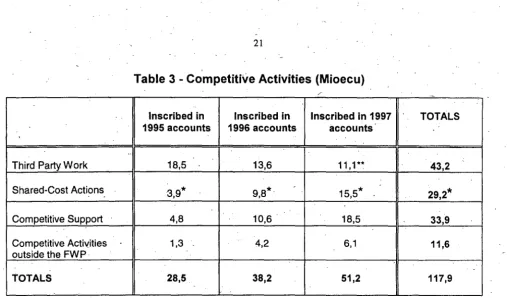
The JRC portfolio of Shared-Cost Actions had reached over 95 contracts in number by the end of December·1997, for a total net earned value of 15,5 Mioecu for the year 1997. Th~se results show that the JRC does have something to offer to research consortia as a source of high-quality research, generally in the form of expertise and facilities that closely match the requirements of many companies and research institutes involved in the Specific Programm·es.
Competitive scientific and technical activities in support of the Commission have continued at a sustained rate in 1997. The total of new contracts won in 1997 is well over 55 with a total contract value of 18,5 Mioecu.
Examples of
srr
support activities where the JRC successfully bid in response to Commission services calls for tender can be found in the following projects:~ in support of the Environment Policy : monitoring of tropical forest ecosystems via remote sensing applications;
- advanced comparative food analyses for industrial and Consumer Protection Policies;
'
- the study and implementation of ways and means for transferring selected technologies--belonging to the Community to targeted industries.
Outside the Framework Programmes, the JRC has gained competitive contracts with a total value of 6,1 Mioecu in 1997. New activities cover, amongst others, studies for the definition of a decision support system for coastal area management.
In addition to· these activities, the JRC continued to perform and obtain new work under contract from Third Parties. New contracts in 1997 totalled 11,1 Mioecu (cumulative actual 43,2 Mioecu over 3 years).
Recent significant contracts being carried out include: ·
- the design, procuremen1 and operation of . an integrated information system delivering network services to a large group of cooperative banks in one member state;
I
Table 3 - Competitive Activities (Mioecu)
/
--Inscribed in Inscribed in Inscribed in 1997 TOTALS
1995 accounts 1996 accounts accounts
--Third Party Work 18,5 13,6 11,1 ** 43,2
Shared-Cost Actions 3,9* 9 a*- 15,5* 29,2*
I
Competitive Support 4,8 10,6 18,5 33,9
Competitive Activities 1,3 4,2 6,1 11,6
outside the FWP
TOTALS 28,5 38,2 51,2 117,9
*"Matching funds" (i.e. for participation by JRC in specific programmes of indirect action) not included.·
** These figures do not include the activities performed under external contract and related to the HFR reactor at Petten (NL), carried out by the Institute for Advanced Materials, which amount to·around 5,5
-·-Mioecu-for 1997. · · ·
'
HFR Supplementary Programme
As reported earlier, the High Flux Reactor (HFR) at Petten is operated by the Commission in accordance with the Euratom/Netherlands agreement of 25 July 1961. On 27 June 1996, the Council adopted a four-year (1996-1999) supplementary research programme to be implemented by the Joint Research Centre for the European Atomic ~nergy Community, concerning the operation of the High Flux Reactor (HFR) at Petten. Under previous supplementary programmes, the activities of the HFR were essentially the outcome of a cooperation between two partners,· Germany and the Netherlands. The new supplementary programme introduced t_Wo- major changes. On the one hand, the cooperation was enlarged to include France, which decided to support the HFR. On the other hand, besides traditional work for the nuclear R&D and industry, it was decided to dedicate a large part of HFR activities to medical applications. On the basis of contractual relationships, the reactor is now a mafor contributor to the production of medical ·radioisotopes for the European radio-pharmaceutical industry. Taking'advantage of the unique possibilities offered by the HFR for the treatment of glioma, a highly malignant cancer pf the brain, a pilot clinical testing of Boron Neutron Capture Therapy (BNCT) was continued within a demonstration project funded by DG · XII. After 10 years of efforts by all the partners working with the JRC in this field, this is the decisive step which will make this promising new therapy available for human treatment.
In 1997,-the HFR went successfully through the in-service inspection of the reactor vessel, an operation which has to take place every 3 years. The number of operational days in 1997 was 280 days, slightly above the planned 273 days, and the occupation level for experiments was on average around 80%.
Another significant achievement is th~ upgrading of o_ne of the beam tubes, used for the measurement of residual stre.ss in materials by neutron diffraction. This technique is applicable to a wide range of· components used in industrial plants, aeronautics, or the car industry.
1.3
JRC INFORMATION DAYS, PUBLICATIONS, AND CONFERENCES
As one of the measures to increase .the visibility of the JRC and stimulate collaboration with industry and the national research and academic world, members of the JRC::: Board of Governors have taken. the initiative in recent years in organizing JRC Information Days in Member ~tates. Following successful
events in Ireland .and Finland last year, the Swedish Member of the Board of Governors, Professor Janne Carlsson, President of the Royal Institute for Technology, Stockholm, took the initiative and a similar event
was held on 25-26 September 1997. · ·
The event, organized by the Swedish R&D Council with the JRC, drew some 140 participants representing industry notably SMEs, research institutes and universities. The programme of the first day in Stockholm was devoted to a presentation of the JRC by the JRC delegation led by Mr. H. Richardson, the Acting Director General, and directors and representatives of all JRC institutes. This was followed by discussion sessions on the individual institutes and their projects of interest to the Swedish participants. During the seco!ld day the JRC participants visited Swedish industry, research institutes; and authorities in the Stockholm and Gothenburg areas. The JRC unit for public relations and publications took care of the dissemination of information.·material to the participants, who also followed JRC presentations on
Internet. ·
The Information days in Swed~n gave rise to further collaboration by Swedish partners in JRC activities. To consolidate this, a Swedish delegation recently paid a visit to the JRC lspra Site. This will be followed up by other schemes for extending JRC collaboration with this Member State, for instance in multi-lateral networks th.rough which ·the JRC conducts much of its ·work.
The JRC offers a vast array of publications ·on
scientifi~
matters, ranging from papers and articles published in scientific magazines, to conference papers, EUR reports, reviews, and information about theJ_RC posted on INTERNET. .
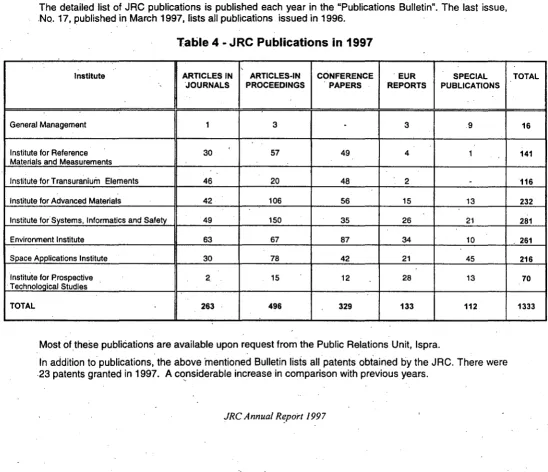
[image:21.576.4.552.352.824.2]In 1997 the JRC published in total around 1 333 papers, and their distribution by Institute is shown in Table 4.
The detailed list of JRC publications is published each year in the "Publications Bulletin". The last issue, .NQ. 17, published in March 1997, lists all publications issued in 1996.
Table 4- JRC Publications in 1997
'
Institute ARTICLES IN ARTICLES-I~ CONFERENCE . EUR SPECIAL .JOURNALS PROCEEDINGS . PAPERS REPORTS PUBLICATIONS
General Management 1 3
-
3 .9Institute for Reference 30
.
57 49 4 1Materials and Measurements
Institute for Transuranium Elements 46 20 48 2
-Institute for Advanced Materials 42 106 56 15 13
Institute for Systems, Informatics and Safety 49 150 35 26 21
Environment Institute 63 67 87 34 10
Space Applications Institute 30 78 42 21 45
InstitUte for Prospective 2 15 12 28 13
· Technoloqical Studies
TOTAL 263 496 329 133 112
Most of these publications are available upon request from the Public Relations Unit, lspra .
. In addition to publications, the above 'mentioned Bulletin lists all patents obtained by the JRC. There were .23 patents granted in 1997. A co_nsiderable increase in comparison with previous years.
TOTAL
16
141
116
232
281
. 261
216
70