White Rose Research Online URL for this paper: http://eprints.whiterose.ac.uk/113597/
Version: Accepted Version Article:
Das, C orcid.org/0000-0002-1454-6210, Read, DJ orcid.org/0000-0003-1194-9273,
Soulages, JM et al. (1 more author) (2017) Static and dynamic scaling close to gelation in chain-polymerization: Effect of reactor type. Macromolecular Theory and Simulations, 26 (3). 1700006. ISSN 1022-1344
https://doi.org/10.1002/mats.201700006
© 2017, Wiley.This is the peer reviewed version of the following article: "C. Das, D. J. Read, J. M. Soulages, P. P. Shirodkar, Macromol. Theory Simul. 2017, 1700006" which has been published in final form at http://doi.org/10.1002/mats.201700006. This article may be used for non-commercial purposes in accordance with Wiley Terms and
Conditions for Self-Archiving.
[email protected] https://eprints.whiterose.ac.uk/
Reuse
Items deposited in White Rose Research Online are protected by copyright, with all rights reserved unless indicated otherwise. They may be downloaded and/or printed for private study, or other acts as permitted by national copyright laws. The publisher or other rights holders may allow further reproduction and re-use of the full text version. This is indicated by the licence information on the White Rose Research Online record for the item.
Takedown
If you consider content in White Rose Research Online to be in breach of UK law, please notify us by
DOI: 10.1002/marc.((insert number))
Article Type (Full Paper)
Static and dynamic scaling close to gelation in chain-polymerization: Effect
of reactor type
Chinmay Das*, Daniel J. Read*, Johannes M. Soulages, Pradeep P. Shirodkar
–––––––––
Dr. Chinmay Das School of Mathematics University of Leeds,
Leeds LS2 9JT, United Kingdom E-mail: [email protected]
Dr. Daniel J. Read School of Mathematics University of Leeds,
Leeds LS2 9JT, United Kingdom E-mail: [email protected]
Dr. Johannes M. Soulages Corporate Strategic Research
ExxonMobil Research and Engineering Company Annandale, NJ 08801, USA
Dr. Pradeep P. Shirodkar Global Chemical Research ExxonMobil Chemical Baytown, TX 77520, USA
–––––––––
1.
Introduction
In many branched polymer synthesis, certain reaction conditions lead to gelation with diverging molar mass of the largest molecule (network formation). Since the seminal analysis of Flory[1]
and Stockmayer,[2] step-growth polymerization (or polycondensation reaction)[3] served as the archetypal example of this sol-gel transition in polymer synthesis. During polycondensation reaction involving monomers with functionality f ≥ 3, the molar mass of the largest molecule diverges as the reaction probability p of the functional groups reaches a certain critical value . Close to the gel point, the resins exhibit universal features in both the static properties[1,2,4] (high molar mass tail of the molar mass distribution follows a power-law with a universal exponent, the weight averaged molar mass diverges as a power of normalized distance to the critical probability) and in dynamics[5,6] (relaxation follows a power-law in time, incorporating
self-similar distribution of modes). The success and simplicity of the statistical description of gelation in polycondensation has often led to usage of the same results in other polymerization processes, often without any real justification.
history of this particular monomer. Different multifunctional monomers acquire different crosslinking probability because of the different available times for the second reaction to happen in the reactor. So far, a systematic study looking at the scaling properties in chain growth polymerization as the gel point is approached has received little attention, mainly limited to free-radical polymerization;[9–12] often with the a priori assumption that the gel point is defined by divergence of the weight-averaged molar mass.
In this paper, we consider copolymerization of a bi and a tetra functional monomers (phrased in terms of ethylene and non-conjugated diene) with a metal catalyst in realistic reactor conditions: in a semibatch reactor and in a continuous stirred tank reactor (CSTR).[13]
Comparing with polycondensation reactions, the ethylene monomer is equivalent to a bifunctional polycondensation monomer in the sense that its incorporation into a growing polymer gives rise to locally linear chain sections. In contrast, the diene comonomer is equivalent to a four-functional polycondensation monomer in that, when all groups are reacted, a branchpoint is formed linking four linear chain sections at their ends. In a batch reactor, all reactants are placed in the reactor at the start of the reaction. In a semibatch reactor, some of the gaseous monomer types are replenished by maintaining a constant gas pressure during the reaction. In the CSTR, all reactants are introduced in the reactor at a constant rate and product resin is removed continuously. We assume ideal mixing for both reactors here. A small amount of long-chain branching (LCB) can drastically alter the flow properties of polymer molecules[14–
16] and is often exploited for better processability when shear thinning or extension hardening
at low rates are desired. In the past few decades, constrained geometry metal catalysts,[17] like metallocenes, have allowed synthesis of polyolefin resins of well-defined structure and comparatively narrow polydispersity. Under certain reaction conditions, vinyl terminated segments (macromonomers) can be incorporated in another chain growing at a later time[18]
with two terminal double bonds at each end) can be used to increase the amount of branching in polyolefin resins.[19,20] Contrary to the single terminal double bond in a macromonomer, copolymerization with diene introduces pendant double bonds at each of the incorporated diene sites. Thus copolymerization with diene provides a route to create much more branched resins than is possible in homopolymerization of olefins.
Understanding and eventually predicting the molecular structures created during this copolymerization can help in optimizing reactor conditions for desired flow properties of the manufactured resin.[16] Equally importantly, such a knowledge would help in avoiding reactor fouling (while often high level of branching is preferred, reaching post-gel conditions in the reactor results in reactor downtime and costly cleanups[21,22] ). Because of its commercial relevance, ethylene-diene copolymerization (often considered along with another comonomer like hexene, octene or propylene to control crystallinity by introducing short-chain branches[23] ) has been the focus of a number of patents[24–28] and publications.[20,29–31] However, the theoretical modeling of this important class of polymerization[32–35] has been mostly limited to calculations based on the method of moments. In this methodology, the branch-formation step couples the equations relating different moments. The set of infinite equations is reduced to a smaller set of equations (often just two), by introducing a closure hypothesis for higher moments, or by assuming some particular form of chain length distribution beyond a certain molar mass. The gel point is identified by considering either the divergence of the weight-averaged molar mass,[34] or the non-existence of any real root for the weight averaged molar mass[32] from the closed equations with untested closure hypothesis. In general, the divergence of molar mass of the largest polymer does not ensure concomitant divergence of the second moment of the molar mass distribution. Close to gelation, the number distribution of molecules scales as a power-law of molar mass with some exponent . The second moment of the molar
mass distribution at gelation is the first moment to diverge only for 2 < ≤ 3. For
the case for all polymerization schemes. Another possible route for calculating the molar mass
distribution is direct numerical solution for the “population balance” of different species in the
reactor (e.g. using finite element methods[36] ). We expect that this method, properly applied, would result in similar conclusions to ours. However, for the particular set of reactions considered in this work, the balance equations would need to track the concentration of species varying with respect to five separate variables (degree of polymerization, number of branches of two different types, number of unsaturated groups of two different types), paying close attention to the tails of the distribution for each variable. We believe that under such circumstances our Monte Carlo approach detailed below is a competitive method, despite the care needed in obtaining a statistically significant number of large molecules.
A route to gain detailed information about the structure of the molecules, which does not suffer from the closure problem of moment-based calculations, is a stochastic simulation of the polymerization process. Two quite distinct stochastic approaches have been developed for generating polymers from a certain reaction scheme. The first, direct stochastic simulation of the rate equations,[37] remains computationally costly with much of the computational cost being used in creating a library of branched structures that would be present in steady state. The second, stochastic Monte Carlo sampling at the segment level,[11,38] starts with calculations of the probabilities for different branching scenarios. Armed with the probabilities of various branching events, one can avoid the necessity of having a library of shapes and can generate representative in silico molecules one at a time. By generating a large ensemble of molecules for given reaction conditions, one can calculate both the structural and flow properties.
sol-gel transition can be viewed as a geometric phase transition and has been modeled as a percolation transition on a lattice.[39,40] In the simplest form of the bond-percolation model,[39] one considers a regular lattice (for example, a cubic lattice) with bonds forming between adjacent lattice points with some fixed probability p. The size of the largest connected cluster diverges at a critical value of probability and the various measurable quantities scale as power-laws close to with exponents that are independent of the details of the underlying lattice. The mean-field description of the classical gelation model[1,2] can be viewed as a percolation on a Bethe lattice (Cayley tree) and, hence, neglects loop formation. During polymerization under usual conditions, except in a narrow window that decreases with the segment length between branchpoints,[41] the influence of loops can be neglected and the
exponents are expected to be mean-field-like. Polycondensation of tri-functional oligomers of increasing length has been used to experimentally observe the exponents changing from the percolation-like to mean-field-like values.[42]
of molecules that remain in the reactor for longer than average duration. All commonly measured low-order moments of molar mass are found to remain finite at the gel-point with the 4-th moment of the molar mass being the first moment to diverge. Associated with these finite lower-order moments are exponents that are different from the classical mean-field model for gelation. Unlike the semibatch case, the exponent describing the power-law region of the molar mass distribution reaches a constant value only very close to the gel-point.
Close to gelation, the shear relaxation modulus decays as a power-law in time.[5,6] The dynamical exponents are not universal and cannot be calculated without additional assumptions about the relaxation dynamics. In Section 4 we use the numerical ensembles of molecules generated from our Monte Carlo simulations to calculate the rheological responses in the melt state using a numerical scheme[43] based on the tube theory of entangled polymers.[44] As the gel point is approached for resins from either of the reactors, the shear relaxation moduli were found to decay as power-law in time (over suitable time range that increases with proximity to the gel point) with very similar exponents. However, the zero shear viscosity or the recoverable compliance for resins synthesized in CSTR shows much gentler increase as the gel-point is approached when compared to the resins synthesized in semibatch reactor.
We end this paper (Section 5) with a detailed discussion on the relevance of our modeling to experimental synthesis of ethylene-diene copolymers, and to other chain-growth polymerization processes.
2. Monte Carlo scheme
2.1. Reaction Kinetics
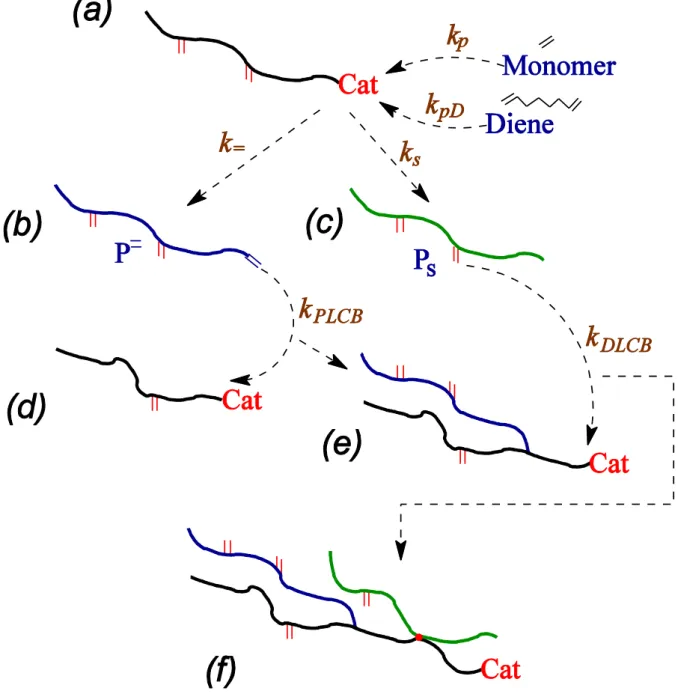
diene.[45] Schematically the reaction steps are shown in Figure 1. An activated catalyst binds to a monomer to initiate polymerization. Ethylene and unreacted diene are incorporated with respective rate constants and . The catalyst detaches itself from the growing chain leaving behind a double bond with rate or a saturated chain end with rate . Molecules having terminal double bond, macromonomers (P=), are incorporated in a growing chain with rate constant . Irrespective of the presence or absence of the terminal double bond, molecules can be incorporated in a growing chain with rate constant at the point where a once reacted diene leaves a pendant double bond. For semibatch reactor, we assume that the catalyst is deactivated at a rate during termination events without assigning any particular mechanism behind this deactivation process.
2.2. Monte Carlo sampling
We consider the population balance equations implied by the rate equations and analytically compute the concentrations of the various species and the probabilities of branch formation. Starting from a randomly chosen reacted monomer in the final product, we use these probabilities to recreate a probable life history of a single molecule. Repeating this a (potentially large) number of times, we generate an ensemble of molecules that collectively follows the analytically determined probabilities of branching.
(1)
Here, is the initial catalyst concentration. We denote the final monomer conversion in the semibatch reactor by and the corresponding time of reaction by .
Once a free diene is incorporated in a growing chain, there is a pendant double bond created. We denote the density of such pendant double bond from once-incorporated diene as . Concentrating on a particular growing chain, we will distinguish between two different kind of diene-induced long-chain branching: (i) the growing chain can incorporate a free diene creating a pendant diene. The pendant diene is incorporated in another chain growing at a later time. We denote this branching event as of type . (ii) the growing chain can incorporate a pendant diene that is already part of another chain grown in the past. We denote this branching event as of type . Chains ending with a terminal double bond can be incorporated in another growing chain at a later time. We term this branching from macromonomer as of type .
The derivation of the Monte Carlo scheme follows closely existing studies[11,38,45] for other polymerization scenarios and we only present an outline of the algorithm in the appendix.
2.3 Simulations
For our numerical explorations, we choose mol/L, L/mol-s,
nontrivial combinations of these parameters determine the long-chain branched structure of the molecules.[47] For both the CSTR and the semibatch reactor, we vary starting from a small concentration (10-6 mol/L) until the point we can no longer reliably estimate the moments of the molar mass or until the level of recursion reaches a predetermined value (see below). For the CSTR case, we consider a number of different mean residence times ( ). Similarly, for the semibatch reactor, we consider a number of different final conversions.
With increasing diene concentration, some of the molecules can become highly branched with many segments. Equivalently, our recursive algorithm can reach many levels of recursion, eventually exceeding the available stack size. For a particular parameter set, if the level of recursion reaches more than 260 during generation of a molecule, we reject the molecule. If two such rejections are found while generating 106 molecules, we consider numerically being close enough to the gel-point and do not proceed any further in increasing the diene concentration. The maximum recursion level of 260 is arbitrarily fixed from the observation that for recursion levels slightly more than this, the memory requirement becomes larger than that is available (2GB) for the particular computer in which simulations were performed. For the semibatch reactor, this exhaustion of available stack is the limiting resource that determines how close we can approach the gel-point.
until we either reach error estimates within our chosen criteria or the number of molecules generated becomes larger than 109 . This provides a second criterion for how close to the gel-point we can go numerically: If with 109 molecules we cannot estimate the fourth moment within 1% relative error, then we discard the simulation. For the CSTR case, this lack of convergence of higher moments decides how close we can approach the gel-point.
Using the highest calculated decade in diene concentration, we use the nonlinear Levenberg-Marquardt algorithm[48] to fit the molar mass moments in a power-law form. The initial values for the critical diene concentrations were set from a linear extrapolation to zero value of the inverse of the moment and the initial values of the amplitudes were set to the value of the molar mass moment at low diene concentration.
For the CSTR case, we also separately considered catalysts that do not allow macromonomer incorporation (i.e. was set to zero with all other rate constants kept the same).
For a single value of conversion in semibatch reactor and a single residence time in CSTR, we use the generated molecules at various diene concentrations to calculate the rheological responses and investigate the dynamical scaling close to gelation.
3. Scaling of molar mass distributions
Concentrating on the pre-gel conditions, we define the closeness to the gel-point as[4]
(2)
, (3)
with an exponent . The cut-off function is a function which is equal to 1 for and which decays rapidly for so that is a characteristic molar mass above which the power-law scaling is suppressed. As gelation is approached, diverges with an
exponent 1/ as
(4) The moments of molar mass
(5)
diverge for all as powers (or logarithmically when ) of and hence as powers of from Equation 4.
In both lattice-percolation ( in 3-dimensions) and mean-field gelation models ( = 5/2), the first (integer) moment to diverge is the weight averaged molar mass , defining
another exponent
(6)
Keeping the possibility open that the first moment to diverge may not be the second one, we define a more general version of this power-law dependence as
(7)
In trying to estimate the exponents, we first calculate different moments for as a function of .
defined gelation as the point where decreases past a value of 3. This, of course, is the value of
below which the weight averaged molar mass diverges, but it does not define the gel point.
3.1 Semibatch reactor
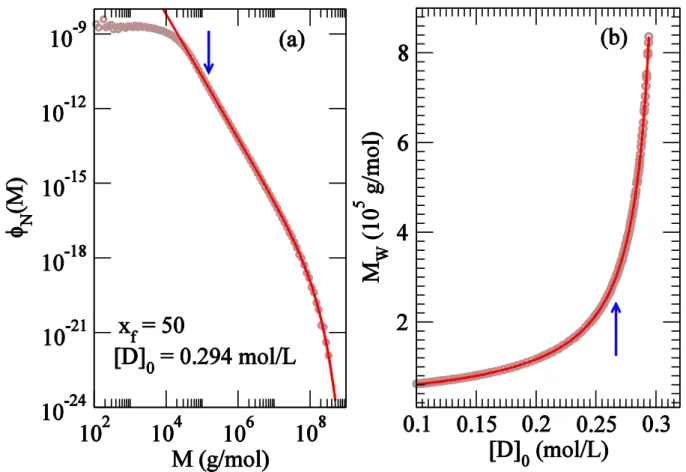
For the semibatch reactor, Figure 2(a) shows the number distribution of molar mass for ( s) and mol/L. The high molar mass end of the data can be described well over three decades with a power-law dependence and an exponential cut-off function characteristic of mean-field theory[4]. The exponent from the fit in Figure 2 is close to the mean-field prediction of 5/2.
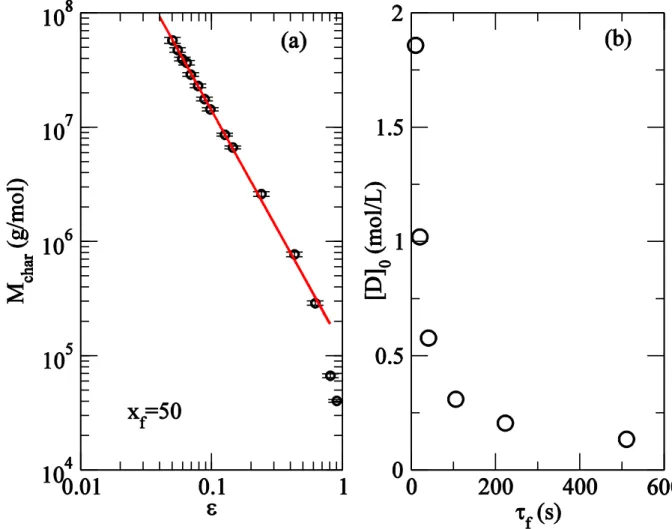
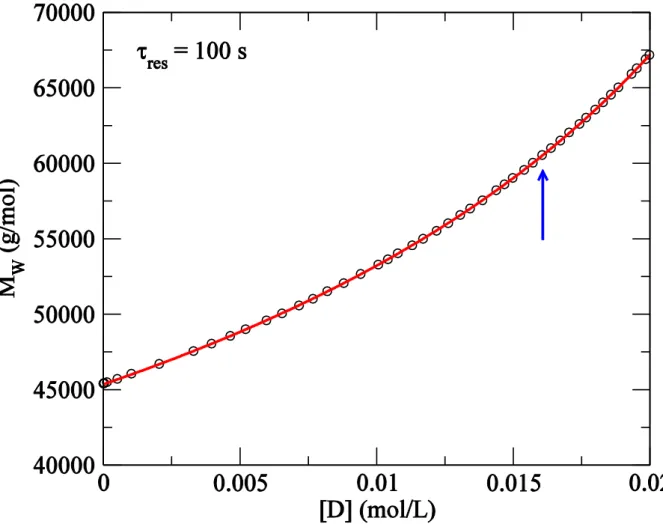
Figure 2(b) shows the weight averaged molar mass as a function of initial diene concentration. The fit gives an exponent for the scaling of that is consistent with the mean-field prediction of 1. The fit also provides estimate of the critical diene concentration at which diverges as = 0.3095(2). Repeating the fitting exercise with the number averaged molar mass (first moment of the molar mass distribution) gives an apparent critical concentration =1.04(2), showing that remains finite as the gel-point is approached. For moments higher than 2, the fitting retrieves the same critical diene concentration as with . In particular, fitting of third moment predicts = 0.3097(2). From fitting the molar mass distribution with mean-field exponential cut-off (Figure 2), we calculated for different values of and hence for different . Figure 3(a) shows the plot of as a function of . The fit gives 1/ = 2.06(2), a value close to the mean-field prediction of 2.
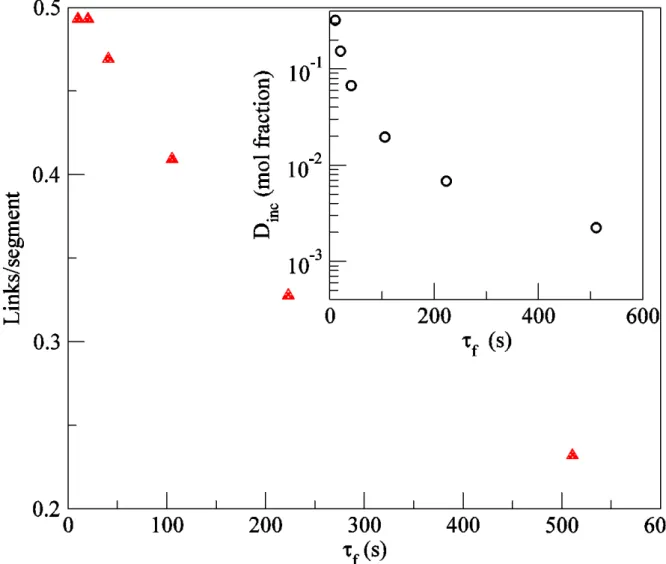
segment generated from initiation until termination) at gelation threshold. To calculate the number of links per primary segment, we start with the concentration of twice reacted diene at a certain conversion
exp exp
(8)
The ratio of and evaluated at gives the number of diene link per reacted monomer. In order to find the average number of links per primary segment at the gel point, we set as the critical value extrapolated from scaling of and multiply by the degree of polymerization of a primary segment . Figure 4 shows that at small conversions, the number of links per primary segment approaches the simple estimate 1/2 as expected for vulcanization of linear polymers. In semibatch reactor, for short reaction times, the macromonomer incorporation plays no role (their density is effectively zero). With increasing reaction time, the presence of three functional macromonomer induced branching reduces the number of diene induced four functional links required to reach gelation. The inset of Figure 4 shows the mole fraction of diene to that of monomer in the resins at gelation, estimated as exp . For short reaction times, most of the incorporated dienes remain as pendant short chains and do not have the possibility of undergoing the second incorporation to produce a long-chain branch. At conversion
( s), for the particular values of rate constants we have chosen in this work, diene occupies 0.002 mole fraction. Even at this high conversion, only about 7% of these incorporated diene contributes to branch-points.
3.2 Continuous stirred tank reactor
weight averaged molar mass can be fit to a power-law to find an apparent critical diene concentration = 0.0373(1) mol/L (Figure 5). However, higher moments diverge before this concentration. Figure 6 shows apparent calculated by fitting power-law divergence to the first five moments of the molar mass. In the figure, we denote the critical diene concentration estimated from the k-th moment as . These estimates of suggest that the first
moment to diverge is the fourth moment at = 0.0237(3) mol/L. The inset of Figure 6 shows the ratios of apparent calculated by fitting a power-law to successive moments of the molar mass for a number of different . For s, the critical diene concentration predicted from the power-law fit for is higher than that estimated from the power-law fit for
.
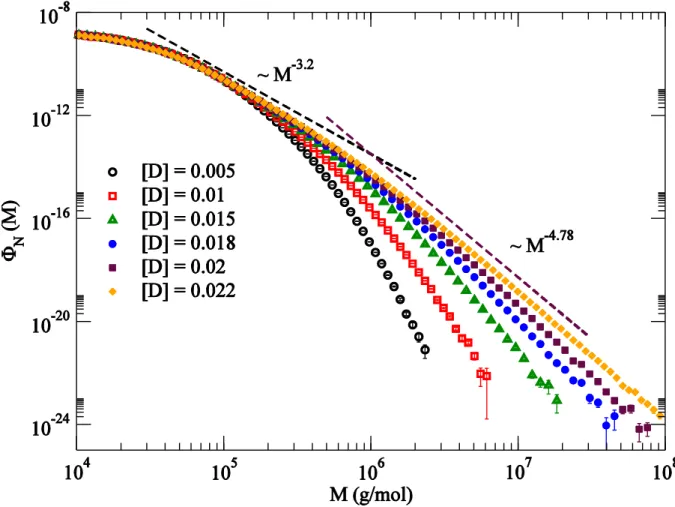
In Figure 7, we plot the number distributions for several different diene concentrations, and with s. In calculating these distributions, we used molecules to resolve reliably at the high molar mass. Even at the highest diene concentration considered, the data looks qualitatively different from the semibatch case (Figure 2). At high diene concentrations, two distinct power-law regions can be identified (indicated by dashed lines in Figure 7) with exponents that depend on .
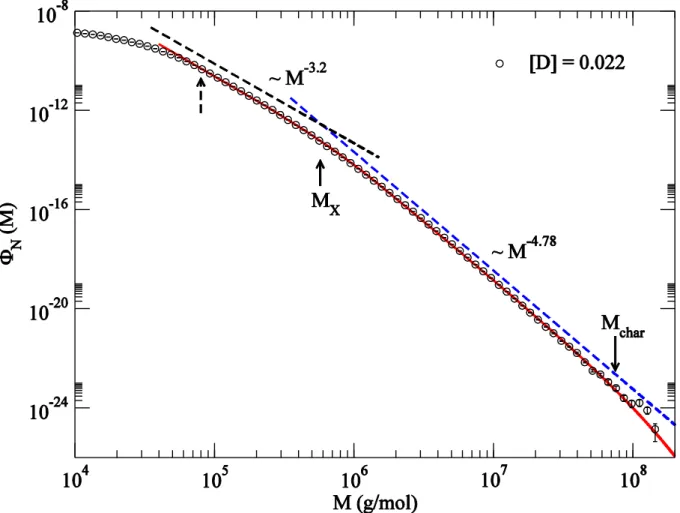
To accommodate two power-law features, we fit a functional form
, (9)
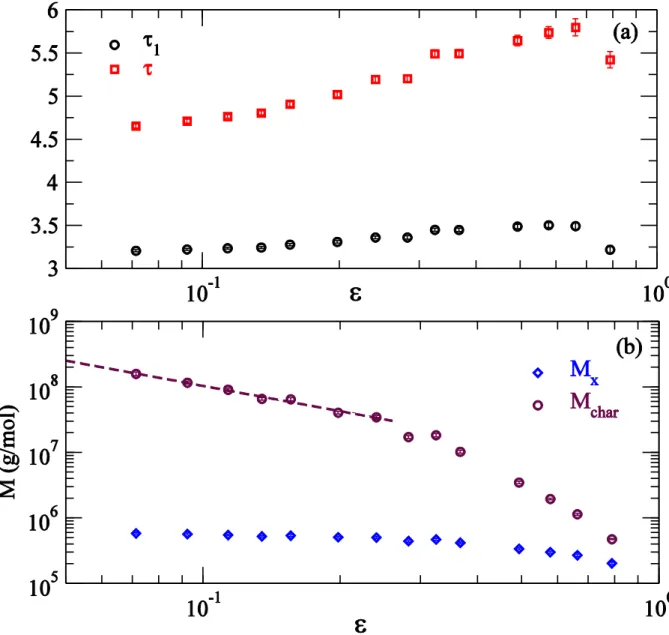
small by a linear form: . The characteristic molar mass diverges as . Both the exponents and vary with . A linear fit from the lowest four data gives the limiting and at the gel-point. Since only the moments of molar mass with diverges, this is consistent with our previous finding in Figure 6 that the first three molar mass moments remain finite at the gel-point.
We can qualitatively understand the long-tailed behavior of by noting the exponential distribution in the residence time of individual molecules. Even in the absence of diene, a strand destined to remain for a long duration in the reactor has higher probability of being reincorporated in another growing strand. Since each of the primary strands are on average of the same length, molecules with longer than average residence times are typically more branched, resulting in higher molar mass from this macromonomer incorporation process. In the presence of diene, any pendant diene in a long-lived segment is almost certain of leading to a long-chain branch and hence to molecules with larger molar mass. To isolate the effect of diene, we have separately simulated the case where macromonomer incorporation is not allowed ( ). This can be achieved experimentally by using a catalyst that has very low reactivity for macromonomers. Figure 10 shows that even without macromonomer incorporation, the first moment of molar mass to diverge is the 4-th moment. Though in this case, the estimates of from the third moment is only about 5-10% higher than that from the fourth moment.
Figure 11 shows the estimated critical diene concentration (estimates from the 4-th moment of
decreases with . When macromonomer incorporation is allowed, molecules residing for a long duration in the reactor also acquire 3-functional branches. This lowers the significantly at large compared to the case where macromonomer incorporation is not allowed. The inset in Figure 11 shows the estimated number of 4-functional branches from diene per primary segment at gelation, estimated as
. Without macromonomer insertion (solid symbols), the gel point is reached when the average number of 4-functional branches (H links) reaches about 0.1 per primary segment. When is large and macromonomer incorporation is allowed, the average number of diene branches required to reach gelation can be extremely small. For s and
L/mol-s, only 0.014 diene induced branches per primary segment on average suffices to reach gelation.
macromonomer incorporation is , when the residence time is large. With macromonomer incorporation, the relative growth in PDI is much lower.
4. Dynamic scaling
Close to gelation, the stress relaxation and rheological responses also follow scaling forms:[5,6,50] the shear stress relaxation function behaves like a power-law in time
(10) and the complex viscosity follows a power-law in frequency ( )
(11) As the gel point is approached, the zero shear viscosity diverges as
(12) and the recoverable compliance diverges as
(13) To calculate the rheological properties of the polymers synthesized via our reaction scheme, we use a computational rheology software[43,51,52] developed by us. With only two main chemistry dependent parameter, viz. the entanglement molar mass and the entanglement time , melt state flow properties of entangled polymers are well described by the ‘tube theory’.[44,53] In a
potential softens (or equivalently the tube diameter increases) as relaxation proceeds.[56] This dynamic dilation couples the relaxation of all the molecules and necessitates numerical schemes[43,55,57] for a polydisperse (both architecturally and in molar mass) melt as in the present case.
For these calculations we assume that and are independent of diene concentration and choose g/mol and s at corresponding to high density polyethylene.[52] With density 0.784g/cc, the chosen is consistent with a plateau modulus of 1.99MPa. Phenomenologically both and have been found to vary systematically with the comonomer content.[58,59] Also ring formation from diene has been implicated in variation of .[45] As our results in the previous section show, one can decrease the amount of incorporated diene by increasing the time of reaction (or residence time). Similarly, longer dienes can avoid ring formation due to the low probability of both the double-bonded ends being in close proximity of the growing chain end at the same time. We use the commonly used values for the dynamic dilation exponent = 1 and the hopping parameter .
We fix for the semibatch case and s for the CSTR case. For a given diene concentration, we generate 106 molecules. For computational efficiency in the rheology
calculation we separate the molecules in 1000 bins equidistant in the logarithm of molar mass, retain a maximum of 10 molecules per bin and reassign the weights of the deleted molecules to the surviving molecules from the same bin. The resulting ensemble was used to calculate the rheological properties. Resampling from the same initial 106 molecules give very similar results. At each diene concentration, we repeat the whole procedure five times to estimate the statistical errors in our results.
Figure 13(a) and (b) respectively show the shear stress relaxation function and the complex viscosity for the semibatch case. The lines indicate power-law behavior fitted
these plots can be used to estimate the exponent u = 0.36(1). The corresponding plots for the
CSTR case in Figure 14(a) and (b) gives the exponent u = 0.48(1). By fitting the zero shear
viscosity and the recoverable compliance in power-law forms as a function of distance to
the gelpoint , we find the viscosity exponent s = 4.53(7) and the recoverable compliance
exponent t = 3.45(5) for the semibatch case (Figure 13c and d), and s = 1.19(8) and t = 2.0(1)
for the CSTR case (Figure 14 c and d). These fits used the data in the 0.2 ≤ ≤ 0.6 range. Even for the lowest value of considered here, shows a power-law decay only in a limited range of time. The exponent u is similar for either reactor reflecting the hierarchical relaxation
of entangled polymers. However, the zero-shear viscosity and the steady state compliance are dominated by stress decay at long times from the relaxation of the largest and most branched molecules. The differences in the high molar mass tail between the resins from the two reactors show up as significantly different exponents for and between the semibatch and the CSTR case. The divergence of for the CSTR case is much slower (with and exponent s = 1.2) than
the semibatch case (s = 4.5). The exponent for the semibatch case is consistent with gelation of
well-entangled polymers with several entanglements between branch-points.[42] The viscosity exponent for the CSTR case is similar to the Rouse model prediction[42] despite the inter-branch point segments being significantly longer than one entanglement. We can reconcile this by noting that due to the presence of trace amount of highly branched molecules the long-time relaxation of the CSTR resins is dominated by constraint release Rouse motion,[60,61] having the same dynamical form as of un-entangled Rouse beads.
5. Discussions
the concentration of diene. We used a Monte Carlo scheme to sample representative molecules and calculate the molecular weight distributions. This method avoids closure approximations used in commonly used moments-based calculations. Unlike most theoretical treatments of gelation,[1,2,7,8,39] consideration of realistic reactor conditions leads to a distribution of reaction
probabilities. In spite of this distribution in the reaction probabilities, the approach to gelation in the semibatch reactor is characterized by diverging weight averaged molar mass with the static exponents identical to the simple theoretical picture that considers a constant reaction probability. The same conclusion was previously reached for the approach to gelation in a free-radical polymerization scheme in a batch reactor.[10] For a diffusion limited lattice model of
free-radical polymerization, the divergence of the weight averaged molar mass was found to hold,[9] albeit with an exponent that differs from polycondensation reactions.
In contrast, the results for the CSTR case fails to fit in this traditional picture: the weight averaged molar mass remains finite at gelation with the first moment to diverge being the fourth moment of the molar mass. The molar mass distribution close to gelation is characterized by a power-law tail with a non-universal exponent that depends on the details of the simulation parameters. Qualitatively, this heavy tail distribution results from a cooperative effect of the residence time of a particular segment and the probability of crosslinking: a segment residing for longer than average times in the reactor has higher probability of crosslinking and the segments to which it crosslinks themselves reside for longer than average times in the reactor. While our calculations only considered a particular class of chain-growth polymerization, such cooperative effect should be active in all chain polymerization schemes in CSTR where some crosslinking reaction step exists (for example, chain transfer to polymer together with termination by combination in free radical polymerization).
experiments[31] by noting that the polydispersity index remains finite as the gel point is approached. However, the possibility that the weight averaged molar mass remain finite across the transition has been overlooked because of the approximate nature of the calculations. Since commonly measured low-ordered molar mass moments remain finite at gelation, predicting the gel-point from experimental data for this system should be difficult.
Experimentally polymer molar mass distribution is traditionally represented as the weight distribution normalized on the axis. In Figure 15, we show the molar mass
distributions for two values of for both the CSTR and the semibatch reactor cases in log-log scale (main plot) and log-linear scale (inset). In the traditional log-linear scale plot, we have omitted the data where , the typical sensitivity of the concentration detector in routine gel permeation chromatography (GPC) measurements. The plots for = 0.79 for both
the CSTR and the semibatch cases are very similar. The = 0.07 curves are representative of
the distributions as gelation is approached. In the semibatch case, a broad distribution with a high molecular weight tail can be easily seen in the linear-log plot; here the approach to gelation
molecules, as predicted by our algorithm, are actually generated.[12] Once generated, there is a possibility that strong flow fields in the reactor may break the molecules apart.[62,63] Nonetheless, the practical point of this paper, that gelation can occur significantly in advance of practical detection, remains.
Appendix
Incorporation of macromonomers
For the CSTR reactor, the concentration of macromonomers, is invariant in time and is given by
(14)
Here, s is the flow rate defined as inverse of the mean residence time . For the semibatch
reactor, depends on the current conversion x and is given by
(15)
Starting from a randomly selected monomer on a segment, in both the reactor types, the mean length to a branch-point from macromonomer incorporation is estimated by comparing the monomer incorporation rate to the macromonomer incorporation rate:
(16)
For a segment growing at time in a CSTR reactor, , the time of creation of the incorporated macromonomer is estimated by considering the survival probability of macromonomers created at times prior to and is given by the cumulative distribution function ( )
Similarly, for a segment growing at conversion in a semibatch reactor, the conversion at which an incorporated macromonomer was created is given by
(18)
Incorporation of unreacted diene
Solely concentrating on the incorporated diene that eventually is incorporated in another growing chain at a later time before the end of the reaction, the mean-length to a branch-point of type for a chain growing at time in the CSTR reaction is
(19)
The time at which this pendant once reacted diene is incorporated in another chain is given from
(20)
For the semibatch reactor, concentration of available free diene depends on the conversion. Concentrating on a segment growing at conversion , mean length to a branch-point of type
is given by
(21)
(22)
Incorporation of pendant diene
The steady state concentration of a once reacted diene in the CSTR reactor is given by
(23)
The mean length to a branch-point created by incorporation of a once reacted diene ( ) is given by comparing the polymerization rate to the incorporation rate of
(24)
Considering a once reacted diene incorporation at a time , the chain on which this diene was first incorporated was created in the past at that follows
(25) In the semibatch reactor, the mean length to a branch-point created by incorporation of once reacted diene depends on the conversion at which a chain is growing and is given by
(26)
The conversion at which this incorporated had reacted for the first time is given by
(27)
A fraction of growing chains terminates with a double bond in either of the reactors. For a chain growing at time in a CSTR and terminating with a double bond, a fraction
exp is reincorporated before the chain exits from the reactor ( ). The time of this reincorporation is decided from
(28)
For the semibatch reaction with a chain ending with a double bond at a conversion , a fraction of chains ending with a double bond is reincorporated before the final conversion . The conversion for such a reincorporation is given by
(29)
Recursive construction of molecules
For both reactors, we start by randomly selecting a reacted monomer (that is attached to some polymer molecule) as it exits the reactor in the CSTR case (arbitrarily chosen origin of time, ), or, at the end of the reaction in the semibatch case ( ). From the exponential residence time in the CSTR,[13] the time at which the selected monomer reacted is given by
exp (30)
The two directions along the chain from the selected monomer are not equivalent because of the flow (in CSTR) or catalyst deactivation (in semibatch). Each segment has a unique end at which the termination event happens (the catalyst detaches). We denote this end the downstream end and the opposite end (at which the initiation starts) is designated as the upstream end. The average number of monomer in the downstream direction for either of the two reactors is given by considering the ratio of the monomer addition rate to that of the termination and is given by
(31)
The average number of monomer in the upstream direction is calculated by considering the ratio of the monomer addition rate to that of initiation, and for the CSTR case, is given by
(32)
and in the semibatch case by
(33)
Because of the high reactivity of metallocene catalysts, the synthesis of a primary segment (from initiation to termination) can be considered as instantaneous. Since the monomers are added at the catalyst site at a constant rate, we generate Flory distributed random numbers from these average values and use them as the upstream and the downstream segment lengths from the randomly chosen monomer.
the mean distance to a branch-point formed by incorporating a pendant diene that was part of another chain, from Equation 24 for CSTR (or from Equation 26 for semibatch) case. The mean distance to a branch-point created from any of these three possibilities is given by
(34)
The distance to the next branch-point is determined by generating a Flory distributed random number with average given by . If this distance is less than the current segment length, a branch-point is considered at that distance. The branch-point is due to macromonomer insertion with probability
(35)
and a similar method is applied for calculating the probabilities of the branch-point being due to incorporation of a free diene or due to incorporation of a pendant diene attached to another chain segment.
Once we have decided on a branch-point, we move our focus recursively to the incorporated branch. If the branch-point is due to macromonomer incorporation, we only need to consider the upstream direction (since macromonomers are grafted at the terminal double bond). We assign the time of synthesis of the grafted macromonomer for the CSTR from Equation 17 or the conversion of the macromonomer from Equation 18. As with the initial segment, we associate a length with this segment and decide if branches should be added.
However, the time is now is determined from Equation 25 for the CSTR or the conversion from Equation 27.
Moving back to our original segment, we repeat our attempt to find the next branch point along the upstream direction from the current branch point. If the next branch point is predicted to lie beyond the end of the current segment, we conclude there are no more branch points and the search for branch points ends.
Starting from the first selected monomer, we follow the same steps along the downstream direction in creating branches. When the next branch-point in the downstream direction is predicted to be outside the segment, we decide if the segment terminated with a double bond and if so, if it was reincorporated in another growing chain at a later time (or conversion) following the probability expressions in the subsection titled “Reincorporation after
termination”. If the chain is decided to have been reincorporated, new segments are grown from the terminal monomer in both the upstream and downstream directions with time given from Equation 28 for the CSTR (or conversion from Equation 29 for semibatch reactor).
Since our attention is always on one segment considered to have grown instantaneously, the algorithm sketched above can be coded in a simple recursive form. Since we start with a randomly selected monomer, the algorithm selects molecules in a weight-biased ensemble, with each of the generated molecules carrying the same weight fraction.
Received: Month XX, XXXX; Revised: Month XX, XXXX; Published online: DOI: 10.1002/mats.((insert number))
[1] P. J. Flory, J. Am. Chem. Soc. 1941, 63, 3083. [2] W. H. Stockmayer, J. Chem. Phys. 1943, 11, 45.
[3] P. J. Flory, Principles of polymer chemistry, Cornell University Press, Ithaca, N. Y., USA
1953.
[4] M. Rubinstein, R. H. Colby, Polymer Physics, Oxford University press, Oxford, 2003. [5] E. M. Valles, C. W. Macosko, Macromolecules 1979, 12, 673.
[6] D. Durand, M. Delsanti, M. Adam, J. M. Luck, Eur. Phys. Lett. 1987, 3, 297. [7] M. Gordon, Proc. R. Soc. A 1962, 268, 240.
[8] C. W. Macosko, D. R. Miller, Macromolecules 1976, 9, 199.
[9] H. J. Herrmann, D. P. Landau, D. Stauffer, Phys. Rev. Lett. 1982, 49, 412. [10] H. Tobita, A. E. Hamielec, Macromolecules 1989, 22, 3098.
[11] H. Tobita, J. Poly. Sc. Poly. Phys. 1993, 31, 1363. [12] H. Tobita, e-Polymers 2004, 4, 878.
[13] O. Levenspiel, Chemical reaction engineering, 3rd ed., Wiley, New York, 1999. [14] D. Yan, W.-J. Wang, S. Zhu, Polymer 1999, 40, 1737.
[15] A. D. Gotsis, B. L. F. Zeevenhoven, A. H. Hogt, Polymer Eng. Sc. 2004, 44, 973.
[16] D. J. Read, D. Auhl, C. Das, J. den Doelder, M. Kapnistos, I. Vittorias, T. C. B. McLeish, Science 2011, 333, 1871.
[17] H. Braunschweig, F. M. Breitling, Coordination Chemistry Reviews 2006, 250, 2691. [18] J. B. P. Soares, A. E. Hamielec, Macromol. Theory Simul. 1996, 5, 547.
[19] P. J. Flory, J. Am. Chem. Soc. 1947, 69, 2893.
[20] E. K. Gladding, B. S. Fisher, J. W. Collette, I & E Chem. Prod. Res. Dev. 1962, 1, 65. [21] K. R. Geddes, US Patent 4957982, 1990.
[22] T. E. Nowlin, F. Y. Lo, R. S. Shinomoto, P. P. Shirodkar, US Patent 5332706, 1994. [23] A. H. Willbourn, J. Poly. Sc. 1959, 34, 569.
[25] P. Meka, K. Imanishi, G. F. Licciardi, A. C. Gadkari, US Patent 5670595, 1997.
[26] A. K. Mehta, C. S. Speed, J. A. M. Canich, N. Baron, B. J. Folie, M. Sugawara, A. Watanabe, H. C. Welborn, US Patent 6300451 B1, 2001.
[27] P. Agarwal, W. Weng, A. Mehta, A. Dekmezian, M. Chang, R Chudgar, C. Davey, C. Lin, M. Chen, G. Richeson, US Patent 20020013440 A1, 2002.
[28] R. P. Duttweiler, M. J. Krause, F. Y. K. Lo, S. M. C. Ong, P. P. Shirodkar, US patent 6509431, 2003.
[29] P. Pietikäinen, J. V. Seppälä, L. Ahjopalo, L.-O. Pietilä, Eur. Poly. J. 2000, 36, 183. [30] E. Kokko, P. Pietikäinen, J. Koivunen, J. V. Seppälä, J. Poly. Sc. Poly. Chem. 2001, 39, 3805.
[31] J. D. Gunzmán, D. J. Arriola, T. Karjala, J. Gaubert, B. W. S. Kolthammer, AIChE J. 2010, 56, 1325.
[32] G. ver Strate, C. Cozewith, W. W. Graessley, J. Appl. Polymer Sc. 1980, 25, 59. [33] M. Nele, J. B. P. Soares, J. C. Pinto, Macromol. Theory Simul. 2003, 12, 582.
[34] R. Li, A. B. Corripio, K. M. Dooley, M. A. Henson, M. J. Kurtz, Chem. Eng. Sc. 2004, 59, 2297.
[35] R. C. S. Dias, M. R. P. F. N. Costa, Macromol. React. Eng. 2007, 1, 440. [36] P. D. Iedema, M. Wulkow, C. J. Hoefsloot, Macromolecules 2000, 33, 7173.
[37] D. Beigzadeh, J. B. P. Soares, T. A. Duever, A. E. Hamilec, Poly. React. Eng. 1999, 7, 195.
[38] H. Tobita, Macromol. React. Eng. 2013, 7, 181.
[39] D. Stauffer, J. Chem. Soc. Faraday Trans. 2 1976, 72, 1354. [40] D. Stauffer, A. Coniglio, M. Adam, Adv. Polym. Sc. 1982, 44, 103. [41] P. G. de Gennes, J. Physique Lett. 1977, 38, 355.
[43] C. Das, N. J. Inkson, D. J. Read, M. A. Kelmanson, T. C. B. McLeish, J. Rheol. 2006, 50, 207.
[44] M. Doi, S. F. Edwards, The theory of polymer dynamics, Clarendon Press, Oxford, 1986. [45] C. Das, D. J. Read, J. M. Soulages, P. P. Shirodkar, Macromolecules 2014, 47, 586. [46] N. J. Inkson, C. Das, D. J. Read, Macromolecules 2006, 39, 4920.
[47] D. J. Read, T. C. B. McLeish, Macromolecules 2001, 34, 1928.
[48] W. H. Press, S. A. Teukolsky, W. T. Vetterling, B. P. Flannery, Numerical recipes in C+ + : The art of scientific computing, 2nd ed., Cambridge University Press, 1992.
[49] H. Tobita, Macromolecules 2004, 37, 585.
[50] C. Das, D. J. Read, M. A. Kelmanson, T. C. B. McLeish, Phys. Rev. E 2006, 74, 011404. [51] bob2.5. http://sourceforge.net/projects/bob-rheology, 2012.
[52] C. Das, D. J. Read, D. Auhl, M. Kapnistos, J. den Doelder, I. Vittorias, T. C. B. McLeish, J. Rheol. 2014, 58, 737.
[53] P. G. de Gennes, J. Chem. Phys. 1971, 55, 572. [54] T. C. B. McLeish, Europhys. Lett. 1988, 6, 511. [55] R. G. Larson, Macromolecules 2001, 34, 4556.
[56] G. Marrucci, J. Polym. Sci., Polym. Phys. Ed. 1985, 23, 159.
[57] E. van Ruymbeke, C. Bailly, R. Keunings, D. Vlassopoulos, Macromolecules 2006, 39, 6248.
[58] L. J. Fetters, D. J. Lohse, C. A. García-Franco, P. Brant, D. Richter, Macromolecules 2002, 35, 10096.
[59] X. Chen, F. J. Stadler, H. Münstedt, R. G. Larson, J. Rheol. 2010, 54, 393. [60] J. Klein, Nature 1978, 271, 143.
[61] J. L. Viovy, M. Rubinstein, R. H. Colby, Macromolecules 1991, 24, 3587.
Figure 2. (a) Number distribution at and mol/L. The fit line has
the functional form exp for which data above g/mol (indicated by the arrow) was used. (b) Weight averaged molar mass as a function of for . The line shows the fit . The data for
Figure 3. (a) diverges as a power of . The line is a fit . The
Figure 6. Critical diene concentration estimated from power-law fit of the -th moment of the molar mass for resins generated in CSTR conditions with s. Inset: Ratio of critical diene concentrations estimated from successive molar mass moments as a function of
Figure 7. Number distributions for the indicated diene concentrations in CSTR with
Figure 8. Number distribution (symbols) with mol/L and s in CSTR. The solid line is a fit of the form Equation 9 with , ,
Figure 9. (a) Exponents that describe the number distribution in the intermediate molar mass ( ), and in the high molar mass ( ) regions as a function of closeness to the gel-point in CSTR with s. (b) The cross-over molar mass between the two power-law regions , and the characteristic molar mass as a function of . The dashed line is a fit of the
Figure 12. Polydispersity index as a function of . Square symbols are PDI without diene, circles are extrapolated values at critical diene concentrations corresponding to the relevant
. Open symbols are from simulations with L/mol-s, closed symbols are from simulations with . Inset: Ratio of PDI at critical diene concentration to diene-free reactions. Open and closed symbols respectively refer to the case with and without macromonomer incorporation. The dashed line is a fit for data of the form
Figure 15. Molar mass distributions at fixed separations from gelation at =0.79 and =0.07 for CSTR (lines) and semibatch (symbols) reactors. Inset: Molar mass distribution in traditional linear-log scale.
Table of content entry
Copolymerization of two and four functional groups in semibatch reactor leads to diverging weight averaged molar mass and zero shear viscosity with an exponent -4.5 as gelation is approached with increasing amount of four functional groups. In contrast, in
continuous stirred tank reactor, the number, weight and z-averaged molar masses remain finite and viscosity diverges with an exponent -1.2.
Chinmay Das*, Daniel J. Read*, Johannes M. Soulages, Pradeep P. Shirodkar
Static and dynamic scaling close to gelation in chain-polymerization: Effect of reactor type