This is a repository copy of
How sharp is the transition into the N=20 island of inversion for
the Mg isotopes ?
.
White Rose Research Online URL for this paper:
http://eprints.whiterose.ac.uk/128886/
Version: Published Version
Proceedings Paper:
Fernández-Domínguez, B., Pietras, B., Catford, W N et al. (34 more authors) (2018) How
sharp is the transition into the N=20 island of inversion for the Mg isotopes ? In: How sharp
is the transition into the N=20 island of inversion for the Mg isotopes ? .
[email protected] https://eprints.whiterose.ac.uk/ Reuse
This article is distributed under the terms of the Creative Commons Attribution (CC BY) licence. This licence allows you to distribute, remix, tweak, and build upon the work, even commercially, as long as you credit the authors for the original work. More information and the full terms of the licence here:
https://creativecommons.org/licenses/
Takedown
If you consider content in White Rose Research Online to be in breach of UK law, please notify us by
PAPER • OPEN ACCESS
How sharp is the transition into the N=20 island of
inversion for the Mg isotopes ?
To cite this article: B. Fernández-Domínguez et al 2018 J. Phys.: Conf. Ser. 966 012020
View the article online for updates and enhancements.
Related content
Shell Model Far From Stability: Island of Inversion Mergers
F. Nowacki and A. Poves
-Deformed halo nuclei probed by breakup reactions
Takashi Nakamura
-The nuclear shell model toward the drip lines
A Poves, E Caurier, F Nowacki et al.
1
Content from this work may be used under the terms of theCreative Commons Attribution 3.0 licence. Any further distribution of this work must maintain attribution to the author(s) and the title of the work, journal citation and DOI.
Published under licence by IOP Publishing Ltd
1234567890 ‘’“”
12th International Spring Seminar on Nuclear Physics IOP Publishing
IOP Conf. Series: Journal of Physics: Conf. Series 966 (2018) 012020 doi :10.1088/1742-6596/966/1/012020
How sharp is the transition into the N=20 island of
inversion for the Mg isotopes ?
B. Fern´andez-Dom´ınguez1,2,3, B. Pietras1, W.N. Catford4, N.A. Orr2,
M. Petri1,5,6, M. Chartier1, S. Paschalis1,6, N. Patterson4, J.S. Thomas4, M. Caama˜no3, T. Otsuka7, A. Poves8, N. Tsunoda7, N.L.
Achouri2, J-C. Ang´elique2, N.I. Ashwood9, A. Banu10,1, B. Bastin2,
R. Borcea11, J. Brown1, F. Delaunay2, S. Franchoo12, M. Freer9, L. Gaudefroy13, S. Heil5, M. Labiche14, B. Laurent2, R.C. Lemmon14,
A.O. Macchiavelli15, F. Negoita11, E.S. Paul1, C. Rodr´ıguez-Tajes13, P. Roussel-Chomaz13, M. Staniou11, M. Taylor6,2, L. Trache10,11, G.L.
Wilson4
1
Department of Physics, University of Liverpool, Liverpool, L69 7ZE, UK
2LPC-Caen, IN2P3/CNRS, ENSICAEN, UNICAEN et Normandie Universit´e, 14050 Caen
Cedex, France
3Universidade de Santiago de Compostela, 15754 Santiago de Compostela, Spain 4
Department of Physics, University of Surrey, Guildford GU2 5XH, UK 5
Institut f¨ur Kernphysik, Technische Universit¨at Darmstadt, 64289 Darmstadt, Germany 6Department of Physics, University of York, Heslington, York YO10 5DD, UK
7
CNS, University of Tokyo, 7-3-1 Hongo, Bunkyo-ku, Tokyo, Japan
8Departamento de Fisica Te´orica and IFT-UAM/CSIC, Universidad Aut´onoma de Madrid,
E-28049 Madrid, Spain
9School of Physics and Astronomy, University of Birmingham, Birmingham, B15 2TT, UK 10
Cyclotron Institute, Texas A&M University, College Station, TX-77843, USA 11
IFIN-HH Bucharest-Magurele, RO-077125, Romania 12
IPN-Orsay, 91406 Orsay, France 13
GANIL, CEA/DRF–CNRS/IN2P3, BP 55027, 14076 Caen Cedex 05, France
14Nuclear Structure Group, CCLRC Daresbury Laboratory, Daresbury, Warrington WA4
4AD, UK
15Nuclear Science Division, Lawrence Berkeley National Laboratory, Berkeley, California
94720, USA
E-mail: [email protected]
Abstract.
The N=20 island of inversion is an excellent playground for testing shell model calculations. The Mg chain is a region of shell evolution still far from being well understood. In this paper we present preliminary results of a single-neutron knockout experiment from31Mg performed at GANIL to study the structure of 31
Mg and of the core 30
Mg. The level scheme and longitudinal momentum distributions were mesured and spectroscopic factors were deduced. Negative parity states arise at low energy and the spectroscopic factor for the isomeric 0+
2 in 30
Mg was determined to be smaller than foreseen in the standard picture. The preliminary
1 Present address: Department of Physics and Astronomy, James Madison University, Harrisonburg, VA 22807,
USA 2
2
experimental results are compared to state-of the art shell model calculations revealing opposed interpretations.
1. Introduction
The N=20 island of inversion is a region of sudden changes in shell structure where intruder configurations become dominant in the ground state wave function of several neutron-rich nuclei with atomic numbers in between Z=10 and Z=12. Over the past years, large-scale shell model calculations have been very succesful in describing the main properties of the nuclei around this region [1] and predicting new islands of inversions [2]. However, just recently a newly developed interaction, EEdf1 [3], that reproduces as well most of the electromagnetic properties of the nuclei around the N=20 region, predicts an increase of particles in the pf shell and holes in the sd shell over the Z = N = 20 shell gap. In particular along the Mg chain, nuclei at the border of the island of inversion are ideal to investigate the enhancement of np−nhexcitations
across the N=20 shell gap. Energy levels are important but overlap functions are key inputs in the calculations. Therefore, a single-neutron knockout experiment from 31
Mg was performed at GANIL to study the structure of 31
Mg and of the core30 Mg.
2. Experimental details
The experiment was performed at the GANIL coupled cyclotron facility. A primary beam of36 S incident on a12
C production target was used to produce a cocktail beam, analysed and purified using the SISSI device and the ALPHA spectromer [4]. The secondary beam of 31
Mg at∼ 55
MeV/u impinged on a 171 mg/cm2 12
C target placed at the entrance of the SPEG spectrometer [5]. An array of 8 segmented EXOGAM clovers of high purity Ge detectors [6] surrounded the target. The array was arranged in a configuration with two rings at 45◦ and 135◦ polar angles
with four clovers detectors each. The photopeak efficiency of the array was measured to be 3.3% at 1.3 MeV and the energy resolution, after Doppler correction, was 2.7%.
3. Results
The add-back reconstructed and doppler correctedγ-ray spectrum detected in coincidence with 30
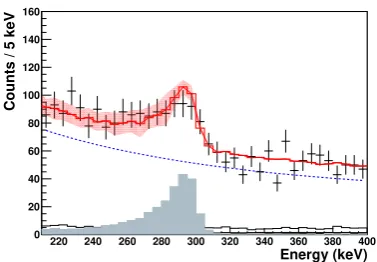
Mg is shown in Fig. 1. Transitions previously reported [7, 8, 9, 10] can be clearly seen at: 799, 954, 985, 1482, 1816, 1898, 1975 and 3534 keV. A weak transition not reported before at 1660 keV is also visible. Furthermore, a peak at∼300 keV corresponding to the known isomeric 306γ-ray,
coming from the 1789 keV level and decaying into the 1482 keV 2+1 state, is also observed. This state was reported to have a half-life of 3.9(5) ns based on fast timing measurementsβγγ(t) [11]. The line shape shown by the forward energy spectrum in Fig. 2 reflects the isomeric nature of the state and agrees well with the reported value of the lifetime. The number of counts below each transition Nγ, was obtained in a statistical fit of the γ-ray spectrum to GEANT4 simulations. The γ-ray intensities for each transition, Iγ, are then calculated from the ratio of the efficiency corrected photopeak counts N′γ, and the number of residual knockout cores. Branching ratio for the direct population of each level, b, has been obtained after feeding correction, assuming the level scheme proposed in Fig. 4.
For the isomeric state, the branching ratio was deduced only from the E2 radiative contribution since the branching ratio between the E0 and E2 transitions is shown to be small
∼ 1.4 10−2, as deduced from the partial lifetime of the E0 decay (τ(E0)=396 ns) measured by
Schwerdtfeger et al. [12]. Besides, the non-radiative contribution of the E2 transition was found to be negligeable (internal conversion coefficient αtot=9.1 10−4
3
1234567890 ‘’“”
12th International Spring Seminar on Nuclear Physics IOP Publishing
IOP Conf. Series: Journal of Physics: Conf. Series 966 (2018) 012020 doi :10.1088/1742-6596/966/1/012020
Energy (keV)
1000 1500 2000 2500 3000 3500 4000
Counts / 8 keV
0 100 200 300 400 500 600 700 Energy (keV) 900 950 1000 1050
Counts / 5 keV
0 50 100 150 200 Energy (keV) 1600 1800 2000
Counts / 8 keV
[image:5.595.79.276.119.256.2]0 50 100 150
Figure 1. The γ-ray energy spectrum (Eγ > 500 keV) compared to Geant4 simulated line shapes for each transition (black lines). The total fit (red line) includes also a continuum background of an exponential function (blue dashed line), where the slope and scale parameters are left free to vary in the fit.
Energy (keV)
220 240 260 280 300 320 340 360 380 400
Counts / 5 keV
[image:5.595.312.501.123.254.2]0 20 40 60 80 100 120 140 160
Figure 2. The γ-ray energy spectrum
(Eγ < 500 keV) reconstructed using the
post-target velocity (βpost = 0.303) and using only the EXOGAM clovers in the forward array owing to a higher sensitivity to the lineshape. The grey histogram shows a simulated isomeric transition at ∼ 300
keV with a lifetime of 3.9(5) ns
8600 8800 9000 9200 0
0.1 0.2
l=0 g.s.
8600 8800 9000 9200 0 0.05 0.1 0.15 l=2 = 1482 x E
8600 8800 9000 9200 0
0.1 0.2
0.3 Ex= 1782 l=0
8600 8800 9000 9200 0 0.05 0.1 0.15 0.2 l=1 l=2 = 2467 x E
8600 8800 9000 9200 0 0.05 0.1 0.15 l=2 l=3 = 3298 x E
8600 8800 9000 9200 0 0.05 0.1 0.15 l=1 l=2 = 3457 x E
8600 8800 9000 9200 0 0.1 0.2 l=2 l=1 = 3534 x E
8600 8800 9000 9200 0 0.05 0.1 0.15 0.2 l=2 l=3 = 4252 x E (MeV/c) || P
N (arb. units) / 30 (MeV/c)
(MeV/c)
||
P
N (arb. units) / 30 (MeV/c)
(MeV/c)
||
P
N (arb. units) / 30 (MeV/c)
(MeV/c)
||
P
N (arb. units) / 30 (MeV/c)
(MeV/c)
||
P
N (arb. units) / 30 (MeV/c)
(MeV/c)
||
P
N (arb. units) / 30 (MeV/c)
(MeV/c)
||
P
N (arb. units) / 30 (MeV/c)
(MeV/c)
||
P
N (arb. units) / 30 (MeV/c)
Figure 3. Experimental momentum distributions (solid marker) compared to eikonal-model calculations with ℓ= 0, 1, 2 and 3 (red solid, blue short-dashed, green dot-dashed, and brown long-dashed lines, respectively) for the states in 30
Mg. The theoretical lineshapes have been convoluted with the experimental resolution and are normalized to the best fit of data.
each state is given by the product of the branching ratio and the inclusive cross section (σinc = 90(12) mb).
[image:5.595.124.476.386.576.2]4
the resolution of the spectrometer and are compared in Fig. 3 to the experimental results. The experimental shape of the ground state distribution is reproduced with as-wave, whereas the first excited state at 1482-keV is in agreement with a l=2 value. Despite the low statistics of the momentum distribution gated on the isomeric transition at 300-keV, the narrow shape is consistent with an assignment of l=0. The momentum distribution for the state at 2467-keV was obtained applying a narrow gate on the high-energy side of the 985-keV photopeak and the shape is compatible with l=1 since χ2
ν(l = 1) = 1.0 whereas χ2ν(l = 2) = 1.6. For the state at 3298-keV, the distribution is broad and in best agreement with a l=3 value (χ2ν(l = 3) = 1.9 and χ2ν(l= 2) = 2.8). The distribution gated on the 1975-keV transition is best described by a l=2 value (χ2
ν(l= 2) = 0.8 andχ2ν(l= 1) = 2.2) and that to the state at 3534-keV is consistent with l=1 and l=2 (χ2ν(l = 1) = 1.9 and χ2ν(l = 2) = 2.0). The level at 4252 keV exhibits a broad distribution compatible with a l=3 orbital (χ2
ν(l = 3) = 1.4 and χ2ν(l = 2) = 1.6). Spectroscopic factors were deduced from the ratio between the exclusive cross section for each state and the corresponding single-particle cross sections computed using the eikonal formalism [13, 14]. Tentative assignments of the spin-parity of the levels were based on the rules of gamma decay (see text). The results discussed above are summarized in Fig. 4.
4. Discussion
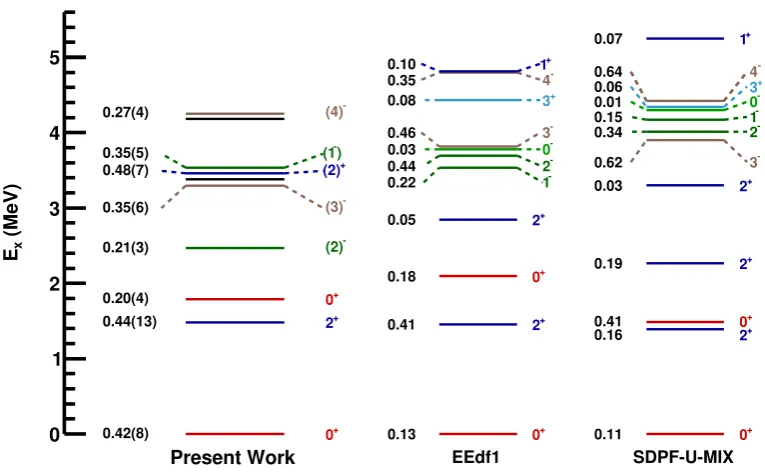
Figure 4 shows the preliminary experimental results compared to state-of-the-art shell model predictions using both microscopically derived interactions from chiral effective field theory, EEdf1 [3], and phenomenological theories with the newly available SDPF-U-MIX interaction [1]. No quenching [16] has been applied to the predicted spectroscopic factors of both theories.
Knocking a neutron out the 2s1/2 orbital in 31Mg leads to the population of 0 +
1,2 states in 30Mg. These correspond to the measured ground and isomeric state at 1782(5). Given the upper
limit obtained for C2
S(0+1)=0.42(8), the experimental result is in agreement with both theories but with completely different descriptions. While the SDPF-U-MIX interaction describes the ground-state wave function of 30
Mg as dominated by 0p−0h, the newly developped, ab initio-type, EEdf1 interaction, produces much enhancednp-nhexcitations, indicating that this nucleus belongs to the island of inversion. However, the moderately low C2
S(0+2) obtained here suggests a more complex structure rather than the conventional interpretation of this state as being purely 2p-2h. The deduced spectroscopic factors for both 0+
1,2 are in good agreement with the results from the EEdf1 interaction and only the C2
S(0+1) agrees well with the SDPF-U-MIX. Removing a neutron from the 1d3/2 orbital in
31
Mg populates spins and parity states of (1,2)+
in 30
Mg. The first 2+1 state at 1482 keV in 30
Mg shows a relatively large strength of 0.44(13) in agreeement with the EEdf1 interaction. Assuming some population to the 2+1 state could come from dynamical excitation of the core, the resulting spectroscopic factor is thus an upper limit and also consistent with the SDPF-U-MIX interaction. The next 2+
2 is placed at 3457-keV since 1+
states are expected at higher energy. Fusion-evaporation measurements employing a14
C(18
O,2p) reaction of Deacon et al. [8], have assigned this state to be a 4+ based on an angular ratioRang <1 for the 1975-keV γ-ray, however in a direct knockout process from 31
Mg, the neutron had to be removed from the 1g9/2 orbital and the shape of the momentum distribution is clearly not compatible with l = 4. Therefore a 2+2 assignment is made for this state, in line with the results from [10]. The spectroscopic factor is rather large, 0.48(7), and no equivalent strength for positive parity states is found in shell model calculations at these energies. The large spectroscopic factor found here evidences a substantial overlap with the ground state wavefunction of 31
Mg pointing to the intruder nature of the 2+2 state. This result is supported by the large β and γ-branching ratios observed in [10].
5
1234567890 ‘’“”
12th International Spring Seminar on Nuclear Physics IOP Publishing
IOP Conf. Series: Journal of Physics: Conf. Series 966 (2018) 012020 doi :10.1088/1742-6596/966/1/012020
[image:7.595.84.467.134.372.2](MeV)x E 0 1 2 3 4 5 Present Work + 0 0.42(8) + 2 0.44(13) + 0 0.20(4) -(2) 0.21(3) -(3) 0.35(6) + (2) 0.48(7) ) -(1 0.35(5) -(4) 0.27(4) SDPF-U-MIX + 0 0.11 + 2 0.16 + 0 0.41 + 2 0.19 + 2 0.03 -3 0.62 -2 0.34 -1 0.15 -0 0.01 -4 0.64 + 3 0.06 + 1 0.07 EEdf1 + 0 0.13 + 2 0.41 + 0 0.18 + 2 0.05 -1 0.22 -2 0.44 -0 0.03 -3 0.46 -4 0.35 + 3 0.08 + 1 0.10
Figure 4. Experimental level scheme of 30
Mg (first column) compared to shell model calculations using the EEdf1 and SDPF-U-MIX interactions (second and third column, respectively). Spin and parity assignments are displayed on the right and the spectroscopic factors on the left of the levels.
based on the branching scheme, this state must surely be the 2− because otherwise it would
decay to the ground state by an E1 rather than to the 2+
. This is unexpected according to shell model calculations that predict these negative parity states at much higher excitation energy. Despite the experimental C2S of 0.20(3) being in agreeement with the 1− state predicted by the EEdf1 and close to the value obtain by the SDPF-U-MIX, the low position in energy for this negative parity state remains a challenge for current theories. An assignment of 2+was originally suggested by H. Mach [11], later adopted by [8] and by β-decay measurements from 30
Na [10], although with a remarkably weak feeding and large logf tvalue for this later measurement. It is also worth to notice here, that according to our spin and parity assingment, the corresponding E1 transition is still in agreement with the upper limit for the lifetime of this state measured in [11] The momentum distribution for the state at 3534-keV is compatible withl= 1,2 which yields a spin-parity assignment of (1, 2)+
or (1, 2)−. Preference to the l=1 assignment is made
based on the direct decay to the ground state. A tentative assignment of 1− is suggested for
this state.
Some occupancy of thef7/2orbital in 31
Mg results in (3,4)−states in30Mg. The distributions
of the 3298-keV and the 4252-keV states are both consistent with l = 3 shapes and therefore spins and parities of 3− and 4− are assigned for these states, respectively. The order is deduced
from the typical Weisskopf estimates, that favour a E1 transition from the 3− to the 2+ state over a E3 for an anssignement of 4− for that level. The upper state with l = 3 is a 4− in
agreement with a M1 transition to the 3− state. A remarkably good agreement is found with
6
assignment for the state at 3298-keV, (found at 3.302 MeV). Based on the measured logft >6.5 in the β-decay experiment, this transition could still be first-forbidden in agreement with our assignment of 3−. We also note that a tentative assignment of 4+ has been made in a 2-neutron
removal measurement [15].
We have studied single-neutron removal from 31
Mg using the SPEG spectrometer and the EXOGAM array for gamma-ray detection. Inclusive and exclusive cross sections and momentum distributions for the populated states in30Mg have been measured. The two 0+states have been measured simultaneously allowing us to extract information on the mixing in 30
Mg. The low spectroscopic factor of the 0+
2 suggests a different structure from the well established 2p2h configuration of the ground state of 31
Mg. The large spectroscopic factor found for the 2+2 state points to the intruder nature of this state. The results obtained for the 2.467-MeV state are intriguing because negative parity states are expected at higher excitation energy. A comparison of the present30
Mg results with two new shell model calculations, using state-of-the-art interactions, shows two plausible and quite different scenarios. The EEdf1 interaction suggests that many-particle many-hole configurations dominate the low-lying structure of 30
Mg and therefore would place30
Mg into the N=20 island of inversion. On the contrary, the SDPF-U-MIX interaction supports a picture of shape coexistence with a dominant spherical configuration in the ground state of 30
Mg. The present data suggest that the transion into the island of inversion in the Mg chain is more complex than expected.
Acknowledgements
The authors acknowledge the excellent support provided by the technical staff of LPC and GANIL. B. F. D. and M. C. F. acknowledge financial support from the Ram´on y Cajal RYC-2010-06484 and RYC-2012-11585 and from the Spanish MINECO grant No. FPA2015-71690-P. W.N. Catford acknowledges financial support from the STFC grant number ST/L005743/1. This work is partly supported by MINECO (Spain) grant FPA2014-57196 and Programme Centros de Excelencia Severo Ochoa SEV- 2012-0249.
References
[1] Caurier E, Nowacki F and Poves A 2014Phys. Rev.C90014302.
[2] Nowacki F, Poves A, Caurier E and Bounthong B 2016Phys. Rev. Lett.117272501.
[3] Tsunoda N, Otsuka T, Shimizu N, Hjorth-Jensen M, Takayanagi K and Suzuki T 2017 Phys. Rev C 95 021304(R).
[4] Anne R 1997Nuc. Inst. and Meth.B126279 [5] Bianchi L et al. 1989 Nucl. Instr. Meths.A276509 [6] Simpson J et al. 2000Act. Phys. Hung.11159 [7] Bauman P et al. 1989Phys. Rev.C39626 [8] Deacon A N et al. 2010Phys. Rev.C82034305 [9] Klotz G et al. 1993Phys. Rev.C472502 [10] Shimoda T et al. 2014Hyper. Inter.225
[11] Mach H et al. 2005Eur. Phys. J.A25s01 105-109 [12] Schwerdtfeger W et al. 2009Phys. Rev. Lett.103012501 [13] Tostevin J A et al. 1999J. Phys.G25735