
ORIGINAL PAPER
Effects of Using Alternative Extreme Pressure (EP) and Anti‑Wear (AW)
Additives with Oxy‑Nitrided Samples
Thawhid Khan1 · Shunsuke Koide2 · Yukio Tamura2 · Hiroshi Yamamoto2 · Ardian Morina1 · Anne Neville1
Received: 15 August 2017 / Accepted: 27 January 2018 / Published online: 8 February 2018 © The Author(s) 2018. This article is an open access publication
Abstract
Oxy-nitriding is a widely used industrial process aiming to improve the tribological properties and performance of com-ponents. Previous studies have shown the effectiveness of the treatment with friction and wear performance, but very few have focussed on optimising this behaviour. The lubrication properties of several EP and AW additives were examined to investigate their effectiveness in improving the tribological properties of the layers formed after treatment. Previous studies showed the presence of an oxide layer on the sample could improve the effectiveness of the sulphurised olefin (SO) and tricresyl phosphate (TCP) additives. The friction and wear behaviour of oxy-nitrided samples were analysed using a tri-bometer and surface profiler. Scanning electron microscope, energy-dispersive X-ray spectroscopy and X-ray photoelectron spectroscopy were employed to identify the morphologies and chemical compositions of the treated surface before and after testing. No real effect on friction was observed when using the SO or TCP additives, mostly due to lack of interaction with the less reactive iron nitride layer and their roles as anti-wear additives. However, when the zinc dialkyldithiophosphate-containing lubricant was used, a higher friction coefficient was observed. Greater improvements in anti-wear properties with the presence of additives in comparison with only using base oil were reported, with the TCP additive producing the lowest wear rates. The study effectively demonstrated that the additive package type used could impact the tribological and tribochemical properties of oxy-nitrided surfaces.
Keywords Oxy-nitriding · Sulphurised olefin · Tricresyl phosphate · Tribochemistry · Zinc dialkyldithiophosphate
1 Introduction
Hydraulic motors/pumps are key components within hydrau-lic systems, but they are hindered by their inefficiency which in some cases can be up to 15% [1]. High friction between interacting components can cause excessive wear and may also initiate seizure and complete failure of the motor/pump [2]. Tribology has a great influence in energy and material loss within the system, and through the reduction in friction and wear, the lifetime of components can be significantly increased [3].
Friction and wear performance are influenced by a number of factors such as lubricant additives and surface
modification, which can individually improve tribologi-cal properties or through a synergistic effect between the two factors. To achieve optimal tribological performance between friction pairs, it is crucial to understand the mecha-nisms of any synergistic interactions between modified sur-faces and lubricant additives [4].
Nitriding is recognised as an effective surface treatment technique for improving tribological and anti-corrosion properties alongside increasing the hardness of the material. This makes it ideal in machine parts, where the combination of a hard nitride layer and a lubricating film can effectively improve friction and wear behaviour [4].
The nitride treatment leads to the formation of two dis-tinctive zones—compound and diffusion layers. The com-pound layer is commonly referred to as the white layer [5]. The layer can be composed of iron nitrides either as a single layer of γ′-Fe4N or ε-Fe2−3 N or as a mixed-phase compound
layer composed of both types of nitrides. γ-Phases are seen to dominate the compound zone after nitriding, whereas * Thawhid Khan
1 Institute of Functional Surfaces, School of Mechanical Engineering, University of Leeds, Leeds LS2 9JT, UK 2 Materials Technical Centre, Development Division, Komatsu
ε-phases are almost solely seen after nitrocarburising due to the greater influence of the presence of carbon [5–8].
The formation of ε-carbonitride phases are preferred over γ′-Fe4N as they are more ductile and provide higher
hardness and wear resistance compared to untreated base metal. The ε layer composed from nitrocarburising contains porosity caused by the association of dissolved nitrogen as gas molecules ( N2 ) at grain boundaries and within grains. At the surface-adjacent part of the layer, porosity is most distinguishable due to this layer having the largest dissolved nitrogen content [9, 10].
The diffusion layer lies beneath the compound layer, due to the decrease in nitrogen content from the edge to the core of treated components. Iron nitrides are not formed in this zone. With unalloyed steels, the crystalline phases produced in the diffusion layer are influenced by the cooling rate after treatment. At a faster cooling rate, e.g., using water, a higher hardness is achieved in the zone compared to slow cooling which allows greater ductility [5].
With alloyed steels, the diffusion zone is mostly com-posed of solid solution (α-Fe, N), and due to alloying ele-ments, nitrides and carbonitrides such as γ′-Fe4 N and ζ-Fe2N are formed in the diffusion layer due to precipitation [8, 10]. This is due to the diffused nitrogen interacting alloying ele-ments such as chromium and vanadium. The nitrides created such as chromium nitrides are shown to exhibit very high hardness values and also influence the depth of the diffusion zone [7].
There has been little research carried out on the tribo-chemical interactions between nitrided steel surfaces and variants of extreme pressure and anti-wear additives.
The lubrication behaviour of an additive is influenced by the properties of the interacting surfaces, the environmental atmosphere and the properties of the additive itself. Zinc dialkyldithiophosphate (ZDDP) is one of the most successful and effective anti-wear and extreme pressure additives com-monly applied to hydraulic fluids. The formation of a glassy sacrificial phosphate film due to interacting contacts helps determine the effectiveness of the wear reduction though preventing adhesion between surfaces. The interaction of ZDDP with solid surfaces can lead to the formation of differ-ent compounds such as iron sulphide or zinc/iron phosphate which could further impact the wear and friction behaviour of the tribofilm. On steel samples, the tribofilms can grow to a thickness > 100 nm and have an uneven pad-like structure [4, 11, 12].
Alternative extreme pressure and anti-wear additives include sulphurised olefin (SO) and tricresyl phosphate (TCP), respectively, both widely used in industry. The effectiveness of SO and TCP additives is due to the reaction with iron to form FeS and FePO4, respectively, within the tribofilm [4]. Khorramian et al. [13] states that phospho-rous-containing oils are effective anti-wear additives under
moderate friction conditions, whereas sulphur-containing compounds mitigate the process of scuffing under severe operating conditions.
This research focuses on investigating and understanding the impact of additives in extending the life of friction pairs within hydraulic systems. This study uses base oil (BO) and three effective EP and AW additives to investigate and com-pare the tribological response of the oxy-nitrided samples, alongside analysing the tribochemical interactions using SEM–EDX and XPS. This study investigates the impact of various single- or multiple-element-containing lubricant additive packages on the tribological properties of the QPQ samples. The characteristics of the nitride layer and its influ-ence on tribochemical interactions are analysed.
2 Experimental Methodologies
2.1 Materials and Lubricants
The material used for this investigation is alloyed nitrid-ing steel, generally used for components subjected to high friction and wear. The pin-shaped samples (sliding
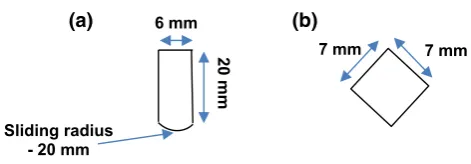
r = 20 mm × h = 20 mm) had a hardness of ~ 300 HV1 prior to treatment (Fig. 1a). A 20 mm sliding radius for the pins was used to allow the application of contact pressures up to 2 GPa. To carry out the oxy-nitriding heat (QPQ) treatment on the pin samples, it involved using a cyanide/cyanate bath at 400–600 °C to form a nitride layer (15 µm), followed by using a specialised nitrate–nitrite cooling salt bath to form an oxide layer (0.5 µm) on top, which acts as a protective running-in coating (Fig. 2). Due to the formation of carbon-ate during the process, both nitrogen and carbon diffuse into the surface; hence, this process is recognised as nitrocarbur-ising. Another variant of the nitriding process was applied to the counterface plate samples. The 7 mm × 7 mm × 3 mm plates (Fig. 1b) were made from cast iron (spheroidal graph-ite) which were then gas nitrided (Ra = 0.6 µm). The treat-ment applied to the plates was not varied. The coupling of steel pins to cast iron plates represents friction pair compo-nents within a hydraulic motor.
6 mm
20 mm
Sliding radius - 20 mm
(a)
7 mm 7 mm
(b)
[image:2.595.307.543.601.683.2]The microstructure of the treated pin sample through its cross section has been examined using scanning electron microscopy (SEM). The phases formed after the samples had been treated were characterised by a Siemens Bruker X-ray diffractometer using Cu radiation. Microhardness measurements have been carried out with Vickers micro-hardness tester using a load of 9.81 N (1 kg) on the treated pin samples. The results are presented in Fig. 3, highlighting the differences in hardness of the pins before and after the QPQ treatment was employed. The Taylor Hobson Form Talysurf was employed to measure the surface roughness of the samples.
Table 1 highlights the lubricants used within this study. The base oil (BO) used was a group I mineral oil with a viscosity of 5.2 cSt at 80 °C. Lubricant two was a fully formulated oil composed of the EP additive—ZDDP and dispersants and detergents. Lubricants three and four were mixtures of BO and SO or TCP additive, respectively. The concentrations used matched those used in previous studies
and helped to compare any similarities observed when using the additives with oxy-nitrided samples.
2.2 Tribometer Tests
Using a Cameron Plint TE77 reciprocating tribometer with a pin-on-plate configuration to represent the sliding condi-tions of interacting components, the friction and wear behav-iour of the treated samples could be investigated. In opera-tion, the pins were the nitriding steel samples, the plates were composed from graphite cast iron, and the treatments applied to both sets of samples are described above. The testing conditions are given in Table 2 and were derived from those used to mimic the operational conditions of a hydraulic motor.
Fig. 2 Salt bath nitriding (QPQ) heat treatment process [5]
0 100 200 300 400 500 600 700 800 900
0 0.1 0.2 0.3 0.4 0.5 0.6 0.7
Vickers Hardness
(HV1
)
Depth (mm)
QPQ (Ra=0.05µm)
Plain (Ra=0.08µm)
Fig. 3 Comparison of the hardness through the oxy-nitrided and untreated pin sample cross sections and also their surface roughness
Table 1 Lubricants tested
No. Lubricant Additive wt%
1. Base oil (BO) –
2.
BO + ZDDP + detergent + dis-persants ~ 1% ZDDP
3. BO + SO 1.5%
4. BO + TCP 0.25%
Table 2 TE77 test conditions
Set up Conditions
Stroke length 7 mm
Sliding speed 0.35 m/s (25 Hz)
Hertzian contact pressure 1.19 GPa Dynamic viscosity (100 °C) ~ 0.030 Pa.s
Lubricant temp. 80 °C
[image:3.595.204.546.54.226.2] [image:3.595.71.268.256.412.2] [image:3.595.304.544.271.353.2] [image:3.595.306.546.395.493.2]The TE77 using a force transducer and program produces a data file of the friction force every 300 s for a duration of 2 h. Each data file is composed of 1000 measurements taken every 0.3 s. The friction coefficient results were calculated when the system has reached steady state and were based on the last 30-min steady friction data. The lubricant was heated to 80 °C using heating elements attached to the bath in which the samples were clamped down and flooded in lubricant.
The tests are carried out under the boundary lubrication regime which was defined by calculating the lambda ratio:
where hmin . is the minimum film thickness determined
using the Dowson/Hamrock equation and Rq1 and Rq2 are the roughness of the interacting surfaces. For the lubrication regime to be within boundary condition; λ < 1.
After testing the samples, they were washed in heptane to remove excess oil and contaminants. All tests were repeated to achieve a good repeatability for the friction and wear behaviour.
2.3 Morphology and Topography Analysis
Wear measurements of the diameter and depths were carried out using a Leica optical microscope and a Taylor Hobson Talysurf profilometer.
2.4 Tribofilm Chemical Properties
Post-experimental surface analysis included carrying out X-ray photoelectron spectroscopy (XPS) on the worn surfaces of the pin samples to identify the chemical spe-cies present in the tribofilms. A monochromatised Al Kα X-ray source was used to carry out high-resolution scans (1) 𝜆=
hmin
√ R2
q1+R 2
q2
for specific peaks. The beam was focused in the centre of the wear scar in an area of 200 µm × 200 µm. The tribofilm was also etched, and the charging effects in the results were corrected by fixing the C1s peak (adventitious carbon) at 284.8 eV. Casa XPS software applies a Shirley algorithm to construct a background, through a curve fining procedure, which is applied to the peaks identified. To accurately deter-mine the chemical species present, the peak areas and full width at half maximum (FWHM) were constrained.
3 Results
3.1 Surface Characterisation
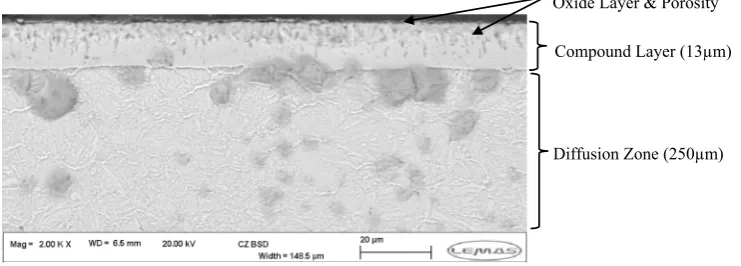
Figure 4 shows the SEM image of a cross section of the QPQ-treated pin sample. The QPQ samples three distinc-tive layers are detected. On the very top surface, a very thin black oxide layer of ~ 0.5 µm thickness is present. Under-neath this layer is a 13-µm-thick compound layer of a porous constitution. The final visible layer was a diffusion zone of approximately 250 µm thickness.
X-ray diffraction (XRD) scans (Fig. 5) across the QPQ pin sample showed that the oxide layer was primarily com-posed of Fe3O4, , whereas the compound layer was
predomi-nantly composed of ε-Fe2−3N . with traces of γ′-Fe4N.
3.2 Friction Evaluation
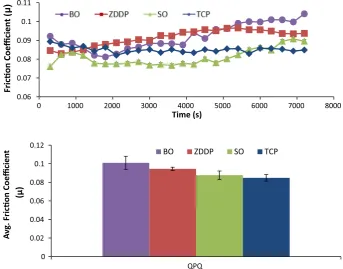
Figure 6 highlights the typical change in behaviour over time observed with the four lubricants during the complete duration of the test using the QPQ pin sample. With the base oil, a steady rise in friction is observed after a running-in period lower than that observed with usrunning-ing the ZDDP-containing lubricant. However, a higher friction response is observed in the final 30 min of testing in comparison with when using the alternative lubricants. With the TCP addi-tive, steady-state friction was maintained after an initial
Compound Layer (13µm)
Diffusion Zone (250µm) Oxide Layer & Porosity
[image:4.595.114.485.560.693.2]running-in period. When using the SO-containing lubricant, a low friction response is recorded after running-in with an increase in friction being observed towards the end of the test period. During the final 30 min, the friction coefficient closely resembled that observed with the TCP additive.
The average friction coefficients for the QPQ samples in the stable stage (last 30 min of the test) with plain base oil and with it mixed with different EP additives are shown and compared in Fig. 7. The base oil and the fully formulated lubricant-containing ZDDP had the highest
friction compared to the other additive-containing oils with the base oil producing the higher friction response. The SO and TCP additive produced almost identical fric-tion responses.
3.3 Wear Results
Figure 8 highlights the wear scars of the QPQ samples when the different additives are used. When using the ZDDP-containing lubricant (Fig. 8a), a patchy tribofilm is formed on the smooth nitrided surface of the sample. A different behaviour is observed when using the SO additive (Fig. 8b), and abrasive wear is detected on the surface alongside the delamination of the oxide layer and wearing of the nitride surface. When using the TCP addi-tive (Fig. 8c), the presence of a patchy tribofilm is easily identified.
Figure 9 highlights the wear depths of the pin samples showing that with the QPQ pins base oil produced the highest wear; however, when additives were used, the SO additive caused the higher wear penetration, followed by the ZDDP additive. The TCP additive had the greatest effect showing the lowest wear. When using the additives with the base oil, the wear depths never penetrated past the compound layer, whereas with the BO it did (> 15 µm). Fig. 5 X-ray diffraction pattern of a QPQ pin sample
Fig. 6 Friction coefficient vs time results over 2 h of the QPQ samples with four lubricants at a 1.19 GPa contact pressure and 25 Hz sliding frequency
0.06 0.07 0.08 0.09 0.1 0.11
0 1000 2000 3000 4000 5000 6000 7000 8000
Fricon Coefficien
t (
μ)
Time (s)
Fig. 7 Average friction
coef-ficient results of the last 30 min of the experiments when using a contact pressure 1.19 GPa at a sliding frequency 25 Hz with four different oil additives
0 0.02 0.04 0.06 0.08 0.1 0.12
QPQ
Av
g. Fricon Coefficie
nt
(μ)
Sample Type
[image:5.595.53.288.54.231.2] [image:5.595.202.546.433.702.2]3.4 SEM–EDX Analysis
SEM–EDX was used to analyse the areas inside and out-side the worn areas of the oxy-nitrided pin samples after the tribometer tests using the four lubricant variants. The
analysis gives an indication whether a tribofilm has been formed on the worn surface and of its chemical composi-tion. It essentially gives a suggestion of the interaction of the surface with the additives within the lubricant. Fig. 8 Optical images of the
wear scar regions of the QPQ-treated pin samples when using different EP additives. a ZDDP, b SO, c TCP
(a) ZDDP
(b) SO
(c) TCP
Fig. 9 Wear depths of the QPQ pins when using a contact pres-sure 1.19 GPa at a 25 Hz sliding frequency using base oil and four lubricant additives at 80 °C
0 5 10 15 20 25 30 35
QPQ
We
ar Depth (µm)
Sample Type
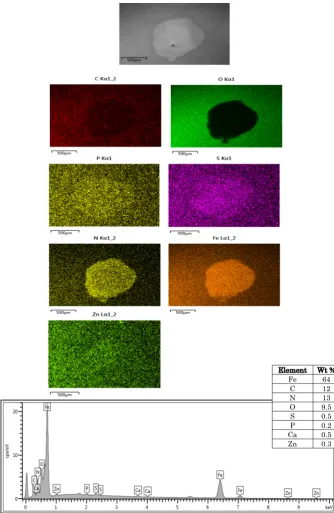
[image:6.595.202.544.52.629.2]With the ZDDP-containing lubricant, EDX (Fig. 10) shows a high presence of oxygen is on the unworn areas of the pin sample, which relates to the presence of a Fe3O4 oxide layer. However, within the wear scar a significantly lower oxygen presence is detected most likely due the removal of the oxide layer during testing. Within the wear scar, a high concentration of iron and nitrogen is detected relating to the nitride layer exposed under the oxide layer. In comparison, a lower presence of sulphur and phospho-rous is detected within the wear region; however, zinc is not
identified. The EDX spectra of the worn area showed the presence of all elements. This indicated the possibility of the formation of a protective tribofilm, which will be confirmed using XPS which is a more surface-sensitive technique.
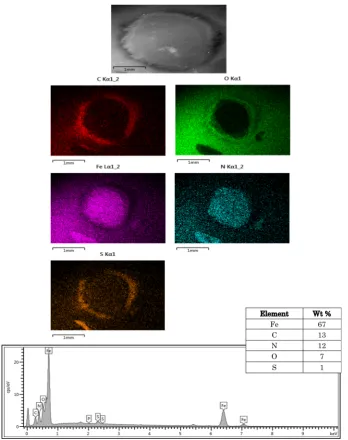
When using the SO additive (Fig. 11), similar trends are observed to when using the ZDDP-containing lubricant (Fig. 10). There are lower levels of oxygen detected with the worn area with the removal of the oxide layer. With the exposure of the nitride layer, a high presence of iron and nitrogen is detected. No presence of sulphur is clearly
Fig. 10 SEM image, EDX map and spectra in the worn surfaces of the QPQ pin samples at 1.19 GPa contact pressure and 12 Hz sliding speed with ZDDP additive
Element Wt % Fe 64
[image:7.595.203.538.201.715.2]observed within the wear scar; however, an enriched presence is detected around the edges of the worn area. However, the EDX spectra identified all elements present within the worn area, and XPS will be used to confirm these findings.
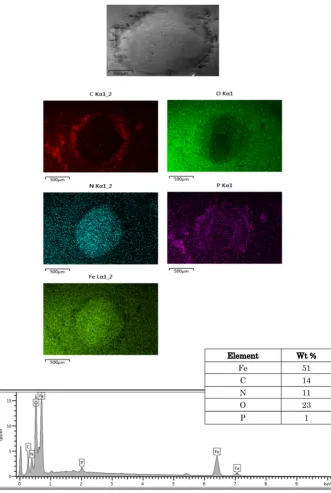
With the TCP additive (Fig. 12), within the wear scar there is a high presence of nitrogen due to the exposure of the nitride layer after the removal of the oxide layer. Phosphorous and iron within the worn area are detected. However, there is a low visible presence of oxygen within the wear scar, but this is mostly likely due to the strong signal from the oxide layer outside the scar. In compari-son, when using the ZDDP and SO additive it appears that there is a higher oxygen presence within the wear scar with the TCP additive.
3.5 XPS Analysis of the Worn Surfaces
To identify the chemical compounds present within the tri-bofilm and support the findings from SEM–EDX, a more surface-sensitive technique—XPS—was used. Using XPS to etch through the depth of the tribofilm, the results gener-ally showed the formation of a relatively thin tribofilm with all additives. Table 3 and Figs. 13, 14, 15 highlight the key species formed on the worn surface of the QPQ sample when using different additives. Table 3 shows the species present at an etching depth of 1.34 nm, alongside confirming the presence of a tribofilm with all the additives in this study.
With the fully formulated oil (Fig. 13) which uses ZDDP as an EP additive, there is the formation of phosphates (~ 133.2 eV—P 2p) and FeS2 (~ 706.8 eV—Fe 2p). When Fig. 11 SEM image, EDX map
and spectra in the worn surfaces of the QPQ pin samples at 1.19 GPa contact pressure and 12 Hz sliding speed with SO additive
Element Wt % Fe 67
C 13 N 12
O 7
[image:8.595.202.551.53.494.2]using the SO additive (Fig. 14), the key species identified is FeS (~ 712.4 eV—Fe 2p) and iron oxides (~ 710.8 eV—Fe 2p). In comparison, there is no formation of phosphorous compounds due to the absence of phosphorous-containing additives. When using the TCP additive (Fig. 15), the for-mation of FePO4 (~ 712.4 eV—Fe 2p) is observed within the tribofilm alongside iron oxides (~ 710.8 eV—Fe 2p). Alternatively to the SO additive tests, no sulphur compounds are seen to form with TCP as there are no sulphur-contain-ing additives present within the oil. With ZDDP and SO additives, nitrides (~ 397.6 eV) were detected within the
tribofilm; however, with the TCP additive only organic mate-rial (~ 399 eV) was detected with the N 1s peaks.
4 Discussion
The tribological behaviour observed is due to the tribochem-ical interaction of the different additives with the modified surface. The following sections summarise this study’s find-ings relating to the role chemical interactions in the friction and wear behaviour on the QPQ surfaces.
Fig. 12 SEM image, EDX map and spectra in the worn surfaces of the QPQ pin samples at 1.19 GPa contact pressure and 12 Hz sliding speed with TCP additive
Element Wt %
Fe 51
C 14
N 11
O 23
[image:9.595.209.541.53.547.2]4.1 Friction
As shown in Fig. 7, the plain base oil gives the highest fric-tion result compared to the other lubricants. This is most likely due to the absence of any tribological performance-modifying additives which could possibly improve the sam-ples friction performance. However, with oil-containing additives, the fully formulated lubricant-containing ZDDP produced the largest friction values compared to the other additives as expected. This is a well-recorded phenomenon due to the formation of an anti-wear tribofilm which has an uneven, pad-like distribution separated by deep fissures (Fig. 16). The roughness of these pads is usually orientated towards the direction of sliding, which is shown by the high friction coefficients in boundary conditions usually ranging from 0.11 to 0.14 [12]. The key difference between the tri-bofilm formed on the QPQ surface and an untreated sample was the formation of FeS2 with the former sample, which was due to the presence of an oxide layer composed of Fe3O4 [15].
Table 3 General binding energy values for compounds relevant to the tribofilms formed on the worn surface of the QPQ sample when using the different EP additives at 1.34 nm etching depth [14]
Additive Element B.E/eV ( +
−0.5 eV) Chemical state
SO Fe 2p 712.4 FeS
710.8 Fe2O3
N 1s 397.8 Nitride
S 2p 161.7 Sulphide
TCP Fe 2p 712.4 FePO4
710.8 Fe2O3
N 1s 399.5 Organic Species
P 2p 134.3 Phosphate
ZDDP Fe 2p 710.3 Fe2O3
706.8 FeS2
N 1s 397.8 Nitride
P 2p 133.5 Phosphate
Zn 3s 139.9 ZnS
S 2p 161.7 Sulphide
Ca 2p 347.0 CaCO3
[image:10.595.49.291.91.301.2] [image:10.595.53.543.335.686.2]When comparing the impact on friction behaviour of the SO and TCP additives in the final 30 min, the responses are almost identical. This may be due to the interaction of the additives with the inert and non-metallic compound layer [16, 17], where wear was contained for all the additives used. Spikes [18] research demonstrated that the thickness of tribofilms formed was influenced by the elements present on the rubbing surfaces; the presence of an iron nitride (com-pound) layer with the QPQ samples would have impacted the tribochemical behaviour of the sample. The presence of the iron nitride layer instead of a nascent metal surface may have reduced reactivity and caused the formation of a relatively thin tribofilm or hindered the formation of key compounds which may have minimised the influence of the tribofilm on friction behaviour.
Khorramian et al. [13] states the lubricity of SO and TCP additives is due to their EP mechanisms. They found that sulphur-containing additives are most effective in severe operating conditions. In this study, the conditions may not have been severe enough to cause the SO additive to react with the less reactive/inert iron nitride surface to form
significant amounts of FeS in this case to affect the fric-tion response of the system [13, 16, 17]. This may explain the low friction behaviour initially observed when using SO additive until it rose to match that observed with the TCP additive. FeS is softer than the metal surface and acts as solid lubricant, which in high concentrations would make it effective in friction reduction.
It is believed that the TCP additive has minimal influence on friction behaviour. Typically the effect of anti-wear addi-tives on friction response is expected to be minimal, as they are mainly used to protect surfaces from wear.
4.2 Wear
[image:11.595.53.541.50.395.2]sliding between planes helps to reduce friction [19]. The exposure of the diffusion zone with non-ceramic features would account for the high friction response observed. The wear when solely using BO was in some cases five times higher than when an extreme pressure additive was
present. Even with the formation of relatively thin tri-bofilms with the different additives, their formation was extremely effective on the wear performance of the QPQ sample.
When using TCP which gave the lowest wear depths (Fig. 9), FePO4 is seen to form within the tribofilm along-side phosphates which improved the anti-wear behaviour of the sample. Ma et al. [11] believed due to the formation a thick and compact boundary lubrication film-containing FePO4 and iron oxide, oxy-nitrided samples would have better anti-wear properties and load-carrying capacity as observed within this study. Guan et al. [20] believed that the mechanism of decomposition of TCP on an oxide layer involved a chemical mechanism of decomposition with an initial P=O bonding of intact TCP to the surface. This results in increased polarisation and activation of the P=O bond, followed by nucleophilic attack of residual H2O or Fig. 15 XPS, Fe 2p, N 1s and P 2p spectra of the tribofilms formed on the QPQ-treated samples at an applied contact pressure 1.19 GPa and 25 Hz sliding speed at 1.34 nm etching depth with TCP additive
FeS2/ ZnS
Glassy Fe/Zn phosphate Zn polyphosphate Organic sulphides/ZnDTP
Oxide Layer
[image:12.595.57.542.47.451.2] [image:12.595.52.288.509.592.2]surface O2− onto the P atom. Ultimately this results in the formation of the metal phosphate or polyphosphate layer.
When assessing the wear performance of the different additives, SO produced the largest wear. This is most likely due to the absence of a phosphate protective layer and the presence of soft FeS compounds within the tribofilm. This behaviour is also supported by Kawamura et al. [21] who state the crystal structure of the reaction products (FeS) when using SO would substantially affect the samples wear properties. Ma et al. [11] found that TCP additives were more effective on improving the anti-wear properties and load-carrying abilities of samples, whereas SO additives only tended to improve the samples load-carrying abilities.
The fully formulated oil-containing ZDDP had higher wear rates when compared to the TCP additive, even though ZDDP is described as being the most effective anti-wear additive. This behaviour is similar to that observed by Khorramian et al. [13]; this is likely due to the presence of detergents and dispersants alongside ZDDP within the fully formulated oil. Several researchers [22] have observed the deterioration of ZDDP’s anti-wear properties in the pres-ence of metallic detergents. This is due to the competition between the two additives for surface sites, hence reducing the effective ZDDP surface concentration.
The presence of nitrides detected when using the SO and ZDDP additives may be due to the greater wear and expo-sure of the nitrided layer in comparison with using the other additives. The presence of organic species when using the TCP additive can be attributed to absorbed nitride complex [23]. It was important to determine whether the presence of a nitrided layer would enhance the effectiveness of the lubricant additive in reducing wear. Wen Yue [4] found that the effect of the additive ZDDP did not greatly enhance the wear reduction properties when used with a nitrided surface compared to a plain untreated sample as shown in Table 4.
5 Conclusions
The lubricating characteristics and possible mechanisms of friction and wear reduction in selected extreme pressure additives widely used within industry and their interaction with oxy-nitrided surfaces were investigated. It was shown that the chemical compounds within the additive packages could impact the tribological and tribochemical behaviour
of the nitrided layer. The presence of an iron nitride layer reduced reactivity in comparison with untreated steel sam-ples; however, even with the formation of thin tribofilms the impact on friction and wear was significant. The following key conclusions were made:
1. When using base oil, the wear was significantly higher than with the presence of an extreme pressure additive in the lubricant. This study showed that the wear per-formance of nitrided surfaces can be greatly improved even with the formation of relatively thin tribofilms due to the presence of additives.
2. Compared to other lubricants, the fully formulated oil-containing ZDDP produced high friction and wear due to the roughness of the pads forming the tribofilm. The presence of detergent within the oil reduces the effec-tiveness of ZDDP’s anti-wear properties; hence, it per-forms worse than the TCP additive.
3. The friction reduction effect of SO was minimal due to its limited interaction with the inert/ceramic compound layer. This reduced reactivity between the oil additives and the worn surface to produce critical compounds such as FeS which could affect friction behaviour.
4. TCP had no real impact on friction behaviour in com-parison with BO; however, it showed the best anti-wear properties and increased load-carrying capability due the presence of FePO4 and iron oxide within the tri-bofilm. The presence of an oxide layer enhanced the reactivity of the surface with the additive.
5. The greater the exposure of the nitrided layer with larger wear depths, the more likely the nitrides instead of organic species are detected, as seen when using the SO- and ZDDP-containing lubricants.
6. The study showed that even with the reduced reactivity of the compound layer, additives can impact the tribo-logical properties of a nitrided surface. Future work can be used to focus on optimising friction behaviour using friction modifiers or other alternative additives.
Open Access This article is distributed under the terms of the
Crea-tive Commons Attribution 4.0 International License (http://creat iveco mmons .org/licen ses/by/4.0/), which permits unrestricted use, distribu-tion, and reproduction in any medium, provided you give appropriate credit to the original author(s) and the source, provide a link to the Creative Commons license, and indicate if changes were made.
References
1. Manring, N.D.: Friction forces within the cylinder bores of swash-plate type axial-piston pumps and motors. J. Dyn. Syst. Meas. Contr. 121(3), 531–537 (1999)
Table 4 Wear depth ratios (BO/ZDDP) for untreated and nitrided samples [4]
2. Nilsson, D., Prakash, B.: Investigation into the seizure of hydraulic motors. Tribol. Int. 43(1–2), 92–99 (2010)
3. Yazawa, S., Minami, I., Prakash, P.: Reducing friction and wear of tribological systems through hybrid tribofilm consisting of coating and lubricants. Lubricants 2, 90–112 (2014)
4. Yue, W., Gao, X., Wang, C., Li, X., Wang, S., Liu, J.: Syner-gistic effects between plasma-nitrided AISI 52100 steel and zinc dialkyldithiophosphate additive under boundary lubrication. Tri-bol. Trans. 55(3), 278–287 (2012)
5. Kato, H., Eyre, T.S., Ralph, B.: Sliding wear characteristics of nitrided steels. Surf. Eng. 10(1), 65–74 (1995)
6. Boβlet, J.: Tufftride/QPQ process. (2014)
7. Brinke, T., Crummenauer, J., Hans, R.: Plasma assisted surface treatment. SV Corporate Media, Germany (2006)
8. ASM Handbook: Steel Heat Treating, ed. J. Dosset and G. Totten. Vol. 4A. p. 768 (2013)
9. Holm, T., Sproge, L.: Nitriding and Nitrocarburizing, Sweden. p. 24
10. Karamboiki, C.M., Mourlas, A., Psyllaki, P., Sideris, J.: Influence of microstructure on the sliding wear behavior of nitrocarburized tool steels. Wear 303(1–2), 560–568 (2013)
11. Ma, Y., Liu, J., Zheng, L.: The synergistic effects of EP and AW additives with oxynitrided surface of steel. Tribol. Int. 28(5), 329–334 (1995)
12. Ratoi, M., Niste, V.B., Alghawel, H., Suen, Y.F., Nelson, K.: The impact of organic friction modifiers on engine oil tribofilms. RSC Adv. 9, 4278–4285 (2014)
13. Khorramian, B.A., Lyer, G.R., Kodali, S., Natarajan, P., Tupil, R.: Review of anti-wear additives for crankcase oils. Wear 169(1), 87–95 (1993)
14. Naumkin, A.V., Kraut-Vass, A., Gaarenstroom, S.W., Powell, C.J.: NIST X-ray Photoelectron Spectroscopy Database. (2012). Accessed 13 April 2015. http://srdat a.nist.gov/xps/Defau lt.aspx 15. Khan, T.A., Tamura, Y., Yamamoto, H., Morina, A., Neville,
A.: Friction and wear mechanisms in boundary lubricated oxy-nitrided treated samples. Wear 368, 101–115 (2016)
16. Leite, M.V.: Wear mechanisms and microstructre of pulsed plasma nitrided AISI H13 tool steel. Wear 269, 466–472 (2010) 17. Basso, R.L.O.: Effect of carbon on the compound layer properties
of AISI H13 tool steel in pulsed plasma nitrocarburizing. Plasma Process. Polym. 4, 728–731 (2007)
18. Spikes, H.: The history and mechanisms of ZDDP. Tribol. Lett. 17(3), 469–489 (2004)
19. Qiang, Y.H., Ge, S.R., Xue, Q.J.: Microstructure and tribological properties of complex nitrocarburized steel. J. Mater. Process. Technol. 101, 180–185 (2000)
20. Guan, B., Pochopien, B.A., Wright, D.S.: The chemistry, mecha-nism and function of tricresyl phosphate (TCP) as an anti-wear lubricant additive. Lubr. Sci. 28(5), 257–265 (2016)
21. Kawamura, M., Fujita, K.: Organic sulphur and phosphorous com-pounds as extreme pressure additives. Wear 72, 45–53 (1981) 22. Wan, Y.: Effects of detergent on the chemistry of tribofilms from
ZDDP: studied by X-ray absorption spectroscopy and XPS. Tri-bol. Ser. 40, 155–166 (2002)
![Fig. 2 Salt bath nitriding (QPQ) heat treatment process [5]](https://thumb-us.123doks.com/thumbv2/123dok_us/1986765.160365/3.595.204.546.54.226/fig-salt-bath-nitriding-qpq-heat-treatment-process.webp)

![Table 3 General binding energy values for compounds relevant to the tribofilms formed on the worn surface of the QPQ sample when using the different EP additives at 1.34 nm etching depth [14]](https://thumb-us.123doks.com/thumbv2/123dok_us/1986765.160365/10.595.53.543.335.686/general-binding-compounds-relevant-tribofilms-surface-different-additives.webp)
