This is a repository copy of
Debye formulas for a relaxing system with memory
.
White Rose Research Online URL for this paper:
http://eprints.whiterose.ac.uk/128564/
Version: Published Version
Article:
Klik, Ivo, McHugh, James, Chantrell, Roy W. orcid.org/0000-0001-5410-5615 et al. (1 more
author) (2018) Debye formulas for a relaxing system with memory. Scientific Reports.
3271. ISSN 2045-2322
https://doi.org/10.1038/s41598-018-21028-2
[email protected]
https://eprints.whiterose.ac.uk/
Reuse
This article is distributed under the terms of the Creative Commons Attribution (CC BY) licence. This licence
allows you to distribute, remix, tweak, and build upon the work, even commercially, as long as you credit the
authors for the original work. More information and the full terms of the licence here:
https://creativecommons.org/licenses/
Takedown
If you consider content in White Rose Research Online to be in breach of UK law, please notify us by
Debye formulas for a relaxing
system with memory
Ivo Klik , James McHugh , Roy W. Chantrell & Ching-Ray Chang
Rate (master) equations are ubiquitous in statistical physics, yet, to the best of our knowledge, a rate
equation with memory has previously never been considered We write down an integro di erential
rate equation for the evolution of a thermally relaxing system with memory. For concreteness we adopt
as a model a single domain magnetic particle driven by a small ac eld and derive the modi ed Debye
formulas. For any memory time Θ the in-phase component of the resultant ac susceptibility is positive at small probing frequencies ω, but becomes negative at large ω. The system thus exhibits frequency
induced diamagnetism. For comparison we also consider particle pairs with dipolar coupling. The
memory e ect is found to be enhanced by ferromagnetic coupling and suppressed by antiferromagnetic
coupling. Numerical calculations support the prediction of a negative susceptibility which arises
from a phase shift induced by the memory e ect It is proposed that the onset of frequency induced
diamagnetism represents a viable experimental signature of correlated noise.
he Debye formulas determine the initial ac response of a two level, equilibrium system to an applied ac pertur-bation. We address here the dynamic magnetic susceptibility discussed by e.g. Bermúdez et al1. or Klik et al.2.
Motivating the research is the underlying assumption of uncorrelated (white) noise adopted in all models to date and the need to investigate the implications of colored noise arising from the temporal correlation of heat bath properties. his is an important generalization of the theoretical approach and is especially timely in relation to the current advances in ultrafast laser processes involving femtosecond laser processes. Following the pioneering work of Beaurepaire et al.3 demonstrating ultrafast demagnetization of Ni, more recent work has shown extremely
complex and subtle behavior during laser driven processes including thermally driven magnetization switching4,5
in which the magnetization is reversed by the action of a thermal pulse in the absence of an applied ield. Ultrafast experiments rely on the rapid thermally driven relaxation of the spin system, modelled in refs4,5. using a white
noise thermostat, however it has been shown6 that correlated noise can signiicantly slow down the relaxation
processes. Ultrafast laser processes are extremely complex, for this reason we consider here the study of the efects of correlated noise on the well-understood Debye formulas. his provides an important generalization of the Debye formulas and also provides an experimentally realizable means of determine the correlation times.
For simplicity we adopt the well known uniaxial single-domain particle with magnetic ield applied parallel to its easy axis. he corresponding free energy7 is
= − −
E KV/ 1 2hx x2 (1)
with K the anisotropy constant, V the particle volume and the reduced ield h=H/HK where H=H(t) is the time
dependent applied magnetic ield and HK= 2K/Ms is the anisotropy ield. Further, Ms is the saturation
magnetiza-tion of the particle and x= cosϑ, where ϑ is the angle spanned by the magnetization vector and the applied ield. At | |<h 1 the system has two local minima located at x=±1 and thermally activated transitions between these two minima take place with rates κ12=κ1→2 and κ21=κ2→1. Neglecting all intrawell processes8–11, the
ther-mally activated dynamics of the system are then given by the simple master (rate) Eq.7,12 for the occupation
prob-abilities n1 and n2= 1 −n1,
κ κ κ κ κ
= − + = − + +
n1 12 1n 21 2n ( 12 21)n1 21, (2)
=
n1 dn dt1/ and we made use of the probability normalization. For the uniaxial particle (1) there is
κ12=f0exp[−q(1+h) ],2 and κ21=f0exp[−q(1−h) ]2 where f0 is the prefactor, usually taken to be a con-stant13,14 and q=KV k T/
B where kB is the Boltzmann constant and T the ambient temperature. Let now
Department of Physics, National Taiwan University, Taipei, Taiwan. Department of Physics, The University of York York YO DD UK Correspondence and requests for materials should be addressed to J M email james. mchugh york ac uk)
Received: 7 February 2017 Accepted: 17 January 2018 Published: xx xx xxxx
www.nature.com/scientificreports/
ω
=
h t( ) h0cos t (3)
where 0 <h0≪ 1 is a small ield amplitude and ω is the ield frequency. Solving Eq. (2) in the irst order of h0 we obtain for the reduced magnetization m=M/Ms the expression
χ ω χ ω
= − = + +
m n1 n2 h0( 1cos t 2sin t) O h( 0), (4)
2
with the Debye susceptibilities
χ ω
ω
= Γ
+ Γ ↑↑
qn
( ) 8 ,
(5)
1
2
2 2
χ ω ω ω
= Γ
+ Γ ↑↑
qn
( ) 8 ,
(6)
2 2 2
Γ= 2f0e−q. In these expressions we introduced the quantity n↑↑=1/4 whose signiicance shall become apparent
later, when we consider the response of interacting particle pairs. It should be noted that we use only O(h0) terms of the relaxation rates whose precise form is thus irrelevant. For this reason Eqs (5) and (6) hold also for other physical quantities, such as electric susceptibility1. At this point is is worth evaluating the generality of the master
equation expressions for the susceptibility. To do this we have evaluated the temperature dependence of the sus-ceptibility in Supplementary Information S1. It is shown that Eqs (5) and (6) predict results in good agreement with experiment, with correct limiting behaviour as q→ ∞ and q→0. In Supplementary Information S1 we also show that the numerical approach, to be described shortly, give behaviour in good qualitative agreement.
If the system has memory, then in place of Eq. (2) we write the integro-diferential equation
∫
τ κ τ κ τ τ τ∫
τ κ τ τ= − − + + −
n1 tK t( )[ ( ) ( )] ( )n d tK t( ) ( )d (7)
0 12 21 1 0 21
with the memory kernel K(t), which we take to have the exponential form15,16
δ
=
[image:3.595.155.552.48.189.2]Θ → Θ →
−| | Θ
K t( ) e t as
2 ( ) 0, (8)
t/
Θ is the memory time. his topic has been discussed in a diferent context by Sun et al.17,18.
To irst order in h0 Eq. (7) is composed of two convolution integrals and is readily solved. he long time, steady state solution then has the form (4), with
χ ω ω ω ω
= Γ Γ − Θ
+ Γ − Θ
↑↑
qn
( ) 8 ( )
( ) , (9)
1
2
2 2 2
χ ω ω ω ω
= Γ
+ Γ − Θ . ↑↑
qn
( ) 8
( ) (10)
2 2 2 2
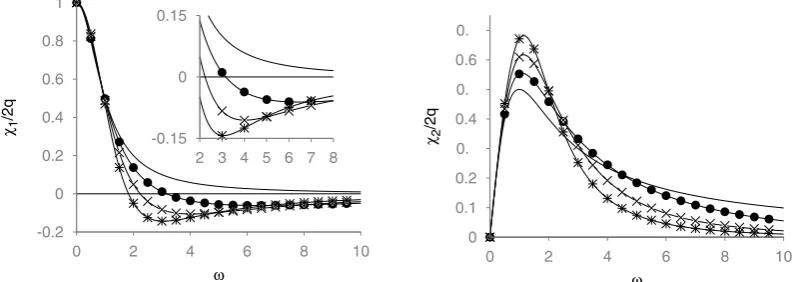
he two functions χ1(ω) and χ2(ω) are plotted in Fig. 1, where we note we have used a large value of the escape rate, Γ= 1 Hz, for visual clarity. he salient feature of the in-phase component χ1 is the fact that it becomes negative at suiciently large frequencies for any Θ> 0, passes through a local minimum and only then rapidly approaches its asymptotic zero value from below. his means that the particle is paramagnetic at low frequencies,
Figure 1. he in-phase (let) and out-of-phase (right) components of the ac susceptibility versus the frequency
but diamagnetic at high frequencies. In the diamagnetic phase of the response the particle is apparently slowed down by the medium in which it inds itself and cannot follow the rapidly oscillating ield. One can therefore expect to ind the frequency induced diamagnetism in particles suspended in viscous luids. However, the efect has previously been observed experimentally in single crystals by Rhyee et al.19. heoretically the efect can be
so strong that it would render the magnetic permeability negative20. he out-of-phase component is
interest-ing in that its peak grows signiicantly higher and narrower with increasinterest-ing memory time, so that we conclude that memory enhances energy losses and heating of the sample in a narrow frequency interval. his behavior is required from particles used to treat cancer by magnetic particle hyperthermia21. We note that, in the fully
hys-teretic regime with a conventional (white noise) thermostat, El Mrbati et al.22 have shown diamagnetic behaviour,
here we demonstrate a very general efect arising from the nature of the noise itself.
So far we have considered only noninteracting media. Now we shall consider an exactly solvable model system of two identical superparamagnetic particles with parallel easy axes7,23. he particles interact with each other via
dipolar coupling and have three metastable states: ↑↑, ↑↓ + ↓↑ and ↓↓. he mutual coupling is ferromagnetic if the bond angle β between the easy axes is zero, β= 0 and antiferromagetic if β=π/2. he thermally driven dynamics of the particle pair, at the small ields of interest here, are described by the three level master equation7
κ κ κ κ
= − + − +
n1 (2 12 21)n1 21 3n 21, (11)
κ κ κ κ
= − − + +
n3 23 1n (2 32 23)n3 23, (12)
where again we made use of the probability conservation n1+n2+n3= 1. he two particle occupation probabili-ties are n1=n↑↑, n2=n↑↓+↓↑ and n3=n↓↓. Obviously, n2 corresponds to a demagnetized state and the reduced magnetization m= 2(n1−n3). he rates of the thermally activated transitions between the individual minima,
κij=κi→j, are given by the formula
κij=f e0 −qQij, (13) with
ερ
= + + −
Q12 hc2 2 (2h hc), (14)
= −
Q21 hc 2hhc, (15)
2
= +
Q23 hc2 2hhc, (16)
ερ
= + − − .
Q32 hc2 2 (2h hc) (17)
he dipole strength ρ=M V KRs2 /2 3 where R is the distance between the particles. If the bond angle β= 0, then the critical ield hc= −(1 ρ)(1−3 )ρ
2 and ε= 8. At β=π/2 there is
ρ ρ
= − +
hc (1 )(1 3 )
2 and ε=−4. Introducing
now memory into Eqs (11) and (12) in the same manner as was done in Eq. (7) and linearizing with respect to h0, we obtain again the formulas (9) and (10), but with Γ =2f e−q h+ερ
0
( c2 ), and
= =
+ ερ
↑↑ →∞ −
n n t
e
lim ( ) 1
2(1 ) (18)
t 1
in zero ield. he formal equivalence of the two results, for interacting and noninteracting particles, follows from the fact that in the irst order of h0 Eqs (11) and (12) yield a single rate equation for the reduced magnetization
m. his property follows from the symmetry of the interacting system and is preserved also if a mean ield theory is employed. However, it could not hold for more complex, strongly coupled particle assemblies whose response is thus not of the Debye type24. It should be noted that ferromagnetic coupling with ε> 0 reduces the rate Γ and
facilitates the onset of the diamagnetic state, while antiferromagnetic coupling, which favors the creation of mag-netically neutral demagnetized states, has the opposite efect.
he dynamics of superparamgnets are also amenable to investigation via direct numerical simulation of the corresponding Langevin equation, the Landau-Lifshitz-Gilbert (LLG) equation. he Markovian rate equations of the form Eq. 2 correspond to the high barrier limit of the LLG14,25, in what is termed the discrete orientation
approximation. he preceding analysis of the non-Markovian rate equations may then be understood as the direct modiication of said high barrier rate equations to include explicit memory efects. In what follows we will com-pare this approach to that of an explicitly non-Markovian Langevin equation for the magnetic system.
he LLG equation for the time-evolution of a single spin is
γ
α α
= −
+ × + × ×
d dt
S
S H S S H
1 2( ( )), (19)
where α is the phenomenological damping constant, γ= .1 76×1011T−1s−1 is the gyromagnetic ratio and S is a unit vector representing the direction of the magnetic moment. he local magnetic ield, H, is obtained from the spin Hamiltonian, , as H= −µ1∂∂S
s
www.nature.com/scientificreports/
other ields as appropriate. At non-zero temperature the local ield is augmented by a thermal ield, Hth, whose
components are assumed to be spatially and temporally uncorrelated, thus
〈Hth i,( )t〉 =0 (20)
α
γµ δ δ
〈H ( )t H ( )t′ 〉 =2 k T (t− ′t) ,
(21)
th i th j B
s
ij
, ,
where (i, j) refer to Cartesian coordinates.
he Landau-Lifshitz-Miyazaki-Seki (LLMS) Eq.6, is the natural non-Markovian extension of the LLG, via
the introduction of time-correlated, coloured noise, Under this approach, the spin no longer includes an explicit damping term; rather we consider a spin undergoing only precessional motion. Damping and correlations are included via a bath magnetic ield with a characteristic correlation time and which dynamically evolves to align with the spin while also being driven by a white noise. he time evolution of the spin and the bath ield are of the form6 γ η = × + d dt S S H ( ( )) (22) η η λ = −
Θ − +
d
dt S R
1
( ) ,
(23)
where Θ is the noise correlation time, λ is the coupling of the bath to the spins and η is the correlated thermal magnetic ield. he luctuation-dissipation theorem for the white noise R is
λ
µ δ δ
〈 ′ 〉 =
Θ − ′ .
R t R t( ) ( ) 2 k T (t t)
(24)
i j B
s
ij
he Langevin equation for the spin-only is
∫
γ λ ψ
= × + − ′ − ′ ′
′ −∞
d t
dt t t dt t t
d t dt
S
S H R S
( )
( ) [ ( ) ( ) ( )],
(25)
t
where ψ( )t =e− Θt/ , R( ) is exponentially-correlated thermal noise t 〈R t R ti( ) ( )j ′ 〉 = λµ ψ(t− ′t)δ
k T
ij B
s
and the last term represents the damping which contains an efect of retardation due to the inite relaxation time of the luc-tuating ield. he spin-only LLMS is very similar to the LLG equation in the form ddtS = −γ
(
S×H−αS× ddtS)
and by taking the Θ →0 limit, we may recover the LLG equation and obtain the relation α=γλΘ. Both sets of equations are integrated using the Heun method which is consistent with the Stratonovich calculus.
To calculate the susceptibility, we simulate the time evolution of an ensemble of non-interacting spins using either LLG or LLMS as appropriate. he spin is irst evolved in time until the system has thermalised. Following this an oscillating magnetic ield hz=h0cos(ωt) was applied to the system along the anisotropy direction, where
h0 is the ield magnitude and ω the frequency. he real and imaginary susceptibility, respectively χ1 and χ2 are calculated as the cosine and sine Fourier transform of 〈Sz〉, the ensemble average of the z-component of the spin.
Calculations as a function of ac ield magnitude were carried out to ensure the model was applied in the linear region of the system response.
For the following simulations we consider an ensemble of non-interacting Co nanoparticles in the absence of external ields. he particles are assumed to have a volume of V= 8 × 10⁻²⁷m3, anisotropy energy
KV= 3.36 × 10⁻²¹J and a magnetic moment of µ
s= 1.12 × 10⁻²⁰J/T. he temperature and damping
parame-ters are taken such that q= 2 and α= 0.5. An ensemble of 10,000 spins were used for the simulations. We are especially interested in the behaviour of the real part of the dynamic susceptibility, χ1 in the vicinity of the analytically-predicted diamagnetic phase transition.
he variation of the real part of the susceptibility with frequency (normalised by the Larmor frequency,
ω′ =ω γ( Hk)−1) for various values of τ=ΘγHk for high frequencies, on the order of the expected phase transition,
is shown in Fig. 2. his shows that the susceptibility with correlations becomes negative in this region, supporting the analytical predictions of the master equation approach and conirming that the negative susceptibility arises from a phase change induced by the slowing down of the response of the particle by the medium. We also note a cross-over in the variation of χ1 with frequency, in agreement with the analytical predictions. Overall, the numer-ical calculations represent an important counterpart to the analytnumer-ical model. he presence of a diamagnetic phase transition under both approaches leads us to anticipate that such a transition may be the generic result of memory in magnetic systems, regardless of the precise form of the memory kernel.
Finally, We consider the critical frequency for the transition to diamagnetic behaviour. From Eq. 9 the transi-tion to diamagnetic behavior occurs at the frequency ωc = Γ Θ ∝/ τ−
2 1. hus we estimate that
ω
Θ =2 expf0 −(KV kT/ )/ c, (26)
2
approxima-tion to the attempt frequency, so we may take f0= 1 in the reduced units and the anticipated prefactor is then simply 2e−q= .0 668, 0 52. for q= 1.5, 2 respectively.
Overall, the behavior predicted by the LLMS approach shows non-monotonic behavior with an increase for large Θ. We anticipate that this departure is due to the assumption of a ixed transition rate, Γ, between the wells in the master equation expression, an assumption which is not generally valid for the LLMS model, where the transition rate will be some, potentially complicated, function of Θ and λ. Given that we have maintained a ixed phenomenological damping, α=γλΘ, an increase in the correlation time will cause a corresponding decrease in the coupling of the bath and the spin. he efect of the low-λ limit on the escape dynamics is much the same as the low-α behaviour of the LLG and will generally lead to a decrease in the escape rate in the limit of van-ishing λ. Similarly, an increase in the correlation time of the thermal ield will tend to decrease the transition rate between wells26. his efect is similar to the increase in the longitudinal and transverse relaxation times for
exchange-coupled spins undergoing LLMS evolution6.
[image:6.595.158.362.46.203.2]In summary, we have presented analytical and numerical studies of the frequency dependent susceptibility of magnetic nanoparticles. Remarkably, the calculations, consistently between the analytical and numerical models, show a frequency-induced diamagnetic susceptibility above a critical frequency dependent on the correlation time. he efect is shown to be enhanced by the presence of interparticle interactions, leading to the intriguing suggestion that interaction efects themselves may be considered as a memory efect. It should be noted that fur-ther work is needed to link the LLMS approach to the exponentially correlated noise introduced into the master equation formalism. However, this is a non-trivial problem which can only be achieved via the Fokker-Planck equation and is beyond the scope of the current work. However, we stress that the negative susceptibility arises from a phase shit induced by the low frequency iltering property of the non-Markovian system for both distinct models. hus it is suggested that the negative susceptibility will be a common feature of systems with corre-lated noise. he efects of heat-bath correlations are not easy to investigate experimentally. Our prediction of frequency-induced diamagnetic behavior represents an important prediction of a clear experimentally acces-sible signature of heat-bath correlations, with Eq. 26 giving a direct relationship between the correlation time
Figure 2. he variation of the real part of the susceptibility with the frequency, normalised by the Larmor frequency, ω′ =ω γ/ Hk) for various values of τ=(γHk)−1Θ, in the vicinity of the diamagnetic phase transition.
Figure 3. Estimated critical frequency, ωc of diamagnetic phase transition vs correlation time and numerical it
for low τ. he τ-dependence compares favourably to the prediction of the master equation, ωc∝τ−
1 in this
[image:6.595.156.358.256.413.2]www.nature.com/scientificreports/
and the critical frequency for diamagnetic behaviour. Measurements of the correlation time would generate new understanding of the properties of thermal baths and their interaction with spin systems and would be especially important in the understanding of ultrafast magnetization processes as pointed out in ref.6.
References
1. Sierra-Bermúdez, S., Maldonado-Camargo, L. P., Orange, F., Guinel, M. J.-F. & Rinaldi, C. Assessing magnetic nanoparticle aggregation in polymer melts by dynamic magnetic susceptibility measurements. J. Magn. Magn. Mat. 378, 64–72 (2015). 2. Klik, I., Yao, Y. D., Yan, X. & Chang, C. R. Magnetic viscosity efect in ac susceptibility measurements. Phys. Rev. B 57, 92–95 (1998). 3. Beaurepaire, E. et al. Ultrafast spin dynamics in ferromagnetic nickel. Phys. Rev. Lett. 76, 4250 (1996).
4. Radu, I. et al. Transient ferromagnetic-like state mediating ultrafast reversal of antiferromagnetically coupled spins. Nature 472, 205 (2011).
5. Ostler, T. A. et al. Ultrafast heating as a suicient stimulus for magnetization reversal in a ferrimagnet. Nature Commun. 3, 666 (2012). 6. Atxitia, U., Chubykalo-Fesenko, O., Chantrell, R. W., Nowak, U. & Rebei, A. Ultrafast spin dynamics he efect of colored noise.
Phys. Rev. Lett. 102, 057203 (2009).
7. Klik, I. & Chang, C. R. hermal relaxation in arrays of coupled ferromagnetic particles. Phys. Rev. B 52, 3540–3545 (1995). 8. Svedlindh, P., Jonsson, T. & Garca-Palacios, J. L. Intra-potential-well contribution to the AC susceptibility of a noninteracting
nano-sized magnetic particle system. J. Magn. Magn. Mat. 169, 323–334 (1997).
9. Berkov, D. V. & Gorn, N. L. Susceptibility of the disordered system of fine magnetic particles a langevin-dynamics study. J. Phys.:Condensed Matter 13, 9369–9382 (2001).
10. Sadykov, E. K. & Isavnin, A. G. heory of dynamic magnetic susceptibility in uniaxial superparamagnetic particles. Phys. Solid. State
38, 1160–1164 (1996).
11. Garanin, D. A., Ischenko, V. V. & Panina, L. V. Dynamics of an ensemble of single-domain magnetic particles. heor. Math. Phys. 82, 169–179 (1990).
12. Klik, I. & Yao, Y. D. Magnetization reversal by a ield pulse. J. Magn. Magn. Mat. 186, 233–238 (1998).
13. Klik, I., Chang, C. R. & Huang, H. L. Field-dependent prefactor of the thermal relaxation rate in single-domain magnetic particles. Phys. Rev. B 48, 15823–15828 (1993).
14. Cofey, W. T. & Kalmykov, Y. P. hermal luctuations of magnetic nanoparticles Fity years ater brown. J. Appl. Phys. 112, 121301 (2012). 15. Klosek-Dygas, M. M., Matkowski, B. J. & Schuss, Z. Colored noise in activated rate processes. SIAM J. Appl. Math. 48, 425–441
(1988).
16. Miyazaki, K. & Seki, K. Brownian motion of spins revisited. J. Chem. Phys. 108, 7052–7059 (1998). 17. Sun, Y., Salamon, M. B., Garnier, K. & Averback, R. S. Phys. Rev. Lett., 91, 167206 (2003).
18. Sasaki, M., Jönsson, P. E., Takayama, H. & Nordblad, P. Memory Efects in an Interacting Magnetic Nanoparticle System. Phys. Rev. Lett. 93, 139701 (2004).
19. Rhyee, J. S., Peng, J. B., Lin, C. T. & Lee, S. M. Anisotropic magnetization and sign change of dynamic susceptibility in Na0.85CoO2
single crystal. Phys. Rev. B 77, 205108 (2008).
20. Veselago, V. G. he electrodynamics of substances with simultaneously negative values of ε and µ. Soviet Physics Uspekhi 10, 509–514 (1968).
21. Hergt, R., Dutz, S., Müller, R. & Zeisberger, M. Magnetic particle hyperthermia nanoparticle magnetism and materials development for cancer therapy. J. Phys. Cond. Mat. 18, S2919–S2934 (2006).
22. El Mrabti, H., Déjardin, P. M., Titov, S. V. & Kalmykov, Y. P. Damping dependence in dynamic magnetic hysteresis of single-domain ferromagnetic particles. Phys. Rev. B 85, 094425 (2012).
23. Chen, W., Zhang, S. & Bertram, H. N. Energy barriers for thermal reversal of interacting single domain particles. J. Appl. Phys. 71, 5579–5584 (1992).
24. Jönsson, P. E., Garca-Palacios, J. L., Hansen, M. F. & Nordblad, P. Relaxation in interacting nanoparticle systems. J. Mol. Liquids 114, 131–136 (2004).
25. Cofey, W. T., Kalmykov, Y. P. & Waldron, J. T. he Langevin Equation. World Scientiic, Singapore (1996). 26. Hânggi, P. Escape from a metastable state. J. Stat. Phys 42, 105–148 (1986).
Acknowledgements
he authors acknowledge support by the National Science Council grant number NSC98-2112-M-002-012-MY3. he work also made use of the facilities of N8 HPC provided and funded by the N8 consortium and EPSRC (Grant No. EP/K000225/1) co-ordinated by the Universities of Leeds and Manchester and the EPSRC Small items of research equipment at the University of York ENERGY (Grant No. EP/K031589/1).
Author Contributions
I.K. conducted analytical investigation of rate equations. J.M. implemented Langevin simulations and compiled data. All authors contributed to and reviewed the manuscript.
Additional Information
Supplementary information accompanies this paper at https://doi.org/10.1038/s41598-018-21028-2.
Competing Interests: he authors declare no competing interests.
Publisher's note: Springer Nature remains neutral with regard to jurisdictional claims in published maps and institutional ailiations.
Open Access This article is licensed under a Creative Commons Attribution 4.0 International License, which permits use, sharing, adaptation, distribution and reproduction in any medium or format, as long as you give appropriate credit to the original author(s) and the source, provide a link to the Cre-ative Commons license, and indicate if changes were made. he images or other third party material in this article are included in the article’s Creative Commons license, unless indicated otherwise in a credit line to the material. If material is not included in the article’s Creative Commons license and your intended use is not per-mitted by statutory regulation or exceeds the perper-mitted use, you will need to obtain permission directly from the copyright holder. To view a copy of this license, visit http://creativecommons.org/licenses/by/4.0/.