BY
JYOTHI. S. SUNANDHA
A DISSERTATION SUBMITTED TO THE TAMILNADU DR.M.G.R.MEDICAL UNIVERSITY, CHENNAI, IN PARTIAL FULFILMENT OF THE
REQUIREMENTS FOR THE DEGREE OF MASTER OF SCIENCE IN NURSING
Approved by the Dissertation Committee on:
Research Guide : _____________________ Dr. Latha Venkatesan,
M.Sc (N)., M.Phil., Ph.D.,
Principal and Professor in Nursing, Apollo College of Nursing,
Chennai - 600 095.
Clinical Guide : ___________________ Mrs. Vijayalakshmi.K., M.Sc (N).,
HOD Psychiatric Nursing, Apollo College of Nursing, Chennai – 600 095.
Medical Guide : ____________________ Dr. Bharathi Visveswaran,
M.D., D.P.M., F.I.C.P.,
Consultant psychiatrist,
Apollo Hospitals,
Chennai – 06.
A DISSERTATION SUBMITTED TO THE TAMILNADU DR.M.G.R.MEDICAL UNIVERSITY, CHENNAI, IN PARTIAL FULFILMENT OF THE
REQUIREMENTS FOR THE DEGREE OF MASTER OF SCIENCE IN NURSING
Assertiveness Training upon the Assertiveness Skills and Self-Esteem among Alcoholic Patients in Selected De-addiction Centres, Chennai”, is the outcome of the
original research work undertaken and carried out by me, under the guidance of
Dr. Latha Venkatasen, M.Sc (N)., M.Phil., Ph.D., Principal and Professor in Obstetric and Gynecological Nursing, Apollo College of Nursing and Mrs. Vijayalakshmi. K,
M.Sc (N)., HOD, Psychiatric Nursing, Apollo College of Nursing, Chennai. I also declare that the material of this has not formed in any way, the basis for the award
of any degree or diploma in this university or any other universities.
experience. They showed me the harsh reality, the tears and pain that goes along with
the menace called alcoholism. The challenges they posed during the therapy has made
me realize the need to have the best effective intervention as quick as possible. Hope
that day comes soon so that many families can have a peaceful existence. Thank you all
for opening up and to share your joy and sorrow along with me.
I am greatly indebted to Dr. Latha Venkatesan, M.Sc. (N)., M.Phil., Ph.D.,
Principal, Apollo College of Nursing, who has been a source of unflagging and whole
hearted support. She gave me the opportunity and leading me into the challenging field
of substance abuse. She ingrained in me the thought that obstacles exist and thus
challenge one to keep going.
I extend my earnest gratitude to Prof. Lizy Sonia. A., M.Sc. (N)., Vice Principal
and Course Coordinator, Apollo College of Nursing, for her kind encouragement and
support to venture into this project.
I owe a great sense of gratitude to my guide Prof. Vijayalakshmi. K.,
M.Sc. (N)., M.A. (Psychology)., the Head of Psychiatric Nursing Department and Research Coordinator, who was a major guiding and sustaining forces in the completion
of this thesis. She believed in me and was constantly there for me, whenever I needed
pointers to go forward. Discussions with her have opened up new vistas of thinking to
Professor and Mrs. Stella Mary. I., M.Sc (N)., Lecturer, Department of Mental Health
Nursing, for their steadfast support, inspiration and enduring mentorship.
I am grateful to the experts for validating the tools used in this study and also I
would like to extend my gratitude to all the Faculty of Apollo College of Nursing for
their valuable inputs into the study.
Special thanks are due to Mr. Kamalesh, Manager Operations, Wisdom
Hospitals, and Mr. Bharathan, Managing Director, Freedom Foundation and Care for
providing the facilities to carry out this work. They showed me the way and gave me the
freedom to pursue it according to my lights.
A note of thanks to the Librarians at Apollo College of Nursing and the Tamil
Nadu Dr. M. G. R. Medical University, for their help in providing needed reference
materials required.
Words fail to express my gratitude I feel towards my parents Mr. Sundara
murthi. K. and Mrs. Nangamani. P. K., the guiding lights of my life. Thanking them is like thanking myself, so I leave it unsaid. I am also grateful to Mr. Sunil. S.
Krishnan, who was more than just a brother, but also a close friend and a confidant.
Last but not least I am deeply indebted to all my classmates ‘SPARTANS’, in
appreciation of their care and support. The list of individuals who have helped in the
entire process of this academic pursuit is far too long and perforce. Hence I limit myself
A Quasi Experimental Study to Assess the Effectiveness of Assertiveness
Training on Assertiveness Skills and Self-Esteem among Alcoholic Patients in Selected
De-Addiction Centers at Chennai.
Objectives of the Study
1. To assess the level of assertiveness skills and self-esteem in the control and
experimental group of alcoholic patients.
2. To evaluate the effectiveness of assertiveness training by comparing the
assertiveness skills and self-esteem of control and experimental group of
alcoholic patients before and after the assertiveness training.
3. To find out the association between the selected demographic variables and level
of assertiveness skills and self esteem, before and after assertiveness training in
the control and experimental group of alcoholic patients.
4. To find out the association between the selected clinical variables and level of
assertiveness skills and self-esteem, before and after assertiveness training in the
control and experimental group of alcoholic patients.
5. To determine the level of satisfaction among experimental group of alcoholic
patients on assertiveness training.
The conceptual framework of the study was based on “Peplau’s Interpersonal
foundation to the development of study instruments. A quasi experimental research
design was selected to achieve the objectives of the study. The study was conducted at
Freedom care and foundation, Sithalapakkam and Wisdom hospitals, Saidapet. The
sample size of the study was 60 (30 in each group). The settings were randomised and
allotted to the control and experimental group. Purposive sampling technique was used
to select the samples from the respective settings.
The instruments used in the study were demographic variable proforma of
alcoholic patients, clinical variable proforma of alcoholic patients, Rathus assertiveness
schedule, Rosenberg self-esteem scale. The data collection tools were validated and the
reliability was established through split half technique. After the pilot study, the data for
the main study was collected by self-administration and interview method.
Assertiveness training includes activities like practice sessions with detailed exercises,
worksheets, video shows, games and innovative methods with lecture cum discussion
using power point presentation. It was a one hour session for a period of ten days.
Assertiveness training was administered only to the experimental group. On the
15th day, assertiveness skills and self-esteem scores were assessed for both the control
and experimental group by using the Rathus assertiveness schedule and Rosenberg’s
self-esteem scale. The level of satisfaction on administration of assertiveness training
was assessed by using the rating scale in the experimental group. Then collected data
were tabulated and analysed using descriptive (frequency, percentage, mean, standard
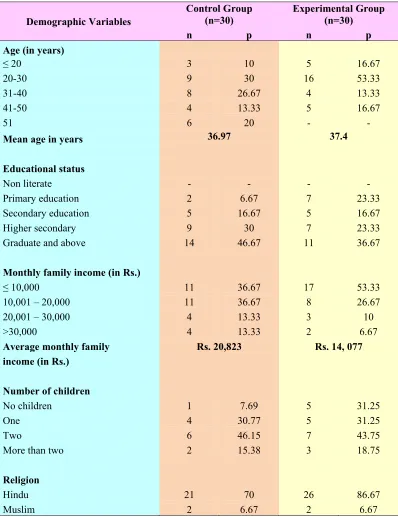
age group of 20-30 years (30%, 53.33%), were graduates (46.67%, 36.67%), were
labourers (26.67%, 43.33%), earned a monthly family income of ≤ 10,000 rupees
(36.67%, 53.33%), had two children (46.15%, 43.75%), belonged to joint family
(43.33%, 50%), had a family history of alcohol abuse/ dependence (63.33%, 66.67%) in
the control and experimental group respectively. Majority of them were Hindus
(70%, 86.67%) in the control and experimental group respectively. Most of them were
unmarried in the control group (53.13%) and married in the experimental group
(66.67%) respectively.
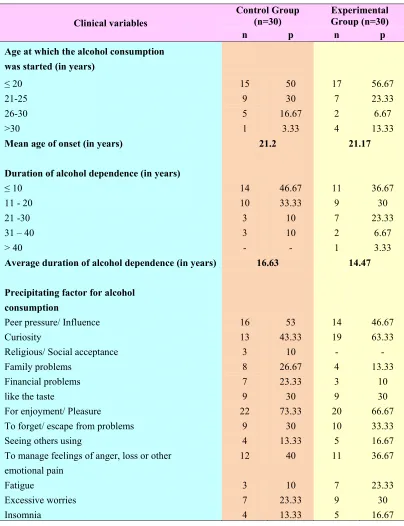
¾ In the present study most of the alcoholic patients in the control and experimental group started consuming alcohol at the age of ≤ 20 years (50%, 56.67%),
for a duration of ≤ 10 years (46.67%, 36.67%), stated enjoyment/ pleasure as the
precipitating factor for alcohol consumption (73.33%, 66.67%), tolerance as the
situation that provoked them to consume more amount of alcohol (63.33%, 63.33%),
consumed alcohol everyday (57%, 60%), had tremors in hands and fingers (60%,
66.67%), had a previous history of alcohol de-addiction treatment (73.33%, 70%),
believed in alcohol de-addiction treatment to be effective (83.33%, 73.33%) and stated
family responsibility as the motivation to seek treatment (73.33%, 60%) respectively.
developed complications like depression (26.67%, 40%), stated self-control as the
reason for abstinence (21.43%, 17.39%), stated loss of pleasure as the reason for
restarting alcohol consumption after a period of abstinence (39.29%, 60.87%), had a
history of psychiatric hospitalisation (33.33%, 23.33%) and stated depression as the
reason for psychiatric hospitalisation (30%, 57.14) in the control and experimental
group respectively.
¾ Majority of the alcoholic patients in the control group were non-assertive and had normal level of self-esteem before (96.7%, 70%) and after (96.67%, 80%) AST
respectively. None of them had high self-esteem. In the experimental group, most of the
alcoholic patients were non-assertive and had normal level of self-esteem before AST
(93.3%, 70%). However, after the administration of AST, most of them were assertive
(63.3%) and majority of them had normal level of self-esteem (76.67%) in the
experimental group of alcoholic patients respectively. Twenty percent of them had high
self- esteem after AST. This can be ascribed to the effectiveness of AST.
¾ The mean and standard deviation for scores of assertiveness skills (M=-2.47, SD=12.78), (M=-3.30, SD=12.25) and self-esteem (M=16.93, SD=3.52),
(M=15.7, SD=4.25) among alcoholic patients before AST in the control and
experimental group was not significant at p>0.05. On the other hand, after the
administration of AST, the mean and standard deviation of assertiveness skills
(M=2.60, SD=13.34) and self-esteem (M=17.37, SD=3.06) of control group were less in
AST. Hence the null hypothesis Ho1 was rejected.
¾ There was a significant association between age of the alcoholic patients (χ2 = 4.85, df=1) at p<0.05 and the level of assertiveness skills. In this regard, the null
hypothesis Ho2 was rejected. However, there was no association between other
demographic variables such as educational status, occupation, marital status, monthly
family income, religion, type of the family, family history of alcohol abuse/ dependence
and the level of assertiveness skills (p > 0.05). Hence the null hypothesis Ho2 was
retained.
¾ Majority of the clients (93.33%) were highly satisfied with all the aspects of assertiveness training.
¾ There was no significant association between any of the selected demographic variables and the level of self-esteem in the control and experimental group of alcoholic
patients. Hence the null hypothesis Ho3 was retained.
¾ There was no significant association between any of the selected clinical variables and the level of assertiveness skills in the control and experimental group of
alcoholic patients. Hence the null hypothesis Ho4 was retained.
¾ However there is no significant association between other clinical variables like age at which the alcohol consumption was started, frequency, amount of alcohol
consumption, money spent on alcohol consumption, efforts to quit alcohol in the past,
previous history of alcohol de-addiction treatment, belief in effectiveness of
de-addiction treatment, history of psychiatric hospitalisation and the level of self-esteem
(p > 0.05). In this regard, the null hypothesis Ho5 with regard to association between the
other selected clinical variables such as age at which the alcohol consumption was
started, frequency, amount of alcohol consumption, money spent on alcohol
consumption, efforts to quit alcohol in the past, previous history of alcohol de-addiction
treatment, belief in effectiveness of de-addiction treatment, history of psychiatric
hospitalisation and self-esteem was retained.
Recommendations
¾ The study can be conducted on a large scale to generalize the results.
¾ The study can be conducted among different groups like adolescents, mentally ill patients, teenagers who abuse other substances, family members of alcoholic
patients etc.
¾ A follow up study can be conducted to assess the effectiveness of the present programme in reducing the relapse rates of alcoholic patients.
¾ A time series design can be conducted with an interval of 2, 4 and 6 months to assess the long term effects of assertiveness training upon assertiveness skills
and self-esteem.
I INTRODUCTION 1-14
Background of the study 1
Need for the study 4
Statement of the problem 7
Objectives of the study 7
Operational definition 8
Assumption 9
Null hypothesis 10
Delimitations 10
Conceptual framework 11
Projected outcome 14
Summary 14
Organisation of the report 14
II. REVIEW OF LITERATURE 15- 22
Literature related to alcoholism 16
Literature related to assertiveness skills and alcoholism
17
Literature related to self-esteem and alcoholism 19
Literature related to effectiveness of assertiveness training
Research design 23
Variables 25
Research settings 27
Population 27
Sample 28
Sampling technique 28
Sampling criteria 28
Selection & development of the study instruments 29
Psychometric properties of the instruments 33
Pilot study 34
Protection of human rights 34
Data collection procedure 35
Problem faced during data collection 36
Plan for data analysis 36
Summary 37
IV ANALYSIS AND INTERPRETATION 38 - 70
V DISCUSSION 71 - 83
VI SUMMARY, CONCLUSION, IMPLICATIONS, AND RECOMMENDATIONS
84 - 93
VII REFERENCES 94 – 96
No No
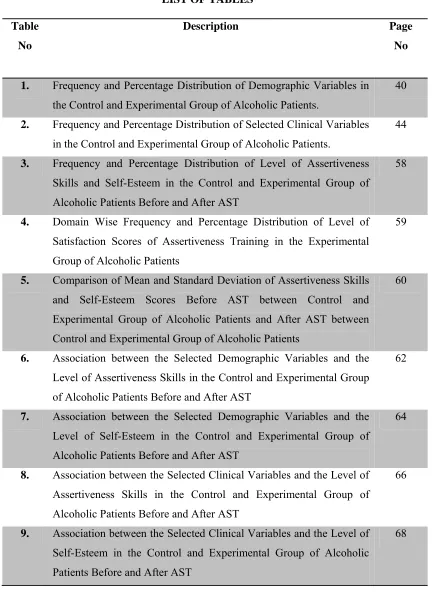
1. Frequency and Percentage Distribution of Demographic Variables in the Control and Experimental Group of Alcoholic Patients.
40
2. Frequency and Percentage Distribution of Selected Clinical Variables in the Control and Experimental Group of Alcoholic Patients.
44
3. Frequency and Percentage Distribution of Level of Assertiveness Skills and Self-Esteem in the Control and Experimental Group of Alcoholic Patients Before and After AST
58
4. Domain Wise Frequency and Percentage Distribution of Level of Satisfaction Scores of Assertiveness Training in the Experimental Group of Alcoholic Patients
59
5. Comparison of Mean and Standard Deviation of Assertiveness Skills and Self-Esteem Scores Before AST between Control and Experimental Group of Alcoholic Patients and After AST between Control and Experimental Group of Alcoholic Patients
60
6. Association between the Selected Demographic Variables and the Level of Assertiveness Skills in the Control and Experimental Group of Alcoholic Patients Before and After AST
62
7. Association between the Selected Demographic Variables and the Level of Self-Esteem in the Control and Experimental Group of Alcoholic Patients Before and After AST
64
8. Association between the Selected Clinical Variables and the Level of Assertiveness Skills in the Control and Experimental Group of Alcoholic Patients Before and After AST
66
9. Association between the Selected Clinical Variables and the Level of Self-Esteem in the Control and Experimental Group of Alcoholic Patients Before and After AST
[image:14.612.112.544.93.699.2]Fig No
Description Page No
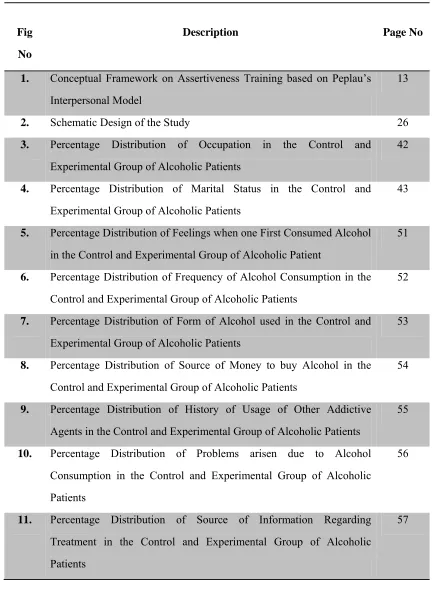
1. Conceptual Framework on Assertiveness Training based on Peplau’s Interpersonal Model
13
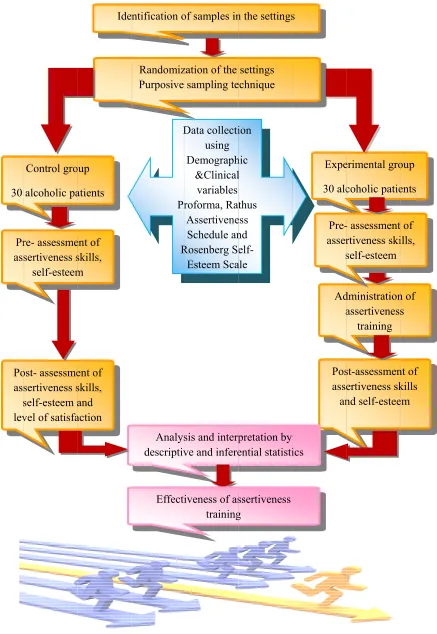
2. Schematic Design of the Study 26
3. Percentage Distribution of Occupation in the Control and Experimental Group of Alcoholic Patients
42
4. Percentage Distribution of Marital Status in the Control and Experimental Group of Alcoholic Patients
43
5. Percentage Distribution of Feelings when one First Consumed Alcohol in the Control and Experimental Group of Alcoholic Patient
51
6. Percentage Distribution of Frequency of Alcohol Consumption in the Control and Experimental Group of Alcoholic Patients
52
7. Percentage Distribution of Form of Alcohol used in the Control and Experimental Group of Alcoholic Patients
53
8. Percentage Distribution of Source of Money to buy Alcohol in the Control and Experimental Group of Alcoholic Patients
54
9. Percentage Distribution of History of Usage of Other Addictive Agents in the Control and Experimental Group of Alcoholic Patients
55
10. Percentage Distribution of Problems arisen due to Alcohol Consumption in the Control and Experimental Group of Alcoholic
Patients
56
11. Percentage Distribution of Source of Information Regarding Treatment in the Control and Experimental Group of Alcoholic
Patients
[image:15.612.110.545.109.707.2]Permission letters
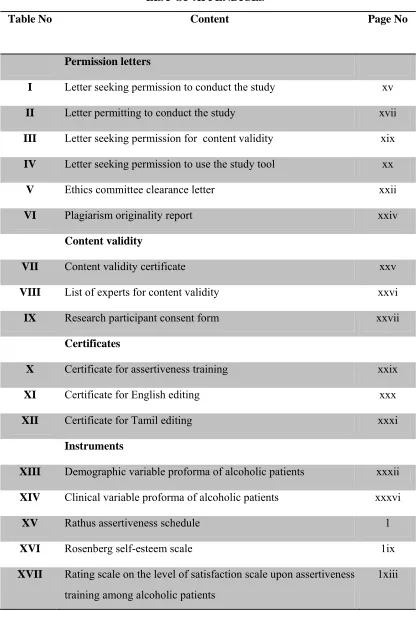
I Letter seeking permission to conduct the study xv
II Letter permitting to conduct the study xvii
III Letter seeking permission for content validity xix IV Letter seeking permission to use the study tool xx
V Ethics committee clearance letter xxii
VI Plagiarism originality report xxiv
Content validity
VII Content validity certificate xxv
VIII List of experts for content validity xxvi
IX Research participant consent form xxvii
Certificates
X Certificate for assertiveness training xxix
XI Certificate for English editing xxx
XII Certificate for Tamil editing xxxi
Instruments
XIII Demographic variable proforma of alcoholic patients xxxii XIV Clinical variable proforma of alcoholic patients xxxvi
XV Rathus assertiveness schedule 1
XVI Rosenberg self-esteem scale 1ix
XVII Rating scale on the level of satisfaction scale upon assertiveness training among alcoholic patients
[image:16.612.114.531.95.718.2]Experimental Group of Alcoholic Patients
Assertiveness Training
XIX Assertiveness training schedule 1xvii
XX Lesson plan on assertiveness training 1xix
XXI Power point presentation on assertiveness and self-esteem cxvi
XXII Data code sheet cxxiii
XXIII Master code sheet cxxvii
Background of the Study
"It is better to be hated for what you are,
Than to be loved for something you are not"
-Andre Gide
Alcoholism is a disorder characterised by loss of control over drinking, with
habituation to the drug alcohol, causing interference in any major life function.
e.g. health, family, job, spiritual, friends, legal.
The world’s highest alcohol consumption levels are found in the developed
world, including Western and Eastern Europe. According to the Hindustan Times it
is estimated that around 1% of the population in India, can be classified as being
alcohol-dependant. This translates into about 5 million people dependant on alcohol.
Kerala is the largest consumer of alcohol in India, followed by Punjab. Kerala alone
accounts for 16% and Punjab accounts for 14% of all the liquor consumed in India.
Alcoholism is multifactorial in nature. The causes of alcoholism are
bio-socio-psycho-faceted. Experts in the medical field ascribe alcohol problems and alcoholism to
a bewildering array of causes. Genetic or bio-chemical predisposition to alcoholism is a
controversy that has been debated for years. Conflictual emotions, irrational cognitions,
social learning processes, family pathology, sociocultural influences, self regulation
failure and personal choice are also considered as contributory factors.
The damage of long term alcohol consumption on the health of an individual is
well documented. According to Global status report on alcohol and health of WHO,
causal factor in 60 types of diseases and injuries and a component cause in 200 others.
It is estimated to cause from 20% to 50% of cirrhosis of the liver, epilepsy,
poisonings, road traffic accidents, violence and several types of cancer. New evidence
points to a causal link between alcohol and infectious diseases. A strong association is
found to exist between alcohol consumption and sexually transmitted diseases like HIV
infection. Alcoholism is also associated with many serious social issues, including
violence, child neglect and abuse, and absenteeism in the workplace. Perhaps the
biggest social impact is crime and violence related to alcohol consumption, which create
significant costs for justice and law enforcement sectors.
It has become increasingly evident that legal sanctions and moral pressures have
not provided an adequate remedy for this problem. Moreover, it is estimated that
treatment of alcoholic individuals with present techniques would fill every existing
hospital bed and require the full-time services of every physician in the Nation.
Consequently, solution of this problem must ultimately lie in the development of
improved prevention and treatment techniques.
Treatment of alcoholism takes several steps. Accepting that one has a problem,
and seeking help when necessary, is the first step to quit alcohol. Because of the
medical problems that can be caused by withdrawal, alcohol detoxification is carefully
controlled and may involve medications such as benzodiazepines. Some are assisted by
counselling from a nurse, doctor or specially trained counsellor. In some cases,
cognitive behavioural therapy and motivational interviewing may be appropriate. Many
programs also offer marital counselling and family therapy as part of the treatment
Humans are emotional creatures, and this emotion often gets them into trouble.
When one has to deal with people on a personal level, it is always critical to keep the
emotions in check. “Being firm without being rude”, is the art of assertiveness. It is the
action of declaring oneself, or stating, "This is who I am and what I think and feel".
Alberti and Emmons (1970), perhaps summarized it best when they said that assertive
behaviour is that "which enables a person to act in his own best interest, to stand up for
himself without undue anxiety, to express his rights without denying the rights of
others". They assume the best about people, respect themselves, think “win-win” and
try to compromise. As we become more assertive, we drop the mask and show our true
selves. An assertive manner certainly means that we'll feel more empowered, and more
in control of circumstances.
One of the main reasons people have a hard time being assertive is that they
have a low self-esteem. They do not express their thoughts, feelings and needs for fear
of rejection, or are afraid that people won’t like them any longer if they don’t help with
whatever is requested of them. As quoted by Butler (1979), “Being able to assert oneself
is a necessary ingredient of becoming self- actualised and to developing and
maintaining self-esteem”. This process gives power over us and our destinies.
A behaviour that is frequently attributed to alcoholics involves a pattern of
inappropriate responding to inter-personal conflict situations. Rather than dealing with
such situations in a forth-right assertive fashion, alcoholics choose avoidance or
passive-aggressive manoeuvres. Most obvious of these inappropriate responses is
excessive drinking, which may involve aspects of avoidance, passive- aggressiveness
and right. It is assumed that, assertive behaviour will bring about positive changes in the
behaviour of others toward him, and thus be better able to achieve significant social
(as well as material) rewards. Therefore, the individual achieves both internal and
external positive feedback from appropriate assertive responses.
Clients, who benefit from assertiveness training, often state that they have
become less inhibited, more outspoken, and able to stand up for their rights. Clinicians
have recognized that assertive training can be effectively utilized to help alcoholic
clients achieve a greater degree of self-esteem and emotional freedom. Hence, the
present study was an attempt to fulfil these goals by developing an all-inclusive
assertiveness training program and evaluating its usefulness among alcoholic patients.
The role of nursing involves interaction with clients, peers and other health
professionals. This role is enhanced when nurses have a good command of
communication skills. An essential component of effective communication is the ability
to behave assertively. Thus nurses while interacting with alcoholic patients can
incorporate formal and informal training on assertiveness to promote assertiveness skills
and self-esteem so as to improve the coping skills and quality of life of alcoholic
patients.
Need for the Study
Alcoholism is a broad term for problems with alcohol, and is generally used to
mean compulsive and uncontrolled consumption of alcoholic beverages, usually to the
detriment of the drinker's health, personal relationships, and social standing.
(central, north and north-east India), and reported a prevalence of current alcohol use of
20–38% in males and of 10% among females.
Studies in Northern India found the 1 year prevalence of alcohol use to be
between 25 and 40% (Varma, Singh, Singh & Malhotra et al., 1980). In Southern
India, the prevalence of current alcohol use varies between 33 and 50%, with a higher
prevalence among the lesser educated and the poor (Chakravarthy et al., 1990). A
number of factors have been implicated in the predisposition to abuse of alcohol. At
present there is no single theory that can adequately explain the aetiology of this
problem. No doubt the interaction between various elements forms a complex collection
of determinants that influence a person’s susceptibility to abuse substances like
genetics, biochemical, psychological and sociocultural factors.
Alcohol can induce a general, non-selective, reversible depression of the CNS.
Only moments after alcohol is consumed, it can be found in all tissues, organs and
secretions of the body. At low doses alcohol produces relaxation, loss of inhibitions,
lack of concentration, drowsiness, slurred speech and sleep. Chronic abuse results in
multisystem physiological impairments. These complications include cirrhosis of the
liver, pancreatitis, epilepsy, polyneuropathy, alcoholic dementia, heart disease,
nutritional deficiencies, peptic ulcers and sexual dysfunction, and can eventually be
fatal.
Treatment can be broadly divided into two categories, which are often
interlinked. These are detoxification and treatment of alcohol dependence.
Detoxification is the treatment of alcohol withdrawal symptoms. After detoxification,
patients.
The therapeutic objective of assertiveness training with alcoholics is to provide
clients with direct training in precisely those interpersonal and social skills deficient.
Very little attention is given to eliminate existing maladaptive behaviour; instead, as
skilful, adaptive responses are acquired, rehearsed and reinforced, the previous
maladaptive responses will be displaced and will disappear. Assertiveness training is
very similar to deep muscle relaxation in being physiologically antagonistic to anxiety.
It will instill in the client a greater feeling of well-being. It will also help them to
express their needs in a forthright straight forward assertive manner. As positive
rewarding behaviours are practiced and developed, they will compete with and
eventually replace alcoholic avoidance and escape.
The literature indicates that alcoholic patients experience problems related to
being non-assertive. Thus there is a need to develop a comprehensive program to train
the alcoholic patients in assertiveness and related skills. However within the Indian
context, research has not focussed on assertiveness and formulation of specific
strategies in order to deal with the non-assertive behaviour of alcoholic patients.
Thus this study was undertaken to assess the effectiveness of assertiveness
training on assertiveness skills and self-esteem among alcoholic patients. This will help
the nurses to plan for the assertiveness training as a part of routine care of alcoholic
patients. This will improve the assertiveness and self-esteem level of patients which in
turn would help them to adopt healthy coping strategies rather than depending on
alcohol. It would prevent relapse and remain abstinent from alcohol intake in future,
A Quasi Experimental Study to Assess the Effectiveness of Assertiveness
Training upon Assertiveness Skills and Self-Esteem among Alcoholic Patients in
Selected De-Addiction Centers at Chennai.
Objectives of the Study
1. To assess the level of assertiveness skills and self-esteem in the control and
experimental group of alcoholic patients.
2. To evaluate the effectiveness of assertiveness training by comparing the
assertiveness skills and self-esteem of control and experimental group of
alcoholic patients before and after the assertiveness training.
3. To determine the level of satisfaction among experimental group of alcoholic
patients on assertiveness training.
4. To find out the association between the selected demographic variables and level
of assertiveness skills and self esteem, before and after assertiveness training in
the control and experimental group of alcoholic patients.
5. To find out the association between the selected clinical variables and level of
assertiveness skills and self-esteem, before and after assertiveness training in the
In this study, it refers to the extent to which assertiveness training has improved the level of assertiveness skills and self–esteem in terms of increase in assertiveness skills and self-esteem scores among the alcoholic patients.
Assertiveness training (AST)
In this study, it is a planned one hour interventional program for a period of ten days by using pre-designed module. Assertiveness training includes various components such as modelling, coaching, role playing, instructions, behaviour rehearsal, feedback and graded-structured exercises. Techniques like fogging, broken–record and negative assertion were employed. Activities like practice sessions with detailed exercises, worksheets, video shows, games and innovative methods with lecture cum discussion using power point presentation were held.
Assertiveness skills
In this study, it refers to standing up for one’s rights without infringing the rights of others, which includes components like interpersonal communication, self concept and public speaking as measured by the Rathus assertiveness schedule.
Self – esteem
In this study, it refers to the over-all evaluation of his/her own worth as measured by Rosenberg’s self- esteem scale.
Alcoholic patients
rehabilitation services to patients who abuse substance.
Assumptions
The study assumes that:
¾ Man is a social animal who cannot live in isolation.
¾ Dependence causes progressive neglect of alternative interests because of
alcohol use.
¾ Alcoholics suffer a disturbed and stressful life situation in relationship to their
personality and family atmosphere.
¾ The family members of alcoholics experience agony, ambivalence and
frustration because of the problems arisen due to alcoholism.
¾ An assertive individual will be able to resist peer pressure to drink.
¾ People who have mastered the skill of assertiveness are able to greatly reduce
the level of interpersonal conflict in their lives.
¾ Every human being has a right to live with self-esteem.
¾ The self- esteem an essential quality to reduce anxiety may be lost to alcoholics.
¾ Low self-esteem can result in depression.
¾ Assertiveness training is a psycho social intervention.
Ho1: There will be no significant difference in assertiveness skills and self-esteem
before and after assertiveness training in the control and experimental group of
alcoholic patients.
Ho2: There will be no significant association between the selected demographic
variables and the level of assertiveness skills before and after assertiveness
training in the control and experimental group of alcoholic patients.
Ho3: There will be no significant association between the selected demographic
variables and the level of self-esteem before and after assertiveness training in the
control and experimental group of alcoholic patients.
Ho4: There will be no significant association between the selected clinical variables and
the level of assertiveness skills before and after assertiveness training in the
control and experimental group of alcoholic patients.
Ho5: There will be no significant association between the selected clinical variables and
the level of self-esteem before and after assertiveness training in the control and
experimental group of alcoholic patients.
Delimitations
¾ Study period was limited to 4 weeks only.
¾ Study participants were confined to alcoholic patients who attend
assembled together in some rational schemes by virtue of their relevance to a common
theme (Polit and Beck, 2010). The conceptual framework of the study is based on
“Peplau’s Interpersonal Model” (1952). According to Hildegard Peplau, "the goals of
nursing are currently in transition; its major concern fifty years ago had to do with
getting sick people well; today, nursing is more concerned with ways for helping people
to stay well".
The model views nursing in two ways. Firstly, nursing is educative. Secondly,
nursing is therapeutic. With these two functions combined, they allow nurses and clients
to develop skills for problem solving. This process of education and therapeutic
interaction occurs only within the relationship of the nurse and the client. This
interpersonal relationship between the nurse investigator and the alcoholic patients has
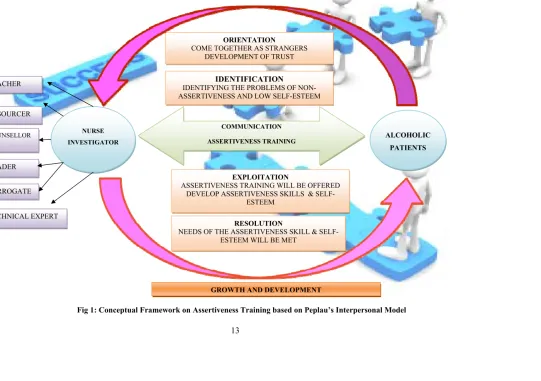
four clearly discernible phases. These phases are orientation, identification, exploitation
and resolution. Each of these phases are seen as being interlocking and requiring
overlapping roles and functions as the nurse and the alcoholic patients learn to work
together to resolve difficulties in relation to health problems.
Orientation
The alcoholic patients and nurse investigator came together as strangers meeting
for the first time. During this phase, the development of trust and empowerment of the
alcoholic patients were primary considerations. The nurse investigator encouraged the
alcoholic patients to participate in identifying the need for assertiveness and allowed
them to be an active participant in assertiveness training program. By asking for and
receiving help, the alcoholic patients felt more at ease expressing their need for
assertiveness knowing that the nurse investigator will take care of those needs. Once
identify the problems of unassertiveness and low self-esteem that require working on
within the relationship. The alcoholic patients selectively responded to a nurse
investigator who offered the assertiveness training program needed by the alcoholic
patients. Both the nurse investigator and the alcoholic patients clarified each other's
perceptions and expectations, which affected the ability of both to identify problems and
the necessary solutions. When clarity of perceptions and expectations was achieved, the
alcoholic patients learned to make use of the nurse investigator- patient relationship.
Once identification has occurred, the relationship entered the next phase.
Exploitation
The alcoholic patients took full advantage of assertiveness training program. The
degree to which the assertiveness training program was used is based upon the needs
and the interest of the alcoholic patients. Within this phase, alcoholic patients began to
develop assertiveness skills and self-esteem. They started to take control of their life
situation with the assertiveness training program that was offered. From this sense of
self-determination, alcoholic patients developed an inner strength that allowed them to
face new challenges. As the relationship passed through all of the aforementioned
phases and the needs of the alcoholic patients have been met, the relationship passed to
closure or the phase of resolution.
Resolution
It occurred when the needs of assertive skills and self-esteem was met. It implied
the gradual freeing from identification with the nurse investigator and the generation
ALCOHOLIC PATIENTS COMMUNICATION
ASSERTIVENESS TRAINING NURSE
INVESTIGATOR
ORIENTATION COME TOGETHER AS STRANGERS
DEVELOPMENT OF TRUST
IDENTIFICATION IDENTIFYING THE PROBLEMS OF
NON-ASSERTIVENESS AND LOW SELF-ESTEEM
EXPLOITATION ASSERTIVENESS TRAINING WILL BE OFFERED
DEVELOP ASSERTIVENESS SKILLS & SELF-ESTEEM
RESOLUTION NEEDS OF THE ASSERTIVENESS SKILL &
SELF-ESTEEM WILL BE MET TEACHER
RESOURCER
COUNSELLOR
LEADER
SURROGATE
TECHNICAL EXPERT
[image:30.612.71.676.92.501.2]GROWTH AND DEVELOPMENT
Projected Outcome
This study will be useful to enhance the assertiveness skills and self-esteem of
alcoholic patients. In turn, it will help them to express their views in a clear, affirmative
way without stepping on others toes. It will help in building an effective communication
pattern which will indirectly influence the prognosis and reduce the relapse rate.
Summary
This chapter has dealt with the background, need for the study, and statement of
the problem, objectives, operational definitions, assumptions, null hypotheses,
delimitations and conceptual framework.
Organisation of the Report
Further aspects of the study are presented in the following five chapters.
In Chapter – II : Review of literature.
In Chapter – III : Research methodology- which includes research approach,
design, setting, population, sample and sampling techniques, tool
description, content validity and reliability of tools, pilot study,
data collection procedure and plan for data analysis.
In Chapter – IV : Analysis and interpretation of data.
In Chapter – V : Discussion.
In Chapter – VI : Summary, conclusion, implications and recommendations.
CHAPTER - II
REVIEW OF LITERATURE
“Review of literature is a key step in the research process. It is an extensive
systematic scrutinisation of potential sources of previous study and work. The typical
purposes of it are to generate research questions, to identify what is known and not
known about the topic and to describe methods of enquiry used in earlier work
including their success and short comings”.
Assertiveness is a concept which in recent years has gained immense recognition
in our society (Alberti & Emmons, 1982). The majority of the articles on assertiveness
in nursing journals have been of the “how- I-ran-an-assertiveness-training-class” kind or
of the general “assertiveness-can-help-reach-one’s-potential’ variety (Donner &
Goering, 1982).
This chapter is an attempt to review studies on the related aspects of
assertiveness, self-esteem and alcoholism. The research studies that have explored the
above mentioned areas has been organised under the following sections;
¾ Literature related to alcoholism.
¾ Literature related to assertiveness skills of alcoholic patients.
¾ Literature related to self-esteem of alcoholic patients.
I. Literature related to alcoholism
According to the Global status report on alcohol and health, the world’s highest
alcohol consumption levels are found in the developed world, including Western
and Eastern Europe. High-income countries generally have the highest alcohol
consumption. Every fifth death is due to harmful drinking in the Commonwealth
of Independent States. Outside of the Russian Federation and some
neighbouring countries, rates of disease and disability attributable to alcohol are
also quite high, for example, in Mexico and in most South American countries
(WHO, 2011).
In 2002, a study was conducted to examine the pattern of drinking in India. The
results found out that, there are 62.5 million estimated alcohol users in India whose
per capita consumption increased by 106.7% over the estimated 15 year period from
1970 to 1996. The study results also showed that alcoholism has nothing to do with age,
education, intelligence or socio-economic status (Parry & Charles, 2002). Mohan,
Chopra, Ray & Sethi (2001), conducted a survey in three districts (central, north and
north-east India), which involved 32,000 people and used standardized questionnaires
based on DSM III. The objective of the study was to report the prevalence of alcohol
use among males and females. The results revealed prevalence of current alcohol use of
20–38% in males and of 10% among females.
In Southern India, a study was conducted to associate socioeconomic correlates
with that of alcohol use. The results found out that the prevalence of current alcohol use
varies between 33 and 50%, with a higher prevalence among the lesser educated and the
poor (Chakravarthy et al., 1990). In 1980, study examined 1 year prevalence of alcohol
use among 500 samples in Kolkata. Results showed that the 1 year prevalence of
II. Literature related to assertiveness skills and alcoholism
Researchers from the University of Virginia gathered information on drug and
alcohol use among a diverse group of 150 teenagers. They also examined the teens'
social skills and friendships as well as how they communicated with their mothers. The
study found the teens that were best able to resist peer pressure were those who openly
expressed their views with their mothers. These teens also used reasonable arguments
instead of whining or using insults to influence their mother's opinion on common
issues, such as grades, household rules, money and chores (Dallas, 2011)
Patock-Peckham, Cheong, Balhorn & Nagoshi in 2006, compared alcoholic and
non-alcoholic psychiatric patients on self-reported assertiveness and behavioural
assertiveness. Here, the relationship between the assertiveness of alcoholics and their
alcohol drinking behaviour was assessed. Results indicated that, while alcoholics
reported themselves to be more assertive than non-alcoholic's, both groups were equally
non-assertive on behavioural tests measuring negative assertion which is expression of
anger or irritation.
In 2002, Zielenski et al., administered assertive situations varying in
social-interpersonal context to depressed alcoholic patients by means of role playing in
Michigan. Results showed that assertive behaviours varied as a function of sex and
social context providing further support for a stimulus-specific theory of assertiveness.
Suggestions were made for the assessment and treatment of assertive skill deficits
within comprehensive treatment programs for alcoholism.
A study examined the relationships among risk taking, refusal assertiveness, and
alcohol use in a sample of 1,459 inner-city minority students using a cross-lagged
subsequent refusal assertiveness which predicted an increased alcohol use. These
findings suggested that alcohol prevention programs that focused on enhancing
competence or reducing normative expectations for peer alcohol use might be more
effective for high risk-taking youth (Epstein et al., 1981).
In 1979, a study compared two groups of alcoholics who were markedly
different in terms of assertiveness by a self-report measure. Results revealed that
alcoholics who were low in assertiveness showed more neurotic and psychotic
characteristics on the MMPI; were high on general anxiety, more depressed and had low
level of energy when compared to the highly assertive alcoholics (Sturgis & Calhoun).
Eisler, Miller & Hersen (1973), studied components of assertive behaviour.
Those who were perceived as being assertive tend to respond to interpersonal problems
quickly, in a strongly audible voice with a marked intonation. The results obtained
showed that highly assertive individual do not automatically accede to the demands of
others and are more likely to request the others to have a change in their behaviour. In
Peru, a study conducted using multivariate grouping techniques on MMPI data
identified four distinct personality profiles among an alcoholic sample. The most
prominent feature of one of these profiles was poorly controlled anger, and another
profile was related to a tendency to be in a dependant marital relationship with a
dominant partner. Both of these profiles suggest ineffective and possibly non-assertive
III. Literature related to self-esteem and alcoholism
In the Oxford University a study was conducted with an objective of relating
teenagers’ alcohol use and their level of self-esteem among a sample of 158 college
students. It was found that teenagers who experimented with alcohol usually can
maintain a healthy sense of self. On the other hand teenagers who make alcohol their
primary entertainment and all they do is drink, usually have lower self esteem (Debra,
2011).
Silverstone et al., carried out a study to determine the prevalence and degree of
low self-esteem across the spectrum of psychiatric disorders on a consecutive sample of
1,190 individuals attending an open-access psychiatric outpatient clinic. The results of
the study demonstrated that all psychiatric patients suffer from some degree of lowered
self-esteem. Furthermore, self-esteem was lowest in patients with major depressive
disorder, eating disorder, and substance abuse (2003).
In Virginia a study was conducted among a total of 1520 children, 9 to 10 years
of age, whose self-esteem was measured using self-perception profile for children.
Additional data included a self-administered questionnaire at 13 to 14 years of age
concerning emotional well being, smoking, and alcohol consumption. It was found that
obese children with decreasing levels of self-esteem demonstrated significantly higher
rates of sadness, loneliness, and nervousness and was more likely to engage in high-risk
behaviours such as smoking or consuming alcohol (Strauss et al., 2000).
Greenberga et al., (1999) examined whether there is a tendency for individuals
to be multiply addicted, overlapping addictions to common substances (alcohol,
caffeine, chocolate, cigarettes) and activities (exercise, gambling, internet use,
television, video games) in 129 college men and women. The results found out that
A study was carried out in Pittsburgh to provide a comprehensive description of
the clinical features of patients who presented to an intake psychiatric setting which
concluded that the depressed alcoholics differed significantly from the non-alcoholic
depressed patients on only two depressive symptoms, suicidality (59% higher) and low
self-esteem (22% higher) (Cornelius et al., 1995).
Hull et al., (1983) tested the proposition that alcohol is consumed as a function
of the quality of past performances and of the individual's level of private
self-consciousness. 120 adult male study samples were randomly given success or
failure feedback on an intellectual task. They then participated in a separate
"wine-tasting" experiment in which they were allowed to regulate alcohol consumption. As
predicted, high self-conscious study samples who had received failure feedback drank
significantly more than did high self-conscious study samples who received success
feedback.
In 1976, Gossop et al., investigated the association between self-esteem and drug
dependence among 71 subjects who completed semantic differential forms for their self
and ideal-self concepts. Results showed considerable deficiencies of self-esteem among
drug-dependent patients, and that female addicts are especially deficient in this respect.
It was suggested that self-image therapy may be of value for certain drug-dependent
patients, especially females.
IV. Literature related to effectiveness of assertiveness training
Hester et al., (2003) performed a meta-analysis ranking all current alcoholism
treatments. They rated only those studies that had randomly assigned alcoholics to at
least one comparison group in addition to the treatment being evaluated. A total of 219
too few studies to be definitively rated. Brief interventions had the highest score,
followed by social skills training. At the bottom of the list in effectiveness were general
alcoholism counselling and educational lectures and films about alcoholism. AA
received the lowest score among the 13 treatments inadequately tested.
Pfost et al., (1992) examined three outcomes of assertion training considered
relevant for alcoholics: (a) assertive behaviour in negative situations; (b) discomfort in
negative situations that call for assertive behaviour and (c) expectations of assertive
behaviour in sober vs. intoxicated states. Subjects were 38 male alcoholics in an
inpatient treatment program. Although some behavioural competencies were acquired
after assertion training, such training did not differentially reduce discomfort in negative
situations or the discrepancy between perceptions of assertiveness in sober vs.
intoxicated states at post-test or at 6-week follow-up.
A study was conducted with two different forms of assertiveness training
program designed for use in an inpatient ward at a VA hospital. Alcoholic subjects were
pretested on self-report, behavioural and unobtrusive measures of assertiveness, and
randomly assigned to one of three conditions: rehearsal group, modelling group, or
discussion control group. Six 1-hour group assertiveness training sessions were held
over a 2-week period. On completion of the assertiveness training, trained subjects
scored significantly higher on the measures of assertiveness than did controls; and
received more regular (vs. irregular) discharges from the hospital. At a 2-month
follow-up interview from date of discharge, assertiveness trained subjects reported less
drinking and more abstinent days than controls, though the differences were not
statistically significant (Nelson & Howell, 1982).
Of 101 alcoholic subjects participating in an intensive three week program,
one year follow-up program, during which data were collected on drinking behaviour,
work performance, job retention, and psychological functioning. Subjects who received
assertion training achieved better results on all 4 outcome measures. While several
recent studies have suggested that specific treatment procedures have little effect on
outcome, this study indicates that assertion training in a comprehensive program
significantly improves outcome (Freedberg et al., 1981).
A study was conducted to delineate the parameters of unassertiveness in
alcoholics as compared to normals. A random sample of 123 state hospitalised
alcoholics was chosen as a standardisation / normalisation group for the Rathus
assertiveness schedule. The results of the study found that alcoholics who received 10
hours of assertiveness training scored significantly higher than control and minimal
training groups on three measures of assertiveness (Hirsch, Rosenberg, Phelan & Dudle,
1978). Adinolfi, McCourt & Geoghega (1976), conducted a study among six men
alcoholics in Copenhagen to evaluate the effectiveness of assertiveness training among
alcoholics. The results showed an increase in assertiveness and improvement in social
and occupational status after attending a group assertiveness training program.
Even though assertiveness training is very beneficial, there is paucity of research
in this area especially among alcoholic patients. Thus the investigator is interested to
assess the effectiveness of assertiveness training on self-esteem and assertiveness skills
among alcoholic patients.
Summary
This chapter has dealt with the review of literature related to problem stated. It
has also enabled the researcher to design the study, develop the tool, and plan the data
collection procedure to analyze the data. 25 studies were reviewed. Out of which 21
CHAPTER - III
RESEARCH METHODOLOGY
The present study was conducted to assess the effectiveness of assertiveness
training among the alcoholic patients on enhancing the level of assertiveness skills and
self-esteem, at selected de-addiction centres.
This chapter deals with the methodology adopted by the investigator for the
study. It includes research approach, research design, sample and sampling technique,
development of data collection instruments, method of data collection, pilot study and
plan for data analysis. On the whole it gives the general process for gathering and
processing research data.
Research Approach
Research approach is the most significant part of any research. According to
Polit & Beck (2010), Experimental research is an extremely “applied” form of research
involving in finding out how well a programme, practice, or policy is working. In this
study as the investigator wanted to assess the effectiveness of assertiveness training on
the level of assertiveness skills and self-esteem of alcoholic patients, the experimental
approach was chosen to conduct this study.
Research Design
A research design incorporates the most important methodological design that a
researcher works in conducting a research study (Polit & Beck, 2010). The research
design used this study is quasi experimental design. Two settings were chosen for the
this study, the investigator manipulated the independent variable i.e. assertiveness
training which was conducted to the experimental group. The level of assertiveness
skills and self-esteem scores was assessed for both the control and the experimental
group before and after the intervention. Then the level of satisfaction was assessed using
rating scale.
O1 - O2
O1 X O2
O1 Pre test to assess the level of assertiveness skills and self-esteem.
O2 Post test to assess the level of assertiveness skills and self-esteem.
X Assertiveness training.
Intervention
It is a planned one hour interventional program for a period of ten days by using
pre-designed module. The researcher utilised all the components of assertiveness
training such as modelling, coaching, role playing, instructions, behaviour rehearsal,
feedback and graded-structured exercises. Techniques like fogging, broken–record and
negative assertion were employed. Activities like practice sessions with detailed
exercises, worksheets, video shows, games and innovative methods with lecture cum
discussion using power point presentation were held. It mainly focused on assertiveness
skills and the core factors of assertiveness. The program was conducted mainly in the
mornings between 11 am to 12 pm.
The intervention was designed to help the alcoholic patients handle difficult
interpersonal situations by asserting themselves and letting others know what they want
someone a compliment. Hence it emphasized both on the task of becoming more
self-expressive and retaining good relationships with those around the patient. It also
helped to break old, unhealthy patterns of communication and replace them with more
powerful and effective ways of thinking, feeling, behaving and relating to others. Ice
breaking sessions was also conducted between the sessions to prevent monotony of the
program. (These details are given in appendix)
Variables
An abstract concept that can be measured in a study is called a variable.
Variables are characteristics that vary among the subject being studied.
Independent variable
The independent variable of the study is assertiveness training.
Dependent variable
It was the level of assertiveness skills and self-esteem among alcoholic patients.
Attribute variable
It included the demographic and the clinical variables which has influence on the
30 Po ass s lev Pr ass Control gro alcoholic pa ost- assessme sertiveness s self-esteem a vel of satisfa re- assessme sertiveness s self-esteem Ide oup atients ent of skills, and action ent of skills, m entification o Randomiz Purposive Analys descriptiv D Pr R Effecti
of samples in
zation of the sampling te
sis and interp ve and infere Data collecti using Demograph &Clinical variables roforma, Rat Assertivene Schedule an Rosenberg Se Esteem Sca
iveness of as training
n the settings
[image:43.612.110.547.67.701.2]Research Settings
The study was conducted at Freedom care and foundation which is situated at
Sithalapakkam in Chennai at a distance of 21 kilometres from Koyambedu. The year
1993 saw the materialization of Freedom care and foundation with the commencement
of an exclusive facility offering treatment for alcohol and drug dependency. It is a 30
bedded de-addiction cum rehabilitation centre. It offers tailor made programs for men
and women who suffer from addiction and are struggling to recover. It continues to
grow with various new innovations and scaled up interventions in the area of alcohol
and drug abuse. It provides in-patient treatment with boarding and lodging facilities.
The treatment and rehabilitation services include medical management (detoxification)
and psychological therapy. The primary treatment is followed by after care, follow-up
and vocational rehabilitation services.
Wisdom hospitals is located at Saidapet in Chennai at a distance of
8.69 kilometres from the Central Railway Station. Wisdom hospital is a unit of Savitha
Charitable Trust, which started functioning in the year 2002 with a vision to lend a
helping hand to the suffering addicts. The main activities of Wisdom hospitals are
detoxification and rehabilitation of individuals addicted to alcohol, tobacco, narcotics
and other drugs. Patients with behavioural problems and psychiatric disturbances are
also given treatment. The treatment period can vary according to the individual
requirement, though it is a 60 days residential programme for alcoholics and 90 days for
drug addicts.
Target Population
Target population is the group of population, that the researcher is aimed to
study and to whom the study findings will be generalised. In this study target population
Accessible Population
Accessible population is the list of population, the researcher finds in the
research area. Accessible population in this study is alcoholic patients admitted in
Freedom care and foundation and Wisdom hospitals.
Sample
Sample consists of subset of units that comprises the population. A sample of 60
alcoholic patients who met the inclusion criteria, in selected de-addiction centres,
Chennai. (30 patients in control group were selected from Freedom care and foundation
and 30 patients in experimental group were selected from Wisdom hospitals).
Sampling Technique
It was stated by Polit and Beck (2010) that sampling referred to the process of
selecting a portion of the population to represent the entire population. The participants
of the present study were selected by purposive sampling technique. It is a
non-probability sampling technique in which the researcher selected participants based
on the needs of the alcoholic patients.
Sampling Criteria
Inclusion criteria
¾ Patients who are admitted in alcoholic de-addiction centres.
¾ Patients who are dependant on alcohol / abuse alcohol.
¾ Patients who can speak English or Tamil.
Exclusion criteria
¾ Patients with acute or severe psychotic symptoms, severe withdrawal symptoms
and unable to co-operate.
¾ Patients who are not willing to participate.
Selection and Development of Study Instruments
As the study aimed to evaluate the effectiveness of assertiveness training upon
assertiveness skills and self-esteem, the data collection instruments were developed and
chosen through an extensive review of literature in consultation with experts and with
the opinion of faculty members. The instruments used in this study were demographic
variables proforma of alcoholic patients, clinical variables proforma of alcoholic
patients, Rathus assertiveness schedule, Rosenberg self-esteem scale and rating scale on
the level of satisfaction upon assertiveness training among alcoholic patients.
1. Demographicvariable proforma of alcoholic patients
Demographic variables proforma of alcoholic patients consists of age, gender,
educational status, occupation, marital status, monthly family income, number of
children, religion, type of the family, family history of alcohol abuse etc.,
2. Clinical variable proforma of alcoholic patients
This was used to assess the clinical variables of alcoholic patientssuch as age at
which the alcohol consumption was started, precipitating factor, feelings when first
consumed alcohol, situations that provoked to consume more amount of alcohol,
duration, frequency, form, amount, money spent, history of usage of other addictive
consumption, efforts to quit or cut down alcohol in the past, history of abstinence,
reason for abstinence , reason for restarting alcohol consumption, previous history of
alcoholics de-addiction treatment, belief in the effectiveness of alcohol de-addiction
treatment in dealing with addiction, history of psychiatric hospitalisation, reason for
hospitalisation, motivation to seek treatment and the source of information regarding
treatment.
3. Rathus assertiveness schedule
This scale was developed by Rathus and Nevid. This is standardised tool
consisting of thirty (30) items self report test on assertiveness. It has been shown to be
valid with both normal and psychiatric populations. This scale may be used to estimate
or assess whether or not the assertiveness training program has lead to a gain in the
individual’s assertive behaviour. The individual is asked to place himself in the
particular situation each item describes, think how descriptive is it of him and mark the
degree of response on a six point scale. The scale is a 6 point Likert rating scale to
measure the level of assertiveness. It consists of positive and negative items. Scoring
was based on the responses of the clients. Scores of the individual items are summed
and total scores are obtained. Scores for each item ranged from -3 to +3. For items
3,6,7,8,9,10,18,20,21,22,25,27,28 and 29, the values ascribed to each of the 6 points are:
Score Category
3 Very much like me
2 Rather like me
1 Slightly like me
-1 Very much unlike me
-2 Slightly unlike me
For items 1,2,4,5,11,12,13,14,15,16,17,19,23,24,26 and 30 (scores are reversed
in valence). The obtainable score ranges from -90 to +90. Obtained scores are
interpreted as follows:
Score Interpretation
-90 to +20 +21 to +90
Non-Assertive Assertive
“Higher the score, better the assertiveness skills”
4. Rosenberg’s self-esteem scale
It is a standardised tool to measure self- esteem developed by Dr. Morris
Rosenberg. This tool consists of 10 items with both positive and negative items. The
scale is a 4 point likert scale. The scores for each item ranges from 0 to 3. (Strongly
agree, Agree, Disagree, Strongly disagree). Scores of the individual items are summed
to obtain the total score. For items 1, 2, 4, 6, and 7:
Score Category
3 Strongly agree
2 Agree
1 Disagree
For items 3, 5, 8, 9, and 10 (which are reversed in valence). Obtained scores are
interpreted as follows:
Score Interpretation
<15 15-25
>25
Low self-esteem Normal High self-esteem
“Higher the score, higher the self- esteem.”
4. Rating scale on the level of satisfaction upon assertiveness training among
alcoholic patients
This scale was developed by the researcher based on the objectives of the study.
This scale consisted of 10 items on satisfaction of the clients regarding various aspects
of assertiveness training, rated on a four point scale, score ranging from 3-1 (Highly
satisfied -3, satisfied-2, dissatisfied-1 and highly dissatisfied-0). The scale was used to
assess the explanation given about the assertiveness training, the researcher’s approach
to the clients, time, duration, understanding ability, usefulness, involvement of the
participants and the arrangements made during the program. Thus the total obtainable
score range is 0-30. The obtained score is converted into percentage and is interpreted
as follows,
Score Interpretation
76-100% 51-75% 25-50% Below 25%
Psychometric Properties of the Instruments
Validity
The content validity refers to the degree to which the item on an instrument
adequately represents the universe of the content (Polit & Beck, 2010). Rathus
assertiveness schedule and Rosenberg self- esteem scale are standardised instruments
and permission was obtained from the author to use it. The other proformas and scales
were certified and validated by seven experts. The modifications and suggestions of
experts were incorporated in the final preparation of the tool.
Reliability
Reliability refers to the accuracy and consistency of measuring tool (Polit &
Beck, 2010).
1. Rathus assertiveness schedule
Rathus assertiveness schedule is a standardised tool developed by Rathus and
Nevid. Original version of Rathus assertiveness schedule has internal consistency (alpha
0.94); split half reliability (0.94) and test retest correlation of over a week. The
reliability of the translated version in Tamil is established by split half method and the
reliability score was 0.83.
2. Rosenberg self-esteem scale
Rosenberg self-esteem scale is a standardised tool developed by Dr. Morris
Rosenberg. Reliability score of Rosenberg self- esteem scale is 0.88, which indicates
3. Rating scale on the level of satisfaction upon assertiveness training among
alcoholic patients
The satisfaction scale was tested using split half method and the reliability was
found to be 0.79, indicating that the tool is highly reliable.
Pilot Study
Polit and Beck (2010) states that pilot study is a miniature of some parts of the
actual study in which the instruments are