0022-538X/93/116357-08$02.00/0
Copyright © 1993, American Society for Microbiology
High
Rate
of
Genetic Rearrangement during Replication
of
aMoloney Murine Leukemia Virus-Based
Vector
ALFREDOVARELA-ECHAVARRIA, CHRISTINE M.PROROCK,t YACOV RON, ANDJOSEPH P. DOUGHERTY*
Departmentof MolecularGenetics and Microbiology, Robert WoodJohnson Medical School, University of Medicine and
Dentistry
of
NewJersey,
675 HoesLane,
Piscataway,
NewJersey
08854-5635Received 5 May 1993/Accepted 26 July1993
A protocolwas designed tomeasurethe forward mutationrate over an entiregenereplicated aspartofa
Moloney murine leukemiavirus-basedvector.For these studies, the herpes simplex virus thymidine kinase (tk)
gene underthecontrol of the spleen necrosis virus U3 promoterwas usedas targetsequencesince it allows
selection foreither the functionalortheinactivatedgene.Ourresultsindicatethatafteroneround of retroviral
replication, the tkgene is inactivated at an average rate of 0.08 percycle of replication. Southern blotting revealed that themajorityof themutantprovirusesresulted fromgrossrearrangementsand that deletionsof spleennecrosis virus and tksequences werethemostfrequentcauseofthegeneinactivation. Sequenceanalysis
ofthemutantprovirusessuggested that homologousaswellasnonhomologousrecombinationwasinvolved in
the observedrearrangements. Some mutations consisted of simple deletions,and others consisted of deletions combined with insertions. The frequency at which these mutations occurred during one cycle ofretroviral
replication provides evidence indicating that Moloney murine leukemia virus-based vectors may undergo geneticrearrangement athighrates.The highrateofrearrangementand its relevance for retrovirus-mediated genetransferarediscussed.
Retroviruses are RNA viruses that evolve at rapid rates (3, 13). Several studies have demonstrated that retroviral base substitution mutation rates are several orders of magnitude higher than those of cellular sequences (6, 18, 22, 26, 40). In addition to generating diversity by base substitution mutations, retroviruses are subject to genetic rearrangements involving deletions (24, 41, 42) or duplications (1, 36) of viral elements and to recombination with cellular sequences (29, 39) or other retroviral genomes present in the same cell(2, 11, 12, 38). This characteristically imperfect replication process is responsible for the generation of genetic diversity which is presumably advantageous for responding to selective forces (3, 13).
As a result of mutational events, defective retroviral ge-nomeshave been found to arise spontaneously during retrovi-ralreplication. For instance, after replication in culture, rep-lication-defective variants of Rous sarcoma virus (41, 42) and Moloney murine leukemia virus (MoMLV) (34) as well as
nontransforming variants of avian sarcoma virus (24) have been observed. An indication that these defective retroviral genomesmight be generated at a high frequency camefrom thefindingthat aboutone-third of the viral progenyproduced byclonal stocks of MoMLVwasreplicationdefective (34).In
that study, however, the precise nature of the mutations leadingtothe defectswas notdetermined,and thepossibility that defective genomes were already present in the virus producercells couldnotberuledout.Theanalysisofgenomic RNA derived from some of the defective MoMLV
proviral
clones suggested that at least one in five was the result of deletion of viral sequences. Other defective genomes
resulting
from deletion of part of the viral genes were also detected duringpassageofRous sarcomavirus in culturedcells
(41, 42),
buttheirrateof appearance wasnotdetermined.
*Correspondingauthor.
tPresentaddress: CenterforAdvanced
Biotechnology
andMedi-cine, Piscataway, NJ08854-5638.
An inherent difficulty of using replication-competent retro-viruses fordetermining mutation rates, the mutation frequency per replication cycle, is posed by their ability to spread throughout a culture. However, vector systems that facilitate the determination of mutation rates in the absence of helper viruses and allow the detailedanalysis of mutations that occur inasingle cycle of retroviral replication have been developed. Spleen necrosisvirus (SNV)- and MoMLV-basedvector
sys-temshave been usedtodetermine base substitution mutation
rates (6, 26, 27, 40), but studies concerning other types of mutations, such as genetic rearrangements of different types, have been performed mainly with SNV-based vectors. Inone suchstudy, aforward mutationrate wasdetermined by using thelacZot gene(280 bp)as areporter gene in an SNV-based vector,and itwasfound that deletionsoccur at a rateof2 x
10-6/bp
percycle(27).Deletions combined with insertions ofupto 34bpof sequences present in theparental vector were foundto occur at a similarrate.
In this study, a protocol was designed to measure the forward mutation rate over an entire gene carried within an MoMLV-based vector. This is the first time that a forward mutation rate analysis has been performed with use of an MoMLV-based system. The herpes
simplex
virusthymidine
kinase (tk) gene was used as the reporter gene because conditions are available to select for either the functional or the inactivated gene and because the tk gene is
potentially
relevant for some gene therapy procedures
(20).
Moreover, since the size of the potential target locus is 2.7kbp,
it is possibletoefficientlyscorefor gross rearrangementsaswellas for base substitution mutations,frameshifts,
and small inser-tionsanddeletions. Itshould be notedthat the2.7-kbp
locusincludes the tk gene, the SNV U3 promoter
directing
itsexpression, and
flanking
sequences that can be involved in rearrangements withoutaffecting
viralreplication
or expres-sion of theother exogenous gene in thevectors. Our results indicate that the tk gene is inactivated in about 8% of the MoMLVproviruses
afterasingle
cycle
ofreplication.
South-6357
on November 9, 2019 by guest
http://jvi.asm.org/
ern blotting and DNA sequence analyses revealed that the majority of the inactivating mutations involved deletion of tk coding sequences and the promoter driving its expression. Moreover, the deletions arose from both homologous and nonhomologous recombination events. In some mutant provi-ruses, the rearrangements resulted in deletion of vector
se-quencescombined with the insertion of sequences of unknown origin. These results suggest that at least some MoMLV vectors can undergogenetic rearrangement at a high rate.
In addition to constituting a step toward the understanding of theprinciples underlying rates and mechanisms of mutation in retroviruses, this study provides information pertaining to the stability of retroviral vectors, an important consideration for their use as vehicles forretrovirus-mediated gene transfer.
MATERUILS AND METHODS
DNA constructions. Plasmid pN2 has been described
else-where (15). The vector pMSTK was constructed in two steps. First, theBglII-BamHI fragment containing the herpes simplex virus tk gene frompTKAterR (35) was blunt-end ligated to the AvaI fragment of pME111 (7), which contains the SNV promoter (U3 region of the long terminal repeat [LTR]), yielding pSNVtk. The EcoRI-PpuMI fragment from pSNVtk which contains the SNV promoter-tk cassette was cloned into the XhoI site of pN2byblunt-end ligation to yield the pMSTK vector.
Cells. GP+E-86 is an NIH 3T3-derived helper cell line which expresses the MoMLV proteins required for the prop-agation ofreplication-defective MoMLV-based vectors
with-out producing replication-competent virus (19). PG13 is an-other NIH 3T3-derived helper cell line which expresses the
MoMLV Gag and Pol proteins as well as the Gibbon ape leukemia virus (GaLV) envgene products (21). This cell line
canbe usedtopropagateMoMLV-based vector virus with the GaLV receptor specificity (21). The BRLtk- cell line is a bromodeoxyuridine (BrdU)-resistant buffalo rat liver cell line permissiveforinfection by MoMLV vector virus and MoMLV
vectorviruspseudotyped with the GaLV Env glycoproteins. Transfections andinfections. Transfections were performed by the Polybrene-dimethyl sulfoxide method (14). Infections
weredone by inoculating 60-mm-diameter dishes containing 2
x 105cells with virus in the presence of 50 ,ug of Polybrene per
mlin 0.4mlof medium. Vector virus titers were determined by infection of BRLtk- cells with 10-fold serial dilutions of virus stocks.At 24hafter infection, the cells were placed in medium containing G418 (300 ,ug/ml), HAT (0.1 mM hypoxanthine, 0.5
FiM
aminopterin,30 ,uM thymidine), or both G418 and BrdU(300
and 30jig/ml,
respectively). Titers were obtained by multiplying the number of resistant colonies by the dilution factor.Establishment of helper cell clones containing a single parental provirus. To establish helper cell clones containing a single parental provirus, the following steps were performed. (i)GP+E-86helper cells weretransfected with vector plasmid
DNA (pMSTK) and placed in selection medium containing G418 (300 ,ug/ml). (ii) Vector virus was harvested from the resulting G418-resistant cells and used to infect either fresh GP+E-86orPG13 helper cells atlow multiplicity ofinfection
as previously described (40) to obtain G418-resistant cell clones harboring a single provirus. (iii) To determine which helper cells harbored parental MSTK proviruses, HAT and G418 titers were obtained by infection of BRLtk- cells. The helpercell clones that yielded no HAT-resistant cells were not usedfor mutation rate determinations because they probably represent clones with defective proviruses generated during
transfection of GP+E-86 cells orinfection of either GP+E-86 or PG13 cells. Thus, the procedure described above ensures
that only helper cell clones harboring a single parentalvector provirus are used in the mutation rate analysis.
Southern blot analysis. Southern blotting wasperformed by standard protocols (32). Briefly, 10
jig
ofgenomicDNAfrom theinfected BRLtk- clonesof interestwasdigestedwithXbaI,
electrophoresed in 1% agarose gels,andblotted onto nitrocel-lulose. The blots were then hybridized with a neomycin phos-photransferase (neo) gene-specific
32P-labeled
probe(EcoRI-XhoI fragment from pN2).
PCR and sequencing. Proviral DNA was amplified from genomic DNA of infected cell clonesby the polymerase chain reaction (PCR) (33), using Taq polymerase (Perkin-Elmer-Cetus, Norwalk, Conn.) and two pairs of oligonucleotide primers (see Fig. 3). The first pair was 5'-GCCTTCTTGAC GAGTTCTT7lC-3' (primerI),located upstream andadjacentto
the stop codon of the neo gene, and 5'-CTTGCCAAACCTA CAGGT-3' (primerII),located 14 bp downstream of thestart
of the MoMLV LTR U3 sequence. The second pair was
5'-AGCGGATCCCCTTCTATCGCCTTC-3' (primer III), lo-cated 15 bp upstream of the neo stop codon, and 5'-AG CAAGCTTGCCAAACCTACA-3' (primer IV), located 17 bp downstream of the start of the MoMLV LTR U3 sequence. The primers of the second set had base substitutions which upon amplification generated the restriction sites BamHI (from primer III) and HindIII (from primer IV). The frag-ments amplified by using the primer pair I-II were cloned by blunt-end ligation into the SmaI site of M13mpl9, and those amplified with the pair III-IV were digested with BamHI and HindIll and cloned into the corresponding sites ofM13mpl9. Single-stranded phage DNA from these recombinants was then prepared (32) and used in sequencing reactions carried out with the Sequenase 2.0 kit (United States Biochemicals, Cleveland, Ohio). It should be noted that gross rearrange-ments detected after PCR amplification and DNA sequencing were also readily detectable during Southern blotting, so they are not likely to be due to artifacts occurring during amplifi-cation.
Sequences and computer analysis. The MoMLV sequence
coordinates given in Fig. 3D and Ewere obtained from the MoMLV complete genome sequence (GenBank accession numbers J02255, J02256, and J02257). Searches for sequence homology were performed by using the FASTA program of the Genetics Computer Group sequence analysis package (5).
RESULTS
Forward mutation rate measured by using an MoMLV vector containing the herpes simplex virus tk gene. To measure
the mutation rate over an entire gene in an MoMLV-based vector system, the retroviral vector MSTK was constructed (Fig. 1A). The neo gene is expressed from the 5' LTR promoter, and the herpes simplex virus tk gene is expressed from theinternal SNV promoter (U3 region of the SNV LTR). Expression ofneoconfers resistance to G418, whereas expres-sion of tk confers resistance to aminopterin present in HAT medium. The tk gene was chosen as target for mutations because an inactivating mutation intkis readily detectable in cells lacking the endogenous tk gene by selection with the nucleotide analog BrdU. Therefore, BrdU selection was used tomeasure the rate of inactivation oftkin an MoMLV-based vector during a single cycle of retroviral replication as a measure of the forward mutation rate (see below).
For themutation rate determination, GP+E-86 helper cells harboring one copy of the MSTK provirus were established as
on November 9, 2019 by guest
http://jvi.asm.org/
A
MSTK
LTRj {
1 kbp I
B
virus
productio
Transcnption
byRNApol11 PROVIRUS
HeperCd
(GP+E-86or PG13)
u
ton
Reverse
Transcripton
PROVIRUS
TargetCell
(BRLIk-)
G418 HAT G418+BrdU
(Overall titer;neo+) (Overall titer; tk +) (Mutant titer;neo+/tk )
G418+BrdUtiter
Mutationrate=
G418 titer
FIG. 1. Retroviral vector MSTK and protocol used for forward mutation rate determination. (A) Diagram of the MoMLV-based vectorMSTK. LTR, MoMLV LTR; SNV, SNVpromoter;horizontal lines,MoMLV sequencescontaining cis-acting elements required for
vectorvirus replication.(B)Schematic representation of the protocol usedtodetermine the forward mutationrateinvolvingasingle cycle of
viral replication. Inside the cells,avectorprovirus is depicted.Thetwo
open squaresrepresentLTRs; thetworectanglesrepresentexogenous
neoandtkgenes;the jagged linesrepresentgenomic DNA;GP+E-86 isanMoMLV-derivedhelper cell line; PG13 isahelper cellline which
produces the MoMLVvector particles pseudotypedwith GaLV Env glycoproteins; BRLtk- is a buffalo rat liver cell line permissive for infection by MoMLV-based vectors and by MoMLV-based vectors packaged by using the GaLV Env glycoproteins; G418, HAT, and G418+BrdU denote drugs used for selectiontoobtain thevectorvirus titers;neo+, tk+,andneo+/tk- representthephenotypes conferred by thevector proviruses present in cells obtained under each selection condition. pol, polymerase.
previously described (6, 40) andwereinitiallyused as asource
ofvectorvirus which wasin turn used toinfect BRLtk- cells
(Fig. 1B). During this process, a single cycle of retroviral
replication is completed; the cycle includes one round of
proviral transcription in the helper cell byRNApolymeraseII
to produce the vector virion RNA and one round ofreverse
transcription bythe viralreversetranscriptase (RT)toproduce
a new provirus in the targetcell (Fig. 1B). Itshould be noted
that the spread ofvectorvirus isgreatly reduced in the helper cells as a result of superinfection interference (37) (superin-fection of GP+E-86 is reducedbyafactor of103 [17]) and in
thetargetcells is totally blockedas a result of the absence of viral proteins required for replication. The infected BRLtk-cellswere then selected in mediumcontaining G418, HAT,or
both G418and BrdU (G418+BrdU; Fig. 1B).Thevectorvirus titers obtainedwithG418 orHATyieldthe overall virustiter,
TABLE 1. Titers and forward mutation rates obtained from GP+E-86helper cells containing MSTK proviruses
Titer(CFU/mlof virusstock)' Mutation
Clone rtb
G418 HAT G418+BrdU rate
1 5.0x 10³ 5.0 x 10³ 5.0x 10² 0.100 2 4.5 x 10³ 1.1 X 10⁴ 1.0 X 10³ 0.222
3 4.0 x 10⁴ 3.5 x 10⁴ 4.5 x 10³ 0.112
4 1.5 x 10⁴ 1.5 x 10⁴ 1.5 x 10³ 0.100
5 1.0X 10⁴ 2.0 x 10⁴ 5.0x 10² 0.050
6 1.0 x 10⁴ 1.0X 10⁴ 7.5 x 10² 0.075
7 5.0 x I05 6.0 x 10⁵ 4.0 x 10⁴ 0.080
8 3.5 x 10⁵ 4.0 x 10⁵ 1.5 x 10⁴ 0.043
9 3.5 x 10⁵ 5.0x 10⁵ 1.0 x 10⁵ 0.286
10 3.0 x 10⁵ 2.5 x 10⁵ 4.5 x 10⁴ 0.150 11 3.0 x 10⁵ 6.5 x 10⁵ 3.5 x 10⁴ 0.117 12 1.0 x 10⁴ 1.2 x 10⁴ 7.5 x 10² 0.075 13 5.0 x 10⁵ 6.5 x 10⁵ 2.5 x 10⁴ 0.050 14 4.0 x 10⁵ 6.5 x 10⁵ 4.5 x 10⁴ 0.112 15 1.2x 10⁵ 1.5 x 10⁵ 2.0 x 10³ 0.017 16 6.5 x 10⁴ 5.5 X 10⁴ 5.0 x 10³ 0.077 17 4.0x 10⁴ 4.0 x 10⁴ 8.0 x 10³ 0.200 18 6.5 x 10⁵ 6.0 x 10⁵ 1.0 x 10⁵ 0.154
0.112(avg)c
aG418, HAT, and G418+BrdUrepresent the selection drugs usedtoobtain the titersshown.
bRatio of the G418+BrdU titer to the G418 titer. The variation in the rates
obtained from the different helper cell clones is probably a consequence of
normalexperimentalvariation in viral titers. When one is dealing with viral titers in the range of those shown, a twofold variation is not unexpected. If we assume a2-fold error, the titers canvary from 0.5- to 2-fold of the actual titer, as indicatedbythefollowingexpressions, in which x represents the G418 titerand
y represents theG418+BrdU titer:x/2 <x < 2x andy/2 <y < 2y. Sincethe mutation rate is the ratio of the dual G418+BrdU titer to the G418 titer(y/x),
then the ratesfrom individual helper cell clones can be expected to vary as follows:y/4x<y/x<4y/x.Thus, the mutation rate can be 4-fold lower to 4-fold
higherthan the average rate, accounting for at least a 16-fold difference between
the highestand the lowest possible rates.
cStandarddeviation=0.069.
while theG418+BrdU titer yields the mutant titer (Fig. 1B).
Cells resistant to the dual drug selection represent infected
cells harboring aprovirus with afunctional neo gene andan
inactivated tk gene (Fig. 1B). These mutant proviruses could arise as aconsequenceof differenttypes ofmutations,such as base substitutions, frameshifts, deletions, and insertions, in-volving the tk gene or the SNV promoter which directs its expression. The target sequence (2.7 kbp) includes
untrans-latedregions ofneoandtk andsomeviralsequences whichare not required for tk expression but could be involved in rearrangements that cause its inactivation. The ratio of the
mutant titer(G418+BrdU) tothe overall titer(G418)
repre-sentsthe mutation frequency. Since the mutationfrequency is
measured in a single cycle of retroviral replication, it
consti-tutes a measure of the mutation rate, that is, the mutation
frequency in asingle cycle of viralreplication (Fig. 1B).
A total of 18 GP+E-86 helper cell clones harboring the MSTK vector wereusedassourceofvectorvirus for infection
ofBRLtk - cells. Afteronecycleof retroviralreplication,these
helper cells yielded Neo+Tk - provirusesatanaveragerateof 0.11 per cycle (Table 1), indicating that tkwas inactivated in
about 11% of the G418-resistant clones. It should be noted
that the apparent low vector virus titers obtained with the
helpercells used in this studyare dueto a reduced suscepti-bility ofBRLtk- cells for infectionbythe vectorsystemsused
(unpublished observations).
Control experiments were performed to rule out possible :~~~~~~~~~~~~~~~
rA
on November 9, 2019 by guest
http://jvi.asm.org/
[image:3.612.328.568.100.305.2]Xba MSTK
ROE
--i PROBE
Xba
5 kbp
1 2 3 4 5 6 7 8 9 10 C
-J.5 kbp. i
>#.' *-3kbp
FIG. 2. Southern blotanalysisofproviralDNA from
G418+BrdU-resistantBRLtk-cellclones. Thediagramdepictsthestructureofthe parental MSTKvector provirus. Genomic DNA was isolated from G418+BrdU-resistantBRLtk- cellclonesinfectedwithMSTKvector virus.Ten micrograms ofgenomic DNAfrom the different
BRLtk-cell clones (lanes 1 to 10) was digestedwith XbaI and analyzed by
Southern blotting using a neo-specific probe. As a control for
full-length proviral DNA (5 kbp after digestion with XbaI), 10 jig of
genomic DNAisolated from aG418-resistant cellcloneinfectedwith
MSTK vector viruswas also analyzed (lane C). The mutant clones
shown (in the order in which they appear) were derived from virus
fromthefollowing helpercellclonesshowninTable1: 1, 17, 10, 10, 13, 14, 18,9, 16, and 11.
interference or synergistic effects of dual selection with G418 and BrdU which might affect the G418 titers. A helper cell clone harboringan MoMLV-based vectorcontaining only the
neo gene (N2 [15]) was used as a source ofvector virus for infection of BRLtk- cells. As expected, this vector did not yieldHAT-resistantcells,and itsG418 and G418+BrdU titers werevery similar(2 x 10⁶ CFU/mlwas the average titer for
both selections in sevenexperiments; datanot shown). These results indicate that BrdU does notaffect the G418 titer.
Southern blot analysis ofmutant proviruses. To examine thestructures of the proviruses in dual-resistant cells (Neo+ Tk-), Southern blot analysis was performed with genomic DNA isolated from G418+BrdU-resistant cells, using a neo-specific probe.TherestrictionenzymeXbaIwasusedtocleave
thegenomicDNAbecauseitcutsonlyoncewithin each LTR. This analysis revealed that the majority of the mutant provi-ruses had readily detectable gross rearrangements and that mostproviruseswere smallerthan theparentalvector(Fig. 2 and datanotshown). Of31clonesanalyzed,2werelargerand 30 were smaller than the parental vector provirus, and 2 showed no detectable size difference. Approximately halfof the mutants were a consequence of an apparent 2.1-kbp deletion.It isnoteworthythatthesemutantswerederivedfrom viral stocksobtained from different helpercell clones, so the
mutantsyieldingsimilardeletionsarenotarisingfrom the viral stocks ofonlyone helper cell clone.
An additional experiment was performed to determine whetherthe system used yields an accurate depiction of the mutation rate. Ifthe observed high rate oftkinactivationby geneticrearrangementisnotanartifact of theselectionsused, a similarly highrateofrearrangements shouldbe expectedin infectedcellsselectedforafunctionalneogenein theabsence ofselectionfortkmutants.Totestthisprediction,30 BRLtk
-clones wereobtainedby infectionwithvectorvirusharvested fromclone7(Table 1)andselectedwithG418 only. Southern
blot analysis of these clones revealed that two of them har-bored rearranged proviruses; one was smaller and the other was larger than the parental MSTKvector (data not
shown).
Thisfinding indicates that the observed highrateof rearrange-ment is not an artifact of the selection system used.
Sequence analysis of deletion mutants. To further
analyze
the mutantproviruses,DNAfragmentscontainingthe deletion junctions were PCR amplified from
genomic
DNA andse-quenced.Theamplificationwas
performed
withprimers
flank-ing the SNV and tk sequences, and the resultingfragments
were cloned into M13 to assist in determining their DNA sequences. The results of that analysis are shown in
Fig.
3. About half ofthe deletions (8 of14clones analyzed) resulted from excision of the entire SNV-tk cassette involving30-bp
direct repeats flanking the deleted sequence which consist of plasmid sequences introduced duringconstruction of the
vec-tor (Fig. 3A). The mutants with this deletion belong to the group which yielded a 2.1-kbp deletion in the Southern blot analysis and probably resulted from misalignment of the template during proviral DNA synthesis (26, 29). Another deletion also involved direct repeats at the ends of thedeleted sequence (Fig. 3B). It was a deletion of 1,954 bp flanked by 10-bp direct repeats present in the 3' noncoding region of neo and at the 3' end of the coding region of tk.A deletion of 1,768 bp in a different mutant clone did not involve direct repeats except for a single-base-pair overlap at the ends of the deleted fragment (Fig. 3C). Another type of mutation involved recom-bination of vector viral sequences with MoMLV env sequences (Fig. 3D and E). The recombination resulted in the loss of most of the SNV and tk sequences and the insertion of env sequences which at their 3' ends were indistinguishable from the MoMLV provirus. One of the mutants had an additional insert of 30 bp between the MSTK vector and MoMLV env sequences (Fig. 3D). The central 26-bp stretch of this insert is identical to an internal segment of a centromeric satellite DNA species found in murine chromosomes (10, 30). In this mutant, as well as in the other mutant which acquired MoMLV env sequences, no sequence similarity was found at the 5' recom-bination points between the vector and the transduced se-quences (Fig. 3D and E). It is noteworthy that the virus stocks used to obtain these two mutant proviruses originated from different helper cell clones (see implications in Discussion). Two other mutant proviruses combined deletions and inser-tions. One of them had a 1,133-bp deletion combined with an insertion of three C nucleotide residues (sequence correspond-ing to the plus strand of the provirus; Fig. 3F). The other mutant had a 2,388-bp deletion and an insertion of 261 bp (Fig. 3G and H). The inserted sequence in this last mutant does not correspond to any sequence found in the parental MSTK vector or to any sequence represented in the GenBank data base (as of April 1993). It probably represents transduced cellular sequences.
Although proviral transcription by RNA polymerase II remains a possible source of mutations, it is likely that reverse transcription is the major contributor to the high rate of rearrangement (see Discussion).
Forward mutation rate analysis using PG13 helper cells.
Although the spread of the vector virus in the GP+E-86 helper cells is effectively reduced as a result of superinfection inter-ference, it is not blocked completely. To determine whether limited cycling which might occur during propagation of the GP+E-86 helper cell clones significantly contributed to the observed high mutation rate, we performed similar mutation rate analyses using PG13 cells (21). PG13 is an NIH 3T3-derived helper cell line which produces the MoMLV Gag and Pol proteins and the GaLV Env glycoproteins. Therefore, the
on November 9, 2019 by guest
http://jvi.asm.org/
[image:4.612.65.282.72.238.2]MSTK
00.0v
LTRi rtKneo 4tk
t
t
t
t
t
t
1 1495 2816 3325 4687 567
2815 4943
TCACCACCCACTGA|AATTCTCATGTTTGACAGCTTATCATCGATI
TAGTCCAAIrTTGTTA2434 4399
CTTCGGAATCGTTTT CCGGGACGCC CTGCTGCTGCAACTTACC
3200 4970
CCAATCACGAACGA 1TCAGCGGTCCAGGC
3015 +30 (6719)
D CTTGCTTGCCTTAGIACGTCAGTTTTCCTCGCCATATTTCACGTAICTAAACTTAGTAGAC
MoMLV env
3208 (7542)
GAACGAACACGAGAFGTTTGAGTCAACTC
MoMLV env
3893 5027
+3C
GCCGCCCTCCTGTGC FCCCI ACGAGCCATAGATAA
2441 830
+2 61
G ATCGTTTTCCGGGAC IAACTAT... TGCTGAI TGCTCATGGAGCGCG
H 1 AACTATAAGG TCGAGTGACC TATCTACAGA AAGTCTCAAG AGAAGATAGA
51 ACCTCTATAG GTACTCCCTG GTGAAGGCAT CTTCTCCTGA AAGCAATCAG 101 TGAAGTTAGA AGAACAGAGG TGTGATTGCC GCTTCAAATG AAAAAGTTAA 151 CAATACATGA TCATGGGTCG GCTGTGATAG TTCAGTAGAA AAGGTACTTT
201 TATATAAGCT TGATGGCCTG CATTTAGTCT CTATAACATA TACAAAAAAG
251 CTAGATGCTG A
FIG. 3. Sequences of mutant proviruses obtained under G418+BrdU selection. This figure depicts the sequence of mutant proviruses analyzed byDNAsequencing after PCR amplification and molecular cloning of proviralDNAfromBRLtk-cell clones thatgrew
inthepresenceofG418+BrdU after infectionby MSTKvectorvirus. Theparental provirus is 5,672 bp long, andrelevantcoordinates are
givenbelowthevector.Theapproximate locations of the PCR primers
are shownby the horizontalarrows above thevector(not drawn to scale). A, B,and Crepresent simple deletions for which the
coordi-nates of the breakpoints are given above the sequences. For these three mutants, the deletion breakpoint was flanked by repeated sequences which are designated within the rectangles. The
approxi-matelocations of the30-bprepeatsshown in Aare indicated by the asterisks belowthevector. D and Erepresent examples of recombi-nation which resulted in insertion of endogenous MoMLVenv
se-quences.Thesequencewithin thebracketin Drepresentsaninsertion of 30 bp between the MSTK and MoMLV env sequences. The underlined sequence in the insert was found to be identical to an
internalsegment ofamurine centromeric satellite DNA. The
break-pointswithin thevectorin D and Eareagainrepresentedbynumbers without parentheses, whereas the env sequence coordinates
corre-spondingtotheir locations in the MoMLV genome areindicated by numbers with parentheses. Theenv inserts extend from the
coordi-nates shown to nucleotide 7673 of the MoMLVgenome. F and G
represent examples of deletion with accompanying insertions of
se-quenceof unknown origin.The insertions are indicatedby brackets,
and the sizes of the insertions are given above the brackets. The sequenceofthe entire261-bpinsertion foundinGisgiven in H.The sequences of mutants displayed were derived from virus from the
helpercellclones in Table I asfollows: Afrom 1,Bfrom 16,Cfrom
1,Dfrom 11,Efrom9, Ffrom 1,and G from 17.
virus produced bythis cell line is aGaLV-pseudotypedvector
virus which uses the RT of MoMLV but has the GaLV receptorspecificityfor infection. Thispseudotypedvectorvirus is unable to infect NIH 3T3 cells because GaLV Env
glyco-TABLE 2. Titers and forward mutation rates obtained from PG13 helpercellscontaining MSTK proviruses
Titer(CFU/ml of virusstock)' Mutation
Clone ,h
G418 HAT G418+BrdU rate
1 5.0x 10⁴ 4.0 x 10⁴ 1.6 x 10⁴ 0.320
2 7.0 x 10⁴ 8.5 x 10⁴ 1.0 X 10⁴ 0.143
3 4.5 x 10⁴ 3.5 x 10⁴ 1.2 x 10⁴ 0.267
4 9.0 x 10⁴ 1.2 x 10⁵ 1.0 x 10⁴ 0.111
5 5.5 x 10⁴ 5.0 x 10⁴ 3.5 x 10³ 0.064
6 5.0 x 10⁴ 9.0 x 10⁴ 9.0 x 10³ 0.180
7 5.5 x 10⁴ 5.5 x 10⁴ 1.5 x10⁴ 0.273
8 6.5 x 10⁴ 6.0 x 10⁴ 7.5 x 10³ 0.115
9 7.5 x 10⁴ 1.2 x 10⁵ 1.8 x 10⁴ 0.240
10 1.5 x 10³ 5.5 x 10³ 5.0x 10' 0.033 0.175(avg)'
G418, HAT,andG418+BrdUrepresenttheselectiondrugs used to obtain
the titers shown.
hRatioof the G418+BrdU titer to the G418 titer.
'Standarddeviation = 0.097.
proteinscannotmediate infection of thesecells, at leastunder the conditions used in theseexperiments (21). Therefore, the
vectorvirus cannotcycle inthe PG13 helper cells even at low
levels. This vector virus, however, can infect BRLtk- cells. PG13 cell clones containing MSTK vector proviruses were
established by infection with virus produced in GP+E-86 helper cells at low multiplicity of infection and used in the forward mutation rate assay. The titers obtained from these helpercell clonesrevealed an average rateoftkinactivationof 0.18 per cycle (Table 2), which is not significantly different from that obtained from GP+E-86 helper cells. Southern blot analysisof the G418+BrdU-resistant cell clones again demon-strated thatmanyof themutantproviruses(7 of 10analyzed) resulted fromgrossrearrangements similarto thoseobserved
intheassays using GP+E-86helpercellclones (Fig. 4).These results indicate that the highforward mutation rate displayed bythese vectorsis notdue to cycling of vector virus during the propagation of the helper cell clones.
DISCUSSION
Highrateofgenetic rearrangement duringretrovirus vector
replication. Our results show that an MoMLV-based vector
carrying the tkgeneissubjectto ahigh forward mutationrate upon replication.In asinglecycle of retroviralreplication, the tkgene wasinactivated in the MSTKvector at anaveragerate of 14.4%perreplicationcycle (this valuerepresents an average
1 2 3 4 5 6 7 8 9 10 C
't.P5
kbp
d
___ 3kbp
FIG. 4. Southern blot analysis of proviral DNA from mutant provirusesobtainedbyinfectionwiththe MSTKand MSTK2vectors producedby PG13 helpercells. Genomic DNAfrominfected BRLtk-cells was analyzed as described in the legend to Fig. 2. Lane C, full-length MSTK provirus control clone (5 kbp) described in the legend toFig. 2.
A
B
C
E
72
on November 9, 2019 by guest
http://jvi.asm.org/
[image:5.612.66.306.81.380.2] [image:5.612.325.565.100.238.2] [image:5.612.344.544.574.671.2]of the rates shown in Tables 1 and
2).
Themajority
ofthe mutations(36
of41)
were the result ofgross rearrangements, and about half of themweretheresult ofanidenticaldeletioninvolving
30-bp
direct repeats(Fig.
2to4anddatanotshown). Since such direct repeats wouldnormally
notbe foundbetweenthe
primer
binding
site and thepolypurine
tractofaretrovirus genome, the 14.4% mutation rate isprobably
anoverestima-tion of theactualrate.
Excluding
mutationsinvolving
the30-bp repeats(19
of41),
the rateis7.7%,
which isprobably
amore accurate reflection of the mutationrate.In the MSTKvector, the
potential
target size is 2.7kbp,
whichincludes the SNVU3 promoter,the tkgene,and1.0kbp of
flanking
sequencenotrequired
incisforreplication
andnotrequired
forNeoprotein production. Thus,
the rateofgeneticrearrangement is 2.2 x
10-5/bp
perreplication cycle
(i.e.,0.077/2,700
bp
multiplied by 17/22,
which excludesrearrange-ments
involving
30-bp
repeats).
Ifthemeasuredmutationrate isextrapolated
toreplication-competent
MoMLV(8.3 kbp),
it wouldcorrespond
approximately
to theproduction
of one mutantprovirus
in every fiveproduced. Although
caution should be exercised inmaking
thisextrapolation,
this estima-tion is similar to that observedduring
MoMLVreplication
in culture in whichreplication-defective
mutants wereproduced
at afrequency
of33% after asingle
cycle
ofreplication (34),
which lends support to the
significance
ofourfindings.
The rearrangementrate observed in ourMoMLV-basedvectors is aboutfive timeshigher
thanthatobtained withanSNV-based vectorby using
a target sequence of 280bp (27).
Furtherexperimentation
is needed todeterminewhether this discrep-ancy reflects differentproperties
of the RTs involved or it isjust
the result of differences intheexperimental
protocols
used in thetwo studies.Genetic rearrangements are
likely
to occurduring
reversetranscription.
The mutations could have occurredduring
proviral
replication by
cellular DNApolymerases, during
proviral transcription
by
RNApolymerase
II,orduring
reversetranscription by
the viral RT. Because of itshigh fidelity,
cellularDNA
replication
isnotlikely
tocontributesignificantly
to the
high
rate of mutation observed. Thehigh
rateofgenerearrangement suggests that the
polymerase
responsible for therearrangements exhibits lowprocessivity.
Invitro measure-ments have shown that RTpolymerizes
DNA with lowerprocessivity
thandootherreplicative
polymerases (reviewed inreference
16),
probably
becauseofits needto switchtemplates twiceduring
normal retroviralreplication (26,
27). Althoughan
important
role forRNApolymerase
IIinthegenerationofthe observed mutationscannotbe
excluded,
it wouldseemthatgross rearrangements are more
likely
to occur during reversetranscription
because there is no obvious mechanism forkeeping
anincomplete transcript
in close proximity to RNApolymerase
IIifitdissociates from thetemplate.
On the otherhand,
if anincomplete
reversetranscript
dissociates from itstemplate,
it still remains in close association with numerous RTmolecules in a coreparticle.
It should benoted that another mechanismindependent of
polymerase
errors could result in generation ofgrossmuta-tions.Suchmutationscouldariseasaresult ofaberrantvector viral RNA
processing.
For example, ifcryptic splice sites arepresent in the exogenous sequences inserted into the vector,
splicing
wouldproduce
defectivevectorviralRNA byremov-ing
vectorsequences. Ifsuch an RNAwaspackaged, itcouldthenserve as a
template
forreversetranscriptiongeneratingaprovirus
withadeletion. However, in thisstudy, this doesnotseem to be the case since analysis of the junctions in the deletionmutants did notreveal anyconcordance with
consen-sus
splice junctions
(Fig. 3).
Homologous as well as nonhomologous recombination is involved in vector rearrangement. Sequence analysis of a number of deletionmutantssuggested thathomologousaswell asnonhomologousrecombination was involved in the genera-tion ofrearrangements. Some of the deletions observedmost likely resulted from misalignment between direct repeats
presentin thetargetsequences (Fig. 3A andB). Similar types of rearrangementsinvolvingdirectrepeatshave been observed
for deletions obtained with SNV-based vectors (27, 29) and
avian sarcoma virus (24). As previously proposed, deletions involving two direct repeats presumably occurwhile the RT
copies the first of the direct repeats and the growing DNA
strand misaligns with the second direct repeat found down-stream in thetemplate (27, 29,43).
We observed a mutation in which nonhomologous se-quences were involved in the deletion of about 1.8 kbp(Fig. 3C). In thismutant, only an A residuewas common to both
endpoints. Deletions of sequences flanked by divergent se-quenceswithonlyonebase in common have been observed in
other retroviruses (29, 41). These mutations suggestthat the
retroviral RTis capable of strand transfer between templates with little or no sequence similarity.
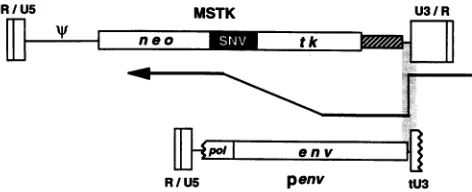
Transduction of MoMLV env sequences. Twosimilar butnot identical MSTK mutant proviruses lost most of the SNV promoterand tk geneand acquired sequences corresponding tothe 3' end of the MoMLVenv gene(Fig. 3D and E). Oneof
them hadanadditional insert between thevectorand MoMLV envsequences (Fig. 3D) whichwasfoundtobehomologousto aninternal region ofa mousesatellite DNAspecies (10).The env sequence transduced by MSTK vector virus is probably derived frompenv,which isanexpressionvectorencodingthe
MoMLV envelope glycoproteins present in GP+E-86 cells
(19). Since these mutant proviruses originated from different helpercellclones, it is unlikely that they both integratednear penvDNAin thehelpercellclones, thereby generating vector-penvrecombinants.Therefore, it is possible that the mutations are the result ofa doublecrossover after copackaging of the vectorandpenvRNA.Thissuggests analternativemechanism by which retrovirusescantransduce cellular sequences without the need ofproviralintegration adjacenttothesequence tobe transduced. It should be noted that although the viral encap-sidation signal and most of the MoMLV 3' LTR have been deleted frompenv, it shares a 170-bp identity with sequences
presentatthe3' endofvectorMSTK starting3' to the tkgene andending30bp within the 3' LTR.Furthermore, the 5' LTR
is still presentin penv.The proposed mechanism of recombi-nation is shown in Fig. 5. This model suggests that both homologous (3' junction) and nonhomologous (5' junction) strand transfers occurredduring minus-strandDNAsynthesis.
In the caseofthe mutantprovirusdepicted in Fig. 3D, an
additional strand transfer event involving transcripts derived from thecentromeric satellite DNA would have beenneeded toproduce the30-bp insertion at the 5'junction. The helper
cells used in thisstudy havenot been analyzed for thepresence
of such transcripts; however, ithas been reported that satellite DNA is transcribed in avariety of rodent cells. For example,
centromeric satellite DNA transcripts have been detected in mouse senescent cardiac muscle (8), in mouse L cells (4, 9), andinculturedrathepatomacells (33). Thus, it seemspossible that thesesequences were transduced duringreverse
transcrip-tion usingcopackaged satellite RNA as a template.
The finding that two independently generated mutants
ac-quiredMoMLVenvsequences suggests that their appearance
isnot a rareevent. This highfrequency could be the result of moreefficient copackagingoftheMoMLV env mRNA thanof
other cellular RNAs, which would result in a concomitant
on November 9, 2019 by guest
http://jvi.asm.org/
R/U5 MSTK U3/R
SP°I eenv [
R/U5 penv tU3
FIG. 5. Model for the generation of mutants with deletions com-bined with insertions of MoMLV env sequences. Structures of the mRNAs derived from the retroviral vector MSTK and the expression vector penv areshown. T represents the encapsidation signal present only in the MSTK vector RNA. The hatched box represents untrans-lated sequences. The jagged lines in the vector penv represent trunca-tionof pol and LTR sequences produced during its construction. The R, U5, and U3elements of the LTRs are shown. tU3 represents the truncated U3 present at the 3' end of the penv RNA. The shaded area corresponds to region of homology between the two vectors at their 3' ends,and the arrow represents the minus-strand DNA being synthe-sized, showing the two template switches between the two mRNAs. The recombination point within the region of homology cannot be determinedwith precision.
increase in the probability of recombination with the MSTK vector sequences. This seems possible since elements within
theU5 region have been shown to actas auxiliary sequences
for packaging of MoMLV genomic RNA in addition to the
already mapped encapsidation signal (23).High levels ofpenv
expression andits homology with theMSTKvectorcould also increase the probability of copackaging and recombination,
respectively. Further analysis is required to determine the contribution of these possible mechanisms, which are not mutually exclusive, to the transduction of MoMLV env se-quences.
Deletions combined with insertions. Two other mutant proviruses resulted from deletions combined with insertions.
Inoneofthem, the deletionwascombined withaninsertion of
three Cresiduesof unknownorigin (Fig. 3F). Small insertions
of one or more nucleotides at deletion or recombination
junctions have also been observed for other retroviruses (27, 29, 39, 44).Thistypeof insertion could be the result ofastrand transfer from one deletion endpointto atemplate containing the inserted nucleotide residues and thenanother transferto
the template containing the second deletion endpoint. A second possibility is that the insertions are consequences of
non-template-directed elongation of the nascent DNA chain
bythe RTcombined with forcedcopychoice (3).Togenerate the insertion inourmutant,three G residueswould have been
incorporated duringminus-strand DNAsynthesisatthe
grow-ing end of the molecule upon reaching a nick in thevector genomicRNA(3' deletionendpoint),followedbythe transfer tothetemplate containingthe 5' deletion endpoint. Although
the template-directed insertion remains a possibility in the absence ofmoreexperimental evidence,thesecond alternative isindirectlysupported bybiochemicalanalysis performedwith RTpurifiedfromdifferent retroviruses.Inthosestudies,itwas shown that human immunodeficiency virus, avian
myeloblas-tosisvirus,andMoMLV RTsarecapableofelongatingthe end ofagrowingDNA strand past the end of theRNAtemplate
moleculebyone or several nucleotides (25, 28).
In the second mutant of this class, the insertion was a
sequence of 261 nucleotides which was probably transduced
from the helper cells (Fig. 3G and H). Since the genomic
locations andflankingsequencesofthe insertand theprovirus
in the helpercells are unknown, it is not possible at this point to conjecture about the mechanism of transduction involved.
Thisand some other mutant proviruses which have not been
fully characterizedyetbut whichprobably contain insertions of sequencesofup to1.5kbp (Fig.4 anddatanotshown)present an opportunity tostudy retroviral transduction.
Conclusions and perspectives. Our results suggest that at
least some MoMLV-based retroviral vectors can undergo a
high rate of genetic rearrangement.This inference is consistent
with viewsof retroviral replication as a process that results in
thegeneration of genetic diversity aswell as defective
provi-ruses(3, 13). Theseresults have significance for the utilization
of MoMLV-basedvectorsfor retrovirus-mediatedgene
trans-fer, including somatic cell genetherapy. Retrovirus-mediated
genetransfer usuallyinvolvesasingle cycle of replicationsince producer cell clones harboringthe vector provirus are used as
sourceofvectorvirustoinfecttarget cells which do not express
the viral proteins (20). Thus, there could be similar rates of
geneinactivation forgenetic units of the size described here.It
should be pointedout, however, that the mutation rate is at
least partlysequencedependentand that mutation ratescould
be lower withuseofother exogenous sequences.Nevertheless, even a rate of gene inactivation of 7.7% is likely to be
acceptable for many gene transferprotocols.
Inourexperiments, only one marker genein a single vector
was analyzed. The molecular analysis of a greater numberof mutantsobtained with thisand other vector systems isrequired
to gainabetter insight into thesequence elements affectingthe
generation of mutations during retroviral replication. The effects of the relativepositions of the target geneswithinthe vector as well as the role of cellular factorsupon the mutation
rate are issues that deserve careful analysis. This effort will
result in a better understanding of retroviralmutagenesis and
will lead to a more rational design of vectorsforapplications in
which high genetic stability of the vector is required. ACKNOWLEDGMENTS
Wethank AbramGabriel,Celine Gelinas, Stuart W. Peltz, Bradley D. Preston, Han-Mo Koo, and Hong Yu for discussion and helpful comments onthe manuscript.
This work was supported by Public Health Service grant 5 R29 CA50777from theNational Institutes of Health, grant 13-92 from the Foundation of the Universityof Medicine and Dentistry of New Jersey, grant 92-39-CCR-00 from the New Jersey Commission for Cancer Research,and basic research grant 1-FY92-0699 from the March of Dimes. J.P.D. is scholar of the Pew Foundation. A.V.-E. received partial support from the International Center for Molecular and CellularBiology,Monterrey, Mexico.
REFERENCES
1. Alizon, M., S. Wain-Hobson, L.Montagnier, and P.Sonigo. 1986. Geneticvariability ofthe AIDSvirus: nucleotidesequenceanalysis oftwoisolatesfromAfricanpatients.Cell 46:63-74.
2. Clavel, F., M. D. Hoggan, R.L.Willey, K.Strebel,M.A.Martin, and R.Repaske.1989.Genetic recombination ofhuman immuno-deficiencyvirus. J.Virol.63:1455-1459.
3. Coflin,J.M.1990. Genetic variationinretroviruses, p.11-33. In E. Kurstak, R. G. Marusyk, F. A. Murphy, and M. H. V. Van
Regenmortel (ed.), Applied virology research, virus variability, epidemiologyand control. PlenumPress,New York.
4. Cohen,A.K.,T. Y.Huh, and C.W.Helleiner.1973.Transcription ofsatelliteDNA in mouseL-cells. Can. J. Biochem.51:529-532. 5. Devereux,J.,P.Haeberli,and0.Smithies.1984. Acomprehensive set of sequence analysis programs for the VAX. Nucleic Acids Res.12:387-395.
6. Dougherty, J.P.,and H.M.Temin. 1988.Determination ofthe rateofbase-pair substitutionandinsertion mutationsinretrovirus replication.J.Virol.62:2817-2822.
on November 9, 2019 by guest
http://jvi.asm.org/
[image:7.612.64.300.79.175.2]7. Emerman, M., and H. M. Temin. 1984. Genes with promoters in retrovirus vectors can be independently suppressed by an epige-netic mechanism. Cell 39:459-467.
8. Gaubatz, J. W.,andR.G. Cutler. 1990. Mouse satellite DNA is transcribedin senescentcardiac muscle. J. Biol. Chem. 265:17753-17758.
9. Harel, J., N. Hanania, H. Tapiero, and L. Harel. 1968. RNA replication by nuclear satellite DNA in different mouse cells. Biochem.Biophys. Res. Commun. 33:696-701.
10. Horz, W., and W. Altenburger. 1981. Nucleotide sequence of mousesatellite DNA. Nucleic Acids Res. 9:683-696.
11. Hu, W.-S., and H. M. Temin. 1990. Genetic consequences of packaging two RNA genomes in one retroviral particle: pseudo-diploidy and high rate of genetic recombination. Proc. Natl. Acad. Sci. USA87:1556-1560.
12. Hu, W.-S., and H. M. Temin. 1990. Retroviral recombination and reverse transcription.Science 250:1227-1233.
13. Katz, R. A., and A. M. Skalka. 1990. Generation ofdiversity in retroviruses. Annu. Rev. Genet. 24:409-445.
14. Kawai, S., and M. Nishizawa. 1984. New procedure for DNA
transfection with polycation and dimethyl sulfoxide. Mol. Cell. Biol. 4:1172-1174.
15. Keller,G., C. Paige,E.Gilboa, and E.F.Wagner. 1985.Expression of a foreign gene in myeloid and lymphoid cells derived from multipotent haematopoietic precursors. Nature (London) 318: 149-154.
16. Klarmann, G. J., C. A. Schauber, and B. D. Preston. 1993. Template-directed pausing of DNA synthesis by HIV-1 reverse transcriptaseduringpolymerizationofHIV-1 sequences in vitro.J. Biol.Chem. 268:9793-9802.
17. Kuo, M.-L.(Rutgers University). Personal communication. 18. Leider, J. M., P. Palese, and F.I. Smith. 1988. Determination of
the mutationrateofaretrovirus. J. Virol. 62:3084-3091. 19. Markowitz, D., S.Goff,and A. Bank. 1988. Asafepackaging line
for gene transfer:separatingviral geneson twodifferentplasmids. J. Virol. 62:1120-1124.
20. Miller, A. D. 1992. Human gene therapy comes of age. Nature (London)357:455-460.
21. Miller, A. D., J.V.Garcia,N. vonSuhr, C.M. Lynch, C.Wilson, and M. V.Eiden. 1991.Construction andpropertiesof retrovirus packaging cells based on Gibbon ape leukemia virus. J. Virol. 65:2220-2224.
22. Monk, R. J.,F.G. Malik, D. Stokesberry, and L. H. Evans. 1992. Direct determination of the point mutation rate of a murine retrovirus. J. Virol. 66:3683-3689.
23. Murphy, J. E., and S. P.Goff. 1989.Construction and analysis of deletion mutations in the U5regionofMoloney murine leukemia virus: effects on RNA packaging and reverse transcription. J. Virol. 63:319-327.
24. Omer, C. A., K. Pogue-Geile, R. Guntaka, K. A. Staskus, and A. J. Faras. 1983. Involvement ofdirectly repeated sequences in the generation of deletions of the avian sarcoma virus src gene. J. Virol. 47:380-382.
25. Patel, P. H., and B. D. Preston. Infidelity of human immunodefi-ciency virus type 1 reverse transcriptase at RNA and DNA templateends.Proc. Natl.Acad.Sci. USA, in press.
26. Pathak, V. K., and H. M. Temin. 1990. Broad spectrum of in vivo forward mutations, hypermutations, and mutational hotspots in aretroviral shuttle vector after a single replication cycle: substi-tutions, frameshifts, and hypermutations. Proc. Natl. Acad. Sci.
USA87:6019-6023.
27. Pathak, V. K., and H. M. Temin. 1990. Broadspectrum of in vivo forwardmutations,hypermutations, and mutationalhotspots ina retroviral shuttle vector afterasingle replication cycle: deletions anddeletions with insertions. Proc. Natl. Acad. Sci. USA 87:6024-6028.
28. Peliska, J. A., and S. J. Benkovic. 1992. MechanismofDNA strand transfer reactionscatalyzed by HIV-1 reverse transcriptase. Sci-ence 258:1112-1118.
29. Pulsinelli, G. A., andH. M.Temin.1991.Characterization of large deletions occurring during a single round of retrovirus vector replication: novel deletion mechanism involving errors in strand transfer. J. Virol. 65:4786-4797.
30. Radic, M. K., K.Lundgren, and B. A. Hamkalo. 1987. Curvature of mouse satellite DNA and condensation of chromatin. Cell 50:1101-1108.
31. Saiki, R. K., S. Scharf,F.Faloona, K. B.Mullis, G.T.Horn,H. A. Erlich, and N. Arnheim.1985.Enzymatic amplificationof 3-globin genomic sequences and restriction site analysis fordiagnosis of sickle cell anemia. Science 230:1350-1354.
32. Sambrook, J., E. F. Fritsch, and T. Maniatis. 1989. Molecular
cloning: alaboratorymanual,2nded. ColdSpringHarbor Labo-ratory Press,Cold Spring Harbor, N.Y.
33. Sealy, L., J. Hartley, J. Donelson,R.Chalkley,N.Hutchinson,and B. Hamkalo. 1981. Characterization of a highly repetitive se-quence DNAfamilyin rat.J.Mol.Biol. 145:291-318.
34. Shields, A., 0.N.Witte,E.Rothenberg,and D. Baltimore.1978. High frequency of aberrantexpression of Moloney murine leuke-mia virusin clonal infections. Cell 14:601-609.
35. Shimotohno, K.,and H. M.Temin. 1981. Formationof infectious progenyvirus after insertion ofherpessimplexthymidine kinase gene into DNA ofanavian retrovirus. Cell 26:67-77.
36. Shimotohno, K., and H. M.Temin. 1982. Spontaneousvariation andsynthesis in the U3 regionof the longterminal repeat ofan avian retrovirus. J.Virol. 41:163-171.
37. Steck,F.T.,and H.Rubin. 1966.The mechanism of interference between an avian leukosis virus and Rous sarcoma virus. I. Establishment of interference. Virology 29:628-641.
38. Stuhlman,H.,and P. Berg. 1992.Homologous recombination of copackaged retrovirusRNAsduringreversetranscription.J.Virol. 66:2378-2388.
39. Swain, A., and J. M. Coffin. 1992. Mechanism of transductionby retroviruses. Science 255:841-845.
40. Varela-Echavarria, A., N. Garvey, B. D. Preston, and J. P. Dougherty. 1992.Comparison of Moloney murine leukemia virus mutation rate with the fidelity of its reversetranscriptase. J. Biol. Chem. 34:24681-24688.
41. Voynow, S. L., and J. M. Coffin. 1985. Evolutionary variants of Rous sarcoma virus: large deletion mutants do not result from homologousrecombination. J. Virol. 55:67-78.
42. Voynow, S. L., and J. M. Coffin. 1985. Truncated gag-related proteins are produced by large deletion mutants of Rous sarcoma virusand formvirus particles. J. Virol. 55:79-85.
43. Xu, H., and J. D. Boeke. 1987. High-frequencydeletion between homologous sequences during retrotransposition of Ty elements inSaccharomyces cerevisiae. Proc. Natl. Acad. Sci. USA 84:8553-8557.
44. Zhang, J., and H. M. Temin. 1993. 3' junction ofoncogene-virus sequences and themechanisms for formation of highly oncogenic retroviruses. J. Virol. 67:1747-1751.