Copyright
q
1997, American Society for Microbiology
Differential Effects of Nerve Growth Factor and Dexamethasone on
Herpes Simplex Virus Type 1 oriL- and oriS-Dependent
DNA Replication in PC12 Cells
MARY ANN HARDWICKE†
ANDPRISCILLA A. SCHAFFER*
Division of Molecular Genetics, Dana-Farber Cancer Institute, and Department of Microbiology
and Molecular Genetics, Harvard Medical School, Boston, Massachusetts 02115
Received 14 November 1996/Accepted 24 January 1997
The herpes simplex virus type 1 (HSV-1) genome contains three origins of DNA replication, one copy of oriL
and two copies of oriS. Although oriL and oriS are structurally different, they have extensive nucleotide
se-quence similarity and can substitute for each other to initiate viral DNA replication. A fundamental question
that remains to be answered is why the HSV-1 genome contains two types of origin. We have recently identified
a novel glucocorticoid response element (GRE) within oriL that is not present in oriS and have shown by gel
mobility shift assays that purified glucocorticoid receptor (GR), as well as GR present in cellular extracts, can
bind to the GRE in oriL. To determine whether glucocorticoids and the GRE affect the efficiency of
oriL-depen-dent DNA replication, we performed transient DNA replication assays in the presence and absence of
dexa-methasone (DEX). Because HSV-1 is a neurotropic virus and establishes latency in cells of neural origin, these
tests were conducted in PC12 cells, which assume the properties of sympathetic neurons when differentiated
with nerve growth factor (NGF). In NGF-differentiated PC12 cells, oriL-dependent DNA replication was
enhanced 5-fold by DEX, whereas in undifferentiated cells, DEX enhanced replication
;
2-fold. Notably, the
enhancement of oriL function by DEX was abolished when the GRE was mutated. NGF-induced differentiation
alone had no effect. In contrast to oriL, oriS-dependent DNA replication was reduced
;
5-fold in
NGF-differ-entiated PC12 cells and an additional 4-fold in differNGF-differ-entiated cells treated with DEX. In undifferNGF-differ-entiated PC12
cells, DEX had only a minor inhibitory effect (
;
2-fold) on oriS function. Although the cis-acting elements that
mediate the NGF- and DEX-specific repression of oriS-dependent DNA replication are unknown, a functional
GRE is critical for the DEX-induced enhancement of oriL function in NGF-differentiated PC12 cells. The
en-hancement of oriL-dependent DNA replication by DEX in differentiated PC12 cells suggests the possibility that
glucocorticoids, agents long recognized to enhance reactivation of latent herpesvirus infections, act through the
GRE in oriL to stimulate viral DNA replication and reactivation in terminally differentiated neurons in vivo.
The herpes simplex virus type 1 (HSV-1) genome contains
three origins of DNA replication, one located in the unique
long (U
L) region of the genome (oriL) and two within the
repeats flanking the unique short (U
S) region of the genome
(oriS) (26, 44, 46, 49, 52). The functional significance of the
existence of three origins of replication in the pathogenesis of
HSV-1 is not yet clear. Viruses with deletions in either oriL
(37) or both copies of oriS (23) have no obvious growth defects
in cultured cells, suggesting either that oriL or oriS is sufficient
for viral replication in vitro.
oriL and oriS have extensive nucleotide sequence
similari-ties, yet the two origins are structurally different. oriS consists
of an imperfect 45-bp palindrome (45), whereas oriL is a
per-fect 144-bp palindrome (19, 38, 52). Both oriL and oriS are
located in the promoter-regulatory regions of divergently
tran-scribed genes. oriL is located within the promoter-regulatory
regions of two early genes (UL29, which encodes the major
single-stranded DNA binding protein, ICP8, and UL30, which
encodes the DNA polymerase). oriS lies within the shared
promoter-regulatory regions of the immediate-early genes
en-coding ICP4 and either ICP22 or ICP47.
Characterization of eukaryotic origins of DNA replication
has revealed several common structural and functional
fea-tures (10). Eukaryotic origins are composed of two discrete
components: (i) a core which contains the binding site(s) of
essential DNA initiation and elongation factors, the precise
site of initiation, and elements which determine the direction
of DNA synthesis and (ii) an auxiliary region(s) which contains
the binding sites of transcription and other factors that
en-hance origin function but is dispensable under certain
condi-tions. Characterization of the protein-DNA complexes that
form with the core and auxiliary components of oriL and oriS
has revealed similarities between these two origins and other
eukaryotic origins and has begun to provide insight into the
mechanism by which HSV-1 DNA replication is initiated (1, 7,
8, 53). Thus to date, three proteins or protein complexes have
been shown to bind specifically to common sequences in the
core components of oriL and oriS: a viral protein (origin
bind-ing protein [OBP]) that serves as an origin recognition factor
(7, 9, 12–14, 29, 36, 50, 51), a second viral protein (OBPC)
postulated to favor the switch from the theta to the
rolling-circle mechanism of DNA replication and to facilitate
encap-sidation (2), and a cellular protein or protein complex, OF-1,
whose binding to core elements is essential for efficient origin
function (8). The promoter-regulatory regions surrounding
oriL and oriS comprise the auxiliary regions of the two origins
and contain binding sites for a variety of recognized
transcrip-tion factors (22, 53). The results of systematic deletranscrip-tion
mu-tagenesis suggest that these auxiliary regions and the proteins
* Corresponding author. Present address: Department of
Microbi-ology, University of Pennsylvania School of Medicine, Philadelphia,
PA 19104. Phone: (215) 573-9863. Fax: (215) 573-5344. E-mail: pschfr
@mail.med.upenn.edu.
† Present address: SmithKline Beecham Pharmaceuticals, 1250
South Collegeville Rd., P.O. Box 5089, Collegeville, PA 19426.
3580
on November 9, 2019 by guest
http://jvi.asm.org/
that bind to them serve to enhance the efficiency of initiation
in transient DNA replication assays when essential viral DNA
replication factors are provided in trans (53). Despite our
growing knowledge of the cis-acting elements and trans-acting
factors involved in the initiation of DNA replication at oriL
and oriS, studies of HSV-1 origins have revealed no significant
functional differences between the two origins.
During studies designed to characterize oriL function, we
identified a putative glucocorticoid response element (GRE)
adjacent to the A-T-rich center of the oriL palindrome.
Be-cause of minor sequence variation in the region, oriS does not
contain this element. In this report, we describe the formation
of specific complexes between the oriL GRE and either
puri-fied glucocorticoid receptor (GR) or GR from cellular extracts.
Transient DNA replication assays indicate that the GR-GRE
interaction enhances oriL-dependent DNA replication in cells
of neural lineage (PC12) terminally differentiated with nerve
growth factor (NGF). Specifically, oriL-dependent DNA
rep-lication was
;5-fold greater in NGF-differentiated PC12 cells
than in undifferentiated cells in the presence of a synthetic
glucocorticoid, dexamethasone (DEX). In contrast,
oriS-de-pendent DNA replication was reduced
;5-fold in
NGF-differ-entiated PC12 cells and a further 4-fold in NGF-differNGF-differ-entiated
PC12 cells in the presence of DEX. DEX had only minor
effects on oriL- and oriS-dependent DNA replication in
undif-ferentiated PC12 cells.
The results of these studies demonstrate that oriL and oriS
differ significantly in their responses to factors induced by NGF
in cells of neural lineage and that DEX further enhances these
differences. Although the mechanism responsible for the
NGF-and DEX-induced repression of oriS function in PC12 cells is
unclear, the DEX-induced enhancement of oriL function
re-quires the GRE in oriL.
MATERIALS AND METHODS
Cells and virus.PC12 cells (a gift of John Wagner, Cornell University, Medical College, New York, N.Y.) were grown in Dulbecco’s modified Eagle’s medium (GibcoBRL Laboratories, Inc., Gaithersburg, Md.) supplemented with 10% fetal bovine serum (Sigma Chemical Co., St. Louis, Mo.), 5% donor horse serum (JRH Biosciences, Lenexa, Kans.), 0.03% glutamine, 0.37% bicarbonate, 100mg of streptomycin per ml, and 100 U of penicillin per ml at 378C in 10% CO2. To differentiate PC12 cells, NGF [NGF(2.5 S); Collaborative Biomedical Products, Bedford, Mass.] was added to cells at a concentration of 100 ng/ml for 6 days; NGF-containing medium was changed on day 3. The wild-type strain of HSV-1 (KOS) was grown and assayed as previously described (22).
Plasmids.Plasmids containing wild-type oriS (pOS-822) and oriL (pOL-833) have been described elsewhere (22, 53). Plasmid pOL GRE(2), containing a mutated oriL GRE, was generated as follows. Five contiguous oligonucleotides (containing the oriL palindrome and nucleotides on either side of the palin-drome) and their complementary strands were synthesized with overlapping ends. Two point mutations in each hexanucleotide half-site of the GRE were engineered into two oligonucleotides, each containing one half-site of the com-plete GRE (see Fig. 2A). Each of the five oligonucleotides was annealed with its complementary strand by heating the paired oligonucleotides at 708C for 3 min, followed by slow cooling to below 358C. Two micrograms of each double-stranded oligonucleotide was then phosphorylated by incubation in 1 mM ATP, linker-kinase buffer (0.5 M Tris-Cl [pH 7.6], 0.1 M MgCl2, 50 mM dithiothreitol [DTT], 1 mM spermidine HCl), and 1 U of T4 polynucleotide kinase (New England Biolabs, Beverly, Mass.) in a volume of 20ml at 378C for 1 h. The phosphorylated oligonucleotides were then ligated sequentially in linear order within the palindrome as follows: oligonucleotide 1 was ligated to oligonucleo-tide 2 in linker-kinase buffer with 40 U of T4 ligase (New England Biolabs) for 1 h at room temperature; oligonucleotides 4 and 5 were ligated in the same manner; ligated oligonucleotides 1 and 2 were then ligated to oligonucleotide 3; finally, ligated oligonucleotides 1, 2, and 3 were ligated to oligonucleotides 4 and 5 as described above except that the ligation was carried out at 168C overnight. After the ligation was complete, the full-length 226-bp fragment was digested with BsrGI and SgrAI and isolated on a 5% polyacrylamide gel. The plasmid containing wild-type oriL, pOL833, was digested with BsrGI and SgrAI, and the 3.6-kb vector-containing fragment was isolated and gel purified. The 226-bp fragment containing the mutated GRE was ligated to the 3.6-kb vector-contain-ing fragment to generate a plasmid containvector-contain-ing 833 bp of oriL sequence with a mutated GRE. SURE cells (Stratagene, La Jolla, Calif.) were then transformed
with the plasmid as previously described (22). The 226-bp region was sequenced as previously described to confirm the existence of the desired mutations and the absence of spurious mutations (22).
Transient DNA replication assays.For transient DNA replication assays, 100-mm-diameter dishes were seeded with 3.53106PC12 cells and incubated at 378C in 10% CO2. Eighteen to 24 h later, cells were transfected by the Lipofectin method. Specifically, plasmid DNA (10mg) was diluted in 2 ml of serum-free medium. Lipofectin reagent (GibcoBRL) (final concentration, 8mg/ml) diluted in 2 ml of serum-free medium was mixed with the diluted plasmid DNA; the mixture was held at room temperature for 15 min and then added dropwise to the culture medium. Monolayers were incubated at 378C for 5 h, at which time they were rinsed once with serum-free medium and fresh medium containing serum was added. To differentiate transfected PC12 cells, NGF (100 ng/ml) was added to medium after the wash with serum-free medium. Untreated PC12 cells served as undifferentiated controls in all tests. After 3 days, fresh medium containing NGF (differentiated cells) or without NGF (undifferentiated cells) was added to the cells. On day 6 posttransfection, cells were infected with KOS at a multiplicity of 10 PFU/cell to provide essential DNA replication factors in trans. In experiments in which cells were treated with DEX, 0.5mM DEX was added at the time of infection. Total cellular DNA was isolated 18 h after infection and purified as previously described (22). Ten micrograms of DNA was digested either with EcoRI and DpnI or with EcoRI and MboI. Replicated DNA linearized with EcoRI was differentiated from unreplicated DNA by DpnI diges-tion, whereas input DNA was separated from newly replicated DNA following MboI digestion. The DNAs were analyzed by Southern blot hybridization using 32P-labeled, nick-translated vector sequence [pGEM7Zf(1)] as the probe as described previously (22). The resulting bands were quantitated by PhosphorIm-ager analysis (Molecular Dynamics, Sunnyvale, Calif.) and corrected to normal-ize for levels of DNA template.
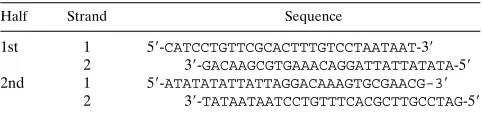
Oligonucleotides and probes.The oligonucleotide probes used in the DNA binding assays (see Fig. 2) were synthesized by the Molecular Biology Core Facility, Dana-Farber Cancer Institute. To prevent the palindromic sequence from annealing to itself, the oriL GRE and the oriL/S GRE oligonucleotides were synthesized as four separate oligonucleotides. Each half of the full-length oligonucleotide was first annealed to its complementary strand (which was syn-thesized with a 59overhang) as previously described (22). The nucleotide se-quences of the annealed oligonucleotides are shown in Table 1. The two an-nealed halves were then ligated, the double-stranded full-length molecules were gel purified, and radiolabeled probes were prepared as previously described (22). A double-stranded oligonucleotide containing the consensus binding site for nuclear factor 1 (NF-1) was used as a nonspecific competitor (7, 8). Nonspecific probes NSA, NSB, and site I oriS and oriL have been described elsewhere (7, 8). The GRE consensus oligonucleotide was purchased from Promega (Madison, Wis.).
Preparation of nuclear extracts and sources of GR protein.PC12 cells (107to 108) were harvested in cold phosphate-buffered saline (PBS) and pelleted at 2,2003g and 48C for 5 min. The cell pellet was resuspended in 5 ml of PBS and repelleted. Cells were resuspended in 1 ml of PBS, transferred to an Eppendorf tube, and repelleted at 3,0003g for 6 min at 48C. The cell pellet was gently resuspended in 1 ml of reticulocyte standard buffer (RSB; 10 mM Tris-HCl [pH 7.5], 10 mM NaCl, 5 mM MgCl2, 0.5 mM phenylmethylsulfonyl fluoride [PMSF], 0.5 mM DTT) and pelleted as before. Cells were again gently resuspended in RSB containing 0.5% Nonidet P-40 (NP-40), and the resulting nuclei were pelleted as before. Nuclei were resuspended in 1 ml of RSB without NP-40 and centrifuged as before. The final nuclear pellet was gently resuspended in 100 to 300ml of buffer C (HEPES [pH 7.9], 25% glycerol, 0.42 M KCl, 1.5 mM MgCl2, 0.2 mM EDTA, 0.5 mM PMSF, 0.5 mM DTT) and gently rocked at 48C for 30 min, at which time the nuclear extract was transferred to an Oakridge tube and spun at 14,5003g for 30 min. The supernatant was then dialyzed against 300 ml of buffer D (20 mM HEPES [pH 7.9], 20% glycerol, 0.1 M KCl, 0.2 mM EDTA, 0.5 mM PMSF, 0.5 mM DTT) for 1 h at 48C with one change of buffer. Protein concentrations were determined for each sample by the method of Bradford (Bio-Rad, Hercules, Calif.), using a standard curve generated with bovine serum albumin as the protein source.
[image:2.612.316.557.81.139.2]The plasmids expressing the GR DNA binding domain, GR440-525, and its mutated derivative, GR-EGA, were expressed in Escherichia coli by using the T7 system and purified to virtual homogeneity by Iris Alroy and Leonard Freedman (Sloan-Kettering Institute, Cornell University Graduate School of Medical Sci-ences, New York, N.Y.). The isolation and characterization of GR440-525 and GR-EGA have been described previously (1).
TABLE 1. Oligonucleotides used in this study
Half Strand Sequence
1st 1 59-CATCCTGTTCGCACTTTGTCCTAATAAT-39
2 39-GACAAGCGTGAAACAGGATTATTATATA-59
2nd 1 59-ATATATATTATTAGGACAAAGTGCGAACG-39
2 39-TATAATAATCCTGTTTCACGCTTGCCTAG-59
on November 9, 2019 by guest
http://jvi.asm.org/
Gel mobility shift assays.PC12 cell nuclear extracts (10mg) were incubated at 258C for 30 min with 43104to 83104cpm of probe (1 to 2 ng) and 1.5mg of poly(dI-dC)zpoly(dI-dC) (Pharmacia, Bern, Switzerland) in DNA binding buffer (10% glycerol, 50 mM HEPES [pH 7.5], 0.1 mM EDTA, 0.5 mM DTT, 100 mM NaCl, 1 mM TLCK) in a final volume of 10ml. Protein-DNA complexes were resolved by electrophoresis on 6% nondenaturing acrylamide gels (37.5:1, acrylamide/bisacrylamide) at 48C. In experiments involving antibody, the reac-tion was incubated for 5 min and the antibody was added for the remaining 25 min. Competition experiments were performed as described above; probe and unlabeled competitor DNAs were premixed prior to the addition of cell extracts in DNA binding buffer.
For gel mobility shift assays involving purified protein, GR440-525 and GR-EGA (as indicated in Fig. 2B) were incubated at 258C for 30 min with 43104 to 83104cpm of probe and 0.5 ng of poly(dI-dC) in binding buffer (10% glycerol, 20 mM Tris-HCl [pH 7.5], 1 mM EDTA, 0.05% NP-40, 50 mM KCl, 1 mM DTT) in a final volume of 10ml. The resulting protein-DNA complexes were resolved as described above.
RESULTS
HSV-1 oriL contains a GRE.
A computer search of the
nucleotide sequence of the oriL palindrome for binding sites of
transcription factors revealed the presence of a putative GRE
hexanucleotide half-site immediately adjacent to the AT-rich
center of the palindrome (18) (Fig. 1A). This element is
iden-tical to the half-site of a GRE identified in the promoter of the
human metallothionein IIA gene (27, 28). Because oriL is a
perfect palindrome, a second GRE hexanucleotide half-site is
also present in the other arm of the palindrome, such that the
oriL GRE consists of two half-sites separated by an
18-nucle-otide spacer (Fig. 1A). Because nucle18-nucle-otide sequence
differ-ences occur in the analogous regions of the oriL and oriS
palindromes, oriS does not contain a GRE (Fig. 1). The
pub-lished consensus GRE consists of variations of the perfect
palindrome 59-AG(A/G)ACAN
3TGT(T/C)CT-39
(15, 30) (Fig.
1B). The oriL GRE differs from the consensus GRE in two
ways: (i) the two half-sites are switched such that the TGTCCT
half-site is located 59
to the AGGACA half-site, and (ii) the
spacer between the two half-sites is 18 nucleotides rather than
3 (Fig. 1B).
Because the putative GRE in oriL differs from the consensus
GRE, we were interested in determining whether the oriL
GRE was able to bind GR. For this purpose, we performed gel
shift analysis using two synthetic probes: a probe containing
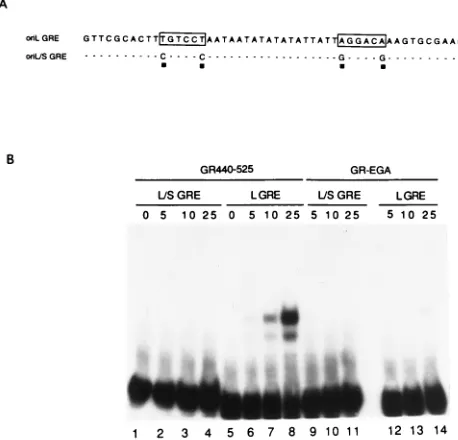
the wild-type oriL GRE (Fig. 2A) and a mutant probe in which
the nucleotides at positions 1 and 6 of the first half-site were
changed from T to C (as found in oriS) and nucleotides at
positions 1 and 6 of the second half-site were changed from A
to G (oriL/S GRE [Fig. 2A]). The probes were incubated with
increasing concentrations of protein consisting of the purified
GR DNA binding domain (GR440-525) or its mutated
coun-terpart GR-EGA (1). The resulting protein-DNA complexes
were separated on a 6% polyacrylamide gel.
[image:3.612.63.297.86.240.2]Two complexes were observed with the wild-type probe (Fig.
2B, lanes 6 to 8), whereas no complex formation was observed
with the mutant probe even at the highest concentration of GR
tested (lanes 2 to 4). The specificity of complex formation was
tested by incubating the wild-type (lanes 12 to 14) or mutant
(lanes 9 to 11) probe with increasing concentrations of a
pu-rified mutant GR protein (GR-EGA), in which three amino
acids had been changed to correspond to the analogous amino
acids in the estrogen receptor (1). These tests demonstrated
that (i) a region of GR containing the DNA binding domain
can bind specifically to the wild-type oriL GRE but not to a
mutated GRE and (ii) the wild-type GR binding domain, but
not a mutated GR binding domain, can bind to the wild-type
oriL GRE.
FIG. 1. Sequence comparison of oriL and oriS. (A) DNA sequence compar-ison of the OBP binding sites (OBP BS-I, -II, and -III) in oriL and oriS and the location of the GRE in oriL. The dashed lines in the oriS sequence indicate nucleotides that are identical in oriL. The “x” in the oriS sequence indicates a nucleotide that is not present in oriS. The boxes labeled GRE represent the bipartite hexanucleotide binding sites (half-sites) of the GRE present in oriL but not in oriS. The vertical dashed line and convergent arrows indicate the center of dyad symmetry of the two palindromic sequences. (B) Comparison of the se-quence of the GRE present in oriL with the sese-quence of the consensus GRE. The consensus GRE consists of palindromic hexanucleotide half-sites with an intervening sequence consisting of three nucleotides of variable sequence. The GRE present in oriL also consists of two palindromic half-sites; however, the 59
hexanucleotide in the consensus sequence is found 39 in oriL. The sequence between the two half-sites in oriL is 18 nucleotides. The shaded boxes denote the nucleotides that are different in oriL and oriS.
FIG. 2. Analysis of protein-DNA complex formation between the GRE in oriL and purified GR receptor. (A) Sequences of the oligonucleotide probes used in gel shift analysis. The boxes contain the two palindromic hexanucleotide half-sites of the oriL GRE. Shown below the oriL GRE is an oligonucleotide (oriL/S GRE) in which oriL nucleotides in positions 1 and 6 of the first hexanu-cleotide were changed from T to C and the nuhexanu-cleotides in positions 1 and 6 of the second hexanucleotide were changed from A to G. The dashes represent nucle-otides that are identical in the two probes; the squares denote nuclenucle-otides that have been altered. (B) Radiolabeled oriL wild-type (L GRE; lanes 5 to 8) or mutant (L/S GRE; lanes 1 to 4) GRE-containing probes were incubated in the presence of increasing concentrations (0 to 25 mg) of purified GR DNA binding domain (GR440-525), and protein-DNA complexes were separated on a 6% polyacrylamide gel. The specificity of formation of this complex was confirmed by incubating radiolabeled L GRE (lanes 12 to 14) or L/S GRE (lanes 9 to 11) with increasing concentrations of purified mutant GR (GR-EGA) (lanes 9 to 14).
on November 9, 2019 by guest
http://jvi.asm.org/
[image:3.612.318.547.384.604.2]Functional analysis of oriL and oriS in PC12 cells.
HSV-1
establishes latency in sympathetic neurons and reactivates with
increased frequency in the presence of elevated levels of
glu-cocorticoids (16, 21, 24, 32, 35, 43, 48). Based on these
obser-vations, we hypothesized that the GRE in oriL may function to
enhance viral DNA replication in response to
glucocorti-coids specifically in cells of neural origin. We therefore
tested the functional significance of the oriL GRE in PC12
cells, using oriS as a control. PC12 cells were derived from a
transplantable rat pheochromocytoma and as such are of
neu-ral lineage (20). Important features of these cells are that
following treatment with NGF, they develop neurites, become
electrically excitable, and acquire a number of other properties
characteristic of sympathetic neurons (20).
Before testing the effect of DEX on oriL- and
oriS-depen-dent DNA replication in PC12 cells, we first determined
whether the GRE in oriL can bind GR present in nuclear
extracts of PC12 cells and whether treatment of PC12 cells with
NGF affects the efficiency of oriL or oriS function in transient
DNA replication assays.
GR in PC12 cells binds specifically to the GRE in oriL.
The
radiolabeled probe containing oriL GRE was incubated with
nuclear extracts of PC12 cells, and the resulting protein-DNA
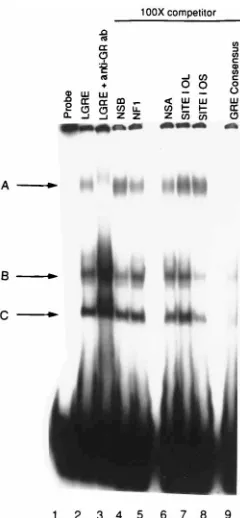
complexes were visualized on a 6% polyacrylamide gel. Three
major complexes were observed (Fig. 3, lane 2, arrows). The
presence of GR in all three complexes was demonstrated by
the ability of anti-GR-specific antibody to decrease the
mobil-ity of all three bands in the gel (lane 3). The slowest-migrating
complex (A) was supershifted completely in the presence of
anti-GR antibody, whereas only a portion of each of the two
faster-migrating complexes (B and C) was supershifted. To test
the binding specificity of complexes A, B, and C, competition
analysis was performed. PC12 cell nuclear extracts were
incu-bated with the probe containing oriL GRE and a 100-fold
excess of unlabeled competitor probe (lanes 4 to 9). These tests
demonstrated that only the probe containing the GRE
consen-sus element was capable of competing completely for
forma-tion of complex A and competing partially for formaforma-tion of
complexes B and C (lane 9). Four nonspecific competitor
probes, including two nonspecific oligonucleotide sequences,
NSA and NSB (lanes 4 and 6), and probes containing an NF-1
binding site (lane 5) and the core binding sites for the HSV-1
OBP in oriL (lane 7), did not compete significantly for
forma-tion of the three complexes. The probe containing the core
binding site for OBP in oriS competed to some degree for
formation of complexes B and C but not for complex A; the
reason for this is unclear. We conclude from these tests that
GR in PC12 cell nuclear extracts is capable of forming specific
complexes with the GRE in oriL.
NGF differentiation of PC12 cells inhibits oriS- but not
oriL-dependent DNA replication.
In a previous paper, we
re-ported that oriL-dependent DNA replication was
approxi-mately 70% as efficient as oriS-dependent DNA replication in
Vero cells. Similar results were obtained for undifferentiated
PC12 cells in these studies (data not shown). To determine
whether NGF differentiation of PC12 cells affected the
effi-ciency of oriL- or oriS-dependent DNA replication,
undiffer-entiated PC12 cells were transfected with either an oriL- or an
oriS-containing plasmid. NGF was added to half of the
cul-tures, and the transfected cells were allowed to differentiate for
6 days. Cells were then infected with HSV-1 strain KOS, and
total cellular DNA was harvested after 18 h and assayed for
plasmid replication. Replicated DNAs were quantitated by
PhosphorImager scanning, and the resulting values were
nor-malized for input DNA (data not shown). The replicated
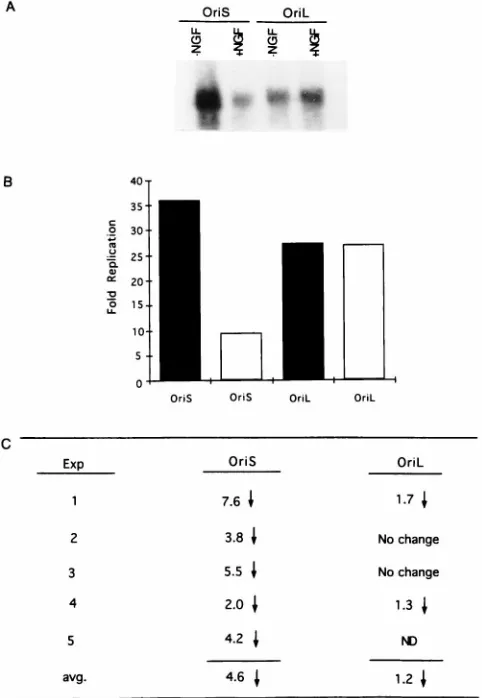
DNAs from one such experiment are shown in Fig. 4A. Results
are presented in Fig. 4B as fold amplification of replicated
plasmid DNA over input. The results of five independent
ex-periments are presented in Fig. 4C as fold difference in the
replication efficiencies of oriS- and oriL-containing plasmids in
NGF-differentiated compared to undifferentiated PC12 cells.
Although NGF treatment had no effect on the efficiency of
oriL-dependent DNA replication in PC12 cells, a significant
and reproducible decrease in the efficiency of oriS-dependent
DNA replication (average decrease, 4.6-fold) occurred in
re-sponse to NGF treatment.
DEX treatment of NGF-differentiated PC12 cells enhances
oriL-dependent DNA replication and represses
oriS-depen-dent DNA replication.
Having shown that GR in PC12 cell
extracts can bind to the GRE in oriL and that NGF
differen-tiation of PC12 cells affects the efficiency of oriS- but not
oriL-dependent DNA replication, we tested the effect of a
synthetic glucocorticoid, DEX, on oriL- and oriS-dependent
DNA replication in undifferentiated and NGF-differentiated
PC12 cells. For this purpose, PC12 cells were transfected with
either an oriL- or an oriS-containing plasmid, and half of each
set of transfected cultures was treated for 6 days with NGF. All
transfected cells were superinfected with HSV-1 on day 6, and
DEX was added to half the cultures in each set at the time of
superinfection. The results of four independent experiments in
undifferentiated PC12 cells are shown in Table 2. DEX had
only minor effects on origin function for oriS or oriL in
undif-FIG. 3. Analysis of complex formation between oriL GRE and PC12 cell nu-clear extracts. The radiolabeled oriL GRE-containing probe was incubated in the presence of PC12 cell nuclear extracts for 30 min, the resulting three complexes (labeled A, B, and C) were separated on a 6% polyacrylamide gel (lane 2). The specificity of formation of these complexes was demonstrated by incubating radiolabeled oriL GRE-containing probe and PC12 cell nuclear extracts with anti-GR antibody (ab) such that the complexes were supershifted (lane 3). To fur-ther confirm the specificity of complex formation, competition analysis was per-formed. PC12 cell nuclear extracts were incubated with radiolabeled oriL GRE-containing probe and a 100-fold excess of unlabeled competitor: lane 4 (NSB) and lane 6 (NSA), nonspecific sequences; lane 5, an oligonucleotide containing an NF-1 binding site; lanes 7 and 8, oligonucleotides containing OBP binding site I of oriL and oriS, respectively; lane 9, the GRE consensus oligonucleotide.
on November 9, 2019 by guest
http://jvi.asm.org/
[image:4.612.117.237.68.327.2]ferentiated PC12 cells. Thus, the level of oriS-dependent DNA
replication was slightly but reproducibly reduced, whereas
rep-lication from oriL was slightly but reproducibly increased in
these tests.
In contrast to its effects in undifferentiated cells, the effects
of DEX on plasmid replication in NGF-differentiated PC12
cells were marked (Table 3). Replication of the
oriL-contain-ing plasmid was
;5-fold greater in the presence compared to
the absence of DEX, whereas replication of the
oriS-contain-ing plasmid was
;4-fold lower in the presence compared to the
absence of DEX. This fourfold repression of oriS function by
DEX was in addition to the 4- to 5-fold repression induced by
NGF (Fig. 4).
[image:5.612.58.299.72.421.2]An oriL-containing plasmid mutated in the GRE does not
respond to DEX in NGF-differentiated PC12 cells.
The
en-hancing effect of DEX on the replication of the
oriL-contain-ing plasmid suggested strongly that the GRE in oriL serves as
a target for GRs in response to DEX in NGF-differentiated
PC12 cells. To test this hypothesis, we generated a mutant
plasmid, pOL GRE(2), in which two point mutations were
introduced into each half-site of the oriL GRE. These
muta-tions were the same as those shown in the gel shift analysis to
ablate the ability of purified GR to bind to the GRE (oriL/S
GRE [Fig. 2A]). It should be noted that the point mutations
generated in the first hexanucleotide half-site of the GRE in
plasmid pOL GRE(2) are identical to the analogous region in
oriS (compare Fig. 1A and 2A). The replication efficiencies of
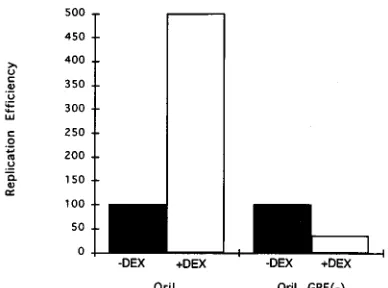
pOL and pOL GRE(2) were then tested in
NGF-differenti-ated PC12 cells in the presence and absence of DEX. The
average replication efficiencies of two independent
experi-ments are shown in Fig. 5. As in previous tests (Table 3), DEX
treatment produced a significant increase (;4.5-fold) in the
replication efficiency of pOL which contains the wild-type
[image:5.612.313.557.100.190.2]FIG. 4. Replication of oriL- and oriS-containing plasmids in undifferentiated (2NGF) and NGF-differentiated (1NGF) PC12 cells. (A) Southern blot anal-ysis of a transient replication assay. PC12 cells were transfected with 10mg of ei-ther an oriL-containing plasmid or an oriS-containing plasmid. Five hours after transfection, the cells were rinsed and medium with or without NGF (100 ng/ml) was added. Fresh medium was added on day 3. Six days after the addition of NGF, cells were infected with HSV-1 (multiplicity of infection 10 PFU/cell) in the ap-propriate medium (i.e., with or without NGF), and total cellular DNA was har-vested 18 h postinfection. Ten micrograms of DNA was digested with either EcoRI and DpnI to quantitate replicated DNAs (A) or EcoRI and MboI to quan-titate input DNAs (data not shown). The digested DNAs were analyzed by South-ern blot hybridization using a32P-labeled pUC19 probe. (B) Graph of data ob-tained from scanning the Southern blot shown in panel A. The replicated and input DNAs were quantitated by PhosphorImager scanning analysis and correct-ed for transfection efficiency. Results are presentcorrect-ed as fold amplification over input DNA. Black bars represent replication assays in the absence of NGF; white bars represent the results of assays in the presence of NGF. (C) Results of five separate experiments performed as described for panel A. The replicated and input DNAs were quantitated by PhosphorImager scanning analysis, and the results are pre-sented as fold difference in the replication efficiencies of either oriL- or oriS-containing plasmid in PC12 cells in the presence compared to the absence of NGF. The downward arrows represent the fold decrease in replication efficiency. avg., average change in the four or five experiments; ND, not determined.
TABLE 2. Fold differences in replication efficiencies of oriS- and
oriL-containing plasmids in undifferentiated PC12 cells in
the presence compared to the absence of DEX
aExpt Fold difference
oriS oriL
1
2.1
2
1.7
1
2
2.8
2
1.5
1
3
1.3
2
1.5
1
4
2.0
2
ND
Avg
2.1
2
1.6
1
aUndifferentiated PC12 cells were transfected with either an oriS or an oriL-containing plasmid as described in the legend to Fig. 4. At the time of superin-fection, DEX was added to half of the cells, and at 18 h postinsuperin-fection, total cellular DNA was harvested and processed as described in the legend to Fig. 4. The results of four separate experiments are presented as fold difference in replication efficiencies of either an oriL or an oriS-containing plasmid in undif-ferentiated PC12 cells in the presence compared to the absence of DEX. The arrows represent fold increase or decrease in replication efficiency. ND, not determined.
TABLE 3. Fold differences in replication efficiencies of oriS
(pOS822)- and oriL (pOL833)-containing plasmids in
NGF-differentiated PC12 cells in the presence
compared to the absence of DEX
aExpt Fold difference
oriS oriL
1
5.7
2
2.6
1
2
2.6
2
4.4
1
3
3.9
2
4.3
1
4
ND
8.9
1
Avg
4.1
2
5.0
1
aTransient replication assays were performed in NGF-differentiated PC12 cells as described in the footnote to Table 2. The results of four separate experiments are presented as fold difference in replication efficiencies of either an oriL- or an oriS-containing plasmid in differentiated PC12 cells in the pres-ence compared to the abspres-ence of DEX. The arrows represent fold increase or decrease in replication efficiency. ND, not determined.
on November 9, 2019 by guest
http://jvi.asm.org/
[image:5.612.314.558.587.677.2]GRE. In contrast, no increase, but rather a reproducible
de-crease, in the replication efficiency of pOL (GRE2) occurred
in the presence of DEX. The decrease in replication efficiency
of plasmid pOL GRE(2) in response to DEX was similar to
the decrease in replication efficiency of the plasmid containing
the bona fide oriS observed in response to DEX in
NGF-differentiated PC12 cells. The decrease in the replication
effi-ciencies of both plasmids in response to DEX may reflect the
fact that the GREs in the two plasmids differ by only two
nucleotides.
Collectively, the results of these tests demonstrate that the
increase in oriL-dependent DNA replication efficiency in the
presence of DEX is due to the presence of the GRE in oriL
and suggest that the activities of minor variants of the oriL
GRE can be repressed by DEX in NGF-differentiated PC12
cells.
DISCUSSION
Differential effects of NGF and DEX on oriL- and
oriS-dependent DNA replication.
The functional significance of the
existence of three origins of DNA replication in the HSV
genome has been the subject of much speculation. oriL and
oriS have considerable nucleotide sequence similarity and
con-sequently have been postulated to function similarly. Indeed,
in vitro tests of mutants lacking either oriL or both copies of
oriS have shown that the two origins can substitute for one
another (23, 37). The presence of a putative GRE in oriL but
not oriS raised the possibility that this element mediates
glu-cocorticoid-induced functional differences in the two origins.
Because HSV is a neurotropic virus and establishes latency in
sympathetic neurons, we chose to test the effects of DEX on
oriL and oriS function in NGF-differentiated PC12 cells, which
exhibit many of the properties of sympathetic neurons. Prior to
testing the effects of DEX, however, it was necessary to test the
effects of NGF-induced differentiation on oriL and oriS
func-tion. Unexpectedly, oriS-dependent DNA replication was
sig-nificantly reduced in PC12 cells in response to NGF treatment
and further reduced in NGF-differentiated cells in response to
DEX. In contrast to oriS, NGF-induced differentiation of
PC12 cells had no effect on oriL function, but DEX had a
significant enhancing effect on oriL function in
NGF-differen-tiated PC12 cells. Thus, the effects of DEX on both origins
were observed in NGF-differentiated but not undifferentiated
PC12 cells. DEX had no effect on the replication efficiency of
an oriL-containing plasmid mutated in the GRE,
demonstrat-ing the specificity of the effect of DEX on oriL function.
Potential mechanisms of NGF-induced repression and
DEX-induced enhancement of oriL and oriS function.
A major
ex-perimental challenge will be to elucidate the mechanisms by
which (i) NGF differentiation of PC12 cells represses oriS but
not oriL function and (ii) DEX activates oriL and further
represses oriS function in NGF-differentiated PC12 cells.
NGF is a member of the neurotrophin subfamily of growth
factors, which is necessary for the survival and differentiation
of sensory and sympathetic neurons (31). NGF mediates its
growth- and differentiation-specific effects through a complex
series of signal transduction pathways involving
phosphoryla-tion of preexisting proteins, some of which are transcripphosphoryla-tion
factors, and the induction of new sets of cellular proteins
(re-viewed in reference 47).
Although few studies have been conducted specifically in
PC12 cells, glucocorticoids are known to exert their
physiolog-ical effects on biologphysiolog-ical processes through GRs which act as
ligand-dependent transcription factors. Glucocorticoid-GR
complexes stimulate, or in some cases repress, gene expression
by binding to GREs in the promoter-regulatory regions of
genes regulated by glucocorticoids (11). GREs able to
stimu-late gene expression have been identified in the
promoter-regulatory regions of Epstein-Barr virus, human
immunodefi-ciency virus, mouse mammary tumor virus, Moloney murine
sarcoma virus, and human papillomaviruses (3–5, 33, 34, 42).
At present, neither the molecular mechanism by which NGF
differentiation of PC12 cells results in the repression of oriS
function nor the time during differentiation when repression is
first apparent is known. To answer these questions, the
cis-acting elements and trans-cis-acting factors that mediate
repres-sion must be identified. Efforts in this regard are currently
under way.
[image:6.612.81.275.68.212.2]The molecular basis for the inhibitory effect of DEX on oriS
function in NGF-differentiated PC12 cells (Table 3) is also
unknown but may involve the degenerate GRE in oriS. The
basis for this suggestion is as follows: oriS contains a
degener-ate variant of the oriL GRE, and oriS function was inhibited
by DEX in NGF-differentiated PC12 cells (Table 3); oriL
GRE(2) differs from the degenerate GRE in oriS by only two
nucleotides (Fig. 1 and 2), and the replication efficiency of oriL
GRE(2) was also repressed by DEX in NGF-differentiated
PC12 cells. Several published reports indicate that minor
se-quence variants of GREs can function as negative GREs (i.e.,
as transcriptional repressors) in response to glucocorticoids
(11, 15, 30). Thus, it is possible that minor variations in the
oriL GRE, such as found in oriS and in oriL GRE(2),
corre-spond to negative GREs that recorre-spond negatively to
glucocor-ticoids. However, the fact that the mutated GRE in oriL
GRE(2) failed to bind purified GR in gel shift assays (L/S
GRE [Fig. 2]) argues against the involvement of GR and these
putative negative GREs in the DEX-induced repression of
DNA replication driven by oriS and oriL GRE(2). It may be,
however, that cellular transcriptional factors interact with GRs
and generate the negative effects observed with the oriS and
oriL GRE(2) plasmids. Evidence in support of this hypothesis
comes from studies demonstrating that GRs can interfere with
FIG. 5. Effect of DEX on a mutated oriL GRE plasmid in NGF-differenti-ated PC12 cells. PC12 cells were transfected with a plasmid containing either a wild-type oriL (pOL) or a plasmid containing four point mutations in oriL sequences, two in each hexanucleotide half-site of the GRE [pOL GRE(2)]. Replication efficiencies of the two plasmids were tested in NGF-differentiated PC12 cells in the presence and absence of DEX. The amplified DNA was quantitated by PhosphorImager scanning analysis, corrected for transfection efficiency. The replication efficiency of the wild-type oriL plasmid in NGF-differentiated PC12 cells in the absence of DEX was set to 100, and the repli-cation efficiencies of the wild-type and mutant plasmids in NGF-differentiated PC12 cells in the presence or absence of DEX were calculated relative to this value. Black bars represent the replication efficiencies in differentiated PC12 cells in the absence of DEX; white bars represent the replication efficiencies in differentiated PC12 cells in the presence of DEX. These results represent the averages of two separate transfection experiments.
on November 9, 2019 by guest
http://jvi.asm.org/
transcriptional activators via protein-protein interactions and
cause transcriptional repression (25, 40, 41, 54).
Is the DEX-induced enhancement of DNA replication from
oriL linked to transcriptional activation?
Although
glucocor-ticoids are recognized transcriptional activators, this is the first
report in which a GRE has been shown to be involved in the
stimulation of origin-dependent DNA replication. Because the
GRE in oriL and the degenerate GRE in oriS are also
com-ponents of promoter-regulatory regions of genes transcribed
divergently from these two origins, it may be that the
enhanc-ing and repressenhanc-ing effects of DEX on oriL and oriS function,
respectively, are related to the transcriptional regulatory
activ-ities of DEX. In the case of oriL, it is possible that the
DEX-induced enhancement of origin-dependent DNA replication is
due, at least in part, to increased expression of the divergently
transcribed genes encoding the single-stranded DNA binding
protein, ICP8, and DNA polymerase, both of which are
re-quired for DNA replication. This possibility is currently being
investigated.
Significance of NGF- and DEX-induced regulation of origin
function for HSV-1 pathogenesis.
A unique property of
her-pesviruses is their ability to cause both productive and latent
infections of the host. During latency, viral genomes are
main-tained in the nuclei of sympathetic neurons for the lifetime of
the host, greatly increasing the long-term survival capability of
the virus. Reactivation and the resumption of productive
in-fection following stress, trauma, and immunosuppression
pro-vide the opportunity for the virus to reactivate and spread to
new hosts. Of special significance to the pathogenesis of
HSV-1 are the facts that both NGF and DEX are induced in
re-sponse to stress and that NGF is essential for the survival and
functional integrity of sympathetic neurons in which HSV-1
establishes latent infections. Thus, the findings presented in
this report indicate that HSV-1 utilizes factors needed for the
survival of the host cell (in this case, NGF and DEX) to ensure
its own survival and perpetuation.
We have shown recently that NGF treatment of PC12 cells
activates expression from the promoter of the
latency-associ-ated transcripts which are thought to play a central role in the
establishment and reactivation of latent HSV infections (16,
17). In this report, we have shown that NGF distinguishes
between oriL and oriS, by repressing oriS but not oriL
func-tion. This observation suggests that factors present in
NGF-differentiated but not unNGF-differentiated neurons are responsible
for this distinction and, further, that in NGF-differentiated
neurons, oriL is the more active origin. One can speculate that
the selective repression of oriS function in neurons confers a
survival advantage on the virus, although no evidence to this
effect is currently available.
Like NGF, DEX is induced in response to stress. Indeed,
glucocorticoids are primarily responsible for suppression of the
immune response following stress. It is well documented in the
clinical literature and in animal models of HSV latency and
reactivation that stress and the clinical administration of
glu-cocorticoids result in immunosuppression and the reactivation
of HSV infections (6, 21, 24, 32, 35, 43, 48). The fact that
reactivation routinely follows immunosuppression has led to
the concept that immunosuppression is the cause of
reactiva-tion (i.e., reactivareactiva-tion is controlled in immunocompetent
indi-viduals, whereas it is not controlled in the
immunocompro-mised host). Although available evidence strongly supports a
role for stress-induced, glucocorticoid-mediated
immunosup-pression in reactivation of HSV from latency, the targeted
stimulation of oriL-dependent DNA replication by
glucocorti-coids may provide a critical boost in the reactivation process.
From the perspective of the virus, the ability to reactivate in
response to the very agents that induce immunosuppression
confers a significant survival capability.
ACKNOWLEDGMENTS
We thank Iris Alroy and Leonard Freeman for the wild-type and
mutant GR peptides, Paul Farrell for GR antibody, and Christine
Dabrowski, Rob Jordan, Eleanor Mendoza, and Anh Nguyen-Huynh
for helpful discussions and thoughtful review of the manuscript.
This work was supported by Public Health Service grant ROIA128537
from the National Institute of Allergy and Infectious Diseases. M.A.H.
was the recipient of postdoctoral fellowship F32AI08878 from the
National Institutes of Health.
REFERENCES
1. Alroy, I., and L. P. Friedman. 1992. DNA binding analysis of glucocorticoid receptor specificity mutants. Nucleic Acids Res. 20:1045–1052.
2. Baradaran, K., M. A. Hardwicke, C. E. Dabrowski, and P. A. Schaffer. 1996. Properties of the novel herpes simplex virus type 1 origin binding protein, OBPC. J. Virol. 70:5673–5679.
3. Bauer, G. 1983. Induction of Epstein-Barr virus early antigens by cortico-steroids: inhibition by IPA and retinoic acid. Int. J. Cancer 31:291–295. 4. Buetti, E., and H. Diggelmann. 1981. Cloned mouse mammary tumor virus
DNA is biologically active in transfected mouse cells and its expression is stimulated by glucocorticoid hormones. Cell 23:335–345.
5. Chan, W. K., G. Klock, and H. U. Bernard. 1989. Progesterone and glu-cocorticoid response elements occur in the long control regions of several human papillomaviruses involved in anogenital neoplasia. J. Virol. 3:3261– 3269.
6. Cook, S. D., M. J. Paveloff, J. J. Doucet, A. J. Cottingham, F. Sederati, and J. M. Hill.1991. Ocular herpes simplex virus reactivation in mice latently infected with latency-associated transcript mutants. Invest. Ophthalmol. Vi-sual Sci. 32:1558–1561.
7. Dabrowski, C. E., and P. A. Schaffer. 1991. Herpes simplex virus type 1 origin-specific binding protein: oriS-binding properties and effects on cellu-lar proteins. J. Virol. 65:3140–3150.
8. Dabrowski, C. E., P. C. Carmillo, and P. A. Schaffer. 1994. Cellular protein interactions with herpes simplex virus type 1 oriS. Mol. Cell. Biol. 14:2545– 2555.
9. Deb, S., and S. P. Deb. 1989. Analysis of oriS sequence of HSV-1: identifi-cation of one functional DNA binding domain. Nucleic Acids Res. 17:2733– 2752.
10. DePamphilis, M. L. 1988. Transcriptional elements as components of eu-karyotic origins of DNA replication. Cell 52:635–638.
11. Diamond, M. I., J. N. Miner, S. K. Yoshinaya, and K. R. Yamamoto. 1990. Transcription factor interactions: selectors of positive or negative regulation from a single DNA element. Science 249:1266–1272.
12. Elias, P., and I. R. Lehman. 1988. Interaction of origin binding protein with an origin of replication of herpes simplex virus 1. Proc. Natl. Acad. Sci. USA 85:2959–2963.
13. Elias, P., C. M. Gustafsson, and O. Hammarsten. 1990. The origin binding protein of herpes simplex virus 1 binds cooperatively to the viral origin of replication ori. J. Biol. Chem. 265:17167–17173.
14. Elias, P., M. E. O’Donnell, E. S. Mocarski, and I. R. Lehman. 1986. A DNA binding protein specific for an origin of replication of herpes simplex virus type 1. Proc. Natl. Acad. Sci. USA 83:6322–6326.
15. Evans, R. M. 1988. The steroid and thyroid hormone receptor superfamily. Science 240:889–895.
16. Frazier, D. P., D. Cox, E. M. Godshalk, and P. A. Schaffer. 1996. Identifi-cation of cis-acting sequences in the promoter of the herpes simplex virus type 1 latency-associated transcripts required for activation by nerve growth factor and sodium butyrate in PC12 cells. J. Virol. 70:7433–7444. 17. Frazier, D. P., D. Cox, E. M. Godshalk, and P. A. Schaffer. 1996. The herpes
simplex virus type 1 latency-associated transcript promoter is activated through Ras and Raf by nerve growth factor and sodium butyrate in PC12 cells. J. Virol. 70:7424–7432.
18. Gloss, B., H. U. Bernard, K. Seedorf, and G. Klock. 1987. The upstream regulatory region of human papillomavirus 16 contains an E2 protein inde-pendent enhancer which is specific for cervical carcinoma cells and regulated by glucocorticoid hormones. EMBO J. 6:3735–3743.
19. Gray, C. P., and H. C. Kaerner. 1984. Sequence of the putative origin of DNA replication in the ULregion of herpes simplex virus type 1 ANG DNA. J. Gen. Virol. 65:2109–2119.
20. Greene, L. A., and A. S. Tischler. 1976. Establishment of a nonadrenergic clonal line of rat adrenal pheochromocytoma cells which respond to nerve growth factor. Proc. Natl. Acad. Sci. USA 73:2424–2428.
21. Halford, W. P., B. M. Gebhardt, and D. J. J. Carr. 1996. Mechanisms of herpes simplex virus type 1 reactivation. J. Virol. 70:5051–5060.
22. Hardwicke, M. A., and P. A. Schaffer. 1995. Cloning and characterization of herpes simplex virus type 1 oriL: comparison of replication and
on November 9, 2019 by guest
http://jvi.asm.org/
DNA complex formation by oriL and oriS. J. Virol. 69:1377–1388. 23. Igarashi, K., R. Fawl, R. J. Roller, and B. Roizman. 1993. Construction and
properties of a recombinant herpes simplex virus 1 lacking both S-compo-nent origins of DNA synthesis. J. Virol. 67:2123–2132.
24. Inglis, A. F. 1993. Herpes simplex virus infection: a rare case of prolonged croup. Arch. Otolaryngol. Head Neck Surg. 119:551–552.
25. Jonat, C., H. J. Rahmsdorf, K. K. Park, A. C. Cato, S. Gebel, H. Ponta, and P. Herrlich.1990. Antitutmore promotion and antiinflammation: down-modulation of AP-1 (Fos/Jun) activity by glucocorticoid hormone. Cell 62: 1189–1204.
26. Kaerner, H. C., I. B. Maichle, A. Ott, and C. H. Schroˆder. 1979. Origins of two different classes of defective HSV-1 Angelotti DNA. Nucleic Acids Res. 6:1467–1478.
27. Karin, M., and R. Richards. 1982. Human metallothionein genes—primary structure of the metallothionein-II gene and a related processed gene. Na-ture 299:797–802.
28. Karin, M. A.,●. Haslinger, H. Holtgreve, R. I. Richards, P. Krauter, H. M. Westphal, and M. Beato.1984. Characterization of DNA sequences through which cadmium and glucocorticoid hormones induce human metallothio-nein-IIA gene. Nature 308:513–9.
29. Koff, A., and P. Tegtmeyer. 1988. Characterization of major recognition sequences for a herpes simplex virus type 1 origin-binding protein. J. Virol. 62:4096–4103.
30. Kupfer, S. R., and W. C. Summers. 1990. Identification of a glucocorticoid-responsive element in Epstein-Barr virus. J. Virol. 64:1984–1990. 31. Levi-Montcalcini, R. 1987. The nerve growth factor: thirty-five years later.
EMBO J. 6:1145–1154.
32. McCinn, P. C., I. S. Lim, P. E. McKenzie, A. G. van Deth, and A. Simmons. 1989. Disseminated herpes simplex virus infection in an apparently immu-nocompetent woman. Med. J. Aust. 151:588–594.
33. Miksicek, R., A. Heber, W. Schmid, U. Danesch, G. Posseckert, M. Beato, and G. Schutz.1986. Glucocorticoid responsiveness of the transcriptional enhancer of Moloney murine sarcoma virus. Cell 46:283–290.
34. Moens, U., N. Subramaniam, B. Johansen, T. Johansen, and T. Traavik. 1994. A steroid hormone response unit in the late leader of the noncoding control region of the human polyomavirus BK confers enhanced host cell permissivity. J. Virol. 68:2398–2408.
35. Mosimann, F., P. F. Cuenoud, F. Steinhauslen, and G. P. Wauters. 1994. Herpes simplex esophagitis after renal transplantation. Transplant. Int. 7:79– 82.
36. Olivo, P. D., N. J. Nelson, and M. D. Challberg. 1988. Herpes simplex virus DNA replication: the UL9 gene encodes an origin-binding protein. Proc. Natl. Acad. Sci. USA 85:5414–5418.
37. Polvino-Bodnar, M., P. K. Orberg, and P. A. Schaffer. 1987. Herpes simplex virus type 1 oriL is not required for virus replication or for the establishment and reactivation of latent infection in mice. J. Virol. 61:3528–3535. 38. Quinn, J. P., and D. J. McGeoch. 1985. DNA sequence of the region in the
genome of herpes simplex virus type 1 containing the genes for DNA poly-merase and DNA binding protein. Nucleic Acids Res. 13:8143–8163.
39. Rock, D., J. Lokensgard, T. Lewis, and G. Kutish. 1992. Characterization of dexamethasone-induced reactivation of latent bovine herpesvirus 1. J. Virol. 66:2484–2490.
40. Sakai, D. D., S. Helms, J. Carlstadt-Duke, J. A. Gustafsson, F. M. Rottman, and K. R. Yamamoto.1988. Hormone-mediated repression: a negative glu-cocorticoid response element from the bovine prolactin gene. Genes Dev. 2:1144–1154.
41. Schåle, R., P. Rangarajan, S. Kliewer, L. J. Ransone, J. Bolado, N. Yang, I. V. Verma, and R. M. Evans.1990. Functional antagonism between onco-protein c-Jun and the glucocorticoid receptor. Cell 62:1217–1226. 42. Schuster, C., S. Chasserot-Golaz, and G. Beck. 1991. Activation of
Epstein-Barr virus promoters by a growth-factor and a glucocorticoid. FEBS Lett. 284:82–86.
43. Shane, S. A., M. W. Wollman, and D. Claassen. 1994. Herpes simplex dissemination following glucocorticoids for upper airway obstruction in an adolescent girl. Pediatr. Emerg. Care 10:160–162.
44. Spaete, R. R., and N. Frenkel. 1985. The herpes simplex virus amplicon: analyses of cis-acting replication functions. Proc. Natl. Acad. Sci. USA 82: 694–698.
45. Stow, N., and E. C. McMonagle. 1983. Characterization of the TRSIRSorigin of DNA replication of herpes simplex virus type 1. Virology 130:427–438. 46. Stow, N. D. 1982. Localization of an origin of DNA replication within the
TRs/IRs repeated region of the herpes simplex virus type 1 genome. EMBO J. 1:863–867.
47. Szeberenyi, J., and P. Eberhardt. 1994. Cellular components of nerve growth factor signaling. Biophys. Biochim. Acta 1222:187–202.
48. Underwood, G. E., and S. D. Weed. 1974. Recurrent cutaneous herpes sim-plex in hairless mice. Infect. Immun. 10:471–474.
49. Vlazny, D. A., and N. Frenkel. 1981. Replication of herpes simplex virus DNA: localization of replication signals within defective virus genomes. Proc. Natl. Acad. Sci. USA 78:742–746.
50. Weir, H. M., and N. D. Stow. 1990. Two binding sites for the herpes simplex virus type 1 UL9 protein are required for efficient activity of the oriS repli-cation origin. J. Gen. Virol. 71:1379–1385.
51. Weir, H. M., J. M. Calder, and N. D. Stow. 1989. Binding of the herpes simplex virus type 1 UL9 gene product to an origin of viral DNA replication. Nucleic Acids Res. 17:1409–1425.
52. Weller, S. K., A. Spadaro, J. E. Schaffer, A. W. Murray, A. M. Maxam, and P. A. Schaffer.1985. Cloning, sequencing, and functional analysis of oriL, a herpes simplex virus type 1 origin of DNA synthesis. Mol. Cell. Biol. 5:930– 942.
53. Wong, S. W., and P. A. Schaffer. 1991. Elements in the transcriptional regulatory region flanking herpes simplex virus type 1 oriS stimulate origin function. J. Virol. 65:2601–2611.
54. Yang-Yen, H. F., J. C. Chambard, Y. L. Sun, T. Smeal, T. J. Schmidt, J. Drouin, and M. Karin.1990. Transcriptional interference between c-Jun and the glucocorticoid receptor: mutual inhibition of DNA binding due to direct protein-protein interaction. Cell 62:1205–1215.