A study of using solar energy for stadium in Malaysia
MOHD KHAIRUL IZHAM BIN ABDUL LATIFF
Laporan ini dikemukakan sebagai
memenuhi sebahagian daripada syarat penganugerahan Ijazah Sarjana Muda Kejuruteraan Mekanikal ( Struktur & Bahan )
Fakulti Kejuruteraan Mekanikal Universiti Teknikal Malaysia Melaka
iii
PENGAKUAN
“Saya akui laporan ini adalah hasil kerja saya sendiri kecuali ringkasan dan petikan yang tiap-tiap satunya saya telah jelaskan sumbernya”
Tandatangan:……….. Nama penulis:………..
iv
ABSTRACT
v
ABSTRAK
vi
TABLE OF CONTENT
CHAPTER CONTENT PAGE
DEDIKASI ii
PENGAKUAN iii
ABSTRACT iv
ABSTRAK v
CONTENT vi
LIST OF TABLE vii
LIST OF FIGURE viii
LIST OF SYMBOL AND ix
ABBREVIATIONS
CHAPTER 1 INTRODUCTION 1
1.1 Background 1
1.2 Objective 2
1.3 Scopes 2
1.4 Problem Statement 3
CHAPTER 2 LITERATURE REVIEW 4
2.1 Renewable Energy Alternative 4
2.1.1 Solar Energy 6
2.1.2 Wind Energy 7
2.1.3 Hydropower 7
2.1.4 Biomass 7
2.1.5 Wave 8
2.1.6 Tidal 8
2.1.7 Hydrogen 9
2.1.8 Geothermal 9
vii
2.3 Types of collector 15
CHAPTER CONTENT PAGE
2.4 Stadium 21
2.5 Availability of Solar energy 24 system in Malaysia
CHAPTER 3 METHODOLOGY 28
3.1 Collect Data and Information 30
3.2 Selection of the stadium 30
3.3 Study of the solar panel 32
3.4 Study the concept, consumption, 32 costing for installation of system
3.5 Fabricate Scale Model 33
3.6 Study about energy consumption 33 and costing after installation
CHAPTER 4 RESULT AND ANALYSIS 34
4.1 Analysis 34
4.2 Calculation 34
4.3 Summary 44
CHAPTER 5 DISCUSSION 45
5.1 Bill of Material 45
5.2 Electricity Bill 47
5.3 Return of Investment 47
5.4 Design consideration 48
CHAPTER 6 CONCLUSION 49
CHAPTER 7 RECOMMENDATION 50
REFERENCES 59
BIBLIOGRAPHY 61
vi
LIST OF TABLE
NO ITEM PAGE
2.1 Advantage and disadvantage of solar collector 20
4.1 Electricity Usage for Kompleks Sukan UTeM 39
4.2 Electricity equipment and its workload 39
4.3 Summary of using Sanyo HIT POWER 205 solar panel
41
4.4 Comparison of Solar system with different amount of equipment
44
5.1 Bill of material 46
5.2 Energy Demand for Kompleks Sukan UTeM in year 2008
vii
LIST OF FIGURE
No Item Pages
1.1 2.1 2.2 2.3 2.4 2.5 2.6 2.7 2.8 2.9 2.10 2.11 2.12 2.13
Application of solar Energy Classification of Renewable Energy
Application of Solar Energy
Low temperature heat collector
High heat collector
Parabolic Dish system
High Temperature collector
Photovoltaic cell collector
Solar pond
Stadium UTeM Melaka in Durian Tunggal
Stand cross-section of the DSB stadium
Graph of illuminance against irradiance for
Bangi, Malaysia
Measured irradiance and iluminance at Bangi,
Malaysia
Graph of illuminance against irradiance for
viii 2.14 3.1 3.2 3.3 3.4 3.5 4.1 4.2 4.3 4.4 4.5 4.6 5.1 7.1
Shah Alam, Malaysia
Measured irradiance and iluminance at Shah
Alam, Malaysia
Flow chart for Semester 1
Flow chart for Semester 2
Location of Stadium UTeM view from
satellite
Stadium UTeM
Standalone Photovoltaic system
Stand alone photovoltaic solar panel systems
Solar panel 3000Watt with tracking system
design
Positioning of Solar Energy System in
Stadium UTeM
HOMER result window for Electrical
Bar chart of monthly average electric
production
Daily workload demand for Komleks Sukan
UTeM
Solar Module system with auto tracking system and Reflector
ix
7.2
7.3
7.4
Organic Solar Concentrator Solar
Panel mechanism Ventera’s 12kW Hybrid
Energy System
FLOW-Wind Solar energy system
53
55
x
LIST OF SYMBOL AND ABBRREVIATIONS
CO2 Carbon dioxide
MW Mega Watt
USA United State of America
H2O Water
K Unit of temperature,Kelvin
PV Photovoltaic
PC Photochemical
PB Photobiological
H Hydrogen
1
CHAPTER 1
INTRODUCTION
1.1 Background
2
[image:13.612.109.477.176.392.2]which is less roof and have a great area of pedestrian walk. This area can been used to install the solar panel depend on how many power that we want to generate.
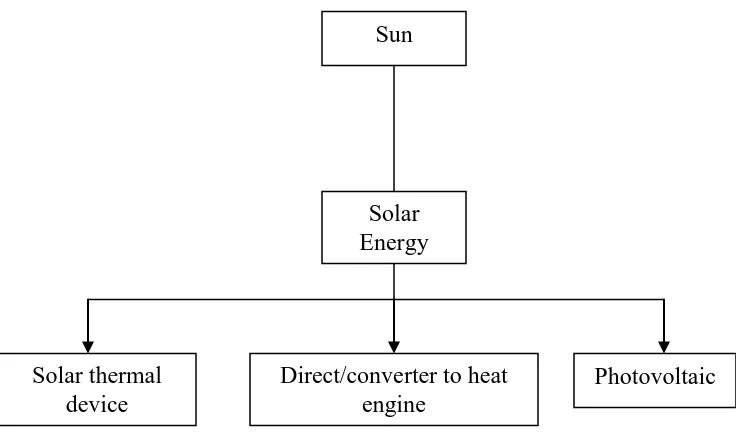
Figure 1: Application of solar Energy
1.2 Objective
The objectives of this research are:
1) Explaining type of solar energy can be converted. 2) Apply solar energy for application.
3) Considered the design of the solar panel
1.3 Scopes
Sun
Solar Energy
Solar thermal device
Direct/converter to heat engine
3
The scopes of this study are:
1) To design solar energy system to generate electricity power for stadium usage 2) To study a cost of implementing the system
3) To fabricate a model of the design.
This project maybe not required any prototype but must developed model scale which is explain clearly about its concept and how does it work.
1.4 Problem Statement
4
CHAPTER 2
LITERATURE REVIEW
2.1 Renewable Energy Alternative
Renewable energy sources are expected to become economically competitive as
their costs already have fallen significantly compared with conventional energy sources
in the medium term, especially if the massive subsidies to nuclear and fossil forms of
energy are phased out. Finally, new renewable energy sources offer huge benefits to
developing countries, especially in the provision of energy services to the people who
currently lack them. Up to now, the renewable sources have been completely
discriminated against for economic reasons. However, the trend in recent years favors the
renewable sources in many cases over conventional sources. The advantages of
renewable energy are that they are sustainable (non-depletable), ubiquitous (found
everywhere across the world in contrast to fossil fuels and minerals), and essentially
clean and environmentally friendly. The disadvantages of renewable energy are its
variability, low density, and generally higher initial cost. For different forms of
renewable energy, other disadvantages or perceived problems are pollution, odor from
biomass, avian with wind plants, and brine from geothermal. In contrast, fossil fuels are
stored solar energy from past geological ages. Even though the quantities of oil, natural
gas, and coal are large, they are finite and for the long term of hundreds of years they are
not sustainable. The world energy demand depends, mainly, on fossil fuels with
respective shares of petroleum, coal, and natural gas at 38%, 30%, and 20%, respectively.
5
(7%) and nuclear energy (5%). It is expected that the world oil and natural gas reserves
will last for several decades, but the coal reserves will sustain the energy requirements for
a few centuries. This means that the fossil fuel amount is currently limited and even
though new reserves might be found in the future, they will still remain limited and the
rate of energy demand increase in the world will require exploitation of other renewable
alternatives at ever increasing rates. The desire to use renewable energy sources is not
only due to their availability in many parts of the world, but also, more empathetically, as
a result of the fossil fuel damage to environmental and atmospheric cleanness issues. The
search for new alternative energy systems has increased greatly in the last few decades
for the following reasons:
1). The extra demand on energy within the next five decades will continue to increase
in such a manner that the use of fossil fuels will not be sufficient, and therefore, the
deficit in the energy supply will be covered by additional energy production and
discoveries.
2). Fossil fuels are not available in every country because they are unevenly
distributed over the world, but renewable energies, and especially solar radiation, are
more evenly distributed and, consequently, each country will do its best to research and
develop their own national energy harvest.
3). Fossil fuel combustion leads to some undesirable effects such as atmospheric
pollution because of the CO2 emissions and environmental problems including air
pollution, acid rain, greenhouse effect, climate changes, oil spills, etc. It is understood by
now that even with refined precautions and technology, these undesirable effects can
never be avoided completely but can be minimized. One way of such minimization is to
substitute at least a significant part of the fossil fuel usage by solar energy.
4). To optimize and safe energy usage of conventional energy, to reduce cost for the
6
dam using so many man powers, a lot of maintenance and must been monitoring all the
[image:17.612.98.510.194.386.2]time compare to solar energy which is less maintenance.
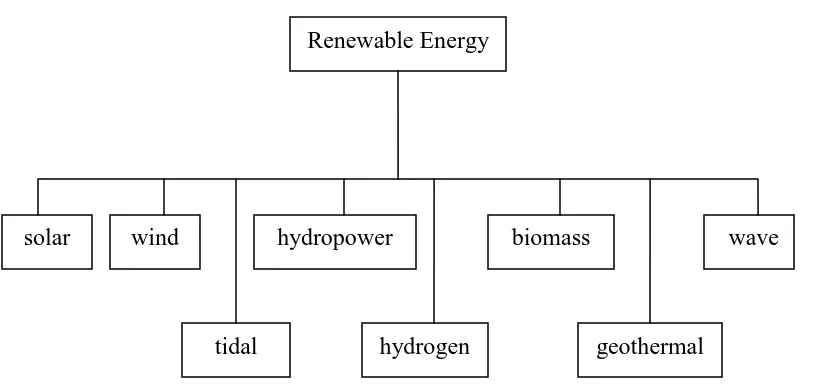
Figure 2.1: Classification of Renewable Energy
2.1.1 Solar Energy
In this context, solar energy refers to energy that is collected from sunlight. Solar energy can be applied in many ways, including to:
Generate electricity using photovoltaic solar cells.
Generate hydrogen using photo-electrochemical cells.
Generate electricity using concentrated solar power.
Generate electricity by heating trapped air which rotates turbines in a solar updraft tower.
Heat buildings, directly, through passive solar building design. Renewable Energy
wind hydropower biomass
solar wave
hydrogen
7
Heat foodstuffs, through solar ovens.
Heat water or air for domestic hot water and space heating needs using solar-thermal panels.
Heat and cool air through use of solar chimneys.
Generate electricity in geosynchronous orbit using solar power satellites.
Solar air conditioning
2.1.2 Wind Energy
Airflows can be used to run wind turbines. Modern wind turbines range from around 600 kW to 5 MW of rated power, although turbines with rated output of 1.5–3 MW have become the most common for commercial use; the power output of a turbine is a function of the cube of the wind speed, so as wind speed increases, power output increases dramatically. Areas where winds are stronger and more constant, such as offshore and high altitude sites are preferred locations for wind farms.
2.1.3 Hydropower
Energy in water (in the form of kinetic energy, temperature differences or salinity gradients) can be harnessed and used. Since water is about 800 times denser than air, even a slow flowing stream of water, or moderate sea swell, can yield considerable amounts of energy, (Wikimedia Foundation, Inc., 2008)
2.1.4 Biomass
8
may not be grown intentionally as an energy crop, and the remaining plant byproduct used as a fuel. Most types of biomass contain energy. Even cow manure still contains two-thirds of the original energy consumed by the cow. Energy harvesting via a bioreactor is a cost-effective solution to the waste disposal issues faced by the dairy farmer, and can produce enough biogas to run a farm.
2.1.5 Wave
Wave power uses the energy in waves. Wave powers machines are usually take the form of floating or neutrally buoyant structures which move relative to one another or to a fixed point. Wave power has now reached commercialization. The possibility of extracting energy from ocean waves has intrigued people for centuries. Although there
are a few concepts over 100 years old, it is only in the past two decades that viable
schemes have been proposed. Wave power generation is not a widely employed
technology, and no commercial wave farm has yet been established. In the basic studies
as well as in the design stages of a wave energy plant, the knowledge of the statistical
characteristics of the local wave climate is essential, no matter whether physical or
theoretical/numerical modeling methods are to be employed. This information may result
from wave measurements, more or less sophisticated forecast models, or a combination
of both, and usually takes the form of a set of representative sea states, each characterized
by its frequency of occurrence and by a spectral distribution. Assessment of how
turbo-generator design and the production of electrical energy are affected by the wave climate
is very important. However, this may have a major economic impact, since if the
equipment design is very much dependent on the wave climate, a new design has to be
developed for each new site. This introduces extra costs and significantly limits the use of
9
2.1.6 Tidal
Tidal energy is a form of hydropower that converts the energy of tides into electricity or other useful forms of power. Although not yet widely used, tidal power has potential for future electricity generation. Tides are more predictable than wind energy and solar power. Historically, tide mills have been used, both in Europe and on the Atlantic coast of the USA. The earliest occurrences date from the Middle Ages, or even from Roman times.
2.1.7 Hydrogen
Hydrogen is the most abundant element on earth, however, less than 1% is present as molecular hydrogen gas H2; the overwhelming part is chemically bound as H2O in water and some is bound to liquid or gaseous hydrocarbons. It is thought that the heavy elements were, and still are, being built from hydrogen and helium. It has been estimated that hydrogen makes up more than 90% of all the atoms or 75% of the mass of the universe (Weast 1976). Combined with oxygen it generates water, and with carbon it makes different compounds such as methane, coal, and petroleum. Hydrogen exhibits the highest heating value of all chemical fuels. Furthermore, it is regenerative and environment friendly, (Zekai Sen, 2008).
2.1.8 Geothermal
10
[image:21.612.126.460.209.355.2]world is located in The Geysers, a geothermal field in California. As of 2008, geothermal power supplies less than 1% of the world's energy.Geothermal can generally refer to any heat contained in the ground, (Wikimedia Foundation Inc., 2008).
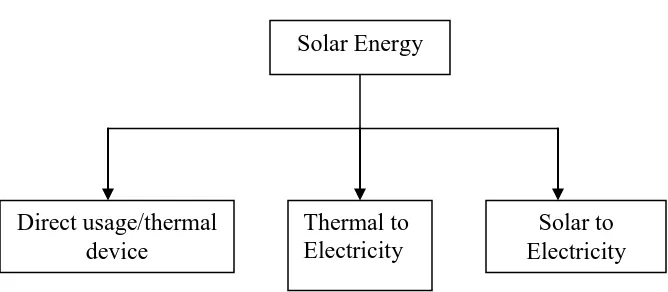
Figure 2.2: Application of Solar Energy
2.2 Sun as the Source of Solar Energy
Solar radiation and daylight are essential to all forms of life. Solar radiation is a fundamental energy for the survival and the development of living things. Daylight to humans is important in that it is necessary for visual comfort and providing psychological needs. Solar radiation is energy from the sun and daylight is part of the energy spectrum of electromagnetic radiation emitted by the sun within the visible wave-band that is received at the surface of the earth after absorption and scattering in the earth’s atmosphere. Sunlight is the direct component of light while daylight is the total light from the sky dome. Solar radiation and daylight possess similar physical properties and modeling of one involves the other. Modeling solar and daylight availability requires
Solar Energy
Direct usage/thermal device
Thermal to Electricity
11
slope irradiation and illuminance on a monthly averaged, daily or hourly basis, depending on the analysis. Daylight is also affected by attenuation due to absorption and scattering in the atmosphere and consists of direct (or beams); diffuse and ground-reflected components, (A. Zain-Ahmed, 2000)
.
The Sun is the star at the center of the Solar System. The Earth and other matter (including other planets, asteroids, meteoroids, comets, and dust) orbit the Sun, which by itself accounts for about 99.8% of the Solar System’s mass,(Wikimedia Foundation, Inc.2008). Energy from the Sun, in the form of sunlight and heat, supports almost all life on Earth via photosynthesis, and drives the Earth’s climate and weather. The surface of the Sun consists of hydrogen (about 74% of its mass, or 92% of its volume), helium (about 24% of mass, 7% of volume), and trace quantities of other elements, including iron, nickel, oxygen, silicon, sulfur, magnesium, carbon, neon, calcium, and chromium (Wikimedia Foundation, Inc.2008).
The Sun has a spectral class of G2V. G2 means that it has a surface temperature of approximately 5,780 K, giving it a white color that often, because of atmospheric scattering, appears yellow when seen from the surface of the Earth,( Wikimedia Foundation, Inc.2008). This is a subtractive effect, as the preferential scattering of shorter wavelength light removes enough violet and blue light, leaving a range of frequencies that is perceived by the human eye as yellow. It is this scattering of light at the blue end of the spectrum that gives the surrounding sky its color. When the Sun is low in the sky, even more light is scattered so that the Sun appears orange or even red. The Sun’s spectrum contains lines of ionized and neutral metals as well as very weak hydrogen lines. The V (Roman five) in the spectral class indicates that the Sun, like most stars, is a main sequence star. This means that it generates its energy by nuclear fusion of hydrogen nuclei into helium.
12
age, determined using computer models of stellar evolution and nucleocosmochronology, is thought to be about 4.57 billion years. The Sun is about halfway through its main-sequence evolution, during which nuclear fusion reactions in its core fuse hydrogen into helium. Each second, more than 4 million tonnes of matter are converted into energy within the Sun’s core, producing neutrinos and solar radiation; at this rate, the Sun will have so far converted around 100 Earth-masses of matter into energy. The Sun will spend a total of approximately 10 billion years as a main sequence star. The diameter of the sun is R = 1.39×10⁶ km. The sun is an internal energy generator and distributor for other planets such as the earth. It is estimated that 90% of the energy is generated in the region between 0 and 0.23R, which contains 40% of the sun’s mass. The core temperature varies between 8×10⁶ K and 40×106 K and the density is estimated at about 100 times that of water. At a distance 0.7R from the center the temperature drops to about 130,000K where the density is about 70 kg/m3, (Zekai Sen, 2008). The space from 0.7R to 1.0R is known as the convective zone with a temperature of about 5000K and the density is about 10−5 kg/m3.
13
difference in mass (around 5×10⁹ kg/second) is converted into energy, which is transferred to the surface where electromagnetic radiation and some particles are emitted into space; this is known as the solar wind.
Most of the developing countries lie within the tropical belt of the world where there are high solar power densities and, consequently, they want to exploit this source in the most beneficial ways. On the other hand, about 80% of the world’s population lives between latitudes 35°N and 35° S. These regions receive the sun’s radiation for almost 3000 – 4000 h/year. In solar power density terms, this is equivalent to around 2000kWh/year, which is 0.25 cet/year. Additionally, in these low latitude regions, seasonal sunlight hour changes are not significant. This means that these areas receive the sun’s radiation almost uniformly throughout the whole year. Apart from the solar radiation, the sunlight also carries energy. It is possible to split the light into three overlapping groups:
1. Photovoltaic (PV) group: produces electricity directly from the sun’s light
2. Photochemical (PC) group: produces electricity or light and gaseous fuels by means of non-living chemical processes
3. Photobiological (PB) group: produces food (animal and human fuel) and gaseousfuels by means of living organisms or plants
The last two groups also share the term “photosynthesis”, which means literally the building (synthesizing) by light.