R E S E A R C H A R T I C L E
Open Access
A mixed methods process evaluation of a
person-centred falls prevention program
Rebecca L. Morris
1*, Keith D. Hill
2,3, Ilana N. Ackerman
1, Darshini Ayton
1*, Glenn Arendts
4,5, Caroline Brand
1,6,
Peter Cameron
1,7, Christopher D. Etherton-Beer
4,8, Leon Flicker
4,8, Anne-Marie Hill
3, Peter Hunter
1,7,
Judy A. Lowthian
1,9, Renata Morello
1, Samuel R. Nyman
10, Julie Redfern
11, De Villiers Smit
1,7and Anna L. Barker
1Abstract
Background:RESPOND is a telephone-based falls prevention program for older people who present to a hospital emergency department (ED) with a fall. A randomised controlled trial (RCT) found RESPOND to be effective at reducing the rate of falls and fractures, compared with usual care, but not fall injuries or hospitalisations. This process evaluation aimed to determine whether RESPOND was implemented as planned, and identify implementation barriers and facilitators.
Methods:A mixed-methods evaluation was conducted alongside the RCT. Evaluation participants were the RESPOND intervention group (n= 263) and the clinicians delivering RESPOND (n= 7). Evaluation data were
collected from participant recruitment and intervention records, hospital administrative records, audio-recordings of intervention sessions, and participant questionnaires. The Rochester Participatory Decision-Making Scale (RPAD) was used to evaluate person-centredness (score range 0 (worst) - 9 (best)). Process factors were compared with pre-specified criteria to determine implementation fidelity. Six focus groups were held with participants (n= 41), and interviews were conducted with RESPOND clinicians (n= 6). Quantitative data were analysed descriptively and qualitative data thematically. Barriers and facilitators to implementation were mapped to the‘Capability, Opportunity, Motivation–Behaviour’(COM-B) behaviour change framework.
Results:RESPOND was implemented at a lower dose than the planned 10 h over 6 months, with a median (IQR) of 2.9 h (2.1, 4). The majority (76%) of participants received their first intervention session within 1 month of hospital discharge with a median (IQR) of 18 (12, 30) days. Clinicians delivered the program in a person-centred manner with a median (IQR) RPAD score of 7 (6.5, 7.5) and 87% of questionnaire respondents were satisfied with the program. The reports from participants and clinicians suggested that implementation was facilitated by the use of positive and personally relevant health messages. Complex health and social issues were the main barriers to implementation.
Conclusions:RESPOND was person-centred and reduced falls and fractures at a substantially lower dose, using fewer resources, than anticipated. However, the low dose delivered may account for the lack of effect on falls injuries and hospitalisations. The results from this evaluation provide detailed information to guide future implementation of RESPOND or similar programs.
Trial registration:This study was registered with the Australian New Zealand Clinical Trials Registry, number ACTRN12614000336684(27 March 2014).
Keywords:Falls prevention, fractures, older adults, emergency department, process evaluation, complex intervention, mixed methods
© The Author(s). 2019Open AccessThis article is distributed under the terms of the Creative Commons Attribution 4.0 International License (http://creativecommons.org/licenses/by/4.0/), which permits unrestricted use, distribution, and reproduction in any medium, provided you give appropriate credit to the original author(s) and the source, provide a link to the Creative Commons license, and indicate if changes were made. The Creative Commons Public Domain Dedication waiver (http://creativecommons.org/publicdomain/zero/1.0/) applies to the data made available in this article, unless otherwise stated. * Correspondence:[email protected];[email protected]
1School of Public Health and Preventive Medicine, Monash University, Melbourne, Australia
Background
Falls are the leading cause of hospital emergency depart-ment (ED) presentations for older people [1]. The evidence suggests that for fallers presenting to the ED, 13–33.3% will fall again within 6 months [2, 3], and 46–52% within 12 months [4,5], highlighting the need for secondary falls pre-vention. In response to this clinical need, Barker et al. devel-oped RESPOND: a falls prevention program targeting people presenting to ED with a fall to reduce their risk of subsequent falls (“Respond to the first fall to prevent the sec-ond”) [6, 7]. RESPOND was designed to include the characteristics that appear to distinguish successful falls pre-vention, and other behaviour change programs, from others: interventions delivered at sufficient dose; in a timely manner; incorporating person-centred education and goal setting; using a telephone-based motivational coaching approach [7]. A randomised controlled trial (RCT) of RESPOND showed the program to be effect-ive at reducing the rate of falls and fractures, compared with usual care. There was no difference in fall injuries (other than fractures), or hospitalisation outcomes be-tween groups [6].
RCTs are the gold standard for establishing the effective-ness of an intervention [8]. However, RCT results alone do not provide information related to what worked, how, and why. RESPOND is a complex intervention, comprising nu-merous potential “active ingredients” where the combin-ation of components comprise more than the sum of its parts [9]. Process evaluations conducted alongside clinical trials can determine the degree of implementation fidelity, clarify causal mechanisms (how and why it worked), and identify contextual factors (barriers and facilitators) associ-ated with outcomes [8]. This information can guide re-searchers, clinicians and policy makers to successfully implement similar programs in different settings [10].
To date, information related to process factors for falls prevention RCTs is limited. Of eleven RCTs of falls pre-vention programs targeting older adults who present to an ED with a fall [4, 5, 11–19], elements of process evaluation, such as reach, adherence and timeliness of program delivery are inconsistently reported. Only one program conducted a detailed process evaluation along-side the RCT [17, 20]. The evaluation attributed lack of program effectiveness to an insufficient number of refer-rals and recommendations resulting from medical assess-ments, and participants’low compliance with advice [20]. No comprehensive process evaluation has been conducted on an RCT of a program that has been shown to reduce the rate of falls for older people who present to an ED with a fall, thus our understanding of critical success fac-tors for reducing falls in this sub-optimally managed co-hort remains limited. This process evaluation aimed to fill this gap in the literature by providing detailed insight into the RESPOND RCT results, and assist others in effectively
translating the RESPOND program into real world set-tings, by addressing the following objectives:
1. To assess the degree to which RESPOND was implemented as planned; and
2. To identify barriers and facilitators to
implementation from the perspectives of those delivering and receiving the intervention.
Methods Study design
This paper reports a convergent parallel mixed-methods [21] process evaluation of the RESPOND RCT. Implemen-tation fidelity is the degree to which an intervention is de-livered as intended, and key components of evaluation of implementation fidelity have been variously categorised and defined [22]. For this study, components of implemen-tation fidelity evaluated are: reach (the proportion of target cohort who participated in RESPOND); intervention par-ticipant adherence to minimum program requirements; RESPOND clinician adherence to key program compo-nents; and dose and timeliness of intervention delivered.
Study setting and participants
A total of 541 community-dwelling adults aged 60–90 years, who had presented to one of two Australian pub-lic hospital EDs in Victoria and Western Australia with a fall, and had a planned discharge home within 72 h, were recruited to the RESPOND RCT. Exclusion criteria were: planned discharge to a residential aged care facil-ity; current palliative care or terminal illness, requiring hands-on assistance to walk, non-English speaking, un-able to use a telephone, a history of social aggression or psychosis, cognitive impairment (Mini Mental State Examination (MMSE) < 23) [23], or living > 50 km from the recruiting hospital. Recruited participants were ran-domised to either the RESPOND intervention or usual care and followed-up for 12 months. For those rando-mised to the intervention group, the first 6 months com-prised the RESPOND program. RESPOND RCT details are published elsewhere [6,7].
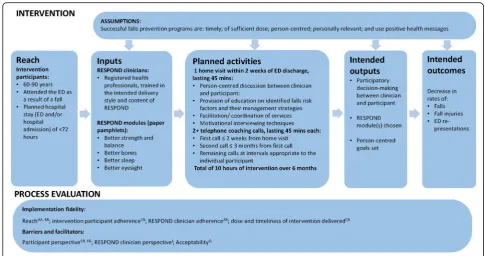
RESPOND process evaluation participants were the trial intervention participants (n= 263) and the healthcare pro-fessionals delivering the program (n= 7: three physiother-apists, two occupational therphysiother-apists, one dietitian, and one nurse). This process evaluation corresponds with the in-puts, activities and outputs detailed in the RESPOND pro-gram logic model [24], and interrogates the assumptions underlying the model and the linkages between program components and trial outcomes (Fig.1).
RESPOND intervention
was conducted, using a valid and reliable tool: Falls Risk for Older People–Community setting (FROP-Com) [25,26], and the RESPOND intervention was introduced. RE-SPOND consisted of four evidence-based modules related to falls risk factors: Better Strength and Balance; Better Bones; Better Eyesight; and Better Sleep. Each RESPOND module had an associated pamphlet with the slogan: “Be Your Best”. These each provided positively framed health messages related to the interventions such as: “Exercise… can help you feel revitalised, relaxed and help you get a good night’s sleep”;and “With good eyesight you can…keep driving independently”. Subsequent telephone coaching calls, using motivational interviewing approaches [27] were made by the RESPOND clinician over the 6 month inter-vention period. The timing, intended dose, and delivery style (person-centred education and goal setting, use of positive health messages, and motivational interviewing techniques), were pre-determined in the RCT protocol (summarised in Fig.1) [7].
Clinician training
A standard operating procedures manual guided consistent delivery of program content and intended delivery style across the two sites. The lead clinician attended a motiv-ational interviewing course, and provided face-to-face training to the other clinicians, using a ‘train the trainer’ approach [28]. RESPOND clinicians shadowed their senior during intervention sessions prior to commencing their
own intervention delivery. The lead clinician held regular meetings with RESPOND clinicians to discuss specific is-sues or achievements with program delivery, present case studies, and provide trial updates.
Data collection Implementation fidelity
Reach Program reach was evaluated through the num-ber of participants recruited into the RCT compared to the number of potentially eligible patients presenting to the recruiting hospital EDs (identified from hospital ad-ministrative data). Reasons for declining to participate were coded. Recruitment data were collected by the RE-SPOND trial recruitment team and entered directly into a web based database via an iPad.
Intervention participant adherence Participant adher-ence was defined as the proportion of participants who: i) had an initial home visit and at least two telephone coach-ing calls; ii) chose at least one RESPOND module to work through; and iii) set at least one goal. These data were re-corded by the RESPOND clinicians in the project database.
[image:3.595.54.540.86.342.2]intervention sessions, and part-way through the trial period this was changed to recording on a month on/ month off basis in order to reduce clinician burden. This component of the study evaluated whether the clinicians: delivered the intervention in the spirit of participatory decision-making, using motivational interviewing (MI) techniques; provided education related to falls risks and their management strategies; and provided linkage to ap-propriate local community health services. Examples of community linkage included referral to a strength and bal-ance exercise group; seeking advice from their general practitioner (GP) regarding withdrawal of sedative medi-cation or having a vitamin D test; or making an appoint-ment with an optometrist for a vision test.
Motivational interviewing skills evaluated were: Open-ended questions, Affirmations (statements and gestures that recognise client strengths and acknowledge behav-iours that lead in the direction of positive change); Re-flections (listening to the participant and then making statements to demonstrate understanding); and Sum-maries (synopsis of the conversation)– “OARS”[29].
Education, community linkage and motivational inter-viewing were assessed as either being present (“1”) if there was an example of the clinician providing each component, or absent (“0”). Scoring guidelines were de-veloped with definitions and examples for each compo-nent in order to assist with analysis.
Person-centeredness was analysed using the Rochester Participatory Decision-Making Scale (RPAD) [30]. This tool comprises nine aspects of participatory decision-making, each scoring “0” if no evidence of the item was present,
“0.5”if some evidence, or a full point if strong evidence was present, with the exception of item 6, ‘Clinician’s medical language matches participant’s level of understanding’, which was scored:“-0.5” (clear mismatch), “0.5”(language mostly matches) or “1” (language clearly matches). The RPAD provides a total maximum score of nine.
Dose and timeliness of intervention delivery Data re-lated to the RESPOND modules chosen, dose delivered (number of intervention sessions, and total duration of intervention delivered), and timing of intervention con-tacts (time from ED discharge to the initial home visit, and subsequent telephone coaching calls), were recorded on the project database by the RESPOND clinicians fol-lowing each intervention contact, and compared to the parameters set in the RESPOND RCT protocol (sum-marised in Fig.1: planned activities).
Participant focus groups and RESPOND clinician interviews The opinions of and experiences with the im-plementation fidelity components detailed above, from the perspectives of those participating in, as well as those deliv-ering RESPOND, were captured qualitatively. Intervention
participants’perspectives were examined through focus groups at the completion of the intervention period. Following the intervention period, participants were contacted via telephone and invited to participate in a focus group, with a follow-up letter sent to individuals who agreed to participate. All focus groups were con-ducted by the lead researcher (RLM), using a discussion guide developed in consultation with the RESPOND in-vestigator team. The guide included prompts to discuss opinions about program content, dose, delivery style, and delivery mode, as well as perceived benefits of and barriers and facilitators to participation.
The opinions and experiences of the RESPOND clini-cians were identified through individual semi-structured audio-recorded interviews, following the intervention period. The interview discussion guide mirrored that of the focus groups to allow for comparison between the experiences of those delivering and receiving the program. The lead researcher conducted the focus groups and interviews, and field notes were taken. All interviews and focus groups were audio-recorded and transcribed. Cop-ies of the transcripts were sent to the participants to provide the opportunity to comment on accuracy.
Barriers and facilitators
Barriers and facilitators to implementing RESPOND were identified through the participant focus groups and clinician interviews as detailed above. In addition, clini-cians routinely asked participants to identify barriers and facilitators to achieving RESPOND goals as part of the intervention sessions. These were recorded in the project database via‘tick box’categorical options.
Acceptability Acceptability of RESPOND was deter-mined using a purpose-designed questionnaire sent to all intervention participants on completion of the 6 month RE-SPOND program. The questionnaire comprised nine Likert-type five point scale questions (strongly agree to strongly disagree) exploring opinions related to key pro-gram components, and perceived benefits and satisfaction with participating in RESPOND. A further four questions explored participant opinions related to the mode of deliv-ery (one face-to-face visit and telephone calls) and dose de-livered, with categorical options to choose from.
Data analysis
discussed until consensus was reached. An inter-rater discrepancy of <10% was considered acceptable. Descriptive statistics were used to summarise all quanti-tative data, using Stata version 14 [31].
Qualitative data were analysed by the lead researcher using deductive and inductive coding [32]. Coding was guided by the assumptions underlying the RESPOND program logic, and key components of the RESPOND program design: person-centredness, motivational inter-viewing, provision of education and community linkage, dose and timeliness of intervention delivery, perceived relevance and benefit of RESPOND, and barriers and fa-cilitators to implementation. An inductive approach was used to code relevant features of the data beyond the pre-defined categories described above. Coding was vali-dated by a second researcher who coded 10% of the transcripts selected at random to ensure rigour with dif-ference being resolved by consensus. Coding was sup-ported by NVivo version 11 [33]. Themes were identified from the codes and mapped to the Capability Oppor-tunity Motivation – Behaviour (COM-B) model [34]. This model categorises behaviour (B) as the result of an individual’s capability (C); opportunity (O); and motiv-ation (M), to perform the behaviour. The behaviours of interest for this evaluation were: (i) participation in the RESPOND program (intervention participants); and (ii) delivery of RESPOND (RESPOND clinicians). The themes and their categorisation in the COM-B model were reviewed by a second researcher and refined fol-lowing discussion and consensus.
For each evaluation component, quantitative and qualitative data were synthesised at the interpretation and reporting level. Data were integrated through narra-tive, using a weaving approach, with qualitative and quantitative findings reported together on a component-by-component basis [35].
As the trial was conducted in two Australian States, it was possible that State-specific contextual variations could have influenced implementation of the program. An inter-site comparison was made to determine fidelity across sites using chi square tests for categorical data and t-tests for continuous data, with a pvalue of < 0.05 considered statistically significant.
Results
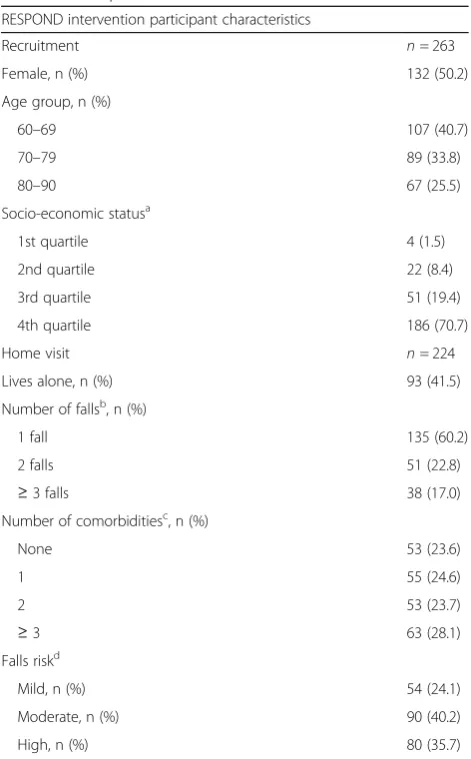
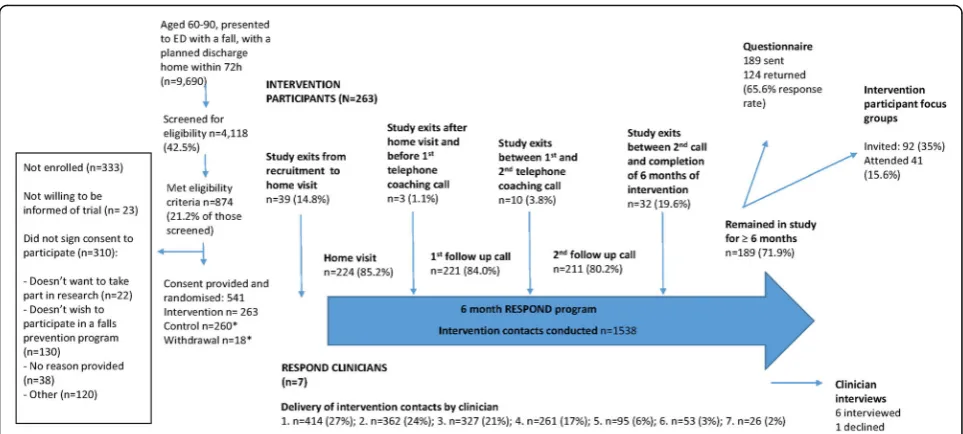
Intervention participants were a mean (SD) age of 73 (8.4) years, with the majority (71%) of high socio-economic sta-tus. A large proportion (42%) of participants lived alone, and a further 36% were a high falls risk. Participant charac-teristics are presented in Table1. A total of 224 (85%) of all participants randomised to the intervention participated in at least one intervention session. The seven RESPOND clinicians contributed various proportions of intervention delivery. Six clinicians participated in interviews, with one
declining (clinician 6). Participant flow through the study is summarised in Fig.2.
Implementation fidelity Reach
[image:5.595.304.540.96.476.2]Over the study period, 9690 people aged 60–90 years presented to the two EDs with a fall, and had a planned discharge home within 72 h; of these, 4118 (43%) were
Table 1Participant characteristics RESPOND intervention participant characteristics
Recruitment n= 263
Female, n (%) 132 (50.2)
Age group, n (%)
60–69 107 (40.7)
70–79 89 (33.8)
80–90 67 (25.5)
Socio-economic statusa
1st quartile 4 (1.5)
2nd quartile 22 (8.4)
3rd quartile 51 (19.4)
4th quartile 186 (70.7)
Home visit n= 224
Lives alone, n (%) 93 (41.5)
Number of fallsb, n (%)
1 fall 135 (60.2)
2 falls 51 (22.8)
≥3 falls 38 (17.0)
Number of comorbiditiesc, n (%)
None 53 (23.6)
1 55 (24.6)
2 53 (23.7)
≥3 63 (28.1)
Falls riskd
Mild, n (%) 54 (24.1)
Moderate, n (%) 90 (40.2)
High, n (%) 80 (35.7)
a
economic status was approximated using the Index of Relative Socio-Economic Advantage and Disadvantage (IRSAD) [36]. The 1st quartile (25th percentile) represents those with the most disadvantage, with the 4th quartile (100th percentile) representing those with the most advantage
b
Number of falls in the last 12 months (including the index fall) was reported by participants as part of the Falls Risk for Older People–Community setting (FROP-Com) risk assessment tool
c
Number of comorbidities was reported by participants as part of the FROP-Com assessment. Defined as total number of diagnoses of: arthritis; any respiratory condition; Parkinson’s Disease; diabetes; dementia; peripheral neuropathy; any cardiac condition; stroke; any other neurological condition; lower limb amputation; osteoporosis; vestibular disorder; or lower limb joint replacement
d
screened for eligibility. The remainder either presented outside trial recruitment times or were discharged before recruitment could occur. Of those screened, 21% met all eligibility criteria. Of those eligible but not enrolled (n= 333), 39% did not want to participate in a falls preven-tion program, and 7% did not wish to be part of a re-search project (Fig.2).
Intervention participant adherence
Better Strength and Balance was the most frequently selected module (n = 204; 91% of participants who received the intervention), followed by Better Bones (n = 148; 66%). Better Sleep and Better Eyesight were the least frequently chosen (n = 81; 36% and n = 72; 32% respectively). Participants chose a median (IQR) of 2 (2–3) modules over the intervention period. Five of the 224 participants who received at least one intervention session did not choose a module throughout their intervention period. Two of these five dropped out after their home visit, one dropped out after their first follow up coaching call, and one after their second call. The fifth participant was lost to follow up after six follow up coaching calls. Ad-herence to the program was defined as choosing at least one module, completing a minimum of three intervention sessions and setting at least one goal. A total of 195 of the 263 intervention participants (74%) met these three minimum requirements. Par-ticipants who chose Better Strength and Balance had the highest proportion of adherence 180 (88%); with similar proportions for Better Eyesight and Better
Bones (n = 55, 76% and n = 111, 75% respectively). The lowest adherence was for those who chose Bet-ter Sleep (n = 41, 51%).
RESPOND clinician adherence
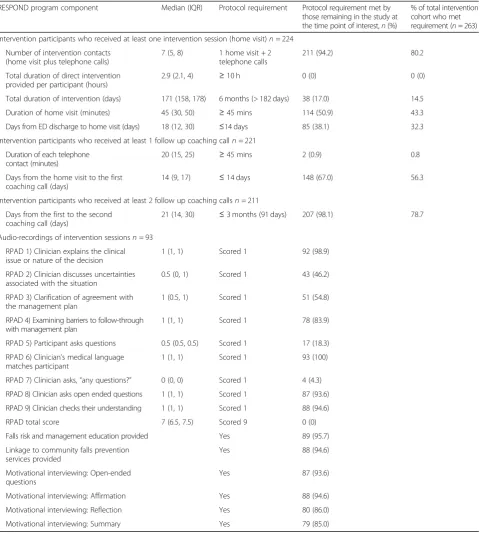
A total of 926 sessions (60% of all intervention con-tacts) were audio-recorded by the RESPOND clini-cians. Ten percent (n = 93) of recordings were randomly selected for inclusion in the analysis. Over-all, the RESPOND clinicians delivered the program in a person-centred manner, as indicated by the RPAD scores (median RPAD score 7; IQR: 6.5–7.5) (Table2). Some aspects of participatory decision-making were exemplary, with evidence of the clinicians matching their language to the participants’ level of understand-ing in all of the analysed intervention contacts. The clinicians explained the issue, asked open ended ques-tions, and checked their understanding of the partici-pant’s point of view in over 90% of analysed audio-recordings. However, there was little evidence (4%) of the clinicians asking the participants if they had any questions (Table 2).
Qualitative data demonstrated that a person-centred, participatory decision-making approach was favoured by clinicians and participants:
“When people set their own goals it’s often a lot more empowering and they’re often a lot more motivated to actually do them because they’ve come up with them themselves.”(Clinician 1).
[image:6.595.57.539.86.303.2]“[The RESPOND clinician] encouraged you and sort of steered you in the right[direction]or gave you
options…if someone tells me what to do I just ignore it.”(Male participant, aged 68).
The clinicians implemented at least one motivational interviewing technique in the majority of intervention
sessions (85–95%), with 71% (n= 66) of recorded contacts demonstrating evidence of all four OARS components (Table2). The clinicians recognised that motivational inter-viewing techniques were a useful strategy for delivering be-haviour change interventions:
[image:7.595.59.543.98.633.2]“I think motivational interviewing is really appropriate
Table 2Implementation fidelity
RESPOND program component Median (IQR) Protocol requirement Protocol requirement met by those remaining in the study at the time point of interest,n(%)
% of total intervention cohort who met requirement (n= 263)
Intervention participants who received at least one intervention session (home visit)n= 224
Number of intervention contacts (home visit plus telephone calls)
7 (5, 8) 1 home visit + 2 telephone calls
211 (94.2) 80.2
Total duration of direct intervention provided per participant (hours)
2.9 (2.1, 4) ≥10 h 0 (0) 0 (0)
Total duration of intervention (days) 171 (158, 178) 6 months (> 182 days) 38 (17.0) 14.5
Duration of home visit (minutes) 45 (30, 50) ≥45 mins 114 (50.9) 43.3
Days from ED discharge to home visit (days) 18 (12, 30) ≤14 days 85 (38.1) 32.3
Intervention participants who received at least 1 follow up coaching calln= 221
Duration of each telephone contact (minutes)
20 (15, 25) ≥45 mins 2 (0.9) 0.8
Days from the home visit to the first coaching call (days)
14 (9, 17) ≤14 days 148 (67.0) 56.3
Intervention participants who received at least 2 follow up coaching callsn= 211
Days from the first to the second coaching call (days)
21 (14, 30) ≤3 months (91 days) 207 (98.1) 78.7
Audio-recordings of intervention sessionsn= 93
RPAD 1) Clinician explains the clinical issue or nature of the decision
1 (1, 1) Scored 1 92 (98.9)
RPAD 2) Clinician discusses uncertainties associated with the situation
0.5 (0, 1) Scored 1 43 (46.2)
RPAD 3) Clarification of agreement with the management plan
1 (0.5, 1) Scored 1 51 (54.8)
RPAD 4) Examining barriers to follow-through with management plan
1 (1, 1) Scored 1 78 (83.9)
RPAD 5) Participant asks questions 0.5 (0.5, 0.5) Scored 1 17 (18.3)
RPAD 6) Clinician’s medical language matches participant
1 (1, 1) Scored 1 93 (100)
RPAD 7) Clinician asks,“any questions?” 0 (0, 0) Scored 1 4 (4.3)
RPAD 8) Clinician asks open ended questions 1 (1, 1) Scored 1 87 (93.6)
RPAD 9) Clinician checks their understanding 1 (1, 1) Scored 1 88 (94.6)
RPAD total score 7 (6.5, 7.5) Scored 9 0 (0)
Falls risk and management education provided Yes 89 (95.7)
Linkage to community falls prevention services provided
Yes 88 (94.6)
Motivational interviewing: Open-ended questions
Yes 87 (93.6)
Motivational interviewing: Affirmation Yes 88 (94.6)
Motivational interviewing: Reflection Yes 80 (86.0)
whenever you’re dealing with any kind of health care.”
(Clinician 1).
However, some clinicians found that this approach worked better with some participants than others:
“Using[motivational interviewing]in the purer sense was difficult at times…There’s a couple of male
[RESPOND participants]that come to mind who don’t want to have in-depth conversations. They really want a“yes/no”. Some people are used to a very prescriptive style of care.”(Clinician 5).
Falls prevention education was provided in most (96%)
of the analysed intervention sessions (Table 2). The
cli-nicians and participants recognised the benefits of pro-viding education related to falls risk and associated management strategies:
“I think bringing new ideas to them, new information, new education, that was also a key benefit, and a lot of people didn’t have a lot of this knowledge, and they were really grateful for that”. (Clinician 7).
“They[RESPOND clinicians]were informative…and explained them[the RESPOND modules]all very thoroughly”. (Female participant, aged 62).
The clinicians linked participants with appropriate com-munity services in 95% of analysed audio-recordings. The participants appreciated having an allocated clin-ician to facilitate this community linkage:
“Before I had the fall I did strength training with
[community health centre].After the RESPOND clinician came to me see me, I said I wanted to go back to the exercise program, but if I’d just rung the exercise program and said I’d like to go back, I would have been on the waiting list for six months. I said
‘this is my goal, I’d like to go back to this exercise program’.[My RESPOND clinician]either phoned ... they did something, which meant that I was able to get in much quicker, and that was very helpful. And I’m still involved in that, and I intend to continue it”.
(Female participant, aged 67).
The unique role of the RESPOND clinician as the‘
miss-ing link’ for providing coordinated falls prevention
ad-vice and support was recognised by clinicians at both sites:
“When you actually look at it, I listen to that person for as long as they want to talk, and we make a plan of what to do next, and I encourage them. What other services do that? Very, very few”.(Clinician 1).
“I think it[RESPOND]does fill a gap….When someone turns up at the ED it’s unlikely that they’re going to get anywhere near the kind of information that RESPOND’s providing for them, and it’s a bit hit and miss with their GP as well just because they’re busy…the ongoing support[provided by the RESPOND clinician]over a period of time is really valuable for these people”.(Clinician 7).
The participants expanded on this idea of RESPOND meeting a clinical need and suggested that it has particular value to those who live alone and/or are socially isolated:
“She[RESPOND clinician]put me on to the right exercise program, she encouraged me, she helped me to get bits and pieces of furniture, lifting up the mats. I found her invaluable, plus having that support. When you live on your own, it’s a horrible experience”. (Female participant, aged 79).
“There must be other people, like me, that really don’t have anybody and you fill in a very important job”. (Male participant, aged 74).
Dose and timeliness of intervention delivery
The majority of participants (80% of the total intervention cohort) received the minimum requirement of one home visit plus two follow up coaching calls. However, overall, the intervention was delivered at a lower dose than planned. Less than 1% achieved a telephone call that lasted 45 min or more (median 20 mins, IQR: 15, 25). No partici-pants received the planned 10 h of intervention contact time with their RESPOND clinician, with a median total intervention time of 2.9 h (IQR: 2.1, 4) (Table2).
However, the clinicians highlighted the importance of quality over quantity in terms of the dose of program delivered:
“I’ve got another man who very seldom went over eight minutes in a call, and he just loved having the calls, and he was in a totally different place…in a positive way…at the end of that six months than the beginning”.(Clinician 1).
The clinicians suggested that a higher dose was often as-sociated with increased participant complexity:
“Lower-functioning ones who needed more assistance and support, you could do a half-an-hour phone call with them”.(Clinician 5).
(median 18 days; IQR 12, 30) (Table 2). A further 85 (38%) received their first intervention session within 30 days, meaning that 76% of participants received their home visit within 1 month of ED discharge.
Clinicians cited complex health reasons as contribut-ing to the delay in completcontribut-ing a home visit:
“Perhaps all of the health issues weren’t immediately understood when they were seen in ED so sometimes that would mean re-presentations or it would mean later on they’d end up being admitted to rehab…or staying on in the hospital…or they’d gone to stay with family”.(Clinician 1).
Despite the challenges of delivering an early intervention, the participants perceived value in receiving the RE-SPOND program during the vulnerable post-fall period:
“[RESPOND]really helped in those first few weeks when you’re at home and you’re sort of thinking‘oh my god, what have I done here?’I just found that very
reassuring. I was very impressed”.(Female participant, aged 62).
Nearly all participants (98%) received their second
coaching call within 3 months of the first call (Table2).
The clinicians perceived the frequency of intervention sessions as important for maintaining progress towards RESPOND goals:
“In terms of frequency I think you need to stay in touch with them every two or three weeks otherwise they forget and it becomes strange to talk something that you have discussed at the last phone call”.
(Clinician 5).
Inter-site consistency was high with no statistically sig-nificant differences between sites for program dose, timeliness, or delivery of key program components.
Barriers and facilitators Capability
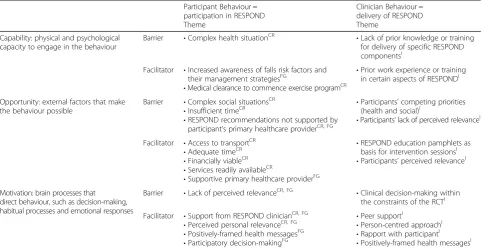
The main‘capability’barrier to participation in RESPOND was participants’ complex health issues taking priority and/or limiting the participant’s physical capacity to take part (Table3). Complex health issues fell into the follow-ing main categories: recent surgery; an exacerbation of an existing condition; or new medical diagnosis and associ-ated treatment. Conversely, medical clearance to exercise (physical capacity to participate in falls prevention exer-cises following fall-related musculoskeletal injury, as judged by the participant’s GP or other medical profes-sional) was stated as a facilitator for participants to engage in RESPOND activities. Increased awareness of falls risk
factors and their associated management strategies, result-ing from the educational component of RESPOND, was also reported as a key facilitator to participants’capability to engage in RESPOND.
“[RESPOND is]worth doing from the point of view that they make you aware of the reasons why you have a fall…I think the information was beneficial…it made me change my lifestyle”.(Female participant, aged 62). For the clinicians, lack of prior knowledge or training for delivering certain RESPOND components was viewed as a barrier to delivering RESPOND. The clinicians consid-ered prior relevant experience as a facilitator to their perceived capacity to deliver RESPOND, with a bias to-wards modules that correlated most closely with their professional background:
“I skew more to strength and balance and bones, because it’s something I know a lot more about than, say, vision or sleep”.(Clinician 7).
Opportunity
The external factor that was perceived as the greatest barrier to participating was complex social issues. This most frequently related to carer commitments (caring for a spouse, or grandchildren); breakdown of personal relationships; social engagements; or travel. Lack of time was an additional barrier for some, most commonly due to work commitments. Some participants also reported their primary healthcare provider sometimes posed a barrier to completing agreed actions in order to achieve RESPOND goals:
“My doctor wouldn’t give me a referral to have the vitamin D checked. He said it was an overtreatment and unnecessary”.(Female participant, aged 71). The participants’other health and social issues were also identified as key ‘opportunity’ challenges for the
clini-cians delivering RESPOND, because participants’
prior-ities were elsewhere:
“A lot of comorbidities makes it essential but difficult”.
(Clinician 7).
“She[RESPOND intervention participant]had all this other emotional stuff–family issues–going on that were a higher priority[than RESPOND]to deal with”.
(Clinician 5).
challenge for clinicians:
“Those who came through with a really severe health event, or an accident…and don’t even classify it as a fall, it was harder to see a link between what we’re offering and what’s happening in their life. There was not so much relevance there.”(Clinician 7).
Key facilitators for participants included adequate access to transport, affordable and accessible services, and hav-ing sufficient time for the intervention sessions and to address RESPOND goals.
The clinicians identified the RESPOND pamphlets as facilitating the delivery of RESPOND by providing a prompt and focus for the intervention sessions:
“To leave them with people so that they could look at them and then ask them,‘Had they looked at them since you’d spoken?’,‘Was there anything else that came up out of them?’, and as a memory jogger. Sometimes they used them as a cue when they went to their GP to cover some element of whichever module was involved. So, yeah, I found them quite useful”. (Clinician 5).
The clinicians found that participants were more en-gaged in the program if they perceived RESPOND to be personally relevant:
“Some of those people[RESPOND participants]would
definitely relate[to the RESPOND modules]if they were looking at their health and general wellbeing and going‘yeah, I notice that my balance has been getting a little bit worse in the last few weeks’. These are the words and the language that you could usually pick up from the conversation and go, great, I think there’s going to be some perceived relevance and some acceptance here”.(Clinician 7).
Motivation
Lack of perceived relevance was a key motivational bar-rier to participation for some participants:
“I think it[RESPOND]is more for people that have a
‘proper’fall”.(Male participant, aged 84).
Conversely, perceiving the RESPOND modules to be personally relevant, was a motivating factor for many:
“Once you have one fall the chances of you having another fall are high. So it[RESPOND]really made me aware of that…I was off to exercise”.(Female participant, aged 60).
[image:10.595.57.540.99.349.2]For the clinicians who were used to having a broad repertoire of patient management options in real-world clinical situations, performing clinical decision-making and treatment within the constraints of an
Table 3Barriers and facilitators to participation in and delivery of RESPOND, mapped to the COM-B Framework Participant Behaviour =
participation in RESPOND Theme
Clinician Behaviour = delivery of RESPOND Theme
Capability: physical and psychological capacity to engage in the behaviour
Barrier •Complex health situationCR •Lack of prior knowledge or training for delivery of specific RESPOND componentsI
Facilitator •Increased awareness of falls risk factors and their management strategiesFG
•Medical clearance to commence exercise programCR
•Prior work experience or training in certain aspects of RESPONDI
Opportunity: external factors that make the behaviour possible
Barrier •Complex social situationsCR •Insufficient timeCR
•RESPOND recommendations not supported by participant’s primary healthcare providerCR, FG
•Participants’competing priorities (health and social)I
•Participants’lack of perceived relevanceI
Facilitator •Access to transportCR
•Adequate timeCR •Financially viableCR
•Services readily availableCR
•Supportive primary healthcare providerFG
•RESPOND education pamphlets as basis for intervention sessionsI •Participants’perceived relevanceI
Motivation: brain processes that direct behaviour, such as decision-making, habitual processes and emotional responses
Barrier •Lack of perceived relevanceCR, FG •Clinical decision-making within the constraints of the RCTI
Facilitator •Support from RESPOND clinicianCR, FG •Perceived personal relevanceCR, FG
•Positively-framed health messagesFG •Participatory decision-makingFG
•Peer supportI
•Person-centred approachI
RCT sometimes posed a challenge to delivering RE-SPOND.
“The thing is when you’ve got fixed strategies like we do in our modules, to let a person take their choices and be the one guiding their choices… is such a difficult thing to do”. (Clinician 7).
“Having the four specific modules that we were to stick to was really tricky”.(Clinician 1).
Participants considered decision-making support from the RESPOND clinicians to be a main motivational fac-tor. This included problem-solving identified barriers to participation, practical suggestions for navigating the healthcare system, and adapting strategies to achieve RE-SPOND goals. Words used by the participants to de-scribe their clinicians include: “supportive”; “friendly”;
“caring”; “approachable”; “encouraging”; “motivating”;
“uplifting”. In a similar theme, the clinicians identified their rapport with the participants as a factor that facili-tated their delivery of the program.
Health messages delivered in a positively-framed manner were facilitating factors for both participants and clinicians. Specifically, participants and clinicians identified the RESPOND education pamphlets and their
“Be Your Best” slogan as non-confrontational and motivating:
“There’s nothing in here to say you had a fall…it’s just
‘be your best’ …and happy, older person on the front... and it’s health education. I think this is excellent.”
(Male participant, aged 76).
“I think it’s good–especially for those patients who are very fall-phobic.”(Clinician 1).
Acceptability
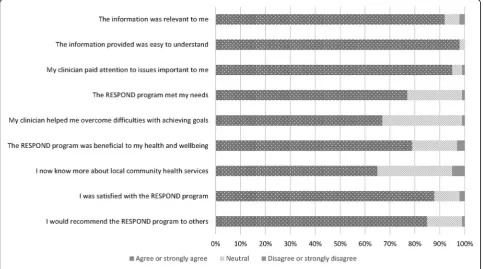
Over half of the participants who received the inter-vention (n = 124, 55%) completed the post-interven-tion questionnaire. The majority of respondents perceived the program to be acceptable and were sat-isfied with the program (87%) (Fig. 3). Half (51%) were satisfied with the mode of delivery (one face-to-face home visit with subsequent telephone calls) with 23% preferring to only talk over the phone, and 11% preferring to only have face-to-face meetings with their RESPOND clinician. A further 9% preferred other modes of communication, such as email, and the remaining 6% left this question blank. Mixed opinions regarding mode of delivery were also evident in the focus groups, however, the majority were happy with the RESPOND format:
“I think one visit’s enough…I loved the phone calls much better.”(Female participant, aged 60).
[image:11.595.57.541.449.718.2]The clinicians found the telephone calls to be flexible and convenient:
“Some of them would say‘here’s my mobile number, call me on my mobile, I’ll be out and about but I’ll answer it’…so it was very convenient for them.”(Clinician 1). However, the clinicians also valued the face-to-face ses-sion in terms of rapport building:
“I feel like when you’ve spent more time with them in the house they’re more likely to relax and chat to you longer on the phone at the subsequent follow-ups be-cause you’ve got a little rapport.”(Clinician 7). A similar sentiment was expressed by the participants:
“I like the phone calls, but it was also nice to have the initial face-to-face and meet the person, that’s just a nice way to communicate with somebody.”(Female participant, aged 62).
Of the participants who preferred the home visits over the phone calls, social interaction was commonly stated as the main reason:
“I personally like the visits…but that’s probably because I am on my own so much.”(Male participant, aged 74).
The total number of telephone calls was considered ac-ceptable, with 89% of participant questionnaire respon-dents stating that they had just the right amount of calls and 85% felt the program length of 6 months was just right.
Discussion
This is the first comprehensive process evaluation to be performed in parallel with an RCT of a falls prevention program that significantly reduced the rate of falls and fractures for older people who have presented to an ED with a fall. Our evaluation showed that RESPOND was effective at a substantially lower dose than intended, and the program content and style was acceptable to partici-pants and clinicians. This evaluation suggests that the critical success factors are: i) the delivery style - delivering positively framed health messages in a person-centred manner, using motivational interviewing techniques; ii) the program content - the provision of consistent support, targeted education, and coordination of community ser-vices; and iii) timely intervention - the first session being conducted within 1 month of ED discharge.
An important aspect of person-centred care is partici-patory or shared decision-making. This involves people
making informed decisions based on facts as well as their personal values and preferences [37]. The RE-SPOND clinicians delivered the program in a person-centred manner, as evidenced by the overall RPAD scores. Importantly, this style of program delivery was preferred by RESPOND participants and clinicians.
In addition to participatory decision-making, motiv-ational interviewing is a well-established method for accomplishing person-centred care [38]. However, motiv-ational interviewing has only been used to a limited extent with older adults [27]. The current evaluation demon-strated that over 70% of analysed audio-recordings of RE-SPOND intervention sessions had evidence of the clinicians using all four key motivational interviewing
‘OARS’ skills; this may have contributed to the positive RCT results. Similarly, a recent study found that provision of motivational interviewing was associated with older adults’adherence to a falls prevention exercise program at 1 year [39].
RESPOND education and the accompanying module pamphlets emphasised maximising independence and functional capabilities to allow people to“Be Your Best”, rather than focusing on reducing falls and the associated negative connotations [40]. This was well received by the RESPOND participants, and the clinicians found the positively-framed messages facilitated their delivery of the program. This finding is consistent with the litera-ture. A meta-analysis found that ‘gain-framed’ messages appear to be more effective than ‘loss-framed’ messages in promoting prevention behaviours [41]. This is sup-ported by a recent study that concluded that older adults prefer falls prevention information to be delivered in a positive tone [42]. In contrast, Haines et al. (2014) sug-gested that explicitly discussing falls and falls risks is re-quired to overcome the “better for others than me” attitude to falls prevention activities [43]. However, only 36% of their study participants had experienced a fall in the last 12 months, compared with 100% of RESPOND participants, which may account for differences in the perceived relevance and benefit of engaging in falls pre-vention activities.
facilitated the delivery of the program, and motivated the participants. This support for the participants for the first 6 months following an ED presentation for a fall ap-pears to address a clear gap in existing falls prevention services. This may be especially pertinent for those living alone or socially isolated. Prior studies highlight the im-portance of social support for maintaining health and function for older adults [46–48].
The RESPOND intervention was not as timely as planned (the initial home visit was intended to be con-ducted within 2 weeks of ED discharge). However, des-pite not achieving trial protocol, most participants were seen within 1 month of ED discharge. Delivery of the intervention within 1 month of the index fall appears to differentiate successful programs from others [7]. A Dutch RCT cited the time lag for intervention as a rea-son for the ineffectiveness of the program, with medical and occupational therapy assessments taking place five and 10 weeks after baseline, respectively [17]. In con-trast, a successful UK trial delivered services within 1 month of ED discharge [16]. The main reasons identified for the delay in delivering the initial RESPOND interven-tion session were the participants’ complex health and social issues acting as competing priorities. These factors should be considered when planning appropriate timing of intervention sessions.
RESPOND was effective at reducing falls and fractures at a lower dose than anticipated (median of 3 h, com-pared with the planned 10 h), thereby requiring fewer re-sources. The concept of‘quality over quantity’was cited as a reason for brief intervention sessions. Despite the relatively short contact duration, the median number of intervention sessions was seven per participant, exceed-ing the minimum of three contacts stated in the proto-col. This suggests that frequency may be more beneficial than duration of intervention contacts. This was sup-ported by the clinicians’ perceptions that regular clin-ician contact maintained participant progress towards goals. However, the delivery of a substantially lower dose of intervention than planned may be a reason for the lack of impact on falls injuries or hospitalisations. Fur-ther information is required to better understand the program dose or other factors required to support re-duction in fall injuries and hospitalisation outcomes.
Refining the clinician training program is recom-mended. RPAD item scores indicated a need for further training related to consistently asking the par-ticipant if they have any questions. Interview data showed that clinicians were more confident delivering aspects of RESPOND that they had prior knowledge or experience with. This suggests that RESPOND clinician training and resources may need to be tai-lored to account for individual expertise and profes-sional backgrounds.
A further suggestion for future implementation is to allow increased flexibility with the mode of program de-livery. The home visits were valued by clinicians and participants, particularly those who live alone or are so-cially isolated, and some participants may benefit from additional face-to-face sessions. Similarly, addition of al-ternative methods of communication, such as email or text messaging, may improve engagement for some.
This evaluation has a number of methodological strengths. The use of a mixed methods approach, with pre-specified data collected alongside the multi-centre RCT, allows for a rich understanding of the RESPOND trial results to be generated. Our evaluation of program fidelity through analysis of audio-recordings reduced the risk of bias associated with clinician- or participant-reported data alone.
We also acknowledge the study limitations. While pro-gram acceptability was high among participants who returned the participant questionnaire, the opinions of those who exited the intervention prior to 6 months or chose not to complete the questionnaire could not be captured. Similarly, those who chose to attend the focus groups are unlikely to be representative of those who de-clined to participate, or exited the study prior to comple-tion. However, this was somewhat mitigated through the additional data related to barriers and facilitators re-corded following each intervention session. A further limitation is that despite participant adherence being high, as per our definition, we do not have data related to whether participants acted on recommendations made by their clinicians, and whether their goals were met. A separate paper will augment this study by report-ing: i) participation in falls prevention strategies, com-paring the RESPOND RCT intervention and control groups; and 2) sub-group analyses of intervention partic-ipants to determine who RESPOND is most effective for, as described in the RESPOND program evaluation protocol [24].
Conclusions
Abbreviations
COM-B:Capability, opportunity, motivation–behaviour (behaviour change framework); ED: Emergency department; FROP-Com: Falls Risk for Older People–Community setting (falls risk assessment tool); GP: General practitioner; IQR: Interquartile range; MI: Motivational interviewing; OARS: Open-ended questions, affirmations, reflections, summaries (motivational interviewing skills); RCT: Randomised controlled trial; RPAD: Rochester Participatory Decision-Making Scale
Acknowledgements
This study would not have been possible without the contributions of the RESPOND investigator team responsible for the development and
implementation of the RESPOND RCT. RESPOND team members who are not co-authors in this paper, and their affiliations, are listed below: Professor An-drew Forbes, Department of Epidemiology and Preventive Medicine, Monash University, Melbourne, Victoria, Australia; Professor Terry Haines, School of Pri-mary and Allied Health Care, Monash University, Frankston, Victoria, Australia; Dr. Nicholas Waldron, Health Networks Branch, System Policy and Planning, Department of Health, Government of Western Australia, Perth Australia; De-partment of Rehabilitation and Aged Care, Armadale Health, Perth, Western Australia, Australia. In addition, we thank representatives from our funding partner organisations who have contributed to development and implemen-tation of the RESPOND project. The partner organisations are: (1) Health Strategy and Networks Branch, Strategic System Policy and Planning, Depart-ment of Health, Western Australia, Australia. (2) Aged and Continuing Care Directorate, Department of Health, Western Australia, Australia. (3) Royal Perth Hospital. (4) Curtin University. (5) The University of Western Australia. (6) The Royal Perth Hospital Medical Research Foundation. (7) Sir Charles Gairdner Hospital (SCGH) Area Rehabilitation and Aged Care Falls Specialist Program. (8) Injury Control Council of Western Australia (ICCWA). (9) The George Insti-tute for Global Health. (10) The Alfred Hospital. (11) Monash University. (12) Integrated Care, Victorian Department of Health. We wish to thank Elissa Bur-ton, Senior Research Fellow, School of Physiotherapy and Exercise Science, Faculty of Health Sciences, Curtin University, for assisting with the focus groups in Western Australia, including recording of field notes.
Authors’contributions
Concept and design: RLM, KDH, DA, GA, CB, PC, CEB, LF, AMH, PH, JAL, SRN, RM, JR, DS, ALB; data collection and analysis: RLM, KDH, INA, DA, CB, SRN, RM, ALB; manuscript writing: RLM, KDH, INA, DA, CB, SRN, RM, ALB. All authors approved the final version of the manuscript to be published.
Funding
This project was funded under the Australian National Health and Medical Research Council’s Partnership Projects funding scheme (project number APP1056802) with financial and in-kind contributions from the partner orga-nizations listed below:
1. Health strategy and networks branch, strategic system policy and planning, Department of Health, WA
2. Aged and continuing care directorate, Department of Health, WA 3. Royal Perth Hospital*
4. Curtin University*
5. The University of Western Australia*
6. The Royal Perth Hospital Medical Research Foundation
7. Sir Charles Gairdner hospital (SCGH) area rehabilitation and aged care falls specialist program
8. Injury control Council of Western Australia (ICCWA) 9. The George Institute for Global Health*
10. The Alfred Hospital* 11. Monash University*
12. Integrated care, Victorian Department of Health
*Note, authors are employees or have affiliations with these partner organisations.
All partner organisations were consulted during the project design and implementation. The findings and conclusions of this manuscript are those of the authors and do not necessarily represent the official position of the partner organisations.
RLM was funded by a Research Training Program (RTP) scholarship. RM and DA’s salaries were supported by the project grant. ALB was funded by an NHMRC Career Development Fellowship (1067236). JR was funded by a Career Development and Future Leader Fellowship co-funded by the
National Health and Medical Research Council and the National Heart Foun-dation. JAL was funded by an Early Career Fellowship funded by the NHMRC (1052442). SRN was funded by a National Institute for Health Research Career Development Fellowship (CDF-2015-08-030).
The funding bodies did not have any role in the design of the study, collection, analysis, interpretation of data, or writing the manuscript.
Availability of data and materials
The datasets generated and/or analysed during the current study are available from the corresponding author on reasonable request.
Ethics approval and consent to participate
Ethical approval was obtained from Alfred Health (HREC 439/13) and Royal Perth Hospital (REG 13–128), Monash University Human Research Ethics Committee (HREC) (MUHREC CF13/3869–2013001975) and Curtin University HREC (HR 43/ 2014). Written informed consent was obtained from all study participants.
Consent for publication
Not applicable.
Competing interests
The authors declare that they have no competing interests.
Author details
1
School of Public Health and Preventive Medicine, Monash University, Melbourne, Australia.2Rehabilitation, Ageing and Independent Living (RAIL) Research Centre, Monash University, Melbourne, Australia.3School of Physiotherapy and Exercise Science, Curtin University, Perth, Australia. 4
University of Western Australia, Perth, Australia.5Harry Perkins Institute of Medical Research, Perth, Australia.6Melbourne EpiCentre, University of Melbourne and Melbourne Health, Melbourne, Australia.7Alfred Health, Melbourne, Australia.8Royal Perth Hospital, Perth, Australia.9Bolton Clarke Research Institute, Bolton Clarke, Melbourne, Australia.10Department of Psychology and Ageing & Dementia Research Centre, now at Department of Medical Science and Public Health, Bournemouth University, Dorset, UK. 11University of Sydney, Westmead Applied Research Centre, Faculty of Medicine and Health, the George Institute for Global Health, Sydney, Australia.
Received: 23 April 2019 Accepted: 4 October 2019
References
1. Samaras N, Chevalley T, Samaras D, Gold G. Older patients in the emergency department: a review. Ann Emerg Med. 2010;56(3):261–9. 2. Bloch F, Jegou D, Dhainaut J-F, Rigaud A-S, Coste J, Lundy J-E, Claessens
Y-E. Do ED staffs have a role to play in the prevention of repeat falls in elderly patients? Am J Emerg Med. 2009;27(3):303–7.
3. Salter A, Khan KM, Donaldson M, Davis J, Buchanan J, Abu-Laban RB, Cook WL, Lord SR, McKay HA. Community-dwelling seniors who present to the emergency department with a fall do not receive guideline care and their fall risk profile worsens significantly: a 6-month prospective study. Osteoporos Int. 2006;17(5):672–83.
4. Russell MA, Hill KD, Day LM, Blackberry I, Schwartz J, Giummarra MJ, Dorevitch M, Ibrahim JE, Dalton AC, Dharmage SC. A randomized controlled trial of a multifactorial falls prevention intervention for older fallers presenting to emergency departments. J Am Geriatr Soc. 2010;58(12):2265–74. 5. Close J, Ellis M, Hooper R, Glucksman E, Jackson S, Swift C. Prevention of
falls in the elderly trial (PROFET): a randomised controlled trial. Lancet. 1999; 353(9147):93–7.
6. Barker A, Cameron P, Flicker L, Arendts G, Brand C, Etherton-Beer C, Forbes A, Haines T, Hill A-M, Hunter P, et al. Evaluation of RESPOND, a patient-centred program to prevent falls in older people presenting to the emergency department with a fall: A randomised controlled trial. PLoS Med. 2019;16(5):e1002807.
8. Moore GF, Audrey S, Barker M, Bond L, Bonell C, Hardeman W, Moore L, O’Cathain A, Tinati T, Wight D. Process evaluation of complex interventions: Medical Research Council guidance. BMJ. 2015;350:h1258.
9. Oakley A, Strange V, Bonell C, Allen E, Stephenson J. Process evaluation in randomised controlled trials of complex interventions. BMJ. 2006; 332(7538):413–6.
10. Craig P, Dieppe P, Macintyre S, Michie S, Nazareth I, Petticrew M. Developing and evaluating complex interventions: the new Medical Research Council guidance. BMJ. 2008;337:a1655.
11. Harper KJ, Barton AD, Arendts G, Edwards DG, Petta AC, Celenza A. Controlled clinical trial exploring the impact of a brief intervention for prevention of falls in an emergency department. Emergency Medicine Australasia. 2017; 29(5):524–30.
12. Matchar DB, Duncan PW, Lien CT, Ong ME, Lee M, Gao F, Sim R, Eom K. Randomized controlled trial of screening, risk modification, and physical therapy to prevent falls among the elderly recently discharged from the emergency department to the community: the steps to avoid falls in the elderly study. Archives of physical medicine and rehabilitation. 2017;1:98(6):1086–96. 13. Lightbody E, Watkins C, Leathley M, Sharma A, Lye M. Evaluation of a
nurse-led falls prevention programme versus usual care: a randomized controlnurse-led trial. Age Ageing. 2002;31(3):203–10.
14. Shaw FE, Bond J, Richardson DA, Dawson P, Steen IN, McKeith IG, Kenny RA. Multifactorial intervention after a fall in older people with cognitive impairment and dementia presenting to the accident and emergency department: randomised controlled trial. BMJ. 2003;326(7380):73. 15. Whitehead C, Wundke R, Crotty M, Finucane P. Evidence-based clinical
practice in falls prevention: a randomised controlled trial of a falls prevention service. Aust Health Rev. 2003;26(3):88–97.
16. Davison J, Bond J, Dawson P, Steen IN, Kenny RA. Patients with recurrent falls attending Accident & Emergency benefit from multifactorial intervention—a randomised controlled trial. Age Ageing. 2005;34(2):162–8. 17. Hendriks MR, Bleijlevens MH, Van Haastregt JC, Crebolder HF, Diederiks JP, Evers SM, Mulder WJ, Kempen GI, Van Rossum E, Ruijgrok JM. Lack of effectiveness of a multidisciplinary fall-prevention program in elderly people at risk: a randomized, controlled trial. J Am Geriatr Soc. 2008; 56(8):1390–7.
18. Vind AB, Andersen HE, Pedersen KD, Jørgensen T, Schwarz P. An outpatient multifactorial falls prevention intervention does not reduce falls in high-risk elderly Danes. J Am Geriatr Soc. 2009;57(6):971–7.
19. Chu MML, Fong KNK, Lit ACH, Rainer TH, Cheng SWC, Au FLY, Fung HKK, Wong CM, Tong HK. An occupational therapy fall reduction home visit program for community-dwelling older adults in Hong Kong after an emergency department visit for a fall. J Am Geriatr Soc. 2017;65(2):364–72. 20. Bleijlevens MH, Hendriks MR, van Haastregt JC, van Rossum E, Kempen GI,
Diederiks JP, Crebolder HF, van Eijk JT. Process factors explaining the ineffectiveness of a multidisciplinary fall prevention programme: a process evaluation. BMC Public Health. 2008;8(1):332.
21. Creswell JW, Clark VLP. Designing and conducting mixed methods research: Wiley online library; 2007.
22. Hasson H. Systematic evaluation of implementation fidelity of complex interventions in health and social care. Implement Sci. 2010;5(1):67. 23. Tombaugh TN, McIntyre NJ. The mini-mental state examination: a
comprehensive review. J Am Geriatr Soc. 1992;40(9):922–35.
24. Morris R, Brand C, Hill KD, Ayton D, Redfern J, Nyman S, Lowthian J, Hill A, Etherton-Beer C, Flicker L, et al. RESPOND: a patient-centred programme to prevent secondary falls in older people presenting to the emergency department with a fall—protocol for a mixed methods programme evaluation. Inj Prev. 2016;22(2):153–60.
25. Russell MA, Hill KD, Day LM, Blackberry I, Gurrin LC, Dharmage SC. Development of the falls risk for older people in the community (FROP-com) screening tool. Age Ageing. 2009;38(1):40–6.
26. Russell MA, Hill KD, Blackberry I, Day LM, Dharmage SC. The reliability and predictive accuracy of the falls risk for older people in the community assessment (FROP-com) tool. Age Ageing. 2008;37(6):634–9.
27. Purath J, Keck A, Fitzgerald CE. Motivational interviewing for older adults in primary care: a systematic review. Geriatr Nurs. 2014;35(3):219–24. 28. Yarber L, Brownson CA, Jacob RR, Baker EA, Jones E, Baumann C,
Deshpande AD, Gillespie KN, Scharff DP, Brownson RC. Evaluating a train-the-trainer approach for improving capacity for evidence-based decision making in public health. BMC Health Serv Res. 2015;15(1):547.
29. Rosengren DB. Building motivational interviewing skills: a practitioner workbook: Guilford publications; 2017.
30. Shields CG, Franks P, Fiscella K, Meldrum S, Epstein RM. Rochester participatory decision-making scale (RPAD): reliability and validity. Ann Fam Med. 2005;3(5):436–42.
31. StataCorp. Stata Statistical Software: Release 14. College Station: StataCorp LP; 2015.
32. Braun V, Clarke V. Using thematic analysis in psychology. Qual Res Psychol. 2006;3(2):77–101.
33. QSR International Pty Ltd. NVivo qualitative data analysis Software. 11th ed: QSR International Pty Ltd; 2015.
34. Michie S, Van Stralen MM, West R. The behaviour change wheel: a new method for characterising and designing behaviour change interventions. Implement Sci. 2011;6(1):42.
35. Fetters MD, Curry LA, Creswell JW. Achieving Integration in Mixed Methods Designs—Principles and Practices. Health Serv Res. 2013;48(6pt2):2134–56. 36. Australian Bureau of Statistics (ABS). In: ABS, editor. Technical Paper:
Socio-Economic Indexes for Areas (SEIFA) 2016, vol. 2033.0.55.001. Australia: Commonwealth of Australia; 2018.
37. Elmore JG, Kramer BS. Breast cancer screening: toward informed decisions. JAMA. 2014;311(13):1298–9.
38. Elwyn G, Dehlendorf C, Epstein RM, Marrin K, White J, Frosch DL. Shared decision making and motivational interviewing: achieving patient-centered care across the spectrum of health care problems. Ann Fam Med. 2014; 12(3):270–5.
39. Arkkukangas M, Söderlund A, Eriksson S, Johansson A-C. One-year adherence to the Otago exercise program with or without motivational interviewing in community-dwelling older adults. J Aging Phys Act. 2018; 26(3):390–5.
40. Yardley L, Donovan-Hall M, Francis K, Todd C. Attitudes and beliefs that predict older people's intention to undertake strength and balance training. J Gerontol Ser B Psychol Sci Soc Sci. 2007;62(2):P119–25.
41. Gallagher KM, Updegraff JA. Health message framing effects on attitudes, intentions, and behavior: a meta-analytic review. Annals of behavioral medicine. 2011;43(1):101–16.
42. Khong L, Bulsara C, Hill KD, Hill A-M. How older adults would like falls prevention information delivered: fresh insights from a world Café forum. Ageing Soc. 2017;37(6):1179–96.
43. Haines TP, Day L, Hill KD, Clemson L, Finch C.“Better for others than for me”: a belief that should shape our effeorts to promote participation in falls prevention strategies. Arch Gerontol Geriatr. 2014;59(1):136–44.
44. Hill A-M, McPhail SM, Waldron N, Etherton-Beer C, Ingram K, Flicker L, Bulsara M, Haines TP. Fall rates in hospital rehabilitation units after individualised patient and staff education programmes: a pragmatic, stepped-wedge, cluster-randomised controlled trial. Lancet. 2015;385(9987): 2592–9.
45. Nyman SR, Yardley L. Web-site-based tailored advice to promote strength and balance training: an experimental evaluation. J Aging Phys Act. 2009; 17(2):210–22.
46. Fealy GM, Treacy M, Drennan J, Naughton C, Butler M, Lyons I. A profile of older emergency department attendees: findings from an Irish study. J Adv Nurs. 2012;68(5):1003–13.
47. Muramatsu N, Yin H, Hedeker D. Functional declines, social support, and mental health in the elderly: does living in a state supportive of home and community-based services make a difference? Soc Sci Med. 2010;70(7): 1050–8.
48. Saito E, Sagawa Y, Kanagawa K. Social support as a predictor of health status among older adults living alone in Japan. Nurs Health Sci. 2005; 7(1):29–36.
Publisher’s Note