S T U D Y P R O T O C O L
Open Access
The effects of a regional telepathology project:
a study protocol
Marie-Claude Trudel
1*, Guy Paré
2, Bernard Têtu
3and Claude Sicotte
4Abstract
Background:Telepathology, which is an emerging form of telemedicine in Canada, is defined as the electronic transmission of pathological images, usually derived from microscopes, from one location to another. There are various applications of telepathology, including case referral for an expert opinion, provision of an emergency service in the absence of a resident pathologist, and education. Until now, there has been relatively little use of telepathology for core diagnostic services in the absence of a local pathologist, but this practice is likely to increase in the future. The Laval University Integrated Health Network is in the process of deploying a telepathology system, primarily to provide an intraoperative frozen section service to small hospitals in sparsely populated areas which are experiencing a severe shortage of on-site pathologists. The telepathology project involves 17 hospitals located in five regions of eastern Quebec, Canada. This paper describes the study protocol that will be used to evaluate the benefits associated with the project.
Methods/Design:A panel of experts was first assembled by Canada Health Infoway to agree on a set of benefits indicators that could be applied to all telepathology projects across Canada. Using the set of indicators as an input, we have developed a three-step study protocol. First, a survey questionnaire will be distributed to appraise the way pathologists, pathology technologists and surgeons perceive the telepathology system and its impacts. Second, a series of semi-structured interviews will be conducted with project leaders and telepathology users at sites that are representative of all the hospitals in the Laval University Integrated Health Network. The overall aim is to better understand the expected and unexpected effects of telepathology on health care professionals and patients as well as on the regional organization and delivery of care services. Finally, a pre-post design using secondary data is proposed to evaluate a wide array of tangible benefits to the patients, the health care providers, the hospitals, and the region as a whole.
Discussion:The Laval University Integrated Health Network’s telepathology project is expected to yield positive and significant results that are relevant internationally. Our findings will provide valuable information on the nature and extent of benefits associated with telepathology systems intended to provide an intraoperative frozen section service to remote hospitals experiencing a shortage of specialists.
Background
Pathology is a scientific field concerned with the study of the nature and causes of diseases. Anatomic pathol-ogy, which is at the heart of this paper, is a medical spe-cialty concerned with the diagnosis of diseases based on the gross, microscopic, chemical, immunologic, and molecular examination of organs, tissues, and whole bodies (autopsies). Because pathology examinations serve as the basis for a large percentage of decisions
about diagnosis, treatment, hospital admission, and dis-charge, their annual number have increased in recent years in step with health care demand and, ultimately, with population growth and demographic aging. While an increase in the supply of pathologists would appear to be essential to maintaining patient care, the number of pathologists has declined in many developed coun-tries over the last decade. This has been the case in Japan [1,2], Australia [3], the UK and New Zealand [4], as well as Canada [5], to name a few. In the province of Quebec - the site of our study - the supply of patholo-gists fell 10% from 1998 to 2008 [5]. Moreover,
* Correspondence: [email protected]
1HEC Montréal, 3000, Côte-Ste-Catherine Road, Montréal, Canada, H3T 2A7
Full list of author information is available at the end of the article
pathology is known to be unpopular among medical stu-dents [6], making it even more difficult to reverse this trend.
A shortage of pathologists has several consequences. The most direct is a longer turn-around time before a diagnosis can be made on a specimen [7]. Knowing that in the case of cancer - an area where pathology diag-noses are crucial - prompt diagnosis/treatment is parti-cularly important, the repercussions of this labor shortage can be dramatic. The shortage also influences workload and quality assurance. When there are fewer people to do a job, workers become overloaded and it is difficult to guarantee good quality [6,8]. Finally, because of the shortage many pathologists are compelled to work past retirement age, and this may add to the over-all quality problem. Once purely theoretical, such conse-quences were confirmed in recent years when news accounts about errors in anatomic pathology testing began to make national headlines. In addition to this shortage, pathology is gaining in complexity and pathol-ogists working alone increasingly require support from colleagues. It is estimated that 10 to 20% of oncology cares require a second opinion [9].
One way to counteract the scarcity of pathologists and help them obtain a second opinion is to adopt tele-pathology, which is defined as the practice of pathology at a distance. Telepathology uses telecommunications technologies to facilitate the transfer of image-rich pathology data between distant locations for the pur-poses of diagnosis, education, and research [10]. Tele-pathology is performed in three modes: static, dynamic, and hybrid. When a pathologist is reviewing one or sev-eral preselected still images, he is working in static mode (also known as store-and-forward). In contrast, when a pathologist examines images while communicat-ing live with the remote site where the specimen is located, he is working in dynamic mode. Finally, when-ever a pathologist uses both methods to provide a diag-nosis, he is working in hybrid mode [11].
Microscopic static examinations work well when there is no ambiguity as to the images the laboratory technol-ogist should submit to the patholtechnol-ogist [12]. A micro-scopic dynamic examination involves the use of a robotized remote-controlled microscope by the patholo-gist to explore an entire slide surface, change the magni-fication level, or focus on and digitize a portion of interest. The glass slide is usually prepared by a well-trained laboratory technologist who must also position it within the microscope [13]. A macroscopic (or gross) dynamic examination is performed when the pathologist can first look at the whole specimen (e.g., tumour, organ, etc.) and talk to the technologist to orient the cuts. The histological section is then fixed on a glass slide and completely digitized by a slide scanner to
provide a virtual slide of outstanding quality that can be remotely accessed and examined [14]. Virtual slides, as they are called, therefore constitute a newer form of microscopic static examination.
Once installed, a telepathology system can be used for distant primary diagnoses, expert referrals, quality assur-ance, and education [12]. For distant diagnoses in the absence of a local pathologist or a telepathology system, slides must be physically sent to another facility, hence delaying the diagnoses. With telepathology, the slides are examined remotely, either statically or dynamically, and diagnoses are swiftly provided. In some particular instances, however, pathology examinations are per-formed while the patient is still under anaesthetics and undergoing surgery, and the surgeon needs a pathology diagnosis to properly resume his procedure. For these specific examinations, called intraoperative frozen sec-tions, delays are undesirable. When there is no local pathologist in a hospital and a surgical procedure requires an intraoperative frozen section examination, either the patient is transferred to another hospital, a visiting pathologist is called on site, or a procedure is performed in two steps (creating time for the slides to be sent and read elsewhere).
With telepathology, intraoperative frozen section ana-lyses can be performed whenever a pathologist is avail-able at a remote location. The procedure usually unfolds as follows: a laboratory technologist manipulates the specimen locally while it is filmed; a pathologist per-forms a gross examination of the specimen from another location examining the specimen and interact-ing with the technologist via a monitor and tells her where to cut; the technologist prepares one or more slides from the section then digitizes and stores them in a repository; and the pathologist accesses the images, performs his examination and provides his diagnosis directly to the surgeon by phone. The present study focuses specifically on this hybrid telepathology service: intraoperative frozen section examinations of virtual slides.
(Michigan) in 1996. This service has been used, among other things, to examine intraoperative frozen section cases at Iron Mountain, which has had no on-site pathologist since that time [16]. In Canada, pathologists from the University Health Network (UHN) started using telepathology to examine frozen sections in 2004. More precisely, pathologists located at the Toronto General Hospital cover for Toronto Western Hospital and its affiliated Neuroscience Center.
We conducted a scoping review [17] to identify the nature and extent of telepathology research evidence. First, we searched two databases (PubMed and ABI Inform) with the keyword “telepathology” to obtain a general sense of the existing research on this topic. We chose these databases because we felt that they were offering a good sample of knowledge dissemination within the medical field (PubMed) as well as the busi-ness field (ABI Inform). Our queries, performed on Sep-tember 9, 2011, resulted in 763 citations (730 found in PubMed, 25 found in ABI Inform and 8 found in both databases.) The titles and abstracts of these articles were skimmed and they appeared to be predominantly valida-tions of the diagnostic accuracy of telepathology sys-tems. At that point, we added the keyword “frozen section” to our search algorithm, as our study focuses on this type of examination. Our revised queries resulted in 72 citations (68 found in PubMed, three found in ABI Inform and one found in both databases). Four of these articles were excluded: three were not in English or French and one could not be found through our interlibrary system. Of the remaining 68 articles, 38 were concerned with diagnostic accuracy (19 of these articles also examined the time spent to arrive at these diagnoses), 10 were general papers introducing the topic/technology, nine were qualitative research on mat-ters such as organizational consequences, learning, and cooperation in setups where telepathology was used (seven of them were subsections of a single research project by a single author), four were technical papers related to specific systems/features, and two were descriptive case studies presenting projects without eval-uating them. Finally, only two articles were looking at the outcomes of telepathology, which is at the heart of our project. This literature dates back to 1991 when the first papers on the Norwegian installations were published.
According to Drummond et al. [18], evaluations must first be carried out on efficacy (can this theoretically work?), effectiveness (does this work in practice?), and availability (is this accessible to those who need it?) before an in-depth economic evaluation can be per-formed. The results of our scoping review confirm this evolution and suggest that the field is mature enough for more benefit assessments, economic or not. In this
line of thought, the primary objective of this study is to evaluate the benefits of a major regional telepathology project implemented in 17 health care organizations located in eastern Quebec, Canada. The main goal of the project is to allow remote analysis of intraoperative frozen sections, although the telepathology system in place can also be used for other purposes, including sec-ondary opinions and education sessions. As explained below, expected benefits encompass quality, access and productivity outcomes and will be measured at both the local and regional levels.
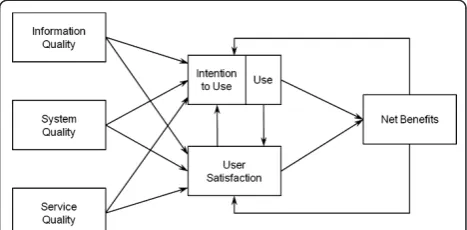
Our evaluative approach is based on DeLone and McLean’s information systems success model, illustrated in Figure 1. According to this framework, the individual benefits of an information system are derived from expressed satisfaction with the system and its use, which are in turn influenced by three factors: the perceived quality of the system, the perceived quality of the infor-mation contained in the system, and the perceived qual-ity of the technical and organizational support offered. Finally, the greater the benefits at the individual level, the more the positive effects associated with use of the new system will be felt at the organizational and regio-nal levels [19-21].
Methods/Design
Setting and project
[image:3.595.305.539.583.698.2]The province of Quebec counts 7.9 million inhabitants and its health system is public. The health system is divided into four regions, each under the responsibility of a different University Integrated Health Network (UIHN). The mandate of each UIHN is to coordinate tertiary health care services, teaching and research pro-vided by its faculty of medicine and its associated teach-ing hospitals so as to improve access to health care by streamlining relationships between primary care provi-ders - doctors and regional hospitals - and upper-level care providers for specialized procedures. Each UIHN is also responsible for coordinating technology evaluation and health intervention methods in order to improve
productivity and efficiency on its territory. In 2004, the Quebec Health Ministry asked each UIHN to submit a business case for a major regional telehealth project. The Laval University Integrated Health Network (here-inafter called the Laval UIHN) proposed a telepathology project, which is described next.
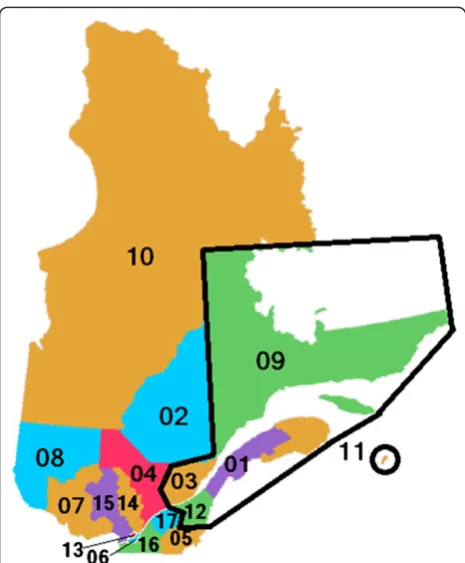
The telepathology project involves 17 hospitals located in 5 geographic regions of eastern Quebec, Canada [22]. The area covered by the project accounts for approxi-mately 19% of the province’s total population and the territory spans 378,037 km2 (approximately the size of Germany). Its population density is quite low. Figure 2 illustrates the province of Quebec and the area covered by the telepathology project, and Table 1 presents more information on the different regions.
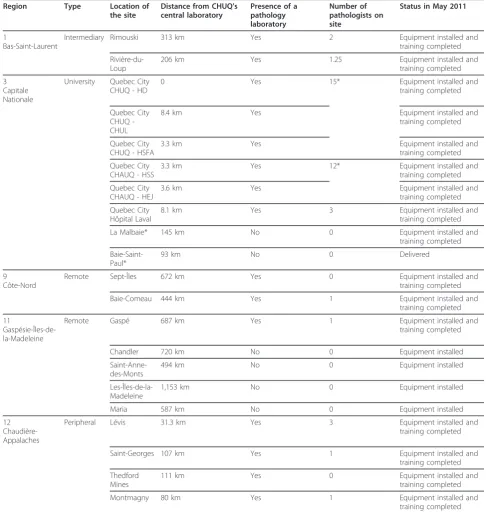
At the beginning of 2010, six of the 17 hospitals had no pathology laboratory and seven hospitals had a laboratory but were functioning with 0, 1 or 1.25 full-time equivalent pathologists (see Table 2). All 17 hospi-tals had surgeons who could execute procedures requir-ing intraoperative frozen section analyses. For these procedures to be performed where there was no on-site pathologist, four courses of actions were possible: (1) a visiting pathologist could be appointed, (2) the patient could be transferred to another hospital, (3) the opera-tion could be completed in two stages (the specimen
would be transported and analyzed elsewhere and the patient would be reopened if the diagnosis was positive), or (4) the surgery could be performed more aggressively (i.e. by removing more of the organ in order to“play it safe”).
In 2006, the Laval UIHN decided to invest in a large telepathology project to offer the population in periph-eral, intermediary and remote regions improved access and continuity with respect to specialized services. The CAN$6.2 million project is financed by the Quebec Health Ministry and Canada Health Infoway, an inde-pendent not-for-profit corporation that works as a stra-tegic investor of funds provided by the Canadian government. In May 2011, the status of the project was as follows: the equipment had been delivered, physically installed and configured, and biomedical technicians, laboratory technologists and pathologists had been trained at 14 of the 21 sites. The equipment had been delivered, physically installed and configured but train-ing had not been given at five other sites, mainly the ones that had to build a pathology laboratory before receiving the equipment. Finally, at the last site, the equipment had been delivered but further steps were delayed because the building posed a security risk, according to a recent seismic study. The equipment delivered to each site comprised a slide scanner (Nano-zoomer, Hamamatsu Photonics, Shizuoka Prefecture, Japan), a macroscopic imaging station (Pathstand 40, Diagnostic Instruments, Sterling Height, USA), visualiza-tion and communicavisualiza-tion software (mScope, Aurora Interactive Ltd., Montreal, Canada), computer stations, and storage servers.
As mentioned above, the main applications for tele-pathology are distant primary diagnosis, expert referrals, and education [12]. The Laval UIHN’s priority in this project is to have the telepathology system used for intraoperative examinations and, to a lesser extent, expert referrals, although utilization for other purposes (quality assessment, education, etc.) is not forbidden. Lastly, an important feature of the Laval UIHN project is the absence of a core laboratory to provide telepathol-ogy services to each facility involved. Instead, each hos-pital had to enter into a partnership agreement with one or more facilities of their choice and test their config-urations (hardware, software and telecommunication links.) Ultimately, each hospital should be linked to every other hospital, which would make a rotating 24-hour schedule feasible.
Research design
[image:4.595.57.290.419.701.2]This study uses a mixed method design that integrates case studies, survey questionnaires and a quantitative pre-post evaluation. As a first step, a panel of experts was assembled by the Benefits Realization and Quality Figure 2Regions Underserved by the Laval UIHN in Eastern
Table 1 Profile of the Regions Underserved by the Laval UIHN
Region 1 Region 3 Region 9 Region 11 Region 12
Bas-Saint-Laurent Capitale Nationale Côte-Nord Gaspésie-Îles-de-la-Madeleine Chaudière-Appalaches
Type Intermediary University Remote Remote Peripheral
Population 201,135 695,262 96,001 94,243 406,596
Area (km2) 22,405.07 19,285.71 300,281.83 20,937.69 15,128.14
Population density (per km2) 8.98 36.05 0.32 4.50 26.88
Table 2 Profile of the Sites Involved in the Laval UIHN’s Telepathology Project
Region Type Location of
the site
Distance from CHUQ’s central laboratory
Presence of a pathology laboratory
Number of pathologists on site
Status in May 2011
1
Bas-Saint-Laurent
Intermediary Rimouski 313 km Yes 2 Equipment installed and
training completed
Rivière-du-Loup
206 km Yes 1.25 Equipment installed and
training completed
3 Capitale Nationale
University Quebec City CHUQ - HD
0 Yes 15* Equipment installed and
training completed
Quebec City CHUQ -CHUL
8.4 km Yes Equipment installed and
training completed
Quebec City CHUQ - HSFA
3.3 km Yes Equipment installed and
training completed
Quebec City CHAUQ - HSS
3.3 km Yes 12* Equipment installed and
training completed
Quebec City CHAUQ - HEJ
3.6 km Yes Equipment installed and
training completed
Quebec City Hôpital Laval
8.1 km Yes 3 Equipment installed and
training completed
La Malbaie* 145 km No 0 Equipment installed and
training completed
Baie-Saint-Paul*
93 km No 0 Delivered
9 Côte-Nord
Remote Sept-Îles 672 km Yes 0 Equipment installed and
training completed
Baie-Comeau 444 km Yes 1 Equipment installed and
training completed
11
Gaspésie-Îles-de-la-Madeleine
Remote Gaspé 687 km Yes 1 Equipment installed and
training completed
Chandler 720 km No 0 Equipment installed
Saint-Anne-des-Monts
494 km No 0 Equipment installed
Les-Îles-de-la-Madeleine
1,153 km No 0 Equipment installed
Maria 587 km No 0 Equipment installed
12 Chaudière-Appalaches
Peripheral Lévis 31.3 km Yes 3 Equipment installed and
training completed
Saint-Georges 107 km Yes 1 Equipment installed and
training completed
Thedford Mines
111 km Yes 0 Equipment installed and
training completed
Montmagny 80 km Yes 1 Equipment installed and
training completed
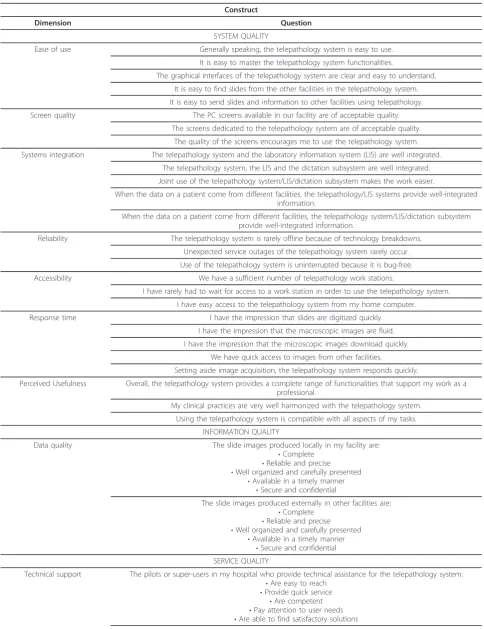
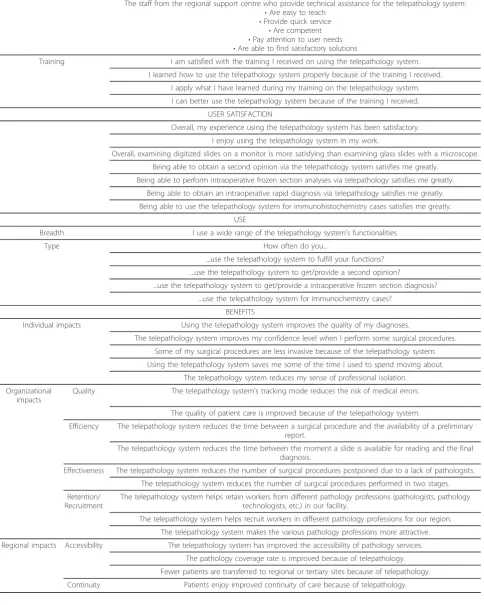
[image:5.595.54.541.215.728.2]Improvement department at Canada Health Infoway. This panel consisted of 26 people engaged in various telepathology projects across Canada. Panel members either were pathologists, laboratory technologists, or independent academic researchers. The goal of this panel was to agree on a set of indicators that could be applied to most Canadian telepathology projects. The panel met via teleconference once a month for 4 months in order to share opinions. As mentioned before, the theoretical framework driving the effort was DeLone and McLean’s information systems success model [19,21]. The final list of indicators, shown in Table 3, was approved in May 2011.
Our evaluation will be conducted in two separate phases. Phase 1 will focus on individual perceptions and will be divided into two parts. First, a survey question-naire has been developed to appraise how users perceive the telepathology system and its impacts. The question-naire was adapted from a recent digital medical imaging evaluation study that used the same framework as a conceptual foundation [23]. Questions were reformu-lated to reflect the different systems, work processes and settings and confirm the instrument’s validity. Three versions of the questionnaire instrument are now ready to be pre-tested with a small group of pathologists (ver-sion 1), pathology technologists (ver(ver-sion 2) and surgeons (version 3) who have been involved in telepathology projects elsewhere in Canada. Following the pre-test, a final version of each instrument will be prepared and gradually administered to all the pathologists (N = 48), pathology technologists (N = 60), and surgeons (N = 30) involved in the Laval UIHN project. Questionnaires will be distributed approximately 6 months after the “go live”at each site.
As a second step, a series of semi-structured inter-views will be conducted concurrently with both project leaders and telepathology users at sites representative of all types of establishments - remote, intermediary, and teaching hospitals. The overall goal is to better under-stand the effects of telepathology on health care profes-sionals, patients, and the overall organization and delivery of care services in different types of organiza-tions. The data collection process will continue until theoretical saturation [24] is reached; i.e. when addi-tional qualitative data no longer contributes anything new about the constructs in our conceptual framework and the relationships among them. Interview guides containing the specific issues to be discussed with the pathologists, pathology technologists, and surgeons were developed and will be used at each interview. Table 4 synthesizes the key constructs to be investigated with each group of respondents in Phase 1.
While Phase 1 is concerned with users’perceptions, Phase 2 will allow us to evaluate objective or factual
benefits to the hospitals (e.g., a decrease in the number of cancelled surgical procedures due to pathology-related issues), the patients (e.g., a decrease in the aver-age time between a medical diagnosis and a first surgical intervention) and the UIHN as a whole (e.g., a decrease in the number of patients transferred to a regional or tertiary hospital for surgery). To achieve this, pre-post analyses will be performed using data from different information systems - i.e. laboratory information sys-tems, operating room information syssys-tems, and telepathology visualization and communication systems -available at each hospital. More specifically, data from these systems will be obtained for two 6-month periods: post implementation data will be obtained for the six first months after system deployment, and pre imple-mentation data will be gathered for the corresponding 6 months of the previous year.
Given the exploratory nature of our study, it was decided to limit our sample to two specific procedures: sentinel lymph node analyses for breast cancer and sur-gical margin analyses for colorectal cancer. According to the Laval UIHN authorities, these procedures are among the most common ones requiring intraoperative frozen section diagnoses. In order to capture a broad range of effects, both anticipated and unanticipated, and to better understand the nature of the effects according to the context, our pre-post analysis will be conducted in three different settings. First, we will investigate a remote hos-pital where telepathology was deployed in order to avoid a break in services; the on-site pathologist left between the pre and post periods (thereby leaving the site with no pathologist). Our second setting is a remote hospital where pathology services were nonexistent. With the arrival of telepathology, a mini-laboratory was installed at this site, and a pathology technologist was trained so that medical interventions requiring pathology services could now be provided. Finally, we will investigate the effects of telepathology at a regional hospital where a number of pathologists left between the pre and post periods without being replaced, causing breaks in services.
Data analysis
Table 3 List of Indicators and Measures
Construct
Dimension Question
SYSTEM QUALITY
Ease of use Generally speaking, the telepathology system is easy to use.
It is easy to master the telepathology system functionalities.
The graphical interfaces of the telepathology system are clear and easy to understand.
It is easy to find slides from the other facilities in the telepathology system.
It is easy to send slides and information to other facilities using telepathology.
Screen quality The PC screens available in our facility are of acceptable quality.
The screens dedicated to the telepathology system are of acceptable quality.
The quality of the screens encourages me to use the telepathology system.
Systems integration The telepathology system and the laboratory information system (LIS) are well integrated.
The telepathology system, the LIS and the dictation subsystem are well integrated.
Joint use of the telepathology system/LIS/dictation subsystem makes the work easier.
When the data on a patient come from different facilities, the telepathology/LIS systems provide well-integrated information.
When the data on a patient come from different facilities, the telepathology system/LIS/dictation subsystem provide well-integrated information.
Reliability The telepathology system is rarely offline because of technology breakdowns.
Unexpected service outages of the telepathology system rarely occur.
Use of the telepathology system is uninterrupted because it is bug-free.
Accessibility We have a sufficient number of telepathology work stations.
I have rarely had to wait for access to a work station in order to use the telepathology system.
I have easy access to the telepathology system from my home computer.
Response time I have the impression that slides are digitized quickly.
I have the impression that the macroscopic images are fluid.
I have the impression that the microscopic images download quickly.
We have quick access to images from other facilities.
Setting aside image acquisition, the telepathology system responds quickly.
Perceived Usefulness Overall, the telepathology system provides a complete range of functionalities that support my work as a professional.
My clinical practices are very well harmonized with the telepathology system.
Using the telepathology system is compatible with all aspects of my tasks.
INFORMATION QUALITY
Data quality The slide images produced locally in my facility are:
•Complete •Reliable and precise •Well organized and carefully presented
•Available in a timely manner •Secure and confidential
The slide images produced externally in other facilities are: •Complete
•Reliable and precise •Well organized and carefully presented
•Available in a timely manner •Secure and confidential SERVICE QUALITY
Technical support The pilots or super-users in my hospital who provide technical assistance for the telepathology system: •Are easy to reach
Table 3 List of Indicators and Measures(Continued)
The staff from the regional support centre who provide technical assistance for the telepathology system: •Are easy to reach
•Provide quick service •Are competent •Pay attention to user needs •Are able to find satisfactory solutions
Training I am satisfied with the training I received on using the telepathology system.
I learned how to use the telepathology system properly because of the training I received.
I apply what I have learned during my training on the telepathology system.
I can better use the telepathology system because of the training I received.
USER SATISFACTION
Overall, my experience using the telepathology system has been satisfactory.
I enjoy using the telepathology system in my work.
Overall, examining digitized slides on a monitor is more satisfying than examining glass slides with a microscope.
Being able to obtain a second opinion via the telepathology system satisfies me greatly.
Being able to perform intraoperative frozen section analyses via telepathology satisfies me greatly.
Being able to obtain an intraoperative rapid diagnosis via telepathology satisfies me greatly.
Being able to use the telepathology system for immunohistochemistry cases satisfies me greatly.
USE
Breadth I use a wide range of the telepathology system’s functionalities.
Type How often do you...
...use the telepathology system to fulfill your functions?
...use the telepathology system to get/provide a second opinion?
...use the telepathology system to get/provide a intraoperative frozen section diagnosis?
...use the telepathology system for immunochemistry cases?
BENEFITS
Individual impacts Using the telepathology system improves the quality of my diagnoses.
The telepathology system improves my confidence level when I perform some surgical procedures.
Some of my surgical procedures are less invasive because of the telepathology system.
Using the telepathology system saves me some of the time I used to spend moving about.
The telepathology system reduces my sense of professional isolation.
Organizational impacts
Quality The telepathology system’s tracking mode reduces the risk of medical errors.
The quality of patient care is improved because of the telepathology system.
Efficiency The telepathology system reduces the time between a surgical procedure and the availability of a preliminary report.
The telepathology system reduces the time between the moment a slide is available for reading and the final diagnosis.
Effectiveness The telepathology system reduces the number of surgical procedures postponed due to a lack of pathologists.
The telepathology system reduces the number of surgical procedures performed in two stages.
Retention/ Recruitment
The telepathology system helps retain workers from different pathology professions (pathologists, pathology technologists, etc.) in our facility.
The telepathology system helps recruit workers in different pathology professions for our region.
The telepathology system makes the various pathology professions more attractive.
Regional impacts Accessibility The telepathology system has improved the accessibility of pathology services.
The pathology coverage rate is improved because of telepathology.
Fewer patients are transferred to regional or tertiary sites because of telepathology.
to demonstrate convergent validity, items that measure the same construct (i.e. a trait) should be highly corre-lated with one another [25]. Discriminant validity is concerned with the ability of a measurement item to dif-ferentiate between the concepts being measured. We will thus compare the square root of the variance shared by the constructs and their measures to the correlations between the constructs. Following this assessment of the measurement model, descriptive statistics will be com-puted and the associations presented in Figure 1 will be tested using linear stepwise regression analyses. Statisti-cal tests will also be performed to determine whether significant differences can be found by type of institu-tion (local, regional, university) and type of health care professional (pathologists, technologists, surgeons.) Given our small sample size, non-parametric tests such as Kruskal-Wallis and Mann-Whitney will be performed. The SPSS statistical package will be used to run these analyses at a 5% significance level.
As for the qualitative data, interview transcripts and observation notes will be analyzed using the NVivo soft-ware package. The constructs in our conceptual frame-work (Figure 1) will be critical to developing our coding
scheme and interpreting the qualitative material [26]. Open coding will also be performed so that any unfore-seen themes that might emerge from the data will also be captured [27]. It is worth mentioning that, in order to increase reliability, all interviews will be coded by two researchers.
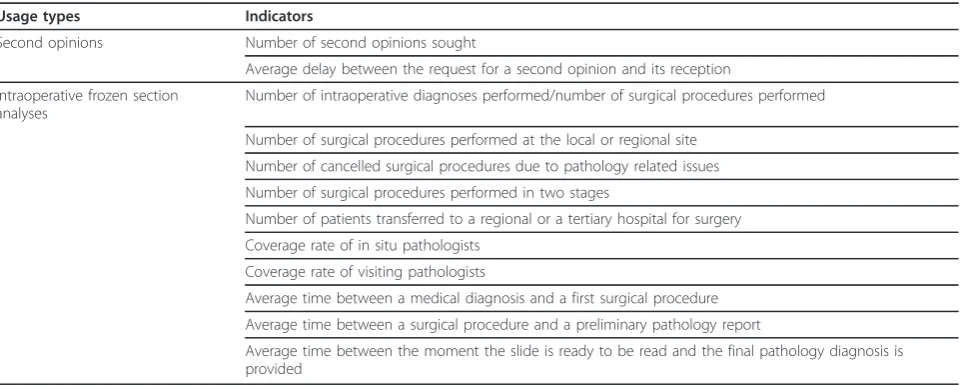
Lastly, a paired two-sample test of means (t-test) will be conducted to determine whether any differences found between pre and post measures are significant (based on the list of indicators in Table 5). Given that two common procedures were selected for the pre-post analyses, we expect our sample size to be large enough to allow the use of a parametric test.
Ethics considerations
This research project has been assessed with regard to the ethical conduct for research involving humans and meets the requirement of HEC Montréal’s Research Ethics Board. A notice has been issued to this effect on December 14, 2011.
Discussion
[image:9.595.56.292.99.207.2]In the last 30 years, the number of telemedicine applica-tions has multiplied due to advancements in telecom-munications. One of these applications, telepathology, has fostered considerable academic research since the mid-1980s. The extant literature has mainly followed the path described by Drummond et al. [18], and eva-luations have so far been carried out on reliability, effi-cacy, effectiveness, and availability [e.g., [12,28]]. For frozen section examinations, the accuracy of the techni-que has been demonstrated [e.g., [29,30]] as has its speed [e.g., [14,31]]. However, very few empirical studies have evaluated the benefits of telepathology at the patient, provider, organizational and regional levels. Table 4 Constructs and Categories of Respondents
Constructs Pathologists Technologists Surgeons
Information quality X
System quality X X
Service quality X X
Use X X
Intention to use X X
User satisfaction X X X
Net benefits X X X
Table 5 Key Indicators for the Pre-Post Analyses
Usage types Indicators
Second opinions Number of second opinions sought
Average delay between the request for a second opinion and its reception
Intraoperative frozen section analyses
Number of intraoperative diagnoses performed/number of surgical procedures performed
Number of surgical procedures performed at the local or regional site
Number of cancelled surgical procedures due to pathology related issues
Number of surgical procedures performed in two stages
Number of patients transferred to a regional or a tertiary hospital for surgery
Coverage rate of in situ pathologists
Coverage rate of visiting pathologists
Average time between a medical diagnosis and a first surgical procedure
Average time between a surgical procedure and a preliminary pathology report
[image:9.595.59.540.538.731.2]Using a mixed-method design that combines qualita-tive and quantitaqualita-tive data collection methods, the pre-sent study attempts to fill this gap. More specifically, our research will add to the extant body of knowledge by offering a thorough evaluation of a large telepathol-ogy project, assessing outcomes at multiple levels of analysis. To our knowledge, our study will be the first to examine a regional telepathology project by focusing on intraoperative frozen section analyses. Our study will also be the first to perform an exhaustive pre-post eva-luation using secondary data from operating room and other health information systems. By drawing a clearer picture of the benefits to be obtained by deploying a large regional telepathology project, our study should help decision makers and regional authorities redistri-bute regional workforces around optimal workflows that take advantage of telepathology. Ultimately, positive results should influence health policy decisions targeted at broader societal and environmental issues.
Notwithstanding these anticipated contributions, our study protocol has limitations and, hence, more research will be needed to further explore the implications of our work. For one thing, we must acknowledge the usual limitations on generalizability associated with collecting data through mail questionnaires as well as the cross-sectional nature of Phase 1. Significantly, even though we will be able to compare contrasting situations by investigating a wide variety of settings in Phase 2, the fact remains that this research is limited to the study of a single telepathology project and our results will be context-dependent. Indeed, the province of Quebec has its own specificities in terms of the healthcare system (public), density of population (medium to very low), physicians’ remuneration mode (fee-for-service) and pathologist shortage (moderately severe). Therefore, more evaluative studies will need to be conducted in other regions or countries to enhance the generalizabil-ity of our findings.
To our knowledge the ongoing telepathology project at the Laval UIHN is unique in Canada and is expected to yield significant results that are relevant both nation-ally and internationnation-ally. Results will provide valuable information to healthcare managers and decision makers who must find more effective and efficient ways to pro-vide accessible care services to patients and, more speci-fically, patients living in rural regions. A demonstration of both perceived and actual impacts will likely contri-bute to the promotion of telepathology at the individual (patient and provider), organizational and regional levels. We hope that the study protocol provided here will guide other researchers interested in evaluating such projects and contribute to the overall development of a solid knowledge base regarding the range of
benefits associated with telepathology in health care organizations.
Abbreviations
UHN: University health network; UIHN: University integrated health network.
Acknowledgements
This research is supported by Canada Health Infoway and the Canada Research Chairs Program.
Author details 1
HEC Montréal, 3000, Côte-Ste-Catherine Road, Montréal, Canada, H3T 2A7. 2Canada Research Chair in Information Technology in Health Care, HEC Montréal, Montréal, Canada.3Head of the Pathology Department, Centre Hospitalier Affilié Universitaire de Québec, Québec, Canada.4Faculty of Medicine, University of Montreal, Montréal, Canada.
Authors’contributions
MCT, GP and CS led the design of the study. MCT and GP developed the instruments and drafted the manuscript. BT and CS participated in the critical review of the manuscript. All authors gave final approvals on the version of the manuscript submitted for publication.
Competing interests
The authors declare that they have no competing interests.
Received: 18 October 2011 Accepted: 15 March 2012 Published: 15 March 2012
References
1. Sawai T, Uzuki M, Kamataki A, Tofukuji I:The state of telepathology in Japan.J Pathol Informat2010, 1-13.
2. Nakajima I:Forecast on the application of japanese universal service fund to remote diagnosis for frozen section.J Med Syst2010,
34(6):1023-1031.
3. Leong AS-Y, Leong JW-M:Strategies for laboratory cost containment and for pathologist shortage: centralised pathology laboratories with microwave-stimulated histoprocessing and telepathology.Pathology
2005,37(1):5-9.
4. Legge M:Extended role of medical laboratory scientists in diagnostic pathology.Dunedin, NZ: District Health Boards (NZ) Technical Workforce Strategy Group; 2008.
5. Pollett AF, Lajoie G, Colgan TJ:Canadian laboratory physician supply: falling behind.Can J Pathol2011,3(1):12-17.
6. Harrison P:Laboratory medicine needs higher profile with medical students, MDs, pathologists say.Can Med Assoc J1995,153(6):805-808. 7. Graves D:The impact of the pathology workforce crisis on acute health
care.Aust Heal Rev2007,31(Supp):28-30.
8. Ford JC:If not, why not? Reasons why Canadian postgraduate trainees chose -or did not choose - to become pathologists.Hum Pathol2010,
41:566-573.
9. Nakhleh RE, Bekeris LG, Souers RJ, Meier FA, Tworek JA:Surgical pathology case reviews before sign-out: a College of American Pathologists Q-Probes study of 45 laboratories.Arch Pathol Lab Med2010,134(5):740-743. 10. Kumar S:Telepathology: an audit.InTelepathology.Edited by: Kumar S,
Dunn BE. Berlin Heidelberg: Springer; 2009:225-229.
11. Williams S, Henricks WH, Becich MJ, Toscano M, Carter AB:Telepathology for patient care: what am I getting myself into?Adv Anat Pathol2010,
17(2):130-149.
12. Furness PN, Bamford WM:Review: telepathology.Curr Diagn Pathol2001,
7:281-291.
13. Mencarelli R, Marcolongo A, Gasparetto A:Organizational model for a telepathology system.Diagn Pathol2008,3(Supplement 1):S7.
15. Nordrum I, Engum B, Rinde E, Finseth A, Ericsson H, Kearney M, Stalsberg H, Eige TJ:Remote frozen section service: a telepathology project in northern Norway.Hum Pathol1991,22(6):514-518.
16. Agha Z, Weinstein RS, Dunn BE:Cost minimization analysis of telepathology.Am J Clin Pathol1999,112(4):470-478.
17. Grant MJ, Booth A:A typology of reviews: an analysis of 14 review types and associated methodologies.Heal Inf Libr J2009,26:91-108.
18. Drummond M, Sculpher M, Torrance G, O’Brien B, Stoddart G:Methods for the Economic Evaluation of Health Care Programmes.3 edition. Oxford: Oxford University Press; 2005.
19. DeLone WH, McLean ER:Information Systems Success Revisited. Proceedings of the Hawaii International Conference on Systems Science: 2002; Hawaii2002.
20. DeLone WH, McLean ER:Information systems success: the quest for the dependent variable.Inf Syst Res1992,3(1):60-95.
21. DeLone WH, McLean ER:The DeLone and McLean model of information systems success: a ten-year update.J Manag Inf Syst2003,19(4):9-30. 22. Têtu B:Le projet de télépathologie au RUIS de l’Université Laval.
Présentation slides, Symposium du réseau québécois de télésanté: September 24 2008; Québec, Canada2008.
23. Sicotte C, Paré G, Bini KK, Moreault M-P, Laverdure G:Virtual organization of hospital medical imaging: a user satisfaction survey.J Digit Imag2010,
23(6):689-700.
24. Glaser BG, Strauss AL:The Discovery of Grounded Theory: Strategies for Qualitative ResearchChicago: Aldine Publishing; 1967.
25. Kerlinger FN:Foundations of Behavioral Research.3 edition. Orlando: Holt, Rinehart and Winston, Inc; 1986.
26. Paré G:Investigating information systems with positivist case study research.Communications of the AIS2004,13:231-264.
27. Miles MB, Huberman AM:Qualitative Data Analysis.2 edition. Thousand Oaks, CA: Sage Publications; 1994.
28. Dunn BE, Choi H, Recla DL, Kerr SE, Wagenman BL:Robotic surgical telepathology between the Iron Mountain and Milwaukee Department of Veterans Affairs Medical Centers: a 12-year experience.Hum Pathol
2009,40:1092-1099.
29. Hutarew G, Dandachi N, Strasser F, Prokop E, Dietze O:Two-year evaluation of telepathology.J Telemed Telecare2003,9:194-199. 30. Liang W-Y, Hsu C-Y, Lai C-R, Ho DM-T, Chiang I-J:Low-cost telepathology
system for intraoperative frozen-section consultation: our experience and review of the literature.Hum Pathol2007,39:56-62.
31. Tsuchihashi Y, Takamatsu T, Hashimoto Y, Takashima T, KNakano K, Fujita S:
Use of virtual slide system for quick frozen intra-operative telepathology diagnosis in Kyoto, Japan.Diagn Pathol2008,3(Supplement 1):S6.
Pre-publication history
The pre-publication history for this paper can be accessed here: http://www.biomedcentral.com/1472-6963/12/64/prepub
doi:10.1186/1472-6963-12-64
Cite this article as:Trudelet al.:The effects of a regional telepathology project: a study protocol.BMC Health Services Research201212:64.
Submit your next manuscript to BioMed Central and take full advantage of:
• Convenient online submission
• Thorough peer review
• No space constraints or color figure charges
• Immediate publication on acceptance
• Inclusion in PubMed, CAS, Scopus and Google Scholar
• Research which is freely available for redistribution