R E S E A R C H A R T I C L E
Open Access
An implementation study of the crisis resolution
team model in Norway: Are the crisis resolution
teams fulfilling their role?
Nina Hasselberg
1*, Rolf W Gråwe
2, Sonia Johnson
3and Torleif Ruud
4Abstract
Background:The establishment of crisis resolution teams (CRTs) is part of the national mental health policy in several Western countries. The purpose of the present study is to describe characteristics of CRTs and their patients, explore the differences between CRTs, and examine whether the CRTs in Norway are organized according to the international CRT model.
Methods:The study was a naturalistic study of eight CRTs and 680 patients referred to these teams in Norway. Mental health problems were assessed using the Health of the Nation Outcome Scales (HoNOS), Global Assessment of Functioning Scales (GAF) and the International Statistical Classification of Diseases and Related Health Problems, 10th Revision (ICD-10).
Results:None of the CRTs operated 24 hours a day, seven days a week (24/7 availability) or had gate-keeping functions for acute wards. The CRTs also treated patients who were not considered for hospital admission. Forty per cent of patients waited more than 24 hours for treatment. Fourteen per cent had psychotic symptoms, and 69% had affective symptoms. There were significant variations between teams in patients’total severity of symptoms and social problems, but no variations between teams with respect to patients’ aggressive behaviour, non-accidental self-injury, substance abuse or psychotic symptoms. There was a tendency for teams operating extended hours to treat patients with more severe mental illnesses.
Conclusions:The CRT model has been implemented in Norway without a rapid response, gate-keeping function and 24/7 availability. These findings indicate that the CRTs do not completely fulfil their intended role in the mental health system.
Keywords:acute psychiatric services crisis resolution teams, mental health services, implementation study, patient characteristics
Background
The key characteristics of CRT model are separate multi-disciplinary mobile teams offering rapid short term emer-gency services in the community, as an alternative to inpatient admission [1]. CRTs are intended to operate 24 hours, 7 days per week with a gate keeping function to acute wards. The target group is patients with psychosis or other mental health problems so severe and acute that without the involvement of a CRT, acute admission would
usually be necessary [1-5]. Establishing CRTs is a part of the national mental health policy in several countries. In the UK, CRTs have been rapidly implemented across the country with 343 teams in place in 2006/07 [6], and in Norway 35 of the 75 community mental health centres (CMHCs) had established a CRT by 2008 [7]. Both CRTs and assertive outreach teams are intended to manage epi-sodes of acute mental illness without admitting the patient to hospital. Assertive outreach teams provide intensive long-term community-based support for frequently relap-sing and difficult-to-engage patients enrolled in their pro-gramme, while CRTs provide crisis resolution to anyone considered to be in the target group [8,9].
* Correspondence: [email protected]
1
R&D Department, Mental Health Services, Akershus University Hospital and Institute of Clinical Medicine, University Oslo, Norway
Full list of author information is available at the end of the article
A Cochrane review of randomized controlled studies on home care crisis treatment from the 1960s to the 1980s showed that such treatment could be effective [10], but this may not be representative of the recent model for CRTs. A later review found that CRTs were promising, but could not draw conclusions because of limited research [11]. In the last decade, only one rando-mized controlled trial of a CRT has been completed [12]. Johnson et al found a reduction in hospital admis-sions and a small increase in the satisfaction of patients receiving CRT care compared with standard care. Other uncontrolled recent studies also suggest that the intro-duction of CRTs was associated with a reintro-duction in admissions [9,13-16] and there is some evidence that service users are more satisfied with CRTs than with standard care [13,17-19].
Some recent studies have described characteristics of CRTs. Glover et al used routine data to analyse national changes following the implementation of the CRT model across the UK [9]. They found that teams operat-ing 24 hours a day, seven days a week (24/7 availability) were most likely to be associated with reduced admis-sions. Onyett et al examined how the CRT model has been implemented in the UK and identified 243 teams [20]. Almost all teams included nurses, the majority of teams included support workers, and just under half included psychiatrists. Other professions were not well represented. Sixty-eight per cent reported that they were gate-keepers to acute wards and 54% offered 24/7 availability.
Regarding patient characteristics of the CRTs, in the randomized controlled trial of Johnson et al, patients’ average age was 38 years, about half were men, half were living alone, half were from ethnic minorities, most were unemployed, and 37% had a psychotic disor-der [12]. In a non-randomized study by Johnson et al, patients’characteristics were similar except for some minor differences in the number of ethnic minorities, unemployment, and patients with psychotic diagnoses [13]. In a Norwegian study of one CRT, 27% had hallu-cinations or delusions [21]. In studies of home-care acute psychiatric treatment, based on data collected before the government proposed the establishment of nationwide CRTs in the UK [2], it was found that 53-62% of patients had psychotic disorders [22-25].
Several authors have pointed out that there is a gap between models based on what is known about effective treatment, and the implementation of effective routine clinical practice [26-28]. Tansella and Thornicroft [26] described three phases, including different barriers or facilitators at the national, local and individual levels, in understanding the translation of knowledge in the health science into routine clinical practice. The three phases are called adoption in principle, early implementation
and persistence of implementation. This is a study of how the transfer of knowledge from the CRT model has been implemented into routine clinical practice in Norway.
The aims of the present study were to a) describe the characteristics of Norwegian CRTs and their patients, b) examine if there are differences between the CRTs with reference to key team characteristics and patients’ men-tal health problems, c) examine if the teams cluster into particular groups with shared characteristics, and d) examine whether the CRTs in Norway are organized according to the international CRT model.
Methods
Study design
The study was a naturalistic study on eight CRTs and their patients in Norway, as part of the Multicentre Study on Acute Psychiatry (MAP) in Norway. The mul-ticentre study was planned and implemented by a national network for the evaluation of acute psychiatric services.
Setting
In 2005, the Norwegian health authorities decided to implement the CRT model in Norway, inspired by the implementation of CRTs in the UK. The implementa-tion of CRTs in Norway was proposed to increase acces-sibility to specialized mental health services for patients experiencing acute mental health crisis. The teams were to offer rapid assessment and 24/7 availability, and be an alternative treatment to acute admission.
Norway has 4.8 million inhabitants. There are large areas with low population density which implies longer distances to acute wards for the patients and longer dis-tances to patients’residences for the staff of the mental health services. The national mental health system for adults consists of three service levels: at the first level there are GPs and mental health teams in primary care settings run by the 430 municipalities. Some municipali-ties have residential or sheltered accommodation. At the second level, there are 75 CMHCs. The CMHCs com-prise different types of care units and teams. The outpa-tient teams comprise general outpaoutpa-tient teams, psychosis/rehabilitation/ambulatory teams, drug/alcohol teams and day/group teams. Some teams provide inpati-ent treatminpati-ent at the CMHCs [7]. Assertive outreach teams are in the early stages of implementation in Nor-way. At the third level, there are psychiatric hospital wards, including acute wards (21 beds per 100,000 inhabitants).
Sample
years or older, who had face-to-face consultations with the CRT, were included in the study. The inclusion per-iod was three months, but could be prolonged to include 60 patients from each team. The number of 60 patients was chosen to include a reasonable sample of patients from each team for comparative data analysis and to give a picture of the implementation process of the CRT model. The number of patients included by each team ranged from 46-147. There were no exclusion criteria.
All the CRTs in Norway at that time took part in the study, except one that had recently carried out a study of its own [21]. The CRTs were from all parts of the country. Two teams were in urban areas, and the other six were in smaller towns or more rural areas. None of the catchment areas of the CRTs can be characterized as highly deprived. One of the teams is situated within an area with a significant number of people from minor-ity ethnic groups (26%, compared to 2-16% for the other CRTs). The eight CRTs in this study covered 15.4% of the total population in Norway.
All patients were included. Written consent was not requested as the Regional Committee on Ethics in Medi-cal Research agreed that, for ethiMedi-cal reasons, it was important to include all patients in need of acute treat-ment, especially those with severe mental illness who probably would not have given written consent.
Registration form, instruments and data collection
A registration form was used to collect data from each treatment episode. The form was developed in the net-work doing the multicentre study, and the final version was based on experiences of earlier pilot drafts. The data on patients included socio-demographic and clini-cal data. Type and severity of psychiatric problems and level of functioning were assessed using the Interna-tional Statistical Classification of Diseases and Related Health Problems, 10threvision (ICD-10) for diagnoses [29], the Health of the Nation Outcome Scale (HoNOS) [30] and Global Assessment of Function Scales (GAF) [31-33]. The HoNOS has 12 items with a five-point scale (from 0-4) regarding severity of clinical and social problems. We used a split version of the GAF consisting of two scales ranging from 1-100 for symptom severity and functional impairment, respectively. Staff members who participated in the study received half a day of training in the use of the HoNOS, as provided in the UK, and all clinicians were trained in using the GAF as it was the routine measure required for all treatment episodes in the mental health services in Norway. Other studies with the same training of clinicians have repeat-edly shown acceptable inter-rater reliability (intra-class correlation coefficient of. 60-.89) for the HoNOS sub-scales, with the exception of scale 8 [34]. These
reliability data were from the approved Norwegian translation of HoNOS as used in this study. Scale 8 was therefore excluded from the analysis of single HoNOS scales. Studies have indicated moderately high internal consistency and low item redundancy of the HoNOS sum score, and therefore support the use of sum scores as a meaningful summary of severity of symptoms [35]. The Alcohol Use Scale (AUS) and the Drug Use Scale (DUS) were also used at admission [36,37] to rate the severity of alcohol and drug use, respectively. These are five-point scales ranging from “abstinence” (1) to
“abuse”(3) to“addiction with hospitalization” (5). A sui-cidal behaviour scale (suisui-cidal ideation, plans or attempts) administered at the time of referral was designed in collaboration with the National Centre for Prevention of Suicide [38]. ICD-10 diagnoses were made during the treatment.
Staff members from each team filled in the registration forms on the patients they were treating, and one team member coordinated the data collection for the team.
A questionnaire on how the CRT was organized and operated was completed by the leader of each team. This included information on catchment area, opening hours, number of team members and their profession, accessibility to beds, and availability of psychosis teams (early intervention teams and/or case management teams) or community mental health teams in the catch-ment area.
Approval from authorities and contributions from user groups
The study was approved by the Regional Ethical Com-mittee for Research in Health and by The Norwegian Data Inspectorate. The Directorate of Health and Social Affairs gave consent for the use of information from the health services.
Representatives of the user organizations Mental Health Norway and The National Association of Rela-tives in Mental Health participated in a reference group and in the workshops for planning and preparation of the study.
Data analysis
For HoNOS scales with missing data (5.5% across scales) the rating was set to 0. This was considered to be the most probable rating based on the skewed distribution, with most patients rated 0, and it was assumed that clinicians would forget to mark the rating when there was no indication of problems. In addition, this was chosen in favour of imputation because it was the most conservative way to measure the patients’ severity of mental health problems.
teams. In Norway, only physicians and psychologists are authorized to make ICD-10 diagnoses. The teams with the most missing values on the diagnosis variable oper-ated without a physicians/psychiatrist or psychologist as a part of the team and with nurses and social workers as the majority of staff. In these teams, diagnoses were made by physicians who were not a part of the team. These physicians took part in some consultations that focused on issues such as psycho pharmacological treat-ment, admissions to acute psychiatric ward, suicidal risk, violence risk or compulsory admission. In addition, the staff did use previous diagnoses made by physicians/psy-chologists in other mental health services.
For this reason, HoNOS scales were used instead of diagnosis in the analyses of type and severity of psychia-tric problems. There was no significant difference between patients with or without diagnosis on the sum scale of HoNOS score or GAF symptoms and function-ing score.
Continuous and some ordinal variables are reported with means and standard deviations and categorical and some ordinal variables are reported with frequencies and percentages. Independent sample t-tests, chi-squared tests, one-way analysis of variance (ANOVA), Mann-WhitneyUand Kruskal-Wallis tests were used to test for statistically significant differences. For skewed variables, both parametric and non-parametric tests were used and results did not differ. Multiple compari-sons with Bonferroni post hoc corrections were used to reduce the probability of type 1 errors. Thus, with an alpha level of 0.05, the individual error rate was reduced to 0.002 when using 25 items (0.05 divided by 25).
Hierarchical cluster analysis was used to identify homogeneous groups of CRTs based on key team char-acteristics. A dissimilarity matrix was calculated using squared Euclidean distance and clustering performed by Ward’s method. Comparison of identified clusters was made by chi-square,t-tests and Mann-Whitney Utests on key patient characteristics. Both SPSS and Clustan showed the same results.
SPSS software (version 15 for Windows; SPSS Inc., Chicago) was used for data analysis. A significance level of 0.05 was used.
Results
Characteristics of the CRTs
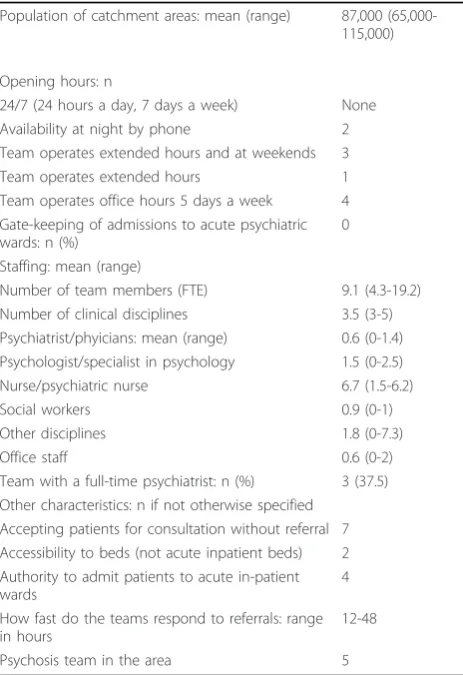
Table 1 shows some characteristics of the organization and policy of the eight CRTs in this study.
None of the teams had 24/7 availability or gate-keep-ing functions to acute inpatient wards, and they all trea-ted some who were not considered for hospital admission.
The number of team members varied substantially (range = 4-19 full time equivalent staff members, which
was 0.5-2.0 staff members per 10,000 inhabitants). Some of the CRTs had been established recently, while others had been in operation for longer periods of time (range = 0-6 years). The CRTs were led by different profes-sionals (psychiatrist, psychologist or psychiatric nurse). The CRTs used a team approach to patients, and two clinicians usually participated in each consultation.
The mean waiting time for admission to the CRTs was 1.6 days (SD = 10.4), and the median waiting time was one day. Approximately 40% of patients waited more than 24 hours. Patients with psychotic symptoms waited significantly less time than patients with other mental health problems.
Patient characteristics
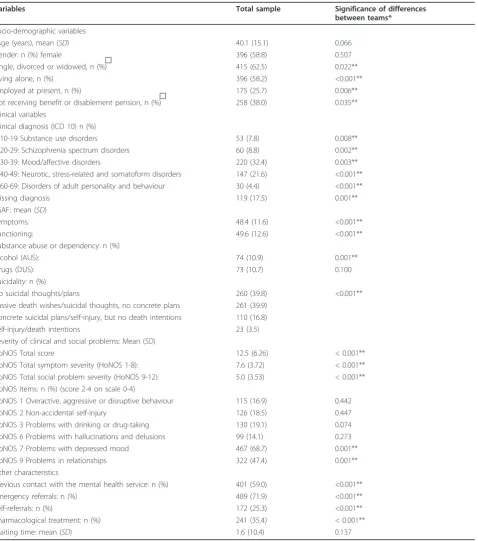
The socio-demographic and clinical characteristics of the 680 patients are presented in Table 2.
[image:4.595.305.537.99.437.2]Most patients were aged between 20 and 50 years, slightly more than half were women. Approximately half of the patients were unmarried and living alone, and one-quarter were in paid employment. Twenty-three patients (2%) were homeless. Twelve patients (1%) were not of Norwegian ethnicity, compared to 8% of the Table 1 Characteristics of CRTs (n = 8)
Population of catchment areas: mean (range) 87,000 (65,000-115,000)
Opening hours: n
24/7 (24 hours a day, 7 days a week) None Availability at night by phone 2 Team operates extended hours and at weekends 3 Team operates extended hours 1 Team operates office hours 5 days a week 4 Gate-keeping of admissions to acute psychiatric wards: n (%)
0
Staffing: mean (range)
Number of team members (FTE) 9.1 (4.3-19.2) Number of clinical disciplines 3.5 (3-5) Psychiatrist/phyicians: mean (range) 0.6 (0-1.4) Psychologist/specialist in psychology 1.5 (0-2.5) Nurse/psychiatric nurse 6.7 (1.5-6.2)
Social workers 0.9 (0-1)
Other disciplines 1.8 (0-7.3)
Office staff 0.6 (0-2)
Team with a full-time psychiatrist: n (%) 3 (37.5) Other characteristics: n if not otherwise specified
Accepting patients for consultation without referral 7 Accessibility to beds (not acute inpatient beds) 2 Authority to admit patients to acute in-patient wards
4
How fast do the teams respond to referrals: range in hours
12-48
general population of Norway. The majority of patients had primarily mood and anxiety disorders, and 14% had psychotic symptoms.
About 60% of the total sample had had previous con-tact with the mental health services. In the past 12
[image:5.595.63.542.98.640.2]months, 38% of patients had received treatment at an outpatient clinic, and 22% had been in an inpatient ward. Patients with previous contact with the mental health services had significantly more severe mental health problems on most clinical measures (HoNOS Table 2 Characteristics of patients (n = 680), and variations between CRTs (n = 8)
Variables Total sample Significance of differences
between teams*
Socio-demographic variables
Age (years), mean (SD) 40.1 (15.1) 0.066
Gender: n (%) female 396 (58.8) 0.507
Single, divorced or widowed, n (%)ͣ 415 (62.5) 0.022**
Living alone, n (%) 396 (58.2) <0.001**
Employed at present, n (%) 175 (25.7) 0.006**
Not receiving benefit or disablement pension, n (%)ͣ 258 (38.0) 0.035** Clinical variables
Clinical diagnosis (ICD 10) n (%)
F 10-19 Substance use disorders 53 (7.8) 0.008**
F 20-29: Schizophrenia spectrum disorders 60 (8.8) 0.002**
F 30-39: Mood/affective disorders 220 (32.4) 0.003**
F 40-49: Neurotic, stress-related and somatoform disorders 147 (21.6) <0.001** F 60-69: Disorders of adult personality and behaviour 30 (4.4) <0.001**
Missing diagnosis 119 (17.5) 0.001**
GAF: mean (SD)
Symptoms: 48.4 (11.6) <0.001**
Functioning: 49.6 (12.6) <0.001**
Substance abuse or dependency: n (%)
Alcohol (AUS): 74 (10.9) 0.001**
Drugs (DUS): 73 (10.7) 0.100
Suicidality: n (%)
No suicidal thoughts/plans 260 (39.8) <0.001**
Passive death wishes/suicidal thoughts, no concrete plans 261 (39.9) Concrete suicidal plans/self-injury, but no death intentions 110 (16.8)
Self-injury/death intentions 23 (3.5)
Severity of clinical and social problems: Mean (SD)
HoNOS Total score 12.5 (6.26) < 0.001**
HoNOS Total symptom severity (HoNOS 1-8): 7.6 (3.72) < 0.001** HoNOS Total social problem severity (HoNOS 9-12): 5.0 (3.53) < 0.001** HoNOS items: n (%) (score 2-4 on scale 0-4)
HoNOS 1 Overactive, aggressive or disruptive behaviour 115 (16.9) 0.442
HoNOS 2 Non-accidental self-injury 126 (18.5) 0.447
HoNOS 3 Problems with drinking or drug-taking 130 (19.1) 0.074 HoNOS 6 Problems with hallucinations and delusions 99 (14.1) 0.273
HoNOS 7 Problems with depressed mood 467 (68.7) 0.001**
HoNOS 9 Problems in relationships 322 (47.4) 0.001**
Other characteristics
Previous contact with the mental health service: n (%) 401 (59.0) <0.001**
Emergency referrals: n (%) 489 (71.9) <0.001**
Self-referrals: n (%) 172 (25.3) <0.001**
Pharmacological treatment: n (%) 241 (35.4) < 0.001**
Waiting time: mean (SD) 1.6 (10.4) 0.137
total score; 13.6/11.0, p<.001, GAF symptoms; 46.7/ 50.7, p <. 001, and GAF functioning; 47.5/52.1, p <. 001).
Three in four were emergency referrals and 25% had self-referred to the CRT. Patients with emergency refer-rals had significantly more severe mental health pro-blems on most clinical measures than those who were not referred as an emergency (HoNOS total score; 13.2/ 10.7,p<. 001, GAF symptoms; 47.2/51.2, p<. 001, and GAF functioning; 48.5/52.3, p<. 001). Those who self-referred did not differ significantly on any clinical mea-sures from those who were referred (HoNOS total score; 12.9/12.4,p= 0.42, GAF symptoms; 47.5/48.6,p = 0.28., and GAF functioning; 48.0/50.1,p= 0.05).
Variation between teams and their patients
Table 2 shows comparisons between the CRTs on patients’socio-demographic and clinical characteristics. After Bonferroni adjustment for multiple comparisons, there were no significant differences between the CRTs on socio-demographic variables, except whether patients were living alone, and whether patients were employed, with the two urban CRTs serving more unemployed patients. There were no significant differences between the CRTs on proportions of patients with overactive, aggressive or disruptive behaviour (HoNOS 1), non-acci-dental self-injury (HoNOS 2), problems with drinking or drug-taking (HoNOS 3), or problems with hallucinations and delusions (HoNOS 6). There were significant differ-ences between teams on most other clinical variables.
The hierarchical cluster analysis indicated that the CRTs clustered on operating during office hours (except for one team) and lack of a psychosis team in the catch-ment area. However, the cluster analysis did not give a
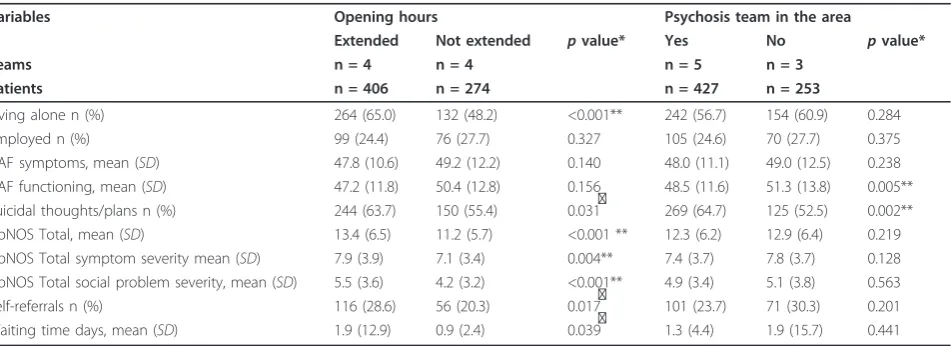
consistent clustering on the combination on these vari-ables and the degree to which the teams operated with a full-time psychiatrist. The most distinct cluster identi-fied by the analysis was the clustering on teams that operated during office hours (except for one team), which made a separate cluster in both the 2- and 3-clus-ter structure. Due to this, we chose to analyse differ-ences between teams in respect of whether the teams operated during office hours and whether there was a psychosis team in the area.
As shown in Table 3, after Bonferroni adjustment for multiple comparisons, patients admitted during CRTs operating office hours were significantly less likely to live alone and had lower scores on all HoNOS total scales. In the CRTs that operated with no psychosis team in their catchment area, the patients were signifi-cantly less likely to have problems of suicidality and had higher GAF functioning scores.
Discussion
The purpose of this study was to describe the character-istics of Norwegian CRTs and their patients, examine any differences and/or clusters between the CRTs, and examine whether the CRTs in Norway are organized according to the international CRT model.
Characteristics of the teams
We found that, in Norway, the CRTs did not have 24/7 availability or gate-keeping functions for acute wards, average waiting time was about one and a half days, and the CRTs appeared to treat some patients who were not considered for hospital admission.
[image:6.595.63.539.529.702.2]Operating without a gate-keeping function and 24/7 availability, with a waiting time of approximately one
Table 3 Variation between groups of teams based on opening hours and psychosis team in the area
Variables Opening hours Psychosis team in the area
Extended Not extended pvalue* Yes No pvalue*
Teams n = 4 n = 4 n = 5 n = 3
Patients n = 406 n = 274 n = 427 n = 253
Living alone n (%) 264 (65.0) 132 (48.2) <0.001** 242 (56.7) 154 (60.9) 0.284
Employed n (%) 99 (24.4) 76 (27.7) 0.327 105 (24.6) 70 (27.7) 0.375
GAF symptoms, mean (SD) 47.8 (10.6) 49.2 (12.2) 0.140 48.0 (11.1) 49.0 (12.5) 0.238 GAF functioning, mean (SD) 47.2 (11.8) 50.4 (12.8) 0.156 48.5 (11.6) 51.3 (13.8) 0.005** Suicidal thoughts/plans n (%) 244 (63.7) 150 (55.4) 0.031ͣ 269 (64.7) 125 (52.5) 0.002** HoNOS Total, mean (SD) 13.4 (6.5) 11.2 (5.7) <0.001 ** 12.3 (6.2) 12.9 (6.4) 0.219 HoNOS Total symptom severity mean (SD) 7.9 (3.9) 7.1 (3.4) 0.004** 7.4 (3.7) 7.8 (3.7) 0.128 HoNOS Total social problem severity, mean (SD) 5.5 (3.6) 4.2 (3.2) <0.001** 4.9 (3.4) 5.1 (3.8) 0.563 Self-referrals n (%) 116 (28.6) 56 (20.3) 0.017ͣ 101 (23.7) 71 (30.3) 0.201 Waiting time days, mean (SD) 1.9 (12.9) 0.9 (2.4) 0.039ͣ 1.3 (4.4) 1.9 (15.7) 0.441
*pvalues are from chi-square tests for categorical variables,t-tests for continuous variables and Mann-WhitneyUtests for ordinal variables **significant differences between CRTs
and a half days and not focusing on patients for whom hospital admission is considered, are fundamental depar-tures from the CRT model. Fidelity scales of assessment of critical ingredients have not been established for CRTs as they have for assertive outreach teams. How-ever, there is some consensus on the key characteristics of the CRT model [1,2,5]. These are a separate multidis-ciplinary team, the capability to deliver a full range of emergency psychiatric interventions in the community, targeting severe emergencies in which inpatient admis-sion would otherwise be required, 24/7 availability, a psychiatrist working within the team, rapid emergency assessments, response within one hour if required, and gate-keeping functions to acute wards.
There are a number of possible explanations for not having implemented the whole CRT model in Norway. Firstly, it is less expensive to operate without 24/7 avail-ability. Secondly, the geography of Norway, which is characterized by low density of population compared to the UK, makes rapid response and home treatment more challenging. Thirdly, a gate-keeping function to acute wards requires a transfer of authority from acute wards to CRTs. This has not been done in Norway. Fourthly, the practice of treating patients who are not considered for hospital admission may be explained by a need to reduce pressure on other mental health services. It is therefore possible that the CRTs are reducing emergency referrals to outpatient clinics more than to the acute wards. Fifthly, independent of national and international guidelines, local and national variations in resources and available clinical staff can affect team composition at times. In addition, there is a greater risk of local variation when the national guidelines for CRTs in Norway can be criticized for being vague.
Because Norwegian CRTs also treat patients who are not considered for hospital admission, they may have a lower threshold for the initial assessment of patients. This may make it possible for CRTs to pre-empt a full blown crisis by intervening before problems become severe. Evidence is emerging for the importance of early detection and intervention for people who may be devel-oping signs of mental illness [39], though the aim of the CRTs is to give emergency community treatment to patients already in severe acute crises.
Patient characteristics
Our study showed that 14% of patients admitted by the CRTs had psychotic symptoms, one-quarter of the patients in our study were employed and three in four were emergency referrals. In both the UK and Norway, CRT services are intended to target patients with psy-chosis and other severe mental health problems [2,3]. The smaller proportion of patients with psychotic symp-toms in Norway cannot be explained by differences in
the size of the catchment areas in the UK and Norway (63,000 in the Islington area [13] compared with a mean population of 87,000 in the Norwegian CRT catchment areas).
Another possible explanation for the low proportion of patients with psychotic symptoms could be that patients with psychosis are treated by psychosis teams at CMHCs, although three of the CRTs did not have a psy-chosis team in their catchment area and there were no significant differences between CRTs in terms of admis-sion of patients with psychotic symptoms.
A difference between Norway and the UK is that CRTs in Norway accept self-referrals, but in the UK they do not, even though the CRTs in the UK allow direct referrals from former service users and their families or carers [2]. In this study, about one-quarter of patients self-referred to Norwegian CRTs. This may contribute to the CRTs in Norway reaching patients with less acute needs than in the UK, although there were no significant differences between self-referrals and those who were referred by others.
Nevertheless, the above findings on the proportion of patients with psychotic symptoms, persons fully employed and emergency referrals indicate that Norwe-gian CRTs serve patients with less severe mental ill-nesses than the CRTs in the UK.
Variation between teams
The results from this part of the study must be inter-preted in light of the fact that there are substantial dif-ferences between teams in the way they operate and are organized, and the small number of teams (eight CRTs).
As discussed above, CRTs should serve patients with severe mental symptoms. There were no significant dif-ferences between the CRTs on clinically relevant vari-ables regarding the degree to which they treat patients with overactive, aggressive or disruptive behaviour, non-accidental self-injury, problems with drinking or drug-taking, or with psychotic symptoms. This may indicate that there are no significant differences between the CRTs in their admission assessments for these patients.
There was a tendency for teams that operate extended opening hours to treat patients with more severe mental illnesses, but the same consistent pattern of differences did not appear when comparison was made between CRTs operating with a psychosis team in their catch-ment area and those without. In addition, whether CRTs were operating with a full-time psychiatrist did not seem to make any difference to the severity of psy-chiatric problems.
randomized controlled trial and therefore one cannot draw causality conclusions between the variables mea-suring severity of mental symptoms and opening hours. There may be other confounding variables. However, patients experience mental health crises in the evenings, at night and on weekends and it is difficult for Norwe-gian CRTs to operate as an adequate alternative to inpa-tient treatment if they do not operate during these hours. Local mental health care in these areas provides only casualty clinics and acute inpatient wards outside office hours.
Implementation
Tansella and Thornicroft [26] described three phases, including different barriers or facilitators at the national, local and individual levels, in understanding the transla-tion of knowledge in the mental health science into rou-tine clinical practice. In the first phase, called adoption in principle, the authors emphasize the importance of setting a policy priority at national level and having clin-ical guidelines. The establishment of CRTs in Norway was a priority of national mental health authorities, but the teams were not given the resources to operate with 24/7 availability or gate-keeping authority to acute wards. Clinical guidelines were developed in Norway, but these seemed to be less specific than similar guide-lines from the UK, giving a greater risk of local varia-tions. On an individual level, the lack of full-time consultant psychiatrists at CRTs in Norway may be related to more general problems in the mental health services, with a limited number of psychiatrists and pro-blems recruiting psychiatrists to vacant positions. This lack of input from consultant psychiatrists makes the CRTs less multidisciplinary, and two teams in our study included mainly nurses and social workers.
While the policy implementation guidelines in the UK look relatively specific, there have been some difficulties in implementing CRTs in the UK too. Onyett et al found 68% of the CRTs in the UK in 2005 reported being gate-keepers to inpatient beds and 54% offered a 24/7 service [20]. A report by the National Audit Office [40] found that the introduction of CRTs had success-fully reduced pressure on beds and supported earlier discharge from acute wards, but they found wide regio-nal variations, particularly in the lack of consultant psy-chiatrists. In addition, they found that of 500 admissions, only half had been assessed by the CRT staff before admission (gate-keeping).
Strengths and limitations
The main strength of our study is that it is a naturalistic study of nearly all patients treated by the CRTs in Nor-way at the time of the study. Both the variety within the sample, the size of the sample, the length of the
registration period, and the different geographical loca-tions of the CRTs suggest that the data may be consid-ered to be representative of such teams in Norway. Since the data collection, more CRTs have been estab-lished (35 of the 75 CMHCs had estabestab-lished a CRT by 2008) in Norway. These 35 CRTs were operating with-out a gate-keeping function and 24/7 availability and there was still a lack of full-time psychiatrist in these teams. About half of the teams operated extended hours. This indicates that the way the CRTs are orga-nized and operate have not changed significantly since our data-collection and that our data was still represen-tative for these teams [7].
The lack of randomization and control group are important limitations, and causality cannot be shown from this study. The multicentre design meant that many raters participated, which may have introduced some uncontrolled error variances, even though the pro-ject coordinators of each team participated in develop-ing the registration forms and were responsible for instructing the other raters and the data collection by their team.
Conclusion
In our study, we found that the CRTs in Norway did not implement the whole CRT model and this may lead to the result that CRTs were only reaching part of the target group. Norwegian CRTs do not serve as an ade-quate alternative to admission in the same way as inter-national CRTs and therefore do not completely fulfil their role in the mental health system. For fuller imple-mentation of the CRT model, fidelity scales and sup-porting toolkits for achieving fidelity might be useful. A further investigation of barriers to implementation is recommended.
Acknowledgements
We thank the Norwegian Directorate of Health for financial support of the network and the study, SINTEF Health Research for organizing and co-ordinating the network and the study, Akershus University Hospital for financial support of the writing process, and all the members of the CRTs for collecting the data. We also thank Jurate Saltyte Benth at the Helse Øst Centre for Health Services Research for her help with the cluster analysis and her advice on statistical methods.
Author details
1R&D Department, Mental Health Services, Akershus University Hospital and
Institute of Clinical Medicine, University Oslo, Norway.2Department of Research and Development, Alcohol and Drug Treatment Health Trust in Central Norway; Norwegian Centre for Addiction Research, University of Oslo, Norway.3Department of Mental Health Sciences, University College
London, London, UK.4R&D Department, Mental Health Services, Akershus
University Hospital and Professor, Institute of Clinical Medicine, University Oslo, Norway.
Authors’contributions
manuscript was written by NH and substantially revised by TR, SJ and RWG. The final version of the manuscript was prepared by and revised by all authors. TR was head supervisor of this manuscript and project leader of the Multicentre Study of Acute Psychiatry in Norway (MAP).
Competing interests
The authors declare that they have no competing interests.
Received: 30 August 2010 Accepted: 10 May 2011 Published: 10 May 2011
References
1. Johnson S, Needle J, Bindman JP, Thornicroft G:Crisis Resolution and Home Treatment in Mental HealthCambridge: Cambridge University Press; 2007. 2. Department of Health:Crisis Resolution/Home Treatment Teams. The Mental
Health Policy Implementation GuideLondon: National Institute for Mental Health in England; 2001.
3. Sosial-og helsedirektoratet:“Du er kommet til rett sted....Ambulante akuttjenester ved distriktspsykiatriske sentre”. Rapport IS-1358 ["You have come to the right place.... Ambulant services at community mental health centers"].Oslo: Sosial- og helsedirektoratet; 2006.
4. Johnson S, Zinkler M, Priebe S:Mental health service provision in England.Acta Psychiatr Scand2001,104:47-55.
5. Johnson S:Crisis resolution and home treatment.Psychiatr2004,3:22-25. 6. Clark M:Crisis Resolution and Home Treatment: Report of a 2-day
Policy-Research-Practice Conference: 31. January and 1. February 2008; Birmingham Burmingham: Birmingham City University, National Institute for Mental Health in England; 2008.
7. Helsedirektoratet:Kartlegging av de distriktspsykiatriske sentrene i Norge 2008. Rapport IS-6093 [Survey of community mental health centres in Norway 2008].Oslo: Muusmann/AGENDA; 2008.
8. Wright C, Burns T, James P, Billings J, Johnson S, Muijen M, Priebe S, Ryrie I, Watt J, White I:Assertive outreach teams in London: Models of operation.Br J Psychiatry2003,183:132-138.
9. Glover G, Arts G, Babu KS:Crisis resolution/home treatment teams and psychiatric admission rates in England.Br J Psychiatry2006,189:441-445. 10. Joy CB, Adams CE, Rice K:Crisis intervention for people with severe
mental illnesses.Cochrane Database Syst Rev2006,3:CD001087.
11. Gråwe R, Ruud T, Bjørngaard JH:Alternative akuttilbud i psykisk helsevern for voksne. [Alternative acute mental health services for adults].Tidsskr Nor Legeforen2005,125:3265-3268.
12. Johnson S, Nolan F, Pilling S, Sandor A, Hoult J, McKenzie N, White IR, Thompson M, Beddington P:Randomised controlled trial of acute mental health care by a crisis resolution team - the north Islington crisis study.
Br Med J2005,331:586-587.
13. Johnson S, Nolan F, Hoult J, White IR, Bebbington P, Sandor A, McKenzie N, Patel SN, Pilling S:Outcomes of crisis before and after introduction of a crisis resolution team.Br J Psychiatry2005,187:68-75.
14. Jethwa K, Galappathie N, Hewson P:Effects of a crisis resolution and home treatment team on in-patient admissions.Psychiatr Bull2007,
31:170-172.
15. Keown P, Tacchi MJ, Niemiec S, Hughes J:Changes to mental healthcare for working age adults: impact of a crisis team and an assertive outreach team.Psychiatr Bull2007,31:288-292.
16. Catty J, Burns T, Knapp K, Watt H, Wright C, Henderson J, Healey A:Home treatment for mental health problems: a systematic review.Psychol Med 2002,32:383-401.
17. Carroll A, Pickworth J, Protheroe D:Service innovations - an Australian approach to community care: The Northern Crisis assessment and treatment team.Psychiatr Bull2001,25:439-441.
18. Hopkins C, Niemiec S:Mental health crisis at home: service user perspectives on what helps and what hinders.J Psychiatr Ment Health Nurs2007,14:310-318.
19. Winness MG, Borg M, Kim HS:Service users’experiences with help and support from crisis resolution teams. A literature review.J Ment Health 2010,19:75-87.
20. Onyett S, Linde K, Glover G:A national survey of crisis resolution teams in England. London: Care Services Improvement Partnership, Department of Health and University of the West of England.2007.
21. Kolbjørnsrud OB, Larsen F, Elbert G, Ruud T:Kan psykiatrisk akutteam redusere bruk av akuttplasser ved sykehus? [Can CRT reduce use of acute inward hospital beds?].Tidsskr nor laegeforen2009,129:1991-1994. 22. Harrison J, Marshall S, Marshall P, Marshall J, Creed F:Day hospital vs.
home treatment. A comparison of illness severity and costs.Soc Psychiatry Psychiatr Epidemiol2003,38:541-546.
23. Ford R, Minghella E, Chalmers C, Hoult J, Raftery J, Muijen M:Cost consequences of home-based and in-patient-based acute psychiatric treatment: Results of an implementation study.J Ment Health2001,
10:467-476.
24. Guo S, Biegel DE, Johnson JA, Dyches H:Assessing the impact of community-based mobile crisis services on preventing hospitalization.
Psychiatr Serv2001,52:223-228.
25. Harrison J, Alam N, Marshall J:Home or away: which patients are suitable for a psychiatric home treatment service?Psychiatr Bull2001,25:310-313. 26. Tansella M, Thornicroft G:Implementation science: understanding the
translation of evidence into practice.Br J Psychiatry2009,195:283-285. 27. Proctor EK, Landsverk J, Aarons G, Chambers D, Glisson C, Mittman B:
Implementation research in mental health services: an emerging science with conceptual, methodological, and training challenges.Adm Policy Ment Health2009,36:24-34.
28. Perkins MB, Jensen PS, Jaccard J, Gollwitzer P, Oettingen G,
Pappadopulos E, Hoagwood KE:Applying theory-driven approaches to understanding and modifying clinicians’behaviour: what do we know?
Psychiatr Serv2007,58:342-348.
29. World Health Organization:International Statistical Classification of Diseases and Related Health Problems - 10th RevisionGeneva: WHO; 1999. 30. Wing JK, Beevor AS, Curtis RH, Park SBG, Hadden S, Burns A:Health of the
Nation Outcome Scales (HoNOS). Research and development.Br J Psychiatry1998,172:11-18.
31. Endicott J, Spitzer RL, Fleiss JL, Cohen J:Global assessment scale. A procedure for measuring overall severity of psychiatric disturbance.Arch Gen Psychiatry1979,33:766-771.
32. Goldman HH, Skodol AE, Lave TR:Revising axis V for DSM-IV: A review of measures of social functioning.Am J Psychiatry1992,149:1148-1156. 33. Karterud S, Pedersen G, Loevdahl H, Friis S:Global Assessment of
Functioning-Split Version (GAF-S): Background and Scoring ManualOslo, Norway: Ullevål University Hospital, Department of Psychiatry; 1998. 34. Ruud T, Reas D:Community Mental Health Centres, Services and Patient
Satisfaction - State and Variation 2002Trondheim, Norway: SINTEF Unimed; 2002.
35. Pirkis J, Burgess P, Kirk P, Dodson S, Coombs T, Williamson M:A review of the psychometric properties of the Health of the Nation Outcome Scale (HoNOS) family of measures.Health Qual Life Outcomes2005,3:76. 36. Mueser KT, Drake RE, Clark RE, McHugo GJ, Mercer-McFadden C,
Ackerson TH:A Toolkit for Evaluating Substance Abuse in Person with Severe Mental IllnessCambridge, MA: The Evaluation Center at Human Services Research Institute; 1995, [Translated to Norwegian by Turid Møller]. 37. Drake RE, Osher FC, Noordsy DL, Hurlbut SC, Teague GB, Beaudett MS:
Diagnosis of alcohol use disorders in schizophrenia.Schizophr Bull1990,
16:57-67.
38. Mellesdal L, Mehlum L, Wentzel-Larsen T, Kroken R, Jørgensen HA:Suicide risk and acute psychiatric readmissions: a prospective cohort study.
Psychiatr Serv2010,61:25-31.
39. Rosen A:Crisis management in the community.Med J Aust1997,
167:633-638.
40. National Audit Office:Helping People Through Mental Health Crisis: The Role of Crisis Resolution and Home Treatment ServicesLondon: The Stationery Office; 2007.
Pre-publication history
The pre-publication history for this paper can be accessed here: http://www.biomedcentral.com/1472-6963/11/96/prepub
doi:10.1186/1472-6963-11-96