RESEARCH NOTE
Minimization of the Wilson’s Central
Terminal voltage potential via a genetic
algorithm
Hossein Moeinzadeh
1*, Paolo Bifulco
2, Mario Cesarelli
2, Alistair L. McEwan
3, Aiden O’Loughlin
4,
Ibrahim M. Shugman
5, Jonathan C. Tapson
1, Aravinda Thiagalingam
6,7,8and Gaetano D. Gargiulo
1,2,9Abstract
Objective: The Wilson Central Terminal (WCT) is an artificially constructed reference for surface electrocardiography, which is assumed to be near zero and steady during the cardiac cycle; namely it is the simple average of the three recorded limbs (right arm, left arm and left leg) composing the Einthoven triangle and considered to be electrically equidistant from the electrical center of the heart. This assumption has been challenged and disproved in 1954 with an experiment designed just to measure and minimize WCT. Minimization was attempted varying in real time the weight resistors connected to the limbs. Unfortunately, the experiment required a very cumbersome setup and showed that WCT amplitude could not be universally minimized, in other words, the weight resistors change for each person. Taking advantage of modern computation techniques as well as of a special ECG device that aside of the standard 12-lead Electrocardiogram (ECG) can measure WCT components, we propose a software minimization (genetic algorithm) method using data recorded from 72 volunteers.
Result: We show that while the WCT presents average amplitude relative to lead II of 58.85% (standard deviation of 30.84%), our minimization method yields an amplitude as small as 7.45% of lead II (standard deviation of 9.04%). Keywords: Electrocardiography, Wilson Central Terminal, Genetic algorithm, Potential reference
© The Author(s) 2018. This article is distributed under the terms of the Creative Commons Attribution 4.0 International License (http://creat iveco mmons .org/licen ses/by/4.0/), which permits unrestricted use, distribution, and reproduction in any medium, provided you give appropriate credit to the original author(s) and the source, provide a link to the Creative Commons license, and indicate if changes were made. The Creative Commons Public Domain Dedication waiver (http://creat iveco mmons .org/ publi cdoma in/zero/1.0/) applies to the data made available in this article, unless otherwise stated.
Introduction
The very first surface electrocardiogram was conceived and outlined by E. Einthoven in the 1900s, and entered clinical practice in the 1940s as 12-lead-Electrocardio-gram (ECG). Since then, it is still the most popular non-invasive diagnostic tool for cardiac assessment [1, 2].
The 12-lead ECG is composed of twelve signals or ‘leads’ measured from the limbs and six positions on the chest called precordials. The precordials (1/2 of the sig-nals) are measured as the potential difference between each exploring electrode located on the chest, and an assumed constructed ‘zero’ reference. This ‘zero’ refer-ence was introduced by F. N. Wilson in 1931 and named after him as Wilson’s Central Terminal (WCT) [1]. By
definition, it is the simple average of the three exploring electrodes connected to the right arm (RA), left arm (LA) and left leg (LL) and it is assumed to be steady and of negligible amplitude during the cardiac cycle.
However, the WCT voltage is neither steady nor of neg-ligible amplitude [3]. Frank [4] was the first to undermine the idea of having a constant WCT during the cardiac cycle and discussed how this variation could affect the ECG measurement [2, 4–6]. Later, Burger clarified the true meaning of zero potential and defined the WCT as the average of the three limb leads which is symmetrical with respect to the limb leads [3]. To quantify the WCT voltage, Wilson proposed immersing the body in a large homogeneous conductor and theorized that 0.15 mV was its maximal value [7, 8].
Following this recommendation, Bayley and Kinard [9, 10] encased the body of volunteers inside a metal struc-ture (called integrator electrode) that was immersed in water for the duration of the recording. With this
Open Access
*Correspondence: [email protected]
1 The MARCS Institute, Western Sydney University, Sydney, NSW, Australia
experiment, they determined that the WCT is non-sta-tionary during the cardiac cycle and its amplitude could be as large as 40% of Einthoven’s ECG signals [9, 10]. Dur-ing this experiment, Bayley and Kinard also attempted a real-time minimization of the WCT amplitude to bring it below a non-influent value [10]. To achieve minimization they made use of three rheostats instead of fixed resis-tors and adjusted the weights of the three WCT compo-nents continually reporting the achieved new amplitude. To Achieve the WCT recording for the minimization, the volunteer was encased by a metal structure that was submerged in the water for the duration of the recording [10].
Although the notion that a large WCT voltage may be affecting the clinical recordings, aside from the few notable research studies [11, 12], all recording methods currently employed use the raw WCT as a reference for precordials. Eventually, after an initial wave of interest, the WCT has received scant research attention during the past decades [2]. Recently Gargiulo et al. [2, 12] pro-posed a way to record unipolar ECG without using the WCT and suggested a new device and a method to meas-ure and store the WCT components. Taking advantage of the availability of these unique recording we present a software minimization for the WCT.
Our method similarly to the originally attempted minimization performs a weighted average of the WCT components. To achieve this goal we use a genetic algo-rithm (GA) [13]. The GA is a heuristic search method for finding the optimal answer for problems with high com-putational complexity. This approach is used for those problems, like ours, that either lacks a deterministic tion or a deterministic polynomial time complexity solu-tion. This algorithm is called “genetic” because is based on the concept of the biological evolution of individuals within a population where “chromosomes” mutates to achieve the survival of the fittest. A “chromosome” repre-sents a possible solution to the problem that can mutate from one population of chromosomes to the next popu-lation (generation) by using a “selection” procedure. The chromosomes that are selected to be in the next genera-tion also could be changed or become parents of new chromosomes in the process of “mutation”, and “crosso-ver” [13]. In this paper, we show results of our minimi-zation method applied to data recorded from 72 patients (25 female, age average 66.35 year-old ± 11.46 year-old), at Campbelltown Hospital, New South Wales, Australia.
Main text
To our knowledge, this is the first attempt to the WCT minimization employing new data since Bayley and Kinard’s effort in 1954 [10]. The proposed approach to
estimate M-WCT (whereas M stands for minimized) is engineered to fulfill:
1. Possibly be zero or near zero;
2. In any case (worst case scenario), M-WCT amplitude should be less than 0.1 mV, so that it can be consid-ered clinically irrelevant and smaller than Wilson estimation of max amplitude [14].
In order to fit the M-WCT into the genetic algorithm paradigm, we need to formalize our problem regarding population, mutation, crossover and fitness function. Recalling that the WCT is the average of the limbs’ elec-trodes, we can define M-WCT as the weighted mean of the WCT’s components (weights can be different from 1/3, positive, not null and add up to one). More formally:
whereas α,β, andγ are the minimization parameters;
∅L,∅R and ∅F are the raw potential of the limb electrodes placed on LA, RA, and LL respectively; thus α,β, andγ are related to LA, RA and LL respectively, and will replace the averaging 5 kΩ resistors in our minimization.
To summarize, our method minimizes (1.1) according to the three main criteria enounced above constrained by (1.2) and (1.3).
Fitness function
As mentioned, the role of the fitness function is to ensure “the survival of the fittest” hence converging towards the solution. Equation (1.4) is selected as the fitness func-tion. This is because its shape and its nonlinearity pro-vide an increase in the probability of having M-WCT with smaller values; in other words, it encourages the algorithm to converge more rapidly to amplitudes smaller than 0.1 mV. The plot of the fitness function is depicted in Fig. 1.
Population
Represents all possible answers (chromosomes), a new population is generated during each iteration where each individual is a tern of weighted factors (α,β,γ ) . 80
indi-viduals are chosen as population size. In the first popu-lation, only one chromosome is initialized by the WCT chromosome ( α=β=γ= 1/3) and the rest are gener-ated randomly constrained only by the conditions (1.2) and (1.3). Also, (1) the elite members of each population are moved to the next generation directly; (2) the WCT chromosomes are preserved in each population.
(1.1)
M-WCT =α∅L+β∅R+γ∅F
(1.2)
0< α,β,γ <1
(1.3)
α+β+γ =1
(1.4)
Crossover
The role of the crossover operation is to build the next population based on selected chromosomes of the cur-rent population. We use single point and averaging crossover methods randomly to populate the next gen-eration. For details see [15, 16].
Mutation
To avoid trapping into local optima the permuta-tion algorithm is used to change the posipermuta-tion of three parameters in a selected chromosome (mutation prob-ability is equal to 0.1).
This method is applied to every voltages sample of the recording and computes three parameters to have the M-WCT trace during the cardiac cycle. For this study, we included data from 72 patients; each selected data excerpt has a normalized length of 10 s. As men-tioned earlier, three weighting factors α,β, andγ are calculated using the GA to minimize Wilson Central Terminal. In Additional file 1: Table S1, we report the average values of the three weights and the average number of iterations that the GA needs to converge for all patients.
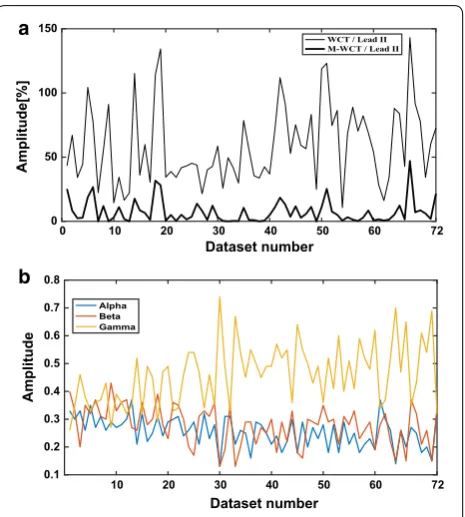
Similarly to previous studies [9, 10], the WCT and M-WCT amplitudes are measured averaging five con-secutive beats for each dataset and reported as a per-centage of lead II. We used the orientation of the QRS complex to report the polarity of the WCT. “N” denotes signals with an unclear polarity in which the posi-tive deflection amplitude closely matched the negaposi-tive deflection at the QRS. In Fig. 2, we report the ampli-tude of the M-WCT and the WCT for each patient as well as the average across the full 10 s of the three weighting parameters. As it can be seen in Fig. 2b, the variation of each parameter is too high among all the patients, and three optimal parameters cannot be found
for all the patients. Summary of our findings are sum-marized in Additional file 1: Table S1.
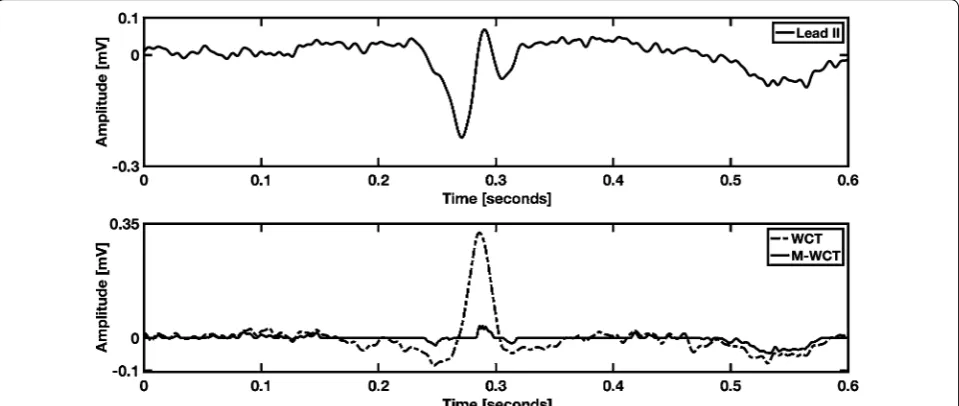
Similarly, to previous studies, we found a variety of the WCT shapes and polarities (slightly in favor, see Addi-tional file 1: Table S1, for positive polarity) hence it is possible to say that the WCT is highly individual, and can have standard ECG characteristics, such as a P-wave and a T-wave. Individuality was also found in the M-WCT, as we show in Fig. 3. However, due to the negligible general amplitude of M-WCT (see Fig. 2), we conclude that the clinical impact of the M-WCT is negligible with respect to the WCT.
Figure 3 shows an example of WCT in which a broader QRS feature with amplitude even higher than Lead II. However, as one can infer comparing M-WCT and WCT (bottom panel), the relative amplitude of M-WCT has highly decreased compared to the WCT relative amplitude.
An example of the WCT signal with a marked T-wave is visible in Additional file 2: Figure S1. As it can be observed, a marked T-wave deflection on the WCT trace (bottom panel) is synchronized with the T-wave on lead II (top panel). The WCT trace in Addi-tional file 2: Figure S1 is also an excellent example of a highly variable WCT and an almost steady M-WCT. In one single cardiac cycle, the deflection’s polarity of the
Fig. 1 Nonlinear fitness function is used to encourage individuals to have smaller M-WCT
0 10 20 30 40 50 60 72
Dataset number
0 50 100 150
Amplitude[%
]
WCT / Lead II M-WCT / Lead II
10 20 30 40 50 60 72
Dataset number
0.1 0.2 0.3 0.4 0.5 0.6 0.7 0.8
Amplitude
Alpha Beta Gamma a
b
[image:3.595.307.540.86.345.2] [image:3.595.56.298.88.224.2]WCT changes at least three times, and its amplitude reaches 45.27% of lead II (average), while the M-WCT amplitude is 3.59% of lead II. Additional file 3: Figure S2 is an example of high WCT amplitude with nega-tive deflection. As seen, the WCT has an amplitude of 59.21% of lead II, while M-WCT amplitude is only 2.79% of lead II.
Recall that there was an attempt to measure and minimize the WCT in 1954 with a peculiar
experi-ment which required a very cumbersome setup [9,
10, 17]. Minimization was attempted by varying the weight resistors connected to the limbs in real time, and it showed that the WCT amplitude could not be universally minimized (see Additional file 4: Figure S3). They found out the value of the WCT is zero for half of their subjects when the three resistors were chosen as (r=l=2.6f) . Unfortunately, this resistors selection, for the other tested subjects) decreased the WCT amplitude to less than 50% when compared to
an unweighted terminal selection
r=l=f
[17]. Our results (see Fig. 2b) shows that to minimize WCT amplitude, different weights should be used similarly to Bayley et al. experiment [17]. Additionally, we found that γ (the weighting factor of ∅F ) have usually larger amplitudes in comparison with α and β . However, as
the WCT component signals ( ∅L,∅R and ∅F ) are highly individual, the computed weighted factors are also dif-ferent for each patient. In our dataset, the ratio of γ to α is in the range of [0.78, 5.69], and the ratio of γ to β is
in the range of [0.62, 5.69] (see Fig. 2).
Limitations
Although with this work we overcome the need to sub-merge the patients in water and use manual rheostats actually achieving a real minimization, probably the largest limitation is represented by the need to col-lect an excerpt of data that need to be used for the GA. For this work, we used a data excerpt of 10 s that at a sample rate of 800 Hz means a buffer for 8000 samples. Although this may seem like a small number, consider-ing that to converge our GA takes 200 ± 41 iterations requiring few minutes on an average computer before that the new precordials can be computed adding con-siderable delay to the ECG diagnosis. To improve our method, we are currently working on faster minimiza-tion techniques that could make the use of M-WCT viable in clinical practice.
Additional files
Additional file 1: Table S1. Measurements summary.
Additional file 2: Figure S1. Example of negative deflection WCT. WCT is 59.21% of lead II amplitude, while M-WCT is 2.79% of lead II amplitude (average); the recording is from a 59-year-old male patient admitted with chest pain.
Additional file 3: Figure S2. Example of negative deflection WCT. WCT is 59.21% of lead II amplitude, while M-WCT is 2.79% of lead II amplitude (average); the recording is from a 59-year-old male patient admitted with chest pain.
[image:4.595.59.539.89.292.2]Additional file 4: Figure S3. Comparison of three resistors for right hand, left hand, and foot electrodes for 33 patients, experiment done by Bayley and Schmidt.
Abbreviations
WCT : Wilson Central Terminal; ECG: electrocardiogram; GA: genetic algorithm; RA: right arm; LA: left arm; LL: left leg; M-WCT : Minimized Wilson Central Terminal.
Authors’ contributions
MH conceptualized this study and wrote the necessary code. GG, IS, and AOL performed data recording in hospital and data analysis. PB, MC, AM, and JT contributed to the data analysis and to the writing of the text. IS, AOL, and AT gave also clinical advice. All authors read and approved the final manuscript.
Author details
1 The MARCS Institute, Western Sydney University, Sydney, NSW, Australia. 2 Department of Electrical Engineering and Information Technology (DIETI),
“Federico II”, The University of Naples, Naples, Italy. 3 School of Electrical
and Information Engineering, University of Sydney, Sydney, NSW, Australia.
4 School of Medicine, Western Sydney University, Sydney, NSW, Australia. 5
Car-diology Department, Campbelltown Hospital, Sydney, NSW, Australia. 6 School
of Medicine, The University of Sydney, Sydney, NSW, Australia. 7 Cardiology
Department, Westmead Hospital, Sydney, NSW, Australia. 8 Westmead Institute
for Medical Research, Sydney, NSW, Australia. 9 School of Computing,
Engi-neering and Mathematics, Western Sydney University, Sydney, NSW, Australia.
Acknowledgements
The authors wish to thank the patients at Campbelltown Hospital (New South Wales, Australia) who volunteered for this study, and the hospital staff who supported and helped with the data collection, particularly the nurses of the Coronary Care Unit.
Competing interests
The authors declare that they have no competing interests.
Availability of data and materials
Although we are still working to the data collection and planning to release the full dataset before the end of the year, the data used for this paper are available upon request.
Consent for publication
Not applicable.
Ethics approval and consent to participate
All the patients volunteered for this study and gave written consent (this study was approved by the Ethics Committee of the South West Sydney Health District on 23rd September 2015 with the protocol number HREC/15/ LPOOL/302).
Funding
This study is supported by the office for Research Engagement and Develop-ment with Industry (REDI) at the Western Sydney University and by the MARCS Institute.
Publisher’s Note
Springer Nature remains neutral with regard to jurisdictional claims in pub-lished maps and institutional affiliations.
Received: 21 October 2018 Accepted: 13 December 2018
References
1. Malmivuo J, Plonsey R. Bioelectromagnetism Principles and Applica-tions of Bioelectric and Biomagnetic Fields. Oxford University Press; 1995. p. 1–506. http://www.oxfor dscho larsh ip.com/view/10.1093/acpro f:oso/97801 95058 239.001.0001/acpro f-97801 95058 239.
2. Gargiulo GD. True unipolar ECG machine for Wilson Central Terminal measurements. Biomed Res Int. 2015;2015:586397.
3. Burger HC. The zero of potential: a persistent error. Am Heart J. 1955;49(4):581–6.
4. Frank E. General theory of heart-vector projection. Circ Res. 1954;2(3):258–70. https ://doi.org/10.1161/01.RES.2.3.258.
5. Dower GE, Osborne JA, Moore AD. Measurement of the error in Wilson’s central terminal: an accurate definition of unipolar leads. Br Heart J. 1959;21:352–60.
6. Frank E, Kay CF. The construction of mean spatial vectors from null con-tours. Circulation. 1954;9(4):555–62.
7. Wilson FN, Johnston FD, Rosenbaum FF, Barker PS. On Einthoven’s trian-gle, the theory of unipolar electrocardiographic leads, and the interpreta-tion of the precordial electrocardiogram. Am Heart J. 1946;32(3):277–310.
https ://doi.org/10.1111/j.1365-2818.1858.tb045 42.x.
8. Miyamoto N, Shimizu Y, Nishiyama G, Mashima S, Okamoto Y. The abso-lute voltage and the lead vector of Wilson’s central terminal. Jpn Heart J. 1996;37(2):203–14.
9. Bayley RH, Kinard CL. The zero of potential of the electrical field produced by the heart beat; the problem with reference to the living human sub-ject. Circ Res. 1954;2(2):104–11.
10. Bayley RH, Reynolds EW, Kinard CL, Head JF. The zero of potential of the electric field produced by the heart beat; the problem with reference to homogenous volume conductors. Circ Res. 1954;2(1):4–13.
11. Gargiulo G, Thiagalingam A, McEwan A, Cesarelli M, Bifulco P, Tapson J, et al. True unipolar ECG leads recording (without the use of WCT). Hear Lung Circ. 2013;22:S102.
12. Gargiulo GD, McEwan AL, Bifulco P, Cesarelli M, Jin C, Tapson J, et al. Towards true unipolar ECG recording without the Wilson central terminal (preliminary results). Physiol Meas. 2013;34(9):991–1012. http://stack s.iop. org/0967-3334/34/i=9/a=991?key=cross ref.3ee57 f7715 7cc5f a5624 7c277 5f231 7d.
13. Mitchell M. An introduction to genetic algorithms, vol. 32. In: Computers and mathematics with applications. MIT Press Ltd; 1996. https ://books .googl e.ca/books /about /An_Intro ducti on_to_Genet ic_Algor ithms .html?id = 0eznl z0TF-IC&pgis = 1%5Cn, http://www.amazo n.ca/exec/ obido s/redir ect?tag = citeu like0 9-20&path = ASIN/02626 31857 %5Cn, http://linki nghub .elsev ier.com/retri eve/pii/S0898 12219 69022 78. 14. Sheppard JP, Barker TA, Ranasinghe AM, Clutton-Brock TH, Frenneaux MP,
Parkes MJ. Does modifying electrode placement of the 12 lead ECG mat-ter in healthy subjects? Int J Cardiol. 2011;152(2):184–91.
15. Rawlins GJE. Foundations of genetic algorithms 1991 (FOGA 1). Founda-tions of genetic algorithms (Book 1). Morgan Kaufmann; 1 edition (July 15, 1991); 1991.
16. Gwiazda TD. Genetic algorithms reference, vol. 1. Tomasz Gwiazda; 2006. 17. Bayley RH, Schmidt AE. The problem of adjusting the wilson central