..
XV/0105/92
EASIER CROSS BQBDER PAYMENTS BREAK, I NG DOIN THE BARR I ERS
SOURCE DOCUMENTS
LIBRARY
Report of the Payment Systems Technical Development Group (PSTDG) Appendices to the PSTOG report:
1 • Terminology 2. Infrastructures 3. Standards
4. Legal Issues
5. Guidelines on Competition
e.
Reporting ReQuirementsReport of the Payment Systems Users Liaison Group (PSULG)
Appendix to the PSULG Report
1. Guldel ines on remote payments
Working Papers
·
..COMMISSION
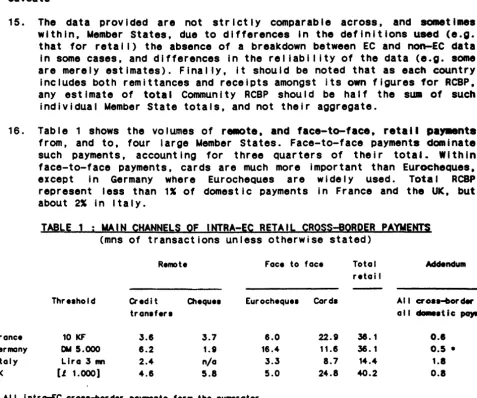
OF THE EUROPEAN COMMUNITIES
DIRECTORATE-GENERAL
Fl NAHC IAL INSTITUTIONS All)
o::MI'AHY LAW
App II cot ion of Conmln I ty Law XV/1
332,
IREPORT OF THE
20 February 1992 Final
PAYMENT SYSTEMS TECHNICAL DEVELOPMENT GROUP TO SIR LEON BRITTAN, VICE PRESIDENT OF THE COMMISSION
CONTENTS
1. REpgRI
SubJect ParagraPhs
A. I ntroc:lu.ct I on ..•....•...•..•...••...•.•••• 1
-PSTDG·s goals and work programme •.•...•••.••..•.••..•••..•••••
7-B. Stock-taking exercise : - vo I umes •••••••••••••••••••••••••••••••••••••••••••••••••••• 141 charges •••••••.•••••••••••••••••••••••..••.••.••••••••••••• 24
-- Infrastructures ••.••.••••...••.•••..•••.••..•...•••••••• 28
-c.
Key Issues to be addressed: I . Standards •...••...••.••.•••••...•.•••.•.•...• 35-I -I . Te 1 ecornrnun i cat ions ..•.••.••...•..•••...••..••.•• 49
-I -I -I . Lega -I i ssues ...•..••...••...•...•..•.•• 56
-I
v.
Compe t I t I on po I i cy ..•...•..•...••...•...•..•... 67-v.
Access ...•...•... 76-VI. Systemic risk and supervision ...
94-VI 1. Reporting re~ulremerits ...••...•.
99-VIII. Data protection ....•...•...•...••...• 107
D. The possible ways ahead : 6 13 23 25 34 48 55 66 75 93 98 106 119 -Determining factors •...•... 120- 123 -Correspondent banking ...•...•...•.. 124- 126 -Linkage between ACHs and eQuivalent systems ... 127- 150 -Direct debiting, cheQues and cards ... 151- 155 E. Next steps ... 156 - 166 2. APPENDICES SubJect Number - Terminology ... 1
- Infrastructures ...•...•... 2
- Standards ...•...•...•...••.• 3
- Leg a I i ssues ...•...•..••... 4
- Guide I I nes on compet It ion ...•...•... 5 -Reporting reQuirements .•..•...•...•...••• &
...
- 1
-A. INTRODUCTION
The September 1990 Discussion Paper and reactions to It
1 • The Commission issued a Discussion Paper entitled "Making 11a,..nts 1t111r
the Internal market .. (COM(90)447) on 26 September 1990. Thls- paper - ·
out Ideas for improvements in the main categories of cross-fronti..-payments and invited responses from interested organisations by the ~
of 1990.
2. There was a widespread consensus among commentators that present pa,wxa:U systems did not provide arrangements for retail cross-border pa,_nts (RCBP) which met the standards of speed, certainty and econc.y tllat characterised purely domestic payment systems, and which wou•d bene~
under full EMU. (A variety of factors were adduced to eaplain tttts
sltuat ion Including the fact that domest lc payment syst- ln . . . Member States were significantly less efficient than in otlters). S . .
suggested that these Inadequacies typified regular (I.e. recurrent" periodic) as wei 1 as "one-off" (i.e. spontaneous> remote pa~ea
(remote signifying that only the payment crosses the u..eer Stat••·• border). 1 t was genera II y _acknow I edged that face-to-face IICBP - ...,_ the user from one Member State is phys i ca I I y present at tllle place d payment in another Member State - presented fewer probl•s. at -difficult to forecast the demand for RCBP services. However, tba
complete opening of frontiers to trade in goods and services and to~
free movement of persons, would certainly be accompanied by an lncre8S~
demand for more convenient payment services. Wh I I e this de...·a would
a.
driven primarily by the growth of trade in goods and services it CCJU;fdalso be responsive to any reduction in charges and/or the time taken~
effect such payments.
3. Consumer groups emphasized the need to strengthen consumer protecti~.
by e.g. implementing measures to increase the transparency of ~
conditions (e.g. charges, time-spans) associated with RCBP. the bank~
industry also recognised that consumers were not wei I infor..a regarabnm the merits of the different instruments that could be used for RCIF
(e.g. cards and cheques) and that many consumer complaints would be eliminated where customers to be better advised regarding t~ diff.eremtt alternatives available to them.
4. A series of issues which wou 1 d have to be addressed int order fcur
improvements to be effected in RCBP systems (RCBPS) - and in some caaeB domestic payment systems were identified, including. :. leplt uncertainties, the lack of standardisation, the dearth of data regardins current, and expected future, volumes of RCBP, and the unp·redictabill\tt)y of further progress towards EMU .. Several of these related to, ctffferena~S
in public policy between Member States and/or could only be removed~
5.
public intervention. Most of the comments described In the paper credit transfer orders generally agreed that systems were technically whether the substantial
received on the four categories of pa·~
related to one particular means of remote~
(henceforth referred to as transfers). Bantarna improvements to retai I cross-border transter feasible; however, several were sceptical as~
- 2
-for this would yield a sufficiently high rate of return, given the low level of demand In the foreseeable future for such transfers. This viewpoint was questioned by other commentators who pointed to the fact that some banks<*>, and groups of banks, were a I ready developIng, or even offering, new Improved systems for them. The majority of commentators were willing to work with the Commission on a detailed study of the technical, and economic feasibi I ity of various improvements to retai I cross-border transfer systems.
6. A Conlll.tnlcatlon on "Making payments in the Internal Market" was then presented by Sir Leon Brittan and Mr. Van Mlert to the Commission on 19 March 1991. This recommended that the expertise of both public and private sectors be harnessed In order to ensure rapId and effectIve fo I low-up work. In order that this work be effIcIent I y conducted, It proposed that two groups be established. The first of these - the Payment Systems Techn I ca I Deve I opment Group ( PSTDG) - wou I d focus on technical Issues relat lng to the Infrastructures used for RCBP, while the second group the Payment Systems Users Liaison Group (PSULG) -would consider the Questions of what services, and forms of consumer protection, would be reQuired by "users" within the Internal Market.
The PSTDG, Its goals and work programme
7. The PSTDG started Its work in April 1991. The seventeen members of the Group were drawn from the credit Industry (4 from commercial banks, 2 from savings banks, and I each from the cooperative banks, the Glrobanks, and third country banks), 2 from organisations related to the credit - In particular the payment - sector (APACS, ECU Bankers' Association) and from central banks (6 members nominated by the Committee of EC Central Bank Governors). The Group was chaired by the Commission which also held the secretariat. The Group held monthly meetings until February 1992 (9 meetings altogether). It based its discussions on working papers many of which were written by individual members of the groups or organisations represented by them. Group members participated throughout in a personal capacity. As a result this report, which conveys the findings of the Group to the Commission, does not necessarily reflect the positions of members' organisations on the Issues raised. In particular the participation of central banks does not commit specific central banks, or the Committee of EC Central Banks in any way. The report out I ines the consensus, and not necessarIly the unanimous, view of th~ Group on the topics covered and it cannot be assumed that every Group member agrees wIth each cone I us ion reached therein.
a.
The Commission's underlying belief is that in the long-run the payment systems used for RCBP in the Community, should be as efficient as the· most efficient systems for domestic payments within Member States are.In the short-run, the aim should be to ensure that problems with RCBP systems do not lead to such systems slowing the momentum behind the Single Market programme, and being unable to adeQuately cope with the
Increased demands for RCBP associated with the progress towards EMU. The -~
function of the PSTDG was therefore to advIse the Commission on the steps that could be taken in order for these objectives to be realised. It would therefore be consulted, in the words of the Decision
9.
•.
10.
1 1 •
12.
•
3
-establishing the Group .. on questions relating to the Integration of payment systems of the technical kind, In particular on the feasibility of and requirements for I lnkages between clearing systems, on matters of organisation, costs, standardisation and similar aspects".
The scope of the Group's work was defined as follows It would concentrate on systems used for retail cross-border payments, and the Ad Hoc Working Group on EC Payment Systems, established by the Committee of EC Central Banks Governors, would primarily focus on large value payment systems in the Community In the light of the Single Market programme and EMU. (The latter group has been commissioned to report to EC Central Bank Governors in May 1992.) It was considered that this well-defined division of labour, together with cross...membership between the two groups, would avoid any unnecessary duplication of work. However, It was acknowledged that certain issues e.g. public policy regarding competition and access - were common to both groups and would therefore be discussed in both fora. It was noted that the agreements reached In Maastricht in December (towards the end of the Group's life) particularly those relating to the role of the European Monetary Institute and the European Central Bank, had Important implications for the future involvement of particular Community institutions in the area of RCBPS. Such imp I I cat ions were not explored by the Group, which concentrated mainly on the need for action in this field by all parties concerned, and less on the allocation of responsibility between
institutions.
Within RCBP It would focus on re110te payments, espec·ially electronic funds transfers, rather than face-to-face payments. However, all RCBP would be covered by the Group to some extent, e.g. in establishing the size of the market and in addressing the key issues I isted in paragraph 12 below.
The Group's work programme was divided into three parts. The first related to the need for providers of RCBP systems to have better Information on the size of the overall markets that they were serving and the I nfrastructura I developments that were underway. In part leu lar the Group would seek to ascertain the current volume and value of the main types of RCBP, to forecast future volumes and values, and to quantify the costs associated with such payments. It would also examine the type of RCBPS that were currently In use, or planned.
Second, the Group would consider a series of key Issues whfch would need to be addressed if RCBPS were to be significantly improved. These issues related to :
- the standards used In RCBPS;
-telecommunication infrastructures;
-differences between Member States' national legislation regarding payments;
-European Community (EC) competition pol icy;
- EC legislation concerning access to, and membership of, RCBPS;
-the systemic risk in, and reflecting this, the regulation of, RCBPS; -the distinction in most Member States between resident. and
non-resident accounts, for reporting purposes;
-the Commission's proposed legislation on data protection.
- 4
-The Identification of promising ways of Improving RCBP systems -Including the possibility of linking auta.ated clearing hoUses (ACHs) or eQUivalent syst . . s - was viewed as the third component of the Group's work programme.
13. Three of the papers submitted by Group members In the light of this work programme- I.e. those on Infrastructures, standards and legal Issues-are included as Appendices to this report, together with three by the Commission on terminology, guidelines on competition and reporting reQuirements. Other papers submitted to the Group on systemic risk and telecommunications are available from the Commission.
' ~
5
-B. STOCK-TAKING EXERCISE Volumes
14. Data relating to RCBP are collected neither by the public authorities nor the banks that facilitate such payments. Thus, th~exercise by the European Banking Feder at ion to collect data on such payments - In response to the Commission's Invitation to do so - represented a path-breaking step. Paragraph 15 spells out the health warnings attached to the figures that they produced which are set out In Tables 1 to 3 -while paragraphs 16-19 sets out the tentative conclusions that can be
drawn from them.
caveats
15. The data provided are not strictly comparable across, and SOIHtl•s within, Member States, due to differences In the definitions used (e.g.
that for retail) the absence of a breakdown between EC and non-EC data in some cases, and differences in the rei iabl I lty of the data (e.g. some are merely estimates). Finally, It should be noted that as each country Includes both remittances and receipts amongst its own figures for RCBP. any est I mate of tot a 1 Commun 1 ty RCBP shou I d be ha If the swa of such
individual Member State totals, and not their aggregate.
16. Table 1 shows the volumes of remote, and face-to-face, retail pa,..nta from, and to, four large Uember States. Face-to-face payments dominate such payments, accounting for three Quarters of their total. Within face-to-face payments, cards are much more important than EurocheQues, except in Germany where Eurocheques are widely used. Total RCBP represent less than 1X of domestic payments in France and the UK, but about 2X in Italy.
TA8LE 1 ; MAIN CHANNELS OF INTRA-EC RETAIL CROSS-BORDER PAYMEN!S (mns of transactions unless otherwise stated)
Remote
Threahold Credit Oaequea tranafera
F'ace to face
Eurochequea Carda
Total retai I
Addendum
A I I croa..,.or dar PGJIILI
all -...atic ~- ~)
F'rance 10 KF' 3.8 3.7 8.0 22.9 38.1 0.1 0.5 •
1.8 0.8 Germany ow 5.000 6.2 1.9 18.4 11.8 38.1
Italy Lira 3 mn 2.4 n/a 3.3 8.7 14.4
tJ( [.f 1.000] 4.8 5.8 5.0 24.8 40.2 • All intro-EC croaa-border payment• form the numerator.
17. Table 2 overleaf shows intra-EC cross-border payments by cheQUes, cards and transfers as a proportion of domestic payments using the sa.e media. (Where an lntra-EC figure is not available total cross-border payments have been used.) The final column shows total intra-EC cross-border payments as a proportion of tot a 1 domestic payments. The figures are
[image:8.602.89.566.242.639.2]6
-IMLE 2 ; MAIN CHANNELS OF I NJRA-EC CROSS-BORDER PAYMENJS (proportion of lntra-EC, In total (Including domestic) payments via
the channel In Question- brackets Indicate that lntra-EC data are unavailable and all cross-border used Instead)
All figures are percentages
Transfers CheQues Cards Total
Belgium 3.<4 [ 1. 5] [10] <4
France 0.5 0.1 1.9 0.6
Greece 15 12 12 12
Italy 0.8 0.5 [2<4] n/a
Netherlands [0.17] [8.6] [53] [2.8]
Portugal 141.7 1. 5 21.3 1.8
UK 0.5 0.<4 2.7 0.8
18. Finally, Table 3 focusses on retail cross-border transfers In the EC.
France Germany
Italy
The def In 1 t I on of ret a II that Is used var les between Member States, ranging from 1.4100 to 2.500 ecu. The aggregate of such transfers Ia around 35 mill ion for the 7 Member States concerned. Retail cross-border transfers in the EC account for a high proportion- I.e. around a half-of all cross-border transfers involving these Member States. However, they are dwarfed by.total domestic transfers, amounting for only 0.2X to
o.ss
of domestic transfers In the 41 largest countries In Table 3, though higher proportions in smaller Member States (e.g. 2.3S In Belgium). The figures in the final column of Table 3 are of some global ones and conceal the fact that transfers between contiguous regions of different Member States are often a significantly higher proportion of total (including domestic) transfers from such regions than the figure In the final column for the Member State as a whole. This caveat applies to all types of RCBP.IA9LE 3 ; INJRA-EC RETAIL CROSS-BORDER TRANSFERS CRCBTl Threshold Volume of RCBT/a II* CBT RCBT/
(ecu 000) RCBT (mns) (X) all* transfers (S)
1 .4 4 OJ \I ,. " 0.3
2.5 8 65 0.2
2.0 2 40 0.5
Luxembourg 2.4 2 61 n/a
Netherlands 2.1 41 40 0.3
UK 1. 4 5 40 0.5
Belgium ** 2.4 11 69 2.3
* AI I, not simply intra-EC, cross-border transfers.
** AI I retai I cross-border payments, not simply intra-EC payments are included for Belgium and the Netherlands.
#J
'
..
..
7
-19. The main conclusions from Tables 1 to 3 are that :
-retail cross-border pa,..nts within the EC currently represent a very low proportion of total transfers In these countries, especiaiiJ In the large u..ber States;
retail cross-border transfers within the EC CQiaPr lse a subatantlal proportion- around half- of all cross-border transfers;
- r..,te cross-border paYMnts are less ce•on than face to face
pa~nts;
- face to face cross-border pa~nts Involve . . lnly cards.
20. Tables 1 to 3 are primarily concerned with lntra-EC payments. The data for certain countries within the European Economic Area, e.g. SWeden. show that the volume of RCBP Involving such countr les and the EC is significant and would therefore form a significant part of any global estimate of the volume of RCBP Involving EC members. Of course, any review of the volume of EC retail cross-border payments would include payments Involving all third countries (whether within the European Economic Area or not) but such data are scarcer than those pertaining simply to the EC.
21. In the extremely short-timespan allowed, the European Banking Federation and Group members were unable to collect time-series data on volu.es. However, figures suppl led by EurocheQue show a slight decline in cheques involving both EC and EFTA countries between 1988 and 1990. The main reason for this was the cross-border opening of ATMs to EurocheQUe cards. Not surpr 1 s 1 ng 1 y the number of cross-border ATM transact ions based on Eurocheque cards increased markedly over this period. Expenditure by Eurocard and Vi sa card ho 1 ders, outside the country of
issue, rose sharply over the period from 1988 to 1990.
Forecasting future volumes
8
-23. The most important factor missing from this analysis is the elasticity of the volume of RCBP to the charges made for them. It Is considered likely that Improvements In infrastructure which reduce such charges, and Indeed Improve the other terms (e.g. tIme-spans) associ a ted w 1 th them, could lead to a rise In volu.es. However, It Is difficult to Quantify with confidence how large this effect would be.
Charges
24. Data relating to charges typically levied on transfers of ecu 1.000 In 10 Member States are summarised In Table 4. It should be noted that the sample of banks In the survey was small; In addition Individual banks are free In most countries to set their own charges and may accordingly levy charges significantly different from these. What emerges Is that these charges may vary markedly between banks- In the same, as well as In different, Member States - and that they account for a significant percentage - I.e. 1X to 4X for outgoing payment orders depending on whether the customary or the urgent procedure Is used (see Tab I e 4 below> -of the value of such payments. By contrast, the charges for domestic transfers of the same magnitude are negligible. The charges on cross-border transfers of ecu 1. 000 are divided between commission to the banks concerned, transmission charges, taxes (VAT, plus in some Member States fixed-rate taxes) and foreign exchange commission. The rate currently used for the latter component of the charges var les around an average of 2"/"" on the amount of the outgoing order and a minimum amount of between ecu 2-5. The foreign exchange commission amounts to a small proportion only of the overall charge- with regard to such transfers. (This component will of course disappear in the case of intra-EC cross-border payments when a single EC currency Is Introduced.)
IA8LE 4 ; CHARGES IN ECU ON OUTGQING CROSS-BORDER PAYMENT ORDERS OF ECU 1000 CALL CHARGES PAYA8LE BY THE REMITTER>
Customary procedure Urgent procedure
8 - 17 16 - 39
Part of charges represented by foreign exchange commission
2 - 5
25 .. During the Group's discussion it was noted that banks are Increasingly charging their customers the full cost of providing RCBP (and indeed al 1
other> services. Formerly they often cross-subsidised them with profits made by providing other services.
Infrastructures (see Appendix 2)
26. In order to find out what was actually happening, or being planned, in the field of RCBP systems, the Group Invited several organisations active In this field to make presentations to the Group. These organisations included the Confederation lnternationale du Credit Populalre (CICP) Bank of Scotland, Eurocard International, the European Savings Banks Group, the Society for Worldwide Interbank Financial Telecommunications (SWIFT) and Visa.
)
•
...
•
..
9
-27. Paragraphs 28-34 below summarise the Group's discussions on infrastructures taking Into account, inter alia, Appendix 2 on Infrastructures and the presentations made to the Group .
Recent developments
28. Several new systems have been Introduced, with the specific purpose of facilitating RCBP in recent years. The TIPA (Transfer Interbank Payments Automated) system of the Calsses Centrales des Banques Populalres (CCBP) provides one example. This Is based on agreement between member banks on common standards/formatting arrangements for file transfers between different countries, a payment systems "esperanto" in effect. The TIPA scheme Is essent Iaiiy an example of a "bank to bank" scheme (see category (c) In Append~x 2). The Bank of Scotland's Trans-continental Automated Payment Service (TAPS) provides another example of an operational, bank to bank, system. In this case the Bank of Scotland transfers payment orders Into the shape (format, etc.) required by the clearing system In the country of the receiving correspondent bank, which then transfers funds to the beneficiary's account In that country. 29. Both these schemes - operat lonal before the Commission's Discussion Paper appeared in September 1990 - involved a long gestation period. Neither are designed simply for EC Member States, but aim to provide a world-wide service. (The Group consider that Infrastructures -.ast be able to deal with RCBP to, and from, third countries, if they are to be successful.) Numerous other schemes, e.g. the Royal Bank of Scotland's
IBOS, exist, which are based on automated correspondent banking.
Schemes in the pipe I ine
30. There are numerous other schemes in the pipe I ine. Some involve closed networks which offer added value services (e.g. currency conversion and settlement). The Giro network, which wi I I be operational in 1992, provides such an example.
31. Both Eurocard and Visa are investigating whether it would be feasible to adapt infrastructures used for card operations to deal with remote retai I cross-border transfers. Visa e.g. note th:t the infrastructure underpinning their card operations in the US has been used to establish an ACH, and consider that it might be possible to undertake a similar exercise in Europe. However, they also observe that the European situation is significantly different to that In the US (e.g. twelve currencies exist as against one in the US). The feasibility of an alternative method (to that of setting up a European ACH) of utilising their card Infrastructure for remote cross-border transfers Is already being examined in detail. This relates to the possibility of providing an "International Money Transmission service". This service, which could be operational by late 1992, would not require the beneficiary Involved in a remote transfer to have a Visa card, but would require that the paying bank was informed of the beneficiary's name and account number. The intention is that the period between the time a payment order is submitted by the payer, and funds subsequently being made available to the beneficiary, be a maximum of five days. This service wi 11 be
especially useful for non-urgent, one-off, low value (under ecu 2.000 approximately) payments. This Visa scheme also high I ights the point that s i nee there are var i ous types of RCBP, the demand to make them may optimally be satisfied via a variety of systems, each designed primarily
10
-32. Other work in train includes that by SWIFT, which is investigating a I ternat I ves to the MT1 00 message format conunon I y used for RCBP, in part lcular faclll t les for bulk messages and ED IFACT. SWIFT's work In this area carries potential benefits for several types of RCBP systems-e.g. It could lead to more efficient correspondent banking, or be employed In any system based on linking ACHs.
33. Various other organisations are considering what more they might do In the area of RCBP. This category includes Eurocard International and the European Sav 1 ngs Banks Group. In add It I on sever a I ScandInavIan banks (Including some from Denmark) are examining a proposal to offer RCBP services, using a variant of the ACH to ACH model.
34. The Group's analysis, and recommendations, concerning the factors that Impede the private sector's efforts to provide more efficient Infrastructures for RCBP, are set out In paragraphs 35-119 below. There Is unanimous agreement that work In this field, by Inter alIa the Commission, will be conducive to the cause of establishing better RCBP systems.
•
..
11
-C. KEY ISSUES TO BE AQDBESSED
I , Standards {see Appendix 3)
35. In order to assess whether the I ack of approprIate standards present.s an obstacle to the development of BCBP systems which can meet the needs of the post-1992 Internal market it Is helpful to distinguish between three types of standards technical, applications, and operational. standards.
36. Technical standards are typically Inter-sectoral, i.e. they appty to more than one sector. A technical standard can be set at a number of levels- International, regional or national- but at all levels will be
In the public domain. Essentially a technical standard relates to a generic part of the Infrastructure which supports payment systems. That Is to say that the standard applies to something which Is not on.ly used In payment systems, but which also applies to systems In other sectors. An example Is the standard for the magnetic stripe material used as a storage medium on payment cards, and other plastic cards. There may be more than one agreed standard for any part i cuI ar aspect of the •yst• and users wi II decide which to apply.
37. App II cat ion standards are not i nter-sectora I, but can be agreed .at two levels. The first relates to standards that cover the requirements of one sector and are developed by that sector for its use alone. Examples are cheque codeline formats or magnetic track data formats. The second level is a system specific standard, perhaps better known as a specification developed by the members of a particular system for application only within that system.
38. Ope rat iona I standards cover the agreements whIch have to be reached, upon the operation of individual systems, e.g. relating to legal matters {e.g. such as requirements regarding evidence) and issues such as procedures, service levels, settlement, membership criteria, etc .. Sue" standards are primarily the concerns of members of each payment system. 39. Appendix 3 provides a description how each type of standard is created;
it also identifies the areas in which changes in standards are eit'her in train, or likely to be needed, for each of the main channels of cross-border payment are identified. The focus of the report in Appendix 3 is on technical, and applications, standards on the basis that operational standards can largely be left to the members of specific payment systems. However, several Group members considered that certain operational standards could usefully be agreed at a wider, e.g. European, I eve I .
40. The main European Credit Sector Associations have set up a Committ·ee on European Banking Standards (CEBS). This will produce proposals to CEH
(Comite European de Normalisation> on public domain technical standards, and create sectoral application standards- some of which will atso be in the pub I ic domain. Its obJect lve in this wi II be to meet the needs o·f the European banking Industry, taking into account the international situation In this area. The Group considers it appropriate and important that this body be accepted as a banking sector "Associated Standardising Body" {ASB) by CEN, once such acceptance had been formally requested by
12
-41. The participation of the European banks in the work of ISO, UN/EDIFACT, CEN, and now the CEBS Indicates that the Industry Is capable of ensuring
that the standards necessary for Improved payment systems will be produced In good time.
42. our ing the discussion of Appendix 3, var lous additional points were made. First, the Group emphasizes the importance of securing compatible wor ld-wlde agreements on standards. The nature of the I Iatson between the CEBS <under the auspices of the CEN) and ISO would be crucial In this regard. The ability of European banks to achieve this goal would be enhanced considerably were the CEBS to allow the membership of countries within the newly established European Economic Area.
43. Second, they note that the struggle to win acceptance for those standards used for transfers is less commercially sensitive than It is
in the sphere of plastic <especially chip) cards.
44. Third, they observe that the level of agreement on standards should also be seen in conJunction with competition policy- e.g. the acceptance of one bank•s/group of banks• technical and applications standards, could put It at a competitive advantage over its rivals and thus reduce competition.
45. Fourth, regarding the Question of whether to concentrate work on technical or application standards, some Group members assign a higher priority to securing agreement on application, than on technical, standards, as software is ava i I ab I e whIch can I Ink systems based on different technical standards. However they also note that such linkage can be prohibitively costly.
46. The ways in which different domestic formats can be reconciled are explored in part under the section on ACH linkage below and Appendix 2 on infrastructures. The main problem Is that translation Into a common international format, e.g. SWIFT<*>, reQuires that the latter format Includes all relevant information In the domestic format, and vice versa. SWIFT is seeking to widen its format to this end. The adoption of EDIFACT Is considered a long-term solution in this area, which Is not relevant to the Group's main goal of ident lfylng short-, to MdiUit-, term, means of improving RCBP systems.
47. There was a consensus that while further agreements on standards are not a sine Qua non for the development of Improved RCBP, they would be extremely conducive to such developments. Their benefit would be magnified to the extent that they were accompanied by improvements in other areas, e.g. clearing and settlement. However, even without such assistance they could reduce the costs of RCBP. Thus the cost of data capture/editing which represents the bulk of the costs of international transfers, partly· because it Is done manually - could be reduced through the application of uniform standards, which facilitate automation. Early agreement on standards concerning :
-bank Identification codes (Including any necessary consideration of Individual account numbers;
- message formats;
- and, possibly, a "European test key" that at lowed incoming payments to be handled automatically without any manual input;
would be especial IY useful.
(*) It should be noted, however, that SWIFT exclude certain Girobanks.
•
•
•
4
.
- 13
-The suggestion that account holders should put their account number (and
bank) on their notepaper was also put forward, however, it was agreed that this particular Idea reQuired further examination (e.g. regarding Its securIty Imp II cat tons), before the Group cou I d take a collect tw view on it .
conclusions
48. The Group concludes that while the Infrastructures required to eecure the necessary degree of agr .... nt on technical/application standards are
In place, certain priorities are already visible and ought to tae underlined. These related to those standards which would facilitate tbe
auta.atlon of the routing, and processing, of RCBP Including those : -allowing the custa.er, his bank and the account,to be Identified (bank
Identifier codes);
-used for credit transfers and direct debiting.
By contrast, the need to standardise cheque codellnes should be accor~
a low priority.
In addition the CEBS should be rapidly accorded ASB status by CEN once It has reQuested such status.
11. Telecommunications
49. The cost of telecommunications reQuired in order to facilitate RCBP can represent a significant proportion of the total costs of such payments-for example lOX to 20X for an ecu 100 cross-border transfer. Tn1s
proportion is much higher than it is in the case for .oat other financial services (Including those relating to the provision of large-value, cross-border payment services) and indeed non-financlai servJces.
It is therefore clear that improved efficiency in the telecommunications sector could have a maJor effect on the cost of RCBP. The efficiency of
the sector also has imp I teat Ions for the time-spans (Including
tu
variability) of RCBP. It should also be noted that the efficiency -broadly defined- of a particular RCBP systems, may be significantlyimpaired If the telecommunication sector
:n
one of the countries participating in the system, is significantly less efficient than in other participating countries. For this reason, there is an incentive to omit such ••laggard .. countries from participating in the syst• In tftefirst place.
50. In practice, the market for telecommunication services is far from being
a perfect one- in reflection of this
•. -costs (tariffs) for users vary considerably between different categories of users (e.g. business and consumer users> ana between countries;
- i t is sometimes difficult, if not impossible, to use the eQuipment that is most appropriate for a participant in a particular ACBP system;
the Quality of service is mixed and it is therefore extreme:1y difficult for banks to know the costs/time-spans of facilitating ACBP
14
-banks must deal with numerous bodies for administrative purposes, even though it would be much more efficient for them to interface with a single entity for such purposes;
- governments In different Member States levy different rates of tax on telecommunication services, exacerbating disparities in costs between such States.
51. The Question therefore is what can be done to produce a more efficient market in telecommunication services.
Cone I us Ions
52. The Group sees .ore cc:.petltlon, Including deregulation, as providing a large part of the answer. certain Group ..-bera attest to the beneficial effect of those liberalising ateps that have already been taken - often at the Instigation of the CO..Iaslon - In their countr lea. They are encouraged to see that deregulatIon cont lnuea to represent the EC official policy In this sector - see e.g. the •Guidelines on the Application of EEC Competition Rules In the Telecommunication Sector• (C(91)1437 final). They consider It extremely Important that EC coaapet It I on policy (enshrIned In Art lcles 85, 86 and 90 of the Treaty) Is effectively enforced. Several benefits
wou 1 d accrue to banks were such poI I c les to be pursued; they wou I d be supplied with .are appropriate levels of technology at econo.lc pr 1 ces; 1 n add 1 t I on, teleeaa..tn I cat I on provIders wou I d be prevented from establishing standards syst . . (e.g. In the area· of plastic chip cards) that are. lnCQIIPatlble with standards used by banks, and thereby p 1 ace such prov 1 ders at an unfa 1 r advantage over banks In the urket for the pa~nt services concerned.
53. Finally, It Is Important In this area of payment syst . . s (as Indeed In other areas), that standards are agreed on as early as possible, If significant cost savings are to be realised. The changes In the Infrastructures used for sett lng standards set out In the standard section of this paper notably the acceptance of the CEBS as an ASB -would clearly be helpful In this regard.
54. Looking forward, some see the provision of a public, interlinked,
i nternat iona I te I ecommun i cat Ions network. based on open network
provision rules (on the I ines of Directive 90/387) as being the ultimate obJective.
55. As well as supporting the broad proposals set out above, some Group members reconvnend that a code of conduct be estab II shed for telecommunication providers, which is divided into a general section (recommending, Inter alia, the acceptance of ONP) and one focussed more particularly on the needs of the financial sector.
111. Legal Issues (Appendix 4) Introduction
56. The Group considered a range of legal issues which might to a greater or lesser extent affect the creation of cross-border payment systems. This was done on the basis of Appendix 4.
•
• ..
L
15
-57. The legal Issues examined all stem from the fact that cross-border payments Involve the legal systems of at least two countries. Combined wl th the fact that a number of dIfferences ex 1st between the 1 awe of Member States, affecting payments, this means that there is scope for problems caused by legal uncertainty and by inconsistent or conflicting laws. For the purpose of analysis a distinction is drawn between payment Instruments and payment systems.
58. A summary of the Issues Is set out in the rest of this paragraph.
Payment Instruments Cheques
General differences exist between Member States adhering to the Geneva Convention 1931 and others and (to a lesser extent) differences between Geneva Convention Member States on certain questions.
There are different rules concerning the rights of the bearer over the funds in the drawer's account.
Different rules on stopping payment of cheques by drawers. Different consequences of issuing cheques uncovered by funds. Transfers
Structural differences : some Member States have a comprehensive legal framework for transfers, others operate on the basis of general legal doctrines and case law.
Rules on the time of irrevocability (of the payment order) and finality (when the underlying obi lgation is extinguished) differ.
Payment cards
Different levels of Implementation of the Commission's 1987 and 1'988
Recommendations.
Differences in non-contractual aspects, e.g. legal tender, finality of payments, revocability, proof, etc.
Debit orders
Absence of specific legal provisions and differences in Jurisprudence. Payment systems
Finality of settlement
Differences as to the moment when settlement between the parties becomes final ((1) transaction recorded by system; (2) declaration of clearing
organisation; (3) entry of balances onto accounts at central bank; (4) end of accounting day).
Differences in bankruptcy rules affecting a participant (and thUs confl ictlng with the above) invalidating payments made by bankrupt
- 16
-Responsibilities of participants
The laws on responsibility of banks as between themselves and towards their customers differ as does the scope for contractual I imitations of liability.
Priorities
59. The Group considers that these Issues are not •preconditions• to the establishment of the links between retail payment systems for which the Group Is prepar lng the ground. Several exist lng cross-border payment systems (e.~. ATM linkages) are operating on the basis of contractual provisions alone and the sponsors of others which are being planned do not point to Insuperable legal obstacles. Nevertheless, It is recognised that contractual provlsrons cannot resolve all the issues.
60. The Group therefore takes the view that whilst It would In the long term be desirable to work on all of these areas, the priority at this stage Is to eliminate those differences which endangered the efficacy, and In particular the security, of payments.
61. It was agreed that three Issues shoUld be treated as priority matters : - the legal tender effect of pa,..nts •ade by transfers, payment cards
and debit Instruments;
-the point of Irrevocability of pa,..nts by transfers, cards and debit Instruments;
-the moment of settle.ent finality within a payment syst . . (Including bankruptcy law aspects).
62. These issues affect not only retai I payment systems, but also large value systems, and It would be Impractical to establIsh different rules for these categories. It Is also agreed that the issue of settlement f Ina II ty concerns not on I y the part les to payment systems, but the banking supervisors; indeed, in the Lamfalussy report's minimum standards for netting schemes the First Principle requires ••a well-founded legal basis under alI relevant Jurisdictions ... Clearly, this can not be demonstrated where the legal bases under which the various parties operate -which override the contractual rules of the system-are at variance.
63. A further Quest ton ar lses as to whether the solution would reQuire harmonlsed rules for all payments (within and between Member States), or whether it wou I d be necessary on I y to cover cross-border payments. Although the task would be more difficult, the Group feels that In the
long-run the rules should be the same, within the Community, for domestic as for cross-border payments. It Is also noted that It would be desirable to ensure as far as possible comparabi I ity with other maJor financial centres. The UNCITRAL draft model law was a promising
\
l .
17
-Possible approaches
64. The Group notes that the UNCITRAL draft Model Law deals with some of tbe problems. Indeed, it Includes provisions on the three priority ar-., Identified above, of Irrevocability, legal tender, and final settl..ant (Including the effect of bankruptcy thereon). Nevertheless, the Model Law is not a ready-made solution because
- It only covers credit transfers;
-on the three priority areas the UNCITRAL provisions are probably too Imprecise to take precedence over other specific laws (e.g. on bankruptcy).
65. Although the Model Law Is not yet adopted, it Is likely to ~ an Important International standard and subject to settling the outstanding· points In the draft to the satisfaction of all Member States ahoUfd certainly be the basis for any Community legislation on transfers (supplemented as necessary to deal with consumer issues).
Conclusion
66. The Group therefore concludes that whilst legal disparities ~
uncertainties are an Inconvenient factor which undoubtedly adds to tb8
comp 1 ext ty and r 1 sk of cross-border payment syst•s, they can In tile short-ter• for the 1n0st part be overcome by contractua I or· ou.r arrangements. Work should be put In hand nevertheless by an appraprlate group of specialists with a view to finding solutions In the .adlu.-tena and dealing In part lcular wl th the pr lor I ty quest Ions I dent I fled Ia paragraph 61. The need to begin now with such work -which would tate time to complete -was reinforced by the Maastricht Treaty on EMU. Tbere should be an effective liaison between this legal work and work on t . . technical aspects carried out within the CEBS.
IV. Competition policy (see Appendix 5)
67. The Commission stated in Its Green Paper that there is ample room for and much to be gained from competItion between different cross-border payment systams. Indeed, one of the criteria proposed In that paper f~
assessing the efficiency of systems is that the costs for those using them should be "subject to the maximum extent to competitive •rket forces".
68. At the same time it was recognised that the development of and efficient management of payment systems may reQuire a substantial level of cooperation among banks and between them and the public authorities .. Such co-oper at ion may we II have to include agreements b e t -participants and/or between them and a central body on such matters as standards, operating rules and cost sharing as well as rules defining conditions for membership or other access to the system.
69. The Group considers that this is an area in which the Commission has • vital role to play by indicating in advance as far as possible how tbe Treaty competition rules would be appl led to the cross-border syst . . envisaged. In this way banks and others which are considering the ca . . for making the necessary investment to develop them will not be
- 18
-Access to systems : membership criteria
70. The quest ion of access to payment systems is governed by the Treaty rules on competition. (Additionally, if the payment system is controlled or monitored by public authorities, the Treaty principles on freedom of establishment to provide services will apply. These latter aspects are separately considered In paragraphs 76-92.) The general rule Is that systems should :
- be non-exclusive and thus open for further membership; -apply objectively Justified access criteria.
So far as the participation of non-banks Is concerned, a distinction may be drawn between Joint bodies of the credit sector and others. The above mentioned rules do of course apply to non-banks, but the fact that they are not supervised will be relevant <see paragraph 93).
Operation of systems : standards
71 . Payment systems are run accord 1 ng to ru I es or standards whIch may be divided into technical, applications, and operating, standards <see paragraphs 36-38 above for examples of each type).
72. Reference should be made to paragraphs 35-48 as a whole for the discussion of standards. For the purpose of competition policy, operational standards are particularly relevant as they Include matters such as value-dating. These arrangements are in general legitimate so long as they do not lead to concerted value dating practices with regard to customers. As a general principle operating standards should not lead to any exclusive arrangements; customers must remain free to change banks or to bank with several banks.
Operation of systems : risk management
73. Arrangements need to be made for the setting of minimum security standards and for the management of risk in payment systems. These will usually need to take into account certain of the principles set out in the Lamfalussy report of November 1990. They may include rules on collateral or the setting of I imits to exposures and loss sharing arrangements.
Costs and prices
.•
74. "Agreements between undertakings ... which have as their effect the restriction of competition and in particular those which ... directly or
indirectly fix ... prices ... are prohibited" (Article 85 EEC Treaty). ~1
In the context of payment systems, a distinction should be drawn between three types of "prices" or costs :
-prices charged to customers must remain completely unrestricted;
-costs of payment systems and central bodies, whether starting up costs or operating costs can be shared among participants at fixed rates; -Interchange fees in multilateral systems- whether or not there is a
central body must leave open the possibi I ity of· bilateral negotiations leading to lower fees. This means the interchange fees can only be set as maxima.
19
-The Group recognise that within this third category a furt~
distinction should be drawn, between large and small systems. In a large one It Is unlikely that bilaterally negotiated tariffs can be handled., the system; participants could however achieve the desired result 1aJ applying rebates to each other, outside the system.
COnclusion
75. The Group conclude that the existence of a diversity of pa~t ayat . . . and a variety of different co.petlng providers would be hl~tr
desirable. Within Individual pa,..nt syst ... hoWever cooperation In tba for• of agreements between participants on a range of Issues. Indicated above, Is required. In particular pricing, which Is a sensitive 1...-. had to be viewed by the CU..Isslon In a practical light. It Ia agr . . . that the C:C:..Isslon's revised •Guidelines on ec.petltlon• • t out •• Appendix 5 provide a reasonable basis on which further progr- Ia
developing cross-border pa,..nt syst ... can be . . de.
v.
Access76. If a payment system potentially affects trade between Member States t.t falls under the ambit of articles 85, 86 and 90 of the EEC Treaty. ta.
implications of these - competition - articles, are explored ta
paragraphs 67-75 above on competition pol icy. This section· first examines whether the remainIng corpus of EEC I egIs I at ion has lmpllcat Ions for the access rules <Including the ongoing memberabip conditions) pertaining to RCBP systems. The main point that emerges ia that EEC legislation- especially articles 52 and 59 of the EEC Treaty-has Implications for the access conditions relating to syst ... In wbt~
the public authorities are involved. In a second part the QUestion of
access is considered from the point of view of the banking supervl.ar which wil I often ,but not necessarily, be the public authority referr . .
to above.
Freedom of establishment and services
77. The access problem in terms of EEC Treaty rules on freedom of services and establishment and those of the Second Banking Coordination Directive arises with regard to payment syst ... for which public authorities .are
either directly responsible, or where they have a clear influence on
t._
structure and in particular on the range of participants of the syatea_ 78. There is freQuently a public authority involvement, even in the area~ret a II payment systems. Indeed, ·in sever a I , if not in a II Member States. the Central Banks satisfy themselves about the appropriateness and •• particular the security of payment systems; In most cases parttctpatta. in the system w i II depend amongst other conditIons on the poss ib II tt,-for participants to open settlement accounts with the central bat*s .. This leads to the conclusion that the access to payment systems tn QUite a number of cases is, at least indirectly, under control of ~
therefore the respons i b 1 1 i ty of pub II c authorItIes, so that the EK
Treaty rules on freedom of establishment and services and the seCGiilll
20
-79. For the purposes of the present analysis, two situations are distinguished, one in which a credit institution from another Member State ("EC bank") has set uP a branch in the country in which It
reQuires access to a payment system and the other one In which an EC Institution, not established In the country, wants to participate, from abroad, In a payment system in the country concerned.
Establishment
80. This section deals with the situation In which an EC bank has a presence In the form of a branch in the country In which It seeks access to a payment system. It Is assumed that In the area covered by this paper subsidiaries of foreign banks are in any case treated on an eQual footing with domestic Institutions.
81. In this case, art lcle 18 paragraph 1, art lcle 19 paragraph 4 and the Annex, point 4 ("Money transmission services") of the Second Banking
Coordination Directive apply. Read in conjunction with the general provision of article 52 of the EEC Treaty, these provisions stipulate that the branch of an EC bank is entitled to carry out money transmission services in the host country, provided that the credit institution is authorised to render such services in its country of origin. The branch must receive full national treatment, i.e. It must be treated as If it were a domestic institution <article 52 EEC). However, it is obliged to accept the conditions under which money transmission services must be carried out in the host country if these conditions serve a public interest (article 19 paragraph 4, Second Banking Coordination Directive>. The integrity, stab Ill ty and eff I c Ieney of payment systems are purposes which may lawfully be pursued in the public
Interest.
82. It follows from the above, that the Second Banking Directive by Itself does not Imply that an EC bank has automatically and unconditionally a right to participate in host country payment systems, Just because It participates in such systems In Its country of origin. However, It can be reQuired that obJective criteria are met by candidates wishing to Jo 1 n domest 1 c payment systems <organ i sat lona I structure of the
institution, technological capability, posting of collateral in centralised systems, sharing of costs for past investments necessary to set up the system, etc.). The size of an institution can be an objective criterion, but can pose a problem for newcomers in a given market, which inevitably wi II not immediately have the same volume of business as long-standing participants, i.e. objective criteria must not be of such a kind that, while formally even-handed, they work in practice to the disadvantage of incoming foreign institutions. As regards size criteria, It may be possible to refer back to the size of the bank Itself, which has set up the branch In Question. If this branch is likely to have very few transactions in the host country during a first period, the technological and cost sharing reQuirements provided for in a given system might be dissuasive; this in itself should, however, not be seen to be discriminatory (i.e. profitability considerations of a payment system need not be set aside just to make room for a participant from another Member State).
L
21
-83. As regards discretionary conditions, they are not excluded by tfte CommunIty provisions Quoted above. Indeed, If pub I i c author it lea have discretionary powers (albeit often in conjunction with the body actuallY responsible for the system, which may be a private sector organisation) In admitting domestic banks to a given system or to refuse them, these same powers can be exercised with regard to other EC banks as long as the use of such dlscret lonary powers is non-discriminatory. Thus. the discretion must not be used In such a way that It works to the disadvantage of EC banks, either In its inherent objectives or In Its practical effects. The fact that a candidate member of a payment ayat . .
is •only" a branch of an EC bank must not be held against lt. The monitoring· of discretionary decisions under Community rules can even Include •statistical" considerations. Here again, as with regard to size, the discretionary decision might be based on elements (standing. experience, Quality of·management, credit rating) of the entire bank. which has set up the branch In Question.
84. Considerations similar to those on discretionary powers will apply when it comes to deciding about direct or Indirect llellbershlp In certain systems cr•sett lement members" and "corresponding members•, the latter havIng access to the system vI a a set t I ement member). Branches of EC
banks must not systematically be excluded from becoming settl ... nt members. On the other hand, the same pr tnciples as those guiding the authorities when deciding whether a domestic institution can become a settlement member, or whether It must accept the status of a correspondent member, should apply with regard to branches of EC ~anka.
Here again, discretionary decisions are not per se unlawful. Services
85. Under article 59 EEC and article 16 paragraph 1 as well as the Annex. section 4, of the Second Banking Coordination Directive, freedom for the provision of services must also exist in this area.
86. In practical terms, the likely situation is that an EC bank may want to use a domestic clearing mechanism in order to channel payments to banks in the host country, normally to the benefit of Its customers in that country, or to receive payments from such customers and their banks via the clearing system of the host country in Question. In other words. one is looking at the direct, albeit remote participation of an EC bank in a domestic clearing system; "ACH-1 inkages", which are a way of establishing indirect contacts between foreign banks and a domestic ACH (via a foreign ACH> or the extension of ACH services beyond the frontiers of one country (e.g. the operation of a transnational ACH) are not relevant in this context.
22
-88. Therefore, and without having regard to the pract teal feasibility of remote membership arrangements, It Is clear that EC banks In such cases would have to meet all the technical and legal requirements (technical and operational standards, possibly collateral, operating hours, etc.) of the host country system In question. They would have to convert their payment messages Into the message format applying In the host country; they would have to denominate operations In the currency In which the other country's system operates.
The central bank perspective on access
89. From the central bank viewpoint It Is extremely Important that membership rules/conditions are sufficiently robust In each Member State to uphold the integrity of the payment systems In question. This underlines the need for a close surveillance of access conditions (defined to include ongoing membership requirements for such systems) especially for non-collaterallsed, net, end of day, systems. A priori collaterallsed, real-time gross settlement, systems will be more robust, though the trade-off between robustness and cost should always be taken
into account in order to maintain the efficiency of the system.
90. The less stringent such conditions are, the greater the potential risk to the payment system since it is vulnerable to problems In a wider population of banks than in a tightly- restricted payment system.
91. However, it may be that part I cuI ar, "restr I cted•• systems are no more secure. E.g. the "dlrect"/"ful I" members of such a system may -depending on the structure of the system in quest ton - be extremely sensitive to problems In "Indirect" members of the same system. If so It may be important that these authorities charged with overseeing the system, undertake some form of ••monitoring•• role in relation to the system's indirect members. (The separate question of what should be done to prevent indirect members becomIng excessIve I y dependent on dIrect members, and any undesirable, competitive consequences resulting from of this, is discussed In the section on competition policy.)
92. Improved RCBP systems based on linking domestic payment systems (e.g. that based on ACH I inkage) may need to be carefully supervised, given the danger that the system as a whole could only be a strong as Its weakest component part. One solution would be to ensure that the rules governing members of such a system are such as to insulate each country's domestic payment system from the effects of problems elsewhere in such a connected system. Another, preferable, solution In the longer run would be to harmonise the access principles of the relevant national systems. clear I y the Commission, the Counc i I and centra I banks would have th~ overriding responsibility to ensure that this was Indeed the case.
Non-banks' access
VI.
94.
95.
96.
23
-system. They may e.g. act as network providers or be I inked to banks fulfilling a settlement ·function and thus be indirect members of the system <as in the case of e.g. VIsa and Eurocard). It is Important that the risks associated with indirect members are adeQuately appraised by both the appropriate direct members, and by the authorities overseeing the system.
Syst . . lc risk and supervision
The smooth functioning of payment systems Is a crucial reQuirement for the stability and efficiency of the financial system. Given central banks' role In maintaining the stability of the financial system, It follows that they have the task of ensuring that It Is safeguarded against the risk of a malfunctioning of the payment system. The potential risks arlslni from Interbank netting schemes were analysed In the Lamfalussy Report<
>.
The Group's view Is that due to the limited value of flows proceeding via RCBPS, such risks might, a priori, be expected to be lower than In the case of large value, payment systems. In reflection of this the degree of official oversight reQuired for such systems would need to be less than for large value systems. This was not to deny that problema In RCBPS could be extremely serious for- those using them (e.g. If payMnts were not received on time, or at al 1).
The Group also identified four matters of particular concern to central banks in the context of RCBP :
-the conditions for access to such systems;
- the Quest ion of how ret a II systems - whether organ I sed by banks or non-banks - should be assessed by central banks;
- the legal framework underpinning such systems;
-the risk associated with linking domestic payment systems, In particular ACHs.
97. The first three of these are largely dealt with in the sections on legal issues and access above, and the fourth in the section on ACH linkage. below, in this report.
Conclusions
98. The Group note that rules concerning access to payment syst-. and Masures taken by central banks to IOnltor/ll•lt syst•lc risk, are crucial to the development of pa~nt syst . . s. It observes that work Is already underway In central banks on these Issues and recommend that the COIIIIIsslon continues Its work on access criteria In this context •. The Group agree that It Is desirable for the view of banks be taken Into account In all this work.
(*) "Report of the Committee on interbank netting schemes of the centrat