This is a repository copy of
Mound-building and State-building : a poetic discourse
.
White Rose Research Online URL for this paper:
http://eprints.whiterose.ac.uk/102088/
Version: Published Version
Book Section:
Carver, Martin Oswald Hugh orcid.org/0000-0002-7981-5741 (2016) Mound-building and
State-building : a poetic discourse. In: The Earliest States of Eastern Europe. Old Rus’ and
Medieval Europe. The Origin of States. Russian Academy of Science , pp. 131-157.
[email protected] https://eprints.whiterose.ac.uk/ Reuse
Items deposited in White Rose Research Online are protected by copyright, with all rights reserved unless indicated otherwise. They may be downloaded and/or printed for private study, or other acts as permitted by national copyright laws. The publisher or other rights holders may allow further reproduction and re-use of the full text version. This is indicated by the licence information on the White Rose Research Online record for the item.
Takedown
If you consider content in White Rose Research Online to be in breach of UK law, please notify us by
Martin Carver
MOUND-BUILDING and STATE-BUILDING: A POETIC DISCOURSE
Abstract: This paper considers the relationship between the construction
of monumental burial mounds and the formation of states, using the thesis of H.M. Chadwick as a point of departure. He showed that the surviving northern European literature, and epic poetry in particular, coincided with a widespread ideological change in the Þ fth century AD whereby allegiance to folk and polytheistic cult was superseded by allegiance to single male leaders and Odin. The nations thus created owed more to “heroic” adventurers than ethnogenesis. The circumstances that gave rise to the construction of large monumental burial mounds are held to be a reiÞ cation of this process, celebrating dead leaders in a manner that is analogous to poetic eulogy. The form of these mounds and the symbolic decoration of the objects they contain suggest a spiritual role. Their role in governance is expressed by the wealth of investment and a prominent size and location. Examples are given in which the mound continues to have a political inß uence in its territory, which results in the mound being neutralised by excavation and removal of the body, or re-monumentalised to demonstrate continuing allegiance or supposed inheritance. A particular role, evident in mounds built in Þ fth century Japan and tenth century America is their use as assembly places for decision-making in the presence of the ancestors. Monumental burial mounds are not found everywhere or in all periods. They appear to be prompted by special political conditions in which the supporters of new leaders, usually incomers, create a monarchy and invest it with an appropriate past. The event is paralleled by the adoption of a religion in which a single male warrior god (Odin) is also paramount. The burial mound thus acts as tropheum, a history and a shrine to the dynasty around which a new nation is proclaimed.
Keywords: Northern Europe, early Middle Ages (Þ fth to tenth centuries AD),
cult sites, burial rites, barrows, state formation, ideology
Introduction
former empire rediscovered their demographic identities and asserted them. Another is a process of intrusion in which groups of peoples (for example Angles) migrated and staked a territorial claim in places distant from their homeland, while other groups (such as Ostrogoths) were able to Þ ll commanding vacancies in imperial networks, if only brieß y.
However neither ethnogenesis nor conquest are satisfying explanations for state formation, partly because a sophisticated state already existed in the form of the Roman empire, and partly because modern interpretations involving race are inhibited by the numbing events of recent European history.1 In consequence, there has been a tendency to assume that the Roman empire was the only form of state to which early medieval leaders aspired. The new leaders, in fact, are thought to have put the same value on the Roman prescription that today’s historians do, and set about trying to reinvent an ersatz and essentially inferior version of it2. Most of the literary evidence, being itself embedded in Roman culture, does allow this impression, but the archaeology is far more equivocal. There were attempts to reoccupy Roman towns and resurrect Roman material practice, especially church building, from the sixth century in the south and the seventh century in the north; but this hardly constitutes a successful restart of Roman government and economy. Since there is nothing to prevent the continuation of Romanitas in all its forms, especially in the former empire, it follows that not everyone agreed that this was a good idea. In short, there were other forces at work, mainly emerging from the pagan north and east.
This paper addresses these other forces, seeing them not as a distraction to Europe’s main objective — to return to the path of Rome (which eventually happened), but as constituting a serious alternative ideology, which, although it failed, has left an enduring mark on the European psyche. It is also suggested that this northern region hosted its own debate on the formation of states, within which, like within Rome before them, the merits of co-operative and tyrannical politics were confronted. Since we only know about these political trends from archaeology, it will never be as easy to connect them
1 Härke H. Anglo-Saxon immigration and ethnogenesis // Medieval Archaeology. 2011. Vol. 55. P. 1–28.
to the abstract concerns of politics, and in particular to matters of governance, cult and commerce. However, a model can be advanced, I believe, by comparing the material evidence from cult sites and burial mounds, with the form and context of early poetry. This was a project initiated by H.M. Chadwick just over a century ago.
Chadwick’s vision, one hundred years on
H.M. Chadwick’s initiating interest was the Teutonic poetry of Þ fth-century Europe, much of which had survived as a number of fragments written in Old English, “Beowulf” at 3183 lines being the longest3. Chadwick identiÞ ed the people mentioned in this corpus and realised that there were rather few of them: Eormenric, a Goth who committed suicide on the imminent invasion of the Huns (c. 370); Attila, Aetla, Atli, Etzel (Attila the Hun), who conquered eastern and much of western Europe (died 453); Gunthere, Gundicarius, Burgundian king in the Þ rst half of Þ fth century, defeated by Roman general Aetius in 435; Theodric (Dietrich von Bern) = Theodoric the Ostrogoth, who ruled Italy 489–526; Hygelac the Dane, who campaigned disastrously against Franks and Frisians in c. 520, and Theodberht (a Frank who defeated Hygelac) who ruled 534– 548. There is no mention of anyone later than Alboin, king of the Langobardi, who died in 5724.
Since these works were focused on a particular period, described belligerent adventures, praised military virtues and great heroes and referred to the random interventions of a divine pantheon, Chadwick felt it was legitimate to compare them to works generated in Archaic Greece more than a millennium earlier, especially the Iliad and the Odyssey of Homer, and to connect similar poetry with a similar ideology. He termed this “heroic literature” and summarised their shared context as:
The conquest of new land.
A weakening of tribal ties, an emancipation from tribal law and a new reliance of bonds of allegiance between warriors.
The development of an irresponsible type of kingship resting on military prestige, the formation of kingdoms with no national basis and the growth of relations between one kingdom and another.
In religion, the subordination of chthonic [relating to the underworld] and tribal cults to the worship of a number of universally recognised and highly anthropomorphic deities, together with the belief in a common and distant land of souls5. Chadwick’s “Heroic Age” did not therefore assume that ethnogenesis was the motor of the migration period, rather the opposite — a process in which tribal loyalties were loosened in favour of a cult of masculine leadership adventuring away from home. What these leaders “prized above all else was the ability to indulge their desires to the full — in feasting and every form of enjoyment for themselves, in unlimited generosity to their friends, in ferocious vindictiveness towards their foes”6. The context of the heroic poetry of the north could be speciÞ ed further. It referred to events that took place between 370 and 572 AD. It applauded episodes of conquest. It involved a switch of allegiance from the folk to a single male non-ethnic leader. While religion conformed to the worship of highly anthropomorphic deities, Chadwick argued elsewhere that Odin was an intrusive Þ gure who arrived in Scandinavia sometime before the sixth century7 and was adopted by warriors and princely families8. He also observed that these transitions were likely to be reß ected in monumental mound burials, although only a few had then been excavated. The political circumstances, he believed, prompted the principal actors to exchange family obligations for adventure: “The force formerly exercised by the kindred is now largely transferred to the comitatus, a body of chosen adherents pledged to personal loyalty to their chief”9. Thus in the case of northern Europe, allegiance was not given to Goths, Vandals or Serbs, but to individual leaders, the most prominent of whom, Attila, was neither a German nor a Slav.
The arrival of the Huns from the east is an event that has been given more forceful signiÞ cance by L. Hedeager in her 2011 “Iron Age myth and materiality”. Her proposal is that the Huns created an Empire of the Steppes that took control of a large part of Europe including most of Scandinavia, as suggested by the mapping of
5 Ibidem. P. 442. 6 Ibidem. P. 462.
7 Chadwick H.M. The Cult of Othin: An Essay in the Ancient Religion of the North. London, 1899 (online at URL: <http://ru.scribd.com/doc/2906612/The-Cult-of-Othin-by-H-M-Chadwick#scribd>).
artefacts speciÞ c to Hun culture, notably open-ended earrings and bronze mirrors. Studying the iconography on the early bracteates, she detected episodes in the “Lay of Atli”, such as Gunnar in the Snake pit, and saw in the C Bracteates a representation of Odin as the new king of the gods. She argues that Odin was in fact the divine version of Attila, refashioned in Scandinavia. Both are said to have come from Asia — the area of the River Don. Both went far and wide over the world and won every battle and caused people to ß ee from their lands. Odin was advised by two ravens, and Attila by two falcons. She also sees shamanism, an eastern practice associated with the Huns, as being imported into Scandinavia in this time10. It would survive to be a force in society recognisable among the Vikings11. Hedeager follows modern commentators on seeing ethnicity as something that was adopted or created12, as opposed to being rejected or superseded, as argued by Chadwick13. Like Chadwick, she aligns these events with the ß ourishing of new monuments: “the historical evidence for the introduction of new royal lineages is supported by the reinvention of a monumental burial tradition”, that is the building of large furnished barrows dedicated mainly to male warriors14. Not everyone has been convinced by her thesis. Some, for example, Þ nd the Hunnish signals on metalwork equivocal and the Þ gures on bracteates as more likely to refer to the emperors of Rome15. But in its favour is a point that the author herself underplays, namely the allusion to the Huns and their Germanic contemporaries by name in the poetic fragments located by Chadwick in Scandinavia and northern Germany in the Þ fth century.
Although a speciÞ c connection with heroic poetry and ceremonial burial has only rarely been made, the parallel between immortalisation in verse and immortalisation in burial mounds is implicit in a number of studies, principally on the assumption that they celebrate members of the same “leadership class” in a similar language16. Michael
10 Hedeager L. Iron Age Myth and Materiality. An archaeology of Scandinavia AD 400– 1000. Oxford, 2011. P. 196.
11 Price N. The Viking Way. Religion and war in Late Iron Age Scandinavia (AUN 31) Uppsala, 2002.
12 Hedeager L. Iron Age Myth and Materiality. P. 39. 13 See above.
14 Hedeager L. Iron Age Myth and Materiality. P. 225.
15 Näsman U. Scandinavia and the Huns. A source-critical approach to an old question // Fornvännen. 2008. Vol. 103. P. 111–118.
Müller-Wille has consolidated the view that large burial mounds were erected as memorials to great leaders17. A hierarchy of relative size has been the main criterion used to distinguish the great from the less great. Grave goods give an estimation of rank, but perhaps not of wealth, several historians, notably J. Campbell18, showing that named Þ gures in literature had inÞ nitely more wealth than seen in any burial mound. This could be answered by the idea that mound funeral also constituted expenditure of a different kind — the construction of the mound itself and the slaughter of numerous animals, which might not be found in the mound but in pits around — as in the case of the numerous horses buried beside Childeric19. Even so, the equation between high investment burials and “heroic” leaders has not always been corroborated. For example, the boat burials on Bornholm, placed squarely within Chadwick’s Heroic Age, were seen as commemorating religious specialists20. A similar idea was developed for the Viking
period by N. Price, who saw certain rich graves, for example that at Fyrkat 4, as those of female shamans, rather than the partners of chiefs21. We will go on to explore the idea that monumental mounds performed roles, Þ rst religious and then political. We shall see that this is not inconsistent with the performance of the burial, like a eulogy, also offering a biography of the buried person.
Mounds in religion
The principal areas in which pre-Christian religious afÞ liations ought to be signalled are in burial rites and votive deposits. Both occur, and the question to be addressed is whether they are parallel activities reß ecting different aspects of the same mind set, or
17 Müller-Wille M. Monumentale Grabhügel der Völkerwanderszeit in Mittel- und Nordeuropa: Bestand und Deutung // Mare Balticum: Beiträge zur Geschichte des Ostseeraums in Mittelalter und Nuezeit: Festschrift zum 65. Geburtstag von Erich Hoffmann / Hrggb. W. Paravicini (Kieler Historische Studien. Bd. 36). Sigmaringen, 1992. S. 1–20.
18 Campbell J. The impact of the Sutton Hoo discovery on the study of Anglo-Saxon history // Voyage to the Other World. The legacy of Sutton Hoo / Ed. C.B. Kendall and P.S. Wells. Minneapolis, 1992. P. 79–102.
19 Müller-Wille M. Kongtum und Adel im Spiegel der Grabfunde // Die Franken: Weg-bereiter Europas. Mannheim, 1996. S. 206–221.
20 Crumlin-Pedersen O. Bådgrave og gravbåde på Slusegård. Slusegård-gravpladsen III // Jysk Arkæologisk Selskabs Skrifter. 1991. B. XIV, 3. S. 259.
successive practices denoting a change in spiritual focus. Cult sites have been known for many years in the form of votive deposits of tools, weapons and humans in lakes and bogs, but the evidence has increased and broadened in the last decade, both in the number of sites and greatly improved knowledge of dating and context. Metal-detection has harvested a wide distribution of the principal diagnostic objects, small rectilinear gold foils carrying images of people (guldgubbar — “gold-gaffers”) and round bracteates that feature men, women and animals in manners redolent of documented mythology. It was realised by K. Hauck that these Þ nds were turning up at places with suggestively sacral placenames; and the subsequent excavations revealed sites of some complexity22. Gudme (“God’s Home”) on Fyn in Denmark, had large timber buildings and a number of cemeteries as well as numerous deposits of Roman and Migration period (fourth–seventh century) metal-work23 (for location see Figure 1). At Uppåkra in south Sweden, numerous Þ nds of guldgubbar and discarded weapons were focused on a bow-sided building with a central tower identiÞ ed as a temple24. At Helgö (Holy island) in Lake Mälaren the most recent interpretation suggests a strong ritual role with provision for visitors (“pilgrims”), workshops manufacturing souvenir brooches and a central temple or feasting-hall littered with coloured glass25.
At the very least, these places appear as “congregational” sites, attracting visitors who are in need of spiritual beneÞ ts and willing to pay for them. Although ostensibly dedicated to cult, the presence of hall buildings, manufacturing and exotic imports has suggested that other factors were at work. This led to the adoption of the neutral term “Central Places”, places where it could be supposed that cult, governance and trade could all be practiced at a particular, if loosely focused, locality26. However to establish which of these
22 Fabech Ch. and Näsman U. Ritual landscapes and sacral places in the Frist Millen-nium AD in South Scandinavia // Sacred Sites and Holy Places / Ed. N.S. Walaker and S. Brink. Turnhout, 2013. P. 58.
23 The Archaeology of Gudme and Lundeborg. Papers presented at a Conference at Sv-endborg, October 1991 / Ed. P.O. Nielsen, K. Randsborg and H. Thrane (Arkaeolo-giske Studier X). Copenhagen, 1994.
24 Continuity for Centuries. A ceremonial building and its context at Uppåkra, southern Sweden / Ed. L. Larsson. Uppsala, 2004 (Uppåkrastudier 10).
25 Excavations at Helgö XVIII: Conclusions and New Aspects / Ed. B. Arrhenius and U. O’Meadhra. Stockholm, 2011.
Figure 1: Map showing places mentioned in the text: (1) Gudme on Fyn (2) Uppåkra (3) Helgö (4) Tissø (5) Spong Hill (6) Wasperton (7) Sutton Hoo (8) Jelling (9) Tynwald, Isle of Man
functions is emphasised at a particular place and time remains high on our analytical agenda, since therein lies the key to the way a society is developing: towards a greater or lesser cohesion; towards a dependence on a gift-giving leader, as opposed to gift-taking gods. On Scandinavian sites, hall buildings have been identiÞ ed as serving cult (e. g. at Gudme, Uppåkra), as princely (Lejhre) or as equivocal between these roles (as at Tissø, below). Borg in Lofoten, Norway, is a single hall 80m long containing guldgubbar, in which the functions of cult and governance were probably combined27.
It may be that some of these dichotomies of interpretation could be owed to changes through time. Scandinavian archaeologists have deÞ ned an intellectual revolution, beginning in the Þ fth or sixth century, in which cult was no longer conÞ ned to a special purpose centre, but could also be enacted by the lords in their
halls28. Leaders abrogated to themselves a proprietary element of inbuilt cult, probably to improve their credibility and authenticate their dynasty in the long term. Thus although Gudme and Uppåkra continued to operate, new centres arose that were more plainly sited with governance, and then with trade in mind. Tissø on Sjaelland in Denmark shows the process in action: swords were thrown into its lake in the sixth century, presumably as gifts to the gods, but by the seventh there was a hall and shrine and by Viking times it looks more like a trading centre29. Fabech and Näsman refer to a “shift of sacredness from natural places to constructed places” and a new religious order in which “magnates and kings got a leading role”30. According to F. Herschend, the supplanting of the “people of the bog” by the “people of the hall” is exempliÞ ed by the struggle between Grendel and Beowulf31. As often, while the new order Þ nds its own site, the old order may obstinately persevere nearby. Helgö was receiving exotic imports — a bronze Buddha and Irish crozier and book Þ ttings in the eighth century. Both hall sites and lake sites retained the power to draw crowds, attract revenue and exchange gifts, which makes them players in the development of a political economy. The process has been proposed as an ideological relay, where the principal intellectual emphasis changes through the Þ rst millennium from a perceived domination by cult, to one by kings and thence to a later stage where proÞ t is lord32.
The monumental burial mound also has a starring role in this story of changing ideologies. The use of mounds to mark territorial control in the northern heroic age was deduced in western Norway where B. Myhre was able to propose sixth/seventh-century “Chieftain territories” using
28 Fabech Ch. Reading Society from the Cultural Landscape. South Scandinavia between Sacral and Political Power // The Archaeology of Gudme and Lundeborg. P. 169–183;
Eriksen M.H. Between the real and ideal. Ordering, controlling and utilising space in power negotiations — Hall buildings in Scandinavia, 250–1050. Unpublished MA dis-sertation, University of Oslo, 2010. P. 17.
29 Jørgensen L. Gudme and Tissø. Two magnate complexes in Denmark from the 3rd to the 11th century // Neue Studien zur Sachsenforschung. 2010. Vol. 1. P. 273–286, esp. 285.
30 Fabech Ch. and Näsman U. Ritual landscapes and sacral places. P. 82.
31 Herschend F. Beowulf and St Sabas: the tension between the Individual and the Col-lective in the Germanic society around 500AD // Tor. 1992. Vol. 24. P. 145–164. 32 Carver M.O.H. Commerce and cult. Confronted ideologies in 6–9th century Europe //
mounds, the wealth of graves and the size of ships33. In eastern mid-Sweden, P. Ramqvist showed that the Þ fth-century mounds at Högom marked the seaward access of one of a number of parallel territories that could be regarded as early polities34. However in both these case studies, the governed territories were deÞ ned by valleys, so could be artefacts of topography rather than politics. The Þ rst post-Roman big mounds were built in the Þ fth century at Gamla Uppsala and Högom in Medelpad. Large mounds follow in the Vendel (seventh/eighth century) and Viking (ninth/tenth century) periods. Attempts have been made to link their appearance with an assertion of religious change, as well as the emergence of an upper class. It was suggested that the Sutton Hoo mounds were erected as a response to Christianisation35. W. Böhme noted the Þ rst appearance of mounds in the Rhineland at its delta, with later mound-building moving progressively upstream36. If these are signals of incipient states, then the bankside states are forming Þ rst at the Rhine mouth and latterly in Switzerland. But the arrival of a monument does not have to be directly connected with the arrival of a new social structure. Böhme also studied high status burial in churches and showed them to have followed much the same trajectory, only a few decades later37. In this second case at least, there is no reason to suppose any great change in social organisation or governance; the change is a change of policy. Following this line of argument, the polities are already in existence, and the barrow and the church act as the banners of their current alignment. They build mounds in the face of Christian aggression, and the mounds are replaced by churches as their allegiance changes. However the same argument cannot be used everywhere. Van de Noort’s attempt38 to extend the idea to the
33 Myhre B. Chieftains’ graves and chiefdom territories in South Norway in the Migra-tion period // Studien zur Sachsenforschung. 1987. Vol. 6. P. 169–197.
34 Ramqvist P.H., Müller-Wille M. Regionale und überregionale Bedeutung des völker-wanderungszeitlichen Gräberfeldes von Högom, Medelpad, Nordschweden. Ein Vor-bericht // Germania. 1988. Bd. 66/1. S. 95–134; Ramqvist P.H. Högom. Part 1: The excavations 1949–1984. Stockholm, 1992.
35 Carver M.O.H. Sutton Hoo in context // Settimane di Studio del Centro Italiano di studi sull’alto medioevo. 1986.Vol. 32. P. 77–123, and see below.
36 Böhme H.W. Adelsgräber im Frankenreich. Archäologsche Zeugnisse zur Herausbil-dung einer Herrenschict unter dem merowingischen Königen // Jahrbuch des Römisch-Germansischen Zentralmuseums. 1993. Bd. 40. S. 397–534. Abb. 101.
37 Ibidem. Abb. 99.
whole of north-west Europe was inappropriate, mainly because there is little or no coincidence between the earliest monumental mounds and Christianisation: there is no reason to think that Þ fth-century mound-builders at Gamla Uppsala or Högom in Medelpad, on the mid-Baltic coast, were in immediate danger from missionaries.
The fact that monumental mounds were built at different times in different places suggests we are looking for a historical context, not a single cause or an evolutionary trend. Mound burial may indeed be the sepulchral arm of “Odinisation” but the concomitant ideology need not be reiÞ ed everywhere at the same time. Outbreaks can be seen in the Þ fth century in Medelpad and Uppland, in the seventh century in Uppland, and in the ninth century in Oslo fjord. Coincidentally, these are places where the congregational cult sites are currently thin on the ground, but this is a distribution that may not last. It is not essential that a cult site, dedicated to the service of a wider motley, should be supplanted by the new mood of personal gloriÞ cation celebrated in the mounds and the halls. However we are entitled to conclude that this is the direction of the social trajectory. The aristocratisation of the cult sites and the building of the mounds move in the same direction, towards the divine rule of the individual leader gifted with an ability to amass wealth. A very similar transfer of power from a network of spiritual colleges to a king can be traced a century or so later in Christian Europe, especially in Celtic lands where the altruistic monastic experiment is soon eclipsed by the earnest pursuit of aristocratic and then merchant wealth39.
The initial rules of this inquiry are therefore these: that the appearance of monumental mounds does connect to a change in emphasis from cults of the gods to a cult of the hero. It is reasonable to suppose that at that place and that time the need to build a monumental mound had arisen to assert alignment to the new thinking, whether as a rallying point to the leading dynasty or a signal to would-be invaders. The building and furnishing of a mound was a massive investment that went a long way past the celebration of ancestors or duty to the gods and passed into the realm of power politics.
Mounds in politics: an English case study
English archaeologists, long resistant to the idea that the “Migration Period” applied to them, have now generally accepted that Britain too was settled by Germanic peoples between 400 and 600 who soon became a controlling majority in the south-east of the island40. It was the fusion between incoming Anglo-Saxons and native Britons that allowed the emergence of the English state41, although the character and intensity of Germanisation and its consequent cultural impact varied greatly within the island42. It is clear from burial rites and from the symbolism carried on brooches that Anglo-Saxon belief-systems were closely related to those of Scandinavia43, so, by analogy, a similar transition from “natural” to “structured” ritual places might be expected in England, as in Scandinavia. However, the material signs of non-Christian cult have proved remarkably elusive in Britain. Guldgubbar have not been found, although bracteates have. Votive deposits of early medieval date are rare, although they have been located in rivers44.
Mound burial begins late and monumental mound burial even later, not until the late sixth or early seventh century. It may be that England is too far away to have experienced the bow-wave of the Huns, although it is of course precisely in the Þ fth century that the Angles and Saxons made their semi-legendary journeys to Britain. A brief overview of the social and ideological sequence expressed in English cemeteries can be followed via Spong Hill and Wasperton, the only two Anglo-Saxon cemeteries so far excavated in their entirety, and at Sutton Hoo one of the most intensely studied. The new synthesis, chronological ordering and interpretation of Spong Hill (Norfolk, East Anglia), published by Hills and Lucy in 201245, places the majority of its 2323 cremations in the Þ fth century. Their
40 Härke H. Anglo-Saxon immigration and ethnogenesis. 41 Ibidem. P. 20.
42 Hills C. and Lucy S. Spong Hill. Part XI: Chronology and synthesis. Cambridge, 2013. P. 330.
43 E. g. Signals of Belief in Early England: Anglo-Saxon paganism revisited / Ed. M.O.H. Carver, A. Sanmark and S. Semple. Oxford, 2010.
44 Bradley R. The Passage of Arms: An archaeological analysis of prehistoric hoards and votive deposits. Cambridge, 1990; Stocker D. and Everson P. The straight and narrow way; Fenland causeways and the conversion of the landscape in the Witham valley, Lincolnshire // The Cross goes North. Processes of conversion in northern Europe / Ed. M.O.H. Carver. Oxford, 2003. P. 271–288.
strongly expressed symbolism is that of the northern pantheon, and their material culture and burial rites are closely paralleled in Niedersachsen and Jutland. The initiation of the cremation cemetery in the early Þ fth century is interpreted to be the result of seaborne interaction and immigration between that area and south Lincolnshire and northern Norfolk46. Before the mid sixth century, 57 inhumations had appeared on the northern periphery of the cremation cemetery, with two small mounds and two still smaller to the south-east (Figure 2). Not having religious roots in the locality, the incoming Angles may have relied on cremation and the urn to signify their address to the gods, although it is possible that votive deposits also await discovery in the lowlands of the Wash. Thus an immigrant community from north Germany is seen to settle in Norfolk and follow a theistic or faith-led path for at least a century, but in the sixth century more worldly loyalties emerge, expressed as inhumations and eventually inhumations under mounds.
[image:14.391.38.349.247.489.2]46 Ibidem. P. 229, 330.
A different version of a similar trajectory was observed at Wasperton (Warwickshire) on the Avon in the English midlands47 (Figure 3).
This cemetery began in the third century AD as a burial ground for Romano-Britons in a redundant agricultural enclosure. IdentiÞ ably British graves with slab linings continued there for the next four centuries, culminating in a grand cist grave of the early seventh century, containing an occupant of Mediterranean extraction. Anglian cremations arrived towards the end of the Þ fth century, and were placed in their own fenced area in the enclosure. In the sixth century, the burial rite changed to furnished inhumation, with grave goods showing alignment Þ rst to East Anglia and then to Wessex. In the later sixth century, rich persons of Anglo-Saxon persuasion were commemorated in mounds, one of them in a reused Bronze Age barrow, the others purpose-built. As at Spong Hill, these mounds closed the cemetery, apart from a few stragglers. Inhumation and mounds again seem to mark a process of class stratiÞ cation for the Anglo-Saxon community.
[image:15.391.61.340.49.301.2]47 Carver M., Hills C. and Scheschkewitz J. Wasperton: A Roman, British and Anglo-Saxon Community in Central England. Woodbridge, 2009.
It may also be signalled, if faintly, in the cist graves of the coexisting Britons. Further west, the vocabulary of British lordship includes cist graves under mounds48, but is more emphatically expressed in the building of hillforts and erecting of inscribed stones49.
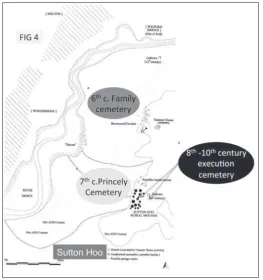
The new research at Sutton Hoo (1983–2005) showed that there are three successive cemeteries there50 (Figure 4).
48 James H. Early Medieval cemeteries in Wales // The Early Church in Wales and the West / Ed. N. Edwards and A. Lane. Oxford, 1992. P. 90–103; Holbrook N. and Thomas A. An Early-medieval Monastic Cemetery at Llandough, Glamorgan: Excava-tions in 1994 // Medieval Archaeology. 2005. Vol. 49. P. 1–92.
49 Alcock L. Dinas Powys. An Iron Age, Dark Age and early medieval settlement in Glamorgan. Cardiff, 1963; Edwards N. Early Medieval Inscribed Stones and Stone Sculpture in Wales: Context and Function // Medieval Archaeology. 2001. Vol. 45. P. 15–40.
[image:16.391.61.325.121.402.2]50 Carver M. Sutton Hoo. A seventh century princely burial ground and its context. Lon-don, 2005; Before Sutton Hoo: the Prehistoric Landscape and Early Anglo-Saxon Cem-etery a Tranmer House, Bromeswell, Suffolk / Ed. C. Fern. Norwich (forthcoming).
The Þ rst is a cremation and inhumation cemetery of Anglian type, lying on the 30 m contour overlooking the River Deben and dating through the sixth century. The excavated sample (in advance of the construction of the visitor centre) was necessarily small, but it had some familiar aspects: cremations, inhumations, small mounds and reuse of a Bronze Age mound. One of the later mound burials employed the unusual rite of cremation in a bronze bowl. Since the mounds were mainly grouped on the eastern periphery, it seems likely that a large part of the cemetery still awaits discovery to the west.
Sutton Hoo’s celebrated monumental mounds and ship burials lie some 500 m south at the same level above the river. The cemetery is inaugurated by mounds covering cremations in bronze bowls (Mounds 5 to 7, 590–600) and continues with a horse and rider under the same mound (Mound 17, c. 600). The sequence then turns towards even more high-proÞ le monumentality with two ship burials, one where the ship was placed over a chamber grave (Mound 2, c. 610) and the second where the chamber was placed in a ship and the ship in a trench (Mound 1, c. 625). Later burials were more modest: three children or teenagers, and a woman with silver ornaments lain on a couch (Mound 14, c. 650). Looting had damaged most of the burials, in some cases severely inhibiting interpretation. Only Mound 17 and Mound 1 escaped serious looting. Mound 17 plausibly presents us with a heroic Þ gure of princely rank and Mound 1 with a regal Þ gure who has been linked with the documented pre-Christian East Anglian ruling dynasty, and king Raedwald in particular (died c. 625). The cemetery as a whole can be seen as operating on the international stage. The horse and rider grave makes references to Frankish practice. The rite of ship burial in Mound 1 shows strong links to contemporary Scandinavian practice but the grave included decorated objects using Roman, German and Celtic vocabulary. It is conscious of many kinds of power: Roman, British, Scandinavian, Christian and pagan, but still succeeds in proclaiming its own independence. It can be argued that the relationship with heroic poetry is not only close but parallel and interactive. The contents and rituals of these monumental burials, full of allusions valid at the time, are themselves rhetorical compositions, material eulogies, analogous to verbal compositions. Thus Sutton Hoo does not imitate “Beowulf”, nor “Beowulf” Sutton Hoo. Both draw on the language of poetry, but express it in different media51.
A third cemetery was added to the gathering of monumental mounds after a short interval. It consisted of 39 execution victims buried in two clusters, one around Mound 5, the other on the eastern periphery next to a track. The bodies had been dumped unceremoniously in graves that were sometimes too small. In several instances, wrists and ankles lay together as if tied. Some heads were missing or dislocated and fragments of rope were found around one neck. The group on the periphery was arranged around an open space containing a tree pit and four post holes, interpreted as a gallows. Radiocarbon dating placed these burials in the eighth–tenth century. With the help of a nationwide study of this phenomenon52, the Sutton Hoo groups were shown to be execution victims at a time when the rulers were Christian53. The choice of the princely burial ground as a place of execution may have been prompted by its prominence in the landscape, but the implied location of a gibbet or gallows on Mound 5, thought to be the “founder mound”, seems more deliberate than convenient. The status of the princely burial ground, its nature, contents and occupants presumably still widely remembered in the eighth century, has been demeaned and rebranded. This context implies that the victims criminalised by the new regime could have been condemned as dissenters or non-conformists54.
Spong Hill, Wasperton and Sutton Hoo offer a vignette of the use of the mound in England. It was not part of the baggage brought over from the continent by immigrants, and a period of half a century or more is implied in which burial is more votive than political. Towards the middle of the sixth century, mounds are built or previous Bronze Age mounds are colonised. An interest in the intellectual ownership of the prehistoric landscape is an aspect of this phase55. At Spong Hill, Wasperton and Sutton Hoo 1, the mounds are modest and placed on the edge of the existing folk cemetery. At Sutton Hoo 2 they become monumental, erected on a separate site and notably eclectic: cremation in bronze bowls, horse burial, chamber burial, ship burial, bed burial all within a small cemetery that endured for barely 60 years. It can be inferred that this period (590–650) was both important for declaring monarchical control and also politically
52 Reynolds A. Anglo-Saxon Deviant Burial Customs. Oxford, 2009. 53 Carver M. Sutton Hoo. A seventh century princely burial ground. P. 348.
54 Ibidem. P. 349; cf. Semple S. Perceptions of the Prehistoric in Anglo-Saxon England. Oxford, 2013. P. 222.
volatile. It was the coincidence between the extravagant burial rites and Christianisation, which both began here around the 590s, that led to the suggestion that mound-building was an act of asserted independence and a statement of deÞ ance in the face of a perceived Christian imperialism, one that threatened East Anglia’s relations with its natural allies across the North Sea56. Sutton Hoo 3, the execution cemetery, aligns with the documented facts of subsequent East Anglian kingship. After Raedwald died in c. 624/625, came Eorpwald (died 627/628), and the Christian Sigebert who was dragged from his monastic retreat by his successor Ecgric to Þ ght the pagan Penda, who killed them both in 636/637. The successor king Anna was a Christian, as were all who succeeded him. If the alignment of the kingdom was equivocal until the middle of the seventh century, by the eighth century there was a context in which Christian belief should be enforced, by execution if necessary. Monumental mounds may be witnesses to (or champions of) ideological persuasion and even political direction. Since they were designed to remain in the landscape, it is likely that this role was intended to endure. This forms the Þ nal topic to be discussed here.
Mounds in governance
The names used for mounds in their afterlife show that the presence of special ancestors is remembered or claimed, for example Taplow (“Taeppa’s Low”), Anundshög (“Anund’s mound”), Oseberg, (“the mound of Åse”). A new ruler must take account of earlier heroes, and heroes persist in the landscape, perhaps more forcefully than they do in epic poetry. Monuments must either be embraced, rebranded or neutralised. Events at the Viking period sites of Jelling, Oseberg and Gokstad provide between them a useful allegory for the process. The two large mounds at Jelling stand over a stone ship setting in a trapezoidal enclosure that also contained buildings of Trelleborg type57. Between the mounds stand a church and two runestones that place the site in history thanks to their citation of the tenth century king Harald Bluetooth and his father Gorm. The larger of the two
56 Carver M.O.H. Sutton Hoo in context. P. 99; see above.
stones announces that “King Harald ordered this monument made in memory of Gorm, his father, and in memory of Thyre, his mother; [he was] that Harald who won for himself all of Denmark and Norway and made the Danes Christian”58. The images on the stone represent Christ as Odin on one side and a dragon Þ ghting a serpent on the other. Early excavations in the north mound (Gorm’s mound) revealed a wooden chamber, largely empty apart from some scraps of bone and metalwork. Excavations within the church revealed a chamber grave containing some bone and metalwork that appears to complement that found in the mound59. It was deduced that at a given moment Harald had transferred his father’s remains out of the mound and into the church, so as to allow him to beneÞ t from the new ideology, or at least to prevent his bones promoting the old. The south mound was built later and contained no burial. It may have been intended for Thyre or for Harald or as a thing mound — a focus for meetings (see below).
Further examples of Harald’s use of mounds for ideological cleansing has been shown at Oseberg and Gokstad both of which were broken into in the tenth century. In the case of Oseberg, dendrochronology showed that while the burial itself took place around 834, the wooden spades found in it dated between 953 and 976. The chamber within the ship was not obviously robbed, but the skeletons of the two women buried there were removed and their bones scattered at the point of the break-in and beyond. This episode coincides with the time of Harald’s ascendency and supposed conquest of Norway, between AD 958–970. It shows that the mound had continued to command allegiance over its region for more than a hundred years, and in consequence its potency had to be dealt with by a conqueror60.
In practical terms, a mound is an artiÞ cial “high place” sometimes prominent in a ß at or coastal landscape and so constituting a natural rallying point that can serve the interests of social control. Both cult and governance require assembly, that is provision for large numbers of people to gather so that they can be reproved or
58 Danmarks runeindskrifter / L. Jacobsen, E. Moltke. Kobenhavn, 1941. B. I. S. 42. 59 Krogh K. The royal Viking Age monuments at Jelling in the light of recent
archaeo-logical excavations // Acta Archaeologica. 1982. Vol. 53. P. 183–216.
energised in matters of political or spiritual action61. The thing, a purpose-built ß at-topped mound is known from later Icelandic saga as a place of quasi-democratic assembly. The Tynwald is a tiered hill still in use to today as the ceremonial place of government of the Isle of Man62. The Þ fth-century example at Gamla Uppsala is situated on the esker beside three giant “heroic” burial mounds. The inference is that many larger burial mounds could potentially have been used in a similar way, a place for a small group to look down on a large group and give them direction, citing the authority of the ancestors within.
Direct archaeological evidence of this aspect of mound-use is archaeologically elusive, especially for mounds made of earth which have often been quarried or ploughed away by later generations. However, indirect evidence is accumulating. In England, known early meeting places frequently refer to barrows and S. Semple has located examples where mounds surviving at such places have been shown to have featured subsidiary burials of appropriate date63. Later assembly at Sutton Hoo, principally in the context of governance, is implied by its two execution sites (at Mound 5 and beside the north-south axial track). Yeavering, an Anglo-British central place in Northumbria, did not make use of monumental mounds but had a purpose-built timber “grandstand” inspired by Roman theatres. In this case, the assembly looked down from its seat onto a focal point where spiritual and war leaders could address them64. Indirectly, there is some credibility in the idea that seventh-century England required a provision of assembly for purposes of governance, and such provision included the use of ancestral mounds.
To raise conÞ dence that mounds might be used in this way, we can draw analogies from further aÞ eld. Cahokia, near St Louis on the ß ood plain of the upper Mississippi in the USA was a gathering of more than 100 mounds containing many skeletons deposited in layers. The largest, Monks Mound, dominating a central plaza, is about 30 m
61 Assembly Places and Practices in Medieval Europe / Ed. A. Pantos and S. Semple. Dublin, 2004; Semple S. Locations of assembly in early Anglo-Saxon England // As-sembly Places. P. 135–154..
62 Darvill T. Tynwald Hill and the ‘things’ of power // Assembly Places. P. 217–232. 63 Semple S. Perceptions of the Prehistoric. P. 216–218; Pantos A. The location and form
of Anglo-Saxon Assembly-places; some “moot points” // Assembly Places. P. 155–180. 64 Hope-Taylor B. Yeavering: an Anglo-British Centre of Early Northumbria. HMSO,
high and has four terraces and a ß at summit on which large timber buildings once stood, including sweat houses and charnel houses. Other mounds and shrines and post-circles stand around the plaza and the whole was surrounded at one time by a palisade. Work on the huge Monks Mound began in the tenth century AD, and mound building ß ourished in the eleventh century AD65. This is the largest centre known in the Mississippi culture, which is associated with the formation of chiefdoms — “a form of political centralization that included inherited leadership positions legitimized by widely shared beliefs and customs”66. The chiefdom so deÞ ned offers an analogy with the European “kingdom”.
The kofun of Japan are perhaps the largest burial mounds ever built. Mounded tombs were already being erected in the late Yayoi period but the genre erupted suddenly as a number of massive keyhole-shaped hills over 300 m long. This monumental upsurge is held to indicate a major episode in the formation of the Yamato state in the early Þ fth century67. Traditionally this state united the southern provinces under a single emperor, ancestors of the surviving imperial family. These monuments, for example, the tomb of the Emperor Nintoku in Osaka, which is 821 m long and 32 ha in area, remain in the care of the imperial household.
Although excavation of the Osaka mounds is prohibited, examples in Kyushu further south have been completely dissected (Figure 5).
This shows that the mounds, keyhole in plan, are constructed in terraces reinforced by pebbles. Burials in stone chambers are found in the round part of the keyhole. The earliest tombs of the third to Þ fth centuries are secondary to the mounds, while from the Þ fth to seventh century the mounds are erected over the tombs68. On the terraces are found pottery vessels and models of ships, houses etc., and it is on the typology accorded to these haniwa that the chronology of mounds is based. In the general evolutionary model of mound building, small
65 Milner G.R. The Moundbuilders. Ancient peoples of Eastern North America. London, 2004. P. 134.
66 Ibidem. P. 124.
67 Anderson A. Recent developments in Japanese prehistory: a review // Antiquity. 1987. Vol. 61. P. 279; Ichinose K. Dai o bo to zenpo koenfun (Tombs of the great kings and keyhole-shaped mounds). Tokyo, 2005; Pearson R. Fifth-century rulers of the Ka-wachi Plain, Osaka, and early state formation in Japan: some recent publications // Antiquity. 2009. Vol. 83. P. 523–527.
keyhole mounds give way to larger, and then to massive keyhole mounds, which are joined by satellite mounds both round and square (baicho). The grand kofun occupy a sanctiÞ ed space deÞ ned by a moat so that visits are regulated, but the quantities of haniwa show that large number of people were involved. It is legitimate to imagine that these people had access to the terraces according to their rank and that the most important people, like the ancestors before them, occupied the focal point at the round end, which could be seen by those standing on the rising ß ange of the mound, so providing an auditorium on the same principle as the Yeavering grandstand. Thus the rationale for the ever larger kofuns should be that they had to assemble ever larger groups of people. This hypothesis is hard to prove, but it might provide an enhancement of the general model preferred in the Japanese literature — that the mounds witness a state formation process — and suggest a practical way in which they might serve it.
[image:23.391.43.355.42.231.2]in the mounds. Buddhism arrived from China via Korea in 552 AD. It did not supplant Shinto, especially in imperial circles, but the construction of Buddhist (and Shinto) temples had largely superseded the construction of mounds by the seventh century69. The analogy can thus be stretched beyond the role of the mounds in social control, to the context of their construction at a time of ideological aggression.
Conclusion
One hundred years after the publication “The Heroic Age” we are still in its debt for its illumination of the Migration period. For Chadwick, barrows were material corroborations of the heroic poetry and conÞ rmed the formation of kingdoms, which he saw as happening without an ethnic basis. The barrows may also be regarded as poetic statements in their own right, proclaiming the transfer of spiritual allegiance to the hero or to Odin. The barrow was complemented by the grand hall, in which the new elite abrogated ritual practice to themselves. The new supernatural apparatus arrived in the Þ fth century and may or may not have owed its genesis to the Huns. It does appear to have provided a new prescription that slowly superseded that of making votive offerings to local deities in natural places.
Burial mounds remained in the landscape, so could not be neglected in later state-forming projects. They could be broken where it was perceived that their power was subversive, and the active agent (the skeleton of the ancestor) removed. It seems likely that mounds were used at Þ rst, and subsequently, as assembly places, their high platforms serving to emphasise domination. We have few examples of this in Europe, as our mounds are so damaged. But there are useful analogies from Japan and elsewhere that might help to direct future lines of inquiry.
Just as we understand better the meaning of heroic poems by studying their broader context, so the study of these broader analogies should help us understand the language of the burial mounds. The role of the barrow in state formation is indirect, offering us the rousing speeches of leaders rather than the substance of a nation. What the burial mound appears to witness is an ideological pressure, either from a triumphant incoming group as was proposed for the Þ fth-century Huns in Scandinavia, or from a new religion as in seventh-century
England. In either event, the monuments may signal the arrival of a new dynasty, or more certainly a new political direction and declared allegiance. Anything less would seem unworthy of such a colossal investment.
REFERENCES
Alcock L. Dinas Powys. An Iron Age, Dark Age and early medieval settlement
in Glamorgan.Cardiff, 1963.
Anderson A. Recent developments in Japanese prehistory: a review // Antiquity.
1987. Vol. 61. P. 270–281.
Assembly Places and Practices in Medieval Europe / Ed. A. Pantos and S. Semple. Dublin, 2004.
Before Sutton Hoo: the Prehistoric Landscape and Early Anglo-Saxon Cemetery a Tranmer House, Bromeswell, Suffolk / Ed. C. Fern. Norwich (forthcoming).
Bill J. and Daly A. The plundering of the ship graves from Oseberg and Gokstad:
an example of power politics // Antiquity. 2012. Vol. 82. P. 808–824.
Böhme H.W. Adelsgräber im Frankenreich. Archäologsche Zeugnisse zur
Herausbildung einer Herrenschict unter dem merowingischen Königen // Jahrbuch des Römisch-Germansischen Zentralmuseums. 1993. Bd. 40. S. 397–534.
Bradley R. The Passage of Arms: An archaeological analysis of prehistoric
hoards and votive deposits. Cambridge, 1990.
Brusgaard N. . Places of Cult and Spaces of Power (MA diss University of
Leiden, 2012).
Campbell J. The impact of the Sutton Hoo discovery on the study of
Anglo-Saxon history // Voyage to the Other World. The legacy of Sutton Hoo / Ed. C.B. Kendall and P.S. Wells. Minneapolis, 1992. P. 79–102.
Carver M. Burial as Poetry: the context of treasure in Anglo-Saxon Graves //
Treasure in the Medieval West / Ed. E. Tyler. York, 2000. P. 25–48.
Carver M. Sutton Hoo. A seventh century princely burial ground and its context.
London, 2005.
Carver M.O.H. Commerce and cult. Confronted ideologies in 6–9th century
Europe // Medieval Archaeology. 2015. Vol. 59. P. 1–23.
Carver M.O.H. Sutton Hoo in context // Settimane di Studio del Centro Italiano
di studi sull’alto medioevo. 1986.Vol. 32. P. 77–123.
Carver M., Hills C. and Scheschkewitz J. Wasperton: A Roman, British and
Anglo-Saxon Community in Central England. Woodbridge, 2009.
Chadwick H.M. The Cult of Othin: An Essay in the Ancient Religion of the
North. London, 1899 (online at URL: < http://ru.scribd.com/doc/2906612/ The-Cult-of-Othin-by-H-M-Chadwick#scribd >).
Continuity for Centuries. A ceremonial building and its context at Uppåkra, southern Sweden / Ed. L. Larsson. Uppsala, 2004 (Uppåkrastudier 10).
Crumlin-Pedersen O. Bådgrave og gravbåde på Slusegård. Slusegård-gravpladsen
III // Jysk Arkæologisk Selskabs Skrifter. 1991. B. XIV, 3. S. 93–266.
Darvill T. Tynwald Hill and the ‘things’ of power // Assembly Places and
Practices in Medieval Europe / Ed. A. Pantos and S. Semple. Dublin, 2004. P. 217–232.
Edwards N. Early Medieval Inscribed Stones and Stone Sculpture in Wales:
Context and Function // Medieval Archaeology. 2001. Vol. 45. P. 15–40.
Eriksen M.H. Between the real and ideal. Ordering, controlling and utilising
space in power negotiations — Hall buildings in Scandinavia, 250–1050. Unpublished MA dissertation, University of Oslo, 2010.
Excavations at Helgö XVIII: Conclusions and New Aspects / Ed. B. Arrhenius and U. O’Meadhra. Stockholm, 2011.
Fabech Ch. Reading Society from the Cultural Landscape. South Scandinavia
between Sacral and Political Power // The Archaeology of Gudme and Lundeborg. Papers presented at a Conference at Svendborg, October 1991 / Ed. P.O. Nielsen, K. Randsborg and H. Thrane (Arkaeologiske Studier X). Copenhagen, 1994. P. 169–183.
Fabech Ch. and Näsman U. Ritual landscapes and sacral places in the Frist
Millennium AD in South Scandinavia // Sacred Sites and Holy Places / Ed. N.S. Walaker and S. Brink. Turnhout, 2013. P. 53–109.
Härke H. Anglo-Saxon immigration and ethnogenesis // Medieval Archaeology.
2011. Vol. 55. P. 1–28.
Hedeager L. Iron Age Myth and Materiality. An archaeology of Scandinavia AD
400–1000. Oxford, 2011.
Herschend F. Beowulf and St Sabas: the tension between the Individual and
the Collective in the Germanic society around 500AD // Tor. 1992. Vol. 24. P. 145–164.
Hills C. History and archaeology: the state of play in early medieval Europe //
Antiquity. 2007. Vol. 81. P. 191–200.
Hills C. and Lucy S. Spong Hill. Part XI: Chronology and synthesis. Cambridge,
2013.
Holbrook N. and Thomas A. An Early-medieval Monastic Cemetery at
Llandough, Glamorgan: Excavations in 1994 // Medieval Archaeology. 2005. Vol. 49. P. 1–92.
Hope-Taylor B. Yeavering: an Anglo-British Centre of Early Northumbria.
HMSO, 1977.
Ichinose K. Dai o bo to zenpo koenfun (Tombs of the great kings and
keyhole-shaped mounds).Tokyo, 2005.
Jacobsen L., Moltke E. Danmarks runeindskrifter. Kobenhavn, 1941. B. I.
James H. Early Medieval cemeteries in Wales // The Early Church in Wales and
Jørgensen L. Gudme and Tissø. Two magnate complexes in Denmark from the 3rd to the 11th century // Neue Studien zur Sachsenforschung. 2010. Vol. 1. P. 273–286.
Krogh K. The royal Viking Age monuments at Jelling in the light of recent
archaeological excavations // Acta Archaeologica. 1982. Vol. 53. P. 183–216.
Mason R.H.P. and Caiger J.G. A History of Japan. Tokyo, 1997.
Milner G.R. The Moundbuilders. Ancient peoples of Eastern North America.
London, 2004.
Müller-Wille M. Kongtum und Adel im Spiegel der Grabfunde // Die Franken:
Wegbereiter Europas. Mannheim, 1996. S. 206–221.
Müller-Wille M. Monumentale Grabhügel der Völkerwanderszeit in Mittel- und
Nordeuropa: Bestand und Deutung // Mare Balticum: Beiträge zur Geschichte des Ostseeraums in Mittelalter und Nuezeit: Festschrift zum 65. Geburtstag von Erich Hoffmann / Hrggb. W. Paravicini (Kieler Historische Studien. Bd. 36). Sigmaringen, 1992. S. 1–20.
Munch G.S, Johansen O.S. and Roesdahl E. Borg in Lofoten. A chieftain’s farm
in North Norway. Trondheim, 2003.
Myhre B. Chieftains’ graves and chiefdom territories in South Norway in the
Migration period // Studien zur Sachsenforschung. 1987. Vol. 6. P. 169–197.
Näsman U. Scandinavia and the Huns. A source-critical approach to an old
question // Fornvännen. 2008. Vol. 103. P. 111–118.
Pantos A. The location and form of Anglo-Saxon Assembly-places; some “moot
points” // Assembly Places and Practices in Medieval Europe / Ed. A. Pantos and S. Semple. Dublin, 2004. P. 155–180.
Pearson R. Fifth-century rulers of the Kawachi Plain, Osaka, and early state
formation in Japan: some recent publications // Antiquity. 2009. Vol. 83. P. 523–527.
Price N. The Viking Way. Religion and war in Late Iron Age Scandinavia (AUN
31) Uppsala, 2002.
Ramqvist P.H. Högom. Part 1: The excavations 1949–1984. Stockholm, 1992.
Ramqvist P.H., Müller-Wille M. Regionale und überregionale Bedeutung
des völkerwanderungszeitlichen Gräberfeldes von Högom, Medelpad, Nordschweden. Ein Vorbericht // Germania. 1988. Bd. 66/1. S. 95–134.
Reynolds A. Anglo-Saxon Deviant Burial Customs. Oxford, 2009.
Roesdahl E. The emergence of Denmark and the reign of Harald Bluetooth //
The Viking World / Ed. S. Brink. Oxford, 2008. p. 652–664.
Sacred Sites and Holy Places / Ed. N.S. Walaker and S. Brink. Turnhout, 2013.
Semple S. Locations of assembly in early Anglo-Saxon England // Assembly
Places and Practices in Medieval Europe / Ed. A. Pantos and S. Semple. Dublin, 2004. P. 135–154.
Semple S. Perceptions of the Prehistoric in Anglo-Saxon England. Oxford, 2013.
Stocker D. and Everson P. The straight and narrow way; Fenland causeways and the conversion of the landscape in the Witham valley, Lincolnshire // The Cross goes North. Processes of conversion in northern Europe / Ed. M.O.H. Carver. Oxford, 2003. P. 271–288.
The Archaeology of Gudme and Lundeborg. Papers presented at a Conference at Svendborg, October 1991 / Ed. P.O. Nielsen, K. Randsborg and H. Thrane (Arkaeologiske Studier X). Copenhagen, 1994.
Van de Noort R. The context of early medieval barrows in western Europe //
Antiquity. 1993. Vol. 67. P. 66–73.
:
: , « »
. . ,
. ,
-, ,
V . . .,
.
, « ». ,
-:
.
. ,
-.
-:
,
-, , , .
( V
X ) ,
.
. ,
, , , ,
.
-, -
(Ó ). , ,
, .
: , (V–X .),