White Rose Research Online URL for this paper:
http://eprints.whiterose.ac.uk/108846/
Version: Accepted Version
Article:
Jiang, S, Zhang, Z-Q orcid.org/0000-0003-0204-3867, Wang, F et al. (1 more author)
(2016) A personalized-model-based central aortic pressure estimation method. Journal of
Biomechanics, 49 (16). pp. 4098-4106. ISSN 0021-9290
https://doi.org/10.1016/j.jbiomech.2016.11.007
© 2016 Elsevier Ltd. Licensed under the Creative Commons
Attribution-NonCommercial-NoDerivatives 4.0 International
http://creativecommons.org/licenses/by-nc-nd/4.0/
[email protected] https://eprints.whiterose.ac.uk/
Reuse
Unless indicated otherwise, fulltext items are protected by copyright with all rights reserved. The copyright exception in section 29 of the Copyright, Designs and Patents Act 1988 allows the making of a single copy solely for the purpose of non-commercial research or private study within the limits of fair dealing. The publisher or other rights-holder may allow further reproduction and re-use of this version - refer to the White Rose Research Online record for this item. Where records identify the publisher as the copyright holder, users can verify any specific terms of use on the publisher’s website.
Takedown
If you consider content in White Rose Research Online to be in breach of UK law, please notify us by
A Personalized-Model-based Central Aortic
1
Pressure Estimation Method
2
Sheng Jiang
1, Zhi-Qiang Zhang
2Fang Wang
3and Jian-Kang Wu
43
1
China Academy of Electronics and Information Technology,Beijing,China
4
2
School of Electronics and Electrical Engineering, University of Leeds, UK
5
3
Division of Cardiology, Beijing Hospital, Beijing, China
6
4
Department of Electrical Engineering, University of Chinese Academy of Sciences, Beijing, China
7
Email:[email protected]
8
Abstract
9
Central Aortic Pressure (CAP) can be used to predict cardiovascular structural damage and cardiovascular events, and the
10
development of simple, well-validated and non-invasive methods for CAP waveforms estimation is critical to facilitate the routine
11
clinical applications of CAP. Existing widely applied methods, such as generalized transfer function (GTF-CAP) method and
N-12
Point Moving Average (NPMA-CAP) method, are based on clinical practices, and lack a mathematical foundation. Those methods
13
also have inherent drawback that there is no personalisation, and missing individual aortic characteristics. To overcome this pitfall,
14
we present a personalized-model-based central aortic pressure estimation method (PM-CAP)in this paper. This PM-CAP has a
15
mathematical foundation: a human aortic network model is proposed which is developed based on viscous fluid mechanics theory
16
and could be personalized conveniently. Via measuring the pulse wave at the proximal and distal ends of the radial artery, the least
17
square method is then proposed to estimate patient-specific circuit parameters. Thus the central aortic pulse wave can be obtained
18
via calculating the transfer function between the radial artery and central aorta. An invasive validation study with 18 subjects
19
comparing PM-CAP with direct aortic root pressure measurements during percutaneous transluminal coronary intervention was
20
carried out at the Beijing Hospital. The experimental results show better performance of the PM-CAP method compared to the
21
GTF-CAP method and NPMA-CAP method, which illustrates the feasibility and effectiveness of the proposed method.
22
Index Terms
23
Central Aortic Pressure, Blood Fluid Dynamics, Human Artery Model, Transfer Function.
24
I. INTRODUCTION
25
Central Aortic Pressure (CAP) has been widely applied to predict the cardiovascular structural damage and cardiovascular 26
events(? ). Traditionally, Blood Pressure (BP) measured over the brachial artery using a sphygmomanometer has been used
27
to predict such damage and events directly, but the measured brachial BP can’t always accurately represent the corresponding 28
pressure in the aorta due to the influence of many factors, such as arterial stiffness, age, heart rate, body height, sex, and drug 29
therapies. All these factors can affect the relationship between brachial pressure and CAP( ? ). In recent years, the standard
30
method for CAP measurement is the direct measurement of aortic root pressures using a pressure transducer introduced into 31
the aortic root at the time of percutaneous transluminal coronary intervention( ? ). This method can provide accurate CAP
32
measurement for individuals, but it is invasive and unsuitable for routine clinical practices; therefore, the development of 33
simple, well-validated methods for non-invasive CAP derivation is critical to facilitate routine clinical applications. 34
Thus far, some ad-hoc methods have been proposed for non-invasive CAP estimation. For example, ? proposed to use
35
electrical impedance tomography (EIT) to measure the blood pressure pulses directly within the descending aorta, but it 36
required at least 32 impedance electrodes placed around the chest at the level of the axilla, which prevented it from the 37
routine clinical practice. In contrast, the Generalized Transfer Function (GTF) method, which applies a transfer function for 38
CAP derivation and related aortic hemodynamic indices extraction, has attracted extensive research interest in the past decade 39
( ? ? ). Although there are already several commercial products, such as SphygmoCorand HEM-9000AI, which are widely
40
used in the clinical environment, how to determine the transfer function, particularly the specific transfer function for different 41
subjects remains a challenge. ? further simplified the idea of a general function and proposed a simple N-Point Moving
42
Average (NPMA), mathematically a low pass filter, to non-invasively derive CAP from the radial artery pressure waveform. 43
Both the GTF-CAP or NPMA-CAP methods can be used for noninvasive assessment of central aortic pressure indices, but they 44
ignore the individual differences in terms of blood viscosity, fluid inertia and arterial compliance, which may cause significant 45
CAP errors. 46
To take the individual differences into consideration and improve the CAP estimation accuracy, it is critical to model the 47
arteries. In general, the arteries can be modeled as a 0D-model, 1D-model, 2D-model and 3D-model( ? ). The 3D and 2D
48
models are widely applied for the analysis of local blood flow. For example, ? applied a 3D-model to study blood flow
49
circulation in intracranial arterial networks. ?explored the pulsating turbulent phenomena in stenotic vessels. A 1D-model of
50
the blood flow in deformable vessels has been proven to be a simple and effective approach to simulate the hemodynamics 51
of the vascular system, which has been widely used for systematic arterial network modeling(? ). For example, ? applied
TABLE I: The subjects detailed information
(Sex,Age,Systolic blood pressure,Diastolic blood pressure and Diabetes)
Sex Age SBP(mmHg) DBP(mmHg) Diabetes
No.1 F 85 136 58 No
No.2 M 60 117.4 64.5 Yes
No.3 M 62 112.7 65.1 Yes
No.4 F 59 128.6 57.6 No
No.5 M 57 125.6 47.8 Yes
No.6 F 70 107.7 69.5 Yes
No.7 M 71 129.9 63 No
No.8 M 63 116.4 81.2 Yes
No.9 F 55 152.4 59.8 Yes
No.10 M 62 155.4 73.8 No
No.11 F 56 137.3 62.5 Yes
No.12 M 66 117.5 68.1 Yes
No.13 M 63 106.5 53.3 Yes
No.14 F 70 144.6 67.9 Yes
No.15 F 73 146 67.4 No
No.16 M 58 142.3 78.4 Yes
No.17 M 54 133.5 71.9 Yes
No.18 F 62 101.9 59.2 No
Mean±SD 63.7±7.7 128.4±16.2 65.0±8.5
Range 56%(M) 54∼85 101.9∼155.4 47.8∼81.2 66.7%(Y)
a 1D-model to compare the pressure and flow wave propagation in conduit arteries against a well-defined experimental 1:1 53
replica of the human arterial tree, which consisted of 37 silicone branches representing the largest central systemic arteries in 54
the human. ?proposed a simple lumped parameter model for the heart and showed how it could be coupled numerically with
55
a 1D model of the arteries. However, 1D-models requires defined of vessel parameters, such as vessel radius, blood density 56
and wall thickness, in advance which can’t be acquired non-invasively. Unlike a 1D-model which reduces the vessel space 57
dependence to the vessel axial coordinate only, 0D-models discretize the space dependence by splitting the cardiovascular 58
system into a set of compartments, and uses an equivalent electric circuit to describe the arbitrary length and structure of blood 59
vessels( ?? ), which can significantly reduce the complexity of the vascular modeling, but it can’t describe the geometrical
60
structure of arteries network in the 0D-model. 61
Considering the state-of-the-art for non-invasive CAP estimation and vascular system modeling, we present a personalized-62
model-based central aortic pressure estimation method (PM-CAP)in this paper. The main contributions of the paper are: 63
• Personalized artery network model: The vessels are mathematically modeled based on hydrodynamics with the continuity
64
and the momentum equations. This model method ismore thorough than the Windkessel model method.The models 65
parameters can be personalized: via measuring the pulse wave at the proximal and distal ends of the radial artery, the 66
least square method is then proposed to estimate the model parameters. 67
• Personalized transfer function and CAP waveform estimation: a Subject-specific ascending aorta-radial artery transfer
68
function can then be acquired to obtain the continuous central artery blood pressure waveform. 69
An invasive validation study with 18 subjects comparing PM-CAP with direct aortic root pressure measurements during 70
percutaneous transluminal coronary intervention was carried out at the Beijing Hospital. The experimental results have shown 71
accurate CAP estimations can be acquired with regard to the invasive measurements for all the subjects, which illustrates the 72
feasibility and effectiveness of the proposed method. 73
The remainder of the paper is organized as follows. Section II presents the viscous fluid mechanics based arteries model,the 74
patient-specific parameter estimation and CAP estimation. Experimental results and conclusion are then provided in Section 75
III and IV. 76
II. PM-CAPMETHOD
77
A. Data Acquisition
78
18 subjects (10 males, 8 females) were recruited (Table I). All volunteers gave written informed consent approved by the 79
Institutional Review Board at Beijing Hospital before participating. Direct aortic root pressure waveforms were collected during 80
percutaneous transluminal coronary intervention by inserting a 6FR angiography catheter (Cordis Corporation) into the right 81
radial artery, and the catheter was connected to the commercial Mac-Lab hemodynamic recording system(GE Healthcare) . 82
Meanwhile, pulse waveforms at the proximal and distal ends of the radial artery were also measured by catheter, which is 83
B. Human Arteries Modeling
85
Human arteries are composed of finite but very small vessels and they can be divided into large arteries and small arteries 86
according to the radius. In this section, we will introduce these two types of arteries separately. 87
1) Large arteries: As shown in the Fig.2, any large arteryΩlof lengthl can be modeled asN finite but very small vessels
88
Ωl,1∆l, Ωl,2∆l· · · and Ωl,N∆l with the same properties; therefore, we can assume cross-sectional area A0; blood viscosity, η, 89
blood density ρ, vascular thickness h0, Young’s modulus E, average blood flow Qˆ(t)and average blood pressure Pˆ(t) are 90
constant. Thus according to Equation (34) the fluid dynamics equations of large artery can then be simplified as: 91
CdP(t)
dt +Q(t, xe)−Q(t, xs) = 0 LdQ(t)
dt +RQ(t) +P(t, xe)−P(t, xs) = 0
(1)
where C = 2l√A0
β is arterial compliance, L = ρl/A0 is the fluid inertia, R =
8ηl πr4
0 is blood resistance. However, similar
92
equations can also be found in the analysis of electric circuits, thus we can simulate the flow in the vascular system based on 93
analog electric circuits. In the electric network analogy, the blood flowQand blood pressure P are equivalent to the current 94
and voltage, while arterial compliance, blood inertia and blood resistance correspond to capacitance, inductance and resistance; 95
therefore, the corresponding circuit can be derived as shown in Fig.3. 96
2) Small arteries: Similar to the large arteries, we can define a small artery as ΩM as N finite but very small vessels
97
Ω1M,∆l,Ω2M,∆l· · · andΩM,N ∆l, then we obtain the similar fluid dynamics equations as: 98
CMdPM(t)
dt +Q
M(t, x
e)−QM(t, xs) = 0
LMdQM(t)
dt +R
MQM(t)+PM(t, x
e)−PM(t, xs) = 0
(2)
whereCM is the compliance,LM is the fluid inertia,RM is the blood resistance,QM is the blood flow and PM is the blood
99
pressure. Since dP
M
(t)
dt and dQM(t)
dt are very small in small arteries, they can be ignored, thus we can simplify the above
100
equations to: 101
(
QM(t, x
e)−QM(t, xs) = 0
RMQM(t) +PM(t, x
e)−PM(t, xs) = 0.
(3)
Similarly, the corresponding circuit can be obtained as shown in Fig.4. In practice, we always take the resistanceRM in small
102
arteries as the peripheral resistance, and use symbolRPM to represent it.
103
C. Human Arteries Network Model
104
Human body has 55 large arteries and 28 small arteries. This division was originally introduced by ? and the data of
105
diameter, length , wall, thickness and Youngs modulus of 55 largest arteries was introduced by ?. Using the electric circuit
106
in Fig.3 to represent large arteries and the electric circuit in Fig.4 to represent small arteries, the human arterial network can 107
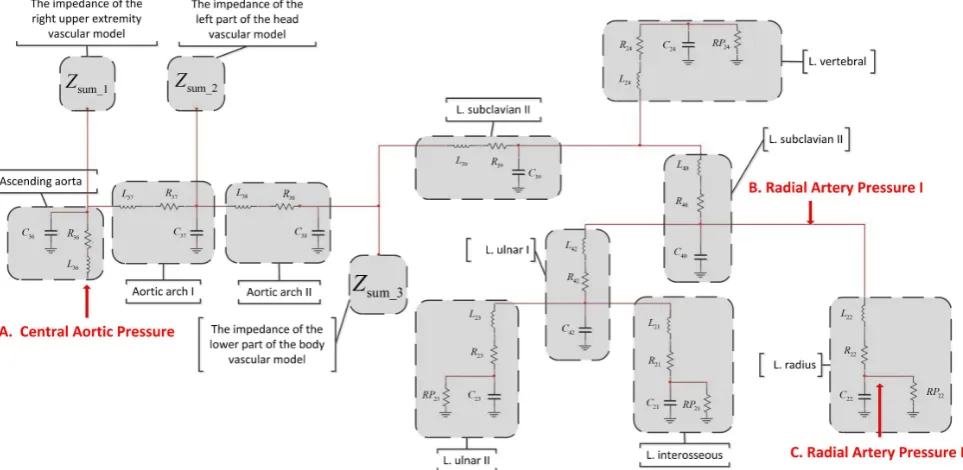
be abstracted as a network of electric circuits consisting of capacitance, inductance and resistance, as shown in Fig.5. Due to 108
space constrictions, here we only present the circuit between the left radial artery and ascending aorta, the whole body circuit 109
given at the end of this paper(Appendix B). To estimate the BP at point Afrom the BP measurement at pointB andC, the 110
circuit parameters need to be estimated first. 111
D. Patient-Specific Parameters Estimation
112
To determine the patient-specific parameters for the human artery network as shown in Fig.5, we need to estimate: 1)RPi,
113
wherei= 1,2,· · ·28, 2)Lj,Cj andRj, wherej= 1,2· · ·55. Via measuring the pulse wave of the proximal and distal ends
114
of the radial artery: P22(t, xs)andP22(t, xe), we will introduce how to estimate them separately.
115
1) Estimate Peripheral ResistancesRPi: On the basis of 0D theory, R+RP =P/CO (P is the average central aortic
116
pressure, CO is cardiac output, R is total large artery resistance, and RP is total small artery resistance). Then we have 117
2 assumption that: (1)the average BP at central artery is equal to the average BP at the proximal end of radial artery [1]; 118
(2)because of the radius of small arteries is less then the radius of large arteries, theRP is widely larger then theR ( see the 119
expression forR ,Equation (18)), ignore the R. ThenR+RP =P/CO is simplified to: 120
RP ≈ P¯22CO(xs) (4)
whereP¯22(xs)is the average BPatthe proximal end of radial artery over periodT, which can be calculated as
121
¯
P22(xs) =
1
T
Z T 0
CO is the cardiac output, which is given as?:
122
CO= 17
K2(P
s
22−P22d) (6)
wherePs
22 andP22d are the measured systolic and diastolic blood pressure at the proximal end of radial artery respectively, 123
and K is the pulse contour characteristic value as ?
124
K= P¯22(xs)−P
d
22
Ps
22−P22d
. (7)
The relationship betweenRPi and the total peripheral resistanceRP can be written as:
125 1 RPi = 1 RP − X k 1 RPk (8)
wherek= 1,2,· · ·28andk6=i. Denote the ratio wRP
k as RPRPk, then we can get
126
1
RPi
= RP
1−P
k RPRPk
= RP
1−P
kwkRP
. (9)
Here,the ratio wRP
k can be assumed to be constant for different subjects to simplify the derivation process, and they can be
127
acquired in advance?.
128
2) Estimate Left Radial Artery Model Parameters(The least squares method):R22,C22and L22: To simplify the analysis, 129
the left radial artery model is shown separately in Fig.6, where R22,L22,C22 are its resistance, inductance and capacitance, 130
respectively;P22(t, xs),P22(t, xe),Q22(t, xs)andQ22(t, xe)are blood pressures and flows in the both ends of radial artery
131
respectively. 132
From the radial artery model shown in Fig.6, we can obtain the following equations: 133 134
P22(t, xe) =Q22(t, xe)RP22
dP22(t, xe)
dt =
Q22(t, xs)−Q22(t, xe)
C22 dQ22(t, xs)
dt =
P22(t, xs)−P22(t, xe)−Q22(t, xs)·R22
L22
(10)
135
get the below equation from Equation (10): 136
L22C22RP22
d2Q
22(t, xe)
dt2 +(L22+R22C22RP22)
·dQ22dt(t, xe)+(RP22+R22)Q22(t, xe)=P22(t, xs).
(11)
Take anyN sets of measurementsP22(t, xs),P22(t, xe)from t=t1, t2· · ·tN, we can have
137
P22,N =HNθ (12)
where 138
P22,N =
P22(t1, xs)
P22(t2, xs)
.. . P22(tN, xs)
, (13) 139
θ= [θ1, θ2, θ3]T
= [L22C22P R22, L22+R22C22P R22, RP22+R22]T
(14)
and 140
HN =
d2
Q22(t1,xe)
dt2
dQ22(t1,xe)
dt Q22(t1, xe) d2
Q22(t2,xe)
dt2
dQ22(t2,xe)
dt Q22(t2, xe)
..
. ... ...
d2
Q22(tN,xe)
dt2
dQ22(tN,xe)
dt Q22(tN, xe)
(15)
so we can get θˆas: 141
ˆ
θ= (HT
ThusR22,C22 andL22can be calculated as: 142
R22= ˆθ3−RP22
C22= ˆ
θ2RP22+ q
(ˆθ2RP22)2−4ˆθ1R22(RP22)2 2R22(RP22)2
L22= ˆθ2−C22R22RP22.
(17)
The solution about estimating left radial artery model parameters is that: Firstly, the peripheral resistance of radial artery 143
RP22could be calculated by equation (4) to (9). Secondly, the blood flow at the end of radial arteryQ22(t, xe)in equation(15)
144
could be calculated by the first equation of equation set (10): Q22(t, xe) = P22(t, xe)/RP22 . It means that, we use the 145
pressure of proximal and distal ends of radial artery :P22(t, xs)andP22(t, xe)to estimate theR22 ,C22 ,L22 of radial artery 146
by equation (16) and (17). 147
3) Estimate Other large Arteries Parameters:Rj,Cj andLj : For anyjth(j= 1,2,3· · ·,55)large artery in the Fig.5, the
148
Cj,Rj andLj can be defined as?:
149
Cj =
2lj
p
A0,j
βj
Rj =
8ηlj
πr4
i
Lj =
ρlj
A0,j
.
(18)
where 150
βj=
√πh
0,jEj
(1-υ2)A 0,j
. (19)
Define 151
ωA
j =A0,j/A0,22
ωlj=lj/l22
ωjr=rj/r22
ωh
j =h0,j/h0,22
ωEj =Ej/E22
(20)
Then we can have: 152
Cj =C22·
ljpAjβ22
l22√A22βj
=C22ω
l j(
q
ωA j)3
ωh jωjE
Rj =R22
lj/(rj)4
l22/(r22)4
=R22ωlj/(ωrj)
4
Lj =L22 lj/A0,i
l22/A0,22
=L22ωjl/ωjA.
(21)
Similar towRP
i ,ωjA,ωlj,ωjr,ωhj andωEj are also constant for different subjects, and they can be acquired in advance(?).
153
E. CAP Estimation
154
Once all the parameters in the Fig.5 are known, it is straightforward to calculate the impulse response functionH(t)between 155
the radial arterial blood pressureP22(t, xe)and central aortic blood pressureCAP(t)(? ), and the central aortic pressure can
156
then be estimated as 157
CAP(t) =H(t)⊗P22(t, xe) (22)
where⊗represents the convolution operation. 158
III. EXPERIMENTALRESULTS ANDDISCUSSION
159
To better illustrate the performance of our method, we compared the estimated CAP with the ground-truth measured from 160
the catheter during percutaneous transluminal coronary intervention. For analysis purpose, the comparison between our method 161
A. CAP waveform estimation results
163
Central aortic waveforms contain valuable cardiovascular information, for example, the rising phases of the waveforms 164
reflects the myocardial contractility, while the descending phases illustrate the timing of aortic valve closure; therefore, it is 165
critical to recover the CAP waveforms. In our first experiment, parameter values of the radial artery and the blood pressure 166
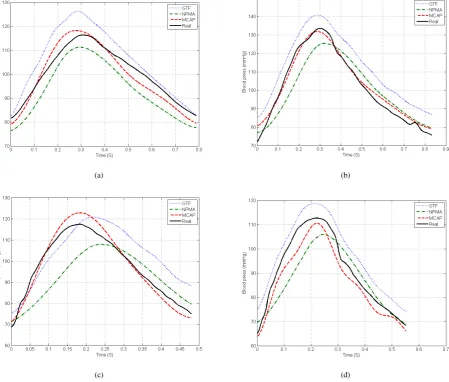
waveforms of the central artery were estimated, which are given in the Table II and Fig.7. In the Fig.7, the black solid lines 167
indicate the direct invasive measurements as the ground-truth, the red dashed lines represent our estimations, while the blue 168
dotted lines and green dotted-dashed lines are the estimated waveforms by the GTF-CAP and NPMA-CAP, respectively. 169
The GTF-CAP and NPMA-CAP measures were obtained by collected the blood pressure at the distal end of the radial artery 170
by inserting a 6FR angiography catheter (Cordis Corporation) ,which is connected to the commercial Mac-Lab hemodynamic 171
recording system(GE Healthcare) ,into the right radial artery at Beijing Hospital. The GTF method (?) to estimate the central
172
artery pressure : (1)Get the general transfer function which is calculated by a large number of clinical experiment data (?):
173
radial artery pressureaortic artery pressure. (2)Blood pressure÷GTF to estimate the central artery pressure. Thirdly, we used 174
NPMA(?) method to estimate the central artery pressure: use n-point moving average method which acts as a low pass filter
175
to smooth collected blood pressure data( n=samplingf requency/4, the value is 256 in this article). 176
As we can see from the Fig.7, it is obvious that our proposed method can get more accurate CAP waveforms for different 177
subjects compared to the GTF-CAP and NPMA-CAP methods. The main reason is we estimated subject-specific parameters in 178
our method, which could handle the individual differences ignored by both GTF-CAP and NPMA-CAP methods. As shown in
TABLE II: The parameter values of the radial artery subjects. (the oldest and youngest males and females)
ID L C R RP
(mmhg·sec2/ml)(ml/mmhg)(mmhg·sec/ml)(mmhg·sec/ml)
1(oldest female) 0.0482 0.0029 2.988 79.95
7(oldest male) 0.0248 0.0036 0.839 43.02
5(youngest male) 0.0936 0.0012 2.402 54.06
9(youngest female) 0.0121 0.0011 4.076 62.57
179
the Table II, it is evident that there are significant artery parameters differences for subjects, and ignorance of such individual 180
differences should be avoided during the CAP estimation. Although there are no ground-truth values for the artery parameters, 181
we insist it is still worthwhile to take the individual differences into consideration and try to get more accurate CAP waveform 182
estimation. The above qualitative analysis has shown that the proposed CAP estimation method can significantly improve the 183
accuracy of the central arterial waveforms over the existing non-invasive methods. To further illustrate the strength of the 184
proposed method over the GTF-CAP and NPMA-CAP methods, quantitative analysis was also conducted. Here, root-mean-185
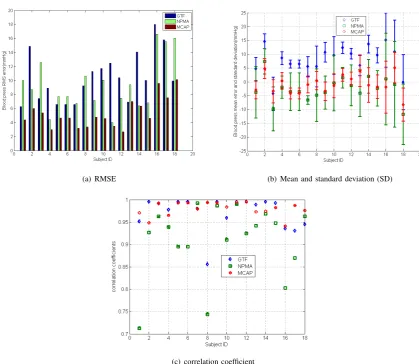
square error(RMSE)mean error and standard deviation, and correlation coefficient were used as the evaluation standards: the 186
estimated CAP and invasive measured CAP are time-varying waveforms, then we sampled 150 data points of them by 15Hz 187
frequency and subtract a point-by-point value of computed method from measured value to get errors. Lastly, calculate the 188
root-mean-square error, mean error, standard deviation and correlation coefficient. Results are shown in the Fig.8(a), Fig.8(b), 189
and Fig.8(c) respectively. As we can see from the figures, our method can achieve the smallest RMSE and high correlation 190
coefficient values for all the subjects. We also noticed the correlation coefficient values of the GTF-CAP methods are slightly 191
better than those of our method for some certain subjects, but the differences are very small and the RMSE of GTF-CAP are 192
much larger for those subjects. It illustrates that the overall performance of our method is better than those of GTF-CAP and 193
NPMA-CAP methods. 194
B. Systolic and diastolic blood pressure estimation results
195
Since the central aortic systolic and diastolic blood pressure are important indicators to measure the level of high blood 196
pressure, we also statistically analyzed the central systolic blood pressure and diastolic blood pressure as shown in the Fig.9. 197
The average errors for central aortic systolic blood pressure estimation are1.4165mmHg,6.4140mmHg and7.7991mmHg
198
for our method, NPMA-CAP and GTF-CAP, respectively, while the standard deviations of the errors are 5.8558mmHg, 199
8.1155mmHg and8.5936mmHg. The average errors for central aortic diastolic blood pressure estimation are2.1413mmHg, 200
9.4160mmHg and3.7646mmHg for our method, NPMA-CAP and GTF-CAP, respectively, while the standard deviations of 201
the errors are3.6420mmHg,4.3795mmHgand4.2777mmHg. It is evident that our proposed method can achieve the most 202
accurate and stable systolic and diastolic blood pressure estimations, and they are also consistent with the standard of the 203
Association for the Advancement of Medical Instrumentation (mean error less than 5 mmHg and standard deviation less than 204
8mmHg)(? ).
205
C. Discussion
206
Above subsections show that PM-CAP method could estimate more accurate CAP waveform for different subjects compared 207
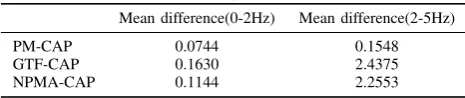
them (Table III). It shows that the error of PM-CAP transfer function0-5Hz is less than the errors of GTF-CAP transfer 209
function and NPMA-CAP transfer function. ?tell us that the power spectral density of blood pressure wave mainly distribute
210
in the 0-5 Hz. Obviously, the main reason that PM-CAP method is more accurate than other two method is PM-CAP method 211
used subjected-specific parameters.Then the transfer function between CAP(central aortic pressure) to RAP(radial artery blood 212
[image:8.595.179.412.141.190.2]pressure) of different subjects is personalized and more close to real transfer function. 213
TABLE III: Error Analysis of Transfer Function
Mean difference(0-2Hz) Mean difference(2-5Hz)
PM-CAP 0.0744 0.1548
GTF-CAP 0.1630 2.4375
NPMA-CAP 0.1144 2.2553
However, there are also some certain errors between our estimations and the direct invasive measurements. 214
The experiment uses invasive methods to obtain radial artery blood pressure for checking the validity of the artery model. 215
In general application scenario, we can use the pressure sensor to collect non-invasive radial arterial blood pressure waveform 216
, and use korotkoff sounds method to obtain radial artery blood pressure for calibrating the blood pressure waveform. The 217
korotkoff sounds method has difficult to obtain the accurate blood pressure, which will affect the accuracy of the pressure 218
value estimation, but this does not affect the accuracy of waveform estimation. 219
Although we have tried our best in the experiment to synchronize all the measurements, there was still some delay between 220
the pulse waves of the proximal and distal ends of the radial artery, which caused the errors in the model parameters estimation 221
and thus the error in the CAP waveform estimations. Meanwhile, to simplify the derivation and make the model computable, 222
we have made some approximations in the arteries network modeling and assumedwRP
i ,ωAj,ωjl,ωrj,ωhj andωjEwere constant
223
for different subjects. In normal condition, such assumption is valid and robust. However, such proportional constants may/may 224
not change duo external stimulations,such as drugs, which needs to be further verified. Due to the experimental constraints for 225
this pilot study, we didn’t take such condition into consideration. In the near future, when we carry out large scale studies, 226
we will explore the robustness of such assumption, and more rigorous tests on more subjects under different situations will be 227
carried out. 228
IV. CONCLUSION
229
In this paper, we present a personalized-model-based central aortic pressure estimation method (PM-CAP) (PM-CAP).PM-230
CAP has mathematical foundation: a novel human aortic network model is proposed and developed based on viscous fluid 231
mechanics theory. Via measuring the pulse wave of the proximal and distal ends of the radial artery, the least square method 232
was then proposed to estimate the patient-specific circuit parameters. Thus the central aortic pulse wave was then obtained 233
via calculating the transfer function between radial artery and central aortic. An invasive validation study with 18 subjects 234
comparing M-CAP with direct aortic root pressure measurements during coronary intervention were carried out at the Beijing 235
Hospital. The experimental results have shown better performance of PM-CAP method compared to the GTF-CAP method and 236
NPMA-CAP method, which illustrated the feasibility and effectiveness of the proposed method. In the future, more subjects’ 237
data will be collected and analyzed to further evaluate the proposed method. The exploration the relationship between the blood 238
vessel parameters and cardiovascular disease will also be carried out. [Conflict of interest]The authors declared that they have 239
no conflicts of interest to this work. We declare that we do not have any commercial or associative interest that represents a 240
conflict of interest in connection with the work submitted 241
[Conflict of interest]The authors declared that they have no conflict of interest to this work. We declare that we do not have 242
any commercial or associative interest that represents a conflict of interest in connection with the work submitted. 243
REFERENCES
244
Alpert B, Friedman B, Osborn D. Aami blood pressure device standard targets home use issues. Home Healthcare Horizons 245
2010;:69–72. 246
Chen CH, Nevo E, Fetics B, Pak PH, Yin FCP, Maughan WL, Kass DA. Estimation of central aortic pressure waveform 247
by mathematical transformation of radial tonometry pressure. validation of generalized transfer function. Circulation 248
1997;95(7):1827–36. 249
Dorf RC, Bishop RH. Modern control systems. Pearson, 2011. 250
Fetics B, Nevo E, Chen C, Kass D. Parametric model derivation of transfer function for noninvasive estimation of aortic 251
pressure by radial tonometry. Biomedical Engineering, IEEE Transactions on 1999;46(6):698–706. 252
Formaggia L, Lamponi D, Tuveri M, Veneziani A. Numerical modeling of 1d arterial networks coupled with a lumped 253
parameters description of the heart. Computer methods in biomechanics and biomedical engineering 2006;9(5):273–88. 254
Formaggia L, Quarteroni AM, Veneziani A. Cardiovascular Mathematics: Modeling and simulation of the circulatory system. 255
Grinberg L, Cheever E, Anor T, Madsen J, Karniadakis G. Modeling blood flow circulation in intracranial arterial networks: 257
a comparative 3D/1D simulation study. Annals of biomedical engineering 2011;39(1):297–309. 258
Hopcroft MA, Nix WD, Kenny TW. What is the Young’s Modulus of silicon? Microelectromechanical Systems, Journal of 259
2010;19(2):229–38. 260
Luo ZC, Zhang S, Yang YM. Pulse Wave Engineering Analysis and Clinical Application. Beijing: Science Press, 2006. 261
Matthys K, Alastruey J, Peir´o J, Khir A, Segers P, Verdonck P, Parker K, Sherwin S. Pulse wave propagation in a model 262
human arterial network: Assessment of 1-D numerical simulations against in vitro measurements. Journal of biomechanics 263
2007;40(15):3476–86. 264
O’Rourke MF, Seward JB. Central arterial pressure and arterial pressure pulse: new views entering the second century after 265
korotkov. In: Mayo Clinic Proceedings. Elsevier; volume 81; 2006. p. 1057–68. 266
Reymond P. Pressure and Flow Wave Propagation in Patient-Specific Models of the Arterial Tree. Ph.D. thesis; ´ECole 267
Polytechnique F ´ED ´ERale De Lausanne; 2011. 268
Reymond P, Merenda F, Perren F, R¨ufenacht D, Stergiopulos N. Validation of a one-dimensional model of the systemic arterial 269
tree. American Journal of Physiology-Heart and Circulatory Physiology 2009;297(1):H208–22. 270
Rłha K, Benes R. Testing of methods for artery section area detection 2011;. 271
Riha K, Chen P, Fu D. Detection of artery section area using artificial immune system algorithm. In: Proceedings of the 7th 272
conference on Circuits, systems, electronics, control and signal processing. 2008. p. 46–52. 273
Sol`a J, Adler A, Santos A, Tusman G, Sipmann FS, Bohm SH. Non-invasive monitoring of central blood pressure by electrical 274
impedance tomography: first experimental evidence. Medical & biological engineering & computing 2011;49(4):409–15. 275
Stergiopulos N, Meister JJ, Westerhof N. Simple and accurate way for estimating total and segmental arterial compliance: the 276
pulse pressure method. Annals of biomedical engineering 1994;22(4):392–7. 277
Stergiopulos N, Young D, Rogge T. Computer simulation of arterial flow with applications to arterial and aortic stenoses. 278
Journal of biomechanics 1992;25(12):1477–88. 279
Tsanas A, Goulermas J, Vartela V, Tsiapras D, Theodorakis G, Fisher A, Sfirakis P. The windkessel model revisited: A 280
qualitative analysis of the circulatory system. Medical engineering & physics 2009;31(5):581–8. 281
Varghese SS, Frankel SH. Numerical modeling of pulsatile turbulent flow in stenotic vessels. Transactions-American Society 282
Of Mechanical Engineers Journal Of Biomechanical Engineering 2003;125(4):445–60. 283
Wang J, Parker K. Wave propagation in a model of the arterial circulation. Journal of biomechanics 2004;37(4):457–70. 284
Westerhof N, Bosman F, De Vries CJ, Noordergraaf A. Analog studies of the human systemic arterial tree. Journal of 285
biomechanics 1969;2(2):121–43. 286
Westerhof N, Lankhaar J, Westerhof B. The arterial windkessel. Medical and Biological Engineering and Computing 287
2009;47(2):131–41. 288
Williams B, Lacy P, Thom S, Cruickshank K, Stanton A, Collier D, Hughes A, Thurston H, ORourke M, et al. Differential 289
impact of blood pressure–lowering drugs on central aortic pressure and clinical outcomes. Circulation 2006;113(9):1213–25. 290
Williams B, Lacy P, Yan P, Hwee C, Liang C, Ting C. Development and validation of a novel method to derive central aortic 291
systolic pressure from the radial pressure waveform using an N-point moving average method. Journal of the American 292
College of Cardiology 2011;57(8):951–61. 293
Zamir M. Modelling preliminaries. The Physics of Coronary Blood Flow 2005;:35–77. 294
APPENDIXA 295
A FINITE BUTVERYSMALLVESSELMODEL
296
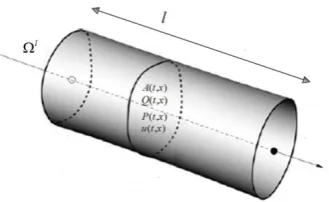
The blood vesselΩl can be defined as an elastic tube as shown in the Fig.1, wherelis the length, vis the volume, A(t, x)
297
is the cross-sectional area at timet and locationxalong the vessel axis,r(t, x)is radius,u(t, x)is blood velocity, ρ(t, x)is 298
the blood density,η(t, x)is the blood viscosity,Q(t, x)is blood flow andP(t, x)is blood pressure. If the length ofΩlis finite
299
but very small, i.e.l = ∆l, the blood viscosity η∆l, velocityu∆l and density ρ∆l will be constant, and the cross-sectional
300
area along the vessel axis will also be constant as A∆l(t) = A∆l(t, x), thusΩl can then be regarded as the finite but very
301
small vessel, denoted by Ω∆l. In general, blood has been conceptualized as a viscous fluid; therefore, it should follow the
302
laws of conservation of mass and momentum, which can be described by the basic equations of fluid dynamics: the continuity 303
equation and momentum equation, respectively(? ).
304
1) Continuity equation: The continuity equation for vesselΩl can be defined as:
305
∂A(t)
∂t +
∂Q(t, x)
∂x = 0 (23)
the continuity equation for vesselΩ∆lcan then be written as:
306
∆ldA
∆l(t)
dt +Q
∆l(t, x
wherexsandxe are the starting and ending locations of vesselΩ∆lrespectively. According to the vessel wall mechanics(?),
307
the blood pressure in Ω∆l can be calculated as
308
P∆l(t, x) =P∆l
ext(t, x) +β∆l(
q
A∆l(t)−qA∆l
0 ) (25)
whereP∆l
ext(t, x) is the external pressure on the vessel wall, A∆0l is the initial cross-sectional area when there is now blood 309
flow in the vessel, andβ∆l is a coefficient which can be defined as:
310
β∆l=
√πh∆l
0 E∆l 0.75A∆l
0
(26)
where h∆l
0 is the thickness of the wall and E∆l is the Young’s modulus( ? ). Integrate Equation(26) along the axis of the 311
blood vessel and differentiate with respect to time. 312
Z xe
xs
∂P∆l(t, x)
∂t dx=
Z xe
xs
β∆l
2p
A∆l(t)
∂A∆l(t)
∂t dx. (27)
Some papers show that the section area of artery is changed by only 10% (?? ), therefor we assumeA∆l
0 ≈A∆l(t) for the 313
vesselΩ∆l , so the average pressurePˆ∆l(t)should satisfy:
314
dPˆ∆l(t)
dt = β∆l
2p
A∆l
0
dA∆l(t)
dt . (28)
where 315
316
ˆ
P∆l= RXs
Xe P
∆l(x)dx
∆l (29)
317
Substituting (28) into (24), we can get: 318
2∆lpA∆l
0
β∆l
dPˆ∆l(t)
dt +Q
∆l(t, x
e)−Q∆l(t, xs) = 0. (30) 2) Momentum equation: The momentum equation for vessel Ωlcan be written as:
319
∂Q(t, x)
∂t + ∂ ∂x(
Q(t, x)2
A(t, x) ) +
A(t, x)
ρ(t, x) ·
∂P(t, x)
∂x
+8u(t, x)η(t, x)A(t)
ρ(t, x)r(t)2 = 0.
(31)
For the vesselΩ∆l, the above equation can be simplified as
320 321
ρ∆lZ x
e
xs
∂Q∆l(t)
∂t dx+A
∆l(t)Z x
e
xs
∂P∆l(t, x)
∂x dx
+8u
∆lη∆lA∆l(t)
(r∆l(t))2
Z xe
xs
dx= 0.
(32)
322
AsA∆l
0 ≈A∆l(t), the equation (32) can be simplified as: 323
324
ρ∆l∆l
A∆l
0 ·
dQˆ∆l(t)
dt +
8η∆l∆l
A∆l
0 (r∆0l)2 ˆ
Q∆l(t)
+P∆l(t, xe)−P∆l(t, xs) = 0.
(33)
325
According to the Zamir’s definitions(?) and Equation(30) arterial complianceC∆l, blood resistanceR∆lof the vesselΩ∆l
326
can then be written as: 327
C∆l=d∆V ∆l(t)
dPˆ∆l(t) =
∆Q∆l(t)dt
dPˆ∆l(t) =
Q∆l(t, x
s)−Q∆l(t, xe)
dPˆ∆l(t)/dt
=2∆l p
A∆l
0
328
R∆l= 8η∆l∆l
π(r∆l
0 )4 = 8η
∆l∆l
A∆l
0 (r∆0l)2
Fluid inertia L∆l means the ratio of force difference (include 2 forces: one is the pressure of blood and the other is the
329
viscous force of blood) and flow rate variation ratio. Therefore,L∆l is:
330
L∆l=
8η∆l∆l A∆l
0 (r ∆l 0 )2
ˆ
Q∆l(t) +P∆l(t, x
e)−P∆l(t, xs)
dQˆ∆l(t)/dt =
ρ∆l∆l
A∆l
0
respectively. Therefore, the equations (30) and (33) can be simplified as 331
C∆ldPˆ∆l(t)
dt +Q
∆l(t, x
e)−Q∆l(t, xs) = 0
L∆ldQˆ∆l(t)
dt +R
∆lQˆ∆l(t)+P∆l(t,x
e)−P∆l(t,xs) = 0.
(34)
APPENDIXB
332
B:HUMANARTERIESNETWORKMODEL
A. Central Aortic Pressure
B. Radial Artery Pressure I
C. Radial Artery Pressure II
36C
36R
36L
37C
37R
37L
38C
38R
38L
39C
39R
39L
24RP
24C
24R
24L
40C
40R
40L
42C
42R
42L
23C
23R
23L
21C
21L
21R
21RP
22C
22R
22L
22RP
23RP
6C
6R
6L
7L
35L
34L
5L
8L
32L
L
3029
L
2L
1L
31L
4L
3L
43L
44L
9L
45L
48L
13L
49L
50L
16L
15L
14L
51L
52L
17L
18L
53L
54L
20L
19L
25L
33L
26L
41L
55L
28L
44R
43R
9R
13R
48R
14R
45R
49R
15R
50R
16R
51R
52R
17R
R
2518
R
5R
54R
20R
19R
33R
41R
26R
R
5527
R
27L
28R
7R
34R
5R
32R
29R
30R
31R
3R
R
42
R
1R
8C
8R
7C
35C
34C
5C
32C
1C
C
229
C
3C
30C
31C
4C
9C
43C
44C
45C
48C
13C
46C
10C
11C
12C
46R
47R
47L
46L
10L
11L
12L
10R
11R
2RP
12R
49C
50C
16C
15C
14C
51C
52C
17C
18C
25C
33C
26C
41C
27C
55C
28C
20C
53C
54C
19C
4RP
3RP
1RP
8RP
sum _1
Z
7RP
RP
69
RP
13RP
10RP
11RP
12RP
17RP
18RP
20RP
19RP
26RP
27RP
RP
2816
RP
15RP
14RP
25RP
35R
47C
sum _ 2
Z
sum _ 3
Z
Thoracic aorta I
Thoracic aorta II
Abdominal aorta I
Abdominal aorta II
R. renal
L. renal
Abdominal aorta III
Sup. mensenteric
Abdominal aorta IV
Inf. mesenteric
Abdominal aorta V
Celiac I
Celiac II
Gastric
Hepatic
Splenic
L. vertebral
L. subclavian II
L. radius
L. ulnar I
L. interosseous
L. ulnar II
L. subclavian II
Aortic arch II
Aortic arch I
Ascending aorta
intercoastals
L. com. iliac
L. ext. iliac
L. femoral
L. ant. tibial
L. post. tibial
L. deep femoral
L. int. iliac
R. com. iliac
R. int. iliac
R. ext. iliac
R. deep femoral
R. femoral
R. post. tibial
R. ant. tibial
R. ext. carotid
R. int. carotid
R. carotid
Brachiocephalic
R. subclavian I
R. vertebral
R. subclavian II
R. ulnar I
R. interosseous
R. ulnar II
R. radius
L. int. carotid
L. ext. carotid
Fig. 1: The illustration of the elastic vessel
Fig. 2: The illustration of a segment of large artery
Fig. 3: The large artery model.
[image:13.595.206.391.478.533.2] [image:13.595.205.390.632.694.2]Fig. 5: The corresponding electric circuit between left radial artery and ascending aorta. Point B and C are the proximal and distal ends of the radial artery, where the BP can be measured conveniently. Point A is the starting point of central aorta, where the BP is about to estimate.
[image:14.595.191.408.591.653.2](a) (b)
[image:15.595.73.523.202.584.2](c) (d)
(a) RMSE (b) Mean and standard deviation (SD)
[image:16.595.84.504.196.560.2](c) correlation coefficient
Fig. 9: Bland-Altman analysis of central aortic systolic and diastolic blood pressure. The three horizonal lines on each sub-figure indicate: mean+2∗SD, mean, and mean−2∗SD.(a) systolic blood pressure comparison between our proposed method