UNIVERSITI TEKNIKAL MALAYSIA MELAKA
DEVELOPMENT OF EASY AND QUICK PLUG IN PLASTIC
WALL TILES
This report submitted in accordance with requirement of the UniversitiTeknikal Malaysia Melaka (UTeM) for the Bachelor Degree of Manufacturing Engineering
(Manufacturing Process) (Hons.)
by
SITI NURE FATIMA BINTI MUSTAPA B051210105
931129-10-5504
UNIVERSITI TEKNIKAL MALAYSIA MELAKA
BORANG PENGESAHAN STATUS LAPORAN PROJEK SARJANA MUDA
TAJUK: Development of Easy and Quick Plug in Plastic Wall Tiles.
SESI PENGAJIAN: 2015/2016 Semester 2
Saya SITI NURE FATIMA BINTI MUSTAPA
mengaku membenarkan Laporan PSM ini disimpan di Perpustakaan Universiti Teknikal Malaysia Melaka (UTeM) dengan syarat-syarat kegunaan seperti berikut:
1. Laporan PSM adalah hak milik Universiti Teknikal Malaysia Melaka dan penulis. 2. Perpustakaan Universiti Teknikal Malaysia Melaka dibenarkan membuat salinan
untuk tujuan pengajian sahaja dengan izin penulis.
3. Perpustakaan dibenarkan membuat salinan laporan PSM ini sebagai bahan pertukaran antara institusi pengajian tinggi.
4. **Sila tandakan ( )
SULIT
TERHAD
TIDAK TERHAD
(Mengandungi maklumat yang berdarjah keselamatan atau kepentingan Malaysia sebagaimana yang termaktub dalam AKTA RAHSIA RASMI 1972)
(Mengandungi maklumat TERHAD yang telah ditentukan oleh organisasi/badan di mana penyelidikan dijalankan)
Alamat Tetap:
No.5, Solok Iskandar 1B, Taman Iskandar, 42200 Kapar, Klang, Selangor.
Tarikh: ________________________
Disahkan oleh:
Cop Rasmi:
Tarikh:
DECLARATION
I hereby, declared this report entitled “Development of Easy and Quick Plug in Plastic Wall Tiles” is the results of my own research except as cited in references.
APPROVAL
This report is submitted to the Faculty of Manufacturing Engineering of UTeM as a partial fulfillment of the requirements for the degree of Bachelor of Manufacturing Engineering (Manufacturing Process) (Hons.). The member of the supervisory is as follow:
i
ABSTRAK
ii
ABSTRACT
iii
DEDICATION
iv
ACKNOWLEDGEMENT
v
TABLE OF CONTENT
Abstrak i
Abstract i i Dedication i i i Acknowledgment iv
Table of Content v
List of Tables v i List of Figures v i i i List of Abbreviations, Symbols and Specialized Nomenclature ix
CHAPTER 1: TITLE 1
1.1 Background of Study 1
1.2 Problem Statement 4
1.3 Objective of Study 7
1.4 Scope of Study 8
CHAPTER 2: LITERATURE REVIEW 8
2.1 Introduction 8
2.2 High Density Polyethylene 9
2.2.1 Characteristics of HDPE Plastic 10
2.3 Hot Press Machine 11
2.4 Externally Research 12
2.4.1 Questionnaire Survey 13
2.4.2 Specialists Advice 13
2.4.3 Standard Associated Product 13
2.5 Quality Function Deployment (QFD) 14
2.5.1 Four Phases of QFD 15
vi
2.6.1 Concept Screening 17
2.6.2 Concept Scoring 18
2.7 SolidWorks 19
2.7.1 Finite Element Analysis 19
CHAPTER 3: METHODOLOGY 21
3.1 Project Planning 21
3.1.1 Project Flowchart 23
3.1.2 Gantt Chart 24
3.2 Research Materials 25
3.3 Hot Press Process 26
3.4 Product Specification 28
3.4.1 Concept Selection 28
3.4.1.1 Concept Screening 29
3.4.1.2 Concept Scoring 32
3.5 Selection Criteria Identification 36
3.5.1 Prepare of Questionnaire Questions 37
3.5.2 Conduct Questionnaire Survey 37
3.5.3 Gather Data and Interpret into Graphical Form 37
3.5.4 Determine List of Criteria for Concept Selection 37
3.6 Design with SolidWorks 38
3.6.1 Simulation using SolidWorks 38
CHAPTER 4: RESULTS AND DISCUSSIONS 39
4.1 Questionnaire Survey 39
4.2 Concept Screening 43
4.3 Concept Scoring 45
vii
4.5 Manufacturing Process 48
4.5.1 Process of Plastic Wall Tiles 48
4.5.2 Process of Base Plate 49
4.6 Cost 50
4.7 Finite Element Analysis 50
4.7.1 Results of Using 16 Pins 50
4.7.2 Results of Using 8 pins 51
4.7.3 Results of Using 4 pins 51
CHAPTER 5.1: CONCLUSIONS AND RECOMMENDATIONS 52
5.1 Conclusion 52
5.2 Future Work Recommendations 53
REFERENCES 54
viii
LIST OF TABLES
2.1 Typical Properties of High Density Polyethylene HDPE 11
2.3.1 Phases of QFD 16
2.6.2 Example of Scoring Matrix 18
3.1 Gantt Chart for Whole Semester 24
3.4.1 Concept Screening Matrix 30
3.4.2 Concept Scoring Matrix 33
3.4.3 A Finer Scale Used for Concept Rating 34
4.2 Concept Screening 43
4.3 Concept Scoring 45
4.6 The Comparison between Permanent and Impermanent Adhesive 50
ix
LIST OF FIGURES
1.1 Failure of Cement 3
1.2 Decorative Panels on the Walls 4
1.3 Ceramic Tiles with Cement Failures 5
1.4 Failures of Silicon Glue 6
1.5 Examples of the Uses Screw 7
2.3 Represent of Schematic of Hot Pressing Technique 12
2.6.1 Determining Criteria Chat 17
2.7 Example of SolidWorks Part 19
2.7.1 Finite Element Analysis Part 20
3.1 Project Flowchart 23
3.2 Recycled HDPE Bottle 25
3.2.1 Example of Plastic Wall Tiles 26
3.12 Hot Press Machine 27
3.6 Part Design Drawing using SolidWorks 38
4.11 The Number of Respondents that Used Decorative Wall Tiles in Their House 39
4.12 The Number of Respondents that Interested with Recycled Plastic Wall Tiles 40
4.13 The Number of Respondents Agree That Permanent Adhesive are Sticky 40
x
4.15 The Number of Respondents Agree the New Design Concept can
Helps the Problem of Permanent Adhesive 41
4.16 The Number of Respondents Prefers of the Concept Needed 42
4.41 Back View of the Base Plate with Tiles 46
4.42 The Drawing of Base Plate 47
4.43 Side View of the Base Plate with Tiles 47
4.44 Back View of Plate of Wall Tiles 47
4.5.1 Fabrication of the Base Plate 49
xi
LIST OF ABBREVIATIONS, SYMBOLS AND SPECIALIZED
NOMENCLATURE
HDPE - High Density Polyethylene FKP - Fakulti Kejuruteraan Pembuatan UTeM - Universiti Teknikal Malaysia Melaka LDPE - Low Density Polyethylene
PP - Polypropylene
SIRIM - Standards and Industrial Research Institute of Malaysia QFD - Quality Function Deployment
1
CHAPTER 1
INTRODUCTION
1.1 Background of Study
The title of this project is a development of easy and quick plug in plastic wall tiles. The goal of this project is to find a best impermanent adhesive for a plastic wall tiles.
As we know, nowadays there has several types of tiles in the industry. Plastic is one of best materials which is cheap and recyclable items. Pick one types of plastics such as HDPE. HDPE plastic has several properties that make it ideal as a packaging and manufacturing product. It’s stronger than standard polyethylene, acts as an effective barrier against moisture and remains solid at room temperature. It resists insects, rot and other chemicals. It is easily recyclable and can be used again. Recycled HDPE creates no harmful emissions during its production or during its use by the consumer. Also, HDPE leaks no toxic chemicals into the soil or water.
Same goes to the types of installation of plastic wall tiles. Usually contractor will used cement and grouting as adhesive. Cement is a permanent adhesive. It can be exchanged depends on the user but it will take a higher cost, time and man power. As we know, cement is a cheap materials but when jump into an installation or maintenance every year the cost will be increased. The tiles can’t recyclable.
2
The idea of this project is actually come from the concept of impermanent plastic wall tiles. In the modern era, mostly houses are usually that used are tile either in bathroom, hall room, kitchen and other. There are few types and characteristics of tiles that commonly used such as ceramic tiles, homogeneous tile, glazed tiles, and rectified tile.
The most tiles that used by the people are ceramic tile but in this project we will only focus on plastic tiles. The recycle plastic wall tiles are eco-friendly option. Other than that, plastic also have a defect such as flammable. Usually, people are used cement during installation process. Cement is very easy to find and cheap. Cement is a mixture of
So that the idea to use impermanent adhesive for plastic wall tiles are generated. The impermanent adhesive are very easy to use, quick in time and can be recyclable. Other than that, impermanent adhesive can be reuse depends on the user.
According to Joseph Lewitin ( Flooring Expert, 2015 ) the drawbacks of using concrete cement for the flooring is an environmentally unfriendly. While using an existing concrete slab as floor, there is no uses of new materials. The manufacture of concrete for a new floor have a negative ecological impact. It is requires a significant expenditure of energy and carbon dioxide in order to manufacture. The major problems is it can’t be reuse or recyclable.
3
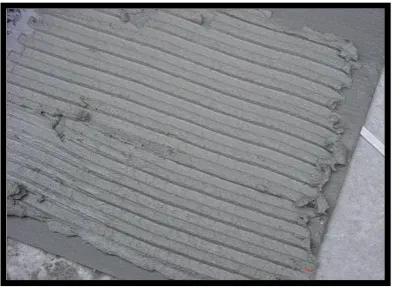
[image:18.612.208.406.199.344.2]O. Zimbili, W. Salim, and M. Ndambuki (2014) the purposes of using ceramics is a waste. Ceramic materials, which include brick walls, ceramic tiles and all other ceramic products, contribute the highest percentage of wastes within the Construction & Demolition (C&D) wastes.
Figure 1.1: Failure of Cement
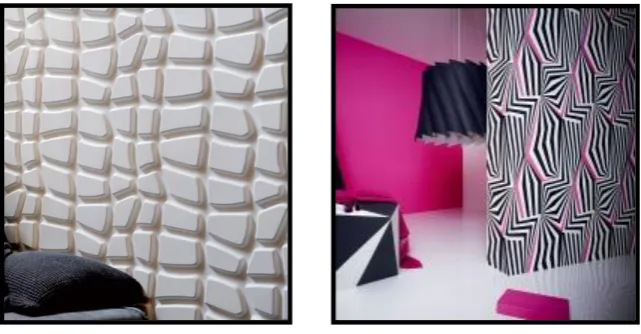
Meanwhile, from as early as the late 15th century saw the introduction of Wall Panelling. At the beginning of the 16th Century a new domestic structure started to evolve. Comfort began to spread. Aided by the printing press which distributed the new designs of Buildings in and Living in Europe. Wall Panelling & Oak Panelling were much sought after for their insulation properties. Protecting the home owners from nasty draughts and cold. From more printing publications more ornate panelling was then developed throughout the Centurys from Stuart Interiors, Georgian and Victorian.
4
[image:19.612.146.467.68.235.2]
Figure 1.2 : Decorative Panels on The walls.
1.2 Problem statement
On 16th century, the tile is used for decorative building and most of wall tile made by ceramic (Malaysian Standard, 1981). Generally, to develop the ceramic tile requires very high costs and brittle (Malaysian Standard, 1983). It also required a long time period and difficult to install. To purposes a problems which is to fix a tiles at walls easily and quick in time.
5
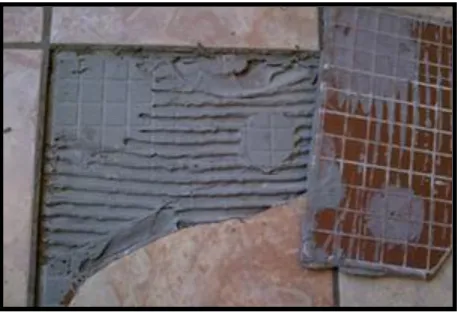
[image:20.612.192.422.172.328.2]The adhesive to stick the ceramic tiles is using cement. In order to use the cement, it requires a specific skills to handle with it. Even though the wage for others to do it is very expensive. The materials also very expensive compared to other alternatives. It takes a long period of time for mounting a ceramic tiles completely.
Figure 1.3 Ceramic tiles with cement failures.
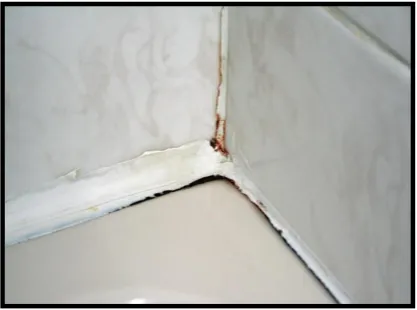
Other than that, silicon glue is using in mounting a tiles. There have a disadvantages of silicon glue. Mostly silicon glue is using in bathroom tiles. This is where the failure glue occurs. When it is used as a sealant, silicone poses a problem to the user when it comes to maintenance of exterior materials, which are sealed using silicon products. Nothing can stick on the sealant, so the sealed surface cannot be repainted or stained. When the sealant is completely cured, it is also difficult to remove. While other sealants dissolve easily in several solvents, silicon sealants are hard to dissolve.
6
[image:21.612.202.411.193.348.2]There are adhesives that are not altered against ultraviolet light while others break down in front of this radiation. The solution to this problem is to select an adhesive according to the environmental conditions in later work; this will allow us to perform a series of accelerated aging tests in order to observe the goodness of the adhesive bond.
Figure 1.4: Failures of silicon glue
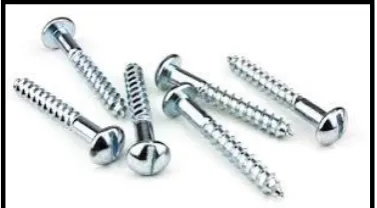
Most tile failures can be attributed to incorrect installation. The next adhesive of tiles is using mounting screw. Screw is a type of fastener and typically made of metal. Some screw thread is mention as male and female.
7
[image:22.612.212.401.194.298.2]The effects of fatigue is cracking and the next will damage the tolerant design. The user need to inspect the part periodically for cracks and replace the part frequently. Other than that, the tiles designs using mounting screw is not suitable and will damage the beauty of tiles. In term of safety for kids, screw is not safety due to their physical characteristics which is piercing.
Figure 1.5 : Examples of the uses screws.
1.4 Objective of Study
Based on the problems and challenges current techniques to install tiles, this project is obtained. The main objectives of this project is:
8
1.5 Scope of the Study
9
CHAPTER 2
LITERATURE REVIEW
2.1 Introduction
This section contains the literature review of the project which is identified with the objectives and scope of the project. This section also will consider an about material of High Density Polyethylene (HDPE) and the proper step of concept selection that involves. This project also proceed with the conceptual design and the best will be select according to the product specification.
2.2 High Density Polyethylene (HDPE)
Koerner (1992), state warm plastic material is viscoelastic, which implies that the mechanical properties mirror the thick fluid and a flexible strong without a moment's delay. Be that as it may, when versatile burdens are forced, it demonstrates the activity of thick stream (which disperse vitality) and the flexible removal (ie put away vitality). The versatile properties of materials rely on upon the time, temperature and rate of distortion. In any case, push and strain testing typically be utilized as to portray (short term) mechanical properties of plastics.