This is a repository copy of
Using Google Glass in human-robot swarm interaction
.
White Rose Research Online URL for this paper:
http://eprints.whiterose.ac.uk/104722/
Version: Accepted Version
Proceedings Paper:
Kapellmann-Zafra, G., Chen, J. and Gross, R. orcid.org/0000-0003-1826-1375 (2016)
Using Google Glass in human-robot swarm interaction. In: Towards Autonomous Robotic
Systems. Towards Autonomous Robotic Systems (TAROS 2016), June 26 - July 1, 2016,
Sheffield, UK. Lecture Notes in Computer Science, 9716 . Springer International
Publishing , pp. 196-201.
https://doi.org/10.1007/978-3-319-40379-3_20
[email protected] https://eprints.whiterose.ac.uk/ Reuse
Unless indicated otherwise, fulltext items are protected by copyright with all rights reserved. The copyright exception in section 29 of the Copyright, Designs and Patents Act 1988 allows the making of a single copy solely for the purpose of non-commercial research or private study within the limits of fair dealing. The publisher or other rights-holder may allow further reproduction and re-use of this version - refer to the White Rose Research Online record for this item. Where records identify the publisher as the copyright holder, users can verify any specific terms of use on the publisher’s website.
Takedown
If you consider content in White Rose Research Online to be in breach of UK law, please notify us by
Human–Robot Swarm Interaction
Gabriel Kapellmann-Zafra1, Jianing Chen2, and Roderich Groß1
1 Sheffield Robotics & Department of Automatic Control and Systems Engineering,
The University of Sheffield, Sheffield, UK
{gkapellmann,r.gross}@sheffield.ac.uk
2 School of Electrical and Electronic Engineering, The University of Manchester,
Manchester, UK
Abstract. We study how a human operator can guide a swarm of robots when transporting a large object through an environment with obstacles. The operator controls a leader robot that influences the other robots of the swarm. Follower robots push the object only if they have no line of sight of the leader. The leader represents a way point that the ob-ject should reach. By changing its position over time, the operator ef-fectively guides the transporting robots towards the final destination. The operator uses the Google Glass device to interact with the swarm. Communication can be achieved via either touch or voice commands and the support of a graphical user interface. Experimental results with 20 physical e-puck robots show that the human–robot interaction allows the swarm to transport the object through a complex environment.
1
Introduction
The cooperative transport of large objects by groups of comparatively small robots is a canonical task studied in collective robotics [5,8,10,4]. Algorithms for cooperative transport need to cope with individual failure and different environ-mental conditions.
Chen et al. [2] proposed an occlusion-based cooperative transport algorithm that does neither require the robots to communicate with each other, nor to consistently perceive the goal. Once the object has been found, a robot would push perpendicular to the surface, but only if it had no line of sight of the goal. In this situation, the robot’s view of the goal is assumed to be occluded by the object. Under the assumption of quasi-static movement, it was proven that any convex object will always reach the goal when using this strategy [2].
(a) (b)
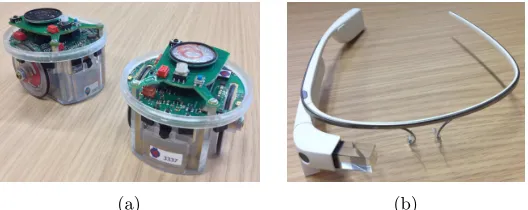
Fig. 1: (a) The E-puck robot. (b) The Google Glass.
a human guides the robots during the transportation task. The human exerts physical forces onto the object, causing it to displace. The robots, which are grasping the object, measure these forces and comply with them, by simulating the behavior of passive casters [9]. In this strategy, the human communicates with the robots only indirectly (through the object). However, this requires the human to physically interact with the object, and produce the lateral forces resulting in its displacement.
Rather than interacting with the object physically, we study how human operators can collaborate with a swarm of robots through portable devices. In [3], a tablet is used to interact with the robots in a swarm. The tablet shows the operator the relative positions of the robots (obtained using an over-head camera system). The operator can then modify the positions of the robots through the tablet. A similar interaction is studied in [1] where body gestures are used as command inputs through a Kinect to organize and position the swarm. The main difference of our system is that the human needs to interact with only a single robot, and yet gains control over the cooperative actions of the entire swarm. The latter comprises simple miniature robots of very low computational power. The leader is a robot of this swarm. A preliminary investigation using hand-held devices was reported in [2]. The present paper focuses on a more advanced interface—the Google Glass—which enables the operator to interact with the swarm in multiple ways, via touch or hands-free commands.
2
Cooperative Transport using a Swarm of Robots
The experiment is conducted with the e-puck (see Fig. 1a), which is a differential wheeled miniature mobile robot [7]. The e-puck is controlled by the on-board Microchip dsPIC30F6014A. It has 8 kB RAM and 144 kB ROM. The e-puck has a directional camera mounted in its front, eight infrared (IR) proximity sensors and Bluetooth connectivity. To make its appearance more uniform, the e-puck was fitted with a black “skirt” (not shown in the figure).
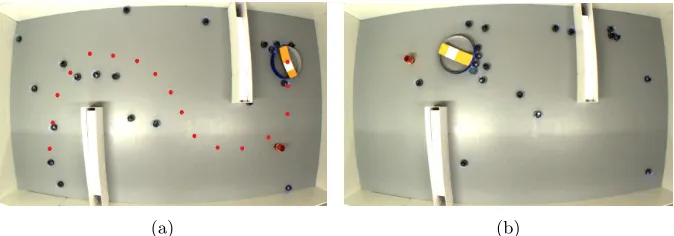
[image:3.612.174.438.115.220.2]Fig. 2: A human operator, wearing the Google Glass, guides a swarm of robots that is transporting a circular object through an arena with obstacles. The swarm consists of 1 leader robot (in red) and 20 follower robots. (a) Red markers in-dicate the example trajectory of the object throughout a trial where the final destination was the bottom-left corner of the arena. (b) Four follower robots push the object towards the position of the leader, thereby gradually approaching the final destination.
length (half of the arena width), are added as shown in Fig. 2a. The object to be transported is a blue cylinder of 42 cm diameter.
We use the occlusion-based cooperative transport controller as detailed in [2]. The robots initially move randomly through the environment, avoiding walls and each other using their proximity sensors. Once a robot detects the blue object with its camera, it approaches it. Once in contact, it performs one revolution to scan its environment for the goal—which is assumed to be of red colour. If the goal is not visible, the robot pushes the blue object for a fixed duration and then repeats scanning for the goal (the repeat scan is not necessary if two fellow robots are present to its left and right sides, respectively). Otherwise, it follows the object’s perimeter and approaches it from a different angle. Full details of the controller are reported in [2].
3
Human–Robot Swarm Interaction
To give the operator the ability to influence the swarm, one robot is configured to be a leader. The leader robot is equipped with a red cylinder—to be recognised by the other robots as the (intermediate) goal. In addition, the leader robot activates the red LEDs along its perimeter.
(a) (b)
[image:5.612.188.427.112.280.2](c) (d)
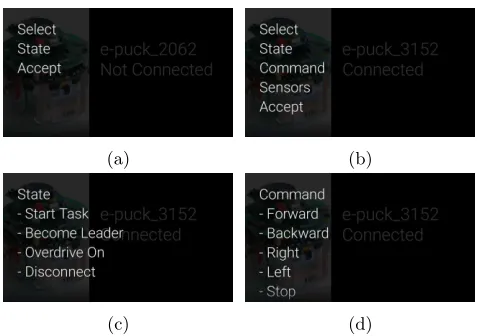
Fig. 3: Sequence of snapshots taken from the Google Glass interface. (a) Main menu when no connection to a robot is established; (b) main menu when a connection to the leader robot is established; (c) state menu when leadership is not initiated yet; (d) state menu during teleoperation.
through Wi-Fi and Bluetooth 4.0LE technology. A small interferometric high resolution display positioned at the right upper side of the operator’s visual range is used to displays the interface information. This allows the operator to connect via Bluetooth directly to the leader robot and gain control of the robot’s movement. While the robots’ sight may be occluded by the obstacles in the environment, the human has the advantage of a bird’s-eye view. This way the swarm can focus on the physical manipulation, while the operator focuses on the overall guidance.
Figure 3 shows the graphical interface that is presented to the operator via the Google Glass. Fig. 3a shows the main menu when no connection to the leader robot has been established. When the operator chooses the Select instruction, they are shown a list of robots that are detected via Bluetooth. They then selects the leader robot via theAccept instruction and connect to it via theStatemenu. Once connected, the Google Glass automatically updates the options in the main menu (Fig. 3b) and State menu (Fig. 3c). The new options in the State
menu are:
– Start Task: Executes the default behaviour of the robot—the occlusion-based
cooperative transport controller.
– Become Leader: Executes the leader mode—enabling the operator to
teleop-erate the robot.
– Overdrive On: Instructs the robot to ignore any commands issued by a
re-mote control.3
3
TheCommands menu (Fig. 3d) gives the operator complete control of the movement of the leader. The options are: {Forward,Backward,Right,Left,Stop}. The interactions with the GUI can be performed via touch and voice com-mands. Instructions issued via voice command require a sequence of words; the operator needs to sayOK Glass, followed by the name of the menu or instruction.
4
Experiment
A set of multiple trials were performed. In each trial, a total of 21 e-puck robots were used: 1 leader robot and 20 follower robots. Initially, the object to be trans-ported was put in one corner (either top right or bottom left in Fig. 2a). In all trials, the human operator was able to lead the pushing swarm along a trajec-tory using the Google Glass. The duration of the trials was on average about ten minutes. Fig. 2 shows two snapshots taking during a trial. A video recording of one of the trials is available athttp://naturalrobotics.group.shef.ac.uk/ supp/2016-002. A documentary, show-casing the experiment, featured in the
Daily Planet program of the Discovery Channel in 2015.
The operator had direct visual contact with the robots. The constant feed-back of the robots positions help the operator to maneuver the leader robot fast enough to respond to the object’s displacement. If the swarming robots were moving substantially faster, an alternative approach would be a semi-autonomous leader, which prevents obstacles by itself while getting high-level direction input by the human.
The Google Glass interface allowed the operator to interact with the swarm via either touch or voice commands. The voice command option turned out to be the preferable one by the operator, as more direct and allowing a hands-free interaction with the swarm. Despite the ease-of-use of the Google Glass interface, it presented some performance issues—such as overheating—which resulted in delays of response time during prolonged use and low performance of the in-built display.
5
Conclusions
system. Future work will focus on how the operator could interact with the swarm without having a bird’s-eye view of the environment.
Acknowledgement
The first author acknowledges scholarship support by CONACYT (Consejo Na-cional de Ciencia y Tecnologia).
References
1. Alonso-Mora, J., Haegeli Lohaus, S., Leemann, P., Siegwart, R., Beardsley, P.: Ges-ture based human-multi-robot swarm interaction and its application to an interac-tive display. In: 2015 IEEE International Conference on Robotics and Automation (ICRA). pp. 5948–5953. IEEE (2015)
2. Chen, J., Gauci, M., Li, W., Kolling, A., Groß, R.: Occlusion-based cooperative transport with a swarm of miniature mobile robots. IEEE Transactions on Robotics 31(2), 307–321 (April 2015)
3. Grieder, R., Alonso-Mora, J., Bloechlinger, C., Siegwart, R., Beardsley, P.: Multi-robot control and interaction with a hand-held tablet. In: ICRA 2014 Workshop on Multiple Robot Systems. IEEE (2014)
4. Groß, R., Dorigo, M.: Evolution of solitary and group transport behaviors for autonomous robots capable of self-assembling. Adaptive Behavior 16(5), 285–305 (2008)
5. Kube, C.R., Zhang, H.: Task modelling in collective robotics 4(1), 53–72 (1997) 6. Miyata, N., Ota, J., Arai, T., Asama, H.: Cooperative transport by multiple mobile
robots in unknown static environments associated with real-time task assignment. IEEE Transactions on Robotics and Automation 18(5), 769–780 (2002)
7. Mondada, F., Bonani, M., Raemy, X., Pugh, J., Cianci, C., Klaptocz, A., Magnenat, S., Zufferey, J.C., Floreano, D., Martinoli, A.: The e-puck, a robot designed for education in engineering. In: Proceedings of the 9th Conference on Autonomous Robot Systems and Competitions. vol. 1, pp. 59–65 (2009)
8. Pereira, G.A.S., Campos, M.F.M., Kumar, V.: Decentralized algorithms for multi-robot manipulation via caging 23(7–8), 783–795 (2004)
9. Stilwell, D.J., Bay, J.S.: Toward the development of a material transport system us-ing swarms of ant-like robots. In: 1993 IEEE International Conference on Robotics and Automation. vol. 1, pp. 766–771 (1993)
10. Tuci, E., Groß, R., Trianni, V., Mondada, F., Bonani, M., Dorigo, M.: Cooperation through self-assembly in multi-robot systems. ACM Transactions on Autonomous and Adaptive Systems 1(2), 115–150 (2006)