International Journal of Innovative Technology and Exploring Engineering (IJITEE) ISSN: 2278-3075,Volume-8 Issue-10, August 2019
Abstract: The data in the organization is distributed among multiple structured databases. The large database makes the process of risk analysis difficult, as data is distributed in the organization. Information gathering for Risk analysis is more subjective and therefore, processing incomplete information over distributed databases increase more fault in risk analysis. Linked Data representation helps to make structured, distributed data more related, combined and ready to be processed. Linked Data approach makes data interlinked and semantically rich, extracting meaning with the use of machines and eliminating the human subjectivity factor in assessing insurance risk. Using Linked data, information retrieval process can be easier as data or databases interlinked semantically. The proposed technique uses a linked data approach for risk analysis and related information retrieval methods over structured data. The work efficiency is also tested and found to be good.
Keywords: Linked Data Analysis, Semantic-web, Ontology, Information retrieval and Gathering.
I. INTRODUCTION
Advancement in data gathering and in data enrichment at an industrial level increase day by day. And it is necessary to improve the quality of data for the diverse business process involved. The blast of data is driven by two specific sources: the interpersonal network sharing information about our activities and an assortment of data recovery form collide information on our condition. Data gathering is a big challenge that minimizes data scarcity in an organization. Structured data storage in the organization has its own limitations. Advanced analytics require external data that gives additional information to make a prediction in a better way. BigData problems in insurance industries are still there compared to other industries. As disparate datasets define limits in insurance industries, Linked data representation helps in overcoming that. Life insurance industry more often has a complex structure of data where user personal details are stored in relational databases in distributed places. Through advanced analytics, we can find risk factors sources in the life insurance sector. Such possible risk factors are [3]:
1. Overall health and pre-existing medical conditions
2. High-risk activities 3. Occupation 4. Lifestyle factors
5.
Lifestyle habits such as smoking or drinking alcoholLinked data approach gives the opportunity to make data more connected with external data so that advanced analytics will be more accurate. Linked data technologies define great opportunities to make data interlinked with external data resources [1]. They use the resource description framework
Revised Manuscript Received on August 02, 2019.
Vishal Shah, SCSE, Vellore Institute of Technology, Chennai, India.
Dr. Shridevi S, SCSE, Vellore Institute of Technology, Chennai, India.
(RDF) language and HTTP protocol to publish structured data on the Web [2]. Linked data ontologies can be shared nowadays openly so that more useful methods applied to ontologies. Linked data over structured data in an organization is a challenging task but under particular ontologies can be developed. Therefore, connected ontologies can be analyzed in a more proper fashion and advanced analytics problems can be solved.
Information retrieval and gathering make linked data produce more useful result thereby making the decision easier. This paper explores the approach for converting structured data to linked data for analyzing risk by combining external data ontologies to the existing one to identify.
Further, in this paper, we have following sections. Section 2- Related work gives previous research related to linked data. Research questions give a review of our literature. Then, a proposed methodology that gives information about methods and techniques we are using. Finally we conclude with results-discussion and conclusion section.
II. RELATEDWORK
Various research works have been completed to enhance the quality of data using a linked data approach. Many studies give an idea of combined approaches or real-world applications where structured data problem are solved using linked data representation. The below subsections discusses few domains where linked data approach helped in reaching better results.
A. Linked Data, Datamining and External Open Data for
Better Prediction of At-Risk Students
Survey-based study more often time-consuming and the data correctness problem is there while we process that data. Students interest in their higher studies is important nowadays and it is the biggest challenge to improve student retention [4,5]. Data mining techniques are applied to study the patterns from past data of student database and models have been developed for students retention during recent years. One of the commonly used model is Tinto’s model [6,7], where the likelihood of a student withdrawing from higher education is seen as being determined by individual attributes, familial attributes, prior qualifications, social integration, academic integration, individual commitment, institutional commitment, and external family and societal factors. The dataset which contains multiple attributes has to be studied well to make a model which identifies students at-risk. Various sources of databases are institutional internal databases and external open data. But, the challenge is to get that database integrated [8].
Health Insurance Data Processing using Linked
Data
Therefore, the linked data approach was utilized and with the neural network identified map attributes with connected data that achieved an overall model accuracy of 84.94% [9].
B. Framework for The Identification of Fraudulent Health
Insurance Claims using Association Rule Mining
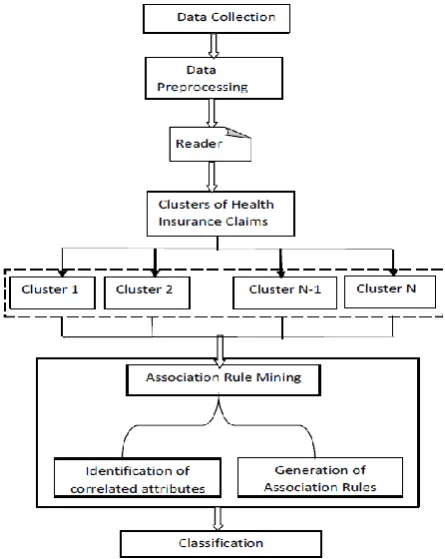
[image:2.595.314.540.140.314.2]Fraudulent claims of insurance incur a heavy loss to the insurance companies and from recent studies, it is known that 15% of the claims of insurance are fraudulent [10]. Fraudulent claims lead to different ways of claiming insurance money and thus it increases forged claims to the insurance company. The way to identify fraudulent claims can be done thru data mining techniques. Supervised and unsupervised data mining technique has their own benefit in processing the data to produce better results. The supervised technique works with train and test data. And the unsupervised technique able to discover patterns from existing data and new data also. Here, authors have completed a study of a mixture of both the techniques. With unsupervised technique, identify patterns and then with the supervised technique, based on that patterns, different classes are identified from the dataset.
Fig 1: Framework for Identify Fraudulent Insurance Claims
By this approach, authors also presented association rule mining as a promising and best fitting approach to finding fraudulent claims within the health insurance domain [11].
C. How Structured Data (Linked Data) Help in Big Data
Analysis – Expand Patent Data with Linked Data Cloud
Big Data is the solution for handling or managing the large structured or unstructured database processing. Big data is described when data in conventional databases exceeds the processing capacity in systems [12]. Big Data can be structured or unstructured with the four main characteristics Volume, Variety, Velocity, and Volume. The main challenge
[image:2.595.57.280.319.599.2]management and algorithmic techniques [13]. Where on the other hand Linked data approach allows integrating interrelated datasets that can be published and shared on the web. Day by day the linked data open cloud is growing constantly, that means data integration is becoming more important in this field.
Figure 2: The Querying Process of Patent Search Engine In this project [14] authors have built a Patent Search Engine where large dataset of patent holders and their information stored on SQL database. From that SQL database, the particular information for the patent holder is collected and correlated with open linked data cloud. Using that linked data, SPARQL (SPARQL Protocol and RDF Query Language) query is applied to collect all interlinked data for the user query. Thus linked data approach benefits information retrieval for user queries.
D. A Linked Data Approach for Geospatial Data
Provenance
Geospatial data provenances are used to obtain geoinformation from the cloud easily. Linked data cloud grows day by day constantly by linking useful information with that cloud. Linked information provides semantically rich content and also it’s machine-readable as linked data allow interlinking data based on its characteristics. This paper proposes a catalog for publishing data into linked data cloud [15].
III. REASEARCHQUESTIONS
This section gives the purpose of the proposed system by identifying certain research gaps and tries to give solution for that. The below questions are based on this research:
A. What is the Limitation with structured data in the
insurance companies?
International Journal of Innovative Technology and Exploring Engineering (IJITEE) ISSN: 2278-3075,Volume-8 Issue-10, August 2019
B. Why linked data approach so beneficial for advanced
analytics?
Linked data provides more opportunity for data enhancement, where data is in a linked data model thereby providing data having the characteristic of relativity. Therefore, any futuristic analysis will be easier through linked data.
C. How linked data approach applied for risk analysis in
the life insurance industry?
The biggest challenge to dig out in the insurance sector is risk analysis in earlier stages. Insurance industry generating structured data to store all the information of insurer and their claims. RDF modeling of insurer data and application of Rules to that data makes them more interlinked. Data extraction can be done through SPARQL query to get domain centric data.
D. In which context advanced analytics works with linked
data in the life insurance industry?
Rule-based mining is applied to the data and then according to the rules, data are segregated based on certain condition High, Low and Medium level risks are identified. Specific Insurer’s data can be analyzed with the linked data approach where their other information or geospatial information can also be analyzed.
Now, based on the research questions the proposed system is developed.
IV. PROPOSEDMETHODOLOGY
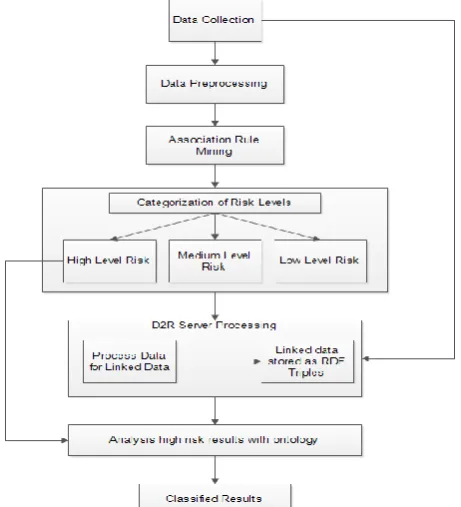
[image:3.595.54.285.485.739.2]The proposed system for this research consists of several important components namely data collection, data preprocessing, association rule mining, categorization of risk levels, D2R server processing, analysis with ontology and classified results. The below diagram illustrates the working of the proposed system.
Fig 3: Framework for Advanced Risk Analysis
A. Data Collection
Data collection for this framework completed through various ways like claims data, insurer personal data sets, and geospatial data. Partially the database is collected from kaggle.com [16]. Other related information is combined from different databases. Geospatial data is scratched from online sources through user activities and by tracking their day to day life [17].
B. Data Preprocessing
Data cleaning is the initial step of data pre-handling. It expels irregularities and redundancies from the chose data sets. Data Integrity consolidates the data which is accumulated from various sources at one place e.g. numerous databases, documents. After the data incorporation, the last advance of data pre-handling is performed which is data change. Data change changes over the data into a shape which is required for the examination for instance in this investigation the required data is "health insurance database" so data change will be finished by applying normalization to the data and health insurance claims database will be made.
C. Association Rule Mining
Rule mining in insurance data set is to identifying related attributes that can give frequent rule on the basis of high, medium and low risk level. In the association rule mining attributes identification is the first task that should be initiated first in the algorithmic approach.
Attributes Finalization: The base in association
rule mining approach is handling of attributes that relatively find rules for your conditions. Therefore, attributes and only necessary attributes finalization is very crucial in this process.
Rules Creation: Rules are generated using apriori
data mining algorithm. Apriori algorithm is used to get frequent itemsets and relevant association rules. Dependency created in association rule e.g. A B where B is dependent on A for our rule. A and B are two different item sets [18].
D. Categorization of Risk Levels
After generating the rules, risk level identified and based on that High, Medium and Low level risk records identified. Those records tagged based on the risk level. The process to identify different risk level depends on the insurance company but here we consider only high-risk measures to identify the high-level risk people.
Let consider certain measures for the high-risk level that insurance company identified based on their past experience.
(1)
Figure 4: Displaying High-Risk Records Example Those records are high-risk level records. Then, for further analysis, we only work on high-risk level records for this research.
E. D2R-Server Processing
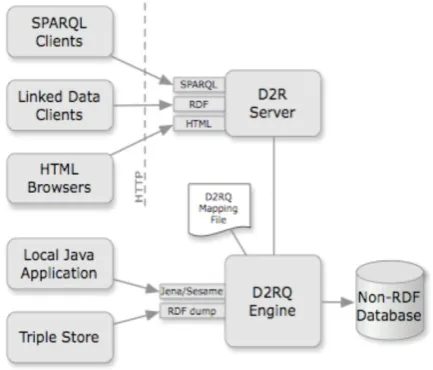
[image:4.595.312.552.228.427.2]D2R Server a tool for publishing the converted data into linked data on the web [19]. D2R server also provides functionality to convert the relational databases to linked data, so that it is ready to publish on the Semantic Web. The semantic web is a global information space which consists the data in Linked data format.
Fig 5: Publishing Data to Semantic Web
D2RQ engine provides functionality to query to the D2R engine. D2RQ engine supports most of the all traditional database and it allows query through SPARQL. The query will fetch the data into triples format. Below see the D2R server working for this work:
In the mapping process both processed and unprocessed data mapped with insurer additional data. Therefore, advanced analysis completed through ontology which is mapped combined data.
F. Analyze High-Level Risk Records With Ontology
The ontology created with the mapping of the raw data and additional information of the insurer. Thus from the ontology, the insurance company person can fire query through SPARQL and get the whole analyzed information of the high-risk level insurer. With this advanced analytics, the insurance company can track particular user data by getting additional information from web sources. Thus, the risk will be minimized as additionally insurance company knows about insurer activity.
Fig 7: Mapped Ontology
After this results will be analyzed in cyclic days to know about the high-risk level insurers. Thus fraud detection can be identified, as data are fully mapped to the insurer and from the other sources also.
G. Classified Results
Now, we will see results and discussion for this study that analyze a score of advanced analysis and predict a certain number of people who are identified as high risk level category.
V. RESULTSANDDISCUSSIONS
In this study, we have developed a linked data approach to risk analysis in an insurance sector based on the structured data. Not to choose structured data and targeting linked data analysis in this study has a particular aim to achieve. In many industries or if we take life insurance industry the data collected often structured or stored in table formats. From that table or rows and columns, dynamic analysis cannot be proven beneficial. Thus linked data analysis dynamically analyzes the data which have relation to a particular person or entity.
[image:4.595.61.278.355.540.2] [image:4.595.68.277.622.775.2]International Journal of Innovative Technology and Exploring Engineering (IJITEE) ISSN: 2278-3075,Volume-8 Issue-10, August 2019
Fig 8: High-Level Risk Records Based on the Condition The above figure displays the results based on the condition after generating rules. The high level risk values further converted to Linked data so that again geospatial information mapped to it and further analysis will be done on that.
[image:5.595.303.545.295.423.2]Plot generation and analysis can be done through python Jupyter environment. The plotting and charting based on the external data and using internal data can be displayed. Below figure shows region wise higher risk pending charges.
[image:5.595.51.285.332.482.2]Fig 9: Region-wise Pending Charges Ontology of the results data has all the attributes and is parsed to a link to be mapped with a web of data.
Fig 10: Ontology of Results
Thus the aim achieved after knowing that how easily we can do advanced analysis with the help of linked data. Linked data also placed easily on the Semantic web where machine understandable rich content acquired.
Fig 11: SPARQL query execution o Linked Data Results The above figure displays how data can be retrieved through SPARQL query language from Linked Data. The important part is that the SPARQL query fired on the knowledge base (ontology) finds appropriate RDF triples in Knowledge Base. It makes results precise when connected or linked data fetched in one instance.
True Values
Total Values
Positive High Risk Values
Negative High Risk Values
Pre
d
icte
d
Va
lu
es
Predicted condition positive
16 1
Predicted condition negative
9 24
(I)
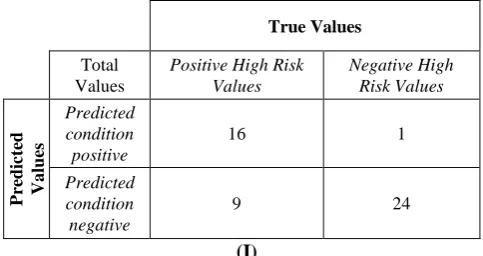
For accuracy of the results, contingency matrix is created for results based on the sample data. The above Table 1 shows numeric terms that recorded after implementation. Sample data of 50 records from 1400 records taken for implementation from our database. It was found that 16 records are Positive True which gives 0.94 as precision value and 0.64 as recall value.
Precision Value = = = 0.94 (2)
Recall Value = = = 0.64 (3)
Where, tp,fp and fn are True Positive,False Positive and
False Negative values respectively. And for the same we
found the accuracy value as 0.8.
Accuracy = = = 0.80 (4)
[image:5.595.58.293.521.659.2]VI. CONCLUSION
The insurance companies in present days gives maximum efforts to identify fraudulent claims, insurer’s risk, and areas that make a loss in the future. The loss generating in the life insurance industry make industry future perspective low. Thus the solution to map from the data or approach to analyze the data is changed now. This paper proposes linked data approach to identifying risk from insurer’s data. The mapping of the data to the external sources data converts structured data to linked data. Linked data can be easily mapped with other data thus advanced analysis will be possible through it. The future scope of this study targets mapping of big data collected through web resources of user activity or through web scrapping to linked data.
REFERENCES
1. Risk Factors in Life Insurance
https://www.finder.com/risk-factors-in-life-insurance
2. T. Berners-Lee. (2006, Jul.). Linked Data [Online]. Available:
http://www.w3.org/designissues/linkeddata.html
3. C. Bizer, T. Heath, K. Idehen, and T. Berners-Lee, “Linked Data on The
Web (Ldow2008),” In Proc. Www 2008, Pp. 1265–1266.
4. National Audit Office (Nao), "Staying the Course: The Retention of Students in Higher Education," London, 2007.
5. F. Sarker, H. Davis, and T. Tiropanis, "A Review of Higher Education
Challenges and Data Infrastructure Responses," in Proceedings of International Conference for Education Research and Innovation (ICERI2010), Madrid, Spain, 2010.
6. V. Tinto, "Dropout From Higher Education: A Theoretical synthesis Of
Recent Research," Review of Educational Research, Vol. 45, Pp. 89- 125, 1975.
7. V. Tinto, "Leaving College: Rethinking The Causes And Cures Of
Student Attrition", Contemporary Sociology, 17(3).
8. K. E. Arnold. "Signals: Applying Academic Analytics", Educause Quarterly (EQ) Magazine, 2010.
9. Farhana Sarkar et al., “Linked Data, Data Mining And External Open
Data for Better Prediction of At-Risk Students”, 2014 International Conference on Control, Decision and Information Technologies (CoDIT), DOI: 10.1109/CoDIT.2014.6996973.
10. V. Rawte And G. Anuradha, “Fraud Detection Using Data Mining
Techniques,” 2015, Vol. 4, No. 1, Pp. 304–312.
11. Framework For The Identification Of Fraudulent Health Insurance
Claims Using Association Rule Mining
12. Dumbill, Edd. What Is Big Data? An Introduction To The Big Data
Langscape. [Online] January 11, 2012.
Http://Strata.Oreilly.Com/2012/01/What-‐Is-‐Big-‐Data.Html.
13. James Manyika, Michael Chui, Brad Borwn, Jacques Bughin, Richard
Dobbs, Charles Roxburgh, Angela Hung Byers. Big Data: The Next Frontier For Innovation, Competition, And Productivity. S.L.: Mckinsey
Global Institute,2011.
Http://Www.Mckinsey.Com/Insights/Mgi/Research/Technology_And_ Innovation/Big_Data_The_Next_Frontier_For_Innovation.
14. Lishan Zhang, “How Structured Data (Linked Data) In Help in Big Data
Analysis -- Expand Patent Data With Linked Data Cloud”.
15. Jie Yuan et al., “A Linked Data Approach For Geospatial Data
Provenance”, IEEE Transactions on Geoscience and Remote Sensing, Vol. 51, Issue. 11, Pp. 5105-5112.
16. P. Yue, Y. Wei, L. Di, L. He, J. Gong, And L. Zhang, “Sharing
Geospatial Provenance In A Service-Oriented Environment,” Comput., Environ. Urban Syst., Vol. 35, No. 2, Pp. 333–343, 2011.
17. Raghu. (2018, April). Insurance, Version 1, Retrieved: August 20, 2019
From: https://www.kaggle.com/raghupalem/insurance
18. A. R. Cai Et Al., “Identification Of Adverse Interactions Through Causal
Association Rule Discovery From Spontaneous Adverse Event Reports,” Artif. Intell. Med.,2017.
19. D2R Server: A Semantic Web Front-End To Existing Relational
Databases Richard Cyganiak And Christian Bizer Freie Universitat Berlin ¨ [email protected], [email protected]
AUTHOR(S)PROFILE
Vishal Shah is pursuing his Master of Computer
Applications in VIT university, Chennai. He has presented papers in reputed conferences and also has published research papers in Journals in the area of Cognitive computing and its applications. He has worked with the research projects of the VIT faculty. His research areas are Semantic-web, Software Engineering, Linked Data and Cognitive Computing applications.
Dr.Shridevi Subramanian is currently working in