International Journal of Innovative Technology and Exploring Engineering (IJITEE) ISSN: 2278-3075, Volume-8 Issue-10, August 2019
Abstract: In extensive general stores, clients feel awkward to remain in long line for charging the obtained items. This will deteriorate at the season of celebration or regular deal. This paper gives an awesome answer for every one of these issues utilizing Li-Fi innovation. Li-Fi is another rising innovation in pattern which employments light waves to exchange information. In this paper, we propose a programmed charging framework which is not just time compelling additionally diminishes human exertion. This framework utilizes Li-Fi innovation to exchange information rapidly. The free accessible android application is conveyed in versatile utilizing which we get the item subtle elements and the installment is prepared in the versatile itself. For security, the items are confirmed in the door area by checking the items in the trolley. The fundamental target of this paper is to maintain a strategic distance from lines in grocery stores and shopping centers.
Index Terms: Li-Fi, Visible light communication, android application, payment.
I. INTRODUCTION
Li-Fi innovation, proposed by the German
physicist—Harald Haas, gives transmission of information through enlightenment by sending information through a Driven light that fluctuates in force quicker than the human eye can take after. Li-Fi involves a wide range of frequencies and wavelengths, from the infrared through noticeable and down to the bright range [1]. It incorporates sub-gigabit and gigabit-class correspondence speeds for short, medium and long ranges. The rationale is exceptionally straightforward. In the event that the LED is on, an advanced 1 is transmitted [2]. In the event that the LED is off, an advanced 0 is transmitted. These high brilliance LEDs can be turned on and off rapidly which is quick for transmitting information through light. The working of Li-Fi is exceptionally straight forward [3]. There is a light producer toward one side, for case, a LED, and a photograph indicator (light sensor) on the other. The photograph indicator enlists a double one at the point when the LED is on; and a paired zero if the LED is off. Li-Fi is a critical part of the Internet of Things (IOT), in which everything is associated with the web [4]. It improves vitality effectiveness by joining information correspondence and
Revised Manuscript Received on August 01, 2019
Dr. Sumit Gupta, Electronics & Communication Engineering, KLEF, Guntur, India.
M. Sai Krishna, Electronics & Communication Engineering, KLEF, Guntur, India.
N. Poojitha chowdary, Electronics & Communication Engineering, KLEF, Guntur, India.
B. Pavithra reddy, Electronics & Communication Engineering, KLEF, Guntur, India
M. Sandeep, Electronics & Communication Engineering, KLEF, Guntur, India.
brightening. Li-Fi advances an extensive variety of use. This venture, shows a new application utilizing Li-Fi innovation which is accommodating to the clients at store. Li-Fi module is connected with portable, trolley and truck. It is interfaced with the microcontroller which is modified utilizing Embedded C dialect [5]. Installment is completed in android portable. Acquired item points of interest are passed to the server and further confirmation is done in door segment.
II. SYSTEM ARCHITECTURE
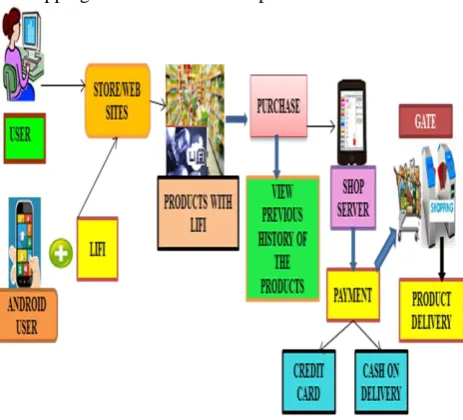
[image:1.595.311.543.397.607.2]Li-Fi is another developing innovation in pattern. It gives transmission of information through light by sending information through a LED light that shifts in force quicker than the human eye can take after. Li-Fi is perfect for high thickness remote information scope in bound territory and for mitigating radio obstruction issues [6]. Li-Fi gives better transfer speed, proficiency, accessibility and security than Wi-Fi. In our framework, Li-Fi innovation is utilized to lessen the shopping time of clients in strip malls.
Fig 1. System Architecture
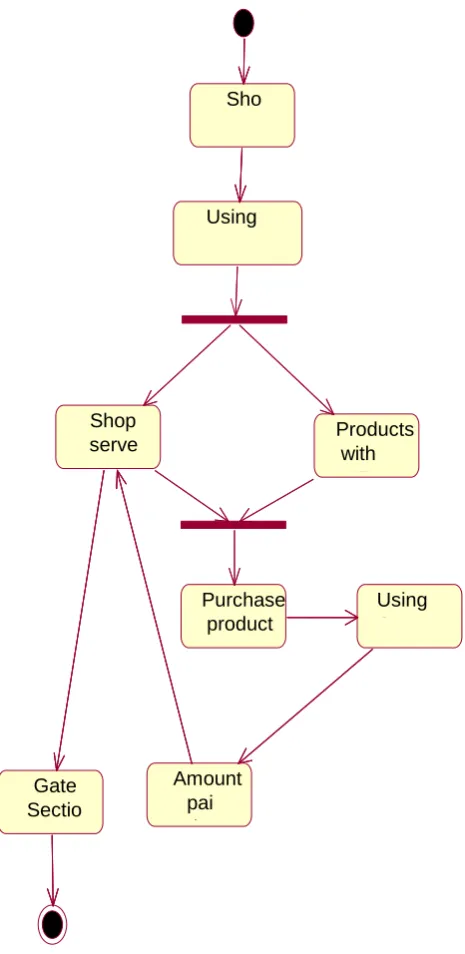
ACTIVITY DIAGRAM:
Effective Avoidance of Queuing in Super
Market using Li-Fi Technology
Fig 2. User Diagram
2.1. Product Module:
Each item comprises of a Li-Fi transmitter. It is interfaced with PIC microcontroller. PIC microcontroller depends on Harvard engineering. PIC microcontrollers are generally utilized for modern reason because of its superior capacity at low control utilization [7]. It is additionally exceptionally well known due to direct cost and simple accessibility of its supporting programming and equipment instruments like compilers, test systems, debuggers. Here it is utilized to store the item ID. Utilizing the item ID, item points of interest are removed from the server database. The Li-Fi transmitter contains a LED light which is exchanged on furthermore, off rapidly to exchange information. The IR indicator is used to peruse the information at the collector end. Li-Fi transmits the subtle elements of the item to the portable and the trolley. These subtle elements will be transmitted in the type of encoded computerized information.
2.2. Mobile Module:
Portable Shopping Application is made and introduced in client mobile. It is created utilizing advance Java
ideas like JSP and Servlet. In the wake of propelling the application, it is associated with the shopping center server utilizing IP deliver to recover the item data and to send the charging points of interest. Portable contains a Li-Fi recipient which is associated through OTG link [8]. A Li-Fi beneficiary contains the IR identifier which peruses the item ID and transmits it to the portable. OTG link is associated with the UART port of the LiFi collector.
2.3. Trolley Module:
The Trolley contains a Li-Fi Transceiver coordinated with PIC Microcontroller. Whenever an item is dropped into the trolley, Li-Fi module consequently peruses the item data. It will keep up a record of the considerable number of items which are inside the trolley. LCD screen shows the item ID. The LCD screen is associated with the D port of the microcontroller. The flag is passed as encoded computerized information. The item ID is shown on the LCD screen [9]. At the point when the item is expelled from the trolley, it will be consequently refreshed. MPLAB IDE is utilized to program the PIC microcontroller. It is a coordinated toolset for the improvement of inserted applications utilizing Microchip's PIC and PIC microcontrollers. It utilizes Hi-Tech C compiler and PIC Developer/Debugger
2.4. Gate Section:
Mobile will send the acquired item data to the server. At that point server will transmit it to the entryway segment. Li-Fi collector likewise gets the item points of interest which are inside the trolley. Cross confirmation is completed. DC Motor which is associated with the B port of microcontroller runs when every one of the items are charged [10]. It is a normally utilized actuator for delivering nonstop development. At the point when the bungle happens, bell sound will be delivered to demonstrate that there is some unbilled item inside the trolley
III. METHODOLOGY:
Li-Fi innovation is utilized to diminish the shopping time of clients in substantial stores. Li-Fi module is appended to portable, trolley and door segment. Each item has a Li-Fi module which contains a special ID. Utilizing these ID's, item points of interest are extricated from the database of the server. At the point when the item is appeared to the portable, Li-Fi module peruses the item ID. The item points of interest will be removed from the database and shown in the cell phone. The trolley segment will likewise store the item ID at the point when the customer drops them into the truck. On the off chance that the client needs to evacuate any item, he/she needs to demonstrate the item again to the versatile and trolley. At that point the subtle elements of the item will be expelled from both the areas. Once the client wraps up shopping, the installment is done in versatile itself utilizing versatile managing an account framework. After installment, the charged item subtle elements will be refreshed in the server.
Sho p
Using LIFI
Shop serve r
Products with LIFI
Purchase product s
Using Cart
Amount pai d Gate
International Journal of Innovative Technology and Exploring Engineering (IJITEE) ISSN: 2278-3075, Volume-8 Issue-10, August 2019
The server sends the data to the door area. It will cross check with the items charged and the items in the trolley. On the off chance that any item is observed to be not charged, then the caution sound will be delivered. The principle point of this venture is to give a programmed charging framework to maintain a strategic distance from line in shopping centers and markets.
3.1. Server login and adding items to the database Executive needs to login to the shopping center server to include the item points of interest, for example, item ID, item name, cost and markdown. The item points of interest will be put away in the database utilizing MYSQL.
3.2. Interfacing portable to the server
Portable is associated with the shopping center server utilizing the IP address. The server will acknowledge the versatile demand and the database will be associated with the versatile.
3.3. Adding the item to trolley
At the point when the item is dropped into the trolley, the item ID will be perused by the Li-Fi recipient and shown on the LCD screen.
3.4. Android installment
In the wake of acquiring the item, the aggregate sum is figured. The bank database is associated with the portable. The client needs to enter their card and stick number. Verification is done and the sum will be executed to the shopping center database.
Circuit Construction:
Fig 3. Hardware of Billing System
3.5. Door segment check
After installment, the obtained item points of interest will be sent to the door segment. The door segment cross check with the items inside the trolley. On the off chance that there is any befuddle, the bell sound will be created. Something else, the entryway will open.
3.6 System Testing:
After payment the items that are billed and the items customer is taking out should be matched. For this the gate section controller helps with two operations one is if the items matched then the gate opens automatically else if not matched with the paid items then the buzzer rings.
Serial
Number Test Case
Expecte
d Output
Actual
Output Remarks
1
For two
items the
bill is
paid and
the third
item is
added to
the
trolley
and tried
taking
the item
out of
market
Buzzer
should
ring
Buzzer
rings
As the
items in
the
trolley
not
matched
with the
payment
made
2
Complete
payment
for the
items
present in
the
trolley is
made
Gates
should
open
Gates
opene
d
As the
items
taking
and the
payment
made for
the
items
matched
IV. RESULTS AND DISCUSSION
From the below output figures we can understand the process of avoidance of queuing in supermarkets using LiFi technology.
[image:4.595.52.287.109.289.2]Fig 4. Scanning the Product
Fig 5. Interfacing with Mobile
[image:4.595.324.532.250.414.2]
Fig 6. Details of the Product
Fig 7. Display of Product IDs
Fig 8. Payment Process
V. CONCLUSION AND FUTURE SCOPE
[image:4.595.60.241.332.569.2] [image:4.595.320.535.444.622.2]International Journal of Innovative Technology and Exploring Engineering (IJITEE) ISSN: 2278-3075, Volume-8 Issue-10, August 2019
On the off chance that any item is unbilled, a bell sound will be created. There are numerous valuable thoughts for further improvement. Programmed charging framework with a credit/check card office in the trolley itself will additionally decrease the human exertion. Indoor mapping innovation alongside IOT can be utilized to find the products in huge stores. Consistent improvement around there will prompt a progressive change in shopping encounter.
REFERENCES
1. H. Aida, S. Aoki, J. Nakazawa and H. Tokuda, "Real-time information distribution at a shopping mall using android phones," Wireless Communications and Mobile Computing Conference (IWCMC), 2011 7th International, Istanbul, 2011, pp. 1923-1928.
2. Rupanagudi, S.R.; Jabeen, F.; Savarni K R, V.R.; Adinarayana, S.; Bharadwaj, V.K.; Karishma, R.; Bhat, V.G., "A novel video processing based cost effective smart trolley system for supermarkets using FPGA," 2015 International Conference on Communication, Information & Computing Technology (ICCICT),, vol., no., pp.1-6, 15- 17 Jan. 2015.
3. Amrutha.S, Ansu Mathew, Rajasree.R, Swathy Sugathan, Aravind.S “A visible light communication system for indoor application”, International Journal of Engineering and Innovative Technology. 2014 Vol 3 pp.40-42.
4. Mr.P. Chandrasekar, Ms.T. Sangeetha “Smart Shopping Cart with Automatic Billing System through RFID and ZigBee” in Information Communication and Embedded Systems (ICICES), 2014 International - 27-28 Feb. 2014.
5. N. D. Lane, E. Miluzzo, H. Lu, D. Peebles, T. Choudhury, and A. T.
Campbell, “A survey of mobile phone sensing,” Commun. Mag., vol. 48, no. 9, pp. 140–150, Sep. 2010.
6. K. K. Rachuri and M. E. Musolesi, “Emotionsense: A mobile phones
based adaptive platform for experimental social psychology research,” in Proc. 12th ACM Int. Conf. Ubiquitous Comput., 2010, pp. 281–290.
7. E. C. E. Larson, “Accurate and privacy preserving cough sensing using
a low-cost microphone,” in Proc. 13th Int. Conf. Ubiquitous Comput., 2011, pp. 375–384.
8. Y. Jiang and K. E. Li, “Maqs: A mobile sensing system for indoor air
quality,” in Proc. Int. Conf. Ubiquitous Comput., 2011, pp. 493–494. 9. J. Lester, T. Choudhury, and G. Borriello, “A practical approach to
recognizing physical activities,” in Pervasive Computing. Berlin, Germany: Springer, 2006, vol. 3968, pp. 1–16.
10.K. Lewin and D. Cartwright, Field Theory in Social Science: Selected
Theoretical Papers. London: U.K.: Tavistock, 1952.
AUTHORS PROFILE
Dr. Sumit Gupta, Associative Professor withthe Department of Electronics & Communication Engineering in KLEF. His works inludes His current research interest includes VLSI, Optical Communication and Digital Communication.
M. Sai Krishna, pursuing B. Tech degree in the department of Electronics & Communication Engineering in KLEF. He recently worked on optical communication. Current works include IOT, Artificial Intelligence.
N. Poojitha chowdary, pursuing B. Tech degree in the department of Electronics & Communication Engineering in KLEF. Her work includes optical communication, signal processing
B. Pavithra reddy, pursuing B. Tech degree in the department of Electronics & Communication Engineering in KLEF. She recently worked on optical communication. Current works include signal processing and IOT.