International Journal of Innovative Technology and Exploring Engineering (IJITEE) ISSN: 2278-3075, Volume-8 Issue-10, August 2019
Abstract: Mobile Ad hoc Network(MANET) provides wireless communication withoutany infrastructure. MANET generally uses a most popular and well-suited routing protocolthat is Ad hoc on Demand Distance Vector (AODV). Random topology and mobilityin MANET cause link break multiple times in network due to which poor link quality thatresults in packet losses in the network. In this paper, link quality improvement in AODV routing protocol is focused. Link quality issue can be resolved through Cross-layer design(CLD) interaction in the OSI communication model. This technique called as Reliable-AODV. CLD is implemented by interacting Physical firstlayer and network third layer of the OSI model, CLDinteraction help in strong route formation inAODV for Reliable-AODV. The result shows an improvement in the system Performance in terms of metricslike throughput, Packet Delivery Ratio(PDR) and reduction in the packet losses, delay ofthe network. Network simulator used for performance analysis is NS-2.a Simulation tool that shows improvement in results. Castadiva Emulator with Wi-Fi routers and laptop are used as test bed architecture for validating sample results of simulations. It is observed that some small variation in the simulated and emulated result by using real-time experimental setup.
Index Terms: AODV, MANET, CLD, NS-2, NS-3
I. INTRODUCTION
Current developments in wireless communication, especially in infrastructure-less networks, introduced Wi-Fi or Bluetooth as a new type of wireless systems. Such networksare known as Mobile Ad-hoc Networks (MANETs) or short live network. In principle,MANET[1] does not require any fixed infrastructure and operates in the absence ofperpetual infrastructure. Wireless communications and networking are one of the growing areas in research. A vital application area of wireless communication and MANET are disaster management, military applications, business, Wireless sensor network[2] VANET and in FLYNET. The Ad hoc On-Demand Distance Vector (AODV)[3] routing protocol is from the several published routing protocols for mobile ad hoc networking Perkins et al. (2003). Currently AODV is the area of much research among the network community. The AODV protocol for routing is designed for wireless nodes connected in ad hoc network. Features of AODV: includes quick adaption to active link condition, low processing and memory overhead, dynamic self-routing multi-chip routing and AODV routing protocol allows wireless nodes to reply to link breakage and changes in network typologies in timely manner.
Revised Manuscript Received on August 03, 2019.
Mazher Sarfaraz Khan, E & TC dept., MIT, Aurangabad, India.
Dr. Sayyad Ajij, E & TC department, Marathwada Institute of Technology, Aurangabad, India.
[image:1.595.321.527.214.342.2]Section-II is about related, Section-III proposed method, section-IV mathematical analysis, Section-V-System development and result analysis and Section-VI conclusion.
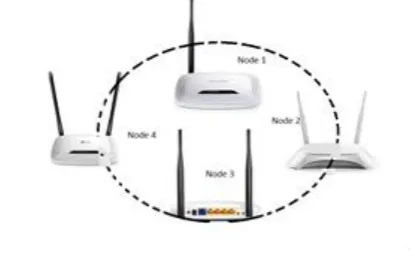
Figure 1: MANET practical operation II. RELATEDWORK
Mobile ad-hoc networks propose quick and horizontal network setting out in conditions where it is not possible otherwise. Mobile ad-hoc network is an independent system of mobile nodes linked by wireless links; each node functions as an end system and a router for all additional nodes in the network. MANETs has mobile nodes with random topology. Hence, it is difficult to maintain a link between the source and destination. Also, link breaking in routing protocol is another issue in network and causes poor performance of the network. There are multiple issue in MANET such as Link break: [4][5][6][7].Route selection under mobility [8][9], Routing and congestion control [10][11][12][13] and for Energy [14][15][16][17].Many researchers have proposed different methods to overcome the above issues such as Route selection based on RSS value [8][18][[19]. Neighbor route discovery methods [20]. Cross layer design approaches: [21][22][23][24]for optimization of network performance. Many AODV improved algorithms are suggested such as Turbo-AODV (TAODV) [18] for performance improvement, AODV with reliable delivery (AODV-RD) [10] for link failure prediction mechanism. Modified Reverse Ad-hoc on Demand Distance Vector (MRAODV) (Mehdi Zaïre et al) to reduce the probability of RREP packet loss and to avoid the source node repeatedly re initiate the route discovery process due to node mobility. Intelligent AODV (IAODV) [[9] and Dhawan (2015) considering RSSI values to find a route among source and destination. Again Intelligent-AODV (I -AODV)[20] to exploit neighbor discovery and reduce the overhead of neighbor discovery processes.
Pro-AODV- [25] to realizing Intelligent Transportation Systems (ITS).
Mazher Sarfaraz Khan, Sayyad Ajij D.
Cross-Layer design method for Power control (CLPC) [4] to improve the transmission power by averaging the RSS values and to obtain a most effective route between the source and the destination. Cross-layer based routing using forwarding node selection (CRNS)[26] in this the forwarding nodes have been selected according to the number of neighbors and their power of received hello message broadcasted by the neighboring nodes.
Cross-Layer Stability based routing mechanism is (CLSAODV) [27] a route is found to get lose due to the low signal strength of a node, it will find another path. Cooperative Opportunistic Routing in Mobile Ad hoc Networks (CORMAN) [Wang et al. (2012b)]- the issue of opportunistic data transfer in MANET can be solved. AODV-2T- [12]for reducing the broken route. Cross-layer design of energy-aware ad hoc on-demand distance vector (CEAODV) [14] to enhanced AODV routing protocol for reduction in the energy consumption and then long life of the entire network. Preemptive Multi-path AODV (PMAODV) to save multiple disjoint routes from source to destination during route discovery phase.
III. PROPOSEDMETHOD(RELIABLE-AODV)
[image:2.595.304.547.135.529.2]MANET is a sub-family of wireless communication which can be used in various application. AODV routing protocol is used in MANET as it is very famous and suitable. MANET has random topology and mobility of nodes due to which poor link quality in AODV which degrades the performance of MANET. Wi-Fi (IEEE 802.11) is used in MANET as physical interface under the physical layer of the OSI model, which has collected values of Received Signal Strength(RSS) of each node. This data can be shared with AODV in the network layer to check the link quality in AODV protocol. This sharing of data is possible by cross-layer interaction in the OSI model. Figure 1 shows the process of sharing RSS values across the layers. Figure 1 shows how RSS value can be used to check link quality for strong route formation in AODV, therefore system performance of MANET can be improved by using the above cross-layer design approach
Figure 2: CLD implementation and RSS value sharing
Figure 1 shows about accessing received signal strength RSS parameter from physical layer and it will help AODV route request to select the route on the basis of RSS value. It will stablish the route in between available strong links. Now starting with implementation steps first need to understand
[image:2.595.333.529.293.527.2]header format of AODV as shown in Figure 3.9.It includes the information about destination IP address, sequence number, source address, type of message and life time of message. Figure 2 shows about packet format and the way in which RSS value added in packet formats of route request and route reply.
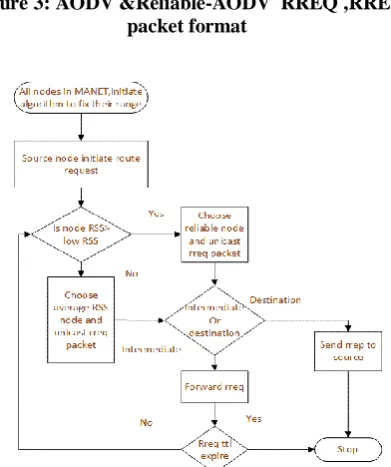
Figure 3: AODV &Reliable-AODV RREQ ,RREP packet format
Figure 4: Algorithm to check link quality
RSS value shared between OSI layers therefore AODV use this value while updating routing tables. Now updated routing table are with RSS values and it will help to form strong route in Mobile ad hoc network. AODV uses the following fields with each route table entry: Destination IP Address, Destination Sequence Number, Valid Destination Sequence Number flag, Other state and routing flags (e.g., valid, invalid, repairable, being repaired) Network Interface, Hop Count.
Algorithm-1: AODV Route Discovery
When a node requires to find a route to a destination node, 1. Sends the network with a Route Request (RREQ) message. 2. The starting node broadcasts a RREQ message to its nearby
nodes, which broadcast
3. the message to their neighbors, and so on.
[image:2.595.56.293.524.721.2]International Journal of Innovative Technology and Exploring Engineering (IJITEE) ISSN: 2278-3075, Volume-8 Issue-10, August 2019
5. in a route request buffer.
6. As these requests spread in whole the network, in between nodes save reverse
7. routes back to the starting node.
8. Intermediate node may have many reverse routes. 9. It always picks the route with the smallest hop count. 10. The destination node produces a Route Reply (RREP)
message.
11. Sends RREP message with the reverse path back towards the source node.
12. The RREP move through in between nodes, nodes update routing tables, so that
13. in the next, messages can be routed though these nodes to the destination.
14. If RREQ source to get a RREP message from multiple node. 15. The RREQ source will update its routing table with the most
newly routing information
Algorithm 2: Reliable-AODV Route discovery algorithm 1. Every Node start Hello message for collecting Nearby node
RSS values
2. Count neighbor nodes with its RSS value
3. Each intermediate node verifies its routing table for RSS value of nearby nodes
4. Is value available then Update routing table 5. Otherwise save as a fresh RSS value 6. Specify threshold-RSS value
7. If neighbors RSS value< threshold-RSS
8. Else Checkout other nodes with higher RSS values and update table
9. Determine most appropriate path for data transmission.
Algorithm-1 shows basic operation of AODV routing protocol, while algorithm-2 shows modified algorithm in which RSS value is checked. Hence, using RSS value to check link quality will improve the performance of network.
IV. MATHEMATICALMODELLING
The link duration and path duration parameter decide the quality of link. It shows parameters on which strong route or link can be established[28]. Duration for link (DL): Two devicex and y ingiven time t, duration of link (x, y) can be defined as the length of the largest time interval [t1, t2]in
which the two devices are within range of each other, These two devices are not in the range at time t1-ε and time t2+ε for ε>0. Formally,
Durationof Path (DP): For a path (m1, m2,mq), withqdevices,
at time t1, path duration of pathcan be defined as the length of the largest time interval [t1, t2], in which every of the q-1 lines
between the devicesare available,at time t, Duration of path is the least of the duration of the q-1 links (m1, m2), (m2, m3),
(mq−1, mq) at time t1. Formally,
Distribution for each duration of path
Properties of
, ,
According to the properties we get,
where is constant of proportionality.
In given model, the average duration for path is 1/ since the duration of path is considered as exponentially distributed with metric
Average duration of path with reference to analysis to reactive protocols metrics: Throughput: - Now, how the protocol performance is related to the duration of path.For every source device and destination device, the time T is considered with two parts: the time utilizedfortransferring data and to repair/maintenance of break paths.
Considering, M total number of devices, T the total time for simulation, T flow be the time in which realdata gettransferred takes place at highestrate, t repair be the time
required to repair path after braking of path everytime, Trepair
total time required for repairing broken paths in the time T, APD is the average path duration.f is defined as frequency of
path breaking, f=1/APD, D is total data to be transfer during
simulation.r is the rate of data transfer [28],[29].
, ,
,
Where,
The major problem of AODV in MANET is route failure and link breakage that affects the performance of wireless communication. New methods and algorithm should be developed to avoid this problem in future technology. Cross layer design is one of the methods that may avoid these problems and increase the performance of system. Throughput of system dependent on path duration and path duration is depends on link repairing time. It is formulated by mathematical expression that performance of wireless ad hoc network depends on path or rout feature of network
V. SYSTEMDEVELOPMENT
Implementation of proposed system is simulated in NS 2.35 Simulator and Castadiva Emulator.
A. Network Simulator NS-2
Element of simulation consists of Entities of model, Resources in Model, Activities and Events, Scheduler, Global variables, Random Sequence Generator, Statistics Gatherer [30].
B. CastadivaEmulator
It has a construction that enables forming a test bed experimentation. It is cost effective and off the shelf type of devices used with Linux based system. It permits designing and making network typologies,exporting them to real
devices/nodes and gaining the
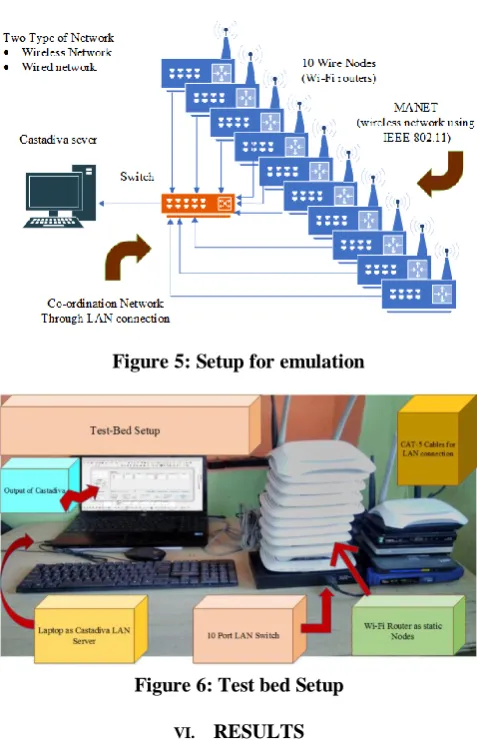
testresultitalsogeneratevarioustypesoftraffic in between wireless nodes/devices and it proposal support for ad hoc routing protocol. Ithas maintwotypesnetworksuch as,Wirednetwork (Connection Network) that connects the main core with group of attached wireless nodes/devices. Second is wireless network where the real test bedtest is executed. Castadiva main application is in JAVA to control all devices/nodes and it keep managing all links according to some defined network parameters. Castadiva main core has dual functions, to permit a user (node) to managewiththesystemsoastodefinealltheexperimentationpa rameters needed and to manage the wireless nodes/nodes during an testing [31].Castadiva Feature includes, Easy use and configure, Permit the user to generate different number of network typologies, Emulates all node mobility, generates different traffic connections among available nodes, can allow generating random scenarios, combines with different routing protocols and it allows connecting external devices like webcams [32].
C. OpenWrt
OpenWrt is also open source project specially for embedded operating system that are based on Linux, it used on embedded devices/nodes to route network traffic. Command line interface (ash shell) with a web interface (Luci) is used to defined OpenWrt, there are about many available optional software packages for installation.
1) Check Table of Hardware (OpenWrt) 2) Download OpenWrt Firmware 3) Update Firmware to OpenWrt 4) Access OpenWrt @ 192.168.1.1
5) Required Model of Router (16MB RAM)
D. Test-bed architecture
1. Server: Hp Laptop with Linux operating System is used as Server for installation of Castadiva Server.
2. Switch: Digi sol with 16 Ethernet port is used. The Generating Simulation Scenario for NS2 and Castadiva
1) Analyzing Simulation Results 2) Installing Castadiva in PC
3) Installing OpenWrt in Wi-Fi routers 4) Communicating nodes with server PC 5) Installing Access Point on every node
[image:4.595.307.546.41.412.2]6) Developing Wired and Wireless Network connection 7) Comparing result of Simulator and Emulator
Figure 5: Setup for emulation
Figure 6: Test bed Setup
VI. RESULTS
International Journal of Innovative Technology and Exploring Engineering (IJITEE) ISSN: 2278-3075, Volume-8 Issue-10, August 2019
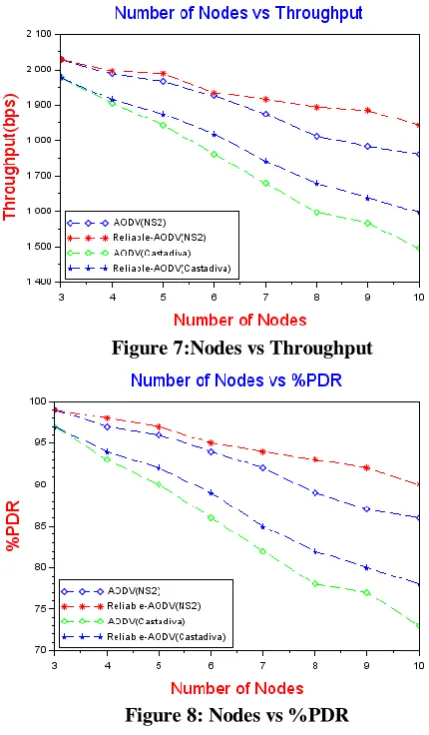
[image:5.595.52.266.329.745.2]Figure 7:Nodes vs Throughput
Figure 8: Nodes vs %PDR
Figure 9: Nodes vs Packet loss
Figure 10:Nodes vs Delay
VII. CONCLUSION
The MANET forms wireless ad-hoc network which phases the problem of link breaks. Implementation of CLD improve the performance. Received Signal strength is the major factor for CLD implementation. In this paper algorithm is designed
under AODV isReliable-AODV, in which CLD
implementation is used in route formation of AODV to reduce number of link breaks in the network.Now, premeditated algorithms are scripted under simulator, emulator and output performance is ascertained in terms of metrics such as throughput, %PDR, packet loss and delays. As compared to AODV, Reliable-AODV shows performance improvement in terms of throughput improved by 10%, %PDR improved by 7%, and reduction in packet loss and delay. Further A test-bed results using Castadiva Emulator shows real time output. Emulation setup with test bed architecture considered for testing. As compared to simulation results emulation results are accurate. There is 5 % change in output observe under emulation. Most of research works are done under simulations but that need to be verified with emulator. In future MANET with improved result will be need of wireless communicationNS2 and Castadiva can be used for Mobile ad-hoc network research simulation and emulation. Hence, MANET along CLD implemented AODV (improved performance) can be usedinmilitaryanddisasterplaces. In this age most of the work is in progress on advanced technologies such as Internet of things, wireless sensor network, flying ad-hoc network, machine learning and artificial intelligence. This all technologies are advanced and need of future. It should be independent of network infrastructure that will make it more power full. Therefore, CLD-AODV can used for mentioned application for better performance of wireless network.
REFERENCES
1. S. Corson and J. Macker, “Mobile ad hoc networking (MANET): Routing protocol performance issues and evaluation considerations, RFC 2501, Jan. 1999,” RFC2501, no. JAN, 1999.
2. A. Lodhi, S. S.-S. C. in D. Analytics, and undefined 2019, “Cluster Head Selection by Optimized Ability to Restrict Packet Drop in Wireless Sensor Networks,” Springer.
3. C. E. Perkins, M. Park, and E. M. Royer, “Wmcsa,” Ad-hoc On-Demand Distance Vector Routing, pp. 90–100.
4. A. Sarfaraz Ahmed, T. Senthil Kumaran, S. Syed Abdul Syed, and S. Subburam, “Cross-layer design approach for power control in mobile ad hoc networks,” Egypt. Informatics J., vol. 16, no. 1, pp. 1–7, 2015. 5. S. N.-U.-2012 I. C. on and undefined 2012, “Study of congestion
control using AODV and signal strength by avoiding link failure in MANET,” ieeexplore.ieee.org.
6. R. S. Kumar and P. Kamalakkannan, “A review and design study of cross layer scheme based algorithm to reduce the link break in MANETs,” in 2013 International Conference on Pattern Recognition, Informatics and Mobile Engineering, 2013, pp. 139–143.
7. M. M. Hassan et al., “Design of an energy-efficient and reliable data delivery mechanism for mobile ad hoc networks: a cross-layer approach,” Concurr. Comput. Pract. Exp., vol. 27, no. 10, pp. 2637–2655, Jul. 2015.
8. H. Dandotiya, R. Jain, and R. Bhatia, “Route selection in MANETs by intelligent AODV,” Proc. - 2013 Int. Conf. Commun. Syst. Netw. Technol. CSNT 2013, pp. 332–335, 2013.
10.G. Wang, S. Wang, C. Liu, and X. Zhang, “Research for improved AODV algorithm based on probability broadcasting with percolation theory,” Prz. Elektrotechniczny, vol. 88, no. 7 B, pp. 372–374, 2012. 11.R. Mangrulkar, M. A.-2010 S. I. conference, and undefined 2010,
“Trust based secured adhoc On demand Distance Vector Routing protocol for mobile adhoc network,” ieeexplore.ieee.org.
12.H. Somnuk and M. Lertwatechakul, “Multi-hop AODV-2T,” 2009 Int. Symp. Intell. Ubiquitous Comput. Educ. IUCE 2009, pp. 214–217, 2009.
13.N. M. Krittika Khator, “A Metaphorical Review on Impact of Congestion and Route failure on the Performance Comparison of Routing Protocols in MANET.”
14.B. Li, Z. Jin, and Y. Shu, “Cross-layer design of energy-saving AODV routing protocol,” Trans. Tianjin Univ., vol. 15, no. 5, pp. 343–349, Oct. 2009.
15.M. K. Singh, B. Kumar, C. Kumar, and M. Gupta, “Preemptive Multipath-Adhoc On Demand Distance Vector Routing Protocol,” vol. 1, no. 1, pp. 36–40, 2011.
16.R. Mehta and D. K. Lobiyal, “Energy efficient cross-layer design in MANETs,” 2017 4th Int. Conf. Signal Process. Integr. Networks, SPIN 2017, pp. 448–453, 2017.
17.M. Anand and T. Sasikala, “Efficient energy optimization in mobile ad hoc network (MANET) using better-quality AODV protocol,” Cluster Comput., Jan. 2018.
18.Z. El-Bazzal, K. El-Ahmadieh, Z. Merhi, M. Nahas, and A. Haj-Ali, “A cross layered routing protocol for ad hoc networks,” 2012 Int. Conf. Inf. Technol. e-Services, ICITeS 2012, 2012.
19.B. Shin, Y. Ko, S. Han, D. L.-A. 2010 S. School, and undefined 2010, “SINR-Based Link-Quality Routing Protocol in Multi-Radio Mobile Ad-Hoc Network,” koasas.kaist.ac.kr.
20.E. Mostajeran, R. M. Noor, and H. Keshavarz, “A novel improved neighbor discovery method for an Intelligent-AODV in Mobile Ad hoc Networks,” 2013 Int. Conf. Inf. Commun. Technol. ICoICT 2013, pp. 395–399, 2013.
21.F. Aune, “Cross-Layer Design Tutorial,” Tutorial, p. 35, 2004. 22.S. G. Bhoge, M. D. Chawhan, Y. Suryavanshi, and V. K. Taksande,
“Cross-layer approach for energy & communication efficient protocol of mobile ad hoc networks,” Proc. 2017 IEEE Int. Conf. Commun. Signal Process. ICCSP 2017, vol. 2018-Janua, pp. 1186–1189, 2018. 23.M. Kamrul Islam and R. K. Liu, “Cross-Layer Optimization of AODV
Routing Protocol For Mobile Ad-Hoc Network (MANET),” no. Iccsee, pp. 1834–1837, 2013.
24.R. S. Kumar and P. Kamalakkannan, “A review and design study of cross layer scheme based algorithm to reduce the link break in MANETs,” Proc. 2013 Int. Conf. Pattern Recognition, Informatics Mob. Eng. PRIME 2013, pp. 139–143, 2013.
25.T. Kabir, N. Nurain, and M. H. Kabir, “Pro-AODV (Proactive AODV): Simple modifications to AODV for proactively minimizing congestion in VANETs,” Proc. 2015 Int. Conf. Netw. Syst. Secur. NSysS 2015, 2015.
26.A. Alqobaty, S. Shaheen, and S. Ibrahim, “A new cross layer based routing technique for mobile ad hoc networks using forwarding node selection,” Proc. - ICCES 2012 2012 Int. Conf. Comput. Eng. Syst., pp. 9–15, 2012.
27.S. Nandgave-Usturge, “Study of congestion control using AODV and signal strength by avoiding link failure in MANET,” Proc. - 2012 Int. Conf. Commun. Inf. Comput. Technol. ICCICT 2012, pp. 1–5, 2012. 28.Bai, N. Sadagopan, B. Krishnamachari, and A. Helmy, “Modeling path
duration distributions in MANETs and their impact on reactive routing protocols,” IEEE J. Sel. Areas Commun., vol. 22, no. 7, pp. 1357–1373, 2004.
29.N. Javaid, M. Ishfaq, M. Jamil, U. Qasim, T. A. Alghamdi, and Z. A. Khan, “Modeling Routing Overhead of Reactive Protocols at Link Layer and Network Layer in Wireless Multihop Networks,” Math. Probl. Eng., vol. 2015, pp. 1–14, 2015.
30.T. Issariyakul and E. Hossain, Introduction to network simulator NS2, vol. 9781461414. 2012.
31.J. Hortelano, M. Nácher, J. C. Cano, C. Calafate, and P. Manzoni, “Castadiva: A test-bed architecture for mobile ad hoc networks,” IEEE Int. Symp. Pers. Indoor Mob. Radio Commun. PIMRC, no. Pimrc 07, pp. 1–5, 2007.
32.J. Hortelano, J.-C. Cano, C. Calafate, and P. Manzoni, “Testing Applications in MANET Environments through Emulation,” EURASIP J. Wirel. Commun. Netw., vol. 2009, no. 1, p. 406979, 2010.
AUTHORSPROFILE
Mazher Sarfaraz Khan, Research student, Field of interest Wireless communication and networking. 10 research publications in the field of wireless communication engineering.