1994
The current status of two year plus three year
articulation of nondestructive testing programs
Arnold A. Prosch Iowa State University
Follow this and additional works at:https://lib.dr.iastate.edu/rtd Part of theIndustrial Technology Commons
This Thesis is brought to you for free and open access by the Iowa State University Capstones, Theses and Dissertations at Iowa State University Digital Repository. It has been accepted for inclusion in Retrospective Theses and Dissertations by an authorized administrator of Iowa State University Digital Repository. For more information, please [email protected].
Recommended Citation
Prosch, Arnold A., "The current status of two year plus three year articulation of nondestructive testing programs" (1994).Retrospective Theses and Dissertations. 245.
by
Arnold A. Prosch
A Thesis Submitted to the
Graduate Faculty in Partial Fulfillment
of the Requirements for the Degree of
MASTER OF SCIENCE
Department: Industrial Education and Technology
Major: Industrial Education and Technology
(Industrial Vocational Technical Education)
Approved:
In Charge of Major Work
For the Major Department
For the Graduate College
Iowa State University Ames, lA
TABLE OF CONTENTS
CHAPTER I. INTRODUCTION . . . I
The Value ofNDT ... 2
Common NDT Methods ... 3
Radiography . . . 3
Ultrasonics . . . 3
Eddy currents . . . 4
Liquid penetrant . . . 4
Magnetic particle . . . 4
Visual testing . . . 4
Training for NDT . . . 5
Schools Offering NDT Programs . . . 7
Interfacing NDT with Engineering . . . 8
Statement of the Problem . . . 9
Purpose of the Study . . . 9
Need for the Study . . . 9
Research Questions . . . I 0 Hypotheses of the Study . . . I 0 Assumptions of the Study . . . II Definitions of the Study . . . II CHAPTER IT. REVIEW OF LITERATURE ... 13
Articulation Between College Programs . . . 13
Design Engineering . . . 17
Non Destructive Testing Engineering Education . . . 23
Background information . . . 23
Advantages and reasons to incorporate NDT in engineering education . . . 25
Information concerning possibilities for incorporating NDT in engineering education . . . 26
Attrition of Students in Engineering Schools . . . 28
Background information . . . 29
Specific causes of attrition . . . 32
Preventing attrition . . . 3 5 CHAPTER ill. METHODOLOGY ... 38
Population of the Study- . . . 3 8 Development of the Survey Instrument ... 39
Telephone Survey . . . 41
CHAPTER IV. RESEARCH RESULTS AND FINDINGS ... 42
Demographic Variables ... 42
Findings related to the Research Questions . . . 4 7 Findings by Research Hypotheses . . . 63
Research hypothesis 1 . . . 64
Research hypothesis 2 . . . 67
Research hypothesis 3 . . . 68
Research hypothesis 4 . . . 70
Summary of Research Hypotheses Results . . . 72
Findings Related to the Telephone Survey . . . 73
CHAPTER V. SUMMARY, CONCLUSIONS AND RECO:MMENDATIONS ... 80
Summary ofResearch Questions . . . 81
Summary of Hypotheses ... 82
Conclusions . . . 83
Recommendations . . . 85
REFERENCES ... 87
ACKNOWLEDGEl\ffiNTS ... 92
APPENDIX A. HUMAN SUBJECTS CO:MMITTEE FORM ... 93
APPENDIX B. CORRESPONDENCE ... 95
Table 1. Table 2. Table 3. Table 4. Table 5. Table 6. Table 7. Table 8. Table 9. Table 10. Table 11. Table 12.
Table 13.
Table 14.
LIST OF TABLES
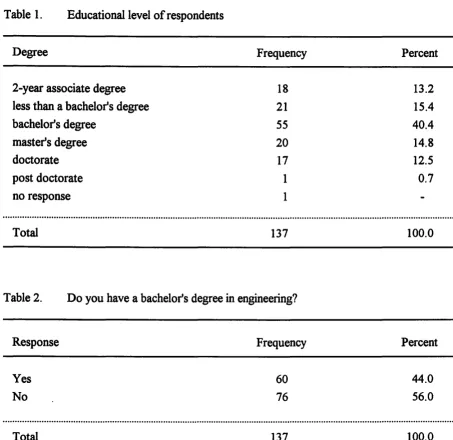
Educational level of respondents . . . 43
Do you have a bachelor's degree in engineering? . . . 43
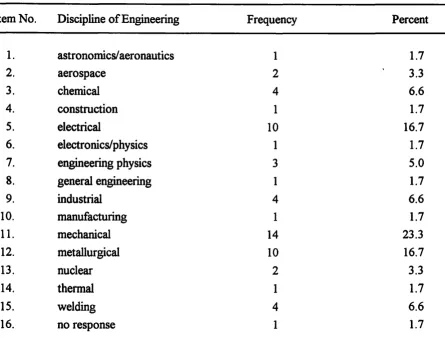
A breakdown of the disciplines of engineering contained within the bachelor's degree of the respondents . . . 44
Have you ever held NDT certification levels (in accordance with SNT-TC-IA)? ... 45
Where did you receive your NDT training? . . . 45
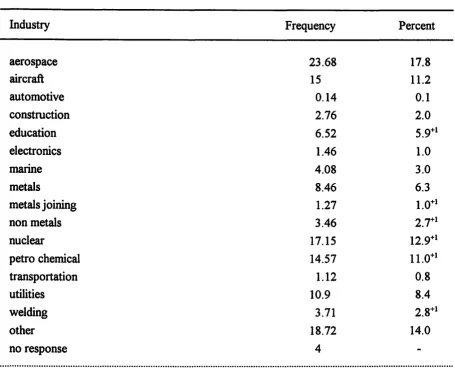
What industry do you represent? . . . 46
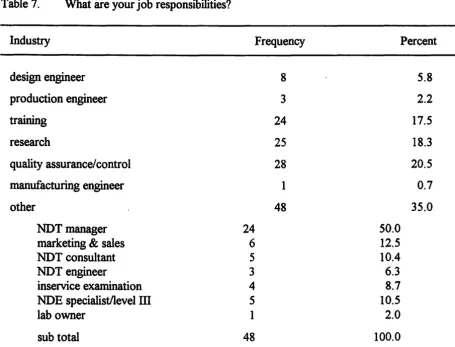
What are your job responsibilities? . . . 48
In the course of time, NDT engineers will decrease in number because they will become independent consultants able to seiVe several industries at once (SQ 2) . . . 49
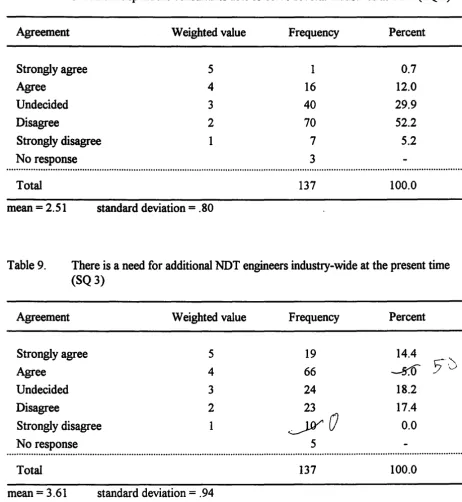
There is a need for additional NDT engineers industry-wide at the present time (SQ 3) ... 49
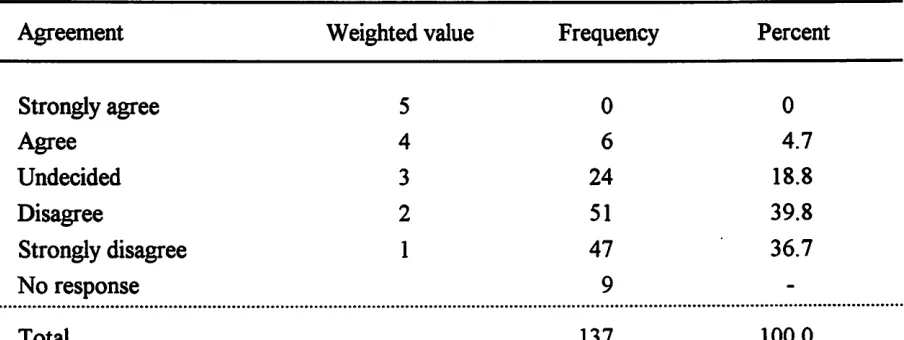
The number ofNDT engineers in industry that have completed formal courses in NDT is adequate (SQ 4) . . . 50
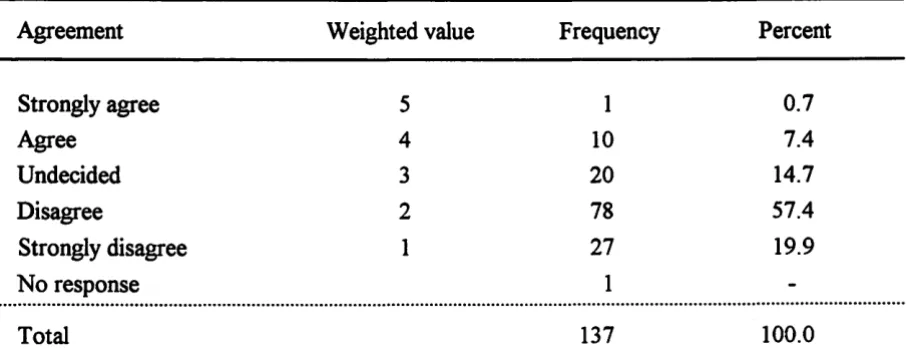
The number ofNDT engineers who enter industry each year should be increased over what it presently is (SQ 5) . . . 51
Computerization affecting the NDT industry (computerization ofNDT equipment and computer assisted design of components and products) will decrease the number ofNDT engineers needed (SQ 6) ... 51
NDT inspection problems of components and products have decreased because of computers aiding in the design process (SQ 8) . . . 52
Table 15.
Table 16.
Table 17.
Table 18. Table 19. Table 20. Table 21. Table 22. Table 23. Table 24. Table 25. Table 26. Table 27. Table 28.
It is more economical to rework and make inspectable products and components than it is to produce an NDT engineer whose background
includes a specific NDT program (SQ 1 0) . . . 53
Accessibility for NDT inspections, i.e., space requirements for
inspections should be common knowledge for NDT engineers involved
in the design process (SQ II) . . . 54
At the present time, the inspectability of products and components requiring NDT is satisfactory and the (NDT) background of those
involved in their design is adequate (SQ 12) ... 54
Desirability of the seven alternatives for preparing an NDT
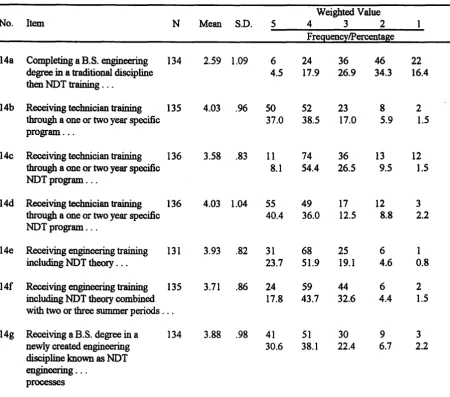
engineer (SQ 14a-g) . . . 56
Do you feel that a specific NDT program that involves practical hands on training is the ideal background for an NDT engineer who will design
components/products that will require NDT inspection? (SQ 17) ... 57
Results of knowledge adequacy ratings ofNDT engineers currently
working in industry (SQ 13a-h) ... 60
Results of ratings of attributes of the NDT engineer concerning increasing capability and usefulness (SQ 18a-t) ... 61
Choice of most important/least important items of attributes of the NDT
engineer concerning increasing capability and usefulness (SQ 19 & 20) ... 61
Results of ratings of level of importance of activities that NDT engineers
are involved with (SQ 2I) . . . 62
Choice of most important/least important items of level of importance
of activities that NDT engineers are involved with (SQ 22 & 23) ... 63
Results of ratings of attributes of the graduate of a specific NDT program
at the technician level (SQ 24a-h) . . . 64
Choice of most important/least important items of a specific NDT
program at the technician level (SQ 25 & 26) . . . 65
Industry members' anticipations of the number ofNDT engineers needed
by the year 2000 . . . 66
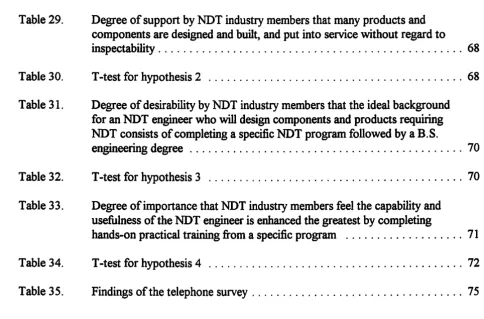
Table 29.
Table 30.
Table 31.
Table 32.
[image:7.611.58.542.68.387.2]Table 33.
Table 34.
Table 35.
Degree of support by NDT industry members that many products and components are designed and built, and put into service without regard to inspectability . . . 68
T -test for hypothesis 2 . . . 68
Degree of desirability by NDT industry members that the ideal background for an NDT engineer who will design components and products requiring NDT consists of completing a specific NDT program followed by a B.S.
engineering degree . . . 70
T -test for hypothesis 3 . . . 70
Degree of importance that NDT industry members feel the capability and usefulness of the NDT engineer is enhanced the greatest by completing
hands-on practical training from a specific program . . . 71
T -test for hypothesis 4 . . . 72
CHAPTER I. INTRODUCTION
Nondestructive testing (NDT) is a means of examining a material, product, or
component (either internally or externally) without altering the item in any way that would
impair its usefulness. Nondestructive testing can be used on raw materials, materials or
components in process, or on a finished product. In addition, in-service NDT inspections may
be conducted during the lifetime of the component.
Originally used mainly for industrial products, NDT increased greatly with the advent
ofWorld War II. The value ofNDT is seen in one's ability to test a product incurring no
alteration whatsoever. Whereas other methods of detecting flaws may render a product
unusable, the NDT process leaves the item in exactly the same condition after testing as it was
prior to testing. The testing, nonetheless, is thorough and exacting, exposing any flaws or
potential weaknesses that may present a dangerous situation in the future.
The terms NDT, nondestructive inspection (NDI), and nondestructive evaluation
(NDE) are often used interchangeably. Halmshaw (1991) noted that NDT and NDI
essentially mean the same: the part is scrutinized and a decision is made whether to accept or
reject. However, NDE means that, in addition to supplying information for acceptance or
rejection, the data can be further used to evaluate the material. This could involve making a
direct relationship between the test data and a variable, such as correlating the velocity of
sound from castings to determine the strength. Another would be to employ computer
The Value ofNDT
Nondestructive testing is of great value to society. The testing of bridges and
airplanes employs NDT to assure the required structural integrity exists and the requirements
of the design have been met. Lifetime testing ensures continued satisfactory performance,
thus preventing dollars loss due to failure. Failure of a bridge or airplane could have
catastrophic implications to the manufacturer, insurance companies, the victims, and in the
case of death, the survivors.
Originally NDT was used mainly for industrial products, but its use has since been
extended to other areas such as the food industry, airport security, and recreation equipment
to name just a few. Present and future uses ofNDT are increasing in areas such as inspection
of aging aircraft, determining the operational conditions of nuclear power plant components,
and detennining the status of the tons of concrete that make up bridges, buildings, and
highways. According to Walkimir (1993), 230,000 out of575,000 bridges are in need of
some type of repair. Bray ( 1993) indicated, that so much of the American infrastructure was
in need of rebuilding that it would seem this would have a higher priority.
Many companies employ NDT because they are required by code. More and more,
NOT is conducted on an elective basis because it is cheaper to invest relatively few dollars to
inspect than it is to discover later that NDT could have saved material, time, human lives, and
resulting law suits. The cost must be justified, but, when considering technological
breakthroughs that continually lower the cost of each new inspection, a present trend is to
Common NOT Methods
Some of the commonly used NDT methods employ radiography (RT), ultrasonic
(UT), eddy currents (ET), liquid penetrants (PT), magnetic particles (MT), and visual testing
(VT). A brief description of the listed NDT methods follows.
Radiography
Radiography uses ionizing radiation that passes through the specimen. The presence
of a flaw causes a difference in the absorption of the radiation that passes through the
specimen between the flawed area and the unflawed area. This difference in absorption of the
radiation is recorded by a device such as an X-ray film, TV monitor, or computer screen
which could be recorded on a disk. Radiography works well to locate subsurface as well as
surface flaws.
Ultrasonics
Ultrasonics is an NDT method that employs high frequency sound waves (> 20,000
hertz) which are introduced into the specimen. A sound beam travels through homogenous
material until it hits an interface which causes the sound to reflect and travel in another
direction. If the reflected sound travels back to the sending unit, similar to sonar, information
can be gathered concerning the depth, type, orientation, size, and severity of the flaw.
Ultrasonics lends itself well to the detection of subsurface flaws but can also be used
for surface flaw detection in certain applications. Radiography and ultrasonics techniques in
Eddy currents
An eddy current inspection uses the principles of electricity and magnetism by
employing alternating current in a coil to introduce eddy currents into an electrically
conductive material. The presence of a flaw causes fluctuations in the eddy current's magnetic
field. These fluctuations can be detected and recorded by using an electrical meter or LED
display. Eddy currents work well to detect both surface and subsurface flaws only in material
that will conduct electricity.
Liquid penetrant
Liquid penetrant is a test method that employs a liquid dye. Capillary action enables
the dye to find its way into any flaws that are open to the surface of the part. By use of a
powder of a contrasting color to absorb the dye back out of the defect, the flaw can easily be
seen. This is one of the less complex and least costly NDT methods used to test a product.
Magnetic particle
Magnetic particle testing utilizes electricity and magnetism by creating a magnetic field
in the material being tested. When ferromagnetic particles are introduced to an area where a
flaw exists, these particles are attracted to the place where the leakage field from the flaw or
flaws originate(s ). This method works best for surface flaws and only on ferrous materials.
Visual testing
Visual testing employs local scrutinizing by the eye. Visual testing is assisted by use of
devices, etc. Visual inspection is a commonly used technique to detect flaws because it is the
easiest to employ. Visual testing is usually the least expensive method and a method that
yields immediate results.
The NDT methods described employ several branches of physics, and principles which
have been known for many years (Bray, 1993). There is no one method ofNDT that can be
singled out as being the best all-around test to use, regardless of the flaw being sought. Each
method has advantages and disadvantages that must be considered when selecting the proper
method. Some methods work best for surface flaws while others are better for subsurface
flaws (e.g., liquid penetrant detects fatigue cracks but radiography would be needed for
detecting subsurface porosity). Still others will detect both surface and subsurface flaws (e.g.,
eddy current). Often one method is used in conjunction with one another for maximum flaw
detection (e.g., radiography, and ultrasonics in bridge components that are classified as
fracture critical).
Training for NDT
The present levels ofNDT qualification and training have evolved much like that in
other fields. Originally, people were given what was considered to be enough training so that
they could do the required inspection(s).
In 1963, the first edition to the American Society for Nondestructive Testing (ASNT)
TC1A was published (Dewey & Turner, 1991). It presented guidelines for the proper amount of training and experience an individual should have in order to carry out inspections properly
technicians. According to the 1963 ASNT publication, the NDT technicians's level of skill
and expertise and the responsibility of inspection decisions to be made were established. New
guidelines require employers to write a formal program describing how (the employer) will
train and certify NDT technicians.
It should be pointed out that the document, SNT-TC-IA, was a guideline and not a
mandatory set of requirements. Its use required the employer to modify the recommendations
to fit each particular application since employer-inspection requirements vary significantly.
This new document indicated that the employe~ was responsible for the work performed by
NDT technicians. The written program produced by the employer was known as the "written
practice." This document was subjected to approval by the employer's customer.
Because the array of components and products was so vast, employers were
responsible for certifying their own NDT technicians in accordance with their own written
practice. Therefore, there was no standardized certification that a technician could obtain.
Today, this policy is still used although a standardized certification is desired by some
individuals.
Each NDT discipline {RT, UT, etc.) has its own levels of certification, commonly
known as Level I, Level II, and Level ill. As indicated in SNT-TC-1 A, level I comprises the
least training, experience, and responsibility. Technicians could calibrate and set up test
equipment under the supervision of a level II or
m,
but in most situations they could not workindependently. After more experience and training, a level I technician could take a series of
tests and advance to level II.
interpret and report test data and infonnation, and make decisions regarding a product's
acceptability or rejection. Today, the bulk of inspections are performed by level II personnel.
The SNT-TC-lA recommendations require level
m
personnel to be responsible for the training, testing, and certification of level I, II, andm
personnel. The levelm
certification requires more hours of training and experience than level II. Levelm
technicians writeinspection procedures and interpret codes and specifications. They must also be
knowledgeable about the manufacturing processes of the material( s) being inspected and the
NDT method to employ for the inspection.
Schools Offering NDT Programs
The early NDT programs consisted mainly of short courses conducted by equipment
manufacturers. Typically, the courses lasted one or two weeks and were compact and
intensive so that the student received a very specific training session in a short amount of time.
The Vocational Education Act of 1963 resulted in the creation of many vocational
technical institutes. Eventually, NDT appeared among some of the more traditional programs
such as auto mechanics, carpentry, etc. Some of the NDT programs created during this time
supplemented other courses the school offered, such as welding or metallurgy. Other NDT
courses were considered part of a 'specific' NDT program that allowed an individual to
receive a considerable amount of training and to complete a one or two-year program and
receive NDT training in several disciplines. With this training, one could gain employment as
a technician with the possibility of obtaining a level II certification after on-the-job experience.
in industry. Employers hire individuals who were already familiar with the theory, and who
have some, if limited, hands-on experience. These technicians find employment in such places
as testing laboratories, quality control/assurance departments in companies, shipyards,
airports, construction sites, and nuclear power plant construction. Some jobs employed
in-house NDT on the companies's premises while others involved travel to the job site to
complete the inspection.
These technicians interfaced with a number of individuals while involved in NDT.
Production managers, engineers, quality control personnel, and customer representatives are
among those who have responsibility and are very interested in the outcome of the NDT
inspection. With the knowledge they possessed concerning materials, theory, and hands-on
inspection experience, NDT technicians became a resource to draw upon, especially when
problems came up. Knowledge of which NDT method to use and the type of flaws it would
detect was important.
Interfacing NDT with Engineering
When designing new products, it is beneficial to answer several questions: ( 1) Will the
proposed details of construction or production interfere with subsequent inspections; (2) Can
the proposed inspection be performed? (3) Will the proposed inspection be able to detect the
type of discontinuities as intended?
In the past, as well as the present, and probably the future, situations come up where
the item to inspect cannot be accessed in a way that allows for a proper inspection or maybe it
have input from those knowledgeable in NDT so that the proper method ofNDT is chosen
and that the flaws being sought will be detected by the chosen method or methods. There are some designers/engineers who possess both the knowledge and experience of design and NDT so that this can be done. These individuals do not exist in large numbers. Possibly, the
solution is to gear the engineers/designers mind toward quality control and NDT right from the start of their training by having them receive formal NDT training in addition to their
engineering education. This could be done by participating in some type of articulation agreement between the two-year schools and the universities. The individual who has
knowledge of both fields will truly be an asset.
Statement of the Problem
This study was designed to determine from industry the perceived need of graduates in the area of Nondestructive Testing and to analyze the current status of articulation agreements
/
~~~
between two year and four year institutions in the field of Nondestructive Testing. ~
Purpose of the Study
The central purpose of this study was to establish the justification for producing an articulation agreement between two-year nondestructive testing technician programs and four-year engineering degree programs.
Need for the Study
Currently, the only significant nondestructive testing (NDT) training programs being
is this segmented system which was of particular interest to the present researcher. Bridging
this gap by providing a blend of technician and engineering training is one viable alternative
for coupling the existing training arrangements. The two-year plus three-year articulation
agreements and its features were the focus of this study.
Research Questions
The following research questions were formulated:
1. Does industry anticipate an increase in the number ofNDT engineers needed?
2. Does industry feel there are many products built and put into service without regard to
inspectability?
3. What does industry feel is the best background preparation for an NDT engineer?
Hypotheses of the Study
Four research hypotheses were made in the study:
Ha 1 It is expected that NDT industry members feel there will be an increase in the number
ofNDT engineers needed by the year 2000.
Ha 2 It is anticipated that NDT industry members feel that many products and components
are designed and built and put into service without regard to inspectability.
Ha 3 It is anticipated that NDT industry members feel the ideal background for the NDT
engineer who will design components and products requiring NDT, consists of
completing a specific NDT program followed by a B.S. engineering degree.
Ha 4 It is anticipated that NDT industry members feel the capability and usefulness of the
a specific NDT program.
Assumptions of the Study
The following assumptions were made:
1. The respondents will be willing to participate by completing the survey.
2. The respondents will understand the questions on the survey.
3. The respondents will be honest and will give accurate information.
4. The sample chosen will be a fair representation of members in the NDT industry.
5. The method chosen to collect data and to analyze it are appropriate for this study.
Definitions of the Study
The following terms were identified for use in this research project.
American Board for Engineering Technology (ABET): The organization that accredits
engineering and engineering technology undergraduate programs in the U.S. The
accreditation criteria are written as minimum standards.
Fe"ous: Iron based metallic material.
NDE: Nondestructive evaluation is a means of testing a material or component without
destroying its usefulness. Further use/uses of the test data allow for a direct relationship
between the test data and some variable of the material (e.g., strength).
NDT engineer: An individual who has a minimum of a bachelor's degree in an
ABET-approved engineering discipline, and is directly involved with NDT and is performing
engineering duties.
destroying its usefulness.
Articulation: The process of transferring credit from one institution of higher education to
another.
Specific NDT Program: An NDT program that includes both theory and hands-on experience
gained from laboratory assignments, usually from a two-year program offered at a community
CHAPTER IT. REVIEW OF LITERATURE
The purpose of this chapter is to look at existing literature relating to the study. The
literature review is divided into four sections: a) Articulation Between College Programs; b)
Design Engineering; c) Non-Destructive Testing Engineering Education; and d) Attrition of
Students in Engineering Schools.
Articulation Between College Programs
The National Science Foundation grant between Iowa State University (ISU) and
Northeast Iowa Community College (NICC) has provided funds for students to articulate
from the two-year non-destructive testing program at NICC to the College of Engineering at
ISU. The period of study is approximately three additional years beyond the Associate of
Science degree. The students will earn a Bachelor of Science degree in one of the engineering
departments.
During the engineering program of study, the engineer would have hands on NDT
training, enabling the engineer to be able to design components/products capable of meeting
inspection standards. The literature review in this area deals mainly with pre-engineering and
engineering technology programs and the four-year university program in engineering.
Similarities between NDT and engineering technology programs were sought.
There are several advantages when the articulation process is in place and functioning.
Some students need to test their ability to do college level work notes (Baum, 1988). While
some students are not accepted into a four-year program, Greenwald and Wecker (1975)
underachievers to pursue and successfully complete a degree at the university level. Having a
successful experience at the two-year post-secondary level allows many students to overcome
apprehension toward completing further education. These students are usually mature and
motivated which contributes to their success.
In comparison, Parnell (1991) noted that there was a 60% increase in the number of
associate degrees awarded during the 1970s. In 1980, 23% of all degrees issued were
associate degrees. Parnell also found that the public has confidence in the degree, with 80.9%
stating that the degree helps a person transfer to a four year university. Three-fourths felt the
degree helped them to obtain a job requiring expertise or training beyond a high school
education. The associate degree implies that individuals have certain proficiencies to enter an
occupation or that they can continue at a four-year college. Parnell concluded and asserted
that the associate degree, " ... is the hallmark of the educated worker who will be the
backbone of tomorrow's work force" (Parnell, 1991, p. 2).
Transfers from liberal arts schools are another method of continuing on
post-secondary programs and should be considered a valuable resource (Baum; 1988). Baum
contended that it is relatively easy for a graduate of a two-year engineering science or
pre-engineering program graduate to continue in a four-year engineering program. Once students
transfer, they typically enter in the junior or third year of undergraduate study. Such students,
according to Baum, are a challenge to four-year engineering programs as they are often
deficient in mathematics and calculus based physics and need remedial coursework in these
areas. The present researcher feels the two-year NDT technology student would be
on preparatory courses at the two-year level, ensuring all prerequisites are met.
Greenwald and Wecker (1975) reported a summary of transfer policies which were
obtained as the result of a survey conducted by the Continuing Education Division of Stone
and Webster Engineering Corporation. Out of 27 schools, 16 accepted the pre-engineering
degree as equivalent to the first two years. Seven schools required individuals evaluation of
all transfer credits. The actual number accepted averaged between one and two years. Four
schools indicated accepting between one or two years of the pre-engineering program.
. Credits from the pre-engineering program at Loras College in Dubuque, Iowa, are
usually evaluated on a course-by-course basis when students transfer to Iowa State
University. All courses have transferred to date, and the student basically receives credit for
the first two years. The same is true when students transfer from Loras to other institutions
such as the University of Iowa, University ofWisconsin-Platteville and Madison, Notre Dame,
Souther Dlinois State University, and Northern Illinois.
In Michigan, credits awarded from the pre-engineering program at Ferris State
University transfer to the engineering colleges at Michigan State University, the University of
Michigan, and Michigan Tech. (Hanson; 1994). If the students know what school they intend
to transfer to, Hansen indicated that virtually everything they take at Ferris State will transfer.
Chelst (1994) indicated that the Engineering College at Wayne State University accepts credit
from two-year community colleges in the Detroit metropolitan area. The basic requirement is
that the courses relate to the proper pre-engineering type course, such as calculus and basic
physics. Chelst also noted that the community colleges cost approximately one-third as much
course is taken, the credits will transfer.
In comparison, when considering the two-year technology program leading to a
bachelor's degree in engineering, 11 schools accepted up to one year of credit. Seven schools
indicated they accepted approximately one and one-half years, while seven other schools
insisted on individual evaluation. No school indicated that it would accept the entire two-year
technology degree in its entirety.
Chelst ( 1994) noted that students are often confused about the differences between
engineers and technicians, and the education and preparation required along with different
college entrance requirements. Where articulation agreements do exist they often do not
specify. Likewise, Greenwald and Wecker (1975) noted in the 1970's that students are often
confused about the differences between engineers and technicians, and the education and
preparation required, including different college entrance requirements. They indicated that,
where articulation agreements do exist, they often do not specify the number of hours the
student has to make up prior to final acceptance. In addition, some two-year colleges do not
present an accurate picture concerning the transfer of credit. To further compound the
difficulties, criteria sometimes varies among different departments at the same institution.
Some schools accept a two-year graduate, but the fine print usually specifies this is for
a pre-engineering student and not a technology student (Greenwald & Wecker; 1975). In some cases, acceptance of a pre-engineering student is conditional. As a result, the
engineering technology student can spend an average of six years to get the same degree that
the non transfer student receives in four and one-half years.
agreements. Baum ( 1988) noted that pre-engineering students usually get involved with a 2+2 or a 2+3 year program.
The purpose of a (two-year/four-year) engineering technology program is to provide
education and training for entry level jobs in local industry. Albertson et al. ( 1985) pointed out that good students avoid what they consider to be dead end programs. Such students
reject technology for non-technical fields unless opportunities exist to continue their
education. In addition, four-year schools are as interested in receiving qualified students as
are two-year schools.
In a report dealing with the advantages ofNDT training plus a bachelor's degree in
fields other than engineering, Getzke ( 1985) affirmed there is a great need for people who understand the technical aspects ofNDT while performing in a business position. Salesmen
are relatively easy to find, but locating a person who knows NDT applications is rare. Getzke
concluded the age of employment specialization is here and NDT plus a business background
is a good combination.
The benefits of technology training were recognized by Morgulis (1975) in a report about Ryerson Polytechnical Institute in Ontario, Canada. In order to complete a bachelor's
degree in engineering technology, the student must complete three requirements:
Step 1: Diploma studies, three years of daytime studies leading to a degree in engineering
technology
Step 2: Following Step I, one year of work experience as a practicing technician.
Baum (1988) indicated there are 1,222 community colleges in the U.S. where
approximately 15% of the students transfer from two-year to four-year schools. This
represents 43% of the U.S. undergraduates and warrants consideration.
In conclusion, the more aware students are about what is required of them, and the
more accurate the communication is between articulating schools, the more successful the
process will be.
Design Engineering
A hoped for outcome of graduating an engineer who had hands-on NDT training is
that the student is made aware of the need to design products that are inspectable. Due to
economic implications, this is implicit. This section of the review of literature deals with
design engineering as it pertains to NDT.
Applying technology in an intelligent and creative way is the purpose of an engineer
(Roadstrum; 1978). In contrast, the scientist works to clarify and extend human knowledge.
Scientists pursue new knowledge for the sake of knowledge, whereas engineers apply the new
knowledge. Smith et al. (1992) stated that engineering is a art requiring practice.
The engineer is valuable when there is a need to make sound decisions based on
principles of science in conjunction with practical experience. The ability to conceive an
original solution and predict performance and cost is a distinguishing attribute of the
professional engineer. Unlike scientists, engineers are not free to choose problems that
interest them; they must solve problems as they arise and the solution must be congruent with
desirable end result after taking into account many factors.
Roadstrum contended the engineer must not lose sight of the big picture of
engineering. All functions of engineering (i.e., design production, experimentation, etc.) are
interrelated. Most engineers specialize by function, but the ultimate purpose of engineering
must not be forgotten. For example, a designed cannot afford to forget production or
experimentation because what happens in these areas affects design work and vice versa.
Engineering design is a continuous process where science and technology are used to
innovate a system, device or process (Hill, 1970; Esposito & Thrower, 1991 ). Science, art, analysis and synthesis, therefore, cannot be separated in the design process because they rarely
occur independently. As a science, it can be learned through combining systematic processes,
experience, and problem-solving techniques. In terms of being an art, the engineer must
practice with complete involvement in order to become proficient. Engineers must be able to
analyze each component and then assemble the elements to form a whole. This must be
tempered with creativity and imagination.
The significant and indispensable role NDT plays in design becomes obvious when
considering the different design concepts. The safe life design method where the
manufacturer builds the perfect part, imposes strict design criteria. With this method one
member carries the load and there is a heavy reliance on the quality control department to pick
well-built parts (Lewis, 1989). Here, the NDT emphasis is during the manufacturing process
to ensure the part meets minimum standards before being placed in service. Using fail-safe
design practices, two or more members carry the load and, if one fails, the remaining person
While allowing for a more flexible design process, the remaining member is subjected
to increased degradation from fatigue and cannot be relied upon to carry the load. Here, the
NDT emphasis is during the maintenance phase during the service life. Damage tolerance
design determines a maximum crack size for a given structure based on fracture analysis and
fatigue. This places a heavy emphasis on NDT to detect and monitor cracks before they
become large enough to cause failure. With this method, crack growth is predicted for the
service load imposed. The ability to predict is a challenging task because certain variables
cannot be controlled.
The designer's responsibility is extensive. An error made in production may affect one
or several parts. An error in design, thus, affects all the production pieces. Engineering
design, therefore, requires a synthesis of technical, human, and economic factors.
A solution to a problem that is too costly is really no solution at all. While the
engineer employs analytical tools that are well-developed, such as heat transfer or electrical
phenomena, the design engineer faces several problems which are unique to the design
process. These distinctive problems come about because the designer must develop, organize,
and evaluate information almost always in the face of uncertainty. Designers must also make
predictions in the face of uncertainty, always keeping economic factors in mind (Asimow
(1962; Duderstadt et al., 1982)).
Hill (1970) contented that the chance for success in design engineers consists of four
elements:
I. Knowledge - an understanding of physical laws and math principles.
communication.
3. Attitude - use a questioning approach with flexibility.
4. Creativity- exhibit a willingness to explore the non-existent with the belief that a creative solution exists.
Esposito and Thrower ( 1991) contended that machine design is a creative activity.
The design engineer must have a diverse background and have a working knowledge in the
areas of materials engineering, mechanics, mechanical drawing, strength of materials,
kinematics, and manufacturing processes.
When considering how NDT interfaces with the design process, the element of
knowledge is of prime importance. Having knowledge based on experience of hands-on
learning exercises or academic preparation contributes to the design engineer's ability to
execute designs which are conducive to NOT and are inspectable.
However, in contrast, Wenk and McMaster (1987) stated that, "Some designers and
analysts though have little regard for NOT, perhaps because they do not understand its
limitations or its capabilities" p. 5. The authors go on to say that NDT specialists must be
involved in the design process so the designer understands the use of NOT. Areas of complex
structures that are not inspectable due to geometry or inaccessibility must be redesigned or
designed with the understanding that they are not inspectable. For these reasons, designers
may consider NDT to have an adverse effect on their design because design modifications may
be necessary in order to accommodate NOT. Determining when NDT is most effective and
least expensive during the fabrication and assembly process is a complex problem Therefore,
beneficial during the early design stage.
An undergraduate design course which emphasizes hands-on learning experiences is
conducted at the Massachusetts Institute of Technology (MIT). According to West et al.
(1990), MIT's experience of learning by doing design complements the other engineering
courses in the curriculum and provides a vital experience for design engineers. Employers of
graduates contribute to this course through donation of material and equipment to support the
design projects. In these hands-on projects, the students learn trade offs between time, design
and manufacturability. Even the most elementary hands-on experience is valuable because it
demonstrates the difference between what is conceived on paper and what can actually be
built.
Numerous students enter school with greater analytical skills that practical experience.
Such students reap enormous benefits through MIT's design course. One of the projects
traditionally assigned is machining a shaft where bearings will be placed. In this project
students learn tolerances. Another project involves the design of an electromechanical device
that will perform in a tug-of-war contest. Each student is given a box of identical parts to
complete this task. The present investigator feels that hands-on training in NDT gained from
laboratory exercises would be of similar benefit.
Optimizing NDT in terms of the appropriate method chosen and sequence of
application is critical in obtaining successful results. Failure can still occur because of
uncontrollable parameters in the end use of the product (i.e., operating for longer periods of
time than specified or use in an environment not accounted for in the design). No two people
one must interpret results and make a decision, thus adding more uncertainty to the inspection
process.
Using fracture mechanics design places an extremely high priority on the ability of
NDT to detect small cracks and to determine the practical reliability of an inspection process
when it is used to find a specific type and size of flaw. According to Moore (1981) this test
must also guarantee that cracks corresponding to the critical crack size for fracture are absent
or that corrective action can take place prior to using the part. This test may also have to
assure that cracks much smaller than the critical crack size are absent and monitor crack
growth through periodic inspection as well. The importance of having informed,
knowledgeable personnel at the design stage is of paramount importance in light of the burden
as well as the implications of the task.
Non Destructive Testing Engineering Education
This section deals with NDT in engineering education and will address three main
areas: a) background information; b) advantages and reasons to incorporate NDT in
engineering education; and c) information concerning possibilities for incorporating NDT in
engineering education.
Background information
In the past, a gap has existed in the knowledge level of those involved with NDT. One
end consisted of technicians performing inspections, while at the other end, there were
researchers at the M.S. and Ph.D. degree level. Nonetheless, education in NDT at the
education at the graduate level (Duke, 1985). The situation in Great Britain has been
essentially the same (Brown, 1983).
In many institutions, NDEINDT has been made supplementary to other disciplines
rather than being a specific discipline itself (Holt, 1987). One example of how academics do
not meet the needs of industry can be seen in the fact that academia does not produce human
resources in the area ofNDT. According to Holt, had an NDE curriculum been established in
the 1960's, it would have been secure with a solid growth because NDT is pertinent to many
engineering disciplines. It would not have fallen prey to fluctuations as did nuclear,
petrochemical and petroleum because NDT is a multidisciplinary technology affecting every
engineering discipline rather than just one.
Typical design texts do not cover NDT; likewise, NDT is only briefly mentioned in
materials and fracture texts (Bray, 1993). Engineering education has not played a strong role
in integrating NDE into academic programs. According to Bray, the technology transfer
process of implementing research results to industrial end users can only be accomplished
when the working engineer is cognizant ofNDT. Bray also noted that the U.S. is good at
conducting NDE research but lacking in implementing the results.
Brown ( 1983) commented that requests are made for post graduates in NDT, but they
cannot be filled since the undergraduate engineer learns so little in this area. Brown described
a communication gap occurs when scientists do not explain in detail what they are working on
and technicians do not take the time to make the scientists aware of their problems in NDT.
Thompson (1985) commented that students who complete MSE 370 at Iowa State
management are responsible for the downfall and poor perfonnance ofNDE in certain
situations. Kitson (1983) observed that the uses and capabilities ofNDE are well known and
proven, but many times qualified technicians and engineers do not exist to apply its use.
Non-destructive testing learned as part of the fundamentals would be similar to other tools
engineers rely upon in their daily work.
Betz ( 1981) contended that there should be enough NDT instruction at the
undergraduate level so every engineer will know and appreciate the value ofNDT. Weiz
( 1985) concurred that there are hundreds, if not thousands, of engineers who have a good
knowledge ofNDT gained on the job, but this is a slow method of educating engineers.
Advantages and reasons to incorporate NOT in engineering education
The quality of industrial products relates to the knowledge ofNDT that engineering
students have (Lord, 1985). When the technology ofNDT can be implemented, quality can
be increased. Economic efficiencies could improve also due to the savings brought about by
the use ofNDT.
Holt (1987) pointed out that there must be successful inservice inspection methods in
mind at the design stage. Extended life of products can only be monitored and assured by
appropriate inservice inspections. Many times the NDT inspector must test a new product
after its design, material selection, and fabrication have occurred (Wheeler ( 1983). Wheeler
added that every engineering degree should have some NDT as a requirement. It would help
to close the technology transfer gap by creating a unique person who can interface with
Bray ( 1993) argued that a more comprehensive knowledge base in NDT among
engineers would result in a greater use ofNDT. This can be done by implementing NDT as
an integral part of engineering education. Automating inspection procedures would mean that
the amount of inspections and reliability woul4 increase. Bray also felt that if the inspection
job is made more convenient, the quality of inspections would also improve. Obviously,
involving NDT at the design stage would help in the effort, because brainstonning of optimum
NDT inspection could be accomplished with better inspection as a result.
There is a definite shortage of engineering managers who have technical NDE
knowledge and an unfortunate situation exist when NDE technicians are considered
quasi-engineers (Rummel, 1985). Large gaps between the knowledge level of technicians and
researchers can put technicians in situations where an engineer should be involved. The
probability of inspection is poor in some cases because NDE engineers, designers, and
management lack a basic understanding ofNDT. Rummel also noted that ifNDE is not in the
engineering curriculum, then engineering students and the country is not being treated fairly.
Engineers must learn the concept of what are the characteristics real materials, rather than the
idealized materials that sometimes exist in the textbook.
Information concerning possibilities for incorporating NDT in engineering education
There is a need to implement NDT into the und~rgraduate curriculum, but how can
this be accomplished best? First, the faculty must increase the students' awareness that careers
involving NOT engineering do exist. This can be accomplished with assistance from industry.
support and cooperation with industry. The faculty cannot sell the idea to the students until
this happens (Lord, 1985).
Changes in engineering curriculum are influenced by the Accreditation Board for
Engineering Technology (ABET). Fletcher (1990) noted that ABET directly influences about
75 percent of a typical engineering curriculum. Approximately one-halfofthe freshmen who
major in math/science and engineering change their major to a non-science field. One reason
for this is that the engineering curriculum is very structural and rigid. Fletcher commented
that the Engineering Accreditation Commission (EAC) and ABET should lead an effort to
make engineering a five-year program, possible with two years of general studies and three
years of technical classes. Jones (1988) suggested that ABET and the American Society of
Nondestructive Testing (ASNT) could:
1. Set minimum standards for NDT engineering and technology;
2. Provide a path of accreditation ofNDT programs; and
3. Encourage inclusion ofNDT activities in all engineering and engineering technology
programs in the U.S.
Sproat ( 1983) indicated that the curriculum used for engineering science and
mechanics closely parallels the need for NDT engineers. The completion ofNDT activities
involves many engineering disciplines and the NDT engineer must have a diverse background
(Lord, 1983; Spinnetti, 1983). Engineering students at the freshman level can be made aware
of the problem ofNDT and learn how the fundamentals tie into NDT. Lord also indicated
that, in some cases where electromagnetic fields are being taught, the word eddy current
Cooperation with industry is important. The brain drain from colleges deters NDT
engineering education with fewer continuing at the graduate degree level rNenk, 1983). If
industry informs the universities of the need for engineering education, the alumni can indicate
where deficiencies exist in the curriculum and improvements can be made (Kitson, 1983).
Another point of view made by Rummel (1985), is that senior industry members can teach the
education through short courses. Here, a positive rapport has to exist between the two.
In a similar approach, Johns Hopkins University requires undergraduates to visit
industry on Saturdays to learn the practical aspects ofNDT. In addition, through continuing
education, the engineer can learn an awareness for NDT (Wheeler, 1985). The present
investigator feels that an awareness, plus an appreciation for NOT, will increase its use and
serve as a vehicle for continuing education at schools with specific NDT programs. It is here
that the practical end use ofNDT technology can be learned.
At Iowa State University, the College of Engineering is considering to include a formal
minor in NDE for the engineering science degree at the bachelor's degree level. Completion
of this program would require 15 semester hours ofNDEINDT, and, subject to course
evaluation and approval 8 of the 15 hours could be transferred in from an institution that
teaches NDT at the technician level (Holger (1994). The Faculty Senate recently accepted a
motion to approve this request (Inside Iowa State, 1994).
Attrition of Students in Engineering Schools
The mere fact that an articulation agreement between two- and four-year institutions
school, completes the requirements and graduates, then success has been achieved. However,
engineering schools are known for their high attrition rates. Rybak ( 1985) indicated that only
one out of three engineering or engineering technology students graduate.
A longitudinal study conducted by Bergman (1991) at Iowa State University revealed
that 43 percent of freshmen engineering students starting in 1985 had actually graduated with
a bachelor of science degree in engineering by 1991. Hayden and Holloway ( 1985) stated that
only about half who start studying engineering finish their degrees in this field. Unless this
problem is addressed and given consideration, the maximum benefits from this process will
not be realized.
A review of the literature dealt mainly with attrition in general rather than specifically
with NDT students who articulate from a two- to a four-year school. This information is
presented as it is applicable to the NDT student who may want to articulate some day.
Background information
Producing an engineer is similar to producing any other product. The raw material,
processing, and finished product must be considered early in the planning stages. The student
is the raw material and the wasting of the raw material, in this case, equates to attrition. In
addition to the engineering courses require, employers want communication skills and critical
thinking skills in prospective employees. These need to be learned early in the undergraduate
years and not reserved for a two-week design course or in a big lecture hall with video
hook-up (Culver, 1984).
1. The high cost involved in educating students.
2. The number of high school graduates is declining so incoming freshmen will be fewer.
3. The school has an ethical obligation to the student because they invest time and money
and their success or lack of it can have an important effect on their lives.
Rybak continued that a high attrition rate is not necessarily an indication of high institutional
quality. The highest persistence rates happen when the school creates a student-oriented
environment and learning is maximized. In some cases, reasons why students quit engineering
school have nothing to do with their basic academic ability.
A good job after graduation was at one time considered to be motivation enough to
finish, but that is not true in many cases. Students must be started out right and it must also
be kept in mind that recruiting potential students is not the same as recruiting potential
graduates. Gardner and Broadus (1990) noted that the student's decision to study engineering
is many times made between grades 11 and 12. Some external factors such as salary,
employment and promotion opportunities, and desire for a certain lifestyle influences students
to study engineering. Some internal factors noted were being of service to people, interest in
this type of work, problem-solving ability, and various role models--possibly an engineer in
the family. Hayden and Holloway (1985) added that, when there is an engineer in the family
already, or if the student's knowledge and awareness of engineering is great, the higher the
retention rate.
In a study to develop a predictive model, Levin and Wyckoff(l990) noted that the
best predictors of success for students who had not entered college were: high school GP A,
choosing engineering. As the students completed the sophomore year, the predictors became:
grades in calculus
n,
physics I, and physics ll. Grades in math and science tended to be goodpredictors of success in engineering school. The best predictors depended on where the
student is in the educational process.
Levin and Wyckoff added that there must be congruency between the personal
characteristics of the student and the education program being considered. Academic advising
can help students make the right decisions so there is a congruent fit. In addition, statistical
analysis of data can be useful, but the complete picture must be looked at which means
considering the person being evaluated as well as the data.
A unique approach used by McMasta University was to have two professors put
themselves in the place of :freshmen and attend lecture classes for four years until they
11
graduated" (Woods & Crowe, 1984). This study found that the entering freshmen did not
know what is expected of them, what they should expect from the faculty, how evaluation
would be done, or what resources were available to help them. The main issue of the first
year was survival.
Woods and Crowe were reminded that all students have a preference for how the
transfer of information is done. Knowing if the person has a preference for visual, verbal, or
symbolic means is useful in order to maximize the learning process. Observations on problem
solving revealed there were many times when no organized strategies were used. Spending
three to four times longer than the average student spent in reading the full problem helped
greatly in finding the correct goal.
pre-engineering school for two years and then transfer to a four-year pre-engineering school and
complete the engineering degree in approximately three additional years. Advantages range
from savings on room and board by living closer to home, to being in smaller classes. Usually
a better student/instructor ratio and rapport can be maintained (Rybak, 1984). Close
observations of what courses transfer facilitates this process greatly. Some perceive this
method as 2nd rate; however, if the engineering school endorses the pre-engineering school in
its catalog, the creditability increases greatly.
Many are not aware that this method of obtaining a bachelor of science degree in
engineering is even available. For some it is the only way they can successfully obtain an
engineering degree. In some cases, after completing an engineering degree, two bachelor of
science degrees are awarded--one from the pre-engineering school, (sometimes a liberal arts
school) and one from the engineering school. This can produce a very well-rounded
individual due to the liberal arts education in addition to the technical education.
Specific causes of attrition
The following lists by reference, some specific causes of attrition and some that relate
indirectly but still affect attrition. In many cases the preventative measure becomes obvious
after noting the cause.
Leven and Wyckoff ( 1990)
I. Excellent employment opportunities lure students into engineering education.
2. Motives of money, status, and employment opportunities do not necessarily result in
3. Students' motives are coupled with a lack of adequate ability and genuine interest in
science and math.
4. Misconceptions of what engineering curriculum involves and daily work that engineers do.
5. Attrition rate of 50% in some cases is attributed to inappropriate educational planning.
Woods and Crowe (1984)
I. A lack of problem solving skills.
2. A lack of good note-taking skills.
3. A lack of understanding that math is used to integrate information rather than just for
review.
4. Lecture classes are too large.
5. Fear to get help from professors.
6. Expectation that instructors must tell students what to do.
7. Trouble sorting out major ideas, laws and fundamentals, and the association among
them.
8. Long hours (60-80 per week) needed to learning coupled with a lack of time
management skills.
Penick and Morning (1 983)
I. An inflated academic self-concept leading to lack of use of help services available.
2. Lack of awareness ofthe time required for studying.
3. Number of hours studied not related to number of hours worked--time management.
1. Quitting because of money problems--up to five years is a long time for college education.
2. Enrollment in pre-engineering because of weak skills and denied admittance into four-year engineering school.
3. Stringent requirements of engineering schools.
4. Pre-engineering studied at a two-year program at a liberal arts college leads to interaction with other liberal arts students, leads some students to drift from their intended career path.
5. Pre-engineering students change majors after two years rather than change schools.
Gardner and Broadus (1990)
1. Leavers (those who left school) had major problems with math and low performance in technical and scientific areas.
2. Leavers had less commitment to engineering and inconclusive career goals. 3. Some women felt they weren't taken seriously.
4. Leavers less aware of faculty assistance available, as well as advising, tutoring, enrollment options, and student organizations.
5. Leavers maintained the lowest grade point average.
6. Leavers avoided building a support network to facilitate their progress.
7. Leavers had fewer friends than did persisters who had slightly more friendships among whom were engineering students.
8. Math was a basic culprit:
b. high schools--did not offer adequate courses.
c. university--the rigor of engineering courses higher than the math that other majors
take (common remedy was to take math at a community college and transfer the
credit).
9. Leavers left for programs involving less math.
10. Leavers left because they lost interest, or changed career fields to a less technical field,
or because they felt they weren't qualified for the program.
Preventing attrition
The causes of attrition may indicate some obvious preventive measures and precautions.
More suggestive and direct are the following suggestions, approaches, and recommendations.
Skoner and Jalongo (1988)
I. Students must be aware of the difficulty of the program, especially during the
recruitment and application stage, and they must have a realistic view of the engineering
field.
2. Academic support programs for marginal students along with peer tutors for high-risk
courses such as calculus, chemistry and physics may pay off.
3. Taking a course from their advisor each semester is helpful in the advising process.
4. Field trips help students to maintain interest by seeing what practicing engineers actually
do.
5. Problem-solving skills can be learned and practiced in many pre-engineering classes with
6. A common thread for success in the engineering school environment is the commitment,
time, and enthusiasm of the faculty and administrators.
Ryback (1985)
1. Highest levels of successful students live in dormitories, or even on floors designated for
engineering and technology students, indicating persistence is affected by a wide variety
of variables.
2. Secretaries can offer a non-threatening environment for non-academic related questions.
3. Advisors must show a high level of concern for the student's ambitions and goals as a
part of the advising process.
4. An orientation session lasting more than one day allows students to see all the facilities
they will use while on campus.
Eide and Jenison (1984)
1. Faculty involvement with the lower division programs help students to develop a definite
sense of purpose.
2. The sociology of a home in a supportive environment among other engineering students.
Renick and Morning (1983)
1. There is a strong relationship between the appeal of problem solving and student
success; that is, rigorous coursework demands hard work and long hours of study.
Retention accelerates when students like problem solving as opposed to just liking high
salaries that can be earned.
2. Using existing support services increases retention.
increase student study time. The suggestions on how to improve the success rate of
students in engineering school cover a wide variety of areas from the individuals
themselves to what the institution can do. Being aware of these factors and following
through not only increases the attrition rate, but also results in developing more
CHAPTER ill. METHODOLOGY
This study was designed to determine the current status of articulation agreements
between two year and four year institutions in the area of nondestructive testing and to
determine the perceived need of graduates in the area of nondestructive testing. A survey
instrument and interviews were utilized to gather data. Descriptive and inferential statistics
were used to analyze the data.
After the research problem was identified, a review of literature was conducted and a
research proposal was developed and approved by the researcher's major professor. The
following procedures were used to investigate the problem:
I. Identify the population.
2. Develop and pilot-test the instrument.
3. Obtain approval and administer survey instrument.
4. Conduct telephone interviews.
5. Analyze the data.
6. Report the results and conclusions, and mak~ recommendations.
Population of the Study
The population of the study consisted of engineers representing a broad spectrum of
NDT in terms of industries and job functions. Materials Evaluation, the official publication of
the American Society for Nondestructive Testing, was used to obtain the majority of the
sample. The February 1993 issue contained a section entitled 11
Redi-Reference Guide... This
members listed, out of which 15% were selected at random, resulting in a total of 133
individuals.
In addition, The Center for NDE (CNDE) at Iowa State University has various industrial sponsors that support research work at the center. All 31 sponsors were used for
the study.
The American Society of Mechanical Engineers (ASME) has various committees and
subcommittees for its Boiler and Pressure Code. Thirty-three individuals involved with the
Nondestructive Examination Committee were identified and 25 were selected at random.
Therefore, a breakdown of the total sample consisted of: 13 3 from ASNT's list of
committee members, 31 sponsors from the CNDE at ISU, and 25 committee members from
ASME which totaled 189. This sample represented a wide diversity of educational levels,
industries and job responsibilities, and was deemed appropriate for determining the needs of
industry.
The survey instrument was mailed to the 189 respondents with 13 7 usable surveys
returned. This represented a return rate of 72.4% of the total sample and provided input for
this study.
Development of the Survey Instrument
The survey instrument was developed, reviewed, pilot-tested with a group of graduate
research seminar students in the Department of Industrial Education and Technology at Iowa
State University, and revised.
in regard to the educational background of individuals with an engineering degree and who
are directly involved with NOT. The initial survey was developed and sent to 17 individuals in
both industry and education for input regarding question content. Industries represented
were: nuclear power, steel, aircraft, and shipbuilding. Five professors involved with NOT
also provided input. The survey was then revised and approved for use by the major
professor.
It was submitted to the Human Subjects Committee at Iowa State University for
approval to ensure that the rights and welfare of the human subjects were adequately
protected, that risks were outweighed by the potential benefits and expected value of the
knowledge sought, that confidentiality of data was assured, and that informed consent was
obtained by appropriate procedures. The signed approval form is shown in Appendix A.
A pre-notification letter was sent one week prior to sending the survey to the
respondents. Then the survey was mailed with an accompanying cover letter. Both letters are
shown in Appendix B.
The survey instrument consisted of five parts which provided data pertinent to the
research questions, hypotheses, and overall purpose of the study. The first part determined
the current status of the perceived need for NDT engineers, NDT related design engineering
problems, and adequacy of knowledge that NDT engineers possess.
The second part determined the perceived needs in regard to attendance in training and
educating an NOT engineer. The third part dealt with the attributes ofNOT engineers with
regard to which background, activities, and knowledge would be beneficial. The fourth part