Using SWARM service for a GRID based
Sequence Assembly
Karthik Narayan Muthuraman
Primary Advisor : Dr. Geoffrey Fox
Contents
1 Abstract 1
2 Introduction 1
3 Teragrid 2
4 Swarm 3
5 Materials and Methods 4
5.1 Repeat Masker . . . 4
5.2 PaCE . . . 5
5.3 CAP3 . . . 6
5.4 BLAST . . . 8
1
Abstract
EST Sequence Assembly is the process of assembling Expressed Sequence tags to contigs and identifying the genes and predicting the gene functions in the organism. The process is highly time consuming and memory intensive and running the process on a desktop or a small server is not feasible. This entails a large scale computing environment to run the pipeline of programs involved and a mechanism to submit the programs to the large scale resource and track the status. In this project, we are using TeraGrid, a open scientific discovery infrastructure which integrates the several high performace clus-ters available across the country and a high level job scheduling web service framework SWARM, to submit and run jobs on the TeraGrid.
In this paper, I demonstrate the importance of the EST sequence assem-bly problem, the motivation for using grid computing resources and SWARM, and a performance evaluation of the system in comparison with one of the existing EST Sequence assembly programs, the EST Piper, which does not use Grid resources.
2
Introduction
EST Sequence assembly is the process of assembling Expressed Sequence Tags [1] of an organism to contigs and then predicting gene functions from them. At the beginning of the EST project the starting material for the construction of cDNA library [9] is selected. This can be cells, tissues or even whole organisms. From this, the messenger RNAs are isolated. mRNAs are highly unstabe and so they are Reverse Transcribed to relatively more stable forms called the complementary DNA or cDNA. The cDNA has to be amplified to form a cDNA library. This is accomplished by cloning the cDNA into plasmid vectors. The plasmids are amplified by transforming the bacterium E-coli to generate the cDNA library. The cDNA library forms the basis of generating EST sequences. Usually the cloning of cDNA is done directionally, that is, it is known at which end of the vector the 5 prime and 3 prime ends of the cDNA are located. The cloned sequence can thus be sequenced from both ends simultaneously. The identified nucleotide sequence can be exported to a computer and the raw data is then processed.
grouped to clusters based on overlapping regions or the consensus region. The consensus region in each cluster is then assembled to a contig. Genes can be predicted [5] from contigs using tools like ORF Predictor, Glimmer or Meme or the contigs can be blasted against a known protein database to identify the functions of the gebes predicted by the contigs.
3
Teragrid
TeraGrid [6] is an open scientific discovery infrastructure combining leadership class resources at eleven partner sites to create an integrated, persistent computational resource. Using high-performance network connec-tions, the TeraGrid integrates high-performance computers, data resources and tools, and high-end experimental facilities around the country. Currently, TeraGrid resources include more than a petaflop of computing capability and more than 30 petabytes of online and archival data storage, with rapid access and retrieval over high-performance networks. Researchers can also access more than 100 discipline-specific databases. With this combination of re-sources, the TeraGrid is the world’s largest, most comprehensive distributed cyberinfrastructure for open scientific research.
TeraGrid is coordinated through the Grid Infrastructure Group (GIG) at the University of Chicago, working in partnership with the Resource Provider sites: Indiana University, the Louisiana Optical Network Initia-tive, National Center for Supercomputing Applications, the National Insti-tute for Computational Sciences, Oak Ridge National Laboratory, Pittsburgh Supercomputing Center, Purdue University, San Diego Supercomputer Cen-ter, Texas Advanced Computing CenCen-ter, and University of Chicago/Argonne National Laboratory, and the National Center for Atmospheric Research.
TeraGrid resources are integrated through a service oriented architec-ture in that each resource provides a ”service” that is defined in terms of interface and operation. Computational resources run a set of software pack-ages called ”Coordinated TeraGrid Software and Services” (CTSS). CTSS provides a familiar user environment on all TeraGrid systems, allowing sci-entists to more easily port code from one system to another. CTSS also provides integrative functions such as single-signon, remote job submission, workflow support, data movement tools, etc. CTSS includes the Globus Toolkit, Condor, distributed accounting and account management software, verification and validation software, and a set of compilers, programming tools, and environment variables.
net-work, with hubs in Chicago, Denver, and Los Angeles. All resource provider sites connect to a backbone node at 10 Gigabits per second. TeraGrid users access the facility through national research networks such as the Internet2 Abilene backbone and National LambdaRail.
4
Swarm
Swarm [8] is a high-level job scheduling Web service framework, devel-oped for scientific applications that must submit massive number of high-throughput jobs or workflows to highly distributed computing clusters. The Swarm service itself is designed to be extensible, lightweight, and easily in-stallable on a desktop or small server. As a Web service, derivative services based on Swarm can be straightforwardly integrated with Web portals and science gateways. The SWARM service is capable of scheduling millions of jobs over distributed clusters, monitoring framework for large scale jobs, a user based job scheduling service, ranking grid resources based on predicted wait times and provides a standard Web Service interface for web applica-tions.
Users access the Swarm framework through a simple Web service client. This is useful for desktop users and Gateway style applications that need lightweight clients. This ease-of-use feature is also applied to file manage-ment. Swarm provides support for third party job submissions. Users or ap-plications do not have to maintain input files allowing them to be lightweight. Thus, after installing the programs we would use on the grid resources, the programs can be launched by contacting the SWARM web service. We can specify the resources we need along with queue parameters and other param-eters required by the program.
5
Materials and Methods
Our Grid based EST Sequence assembly usesRepeat Masker for cleaning of ESTs, PaCE for parallel clustering, CAP3 for assembly and BLAST for homology search. All of these programs are installed in Bigred, Ranger, Cobalt and Abe. Each of the steps in the pipeline are briefly describe below.
5.1
Repeat Masker
The repetetive and low complexity regions in the ESTs arise because of the errors in sequencing and have to be removed or masked. This is because, these regions may produce very high scores even though they are not a part of a gene. Thus, these regions are not only a burden for the assembler but affect the quality of the results by producing false hits. Thus, we have the cleaning module, Repeat Masker as the first step of our pipeline.
RepeatMasker [2] is a program that screens DNA sequences for in-terspersed repeats and low complexity DNA sequences. The output of the program is a detailed annotation of the repeats that are present in the query sequence as well as a modified version of the query sequence in which all the annotated repeats have been masked (default: replaced by Ns). On average, almost 50% of a human genomic DNA sequence currently will be masked by the program. Sequence comparisons in RepeatMasker are performed by the program cross match, an efficient implementation of the Smith-Waterman-Gotoh algorithm developed by Phil Green.
As Repeat Masker is just comparison of the input sequence with database sequences, we can trivially paralellize it. That is, we can break the input into smaller chunks which can be handled more easily, and run them in parallel. As, we use four super computing resources, this would reduce the run time effectively.
5.2
PaCE
To enable fast clustering of large-scale EST data, we use PaCE [4] (for Parallel Clustering of ESTs), a software program for EST clustering on par-allel computers. The organization of PaCE is as follows. It first builds a distributed representation of the GST data structure in parallel. This data structure is constructed for the input set of EST sequences and their Wat-sonCrick complements, and is used for on-demand generation of promising pairs of ESTs in decreasing order of maximal common substring length. The pair generation itself is done in parallel. Maintaining and updating of the EST clusters is handled by a single processor, which acts as a master proces-sor directing the remaining procesproces-sors to both generate batches of promising pairs and perform pairwise alignment on selected promising pairs. It is not mandatory to perform pairwise alignment of each generated pair because the current set of EST clusters may obviate the need to do so. Hence, the master processor is also responsible for the selection of pairs to be aligned and is a necessary intermediary between pair generation and alignment. In order to reduce communication overhead, the master processor dispatches the selected pairs in batches of size batchsize, a configurable parameter. To provide an added degree of flexibility in balancing the load, we do not require that a pair generated on a processor be allocated to the same processor if a pairwise alignment is needed.
Once the GST has been constructed, it can be used to generate promis-ing pairs. The algorithm used for on-demand pair generation is a variant of the suffix tree algorithm for computing all maximal repeats of a sequence. A pair of EST sequences should be reported if they share a maximal common substring of length greater than or equal to a threshold value. Because a pair of sequences can have more than one such maximal common substring, our algorithm might generate the pair more than once. The number of such du-plicates per pair generated by the algorithm is at most the number of distinct maximal common substrings of the pair. The key here is that we report the presence of a maximal common substring for a pair directly from the suffix tree, without having to look at all the smaller length non-maximal common substrings contained within it. This results in a significant reduction in the run-time as opposed to the methods deployed in generating promising pairs by existing software.
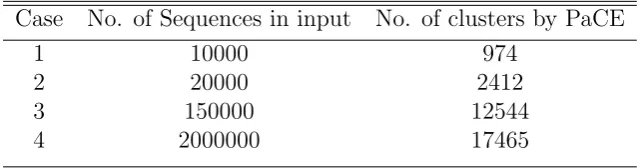
by PaCE for various sizes of human ESTs, ranging from 10000 to 2 million ESTs.
Table 1: Clusters by PaCE
Case No. of Sequences in input No. of clusters by PaCE
1 10000 974
2 20000 2412
3 150000 12544
4 2000000 17465
5.3
CAP3
CAP3 [7] is the assembly program that follows PaCE in the pipeline. The assembly algorithm consists of three major phases. In the first phase, 5’ and 3’ poor regions of each read are identified and removed. Overlaps between reads are computed. False overlaps are identified and removed. In the second phase, reads are joined to form contigs in decreasing order of overlap scores. Then, forwardreverse constraints are used to make corrections to contigs. In the third phase, a multiple sequence alignment of reads is constructed and a consensus sequence along with a quality value for each base is computed for each contig. Base quality values are used in computation of overlaps and construction of multiple sequence alignments.
CAP3 is a the most memory intensive application in the pipeline and it’s complexity increases exponentially with number of sequences in the input. As ESTs are extracted randomly from the cDNA library, CAP3 cannot be trivially parallelized. However, with PaCE, the clusters can be assembled in parallel. But, the number of clusters formed by PaCE increses with the size of input. From Table 1, we can see that the number of clusters formed for 2 million human ESTs is 17465. Hence, the total number of jobs for CAP3 is a bottle neck and has to be minimized.
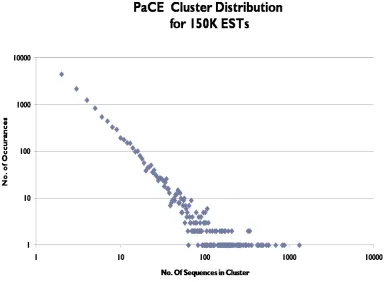
As we can see from figure 1, majority of the clusters have less than 10 sequences in them. The run time for CAP3 on these sequences will be less than a minute, but these small jobs may spend even a few hours on the queue even before they start executing. So, we tried sorting the clusters based on number of sequences they carried, and run the smaller clusters , which is decided based on a set threshold, on the local machine and bigger clusters on the teragrid.
Figure 1: Size distribution of clusters formed by PaCE for 150000 sequences.
[image:9.595.107.392.525.672.2]Swarm and in the globus resource. To minimize the waiting time, we group the clusters into chunks and then run CAP3 on those chunks on the local and grid machines based on number of sequences in each chunk. This way, we do not break any cluster but reduce the number of CAP jobs considerably.
5.4
BLAST
BLAST [3] is the final program in the pipeline. We use blastx against
uniref100 database to predict the gene functions from the contigs predicted by cap3.
the same time speeding up the process of BLAST.
As BLAST is a database comparison done sequence by sequence, it can also be trivially paralellized. That is, we can break the input file into smaller chunks and run the smaller chunks in paralell on the four super computers we use.
6
Results
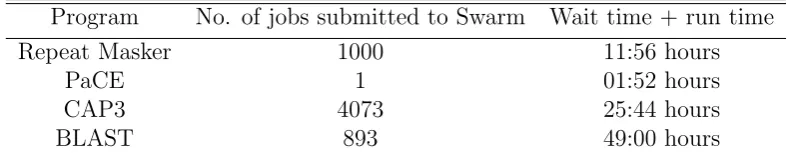
The Grid based EST sequence assembly pipeline was used to assemble 2 million human ESTs and the results are summarized below.
[image:11.595.100.494.401.483.2]For an input of 2 million human ESTs PaCE took 1 hour and 22 minutes including waiting time in the queue. PaCE produced 75460 clusters and after grouping the clussters, the number of jobs for CAP3 was only 4073. CAP3 was run in 25 hours and 44 minutes which includes the waiting time in the queue. Thus, the total time for assembly was 27 hours and 6 minutes.
Table 2: Assembly results for 2 million human ESTs
Program No. of jobs submitted to Swarm Wait time + run time
Repeat Masker 1000 11:56 hours
PaCE 1 01:52 hours
CAP3 4073 25:44 hours
BLAST 893 49:00 hours
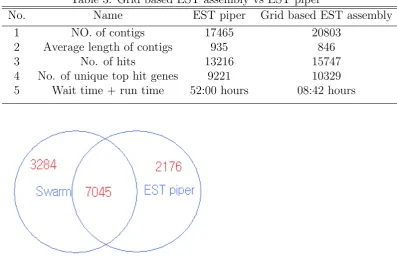
To validate the quality of results in our Grid based EST Assembly pipeline, we bench mark our tool against EST Piper [10] . We took 151000 ESTs of Daphnia pulex. The ESTs were then independently assembled using EST piper and our GRID based EST sequence assembly tool. The number of contigs predicted by EST piper was 17465 and the number of contigs predicted by Grid based EST sequence assembly was 20803. The contigs were then blasted against Uniref100 database with a e-value of 2. Grid based EST Assembly predicted, 90.8% of the genes predicted by EST piper. From the BLAST results, I compared the number unique genes predicted when considering only the best hit for each contig. This way Grid based EST Sequence assembly predicted 76.4% of the genes predicted by EST piper. The results are summarized in table 3.
Table 3: Grid based EST assembly vs EST piper
No. Name EST piper Grid based EST assembly
1 NO. of contigs 17465 20803
2 Average length of contigs 935 846
3 No. of hits 13216 15747
4 No. of unique top hit genes 9221 10329 5 Wait time + run time 52:00 hours 08:42 hours
Figure 3: BLAST results of Grid based EST Assembly vs EST piper for best hit.
but missed 2176 genes predicted by EST piper. The results are summarized in the venn diagram.
References
[1] Gocayne JD Dubnick M Polymeropoulos MH Xiao H Merril CR Wu A Olde B Moreno RF et al. Adams MD, Kelley JM. Complementary dna sequencing: expressed sequence tags and human genome project.
Science, 252(5013):1651-1656, 1991.
[2] P Green AFA Smit, R Hubley. Repeat masker. 1996.
[3] Miller W Myers EW Lipman DJ. Altschul SF, Gish W. Basic local alignment search tool. JOURNAL OF MOLECULAR BIOLOGY, No 215::403–410, 1990.
[5] Zhu W: Brendel V, Xing L. Gene structure prediction from consensus spliced alignment of multiple ests matching the same genomic locus.
Bioinformatics, 20(7):1157-1169, 2004.
[6] C. et al. Catlett. Teragrid: Analysis of organization, system architecture, and middleware enabling new types of applications. HPC and Grids in Action, 2007.
[7] Xiaoqiu Huang and Anup Madan3. Cap3: A dna sequence assembly program. Genome research, No 9::868–877, 1999.
[8] M.Pierce Pallickara, SL. Swarm: Scheduling large-scale jobs over the loosely-coupled hpc clusters. IEEE Fourth International Conference on eScience, pages 285–292, 12/2008 2008. December 7-12.
[9] Andreas Rohwer Paul M. Selzer, Richard J. Marhfer. A Applied bioin-formatics: an introduction. Springer, 2008.