Evaluation of Production Serverless Computing
Environments
Hyungro Lee, Kumar Satyam and Geoffrey C. Fox
School of Informatics,Computing and Engineering Indiana University Bloomington, Indiana 47408
Abstract—Serverless computing provides a small runtime container to execute lines of codes without a management of infrastructure which is similar to Platform as a Service (PaaS) but a functional level. Amazon started the event-driven compute named Lambda functions in 2014 with a 25 concurrent limitation but it now supports at least a thousand of concurrent invocation to process event messages generated by resources like databases, storage and system logs. Other providers i.e. Google, Microsoft and IBM offer a dynamic scaling manager to handle parallel requests of stateless functions in which additional containers are provisioning on new compute nodes for distribution. How-ever, while functions are often developed for microservices and lightweight workload, they are associated with distributed data processing using the concurrent invocations. We claim that the current serverless computing environments are able to support dynamic applications in parallel when a partitioned task is executable on a small function instance. We present results of throughput, network bandwidth, a file I/O and compute performance regarding to the concurrent invocations. We also deployed a series of functions for large distributed data processing to address the elasticity and scalability and then demonstrate the differences between serverless computing and virtual machines for cost efficiency and resource utilization.
Keywords—FaaS, Serverless, Event-driven Computing, Amazon Lambda, Google Functions, Microsoft Azure Functions, IBM OpenWhisk
I. INTRODUCTION
Serverless computing is a commercial cloud service that enables event-driven computing for stateless functions exe-cutable on a container with a small resource allocation. Con-tainers are lightweight which means that it starts in a second and destroys quickly whereas a software environment for applications is preserved in a container image and distributed over multiple container instances. This is one of the benefits that serverless computing takes along with its ease of use while traditional virtual machines on Infrastructure as a Service (IaaS) need some time to scale with system settings i.e. an instance type, a base image, a network configuration and a storage option.
Most services in the cloud computing era, pay-as-you-go is a basic billing method in which charges are made for allocated resources rather than actual usage. Serverless computing may provide a cost-efficient service because it is billed for the execution time of containers without paying for procured resources that never used. Serverless also uses 0.1 second as a charging metric although many VM servers still use an hourly charge metric. Amazon recently applied
per-second billing to EC2 services as Google Compute and Microsoft Azure already have the per-second billing but it still costs every second whether a program actually runs or not.
Serverless is a miss-leading terminology because it runs on a physical server but it succeeded in emphasizing no infrastructure configuration on the user side to prepare compute environments. Geoffrey et al [1] defines serverless computing among other existing solutions, such as Function-as-a-Service (FaaS) and Event-Driven Computing, and we see production serverless computing environments are offered as an event-driven computing for microservices in which event is an occurrence generated by other systems and resources and microservices are described as a formal syntax written in a programming function. New record on a database, deletion of an object storage, or a notification from Internet of Things devices is an example of various events and the event typically contains messages to be processed by a single or multiple event handlers. Sometimes an event is generated at a certain interval of time which is predictable but many cases significant numbers of events need to be processed at scale instantly. Horizontal scaling for processing concurrent requests is one of the properties of cloud-native applications [2] which have same practical approaches and designs to build elastic and scalable systems. Data processing serverless software (ExCamera [3], PyWren [4]) for video rendering and Python program recently show that extensive loads on the event handlers can be ingested on serverless computing by using concurrent invocations. We also understand that namespaces and control groups (cgroups) offered by containers power up serverless computing with an resource isolation to process dynamic applications individually, but provisioning a thousand of instances within a few seconds.
per request. Certain applications that can be partitioned into several small tasks, such as embarrassingly parallel, may take advantage of the concurrent invocations on serverless computing in which horizontal scaling is applied to achieve the minimal function execution time required to process the distributed tasks.
In this paper we evaluate serverless computing environ-ments invoking functions in parallel to demonstrate the perfor-mance and throughput of serverless computing for distributed data processing. We compare the performance of CPU, mem-ory and disk intensive functions running in between a sequen-tial and a concurrent invocation which helps understanding performance bottlenecks and function behaviors on serverless computing environments. We also measure the throughput of a set of event handlers including HTTP, database and storage which may indicate a maximum size of dequeuing event messages because functions are triggered by these common handlers supported by each serverless provider. Continuous de-velopment and integration are tested with source code changes and function configuration changes e.g. timeout value and memory size while concurrent functions are running. The rest of the paper contains comparisons between IaaS and FaaS using experiments on big data and deep learning applications and the latest features offered by each servereless computing environment from Amazon Lambda, Microsoft Azure Func-tions, Google Functions and IBM OpenWhisk.
A. Trigger
A trigger, also called a front-end event handler invokes a function with event messages as input parameters thus a function is executed to process a request. Timers invoked by crons are used to accomplish a set of tasks on a regular interval. For example, an Apache HTTP web server error log is deleted 3AM daily followed by archiving a copy of the log 2AM by scheduling routine cron tasks. Sensors at monitoring services detect events as a series of logics and new event handlers are continuously added based on application behaviors and purposes. For example, Internet of Things (IoT) device at a smart home detects receiving a package from online retailers and generates a new event message which might be a trigger of other applications e.g. sending text messages to a package recipient. Serverless computing providers understand various use cases and support different types of events including HTTP requests, object storage e.g. AWS S3, and a database e.g. IBM Cloudant thus as many actions as they can handle in order to answer back the event messages. Event handlers also called triggers either listen events and create an function invocation (push model) or collect changes at a regular interval to invoke a function (pull model). In this paper, We measure trigger resolutions to see how sensitive it is and understand its capacity of concurrent event messages. To measure a latency of triggers, we ran a simple function on AWS Lambda with three triggers; HTTP API gateway, DynamoDB and S3. For IBM OpenWhisk, we ran a function using a HTTP trigger and the IBM Cloudant trigger. For Google Cloud Function, we had triggers from HTTP, Google Cloud Storage and a pub/sub messaging trigger. For Azure Functions, we had triggers from HTTP and storage.
1) HTTP Trigger: HTTP trigger provides a simple but a rich format to invoke a function with various content types e.g. archive files, text, and JSON and multiple methods e.g. PUT,
POST and DELETE to deliver event messages differently. Asynchronous non-blocking call is available to deal with concurrent requests but queuing systems and database systems are more suitable to estimate dynamic requests than the HTTP trigger.
2) Database Trigger: Database trigger invokes a function when there is an insertion/modification/deletion of a record in a table which behaves like a message queuing system. Google supports pub/sub trigger in their serverless platform and it might be exchangeable with a database trigger since Google Functions does not have a database trigger. We see the comparison of the database type of trigger with AWS DynamoDB and IBM Cloudant as a direct trigger to their respective vendors’ functions. As of now we cannot compare Azure and Google Cloud as they do not have a direct trigger available to their respective functions. As per the graph, we see that performance of the AWS DynamoDB trigger surpasses the IBM Cloudant trigger.
3) Object Storage Trigger: Object storage is widely used to store and access data from various platforms and we find that the object storage trigger is supported in the most serverless providers. AWS S3 trigger performs better than the Google Cloud storage trigger but we still find that HTTP trigger is a more reliable choice in processing multiple requests. Note that we were not able to perform the object storage trigger for IBM cloud storage it does not offer a direct trigger to IBM Openwhisk as of now.
Serverless computing environments with concurrent in-vocations may support distributed data processing with its throughput, latency and compute performance at scale [6]. There are certain restrictions that we must be aware of before implementing a serverless function, for example, event handler types are a few; HTTP, object storage and database in common, memory allocation is small; 512MB to 3GB memory allowance per a container, function execution time is allowed only in between 5 minutes and 10 minutes and a 500MB size of a temporary directory is given. In the following sections, we show our results towards Amazon Lambda, Google Functions, Microsoft Functions, and IBM OpenWhisk Functions with its elasticity, concurrency, cost efficiency and, functionality to depict current serverless environments in production. Big Data Benchmark from AmpLab and TensorFlow ImageNet exam-ples are included as a comparison of costs and computation time between serverless computing and virtual machines as well.
II. EVALUATION
language thus some libraries and packages for data analysis are not imported e.g. TensorFlow needs Python 3.5+, and Google Functions is in a beta version which only supports NodeJS, a javascript runtime although Python is internally included in a function instance. 512MB memory limit on IBM OpenWhisk prevents running TensorFlow ImageNet example which requires at least a 600MB size of memory to perform image recognition using trained models. New recent changes are also applied in our tests such as 3008MB memory limits on Amazon Lambda, and Java runtime on Microsoft Azure Functions. All of the evaluations were performed using 1.5GB memory allocation except IBM with 512MB and 5 minutes execution timeout. To create a concurrent function invocation, the Boto3 library is used to create asynchronous invocation on Amazon Lambda, HTTP API is used on Microsoft Azure and IBM OpenWhisk and an object storage is used on Google Functions. Tests are completed by the set of functions written by NodeJS 6.10, Java, C#, and Python 3 and 2.7.
A. Concurrent Function Throughput
Function throughput is an indicator of concurrent process-ing because it tells how many function instances are supplied to deal with heavy requests. Asynchronous, non-blocking invo-cations are supported by various methods over the providers. Amazon SDK (Boto3) allows to invoke a function up to an account’s concurrent limit and S3 object storage or DynamoDB database is an alternative resource to invoke a function in parallel. Google Functions only allows to concurrent execution by a storage bucket and a rate of processing event messages varies depends on the length of the message and its size. Microsoft Azure Functions also scales out automatically by its heuristic scale controller. IBM OpenWhisk does not seem to provide scalability unless functions are manually invoked as a workaround. We had to create a thousand of functions with an identical logic but a different name and treat them like invoking a single function in parallel. Figure 1 is a throughput result per second over the four serverless providers from 500 to 10000 concurrent invocations. Amazon Lambda generates about 400 throughput per second in average and AWS quickly reaches its maximum throughput from a small number of concurrent invocation (1000). IBM OpenWhisk and Microsoft Azure Functions show similar behavior in reaching the best throughput at 2000 invocations and decreasing slowly over increased invocations. Google Functions indicates slow but steady increase of throughput over increased invocations. Throughput at ten thousands of invocations on Google Func-tions is about 168 per second which is better than IBM and Azure.
B. Concurrency for CPU Intensive Workload
[image:3.612.330.557.53.209.2]Multiplying two-dimensional array requires mostly com-pute operations without consuming other resources thus we created the matrix multiplication function written in a JavaScript to stress CPU resources on a function instance with concurrent invocations. Figure2shows an execution time of the function between 1 and 100 concurrent invocations. The results with 1 concurrent invocation which is non-parallel invocation are consistent whereas the results with 100 invo-cations show the overhead of between 28% and 4606% over the total execution time. The results imply that more than one
[image:3.612.345.543.272.317.2]Fig. 1: Function Throughput on Concurrent Invocations
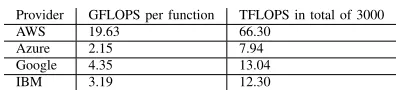
TABLE I: CPU Performance
Provider GFLOPS per function TFLOPS in total of 3000
AWS 19.63 66.30
Azure 2.15 7.94
Google 4.35 13.04
IBM 3.19 12.30
invocation was assigned to a single instance which may have to share allocated compute resources, i.e. two cpu-intensive function invocations may take twice longer by sharing CPU time in half. For instance, the median of the function execution time on Amazon Lambda (3.72 seconds) is about twice the non-concurrent invocation (1.76 seconds).
19.63 gigaflops are detected on AWS Lambda with the 1.5GB size of memory configuration (whereas 40 gigaflops are measured with 3GB memory) but it can reach more than a ter-aflop when a fleet of containers are provisioned for concurrent invocations. Serverless platform allocates compute resources based on the amount of requests which shows to a peak double-precision floating point performance of 66.3 TFLOPs when an Amazon Lambda function is invoked concurrently. TableIis the result of invoking three thousands of functions on serverless functions which indicates proportional between the number of functions and the aggregated flops. 66.3 teraflops are relatively good performance. For example, Intel six core i7-8700K generates 32 gigaflops and the latest NVIDIA TESLA V100 GPU delivers 7.8 teraflops for a double precision floating point. In the comparison of the total of TFLOPS, AWS Lambda generates 5-7 times faster compute speed than others. Azure Functions, IBM OpenWhisk, and Google Functions are in either a beta service or an early stage of development therefore we expect that the allocated compute resource will be more comparable when the services are fully mature.
C. Concurrency for Disk Intensive Workload
Fig. 2: Concurrency Overhead with CPU Intensive Function
Fig. 3: Concurrency Overhead with File I/O Intensive Function
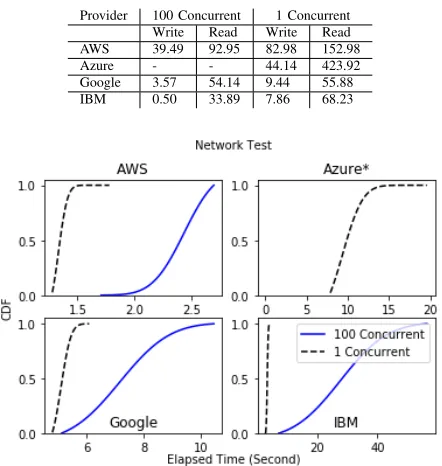
concurrent invocations. The results with 100 invocations show that Amazon generates an execution time overhead of 91%, Google generates the overhead of 145% and IBM generates the overhead of 338% whereas Microsoft Functions fail to complete function invocations within the execution time limit, 5 minutes. The median speed of the file read and write is available in the TableII. Reading speed on Azure Functions is the most competitive among others although it is not measured on 100 concurrent invocations due to the storage space issue. Writing a file between 1 and 100 concurrent invocations is slightly worse compared to reading, the overhead of 110% on Amazon Lambda, 164% on Google Functions and 1472% on IBM OpenWhisk exist whereas the writing speed on Amazon Lambda is 11 to 78 times faster than Google and IBM when 100 concurrent invocations are made.
D. Concurrency for Network Intensive Workload
Processing dataset from dynamic applications i.e. big data and machine learning often incur significant performance degradation in congested networks due to heavy transactions of file uploading and downloading. If such activities are distributed at multiple locations, network delays can be
eas-TABLE II: Median Write/Read Speed (MB/s)
Provider 100 Concurrent 1 Concurrent Write Read Write Read AWS 39.49 92.95 82.98 152.98
Azure - - 44.14 423.92
Google 3.57 54.14 9.44 55.88
[image:4.612.335.556.76.309.2]IBM 0.50 33.89 7.86 68.23
Fig. 4: Concurrency Overhead with Downloading Objects Function
ily mitigated. Containers for serverless functions tend to be deployed at different nodes to ensure resource isolation and efficient resource utilization and this model may help resolving this issue especially when functions are invoked in parallel. We created a function which requests data size of 100 megabytes from an object storage on each service provider thus a hundred concurrent invocations create network traffic in total of 10 gigabytes. Figure 4 shows delays in the function execution time between 1 and 100 concurrent invocations. We find that Google Functions has a minimal overhead between 1 and the 100 concurrency level whereas Amazon Lambda is four times faster in loading data from Amazon object storage (S3) than Google object storage. Microsoft Azure Functions fails to get access of data from its blob storage at 100 concurrency level and we suspect it might be caused by the experimental runtime, i.e. Python 2.7 or a single instance for multiple invocations. Default runtime such as C# and F# may support scalability better than the other runtime under development on Microsoft Azure Functions.
E. Elasticity
[image:4.612.66.287.276.435.2]Fig. 5: Response Time for Dynamic Workload
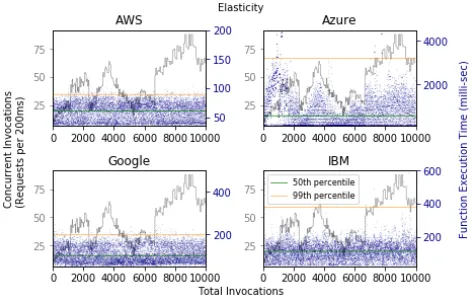
instantiating new instances (which also called cold start) and a total number of instances created during this test. We believe that it explains whether elasticity mechanisms on serverless computing is efficient or not in resource provisioning and utilization. Delays in processing time would be observed when existing function instances are overloaded and new instances are added slowly which may cause performance degradation in the entire invoked functions. Figure 5 shows different results among the serverless providers with the same dynamic workloads over time. We observed that new function instances were added when a workload jumps to higher than the point that existing instances can handle and the increased number of function instances stay for a while to process future requests. We find that Amazon and Google support elasticity well in which the 99th percentile of the function execution time is below 100 and 200 milliseconds whereas both IBM and Azure show significant overhead at least two times bigger than others if we compare the 99th percentile of the execution time. The number of instances created for this workload was 54, 10, 101 and 100 in the order of Amazon, Azure, Google and IBM. If there is a new request coming in while a function is in processing current input data, Amazon provides an additional instance for the new request whereas others decide to increase the number of instances based on other factors, such as cpu load, a queue length, an age of a queued message, which may take some time to determine. The function we tested uses the NodeJS runtime and scalable trigger types but we would consider other runtimes i.e. C# and Java and other triggers e.g. databases to see if it performs better in dealing with dynamic workload. Each serverless provider uses different operating systems and platforms and it seems certain runtimes and triggers have better support in handling elasticity than others. For example, Azure Queues has the 32 maximum batch size to process in parallel and Azure Event Hubs doubles the limit. TableIIIcontains actual numbers we measured during this test and the function execution time which is represented by blue dots in the figure would expect to take less than 0.1 second in a single invocation but there are overhead when workload is increased in which the standard deviations and 99th percentile indicate in the table. It explains that the increased number of instances should be available instantly with additional amounts of compute resources to provide enough capacity for the upcoming demands.
TABLE III: Execution Time (milli-sec) on Elasticity
Provider MED SD 1st PCTL 90th PCTL 99th PCTL
AWS 61.08 14.94 35.08 78.99 89.41
Azure 574.0 747.33 118.0 1808.30 3202.0
Google 101.0 38.75 57.0 162.0 198.0
IBM 112.0 142.23 31.0 177.0 378.79
MED = Median, SD = Standard Deviation, PCTL = Percentile
F. Continuous Deployment and Integration
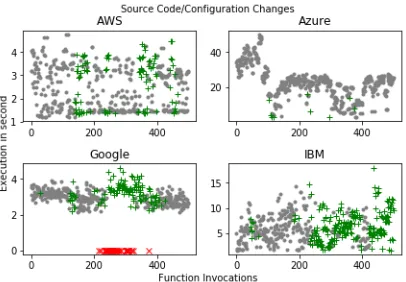
Development andOperations(DevOps) paradigm is applied to serverless functions to enable continuous delivery and integration while functions are in action. Functions are ought to be changed frequently for bug fixes and new updates and the new release of functions should be deployed without causing failures and delays to a production environment during the existing function executions. Function configurations, such as timeout and memory size, are often necessary without affecting a function performance and delaying response time. Serverless computing with DevOps may improve code development and delivery steps through proper function deployment and con-figuration which we expect when we write a function like a program. Figure 6 shows a general function behavior when a region of source code is updated and a configuration is changed during 500 function executions in total with 10 concurrent invocations. Gray dot indicates that a function is completed in an existing function instance and a green plus indicates a function is ran on a new instance. We have made a change of source code before the first 200 invocations and an update of configurations within the next 200 invocations thus different behaviors should be observed close to these timelines. Amazon has a certain period to replace an existing deployment to new one. There are gray dots between 200 and 400 invocations and we find that the previous function instances continued to process several event messages although a new piece of source code is published before the 200 invocations. Instead, Google and IBM refreshed entire instances when there is a new deployment although Google failed to multiple requests during the update (red ’x’ marker indicates a failure of a function). Microsoft Azure shows a similar behavior but it is not clearly visible in the figure due to a small number of instances. A single instance was detected to process of the first 200 invocations and a couple of new instances were added later. We saw six new instances on Azure functions.
G. Serverless versus Virtual Machine
[image:5.612.334.555.78.128.2]Fig. 6: Function Behavior over Changes
(gray dot: existing instances,green +: new instances,red x: failed instances)
allocations (default 0, increased upon request) while AWS Lambda allows to invoke a function at least a thousand of concurrency per region with a small memory allocation up to 2.8GiB (3008MB) which result in a total size of 2.8TiB. We ran an experiment in this section to demonstrate possible use cases of serverless with the understanding of the differences of these two compute models. Serverless computing is powered by container technologies which has near zero start-up and deleting latency during a function life-cycle. For example, we ran a test of NodeJS function using Apache OpenWhisk with Kubernetes and a small Docker container (as a Kubernetes Pod) is deployed and terminated within a few milliseconds for the function invocation. The container instance was in a running state (warm state) for a certain period to receive a future event message which merely consumes compute resources and was changed to a pause state which indicates a terminated process but reserving function data like source code and a temp directory in a storage. This saves time to re-instantiate a function for the upcoming requests without wasting compute resources. This may cause some delays at first which is called cold start but a configuration can be changed to extend the idle time of the running container or a regular wake-up invocation can be implemented as a workaround if necessary. On the contrary, virtual machines take at least a few seconds to be ready to run a program and a high-end server type with multiple virtual CPUs and a large size of memory and storage with a custom machine image may take 10 to 20 minutes to initialize. Another issue of using virtual machines is that a resource utilization needs to be handled by users to maximize values of leasing machines. If a VM is idle, utilization rate will be decreased and if more VMs are necessary to support a huge amount of traffic rapidly, existing VMs will be overloaded which may cause performance degradation. Regarding the charge interval of leased VMs, many cloud providers have applied a per-second basis like serverless computing with some exceptions therefore certain workload would be deployed on VMs if it requires high performance compute resources for a short amount of time.
We did a cost comparison between serverless computing and traditional virtual machines because we think it would explain cost effectiveness for certain workload deployed on these two platforms. The charging unit is different, serverless
TABLE IV: Building Binary Tree with Cost-Awareness
Platform RAM Cost/Sec Elapsed Second Total Cost (Rank) AWS Lambda 3008MB $4.897e-5 20.3 $9.9409e-4 (6) AWS EC2 (t2.micro) 1GiB $3.2e-6 29.5 $9.439e-05 (3) Azure Functions 192MB $3e-6 71.5 $2.145e-4 (4) Azure VM 1GiB $3.05e-6 88.9 $2.71145e-4 (5) Google Functions 2GB $2.9e-5 34.5 $0.001 (7) Google Compute (f1-micro) 600MB $2.1e-6 19.2 $4.0319e-05 (1) IBM OpenWhisk 128MB $2.2125e-6 34.2 $7.5667e-05 (2)
computing is based on 100 milliseconds per invocation and a virtual machine is based on an hour or a second per an instance. When we break down the cost in a second, serverless is almost ten times expensive compared to a virtual machine regarding to the allocated compute resources. We ran a python and a javascript creating binary trees which consumes CPUs and memory intensively on both platforms. Table IV shows the execution time of the creating binary trees and the total cost with the rank ordered by cost effectiveness. The result in-dicates that a sequential and continuing function on serverless computing would not be a good choice in terms of cost-savings although it is still a simple way of deploying a function as a service with a minimal infrastructure management. However, dynamic concurrent invocations on serverless computing will save cost against overloaded virtual machines when a number of event messages spikes.
H. Trigger Comparison
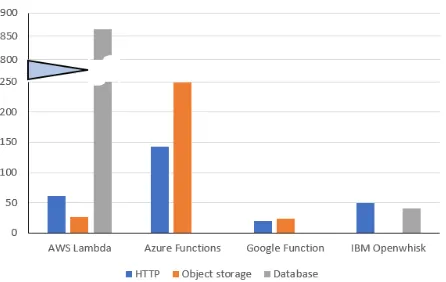
In this section, we measure a trigger throughput to indicate the maximum number of processing event messages in parallel. Certain triggers e.g. Timer and GitHub Commit are excluded because they generate a single event message as a series of procedure and these are not suitable for concurrent function in-vocations. Three types of triggers are selected; HTTP, database and object storage triggers to measure the trigger throughput. In the Figure7, Triggers in AWS Lambda show that the median throughput of the HTTP trigger is 55.7 functions per second and the object storage has the 25.16 functions per second median throughput. The database trigger in AWS Lambda has throughput of 864.60 functions per second which is about 32 times of object storage throughput and 15 times of HTTP trigger throughput. Note that the instance of database trigger at Amazon is adjustable to deal with more event messages when it is necessary. The scale of y axis in the figure is the number of functions processed per second. We did not compare Azure and Google Cloud database trigger as they do not have a direct trigger available to their respective functions. In the HTTP trigger, the asynchronous calls may not be supported by serverless providers and limits of concurrent trigger processing vary as well. Details about quota and limits need to be confirmed by the providers and user accounts. As per Figure7
[image:6.612.323.579.79.140.2]Fig. 7: Trigger Throughput
I. Feature Comparison
The feature comparison would be helpful to the new users of serverless computing and will help the readers of this paper understand the underlying system level information of the serverless platform. As per the Table V, AWS Lambda offers a wide range of trigger endpoints compared to the other cloud providers.We also see that the cost of usage of serverless function is based on two metrics. First, the number of invocation of serverless functions. Second, the time taken by a serverless function to execute and complete paired with an amount of memory in size of gigabytes allocated. Invo-cation to the serverless functions is really cost effective in all serverless providers if an application is executable with certain restrictions that serverless computing has. All providers have similar pricing tables but IBM openWhisk does not charge the number of invocations whereas the other providers do charge. Google upscales in terms of memory as it provides maximum of 2 GB of memory to run a serverless function. Google also outperforms in terms of providing maximum execution timeout of 9 minutes which would be helpful for long running jobs. IBM OpenWhisk has the container which can provided the best clock speed of 2100 *4 MHz.
J. Language Support
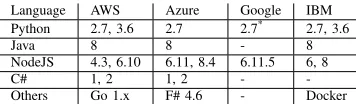
[image:7.612.65.288.91.232.2]Each serverless provider supports different programming languages thus developers are able to write functions with a language preference. As an interpreted language, we find Node.js, JavaScript runtime environment from all of the providers, and Python is mostly supported. Compiled lan-guages such as Java and C# are also supported although a web-based inline editor is excluded. We assume that serverless provider intends to extend language support in the future, for example, Amazon recently added Golang and Microsoft Azure added Java as their new runtime. Table VI shows a list of supported runtimes. One other observation across different language runtimes is an overhead to complete a function. We created a second wait function in different languages and measured excessive execution time in average than a second over 100 times. Figure 8 indicates that the runtime overhead in AWS is negligible and similar whereas
Fig. 8: Runtime Overhead (Missing bars mean a language is not supported)
C# in Azure creates the least overhead among other runtimes and Python in IBM OpenWhisk shows the least standard deviation. Node.js environment is a better choice in Google Functions but we measured Python runtime overhead indrectly through child_process.spawn(). For some functions, these overheads might be sensitive to choose a language runtime since there are timeouts in executing a function (See Table V).
III. USECASES
There are several areas where serverless can play an im-portant role in research applications as well as in commercial cloud. Big Data map-reduce application can be executed in a similar fashion but a cost-effective way of a deployment as we discuss implementations of the big data applications in a series of serverless functions with cloud object storage and databases [7], [8]. We ran some Big Data Benchmark tests by scanning 100 text files with different queries and aggregating 1000 text files with group by and sum queries which show that certain applications are executable on serverless framework relatively easily and fast compared to running on server-based systems. Image processing for CDN is also widely used by commercial purpose to process thumbnails of the images to client such as mobile and tablets which can be taken care by serverless. Internet Of Things (IoT) is also one of use cases for serverless framework because IoT devices typically have a small compute power to process all the information and need to use remote compute resources by sending event messages which is a good fit for serverless computing. IoT devices will trigger the lambda function using a rule. For example, in case of a data-center, cooling facility is very important for proper functioning of servers. If cooling is down, the sensors will call a lambda function which will contain the logic sending alert emails to the support team. In near future, we hope to see several use cases of serverless computing as a main type of cloud-native application development.
IV. DISCUSSION
Item AWS Lambda Azure Functions Google Functions IBM OpenWhisk Runtime language Node.js, Python, Java, C#,
Golang(Preview)
C#, F#, Node.js, PHP, Type-Script, Batch, Bash, Power-Shell, Java(Preview)
Node.js Node.js, Python, Java, C#, Swift, PHP, Docker
Trigger 18 triggers (i.e. S3, Dy-namoDB)
6 triggers (i.e. Blob, Cosmos DB)
3 triggers (i.e. HTTP, Pub/Sub)
3 triggers(i.e.
HTTP,Cloudant) Price per Memory $0.0000166/GB-s $0.000016/GB-s $0.00000165/GB-s $0.000017/GB-s
Price per Execution $0.2 per 1M $0.2 per 1M $0.4 per 1M n/a
Free Tier First 1 M Exec First 1 M Exec First 2 M Exec Free Exec /
40,000GB-s
Maximum Memory 3008MB 1536MB 2048MB 512MB
Container OS Linux Windows NT Debian GNU/Linux 8 (jessie) Alpine Linux
Container CPU Info 2900.05 MHz,1 core 1.4GHZ 2200 MHz, 2 Processor 4 CPU cores,2100.070 MHz Temp Directory
(Path)
512 MB (/tmp) 500 MB (D:\Local\Temp) (/tmp) (/tmp)
Execution Timeout 5 minutes 10 minutes 9 minutes 5 minutes
Code Size Limit 50 / 250 MB (com-pressed/uncompressed)
n/a 100MB (compressed)
for sources. 500MB (uncompressed) for sources plus modules.
[image:8.612.82.540.51.217.2]48 MB
TABLE V: Feature Comparison
Language AWS Azure Google IBM
Python 2.7, 3.6 2.7 2.7* 2.7, 3.6
Java 8 8 - 8
NodeJS 4.3, 6.10 6.11, 8.4 6.11.5 6, 8
C# 1, 2 1, 2 -
-Others Go 1.x F# 4.6 - Docker
TABLE VI: Supported Language Runtime
*Internal Support
can be applied to serverless computing with its concurrent invocations. Additional containers for concurrent function in-vocations reduce a total execution time with a linear speed up, for example, a function invocation divided into two containers decreases an execution time in half. There are also overlaps and similarities between serverless and the other existing services, for example, Azure Batch is a job scheduling service with an automated deployment for a computing environment. AWS Beanstalk [9] is deploying a web service with automated resource provisioning.
V. RELATEDWORK
We have noticed that there were several efforts to utilize current serverless computing for parallel data processing using concurrent invocations. PyWren [4] is introduced in achieving about 40 TFLOPs using 2800 Amazon Lambda invocations. The programming language runtime on serverless computing has been discussed in the recent work [10]. Deploying scien-tific computing applications has been conducted with experi-ments to argue the possible use cases of serverless computing for adopting existing workload [11] with its tool [12]. McGrath et al [13] shows serverless comparison results for function latency among production serverless computing environments including Microsoft Azure Functions but it was not a compre-hensive review, such as testing CPU, network and a file I/O, and several improvements have been made later such as an increment of memory allocation i.e. 3GB on Amazon Lambda and additional runtime support i.e. Java on Azure Functions and Golang on Amazon. OpenLambda [14] discusses running a web application on a serverless computing and OpenWhisk is introduced for mobile applications [5]. Since then several offerings on serverless framework with new features have been
made. Kubeless [15] is a Kubernetes-powered open-source serverless framework, like Fission [16]. Zappa [17] is a python based serverless powered on Amazon Lambda with additional features like keeping warm state of a function by poking at a regular interval. OpenFaaS is a serverless for Docker and Kubernetes with a language support for Node.js, Golang, C# and binaries like ImageMagicK. Oracle also started to support open source serverless platform, Fn project [18]. In this work, we have investigated four serverless computing environments in production regarding to the CPU performance, network bandwidth, and a file I/O throughput and we believe it is the first evaluation across Amazon Lambda, Azure Functions, Google Functions and IBM OpenWhisk.
VI. CONCLUSION
[image:8.612.85.263.261.313.2]with less restrictions on configurations to deal with complex workloads.
ACKNOWLEDGMENT
This work was partially supported by NSF CIF21 DIBBS 1443054 and the Indiana University Precision Health initiative. We thank Intel for their support of the Juliet system, and extend our gratitude to the FutureSystems team for their support with the infrastructure. We thank the WOSC workshop series for focusing attention on this area.
REFERENCES
[1] G. C. Fox, V. Ishakian, V. Muthusamy, and A. Slominski, “Status of serverless computing and function-as-a-service (faas) in industry and research,”arXiv preprint arXiv:1708.08028, 2017.
[2] D. Gannon, R. Barga, and N. Sundaresan, “Cloud-native applications,”
IEEE Cloud Computing, vol. 4, no. 5, pp. 16–21, 2017.
[3] S. Fouladi, R. S. Wahby, B. Shacklett, K. Balasubramaniam, W. Zeng, R. Bhalerao, A. Sivaraman, G. Porter, and K. Winstein, “Encoding, fast and slow: Low-latency video processing using thousands of tiny threads.” inNSDI, 2017, pp. 363–376.
[4] E. Jonas, S. Venkataraman, I. Stoica, and B. Recht, “Occupy the cloud: Distributed computing for the 99%,”arXiv preprint arXiv:1702.04024, 2017.
[5] I. Baldini, P. Castro, P. Cheng, S. Fink, V. Ishakian, N. Mitchell, V. Muthusamy, R. Rabbah, and P. Suter, “Cloud-native, event-based programming for mobile applications,” inProceedings of the Interna-tional Conference on Mobile Software Engineering and Systems. ACM, 2016, pp. 287–288.
[6] H. Lee, “Building software defined systems on hpc and clouds,” 2017. [7] G. C. Fox and S. Jha, “A tale of two convergences: Applications and
computing platforms.”
[8] S. Kamburugamuve and G. Fox, “Designing twister2: Efficient pro-gramming environment toolkit for big data.”
[9] A. Amazon, “Elastic beanstalk,” 2013.
[10] M. Maas, K. Asanovi´c, and J. Kubiatowicz, “Return of the runtimes: Rethinking the language runtime system for the cloud 3.0 era,” in
Proceedings of the 16th Workshop on Hot Topics in Operating Systems. ACM, 2017, pp. 138–143.
[11] J. Spillner, C. Mateos, and D. A. Monge, “Faaster, better, cheaper: The prospect of serverless scientific computing and hpc,” inLatin American High Performance Computing Conference. Springer, 2017, pp. 154– 168.
[12] J. Spillner, “Snafu: Function-as-a-service (faas) runtime design and implementation,”arXiv preprint arXiv:1703.07562, 2017.
[13] G. McGrath and P. R. Brenner, “Serverless computing: Design, im-plementation, and performance,” in Distributed Computing Systems Workshops (ICDCSW), 2017 IEEE 37th International Conference on. IEEE, 2017, pp. 405–410.
[14] S. Hendrickson, S. Sturdevant, T. Harter, V. Venkataramani, A. C. Arpaci-Dusseau, and R. H. Arpaci-Dusseau, “Serverless computation with openlambda,”Elastic, vol. 60, p. 80, 2016.
[15] Kubeless, “A kubernetes native serverless framework,” 2017. [16] Fission-Platform9, “Serverless with kubernetes,” 2017. [17] Zappa, “Serverless python web services,” 2017.