International Journal of Innovative Technology and Exploring Engineering (IJITEE) ISSN: 2278-3075, Volume-8 Issue-9, July 2019
Abstract:In this article, an adaptive PID controller design is proposes for the nonlinear conical tank process. The modeling of the proposed tank process is obtained from local linear modeling technique. Totally five local linear regions are identified and formed to get nonlinear model of the process. The PID controller is designed for each linear model and combined together to get the adaptive PID controller. The identified adaptive PID is presented to the conical system and the measured results are verified with local PID controllers to show the effectiveness of the proposed one. From the measured results, it is verified that the overall performance of the Adaptive PID controller is significantly better than local PID.
Index Terms: Conical tank process, Local linear model, nonlinear model, Adaptive PID, Local PID
I. INTRODUCTION
In process industries, control of nonlinear processes such as conical tank, CSTR, distillation column, etc., is very complex due to dynamic behaviour of the process. Most of the industries are use conical tank because of its different shape which contributes the better drainage for different solid mixtures, slurries and viscous liquids etc. The control of the level is important in conical tank, which is a challenging task because of its shape i.e. variable area and non-linear behaviour.
The nonlinear modeling is complex over its broad operating region and varying nature of operating conditions. The local linear model based multiple model technique avoid these drawbacks in nonlinear tank process modeling.
In multiple model techniques, all operating region of the conical tank is divided into several regions and then local PID controller parameters are identified for the each region. Jose Luis Calvo-Rolle et.al [10] has stated that, PID controller is the mostly used control system in industry due to error correction ability in control systems and stabilizing process. Wen Tan et al. [9] reported various PID tuning techniques such as Ziegler–Nichols (Z–N) method, Cohen–Coon (C–C) method, Internal Model Control (IMC) method with error function ISE, IAE, and ISTE as the objective function to be minimized. J.Prakash and Srinivasan [7] have reported IMC based local PID controller tuning for the nonlinear process. The local PID controller is not effective when the operating region shifts and system is highly nonlinear and complex in nature, because of the operating condition variations.
Revised Manuscript Received on July 05, 2019
Dr.K.Vijayakuamr, Associate Professor, Department of EIE, Dr.Mahalingam College of Engineering and Technology, Pollachi, Coimbatore , Tamilnadu
Mr.P.Kathirvel, Assistant Professor, Department of EIE, Dr.Mahalingam College of Engineering and Technology, Pollachi, Coimbatore , Tamilnadu
Ms.V.Karpagam, Assistant Professor(SS), Department of EIE, Dr.Mahalingam College of Engineering and Technology, Pollachi, Coimbatore , Tamilnadu .
However, the Adaptive PID controller (A-PID), which reflects the nonlinear relations of the input and output variables, can eliminate these issues.
The local region of the conical tank is identified between 0.5 and 2.2 process gain (K). Totally five local regions were taken and PID is tuned for each region by cohen coon and IMC techniques. Locally tuned PID controller is suitable for that particular region. But in real time, conical process region is varied with respect to time, so that local PID tuned one particular region is not suitable for other regions. In order to overcome this issue, nonlinear Adaptive PID (A-PID) is preferred for the process variations tracking. A-PID is designed by combining all locally tuned PID through multi model technique. The Takagi-Sugeno (T-S) fuzzy model [8] is mainly used to make the multi model from the interpolation of the linear models. In T-S model, general model and its equivalent PID values are used to make the A-PID which works in the varying operating region of the process [8]. In order to prove the effectiveness of the proposed work, it is offered to nonlinear conical tank process water level control. From results, it is measure that the A-PID controller technique provide better servo and regulatory tracking performances under varying operating regions. The results of A-PID and local PID are compared with respect to simple performance i.e. overshoot, offset, oscillations, etc., and integral performance criteria such as Integral Square Error(ISE), Integral Absolute Error (IAE), Integral Time weighted Absolute Error (ITAE).
The next part of the paper is structured as follows: Section.2 elaborates the process and hardware setup. Section.3 describes nonlinear multi model of the process from local linear models. Section.4 discusses about the implementation of Adaptive PID controller in conical tank process and the simulation studies of proposed schemes are also given. The brief conclusion of the paper work is given in section.5.
II. PROCESSDESCRIPTION
In process industries conical tank and spherical tank are used as storage elements. Bothe the tanks are nonlinear due to its shape, volume of the tank changes at every point because of the variation in the radius. Conical Tank System (CTS) is used for improved drainage for solid mixtures, slurries and viscous liquids in process industries. The main objective of the proposed work is to design a proper control algorithm for the level control of the CTS. The CTS shown in Figure.1 shows the inverted tank with an inlet flow at top (Fin) and an outlet flow at the bottom (Fout), a pump that allow the liquid flow and a control valve with coefficient (Cv) to manipulate Fin..
Adaptive Tuned Controller Parameters for
Non-Linear Tanks
Fig.1 Schematic of the Conical Tank System
The CTS is a one type of single input single output (SISO) process in which the tank liquid level ‘h’ is considered as the measured variable and the inlet flow Fin is considered as the manipulated variable. Radius(r) of the tank is a varying parameter, so it is expressed as the ratio of maximum radius(R) to maximum height (H) of the Conical Tank. The operating parameters of the CTS are given in the Table.1
Table.1 Operating Parameters of the CTS
Parameters Description Value
H Height of the
tank
64cm
D Diameter of the
tank
8cm
Fin Maximum Inlet
flow of the tank
440LPH
Fout Outlet flow of
the tank
Constant
The mathematical relationship between ‘h’ and ‘Fin’ is expressed as:
-- (1)
The Personal Computer (PC) based closed loop hardware setup of the CTS is shown in Figure.2. The liquid level is measured by various pressure transmitter whose output is in the form of 4-20mA. The inlet flow of tank is regulated through pneumatic control valve and it has a fixed outlet. According to level variations with the set point, controller action is applied to the level of the process through the valve. The measurement comparison with set point and controller algorithm action takes place at the PC. The necessary data acquisition system is used to takes of the conversion of process parameters.
Fig.2 PC based hardware setup of CTS A. Model of Conical Tank Process
The physical model of CTS shown in Figure.2 is done by block box modeling technique i.e open loop method. A known input variation is applied to the system to get dynamic response of the system. From the output response, physical model of the system is derived using black box modeling procedure. In CTS, Fin is varied like step through 40% opening of valve at inlet pipe, and the output response i.e. height of the liquid is observed with respect to time given in Table.2. Figure.3 shows the response of the system for the given 40% opening.
Table.2 Height of CTS level
Time(sec) Height(cm)
0 0
60 8.49 180 18.26 240 22.75 300 27.76 360 29.3 420 30.4 480 31.5 540 32.11 660 33.35 780 34.11 900 34.6 1020 35.06 1080 35.18 1140 35.4 1200 35.4
Figure.3 Open Loop Response of CTS
0 10 20 30 40
0 500 1000 1500
pr
oc
es
s v
ar
ia
bl
e
Time(sec)
40%
International Journal of Innovative Technology and Exploring Engineering (IJITEE) ISSN: 2278-3075, Volume-8 Issue-9, July 2019
From the response, general model of the CTS in the form of First Order Plus Delay Time (FOPDT) is identified as given Equation.2:
G(s) =
--- (2)
Where,
K = 1.36(process gain) Td =34(time delay)
ts =117.82(process time constant)
[image:3.595.42.292.261.358.2]From same procedure, local models of CTS at different operating regions are identified through various openings of Fin. The derived local model are finally combined together to get the nonlinear model of CTS. Table.3 shows the identified local models of the CTS at five different operating regions.
Table 3 Linear models of the CTS
B. FiguresA-PID controller for CTS
The given linearmodel of the CTS is resulting around the steady state operating point and PID controller is tuned for each specified operating region by any one of the conventional linear tuning techniques such as Process Reaction Curve (PRC), Internal Model Control (IMC), etc,. The linear PID tuned for one particular region is not suitable for other regions, so that normally tuned PID is not correct for the nonlinear CTS due to the dynamic characteristics of the process. The Adaptive PID (A-PID) controller formulated through Takagi-Sugeno (T-S) multi model technique can wipe out these issues. The dynamics of the non-linear CTS can be derived by merging general linear regions through T-S multi model procedure. In T-S, multi model of CTS is obtained based on the interpolation of given linear models. The rule related with interpolation of general model of the system can be expressed as,
where, x (t ) ∈Rnis the state vector, u(t ) ∈Rmis the input vector, Ai∈Rn×n, Bi∈Rn× ,Ci∈Rq×n m and {z1(t), z2(t),… ,zp(t)} are nonlinear functions derived from the nonlinear systems and M (z) is the degree of membership of z (t) in a fuzzy set Mij. The output of the fuzzy model can be expressed as,
x =∑h1( z )[ Ai x (t )+ Bi u(t )]
i =1
r
y (t )=∑h1( z )Ci x (t )
i −1
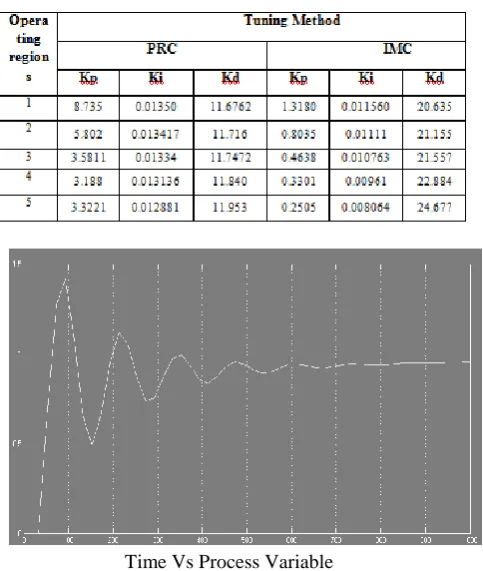
The derived PID settings through PRC and IMC methods for the identified local regions are given in Table.
Table.4 PID values for local linear regions of CTS
The closed loop responses of the CTS region.1 using PID tuned through PRC and IMC methods are shown in Figure.4 and Figure.5
[image:3.595.312.554.389.675.2]
Figure.4 CTS Region.1 Closed loop response for IMC tuned PID settings
The other four regions closed loop response is obtained using PRC and IMC tuned PID controllers. The performance of the controller settings is evaluated through the simple performance criteria’s viz
overshoot, settling time, oscillations, etc., and Operating
regions
Process Gain(K)
Time Delay(td)
Time Constant(ts)
1 0.5 34 105
2 0.8 34 112
3 1.36 34 117.82
4 1.8 34 140
5 2.2 34 180
integral performance criteria such as ISE, IAE and ITAE. The values of the performance criteria’s are given in the Table.5 and Table.6
Table.5 Simple Performance values of the PRC & IMC PID
Table.6 Integral Performance values of the PRC & IMC PID
Figure.5 CTS Region.1 Closed loop response for PRC tuned PID settings
The Adaptive PID (A-PID) controller formulated through Takagi-Sugeno (T-S) multi model technique as expressed in Equation, which provides optimum result over the entire region of the process. The responses of the A-PID for the varying operating regions are given in Figure.5 & Figure.6 and the performance criteria values of the same are given in Table.5 & Table.6
Table.7 Simple performance analysis of local PID & A-PID
Figure.6 a) Servo response of the A-PID controller
Figure.7 a) Servo response of the A-PID controller The performance of the A-PID is obtained through the simple performance and Integral performance criteria’s. Table.7 & 8 shows the A-PID values and the same is compared with the local PID performance given in Table.6 to show the effectiveness.
Table.8 Integral performance analysis of local PID & A-PID
0 20 40 60 80 100 120 140 160
0.08 0.085 0.09 0.095 0.1 0.105 0.11 0.115 0.12
setpoint tracking
time(sec)
P
V
(c
m
)
0 20 40 60 80 100 120 140 160
0.08 0.085 0.09 0.095 0.1 0.105 0.11 0.115 0.12
setpoint tracking
P
V
(
c
m
)
International Journal of Innovative Technology and Exploring Engineering (IJITEE) ISSN: 2278-3075, Volume-8 Issue-9, July 2019
From results, it is observed that the A-PID gives better results over entire operating region of the CTS. A-PID provides better ISE, IAE and quicker settling time with less overshoot and oscillation than the locally tuned PID.
III. CONCLUSION
The conical tank exhibits significant nonlinear dynamics. Adaptive PID was designed, in order to sustain the required level in the tank and to evaluate the servo control and regulatory performance. The adaptive PID controller which is designed for non linear conical tank system operates satisfactorily in all the operating regions. The numerical simulation results show that Adaptive PID is able to control effectively. On comparing with local PID, it can be seen that the error in Adaptive PID is very less comparatively and has quick settling time. Based on the performance criteria of adaptive PID controller, the servo and regulatory performance is good and provides good tracking of the set point. Further, it can be concluded that the design of adaptive PID for non-linear conical system helps to create response with less overshoot and settles to the set point quicker in the complete operating regions.
REFERENCES
1. S.Vijayalakshmi, Dr.D.Manamalli and G.Palanikumar, “Experimental
verification of LPV modeling and control for conical tank system”,IEEE,2013.
2. Nithya Venkatesan and N.Anantharaman, “Controller design based on Model Predictive Control for a nonlinear process”, IEEE, 2012. 3. Sukanya R. Warier, Sivanandam Venkatesh, “Design of controllers
based on MPC for a conical tank system”,IEEE, 2012
4. V.R.Ravi,T.Thyagarajan, B.Puviyarasi. “Centralized neuro controller for two conical tank interacting level system”, IEEE, 2012.
5. V.R.Ravi, T.Thyagarajan, S.Yammuna Priyadharshini, “Gain scheduling adaptive model predictive controller for two conical tank interacting level system”, IEEE, 2012
6. T.K.Madhubala, M.Boopathy, J.Sarat Chandra, T.K.Radhakrishnan,
“Development of tuning of fuzzy controller for a conical level system”, IEEE, 2004.
7. J.Prakash, K.Srinivasan, “Design of nonlinear PID controller and nonlinear Model Predictive Controller for a continuous stirred tank reactor”, ISA Transactions 48(2009) 273-282, Elsevier, 2009. 8. Hong MAN, Cheng SHAO, “Nonlinear predictive adaptive controller
for CSTR process”, Journal of Computational Information Systems, November 15, 2012.
9. Wen Tan, Jizhen Liu, Tongwen Chen, Horacio J. Marquez,
“Comparison of some well-known PID tuning formulas”, Science direct, 2006.
10. A.A.ElDamatty, M.S.Saafan, A.M.I. Sweedan, “Experimental study conducted on a liquid-filled combined conical tank model”, 1398-1417, Science direct, 2005.
11. Jose Luis Calvo-Rolle, Jose Luis Casteleiro-Roca, Hector Quintian, Maria del Carmen Meizoso-Lopez, “A hybrid intelligent system for PID controller using in a steel rolling process”, Expert Systems with Applications, Vol. 40 , PP.5188–5196, 2013.
12. Zwe-Lee Gaing, “A Particle Swarm Optimization Approach for