Fanzi Meng
A thesis submitted for the degree of
Master of Mathematical Science (Advanced) of
The Australian National University
This thesis is an account of research undertaken between February 2016 and May
2016 at The Department of Mathematics, Faculty of Science, The Australian
Na-tional University, Canberra, Australia.
Except where acknowledged in the customary manner, the material presented in
this thesis is, to the best of my knowledge, original and has not been submitted in whole or part for a degree in any university.
Fanzi. Meng
May, 2016
Foremost, many thanks to my supervisor Stephen Roberts, who has provided
in-valuable feedback and guidance throughout this project.
I am very grateful to Jouke de Baar for inspiring discussions and his warm welcome
and hospitality.
I am pleased to thank all the staff in the Department of Mathematics for all help
that you have provided during my two years of my study at the Australian National
University.
Finally, and most importantly,I would like to express my deepest gratefulness to
my beloved family for all their constant support and patience throughout my study.
Without them, this thesis would have hardly been possible.
For the approximation of multidimensional functions, using classical numerical
dis-cretization schemes such as full grids suffers the curse of dimensionality which is
still a roadblock for the numerical treatment of high-dimensional problems. The
number of basis functions or nodes (grid points) have to be stored and processed
depend exponentially on the number of dimensions, where efficient computation are challenging in the implementation. Recently, the technique of sparse grids has been
introduced to significantly reduce the cost to approximate high-dimensional
func-tions under certain regularity condifunc-tions.
In this thesis, we present the classical sparse grid where the problem is discretized
and solved on a certain sequence of conventional grids with uniform mesh sizes
in each coordinate direction. Furthermore, the different types of sparse grids,i.e.
Clenshaw Curtis sparse grid, have been taken into consideration to compare the
accuracy and complexity of these algorithms. We then describe the sparse grid
combination technique to demonstrate that it is competitive to the classical sparse grid approaches with respect to quality and run time and give proof that the
in-terpolation by using combination approach is the classical sparse grid. We give
details on the basic features of sparse grids and we consider several test problems
up to dimensions. The results of numerical experiments report on the quality of
approximation generated by the sparse grids, and, finally, employ the sparse grid
interpolation for a real-world case to reduce a computationally expensive simulation
model. We aim to obtain an efficient surrogate approximation based on a small
number of simulations.
Declaration iii
Acknowledgements v
Abstract vii
1 Introduction 1
2 Sparse grids 3
2.1 Introduction . . . 3
2.2 Finite element basis functions . . . 3
2.3 One-dimensional multilevel basis . . . 5
2.4 High-dimensional multilevel basis . . . 6
2.5 Sparse grid combination technique . . . 9
2.6 Clenshaw Curtis sparse grids . . . 11
2.7 Proof of combination formula . . . 14
3 Numerical experiments 19 3.1 Sine function . . . 20
3.2 Rosenbrock Function . . . 28
3.3 Gaussian function . . . 35
3.4 Checkerboard . . . 40
4 An experimental study of Hokkaido Nansei-oki tsunami 45 4.1 The Hokkaido-Nansei-Oki tsunami . . . 46
4.2 Results of experiments . . . 46
5 Conclusion 51
Bibliography 53
Chapter 1
Introduction
In numerical analysis, the sparse grid methods are general numerical techniques
for multidimensional integration, interpolation, partial differential equations and
more fields of application. The sparse grid method was evolved due to the curse
of dimension: the exponational dependence of conventional approaches on the
di-mensionality d, a term coined in Bellmann (1961) [1]. The sparse grid method was originally introduced by the Russian mathematician Sergey A. Smolyak in 1963 [2].
Computer algorithms for efficient implementations of such grids were later
devel-oped by Michael Griebel and Christoph Zenger [3]. Compared to full grids O(2nd), sparse grid method contains only O(2n·nd−1) grid points during the discretization
process. Under a sufficiently smooth condition, the accuracy of the approximation
to describe a function f is O(h2
nlog(h
−1
n )d
−1) with respect to the L
2 and L∞ norm,
if the solution has bounded second mixed derivatives, in contrast to the full grids
for an accuracy of O(h2n), in which hn = 2−n represents the mesh size and n is the level of discretization [4]. This way, the curse of dimensionality, is overcome to some
extent. Therefore, the sparse grid needs less points in higher dimensional spaces than conventional full sparse grids to obtain a similar approximation.
In principle, in the sparse grids, we assume that the functions to live in spaces
of functions with bounded mixed derivatives instead. The sparse grid approach
can be genetalized from piecewise linear basis functions to higher-order
polynomi-als. we follow this approach. Starting from an introduction of a one-dimensional
multilevel basis (see Section 2.3), preferably with an H1- and L2- stable one, we
discuss the tensor product approach, based on the 1D multilevel bases such as the
classical piecewise linear hierarchical basis. Then, if we represent a 1D function
as usual as a linear combination of these basis functions, the corresponding coeffi-cients decrease from level to level with a rate which depends on the smoothness of
the function and on the given set of basis functions. From this, a multilevel basis
for the higher-dimensional case (see Section 2.4) is derived from a one-dimensional
multilevel basis by a simple tensor product construction. Here, 1D bases living on
different levels are used in the tensor product construction, the basis functions with
anisotropic support can be obtained in the higher-dimensional case. Now, we check
if the function to be expressed has bounded second mixed derivatives and we could
use a piecewise linear 1D basis function as a starting point, it can be seen that the
corresponding coefficients decrease with a factor proportional to 2−2|l|1 where the multi-index l = (l1,· · · , ld) denotes the different levels involved. Thus, these coeffi-cients whose absolute values are smaller than a prescribed tolerance can be omitted,
we obtain sparse grids [5]. It means that the number of degrees of freedom is needed
for some prescribed accuracy which no longer depends on, up to logarithmic factors,
d exponentially . This allows us to obtain substantially faster solution of moderate-dimensional problems and can enable the solution of higher-moderate-dimensional problems.
As i mentioned before, the sparse grid approach is not restricted to the standard
piecewise linear basis functions. It can be extended to general polynomial degreesp. Also,extensions of the piecewise linear hierarchical basis to interpolates, wavelets or
pre-wavelets have been successfully studied as the univariate ingredient for the tensor
product construction. Finally, the sparse grid is a very widely used approach. The
applications of sparse grids ranges from numerical quadrature, via the discretization
of partial differential equations, to more fields such as data mining.
This thesis will first provide an overview of the principles and features of the sparse grid methods and derive the interpolation properties of the resulting sparse grid
spaces. As a starting point, we use the standard piecewise linear multilevel basis
in one dimension to generate higher dimensions by a tensor product construction.
It is the simplest example of a multilevel series expansion which involves
interpo-lation by piecewise linear. After that, the multilevel polynomial hierarchical bases
can be employed by means of a hierarchical Lagrangian interpolation scheme. We
consider the different types of sparse grids such as Clenshaw Curtis grids to analyze
the quality of approximation. In Chapter 3 we present numerical results of selected
experiments. To show the properties of the sparse grid approximation, we discuss four function examples from two dimensions to higher-dimensions. Furthermore, we
confirm the theoretical proof of the interpolation of sparse grids (in Chapter 2) by
plotting the results of numerical experiments. In Chapter 4, where we apply sparse
grids to the solution of a real-world tsunami problem. We use experimental data to
estimate the uncertain input parameters. We construct a surrogate-based approach
to provide an inexpensive approximation of the output of the computer simulation
for any parameter conguration, which enables us to estimate the parameters without
further solver evaluations. The concluding remarks of Chapter 5 close this discussion
Chapter 2
Sparse grids
2.1
Introduction
In this chapter, we will discuss the problem of interpolating smooth functions with
the help of piecewise d-linear hierarchical bases. Starting from the approximation properties of sparse grids, we study a tensor product-based subspace splitting and an
optimized discretization scheme can be derived. We concentrate on theL2 -and the
L∞norm, and to the respective types of sparse grids. In section 2.2 we introduce the
finite element basis functions exemplied in approximation of functions. Section 2.3
we depict classical one-dimensional sparse grid interpolant, and Sections 2.4 covers the basic concepts and theories in mutlidimensions. In Section 2.5 we introduce the
interpolation by using the combination approach. Section 2.6 describes Clenshaw
Curtis sparse grid. Section 2.7 gives the proof that the combined interpolant is the
hierarchical sparse grid interpolant.
2.2
Finite element basis functions
Let us start with some basic concepts while describing the conventional case of a
piecewise linear finite element basis. The basis functions exemplified in
approxi-mation of functions are in general nonzero on the entire domain Ω. We turn the attention to basis functions that have compact support, meaning that functions are
not zero-valued on only a restricted portion of Ω. We shall restrict the functions to
be piecewise polynomials. This means that the domain is split into subdomains and
the function is a polynomial on each subdomain. At the boundaries between
subdo-mains one normally forces continuity of the function only so that when connecting
two polynomials from two subdomains, the derivative becomes discontinuous.
Let V be a function space spanned by a set of basis functionsψ0,· · · , ψN
V = span{ψ0,· · · , ψN} (2.1)
Given a function f, we wish to approximate f defined by u ∈ V. Let us divide the interval Ω on which f and u are defined into non-overlapping subintervals Ωi, i= 0,· · · , N
Ω = Ω0∪ · · · ∪ΩN (2.2)
We shall refer to Ωi as an element, having numberi. A set of points are introduced as nodes on each element. Nodes and elements uniquely define a finite element mesh,
which is our discrete representation of the domain in the computations. A common
special case is that of a uniformly partitioned mesh where each element has the same
length and the distance between nodes is constant.
To produce a sufficiently accurate solution we can do refinement, giving a family of nested subspaces V0 ⊂ V1 ⊂, . . .. Elements of Vk are created by the refinement of level k−1 elements.
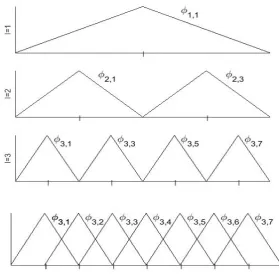
For each spaceVk, two sets of basis functions play important roles in our discussion: the nodal basis ψk
i, i = 0, . . . , Nk (see Fig 2.1, bottom) and the hierarchical basis ϕi, i = 0, . . . , Nk (see Fig 2.1, top). Here, each nodal basis function is a triangle (hat) function of the same extent and the hierarchical basis functions are grouped
into ”levels”, with the functions at the higher levels having a larger extent. We
can convert between the nodal basis representation and the hierarchical basis with
a simple linear matrix transform. The nodal basis ψki ∈Vk is defined by
ψik(xj) = δij, δij =
(
1 if i=j;
0 if i6=j. (2.3)
where xj is a node in the mesh with global node number j. On the other hand, the hierarchical basis for Vk is built from that of Vk−1 by adding the nodal basis
functions of Vk associated with the level k nodesxi, i=Nk−1+ 1, . . . , Nk.
The basis function ψi holds two important properties. Firstly, a convenient inter-pretation of coefficients ci as the value of u at node i
u(xi) =
X
j∈Ii
cjψj(xi) =
X
j∈Ii
cjϕj(xi) = ciϕi(xi) = ci. (2.4)
§2.3 One-dimensional multilevel basis 5
Figure 2.1: Piecewise linear hierarchical basis (top) and nodal basis (bottom) of level 3.
2.3
One-dimensional multilevel basis
In the sparse grid approach, a multidimensinal basis on thed-dimensional unit cube based on one-dimensional hierarchical basis is obtained by a tensor product construc-tion. First, we consider a multilevel basis on one-dimensional space and introduce
some notation which is necessary for a detailed discussion of sparse grids for
pur-poses of interpolation or approximation, respectively. Let Ωlbe the equidistant grids
of levell on the interval ¯Ω with mesh sizehl = 2−l. This way the grid Ωl consists of the points
xl,j = j·hl, 0≤j ≤2l (2.5)
Moreover, let Vl be the space of piesewise linear functions on grid Ωl
Vl = span
The basis functions φl,j(x) based on standard hat function having support [xl,j − hl, xl,j+hl]T[0,1] = [(j−1)hl,(j+ 1)hl]T[0,1] are generated as
φl,j(x) = φ
x−j ·hl
hl = ( 1−
x−j·hl
hl
x∈[(j −1)hl,(j+ 1)hl] T
[0,1]
0 otherwise
This basis is termed nodal basis or lagrange basis. With these function spaces, the
hierarchical increment spaces Wl are defined as
Wl = span{φl,j :j ∈Il} (2.7)
The index set Ii =
j ∈N, j odd,1≤j ≤2l−1
These increment spaces allow us to write Vl as a direct sum of subspaces
Vl =
M
k≤l
Wk (2.8)
The basis corresponding to Wl is just the hierarchical basis of Vl. such that any function u∈Vl can be represented as
u(x) = X k≤l
X
j∈Ii
αk,jφk,j(x) =
X
k≤l ˆ
uk(x), (2.9)
where ˆuk ∈Wk and hierarchical surplus (coefficients)αk,j ∈R.
2.4
High-dimensional multilevel basis
A multidimensional hierarchical basis is obtained from the one-dimensional basis
based on a tensor product construction. Therefore, for a multidimensional basis on
the d-dimensional cube ¯Ω, we define Ωl as anisotropic grid on ¯Ω with equidistant mesh size hlt in each coordinate directiont,t = 1, . . . , d. Here, the l = (l1, . . . , ld)∈
Nd is a multi-index set indicates the level of multi-dimensional sparse grids. The
mesh size is denoted as hl = (hl1, . . . , hld) = 2
−l. The grid points x
l,j of the grid Ωl are considered
xl,j = (xl1,j1, . . . , xld,jd) = j ·hl, 1≤j ≤2
l−1 (2.10)
§2.4 High-dimensional multilevel basis 7
of the tensor product construction.
φl,j(x) = d
Y
t=1
φlt,jt(xt) (2.11)
Now, each of the multidimensional basis functions φl,j that correspond to inner grid points of Ωl with support of the fixed size 2·hl are used to define an associated space Vl
Vl = span
n
φl,j
jt= 0, . . . ,2
lt, t= 1, . . . , do = spannφ
l,j : 1≤j ≤2l−1
o
, (2.12)
where this basis
n
φl,j
o
is the standard nodal point basis of the finite dimensional space Vl. Additionally, the hierarchical difference space Wl is obtained by spanning basis functions
Wl = span
n
φl,j :j ∈Bl
o
, (2.13)
with the index set
Bl =
j ∈Nd : 1≤j
t ≤2lt −1, jt odd, t= 1· · ·d, iflt>0 (2.14)
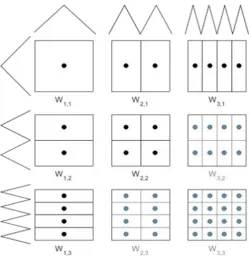
The hierarchical increments spaces Wl consist of all φi,j ∈Vl, which generate a new sparse gridWl0, any sparse gridWlthat meets the order relationWl< Wl0needs to be constructed before. Therefore, we can define a multilevel subspace decomposition
and the space Vn := Vn can be represented as a direct sum of finite-dimensional subspaces of V
Vn =
M
l1≤n
· · ·M ld≤n
Wl =
M
|l|∞≤n
Wl (2.15)
the limit
lim n→∞V
(∞)
n = nlim→∞
M
|l|∞≤n Wl =
∞
[
n=1
Vn(∞) = V (2.16)
where |l|∞ = max1≤t≤dlt. V is simply the underlying Sobolev spaceH01( ¯Ω).
We now define a hierarchical increments space Wl via
Wl = Vl\ d
M
i=1
Vl−ei (2.17)
Again, any function u∈Vn can be uniquely represented by
u(x) = n
X
|l|∞=1
X
j∈Bl
αl,jφl,j(x) =
X
|l|∞≤n ˆ
ul(x), (2.18)
with hierarchical surplus (coefficients) αl,j ∈ R in the hierarchical tensor product basis and ˆul ∈Wl is the hierarchical component functions.
We construct discrete approximation spaces that the same number of invested grid
points leads to a higher order of accuracy. We deal with finite dimensional subspaces
of V with the discrete spaces. First, we summarize some basic properties of the hierarchical subspacesWl according to Bungartz and Griebel (1999) [6]. Concerning the subspaces Wl, we learn the dimension of Wl from (2.13) and (2.14), and the number of degrees of freedom (sparse grid points or basis functions) associated with
Wl:
|Wl| = 2|l−1|1 (2.19)
According to (2.18), the discussion of a subspace contribution to the overall
inter-polant could be based on the maximum norm L∞, the Lp-norm (p = 2 in general) and the energy norm. Now, let us define the Sobolev-space with dominating mixed
derivative Hmix2 . The second mixed derivatives have to be bounded
Dl u = ∂
|l|1u ∂xl1
1 . . . ∂x
ld
d
, where |l|1 =
d
X
t=1
lt and |l|∞ = max
1≤t≤dlt (2.20)
These functions belong to a Sobolev space
Hmix2 (Ω) := u: Ω→R:Dl u∈L2(Ω),|l|∞≤2, u|∂Ω = 0 (2.21)
Under this prerequisite, the corresponding coefficients decay rapidly |αl,j| =
O(2−2|l|1). It follows that for the components u
l ∈Wl of u∈H02,mix( ¯Ω) from (2.18) based on L2-norm holds [7].
kulk2 ≤3−d·2−2·|l|1 · |u|H2
mix. (2.22)
That means the elements are bounded and convergent because 3−d·2−2·|l|1 is less than 1 if u∈H2
mix. It follows the hierarchical basis functions with a small support, and therefore under smoothness assumption, a small contribution to the function
representation, are not included in the discrete space of leveln anymore. Figure 2.2 for the 2D case shows how the supports of the basis functions of the hierarchical
§2.5 Sparse grid combination technique 9
We define the sparse grid function space Vs
n ⊂Vn as
Vns = M
|l|1≤n
Wl (2.23)
Similar to (2.18), any function u∈Vs
n can be uniquely written as
usn(x) = n
X
|l|1=1
X
j∈Bl
αl,jφl,j(x) =
X
|l|1≤n ˆ
ul(x) (2.24)
Where ul ∈Wl.
The dimension of the sparse grid space Vs
n (the number of inner grid points in the underlying grid) is given by
|Vs n|=
n−1
X
i=0
2i d−1 +i d−1
!
= (−1)d+ 2n n−1
X
i=0
2i n+d−1 i
!
(−2)d−1−i
= 2n
nd−1
(d−1)! +O(n d−2)
(2.25)
This, we have
|Vs
n| = O(h
−1
n |log2hn|d−1) (2.26) For the interpolation error of a function f ∈H2
mix in the sparse grid space Vns gives
||f −usn||2 = O(h2nlog(h
−1
n )
d−1) (2.27)
For more details and proof, we can find here Garcke (2004).
2.5
Sparse grid combination technique
A sparse grid solution obtained by a combination of anisotropic full grid solutions is
often the so-called combination technique [8]. The combination technique is a
multi-variate extrapolation type method to achieve a function representation on a sparse grid. It exploits the approximation properties of sparse grids mentioned beforehand:
the discretization of the function applies to a nodal discretization. For the solution
of partial differential equations, the equations are decoupled into smaller systems on
the grids and are linearly combined. Furthermore, the finite element discretization
Figure 2.2: In two-dimensional space, the sparse grid space Vs
3 contains the upper triangle of
spaces shown in black.
preserved. The advantages of the combination technique over working directly in
the hierarchical basis are that the matrix graph has considerably fewer connections
and the resulting linear systems are sparse, in contrast, the stiffness matrices of
sparse finite elements are not sparse and computations of the matrix-vector-product
come with a high cost [9].
For the discretisation of the function space V we use a generalisation of the sparse grid combination technique. We restrict to a bounded domain Ω = [a, b]d and
consider a certain sequence of anisotropic grids Ωl = Ωl1,...,ld which have different
but uniform mesh sizes in each coordinate direction with ht= 2−lt, t= 1, . . . , d. In the original combination technique considers all grids Ωl with indices
|l| = l1 +· · ·+ld = n+ (d−1)−q, q = 0, . . . , d−1, lt >0 (2.28)
A finite element discretisation using piecewise d-linear functions
φl,j(x) = d
Y
t=1
φlt,jt(xt) (2.29)
§2.6 Clenshaw Curtis sparse grids 11
the discrete function space Vl = span
n
φl,j, jt= 0, . . . ,2lt, t= 1, . . . , d
o
on grid Ωl.
A function ul ∈Vl is represented as
ul(x) =
2l1
X
j1=0 · · ·
2ld
X
jd=0
αl,jφl,j(x), (2.30)
and uses combination coefficients to add up the partial solutions ul from each grid combined to obtain the solution uc
n on the corresponding sparse grid according to the combination formula
ucn(x) = d−1
X
j=0
(−1)j d−1 j
!
X
|l|=n−j
ul(x). (2.31)
The combination technique constructs a grid function uc
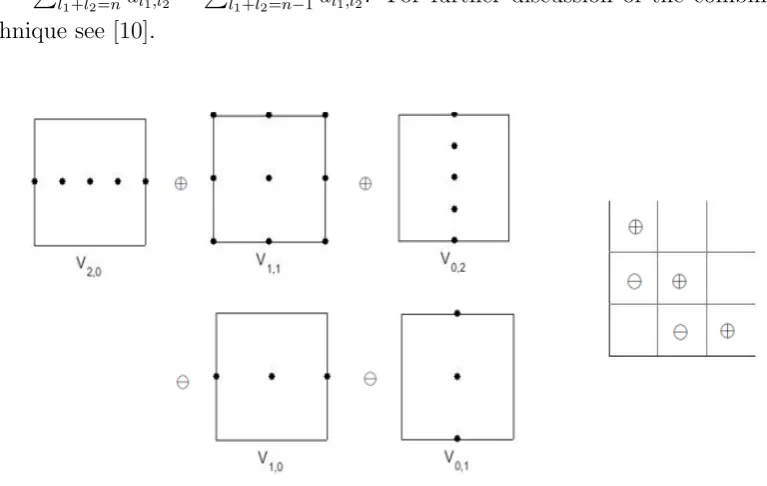
n on a sparse grid space Vns, see Fig 2.3. For examples, in two dimensional space, it clearly shows that ucn = P
l1+l2=nul1,l2 −
P
[image:20.595.134.518.367.610.2]l1+l2=n−1ul1,l2. For further discussion of the combination technique see [10].
Figure 2.3: Combination technique with sparse grid level 2 in two dimension.
2.6
Clenshaw Curtis sparse grids
As we have seen, it is the hierarchical finite elements (Peano 1976) and the
hierar-chical bases (Yserentant 1986) to a tensor product construction with its underlying
hierarchical subspace splitting that the Zenger’s sparse grid concept (Zenger 1991)
closely related technique had been studied for purposes of approximation, or
numeri-cal integration of smooth functions. The Russian literature that has to be mentioned
here is those of Smolyak (1963) studied classes of quadrature formulas of the type
Un(d)f = n
X
i=0
(Ui(1)−Ui(1)−1)⊗Un(d−−i1)
!
f (2.32)
where Un(d) denotes a d-dimensional quadrature formula based on the 1D rule Un(1) with a tensor product. Functions suitable for the Smolyak approach typically live
in spaces of bounded (Lp-integrable) mixed derivatives which are closely related to
our choice of uin (2.20).
For a detailed discussion of those methods, we consider a quadrature known as
Clenshaw Curtis quadrature. The use of Clenshaw Curtis quadrature rule forms a
sparse grid. The rules provided an indexed family have a nested set, so that all
the abscissas from one rule are included in the next. The values of the abscissas and weights can be easily computed. The construction of a nested family requires
that the order of the rules in the indexed family grows exponentially. We define
the Clenshaw Curtis formula, denoted byCCn as the interpolatory quadrature rule constructed on the Chebychev nodes [11].
Suppose a sparse grid constructed for a D-dimensional quadrature of function f. We consider an indexed family of underlying 1D factor quadrature rules over the
interval [0,1]. The interpolating polynomial that we integrate can be expressed in a
compact form as:
I(1)(f) =
Z Γ1 f(x)dx' N X n=0
f(xn)wn (2.33)
This is an (N + 1) points (nodes) quadrature rule having (N + 1) real values wn called weights expressing the integral I(1) as a weighted sum of samples of f.
The trapezoid rule, we write the approximation of integral above as:
Ul(1)f = Nl
X
n=0
f(xn,l)wn,l = 1 2hl
f(0) +f(1) + 2 Nl−1
X
n=1
f(xn,l)
!
(2.34)
where hl = 2l1−1, Nl= 2l−1 + 1, xn,l =nhl= 2ln−1, wn,l =
h
1 2hl,
1
hl,· · · ,
1 2hl,
1
hl
i
In a Clenshaw-Curtis quadrature rule, Chebychev nodes for a given natural number
Nl are: xn,l = 12
1−cosπN(n−1)
l−1
, n= 1,· · ·, Nl.
§2.6 Clenshaw Curtis sparse grids 13
endpoints, and then by rules which successively add points between each pair of
points in the preceding rule [12].
A multidimensional quadrature rule is formed by the product of underlying 1D rules.
Let Ul(1)
i :V →R and f : Ω
d →
R. It can be written as:
UlDf(x) =Ul(1)
1 ⊗ · · · ⊗U
(1)
ld
f(x1,· · · , xd)
=Ul(1)
1 ⊗ · · · ⊗U
(1)
ld−1
Nld
X
nd=1
f(x1,· · · , xd,nd)
=Ul(1)
1 ⊗ · · · ⊗U
(1)
ld−2
Nld
X
nd=1
Ul(1)
d−1f(x1,· · · , xd,nd)wld,nd
=Ul(1)
1 ⊗ · · · ⊗U
(1)
ld−2 Nld−1
X
nd−1=1 Nld
X
nd=1
f(x1,· · · , xd−1,nd−1, xd,nd)
· · ·
=Ul(1) 1
Nl2
X
n2=1 · · ·
Nld
X
nd=1
f(x1· · ·xd,nd)wl3,n3· · ·wld,nd
= Nl2
X
n2=1 · · ·
Nld
X
nd=1
Ul(1)
1 f(x1· · ·xd,nd)wl2,n2· · ·wld,nd
= Nl1
X
n1=1 · · ·
Nld
X
nd=1
f(x1,n1· · ·xd,nd)wl1,n1· · ·wld,nd
(2.35)
where N =Qd
i=1Nli.
This productQ
is a monic polynomial of degree D. The interpolation error satisfies
|IDf −UDf| = O(N−m/d
l ) (2.36)
For function f in the space
Wmixm,∞([0,1]d) =
(
f : [0,1]d→R; max
|l|≤mk
∂|l|f
∂xl1
1 . . . ∂x
ld
d
k∞≤ ∞
)
(2.37)
where d is the dimensions and m is the bounded value. The 1-D nodal points are Θ(1)l ={xl,1,· · · , xl,d}. The sparse grid nodal set is:
Θ(lD) = [
|l|≤l+d−1
Θ(1)l
1 × · · · ×Θ
(1)
We define the difference relations as ∆(1)l f =Ul(1)−Ul(1)−1f. Thus, the sparse grid multidimensional quadrature rule can be expressed as:
Ul(D)f = X
|l|≤l+d−1
∆(1)l
1 ⊗ · · · ⊗∆
(1)
ld
f (2.39)
We say that this product rule has a product level of |l| = P
i≤Dli, where l = (l1,· · · , ld)∈Nd is a multi-index.
A sparse grid can be indexed by the sparse grid level l that uses weighted combina-tions of those product rules. The lowest sparse grid level is taken to be 0. So the
sparse grid of sparse grid level 0 is equal to the product rule of product level 0. To construct the sparse grid in a Clenshaw-Curtis quadrature rule, we have:
A(l, D) = X
l−D+1≤|i|≤l
(−1)l−|i| D−1
l− |i|
!
Ul(1)
1 ⊗ · · · ⊗U
(1)
ld
(2.40)
Formally, to describe a sparse grid using the Clenshaw Curtis rule is to substitute
CCli for each generic quadrature rule Uli. Consider the specific formulas for sparse
grid level one in dimension two which are products of the 1D Clenshaw Curtis rules:
A(1,2) =CC1⊗CC0
+CC0⊗CC1
−CC0⊗CC0
(2.41)
2.7
Proof of combination formula
We discuss the relationship of hierarchical sparse grid interpolation and interpolation
by using combination technique. It is shown that the combined interpolation is
iden-tical with the hierarchical sparse grid interpolation (J Garcke, 2012). The proof can
be seen by rewriting each ul in their hierarchical representation and some straight-forward calculation using the telescoping sum. Moreover, the proof is extended
from two and three dimensions to the high-dimensional cases. To demonstrate the
advantages of the combination technique over working directly in the hierarchical basis, we consider certain equation problems with numerical experiments (Chapter
3). The outputs of numerical implementation are provided to compare these two
interpolations and estimate computational accuracy.
For a given function uthe interpolant uc
n using the combination technique (2.31) is the hierarchical sparse grid interpolant us
§2.7 Proof of combination formula 15
Proof. We start in a two dimensional case. We can have
usn= X k1+k2≤n
ˆ uk1,k2
and according to the combination formula, we write
ucn= X
|l|=n ul−
X
|l|=n−1
ul
We learned in the equations (2.9) and (2.24), we can rewrite the function ul in two dimensional space as
ul(x) =
X
|k|≤l
X
j∈Bk
αk,jφk,j(x) =
X
|k|≤l ˆ uk1,k2
Therefore, following the equation, we now define
X
|l|=n ul=
X
|l|=n
X
|k|≤l ˆ
uk1,k2, and
X
|l|=n−1
ul =
X
|l|=n−1
X
|k|≤l ˆ uk1,k2
For the combined interpolant we get as in
ucn = X
|l|=n
X
|k|≤l ˆ uk1,k2 −
X
|l|=n−1
X
|k|≤l ˆ uk1,k2
= X
l1+l2=n
X
k1≤l1
X
k2≤l2 ˆ uk1,k2 −
X
l1+l2=n−1
X
k1≤l1
X
k2≤l2 ˆ uk1,k2
=X
l1≤n
X
k1≤l1
X
k2≤n−l1 ˆ uk1,k2 −
X
l1≤n−1
X
k1≤l1
X
k2≤n−l1−1 ˆ uk1,k2
=X
l1=n
X
k1≤l1
X
k2=0 ˆ uk1,k2 +
X
l1≤n−1
X
k1≤l1
X
k2≤n−l1 ˆ uk1,k2 −
X
k2≤n−l1−1 ˆ uk1,k2
!
=X
l1=n
X
k1≤l1
X
k2=0 ˆ uk1,k2 +
X
l1≤n−1
X
k1≤l1
X
k2=n−l1 ˆ uk1,k2
=X
l1≤n
X
k1≤l1
X
k2=n−l1 ˆ uk1,k2
= X
k1≤n−k2
X
k2≤n ˆ uk1,k2
= X
k1+k2≤n ˆ uk1,k2
(2.42)
where ˆuk = ˆuk1,k2 = ˆuk1,k\k1 = ˆuk1,k2 [13]. Thus, the expression of interpolant using combination technique uc
n is exactly the same as the hierarchical sparse grid interpolant us
for higher dimensional spaces in terms of the statement (2.42), known as the base
case. By the principle of induction, the lemma is true in any dimensions. Recall the
combination technique formula
ucn(x) = d−1
X
k=0
(−1)k d−1 k
!
X
|l|=n−k ul(x)
We note that the coefficients (the numbers in front of each ulterm) follow a pattern
d= 2: 1 -1
d= 3: 1 -2 1
d= 4: 1 -3 3 -1
d= 5: 1 -4 6 -4 1
d= 6: 1 -5 10 -10 5 -1
This sequence is known as Pascal’s triangle. Each of the numbers is found by
adding together the two absolute numbers directly above it and put minus sign if
the number k is odd.
Thus, the combination function uc
n whend=n can be expressed by the function at d =n−1. Any combination technique functions can be rewritten as two standard terms with respected to the previous function. Then, according to the principle of
induction, we prove ucn = usn is true for d = n. We get the general form by using
Zd−→Zd−1|l1, . . . , ld−→l2, . . . , ld in the following way
ucn = d−1
X
k=0
(−1)k d−1 k
!
X
|l|=n−k ul
=
d−2
X
k=0
(−1)k d−2 k
! X
|l|=n−k ul
−
d−2
X
k=0
(−1)k d−2 k
! X
|l|=n−k−1
ul =
d−2
X
k=0
(−1)k d−2 k
!
X
|l|=n−k
X
|k|≤l ˆ uk −
d−2
X
k=0
(−1)k d−2 k
!
X
|l|=n−k−1
X
|k|≤l ˆ uk
§2.7 Proof of combination formula 17
=
d−2
X
k=0
(−1)k d−2 k
! n
X
l1=0
X
|l2|≤n−k−l1
X
|k|≤l ˆ uk −
d−2
X
k=0
(−1)k d−2 k
!n−1 X
l1=0
X
|l2|≤n−k−l1−1
X
|k|≤l ˆ uk
= n−1
X
l1=0
X
k1≤l1
d−2
X
k=0
(−1)k d−2 k
!
X
|l2|≤n−k−l1
X
|k|≤l ˆ uk−
d−2
X
k=0
(−1)k d−2 k
!
X
|l2|≤n−k−l1−1
X
|k|≤l ˆ uk
+X
l1=n
X
|l2|=0 ˆ
uk (Where ul= ˆul = 0 if any ifli <0, l= (l1,· · · , ld))
= n−1
X
l1=0
X
k1≤l1
X
k2+···+kd≤n−l1 ˆ uk1,k2 −
X
k2+···+kd≤n−l1−1 ˆ uk1,k2
!
+X
l1=n
X
k1≤l1
X
k2+···+kd=0
ˆ uk1,k2
(obtained from induction hypothesis)
= n−1
X
l1=0
X
k1≤l1
X
k2+···+kd=n−l1 ˆ uk1,k2 +
X
l1=n
X
k1≤l1
X
k2+···+kd=0
ˆ uk1,k2
= n
X
l1=0
X
k1≤l1
X
k2+···+kd=n−l1 ˆ uk1,k2
= X
k2+···+kd≤n
X
k1≤n−k2−···−kd
ˆ uk
= X
k1+···+kd≤n
ˆ uk
Chapter 3
Numerical experiments
In the preceding section, we theoretically proved that the combined interpolant is
identical with the hierarchical sparse grid interpolant. However, to demonstrate the
equivalency of these two interpolants and identify properties and patterns, the way is to make numerical experiments. In this section, we report a collection of numerical
results and estimate the quality of the approximations for different problems solved
on the hierarchical sparse grids and the combination approach. We start with the
discussion of the basic interpolation properties of sparse grid methods applied to a
simpler 2D model problem. Then we turn to the approximation of the Rosenbrock
function, Gaussian equation and Checkboard on sparse grids in higher
dimension-ality. For measuring the error, we consider the errors discrete maximum norm and
the discrete L2-norm on grids. In low dimensionalities, we can compute the error
terms numerically. In higher dimensionalities we can still approximate the error
stochastically with Monte Carlo or quasi-Monte Carlo methods. Since the curse of a fixed grid in D dimensions requires ND points where are too difficult to imple-ment, the Monte Carlo method is both interesting and useful for error estimation of
a higher dimensionality. Monte Carlo methods are usually presented as estimates
of averages which in turn are integrals, N1 PN i=1
|f(Xi)−u(Xi)|2
u(Xi) ≈
R
|f(Xi)−u(Xi)|2. The error typically decreases proportionally to √1
N. In the context of solvers, it is important that the influence of the sparse grid level on the accuracy of the
inter-polants. Thus, we attempt to find out a suitable level in which we can obtain a high
quality approximation and estimate the rate of convergence of prediction errors for
an increasing sparse grid level. Moreover, Let us now visualize the sparse grid. Our model problems cover the classical sparse grids and the type of Clenshaw-Curtis
grids. We compare the accuracy of the approximations of these two types of sparse
grids and investigate the efficiency of the performance. For our numerical tests we
used the MATLAB implementation of sparse grid package done in the hierarchical
subspaces can be found here [14]
In the following we will consider the following four functions:
f(x, y) = sin(10x) + sin(10y), (3.1)
with the domain [0,1]2.
f(xi) = d−1
X
i=1
100×(xi+1−x2i)
2
+ (xi −1)2
, (3.2)
with the domain [−2,2]d.
f(xi) = exp − d
X
i=1
xi−µ 2σ2
!
, (3.3)
with the domain [0,1]d.
A discontinues function with a 2×2 checkerboard pattern with the domain [0,1]2
f(xi) =
exp−Pd i=1
xi−µ
2σ2
, if xi ∈[0,0.5]2, or xi ∈[0.5,1]2;
−exp−Pd
i=1
xi−µ
2σ2
, otherwise. (3.4)
3.1
Sine function
The first test function is a low dimensional Sine function, defined on the unit
[image:29.595.69.457.505.743.2]hy-percube [0,1]2. It is a simple and well-defined function.
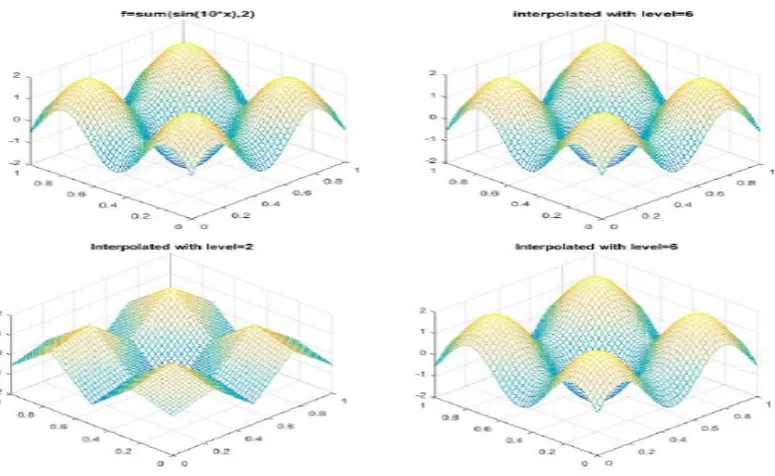
Figure 3.1: The exact solution and the hierarchical sparse grids interpolantusn (on the top).The
combined interpolantuc
§3.1 Sine function 21
Fig 3.1 shows the approximations of the exact solution of (3.1) generated by
the hierarchical sparse grid interpolant and combined interpolant. We study the
accuracy of the hierarchical Lagrangian approach for the classical sparse grids and
combination approach. For the same grid level 6, the hierarchical sparse grids
inter-polant (the upper-right corner) is equivalent to the interinter-polant by using combination
approach (the lower-right corner). Moreover, Fig 3.1 visually illustrates the effect of
the choice of sparse grid levels that the combined interpolant with level = 2 gener-ates a lower accurate and rough approximation than the combined interpolant with
[image:30.595.143.544.288.648.2]level = 6. A higher accurate approximation can be obtained based on the sparse grid depth (level).
Figure 3.2: The contour plots of exact solution (in the upper-left coner) and the hierarchical sparse grids interpolant (in the upper-right coner); In the second row, the contour plots of the combined interpolants with level=2 and level=6, respectively.
In Fig 3.2, the sparse grid points visualized on the contour plots of the
inter-polants, we see that is the classical uniform sparse grid. For two dimensional case,
Figure 3.3: The contour plots of Clenshaw Curtis sparse grids interpolant with level=2 (the left hand side) and of Clenshaw Curtis sparse grids interpolant with level=6 (the right hand side).
of grid points compared with the classical grid, but it constructed on the Chebychev nodes, see Fig 3.3. Fig 3.4 and Fig 3.6 show the absolute error of the solution us n that was computed on the hierarchical sparse grid and the error that was obtained
by the combination approach uc
n. As expected, the error on the hierarchical sparse grid and on the combined grids have the same behaviour and size. In contrast to
that, the absolute error of combined solution with level = 2 shows large errors, see Fig 3.5. The comparison of interpolation error for level = 6 of classical and Clenshaw Curtis sparse grid choice (see Fig 3.4 and Fig 3.7) demonstrates that the
approximation generated by Clenshaw Curtis grid are more accurate than that of
the classical grid. As we can see, the Clenshaw Curtis process reduces the error equally over the whole domain. With a few terms, these are pretty accurate over
the normal range that they are calculated. However, with a finite number of terms
the sine function is never exactly equal to a polynomial.
In Fig 3.8, the convergence behaviour with respect to the RMSE error of the given
function and for level l ∈ {0,· · · ,6} is provided. In addition to the error plots, we show the curves of expected sparse grid convergence (reference) due to the
in-terpolation accuracy (2.27). Since the prediction error goes extremely small and
the number of grid points grows exponentially as the sparse grid level increases, we
§3.1 Sine function 23
Figure 3.4: Absolute error for the hierarchical sparse grids interpolant with level=6.
Figure 3.5: Absolute error for the combined interpolant with level=2.
Figure 3.7: Absolute error for Clenshaw Curtis sparse grid with level=6
Figure 3.8: Convergence of the RMSE error of the function against an increasing level of grids. The numerically observed rate of convergence for two interpolants , compared to a reference line.
Level Points Max.Abs.Error Rel.Error
1 5 3.4494 1.7880
2 13 1.3047 0.4765
3 29 0.3634 0.1377
4 65 0.0965 0.0356
5 145 0.0239 0.0089
6 321 0.0061 0.0023
Table 3.1: The maximum absolute error and relative error for the hierarchical sparse grid interpolant
From the Fig 3.8, we determine the hierarchical sparse grid and sparse grid
combination technique generate the same relative prediction errors at each level
§3.1 Sine function 25
Figure 3.9: Convergence of the RMSE error of the function against an increasing level of grids. The numerically observed rate of convergence for two interpolants.
straight line for an increasing grid level. Compared with the theoretical error analysis
O(h2
nlog(h
−1
n )d
−1), the plot of convergence runs roughly parallel to the reference line.
The rate of convergence is around -1.8. The table 3.1 displays that the maximum
absolute errors and the relative errors are decreasing with a constant rate as the
number of grid points increases.
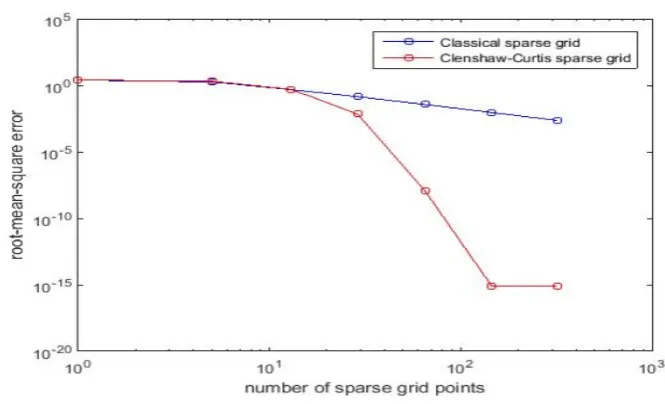
Next, we turn to Clenshaw Curtis sparse grid. In Fig 3.9, we see that the RMSE
error for Clenshaw Curtis grid decreases dramatically against an increasing level of grids. It fast converges to 10e−15 at grid level 5, and then be a constant. As
we expect, the polynomials are never completely accurate. Fig 3.10 illustrates the
cost for computing the interpolants. The combined sparse grid interpolant can be
obtained at a small cost in lower grid levels, but the curves of cost of combined
grid intersects the curves of cost of hierarchical grids and Clenshaw Curtis grids at
sparse grid level 8 and level 9, respectively. Due to the more sophisticated algorithms
required in the polynomial case, the additional cost of computing the interpolant of
Clenshaw Curtis grid is considerably higher compared to the classical sparse grid
interpolation of function values. However, as the grid level increases, the rate of cost decreases, as fewer function evaluation will require a computation. Thus, the
performance is competitive. With these results supporting the efficiency of mesh
refinement on sparse grids and the combination technique approximation, we close
Figure 3.10: Time to compute 1000 values with these three types of sparse grids.
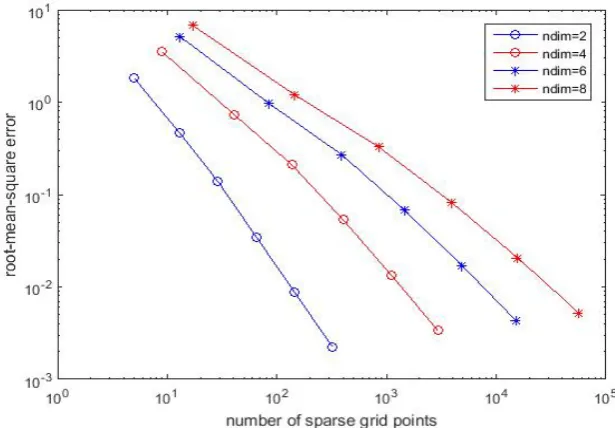
Figure 3.11: Convergence of the RMSE error of the multi-dimensional functions against an increasing level of grids on the classical grid.
In Fig 3.11, we present a summary of the convergence behaviour with respect to multi-dimensions (d ∈ {2,4,· · · ,8}). We can clearly see that it has a fast con-vergence rate even for a higher dimensional case. Similarly, Fig 3.20 illustrates that
the RMSE error for Clenshaw Curtis grid rapidly decreases down to 10e−15 for all
dimensions, and then it keeps constant as grid level increases. We compare the
[image:35.595.105.413.405.619.2]§3.1 Sine function 27
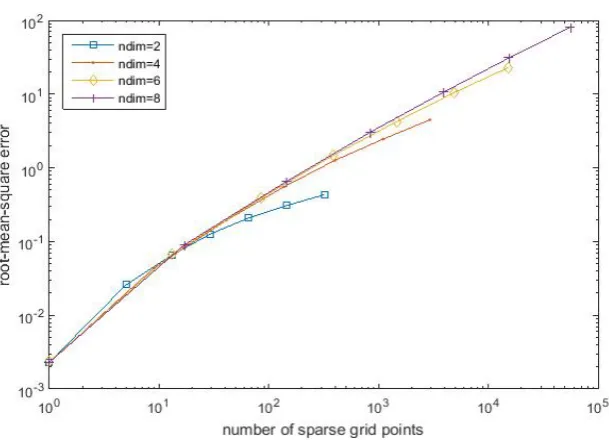
3.13 and Fig 3.14. the computational cost increases exponentially with the number
of dimensions. The computational cost of the Clenshaw Curtis grid interpolation is
[image:36.595.169.481.177.394.2]sightly higher than that of the uniform sparse grid interpolation.
Figure 3.12: Convergence of the RMSE error of the multi-dimensional functions against an increasing level of grids on the Clenshaw Curtis grid.
[image:36.595.172.480.472.688.2]Figure 3.14: Time to compute 1000 values with these three types of sparse grids.
3.2
Rosenbrock Function
As the second test function, we consider the multi-dimensional Rosenbrock function,
which is often used as a performance test problem for optimization algorithms. The
Rosenbrock function, also referred to as the Valley or Banana function. The function
is unimodal, and the global minimum (f(x) = 0, atx= (1,· · ·,1)) lies in a narrow, parabolic valley. However, even though this valley is easy to find, convergence to the
minimum is difficult (Picheny et al., 2012) [15]. We use the following rescaled form
of the Rosenbrock function (3.2) on the domain[0,1]d. Fig 3.11 is an illustration of
the two-dimensional case.
g(xi) = f(4xi −2) (3.5)
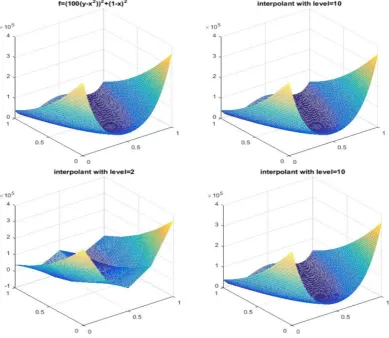
Fig 3.15 shows that the approximations of the exact solution generated by the
hierarchical sparse grid interpolant and combined interpolant. Again, the effects of
the improved sparse grid levels of our interpolation are evident. It also illustrates
that the hierarchical sparse grids interpolant (the upper-right corner) is identical
to the interpolant by using combination approach (the lower-right corner). In Fig 3.16, the sparse grid visualized on the contour plots of the interpolants, we see that
the used sparse grid is of the type classical sparse grid and the Clenshaw-Curtis.
It can be shown that the interpolation of Clenshaw-Curtis grids with level = 2 has obtained relatively accurate approximation of the exact solution compared to
§3.2 Rosenbrock Function 29
[image:38.595.134.524.165.503.2]two-dimensional case, the sparse grids consist of 13 points with level = 2 is, and of level = 10 is 7169 points, respectively.
Figure 3.15: The exact solution and the hierarchical sparse grids interpolantus
n(on the top).The
combined interpolantucnwith level 2 and 10 ( on the bottom).
In Fig 3.17 and Fig 3.18, we present the absolute errors resulting from the
hier-archical sparse grids and the combination approach. Obviously, the errors are the
same, which confirms the theoretical proof in section 2.7. Fig 3.19 shows that the
relative errors on the hierarchical sparse grids are large near the global minimum
which is inside a long, narrow and parabolic shaped flat valley. It does make sense in
terms of the relative error formula (Rel = |measuredvaluetruevalue−+1truevalue|). Since the relative error formula has the minimum value as a denominator, we add a small value such as 1 on the denominator. To get an impression of the Clenshaw-Curtis process, Fig
3.20 and Fig 3.21 show the absolute error and the relative error with girdlevel = 10, respectively. We can see the error is extremely small and the Clenshaw-Curtis
pro-cess reduces the absolute error equally over the whole domain. For the same reason,
§3.2 Rosenbrock Function 31
Figure 3.17: Absolute error for the hierarchical sparse grids interpolant with level=10.
Figure 3.18: Absolute error for the combined interpolant with level=10
Figure 3.20: Absolute error for the Clenshaw-Curtis grids interpolant with level=10.
Figure 3.21: Relative error for the Clenshaw-Curtis grids interpolant with level=10.
Fig 3.22 shows the relative prediction error for 2D example for an increasing
number of grid levels. From Fig 3.22, we determine the hierarchical sparse grid and
sparse grid combination technique generate the same relative prediction errors for
all grid levels. The solid line, the expected sparse grid convergence, indicates the
behaviour of the error of sparse grids with respect to the problem of interpolating
a given function. We observe an almost straight line roughly parallels to the solid
line for an increasing grid level. The rate of convergence is around -1.7. In Fig 3.23, a summary of the convergence behaviour with respect to multi-dimensions
(d ∈ {2,4,· · · ,10}) is provided. For all dimensions presented, we can see that the convergence rate is decreasing as the dimension increases. A strong support of
our proof in section 2.7 indicates the interpolant using the combination technique
Clenshaw-§3.2 Rosenbrock Function 33
Curtis grids. Fig 3.24 illustrates that the RMSE error for Clenshaw Curtis grid
rapidly decreases down to 10e−10 from grid level 1 to level 2, and then it keeps
constant as grid level increases. The achieved accuracy will be compared to the
results of interpolation on the classical sparse grids. With the Clenshaw Curtis
process advancing, the higher accurate approximation of exact solution comes to
fruition. Finally, to get an efficiency of the sparse grids process, Fig 3.25 and Fig
3.26 show the computational cost for the classical grid and the Clenshaw Curtis
grid. The Clenshaw-Curtis sparse grid interpolant can be obtained at a very small
additional cost compared to the classical sparse grid interpolant of function.
Figure 3.22: Convergence of the RMSE error of the function against an increasing level of grids. The numerically observed rate of convergence for two interpolants, compared to a reference line.
Figure 3.24: Convergence of the RMSE error of the multi-dimensional functions against an increasing level of grids. The numerically observed rate of convergence for two interpolants.
Figure 3.25: Time to compute 1000 values with the Classical sparse grids for multidimensions.
§3.3 Gaussian function 35
3.3
Gaussian function
All examples have so for been treated with the classical sparse grid, the Clenshaw
Curtis grid and the combination approach, we want to present one more result for
a Gaussian function. On Ω = [0,1]d, let
f(xi) = exp − d
X
i=1
xi−µ 2σ2
!
, (3.6)
[image:44.595.157.512.222.575.2]where µand σ are constants.
Figure 3.27: The exact solution (on the top).The hierarchical sparse grids interpolant us n and
Figure 3.28: The contour plots of exact solution (in the upper-left corner) and the combined interpolants (in the upper-right corner); In the middle, the contour plots of the hierarchical sparse grids interpolant with level=2 and level=7, respectively; on the bottom, the contour plots of Clenshaw-Curtis grids.
Fig 3.27 shows the true value and the approximation of a Gaussian function in
2D. It should come as no surprise that the approximation generated by the
hierar-chical sparse grids interpolant is the same as the interpolant by using combination
technique. The improved the sparse grid levels (depth) have effects on the quality of approximations. Fig 3.28 shows the classical sparse grid and the type of Clenshaw
Curtis grids with 13 grid points (l = 2, left), and 705 grid points (l = 7, right). In
Fig 3.29 and Fig 3.30, we compare the error on the classical sparse grid and on the
combination approach. Fig 3.29 and Fig 3.30 show a gain in accuracy with higher
§3.3 Gaussian function 37
the contour plots of errors, the different types of grid nodes influence the pattern of
resulting errors. The classical sparse grids show large errors in the middle, in
[image:46.595.134.529.180.420.2]con-trast with that, the Clenshaw Curtis grids generate large error around the corners.
Figure 3.29: Absolute error for the hierarchical sparse grids interpolant with level=2 and level=7, respectively.
[image:46.595.133.528.484.728.2]Figure 3.31: Convergence of the RMSE error of the function against an increasing level of grids. The numerically observed rate of convergence for two interpolants, compared to a reference line.
Figure 3.32: Convergence of the RMSE error of the multi-dimensional functions against an increasing level of grids. The numerically observed rate of convergence for two interpolants.
In Fig 3.31, we present the convergence of the conventional sparse grid method
with the curves of expected sparse grid convergence (reference). We observe that
the rate of convergence decreases against the number of sparse grid points. The
curves of the classical sparse grid convergence is not parallel to the reference line,
but it reasonably works well in 2D. The rate of convergence is around -1.5. Fig
3.32 illustrates the convergence behaviour on the classical sparse grid for higher dimensions. For higher dimensional case, it suggests slow convergence, convergence
in the L2 norm is not achieved in regions. It seems that the convergence behaviour
needs large number of grids points to appear. This was to be expected, since this
is consequence of the fact that Gaussian function distribution mostly sits in a thin
§3.3 Gaussian function 39
convergence behaviour on the Clenshaw Curtis sparse grid for higher dimensions.
Again, as in our previous experimental results of the classical grids, we can see
that the sparse grid method achieves a fast convergence rate in 2D but it does not
work well for high-dimensional cases. Compared to the classical sparse grid, the
Clenshaw Curtis has lower rate of convergence in the higher dimensions. We check
if the sparse grids provide a good compromise between accuracy and computational
cost. Fig 3.34 and Fig 3.35 indicate that the computational cost of Clenshaw Curtis
grid is considerably higher compared to the classical sparse grids interpolation of
function.
[image:48.595.184.477.293.458.2]Figure 3.33: Convergence of the RMSE error of the multi-dimensional functions against an increasing level of grids. The numerically observed rate of convergence for two interpolants.
Figure 3.35: Time to compute 1000 values with the Clenshaw Curtis sparse grids for multidi-mensions.
3.4
Checkerboard
The last example of this section demonstrates that our approach is limited to
dis-continuous function such as the Checkerboard, since for the conventional sparse
grid methods, a priori selection of grid points, optimal under certain smoothness
conditions. Unfortunately, the discontinuous function itself cannot be successfully
approximated by a continuous sparse grid interpolant in the first place.
We first consider two dimensional problems in Ω = [0,1]2. The class labels±1 have
been assigned in a 2 ×2 and 3×3 checkerboard pattern. A 2 ×2 checkerboard
pattern is provided, see Fig 3.36. Now, looking at two dimensional the discontinues
function with a checkerboard pattern
f(xi) =
exp−Pd
i=1
xi−µ
2σ2
, if xi ∈[0,0.5]2, or xi ∈[0.5,1]2;
−exp−Pd
i=1
xi−µ
2σ2
, otherwise. (3.7)
In Fig 3.37, we show the convergence behaviour with respect to L2 error for
regular sparse grids. In addition to the error plots, we present the curves of expected
sparse grid convergence (reference). Moreover, Table 3.2 provides the numerical
values of maximum errors and relative errors on conventional sparse grid methods.
Due to the violation of the smoothness requirements, the L2 error converges much
worse thanO(h2nlog(h−n1)d−1) as in the smooth case. As we can see for this measure, using more grid points does not necessarily lead to a better accuracy, the error can
increase. Investigating the accuracy if depending on how the separation manifold is located relative to the sparse grid structure, we examine a 3×3 checkerboard pattern. Fig 3.38 indicates that again low convergence rates are encountered. We cannot
§3.4 Checkerboard 41
Figure 3.36: The class labels -1 (red) and +1 (blue) have been assigned in a 2×2 checkerboard pattern.
[image:50.595.174.480.323.513.2]Figure 3.38: Numerically observed convergence of the RMSE error of the 3×3 checkerboard function against an increasing level of grids.
Finally, and to give a checkerboard that a similar behaviour can be expected in
higher-dimensional settings, we show the error for a checkerboard in 3D case, see
Fig 3.35. We have shown that the effect that checkerboard functions violate the
sparse grids’ smoothness requirements, non-continuous functions have been studied.
Whereas the classical refinement criterion does not target the error, some refinement strategies can further improve the convergence of the error quite significantly. For a
detailed discussion of an extension of the classical sparse grid approach by spatially
[image:51.595.74.422.366.514.2]§3.4 Checkerboard 43
Chapter 4
An experimental study of
Hokkaido Nansei-oki tsunami
In this chapter, we look for a surrogate method to provide an approximation of the
output of an input-output relationships using as few model evaluations as possible.
Many engineering design problems involve black-box functions whose values are
outcomes of computationally expensive simulations, so an approximation model of
the outcome is used instead. For example, an input-output system with a known
multivariate input distribution p(x), the Monte Carlo statistical sampling allows us to estimate the statistical moments of the output u(x). However, Monte-Carlo approaches of exploring the input parameter space require a large number of L of expensive simulations. One approach of alleviating the burden is by developing
surrogate models, alternatively known as response surface models, metamodels or emulators (Sacks at al., 1989) [16]. The surrogate approximation is based on a small
set of M L simulations, known as ’samples’ or ’training data’. Our objective is to build an accurate and efficient surrogate approximation by using a small set of
M samples. Moreover, since we increase the number of uncertain input parameters, such studies suffer from the curse of dimensionality. In this work, we use the sparse
grid interpolation to reduce the curse of dimensionality. A sparse adaptive surrogate
model is constructed for the Hokkaido-Nansei-Oki tsunami, for which we give a
description in Section 4.1. We study two different types of sparse grid methods: the
classical sparse grids and Clenshaw Curtis grids. We start with the discussion of the simple two uncertain input parameters test-case. Then we illustrate our approach
of a large number of uncertain input parameters to quantify the uncertainty in the
output. We demonstrate the experimental results in Okushiri wave flume, which
reproduce the maximum value of the time-dependent average tsunami height on top
of the Monai zone in Okushiri Island in 1993.
4.1
The Hokkaido-Nansei-Oki tsunami
The Hokkaido-Nansei-Oki earthquake on July 12 produced one of the largest
tsunamis in Japan’s history. Within 2-5 minutes, extremely large waves hit the
central west coast of Hokkaido and the small, offshore island of Okushiri in the Sea
of Japan. The maximum run-up was measured at 32 m in a small valley north of
Monai. A model consists of small curved pocket beach (205m long) of the Monai
coast. The model scale is 1/400 with no-distorted. We consider the Okushiri wave
tank benchmark test-case to produce the maximum of the time-dependent average
tsunami height at Monai zone. The waves comes in from the west, the area of interest is the ellipse with a major axis length = 0.4m and a minor axis length = 0.2m. For
more detailed description of the tank benchmark, see de Baar and Roberts (2016),
for instance. The input wave data used for numerical simulation was collected from
[17]. The data set consists of the value of water surface (m) depending on time (s).
4.2
Results of experiments
Concerning the efficient surrogate approximation of the Okushiri tsunami test-case
based on the sparse grid interpolation has been made (de Baar and Roberts, 2016),
assuming the incoming wave consists of a number of Gaussian bumps, which is
uncertain. Then the parametrised incoming wave can be expressed as:
g0(t, ξ) =
N
X
n=1
ξnαnexp
−(t−τn)
2
2θ2
n
+RN(t), (4.1)
whereα,τ andθare the parameters of height, centre and width of Gaussian bumps, respectively, ξ the uncertain input parameter with i.i.d. ξ ∼ N(1,0.52). For the
sparse grid interpolation, we transformξ∈[0,1]. RN(t) is the residual. For example, setting the initial residual R0(t) is the deterministic incoming wave with a single a
single Gaussian bump. The function (4.1) can be rescaled by a factor b, thus the
the incoming wave has a constant energy.
We first consider a simple uniform sparse grid to create the two-dimensional input
parameter space. Fig 4.1 indicates the output of the maximum of average wave level
(m) with respect to the relative bump height ξ during the time (start from 0 s and end up to 22.5 s) by using a uniform grid and a Clenshaw Curtis grid, respectively.
From Fig 4.1, we can see the range of maximum values of average water level (m)
in the area of interest is between 0.002 m and 0.018 m. The effect of relative bump
height on the maximum of wave level shows a positive relationship, which the wave
§4.2 Results of experiments 47
Table 4.1 shows the numerical values generated by these two sparse grids are almost
the same, except for some nodes in different location. Moreover, Fig 4.2 presents
more simulations by using uniform grid (left) and the Clenshaw Curtis grid (right)
in two dimensional input parameter space. We expect a good compromise between
accuracy and computational complexity, thus we compare the computational cost
of the simulation based on two uncertain input parameters for these sparse grid
interpolations. Fig 4.3 shows that the computational cost of Clenshaw Curtis grid
is higher than that of the uniform sparse grid interpolation.
[image:56.595.122.490.524.725.2]Figure 4.2: The 705 simulations of uniform grid (left) and the Clenshaw Curtis grid (right) in two dimensional input parameter space. The output is the maximum of average water height (m) in the area of interst
Figure 4.3: The computational cost of running a simulation with two dimensional input param-eters.
To represent an increasing number of uncertain input parameters, we fit a
se-quence of Gaussian bumps ξ. Now, we quantify the uncertainty in the output taking into consideration three uncertain input parameters. Similarly, in Fig 4.4, we present the simulation with respect to three uncertain input parameters by using
the uniform sparse grid and the Clenshaw Curtis grid, respectively. We can see
that the resulting output of the maximum of the incoming wave height (m) with
three uncertain input parameters is similar with the output based on two uncertain
[image:57.595.95.431.390.590.2]§4.2 Results of experiments 49
Clenshaw Curtis sparse grids provides no large different outputs. Fig 4.5 shows that
a large number of simulation has been made. We compare the numerical values
of simulations of the uniform sparse grid with the Clenshaw Curtis grid, see Table
4.2. Again, Fig 4.6 indicates that the computational cost of the simulation based
on three uncertain input parameters by using Clenshaw Curtis grid interpolation is
higher than that of the uniform sparse grid interpolation. Further work will include
[image:58.595.130.535.244.439.2]a simulation with a larger number of uncertain input parameters.
Figure 4.4: The uniform grid (left) and the Clenshaw Curtis grid (right) to sample three di-mensional input parameter space. The output is the maximum of average water height (m) in the area of interst.
[image:58.595.126.540.517.711.2]Chapter 5
Conclusion
The dominant motivation for developing the sparse grids is to break the curse of
dimensionality. We start from the underlying tensor product approach, based upon
different 1D multilevel bases such as the classical piecewise linear hierarchical
ba-sis to higher-dimensional multilevel bases. We then presented the sparse grids of
combination technique and proved that the hierarchical sparse grid interpolation
is equivalent to the interpolant using combination approach. We introduced the
Clenshaw Curtis quadrature grid to compare with the classical sparse grid.
More-over, we demonstrated the effectiveness of sparse grids in a series of experiments
and discussed their properties with respect to computational complexity, discretiza-tion error, and smoothness requirements. The presented numerical results of these
experiments include 2D and multi-dimensions model problems. Finally, we applied
the uniform sparse grids and the Clenshaw Curtis quadrature grid to uncertainty
quantification of the output of the Okushiri tsunami simulation. The output
pro-vides the maximum of the time-dependent average tsunami height for an increasing
number of uncertain input parameters.
Future work will include an investigation of the adaptive sparse grid since ordinary
sparse grids only work well under certain smoothness conditions. Further discussion
of the reduction of the curse of dimensionality for different test functions, as well as possible development of a surrogate method based on the sparse grids.