Optimization of Power system with Automatic
Voltage Regulator using Soft Computing
Techniques
P. T. Supriya, R. Prakash
Abstract: In an interconnected power system, if a load demand changes randomly, both frequency and tie line power varies. The main aim of automatic voltage controller is to minimize the transient variations in these variables and also to make sure that their steady state errors is zero. Many modern control techniques are used to implement a reliable controller. The objective of these control techniques is to produce and deliver power reliably by maintaining voltage within permissible range. When real power changes, system frequency gets affected while reactive power is dependent on variation in voltage value. That’s why real and reactive power is controlled separately. Our objective is here for to study and analyze the Genetic algorithms and their application to the problems of Function Optimization and System Identification. Since there are other methods traditionally adopted to obtain the optimum value of a function (which are usually derivative based), the project aims at establishing the superiority of Genetic Algorithms in optimizing complex, multivariable and multimodal function. The Genetic Algorithm is a popular optimization technique which is bio-inspired and is based on the concepts of natural genetics and natural selection theories proposed by Charles Darwin.
Keywords: Genetic Algorithm, AVR, PID, ACO, ITAE, IAE
I. INTRODUCTION
In power system, both active and reactive power demands are never steady as they changes continuously with the rising or falling trend. The voltage and frequency controller has gained importance with the growth of interconnected system and has made the operation of power system more reliable. Many investigations in the area of AVR of an isolated power system have been reported and a number of control schemes like Proportional and Integral (PI), Proportional, Integral and Derivative (PID) and optimal control have been proposed to achieve improved performance. The conventional method exhibits relatively poor dynamic performance as evidenced by large overshoot and transient frequency oscillations
Optimization is the selection of a best element from some set of available alternatives.
Revised Manuscript Received on November 02, 2019.
Mrs. P. T. Supriya, Assistant Professor, Department of EEE, Gnanamani College of Engineering, Namakkal, Tamilnadu.
Dr. R. Prakash, Professor, Department of EEE, Muthayammal Engineering College, Rasipuram, Tamilnadu.
In the simplest case, an optimization problem consists of maximizing or minimizing a real function by systematically choosing input values from within an allowed set and computing the value of the function. Several new optimization techniques like Genetic Algorithm (GA), PSO, Ant Colony Optimization (ACO), Simulated Annealing (SA) and Bacterial Foraging have emerged in the past two decades that mimic biological evolution, or the way biological entities communicate in nature. Due its high potential for global optimization, GA has received great attention in control system such as the search of optimal PID controller parameters.
The natural genetic operations would still result in enormous computational efforts. The premature convergence of GA degrades its performance and reduces its search capability. GA is a local search technique used to find approximate solutions to optimization and search problems. Genetic Algorithm has been developed by John Holland and his co-workers in the University of Michigan in the early. Genetic algorithms are theoretically and empirically proved to provide robust search in complex spaces. Genetic algorithms are a particular class of evolutionary algorithms that use techniques inspired by evolutionary biology such as inheritance, mutation, selection, and crossover.
Schematic diagram showing an overview of the wind energy conversion system
The computer simulations illustrate the results. It also makes a comparison between the GA technique and different error criteria.
The objective of this work is to design and implement GA-PID controller to search the optimal parameter for efficient control of voltage. The model of the AVR of single area power system is designed using simulink in MATLAB.
II. BASIC AVR CONTROL LOOP
In an interconnected power system, AVR equipments are installed for each generator. The schematic diagram of the voltage control loop is represented in fig.1. The controllers are set for a particular operating condition and take care of small changes in load demand to maintain the voltage magnitude within the specified limits.
[image:2.595.309.522.140.277.2]Small changes in real power are mainly dependent on changes in rotor angle δ and, thus, the frequency f. The reactive power is mainly dependent on the voltage magnitude (i.e. on the generator excitation). Genetic Algorithms (GA) provide a general approach for searching for global minima or maxima within a bounded, quantized search space. Since GA only requires a way to evaluate the performance of its solution guesses without any prior information, they can be applied generally to nearly any optimization problem.
Fig-1.a AVR Control Loop
[image:2.595.301.540.305.457.2]The aim of this control is to maintain the system voltage between limits by adjusting the excitation of the machines. The automatic voltage regulator senses the difference between a rectified voltage derived from the stator voltage and a reference voltage. This error signal is amplified and fed to the excitation circuit.
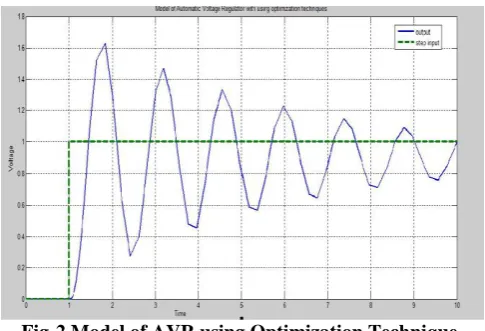
Fig-2 Model of AVR using Optimization Technique
The whole process consists of three steps i.e. firstly is the model preparation, secondly preparation of objective
function, then the last comes the application of optimization technique.
CASE 1: AVR Integral Absolute Error ( IAE)
Figure shows simulation model of AVR with having Integral Absolute Error criteria. From simulation graph is generated. This is as shown below
Figure 3.AVR with IAE
[image:2.595.57.274.364.471.2]This figure shows the output simulation graph
Figure 4. Graph of AVR with IAE
After the model preparation next comes the objective function by which the three variables value is to be calculated. This is basically a MATLAB Programming . In which all the variables in the model i.e. Kp, Ki and Kd values are assign to x(1) , x(2) and x(3) respectively. This values of x(1) x(2) and x(3) are show on MATLAB workspace
Simulation function y = iae_b(x) assignin ('base','Kp', x(1)); assignin ('base','Ki', x(2));
assignin ('base','Kd', x(3)); % assign variable into MATLAB workspace
[t,xx,y_out]=sim ('iae_a.mdl',[0 30] ); y = y_out(end);% evaluate objective function. Now on running the simulation, the graph is obtained which is shown above..
[image:2.595.48.291.582.747.2]Fig 5.AVR with ITAE
[image:3.595.309.561.59.204.2]This figure shows the output simulation graph
Figure 6. Graph of AVR with ITAE
After the model preparation, the next comes the evaluation of objective function by which the three variables’ value is to be calculated. This is basically a MATLAB Programming , in which all the variables in the model i.e. Kp, K i and Kd values are assign to x(1) ,x(2) and x(3) respectively. This values of x(1) , x(2) and x(3) are show on MATLAB workspace. Simulation
function y = itae_b(x) assignin ('base','Kp', x(1)); assignin ('base','Ki', x(2));
assignin ('base','Kd', x(3)); % assign variable into MATLAB workspace [t,xx,y_out]=sim ('itae_a.mdl',[0 30] );
y = y_out(end);% evaluate objective function
III. APPLYING OPTIMIZATION TECHNIQUE
Third step is the application of GA technique in the run model. As using MATLAB 12.0, it provides direct accesses to genetic algorithm technique. This provides the best fitness function and best value for the model. It randomly through value and check for the best, and after different iteration it provides the best fitness function and original value of variables that shows the best value for the model the with minimizing the error.
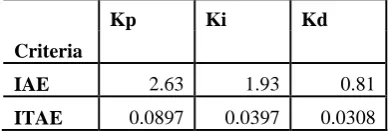
Values of variables on simulation
Kp Ki Kd
Criteria
IAE 2.63 1.93 0.81
ITAE 0.0897 0.0397 0.0308
Table shows the value of P ,I ,D using both criteria Where Kp = proportional controller, Ki = Integral controller, Kd = Derivative controller
After the completion of all above steps, for knowing the values of output step response of both the cases. I have used a command S = step info (Scope Data(: , 1))
The table shows the step information of the graph .This show that how both the criteria provide different response and reduce overshoot. It reduces the error in the system Rise time: time taken by signal to change from low value to specified high value
Settling time: time elapsed from instantaneous step input to time of output
Settling min: Minimum value of y once the response has risen
Settling max: Maximum value of y once the response has risen
Overshoot: Percentage overshoot (relative to y final) Undershoot: Percentage undershoot
Peak: Peak absolute value of y
Peak time : Time at which this peak is reached
S = step info(y ,t) uses the last sample value of y as steady-state value y final.
S = step info(y) assumes t = 1:ns.
IV. VOLTAGE STABILITY IMPROVEMENT BY
USING ANN
The method proposed is based on using linear programming technique to generate different training patterns and obtain the input data to ANN. In this study, feed-forward ANN which contains three layers (Two hidden layers and one output layer) is trained by using Back propagation algorithm to determine the proper adjustment of the reactive power control variables required to improve voltage stability. The block diagram of the ANN-based algorithm for improving voltage stability in power systems is shown in Fig. 1. Furthermore, to design a neural network, it is very important to train and test the network. The well-trained neural network should give the right decision for both normal and abnormal operating conditions
AVR Ris e Tim e Settling time Settl ing min Settl ing max Overs hoot Und er-shoo t Peak
Pea k time With PID 2.9
5 60.95 0.28 9
1.65 34
65.76
7 0
1.65 34 21 With
PID 4.2
3 228.46 0.25 3
1.94
2 86.08 0
1.94 2 20 IAE
With PID
5.3
73 110.49 0.91 1.15
7 12.48 0
[image:3.595.71.266.679.745.2]Fig. 7 The block diagram of the ANN-based algorithmfor improving voltage stability in Power System
Training is a stage at which all the weighting factors and thresholds are regulated according to a specific rule, in such a way that the objective function may be minimized. The usual method for training a multi-layer feed-forward neural network is the method of error propagation (or back-propagation). In order to use this method, both the desired output and the real output of the network must be available. The difference between desired output and real output is called the error. The algorithm of error back-propagation is based on the learning rule of error correction. This algorithm is an iterative method designed for minimizing the average of the squared error.
[image:4.595.308.550.52.236.2]
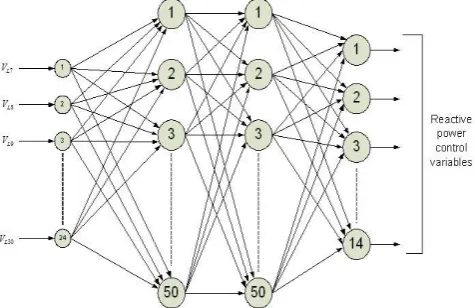
Fig. 8 Structure of neural network concerning 30-bus test system
[image:4.595.44.282.329.483.2]In this study, in order to improve the voltage stability against load variations in the modified 30-bus test system, initial load flow analysis is carried out for the considered power system for different load conditions. Voltage instability analysis is performed from the data that obtained from load flow. Sensitivities of minimum Eigen value with respect to reactive power control variables are computed. By performing the LP, the recommendations of transformer taps, shunt capacitors, generator voltages are computed. Voltage profile at load buses are considered as inputs to the neural network. The LP recommendation values form the target vectors (desired output). The considered structure of the neural network is shown in Fig.8.
Fig. 9 The modified 30-bus test system
V. RESULTS
Both methods of linear programming and artificial neural networks have been simulated in MATLAB software and have been applied to the modified 30-bus test system. The ANN was trained with the three sets of data as shown in Tables IV and V, obtained by performing load flow and voltage instability analysis for different load factors such as 0.8, 1.0, and 1.2. The decision of each method (LP and ANN) are almost coincident, however the ANN gives these decisions in almost on time. A comparison between the computational time of the proposed ANN technique and LP is shown in Table VIII. It is clearly shown that the ANN technique requires very small computational time to improve voltage stability. These results have been achieved by using a computer with Pentium CPU of 2.6 GHz, 512MB RAM specifications.
THE PRE AND POST OPTIMIZATION CONDITIONS WITH FULL LOAD STATE
Load factor (unity)
Pre Optimization
Post Optimization
Vmin
0.83 P.U. 0.957 P.U.
λmin 0.186 0.226
power losses 22.72 MW 20.71 MW
VI. CONCLUSION
It includes both theoretical aspects of genetic algorithms and its variants and some potential applications which incorporate the use of genetic algorithms.
A quick technique to monitor and improve power system voltage stability is proposed, the strategy is based on ANN. Three layers feed-forward ANN with back-propagation is trained to offer the proper rescheduling of reactive power control variables required to reach voltage stability in the day-to-day operation. The considered reactive power control variables are switchable VAR compensators, OLTC transformers and excitation of generators. The training data is obtained by solving several conditions utilizing the LP technique. The outcomes obtained show clearly that the ANN approach is capable of improving voltage stability in power systems.
The trained network is capable of improving the power system voltage stability from minimum to maximum range of load variations at very high speed. A comparison with the LP technique shows the clear superiority of the proposed ANN in achieving the control decision in a short computational time. Furthermore, the ANN is easy in structure and easy to operate compared with linear programming technique. Thus, the method can be used as a guide by the operator in Energy Control Center (ECC) for power system control. The proposed method indicates an important improvement in voltage stability which eventually results in considerable decrease in system losses.
REFERENCES
1. A. Khodabakhshian (Ph.D.) N. Golbon M.Sc.) Uniified PID Design for
Load Frequency Control” Proceedings of the 2004 IEEE International Conference on Control Applications Taipei, Taiwan, September 2-4, 2004.
2. Kothari and Nagrath, “Power System Engineering”2nd edition, Tata
McGraw-Hill Education, 2008.
3. Phillip David Power, “Non Linear Multi Layer Perceptron Channel
Equalization”, and Genetic Algorithm Optimization‟, in IEEE Transactions,The Queen University of Belfast, April 2001.
4. Jacob D. Griesbach and Delores M. Etter, “Fitness-Based Exponential
Probabilities for Genetic Algorithms Applied to Adaptive IIR Filtering”, in IEEE Transactions, Department of Electrical and Computer Engineering University of Colorado Boulder.
5. H. Demuch and M. Beale, “Neural network toolbox manual for MATLAB”, User's Guide, Version 9, 2011.
6. F. M. Elkady and A. Y. Abdelaziz A. Y., “Voltage Stability
Assessment of Electrical Power Systems Using Artificial Neural Networks”, Journal of Engineering and Applied Science, Faculty of Engineering, Cairo University, Vol. 48, No. 4, pp. 727-743, 2005.
7. Z. S. Elrazaz, I. Yassin, A. Hegazy and H. Mostafa , “Voltage Stability
Indicators Via Artificial Neural Networks”, Proceedings of the Sixth Middle East Power Systems Conference MEPCON’98, Mansoura, Egypt, Dec. 2009.
8. R.Dhivya and Dr.R.Prakash, “Edge detection of Images using improved Fuzzy C-means and Artificial Neural Network Technique” Journal of Medical Imaging and Health Informatics , AMER scientific Publishers. ISSN:2156-7018, 2019, cited in science citation Index , JCR, Impact factor : 0.54
9. Prakash.R and Muruganandham.A , “A Novel model reference
Intelligent Adaptive comtrol using Neural Network and Fuzzy logic controller” , Journal of Theoretical and Applied Information Technology (ISSN 1992-8645), april 2014 H Index : 9, SJR score:0.15, SNIP:0.592, cited in Scopus.
AUTHORS PROFILE
Mrs. P. T. Supriya, Assistant Professor, Department of EEE, Gnanamani College of Engineering, Namakkal, Tamilnadu. Email: [email protected]