Abstract: Historic site is a pot of civilization, preserving the fundamental characteristics of each nation, which distinguishes it from others. It reflects not just its history, identity, but also its urban heritage that contains several tangible values. This re-search highlights the protection of tangible heritage for historic sites with their surrounding areas who doesn’t have a unified policy not just to their region, but also state. Therefore, there is a dire need to classify the existing international policies for histori-cal sites, aiming to effectively control on tangible heritage preser-vation. After the introduction of the background problem, this research will present the literature on global vision for conserva-tion management policy. The methodology of this research uses a case study, which follows a qualitative method. This study con-tributes to identification of international policies for tangible heritage, highlighting their methods and criteria to each case, then summarizes these policies in categories, based on each method and criteria., proposing a theory on the control of herit-age areas from possible losses, having an international impact towards humanity issues.
Keywords: tangible heritage, international policies, historic site, conservation management, conservation management policy
I.INTRODUCTION
Development control is a group of procedures to ensure the appropriateness of any new development and proposed developments, according to the conservation plan, or are evaluated and approved as a deviation from the management plan. Thus, the strategy is to manage the tangible heritage processes through a clear planning system.
Tangible heritage protection designates what should be protected and, therefore, a development control policy should include the need of heritage protection within the plan and establish a system that can assess whether a new development harms the existing heritage. (Thomas, 1997) states that the development control, for heritage sites, are connected to the whole stages of tangible heritage’s life: initiation (setting out planning and building permission); constructions in heritage sites and ongoing land use. In this way, development control is necessary at all these stages, not just a theoretical aspect, but also a practical process.
Revised Manuscript Received on May 28, 2019.
Omar Khasro Akram, University Putra Malaysia, Malaysia Sumarni Ismail, Universiti Putra Malaysia, Malaysia
Nada Fadhel Mohammed Jamil, Foreign Affairs Office, Kurdistan Re-gion, Iraq
Daniel José Franco, Universiti Putra Malaysia, Malaysia, Muncipality of Alcácer do Sal, Portugal
Andreia Graça, Polytechnic Institute of Beja, Portugal
António Rafael Carvalho, Muncipality of Alcácer do Sal, Portugal
In several developed countries, such as the UK system, for example, it is included the process of issuing land-use development permits. While development control predomi-nately deals with new development projects, the conserva-tion of existing heritage is part of the permissions process (Philip Booth, 1996).
Controlling and managing change in the historical areas and buildings is very important in order to harness these processes to safeguard local heritage. A focus on the legisla-tion and policy system at both nalegisla-tional and local levels, may help on the explanation of how significant heritage cities, Arab and international countries, have been controlled (Thomas, 1997). Based on these initial considerations, this research assumes a main research question and three objec-tives (Omar Khasro Akram, Mohammed Jamil, Franco, Graça, & Ismail, 2018):
Main Research Question:What are the international policies for tangible heritage of historic sites to be classified? Research Objectives:
- To identify the global vision scenario on conservation management policy;
- To analyze the international policies based on their method and criteria;
- To categorize policy types based on methods that deal with deteriorated historical sites.
II.LITERATURE REVIEW
Global Vision on Conservation Management Policy
Protection and conservation of cultural heritage are highly dependent from institutional capacity and existing legisla-tion of their region, where every region has their own legis-lation, policy and regulations, significantly differing from one to another. The example of Africa, where most state parties have developed a heritage protection policy, just two of them have placed regulations on financial level, having regular budgets applied to heritage conservation (Leask & Fyall, 2006). In the Arab region, most states developed specific national laws to protect and conserve their cultural heritage, however, the World Heritage Centre realised that most of the drawn laws, cited in the periodic reports, were relatively old and never judge, requiring an urgent update(Peterson, Cumming, & Carpenter, 2003).
Asia and pacific regions are good examples in relation to heritage legislation, where most countries present some policies, regulations or other legal instruments related to cultural heritage protection and conservation, however they are still described as being insufficient to solve contempo-rary problems(Leask & Fyall, 2006).
Classification of International Policies of Tangible
Heritage for Historic Sites
Many countries have their legislation outdates or obsolete, needing a revision so they can act in a more effective way, integrating the constant growing complexity demanded by the management of cultural heritage (Akram, Mohammed Jamil, Ismail, Franco, & Graça, 2018; Sisto, Lopolito, & Vliet, 2018).
Australia and China established specific laws referring to responsibilities under the convention, while in Nepal, the national legislation consists on the only existing heritage protection and conservation tool (Leask & Fyall, 2006).
Latin America and Caribbean region reflected, in their pe-riodic report, the same type of issues, related to conservation management of cultural heritage. Also here, most of the state parties adopted specific laws and regulations for the existing cultural heritage in their region, however, the ma-jority of them, are in need to be reviewed and updated. In addition, also World Heritage Centre has mentioned that legislation is not properly corresponding to present-day concepts and requirements and need a close review, in order to consider todays needs and requirements (Bringezu & Bleischwitz, 2017).In Europe, all state parties have legisla-tion and regulalegisla-tions dedicated to cultural heritage proteclegisla-tion and conservation management, where, some of them, also created special organizations responsible for these conserva-tion acts (Bringezu & Bleischwitz, 2017; Leask & Fyall, 2006). Though, having national legislation and regulations for heritage conservation, by its own, do not necessarily ensure its integration into planning or development policies, as it is mentioned in article 5 (a) of the Convention. Also, this article points the design of a general policy with objec-tive of giving heritage a function in the life of the communi-ty, extending their useful life-time.
In analysis of the periodic report, unfortunately only a few countries have implemented such policy (Bringezu & Bleischwitz, 2017; Kaplan‐Hallam & Bennett, 2017; Leask & Fyall, 2006). Similar to Europe, the Arab States’ periodic report also shows significant institutional problems, where it states that institutional structures, mainly focus on the ar-chaeological excavations, sale of tickets and museum ad-ministration. Antiques departments were mainly created during the first half of the 20th Century, when heritage was not as threatened as nowadays, working as archaeological institutes and properties guardians. Consequently, these departments are not properly prepared and armed to meet the new challenges that cultural heritage is facing today, specifically the urban development and some tangible herit-age conservation. Also, some budget issues are needed to be taken in consideration, when most of the time are too low (Kaplan‐Hallam & Bennett, 2017; Leask & Fyall, 2006).
Unfortunately, the Arab Region is not the only region suf-fering from legislation and institutional frameworks inade-quacy, where this problem is also identified in Asia and Pacific region. Also, Latin America and Caribbean regions are facing this problem, as the existing legislation is still in need of an update and reformulation. Overall, the possible important role of heritage to increase social economic de-velopment is not mentioned in any of the periodic reports(Leask & Fyall, 2006).
Conservation Management Scenario
Protection and management of World Heritage properties, namely the tangible ones, should make sure that the unique values, integrity conditions and their authenticity are kept at all times, including the time of inscription and in the future (Ismail, 2014; Kamel, 2011).
As it was mentioned before, management systems are not successfully ensuring that maintenance or enhancement conditions are being kept at all times. The report of Latin America shows that the existing management measures are still insufficient (Bringezu & Bleischwitz, 2017). However, contrary to this situation, the report of Europe, states that national reports consider the current arrangement sufficient or highly effective to nowadays need and demands. Here, the picture may change in relation to the sub-region that is being focused, where Eastern and Central Europe show existing arrangements as still not sufficiently effective and improvements are needed (Bringezu & Bleischwitz, 2017; Leask & Fyall, 2006). These facts confirm the findings related to the authenticity and integrity conditions, where Latin American presents a larger number of issues than the ones found in Europe (Leask & Fyall, 2006; Pickard, 2016).
There is no clear idea on the same issues in reports from Asia, Pacific and Arab regions, though, in the case of Arab states, there are found some issues related to institutional structures that not properly equipped or do not have the correct tools to address the present problems that cultural and natural heritage are now facing (Bringezu & Bleischwitz, 2017; Ismail, 2014; Leask & Fyall, 2006).
The efficiency of management arrangements and tools does not differ only from region to region, but also accord-ing to the type of properties is addressaccord-ing. In Latin America and the Caribbean region, national reports, focusing archae-ological properties, state that management measures are enough for conservation procedures, however, when focus-ing urban settlements, the case changes and such measures are now not robustly enough (Leask & Fyall, 2006).
Several regions show difficulties on conservation man-agement because of the lack of assistance and cooperation between public institutions (Leask & Fyall, 2006; Pickard, 2016). Africa regions also express the same type of worries in relation to management of cultural heritage, where tour-ism caused problems affecting many properties. It is seen that when a threat comes and it is on the responsibility of another administration section, or out-boundaries, the assis-tance is almost none or very limited (Mubaideen & Al Kurdi, 2017).
improper management system (Kamel, 2011). In analysis of the Operational Guidelines, it is possible to highlight that an effective management system is directly dependent on the property itself, namely its type, characteristics and need, as well as its cultural and natural context. The system may also vary according to the cultural environment and its perspec-tives and available resources, where it is possible to incorpo-rate not just traditional practices, but also existing urban or regional planning instruments. Though, management plans are considered an essential factor on cultural heritage pro-tection and conservation. Here, in the Operational Guide-lines, it is mentioned that a management plan is mandatory, but it states that for each property, an appropriate manage-ment plan or any other type of documanage-mented managemanage-ment system must be designed and put into practice, specifying how property’s universal value should be conserved and preserved (Leitão, 2011).
Proposition Theory
The use of existing international policies for tangible her-itage, can work asfoundation for a conservation manage-ment plan, highlighting theirphysical policy, method, and criteria.
III. RESEARCH METHODOLOGY
The qualitative method is effective on this research in the way that it is used to obtain information about international policies, like policy of physical elements, policy method and policy criteria, in order to have better understanding on the needs of protecting the significant heritage from possible loss(Creswell, 2013; Franco, 2014; Graça, 2017). The ex-ploratory case study adopts the most common qualitative approaches, based on main research question of this research and the study’s nature. This approach aims to identify their characteristics and category them into groups based on their methods and criteria (Akram, Franco, & Ismail, 2016a;Akram, Franco, Ismail, Muhammed, & Graça, 2016;Akram, Ismail, & Franco, 2016a). Case studies are composed by five different components(Yin, 2003, 2009). In the specific case of this research, where international policies for tangible heritage is adopted as the exploratory case study, the components are:
Study Questions:
Already mentioned in introduction of research, this re-search aims to answer the followingquestions:
Main Research Question:What are the international poli-cies for tangible heritage of historic sites to be classified?
Study Proposition:
The use of existing international policies for tangible her-itage, can work asfoundation for a conservation manage-ment plan, highlighting theirphysical policy, method, and criteria.
Unit of Analysis:
Classification of the international policies based on their methods, type and criteria. those main findings will be measured by names of policies, category of methods of dealing, category of dealing, features of each policy, level of responsibilities, quality of dealing, validity of use.
Linking Data to Proposition:
Identifying of international policies for historic sites through international regulation, archival analysis, literature content (triangulation).
Criteria for Interpreting the Findings:
The agreement among the international and national ex-perts to the need of protection of the historic sites who doesn’t have a unified policy not just to their region, but also state.
IV. RESULT AND ANALYSIS
A variety of methods deals with deteriorated historic sites and their possible losses (Thomas, 1997). Therefore, the method of dealing with each region is determined to fit with their circumstances and objectives that are set for the differ-ent projects. Local managemdiffer-ent plays an important role in these projects, as it is entrusted with the administration and supervision of the implementation of urbanization, accord-ing to their legislation and organization. The dealaccord-ing with historical areas can be applied through one of these methods to pact or involve with a number of different ways and crite-ria, which have multiple types and terms (Chai, 2011; Orbasli, 2008; Pickard, 2001).
Policies for Dealing with Historic Buildings
• Restoration:This method deals with individual cases of historical buildings and archaeological ruins within the urban fabric of the old cities. Here, there are concerned the cultural values of the heritage ones and not the value of functional or economic, confirming on the spiritual and symbolic aspects of the buildings that reflected heritage values of the era when they were built. The restoration may be applied to a single historic building or to a group of buildings, streets, markets or corridors, where it is possible to find architectural, artistic, historical or visual significance (Kurdi, 2003). The restoration policy focus on restoring the historic site to its original form, by replacing some of the features that were destroyed, removing the additions and completing the missing elements in a full harmony with the historic place (Orbasli, 2008; Radzuan & Ahmad, 2016). Restoration works to treat damage and defects in the build-ing material and make it usable. This is based on respect for the original materials, original design and historical values of the building. Where the same materials of the old build-ing or similar materials are used in the same old construc-tion method, taking into consideraconstruc-tion the original building materials, the difference between the old and modern should not be obscured. Restoration works require high accuracy, skilled labor and high-quality materials. Restoration should not distort the historic building and destroy its artistic value. Restoration work must address collapses and damages, so that they do not return again (Akram, Ismail, & Franco, 2016b; Türkyılmaz, 2016);
The scope of this method ranges from the attention and value of the small historical architectural work to the preser-vation of large architectural sites and monuments with his-torical value associated with the national heritage (Teo, Khan, & Rahim, 2014);
• Preservation: It is intended to preserve the historical or heritage building after its restoration. The periodic mainte-nance is essential, especially after the preservation of the building. It can be achieved by reuse of the building and its occupancy by people who are able to maintain and repair it periodically and continuously(Ismail, 2014);
• Re-Use: It is intended to prepare the historical building for reuse with the same old or modern function, so that these buildings won’t be rigid and abounded. The optimal use of the historic building is to depend on the value of the build-ing and not oppose it. The change in use is accompanied by various modifications in the construction to fit with the requirements of the new function. These modifications shall be within certain limits so as to ensure the preservation of the authenticity of the building and its historical value. When reusing the historical building in a new function, it is likely to be used as a tourist attraction, depending on the importance values of the historical and artistic building, also the availability of easy access roads to historic buildings and the availability of nearby tourist services. The buildings of lesser importance are used in traditional functions that serve the community and are adapted to its needs and require-ments in order to integrate with its surroundings and thus ensure the continuity of its preservation(Z. K. Akram, 2013; Ameen, 2015).
Policies of Dealing with the Urban Environment of Historic Buildings
• Preservation:This type of policy is limited to historical or archaeological areas and sometimes follows modern areas of a distinctive character. The protection of certain build-ings, urban fabric or architectural character is sometimes extended to the protection of the social and economic struc-ture of the area alongside the urban strucstruc-ture. Protection method activities include: protection of the physical struc-ture of buildings degradation, protection of the urban envi-ronment, protection of the visual image at the level of build-ings and urban areas, protection of the social and economic environment and, lastly, the distinctive activities of the pop-ulation(Akram, Ismail, & Franco, 2016c; Ismail, 2014); • Conservation:Conservation policy is defined as actions taken to prevent damage and erosion that prolong the sur-vival of natural and human inheritance. The conservation policy is usually followed by historical zones. In the case of buildings within the historical zone, the architectural charac-ter of the building is to be preserved. In addition, in the case of historical spaces that have been completely destroyed or have been substantially damaged by modifications whose original features have been undone, in this case the architec-tural designs and the selection of the materials are prepared freely within the general outline of the distinctive character to be preserved in the historical space. The concept of con-servation extended to include the urban environment of buildings, historical group and buildings that have distinc-tive architectural character regardless of historical value. In addition, it extended to include activities, uses and
handi-crafts practiced in the urban environment or historical area (Fitri, Ahmad, & Ahmad, 2015; Pickard, 2001);
• Revitalization: It is to give a new life to a building, community, or urban area, etc., and is meant to return to life. This policy is not only limited to historical areas but also extends to existing areas and areas intended for urban exten-sion. By reviving heritage values in the planning and con-struction of these areas. It is an attempt at cultural continuity among the past, the present and the future, while restoring the lost architectural personality based on heritage. The revitalization strategy can include social, urban and institu-tional areas, and includes all those involved in the manage-ment of the urban process (Jokilehto, 1999; Kurdi, 2003; Masoud, 1985).
Policies to Deal with Deteriorating Parts of the Historic Region
Development Policies for Degraded Parts of the Historic Region
• Renewal: It means efforts aimed at developing the ur-ban environment to provide present and future requirements for urban life, either in city center or near city center. An-other definition, is the reconstruction of buildings and dam-aged urban areas in historical areas to qualify them to per-form the function that was lost due to the lack of suitability for changes successively(Abdul Tawab, 1998). The renewal has two levels (Povilaitytė, 2016):
A. Civil level: intended to make the necessary modifica-tions to the buildings, whether historical or modern. There are three methods of treatment:
▪ Internal treatment provided;
▪ Treatment of human needs in use, comfort and safety;
▪ External treatment is the treatment of the external form, which allows modifications to not affect to the distinc-tive character of these buildings.
individual efforts, and self-help has a key role in improving the urban environment such as cleaning and lighting of the streets and landscaping.It is synonymous with upgrading, although this concept seems more appropriate to use when refer to shelter or components of the basic environment. Therefore, it is considered more restrictive (Stubbs, 2008). Change Policies for Degraded Parts of Historical Areas • Clearance:There are two levels of clearance(Kurdi, 2003; Pickard, 2001):
• Removal of degraded areas in full: This method is never dealt with in historical areas because the removal of historic areas means the destruction of its urban fabric, his-torical buildings and distinctive character (Mubaideen & Al Kurdi, 2017);
• Partial removal of some buildings and parts of urban fabric: a method that allows to deal with the degraded parts of the historical area, where some parts of no historical or architectural importance have been removed for reconstruc-tion. This method may be followed by changing some uses with minor modifications in the urban fabric, which should not be a strange alien, but consistent and homogeneous with the actual fabric of the region, in addition to the deportation of a number of residents out of the region. Here, the follow-ing points must be identified accurately and observed before the removal process (Tawab, 2012)
▪ Estimated partial removal cost;
▪ Providing the necessary funding to compensate the population in the absence of an alternative;
▪ A survey of the population in the area of partial re-moval and provision of alternative housing for them in loca-tions inside or outside the area. This method has multiple drawbacks, which make it difficult to implement.
• Gradual Replacement:There are two approaches of removal (Abid, 2016; Akram, 2017):
A. First Approach: Remove all degraded areas and it has several phases must pass though it:
▪ Construction of new housing in vacant areas with inside or outside the area, or provide a residential alternative to residents to move to;
▪ Then, remove all degraded buildings and build new modern houses instead of the degraded ones, in order to move residents and, with this process, remove all entire degraded area.
B. Second Approach: it is only to remove buildings that are degraded and to build new housing blocks that will be replacing the degraded ones, in a gradual way, until the replacement process is completed. This method is the most appropriate one for historical areas, so as not to destroy the old urban fabric. Modern buildings may be built with the character and style of old buildings, preserving the urban character of the historic place (Akram et al., 2015).
• Redevelopment: It is a comprehensive program that aims to organize architectural, functional and population structures of any urban areas. This process can be done by removing old buildings that represent the majority of the urban fabric and rebuild parts of the specific urban area according to new comprehensive plans.This policy was developed during 20th century, when urban renewal practic-es were reprpractic-esented by:
o Rebuilding cities that have been destroyed during the second world war, especially European cities;
o Demolishing unauthorized buildings, especially those accumulated around the cities that lack the basic human requirements on both environmental and health levels. These urban areas have been established due to the rapid growth of the population and the increased immigration from rural areas to cities;
o Renewing city centers, which represent the economic and commercial core of any city(Akram, Ameen, & Khalaf, 2014; Povilaitytė, 2016).
Comprehensive Policies for Dealing with Historical Areas
Inclusive Conservation
The concept of preservation focuses not just on buildings’ historical values, but also on historical areas as a whole, with its buildings, activities, craftsmanship, character and texture. This concept has evolved into a special planning policy that focuses on the urban environment as a whole and not on individual or historic buildings. When dealing with historic areas, or areas with high environmental value, and preservation of historic areas, it is considered a flexible process, where historical monuments are treated within the general framework of the society in which they are located. It changes according to the characteristics and quality of the conservation community (Akram, Franco, & Ismail, 2016a; Sotoudeh & Abdullah, 2013).
Inclusive revitalization
The revitalization policy is considered a comprehensive policy because it is suitable for historical and modern areas, proposed expansion and urban extension in historical neigh-borhoods during planning. There are many ways of revival from architectural and urban to the uses and traditional craft activities, which include the revival and display of heritage values, in the present and future architectures. These meth-ods can be explained as followed:
their way of life and, thus, on the surrounding areas, includ-ing their architecture and urbanization (Franco, Akram, Ismail, MohammedJamil, & Graça, 2017; Ismail, 2014).
By reviving the spirit of cultural heritage in the communi-ty, we can revive the architectural and planning elements of historic areas and get benefits of them, in accordance with the scientific and technological development and the social transformation of contemporary life. The revival of these values does not mean the tradition of the past and the ex-press transfer of it, but the revival of spirit and content through the application of its components and principles in architecture and modern urbanization. This works to pre-serve cultural heritage and the continuity itself, to pre-serve the present and future generations. The revitalization of this concept is more comprehensive than mere preservation of heritage (Akram, Franco, & Ismail, 2016c; Akram, 2013). Upgrading
It is intended to improve the situation for the better, being a relative process in which the overall situation of the region is improved. Its image varies from one region to another and from one society to another, being characterized by upgrad-ing social, economic and urban aspects. This policy is char-acterized by maintaining the urban mass as a national wealth of economic value, working on its development and increas-ing its real estate value, in addition to developincreas-ing the social and economic aspects of the population in the historical
region. This approach is appropriate for countries with lim-ited economic resources, whose budgets do not meet the use of other methods (KwanYung, Zhang, & H.W.Chan, 2017). It must be ensured that the upgrading project may contain works for clearance, restoration and gradual replacement, as well as some conservation, protection and renovation works (Mitra, Grover, & Singh, 2013). This depends on the nature, circumstances and condition of the historical region, being one of the most important and comprehensive methods to deal with historical sites of different urban areas (Darmawan & SamsinarEnis, 2016).
Integrating Comprehensive Policies
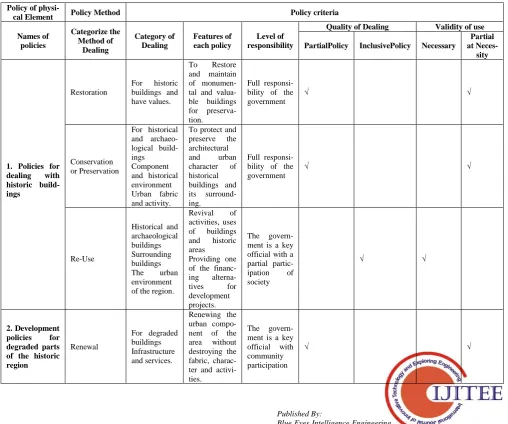
[image:6.595.45.554.395.819.2]Comprehensive approaches (revitalization, renewal, up-grading, and conservation) can be integrated into the devel-opment of historical areas, in order to deal with the various regions, in the historical region, and to take advantage of each method separately, avoiding its disadvantages. Interna-tional conventions, such as the Venice Charter, have empha-sized the integration of such policies as conservation and renewal, or revitalization and renewal. Many Arab countries have followed such integration to achieve their objectives in the development of historic areas (Akram, Ismail, & Franco, 2016;Akram, Franco, & Ismail, 2016b). On this table, it will be presented the categories of international policies, which are classified based on their physical elements, policy meth-od, and policy criteria.
Table. 1 Summary of Policies Categorizations
Policy of
physi-cal Element Policy Method Policy criteria
Names of policies
Categorize the Method of
Dealing
Category of Dealing
Features of each policy
Level of responsibility
Quality of Dealing Validity of use
PartialPolicy InclusivePolicy Necessary
Partial at Neces-sity
1. Policies for dealing with historic build-ings
Restoration
For historic buildings and have values.
To Restore and maintain of monumen-tal and valua-ble buildings for preserva-tion.
Full responsi-bility of the government
√ √
Conservation or Preservation
For historical and archaeo-logical build-ings Component and historical environment Urban fabric and activity.
To protect and preserve the architectural and urban character of historical buildings and its surround-ing.
Full responsi-bility of the government
√ √
Re-Use
Historical and archaeological buildings Surrounding buildings The urban environment of the region.
Revival of activities, uses of buildings and historic areas Providing one of the financ-ing alterna-tives for development projects.
The govern-ment is a key official with a partial partic-ipation of society
√ √
2. Development policies for degraded parts of the historic region
Renewal
For degraded buildings Infrastructure and services.
Renewing the urban compo-nent of the area without destroying the fabric, charac-ter and activi-ties.
The govern-ment is a key official with community participation
Rehabilitation
For buildings in general Infrastructure and services.
The construc-tion of build-ings to per-form its function as well as the basic envi-ronment and services.
The govern-ment is a key official with community participation
√ √
Improvement
For degraded buildings For the urban environment.
Improvement of degraded buildings and their urban environment.
The govern-ment is a key official with community participation
√ √
3. Change policies for degraded parts of historical areas.
Redevelopment
For degraded buildings For deteriorat-ing urban area.
Better recon-struction of the region on the basis of regional bases.
Full responsi-bility of the government
√ √
Clearance
For degraded buildings For deteriorat-ing urban area.
Better recon-struction of the region while provid-ing services.
Full responsi-bility of the government
√ √
Gradual Re-placement
For buildings gradually degraded.
Partially progressive reconstruction.
Full responsi-bility of the government
√ √
4. Comprehen-sive policies for dealing with historical areas.
Conservation
Historic buildings Character and urban fabric Activities and uses of build-ings and the region.
The preserva-tion of the region, its character, its fabric and its distinctive activities are a national and human herit-age.
The govern-ment is a key official with community participation
√ √
Revitalization
For Buildings and their functions Heritage values and activities in historical areas.
Revival of heritage values to reflect the urban envi-ronment of the historical area and modern areas.
Full responsi-bility of the government
√ √
Upgrading
For the urban component For Human For Economic activities.
Promoting the region as a whole with its economic, social and urban aspects.
The govern-ment is a key official with a partial partic-ipation of society
√ √
5. Integrating comprehensive policies.
For buildings For historical component For historic Area.
Integration of more than one policy which means to achieve re-gional devel-opment.
The govern-ment is a key official with community participation.
√ √
V. CONCLUSIONS AND CONTRIBUTION TO
EXISTING KNOWLEDGE
The control of urbanization in historical areas depends on the policies and methods of dealing in these areas, which vary from region to region. Within the same historical re-gion, there are many policies of dealing. The policies of dealing with the historic building differs from other build-ings and also differs from how to deal with the urban space of the historic building. Each component of the historical region is once more treated with an appropriate policy. It was found that the integration of more than one policy is appropriate to the nature of the historical region and it is considered a successful plan in the revitalization and con-servation of historic areas (Akram, 2017).
Based on three different objectives, the aim of this re-search was to identify, analyze, and categories the interna-tional policies for historic sites, in a way to help their pro-tection and provide reliable information for future genera-tions and studies on the area.
and the importance of its protection. This study may be used on foundation to conservation management a framework for heritage sites.
ACKNOWLEDGMENTS
This study was supported by the Municipality of Alcácer do Sal, Portugal. The authors acknowledge the contribution to the Mr. President Dr. VitorProença, who cooperated with the authors in this research.
REFERENCES
1. Abdul Tawab, A. G. E. D. A. (1998). Conservation and Urban Devel-opment. Alexandria University.
2. Abid, S. K. (2016). An examination of heritage protection and conser-vation practices in the pilgrimage city of Najaf. Sheffield.
3. Akram, O. K. (2017). Identification Of Cultural Properties Of Arab District, Erbil,Iraq. University Putra Malaysia (UPM).
4. Akram, O. K., Ameen, N. N., & Khalaf, O. A. (2014). Adaptive Resuse of Arab District (Building Rehabilitation). Erbil.
5. Akram, O. K., Franco, D. J., & Ismail, S. (2016a). Development Phases from Heritage Buildings to Smart Buildings. International Journal of Engineering Technology, Management and Applied Sciences, 4(4), 6– 13. Retrieved from
https://www.researchgate.net/publication/299994273_Development_Ph ases_from_Heritage_Buildings_to_Smart_Buildings
6. Akram, O. K., Franco, D. J., & Ismail, S. (2016b). The Cultural Signif-icant of Erbil City: Case of Traditional Kurdistan Houses. International Journal of Engineering Technology, Management and Applied Scienc-es, 4(2), 102–106. Retrieved from
https://www.researchgate.net/publication/321443128_The_Cultural_Si gnificant_of_Erbil_City_Case_of_Traditional_Kurdistan_Houses 7. Akram, O. K., Franco, D. J., Ismail, S., Muhammed, A., & Graça, A.
(2016). Promoting Heritage Management in New Smart Cities: Évora City, Portugal as a Case Study. International Journal of Engineering Technology, Management and Applied Sciences, 4(9), 148–155. Re-trieved from
https://www.researchgate.net/publication/321442902_Promoting_Herit age_Management_in_New_Smart_Cities_Evora_City_Portugal_as_a_ Case_Study
8. Akram, O. K., Franco, D. josé, & Ismail, S. (2016c). Smart Buildings – A New Environment ( Theoretical Approach ). International Journal of Engineering Technology, Management and Applied Sciences, 4(4), 1– 5. Retrieved from
https://www.researchgate.net/publication/299994174_Smart_Buildings _-_A_New_Environment_Theoretical_Approach
9. Akram, O. K., Ismail, S., & Franco, D. J. (2016a). The Significant of Islamic Architecture Heritage at Baghdad City, Iraq – Case Studies of Shrine of Lady Zumurrud Khatun. International Journal of Engineering Technology, Management and Applied Sciences, 4(4), 133–138. Re-trieved from
https://www.researchgate.net/publication/301349990_The_Significant_
of_Islamic_Architecture_Heritage_at_Baghdad_City_Iraq_-_Case_Studies_of_Shrine_of_Lady_Zumurrud_Khatun_and_Omar_Al -Sahrawardi
10. Akram, O. K., Ismail, S., & Franco, D. J. (2016b). The Significant of Urban Form of Erbil City, Iraq. International Journal of Engineering Technology, Management and Applied Sciences, 4(2), 96–101. Re-trieved from
https://www.researchgate.net/publication/299992594_The_Significant_ of_Urban_Form_of_Erbil_City_Iraq
11. Akram, O. K., Ismail, S., & Franco, D. J. (2016c). The Significant of Tourism Heritage of Najaf City in Iraq. International Journal of Engi-neering Technology, Management and Applied Sciences, 4(4), 14–19. Retrieved from
https://www.researchgate.net/publication/321442948_The_Significant_ of_Tourism_Heritage_of_Najaf_City_in_Iraq
12. Akram, O. K., Ismail, S., & Franco, D. J. (2016d). Urban and Tourism Development Projects for Cities Citadels (Aleppo and Erbil). Interna-tional Journal of Engineering Technology, Management and Applied Sciences, 4(3), 60–68. Retrieved from
https://www.researchgate.net/publication/321441501_Urban_and_Tour ism_Development_Projects_for_Cities_Citadels_Aleppo_and_Erbil
13. Akram, O. K., Ismail, S., & Franco, D. J. (2016). The Heritage Values of Arab District, Erbil City, Iraq. International Journal of Engineering Technology, Management and Applied Sciences, 4(2), 129–135. Re-trieved from
https://www.researchgate.net/publication/299993937_The_Heritage_V alues_of_Arab_District_Erbil_City_Iraq
14. Akram, O. K., Ismail, S., Utaberta, N., Mohd Yunos, M. Y., Ismail, N. A., & Arifin, N. F. (2015). The Important Values of Architectural Baghdadi Heritage. Advances in Environment Biology, 9(24), 46–52. Retrieved from
https://www.researchgate.net/publication/286622942_The_Important_ Values_of_Architectural_Baghdadi_Heritage
15. Akram, O. K., Mohammed Jamil, N. F., Franco, D. J., Graça, A., & Ismail, S. (2018). How To Guide Your Research Using ONDAS Framework. Beja, Portugal.
16. Akram, O. K., Mohammed Jamil, N. F., Ismail, S., Franco, D. J., & Graça, A. (2018). The importance of the heritage values of Al-Ukhaidhir palace, Karbala city, Iraq. IOP Conference Series: Materials Science and Engineering, 401, 1–7. Retrieved from https://www.researchgate.net/publication/328027698_The_importance _of_the_heritage_values_of_Al-Ukhaidhir_palace_Karbala_city_Iraq 17. Akram, Z. K. (2013). Epic of Gilgamish ( The Ilustration Study).
Subartu, 6(7), 58–62.
18. Ameen, N. N. (2015). Buildings Rehabilitation. Erbil City.
19. Bringezu, S., & Bleischwitz, R. (2017). Sustainable Resource Man-agement Global Trends, Visions and Policies (1st ed.). London. Re-trieved from https://www.taylorfrancis.com/books/e/9781351279277 20. Chai, L. T. (2011). Culture Heritage Tourism Engineering at Penang:
Complete The Puzzle Of “The Pearl Of Orient.” Systems Engineering Procedia, 1, 358–364. Retrieved from
http://linkinghub.elsevier.com/retrieve/pii/S2211381911000555 21. Creswell, J. W. (2013). Qualitative inquiry and research design:
Choos-ing among five approaches. London& Thousand Oaks: Sage Publica-tions.
22. Darmawan, E., & SamsinarEnis, A. (2016). The Changing Function of Heritage Building for Roling Tourism Planning Progress. Procedia - Social and Behavioral Sciences, 227, 712–719. Retrieved from http://www.sciencedirect.com/science/article/pii/S1877042816308230# !
23. Elborombaly, H. H. (2016). Architecture and Urban Conservation Methodology for Heritage Areas Case Study” Old Jeddah”. Fourth In-ternational Architectural Conservation Conference and Exhibition 2016: Sustainable Heritage: Global Vision Local Experiences. 2016At: Dubai. Retrieved from
https://www.researchgate.net/publication/299192572_Architecture_and _Urban_Conservation_Methodology_for_Heritage_Areas_Case_Study _Old_Jeddah
24. Fitri, I., Ahmad, Y., & Ahmad, F. (2015). Conservation of Tangible Cultural Heritage in Indonesia: A Review Current National Criteria for Assessing Heritage Value. Procedia - Social and Behavioral Sciences, 184, 71–78. Elsevier B.V. Retrieved from
http://dx.doi.org/10.1016/j.sbspro.2015.05.055
25. Franco, D. J. (2014). Network Security Evaluation and Training Based on Real World Scenarios of Vulnerabilities Detected in Portuguese Municipalities’ Network Devices. Polytechnic Institute of Beja. 26. Franco, D. J., Akram, O. K., Ismail, S., MohammedJamil, N. F., &
Graça, A. (2017). Adopting The Smart Buildings System To Heritage Buildings In Melaka.
27. Graça, A. (2017). Development of a possible solution to fast and silently collect files on Debian Linux operating systems. Polytechnic Institute of Beja.
28. Ismail, S. (2014). Monitoring Strategies and Key Indicators for Sus-taining the Heritage Values of Melaka and George World Heritage Cit-ies. Malaya, Malaysia.
29. Jokilehto, J. (1999). A History of Architectural Conservation. Oxford: Oxford : Butterworth-Heinemann.
30. Kamel, E. (2011). Decoding cultural landscapes: guiding principles for the management of interpretation in cultural world heritage sites. Not-tingham.
https://onlinelibrary.wiley.com/doi/10.1111/cobi.12985
32. Kurdi, F. (2003). Urban Cultural Heritage in Old Aleppo Between International And Local, Experience Of The Revival Of Old Aleppo. 10th international conference of build and construction. Cario. 33. KwanYung, E. H., Zhang, Q., & H.W.Chan, E. (2017). Underlying
social factors for evaluating heritage conservation in urban renewal dis-tricts. Habitat International, 66, 135–148. Retrieved from http://www.sciencedirect.com/science/article/pii/S0197397516306919# !
34. Leask, A. ;, & Fyall, A. (2006). Managing World Heritage Sites (1st ed.). London. Retrieved from
https://www.taylorfrancis.com/books/e/9781136381140
35. Leitão, L. (2011). The protection of world heritage settlements and their surroudings (Factors affecting management policy and practice). Edinburgh.
36. Masoud, O. (1985). Reviving Ancient Regions. Alexandria University. 37. Mitra, S., Grover, A., & Singh, R. (2013). Handbook of Conservation
of Heritage Buildings. Directorate General, Central Public Works De-partment. Retrieved April 21, 2016, from
http://cpwd.gov.in/Publication/ConservationHertBuildings.pdf 38. Mubaideen, S., & Al Kurdi, N. (2017). Heritage conservation and
urban development : A supporting management model for the effective incorporation of archaeological sites in the planning process. Journal of Cultural Heritage. Retrieved September 9, 2017, from http://linkinghub.elsevier.com/retrieve/pii/S129620741630276X 39. Orbasli, A. (2008). Architectural Conservation: Principles and Practice.
Oxford: United Kingdom, Oxford: Blackwell Science.
40. Peterson, G. D. ;, Cumming, G. S. ;, & Carpenter, S. R. (2003). Scenar-io Planning: a Tool for ConservatScenar-ion in an Uncertain World. Conserva-tion Biology, 17(2), 345–647. Retrieved from
https://onlinelibrary.wiley.com/toc/15231739/2003/17/2
41. Philip Booth. (1996). Controlling Development: Certainty and Discre-tion in Europe, the USA and Hong Kong. Psychology Press, UCL Press Limited. Retrieved September 8, 2017, from
http://www.cmecc.com/uploads/课本和论文/城市研究/[106][城市研 究]Booth,.P(1996).Controlling.development.pdf
42. Pickard, R. (2001). Management of Historic Centres. London & New york. Retrieved from http://book.douban.com/subject/11232968/ 43. Pickard, R. (2016). Setting the scene: the protection and management
of cultural World Heritage properties in a national context. The Histor-ic Environment: PolHistor-icy & PractHistor-ice, 7(2–3), 133–150. Retrieved from https://doi.org/10.1080/17567505.2016.1172780
44. Povilaitytė, E. (2016). The Conservation History, Problems and the Rehabilitation of Lithuanian Medieval Castles. Procedia - Social and Behavioral Sciences, 225, 85–95. Retrieved from http://linkinghub.elsevier.com/retrieve/pii/S1877042816306966 45. Radzuan, I. S. M., & Ahmad, Y. (2016). Assessing Cultural Heritage
Potiential : A framework to Incorporate Incentives Programme into Heritage Management Strategies. The Social Science, 11(12), 2916– 2921. Retrieved from
https://www.medwelljournals.com/abstract/?doi=sscience.2016.2916.2 921
46. Sisto, R., Lopolito, A., & Vliet, M. van. (2018). Stakeholder participa-tion in planning rural development strategies: Using backcasting to support Local Action Groups in complying with CLLD requirements. Land Use Policy, 70, 442–450. Retrieved from
https://doi.org/10.1016/j.landusepol.2017.11.022
47. Sotoudeh, H., & Abdullah, W. M. Z. W. (2013). Evaluation of Fitness of Design in Urban Historical Context: From the Perspectives of Resi-dents. Frontiers of Architectural Research, 2(1), 85–93. Elsevier. Re-trieved from http://dx.doi.org/10.1016/j.foar.2012.10.007
48. Stubbs, J. H. (2008). Time Honored: A Global View of Architectural Conservation. Hoboken, New Jersey: John Wiley & Sons, Inc. 49. Tawab, A. G. A. (2012). Area-based conservation: The strengths and
weaknesses of the Egyptian emerging experience in area-based conser-vation. Alexandria Engineering Journal, 51(2), 137–152. Retrieved from
http://www.sciencedirect.com/science/article/pii/S1110016812000373# !
50. Teo, C. B. C. T., Khan, N. R. M., & Rahim, F. H. A. (2014). Under-standing Cultural Heritage Visitor Behavior: The Case of Melaka as World Heritage City. Procedia - Social and Behavioral Sciences, 130, 1–10. Elsevier B.V. Retrieved from
https://www.researchgate.net/publication/275543662_Understanding_
Cultur-al_Heritage_Visitor_Behavior_The_Case_of_Melaka_as_World_Herit age_City
51. Thomas, K. (1997). Development Control : Principles and Practice. ULC press. Retrieved from
https://books.google.com.my/books?hl=en&lr=&id=Ty7PKCad7FcC& oi=fnd&pg=PR11&dq=Thomas,+Development+Control+:+Principles+
and+Practice,+pp.+11- 14&ots=RQVL0KRB0U&sig=1_9CSr1A1ujoLruSpJL-X0o-jUQ&redir_esc=y#v=onepage&q&f=false
52. Türkyılmaz, Ç. C. (2016). Interrelated Values of Cultural Landscapes of Human Settlements: Case of Istanbul. Procedia - Social and Behav-ioral Sciences, 222, 502–509. Retrieved from http://linkinghub.elsevier.com/retrieve/pii/S1877042816302154 53. Yin, R. K. (2003). Applications of Case Study Research (2nd ed.).
Thousand Oaks: Sage.