Learning motivation of first-year students of a technical
university
G. F. Babyuk1,*; N. A. Aksyonova1; Yu. B. Chebykina 3
1Tyumen Industrial University, Nizhnevartovsk branch, 38, Volodarsky str., 625000, Tyumen, Russia
Abstract. The concepts “motive” and “motivation” and their role in the learning process of the technical university are analyzed. The following types of motives were distinguished: internal learning motivation re-lated to learning activities and their content and external learning motivation not rere-lated to learning activities and their content but determined by external factors and circumstances. Learning motivation is associated with various changes that occur in students during the learning process. To identify the motivation in first-year students, they were tested. Driving motives were identified. The results showed that students prefer real learning motives (to use acquired knowledge in life, to continue successful training in subsequent courses, to get good marks, to acquire deep knowledge and intellectual satisfaction). The authors examined motivating methods and techniques. Motivation is a tool used to improve the learning process.
1.Introduction
Choosing a profession is a complex motivational process. Professional activities are crucial for self-realization. A man loving his work creates the financial basis of well-being, feels useful for society.
An analysis of higher education institutions shows it is difficult for school graduates to choose a profession. This is due to their inability to design their life and pro-fessional path, personal qualities of students. The problem of motivation formation is an integral part of personality development.
Today, any young man strives to get a higher educa-tion, because this is one of the ways to build a successful career.
Correct identification of professional motives, inter-ests and inclinations is an important prognostic factor in future satisfaction with a profession
.
2. Materials and methods
In order to study peculiarities of the motivational sphere of first-year students, we used the following diagnostic tools: testing to diagnose learning motives, the level of development of professional motives.
The study was conducted in 2016 - 2019 in Nizhne-vartovsk branch of Tyumen Industrial University. The study involved 40 first-year oil and gas and transport en-gineering students.
Learning motives were established using a test devel-oped by the psychological service of Tyumen Industrial University. The nature of the learning motivation was identified taking into account “consequences of external and internal motives” [1].
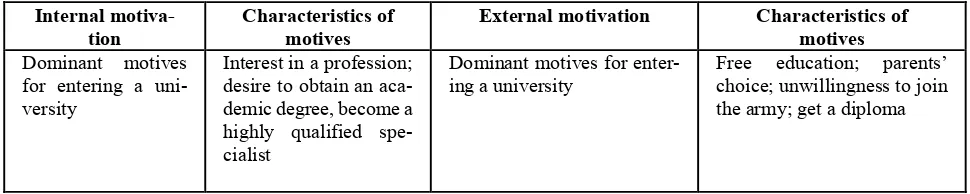
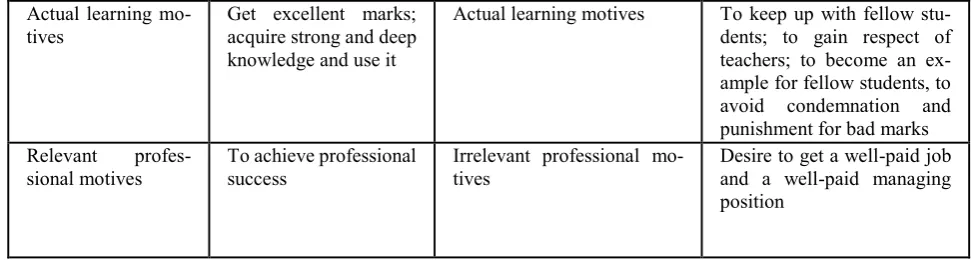
[image:1.595.55.540.649.746.2]Table 1 shows motives used in the test: internal learn-ing motivation related to learnlearn-ing activities and their con-tent and external learning motivation not related to learn-ing activities and their content but determined by external factors and circumstances (see Table 1).
Table 1. Types of Motives
Internal
motiva-tion Characteristics of motives External motivation Characteristics of motives Dominant motives
for entering a uni-versity
Interest in a profession; desire to obtain an aca-demic degree, become a highly qualified spe-cialist
Dominant motives for
Actual learning
mo-tives Get excellent marks; acquire strong and deep knowledge and use it
Actual learning motives To keep up with fellow stu-dents; to gain respect of teachers; to become an ex-ample for fellow students, to avoid condemnation and punishment for bad marks Relevant
profes-sional motives To achieve professional success Irrelevant professional mo-tives Desire to get a well-paid job and a well-paid managing position
3. Literature review
Motivation plays a crucial role in the modern educational process. The motives of university students ae one of the most difficult pedagogical problems of modern education.
B.G. Ananyev, L.S. Vygotsky, E.P. Ilyin, A.N. Leon-tiev, M.G. Yaroshevsky, V.V. Davydov, L.I. Bozhovich, A.K. Markov and others studied the issues of motivation, its role, types of motives, content and their development. Issues of learning motives studies for schoolchildren. The motivation of university students was understudied. The motivation of university students is relevant as young peo-ple aged 17-22 are the most apathetic part of modern so-ciety. Most of the students do not perform regular pur-poseful learning activities due to problems of learning a
large volume of materials, gadgets, inability to express their thoughts and use their time for learning. Teachers need to constantly motivate students.
Motivational processes can and should be controlled: by creating conditions for the development of internal tives, stimulating students. The formation of learning mo-tives involves creating conditions for learning momo-tives. Students are encouraged to learn not by a separate motive, but by their whole system.
The article aims to study learning motivation of first-year students. The research object is motivation.
[image:2.595.53.539.71.201.2]The motivation consists of two motives: learning and achieving success [2, 3]. It includes internal and external motives: professional, cognitive, spiritual, social, mate-rial, communicative, creative, etc. The authors' views on components of the motivation is presented in Table 2
Table 2 . The concept of "motive "
Definition Author
Needs, drives, motivations X. Heckhausen [4]
Desires, duty, habits, thoughts P.A. Rudik [5]
Need L.I. Bozovic [6]
Thoughts and moral-political attitudes G.A. Kovalev [7]
Conscious and unconscious motives, experience, desires A.N. Leontiev [8]
Targets and Needs Hierarchy A. Maslow [9]
Motives which depend the focused nature of actions V.S. Merlin [10]
Mental processes, states and personality traits K.K. Platonov [11]
Purposeful motivation for the implementation of values, initiatives W. Henning [12] A complex integral (systemic) psychological formation that
encour-ages conscious actions and serves as the basis for them E.P. Ilyin [13] A complex system of needs, ideals, interests, aspirations A.K. Markov [14] Congenital ( organismic ) needs for competence and
self-determina-tion [15.16]EL Deci, RM Ryan
Integral psychological system J. Lingart [17]
In China, university education began in 1978 and has become a priority. 95% of Chinese people learn always and everywhere. Compared to European students, they have no bad habits, don’t drink or smoke, and live in hos-tels. One of the main motives of Chinese students is to work for the good of their country discover their own re-sources, not caring for their own benefit. Chinese univer-sities educate young professionals, patriots who are open to world experience.
In China, in order to increase the motivation of stu-dents, there are ideological education courses on the the-ory of Marxism and Leninism, special academic courses for freshmen, student communities on the basis of general interests and needs of students in personal development. Student communities are an important part of the educa-tion system. They are self-organizing formaeduca-tions based on real needs of students [ 19 ].
Motivation is energy that encourages cognitive activi-ties, active development of knowledge. Motives are a mo-bile system that can be controlled. If the future bachelor did not choose his profession on his own, the teacher can help him in his professional adaptation.
A thorough study of motives for choosing a future pro-fession makes it possible to correct the learning motives and influence the professional development of students.
The educational process is a complex activity, there are a lot of learning motives which cannot manifest separately in each person, but merge into a single one, forming com-plex motivational systems.
A survey of students was conducted and opinions of teachers and curators of academic groups on methods used to increase the learning motivation were studied. Curriculum programs, methods and forms of motivation were adjusted .
4. Results
The aim of the study was to confirm that there are differ-ences in the structure of motives for choosing a profession among students of different directions, which must be taken into account in the educational process. The moti-vation level of the first-year students can be enhanced by teachers.
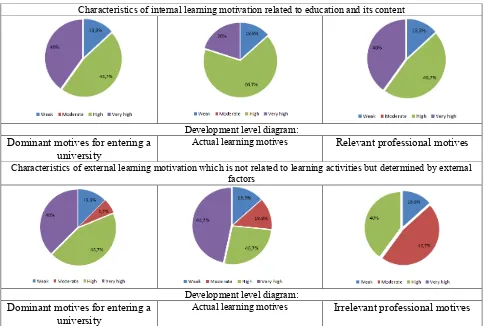
Testing of students of groups NDb-16 and ETMbp-16 identified levels of motivations presented in Figures 1 and 2. The diagrams show the share of students who have a different level of motivation development.
Characteristics of internal learning motivation related to education and its content
Development level diagram:
Dominant motives for entering a
university
Actual learning motivesRelevant professional motives
Characteristics of external learning motivation which is not related to learning activities but determined by external factors
Development level diagram:
Dominant motives for entering a
university
Actual learning motivesIrrelevant professional motives
Analyzing the research data, we found that in group NDb-16, the internal and external motivation level is av-erage.
In group NDb-16, internal motivation:
- according to the level of development of domi-nant motives : 50.0% - weak; 31.8% - very high; 18.2% - high;
- according to the level of development of relevant professional motives: 50.0% - weak; 22.7% - very high; 27.3% - high;
- according to the level of development of real-life motives of learning (educational and cognitive motives
and motives of self-education): 50.0% - weak; 27.3% - very high; 22.7 % is high.
External motivation
- according to the level of development of motives for entering a university: 50.0% - weak; 36.4% - very high; 13.6% - high;
- according to the level of development of irrele-vant professional motives : 50.0% - weak; 31.8% - high; 18.2% - moderately expressed;
-
according to the level of development of real-life learning motives (narrow educational and cognitive mo-tives): 50.0% - weak; 31.8% - very high; 18.2% is high.‒
Characteristics of internal learning motivation related to education and its content
Development level diagram:
Dominant motives for entering a
university
Actual learning motivesRelevant professional motives
Characteristics of external learning motivation which is not related to learning activities but determined by external factors
Development level diagram:
Dominant motives for entering a
[image:4.595.56.541.219.545.2]university
Actual learning motivesIrrelevant professional motives
Figure 1. Testing results for Group ETMbp-16 In group ETMbp-16, internal motivation:
- according to the level of development of dominant and relevant professional motives: 46.7 % - high; 40 % - very high and only 13, 3% - low;
- according to the level of development of real-life mo-tives for learning: 66.7 % - high; 20 % is very high and only 13.3% is low.
External motivation:
- according to the level of development of motives for enteringthe university: 46.7 % - high; 33.3 % - very high, 13, 3 % - low and 6.7 % - moderate e;
- according to the level of development of irrelevant professional motives: 40 % - high; 46.7 % - moderate, 13.3% - low;
- according to the level of development of real-life learning motives: 46.7 % - very high; 26.7% - high; 13.3% - moderate; 13.3% - weak.
arouse students' interest in the profession), students were sent to the following events organized by oil and gas com-panies: a study excursion, a tour to the Rosneft corporate museum, career guidance events).
To increase the internal motivation, students partici-pated in subject competitions and international scientific and practical conferences.
The survey on the learning motives identified that an increase in the educational allowance, opportunities to choose subjects, motivation of teachers can increase the level of motivation.
Feder-Thus, corrective measures implemented by the cura-tors were efficient.
In these groups, practical-modular training was intro-duced for the first time. Students undergo practical train-ing at the workplace as operators of oil and gas industry, assistant drillers, car mechanics, etc.
5 Conclusion
The list of recommendations to improve the motivation of first-year students is as follows:
explain students that knowledge obtained in uni-versities will be useful in their professional activities;
to explain students that the teacher is a mentor help-ing in the educational process;
to formulate goals and tasks correctly;
use laboratory and practical exercises, interactive methods (business games, round tables);
to teach self-organization skills, develop the ability to manage their time;
to use the score-rating systems when assessing stu-dent knowledge;
to apply psychological trainings (group, individual). Today, universities should be a source of professional and form personalities able to plan their activities, set goals and achieve them. The effectiveness of professional activities depends on motives, interests, and needs [19]. Learning motives, their formation mechanisms are prior-ity in modern higher education.
The testing and survey results showed that there are a lot of methods for motivating students. But they require effective, organizational efforts from the teaching staff to increase the students' motivational sphere.
The prose writer and poet Paulo Coelho said: “Decide. Change. Strive forward. Think. Get up and act. Refuse stereotypes. Reach. Dream. Open. Believe. Stop. Listen to yourself. Grow. Win. Look at life with open eyes ."
References
1. V I Chirkov Psychology Issues Self-determination and inner motivation of human behavior 3 123 (1996) 2. S M Ketko Unity reflection in the consciousness of
in-dividual motivation and adaptation (Chelyabinsk: Branch of Moscow State Pedagogical University, 2005)
3. S A Pakulina Adaptive abilities of pedagogical high school students: structure, factors and development tools (Moscow: SGU, 2008)
4. X. Heckhausen Motivation and Activity (St. Peters-burg: SPb Moscow: Smysl, 2003)
5. P A Rudik Psychology: a textbook for institutes of physical culture, 502 (Moscow: Physical Culture and Sports, 1958)
6. L I Bozhovich Personality and its development in childhood 464 (Moscow: Education 1968)
7. G A Kovalev The socio-psychological climate of the team and personality (Moscow: Mysl, 1983) 8. A N Leontyev, Activities. Consciousness. Personality.
304, (Moscow, 1975)
9. A G Maslow, Motivation and Personality 478 (SPb.: Eurasia, 2003 )
10.V S Merzlikin Psychology of individual: Selected psy-chological works 544 (Moscow: SAG; Voronezh MODEK, 2005)
11.K K Platonov, Structure and personal development,
254 (Moscow: Nauka), 1986
12.A GLiders Questions of psychology, Motives for learning in schoolchildren 1, 161-162 (1980)
13.E P Ilyin Motivation and motives, 51 2 (SPb.: Piter), 2006
14.A K Markova Formation of the motivation of learning, 192 (Moscow: Enlightenment), 1990
15.L Deci, R M Ryan Canadian Psychology, Facilitating optimal motivation and psychological well-being across life's domains 49, 14–23, 182–185 (2008) 16.E L Deci, R M Ryan, Canadian Psychology,
Self-de-termination theory: A macrotheory of human motiva-tion, development and health 49, 182–185 (2008) 17.J Linhart process and structure in human studies, 686
(Moscow: Progress, 1970).
18.K Goldstein Health as valueNew knowledge in human values (New York: Harpek and Brothers), 1959 19.Y Fanfan 2018 Organizational and pedagogical
con-dition for involving students in research activities at universities in China: Thesis, 226 (St. Petersburg ) 20.N N Saveleva, Um modelo de formação orientada ao