THE FIT OF MOBILE WORK SUPPORT
FUNCTIONS WITH MOBILE SALES-FORCE
WORKER TASKS
A dissertation submitted by
Markus Lembach, Bachelor of Arts (B.A.),
Master of Management with a specialisation in Information Systems (M.Mgmt.),
Project Management Professional (PMP)
In partial fulfilment of the award of
Doctor of Business Administration,
Faculty of Business and Law, University of Southern Queensland, Australia
Abstract
Abstract
In recent years, mobile computing technologies (MCT) have developed and matured to a stage where they now have the potential to transform organisational work. However, the wide-spread diffusion of innovative MCT within pharmaceutical companies in Germany has still not taken place. This research seeks to provide an in-depth understanding of how MCT fits with pharmaceutical sales-force work and whether MCT can add value to their relationship with physicians.
The purpose of this research is to investigate (1) how and to what extent are specific mobile work support functions enabled by MCT perceived to be useful with pharmaceutical sales-force worker tasks, (2) to what extent is perceived usefulness influenced by individual sales-force worker characteristics, (3) to what extent does perceived usefulness and intention to use mobile work support functions influence sales-force worker performance and (4) does the perceived degree of innovativeness of mobile work support functions moderate the relationship between perceived usefulness and intention to use and the relationship between perceived usefulness and perceived impact on mobile work performance of mobile work support functions.
Abstract
and mobile work support functions and to what extent this fit and individual characteristics of sales-force workers influence sales-force worker performance and intention to use mobile work support functions.
The research findings indicate that except for mobile job scheduling and dispatching functionalities, all mobile work support functions investigated in this research were considered to be moderately useful and innovative. Moreover, mobile work support functions are perceived to accelerate communication, improve information delivery, reduce paper-based work, reduce double-handling of data entries, improve preparation for ad-hoc sales calls and facilitate a more efficient usage of dead times. However, MCT might be also misused as a control tool, might reduce work autonomy and might increase workload and stress. Regarding the task characteristics investigated in this research, time criticality and location dependence of mobile sales-force workers positively affect perceived usefulness of mobile work support functions. Furthermore, this study confirmed the relationships established by TTF theory as the research results indicate that perceived usefulness of mobile work support functions positively affects intention to use and perceived impact on mobile work performance of mobile work support functions. In addition, no moderating effect of the perceived degree of innovativeness could be determined for both the influence of perceived usefulness on intention to use and the influence of perceived usefulness on perceived impact on mobile work performance. Lastly, this study revealed that differences across job roles, across length of tenure and across business units affect perceived usefulness of mobile work support functions - but not across gender.
Abstract
Certification of dissertation
Certification of dissertation
I certify that the ideas, experimental work, results, analyses, software and conclusions reported in this dissertation are entirely my effort, except where otherwise acknowledged. I also certify that the work is original and has not been submitted for any other award, except where otherwise acknowledged.
_____________________ _________________
Signature of Candidate Date
Endorsement:
_____________________ _________________
Acknowledgements
Acknowledgements
As with most dissertations, this study would not have been possible without the help of others.
First and foremost, I want to thank my wife and my son who accepted my absences and encouraged me in times of doubt.
I want to thank the University of Southern Queensland (USQ) for giving me the opportunity to participate in the Doctor of Business Administration Program. Many thanks go to my supervisor, Dr Michael Lane, who encouraged me and provided excellent feedback and suggestions for continuously improving this dissertation. Moreover, I want to thank for the support I have received throughout this dissertation from the School of Information Systems and the Faculty of Business and Law, in particular from Liz Whatson and Chris O’Reilly.
I want to thank all those persons from the study's case organisation for giving me permission to conduct this research and for providing helpful background information for this research.
Thanks to Michael Hetkamp–a German fellow student–for valuable information exchange.
List of abbreviations
List of abbreviations
Abbreviation Description
3G 3rd generation
4G 4th generation
AMOS Analysis of moment structures
ANOVA Analysis of variance
AVE Average variance extracted
B2B Business-to-business
B2E Business-to-employee
BU Business unit
CB-SEM Covariance-based structured equation modelling
CR Composite reliability
CRM Customer relationship management
DBA Doctor of business administration
DOI Diffusion of innovation
DSL Digital subscriber line
ERP Enterprise resource planning
F Female
FAQ Frequently asked questions
FTHREC Fast track human research ethics committee
GMS Global system for mobile communication
GoF Goodness of fit
GP General practitioner
GPRS General packet radio service
HSPA High speed packet access
IM Instant messaging
List of abbreviations
Abbreviation Description
IS Information system
IT Information technology
ITD Innovation diffusion theory
ITU Intention to use
LOCDEP Location dependence
LOCVAR Location variety
LOE Loss of exclusivity
LRS Location-related services
LRSITU Intention to use location-related services functionalities
LRSPI Perceived impact on mobile work performance of location-related services functionalities
LRSPIN Perceived degree of innovativeness of location-related services functionalities
LRSPU Perceived usefulness of location-related services functionalities
M Male
MC Mobile communication
MCITU Intention to use mobile communication functionalities
MCPI Perceived impact on mobile work performance of mobile communication functionalities
MCPIN Perceived degree of innovativeness of mobile communication functionalities
MCPU Perceived usefulness of mobile communication functionalities
MCT Mobile computing technologies
MIS Mobile information searching
MISITU Intention to use mobile information searching functionalities
MISPI Perceived impact on mobile work performance of mobile information searching functionalities
MISPIN Perceived degree of innovativeness of mobile information searching functionalities
MISPU Perceived usefulness of mobile information searching functionalities
List of abbreviations
Abbreviation Description
MJSITU Intention to use mobile job scheduling and dispatching functionalities
MJSPI Perceived impact on mobile work performance of mobile job scheduling and dispatching functionalities
MJSPIN Perceived degree of innovativeness of mobile job scheduling and dispatching functionalities
MJSPU Perceived usefulness of mobile job scheduling and dispatching functionalities
MMS Multimedia messaging service
MO Mobile office
MOITU Intention to use mobile office functionalities
MOPI Perceived impact on mobile work performance of mobile office functionalities
MOPIN Perceived degree of innovativeness of mobile office functionalities
MOPU Perceived usefulness of mobile office functionalities
MTP Mobile transaction processing
mSFA Mobile sales-force automation
MTPITU Intention to use mobile transaction processing functionalities
MTPPI Perceived impact on mobile work performance of mobile transaction processing functionalities
MTPPIN Perceived degree of innovativeness of mobile transaction processing functionalities
MTPPU Perceived usefulness of mobile transaction processing functionalities
Op Operational sales-force worker
PDA Personal digital assistant
PI Perceived impact on mobile work performance
PIN Perceived degree of innovativeness
PLS Partial least squares
PLS-SEM Partial least squares structured equation modelling
PU Perceived usefulness
QoS Quality of service
List of abbreviations
Abbreviation Description
RQ Research question
SD Standard deviation
SEM Structured equation modelling
SFA Sales-force automation
SMS Short message service
SOHO Small office home office
SOV Share of voice
SPSS Statistical package for social sciences
Sup Supervisor
TA Therapeutic area
TAM Technology acceptance model
TC Task complexity
TCR Time criticality
TI Task interdependence
TPB Theory of planned behaviour
TRA Theory of reasoned action
TTF Task-technology fit
UM Unified messaging
UMTS Universal mobile telecommunications system
USQ University of Southern Queensland
UTAUT Unified theory of acceptance and use of technology
W-CDMA Wideband code division multiple access
WiMAX World interoperability for microwave access
Table of contents
Table of contents
Abstract ... ii
Certification of dissertation ... v
Acknowledgements ... vi
List of abbreviations...vii
Table of contents ...xi
List of figures ... xv
List of tables ... xvi
List of publications ... xxii
1 Introduction ... 1
1.1 Background ... 1
1.1.1 Background to this research ... 1
1.1.2 Motivation for the research ... 2
1.1.3 Background to pharmaceutical sales-force work in Germany ... 3
1.1.4 Sales-force work and IT support in the case organisation ... 4
1.2 Research problem, research questions and theoretical framework ... 6
1.3 Justification for this research ... 8
1.4 Methodology ... 9
1.5 Definition of terms ... 11
1.6 Delimitations of scope and key assumptions ... 11
1.7 Outline of the dissertation ... 13
1.8 Chapter summary ... 14
2 Literature review ... 15
2.1 Introduction ... 15
2.2 Sales-force work and technology support ... 16
2.2.1 Sales-force work: definition and overview ... 16
2.2.2 Sales technology and sales-force work ... 21
2.2.3 Impact of sales technology on sales-force worker performance ... 22
2.3 Mobile computing technologies (MCT) ... 28
2.3.1 Definitions of key terms ... 28
2.3.2 Technological foundation of MCT ... 33
2.3.3 Characteristics of MCT ... 35
2.3.4 Benefits of MCT ... 38
2.3.5 Technical limitations and adoption issues of MCT ... 44
2.4 Research-relevant models and theories ... 48
2.4.1 Technology acceptance model (TAM) ... 48
2.4.2 Diffusion of innovation (DOI) theory ... 50
2.4.3 Information system success model ... 53
2.4.4 Task-technology fit (TTF) model ... 55
2.4.5 TTF-related research on mobile technologies ... 60
Table of contents
2.5.1 Research model ... 64
2.5.2 Research hypotheses ... 71
2.5.2.1 Influence of task characteristic-related research constructs on perceived usefulness of mobile work support functions ... 72
2.5.2.2 Influence of perceived usefulness of mobile work support functions on perceived impact on mobile work performance ... 74
2.5.2.3 Influence of perceived usefulness on intention to use mobile work support functions ... 74
2.5.2.4 Influence of intention to use mobile work support functions on perceived mobile work performance ... 75
2.5.2.5 Moderating effect of perceived degree of innovativeness ... 75
2.5.2.6 Influence of individual characteristics on perceived usefulness of mobile work support functions ... 76
2.6 Chapter summary ... 79
3 Research methodology ... 81
3.1 Introduction ... 81
3.2 Justification for research paradigm used in this study ... 82
3.3 Justification for the study’s overall research methodology ... 84
3.4 Research design of research phase 1—Semi-structured interviews ... 87
3.4.1 Data collection procedures ... 88
3.4.2 Data analysis procedures for semi-structured interviews ... 91
3.5 Research design of research phase 2—Online survey ... 92
3.5.1 Data collection procedures ... 93
3.5.2 Data analysis procedures ... 100
3.5.2.1 Descriptive data analysis ... 100
3.5.2.2 Evaluation criteria for research model assessment ... 101
3.6 Validity and reliability aspects ... 107
3.7 Ethical considerations ... 111
3.8 Chapter summary ... 111
4 Data analysis—Research phase 1 ... 113
4.1 Introduction ... 113
4.2 Profiles of the interviewees ... 113
4.3 Results for perceived usefulness and perceived degree of innovativeness of six mobile work support functions investigated ... 114
4.3.1 Mobile communication ... 115
4.3.2 Mobile information searching ... 119
4.3.3 Mobile transaction processing ... 124
4.3.4 Mobile job scheduling and dispatching ... 128
4.3.5 Location-related services... 130
4.3.6 Mobile office ... 134
4.3.7 Summary of findings and implications for research phase 2 ... 139
4.4 Chapter summary ... 142
5 Data analysis—Research phase 2 ... 143
5.1 Introduction ... 143
Table of contents
5.4 Analysis of research models and related hypotheses ... 149
5.4.1 Mobile communication ... 149
5.4.2 Mobile information searching ... 159
5.4.3 Mobile transaction processing ... 168
5.4.4 Mobile job scheduling and dispatching ... 176
5.4.5 Location-related services... 185
5.4.6 Mobile office ... 192
5.5 Chapter summary ... 200
6 Discussion of data analysis and findings ... 202
6.1 Introduction ... 202
6.2 Discussion of data analysis results—Research phase 1 ... 202
6.2.1 Perceived usefulness of mobile work support functions ... 203
6.2.2 Perceived degree of innovativeness of mobile work support functions ... 204
6.2.3 Reasons why specific mobile work support functions are perceived to be useful or not in supporting mobile sales-force worker tasks ... 206
6.3 Discussion of data analysis results—Research phase 2 ... 211
6.3.1 Influence of task characteristic-related research constructs on perceived usefulness of mobile work support functions ... 212
6.3.1.1 Task complexity ... 212
6.3.1.2 Task interdependence ... 214
6.3.1.3 Time criticality ... 216
6.3.1.4 Location sensitivity ... 217
6.3.2 Influence of perceived usefulness of mobile work support functions on perceived impact on mobile work performance of mobile work support functions... 220
6.3.3 Influence of perceived usefulness on intention to use mobile work support functions ... 222
6.3.4 Influence of intention to use mobile work support functions on perceived impact on mobile work performance ... 223
6.3.5 Moderating effect of perceived degree of innovativeness ... 225
6.3.6 Influence of individual characteristics on perceived usefulness of mobile work support functions... 229
6.3.6.1 Gender ... 230
6.3.6.2 Length of tenure ... 231
6.3.6.3 Job role ... 232
6.3.6.4 Business units ... 234
6.4 Chapter summary ... 235
7 Conclusions and implications ... 237
7.1 Introduction ... 237
7.2 Summary of this research ... 238
7.2.1 Research problem ... 238
7.2.2 Research methodology ... 238
7.2.3 Research hypotheses ... 239
7.2.4 Major conclusions and findings ... 241
Table of contents
7.3.1 Contribution to theory ... 248
7.3.2 Contribution to practice ... 249
7.4 Limitations ... 252
7.5 Directions for future research ... 253
7.6 Chapter summary ... 254
List of references ... 257
Appendix 1—Research questions ... 268
Appendix 2—Hypotheses and support ... 269
Appendix 3—Data screening results ... 275
Appendix 4—Path coefficients of research models investigated ... 286
Appendix 5—Semi-structured interview questionnaire (Research phase 1) ... 292
List of figures
List of figures
Figure 1.1 - High-level research framework ... 10
Figure 2.1 - Structure of literature review chapter ... 16
Figure 2.2 - Categorisation of mobile workers based on location and the frequency of changing locations ... 19
Figure 2.3 - Overview of relevant terms in the mobile computing domain ... 29
Figure 2.4 - TAM ... 49
Figure 2.5 - IS success model ... 54
Figure 2.6 - Updated IS success model ... 55
Figure 2.7 - TTF model ... 57
Figure 2.8 - Research model ... 65
Figure 3.1 - Structure of research methodology chapter ... 81
Figure 3.2 - Three-step approach for evaluating PLS-SEM ... 102
Figure 3.3 - Moderating variables in SmartPLS ... 107
Figure 4.1 - Structure of data analysis chapter—Research phase 1 ... 113
Figure 5.1 - Structure of data analysis chapter—Research phase 2 ... 143
Figure 5.2 - Final structural model for the mobile communication functionality ... 157
Figure 5.3 - Final structural model for the mobile information searching functionality ... 166
Figure 5.4 - Final structural model for the mobile transaction processing functionality ... 175
Figure 5.5 - Final structural model for the mobile job scheduling & dispatching functionality ... 183
Figure 5.6 - Final structural model for the location-related services functionality . 191 Figure 5.7 - Final structural model for the mobile office functionality ... 199
Figure 6.1 - Structure of the discussion of data analysis and findings chapter ... 202
Figure 6.2 - Research model ... 212
Figure 7.1 - Structure of the conclusions and implications chapter ... 237
List of tables
List of tables
Table 1.1 - Research questions ... 8
Table 2.1 - Key sales activities of pharmaceutical sales-force workers ... 17
Table 2.2 - Attributes and indicators of sales-force worker performance ... 23
Table 2.3 - Summary of research on technology support for sales-force work ... 25
Table 2.4 - Definitions for mobile computing ... 32
Table 2.5 - Comparison of three standards enabling mobile broadband Internet access ... 33
Table 2.6 - Characteristics of MCT ... 38
Table 2.7 - Benefits of MCT (individual and organisational level) ... 42
Table 2.8 - Technical limitations and adoption issues of MCT ... 47
Table 2.9 - Categories of IS success ... 53
Table 2.10 - Constructs of the TTF model ... 56
Table 2.11 - Summary of research models discussed ... 59
Table 2.12 - Overview of relevant TTF research with a focus on mobile technology 61 Table 2.13 - Mobile work support functions & Sub-functionalities ... 67
Table 3.1 - Analysis of this study’s research paradigm ... 83
Table 3.2 - Summary of the relative strengths of the semi-structured interview and survey methods ... 86
Table 3.3 - Overview on the demographics of the 20 interviewees in research phase 1 ... 89
Table 3.4 - Summary of research questions and related sections in the interview protocol used in research phase 1 ... 90
Table 3.5 - Structure of the interview protocol ... 90
Table 3.6 - Structure of the online survey questionnaire ... 94
Table 3.7 - Summary of research questions and related questions used in the online survey ... 96
Table 3.8 - Variables and measurement items used in research phase 2 ... 97
Table 3.9 - Summary of descriptive data analysis techniques applied in research phase 2 ... 101
Table 3.10 - Evaluation criteria and thresholds for the reflective measurement model assessment ... 103
Table 3.11 - Evaluation criteria for the inner model assessment ... 104
List of tables
Table 4.1 - Overview on the demographics of the 20 interviewees in research phase
1 ... 114
Table 4.2 - Ratings of the 20 interviewees in relation to mobile communication functionalities ... 115
Table 4.3 - Common themes and patterns in relation to mobile communication functionalities ... 116
Table 4.4 - Ratings of the 20 interviewees in relation to mobile information searching functionalities ... 120
Table 4.5 - Common themes and patterns in relation to mobile information searching functionalities ... 121
Table 4.6 - Ratings of the 20 interviewees in relation to mobile transaction processing functionalities ... 125
Table 4.7 - Common themes and patterns in relation to mobile transaction processing functionalities ... 126
Table 4.8 - Ratings of the 20 interviewees in relation to mobile job scheduling and dispatching functionalities ... 128
Table 4.9 - Common themes and patterns in relation to mobile job scheduling and dispatching functionalities ... 129
Table 4.10 - Ratings of the 20 interviewees in relation to location-related services functionalities ... 130
Table 4.11 - Common themes and patterns in relation to location-related services functionalities ... 132
Table 4.12 - Ratings of the 20 interviewees in relation to mobile office functionalities ... 134
Table 4.13 - Common themes and patterns in relation to mobile office functionalities ... 136
Table 4.14 - Common themes and patterns concerning why certain mobile work support functions are perceived to be useful and innovative or not ... 140
Table 5.1 - Distribution of participants for each business unit investigated ... 147
Table 5.2 - Distribution of participants across job roles ... 147
Table 5.3 - Distribution of participants across gender ... 148
Table 5.4 - Distribution of participants across length of tenure ... 148
Table 5.5 - Factor loadings of the measurement model for the mobile communication functionality ... 149
Table 5.6 - AVE, CR and Cronbach's alpha of the measurement model for the mobile communication functionality ... 151
List of tables
List of tables
List of tables
List of tables
List of publications
List of publications
Introduction
1
Introduction
1.1
Background
1.1.1 Background to this research
During the last two decades, the global pharmaceutical industry has benefited from several changes in societal structure. Increased life expectancy, increased wealth of the population in developed countries and the rise in the world population have led to an increased demand for pharmaceutical products (Fischer & Breitenbach 2007, p. 7). Worldwide, pharmaceutical drugs have an exclusivity of 20 years; prominent drugs (e.g., Lipitor, Viagra) are likely to be copied by generic companies after the drugs have lost their exclusivity (Fischer & Breitenbach 2007). Thereby, most of the turnover can be made in the first 20 years when a drug is patent-protected. As there are over 38,000 drugs available in Germany (Fischer & Breitenbach 2007, p. 17), a physician cannot be familiar with all these drugs or their pharmacodynamics. According to the German ‘Heilmittelwerbegesetz’ (law on advertising in the healthcare system), a pharmaceutical company is not permitted to advertise drugs directly to patients (AOK-Bundesverband 2008). Pharmaceutical companies employ sales-force workers who inform targeted physicians about pharmaceutical products that are available in the marketplace. In turn, these physicians are able to consult with patients about pharmaceutical products and are qualified to write drug prescriptions.
Introduction
1.1.2 Motivation for the research
According to industry experts, mobile computing has been the defining information technology trend of the first decade of this millennium (Helal 1999; Lilischkis 2003; Urbaczewski et al. 2003; Xianpei et al. 2008). In ninety-four countries worldwide, mobile phones surpassed fixed phones in the year 2000 and reached 100 percent market penetration by 2004 (Lee & Lee 2009). In addition, capabilities and functionalities of mobile devices, mobile applications, and mobile networks have grown exponentially in recent years (Computerwoche 2008; Ladd 2010; Lee & Lee 2009).
Despite the high investments in sales technology and a considerable amount of research investigating the link between sales technology and work performance (e.g., Ahearne et al. 2008; Ahearne & Schillewaert 2001; BenMoussa 2006; Koschembahr 2005; Scornavacca & Sutherland 2008), the ‘relationship between sales technology and sales-force worker performance remains primarily unsubstantiated’ (Ahearne et al. 2008). This research assumes that there are gaps in the current research regarding the impact of sales technology on sales-force worker performance. Mobile computing technologies (MCT) are expected to add value for mobile workers such as pharmaceutical sales-force workers by, for example, reducing paper-based work, providing online access to a company’s systems and the Internet during dead times and enhancing existing business processes (Accenture 2004; Henri & Aurelie 2006; IBM Cooperation 2004; Liang & Wei 2004; Perry et al. 2001; Schierholz et al. 2007; Sheng et al. 2005). This research assumes that MCT can play a key role in adding value to pharmaceutical sales-force work and the sales force-physician relationship through improved access to relevant information and a more efficient use of the pharmaceutical sales workforce’s time in the field.
Introduction
1.1.3 Background to pharmaceutical sales-force work in Germany
Pharmaceutical sales-force workers are considered mobile workers as they are ‘working away from their office desk for more than 20% of their working day’ (Gartner 2002). As pharmaceutical sales-force workers are mainly dealing with information, ideas and expertise in their mobile work setting, they can be considered mobile knowledge workers (Yuan & Zheng 2006). They have many working locations inside a geographically limited area and therefore the ‘yo-yo’ metaphor is applicable (Lilischkis 2003). Their main purpose is to promote pharmaceutical products (‘detailing’), and maintain and enhance customer relationships by visiting traditional customers in the German pharmaceutical market such as physicians, hospitals and pharmacies (Fischer & Breitenbach 2007). Traditional pharmaceutical sales-force work is share of voice (SOV) driven where pharmaceutical companies try to contact customers through a high frequency of sales calls (Eggert & Serdaroglu 2011). Section 2.2.1 provides more details on specific sales activities of pharmaceutical sales-force workers.
BenMoussa (2006, pp. 15-16) identified three main issues pharmaceutical sales-force workers face in their mobile work setting, namely (1) large intervals of time between sales calls, (2) high costs associated with travelling and waiting time and (3) raised regulatory pressure on physicians’ prescribing freedom. Macintosh (2004) conducted a survey of physicians with the aim of analysing their expectations and attitudes toward pharmaceutical sales-force workers. Several issues that marketing and sales teams in pharmaceutical companies need to consider have been identified, namely:
Physicians want most of all ‘unbiased, evidence-based scientific information about products including head-to-head comparisons as well as risks and side effects’ (Mackintosh 2004, p. 15).
Introduction
‘38% of the surveyed physicians have decided…to make less time for sales-force workers’ (Mackintosh 2004, p. 15).
All these identified issues can be addressed positively through a sales-work force adopting and leveraging MCT in their interactions with physicians.
1.1.4 Sales-force work and IT support in the case organisation
The purpose of this subsection is to describe the nature of sales-force work in the case organisation and to summarise how sales-force workers were supported by information technology at the time this research was conducted. The information provided is based on the author’s work experience as an IT manager in the case organisation. The author had the chance to observe pharmaceutical sales-force work through participating and accompanying sales-force workers from different business units in their daily working life. Due to the study’s non-disclosure agreement with the case organisation, only information relevant for this study is revealed—information that might facilitate the identification of the case organisation was intentionally eliminated.
Nature of sales-force work in the case organisation
During a sales call, sales-force workers mainly provide and discuss product-related information. Product-related information includes news about current products, news about competitor drugs, and information about products that are not on the market yet, but are still in the clinical trial stage. Discussions about medical studies can also be part of a sales call (e.g., a clinical trial revealed the efficacy of product X with regard to disease Z). Other important information for the physician concerns knowledge about potential new indications of specific drugs (e.g., product Z is supposed to also help against disease Y). In addition, current medical literature and information about competitor products are of importance (e.g., why is product A considered to be superior compared to product B for indication C). As physicians are expected to continuously educate themselves, pharmaceutical companies offer specific trainings to fill these needs.
Introduction
spends most of the working day in the mobile work setting. Even though sales-force workers plan their sales-calls activities on a weekly basis, most physicians do not know upfront that they are going to be visited by sales-force workers, as they do not have fixed appointments. As this research is also investigating differences among groups of sales-force workers, it is important to note that supervisors have a different work focus than operational sales-force workers. Besides their regular sales-force work, supervisors are involved in coaching staff reporting directly to them, sales area management activities, and alignment with headquarter strategies, etc.
Sales-force structure in the case organisation
Similar to other businesses, customers are treated differently based on their importance to the company. Inter alia, customers are further segmented on their medical specialisation (e.g., general practitioner [GP], oncologist, cardiologist, etc.), the location of work (office-based physicians, physicians working in hospitals, pharmacies) and customer value (VIP customer, etc.).
Based on this customer segmentation, the sales organisation of this research’s case organisation is divided into four different strategic business units that have different product portfolios and focus on different customer groups. Within the business units, a further division in separate sales-force lines with more specialisations is possible. The business units differ in their degree of competition with other players in the market, the number, amount and value of their product portfolio and the situation of new products in the business unit’s product pipeline. While the business units are working mostly independently, there are some interdependencies among them. The so-called ‘spill-over effect’ deals with the fact that drugs prescribed in hospitals will most likely be prescribed by GPs after a patient has left the hospital and still needs a prescription for the respective drug.
IT support in the case organisation
Introduction
data in mobile work settings at the time this research was conducted, and do not fall under the definition of mobile computing but, rather, nomadic computing (cf. section 2.3 for more information on the different types of computing). Thereby, online access to corporate information systems is only possible when working from home or from the company's headquarters. In the mobile work setting, sales-force workers are required to collect customer and market-related information (e.g., call and visit reports, sample management, customer feedback, plans for the next call, customer network information, number of private patients, etc.) that is then stored in a central CRM system. Data from the CRM system is crucial for their daily work and for further analysis by internal departments (sales effectiveness, market research, etc.). Inter alia, data about calls, visits, turnover, inquiries, samples, customer feedback, event management-related information, business plans, products and customer turnover can be found in the CRM system and have to be refined and updated after each sales call. The previously mentioned weekly planning process is captured in the CRM system. In addition, most of the administrative work (e.g., submitting weekly expense reports, capturing CRM relevant data, email communication with colleagues and headquarters, preparation for the next working day) has to be done in the ‘home office’ (cf. section 1.5 for a definition of the term ‘home office’), which would appear to be restricting the efficiency and effectiveness of sales-force workers.
In this study, the author assumes that MCT is not used effectively and innovatively in the case organisation and that the potential of MCT has not yet been leveraged.
1.2
Research problem, research questions and theoretical framework
Introduction
(e.g., Dishaw & Strong 1999; Gebauer et al. 2010; Lee et al. 2005; Zheng 2007). In this study, the TTF model has been adapted to a new context (Influence of a perceived good fit of mobile work support functions enabled by MCT and mobile sales-force worker tasks on work performance of mobile sales-force workers and their intention to use mobile work support functions) using semi-structured interviews and is validated and tested in this context through a large-scale online survey. Two constructs of the TAM (perceived usefulness; intention to use) have been integrated in this study's final research model.
Thereby, the main objectives of this research is to investigate
1) how and to what extent are specific mobile work support functions enabled by MCT perceived to be useful in supporting mobile sales-force worker tasks;
2) the extent to which perceived usefulness is influenced by individual sales-force worker characteristics;
3) the extent to which perceived usefulness and intention to use mobile work support functions influence mobile sales-force worker performance; and 4) whether the perceived degree of innovativeness of mobile work support
functions moderates the relationship between perceived usefulness and intention to use; and the relationship between perceived usefulness and perceived impact on mobile work performance of mobile work support functions.
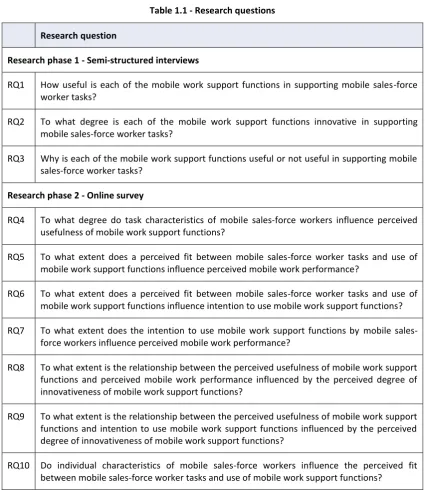
To achieve this objective, a two-stage research design is selected, and 10 research questions and 13 hypotheses are formulated.
Introduction
Table 1.1 - Research questions
Research question
Research phase 1 - Semi-structured interviews
RQ1 How useful is each of the mobile work support functions in supporting mobile sales-force worker tasks?
RQ2 To what degree is each of the mobile work support functions innovative in supporting mobile sales-force worker tasks?
RQ3 Why is each of the mobile work support functions useful or not useful in supporting mobile sales-force worker tasks?
Research phase 2 - Online survey
RQ4 To what degree do task characteristics of mobile sales-force workers influence perceived usefulness of mobile work support functions?
RQ5 To what extent does a perceived fit between mobile sales-force worker tasks and use of mobile work support functions influence perceived mobile work performance?
RQ6 To what extent does a perceived fit between mobile sales-force worker tasks and use of mobile work support functions influence intention to use mobile work support functions?
RQ7 To what extent does the intention to use mobile work support functions by mobile sales-force workers influence perceived mobile work performance?
RQ8 To what extent is the relationship between the perceived usefulness of mobile work support functions and perceived mobile work performance influenced by the perceived degree of innovativeness of mobile work support functions?
RQ9 To what extent is the relationship between the perceived usefulness of mobile work support functions and intention to use mobile work support functions influenced by the perceived degree of innovativeness of mobile work support functions?
RQ10 Do individual characteristics of mobile sales-force workers influence the perceived fit between mobile sales-force worker tasks and use of mobile work support functions?
Source: Developed for this research
1.3
Justification for this research
Introduction
Furthermore, this study follows suggestions for future research in previous studies by:
examining the impact of individual characteristics on perceived usefulness of mobile applications (Yuan et al. 2010);
conducting a large-scale test of the TTF model for mobile technologies at the operational level (Gebauer et al. 2010);
adding contextual extensions to the TTF model (Ahearne et al. 2008); and
examining the link between sales technology and sales-force worker performance using TTF theory—a gap in current research (e.g., Ahearne et al. 2008; Ahearne & Schillewaert 2001; BenMoussa 2006; Koschembahr 2005; Scornavacca & Sutherland 2008).
Thereby, the constructs ‘individual characteristics’ and ‘perceived degree of innovativeness of mobile work support functions’ complement the original TTF model and provide new insights regarding the role and significance of these variables for ongoing TTF research. Individual characteristics (e.g., gender, length of tenure, job role, business units) of mobile sales-force workers are considered to significantly affect perceived usefulness of mobile work support functions. The ‘perceived degree of innovativeness' construct is integrated into this study's research model as the author assumes that this construct has a moderating effect on the relationship between perceived usefulness and intention to use; and the relationship between perceived usefulness and perceived impact on mobile work performance of mobile work support functions.
Last but not least, this research provides the opportunity to compare some of the findings of this study regarding the TTF model and mobile knowledge workers with previous recent empirical studies by Zheng (2007) and Yuan et al. (2010).
1.4
Methodology
Introduction
to determine how and why specific mobile work support functions are perceived to be useful in supporting pharmaceutical sales-force worker tasks. The first research phase informs the second research phase by providing support for the conceptual model proposed for this research and assists in the refinement of the online survey instrument in the context of the case study organisation by developing real-life usage scenarios for each of the mobile work support functions investigated. The second research phase collects quantitative data to validate and test the research’s conceptual model. Thereby, the second research phase determines to what extent there is a perceived fit between sales-force worker tasks and mobile work support functions and to what extent this fit and individual characteristics of sales-force workers influence sales-force worker performance and intention to use mobile work support functions.
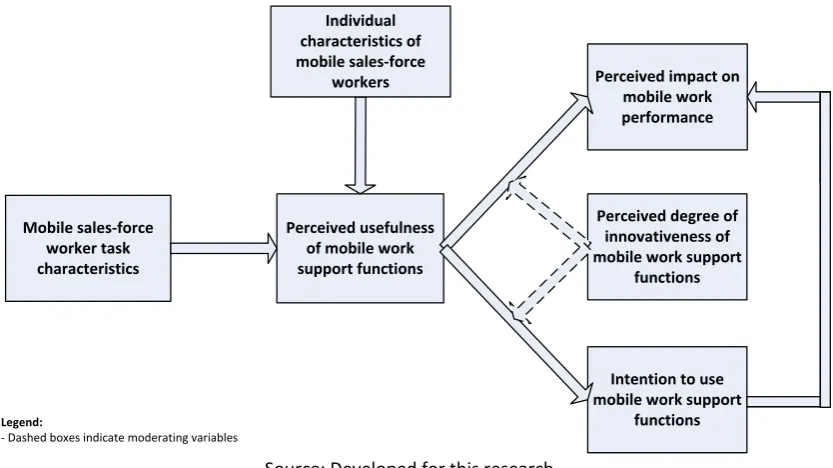
[image:32.595.114.531.457.691.2]To achieve the objectives of this study, the TTF model has been adapted and two new constructs, namely, perceived degree of innovativeness and individual characteristics, have been integrated. Figure 1.1 illustrates this adapted model on a high-level basis.
Figure 1.1 - High-level research framework
Perceived usefulness of mobile work support functions
Perceived impact on mobile work performance
Intention to use mobile work support
functions Perceived degree of
innovativeness of mobile work support
functions
Legend:
- Dashed boxes indicate moderating variables
Mobile sales-force worker task characteristics
Individual characteristics of mobile sales-force
workers
Source: Developed for this research
Introduction
1.5
Definition of terms
As the definitions adopted by researchers are often not uniform (Perry 2002, p. 18), the purpose of this subsection is to define and contrast the following key terms that are used within this dissertation:
Mobile work is defined as the work that is done outside the regular office,
initially by management and staff who travel extensively (McLennan 2007, p.
7). Mobile workers are working away from their office desk for more than
20% of their working day (Gartner 2002).
Sales-force workers are the specific group of employees involved in a
company’s selling process and thereby an organisation’s personal link to its customers (Encyclopaedia Britannica 2011; Kotler 2003). Sales-force workers are considered to be mobile workers.
Mobile tasks are all work-relevant mobile workers’ tasks that need to be
accomplished in the mobile work setting.
In the home office: all those work-relevant tasks conducted when a sales-force worker returns home from the daily sales trip. Sales-sales-force workers in the case organisation are expected to work from home to accomplish their non-mobile tasks (e.g., email inquiries from colleagues and customers, CRM data upload, preparation for the next working day, weekly expenses reports, time management reports).
This research considers dead times as those waiting times when a mobile worker is ’trapped‘ in the work process and has to wait for the next step in the work process (e.g., having to wait for the next sales call).
Mobile computing systems are defined as ‘computing systems that may be
easily moved physically and whose computing capabilities may be used while they are being moved. Examples are laptops, personal digital assistants (PDAs), and mobile phones’ (B'Far 2005).
1.6
Delimitations of scope and key assumptions
Introduction
mobile sales-force workers tasks on perceived impact on mobile work performance and intention to use mobile work support functions is conducted in a single-case organisation. Second, the investigation concentrates on pharmaceutical sales-force work in Germany. Third, as the researcher has been employed at the case organisation at the time of the research, he might be biased in several ways. These biases might be limited by acknowledging this tendency, by having a clear focus on the research problem, by conducting a comprehensive literature review, by using multiple sources of evidence (interviewing different persons; a combined research approach consisting of a case study research design that is validated by a survey), by having a clear definition of the unit of analysis (sales-force workers in the German pharmaceutical industry) and by working closely with the academic supervisor.
The first key assumption of this research is that mobile work support functions enabled by MCT have the potential to add value to pharmaceutical sales-force work. Thereby, this research aims to identify those specific areas where mobile work support functions can add value to pharmaceutical sales-force work and aims to measure the impact on sales-force workers’ performance and intention to use mobile work support functions. Aspects such as mobile solutions promoted by pharmaceutical sales-force workers that support the physician-patient relationship or mobile applications offered by pharmaceutical companies that directly target patients (e.g., an iPhone application that support asthma patients) are outside the scope of this dissertation. This research acknowledges the existence of other relevant stakeholders (key opinion leaders, healthcare organisations, payers, government customer networks, etc.) in pharmaceutical companies in Germany who might be visited by sales-force workers, but these are outside the scope of this research. In addition, this research focuses on the work of pharmaceutical business units.
Introduction
and therefore a better service to the customer through the use of mobile computing.
1.7
Outline of the dissertation
The chapter structure of this dissertation is outlined in the following paragraphs.
Chapter 2 - ‘Literature review’ provides a systematic review of the relevant
literature upon which this research’s theoretical and conceptual framework is built. Thereby, an in-depth discussion on mobile computing, mobile work and pharmaceutical sales-force work is conducted. As this research’s theoretical framework is based on the TTF model, a separate section introduces foundations of the TTF framework and proposes an adapted framework to solve the research problem and questions. This chapter concludes with the development of the proposed research model from the relevant literature for this study and a set of research questions and testable hypotheses for the study’s research phases 1 and 2.
Chapter 3 - ‘Research methodology' explains and justifies this study's overall
research paradigm and methodology. This chapter also describes and justifies the research designs of both research phases of this study (i.e., data collection procedures and data analysis techniques) in detail. Furthermore, ethical considerations are acknowledged and discussed.
Chapter 4 - ‘Data analysis - Research phase 1’ presents and discusses the results of
data analyses for the first research phase of data collection. Appropriate qualitative analysis techniques are used to analyse the data collected in the semi-structured interview process.
Chapter 5 - ‘Data analysis - Research phase 2’ presents and discusses the results of
Introduction
Chapter 6 - ‘Discussions of data analysis and findings’ presents and discusses the
main findings of this study from the integration of the results from both data analysis phases, and relates the main findings to the context of the relevant literature for this study.
Chapter 7 - ‘Conclusions and implications’ provides a high-level summary of this
research in terms of the research questions and hypotheses investigated and tested in this research, the methodological approach used in this study, and the key findings. Most importantly, this chapter discusses the key contributions that this study makes for theory and practice and the implications of this research for current and future research and practice. Lastly, suggestions for future research are provided.
1.8
Chapter summary
The purpose of this introductory chapter is to provide an overview of this study. The research problem and general research questions have been defined and determined as being worthy of research, the research methodology has been outlined, and relevant key terms have been defined.
In this study, the impact of the perceived fit of mobile work support functions enabled by MCT and mobile sales-force workers tasks on perceived impact on mobile work performance and intention to use mobile work support functions is examined. Drawing on TTF and technology acceptance model (TAM) theories, this study uses two research phases and a mixed methodological approach to conduct an in-depth case study of the German division of a large pharmaceutical company.
Literature review
2
Literature review
‘Technology is our friend when it is inconspicuous, working smoothly and invisibly in
the background...to provide comfort and benefit’.
Donald A. Norman, former vice president of Apple’s advanced technology group (1999, p. 115).
2.1
Introduction
Literature review
Figure 2.1 - Structure of literature review chapter
2.1. Introduction
2.2 Sales-force work and technology support
2.3 Mobile computing technologies (MCT)
2.4 Research-relevant models and theories
2.5 Theoretical framework, research issues and questions
2.6 Chapter summary
Source: Developed for this research
2.2
Sales-force work and technology support
The purpose of this section is to examine the existing literature on sales-force work, sales technology and the potential impact of sales technology on sales-force worker performance.
2.2.1 Sales-force work: definition and overview
Sales force and sales-force work
Literature review
Activities of pharmaceutical sales-force workers
Table 2.1 summarises sales activities that have been identified to be specific for pharmaceutical sales-force workers (Engle & Barnes 2000).
Table 2.1 - Key sales activities of pharmaceutical sales-force workers
Activity
Pre-sales activity
Within -sales activity
Post-sales activity
Education -related activity
Other activity
Is relevant for the sales-force group investigated?
Plan selling activities X X
Search out leads X X
Identify decision makers X X
Prepare sales
presentation X X
Overcome objections X X X X
Introduce new products X X
Call on new products X X
Write up orders X X
Handle shipping
problems X
Interface with
marketing department X X X
Learn about products X X
Train/Educate
customers X X X
Provide technical
information X X
Receive
information/feedback X X
Check with superiors X X
Share information with
colleagues X X
Learn about competitive
information X X
Literature review Activity Pre-sales activity Within -sales activity Post-sales activity Education -related activity Other activity Is relevant for the sales-force group investigated?
Take inventory for
customer X
Encourage local
advertising X
Attend sales
conferences X X
Attend regional sales
meetings X X
Work at client
conferences X X
Set up product
exhibitions X
Attend periodic training
sessions X X
Recruit new sales
representatives X
Train new sales
representatives X X
Travel with trainees X X
Entertain customers X X
Take clients to dinner X X
Assist in providing educational opportunities
X X
Establish good relations
with distributors X
Sell to distributors X
Handle product-related
problems X X
Adapted from Engle & Barnes (2000)
Literature review
investigated?' indicates which activities are relevant for this study), table 2.1 provides a general overview of the key activities of pharmaceutical sales-force workers.
Sales-force work and mobile work
In this research, pharmaceutical sales-force work is considered to be a specific form of mobile work, as pharmaceutical sales-force workers are ‘working away from their desk for at least 20% of their time’ (Gartner 2002). Based on a mobile worker’s location and his/her frequency of changing locations, figure 2.2 differentiates among five categories of mobile workers.
Figure 2.2 - Categorisation of mobile workers based on location and the frequency of changing
locations
Yo-Yos
On-site movers
Low High Continous
On the move
One site office
Frequency of changing location Location
Pendulums
Micromobility Total mobility
Multimobility
Carriers Nomads
Adapted from Lilischkis (2003)
Literature review
‘On-site movers’
o During work, on-site movers move continuously within a geographically limited working area, e.g., a plant area or office premises. Examples of on-site workers are security and maintenance personnel. The frequency of location changes for on-site-movers varies from low to continuous.
‘Pendulums’
o Pendulum workers have few possible working places and change their location quite often. An example might be a person doing remote work with two or more regular working places (e.g., office and home office).
‘Yo-Yos’
o Yo-Yos are mobile workers who have many working locations within a geographically limited area. A sales-force worker responsible for a specific district is an example of this kind of worker.
‘Nomads’
o Nomads are highly mobile and their area of mobility is not limited to a certain geographical area. An example of a nomad is a manager of a global organisation travelling between office sites. Nomads are those persons who work continuously wherever they are.
‘Carriers’
o A mobile worker who is on the move all the time is a carrier (e.g., lorry drivers). Carriers are even more mobile than nomads.
Literature review
knowledge workers is in line with the task characteristics of pharmaceutical force workers. The discussion above should help in classifying pharmaceutical sales-force work within the context of mobile work. As this research assumes that different types of mobile workers have different needs for mobile work support, technology support must adapt accordingly to fit with the tasks of the respective type of mobile worker.
2.2.2 Sales technology and sales-force work
Customer relationship management
‘One face to the customer’ is the key metaphor behind customer relationship management (CRM)—a concept adopted by many sales-force driven organisations that aims ‘to create relationships with customers on an individual basis in order to transform the information collected into a useful tool to treat each customer differently’ (Lubbe & Van Heerden 2003, p. 99). CRM has its roots in customer-oriented selling, which was introduced by Saxe and Weitz in 1982 who defined it as ‘the degree to which salespeople practice the marketing concept by trying to help their customer make purchase decisions that will satisfy customers' needs’ (Saxe & Weitz 1982). Thereby, customer-oriented sales-force workers avoid behaviours that may lead to customer dissatisfaction and take actions to increase long-term customer satisfaction. Keillor et al. (1999) state that customer orientation is an important characteristic of a high-performing sales-force worker. Boles et al.(2001) found that regular contact with customers is associated with increased sales and that disclosure of (personal) information by a sales-force worker increases the relationship between customer and sales-force worker. This research considers CRM as an important concept that sales-force driven organisations need to address to stay competitive. A technology (e.g., MCT) supporting sales-force work should therefore be in line with an organisation’s CRM strategy.
Sales-force automation
sales-Literature review
force workers in their daily business (Larpsiri & Speece 2004, p. 392). An effective CRM initiative that is supported by the appropriate SFA applications is expected to positively affect an organisation’s sales-force effectiveness (Larpsiri & Speece 2004, p. 392). Often referred to as mobile SFA or ‘mSFA’ (Scornavacca & Sutherland 2008), MCT can provide the technological foundation for certain SFA applications and thereby has the potential to positively affect sales-force worker performance. In this research, sales technology is considered an umbrella term for technology that has the potential to support sales-force workers. Siebel System (subsidiary of Oracle) is a popular example of a CRM/SFA software vendor that also offers a specific module (i.e., ‘Siebel ePharma’) to effectively support pharmaceutical sales-forces with CRM/SFA software.
Issues with CRM and sales technology
Current issues with CRM include the costs associated with a customer-oriented approach. Buehrer et al. (2005) conducted long-term research on SFA adoption and identified a lack of organisational support and lack of adequate training as main barriers that negatively affect the adoption of SFA systems. Erffmeyer and Johnson (2001) revealed that most of the SFA initiates are triggered by management with improved efficiency as the main target. Their study reveals that SFA planning was made with ‘little or no input from representatives of the sales force’ (Erffmeyer & Johnson 2001). This research assumes that a successful introduction of a CRM/mSFA platform needs to address these issues to leverage tangible benefits for organisations.
2.2.3 Impact of sales technology on sales-force worker performance
Literature review
researched the following attributes and indicators of sales-force worker performance when using mSFA tools. Table 2.2 summarises these attributes and indicators of sales-force worker performance.
Table 2.2 - Attributes and indicators of sales-force worker performance
Dimension Attribute Indicator
Overall sales
Selling process
Sales volume
Sales objectives
Sales presentations
Customer relations
Customer relations
Providing information
Market
Market knowledge
Sales person
Turnover intentions
Time management
Efficiency
Interdependence
Communication
Collaboration
Coordination
Data management
Order
Ordering time
Order accuracy
Literature review
Despite high investments in sales technology and a considerable amount of research investigating the link between sales technology and work performance (e.g., Ahearne et al. 2008; Ahearne & Schillewaert 2001; BenMoussa 2006; Koschembahr 2005; Scornavacca & Sutherland 2008), the ‘relationship between sales technology and sales-force worker performance remains primarily unsubstantiated’ (Ahearne et al. 2008).
Furthermore, research by Avlonitis and Panagopoulous (2005) did not find a link between sales-force worker performance and CRM adoption. Thereby, this study assumes that there are gaps in the current literature regarding the impact of sales technology on sales-force worker performance. This study aims to contribute to the existing body of knowledge in this domain by investigating the impact of a specific technology on work performance in a specific industry setting. A discussion on the measurement of the impact of technology on work performance is continued in section 2.4.
Literature review
Table 2.3 - Summary of research on technology support for sales-force work
Author(s) &
Date Focus of the study Study results/ Contribution
(Ahearne & Schillewaert 2001)
Based on a qualitative research methodology, a theory on how information technology usage can affect sales-force worker performance was established. The research setting is the pharmaceutical industry.
This study makes some empirical contributions regarding the influencing factors of sales-force worker performance. Call productivity, sales skills and smart selling behaviour are considered to positively affect sales performance. These constructs can be supported with IT.
(Ahearne et al. 2008)
Extension of TTF theory by examining the mechanisms through which the use of IT by the sales force influences sales-force worker performance. The research model incorporates key marketing constructs (sales-force workers’ customer service, attention to personal details, adaptability, knowledge) that could mediate IT’s impact on sales-force workers performance.
Results in a pharmaceutical sales setting show that IT usage can improve customer service and sales-force workers’ adaptability, thereby leading to improved sales performance. The researchers suggest the creation of contextual extensions of TTF theory to determine how the use of IT by individuals could lead to benefits.
(Avlonitis & Panagopoul ous 2005)
Based on the TAM and IS success models, the authors provide a conceptual model to explain CRM acceptance antecedents and consequences in a pharmaceutical sales-force setting.
The researchers found evidence that sales-force workers are more likely not to adopt and use implemented information systems in day-to-day activities if they feel that such systems are not useful and/or are difficult to use. Contrary to other research in this area (i.e., Igbaria & Tan 1997), the authors neither found a linkage between CRM acceptance and sales-force worker performance nor between CRM user satisfaction and sales-force worker performance.
(BenMoussa 2009)
BenMoussa proposes a value-based approach for the introduction of mobile applications to support sales-force workers. This approach provides guidelines on how to determine whether or not mobile technologies would add value to sales-force work before those technologies actually get selected and implemented. Good planning of SFA investment would help firms avoid resistance of the sales force towards the implemented systems, rather than having to treat it at the post-implementation stage.
Literature review
Author(s) &
Date Focus of the study Study results/ Contribution
(BenMoussa 2010)
Organisational enablers that facilitate a successful adoption of SFA systems and how the adoption of sales technology happens were investigated. The study investigates the impact of MCT on sales-force workers’ barriers to performance that they face when operating within a mobile work setting.
BenMoussa found evidence that sales-force workers will only choose to adopt SFA if they believe that it is useful in helping them to deal with the barriers to performance they face and thereby would have an impact on their job performance. Adoption can be increased with training that goes beyond technical issues (i.e., a work system perspective).
(Boujena et al. 2009)
Boujena et al.’s qualitative research investigates the benefits of SFA from the customer's perspective within a framework based on theories from the sales and information systems literature relating to the benefits of the implementation of information technology.
The research indicates that customers perceive benefits on four main dimensions of their interaction with salespersons, namely salesperson's professionalism, customer interaction frequency, salesperson responsiveness and salesperson-customer relationship quality. The research is unique because it is the first to examine aspects of SFA from the customer perspective.
(Henri & Aurelie 2006)
Henri and Aurelie’s exploratory empirical study investigates ‘the real advantages and opportunities’ of MCT for organisations.
Organisational and individual benefits are tightly intertwined, and each kind of benefit largely relies on the existence of the others. Benefits brought by mobile tools in organisational contexts are linked to a ‘gift-counter-gift’ logic, i.e., individuals seem to be compelled to be available and reachable (the counter-gift) because their firm equipped them with mobile tools.
(Honeycutt et al. 2005)
This research examines and explains impediments that exist in three SFA areas: planning, communication and evaluation.
The research identified significant gaps between organisational and sales-force worker perception with regard to SFA. While sales-force workers might consider it as a significant drawback, management may consider sales technology to be a benefit. Sales managers must consider these viewpoints when contemplating SFA adoption to plan, clearly communicate, and evaluate the benefits to the sales force.
(Koschemba hr 2005)
The article discusses the potential of a mobile learning solution and its impact on sales-force worker performance. The setting is the pharmaceutical industry.
Literature review
Author(s) &
Date Focus of the study Study results/ Contribution
(Schillewaert et al. 2005)
Based on TAM, Schillewaert et al. study 229 salespeople from different industries to explain why sales-force workers adopt sales technology.
Personal innovativeness, organisation facilitators (e.g., user training, support) and social influences (e.g., peer usage, supervisor influence, competitor utilisation) can positively or negatively affect the adoption of sales technology within enterprises.
(Scornavacc a & Sutherland 2008)
By using an exploratory single case study approach, the authors investigate the perceived impact of mSFA on sales-force worker performance. According to the authors, overall sales and sales efficiency are the two most significant dimensions to evaluate a sales-force worker’s performance.
The findings indicate that sales-force workers and management share different perceptions regarding the extent to which mSFA could improve individual performance. Their overall opinion on the impact of mSFA on sales-force worker performance is positive.
(Speier & Venkatesh 2002)
Speier and Venkatesh use identity theory as a lens to better understand a sales-force worker’s perceptions associated with technology.
The authors found evidence that sales technology implementation may actually hinder a sales force, resulting in significant increases in staff turnover and decreases in perceptions of organisational commitment and job satisfaction of sales-force workers.
Literature review
2.3
Mobile computing technologies (MCT)
According to industry experts, mobile computing has been the defining information technology trend of the first decade of this millennium (Helal 1999; Lilischkis 2003; Urbaczewski et al. 2003; Xianpei et al. 2008). In 94 countries worldwide, mobile phones surpassed fixed phones in the year 2000 and reached 100% penetration by 2004 (Lee & Lee 2009). Indeed, there has been a steady increase of research articles in the domain of mobile computing within the last decade (Ladd 2010; Scornavacca & Sutherland 2008). In addition, capabilities and functionalities of mobile devices, mobile applications, and mobile networks have grown exponentially in recent years (Computerwoche 2008; Ladd 2010; Lee & Lee 2009). To provide an up-to-date overview of this topic, this subsection discusses and contrasts definitions of mobile computing and related terms. Then, three technologies enabling wireless broadband access for MCT are examined. Last but not least, characteristics, benefits and limitations of mobile computing are summarised and synthesised.
2.3.1 Definitions of key terms
Li