1
Post-19 Education Provision for Young People
with Complex Learning Difficulties Living in
Wales: levels of need and current provision
Ymchwil gymdeithasol Social research
Post-19 Education Provision for Young People with
Complex Learning Difficulties Living in Wales: levels of
need and current provision
Ruth Townsley
(Ruth Townsley Research)
Stephen Beyer
(Welsh Centre for Learning Disabilities,
Cardiff University)
Carol Robinson
(Carol Robinson Consulting)
Val Williams
(Norah Fry Research Centre,
University of Bristol)
Views expressed in this report are those of the researchers and not necessarily those of the Welsh Government
For further information please contact: Name: Dr Karen Bathgate
Department: Knowledge and Analytical Services Welsh Government
Cathays Park Cardiff
CF10 3NQ
Tel: 02920 821628
Email: [email protected]
Welsh Government Social Research, 2013 ISBN 978 0 7504 7892 2
1
Table of contents
Acknowledgements ... 4
Glossary of acronyms ... 5
1 Introduction to the research ... 8
2 Policy, practice and funding context ... 16
3 Existing provision of post-19 education for young people with complex learning difficulties living in Wales... 47
4 Demand for post-19 education by young people with complex learning difficulties living in Wales ... 91
5 Cost of providing post-19 education to young people with complex learning difficulties in Wales ... 114
6 Developing post-19 education provision in Wales for young people with complex learning difficulties ... 130
7 Conclusions: responses to the research questions ... 148
8 Recommendations ... 164
Bibliography ... 177
Appendix A Research design and methodology ... 182
Appendix B Findings from interviews with young people ... 200
2
Figures and tables
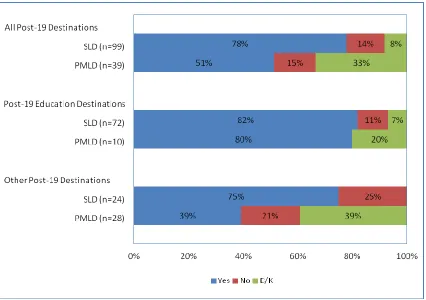
Figure 1: Was the post-19 destination the young person’s first choice of provision? ... 99 Figure 2: Total number of Year 7 to 14 pupils with SLD and PMLD in
maintained and non-maintained schools in Wales with estimates of
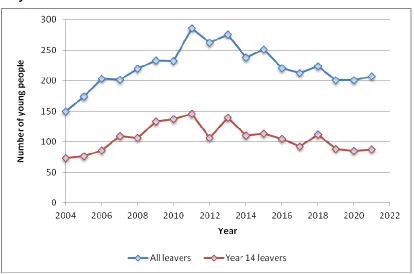
future numbers ... 110 Figure 3: Estimates of all school leavers (Year 11 to 14) and Year 14
only leavers with SLD and PMLD ... 110 Figure 4: Percentage of young people with complex learning difficulties receiving specialist funding for ISC placements by band rate for the
academic year 2011/12 ... 124
Table 1: Reasons given by ISCs for not accepting or progressing certain applications from young people with complex learning difficulties ... 49 Table 2: Arrangements for providing and funding transport to and from
FE colleges for students aged 19+, by college and area of Wales for
year 2011/12 ... 71 Table 3: Number of Year 14 school leavers with SLD or PMLD for the
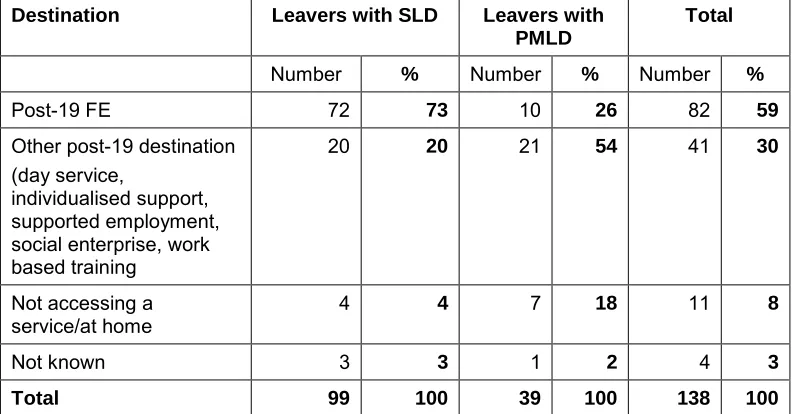
academic year 2010/11, by area of Wales ... 94 Table 4: All post-19 destinations of Year 14 pupils with SLD or PMLD
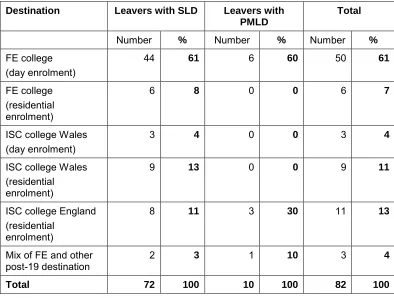
who left school in July 2011 ... 95 Table 5: Post-19 education destinations of Year 14 pupils with SLD or
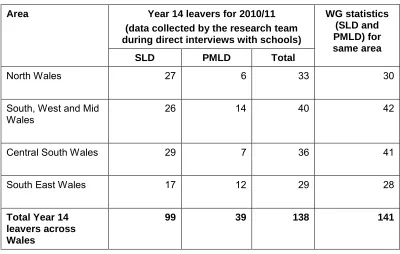
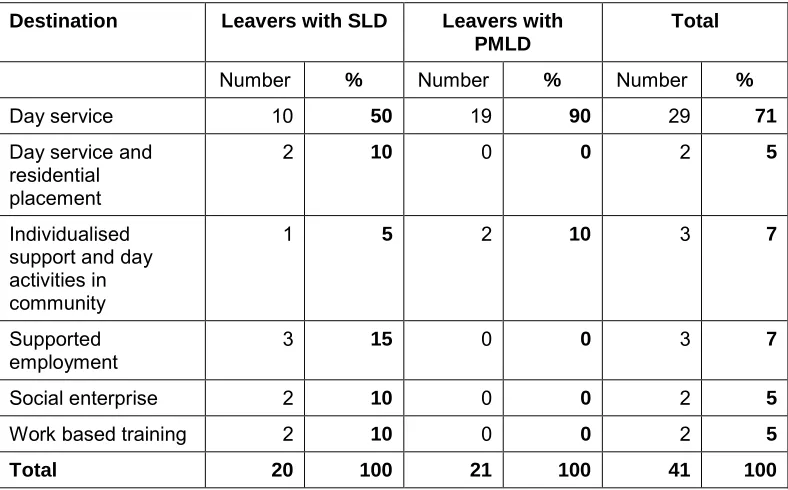
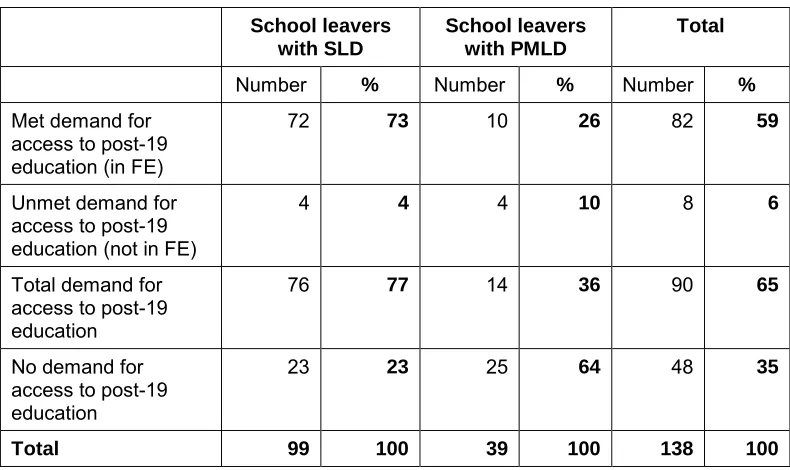
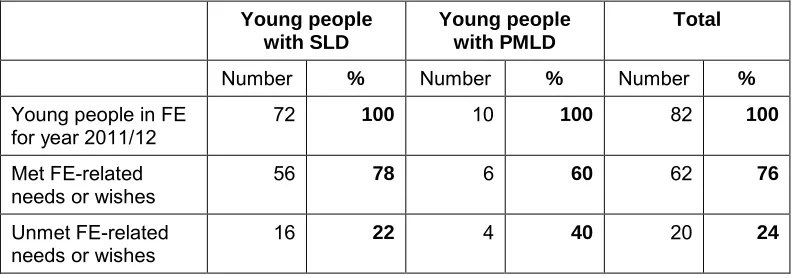
PMLD who left school in July 2011 ... 96 Table 6: Other post-19 destinations of Year 14 pupils with SLD or PMLD who left school in July 2011 ... 98 Table 7: Demand for access to post-19 education for the academic year 2011/12 ... 107 Table 8: The extent of met and unmet FE-related needs or wishes for
the academic year 2011/12 ... 108 Table 9: Estimated future demand for post-19 education by young
people with SLD or PMLD leaving secondary education in Wales
2012-2021 ... 112 Table 10: Estimated future costs of post-19 education by young people
with SLD or PMLD leaving secondary education in Wales 2012-2021 ... 128 Table 11: Overview of approximate costs for the practice examples
described in chapter six ... 163 Table 12: Overview of interviews conducted with schools, colleges and
3
Table 14: Geographical location of families interviewed and number of
schools represented ... 191 Table 15: Post-19 destinations secured by young people in families
interviewed ... 191 Table 16: Geographical region of eight young people included in the
research and number of schools represented ... 195 Table 17: Activities undertaken by young people with support from their transition key workers ... 203 Table 18: Discussion topics that young people would have liked to cover with their transition key worker ... 204 Table 19: Overview of FE college provision potentially available to target group for 2011/12 at colleges interviewed ... 207 Table 20: Overview of ISC provision for 2011/12 at colleges interviewed ... 209 Table 21: Overview of types of support available for 2011/12 at FE
colleges interviewed ... 210 Table 22: Overview of types of support available for 2011/12 at ISCs
4
Acknowledgements
We would like to express our gratitude to all the families, young people and professionals who contributed to this research by taking part in an interview or a focus group. We are very grateful for the positive
response we received from stakeholders across Wales to our requests for information and for their willingness to participate.
We were fortunate to be supported by a skilled fieldwork team, who between them were able to deliver the interviews in Welsh and English. Our thanks for their hard work and commitment go to: Ceri Christian-Jones, Rosemary Counsell, Mary Dykes, Sue McGuire, Kathryn Sharp and Margiad Elen Williams. Thanks must also go to Claire Pimm and Andrea Meek at the Welsh Centre for Learning Disabilities (Cardiff University), Susie Nash at the University of Bangor, Linda Davies at the University of Manchester and Eric Emerson at the University of
Lancaster for advice and input at specific stages of the work.
The research project benefited hugely from the input of others involved in the research, policy, management or delivery of post-19 education for young people with complex learning difficulties who provided advice, answered queries and offered practical assistance as the work
developed. In particular, we are very grateful to Matthew O’Grady from Scope Cymru, Sally Elliott and Katy Burns from Colegau Cymru, Alison Boulton from Natspec, Jill Hale from Scotland’s Colleges, Denise Inger from SNAP Cymru, Sally Rees from Care Co-ordination Network Cymru, Jassa Scott from Estyn, Andrew Kirby from Careers Wales, and
Stephen Hughes, Christine Roberts, Gareth Hopkins, Michelle Evans, Sian Evans, Bethan Webb, Liz Rees, Heather Payne and Deborah Campbell at the Welsh Government.
5
Glossary of acronyms
ALN Additional learning needs
AN Additional needs
ADEW Association of Directors of Education in Wales
ADSS Association of Directors for Social Services
AQA Assessment and Qualifications Alliance
ASDAN Award Scheme Development and Accreditation Network
CQFW Credit and Qualifications Framework for Wales
DAQW Database of Approved Qualifications in Wales
DfES Department for Education and Skills
FE Further education
FEI Further education institution
GCH Guided contact hours
IDP Individual Development Plan
IEP Individual Education Plan
ILP Individual Learning Plan
ILS Independent living skills
ISC Independent specialist college
LA Local authority
LAP Learning Area Programme
6
LHB Local health board
LLDD Learners with learning difficulties and/or disabilities
LLWR Lifelong Learning Wales Record
LSO Learning and Skills Observatory
MCA Mental Capacity Act
MLD Moderate learning difficulties
Natspec The Association of National Specialist Colleges
NPFS National Planning and Funding System
NPTC National Proficiency Tests Council
OCN Open College Network
OCR Oxford Cambridge and RSA Examinations
PA Personal assistant
PECS Picture exchange communication system
PEG Percutaneous endoscopic gastrostomy
PLASC Pupil Level Annual School Census
PMLD Profound and multiple learning difficulties
SAW Subject area weighting
SEN Special educational needs
SLD Severe learning difficulties
UPOSS Unlocking the Potential of Special Schools
7
WCLD Welsh Centre for Learning Disabilities
WG Welsh Government
WJEC Welsh Joint Education Committee
8
1
Introduction to the research
1.1 Young people with severe learning difficulties (SLD) and young people with profound and multiple learning difficulties (PMLD) form the core of those described by the Welsh Government as having ‘complex learning difficulties’ (Welsh Government, 2012a). Typically, in Wales, most young people with complex learning difficulties receive secondary education in special schools until the age of 19 (Year 14). Although relatively small, this group of young people has become the focus of concern for policy makers, practitioners, family members and voluntary sector groups
because their post-school choices are significantly limited compared to other young people with additional learning needs (National Assembly for Wales, 2009).
1.2 In 2009, the Welsh Government received several petitions calling for action to address issues relating to post-19 education for students with additional learning needs. Two petitions highlighted a lack of appropriate, accessible, further education (FE)
programmes at mainstream FE colleges and further education institutions (summarised in National Assembly for Wales, 2009). Specifically, a petition from Scope Cymru highlighted the very significant difficulties experienced by young people with PMLD and their families in accessing appropriate local FE provision. A third petition raised the issue of inconsistent access to funding for travel to and from further education settings (summarised in Thornthwaite, 2011).
9
representatives from the statutory and voluntary sectors, as well as learners and family members (Welsh Assembly Government, 2010). The Task and Finish group concluded that improved planning is essential to ensure more local choices for young people whose post-school options may currently be very limited. The group made 15 recommendations which focus on greater consistency in approach across Wales, regional collaboration and attention to value for money when commissioning further
education provision for young people with additional learning needs.
1.4 In March 2010, Leighton Andrews, Minister for Education and Skills, agreed all of the recommendations made by the Task and Finish Group (Andrews, 2010). The Welsh Government is
currently working with stakeholders to take forward these
recommendations and, as part of this process, commissioned the research, reported here, to inform the development of policy.
Aim and research questions
1.5 The research aimed to identify levels of need and current provision of post-19 education for young people with complex learning difficulties living in Wales and to assess how unmet need can be provided for. The research questions which we were tasked to consider were:
Existing provision of post-19 education
What post-19 education provision is currently available for young people with complex learning difficulties living in Wales?
What barriers do young people with complex learning difficulties experience in accessing post-19 education provision which meets their needs?
10 Demand for post-19 education
What is current demand (met and unmet) for post-19 education for young people with complex learning difficulties living within Wales?
To what extent does current provision meet the needs and
wishes of young people with complex learning difficulties living in Wales?
What proportion of demand is currently met outside of Wales?
What is the future estimated demand?
What do young people want from post-19 education and how would they like that education delivered?
Cost effectiveness
What is the existing cost of providing post-19 education for young people with complex learning difficulties?
How can value for money be achieved in the provision of post-19 education which meets the needs of young people with complex learning difficulties?
Developing post-19 education provision in Wales for young people with complex learning difficulties
How can access to post-19 provision for young people with complex learning difficulties be increased?
What other options/models exist for delivering post-19 education to young people with complex learning difficulties?
How might these alternative options/models (a) meet
demand/needs of young people and families; and (b) deliver positive outcomes for young people?
What are the cost implications and feasibility of adopting approaches identified as effective?
Overview of research approach and methodology
1.6 The research was conducted between March and September 2012 and involved the following phases:
11
Interviews with head teachers (or other lead professionals) in state-maintained schools providing Year 14 education to young people with SLD or PMLD.
Interviews with professionals at FE colleges, ISCs and local authorities.
Interviews with families and young people with complex learning difficulties.
Review of other models of FE provision outside of Wales.
Collection and analysis of costs data from colleges, local authorities and the Welsh Government.
Focus groups with stakeholders from across the FE sector, to feed back initial findings and to discuss potential
recommendations in response to the research.
1.7 In order to quantify the extent of met and unmet demand for post-19 education, it was necessary (a) to focus on a clearly defined cohort of young people with complex learning difficulties in order to collect meaningful statistical data; and (b) to collect data about all post-school destinations of this cohort, and the extent to which these destinations were young people’s first choice.
1.8 The focus of the interviews with professionals was young people, with SLD or PMLD, aged 19 to 20, who had reached the end of Year 14 of state-maintained secondary education in Wales in July 2011. The rationale for selecting this specific cohort was as
follows:
The focus of the research was post-19 education; hence a need to pinpoint young people aged 19+.
The main entry point to FE for young people aged 19+ is most likely to be when they leave school at the end of Year 14.
12
1.9 Anonymised data was collected, in the form of a ‘young person record’, to ascertain the young person’s initials, gender, date of birth, home local authority and post-19 destination. For those young people whose destination was recorded as post-19 FE, more specific details about the costs and funding of their
placement was collected where possible. More than 300 young person records were collected from respondents, but once the project cohort inclusion criteria were applied1 this number
reduced to a dataset of 138 records. In addition, interviews with professionals asked more broadly about their experience of supporting young people with SLD or PMLD to access post-19 education and the nature of the provision that was currently available.
1.10 The focus of the interviews with families was their son or
daughter’s current post-school destination and whether this was their first choice, or not. For families with a young person in post-19 education, more information was sought about the experience of accessing and participating in further education and any on-going barriers or issues. Interviews with young people focused on what they wanted from post-19 education and their hopes for the future.
1.11 A total of 67 separate interviews were conducted with 75 individual professionals. This included representatives from 26 schools (out of a possible 28 providing Year 14 education to the target group of young people), from 14 FE colleges (out of a total of 20 in Wales at that time2), from three ISCs in Wales (out of a
total of five in Wales at that time), from four ISCs in England (out of a sample of six) and from 15 Welsh local authorities (out of a
1 The cohort only included young people with SLD or PMLD, with a date of birth
between and including 1st September 1991 to 31st August 1992, who left Year 14 of
state maintained education in July 2011.
2 Two colleges interviewed have since merged into one FEI, however at the time of the
13
total of 22). We also interviewed a sample of 21 family members (out of a total of 27 who responded to a letter sent, via schools, to 111 families). In addition, we interviewed eight individual young people with SLD or PMLD, identified by transition key workers involved in a Cardiff University evaluation of the European Union funded, SEN Regional Transition to Employment (Real
Opportunities) Project.
1.12 Each interview was given an anonymous, unique code number. This ensured that interview data could be discussed by the research team and presented in the report whilst maintaining the anonymity of the institution or respondent. In this report, data from interviews is attributed to these linked codes to help the reader understand the provenance of the material. The codes used are listed below. Please note that numbering is not necessarily consecutive:
SCH 001 to SCH 03 interviews with special school staff.
FE 033 to FE 049 interviews with FE college staff.
ISC 073 to ISC 130 interviews with ISC staff.
LA 050 to LA 069 interviews with local authority staff.
FAM 082 to FAM 104 families interviewed.
YP 106 to YP 115 young people interviewed.
14
1.14 At the end of the fieldwork phase, focus groups with 21
stakeholders were conducted in three areas of Wales: north/mid Wales, south east Wales and south west Wales. The purpose of the focus groups was to provide feedback to stakeholders on the summary findings; to present and discuss case studies of other models adopted outside of Wales for delivering post-19 education to young people with SLD and PMLD; and to contribute to the development of recommendations in response to the research findings.
1.15 A full description of the methodology is given in Appendix A and the results of the interviews with young people are outlined in Appendix B.
Summary of chapter one: introduction to the research
1.16 Young people with severe learning difficulties (SLD) and with profound and multiple learning difficulties (PMLD) form the core of those described by the Welsh Government as having ‘complex learning difficulties’. Several recent petitions to the Welsh Government have highlighted that this group of young people may experience significant difficulties in accessing appropriate, local, post-19 education opportunities and that local provision may vary from one local authority area to another.
1.17 In response to these petitions, and as part of a wider remit to inform the development of policy relating to further education (FE) provision for young people with additional learning needs, the Welsh Government commissioned the research, reported here. The aim of the research was to identify levels of need and current provision of post-19 education for young people with complex learning difficulties living in Wales and to assess how unmet need can be provided for.
15
Scoping work, including a policy and literature review, to map key issues and inform the development of the interview schedules.
Interviews with head teachers (or other lead professionals) in state-maintained schools providing Year 14 education to young people with SLD or PMLD.
Interviews with relevant professionals at FE colleges, ISCs and local authorities.
Interviews with families and young people with complex learning difficulties.
Review of other models of FE provision outside of Wales.
Collection and analysis of costs data from colleges, local authorities and the Welsh Government.
Focus groups with stakeholders from across the FE sector, to feed back initial findings and to discuss potential
16
2
Policy, practice and funding context
Young people with complex learning difficulties
2.1 In the context of this research, the term ‘young people with complex learning difficulties’ describes young people, aged 19 and over, with ‘severe learning difficulties’ (SLD) or ‘profound and multiple learning difficulties (PMLD)’(Welsh Government, 2012a).
2.2 The Welsh Government requires maintained schools to collect and submit data relating to numbers and ages of pupils with statements of Special Educational Need (SEN), or with School Action and School Action Plus status, as part of the Pupil Level Annual School Census (PLASC). Since 2008, this has included providing information on what schools assess to be the major educational need of each statemented pupil across 11 broad categories as follows:
Moderate learning difficulties.
Severe learning difficulties (SLD).
Profound and multiple learning difficulties (PMLD).
Specific learning difficulties.
Autistic Spectrum Disorders.
Physical and medical difficulties.
Hearing impairment.
Visual impairment.
Multi-sensory impairment.
Speech, language and communication difficulties.
Behavioural, emotional and social difficulties.
2.3 Guidance from the Welsh Government (Welsh Assembly
Government, 2007) defines young people with SLD as those who:
“... have significant intellectual or cognitive impairments. This has a major effect on their ability to participate in the school curriculum without support. They may also have associated difficulties in mobility and co-ordination, communication and perception and the acquisition of self-help skills. Pupils with SLD will need support in all areas of the curriculum. They are likely to require teaching of self-help,
17 National Curriculum for much of their school careers.” (Welsh
Assembly Government, 2007, pp7-8).
Young people with PMLD are described by Welsh Government (2007) as those who:
“…have a profound cognitive impairment/learning difficulty, leading to significant delay in reaching developmental milestones. In addition, they display one or more of the following: significant motor
impairments; significant sensory impairments; complex health care needs/dependence on technology. The inter-relationship of these disabilities increases the complexity of need, in turn affecting all areas of learning. Pupils with PMLD need a distinctive curriculum to help them to develop sensory, motor, social and communication skills all through their school careers, and into adult life. Some pupils communicate by gesture, eye pointing or symbols, others by very simple language. Pupils require a very high level of adult support, both for their own learning needs and also for personal care.” (Welsh Assembly Government, 2007, p8).
2.4 PLASC statistics for January 20113 show that the majority of
pupils aged 11 to 19 (Year 7 to 14), whose major special
educational need4 was defined as SLD or PMLD, were attending
a state-maintained special school. Typically, in Wales, most young people with complex learning difficulties receive secondary education at special schools until the age of 19 (Year 14).
Analysis of PLASC data indicates that half of pupils with SLD and three-quarters of pupils with PMLD continue their post-16
education in the school sector until the end of Year 14 (age 18 to 19).
2.5 Further analysis of PLASC records for the academic year 2010/11, indicates that for the 141 pupils with SLD and PMLD who stayed on at school until Year 14, the vast majority (139 out of 141) were enrolled within the special school sector. There may also have been a small number of young people with SLD and PMLD registered as Year 14 pupils at non-maintained,
independent, schools. Figures from the Independent Schools
3 PLASC data provided by the Welsh Government, June 2011.
4 This includes pupils with statements of SEN issued and maintained by a local
18
Census5 indicate a total of 12 statemented pupils with SLD and one statemented pupil with PMLD aged 16 and over were
attending non-maintained schools for the academic year 2010/11. Thus, according to Welsh Government PLASC statistics, for the academic year ending July 2011, there would have been at least 141 pupils with SLD or PMLD, aged 18 to 196, leaving Year 14 of
education in July 2011, 139 of whom were leaving the state-maintained special school sector. Since the focus of this research was post-19 education provision, it was this, small group of young people with SLD and PMLD, who left school in the year of their 19th birthday, who became the central focus for data collection
and analysis.
Post-school destinations of young people with complex learning difficulties
2.6 If most young people with SLD and PMLD stay on at school until Year 14, where do they go next? Currently, there are no publicly available data providing details of post-school destinations of Year 14 leavers with either SLD or PMLD in Wales. Careers Wales runs an annual survey of pupil destinations for Year 11, Year 12 and Year 13 school leavers7, but this does not extend to
pupils leaving Year 14, nor does it currently provide details of pupils’ major recorded special educational need8. The post-school destination categories under which data are currently collected by Careers Wales are as follows:
Continuing in full-time education.
Continuing in part-time education (less than 16 hours a week).
5 Independent Schools Census data provided by Welsh Government, November 2012.
Data are not collected, or broken down by year group and only include pupils with SLD or PMLD who have statements of SEN.
6 Date of birth range: 1st September 1991 to 31st August 1992. 7http://destinations.careerswales.com/index.html
8 We are aware that there is on-going work by Careers Wales to link their destination
19
Work-based training (non-employed status).
Work-based training (employed status).
Employed (other).
Known not to be in education, training or employment (NEET).
Left the area.
2.7 The ‘My Future’ sub-site of the main Careers Wales website provides a list of the main post-school options that may be available for people with learning difficulties (including those with SLD and PMLD) in Wales:
Local college – full-time or part-time course.
Specialist college – day or residential basis.
Work – full-time, part-time or supported employment.
Work-based learning.
Volunteering.
Daytime opportunities – these are provided by local
authorities and by independent organisations. In some areas of Wales, the only choice offered may be to attend a day centre for people with learning difficulties; in other areas of Wales, people may be supported to choose and engage in mainstream community-based activities and/or to attend a day centre if they wish.
2.8 Very few research studies have investigated the post-school destinations of young people with complex learning difficulties, either in Wales or elsewhere. A survey of 270 special schools in England 10 years ago (Florian et al, 2000) found that at age 19+, most young people with ‘profound and complex learning
difficulties’ (PMLD) remained in school9 (39%), 24% attended day centres on a full or part-time basis, 13% attended full or part-time courses at their local FE college, and 6% attended residential specialist college. Two per cent of this group of young people, at that time, were not in education, employment or training, their
20
destination categorised as ‘family home (no day service)’, and no -one was in work or supported employment. The remainder were doing a combination of activities or results were missing. These findings are consistent with a more recent review for the English Department of Health (Mansell, 2010), which quoted previous research by Emerson and Hatton (2008) and suggested that less than 14% of all adults with ‘profound intellectual and multiple disabilities’ are in some form of education or training.
2.9 Access to post-19 education by school leavers with SLD may well be significantly higher. Research on the post-school transition for people with learning difficulties more generally10, found that it is
common for 75% or more special school leavers to move onto some form of full or part-time time FE course (Heslop et al, 2002; Mitchell, 1999) and Emerson and Hatton (2008) found that 38% of all people with SLD were in some form of education or training.
Main providers of post-19 education for young people with complex learning difficulties
2.10 Currently, post-19 education for young people with complex learning difficulties (SLD and PMLD) living in Wales is delivered through discrete and some mainstream provision in further education colleges (FE colleges) and designated further education institutions (FEIs), and through discrete provision at independent specialist colleges (ISCs) in Wales and England. Discrete provision refers to learning programmes aimed
exclusively at young people with SLD and/or PMLD. Mainstream provision refers to learning programmes that are open to all learners. Potentially, some young people with complex learning difficulties may also be able to access post-19 education through local authority community learning where there is a formal
enrolment with a further education institution (FEI), and through
10 Including young people with mild or moderate learning difficulties, as well as those
21
work-based learning (WBL) where this is pursued as a WBL programme via a FEI.
2.11 FE colleges may be ‘local’ to the young person’s home area, or they may be some distance away and involve significant travel, especially for those young people who live in rural or
geographically isolated areas of Wales. At the time of the research there were 20 FE colleges in Wales, of which 15 were delivering some form of discrete and/or mainstream provision to young people with complex learning difficulties. One of these, Bridgend College, also offered week-day residential
accommodation (at Weston House, a hostel owned and run by the college).
2.12 At the time of the research, there were five ISCs in Wales, four of which11, potentially, offered specialist residential provision, on a
seven days per week basis, to young people with complex learning difficulties. Pengwern College and Beechwood College, also offered day-only placements to young people from the surrounding area.
2.13 There are more than 60 ISCs in England offering specialist residential provision to young disabled people of post-school age12. Each college specialises in providing education for a specific group of young disabled people. As such, applications from young people are made on the basis of the particular specialism and learning support offered by individual colleges.
Funding of post-19 education provision for young people with complex learning difficulties in Wales
2.14 Currently, the Welsh Government funds the provision of further education and training for all young people aged 16-19, and for
11 Beechwood College, Coleg Elidyr, Pengwern College and Plas Dwbl Farm College
(a satellite of Ruskin Mill College, England).
22
19-25 year olds who have a ‘learning difficulty’ assessment as defined by section 140 of the Learning and Skills Act 2000. Section 140 assessments can be carried out from the last year of compulsory schooling up to age 25, where a young person with a statement of SEN is likely to access further or higher education. The assessment process is designed to capture information about young people’s learning, training and support needs and to translate this into a ‘learning and skills plan’ for each individual. The Welsh Government discharges its duty to arrange for section 140 assessments via its contract with Careers Wales. Careers Wales also has the lead role in drawing up learning and skills plans for each young person eligible for a section 140
assessment, ensuring the delivery of the plans, and for co-ordinating the funding arrangements for post-19 education placements.
2.15 The role of Careers Wales is due to change as part of the Welsh Government proposed reform of the legislative framework for special educational needs (Welsh Government, 2012). The Welsh Government has proposed, that from a date no earlier than 2015, the responsibility for arranging section 140 assessments will be transferred to local authorities. This is a response to a
recommendation by the Post-16 ALN Task and Finish Group, which was established by the Minister for Education and Skills in 2010, to consider the funding of transition from school to FE (Welsh Assembly Government, 2010). The other
recommendations made by the group included retaining Careers Wales’ responsibility to use section 140 assessments to draw up individual learning and skills plans, agreed with the young people concerned and delivered to relevant providers. It is further
23
enable the young person to move towards their wider life goals (Andrews, 2010).
2.16 All post-16 learning provision in Wales (excluding higher education) is funded under a standard National Planning and Funding System (NPFS). The NPFS has regard for learners with LDD by recognising additional resource implications as part of the general allocation for post-19 education. In practice, this means that learning programmes13 designed specifically for learners with
LDD are subject to a higher ‘subject area weighting’ (SAW) per unit cost of learning activity14, which can be up to three times the
unit cost for mainstream learning activities. Funding is calculated through Credit Equivalent Units (CEU) where every learning activity is allocated a basic credit value based on the time required to deliver it successfully. The NPFS was suspended in 2011, for a three year period, to allow for a review of the post-16 funding system. The aim is to have a revised system in place for the 2014/15 academic year where the focus will be on planning and funding programme based learning (Welsh Government, 2012d). In the meantime, colleges’ financial targets are being monitored based on the 2010/11 CEU values15.
2.17 Taking data from the 2011/12 academic year, 1,502 learners undertook 5,543 learning activities with a SAW of three. The total spend on these activities was £7,874,489.62, which equates to an average of £1,420.62 per activity and an average of £5,242.67 per learner16.
13 The term ‘learning programme’ refers to a group of related learning activities. 14 The term ‘learning activity’ refers to a specific course, module, or unit, pursued by a
learner.
15 Source: Personal communication, Further Education Division, Department for
Education and Skills, Welsh Government, January 2013.
16 Source: Personal communication, Further Education Division, Department for
24
Funding of support to access post-19 education in Wales for young people with complex learning difficulties
2.18 In addition to the funding of provision, the Welsh Government also funds the learning and personal support needs of learners with SLD and PMLD via the following funding streams:
Supplementary funding to access mainstream provision at FE colleges.
Exceptional funding to access discrete provision at FE colleges.
Specialist funding for specialist day or residential placements at ISCs in Wales and England.
Supplementary funding
2.19 Supplementary funding is a discretionary award, intended to augment a college’s main source of funding. It is made available on a ‘block grant’ formula basis to individual FE colleges to
enable them to make their mainstream provision more accessible to all learners with additional learning needs. The funding
allocation to each college is made on the basis of the previous year’s distribution and the annual amount is confirmed to colleges in March for the current academic year (e.g. in March 2012 for the academic year 2011/12).
2.20 Supplementary funding is used by colleges in different ways to provide additional support to learners. It can be used to cover the costs of human support and technical support (e.g. note takers, communicators, sign language interpreters, specialist software, specialist equipment such as Braille writers, and so on).
2.21 For the academic year 2011/12, £6,406,288 of supplementary funding was made available to FE colleges and designated FEIs in Wales17.
17 Source: Funding data provided by Support for Learners Division, Department for
25 Exceptional funding
2.22 Exceptional funding is a discretionary award, made available to FEIs on a case by case basis. Its purpose is to assist colleges to make their discrete provision accessible to specified, individual learners with exceptional levels of learning and personal support needs. Because of the nature of their learning and support needs, these learners are almost all likely to be young people with SLD or PMLD.
2.23 A FE college may request exceptional funding for an individual young person to enable them to access a discrete learning
programme designed exclusively for learners with LDD. As stated above, these discrete learning programmes are usually subject to the highest level of ‘subject area weighting’ per unit cost of
learning activity. At present, exceptional funding is only awarded to those learners wishing to access local FE provision, whose support needs are such that they would otherwise have needed to access out-of-area residential provision at an ISC college.
2.24 FE colleges make their own assessments about the likely learning and personal support needs of applicants. They then make an application to the Welsh Government for exceptional funding to cover the educational element of the support needed, based on an estimation of the likely number of support hours needed per week for each learner. Colleges are encouraged to seek funding from learners’ home local authorities to cover some or all of any additional personal support costs for individual learners. A very small number of young people aged 18 or over may have a recognised need for ‘continuing NHS health care’, as defined by adult continuing health care guidance (Welsh
26
support with complex health care (including tube-feeding or administration of medication), whose needs are not covered, or recognised by the current adult continuing health care guidance (Welsh Assembly Government, 2010b). For these learners, negotiations to agree and resolve the allocation of joint and tripartite exceptional funding for FE discrete placements can be lengthy and complex and in some cases may be delayed until after a learner has started their course.
2.25 The Welsh Government clarified the conditions associated with exceptional funding as follows:
“Colleges are responsible for managing their core funding which includes the resourcing of discrete programmes aimed at meeting the individual learning support needs of learners with SLD/PMLD. It is recognised that on occasion, high need learners requiring high levels of specialist support may choose not to attend a specialist college which they would otherwise be funded to attend. In these cases Welsh Government may, at its discretion and on a case-by-case basis, make exceptional funding available to assist FEIs make their discrete provision accessible to these learners. Exceptional funding is
discretionary and additional to the core funding colleges use to provide for learners with SLD and PMLD. It is intended to assist colleges in exceptional cases, and should not be relied upon or used as a condition of entry.” Support for Learners Division, Department for Education and Skills, Welsh Government, January 2013.
2.26 In total, £862,383 of exceptional funding was made available to FE colleges in Wales for the academic year 2011/1218.
Specialist funding
2.27 Specialist funding is made available for ISC residential and day placements, on a case by case basis, to those learners whose exceptional needs cannot be met by a local FE provider. The funding is paid directly by the Welsh Government to individual ISCs and covers all, or part, of the yearly fee for an individual learner. Learners are funded for a maximum of three years. In a few cases, the Welsh Government funds the whole fee for an ISC placement. In most cases, however, placements are funded
18 Source: Funding data provided by Support for Learners Division, Department for
27
jointly by the Welsh Government and the young person’s home local authority. A small number of ISC placements are funded via a tripartite agreement between the Welsh Government, the young person’s home local authority and their local health board (LHB).
2.28 Applications for specialist funding are co-ordinated by Careers Wales and may only be authorised once a clear case has been made that no local FE provision is available that meets the post-19 education needs of the learner. The actual per capita funding allocation for each individual is made on the basis of information provided by Careers Wales to ISCs about the learning and support needs of applicants. ISCs will also conduct their own assessments, usually when young people visit the college for taster or preparation sessions in their last year of school.
2.29 ISCs make assessments using a ‘matrix’ which allows them to estimate the number of hours per week of input needed for day or residential learners in terms of education, independent living support, care and therapy. The number of assessed hours is linked to a fee band, ranging from D to H. There is also an H+ category, where the costs exceed the maximum H allocation. The Welsh Government then examines the section 140 assessment and the matrix assessment and seeks to allocate some of the proposed social care or health costs to the learner’s home local authority or local health board. Negotiations to agree and resolve the allocation of joint and tripartite funding for ISC placements can be lengthy and complex and may often not be made until weeks, or even days, before a young person is due to start their first term of study.
28
Implications of the current funding methodology for post-19 education for young people with complex learning difficulties in Wales
2.31 The Welsh Government currently has a single budget for funding learning and personal support for young people with additional learning needs to access further education provision. For the academic year 2011/12, the overall allocation for supplementary, exceptional and specialist funding was £15.8 million. This
represents an increase of 9% since 2008/9 (£14.5million), and an increase of 93% since 2005/6 (£8.2million). Over half of the allocation made in 2011/12 was for the funding of specialist day or residential placements (£8,625,315), with £862,383 (5% of the total allocation) being committed to exceptional funding for FE college discrete placements, and £6,406,288 (40%) going into supplementary funding for mainstream GFE provision.
2.32 The review undertaken by the Welsh Assembly Government (2010a) noted that this single budget is resource limited and allocated against the three main cost elements in the following priority order:
1. Specialist funding – application based. 2. Exceptional funding – bid based.
3. Supplementary funding – formula based and allocated at financial year end from balance of one and two above.
2.33 As the Task and Finish Group report (Welsh Assembly
29
delivery of post-19 education for young people with complex learning difficulties a risky proposition for many providers. Indeed, a recent communication from Welsh Government to FE colleges (Welsh Government, 2012b) advised that there was no guarantee that the 2012/13 allocation of supplementary funding would
remain at the same level as that allocated for 2011/12. The communication also stated that the level of resource available for supplementary funding for 2011/12 had fallen significantly, due to increased pressures arising from demand for residential specialist college placements (although resources sought from other
budgets enabled the overall allocation for 2011/12 to be sustained).
2.34 It has been noted elsewhere (Welsh Assembly Government, 2010) that the cost of funding ISC college placements is increasing due to higher demand from learners. The current funding formula, which prioritises funding for ISC college
placements over local FE provision, is inconsistent with the Welsh Government policy commitment to local, inclusive education for all young people (National Assembly for Wales, 2006). Moreover, if supplementary funding allocations to FE colleges are not
maintained or are actually reduced, this may further inhibit local authorities and FE providers from moving to a more inclusive education model for young people with additional learning needs.
Proposed changes to the way post-19 education funding is managed and delivered in Wales
30
2.36 The 15 recommendations agreed by Leighton Andrews, Minister for Education and Skills in March 2010 (Andrews, 2010) include the proposal that from a date no earlier than 2015, the
responsibility for specialist funding of ISC college placements and for exceptional funding in FE colleges, will be transferred to local authorities. The review also recommended that the timing of assessments for specialist funding should be brought forward from the final to the penultimate year of compulsory schooling. In addition, it set out plans to establish an alternative means of distributing supplementary funding to FE colleges via mainstream funding allocations.
Post-19 education for young people with complex learning difficulties: curriculum and accreditation
2.37 Within FE colleges, young people with complex learning
difficulties are most likely to be enrolled on foundation learning programmes19 which fall within the Lifelong Learning Wales Record (LLWR) subject area classification of Preparation for Life and Work20. Where learning programmes are aimed specifically at learners with additional learning needs, they will tend to be discrete, although some may include ‘taster’ courses on mainstream vocational programmes such as hairdressing, catering and horticulture. Within these discrete programmes, young people with complex learning difficulties will typically be undertaking learning activities at pre-entry level, or entry level 1, as defined in the Credit and Qualifications Framework for Wales (Higher Education Funding Council for Wales, 2003).
2.38 Colleges can offer a range of learning opportunities for the Preparation for Life and Work curriculum at pre-entry level or
19 Foundation Learning is the description given to all adult learning provision at entry
level 1 (inclusive of pre-entry level), entry 2, entry 3 and level 1. Foundation Learning supports a wide range of learners including young people with complex learning difficulties.
20This includes the sub-areas of Independent Living Skills, Adult Basic Education,
31
entry level 1. The pre-entry curriculum framework includes milestones from one to eight (known as P levels) against which learner progress can be monitored and recorded. Learning activities funded by NPFS can include accredited and non-accredited learning, although non-non-accredited learning draws down less funding.
2.39 Any qualification that is recognised by the Credit and
Qualifications Framework for Wales (CQFW) or the Database of Approved Qualifications in Wales (DAQW) is fundable. Several awarding bodies offer accreditation for adult learners in Wales working at pre-entry and entry 1 level. These include Agored Cymru, ASDAN, OCR, Edexel, and City & Guilds. The types of accreditation and qualifications offered include, for example:
ASDAN or City & Guilds Personal Progress award, certificate or diploma, for learners working at or below entry level 1.
ASDAN Personal and Social Development award or diploma, for learners working at entry level 1, 2 and 3.
ASDAN Life Skills diploma, for learners working at entry level 1, 2 and 3.
OCR Life and Living Skills diploma for learners working at entry level 1, 2 and 3.
Edexcel Personal and Social Development qualifications for learners working at entry level 1, 2 and 3.
2.40 Currently21 Agored Cymru offers 71 units at pre-entry level and
250 units at entry level 1. These units can be combined flexibly to meet credit requirements for a range of qualifications including:
Independent living.
Vocational qualifications (catering, food hygiene, retail, etc).
Literacy and numeracy.
Performing arts.
Arts and crafts.
Sport.
32
Information technology.
Environment.
2.41 The Welsh Government and Colegau Cymru are currently
consulting on the development of generic curriculum area models known as ‘Learning Area Programmes’ (LAPs). Each LAP would specify the expectations for providers offering learning
programmes in a range of subject areas including: core skills expected for each level, the preferred qualifications, work experience or work related experience, the total credits and the total guided contact hours (GCH). A generic model for learners with learning difficulties and/or disabilities (the LLDD LAP) has been developed and consultation is currently taking place with provider organisations.
2.42 ISCs are free to set their own learning programmes, curricula and qualifications for young people with complex learning difficulties. Some independent providers choose to follow learning pathways leading to recognised qualifications; others do not. Funding for placements at ISCs is not conditional on programmes being accredited and non-accredited learning does not draw down less funding, as it does in the FE sector.
33
2.44 A project22 run by Scotland’s Colleges has produced an overview of the key elements of a meaningful learning programme for young people with SLD and PMLD (Scotland’s Colleges, 2011). Given its central relevance to this research, this list is reproduced in full below.
A curriculum which is coherent - learning programmes must have an explicitly stated purpose with statements on what learners can expect to understand and be able to do better on completion of the programme.
A set of entry criteria - which matches the purpose of the learning programme and the specific context in which it will be delivered.
A carefully managed transitions process - which will include: o A systematic approach to the involvement of partnership
agencies.
o An informed judgement of an individual’s ability to learn in a college setting matched to the learning programme and based on a thorough needs assessment.
o A Personal Learning Support Plan detailing how learning support needs will be met.
o An exit strategy which is identified at the start of the learning programme and includes time scales, inbuilt review periods, potential progression routes; in consultation with appropriate partner agencies.
Learning and teaching approaches - which are sufficiently flexible to offer development from a learner’s known skills and qualifications base.
Individual support agreed and in place - prior to a learner embarking on a learning programme.
22 The ‘Support for Learners with Profound and Complex Needs’ project aimed to
support and enhance post-school learning choices for learners for profound and complex needs. The project was based at Scotland's Colleges, from 2010 to 2012. The focus was on sharing practice, developing resources and provision, and managing support issues. The project has also developed two USB resource sticks: one focusing on free and open source software, plus tutorials from the project on making interactive materials using Microsoft Office; the other has information about research and
34
Meaningful target setting - built into the learning programme, including opportunities to share targets with partner agencies. For learners with the most profound intellectual disabilities, close professional working with partners is essential.
Appropriate methods for gaining learner feedback/listening to learners.
Formal recognition of achievement.
Effective monitoring of learning and teaching.
Staff development and training opportunities available to cover the specialist pedagogy relating to this learner group (Scotland’s Colleges, 2011, p2).
Learning programme outcomes
2.45 The national arrangements for collecting and recording data about learning programme outcomes do not appear to be
consistent across the FE and ISC sectors. FE colleges in Wales submit data about enrolments, qualifications and learning
activities undertaken by individual learners to the LLWR23, but there is no requirement for ISCs to do so. The LLWR also collects detailed data from FE colleges on the impairment status of
individual learners and on colleges’ assessment of learners’ functional ability in numeracy and literacy at the start of the learning programme, although these data are not publicly available. The Learning and Skills Observatory Wales (LSO)24
uses data from the LLWR to derive success25, completion and
attainment rates. The LSO publishes Learner Outcome Reports (LORs) for all FE colleges in Wales. These reports show colour-coded information on success rates for the past three years, by subject area (the subjects studied) and by course type (the level
23 http://wales.gov.uk/topics/educationandskills/learningproviders/datacollection/llwr09 24The Learning and Skills Observatory Wales (LSO) is a portal that provides users
access to education, learning, skills and labour market news, information and research materials. The LSO is dedicated to the provision of up-to-date information in the field of education, learning and skills in Wales and encourages the development and
exchange of evidence-based policy and improved decision-making across Wales.
25 This measures the number of students achieving a qualification as a proportion of
35
of course followed from entry level upwards). These reports are designed to inform the general public about the outcomes of further education funded by the Welsh Government. Whilst very helpful, the LORs do not record any data on pre-entry level provision.
2.46 The Welsh Government and LLWR do not collect, or hold, data on success and completion rates for ISCs attended by young people from Wales. In England, ISCs are now completing the Individualised Learner Record (ILR) 26. The ILR collects data
about learners and their learning from all FE provider
organisations receiving public money distributed through the Skills Funding Agency and the Education Funding Agency.
Post-college destinations
2.47 For both FE and ISC placements, transition out of college can be
particularly difficult for young people and their families. Sinson’s (1995) study of ex-residential college students found that families’ concerns post-college focused on their youngsters’ future
accommodation needs, community reintegration, and danger of social isolation from local peers. Similar issues have been highlighted by other researchers investigating residential
placements for young disabled people (Pinney, 2005; McGill et al, 2006; Heslop et al, 2007). Young people themselves may be anxious and uncertain about what they might be able to do after college and what support they can expect (Holtom, et al, 2013).
2.48 ISCs have a responsibility to liaise with young people’s home local authorities regarding post-college transition and vice versa. In England, there are formal requirements for regular, detailed reviews of each student’s progress and the local authority uses this information as the basis for recommending whether funding
26 The Information Authority owns and governs the data standards and specification of
36
of the ISC placement should continue (National Audit Office, 2011). However, anecdotal evidence suggests this is not common practice amongst all local authorities, either in Wales or in
England, even where significant local authority resource is committed to an ISC placement.
2.49 The LLWR collects post-college destination data about learners three months after they have left FEIs in Wales. This information is recorded by FEIs for learning activities with guided contact hours of 450+ per year, but currently these data are not made available publicly, or used for any audit purposes other than by the work-based learning programme Skill Build. Individual colleges keep and maintain their own records on post-college destinations and may make these available in prospectuses, websites or other forms of public information. For example, some colleges may conduct learner surveys to find out more about the post-college destinations of ex-students.
Lack of information on outcomes and quality of different types of post-19 education
2.50 Having robust and comparable data, on learning programme outcomes and post-college destinations, is essential in order for families and professionals to judge the relative benefits of different types of post-19 education provision for young people with complex learning difficulties. Such data are also needed by Welsh Government, Careers Wales and local authorities as the basis for informing funding decisions for specific placement types. Currently, this level of outcome and destination data is not
37
additional learning needs and resources allocated to meet their needs. At present, this system only covers the school system. However, further pilot work is on-going and the eight pilot local authorities are working with their local colleges to trial the quality-assurance system extending to FEIs. It is unclear whether the proposals will include extending the tracking system to the ISC sector.
2.51 Reviews conducted in England (National Audit Office, 2011) and Scotland (Millar and Aitken, 2005) have also highlighted a severe lack of information, transparency and awareness of post-19 education options amongst those providing support and
information to young people with complex learning difficulties. In England, the National Audit Office review (2011) drew attention to the discrepancy in inspection arrangements between specialist provision for learners at FE colleges as opposed to those at independent specialist colleges. In ISCs, the quality of the education provision is the main focus of Ofsted inspections with the residential and social care element inspected by the Care Quality Commission (or the Care and Social Services
Inspectorate in Wales). Yet in English FE colleges, inspections cover the college as a whole and inspectors may give very little scrutiny to mainstream or discrete provision aimed at young people with complex learning difficulties.
38
2.53 Our analysis of Estyn’s published inspection reports27 found that although all of the FE colleges in Wales offering post-19
education to this group had been inspected between 2008 and 2012, only two of these inspections had included any scrutiny of provision specifically aimed at young people with complex learning difficulties. Even in these two cases where inspection data were available, it was at a very general level with little detail available on which Welsh Government, local authorities or
families could make assessments about value for money or suitability of the provision for the young people it served. The current inspection framework does not consider the quality of standards and provision in particular learning areas and although it does consider support for learners with ALN generally, this is unlikely to give detailed information about the support and provision specifically available to those with SLD or PMLD28.
2.54 In contrast, Estyn’s published inspection reports for Welsh ISCs are very comprehensive, although only two29 Welsh ISCs offering provision to young people with complex learning difficulties had received inspections since 2008, in line with the inspection cycle. An overview of ISC provision is published yearly, in the Chief Inspector’s Annual Report (Estyn, 2013).
Access to a choice of post-19 education provision
2.55 Recent consultation work in Wales suggested that attending a local FE college whilst living at home may be the preferred choice for the majority of young people with complex learning difficulties and their families, but that in some areas there may be a scarcity of quality, local, FE provision and high demand for a handful of places (SNAP Cymru, 2010). Other concerns included the fact that discrete provision aimed at young people with complex
27 Estyn’s website catalogue of reports was accessed on 20th July 2012. 28 Personal communication, Estyn, December 2012.
39
learning difficulties is rarely full-time and timetables can be subject to change without notice. It was also noted that resources, equipment and appropriately trained staff are sometimes not in place before the start of term (SNAP Cymru, 2010). The concerns about education provision for young people with complex needs living in Wales are consistent with the
findings of research studies conducted in England (Clarke et al, 2011) and Scotland (Millar and Aitken, 2005). Millar and Aitken (2005) interviewed over 30 young people with communication, sensory, physical or learning impairments in Scotland about their experiences of going to a local FE college. These young disabled people described how their access to college was problematic. In particular, the young people highlighted issues relating to
transport, access to the part of the curriculum they wanted, and finance/funding. However, those that did go to college valued the social aspects of the experience, as well as the opportunity for academic success to be recognised formally. When asked, most of the students interviewed said they would not have chosen to go away to residential college, even if their parents had wanted them to.
2.56 Nonetheless, the choice to go away to a residential ISC college may be seen as an important step on the road to adulthood for some young people with complex learning difficulties and their families (Mitchell, 1999). Research has highlighted how
residential college placements can provide opportunities for young people to learn to take risks in a supportive environment, to develop an adult social life without family input, and to develop educational or vocational skills, particularly life skills, in
preparation for a more independent future (Mitchell, 1999). The Welsh Government Task and Finish Group on post-16 FE funding arrangements (Welsh Assembly Government, 2010)
40
be met by their nearest FE college. However, as in England (National Audit Office, 2011; Ofsted, 2011), the current funding system, and local variations in availability of certain types of college placements, may mean that access to the choice of an ISC placement and funding allocations per learner may vary significantly from one local authority to another. Local authority decisions may also be influenced by budgetary constraints and local policy on the commissioning of out-of-area placements.
2.57 Clarke et al (2011) conducted a questionnaire survey of families whose disabled son or daughter had access to a multi-agency transition service. About 70% of responses highlighted lack of local, FE provision as an unmet need, listing lack of transport, lack of staff training, lack of suitable support and lack of funding as areas for concern. The authors suggest that these factors may contribute to families and young people feeling they are ‘driven’ to look for more suitable FE provision at a residential ISC, which may be located many miles from home.
2.58 From 2005 to 2006, an East of England Pathfinder project called ‘Improving Choice’ set out to develop local post-16 education provision for young people with LDD whose only alternative if they wished to continue in education would be to attend a
specialist, residential college (Learning and Skills Council, 2006). The purpose of the project was to test a variety of models and packages of education and support that would enable learners to study in their home areas. The English Learning and Skills
Council made available £3.6 million of development funding for a one year period to support a Pathfinder that would run over three years. The six Learning and Skills areas30 included in the project
were expected to develop action plans to meet needs in their own areas. As part of implementing these action plans, Improving
30 Bedfordshire and Luton, Cambridge and Peterborough, Essex, Southend and
41
Choice developed individual packages for 31 young people across the region for the academic year 2005/6. Various approaches were taken to meeting local need which included:
Developing capacity through training FE staff.
Developing links between FE colleges and special schools.
Establishing ‘specialist hubs’ where individual FE colleges develop as regional centres of expertise (for example for learners with autistic spectrum disorders).
Putting more resources into developing existing FE provision to better meet the needs of individual learners.
2.59 An evaluation of the Improving Choice Pathfinder (Learning and Skills Council, 2006) concluded that whilst each local action plan was different, a number of key themes had emerged which were critical to the success of local initiatives to improve a choice of local provision. These themes included:
Partnership working and buy-in at strategic level across all agencies involved.
Post-16 learning providers which have a culture that
embraces a policy of inclusion for all young people, supported by senior management.
Active engagement with parents to discuss choices and options.
Active engagement with schools.
Engagement with Connexions and support to careers
advisers to contribute to the development of local initiatives.
The involvement of ‘transition brokers’, who work
independently of statutory agencies to support young people and families at transition, to help put together an appropriate post-16 package and who seek to access different funding streams to support this package.
An assessment framework which clarifies the support each learner needs to access post-16 FE.
42
Proposals for reform of the legislative framework for children and young people with special educational needs
2.60 In June 2012, the Welsh Government (2012b) set out proposals for reform of the legislative framework for children and young people with special educational needs (SEN). The key proposals put forward in the consultation document focussed on:
Changing the definition from special educational needs (SEN) to additional needs (AN).
Introducing a process of integrated assessment and planning through Individual Development Plans (IDPs) and a web based tool to support this.
Extending the age range to include children and young people with additional needs from birth up until their 25th
birthday.
Building quality assurance into the proposed new systems.
Developing provision pathways.
Transferring, to local authorities, the responsibility for the assessment, commissioning and funding of specialist FE provision (including residential placements) for learners with AN.
2.61 The Welsh Government (2012b) aims, through this process of SEN reform, to introduce a simpler, more person-centred system. It hopes that reforms will increase the trust and confidence of parents and carers in the system, provide greater consistency between schools and local authorities and foster more effective partnerships between agencies. A series of SEN reform pilot projects were established in 2009 to develop and test alternatives to the current SEN framework. The SEN pilot projects are being evaluated through a programme of action research and costs analysis and a report on the development phase was published in June 2012 (Holtom et al, 2012). A report on the second phase of the pilot projects will be published in due course. Consultation on the SEN reform proposals ended on 19th October 2012 and a
43
will set out the next steps for the SEN reform agenda. However, for the purposes of the research, the existing statutory framework is used and the sections that follow use the current terminology (SEN, statements and learning and skills plans), unless stated otherwise.
Summary of chapter two: policy, practice and funding context
2.62 Typically, in Wales, most young people with complex learning difficulties (SLD and PMLD) receive secondary education at state-maintained, special schools until the age of 19 (Year 14). Very little is known about their post-school destinations. Research conducted in England estimated that 14-19% of young people with PMLD and 75% of all special school leavers may be accessing part-time or full-time further education. There are no publicly available data providing details of the post-19
destinations of young people with SLD or PMLD leaving Year 14 of school in Wales.
2.63 Post-19 education for the vast majority of learners with SLD and PMLD in Wales is delivered through mainstream and discrete provision in FE colleges, and through discrete, specialist
provision at independent specialist colleges (ISCs). Some young people in Wales may also access ISC provision in England, where it has been assessed that their post-19 education needs cannot be met locally.