Research and Information Service
Research Paper
Research and Information Service briefings are compiled for the benefit of MLAs and their support staff. Authors are available to
12
thSeptember 2013
Caroline Perry
GCSE and A level reform
NIAR 400-13
This paper considers the shared qualification arrangements across England, Wales and Northern Ireland and discusses current practice and plans for the reform of qualifications in these jurisdictions, Scotland and the Republic of Ireland. It also explores approaches to maintaining standards at Key Stage 4; considers higher education destinations; and discusses a number of issues in regard to qualification
reform.
Key Points
A fundamental review of GCSEs and A levels was announced by the Minister for Education in October 2012, coinciding with plans for significant reform elsewhere; GCSEs and A levels are currently jointly owned by the three regulators in NI,
England and Wales, and are operated on a three jurisdiction basis;
However recent years have seen some divergence from this, and the Secretary of State for Education has suggested that a separation would be legitimate;
GCSEs and A levels differ from equivalents in Scotland and the Republic of Ireland in size and breadth, however collaboration on frameworks facilitates portability; At Key Stage 4 major reforms are planned in England, although the GCSE brand is
to be retained. The changes include a move from modular to linear assessment, avoiding tiering and including more demanding content;
Wales also plans to keep the GCSE title, although some planned reforms are different to those in England with the retention of a modular approach;
Changes are also underway at this phase in Scotland, with qualifications to include a greater focus on skills and the application of knowledge;
In the Republic of Ireland the Junior Certificate is to be reformed, moving from the current linear approach to a combination of coursework and final assessment; In regard to A levels England plans to move to a fully linear approach, and
changes include involving higher education in the development of qualifications; However in Wales strong support was identified for A levels and it is planned to
maintain the same qualifications as England and NI where possible;
A number of potential issues are associated with plans for reform, including internal assessment; titling; tiering; and the inclusion of mandatory subjects; Over a third (38%) of NI students cross jurisdictions for higher education;
A number of issues could be given further consideration, including:
o The sustainability of the three jurisdiction qualifications system and the potential implications of maintaining or diverging from it;
o The use of the GCSE and A level titles for potentially very different qualifications in England, Wales and NI;
o The forthcoming decisions by the Minister on GCSEs and A levels; o Issues such as tiering, levels of internal assessment, the inclusion of
NIAR 400-13 Research Paper
Executive Summary
Introduction
A fundamental review of GCSE and A level qualifications was announced by the Minister for Education, John O’Dowd MLA, in October 2012. The review coincides with plans for significant reforms in other jurisdictions. This paper considers current practice and plans for the reform of qualifications in England, Wales, Scotland and the Republic of Ireland. It also discusses a number of issues in regard to qualification reform.
Three jurisdiction qualifications system
At present GCSEs and A levels are jointly owned by the three regulators CCEA in NI, Ofqual in England and the Welsh Government, and are operated on a three jurisdiction basis. The system aims to ensure cross-jurisdiction comparability of qualifications. However, in recent years there has been some divergence from this system. At
present, the regulators undertake “parallel decision-making” whereby similar issues are considered, but different decisions may be taken.
A key example of this is the response taken to the issues around the results of GCSE English in 2012. The Welsh Minister offered re-grading for Welsh candidates, while in England a resit was offered to candidates. The Secretary of State for Education has stated that separating qualifications would be a “natural consequence of devolution.” Comparison of qualifications across jurisdictions
GCSEs and A levels differ from the equivalent qualifications in Scotland and the Republic of Ireland in terms of size, age taken and breadth of study. However, the portability of qualifications across the jurisdictions is facilitated through collaboration on National Qualification Frameworks.
Key Stage 4 and equivalents
Currently at Key Stage 4 GCSEs are available in NI, England and Wales at age 15-16. Some subjects are examined by tier, and many subjects include controlled
assessments which count towards the final grade. In Wales the Welsh Baccalaureate is available, with a core of subjects including skills, a foreign language and a period of community participation, together with a number of options.
The Junior Certificate is taken by students in the Republic of Ireland at around age 15. This involves eight areas including language and literature, maths, science and
religious education. Tiers are available and assessment is linear through a national exam taken at the end of the junior cycle.
NIAR 400-13 Research Paper
Northern Ireland Assembly, Research and Information Service 4
Post-16 qualifications
In NI, England and Wales A levels are single-subject exams that can be studied in any combination (depending on the provider). AS contributes 50% of the A level – A2 is the second half of a full A level and covers more demanding material. In Wales the Welsh Baccalaureate is available.
In the Republic of Ireland the Leaving Certificate is taken by students aged 17-18. It assesses a broad range of skills and three distinct forms are available (from the traditional academic version to an approach aimed more at employment options). A more modular approach is taken in Scotland. Students aged 17 take Scottish Highers and may enter higher education if they have taken five subjects. Students aged 18 may take Highers; and students who have passed these may take Advanced Highers. Key Stage 4 reforms
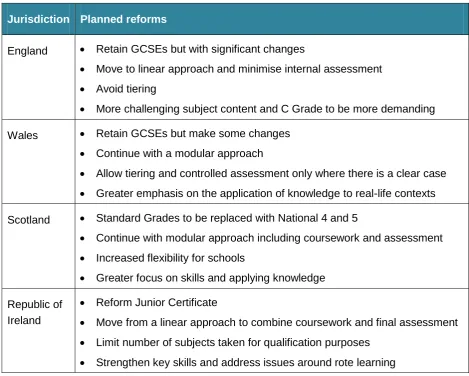
[image:6.595.69.539.378.754.2]In Northern Ireland the Minister for Education is expected to make an announcement on the future of GCSEs and A levels in the coming weeks. Table 1 provides an overview of the planned changes to Key Stage 4 in each of the jurisdictions.
Table 1: Overview of planned qualification reforms at Key Stage 4 (or equivalent)
Jurisdiction Planned reforms
England Retain GCSEs but with significant changes
Move to linear approach and minimise internal assessment Avoid tiering
More challenging subject content and C Grade to be more demanding
Wales Retain GCSEs but make some changes Continue with a modular approach
Allow tiering and controlled assessment only where there is a clear case Greater emphasis on the application of knowledge to real-life contexts
Scotland Standard Grades to be replaced with National 4 and 5
Continue with modular approach including coursework and assessment Increased flexibility for schools
Greater focus on skills and applying knowledge
Republic of Ireland
Reform Junior Certificate
Move from a linear approach to combine coursework and final assessment Limit number of subjects taken for qualification purposes
Post-16 reforms
In England the planned reforms for A levels include a move to a fully linear approach, a review of curriculum content and the involvement of higher education in the
development of qualifications.
In Wales there was strong support for A levels among stakeholders. It is planned to maintain the same A levels as England and NI where possible, and to involve higher education in qualification development. In Scotland, the fundamental characteristics of Highers and Advanced Highers are to be preserved in the revised qualifications. Qualification reform issues
There are a number of potential issues associated with the current plans for GCSE and A level reform. These include:
Levels of internal/ external assessment: Internal assessment is evident in qualifications internationally; both forms have advantages and disadvantages; Titling: England and Wales plan to reform GCSEs while retaining GCSE and A
level titles – this is likely to have implications for comparability and regulation; Tiering: While many teachers support tiering as it may challenge the most able
students, potential disadvantages include demotivating students placed in lower tiers and factors such as socio-economic background influencing streaming; Modular or linear assessment: Modules can allow students to use results to
inform their learning, although concerns include the fragmentation of subject knowledge. A linear approach is high-stakes in nature and may increase the potential for “teaching to the test;”
Breadth vs. depth: A levels are unusual internationally in terms of the number of subjects studied (most countries use a baccalaureate-style approach);
Compulsory subjects: A levels are almost unique in not including mandatory subjects;
Assessing across the ability range: Qualifications expected to cover the whole ability range must be both accessible to the lower end while providing appropriate challenge to the top end;
Inclusion of independent study: It has been suggested that independent projects make up some of the most demanding aspects of qualifications worldwide.
Higher education destinations
NIAR 400-13 Research Paper
Northern Ireland Assembly, Research and Information Service 6
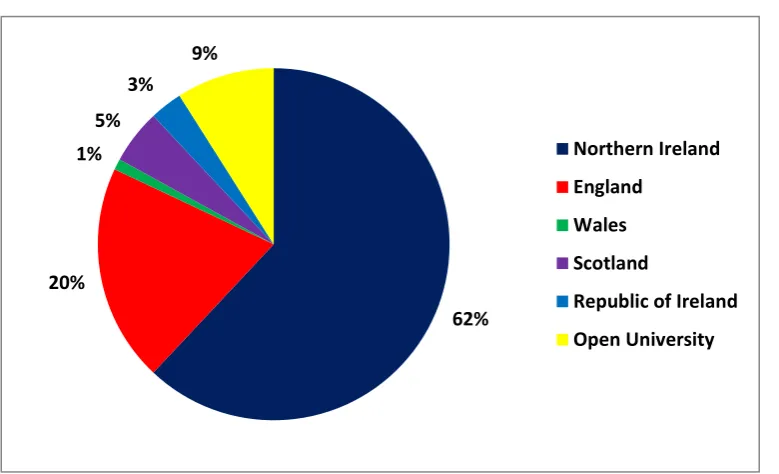
borders, with 20% attending an institution in England, 5% in Scotland and 3% in the Republic of Ireland in 2011/12. The limited availability of third level places and generally higher grade requirements in NI are thought to contribute to this trend. Conclusion
The comparability and portability of qualifications across NI, England, Scotland, Wales and the Republic of Ireland remains an important issue for students, with 38% of NI students crossing jurisdictions for higher education in 2011/12.
While this is facilitated through collaboration on national qualification frameworks, the significant reforms currently taking place may have implications for regulation and the maintenance of standards for GCSEs and A levels. A number of issues could be given further consideration, including:
The sustainability of the three jurisdiction qualifications system given the
different policy directions being taken and the remarks of the Secretary of State for Education;
The implications of maintaining or diverging from the system for students and qualifications in NI;
The forthcoming decisions by the Minister for Education, John O’Dowd MLA, on GCSEs and A levels;
The use of the GCSE and A level titles for potentially very different qualifications in England, Wales and NI;
Issues such as tiering, levels of internal assessment, the inclusion of compulsory subjects and independent study;
Contents
Key Points ... 1
Executive Summary ... 3
Contents 1 Introduction ... 9
2 Three jurisdiction qualifications system ... 9
3 Comparison of qualifications across jurisdictions ... 11
4 GCSEs in Northern Ireland ... 12
5 GCSEs in England... 13
6 GCSEs in Wales ... 15
7 Republic of Ireland Junior Certificate ... 16
8 Standard Grades and Nationals: Scotland ... 18
9 Ensuring comparability of standards at Key Stage 4 ... 19
10 A levels in Northern Ireland ... 21
11 A levels in England ... 22
12 A levels in Wales ... 23
13 Scottish Higher and Advanced Higher qualifications ... 24
14 Republic of Ireland Leaving Certificate ... 25
15 Higher education destinations ... 26
16 Qualification reform issues ... 29
1
Introduction
On 1st October 2012 the Minister for Education, John O’Dowd MLA, announced a fundamental review of GCSE and A level qualifications in Northern Ireland. The review comes at a time of significant qualification reform in other jurisdictions.
This paper considers the shared qualification arrangements across England, Wales and NI and discusses current practice and plans for the reform of qualifications in these jurisdictions, Scotland and the Republic of Ireland. It also explores approaches to maintaining standards at Key Stage 4; considers higher education destinations; and discusses a number of issues in regard to qualification reform.
2
Three jurisdiction qualifications system
Qualifications (and their regulation) at GCSE and A level are currently operated on a three jurisdiction basis, and are jointly owned by the three regulators: Ofqual, the Welsh Government and CCEA (Council for the Curriculum, Examination and
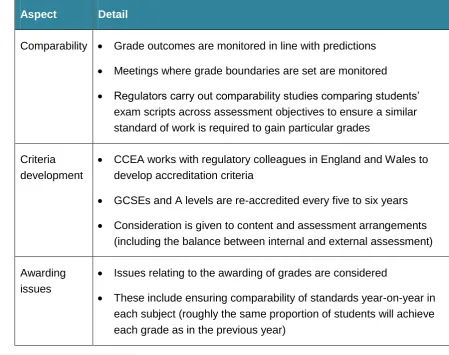
[image:11.595.79.529.399.754.2]Assessment). The following table considers some of the key aspects of this system.1 Table 2: Key aspects of the three-country qualifications system
Aspect Detail
Comparability Grade outcomes are monitored in line with predictions Meetings where grade boundaries are set are monitored
Regulators carry out comparability studies comparing students’ exam scripts across assessment objectives to ensure a similar standard of work is required to gain particular grades
Criteria development
CCEA works with regulatory colleagues in England and Wales to develop accreditation criteria
GCSEs and A levels are re-accredited every five to six years
Consideration is given to content and assessment arrangements (including the balance between internal and external assessment) Awarding
issues
Issues relating to the awarding of grades are considered
These include ensuring comparability of standards year-on-year in each subject (roughly the same proportion of students will achieve each grade as in the previous year)
1
NIAR 400-13 Research Paper
Northern Ireland Assembly, Research and Information Service 10
Initial moves away from the three country system
Decisions on the regulation of qualifications were taken jointly by ministers across Wales, England and NI until the establishment of Ofqual in 2010 removed regulation from ministerial control. Changes to regulation and wider policy changes have meant that Ofqual has moved away from making decisions on a three-country basis.2
In addition, it has been reported that regulation by two or more regulators of shared qualifications has become increasingly challenging.3 Currently, the qualifications regulators undertake “parallel decision-making,” in that similar issues are considered, but different decisions may be taken.4
2012 GCSE English results
Common standards across the jurisdictions are important in regard to joint ownership of qualifications. While GCSEs and A levels have comparable standards across the three regions, differences in approaches to regulation became apparent in 2012 when the results of GCSE English prompted concern.5
Ofqual in England responded to the issue over grade boundaries by offering a resit to candidates in November 2012, while the former Welsh Minister, Leighton Andrews, ordered re-grading for Welsh candidates, leading to increased grades for over 1,200 students. Ofqual was critical of the actions taken in Wales, highlighting significant challenges for maintaining common standards in the future.6
Uncertainty over joint arrangements
In May 2013 Michael Gove, the Secretary of State for Education in England, wrote a joint letter to the Ministers of Education in NI and Wales. He stated that separating GCSEs and A levels would be “a natural and legitimate consequence of devolution”.7 In June 2013 the House of Commons Education Committee commented that the events around GCSE English had tested the joint arrangements “to the limit”,
suggesting that their future appeared to be uncertain. The Committee stated that the end of joint arrangements would be “regrettable” and urged Ministers to seek to retain joint ownership of GCSEs and A levels. The current system of joint ownership and regulation is set to continue until summer 2016 in some subjects and 2017 in others.8 John O’Dowd, the Education Minister, has stated his belief that the best way to ensure the transparency, portability and credibility of GCSEs and A levels in Northern Ireland
2
Department for Education and Skills (2012) Review of Qualifications for 14 to 19-year-olds in Wales Caerphilly: Welsh Government and CCEA (2013) Review of GCSE and A levels: Qualifications Issues Paper
3
As above
4
CCEA (2013) Review of GCSE and A levels: Qualifications Issues Paper
5
House of Commons Education Committee (2013) 2012 GCSE English results London: The Stationery Office Limited
6
As above
7
BBC News (2013) Michael Gove proposes split in exams systems of England, Wales and Northern Ireland [online] Available at: http://www.bbc.co.uk/news/uk-northern-ireland-22604899
8
is to work together on a three-jurisdiction basis. Nonetheless, he has acknowledged the differing policy directions being taken and has maintained the importance of continuing discussions on the issue at both a policy and a regulatory level.9
3
Comparison of qualifications across jurisdictions
CCEA comments that GCSEs and A levels differ from the qualifications offered in Scotland and the Republic of Ireland in terms of size; breadth of study; and age taken. However, it notes that portability of qualifications across the different systems is facilitated through collaboration on National Qualification Frameworks.10
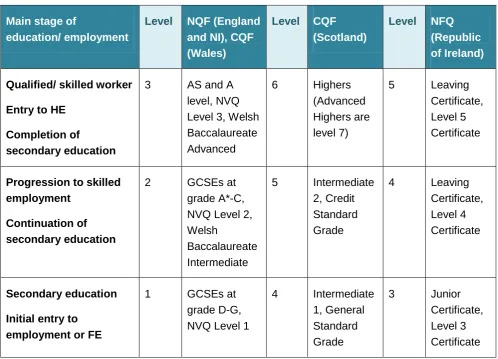
[image:13.595.49.548.319.678.2]The National Qualification Frameworks begin at entry level and extend through higher education (HE) to Doctoral degrees. Table 3 indicates how Key Stage 4 and Post-16 qualifications can be compared, highlighting a number of key stages in education.
Table 3: Cross-jurisdiction comparison of qualifications11
Main stage of
education/ employment
Level NQF (England and NI), CQF (Wales) Level CQF (Scotland) Level NFQ (Republic of Ireland)
Qualified/ skilled worker
Entry to HE
Completion of
secondary education
3 AS and A
level, NVQ Level 3, Welsh Baccalaureate Advanced
6 Highers
(Advanced Highers are level 7)
5 Leaving
Certificate, Level 5 Certificate
Progression to skilled employment
Continuation of secondary education
2 GCSEs at
grade A*-C, NVQ Level 2, Welsh
Baccalaureate Intermediate
5 Intermediate 2, Credit Standard Grade
4 Leaving
Certificate, Level 4 Certificate
Secondary education
Initial entry to employment or FE
1 GCSEs at
grade D-G, NVQ Level 1
4 Intermediate 1, General Standard Grade
3 Junior Certificate, Level 3 Certificate
Source: QAA, SCQF, CCEA, Ofqual, CQFW, NQA (2011) Qualifications can cross boundaries: A
rough guide to comparing qualifications in the UK and Ireland
9
Minister for Education response to an Assembly Question by Mr Danny Kinahan MLA, 21st May 2013
10
CCEA (2013) Review of GCSE and A levels: Qualifications Issues Paper
11
NIAR 400-13 Research Paper
Northern Ireland Assembly, Research and Information Service 12
In addition, the European Qualifications Framework (EQF) links the qualifications frameworks of different countries together.
Employer recognition
Evidence to the House of Commons Education Committee stated that employers are currently used to different exam systems, for example between England and Scotland. However, the Confederation of British Industry (CBI) asserted that Ministers must consider the practical implications of changes as businesses need to understand differences between qualifications.12
4
GCSEs in Northern Ireland
At the end of Key Stage 4 most students take GCSEs. Over 50 subjects are available and there are no regulations governing the minimum or maximum number of subjects that can be taken.
Tiering
At GCSE some subjects are examined by tier, with varied examinations for differing ability bands. There is a foundation tier which covers grades G to C and a higher tier for grades D to A*. However, for subjects where the evidence indicates that questions may be set that apply to the whole ability range, there is only one tier (for example, history, music and art).13
There are also ‘double award’ GCSEs equivalent to two GCSEs in vocational subjects such as applied art and design, business and health and social care.14
Assessment and grading
In 2009 controlled assessments replaced coursework in most subjects. This involves assessing students in supervised conditions (assessments are either set by awarding organisations and marked by teachers, or set by teachers and marked by awarding organisations).
Controlled assessments replaced coursework in order to address criticisms around its unsupervised nature and the fact that it was mainly undertaken as homework.
Controlled assessments at GCSE may make up either 0%, 25% or 60% of the overall assessment, depending on the subject. Typically, the final grade is partly based on controlled assessment and partly on examination.15
12
House of Commons Education Committee (2013) 2012 GCSE English results London: The Stationery Office Limited
13
European Commission (2012) Assessment in General Lower Secondary Education [online] Available at:
https://webgate.ec.europa.eu/fpfis/mwikis/eurydice/index.php/United-Kingdom-Northern-Ireland:Assessment_in_General_Lower_Secondary_Education
14 As above 15
An eight-point scale of grades is used: A*, A, B, C, D, E, F and G (students who do not meet the minimum standard for grade G are recorded as ‘U’ or unclassified). This is based on grade descriptions giving an indication of the standards likely to be shown by learners awarded particular grades.16
Reform
In October 2012 a review of GCSE and A level qualifications in Northern Ireland was announced. A public consultation was undertaken and a steering group of stakeholders from schools, employers and higher and further education institutions was established. CCEA’s final report was due to be given to the Minister for Education in June 2013.17
5
GCSEs in England
There are no regulations governing the minimum or maximum number of GCSE subjects a pupil may take. However, schools may be influenced by the way in which information is published in league tables – in particular, the English Baccalaureate performance measure highlights where pupils have achieved at least a grade C in a core of academic subjects:18
English;
Mathematics;
History or geography;
The sciences; and
A language.
There are more than 50 subjects available ranging from traditionally academic subjects to applied subjects. Students must have access to a course of study leading to at least two science GCSEs, or all three of physics, chemistry and biology (schools may offer other combinations in addition).19
Tiering, assessment and grading
In line with Northern Ireland, some subjects may be examined by tier, and many GCSE grades are based partly on controlled assessment and partly on examination.20
16
European Commission (2012) Assessment in General Lower Secondary Education [online] Available at:
https://webgate.ec.europa.eu/fpfis/mwikis/eurydice/index.php/United-Kingdom-Northern-Ireland:Assessment_in_General_Lower_Secondary_Education
17
Minister for Education response to an Assembly Question by Mr Mervyn Storey MLA, 3rd December 2012
18
European Commission (2012) Assessment in General Lower Secondary Education [online] Available at:
https://webgate.ec.europa.eu/fpfis/mwikis/eurydice/index.php/United-Kingdom-England:Assessment_in_General_Lower_Secondary_Education
19 As above 20
NIAR 400-13 Research Paper
Northern Ireland Assembly, Research and Information Service 14
Reform
In September 2012 the Department for Education launched a consultation on Key Stage 4 qualifications. The original proposals included replacing GCSEs with ‘the English Baccalaureate Certificate’. However, on 7th February 2013 the Secretary of
State, Michael Gove MP, announced that GCSEs in England will be retained but will undergo significant reform.21
The Secretary of State said that there should be new GCSEs in English language; English literature; mathematics; biology; chemistry; physics; combined science (double award); history; and geography. The qualifications were planned to be introduced for first teaching in September 2015 (for first examination in summer 2017). Changes in remaining subjects were proposed to follow.22
While GCSEs will be retained by England and Wales, differences are likely to emerge in terms of modular and linear structures, tiering and the proportion of internal
assessment.23 A consultation on the proposed changes closed on 3rd September 2013. Proposed changes in England include:24
The grade C must become more demanding to achieve;
More challenging subject content and more rigorous assessment structures should be implemented at the top end;
Qualifications should be linear – with all assessments taken at the end of the course;
New GCSEs should avoid tiering (new approaches to allowing for the whole ability range may include extension papers offering access to higher grades); Internal assessment and the use of exam aids should be minimised; In maths and science there should be greater emphasis on quantitative problem
solving, while in English and history extended writing should be tested (with fewer bite-sized and overly structured questions);
Potential for a new grading scale to be used.
On 6th September 2013 the Chief Regulator stated that due to the amount of change required to GCSEs, the planned timetable could not be met. Instead, the reform will initially focus on English Language, English Literature and mathematics (where concerns are greatest) – with these subjects ready for first teaching from September 2015. Other subjects are expected to follow in 2016.25
21
Baird, J., Ahmed, A., Hopfenbeck, T., Brown, C., Elliot, V (2013) Research evidence relating to proposals for reform of the GCSE Oxford: Oxford University Centre for Educational Assessment
22
Letter from Michael Gove MP to Glenys Stacey, Chief Executive of Ofqual, 6th February 2013
23
House of Commons Education Committee (2013) 2012 GCSE English results London: The Stationery Office Limited
24 Letter from Michael Gove MP to Glenys Stacey, Chief Executive of Ofqual, 6th February 2013 25
6
GCSEs in Wales
The arrangements for GCSEs in Wales are currently similar to those in place in Northern Ireland and England. GCSEs are available in a range of subjects and students are not required to take a particular minimum or maximum number of subjects. Arrangements for tiering, assessment and grading are also similar.26 From 2007 the Welsh Baccalaureate was introduced across Wales, sitting alongside and incorporating existing qualifications. Available at Foundation, Intermediate and Advanced levels, it includes a core and options. The options may be academic or vocational, while the core incorporates:27
Essential Skills Wales at either level 2 or level 3;
‘Wales, Europe and the World’: political, social, cultural and economic issues; An individual investigation;
A modern foreign language module;
Personal and social education;
A period of community participation; and
Work-related education, including a period of work experience.
A recent review described this qualification as “well-established and respected”, with a “solid and growing basis of currency within and outside Wales”. It noted that most higher education providers, employers and learners recognise it, and identified its strengths as including a broad range of skills and experience.28
Reform
The Welsh Government has undertaken a review of 14–19 qualifications. The review identified “very strong support” for GCSEs, and recommended that they be retained. However, it recommended some changes, including greater emphasis on the
application of knowledge and use of real-life contexts, and continuing to allow unitised GCSEs. It supported divergence between Wales and other parts of the UK where this is in learners’ best interests.29
26
European Commission (2012) Assessment in General Lower Secondary Education [online] Available at:
https://webgate.ec.europa.eu/fpfis/mwikis/eurydice/index.php/United-Kingdom-Wales:Assessment_in_General_Lower_Secondary_Education
27
Estyn (2012) Welsh Baccalaureate Qualification Provision at level 3 in Secondary Schools Cardiff: Estyn
28
Department for Education and Skills (2012) Review of Qualifications for 14 to 19-year-olds in Wales Caerphilly: Welsh Government
29
NIAR 400-13 Research Paper
[image:18.595.93.533.93.472.2]Northern Ireland Assembly, Research and Information Service 16
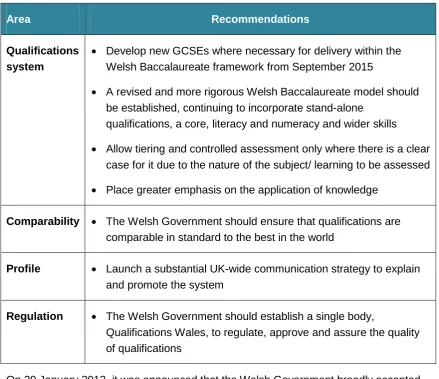
Table 4: Key recommendations for reform in Wales
Area Recommendations
Qualifications system
Develop new GCSEs where necessary for delivery within the Welsh Baccalaureate framework from September 2015
A revised and more rigorous Welsh Baccalaureate model should be established, continuing to incorporate stand-alone
qualifications, a core, literacy and numeracy and wider skills Allow tiering and controlled assessment only where there is a clear
case for it due to the nature of the subject/ learning to be assessed Place greater emphasis on the application of knowledge
Comparability The Welsh Government should ensure that qualifications are comparable in standard to the best in the world
Profile Launch a substantial UK-wide communication strategy to explain and promote the system
Regulation The Welsh Government should establish a single body,
Qualifications Wales, to regulate, approve and assure the quality of qualifications
On 29 January 2013, it was announced that the Welsh Government broadly accepted all of the Review’s recommendations.30
7
Republic of Ireland Junior Certificate
Currently post-primary education in the Republic of Ireland comprises a junior cycle (comprising students aged 12-15) and a senior cycle (students aged 15-18). All post-primaries follow the Junior Certificate syllabus and students take the Junior Certificate at around 15.31 The curriculum is presented in a framework of eight areas:32
Language and literature;
Mathematical studies;
30
Welsh Government (2013) Review of Qualifications 14-19 [online] Available at:
http://wales.gov.uk/topics/educationandskills/qualificationsinwales/revofqualen/;jsessionid=676BD928471F696F99992A8505D B3E25?lang=en
31
Department of Education and Skills (2012) OECD Review on Evaluation and Assessment Frameworks for Improving School Outcomes: Country Background Report for Ireland OECD
32
European Commission (2012) Secondary and Post-Secondary Non-Tertiary Education [online] Available at:
Science and technology;
Social, political and environmental education;
Arts education;
Physical education;
Religious and moral education;
Guidance counselling; and
Pastoral care.
Tiering, assessment and grading
Typically, subjects are studied at Ordinary or Higher Level, while Irish, English and maths may also be studied at Foundation level. Results are provided in the form of grades.33
The Junior Certificate is a national exam taken at the end of the junior cycle. Students choose between eight and ten subjects and levels (Higher, Ordinary and Foundation) to include English, maths and Irish, unless they have been given an exemption.34 Reform
Following consultation, in 2011 the National Council for Curriculum and Assessment (NCCA) put forward ‘radical’ proposals recommending that the Junior Certificate be reformed. The proposals were accepted by the Minister for Education and Skills, Ruairí Quinn T.D., and aim to:35
Limit the number of subjects to be taken for qualification purposes and
reduce the content of syllabuses to focus on the process of learning (rather than exam strategy);
Address issues around rote learning and curriculum overload while providing for greater creativity and innovation;
Strengthen key skills and provide for more relevant and flexible forms of assessment.
Under the new system, from September 2014 schools will need to deliver a programme enabling students to develop a range of skills. Students will take between eight and ten full subjects. Students may substitute full subjects for a maximum of four short courses
33
Department of Education and Skills (2012) OECD Review on Evaluation and Assessment Frameworks for Improving School Outcomes: Country Background Report for Ireland OECD
34
As above
35
NCCA (2011) Minister Quinn backs National Council for Curriculum and Assessment (NCCA) proposals for junior cycle reform [online] Available at:
NIAR 400-13 Research Paper
Northern Ireland Assembly, Research and Information Service 18
(each one equivalent to half a subject), allowing the inclusion of subjects such as Digital Media Literacy, Chinese and Programming.36
The current linear Junior Certificate examination will be phased out over the next eight years. Subjects will instead be assessed through a combination of school work
components (worth around 40%) and a final assessment (worth around 60%). Both elements will be marked by teachers in the school. Quality is expected to be
maintained through a number of measures, including:37
Each subject specification will contain clear learning outcomes;
Teachers will receive professional development in educational assessment, including moderation;
The results will be sent to the Department of Education and Skills for monitoring of national and school patterns.
The first certification will take place in 2017. There will be 21 subjects available, with core subjects in English, maths and Irish. Differing levels of papers will only be available within the core subjects. Grades will range from ‘Not Achieved’ to ‘Achieved with Distinction.’38
8
Standard Grades and Nationals: Scotland
Scotland’s approach has traditionally differed from that in England, Wales and NI. Until 2013/14 students studied for Standard Grades in the 10th and 11th years of schooling, taking exams at age 14-16. In comparison, GCSEs are taken in the 11th and 12th years of schooling at age 15-16.39
Students took seven or eight subjects including maths and English, with three levels of study available: Credit, General and Foundation. Students typically took exams at two levels (Credit and General or General and Foundation) to give them the best chance of achieving as high a grade as possible.40
Students who passed Standard Grades at general or foundation level could take Intermediate 1 and 2 qualifications, with Intermediate 2 acting as a stepping stone to Higher qualifications for some students.41
36
Department of Education and Skills (2013) Information on the Framework for Junior Cycle Dublin: DES
37
As above
38
As above
39
Machin, S., McNally, S., Wyness, G. (2013) Education in a Devolved Scotland: A Quantitative Analysis Economic and Social Research Council
40
SQA NQ Quick Guide [online] Available at: http://www.sqa.org.uk/sqa/14094.html
41 Education Scotland (2013) Exam guide [online] Available at:
Reform
New qualifications are being introduced in 2013/14 in an attempt to simplify the system at SCQF levels 4 and 5 (named National 4 and 5), replacing the Standard Grade and Intermediate 1 and 2 qualifications. The new qualifications will continue to have a unit-based structure. The key differences include:42
Increased flexibility: schools may deliver the qualifications in a way that meets learners’ needs, allowing them to develop at different times, rates and in different areas;
Greater focus on skills and applying learning: students will be required to demonstrate skills, application of knowledge and attributes to equip them for life and work;
More scope for personalisation.
Courses will be made up of a number of contributing units and coursework, allowing for the study of up to eight subjects. National 4 courses are to be assessed by teachers through coursework assessment, with no external assessment or grading. (SQA assessments and quality assurance processes are to be used for quality assurance).43 National 5 courses will include coursework to be assessed by teachers, and an external SQA assessment (examinations where appropriate). The most able pupils would be able to omit the National qualifications and proceed to studying for Highers.44
9
Ensuring comparability of standards at Key Stage 4
Awarding organisations seek to predict GCSE grade profiles in order to ensure that qualification standards are maintained year-on-year and across awarding
organisations. The jurisdictions considered within this paper use different approaches, as outlined in the following paragraphs.
Northern Ireland: Common centre data
In Northern Ireland ‘common centre’ data are used to predict GCSE outcomes (as there are no Key Stage 2 tests). A common centre is a centre that has entered students for a subject in the previous two years. This approach works on the premise that centre’s results tend to be similar to previous years, and that comparing results across common centres indicates whether standards are comparable year-on-year.45 This approach is GCSE subject-specific. The Common Centres database includes outcomes from centres in England, Wales and NI (from various awarding
42
The Scottish Government (2012) Frequently Asked Questions – National Qualifications [online] Available at:
http://www.scotland.gov.uk/Resource/0039/00397045.doc
43
As above
44 As above 45
NIAR 400-13 Research Paper
Northern Ireland Assembly, Research and Information Service 20
organisations). The GCSE outcomes from the centre’s previous year become the prediction for the current year.46
The Department notes that this approach has limitations in that the predictions are made at the centre-level, while the most accurate predictions would be made at the individual student-level. As such, this approach cannot accurately measure changes in a pupil cohort; rather, it assumes that centres will maintain similar outcomes each year, regardless of student characteristics.47
England: Comparable outcomes approach
In England a “comparable outcomes” approach is used. This is a statistical tool, whereby Key Stage 2 attainment data, taken from assessment at age 11, is used to predict the expected achievement of a cohort of 16 year-olds taking their GCSEs. Ofqual uses this approach for two reasons:48
To ensure that students taking new qualifications are not disadvantaged in the first years of the qualification (allowing for lack of teacher familiarity); and To ensure that grade standards between exam boards are comparable.
Challenges
Difficulties associated with this approach include a lack of understanding among schools, challenges in regard to subjects with a high performance element (such as drama) and a lack of comparability with other jurisdictions (using different
approaches).49
Judicial review
Following concerns regarding the results of GCSE English 2012 an application for judicial review was taken against two exam boards (AQA and Edexcel) and Ofqual by an alliance of professional bodies, councils, schools and pupils. The alliance called for a re-grading of the results in line with the January grade boundaries.50
In February 2013 Lord Justice Elias found in favour of the exam boards and Ofqual, dismissing the application for judicial review. In his judgement he stated that there was “nothing improper” regarding predicted outcomes playing a key role in grade awarding, noting that Key Stage 2 predictions were “widely thought to be the most reliable
statistical evidence currently available for the purpose of comparing evidence year on year.”51
46
Information provided by the Department of Education, August 2013
47
As above
48
House of Commons Education Committee (2013) 2012 GCSE English results London: The Stationery Office Limited
49
As above
50 As above 51
Republic of Ireland: predetermined grade boundaries and script sampling
In the Republic of Ireland grade boundaries are predetermined and raw scores are not adapted. As such, the raw mark directly determines the grade, and once the raw marks are finalised no manipulation of the grade distribution is possible.52
Where a large variation in the level of achievement is seen over a short period of time, it is assumed that this is due to the effects of a particular test instrument, rather than a sudden change in the achievement of the cohort. In such cases, adjustment may only be made to the raw marks on scripts (rather than the grade distribution).53
At the start of the marking process each examiner marks a sample of scripts. Once they are marked an overall picture is given as to whether the grade distribution is satisfactory. If so, marking proceeds, but if it is not acceptable, marking criteria may be adjusted and scripts that have already been marked may be revisited.54
It has been suggested that this fixed boundaries approach can pose ‘considerable difficulties’ for maintaining standards year-on-year.55
Scotland: Archive of assessment materials
In Scotland the SQA seeks to ensure that standards are comparable with previous years by using an archive of assessment material and anonymised learners’ work (including examination scripts). This archive is also used to help benchmark standards across the UK.56
Wales: Common centres
As Wales does not have Key Stage 2 assessments to draw on, it also uses the ‘common centres’ approach.57
10 A levels in Northern Ireland
A levels are single-subject examinations that can be studied in any combination depending on the school or college. Courses tend to last two years with students completing the qualifications around the age of 18. An A level qualification includes AS and A2 units:58
52
McManus, H. (2006) Predicting final grade distribution of examination results – selection of sample scripts The International Association for Educational Assessment
53
As above
54
As above
55
As above
56
SQA Setting and revising standards [online] Available at: http://www.sqa.org.uk/sqa/33538.html#GradeBoundaries
57
Welsh Government (2012) GCSE English Language 2012: An investigation into the outcomes for candidates in Wales
58
Eurypedia (2012) Assessment in General Upper Secondary Education [online] Available at:
NIAR 400-13 Research Paper
Northern Ireland Assembly, Research and Information Service 22
AS is a stand-alone qualification worth half a full A level. It typically consists of two units that combined contribute 50% of the full A level; A2 is the second half of a full A level, covering more demanding material
than at AS level. It usually includes two units that together contribute the remaining 50% of the full A level.
Since September 2008, pupils in post-compulsory education have been able to
undertake an extended project as a standalone qualification in addition to A levels. This extended project is equivalent in size to half an A level and equivalent in standard to a full A level, and is intended to develop students’ research and independent learning skills.59
Grading
AS qualifications are graded on a scale of A to E, with A level passes graded from A*-E (the A* grade was introduced in 2010). A U grade denotes a fail. The regulator sets out subject criteria detailing grade descriptions which give an indication of the standards of achievement likely to have been shown by learners awarded particular grades.60
Reform
A number of changes to A levels have already been announced. John O’Dowd MLA, the Education Minister, has stated that the current AS/ A2 modular approach will remain, but that there will be no re-sit opportunity in January (there will be an opportunity to re-sit in June).61
The Minister has requested that CCEA considers changing the weighting of AS/ A2 from 50:50 to 40:60. He has also stated that he does not support the involvement of Russell Group Universities in setting the content of qualifications.62
11 A levels in England
The approach to A levels in England is currently broadly similar to that in place in Northern Ireland. A levels include AS and A2 units, and the approach to grading is the same. Students may also take an extended project as a standalone qualification in addition to A levels.63
59
Eurypedia (2012) Assessment in General Upper Secondary Education [online] Available at:
https://webgate.ec.europa.eu/fpfis/mwikis/eurydice/index.php/United-Kingdom-Northern-Ireland:Assessment_in_General_Upper_Secondary_Education
60
As above
61
Northern Ireland Executive (2013) Education Minister, John O'Dowd, today announced changes to GCE A levels following a local consultation [online] Available at: http://www.northernireland.gov.uk/news-de-200513-odowd-announces-decision
62
As above
63
Eurypedia (2012) Assessment in General Upper Secondary Education [online] Available at:
Reform
In March 2012 the Secretary of State for Education wrote to Ofqual stating his view that A levels do not command adequate levels of confidence, and suggesting that higher education institutions should have greater involvement in developing qualifications.64 The Government has since announced significant reform to A levels with revised qualifications in English; mathematics and further mathematics; physics; chemistry; biology; history and geography planned to be introduced from 2015 for first
examination in 2017.65
Ofqual has agreed that a further six subjects will be reformed within this timescale (including psychology, art and design and economics), and it is expected that further subjects will be reformed at a later date.66 The key changes include:
Changes to the structure of A levels: including a review of curriculum content requirements;
The introduction of standalone AS qualifications that will not contribute to a full A level qualification;
Involvement of higher education in future A level design; All exams to be taken in the summer period (none in January); In the longer term, qualifications will become fully linear (rather than
assessments undertaken at the end of each year of A level study).
12 A levels in Wales
The implementation of A levels is similar to England and NI. In addition, the Welsh Baccalaureate Qualification (WBQ), introduced in 2007, is an overarching qualification incorporating existing qualifications and a common core. This aims to promote breadth of study and to give equal recognition to academic and vocational qualifications.67 Reform
A review of qualifications for 14-19 year-olds ran from September 2011 to November 2012, launched by the Deputy Minister for Skills, Jeff Cuthbert. The review
64
Letter from Michael Gove MP to Ofqual, 31st March 2012 [online] Available at:
http://www2.ofqual.gov.uk/downloads/category/132-correspondence?download=1369%3Aletter-from-michael-gove-to-glenys-stacey-regarding-a-level-reforms-30th-march-2012
65
House of Commons Education Committee (2013) 2012 GCSE English results London: The Stationery Office Limited
66
As above
67
Eurypedia (2012) Assessment in General Upper Secondary Education [online] Available at:
NIAR 400-13 Research Paper
Northern Ireland Assembly, Research and Information Service 24
recommended retaining A levels as the main qualification for this stage of education, citing strong support among stakeholders.68
It reported “little appetite” among stakeholders for divergence between the A levels used in NI, Wales and England; rather cooperation between the jurisdictions was called for. Key recommendations included:69
Maintaining the same A levels as England and NI where possible, but allowing variation where necessary to meet the needs of learners in Wales; Ensuring that employers and higher education institutions are involved in
the development and/ or accreditation of A levels; Retain the AS/ A2 structure;
Allow only one resit opportunity;
A substantial and long-term UK-wide communication strategy should be launched to explain and promote the system.
13 Scottish Higher and Advanced Higher qualifications
Scotland’s approach to examinations is more modular than in England, Wales and Northern Ireland. Students take Scottish Highers at age 17 and Highers and Advanced Highers at age 18. Students aged 17 may take five Higher subjects, enabling entry to higher education.70
Students who remain in education to take Highers may leave school aged 17 (after one year of post-compulsory education) with some qualifications. In England, Wales and NI pupils can leave at age 17 with AS-levels, however, these are not adequate for entry to university.71
Highers are particularly aimed at students who have passed subjects at Standard Grade Credit level or have successfully completed a course at Intermediate 2. Highers are typically required for university or college entry.72
Advanced Highers can be taken by students who have passed Highers, and aim to extend the skills and knowledge gained. They are typically taken in the sixth year of school or college, and are useful for entry to university or employment.73
68
Department for Education and Skills (2012) Review of Qualifications for 14 to 19-year-olds in Wales Caerphilly: Welsh Government
69
As above
70
Machin, S., McNally, S., Wyness, G. (2013) Education in a Devolved Scotland: A Quantitative Analysis Economic and Social Research Council
71
As above
72 SQA NQ Quick Guide [online] Available at: http://www.sqa.org.uk/sqa/14094.html 73
Reform
Although Scotland has been undertaking reforms of its qualification system, the fundamental features and characteristics of the Higher and Advanced Higher courses are to be preserved in the new courses. The new Higher qualifications will be
introduced in 2014/15 with the new Advanced Highers to be introduced in 2015/16.74
14 Republic of Ireland Leaving Certificate
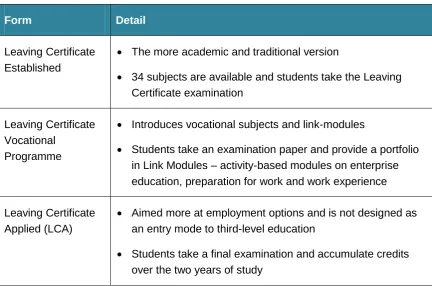
[image:27.595.95.528.304.590.2]All post-primary schools in the Republic of Ireland follow the Leaving Certificate at senior cycle (students aged 15-18 years). At around the age of 17-18 students take the Leaving Certificate. There are three forms that students can choose at the end of the senior cycle which each have distinct aims and objectives.75
Table 5: Three forms of the Leaving Certificate
Form Detail
Leaving Certificate Established
The more academic and traditional version
34 subjects are available and students take the Leaving Certificate examination
Leaving Certificate Vocational
Programme
Introduces vocational subjects and link-modules
Students take an examination paper and provide a portfolio in Link Modules – activity-based modules on enterprise education, preparation for work and work experience Leaving Certificate
Applied (LCA)
Aimed more at employment options and is not designed as an entry mode to third-level education
Students take a final examination and accumulate credits over the two years of study
Used as an entry qualification by higher education institutions and by many employers, schools, students and their parents tend to regard the Leaving Certificate as a high-stakes examination.76
A broad range of skills is assessed by the Leaving Certificate examination, including assessment of knowledge-based skills; practical skills; research skills; interpretation skills; oral and aural linguistic ability; and creative skills.77
74
SQA New Qualifications Outline [online] Available at: http://www.sqa.org.uk/sqa/58085.3588.html
75
Department of Education and Skills (2012) OECD Review on Evaluation and Assessment Frameworks for Improving School Outcomes: Country Background Report for Ireland OECD
76
NIAR 400-13 Research Paper
Northern Ireland Assembly, Research and Information Service 26
15 Higher education destinations
[image:28.595.99.489.219.456.2]Figure 1 provides an overview of NI domiciled students attending higher education institutions in the UK and the Republic of Ireland. It shows that of NI domiciled first year students attending a higher education within the UK and Republic of Ireland, 62% attended within NI compared to 20% attending an institution in England and 3% attending within the Republic of Ireland.
Figure 1: Overview of NI domiciled first year students attending HE institutions in the UK and Republic of Ireland in 2011/1278
CCEA reports that grade requirements in Northern Ireland tend to be higher than in other UK jurisdictions due to the limited availability of third level places. It states that this leads to a significant number of students studying outside of NI.79 Indeed, it is estimated that if all students domiciled in Northern Ireland wished to study here, an average of 5,400 would not receive a place each year.80
Across England, Northern Ireland, Scotland and Wales the majority of students remain in their own jurisdiction to attend university. However, students from Northern Ireland and Wales are more likely to cross borders than Scottish and English students.81 The following figure illustrates the location of higher education institutions attended by students domiciled in NI, England, Scotland and Wales in 2011/12.82
77
Department of Education and Skills (2012) OECD Review on Evaluation and Assessment Frameworks for Improving School Outcomes: Country Background Report for Ireland OECD
78
Data from the Higher Education Statistics Agency and the Higher Education Authority
79
CCEA (2013) Review of GCSE and A levels: Qualifications Issues Paper
80 Wakeling, P., Jefferies, K. (2013) “The effect of tuition fees on student mobility: the UK and Ireland as a natural experiment”
British Educational Research Journal Vol. 39, No. 3, pp. 491-513
81
Higher Education Statistics Agency (2013) Higher Education student enrolments and qualifications obtained at higher education institutions in the United Kingdom for the academic year 2011/12 [online] Available at:
http://www.hesa.ac.uk/index.php?option=com_content&task=view&id=2667&Itemid=161
82
Data from the Higher Education Statistics Agency
62% 20%
1% 5%
3% 9%
Northern Ireland
England Wales
Scotland
Republic of Ireland
Figure 2: Location of higher education institution attended by first year students by domicile, 2011/12
Republic of Ireland
As Figure 1 illustrates, just 3% of NI domiciled students in their first year at a UK or RoI higher education institution attended in the Republic of Ireland in 2011/12, equating to 622 students. There has been a slow decline in the number of NI domiciled students attending universities in the Republic of Ireland since 2004/05 (from 769 students).83 In terms of students domiciled in the Republic of Ireland, in 2011/12 a total of 151,482 students attended university in the Republic of Ireland.84 Of students from the Republic of Ireland attending a higher education institution in the UK and RoI combined, 91% attended in the Republic of Ireland. A total of 2% of all RoI students attended a higher education institution in Northern Ireland.
With regard to the 15,075 students domiciled in the Republic of Ireland attending higher education institutions in the UK, 8,015 attended in England (53%), 2,630 or 17%
attended in Scotland and 910 (6%) attended in Wales. Just under a quarter (23%) of these students attended university in Northern Ireland, representing a decrease of 17.8% from 2010/11.85
83
EURES Cross Border Partnership (2011) A study of obstacles to cross-border undergraduate education
84
Higher Education Authority Student details [online] Available at:
http://www.hea.ie/files/files/file/statistics/2012/Enrolments/FTCounty1112.xlsx
85 Higher Education Statistics Agency (2012) Non-UK domicile students [online] Available at:
http://www.hesa.ac.uk/index.php?option=com_content&task=view&id=2663&Itemid=161
0 10 20 30 40 50 60 70 80 90 100
England Northern
Ireland
Scotland Wales
% of students
Student domicile
Northern Ireland
Scotland
Wales
NIAR 400-13 Research Paper
Northern Ireland Assembly, Research and Information Service 28
Obstacles to student mobility
A report in 2011 identified a number of barriers to student mobility across the island of Ireland, including a change in ‘equivalences’ between A level and Leaving Certificate grades. This was due to universities in the Republic of Ireland choosing to increase the requirement for high demand subjects (such as medicine and law) from three to four A levels at the highest grade.86
The change came about as a result of a 2003 Oxford University-led Expert Group concluding that while UCAS had previously deemed results in each Leaving Certificate subject to be half the value of an equivalent A level, this should be adjusted to two-thirds of the value.87
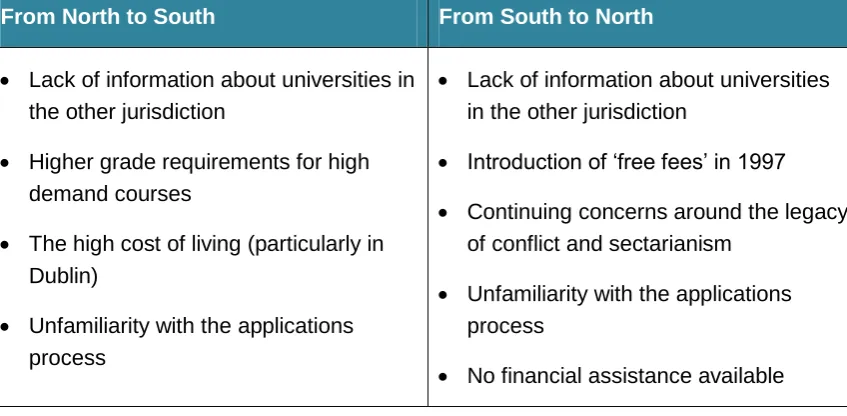
[image:30.595.99.523.405.613.2]As such, universities believed that the change in requirements was necessary to avoid giving an unfair advantage for NI students over their counterparts with top Leaving Certificate results. The requirement for four top A levels tends to be seen by NI students as onerous in comparison to requirements at comparable UK institutions.88 Table 6 provides an overview of the key obstacles to student mobility identified in the 2011 report.89
Table 6: Overview of barriers to student mobility across the island of Ireland
From North to South From South to North
Lack of information about universities in the other jurisdiction
Higher grade requirements for high demand courses
The high cost of living (particularly in Dublin)
Unfamiliarity with the applications process
Lack of information about universities in the other jurisdiction
Introduction of ‘free fees’ in 1997 Continuing concerns around the legacy
of conflict and sectarianism Unfamiliarity with the applications
process
No financial assistance available
Trends in attendance
Figure 3 illustrates the number of first year students domiciled in Northern Ireland attending higher education institutions in each of the jurisdictions considered, and at the Open University (includes full and part time students), over a six year period.
86
EURES Cross Border Partnership (2011) A study of obstacles to cross-border undergraduate education
87
As above
88 As above 89
Figure 3: Location of Higher Education institutions attended by first year Northern Ireland domiciled students between 2006/07 and 2011/1290
16 Qualification reform issues
Levels of internal assessment
Internal assessment is emphasised in senior secondary qualifications internationally. Michael Gove has commented that the new GCSEs should keep internal assessment to a minimum. However, the House of Commons Education Committee has stated that the proportion of internal assessment should be decided on a subject-by-subject basis.91
With regard to A levels, internal or school-based assessment tends to be less evident (typically comprising around 20% of the available marks). Forms of internal
assessment can include:92
Oral tests to assess subject knowledge and skills: tend to be very demanding forms of assessment and educationally beneficial;
Tests and written assignments;
Self-directed research projects;
Practical activities, fieldwork and projects.
While most qualifications contain elements of internal assessment, there is variation in emphasis. In the Republic of Ireland the Leaving Certificate (Established) is fully externally assessed, while in the Netherlands, New South Wales and Alberta the key
90
Data from the Higher Education Statistics Agency and the Higher Education Authority
91 House of Commons Education Committee (2013) 2012 GCSE English results London: The Stationery Office Limited 92
Ofqual (2012) International Comparisons in Senior Secondary Assessment: Full Report Coventry: Ofqual
0 2,000 4,000 6,000 8,000 10,000 12,000 14,000 16,000
Number of students
Northern Ireland
England
Wales
Scotland
Republic of Ireland
NIAR 400-13 Research Paper
Northern Ireland Assembly, Research and Information Service 30
qualifications contain 50% school-based assessment. A small number of systems, such as Norway’s Vitnemål, prioritise internal assessment over external exams.93
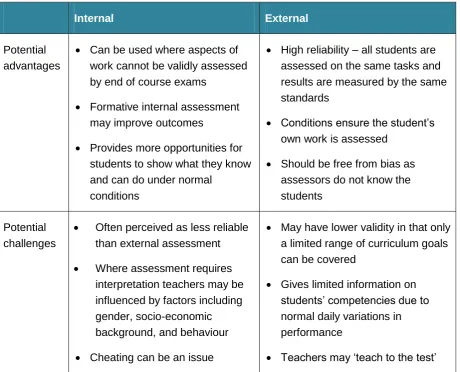
[image:32.595.73.534.224.596.2]However, emphasis on internal assessment has also been problematic in some cases. For example, the Ofqual investigation into the issues around GCSE English in 2012 highlighted the high level of controlled assessment (60%) as an issue affecting results. Such a situation can put teachers into a “sensitive” position as they have significant control over the assessment and there can be strong pressure to deliver good results.94
Table 7: Advantages and disadvantages of internal and external assessment
Internal External
Potential advantages
Can be used where aspects of work cannot be validly assessed by end of course exams
Formative internal assessment may improve outcomes
Provides more opportunities for students to show what they know and can do under normal
conditions
High reliability – all students are assessed on the same tasks and results are measured by the same standards
Conditions ensure the student’s own work is assessed
Should be free from bias as assessors do not know the students
Potential challenges
Often perceived as less reliable than external assessment Where assessment requires
interpretation teachers may be influenced by factors including gender, socio-economic background, and behaviour Cheating can be an issue
May have lower validity in that only a limited range of curriculum goals can be covered
Gives limited information on students’ competencies due to normal daily variations in performance
Teachers may ‘teach to the test’
Source: Baird, J., Ahmed, A., Hopfenbeck, T., Brown, C., Elliot, V (2013) Research evidence relating to proposals for reform of the GCSE and OECD (2013) Synergies for Better Learning: An international perspective on evaluation and assessment
Titles
England and Wales are planning to reform qualifications while retaining the GCSE and A level titles. This is likely to have implications in terms of comparability across
jurisdictions and the regulation of qualifications.
93 Ofqual (2012) International Comparisons in Senior Secondary Assessment: Full Report Coventry: Ofqual 94
Ofqual has stated that it is very difficult to ensure that standards are consistent where qualifications vary significantly in structure, assessment and content. Michael Gove has indicated that Wales and NI may have to relinquish the titles GCSEs and A levels. In response, Leighton Andrews stated:95
“We wish Mr Gove well with his plans to re-name these qualifications in England.”
The Minister for Education here, John O’Dowd MLA, has stated that he has asked CCEA to engage fully with the qualifications regulators in England and Wales, particularly with regard to the issue of titles.96
Tiering
In England the Secretary of State for Education has stated that he would like reformed GCSEs to avoid tiering, as it may limit students’ ambitions by allowing an optimum attainment of grade C.97
Research suggests that high levels of accountability based on grades, particularly centring on students achieving a grade C, may make it more likely that teachers “play it safe” by choosing the lower tier. This may limit students’ achievement.98
Many teachers favour tiering, viewing it as challenging the most able students.
However, many report that students entered for lower tiers become de-motivated, and high performing students within these tiers cannot move to a higher set. In addition, research indicates that factors such as gender and socio-economic background may influence streaming.99
Modular or linear assessment
The potential advantages of modular assessment include that it can allow students to use results and feedback to inform their learning and support teachers in their planning. Challenges include the appropriateness of a modular approach for particular subjects, and concerns around the fragmentation of subject knowledge.100
The evidence indicates that modular exams are not necessarily easier. Challenges around the linear approach include the high stakes nature of testing, and the potential that teachers may be more likely to ‘teach to the test.’ Other issues include the format of assessment. For example, the evidence suggests that boys tend to perform better than girls on multiple choice questions, while girls generally do better where questions require a longer written response.101
95
House of Commons Education Committee (2013) 2012 GCSE English results London: The Stationery Office Limited
96
Minister for Education response to an Assembly Question by Mr Danny Kinahan MLA, 21st May 2013
97
House of Commons Education Committee (2013) 2012 GCSE English results London: The Stationery Office Limited
98
Baird, J., Ahmed, A., Hopfenbeck, T., Brown, C., Elliot, V (2013) Research evidence relating to proposals for reform of the GCSE Oxford: Oxford University Centre for Educational Assessment
99
As above
100 As above 101
NIAR 400-13 Research Paper
Northern Ireland Assembly, Research and Information Service 32
Breadth vs depth
An international study of post-16 qualifications has found that A levels are very unusual in terms of their structure. A level students typically study the fewest subjects (three to four), while most countries use a baccalaureate- or diploma-style approach (often including around ten subjects). Few systems offer qualifications on an individual subject basis (like A levels).102
Within this approach students study a core of compulsory subjects supplemented by optional specialisms. In many countries students are required to study:103
A social science;
Science;
Mathematics;
A foreign language; and
A home language.
Ofqual comments that studying a broad range of disciplines may limit the breadth and depth of study possible within individual subjects. For example, in a comparison of international qualifications, A level Mathematics was found to offer one of the broadest programmes of study. However, in most other systems students may choose optional topics which are studied in greater depth or in different contexts.104
Compulsory subjects
A levels and equivalent qualifications in New Zealand are identified as the only
assessments for which there are not mandatory subjects. Internationally the number of compulsory subjects differs, ranging from one in the Republic of Ireland (Irish) and New South Wales (English), to 13 in Denmark. Where jurisdictions include two or more mandatory subjects, mathematics is compulsory.105
Assessing across the ability range
Where a qualification is expected to cover the whole ability range, it needs to be both accessible to the lower end while providing appropriate challenge to the top end. Approaches to this include:106
Tiering: entering students for one of two or more papers varying in difficulty;
102
Ofqual (2012) International Comparisons in Senior Secondary Assessment: Full Report Coventry: Ofqual
103
As above
104
As above
105
As above
106 Baird, J., Ahmed, A., Hopfenbeck, T., Brown, C., Elliot, V (2013) Research evidence relating to proposals for reform of the
Multiple papers: students may sit two adjacent tiers (there are a number of tiered papers). The Scottish Standard Grade involves three tiers and most students sit two;
General and extended papers: a general paper is taken by all students, with some taking an additional paper to access higher grades;
Computer adaptive testing: one question is posed at a time,