
The design and implementation of effective poverty eradication programmes: the rights based approach
300
0
0
Full text
(2) THE DESIGN AND IMPLEMENTATION OF EFFECTIVE POVERTY ERADICATION PROGRAMMES: THE RIGHTS-BASED APPROACH. Thesis submitted by Nyasulu, Gerald Joseph, B.A. (Public Administration), Chancellor College, The University of Malawi In August, 2009. For the degree of Doctor of Philosophy in the School of Arts and Social Sciences, James Cook University.
(3) STATEMENT OF ACCESS. I, the undersigned, author of this work, understand that James Cook University will make this thesis available for use within the University Library and, via the Australian Digital Theses Network, for use elsewhere.. I understand that, as an unpublished work, a thesis has significant protection under the Copyright Act and I do not wish to place any further restriction on access to this work.. ______________. _____________. Gerald Nyasulu. Date. ii.
(4) DECLARATION ON ETHICS The research presented and reported in this thesis was conducted within the guidelines for research ethics outlined in the National Statement on Ethics Conduct in Research Involving Human (1999), the Joint NHMRC/AVCC Statement and Guidelines on Research Practice (1997), the James Cook University Policy on Experimentation Ethics. Standard Practices and Guidelines (2001), and the James Cook University Statement and Guidelines on Research Practice (2001). The proposed research methodology received clearance from the James Cook University Experimentation Ethics Review Committee (approval number H2470).. Gerald Nyasulu. Date. iii.
(5) STATEMENT OF SOURCES. DECLARATION. I declare that this thesis is my own work and has not been submitted in any form for another degree or diploma at any university or other institution of tertiary education. Information derived from the published and unpublished work of others has been acknowledged in the text and a list of references is given.. _______________. _____________. Gerald Nyasulu. Date. iv.
(6) STATEMENT ON THE CONTRIBUTION OF OTHERS, FINANCIAL AND EDITORIAL HELP. Supervision: Debra Miles, PhD and Mr. Peter Jones Financial Help: Partial upkeep scholarship and tuition fees exemption for one semester, School of Arts and Social Sciences, 2007-2009 Field Study Transport: Concern Universal (Malawi). v.
(7) ACKNOWLEDGEMENTS. Now unto the King eternal, immortal, invisible, the only wise God, be honor and glory forever and ever. Amen (1 Tim 1: 17 [KJV]).. I would like to acknowledge the special role played by my supervisory team – Debra Miles, PhD (Principal Supervisor) and Mr. Peter Jones without whose support and wise counsel this work would have not been the way it is. Perhaps, on a higher level, I would like to thank them for their faith in me. It was their faith that brought out the best in me. I would like to thank them for having supernatural sight that saw what was not yet visible to the ordinary eye. I could not have asked for a better supervisory team!. To my son, Merari, what a Sunshine you are! You never stop amazing me. You are a true inspiration. And I would like to say to you: Man is only a product of what he knows and if anything, a victim of his ignorance! Wisdom is a principal thing; therefore get wisdom: and with all thy getting get understanding (Prov. 4:7 [KJV]).. To my wife Ulemu and friend, I would like to confess: Indeed, houses and wealth are the inheritance of fathers, but a prudent wife is from the Lord! You have been a pillar and my support!. To late Apostle Humphries Ndeule, Thank you very much for your patience and love as you took me through the most treacherous journey of life which every man has to go through: Discovering myself and my purpose in life! I could not have asked for a better mentor.. To all my numerous friends: … Dr. Nonie Harris, Dr. Joanna Baker, Franklin Rono, M.D. and Mr. Emmanuel Kaunda…: Thanks for your encouragement and support.. vi.
(8) Lastly, but not least, I would like to thank all the participants in the field component from Kabwazi and Linthipe Extension Planning Areas in Dedza District, Malawi. You birthed a dream in my heart by your determination; you nurtured that dream by your courage; and you safely brought it out by your ever hopeful spirit! This thesis is dedicated to you.. vii.
(9) ABSTRACT. The aim of this thesis is to explore the views of some of the most disadvantaged and marginalised groups on how poverty eradication programmes should be designed and implemented. This aim is achieved by undertaking a document analysis of some poverty alleviation programmes and a field study conducted in rural Malawi early 2007 using a qualitative, rights-based approach to participative action research.. Recent economic data shows that while billions of dollars have been spent on international aid programmes in developing countries, poverty continues to increase. Poverty in most developing countries has been exacerbated in recent years by failed economic policies and high levels of corruption both in the developing world and among aid agents. This has led to frustrations on the part of both donors, manifesting itself as donor fatigue, and on the part of the poor people themselves who are demanding new approaches to dealing with poverty.. A qualitative, human rights framework informs all the aspects of the study. This framework provides the context for framing the research question and the choice of methodologies used in the project. The study was divided into two parts. The first was a document review of thirty six poverty alleviation programmes implemented in three developing regions of Sub-Saharan Africa, Latin America and South Asia. The second part of the study involved six focus group discussion meetings with a cross section of rural disadvantaged and marginalised Malawians from Kabwazi and Linthipe Extension Planning Areas. The human rights framework provides the analytical lens for the interpretation of the document analysis results and the data from the focus group discussion meetings. It also informed and guided the conduct of the focus group discussion meetings. In particular, principles of participative action research were used.. A key result from the document analysis is that there are low to insignificant levels of participation by the programme primary stakeholders in the design and implementation of these social safety net programmes. All the programmes reviewed were designed and implemented by governments, or non-government organisations or donors while a few had partnerships between government and non-government organisations or a donor agency. The results from the field study show that these marginalised and disadvantaged viii.
(10) groups generally defined poverty from an economic perspective – lack of financial and material resources. However after they had been introduced to the rights-based approach and had discussed the eight human rights principles, they now defined poverty as a violation of human rights. They also went further to propose rights-based poverty eradication interventions which they argued should be designed and implemented by marginalised and disadvantaged groups themselves.. These participants proposed a. radical shift from economic-based poverty interventions to human rights-based interventions that empower poor communities, upholding their fundamental human rights and effectively eradicate poverty.. This study therefore produces an argument for the need to adopt a rights-based approach framework in designing and implementing development programmes, and in particular, poverty eradication programmes. Practical steps, from the participant’s point of view, on how such programmes could be designed and implemented are also provided.. ix.
(11) TABLE OF CONTENTS. Statement of access. ii. Statement of sources. iii. Statement on the contribution of others. iv. Acknowledgements. v. Abstract. vii. List of Diagrams. xvi. List of Tables. xvii. Part I: The Study, the Literature and Methodology. 2. Chapter 1: Introduction. 3. 1.1 Background to study. 4. 1.2 Goal and Aims of the Study. 7. 1.2.1 Significance and Originality. 8. 1.2.2 The Participants’ Role in Shaping the Research Focus. 9. 1.3 Presentation of the Results in this Thesis. 9. 1.4 The Limitations of the Current Study. 10. 1.5 Thesis Outline. 10. 1.6 Conclusion. 12. Chapter Two: Literature Review. 13. 2.1 Development: a Problematic Concept. 14. 2.2 Brief Historical Overview of Development. 15. 2.3 Definitions and Theories of Development. 19. 2.4 Classifications of Definitions and Theories of Development. 20. 2.4.1 The Capitalist Development Paradigm. 21. 2.4.2 The Socialist Development Paradigm. 23. 2.4.3 Alternative Development. 26. 2.5 The Concept of Poverty. 29. 2.5.1 Statistical Definitions. 30. 2.5.2 Expert-derived and Ordinary People-derived Definitions. 33. 2.6 Social Welfare Programmes. 37 x.
(12) 2.7 Definition of Safety Nets. 38. 2.8 Welfare State versus Programmatic Approaches. 39. 2.9 Centralisation versus Decentralisation. 40. 2.10 The Top-Down versus Participatory Approaches. 40. 2.11 Targeted versus Universalist Approaches. 42. 2.12 The Human Rights-Based Approach. 43. 2.12.1 Brief Historical Background. 44. 2.13 What is the Human Rights-Based Approach to Development. 47. 2.14 Emerging Themes. 48. 2.14.1 Action. 49. 2.14.2 Guidance. 49. 2.14.3 Empowerment. 50. 2.15 Fundamental Principles of Human Rights-Based Approach to Development 51 2.15.1 Participation and Inclusion. 52. 2.15.2 Universality and Indivisibility. 52. 2.15.3 Accountability and Rule of Law. 53. 2.15.4 Equity and Non-discrimination. 54. 2.16 Advantages of Using the Rights-Based Approach to Development. 55. 2.17 Advantages of Applying a Rights-Based Approach to Poverty Eradication Programmes. 58. 2.18 Conclusion. 61. Chapter Three: Methodology. 62. 3.1 The Theoretical Framework. 64. 3.2 Human rights – The Overarching Framework. 64. 3.3 The Quantitative versus Qualitative Research Frameworks. 65. 3.4 A Qualitative Approach. 70. 3.5 Participatory Action Research. 73. 3.5.1 Action Research. 73. 3.6 Historical Overview. 75. 3.7 The Principles of Participatory Action Research. 76. 3.7.1 Empowerment of the Disadvantaged Groups. 77. 3.7.2 The Process. 77. 3.7.3 The Outcomes. 78 xi.
(13) 3.8 Limitations of Participatory Action Research. 79. 3.9 Challenges of Participatory Action Research. 80. 3.10 Overview of Methods. 83. 3.10.1 The Document Analysis. 83. 3.10.2 Limitations. 85. 3.11 The Field Study. 86. 3.11.1 Rationale for the Target Group. 86. 3.11.2 Logistics. 87. 3.11.3 Recruitment of the Participants – The Processes. 88. 3.11.4 Selection of Villages to be involved in the Current Research Project 89 3.11.5 The Recruitment of the Leaders. 92. 3.11.6 Meeting Venues and Facilities used. 93. 3.11.7 Distance to the Focus Group Discussion Meeting Venues. 93. 3.11.8 The Conduct of the Focus Group Discussion Meetings and the Interaction of Genders 3.12 My Role. 94 97. 3.12.1 Data Capture in the Focus Groups and Semi-Structured Interviews 100 3.12.2 Data Translation and Transcription. 101. 3.12.3 Data Analysis. 101. 3.13 Ethics 3.13.1 Confidentiality 3.14 Conclusion. 102 102 103. Part II: Findings and Discussions; Summary and Recommendations. 104. Chapter Four: Comparative Analysis of Current Poverty Alleviation Programmes. 106. 4.1 Role of Government, Donors and Non-government Organisations in Implementation of the Programmes. 106. 4.2 Leakage to Non-eligible Recipients. 107. 4.3 Conditions Attached to the Different Safety Net Programmes. 107. 4.4 Involvement of Local Communities and Institutions in the Design and Implementation of the Programmes. 108 xii.
(14) 4.5 Conclusion. 108. Chapter Five: Meeting the Participants and the Definitions of Poverty. 110. 5.1 Meeting the Participants of the Focus Group Discussion Meetings. 110. 5.1.1 The Participants Profile. 110. 5.1.2 Age. 112. 5.1.3 Gender Distribution. 112. 5.1.4 Education. 112. 5.1.5 Occupation of Participants. 113. 5.2 Definitions of Poverty 5.2.1 Initial Definitions of Poverty. 115 115. 5.2.2 Definitions of Poverty after the Rights-Based Approach Discussions 119 5.3 Conclusion. 124. Chapter Six: Meanings of the Eight Human Rights-Based Approach Principles. 125. 6.1 Participation. 126. 6.1.1 Initial Meanings of Participation. 128. 6.1.2 The Transition. 129. 6.1.3 Conclusion. 132. 6.2 Inclusion. 133. 6.2.1 Initial Meanings of Inclusion. 134. 6.2.2 The Transition. 134. 6.2.3 Inclusion for All. 135. 6.2.4 Conclusion. 136. 6.3 Universality. 137. 6.3.1 Universality for All. 138. 6.3.2 Conclusion. 140. 6.4 Indivisibility of Human rights. 142. 6.4.1 Initial Meanings of Indivisibility. 143. 6.4.2 Deep Meanings of Indivisibility. 143. 6.4.3 Conclusion. 144. 6.5 Equality. 145 xiii.
(15) 6.5.1 Conclusion. 149. 6.6 Non-Discrimination. 149. 6.6.1 Conclusion. 154. 6.7 Accountability 6.7.1 Conclusion 6.8 Rule of Law 6.8.1 Conclusion. 154 159 160 162. Chapter Seven: Rights the Participants Identified as Violated. 164. 7.1 Access to Information. 164. 7.2 Access to Opportunities and Resources. 166. 7.3 Accountability. 167. 7.4 Right to be Heard and Express one’s opinion. 170. 7.5 Right of Association. 170. 7.6 Right to Clean Drinking Water. 171. 7.7 Right to be Informed. 171. 7.8 The Bottom-Up Approach. 171. 7.9 Right to Education and Civic Education. 172. 7.10 Equality. 173. 7.11 Formation of Alliances and Belongingness. 174. 7.12 Meaningful Participation. 174. 7.13 Non-discrimination. 175. 7.14 Right to set Meaningful Prices for their commodities. 175. 7.15 Transparency. 176. 7.16 Self-reliance and Self-management. 176. 7.17 Conclusion. 177. Chapter Eight: Rights-Based Approach Poverty Eradication Interventions Suggested by the Participants. 179. 8.1 Civic Education. 179. 8.2 Empowerment Programmes. 184. 8.2.1 Programmes which Promote Access to Smallholder Farmers Clubs and Other Beneficial Associations 8.3 Establishment and Training of Village Development Committees. 186 189 xiv.
(16) 8.4 Information and Communication Technologies (ICT). 195. 8.5 Conclusion. 200. Chapter Nine: Development of a Model. 201. 9.1 Discussions. 201. 9.1.1 The Definition of Poverty. 202. 9.1.2 Meanings of the Eight Human Right Principles. 209. 9.1.3 Rights Violated in Relation to Poverty. 212. 9.1.4 Suggested Rights-Based Poverty Eradication Interventions. 214. 9.2 Rights-Based Approach Programme Model. 220. 9.2.1 Rights-Based Approach Poverty Eradication Strategy and Policy Framework The Role of the International Community. 221 229. 9.2.2 Capacity Building. 231. 9.2.3 Community Mobilisation. 236. 9.2.4 Programme Development. 238. 9.2.5 Fundraising and Partnership Development. 239. 9.2.6 Implementation. 241. 9.2.7 Monitoring and Evaluation. 242. 9.2.8 The Rights-Based Poverty Eradication Programme Model. 242. 9.3 Conclusion. 244. Chapter Ten: Summary and Recommendations. 246. 10.1 Thesis Summary. 246. 10.2 Key Recommendations. 250. 10.3 Conclusion. 252. References. 253. xv.
(17) Appendices. 277. Appendix 1: Essential Items and Services, SASAS, 2005. 277. Appendix 2: Analytical Tool for Safety Net Programme Review. 279. Appendix 3: Information Sheet. 280. Appendix 4: Consent Form. 281. xvi.
(18) List of Diagrams. Diagram 1: Relationship between Income and Standard of Living. 32. Diagram 2: Steps in the Qualitative Research Process. 72. Diagram 3: Map of Africa, Malawi and part of Dedza District. 91. Diagram 4: Composition of Different Focus Groups. 95. Diagram 5: The Focus Group Discussion Process. 99. Diagram 6: Distribution of Participants in the Focus Group Discussion Meetings 111 Diagram 7: Comparison of Genders by Education. 113. Diagram 8: Gender Differences by Occupation. 114. Diagram 9: Thematic Summary of the Initial Definitions of Poverty. 117. Diagram 10: Thematic Summary of Rights-Based Definitions of Poverty. 123. Diagram 11: The Transition Phase. 127. Diagram 12: Local Leadership Structure and Complaint Procedure. 168. Diagram 13: Rights-Based Poverty Eradication Programme Model. 243. xvii.
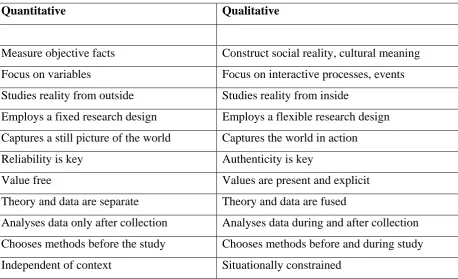
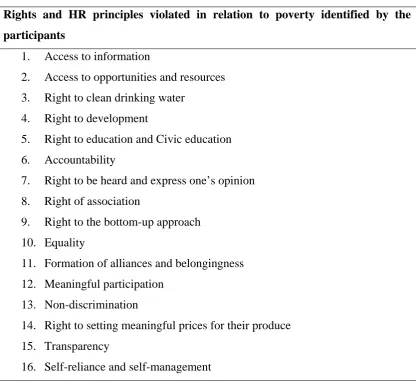
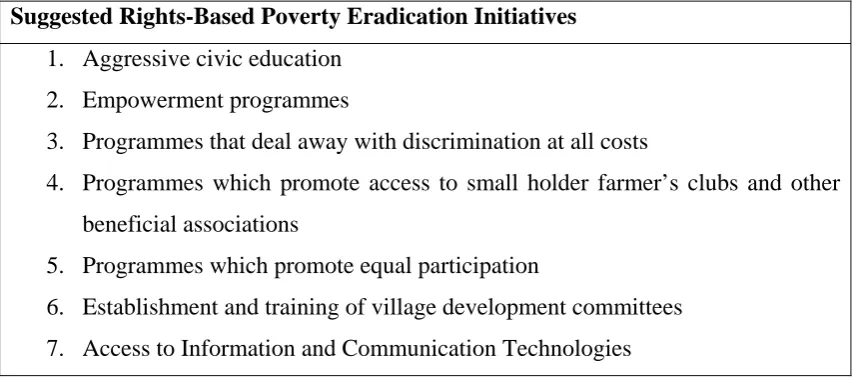
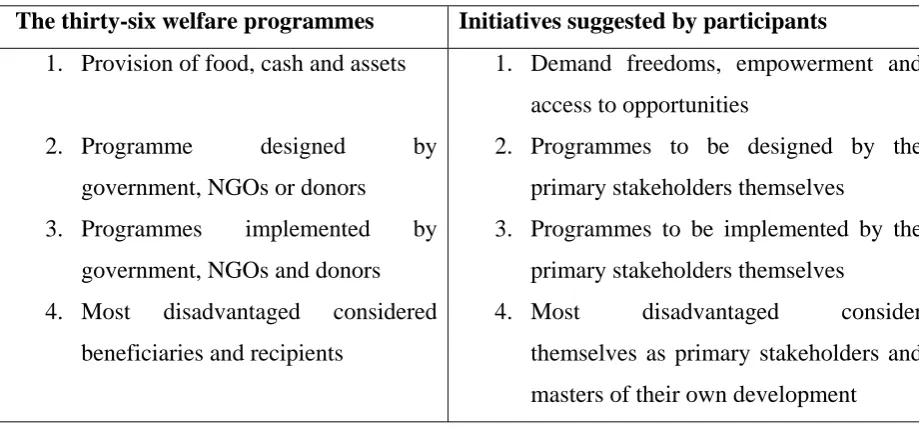
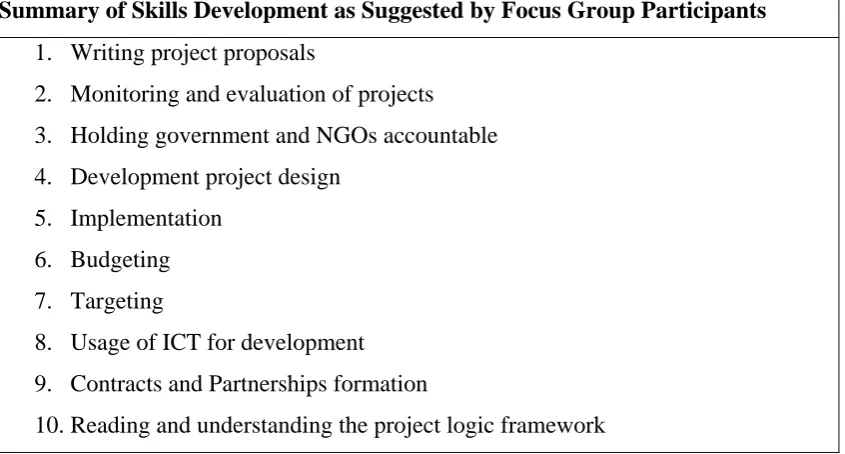
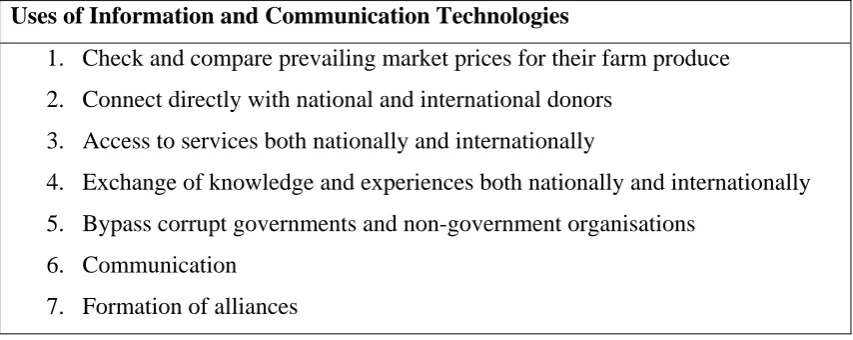
(19) List of Tables. Table 1: Differences between Quantitative and Qualitative Research. 67. Table 2: Rights Violated in Relation to Poverty. 212. Table 3: Suggested Rights-Based Poverty Eradication Initiatives. 215. Table 4: Differences between the Reviewed Social Safety Net Programmes and Poverty Eradication Initiatives Suggested by Focus Groups Participants 217 Table 5: Summary of Skills Development as Suggested by Focus Group Participants Table 6: Uses of Information and Communication Technologies. 233 234. xviii.
(20) Source: Werner, D. (1998).. 1.
(21) PART I. INTRODUCTION, LITERATURE REVIEW AND METHODOLOGY. 2.
(22) CHAPTER ONE: INTRODUCTION. Social welfare programmes play a crucial role in the development of a country. While more emphasis is given to economic growth and gross domestic product (GDP), it is generally accepted that development encompasses more indicators than just the economic performance of a country (UNDP, 2003; UNECA, 2005). Wellbeing of the populace is now considered as one of the most important indicators of development. Developing nations and the donor community have realised that some sections of society are left out in the process of development if no proper disaggregated development indicators are used to measure progress (AWID, 2002). Social Welfare programmes are introduced to cater for these marginalised groups of society (George & Wilding, 1994; UNDP, 2003; World Bank, 2006a; 2006d).. In recent years, however, it has come to the realisation of the donor community that while billions of dollars have been spent on social welfare programmes in developing countries, poverty continues to increase (UNDP, 2005). While some institutions like the World Bank (2008) claim that there has been some substantial economic progress at the global level, it has been only a few powerful and influential groups and nations that have benefited. Indeed, the rich continue to get richer while the poor continue to get poorer (AWID, 2003; UNDP-HDR, 2005). The majority of the population in developing countries (in some cases as high as 65% of the population) continue to live below national poverty lines (UNDP-HDR, 2005). As a result, the economic redistributive functions of most social assistance programmes have been questioned and calls made for more effective social assistance policies that help tackle the growing trends of poverty world wide, particularly in Sub-Saharan Africa (UNDP-HDR, 2005; Minter, 1992). One of the major reasons for failure to eradicate poverty in the last half of the 20th century has been the development paradigms that have been in use (Ultvedt, 2004; UNDP-HDR, 2005; AWID, 2002). Since attaining independence around the 1960s, most developing countries adopted development paradigms that were put in place by their colonial masters with little or no changes at all (AWID, 2003; Minter, 1992). These development paradigms lacked a broad-base support from the grassroots and focused on achieving economic growth at any cost (Minter, 1992; UNDP, 2003; 3.
(23) Chinsinga, 2003a). In the process, the masses were left out and the much sought after development proved elusive. It was this frustration for both developing nations and the donor community that led to the questioning of these development paradigms (AWID, 2002).. The current study sets out to examine an alternative development paradigm, the rightsbased approach, and uses this paradigm to develop a broad poverty eradication framework. This alternative paradigm has been chosen because of its comparative advantages over the traditional development paradigms that are not participatory and lack broad-base action to address poverty eradication. These traditional paradigms also brought unspeakable misery to the vulnerable and disadvantaged groups by failing to uphold their human rights while pursuing development (Minter, 1992; UNDP-HDR, 2005). These paradigms often perceived inclusion of some human rights in the development discourse as a threat to economic growth. These paradigms viewed development and human rights as two separate agendas and often misunderstood them as opposing. The rights-based approach to development has unified these two seemingly competing needs into one. In fact some development commentators have described the rights-based approach as novel to the development discourse (AWID, 2002; Ultvedt, 2004; UNDP, 2003; OHCHR, 2004).. 1.1 Back Ground To The Study. This study builds on earlier work I completed as a project officer with the Dedza Safety Net Pilot Project (DSNPP) in Dedza, Malawi from November 2000 to May 2003. My job involved day to day management of the project, facilitation of community participation, organisation and delivery of welfare transfers to village committees and liaison with two project consultants from the University of Reading in the UK. In order to understand the contextual issues surrounding this study, it is imperative that I explore some aspects of the Dedza Safety Net Pilot Project as it was my involvement with this project that birthed my desire to pursue further studies in social welfare programmes. The lessons I learnt during my involvement with the project also formed the basis for some of the decisions I took as this study developed.. 4.
(24) The Dedza Safety Nets Pilot Project was set up by the Government of Malawi and its major donor partner, the Department for International Development (DFID) and was implemented by a non-government organisation called Concern Universal, Dedza Office. The main goal for the project was to pilot a system of direct welfare transfers (DWT) to work-constrained rural poor in the Kabwazi and Linthipe Extension Planning Areas (EPA). An Extension Planning Area is an area that has about one hundred thousand farming households and has an Agricultural Extension Office and personnel to provide the farming households with technical farming advice. Extension Planning Areas were formed by the Government of Malawi in 1970 to facilitate access to information and agricultural demonstrations on good farming practices. It is used as a local planning and information dissemination centre close to the farming households. An Extension Planning Area is headed by an Agricultural Development Officer (ADO) who reports to the District Agricultural Officer (DAO).. It was envisaged that the lessons generated from this pilot project would inform the design of an expanded direct welfare programme to be implemented country-wide as part of the National Safety Nets Strategy (NSNS), which had formed the third pillar of the Malawi Poverty Reduction Strategy Paper (MPRSP, 1998). The Dedza Safety Nets Pilot Project had a strong monitoring and evaluation component because of the need to generate lessons which could later help in the design and implementation of the enhanced direct welfare programme for the whole country.. The Dedza Safety Nets Pilot Project tested three aspects of the direct welfare transfer process; the type of benefit, type of community management structure, and level of monitoring (Levy, Nyasulu & Kuyeli, 2002). The final results showed that a combination of cash and in-kind benefits had a greater positive impact on the beneficiaries’ wellbeing. This was because cash gave them the flexibility to purchase what they needed while the in-kind benefit shielded them from price hikes when food was scarce. Community management structures comprising beneficiaries and their carers were the most honest and effective in delivering the transfers to the listed beneficiaries (Levy, Nyasulu & Kuyeli, 2002). This was attributed to the fact that these community management structures comprised direct or indirect programme beneficiaries. It can therefore be argued that being direct or indirect beneficiaries fostered a sense of responsibility and programme ownership which in return encouraged 5.
(25) honesty and integrity. None of the committees required close external monitoring to achieve the project goals. This was attributed to the training which all the committees received at the beginning of the project. It could be argued therefore that the training built capacity in the committees which enabled them to handle all the aspects of the project (Levy, Nyasulu & Kuyeli, 2002).. The performance of these community management structures from the Dedza Safety Nets Pilot Project motivated me to pursue the issue of community participation and capacity building further. I wanted to examine poverty alleviation programmes in detail with an aim of improving their efficiency while promoting community participation. I therefore enrolled in a masters degree programme by research in 2006 which was later upgraded to a PhD. This was necessitated by the fact that as I explored the literature, I noted various attempts to design safety net programmes from diverse standpoints. However, these approaches always used development experts’ views to design and implement such programmes. I therefore realised that, as a rights-based approach project, it was imperative that such a project had to capture the views of the disadvantaged who are the primary stakeholders in safety net programmes. This need led to the expansion of the project to include focus group discussion meetings with disadvantaged and marginalised groups in rural Malawi. Kabwazi and Linthipe Extension Planning Areas were perfect choices for such an exercise because the Dedza Safety Nets Pilot Project was implemented in these two Extension Planning Areas. In this expanded project, I sought to engage some disadvantaged and marginalised groups who had participated in the Dedza Safety Nets Pilot Project and their local leadership.. This expansion of the project saw a shift from the original focus of the masters project. Some aspects of the masters level project were replaced by the focus group discussion meetings. Whereas previously a qualitative, document analysis would have been the primary source of data, as the project developed, the value of the field work became apparent. This saw the ascendency of the field study component to the centre of the current study. Nonetheless, results from a comparative analysis of thirty-six poverty alleviation programmes which was conducted as part of the masters level project were retained and are reported in Chapter Four. These results have been retained for the purpose of being compared to the poverty eradication interventions which were. 6.
(26) suggested by the participants in the focus group discussion meetings. This has been done in Chapter Nine.. 1.2 Goal and Aims of the Study. The goal of this study is to develop a rights-based poverty eradication programme that could be implemented in developing countries and be effective in eradicating poverty through the use of the rights-based development paradigm. This study sought to answer the question: What design and implementation features should a poverty eradication programme have in order to uphold fundamental human rights and be effective in eradicating poverty? This question arose because recent economic data show that while billions of dollars have been spent on poverty alleviation programmes in developing countries, poverty continues to increase (UNDP, 2003, UNDP – HDR, 2005).. This project sought to achieve the above stated goal by two means. The first aspect was conducting a document analysis of thirty-six social welfare programmes implemented in three developing regions of the world. Some programmes from two other regions were also included in the review because of their proximity to the three regions and congruence to the project aims. The second means was to use the rights-based approach as a conceptual framework of analysis and a methodological guide to engage local people in two rural communities in Malawi to:. 1. Define poverty 2. Share their views on what human rights principles mean to an ordinary citizen 3. Conduct an assessment of rights not met or violated in relation to poverty 4. Brainstorm and discuss possible poverty eradication interventions and how these interventions would be implemented informed by human rights principles.. 7.
(27) The project sought to engage these local communities because recent economic data released by the National Statistical Office (NSO) and the UNDP in Malawi, showed that 87% of Malawi’s population live in rural areas and of these 65% live below the poverty line, with 22% of these, living in dire poverty (UNDP, 2003; NSO, 2005). Over the years, these rural communities have been targeted with different poverty alleviation initiatives that were aimed at improving their well-being. However, statistics indicate that Malawians in rural areas are poorer now than they were ten years ago (UNDPHDR, 2005). Therefore their situation reflects that of many people in developing nations.. Some commentators claim that there is a wide consensus among development practitioners, the United Nations and its agencies, International Financial Institutions (IFIs) and governments in developing countries that the rights-based approach would make a positive contribution to sustainable development (UNDP, 2003; OHCHR, 2004; Ultvedt, 2004; AWID, 2002; 2003). However, the question that remains to be answered is how do you implement the rights-based approach to development initiatives, in particular, poverty eradication programmes? (OHCHR, 2004; Ewert, 2004).. Indeed, the rights based approach is “a great idea, but how do you do it?...the UN and other development agencies have struggled for years to understand how to actually implement the rights-(based) approach and they have not been able to come up with a model that works” (Ewert, 2004:1). These were remarks made by an excited but puzzled participant in one of the workshops facilitated by Lowell Ewert, the Director of Peace and Conflict Studies at Conrad Glebe University College, Canada. According to Ewert, such puzzlement is not isolated.. 1.3 Significance and Originality. This study therefore seeks to make a unique and original contribution to the poverty eradication discourse by modelling how to use the rights-based approach as both a methodological guide as well as a theoretical framework with participants from two rural communities in Malawi. This study has provided practical guidance on how to engage primary stakeholders (beneficiaries) in designing and implementing poverty eradication programmes. This study goes beyond the current discussions on the ‘need 8.
(28) to’ to ‘how to’ apply human rights principles to poverty eradication programmes. Indeed, it has taken a major leap, from human rights principles on paper to human rights principles in practice by engaging primary stakeholders to develop a rights-based poverty eradication programme model which is ready to be implemented and tested.. 1.4 The Participants’ Role in Shaping the Research Focus. The original title of this project was The Design and Implementation of Effective Poverty Alleviation Programmes: The Rights-Based Approach. However, this topic was changed by the participants in the first focus group discussion meeting and confirmed by the subsequent groups, who argued that since Malawi became independent in 1964, the government and its donor partners have been talking about and implementing poverty alleviation programmes aimed at reducing the suffering of these disadvantaged and marginalised groups. However, the opposite has occurred. Poverty is increasing and the most disadvantaged and marginalised groups have become more vulnerable now to various economic shocks. Therefore these participants demanded that the focus for this research project should be ‘poverty eradication’. This is in keeping with the principles of the rights-based approach and Participatory Action Research (PAR) which allows participants in a research project to help shape a research question and focus. This issue of changing the focus for this research has been discussed in detail in the Methodology Chapter and referred to throughout this thesis.. 1.5 Presentation of the Results in this Thesis. The style used in this thesis for presenting the results differs from a traditional one in which the raw data is presented and then the researcher makes sense of the data before discussing it. The style adopted in this thesis reports two things simultaneously: the journey undertaken by focus group participants, which will be referred to as the process, and the different outcomes at different stages of that process. Two factors necessitated the adoption of this approach. The Participatory Action Research framework which was used in the field study values the process as much as the results. However, depending on the purpose of the research, the ensuing processes sometimes take pre-eminence over the outcomes. In the current research project, the participants were asked different questions at different stages of this process and their responses are reported as part of 9.
(29) both the process as well as being results in themselves. For instance, Chapter Five reports on both initial and rights-based definitions of poverty. These two sets of definitions of poverty are results from two different stages of the focus group discussions. These two stages are interspaced by a process called the ‘engagement’. The ‘engagement process’ is discussed and reported on in Chapter Six. Thus depending on what I am reporting on at a particular time, the process may take pre-eminence over the results and vice-versa. The transformation that occurred for the participants as they participated on this journey is a result in itself and the various outcomes at different stages of this journey, which are products of the process, are also results. The implication of this approach is that these ‘process outcomes’ and ‘content outcomes’ are reported and discussed simultaneously from Chapter Five through to Chapter Nine.. 1.6 The Limitations of the Current Study. As already stated, the current study conducted a document analysis of thirty-six poverty alleviation programmes from Sub-Saharan Africa, South Asia, Latin America, North Africa and the Caribbean and also engaged poor people from two rural communities in Malawi. Given the enormous number of social safety net programmes implemented world wide, this list and analysis are not exhaustive. While the results and recommendations presented in this thesis may have wider policy implications in the poverty eradication discourse, the developing world is faced with numerous challenges which in some cases are unique and specific to individual communities. One of the major limitations with qualitative research is that the views of the participants are bound by specific context, time and place. Therefore what is presented in this thesis, for instance, the views of the participants from the focus group discussion meetings is true for the participants at the time of the discussions in their particular context. These factors may put some limitations on the generalisability of the recommendations.. 1.7 Thesis Outline. This thesis is divided into two parts. Part I contains the Introduction, Literature Review and Methodology. Part II contains Findings and Discussions, and Summary and Recommendations. Part One reviews a number of background issues before moving to examine in greater detail the features of a rights-based approach paradigm to 10.
(30) development. In this chapter, the thesis discusses the place of safety net programmes in the wider development discourse, the goal and the aims of the study, the significance and originality of the study, and its limitations. Then the background to this study is presented followed by the participants’ role in shaping the focus of the study. Finally, this chapter discusses the approach used in presenting the results in this thesis. Chapter Two explores a cross section of literature within the development discourse. Since development is a cross-cutting subject, literature from a range of disciplines and backgrounds has been reviewed and included in this literature review. This literature includes social, community, economic and political development. Literature by Western writers that was relevant for this study has also been included. At the end of the literature review, the rights-based approach to development is introduced and discussed in detail. This section on the rights-based approach begins with an exploration of its emergence and then discusses the advantages of using the rights-based approach to development. Justification for using the rights-based approach to poverty eradication programmes is also discussed. In Chapter Three, the methodology used for this study is set out. The Methodology Chapter presents the theoretical frameworks used in this thesis, and then goes on to discuss the specific processes and methods used in the field study in Malawi. The chapter finishes with a discussion of logistical and ethical issues.. Findings and Discussions, and Summary and Recommendations have been presented in Part II of this thesis. Part II contains seven chapters. Chapter Four presents results from the document analysis and their implications. Chapter Five introduces the participants to the focus group discussion meetings conducted in rural Malawi before presenting the definitions of poverty. Chapter Six presents the meanings of the eight human rights principles. Chapter Seven presents rights violated in relation to poverty; Chapter Eight presents rights-based poverty eradication initiatives which were proposed by the participants in the focus group discussion meetings. Chapter Nine discusses in details the major themes arising from the above chapters and then presents a rights-based poverty eradication programme model. Lastly, Chapter Ten contains a summary of the thesis and recommendations.. 11.
(31) 1.8 Conclusion. Chapter One has introduced the research project, its background information and its goal and aims. Other issues covered in Chapter One are the significance and originality of study, limitations of the study, the participants’ role in shaping the focus of the study and the presentation of the results in this thesis. The next chapter presents a review of the relevant literature.. 12.
(32) CHAPTER TWO: LITERATURE REVIEW. This project explores the application of a human rights-based approach to poverty eradication programmes, with specific application to addressing poverty in rural Malawi and wider implications for poverty eradication and development in general. The project combines two major approaches to exploring these issues; an analysis of social welfare programmes in a number of regions in the developing world conducted through public document analysis, and a field work component involving focus group discussions with rural Malawians intended to illuminate the experience of poverty eradication programmes and the place of a rights-based approach. The chapter explores the many ways in which poverty has actually been defined and conceptualised.. A rights-based approach to poverty eradication sits within the wider context of social welfare responses to poverty and the broader field of development, particularly as that term is used to refer to the efforts of countries in the global North to provide assistance of various kinds, and for various reasons, to countries of the global South. Establishing the parameters of this context involves understanding the historical and ideological basis of both traditional and alternative approaches to social welfare, development and poverty eradication. A key feature of this context is the use of safety-net approaches in their various forms.. The specific focus of the project is on the establishment and implementation of human rights-based approaches to development and poverty eradication in particular. It is therefore necessary to establish the basis of such an approach through a consideration of the concept of human rights, and a review of the influence that the human rights paradigm has had on recent approaches to development. From this position, it is then possible to consider the broad advantages of a human rights-based approach to development and the specific advantages of such an approach when applied to safetynet style poverty eradication programmes.. This literature review therefore covers a number of areas and issues related to the use of human rights-based approaches to development, with a goal of poverty eradication. The chapter begins with an acknowledgement that development is a problematic concept, after which a brief historical overview of development is considered from a general 13.
(33) perspective. A discussion of definitions and theories of development then follows. These definitions and theories have been considered from three view-points namely capitalist, socialist and alternative development. Two major concepts arise from the alternative development discourse, which are the notion of poverty and the human rights framework. These two concepts are considered in succession beginning with poverty followed by an exploration of the human rights framework. Examples of how poverty has been defined have been provided, followed by a brief discussion on social welfare programmes. Several controversies are explored in the social welfare discourse. The discussion of the human rights-based approach begins with a brief historical background followed by the definition of a human rights-based approach. The eight human rights principles which are at the heart of the rights-based approach are also explored. Finally, the advantages of applying the human rights-based approach to both development and poverty in particular are explored. 2.1 Development: A Problematic Concept. In order to begin to understand the specific issues involved in developing poverty eradication programmes, it is necessary to establish the broader development context within which such programmes exist. It is therefore imperative that such an endeavour should begin by examining development as a concept. Ife & Tesoriero (2006) begin their discourse on the concept of development by acknowledging that this term is a problematic one to define. They argue that “In some circles development has become a dirty word, because of the devastating consequences of the dominant form of global economic development on the nations of the majority world” (Ife & Tesoriero, 2006:103). Peet & Hartwick (1999:2) share these sentiments about the entire development enterprise. They argue that development is a. complex, contradictory phenomenon, one reflective of the best of the human aspirations and yet, exactly because great ideas form the basis of power, subject to the most intense manipulation and liable to be used for purposes that reverse its original ideal intent.. 14.
(34) Burkey (1996:2) also concedes that development is a “problematic construct and [therefore] use it [the term development] reluctantly for lack of a better alternative”. Even a cursory review of the literature reveals a trend whereby most development commentators and researchers prefer to avoid including a definition of development at the outset of their discussions, while others use the term development in conjunction with a particular focus such as economic development, social, human or community development and sustainable, green or eco-development (Ife & Tesoriero, 2006; Thomas, 2008). This signifies the elusiveness of development as a concept (Ife & Tesoriero, 2006). Another challenge when defining this concept comes with the usage of other words often seen as synonymous with development. Such words include modernization, urbanization, Westernization and, in the 19th century language, civilization (Burkey, 1996; Thomas, 2008; Slim, 1995). In view of these difficulties with the concept of development, this literature review draws on sources from a cross section of disciplines which include community development, social development, economic development and discourses on human rights, both from legal and social perspectives.. I will now provide a brief historical overview of development as a concept and then look at some specific development theories and how development theorists have attempted to define development. The historical overview is discussed here before actually defining the concept of development because, as it will be seen below, this concept came to mean different things in different eras. It could be said that the conceptions of development are embedded in its historical context.. 2.2 Brief Historical Overview of Development. The history of development has been written by several authors from a range of different perspectives. For example, Midgley (1995:37) traces the “evolution of social development as a practical approach for promoting social welfare”. In particular, Midgley (1995:37) focuses on the “role of colonial administrators who first applied the term [social development] to social welfare in the years following the Second World War”. For our current purposes however, we will look at development from a more general perspective and trace its links to the calls for respect for human rights and an alternative development paradigm. 15.
(35) Development as a discipline of study can be said to have emerged in the 1950s and the post World War II period when nations embarked on elaborate reconstruction programmes (Burkey, 1996; Slim, 1995; Thomas, 2008). The success of the U.S Marshal Plan in reviving and rebuilding the economies of the conquered nation-states in Europe gave Western economists a benchmark for modelling their blueprints for economic growth, which they began to export to the developing world. A significant political development around this period was the gaining of independence by many colonies. These former colonies turned to the economists from the United Kingdom and the USA for advice on how to develop their nations (Burkey, 1996). These economists were convinced that the unprecedented success with development aid programmes they had witnessed in Europe could be replicated in other parts of the world, such as the SubSaharan Africa (Burkey, 1996). These neoclassical economic theorists argued that economic growth was what was required and that its benefits would inevitably trickledown to the poor masses.. However, by the end of the first United Nations development decade (1961-1970) it became apparent that the opposite had occurred. Instead of the expected trickle-down of economic growth, an economic evaporation had occurred. The rich nations had become richer while the poor nations had become poorer. This trend continued to get worse. Peet & Hartwick (1999:9) noted that by 1999, “Sixteen percent of the world’s people living in 26 high-income countries [had] 80.75% of the world’s income, while 56% of the world’s people living in 49 low income countries [had] only 4.85% of the world’s income”. Even within the poor aid-recipient nation-states, the rich had become richer while the poor had become poorer. This led to these developing nations calling for a New and Equitable International Economic Order (NIEC) that would fairly distribute the benefits of economic growth (Burkey, 1996). The push to change the direction of development efforts came from many sources and took many forms. Two examples of movements which exerted significant pressure in this regard are the Cocoyoc Declaration in 1974 and the women’s movement, which were powerful forces in pushing for a new development agenda (Burkey, 1996). These two examples are therefore worthy of some further exploration, as they illustrate some of the important dynamics at work in the field of development.. 16.
(36) The Cocoyoc Declaration was the brain child of ten popular development experts who met in Cocoyoc, Mexico in 1974 (Slim, 1995; Burkey, 1996). At the end of their symposium, the participants issued a communiqué which criticized the prevalent development approaches and their philosophical underpinnings. The Cocoyoc declaration (1974) noted, among other things, that while the intention of the earlier economic development theorists were good, i.e. the belief that economic growth would automatically bring about increased living standards for all, the opposite had occurred after thirty years. In reality, the market forces favoured the most developed states and a few powerful elites. The declaration noted that three quarters of the world’s resources were controlled by only a quarter of its people (Cocoyoc Declaration, 1974). Further concern was raised in regards to the biased trade relations that existed between the developed nations and the developing states. The declaration noted that the developed nations were purchasing raw materials at a fraction of the cost but would sell processed products at exorbitant prices. These unfair trading practices meant that the poor nations became even poorer while the rich nations became richer.. Perhaps one of the key contributions of the Cocoyoc Symposium was the clear articulation of the inner limits of man: how much can man consume and absorb; and the outer limits: the production and carrying capacity of the biosphere (Cocoyoc Declaration, 1974:7). The symposium noted that man should only meet his basic needs and not over produce and over consume, which they argued only results in an “ever increasing need for tranquilizers and mental hospitals” (Cocoyoc Declaration, 1974:6). The notions of over production and over consumption had their philosophical underpinnings in the prevalent notions of economic growth which assumed that production would continue to increase infinitely. The Cocoyoc Declaration (1974) cautioned that current use of world resources to meet needs should not jeopardize the ability of future generations to meet their needs. Thus the declaration managed to bring environmental limits to the forefront of the development agenda (Cocoyoc Declaration, 1974).. The Cocoyoc Symposium came up with several solutions to the above problems and challenges. Among them were the following: immediate abandonment of the philosophy of “growth first, justice in the distribution of benefits later” (Cocoyoc Declaration, 1974:5); increased self reliance among the poor nations, i.e. the idea that poor nations 17.
(37) should pursue detachment from an enslaving and exploitative world economic system; a direct appeal to individuals who were no longer willing to be used by the developed states as agents of exploitation to begin to help poor countries with environmentally friendly research and technologies that would help them develop;. and. the. establishment of international regimes that would control the world’s common property and ensure equitable distribution of its benefits. In essence, the Cocoyoc Declaration (1974:8) rejected the prevalent uni-linear economic growth model and called for the institution of a “new more cooperative and equitable international economic order”, which recognized that the “point of departure for the development process varies considerably from one country to another, for historical, cultural and other reasons; consequently …the need for pursuing many different roads of development” (Cocoyoc Declaration, 1974:6). This declaration can be seen as the foundation of the Alternative Development Agenda (Slim, 1995; Burkey, 1996).. The women’s movement also had a considerable impact on the development discourse in the 1970s (Ife & Tesoriero, 2006; Burkey, 1996). A number of authors recognize, for example, the work of Dutch economist Ester Boserup (1970) who brought to light the plight of women in the developing world, especially Sub-Saharan Africa (Burkey, 1995). Boserup (1970) is given credit for carefully demonstrating that women’s contribution to overall agricultural production was critical in sustaining both local and national economies in the developing world (Burkey, 1995). Boserup (1970) analysed economic data from three continents namely Africa, Asia and South America and showed that colonialism and modernization were having negative impacts in the developing world. The Sub-Saharan African region was singled out as the worst affected. The western values that were imposed by the colonial overseas administrators, “redefined the concept of ‘work’ in African societies to exclude women’s labour” (Burkey, 1995:3). These western values, in effect, devalued and undermined the contribution women make to the household’s livelihood. Peet & Hartwick (1999:8) citing Snyder (1995:15) argue that “60-80% of the food producers in the ‘informal sector’ and 70% of informal entrepreneurs are women”. According to Burkey (1996) Boserup’s work (1970) provided an impetus for female professional development practitioners in the USA to pressure their government for aid policies that would alleviate the suffering of women.. 18.
(38) The above developments coincided with the efforts of the international women’s movement which successfully gained recognition as a political force at the UN level. Because of this recognition, the UN held three conferences for women in 1975 (Mexico City), 1980 (Copenhagen), and 1985 (Nairobi) (Burkey, 1996). The key outcome from these conferences was the elevation of the feminist development agenda onto the international political scene. This meant that feminist development perspectives provided an effective challenge and critique to the prevalent development notions which they argued were patriarchal and structurally designed in ways that oppressed women (Slim, 1995; Ife & Tesoriero, 2006). Another achievement is that the feminist movement managed to bring the plight of the ‘girl-child’ and women’s rights in various areas to the fore of the development discourse (Burkey, 1996). Burkey (1996) finally notes that the feminist movement used their ability to organize and network to form powerful networks among activists, governments and non-government organizations world wide. Their calls and lobbying ability added weight to the argument of the need for alternative approaches to development (Ife & Tesoriero, 2006).. This brief historical account of development has traced the history of development from a general perspective. As noted at the beginning of this section, various authors have looked at the history of development from different perspectives. It was not the intention of this brief historical account to be exhaustive. However, selected literature and authors were explored which had a direct relevance to the goal of this section which was to trace the link between development and the calls for respect for human rights and the alternative development paradigm. In the next section, I will present a number of definitions and theories of development.. 2.3 Definitions and Theories of Development. Burkey (1996:2) noted that the “field of development studies is a veritable jungle, inhabited by theories, counter-theories, approaches, paradigms and programmes of all sizes, shapes and colours”. Therefore, the task of exploring definitions and theories of development is not an easy one. This task is further complicated by the lack of clear cut demarcation between definitions and theories of development. In many cases the definition caries within itself, implicitly or explicitly, an analysis of the causes of underdevelopment and how development could be achieved. Thus in the pursuit of 19.
(39) theories of development, one is bound to be talking about definitions of development as well. As Burkey (1996) further notes, each theory has attracted both criticism and counter-theories.. The focus of this thesis is not on exploring how development has been defined over the years and its subsequent theories. Rather it is an exploration of how to design effective poverty eradication programmes from a human rights perspective. Therefore for our current purposes, I will examine the ways in which earlier development theorists conceptualized development and how they argued it could be achieved. Then I will explore some critiques of such conceptions, especially those which form the foundation for the alternative development discourse. This is because poverty eradication and the human rights framework which is at the heart of this project fall within this alternative development discourse.. 2.4 Classifications of Definitions and Theories of Development. As noted above, the terrain of development definitions and theories is a labyrinthine one (Burkey, 1996). Therefore some form of classification is necessary for organisational purposes. Two broad approaches to the classification and defining of development can be identified, the first of these focuses on purely economic factors and is illustrated by the analyses of Trujillo (2001), while the second looks at ideological factors and is presented in the work of Burkey (1996). Trujillo’s (2001) classification deals with theories and definitions which have their underpinnings in micro and macro economic factors (Trujillo, 2001; Slim, 1995). Micro level economic approaches deal with the traditional and local economic factors and enterprises (Slim, 1995; Trujillo, 2001; Burkey, 1996). Macro level approaches deal with the national and international aspects of the economy (Trujillo, 2001). This level of the economy deals with multinational companies, national and international trading policies and interstate policies.. According to Trujillo (2001) there have been changes in the way development has been defined in the last five decades. These changes have been in accordance with economic, political and social trends. Trujillo (2001) points to an important distinction in the way the concept of development was earlier defined, and cites Olson (1996) and Hayami & Ruttan (1970) who, when focusing on micro-economic factors, defined development as 20.
(40) concerned with “economic transformation produced by structural transformation and institutional change”. The second view of development placed more emphasis on analysing macro-economic factors. Such an analysis resulted in defining development in terms of ‘economic growth’ as measured by Gross National Product (GNP). Therefore Trujillo (2001:171) concludes that “from these economic perspectives, understanding the differences in development is equivalent to understanding the characteristics of an economy and the causes of economic growth”.. Burkey (1996) offers another classification which differs from the one Trujillo (2001) explores. Burkey’s (1996) classification is based on ideological differences which have their roots in the cold war era and on the thoughts of progressive development writers who rejected the conceptions of development advanced by both capitalists and socialists. Using this approach, definitions and theories of development could be classed under three paradigms: capitalist, socialist (also known as radical political economy) and alternative development. However, Burkey (1996:4) cautions regarding capitalism and socialism that as distinct as these two camps may appear, they “do not constitute a simple dichotomy either in theory or in the actual (developing) world economies”. This is because in the postcolonial era, the newly independent states tended to have a combination of some characteristics of both paradigms in their economies (Burkey, 1996). The same could also be said of the current developed economies, and the World Bank Group and the International Monetary Fund (IMF), commonly known as the Bretton Woods Institutions, which claim to be true to a capitalist agenda, have increasingly pursued some socialist policies to redress the shortfalls of capitalism (Burkey, 1996). These dichotomies are further complicated by variations and strands of each paradigm with some contradicting each other (Burkey, 1996; Slim, 1995). Given their significant impact, it is worth exploring the capitalist and socialist paradigms and their various strands in order to clearly see their internal variations and some contradictions.. 2.4.1 The Capitalist Development Paradigm. According to Weaver et al. (1989) there are three variations within the capitalist development paradigm, namely the Free-market, the Malthusian and the Interventionist models (cited in Burkey, 1996:4). 21.
(41) Free-market Model. Capitalism. Malthusian Model. Interventionist Model Three Variations of the Capitalist Model. The free-market model advocates for a free market governed by market forces. It therefore claims that for development to occur there is a need for private capital and for reduced or no government intervention at all in the market. The free-market model argues that the ‘invisible hand’ of the market is capable of allocating the benefits of economic growth to all (Slim, 1995; George & Wilding, 1994). This model is therefore a prime believer in the ‘trickle down’ effect of economic growth. However, the capitalist paradigm recognizes that there are some people who are left out of the economic loop and that such people require assistance (George & Wilding, 1994). Such people might include for example, the aged and frail, orphans and people living with a disability. The capitalist paradigm therefore provides a life-line in the form of some financial payments, vouchers or in-kind support. Although there are variations in size and kind, such programmes have widely been called safety nets. I will explore the issue of safety nets in greater detail later in this chapter.. The foundation for the Malthusian model was laid by The Rev. Thomas R. Malthus in 1798 (Halsall, 1997). This classic work started as a rebuttal against “William Godwin (1756-1836) whose ‘Enquiry Concerning Political Justice’ argued in favour of a more egalitarian society and economics in order to end poverty” (Halsall, 1997). Malthus (1798) used two laws to formulate his ideas – the law of population growth and the law of the biosphere to sustain life. His key observation was that the rate at which population grows is faster than the capacity of the earth to support that population until there would reach a point when the earth can no longer support life. “Population, when unchecked, increases in a geometrical ratio. Subsistence increases only in an arithmetical ratio. A slight acquaintance with numbers will shew the immensity of the 22.
(42) first power in comparison of the second” (Halsall, 1997). Therefore he argued that for development to occur, resource scarcity should be addressed by controlling population growth. His underlying philosophy was that the available resources (Gross National Product (GNP) in modern day language) which mean the “value of the total final output of goods and services produced by an economy” at any one time would be more than enough if shared by fewer people (Peet & Hartwick, 1999:4). This would lead to high per capita incomes – which is Gross National Product (GNP), divided by the number of people sharing the benefits produced by that economy. Therefore the larger the population sharing the economic cake the smaller the piece to each individual and vice versa. For Malthus (1798), nation states had to curtail their populations in order to progress and develop.. The third strand under the capitalist paradigm is the Interventionist model. It is worth noting that in many ways, the Interventionist strand is contradictory to the free-market model (Slim, 1995; Thomas, 2008). The Interventionist model, while remaining true to the capitalist paradigm, does not believe in the rhetoric of the ‘invisible hand of the free-market economy’ and therefore urges “government intervention through regulatory and technocratic mechanisms to redistribute income and provide public goods” (Burkey, 1996:4). This strand argues that left to their own, markets would produce distorted development which would leave many locked out of the economic cake. Indeed at the end of the first development decade (1961 – 1970), the assertions of the interventionist model appeared to have been vindicated. The gap between the rich and poor states had widened and within the poor countries the rich had become richer while the poor had become poorer (Thomas, 2008; Burkey, 1996; Trujillo, 2001; Slim, 1995).. 2.4.2 The Socialist Development Paradigm. The second of the major approaches to development is presented by the socialist development paradigm. Socialism as a development paradigm can be seen as having two strands, namely the dependency analysis and Marxism (Burkey, 1996:5).. 23.
(43) Dependency Analysis. Socialism. Marxism Two strands of the Socialist Paradigm. The dependency analysis approach centres on the concept of unfair ‘relations of exchange’ (Burkey, 1996:5; Martinez-Vela, 2001). The central argument of this perspective is that developed nations achieved and maintained their economic growth and industrialization by exploiting colonies, which they had acquired, and other poor nations. The dependency framework analysts are aided by the world-systems theory to explain the relationship between rich and poor nations (Martinez-Vela, 2001; Burkey, 1996).. The world-systems theory as coined by Immanuel Wallerstein in 1974, deals with unfair relations between rich nation-states which are at the ‘centre of economic activity’, or the core, and the poor nations which are at the periphery. In this relationship, the coreperiphery as it is called, there is a systematic siphoning of resources from the periphery to the core. This is achieved by neo-imperialistic or neo-colonialistic trade policies which favour the rich and powerful states. One such policy is the free trade policy which systematically transfers “surplus from the semi-proletarian sectors in the periphery to the high-technology industrialized core” (Martinez-Vela, 2001:4). Martinez-Vela (2001:4) notes that advancement in “technology is a central factor in the positioning of a region in the core or the periphery”. This being the case, the core states do everything possible to deny, delay, derail or even sabotage technological advancement of the periphery. Indeed, these hegemonic advantages of the core help the rich and powerful states to “maintain a stable balance of power and enforce free trade as long as it is to their advantage” (Martinez-Vela, 2001:4). In this case, it could therefore be concluded that the rich nations depend on the poor and weak states for the acquisition and maintenance of their wealth and that it is in the best interest of the rich states that the poor remain impoverished. 24.
(44) The second strand under the socialist paradigm is the Marxist perspective which centres on ‘relations of production’ (Burkey, 1996:5). Marxist development theorists argued that the state should control the means of production which would enable it to distribute the benefits to each according to need (Burkey, 1996). The Marxists treated the capitalist agenda with suspicion (George & Wilding, 1994), viewing neoclassical economic theory (the capitalist paradigm) as favouring the powerful and rich to the disadvantage of the peasants and the poor. In this regard, Marxism viewed capitalism as actually “restricting economic growth” (Burkey, 1996:5). Marxism therefore sought to be more inclusive by embracing a diversity of strategies aimed at mobilizing ‘everyone’ to be a part of the means of production. These strategies, according to Burkey (1996), included mobilizing unions and grassroots movements, centralized planning and land redistribution.. Regardless of the different strands and some times opposing conceptions of development, the strands in each paradigm can be seen to share certain characteristics. For instance, the three strands in the capitalist paradigm use the individual as the unit of analysis. They all equate development with economic growth and assert that individuals and nation states act in self interest and that their ultimate goal is to increase productivity which in turn increases economic growth. In general, they define development as progress through stages of growth which is realized by “increasing gross levels of savings and investment (internal and external, private and state)” (Burkey, 1996:27). Similarly, the two strands in the socialist paradigm also share some common characteristics. They both use society as the unit of analysis and they both believe in the equality of all peoples and their right to share all material goods. In this regard, development is conceived and defined as a process of increased production through the state machinery and the equitable distribution of the benefits to all the citizens each according to need. Having briefly examined these two perspectives of development as discussed by Burkey (1996), we will now look at the third perspective, commonly referred to as alternative development.. 25.
(45) 2.4.3 Alternative Development. The term alternative development refers to the progressive thoughts of practitioners and theorists who argue that the current situation of underdevelopment is a result of development misconceptions manifested by the current paradigms (Ife & Tesoriero, 2006; Slim, 1995; Burkey, 1996). These development practitioners and theorists therefore call for a new and holistic approach to development (Slim, 1996). While calls for alternative development can be traced to as early as the end of the first development decade (1960-1970), such calls only gained significant momentum in the early 1990s (Burkey, 1996). This gain in momentum has been attributed, in part, to the collapse of the Eastern Bloc and, on the other hand, to increasing empirical evidence of the failure of the capitalist paradigm (Burkey, 1996; Ife & Tesoriero, 2006; Slim, 1995). Indeed economic data “reveal poverty so horrendous that is it impossible for ethical people to conclude that the modern history of the West should ever be repeated in anything like the same form” (Peet & Hartwick, 1999:11). Although resistance and suspicion from the capitalists remain, the plight and scale of human suffering cannot be ignored (Burkey, 1996). The prescribed development “bitter pill” which was claimed would cure poverty and underdevelopment has been swallowed and given time to work, only to result in more poverty, marginalization, greed, hypocrisy and unfair trading policies (Burkey, 1996; Thomas, 2008; Minter, 1992; Slim, 1995). These conditions have precipitated and crystallised the calls for alternative development.. Grouped under the heading of the alternative development paradigm are several theories, perspectives and approaches. At the heart of such alternative development models is an understanding that the development process is complex and that there is a need for a holistic approach (Slim, 1996; 2002; Burkey, 1995). Generally speaking, alternative development models aim to “develop and support community level structures which enhance empowerment and which challenge the oppressive structures of the existing order” (Ife & Tesoriero, 2006:104). Ife & Tesoriero (2006:105) have further argued that alternative development has the following characteristics:. 26.
(46) Little if any reliance on government structures; local-level development; grounding in the local culture rather than imposing a model from outside; indigenous leadership; specific addressing of the structures of disempowerment; and high levels of participation by local people.. Therefore, according to Ife & Tesoriero (2006), development is a process of the people, for the people and by the people.. Another development practitioner who discusses the concept of alternative development is Slim (1995). Slim (1995) provides seven characteristics of effective and genuine development which he refers to as the “basic ingredients of development”. Slim (1995:143) argued that understanding these characteristics is crucial to understanding “what development is and how it comes about”. These characteristics are change for the better; continuity; appropriateness; originality; equity and justice; sustainability, selfreliance and independence; and that every development takes time. I will now briefly touch upon a few of these characteristics. Effective development according to Slim (1995) must be culturally, socially, economically, technologically and environmentally appropriate to the community. He argues that genuine development “must have something in common with the community or society in question” (Slim, 1995:143). He further argues that appropriateness means that “development must make sense to the people and be in line with their values and their capacity” (Slim, 1995:143); He also argues for the role of originality – referring to development that’s initiated by the people, nurtured by the community and shaped by the society and not an “imitation of somebody else’s development” (Slim, 1995:144; Burkey, 1996). Thus Slim (1995) warns against the danger of imported development that it superimposes itself on a society and ultimately destroys it.. Slim (1995) also argues that effective development should be founded on principles of equity and justice. According to Slim (1995) these two should be the twin ingredients of any change for the better. However, he notes that in the process of change, conflicts and struggles are inevitable because any change will be embraced by some and at the same time resisted by others. He then introduces the concept of participation which he argues is a key aspect of equity. If development is going to be ‘original’ then the local people must be at the centre of the development process. This leads Slim (1995:144) to 27.
(47) contend that “true development can be achieved only by the people and can not be done to the people”.. Another characteristic of genuine development that Slim (1995) discusses is sustainability, self-reliance and independence. Slim (1995:144) calls these the “eggs that bind the mixture of the cake”. Slim (1995) argues that if the development originated from within the community and the community members have meaningfully participated at all the phases of the development process, then it will be sustainable and foster independence and self-reliance among the communities.. Slim (1995:144). concluded his discussion on sustainability, self reliance and independence by bringing into perspective the concept of “intergenerational equity”. Intergenerational equity has been defined as ensuring that “the change for the better” is available “for future generations too, and not just at their expense”. Therefore any kind of development should ensure that it is sustainable and take into consideration environmental limitations. Other concepts related to this ingredient include eco-development or green development which according to Katherine Sierra, the Vice President of the World Bank Sustainable Development Programme means “Promoting economic growth strategies based on expanded infrastructure which are environmentally responsible and socially acceptable” (Sierra, 2008).. Finally, Slim (1995:144) notes that every development takes time. He argues that the push for instant transformation and development has been the “cause of many of the world’s most inappropriate development initiatives”. Both the developed and the developing nations have been, and still are, under pressure to see the results of the massive investments that have been made over the last half a century. While billions of dollars have been spent on poverty alleviation and other development programmes, poverty continues to increase (UNDP-HDR, 2005; Ife & Tesoriero, 2006). These aiddefying trends and the failed economic prescriptions have increased the pressure for a quick fix of some sort. However, Slim (1995:144) explains that this pressure for quick results “stems from a wide spread naivety in the world’s major development institutions over the last 50 years, a naivety founded on an over-confidence in technological and economic development, without sufficient regard for social and environmental realities”.. 28.
Figure
+3
Outline
Brief Historical Overview of Development
Alternative Development
The Concept of Poverty
Advantages of Using the Rights-Based Approach to Development
Challenges of Participatory Action Research
Composition of Different Focus Groups
CHAPTER FOUR: COMPARATIVE ANALYSIS OF THIRTY-SIX POVERTY LLEVIATION PROGRAMMES
Accountability
CHAPTER SEVEN: RIGHTS THE PARTICIPANTS IDENTIFIED AS VIOLATED
CHAPTER EIGHT: RIGHTS-BASED APPROACH POVERTY ERADICATION INTERVENTIONS SUGGESTED BY THE PARTICIPANTS
Related documents
