A Work Integrated Learning (WIL) Framework to develop graduate skills and attributes in a university’s Accounting and Business courses
Raymond Leong1
Faculty of Business and Law, University of Southern Queensland
Professor Marie Kavanagh Faculty of Business and Law, University of Southern Queensland
Abstract
For many years, emphasis has been placed on the production of ‘work ready’ graduates competent in their disciplinary field and able to cope in a changing work environment. Universities are being placed under increasing pressure to produce employable graduates with governments making public funding for universities contingent upon demonstrable graduate outcomes. This has resulted in universities offering their undergraduate students in commerce and business the opportunity to gain good business acumen and real world experience by undertaking Work Integrated Learning (WIL) as part of their learning.
This paper proposes a three stage model to effectively embed WIL into undergraduate accounting and business programs. Through careful planning, implementation and assessments in three accounting/business courses in the WIL framework, students are encouraged to build essential knowledge and skills. They learn that to be successful in the working environment, they will need to be equipped with not only technical skills but transferable generic skills like communication, teamwork, problem-solving and the ability to network in a variety of workplace situations.
This program seeks to narrow the expectations gap between industry and academia and students and supports the development of graduates who can respond to changing economic circumstances and are employable, adaptable and positive contributors in the workplace.
Keywords
Introduction
For many multi-national companies, the global skills shortage has impeded their ability to attract competent workers with business leaders citing poor business acumen and lack of real world experience as serious shortcomings (Gamble, Patrick and Peach, 2010). In recent times, there has been a major push by the Government to significantly increase the number of degree-qualified persons in the Australian working population (Bradley, Noonan, Nugent, & Scales, 2008).
As part of the efforts to do that and to improve the quality of graduates, universities have been urged to develop and embed appropriate knowledge and skills through teaching and scholarship to enable self-fulfilment and personal development for students. The intention is to equip graduates with critical analysis skills and independent thought to support a highly productive and professional labour force. This will help to prepare them to be future leaders in a diverse, dynamic global environment (Bradley, et al., 2008).
Employers too have strong views about the employability skills required (Archer and Davidson, 2008) but perceive that new accounting graduates are not being taught adequate generic skills in their programs (Barrie, 2006; Hancock, Howieson, Kavanagh, Kent, & Tempone, 2009; Jackling & De Lange, 2009). A study by Kavanagh and Drennan (2008) found that while employers still expect a base level of technical skills, they require ‘business awareness’ and an understanding of the ‘real world’. Discipline based knowledge in tertiary education alone does not meet all the needs of employers and means have to be found to deliver and assess relevant competencies and capabilities of employable graduates (Business Industry and Higher Education Collaboration Council, 2007; Crebert, Bates, Bell, Patrick, & Cragnolini, 2004; International Federation of Accountants Education Committee, 2003).
(Hancock, Howieson, Kavanagh, Kent, & Tempone, 2009) report that employers are seeking graduates who possess a diverse range of non-technical skills including written and verbal communications, self-management, teamwork, initiative and enterprise, problem solving, technological competence and planning and organising skills with employers also using such skills as discriminators when evaluating graduates. In the workplace, conscientiousness, dedication and an ability to deal with complexity, uncertainty and pressure are also highly valued.
The skills required of accounting professionals have changed drastically during the last few decades (Howieson, 2003). The context and dynamics of a global complex business environment has resulted in changes in the skills set and attributes required by accountants seeking to add value for their clients (Jackling & De Lange, 2009). For example information technology has become a crucial part of our global society yet Kumski, Switzer and Cloeckner (2009) found graduates requiring more engagement in advanced use of technology for communication, information sharing and problem solving.
Accounting is a vocational discipline and the input of industry and professional bodies is important in the design of accounting programs. In fact, professional bodies have been prescribing a required skill set (CPA Australia & The Institute of Chartered Accountants in Australia, 2005).As a result a key focus of the professional accounting bodies and universities is the development of a range of skills both technical and non-technical. The recent accounting threshold learning outcomes produced as part of the Australian Learning and Teaching Council (ALTC) standards agenda (2010) emphasised the need for professional judgment, knowledge, application of skills, communication and teamwork and personal management skills. These skills enhance the ability of graduates to apply acquired technical skills in a variety of contexts and situations and equip them with life-long learning skills (Howieson, 2003).
their teaching approaches in higher education in order to add value to students’ learning and the community (Albrecht & Sack, 2000; Howieson, 2003; Jones, 2010).
Curricula should incorporate generic skills development as core learning objectives. Accounting educators need to develop, teach and assess a multidisciplinary skill set comprising skills in analysis, problem solving, written and verbal communication; and client relations in addition to the technical accounting skills (Howieson, 2003).
Cranmer (2006) suggested that academic efforts to teach employable skills are at best producing mixed results and therefore resources would be better utilised in increasing employment-based training and work experience for graduates. Practical placement exposure to the work environment assists in the development of a range of skills including technical and generic skills. Employability involves far more than possession of generic skills listed by graduate employers as attractive. Rather for optimal economic and social outcomes, graduates must be able to proactively navigate the world of work and self-manage the career building process (Bridgstock, 2009).
Universities have now responded to this pressure to turn out employable graduates. Many of them have started to include employability skills as part of the graduate skill set through curriculum redesign, course content and delivery strategy (Albrecht & Sack, 2000; UniversitiesAustralia, 2008). They have sought to articulate graduate outcomes from university education by identifying combinations of requisite skills and attributes of their graduates (Barrie, 2006). This is done progressively and developed over time in a degree program. Universities are now focusing on developing generic skills in students to prepare them for work in different work contexts and dynamic business environments (Barrie, 2006; Bridgstock, 2009). One of the ways universities address this issue is through the development of Work Integrated Learning Programs, making industry experience a pre-requisite of business programs (Lebihan, 2007).
This paper proposes a model to effectively develop essential skills and attributes using a framework centred around Work Integrated Learning. In the next section relevant literature is discussed. This provides a basis for the development of the WIL Framework and its implementation across courses in the following section. Finally, discussion of the model and conclusions are drawn.
Literature review
Work Integrated Learning (WIL) has a long history of existence under different names such as internship, co-operative education, experiential learning and action learning. In a generic sense, Work Integrated Learning (WIL) is a range of work-related activities and experiences built into a student’s study program. Reeders (2000) defined WIL as “student learning for credit designed to occur either in the workplace or within a campus setting that emulates aspects of the workplace”. Simply put, WIL is learning by doing and is designed to help students to develop a better understanding of their future career path, personal and professional direction, extend their knowledge of the world of work and range of employment opportunities. It is a partnership arrangement among students, educational institutions and host organisations with designated responsibilities for each party. It gives students opportunities to apply the theories being learnt in the academic classroom in an actual workplace. Although there is not one agreed definition of WIL, McIlveen et al (2011) found Moreland’s (2005) definition to the most relevant are surveying career development practitioners at Australian universities. Moreland defines work integrated as learning that:
Apostolides & Looye (1997) provide a model of WIL for integration. Learning tasks and assessments can be integrated and include measuring numerous capabilities and skills in multi-dimensional professional contexts (Wood et al., 2009). They suggest a combination of course work (on campus learning) and placement experiences (work place learning) that has three stages: an early stage, an intermediate stage and a late stage where students experience activities and pedagogies increasing in complexity as they advance through the stages.
A key aspect of WIL is the notion that it entails the integration of knowledge and skills gained in the educational institution and in the workplace. It is the integration aspect of WIL that distinguishes it from workplace learning where a student learns at the workplace (Boud & Falchikov, 2006).
WIL is also a vehicle for developing essential graduate attributes are the qualities, skills and understandings that a university community agrees all its graduates should develop as a result of successfully completing their university studies. These attributes include and extend beyond the disciplinary expertise or technical knowledge that has been the core of most traditional university courses.
There are perceived difficulties in understanding and defining generic attributes (Barrie, 2006; Jones, 2010). Terms like attributes and skills lack conceptual clarity (Green, Hammer, & Star, 2009) and the imprecision and vagueness of concept definitions has led to a persistent view by employers that a skills gap exists (Levenson, 2000; Sin, Jones & Petocz, 2007). Differences in interpretations amongst institutions impact on the way teaching strategies to embed graduate attributes into curricula are designed and taught (Barrie, 2006; Green, et al., 2009; Jones, 2010). This problem of conceptualising is further complicated by different discipline contexts (Jones, 2010) and current environmental and institutional factors like higher student numbers, greater diversity of student backgrounds impacting teaching practices and casualisation of teaching staff (Green, et al., 2009; Jackling & Keneley, 2009). Whilst there are skills which are shared with other disciplines, generic skills in accounting are heavily influenced by the accounting profession and industry needs (Jones, 2010). It was found in the Jones study that critical thinking, problem-solving and communication were conceptualised and taught in different ways in various disciplines.
It is imperative that academics need to have a common understanding of the fundamental nature of graduate attributes and qualities in the accounting discipline and how such outcomes impact the technical aspects of accounting (Barrie, 2006). This had led to a push for discipline standards with accounting the first discipline to be examined (Freeman, 2010).
Jackling & De Lange (2009) investigated the emphasis placed on technical and generic skills essential for employability and career progression developed in undergraduate accounting courses from the graduate and employer perspective. They found that although both groups converged and recognised the importance of technical skills such as accounting problem analysis and key accounting skills, employers require a broad range of generic skills that were not adequately taught and developed in accounting programs. The areas of divergence were in team skills, leadership potential, verbal communication and interpersonal skills. Results also revealed that programs are failing to provide a specialised professional education to meet the needs of employers of accounting graduates.
Robley, Whittle & Murdoch-Eaton (2005) examined the alternate pedagogies of ‘embedding’ and ‘in parallel’ generic skill development and concluded that the embedded approach with appropriate skills development mapping was the superior skill development approach. Lucas, Cox, Croudace & Milford (2004) claimed that generic skill development is a tacit process developed over life and as such it is best not developed through standalone modules. Patrick, Peach & Pocknee (2009) identified the importance of designing WIL and treating skill development as an integral and integrated part of the curriculum rather than as a ‘bolt on’ experience. In a report in 2005, CPA Australia & the Institute of Chartered Accountants in Australia recommended that generic skills should be developed in an integrated manner in the accounting program rather than as a standalone course. Good curriculum design will ensure generic capabilities are built into learning outcomes across the curriculum and will ensure constructive alignment between learning outcomes and learning activities, assessment tasks and the criteria used to evaluate assessments (Biggs, 2003).
In a recent study Hancock et al (2009) identified eighteen different teaching strategies for developing non-technical skills in business programs at the course level with one at the whole of program level. Willcoxson, Wynder & Laing (2010) described a strategy for conducting a whole-of-program review of generic skills in a university accounting program. Accounting staff map courses they teach, aligning generic skills to objectives and to teaching and assessment activities to improve generic skills learning outcomes for students.
Prior research has identified a number of reasons for accounting education failing to provide graduates with the desired competences. These may be generalised to differences in the expectations of accounting academics and employers, students’ perceptions of accounting programmes and the profession; and their ability and aptitude, institutional constraints and the ineffectiveness of university teaching. A framework expanding on the skills gap literature is proposed by Bui & Porter (2010) and identifies contributory causes as:
a. Differences in the expectations of accounting employers and educators regarding the competencies accounting graduates should acquire (‘expectation gap’)
b. Constraints on the effectiveness of accounting education (‘constraints gap’) resulting from institutional factors and accounting students’ ability and aptitude
c. Differences in the competencies accounting educators can reasonably expect accounting graduates to acquire (given the constraints) and those employers perceive the graduates possess when they enter the workforce (‘performance gap’).
Their research used a holistic approach to provide support for the proposed framework and resulted in identifying ways in which the gap may be narrowed.
In 1993, the professional bodies of CPA Australia and Institute of Chartered Accountants in Australia (ICAA) accepted and endorsed recommendations for Competency Standards for Accountants (1993). The Generic Skills list consists of thirty cognitive and behavioural skills commonly applied in practice and highly regarded by professional bodies and employer groups (Birkett, 1993; Institute of Chartered Accountants of Australia & CPA Australia, 2009). Cognitive skills cover routine, analytic/design and appreciative skills whilst behavioural skills consist of personal and interpersonal skills. Communication skills are listed separately as these are valued highly by employers and professional bodies as they permeate across many business environments both locally and internationally.
Accreditation is based on demonstrated quality of an education experience. One of the basis for accreditation by the ICAA is the extent to which teaching methodologies facilitate the development of both technical and generic skills (Institute of Chartered Accountants of Australia & CPA Australia, 2009). The professional bodies expect a total education experience with a balanced curriculum for students covering not only a broad foundation of technical education but also skills relevant for effective work in the business environment.
The WIL Framework
To date, few universities can provide convincing evidence of curricula that comprehensively and systematically develop these abilities (Barrie, Hughes, & Smith, 2009). They identified eight interacting elements which affect an institution’s efforts to foster curriculum renewal to achieve graduate attributes. They are conceptions, stakeholders, implementation, curriculum, assessment, quality assurance, staff development and student-centredness.
The University of Southern Queensland (USQ) aims to address the elements in the Barrie et al (2009) study by introducing a USQ WIL framework in Accounting. At the USQ Springfield campus, all undergraduate accounting students have the opportunity to experience Work Integrated Learning (WIL) as part of their learning. Through careful planning, implementation and execution of assessment in three accounting/business courses in the WIL framework, students build essential skills. They appreciate that to be successful in the working environment; they will need to be equipped with not only technical skills but transferable generic skills like communications, teamwork and problem-solving that can be applied to a variety of workplace situations.
This framework incorporates many aspects of employable skills and attributes expected of a university graduate from business and commerce programs. It narrows the expectations gap between industry and academia and produce graduates that are more readily employable, adaptable and positive contributors in the workplace. The process starts by examining the university’s policy of graduate qualities and attributes. Its implementation will involve a progressive approach in embedding skills in selected courses in the accounting program.
Graduate qualities are ‘vision statements’ that describe five broad domains of student learning, capability and engagement whereas graduate skills are specific, assessable sub-sets of student learning. Teaching and assessing USQ graduate skills in programs and courses ensures that students are given the opportunity to graduate with those skills described in USQ policy (University of Southern Queensland, 2010b). The aim of developing these qualities is so that graduates can manage, apply and communicate discipline knowledge purposefully, ethically, sustainably and with originality to different audiences: apply their learning across a range of contexts; and work with a diverse range of individuals and groups, in local, national and international environments to attain personal and professional goals (University of Southern Queensland, 2010b).
DeLange (2000) argued that non-technical skills need to be developed to some extent before students start their work placement. He identified two clusters of skills that are consistent with the notion of education for sustainability. The first ‘work related dispositions and attitudes’ include respect for property and being open-minded while the second ‘self-management and personal style’ includes attributes of ethics, responsibility and integrity.
Cultural literacy, Management, Planning and organisational skills, Creativity, Initiative and enterprise and Sustainable practice.
There are three levels of learning: foundational, intermediate and advanced. These levels do target undergraduate degree years but they are not necessarily interchangeable with the first, second and third year. What level is appropriate for a particular course objective and assessment task will depend on the specific context of both the course and its discipline (University of Southern Queensland, 2010a). The teaching and assessment of these skills over the course of students’ degrees provide them with the opportunity to develop the five USQ Graduate Qualities (University of Southern Queensland, 2010b). These qualities are Discipline expertise, Professionalism, Global Citizenship, Scholarship and Lifelong Learning.
The progression of many learning levels is based on well-known developmental taxonomies such as Blooms (1956). It also expresses a process of disciplinary mastery, where students must comprehend foundational disciplinary knowledge before they can engage in intermediate and advanced skills including application, analysis and evaluation (Morgan, Watson, Roberts, McKenzie, & Cochrane, 2002).
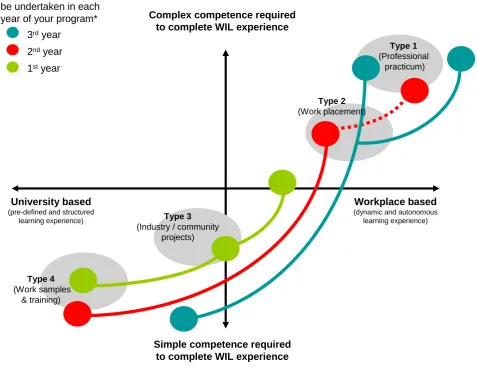
[image:7.595.63.541.376.749.2]All USQ Springfield undergraduate accounting students have the opportunity to experience WIL as part of their learning. There are four types of WIL available to them in the USQ WIL Framework (O'Shea, 2008). This Framework is depicted in Figure 1 and Type descriptions follow:
Figure 1: USQ WIL Framework
University based (pre-defined and structured
learning experience)
Workplace based (dynamic and autonomous
learning experience) Complex competence required
to complete WIL experience
Type 4 (Work samples
& training)
Type 3 (Industry / community
projects)
Type 2 (Work placement)
Type 1 (Professional
practicum)
1styear
2ndyear
3rdyear
Simple competence required to complete WIL experience
Type 1 – Professional practicum. This is a supervised, unpaid work-based placement providing students with the opportunity to explore their chosen industry, while developing and demonstrating the relevant professional standards, ethics and competencies and gaining course credit
Type 2 – Work placement. This is an opportunity for students to complete unpaid work, supervised and supported in a professional role related to students’ studies. Course credit is applicable.
Type 3 – Industry and Community Projects. This could take the form of one off unpaid work or community focussed projects that provide students with the opportunity to put their newly acquired knowledge and skills into practice in the world of work. Completed as part of regular courses
Type 4 – Work samples and training. This may involve projects or work-related events designed, delivered and supervised by USQ as part of a course such as visiting professionals, field trips, industry based case studies and USQ supported participation in community and industry activities.
The USQ Accounting WIL Framework
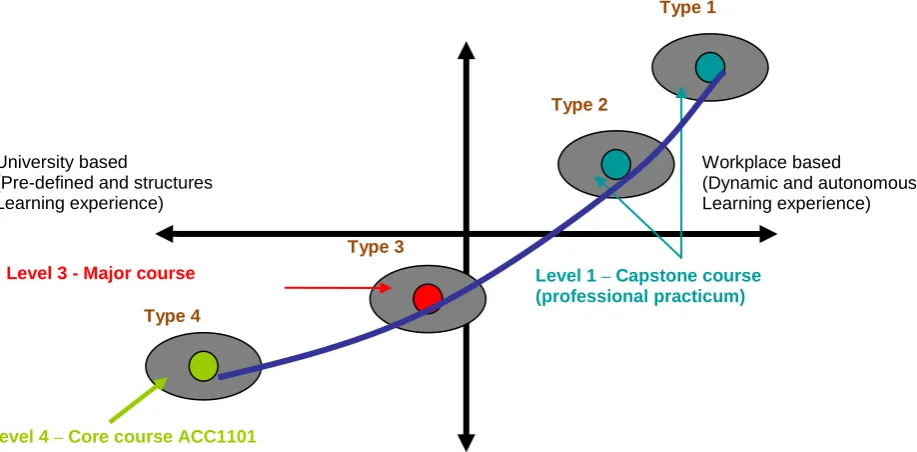
The USQ WIL Framework is then further adapted to the Accounting discipline (O'Shea, 2008). This Framework is depicted in Figure 2:
[image:8.595.75.534.356.582.2]
Figure 2: USQ Accounting WIL Framework
The Accounting WIL Framework is an adaptation of the generic USQ WIL Framework explicitly embedding skills development in three separate courses. These are in a core course Accounting for Decision making in the first year, a major course Management Accounting in the second year and culminating in a capstone course Work Integrated Learning in the final year (see Figure 2).
USQ recognises the importance of a wider skill set than the narrow generic skill lists to foster lifelong career development. Effective skills development involves more than just mapping generic competencies onto existing curricula, it requires effective partnerships between faculties, careers services and employers to develop and implement programs addressing the issue of career management competence, including career building and self-management skills.
Complex competence required to complete WIL experience
Simple competence required to complete WIL experience University based
(Pre-defined and structures Learning experience)
Workplace based
(Dynamic and autonomous Learning experience)
Type 4
Type 1
Type 3
Type 2
Level 4 – Core course ACC1101
Level 3 - Major course Level 1 – Capstone course
First year accounting
For effective learning, the USQ WIL framework incorporates strategies for building students’ capacity to develop relevant skills across their whole degree experience and that effective strategies need to consider interrelationships between personal experiences and skills including the management of confidence and decision making (Stoner & Milner, 2010). During a student’s academic learning experience, parallel development on study and generic skills is undertaken for example in developing writing and creative thinking, using web resources, resume writing, career guidance, constructing effective job applications and with sessions delivered with the input from Careers and Employability consultants.
This approach was chosen by USQ as employability skills development approaches should involve at least one or a combination of structural supports. This is done through career services or similar service providers; curriculum intervention in embedding employability skills in course content, delivery strategy or both; work experience as a structured part of the curriculum with the individual student taking responsibility for reflecting on and recording their learning in a portfolio or enhanced curriculum vitae document (BIHECC, 2007).
This framework supports the development of accounting students’ self-efficacy through WIL programs (Subramaniam & Freudenberg, 2007). Self-efficacy is a central concept in social cognitive theory where it is defined as “beliefs in one’s capabilities to organise and execute the courses of action required to produce given attainments (Bandura, 1997). The level of an individual’s self-efficacy is seen to be an important determinant of how well the individual copes with learning and performing at the workplace.
Students should tailor their study programs to meet the expectations of employers in the job market (career management) (Hancock, Howieson, Kavanagh, Kent, & Tempone, 2009). They need to take responsibility for reviewing or assessing their own employability skills, addressing gaps and then pursuing appropriate ways to report or present relevant information about their skills to prospective employers when seeking employment (BIHECC, 2007). However, unless students are proactive and these skills development activities are compulsory and assessed, any WIL integration efforts will not realise full potential.
Stoner & Milner (2010) noted a range of impediments and barriers to both students’ development of employability skills and their subject learning. Their results suggest that students were not able to engage with or to develop all of the subset of employability skills the courses emphasised. They reported difficulty in managing their time, in engaging in modelling exercises and problem-solving and were reluctant to take responsibility for and to have a positive attitude towards learning to learn.
Career management is essential to enhance chances of employability. This involves an intentional management of work, learning and other aspects of life through reflective, evaluative and decision making processes. Students should be taught career management skills which are abilities to proactively navigate the working world and successfully manage the career building process based on lifelong learning and adaptability (Bridgstock, 2009).
First year accounting students get their first taste of WIL in the course Accounting for Decision Making. Type 4 WIL activities and exposure to industry through course guest speakers are introduced. These are tailored career and work-related tasks and events designed, delivered and supervised by the university and form the start of a student’s career management process. The purpose of these is to help students understand how to network and use the tools of the trade. Typical activities may include site and field visits to observe professional settings and enlisting guest speakers from areas of industry (University of Southern Queensland, 2010c).
In semester one of 2011, first year students were engaged in work training involving participation in talks by visiting industry speakers from reputable accounting firms and relevant professional bodies. An organised career oriented activity by a USQ Careers consultant involved students to assess their current levels of generic skills and attributes. They are exposed to first-hand information on what skills matter in the workplace through these social/networking activities.
In the internal activity, students are asked to complete a number of activities designed to help students to explore their future career path and employment options (University of Southern Queensland, 2010c). They can be grouped into three different areas:
Personal management activities: relates to the skills and self-knowledge to understand ‘you’, the types of work most suited to your abilities, skills, talents and personal attributes, your ability to communicate effectively and being motivated to develop and maintain a learning focus throughout your life;
Learning work exploration activities: Knowing how to locate, interpret, evaluate and use career information and having knowledge of the world of work, society and the economy and understanding the interplay between each of these factors;
Career building activities: being able to identify work opportunities, secure/create and maintain a position in the workforce, having the ability to consider external factors into your decision-making process and improve career prospects, being able to balance work and personal life and managing your career to achieve specific goals while recognising and overcoming stereotypes in the workplace and fluctuations in the work system.
The assessment process used for the WIL framework is both formative and summative. Providing feedback to students during their learning is the formative function of assessment. Awarding grades to students after a learning period is the summative function. Besides providing certification of achievement in learning, assessment is also to facilitate learning. Good curriculum design will embed generic capabilities into learning outcomes across the curriculum. There needs to be constructive alignment between learning outcomes and learning activities, assessment tasks and the criteria used to evaluate assessments (Biggs, 2003). Effective assessment methods should align assessment not only with immediate learning requirements but also with the longer-term to foster post-graduation learning, contributing to lifelong learning (Boud & Falchikov, 2006). A short term focus in assessment must be balanced against a longer-term emphasis for learning-oriented assessment to foster future learning after graduation.
Ten per cent of the assessment in the course is set aside for participation in, and reflection on these activities. Students were asked to complete a survey on their experience and a reflective journal as part of the assessment requirements. A marking rubric detailing the requirements of the assessment was given to all students. This WIL model facilitates mentoring and reflective practices based on experiential learning theory. (Boud, 1985) explored the field of experiential learning and found the key to turning experience into learning is reflection with new understanding and appreciation.
Reflection is a relatively new method in assessment pedagogy. The principal means for fostering integration of on and off campus learning is by reflection and review via for example, reflective journals and assignments/reports post-placement (R. Coll et al., 2009). This integration mostly consists of reflection-on-action (Schon, 1983, 1987), after the learning activities and involves reflection on personal growth and incident/event reconstruction. Students in USQ were taught to use the Bulman’s (2000) reflective cycle to assist them in completing their assignment. They also completed a practice reflection prior to actual assessment submission.
Second year accounting
Generic capacities cannot by themselves develop except through practice of knowledge and skills. Knowledge and skills themselves can be further developed through their continued practice in real-world situations. Wells et al (2009) recommended the application of learning to real real-world situations or professional practice. This was earlier referred to by Brown, Collins & Duguid (1989) as ‘situated learning’. This may be done through case studies and integrating career development learning activities or work integrated learning into accounting programs. The issue is one of balancing between the two different learning environments of the classroom and the workplace to prepare and develop students’ professional capabilities. A clear signal was received from industry of the need to work with real-world problems and this may be done through case studies and integrating work placements into programs of study (Wells, et al., 2009).
Lecturers in class will begin with a simple, single-topic, structured problem from a textbook using established theories and move to more complex, multiple-topic, structured problems when initiating cooperative learning group assignments (Peek, Winking, & Peek, 1995). Community projects connect universities with their communities and at the same time offer learning opportunities that extends beyond the classroom. In a study by Chiang (2008), most students appreciate the opportunity to conduct a real-life project and found that the project helped them in understanding accounting concepts.
By the time students enter their second year, the non-technical skills would have been developed to a certain level. Students in their second year will participate in a community project which puts their knowledge and theory into practice. Small teams of Management Accounting students will be formed to approach small businesses to solve a real world project as a case study for assessment. A number of skills including teamwork, communication and problem-solving skills will be assessed in this course. The group assessment will form twenty percent of the weight of the course.
This activity is a Type 3 activity in the USQ WIL Framework. Students will be working on community or industry focused accounting projects working for a client and being guided and supported by university staff in the course. This may involve going on industry visits and collecting data in the community, spending time meeting with clients to work out their needs and then spending time at university with academics on designing and completing the project (University of Southern Queensland, 2010c).
This WIL approach using service learning through community projects as a learning pedagogy improves the learning of basic accounting concepts through group interaction and provides opportunities for practicing communication skills. The value of learning teamwork and shared responsibility will enhance the students’ appreciation of such skills at work in a business organisation.
Third year accounting
their professional competencies, skills and standards. Students will be assessed on the writing of a resume, a project proposal, reflective journals, a written report about their learning experience and a verbal presentation. This will test them on their requisite skills that they have learnt in the classroom and extend them in an external environment and demonstrate their learning through a process of reflection, verbal and written communication. The project will culminate in a deliverable document to the host organisation with feedback from the host organisation incorporated into assessment.
This is Type 1 WIL activity offered to final year students and worth a full course credit over a semester. This course seeks to further develop students’ skills in an external setting and culminates in the delivery of a business project related to the students’ area of specialisation. The course involves spending time working with clients while under the guidance of a supervisor, shadowing a professional in the workplace, participating in a team of professionals on projects and contributing to client work with an industry partner (University of Southern Queensland, 2010c).
The WIL course connects students with sponsors who provide them with opportunities to apply and further enhance the skills, knowledge and abilities they have acquired during their programs of study in real project work in host organisations. The project takes students into an organisation for a six-month period so that they can develop and demonstrate an awareness of how theory is implemented in the workplace, apply the concepts and theories of their major area of study to the workplace activities and responsibilities and develop and demonstrate work readiness skills which will equip students to make a positive contribution to the workplace. Students interested in enrolling in need to meet the requirement for successful completion of at least half of the discipline curriculum to ensure that students have sufficient prior knowledge, skills and confidence to approach potential sponsors to seek industry experience and to negotiate the nature and extent of that placement with the sponsor and the course coordinator.
In a job market that is becoming increasingly more competitive, experience in the workplace is an invaluable asset to graduates. WIL provides opportunities for students to apply the theoretical knowledge they have learnt in the classroom to the world of work. Through WIL, students will develop, practice and consolidate their skills and develop a deeper understanding of their chosen profession.
The USQ placement approach involves three stages: pre-placement, placement and post-placement.
Pre-placement stage
While undertaking WIL courses, students will be offered a range of structured support programs providing career development learning and workplace preparation prior to and during students’ work-related experience.
Students enrolled in WIL will first attend a pre-placement workshop. The purpose of workshop is to assist in identifying and capturing a highly beneficial and rewarding WIL placement and to help the student in developing a more in-depth understanding of internal and external factors that influence career and employment decision making. During this workshop, students are introduced to the objectives of WIL as well as provided with ‘workforce entry’ skills. A career skills online diagnostic is completed by each student prior to coming to the workshop. Some of the content covered includes workplace health and safety; establishing and maintaining appropriate professional relationships with supervisor and employees of the host organisation; legal matters; and, expectations of organisations for outcomes from the project to be undertaken (Hingst, Mula, Leong, Vagg, & Hoare, 2009). These workshops, online modules and individual sessions focus on developing in-depth understanding of career direction, employment seeking skills, industry-specific and general knowledge about the world of work.
information such as Workplace, Health and Safety and insurance matters (Hingst, et al., 2009). A Supplementary course workbook covering workshop information and preparation for WIL placement is also provided. Topics covered include career self-assessment, USQ Graduate qualities and skills, employability skills, values and work preferences, identifying host organisations, researching the organisation for WIL, preparing resumes, identifying a project, negotiating with host organisation and professional etiquette.
Prior to participation in the work-based project, students are required to access a program of professionally recorded video segment modules through the course study desk which provides transactional information to introduce students to the program, as well as Career Development Learning modules. The on-line modules introduce students to skills associated with research of potential sponsors, how to identify host organisations that suit the students own needs and requirements, how to approach possible employers, and how to communicate and engage in a professional manner. These are all vital skills that are necessary not only for future job search efforts upon graduation, but will also benefit them in interacting with others in the business environment in a professional manner (Hingst, et al., 2009).
The modules comprise a series of practical learning exercises that bind career development theory and experiential learning. All career activities were designed and delivered by the Careers & Employment staff. The pedagogical methodology employed in these sessions was informed by the National Framework, The Australian Blueprint for Career Development (Department of Education Employment and Workplace Relations, 2006) and (Sampson, Reardon, Peterson, & Lenz, 2004) Cognitive Information Processing approach to career development.
Over the course of the modules, students complete four learning activities. During the first two activities, a series of pre-test measures are administered. Results from these measures will inform future design of the project and provide critical feedback regarding student engagement and career learning outcomes for the students. A brief outline of each activity is provided below:
1. Career skills audit: A self-audit of their current level of competency in career development and career management and reflect on how they might continue to improve their mastery in the future. Items from this questionnaire were derived from the ABCD (2006).
2. Career self-assessment: This activity required students to complete a number of activities and questionnaires aimed at increasing their self-awareness and enhancing their self-image. Through this activity they explore their skills, knowledge and the abilities they develop through their study program ('graduate qualities and skills') and also their personal attributes (e.g. interests, values and personality). Students also completed the Career Futures Inventory.
3. Career decision making: Students were introduced to career decision making methodologies and theory to encourage them to further explore and be more critically aware of the choices they make with regard to choosing their WIL placement and future employment choices.
4. Work placement preparation: Students were introduced to a range of information and resources designed to expand their knowledge with regard to industry, employment and placement options available within the business sector and how to approach the providers of these opportunities. In addition, content focused on exploring industry and how to engage with employers offering potential WIL opportunities.
Consistent with the pre placement stage of the (Smith et al., 2009) Two-Way Mirror model, students will start by responding to the preparatory workshop in their first reflective journal. It gives them an opportunity to articulate their expectations for the project and the host organisation.
practice of stepping back to ponder and express the meaning to self and to others in one’s immediate environment of what has, will, or is happening (Raelin, 2008). It is defined as a generic term for intellectual and affective activities in which individuals engage to explore their experiences in order to lead to new understandings and appreciations (Boud, 1993). Critical reflection is essential in transformative learning (Fisher, 2003). The early work of (Schon, 1983, 1987) were concerned with reflection in relation to practices and actions especially in professions such as teaching (Hatton & Smith, 1995) and nursing (Burns & Bulman, 2000). This has now permeated other disciplines.
Reflection is a relatively new method in assessment pedagogy. The principal means for fostering integration of on and off campus learning is by reflection and review via for example, reflective journals and assignments/reports post-placement (R. Coll, et al., 2009). This integration mostly consists of reflection-on-action (Schon, 1983, 1987), after the learning activities and consists of reflection on personal growth and incident/event reconstruction.
Students are also required to prepare their resume covering personal and contact details, qualifications, prior employment experience, contact details of referees, other relevant information, by using the recommended USQ format. This is then sent to potential host organisations and submitted for assessment.
A project proposal is expected to be submitted and approved before the student starts on a placement. This will be in the format of a letter jointly addressed to the host organisation and USQ, providing details of host organisation and sponsor’s contact information, a brief outline of the project, the scope of the project, any anticipated limitations and an explanation of how the project will extend student learning.
Placement stage
This phase requires the student to submit two reflective journals or ePortfolios. An e-Portfolio is a personal digital collection of information describing and illustrating a student’s learning career, experience and achievements” (BIHECC, p. 41) It may also contain evidence of academic results, awards, achievements and highlights of university experiences, employment reports, WIL participation reports, volunteer work, hobbies and interests and personal reflections of experiences (Zegwaard et al, 2003). It offers insights into the generic skills and enables students to express what they believe they have learnt to capture their unique learning experiences, gain enriched meaning and construct new knowledge from their workplace experiences (BIHECC, 2007). Students can then leave university with an E-Portfolio and present their evidence of employability skills in job applications to prospective employers.
The reflective journals record the student’s entry/induction/orientation and experiences in the host organisation and participation in work activities. Students are also expected to give the WIL course coordinator a verbal update on the progress of the project. The purpose of these assessments is to provide a confidential avenue for the student and to reflect critically and comment on the process of the learning evolving in the WIL project, identify application and gaps in theory and practice, evaluate the project in terms of its contribution to the student’s professional understanding and to report progress on the project and milestones achieved.
Post placement stage
evaluation of the completed WIL project is made in terms of how the project has extended learning as a result of the work experience.
An oral presentation is also made to a joint audience of representatives from the host organisation and USQ WIL course coordinator. Its structure includes aims and objectives, an overview and highlights of the completed project, lessons learnt with application of theories to practice, graduate qualities, and an evaluation of the completed project, significant learning and deliverables and recommendations for future improvement. This gives the student the chance to showcase the contribution made to the host organisation through their project and for further engagement with sponsors by interaction with the student and academics.
The final journal submission is designed to facilitate further reflection on their achievements, not only of their own learning, but of the value of their contribution to their host organisation. This journal should also address the development of graduate qualities in the placement. These are in the five broad areas of discipline expertise, professional practice, global citizenship, scholarship and lifelong learning. Students should have had the opportunity to develop most of the nine skills or skill sets expected of a USQ graduate.
Conclusion/Discussion
Successful reform of curricula is needed to facilitate the achievement of graduate outcomes. The introduction of Work Integrated Learning activities in the USQ Springfield accounting curriculum is an attempt to narrow the gap between the skills needed by practitioners and the skills of new accounting graduates. The USQ Accounting WIL Framework has been developed after review of the extensive WIL literature and by incorporating the best practices currently evident in universities in terms of effective WIL programs and the development of student skills and attributes.
Education for sustainability proponents maintain that for an effective approach in learning, it must involve all stakeholders via industry employers, universities, the media and community based organisations (Coll, Taylor, & Nathan, 2003; Nathan & Taylor, 2003). This model can contribute by producing more balanced graduates with greater understanding of business activity on individuals and society and make them more socially conscious. These may be considered as desirable graduate competencies. Employers are keen to employ graduates with a balanced portfolio of skills including soft skills, seeking thoughtful graduates who can think beyond task completion (Nathan & Taylor, 2003).
With the high demand on the employment market for accounting professionals, employers are looking for ‘job ready’ graduates that have not only the theoretical knowledge but also some practical knowledge and employability skills. Universities must have the commitment to develop graduate attributes and improve employability and be prepared to rethink about curriculum, pedagogy and assessment issues. Green et al. (2009) note that stakeholders such as government, industry and universities have grossly underestimated the changes, support and resources required to implement successfully this much needed curriculum reform.
It is not possible and unrealistic for universities to bear the burden of guaranteeing that graduates will possess the necessary generic skills to meet the employer demands (Clanchy & Ballard, 1995; Cranmer, 2006; Lucas, et al., 2004). They can only guarantee that students will have the opportunity to learn and develop generic skills and attributes during their undergraduate accounting studies (Clanchy & Ballard, 1995).
References
Albrecht, W. S., & Sack, R. J. (2000).
Accounting Education: Charting the Course through a Perilous
Future
(Vol. 16).
Apostolides, V., & Looye, J. W. (1997). Student assessment of the co-op experience and optimum
integration of classroom learning with professional practice.
Journal of Cooperative Education,
32
(3), 16-30.
Bandura, A. (1997).
Self efficacy: The exercise of control
. New York: WH Freeman.
Barrie, S. C. (2006). Understanding What We Mean by the Generic Attributes of Graduates.
Higher
Education, 51
(2), 215-241.
Barrie, S. C., Hughes, C., & Smith, C. (2009).
The national graduate attributes project: integration
and assesment of graduate attributes in curriculum
: Australian Learning and Teaching
Council.
Biggs, J. B. (2003).
Teaching for Quality Learning at University.
Buckingham, UK: Society for
Research into Higher Education (SRHE) and Oxford University Press.
BIHECC. (2007).
Graduate Employability Skills
: Business, Industry and Higher Education
Collaboration Council.
Birkett, W. P. (1993).
Competency Based Standards for Professional Accountants in Australia and
New Zealand: Discussion Paper
. Sydney.
Boud, D. (1985).
Reflection: turning experience into learning
. London: Kogan Page.
Boud, D. (1993). Experience as a Base for Learning.
Higher Education Research & Development,
19
(1), 33-44.
Boud, D., & Falchikov, N. (2006). Aligning assessment with long-term learning.
Assessment &
Evaluation in Higher Education, 31
(4), 399-413.
Bradley, D., Noonan, P., Nugent, H., & Scales, B. (2008).
Review of Australian Higher Education:
Final Report
. Canberra.
Bridgstock, R. (2009). The graduate attributes we've overlooked: enhancing graduate employability
through career management skills.
Higher Education Research & Development, 28
(1), 31-44.
Brown, J., Collins, A., & Duguid, P. (1989). Situated cognition and the culture of learning.
Educational Researcher, 18
(1), 32-41.
Bui, B., & Porter, B. (2010). The Expectation-Performance Gap in Accounting Education: An
Exploratory Study.
Accounting Education: an international journal, 19
(1-2), 23-50.
Burns, S., & Bulman, C. (Eds.). (2000).
Reflective practice in nursing: the growth of the reflective
practitioner
. Oxford: Blackwell Science.
Business Industry and Higher Education Collaboration Council. (2007).
Graduate Employability
Skills
: Precision Consultancy.
Chiang, B. (2008). Integrating a Service-learning Project into Management Accounting Coursework -
A Sharing of Implementation Experience and Lessons Learned.
Accounting Education: an
international journal, 17
(4), 431-445.
Clanchy, J., & Ballard, B. (1995). Generic skills in the context of higher education.
Higher Education
Research & Development, 14
(2), 155-166.
Coll, Taylor, N., & Nathan, S. (2003). Using work-based learning to develop education for
sustainability: a proposal.
Journal of Vocational Education and Training, 55
(2), 169-182.
Coll, R., Eames, C., Paku, L., Lay, M., Ayling, D., Hodges, D., et al. (2009).
Exploring the pedagogies
used in Work Integrated Learning
. Paper presented at the 16th WACE World Conference
Conference.
Cranmer, S. (2006). Enhancing graduate employability: best intentions and mixed outcomes.
Studies in
Higher Education, 31
(2), 169-184.
Crebert, G., Bates, M., Bell, B., Patrick, C.-J., & Cragnolini, V. (2004). Developing generic skills at
university, during work placement and in employment: graduates' perceptions.
Higher
Education Research & Development, 23
(2), 147-165.
DeLange, P. (2000). The identification of the most important non-technical skills required by entry
level engineering students when they assume employment.
Journal of Cooperative Education,
35
(2-3), 21-32.
Department of Education Employment and Workplace Relations. (2006). Australian blueprint for
career development. Retrieved 21 June, 2010, from
http://www.deewr.gov.au/Schooling/CareersandTransitions/CareerDevelopment/Resources/Pag
es/ReCaP.aspx
Fisher, K. (2003). Demystifying Critical Reflection: Defining criteria for assessment.
Higher
Education Research & Development, 22
(3), 313-325.
Freeman, M. (2010).
Learning and Teaching Academic Standards Statement for ACCOUNTING
:
Australian Learning & Teaching Council.
Green, W., Hammer, S., & Star, C. (2009). Facing up to the challenge: why is it so hard to develop
graduate attributes?
Higher Education Research & Development, 28
(1), 17-29.
Hancock, P., Howieson, B., Kavanagh, M., Kent, J., & Tempone, I. (2009).
Stakeholders' Perspectives
of the Skills and Attributes for Accounting Graduates
. Paper presented at the 2009 AFAANZ
Conference.
Hancock, P., Howieson, B., Kavanagh, M., Kent, J., Tempone, I., & Segal, N. (2009).
Accounting for
the future: more than numbers - Strategies for embedding non-technical skills into the
accounting curricula
.
Hatton, N., & Smith, D. (1995). Reflection in teacher education:towards definition and
implementation.
Teaching and Teacher Education, 11
(1), 35-49.
Hingst, R., Mula, J., Leong, R., Vagg, K., & Hoare, N. (2009). Programs or Services that Enhance
Learning- Educational partnerships and collaborations with other organisations. University of
Southern Queensland.
Howieson, B. (2003). Accounting practice in the new millennium: is accounting education ready to
meet the challenge?
British Accounting Review, 35
(2), 69-103.
Institute of Chartered Accountants of Australia, & CPA Australia. (2009).
Professional Accreditation
Guidelines for Higher Education Programs
: The Institute of Chartered Accountants in
Australia, CPA Australia.
International Federation of Accountants Education Committee. (2003).
International Education
Standards for Professional Accountants IES 1-6
. New York: International Federation of
Accountants.
Jackling, B., & De Lange, P. (2009). Do Accounting Graduates' Skills Meet the Expectations of
Employers? A Matter of Convergence or Divergence.
Accounting Education: an international
journal, 18
(4-5), 369-385.
Jackling, B., & Keneley, M. (2009).
Perceptions of generic skill development: international and local
accounting students in Australia
. Paper presented at the 2009 AFAANZ Conference. Retrieved
from
http://www.afaanz.org/openconf-afaanz2009/modules/request.php?module=oc_proceedings&action=view.php&a=Accept+as+P
aper&id=65
Jones, A. (2010). Generic Attributes in Accounting: The Significance of the Disciplinary Context.
Accounting Education: an international journal, 19
(1-2), 5-21.
Lebihan, R. (2007, 13 August). Unis want students on the job
. Australian Financial Review,
pp. 1, 32.
Lucas, U., Cox, P., Croudace, C., & Milford, P. (2004). Who wrote this stuff?: Stduents' perceptions
of their skills and development.
Teaching in Higher Education, 9
(1), 55-68.
McIlveen, P., Brooks, S., Lichtenberg, A., Smith, M., Torjul, P., & Tyler, J. (2011). Career
development learning frameworks for work-integrated learning. In S. Billett & A. Henderson
(Eds.),
Developing learning professionals: Integrating experiences in university and practice
settings
(pp. 149-165). Dordrecht: Springer.
Moreland, N. (2005).
Work-related learning in higher education.
Heslington, York: The Higher
Education Academy.
Morgan, C. K., Watson, G. K., Roberts, D. W., McKenzie, A. D., & Cochrane, K. W. (2002).
Structuring the curriculum for different years pf undergraduate programs
. Paper presented at
the The Conference of the Australian Association for Research in Education.
Nathan, S., & Taylor, N. (2003). Linking Cooperative Education and Education for Sustainability: A
New Direction for Cooperative Education?
Asia-Pacific Journal of Cooperative Education,
4
(1), 1-8.
O'Shea, A. (2008). A Developmental Approach to Work Integrated Learning. Unpublished
Unpublished manuscript. University of Southern Queensland.
Patrick, C. J., Peach, D., & Pocknee, C. (2009).
The WIL (Work Integrated Learning) report: A
national scoping study
: Australian Learning and Teaching Council in association with the
Asutralian Collaborative Education Network.
Peek, L. E., Winking, C., & Peek, G. S. (1995). Cooperative Learning Activities: Managerial
Accounting.
Issues in Accounting Education, 10
(1), 111-125.
Raelin, J. A. (2008). Reflective Practices
Work-Based Learning: Bridging Knowledge and Action in
the Workplace
(New and Revised ed.): Jossey-Bass.
Ramsden, P. (2003).
Learning to Teach in Higher Education
(2nd ed.). London: Routledge Falmer.
Reeders, E. (2000). Scholarly practice in Work-based Learning: Fitting the glass slipper.
Higher
Education Research & Development, 19
(2), 205-220.
Robley, W., Whittle, S., & Murdoch-eaton, D. (2005). Mapping generic skills curricula: a
recommended methodology.
Journal of Further and Higher Education, 9
(3), 221-231.
Sampson, J., Reardon, R. C., Peterson, G. W., & Lenz, J. G. (2004).
Career counselling and service. A
cognitive information processing approach
. Belmont, CA: Brooks/Cole.
Schon, D. (1983).
The reflective practitioner
. London: Temple Smith.
Schon, D. (1987).
Educating the reflective practitioner
. San Francisco: Jossey Bass.
Sharma, P., & Hannafin, M. (2004). Scaffolding critical thinking in an online course: An exploratory
study.
Journal of Educational Computing Research, 31
(2), 181-208.
Smith, M., Brooks, S., Lichtenberg, A., Mcllveen, P., Torjul, P., & Tyler, J. (2009).
Career
Development Learning: Maximising the contribution of work-integrated learning to the student
experience. Final Project Report June 2009
: Australian Learning & Teaching Council,
National Association of Graduate Careers Advisory Services.
Stoner, G., & Milner, M. (2010). Embedding Generic Employability Skills in an Accounting Degree:
Development and Impediments.
Accounting Education: an international journal, 19
(1-2),
123-138.
Subramaniam, N., & Freudenberg, B. (2007). Preparing accounting students for success in the
professional environment: enhancing self-efficacy through a work integrated learning program.
Assessment & Evaluation in Higher Education, 8
(1), 77-92.
UniversitiesAustralia. (2008).
A National Internship Scheme: Enhancing the Skills and Work-readiness
of Australian University Graduates
(Position Paper No. 3/08): Position Paper No. 3/08.
University of Southern Queensland. (2010b). USQ Graduate Qualities and Skills - Customisation,
Mapping and Alignment template. In Learning and Teaching Support (Ed.). Toowoomba.
University of Southern Queensland. (2010c). WIL - work integrated learning. Retrieved 10 June,
2010, from
http://www.usq.edu.au/springfield.wil.htm
Wells, P., Gerbic, P., Kranenburg, I., & Bygrave, J. (2009). Professional Skills and Capabilities of
Accounting Graduates: The New Zealand Expectation Gap?
Accounting Education: an
international journal, 18
(4-5), 403-420.
Willcoxson, L., Wynder, M., & Laing, G. K. (2010). A Whole-of-program Approach to the
Development of Generic and Professional Skills in a University Accounting Program.
Accounting Education: an international journal, 19
(1-2), 65-91.
Wood, L., Thomas, T., Petocz, P., Rigby, B., Clark-Murphy, M., Daly, A., et al. (2009).
Embedding
generic skills means assessing generic skills
. Paper presented at the ATN Assessment
Conference 2009.