The Australian Learning and Teaching Council has provided funding for this
Benchmarking COMPASS
®for curriculum renewal
Establishing infrastructure and collaborative processes for
cross-institutional benchmarking of student clinical performance in
speech pathology
Final Report
2011
Project website
http://benchmarking.portal.com.au
Lead institutions
Flinders University The University of Sydney
Partner institutions
La Trobe University James Cook University The University of Newcastle The University of Queensland
Other organisations
Speech Pathology Australia
Project team members
Support for this project has been provided by the Australian Learning and Teaching Council Ltd., an initiative of the Australian Government Department of Education, Employment and Workplace Relations. The views expressed in this report do not necessarily reflect the views of the Australian Learning and Teaching Council or the Australian Government.
This work is published under the terms of the Creative Commons Attribution-
Noncommercial-ShareAlike 3.0 Australia Licence. Under this Licence you are free to copy, distribute, display and perform the work and to make derivative works.
Attribution: You must attribute the work to the original authors and include the following statement: Support for the original work was provided by the Australian Learning and Teaching Council Ltd, an initiative of the Australian Government.
Noncommercial: You may not use this work for commercial purposes.
Share Alike: If you alter, transform, or build on this work, you may distribute the resulting work only under a licence identical to this one.
For any reuse or distribution, you must make clear to others the licence terms of this work. Any of these conditions can be waived if you obtain permission from the copyright holder. To view a copy of this licence, visit
<http://creativecommons.org/licenses/by-nc-sa/3.0/au/ > or send a letter to:
Creative Commons
543 Howard Street, 5th Floor San Francisco California 94105 USA.
Requests and inquiries concerning these rights should be addressed to:
Office for Learning and Teaching GPO Box 9880
Sydney NSW 2001 Location code N255EL10
or
2011
ISBN
Contents
Contents ... i
Acknowledgements ... 1
Executive Summary ... 2
List of Abbreviations ... 3
1. Introduction ... 4
1.1 Background ... 4
1.2 Project Aims ... 6
1.3 Project Membership ... 6
2. Project Method ... 8
2.1 Phase One: Development of the Benchmarking COMPASS® Database ... 8
2.2 Phase Two: Capacity Building ... 10
2.3 Phase Three: Sustaining Practice ... 13
3. Project Outcomes... 14
3.1 Phase One: Benchmarking COMPASS® Database... 14
3.2 Phase Two: Capacity Building ... 19
3.3 Phase Three: Sustaining Practice ... 20
4. Factors Influencing Project Outcomes ... 24
4.1 Factors Influencing Success ... 24
4.2 Factors that Impeded Success ... 24
5. Lessons Learnt ... 25
6. Dissemination ... 25
6.1 Formal Dissemination Activities ... 25
6.2 Relevance for Other Disciplines ... 26
7. Linkages ... 26
7.1 ALTC Priority Areas ... 26
7.2 National and International Standards Agendas ... 27
8. Evaluation ... 27
References ... 28
Appendix 1—Independent Evaluation Report ... 29
Acknowledgements
The project team would like to express their sincere gratitude to the speech pathology discipline located across Australia and New Zealand for their enthusiasm, engagement and support, as well as their commitment to The Benchmarking COMPASS® for
Executive Summary
This report presents outcomes of the development and implementation of a strategy to benchmark the assessment of speech pathology students’ clinical learning via
COMPASS® (McAllister et al 2006) to inform quality improvement of the curriculum. The project’s aims were as follows:
• to establish an ethical, efficient and sustainable cross-institutional benchmarking strategy to benchmark student performance during practicum using COMPASS® data
• to facilitate ongoing engagement with and effective use of benchmarking data through quality improvement cycles to inform speech pathology learning and teaching practices that prepare and support the students’ professional development.
The project was designed to capitalise on and further develop key successes of previous related work. These include the establishment and ongoing development of an enthusiastic and engaged community of practice among speech language
pathology academics within Australia, New Zealand and Asia. Second, the development of procedures and resources that enabled cross-institutional and international benchmarking of COMPASS® assessment data.
The project comprised three concurrent and interactive phases and included the following:
• developing the Benchmarking COMPASS® Database: an interactive online database that enables speech pathology programs to describe or compare their student’s assessment performance with the pooled performance of speech pathology students from other universities that collect assessments via COMPASS® Online (accessible via <http://benchmarking.portal.com.au/>)
• capacity building: developing the speech pathology communities’ capacity to use this data to improve curriculum as a preparation for professional practice, and for research into learning and teaching practices
• sustaining practice: providing tools and resources to support ongoing engagement in collaborative benchmarking as a strategy for informing curriculum improvement. Independent evaluation indicated that this project was highly successful in meeting its objectives. The project has developed an intuitive and highly efficient tool, the
Benchmarking COMPASS® Database, that has functionality beyond that originally proposed. The project has included the development of a comprehensive technical manual to assist users to understand and use data captured in COMPASS® Online for benchmarking (accessible via <https://sites.google.com/site/apecslp/home>). As a result, project outcomes have ensured that the speech pathology discipline is well prepared and properly resourced to continue to use these tools for curriculum improvement and research well into the future.
An additional outcome is that this project provides a model for mutually beneficial collaborative work across universities and among disciplines within a shared framework of standards for learning and teaching. COMPASS® clearly identifies threshold standards of learning outcomes for speech pathology students within practicums across their program of study. This project has demonstrated that
List of Abbreviations
ALTC: Australian Learning and Teaching Council
APEC SLP: Asia Pacific Education Collaboration in Speech Language Pathology
1. Introduction
1.1 Background
This project presents the outcomes of the development and implementation of a strategy to benchmark speech pathology students’ clinical learning to inform quality improvement of curriculum. This project was founded on long term national
collaborations within the speech pathology discipline and addressed quality
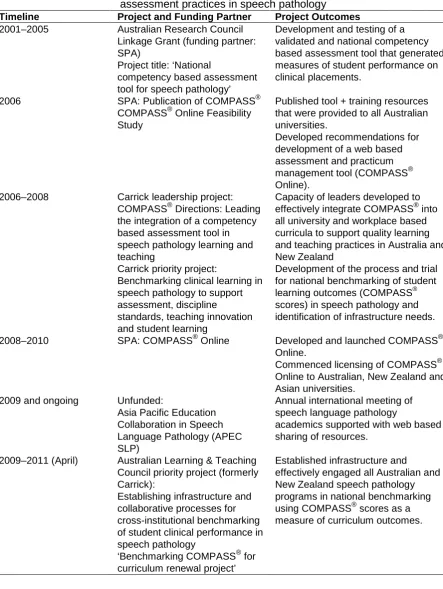
assessment of student competency and related learning and teaching practices (see Table 1).
This activity was initiated in 2001, with an Australian Research Council Linkage grant between three Australian Universities (The University of Sydney, The University of Newcastle and Charles Sturt University) and Speech Pathology Australia (SPA) that aimed to develop a national competency based assessment tool to assess the performance of speech pathology students on placement (McAllister 2006). The outcome of this research was the development of Competency Assessment in Speech Pathology (COMPASS®) (McAllister et al 2006), a validated and score-based
assessment tool that was designed to support quality learning and teaching practices (McAllister et al 2010). This tool was distributed to all Australian universities free of charge by SPA and immediately incorporated into the national curricula. All universities in New Zealand providing a speech pathology program adopted COMPASS® by the end of 2007, followed by The University of Hong Kong and The University of Singapore (2008) and The National University of Malaysia (2010).
The development and rapid uptake of COMPASS® has created a number of opportunities. Firstly, national integration of COMPASS® into curricula provides an opportunity to collaboratively support quality learning and teaching practices across all speech pathology programs. Secondly, as COMPASS® generates measures of student competency that have known properties and can be analysed statistically. Such
measures can be used for benchmarking and research. Two projects were funded by the Carrick Institute, now the Australian Learning and Teaching Council (ALTC) to support both of these opportunities.
Table 1: Timeline for activities related to quality improvement of learning, teaching and assessment practices in speech pathology
Timeline Project and Funding Partner Project Outcomes
2001–2005 Australian Research Council
Linkage Grant (funding partner: SPA)
Project title: ‘National
competency based assessment tool for speech pathology’
Development and testing of a validated and national competency based assessment tool that generated measures of student performance on clinical placements.
2006 SPA: Publication of COMPASS®
COMPASS® Online Feasibility Study
Published tool + training resources that were provided to all Australian universities.
Developed recommendations for development of a web based assessment and practicum
management tool (COMPASS®
Online).
2006–2008 Carrick leadership project:
COMPASS® Directions: Leading the integration of a competency based assessment tool in speech pathology learning and teaching
Capacity of leaders developed to effectively integrate COMPASS® into all university and workplace based curricula to support quality learning and teaching practices in Australia and New Zealand
Carrick priority project:
Benchmarking clinical learning in speech pathology to support assessment, discipline
standards, teaching innovation and student learning
Development of the process and trial for national benchmarking of student learning outcomes (COMPASS® scores) in speech pathology and identification of infrastructure needs.
2008–2010 SPA: COMPASS® Online Developed and launched COMPASS®
Online.
Commenced licensing of COMPASS®
Online to Australian, New Zealand and Asian universities.
2009 and ongoing Unfunded:
Asia Pacific Education Collaboration in Speech Language Pathology (APEC SLP)
Annual international meeting of speech language pathology
academics supported with web based sharing of resources.
2009–2011 (April) Australian Learning & Teaching Council priority project (formerly Carrick):
Establishing infrastructure and collaborative processes for cross-institutional benchmarking of student clinical performance in speech pathology
‘Benchmarking COMPASS® for curriculum renewal project’
Established infrastructure and
1.2 Project Aims
This project aims to capitalise on and further develop key successes of previous related work. These include, first, the establishment and ongoing development of an enthusiastic and engaged community of practice among speech language pathology academics within Australia, New Zealand and Asia, and second, the development of procedures and resources that enabled cross-institutional and international
benchmarking and included resources such as the Benchmarking Collaboration Agreement Memorandum of Understanding (See Appendix 2 in the accompanying resource document) and a Code of Conduct (See Appendix 3 in the accompanying resource document).
The project’s aims were as follows:
• to establish an ethical, efficient and sustainable cross-institutional benchmarking strategy to benchmark student performance during practicum using COMPASS® data
• to facilitate ongoing engagement with and effective use of benchmarking data through quality improvement cycles to inform speech pathology learning and teaching practices that prepare and support students’ professional development.
1.3 Project Membership
The project team consisted of academics and project staff from six Australian universities:
• Dr Sue McAllister, Flinders University (Project Leader)
• Associate Professor Michelle Lincoln, The University of Sydney
• Professor Alison Ferguson, The University of Newcastle;
• Associate Professor Bronwyn Davidson, The University of Queensland (now at The University of Melbourne)
• Ms Anne Hill, The University of Queensland
• Ms Rachel Davenport, La Trobe University
• Ms Louise Brown, James Cook University
• Helen Tedesco (Project Manager), The University of Sydney
• Samantha Kruger (Project Manager), The University of Sydney
The steering committee membership was as follows (see Appendix 1 for Terms of Reference in the accompnaying resource document):
• Professor Ieva Stupans, The University of New England
• Associate Professor Simon Barrie, The University of Sydney
• Ms Vickie Dawson, Senior Advisor, Professional Standards, SPA
• Ms Louise Brown, Project Team Representative
• Dr Sue McAllister, Project Leader
• Ms Helen Tedesco/Sam Kruger (Project Managers)
2. Project Method
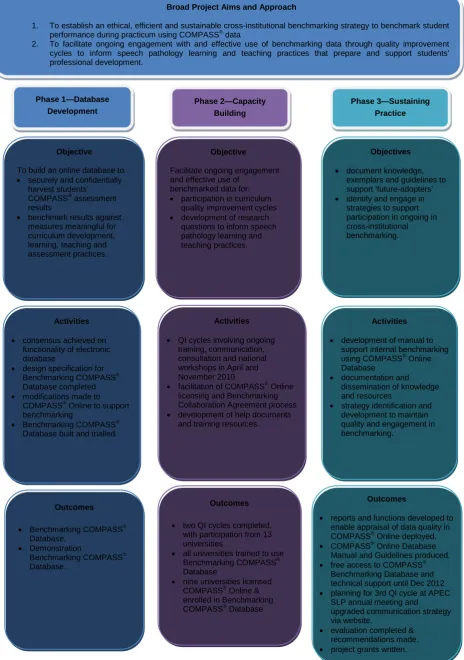
The project was conducted over a two and half year period, commencing in September 2008 and ending in March 2011. The project involved three discrete phases of activity, though in reality each of these phases overlapped and provided information to the other phases. See Figure 1 for a visual representation of the phases and key activities and outcomes.
2.1 Phase One: Development of the Benchmarking COMPASS
®Database
Designing a web based database to harvest, de-identify and benchmark student assessment data across universities was a complex and time-consuming process. However, careful attention to the ‘front end’ of the process (ensuring desired
functionality and adherence to cycles of consultation, feedback and review) ensured that a robust and flexible database was built. The consultative process and the skill level of all involved resulted in a database that far exceeded the project’s original conceptualization of an automated benchmarking system. Portal Australia, the company who developed COMPASS® Online, was engaged to develop the
Benchmarking COMPASS® Database. Each stage required thorough consultation and discussion and drew upon knowledge and expertise within the project leadership team, Portal Australia, steering committee and SPA. Students were also consulted regarding the development of the database and later provided with information via provision of electronic and hard copy posters (<https://sites.google.com/site/apecslp/>).
Key steps included:
• conceptual decision-making regarding desired functionality, with reference to feasibility, desirability and project goals
• alterations to COMPASS® Online data fields and definitions to ensure appropriate data would be available for benchmarking
• establishing and documenting specifications for database design
• building the Benchmarking COMPASS® Database
• revising the database design in response to stakeholder feedback.
Figure 1: Project aims, phases and outcomes
Activities
• consensus achieved on functionality of electronic database
• design specification for Benchmarking COMPASS® Database completed
• modifications made to COMPASS® Online to support benchmarking
• Benchmarking COMPASS® Database built and trialled.
Activities
• QI cycles involving ongoing training, communication, consultation and national workshops in April and November 2010
• facilitation of COMPASS® Online licensing and Benchmarking Collaboration Agreement process
• development of help documents and training resources.
Activities
• development of manual to support internal benchmarking using COMPASS® Online Database
• documentation and dissemination of knowledge and resources
• strategy identification and development to maintain quality and engagement in benchmarking.
Outcomes
• Benchmarking COMPASS® Database.
• Demonstration
Benchmarking COMPASS® Database.
Outcomes
• two QI cycles completed, with participation from 13 universities
• all universities trained to use Benchmarking COMPASS® Database
• nine universities licensed COMPASS® Online & enrolled in Benchmarking COMPASS® Database
Outcomes
• reports and functions developed to enable appraisal of data quality in COMPASS® Online deployed.
• COMPASS® Online Database Manual and Guidelines produced.
• free access to COMPASS® Benchmarking Database and technical support until Dec 2012
• planning for 3rd QI cycle at APEC SLP annual meeting and upgraded communication strategy via website.
• evaluation completed & recommendations made.
• project grants written.
Broad Project Aims and Approach
1. To establish an ethical, efficient and sustainable cross-institutional benchmarking strategy to benchmark student performance during practicum using COMPASS® data
2. To facilitate ongoing engagement with and effective use of benchmarking data through quality improvement cycles to inform speech pathology learning and teaching practices that prepare and support students' professional development. Phase 1—Database Development Phase 2—Capacity Building Phase 3—Sustaining Practice Objective
To build an online database to:
• securely and confidentially harvest students’ COMPASS® assessment results
• benchmark results against measures meaningful for curriculum development, learning, teaching and assessment practices.
Objectives
• document knowledge, exemplars and guidelines to support ‘future-adopters’
• identify and engage in strategies to support participation in ongoing in cross-institutional benchmarking.
Objective
Facilitate ongoing engagement and effective use of
benchmarked data for:
• participation in curriculum quality improvement cycles
2.2 Phase Two: Capacity Building
2.2.1 Engaging and sustaining involvement
This project aimed to build the capacity of academics from speech pathology programs to capitalize on the assessment data available from both COMPASS® and COMPASS® Online to develop curriculum practices through intra program and cross-institutional benchmarking and research. Previous ALTC funded projects had successfully engaged and built collaboration between universities regarding assessment and initial
exploration of benchmarking and research with COMPASS® data. This engagement has been supported by the establishment of the Asia Pacific Education Collaboration in Speech Language Pathology (APEC SLP), which includes a website to support access to resources <https://sites.google.com/site/apecslp/> and an annual forum meeting.
However, the project team was aware that project success would depend on sustaining engagement of previous and new participants, and effectively identifying and meeting participants’ needs. Engagement in a potentially ‘risky’ exercise such as benchmarking and comparing student performance required the active maintenance of collegial relationships with a high degree of integrity. Furthermore, the team needed to sustain their own involvement in developing and participating in the project as well as
managing their other academic commitments.
The following strategies were implemented to engage and sustain involvement in the project:
Project team
• face to face meetings at key stages in the project
• including team members with a diverse range of skills, expertise and university roles
• explicitly communicating expectations including commitment to sharing knowledge, assuming responsibilities, being accountable and providing support to each other
• clear and regular lines of communication and documentation of discussions and decisions
• using project evaluation cycles to identify and address risks to project success and provide feedback to each other on process
Partner universities
• funding two participants from each university at both of the benchmarking forums to ensure support for project participants within their own programs
• establishing a ‘buddy’ system for universities, ie, pairing universities who were delayed in being able to collect assessment data for benchmarking with those who did have data
• phone calls and email support by project manager
• newsletters (See Appendix 4 in the accompanying resource document)
• requiring active acknowledgment of the Code of Conduct (See Appendix 3 in the accompanying resource document) prior to attending the benchmarking forum
• provision of briefing materials and tasks to prepare for meetings (See Appendices 5–11 in the accompanying resource document)
o pre meeting questionnaires to identify training and support needs/issues
o pre meeting teleconference
o post meeting evaluations
• face to face meetings for training and engaging benchmarking activities (see Appendices 6 and 8) that were meticulously planned to
o address identified knowledge and skill needs
o facilitate actively inquiry based learning
o ensure that practical aspects such as travel, accommodation, catering and venue were well managed
Further, project evaluation (see Appendix 1 at the end of this report) highlighted four key elements incorporated into project processes by the team that enabled a strong collegial environment to develop: good communication, demonstrating respect, anticipating risks and demonstrating productive behaviour.
2.2.2 ‘Plan, Do, Study, Act’ cycles
‘A Plan, Do, Study, Act’ cycle approach (Institute for Healthcare Improvement 2003) was undertaken to develop appropriate interpretation of and action regarding
[image:14.595.99.461.411.681.2]benchmarked data by universities. This is a commonly understood quality improvement approach within health care that uses iterative cycles of action to create improvements over time. Two participants from each of the 13 universities in Australia and New Zealand who provide speech pathology programs (in addition to the project team) were funded to attend two such cycles.
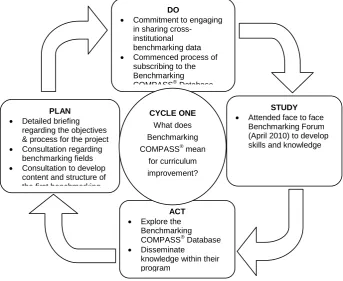
Cycle One (see Figure 3) was modified from the original project plan to allow for delays to universities licensing COMPASS® Online that were beyond the project’s control and resulted from legal negotiations regarding licensing conditions. The process of subscribing to benchmarking was communicated to universities, materials developed during the prior benchmarking project were provided and the project
team/manager(s) provided ongoing support. This process continued over the life of the project.
Subscribing required universities to:
• have a licence for COMPASS® Online
• provide advice from their ethics committee confirming that benchmarking students’ COMPASS® data was considered a quality improvement activity by their university and did not require ethics approval
• provide a signed copy of the Benchmarking Collaboration Agreement
Memorandum of Understanding (See Appendix 2 in the accompanying resource document)
• provide a copy of the Benchmarking Code of Conduct (See Appendix 3 in the accompanying resources document) signed by the Head of the Speech Pathology Program and an appropriate faculty representative.
Universities were provided with briefing materials to prepare for the face to face study meeting and feedback was sought via targeted evaluation questions prior to the meeting to identify needs and concerns. The two day benchmarking forum was
[image:15.595.105.449.441.722.2]designed to meet identified and anticipated needs through a combination of information and practical sessions. See Appendix 5–11 in the accompanying resource document for further information.
Figure 3: ‘Plan, Do, Study, Act’—Cycle One
PLAN
• Detailed briefing regarding the objectives & process for the project
• Consultation regarding benchmarking fields
• Consultation to develop content and structure of the first benchmarking
DO
• Commitment to engaging in sharing cross-institutional benchmarking data
• Commenced process of subscribing to the Benchmarking COMPASS® Database
STUDY
• Attended face to face Benchmarking Forum (April 2010) to develop skills and knowledge
ACT
• Explore the Benchmarking COMPASS® Database
• Disseminate
knowledge within their program
CYCLE ONE
What does Benchmarking COMPASS® mean
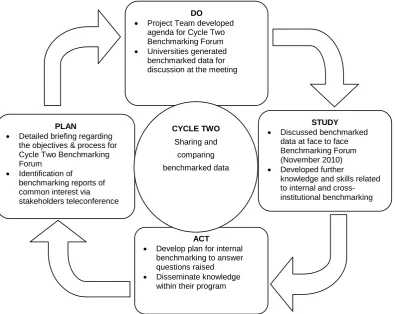
Cycle Two (see Figure 4) was designed to manage the ongoing impact of the delays in universities gaining access to COMPASS® Online. Those universities who did have data available to benchmark were asked whether they would be prepared to ‘buddy’ with representatives from universities who were still in the licensing process. All university representatives signed a copy of the Code of Conduct prior to participating in the face to face meeting. A teleconference for representatives of each university was conducted prior to the meeting to assist in the planning phase, in particular to identify what benchmarked reports would be brought to the Benchmarking Forum for
discussion (See Appendix 8 in the accompanying resource document for a copy of the teleconference agenda). Briefing papers were also provided prior to the meeting. See Appendices 9–11 in the accompnaying resource document for further information on Cycle Two.
[image:16.595.82.478.282.596.2]Discussion at the benchmarking forums and subsequent evaluation of feedback was key in assisting the project team to identify sustainable strategies to support programs through the ‘act’ phases of the cycles and to develop plans for sustaining ongoing collaboration.
Figure 4: Plan, Do, Study, Act—Cycle Two
2.3 Phase Three: Sustaining Practice
Phases one and two provided the foundation for benchmarking COMPASS® Online assessment data for curriculum renewal. Phase three was focussed on sustaining effective use of COMPASS® data to inform curriculum renewal through benchmarking and research. The following strategies were implemented (see section 3, Project Outcomes for detail on deliverables):
• providing support for two staff from each partner university to participate in both
PLAN
• Detailed briefing regarding the objectives & process for Cycle Two Benchmarking Forum
• Identification of benchmarking reports of common interest via stakeholders teleconference
DO
• Project Team developed agenda for Cycle Two Benchmarking Forum
• Universities generated benchmarked data for discussion at the meeting
STUDY
• Discussed benchmarked data at face to face Benchmarking Forum (November 2010)
• Developed further
knowledge and skills related to internal and cross-institutional benchmarking
ACT
• Develop plan for internal benchmarking to answer questions raised
• Disseminate knowledge within their program
CYCLE TWO
Sharing and
comparing
involved in clinical education and support development of learning and research partnerships within participating programs
• creation of resources to facilitate participants to effectively access and understand benchmarked data for both internal and cross-institutional benchmarking, as well as orienting and supporting future adopters
• actively addressing the expressed need to ensure the quality of benchmarked data through increasing understanding of data entry into COMPASS® Online and developing built-in quality reports in COMPASS® Online
• linking ongoing benchmarking activity to APEC SLP including responding to participating universities’ requests to have benchmarking on the agenda for the next APEC SLP meeting
• rehousing and upgrading the APEC SLP website to better facilitate collaboration and communication amongst participating university staff regarding issues of mutual interest and to quickly locate benchmarking resources.
3. Project Outcomes
3.1 Phase One: Benchmarking COMPASS
®Database
The Benchmarking COMPASS® Database harvests, de-identifies and collates
assessment scores from COMPASS® Online daily. Participating universities are able to securely log on and view the benchmarked assessment performance of the entire pool or of their students in any of their programs either as:
• non-comparative reports that summarise student performance in a single university program or in a single pool
• comparative reports that compare student performance in a single university program to the pooled performances of students from other university programs. The same types of queries and reports can be generated for either type of
benchmarking activity, resulting in a minimum of 474 different types of queries for each university program, and more for universities that are members of more than one pool (see Appendix 9 for a list of all reports available on the Benchmarking COMPASS® Database). Assessment data is kept from the time that universities commence
participating in the Benchmarking COMPASS® Database to whenever they choose to end their involvement. Therefore universities can access historical benchmarked assessment information on a year by year basis. Universities are also able to generate PDF files of reports that they can share with colleagues within their program or outside of their universities as long as they adhere to the requirements of the Code of Conduct.
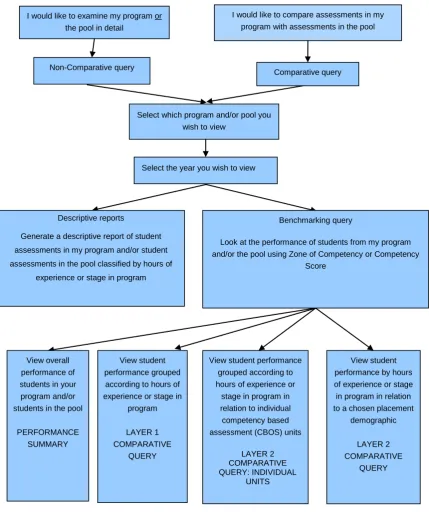
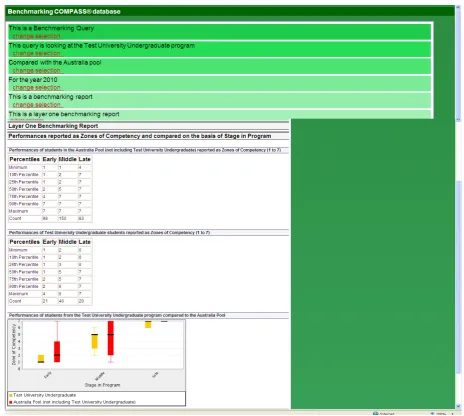
Figure 5 provides an overview of the database design by outlining the decision making tree with which users engage. See Figure 6 for a screen shot of the Benchmarking COMPASS® Database obtained during database operation.
Figure 5: Benchmarking COMPASS® Database decision-making flowchart Descriptive reports
Generate a descriptive report of student
assessments in my program and/or student
assessments in the pool classified by hours of
experience or stage in program
Benchmarking query
Look at the performance of students from my program and/or the pool using Zone of Competency or Competency
Score I would like to examine my program or
the pool in detail
I would like to compare assessments in my program with assessments in the pool
Non-Comparative query
Comparative query
Select the year you wish to view Select which program and/or pool you
wish to view
View overall performance of students in your program and/or students in the pool
PERFORMANCE SUMMARY
View student performance grouped
according to hours of experience or stage in
program
LAYER 1 COMPARATIVE
QUERY
View student performance by hours of experience or stage in program in relation to a chosen placement
demographic
LAYER 2 COMPARATIVE
QUERY View student performance
grouped according to hours of experience or
stage in program in relation to individual competency based assessment (CBOS) units
LAYER 2 COMPARATIVE QUERY: INDIVIDUAL
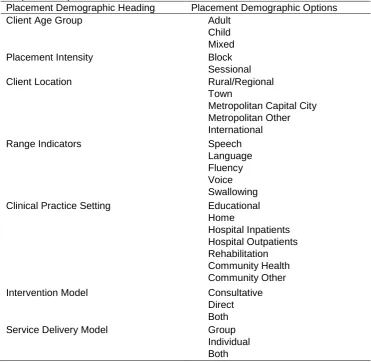
Table 2: Layer two queries—placement demographic options for non-comparative or comparative queries
Placement Demographic Heading Placement Demographic Options
Client Age Group Adult
Child Mixed
Placement Intensity Block
Sessional
Client Location Rural/Regional
Town
Metropolitan Capital City Metropolitan Other International
Range Indicators Speech
Language Fluency Voice Swallowing
Clinical Practice Setting Educational
Home
Hospital Inpatients Hospital Outpatients Rehabilitation Community Health Community Other
Intervention Model Consultative
Direct Both
Service Delivery Model Group
Individual Both
There are 3 levels of access to the Benchmarking COMPASS® Database:
1. APEC SLP Benchmarking Chair:
• create and maintain universities, including: o viewing universities within the pool
o viewing the universities currently enrolled
o viewing or changingthe coordinator for a given university
o reseting coordinator passwords
o removing a university
• create and maintain pools, including: o viewing universities within the pool
o adding or removing universities from the pool
o creating new pools
o renaming pools
o removing pools
request has been made by that university. 2. University Coordinator:
There is one coordinator per university in the Benchmarking COMPASS® Database. The coordinator has their own username and password that allows them to view their university’s data and also allows them to:
• update benchmarking users
• change the benchmarking coordinator
• request and permit administrator access to your university data for troubleshooting
• end university participation in the Benchmarking COMPASS® Database. 3. University User:
Up to five staff from each university can be provided with a log on username and password to allow them to view their university’s data. This process is managed by the University Coordinator.
SPA provided critical support to the development of this database in two key ways. First, allowing the Benchmarking COMPASS® Database to be built as a ‘sister’ database to COMPASS® Online and directly access assessment scores (under strict confidentiality arrangements). Second, SPA have allowed alterations and additions to COMPASS® Online data fields and reporting options providing more detailed
placement demographic data for benchmarking. The new reporting functions enable university coordinators to check the integrity of their data to ensure the demographic data has been accurately recorded.
While the Benchmarking COMPASS® Database is only available to speech pathology programs who have met the enrolment requirements, a Demonstration Benchmarking COMPASS® Database has been made available and is accessible to anyone with an interest in benchmarking for curriculum renewal (http://benchmarking.portal.com.au/). The demonstration database mirrors the live database; however, it uses fabricated student assessments to demonstrate benchmarked data. There are insufficient data to populate all areas of the database but all features are fully operational including tutorials and help documents.
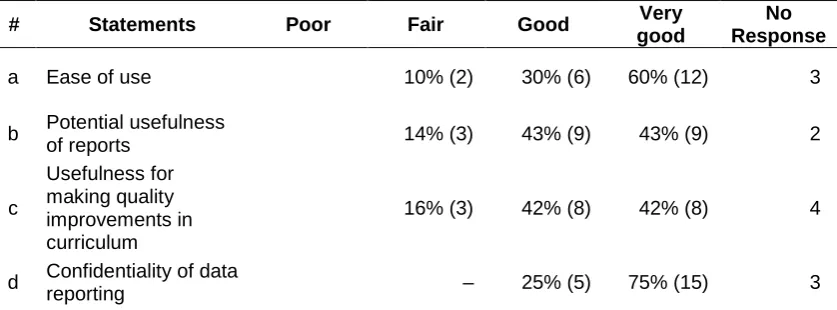
Table 3: Participants’ ratings of their experience of the Benchmarking COMPASS® Database (November 2010)
# Statements Poor Fair Good Very
good
No Response
a Ease of use 10% (2) 30% (6) 60% (12) 3
b Potential usefulness
of reports 14% (3) 43% (9) 43% (9) 2
c
Usefulness for making quality improvements in curriculum
16% (3) 42% (8) 42% (8) 4
d Confidentiality of data
reporting – 25% (5) 75% (15) 3
Note: Prepared by J.Eyre as part of the evaluation of the November national meeting
3.2 Phase Two: Capacity Building
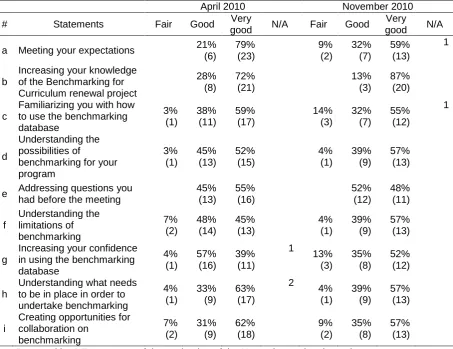
Project evaluation (see Appendix 1 to this report) clearly identifies that the key capacity building activities (Plan, Do, Study, Act Cycles) were very successful in building the capacity of partner universities to do the following:
• use the Benchmarking COMPASS® Database for cross-institutional benchmarking
• use the Benchmarking COMPASS® Online Database downloads for within program benchmarking
• use reports from both types of benchmarking to inform curriculum.
Table 4:Overall rating of workshops in relation to workshop goals (April and November 2010 stakeholder meetings)
April 2010 November 2010
# Statements Fair Good Very
good N/A Fair Good
Very
good N/A
a Meeting your expectations 21%
(6) 79% (23) 9% (2) 32% (7) 59% (13) 1 b
Increasing your knowledge of the Benchmarking for Curriculum renewal project
28% (8) 72% (21) 13% (3) 87% (20) c
Familiarizing you with how to use the benchmarking database 3% (1) 38% (11) 59% (17) 14% (3) 32% (7) 55% (12) 1 d Understanding the possibilities of
benchmarking for your program 3% (1) 45% (13) 52% (15) 4% (1) 39% (9) 57% (13)
e Addressing questions you had before the meeting
45% (13) 55% (16) 52% (12) 48% (11) f Understanding the limitations of benchmarking 7% (2) 48% (14) 45% (13) 4% (1) 39% (9) 57% (13) g
Increasing your confidence in using the benchmarking database 4% (1) 57% (16) 39% (11) 1 13% (3) 35% (8) 52% (12) h
Understanding what needs to be in place in order to undertake benchmarking 4% (1) 33% (9) 63% (17) 2 4% (1) 39% (9) 57% (13) i
Creating opportunities for collaboration on benchmarking 7% (2) 31% (9) 62% (18) 9% (2) 35% (8) 57% (13)
Note: Prepared by J.Eyre as part of the evaluation of the November national meeting
All universities are now trained in the use of the Benchmarking COMPASS® Database. While licensing COMPASS® Online was an unexpectedly slow process, by project end nine universities had licensed COMPASS® Online and had enrolled in Benchmarking COMPASS® Database.
3.3 Phase Three: Sustaining Practice
The speech pathology discipline is committed to sustaining benchmarking as a strategy for curriculum improvement and renewal, as evidenced by the request from
participating universities for benchmarking activities to be a large part of the APEC SLP Forum in July, 2011. Strategies that aim to sustain practice include the development of resources and sharing of expertise. All resources are freely available to speech
pathology programs using COMPASS® as part of their curriculum. Resources are available to non speech pathology programs through the Demonstration Benchmarking COMPASS® Database and this project report.
Evaluation interviews by the independent evaluator with a representative of nine of the eleven participating universities were conducted just prior to project ending. When asked about their intentions for use of theBenchmarking COMPASS® Database, stakeholders indicated they intend to:
• carry out internal benchmarking in relation to the new program being started, compare it with previous results and also look externally
• get clinical educators on board and check if the students are in the ball park with other programs; then look at detail to compare with similar programs in Australia and identify areas for improvement
• reduce subjectivity of clinical educators and to compare ratings with others and identify the difficulties that other universities have had
• compare with comparable cohorts at other universities across years, and see differences when curriculum changes are made
• compare cohort with the pool and look at breakdown in more detail and do comparisons.
3.3.1 Manual for Benchmarking and Research using the COMPASS® Online Assessment Tool
The Benchmarking COMPASS® Database is a very effective tool for cross-institutional benchmarking and provides a shared basis for discussion regarding curriculum
practice. An important part of the quality improvement cycle involves universities returning to their own assessment data from their program(s) to investigate specific questions raised by cross-institutional benchmarking. This reiteration is important for sustaining engagement and generating meaningful information for curriculum
improvement.
Licensing COMPASS® Online provides universities with two Microsoft Access™ database downloads per year, which contain all demographic information related to programs, placements, educators and students, as well as all student assessment information and outcomes for that university. Over the project life it became apparent that this database was very complex to understand and it was challenging to extract data from it for analysis. A major project deliverable, which was not foreshadowed in the original project plan, is the Manual for Benchmarking and Research using the COMPASS® Online Assessment Tool. This is a comprehensive manual that provides clear explanations of the COMPASS® Database, how data is stored, organised and can be extracted for benchmarking or research. The manual includes a series of database tutorials and provides a set of ‘starter’ queries to enable data to be extracted from the COMPASS® Database download. The Manual for Benchmarking and Research using the COMPASS® Online Assessment Tool is an important piece of infrastructure that will be critical for benchmarking and research, and will be a platform for future activities. See Appendix 12 in the accompanying resource handbook for the table of contents for the manual. The manual is also accessible from
<https://sites.google.com/site/apecslp/>.
3.3.2 Training Materials
Resources have been developed throughout the project to assist participants to effectively access and understand benchmarked data for both within and cross-institutional benchmarking. Resources included training material, documenting and providing exemplars, case studies, and implementation guidelines to meet identified needs in relation to participation in cross-institutional benchmarking, interpreting
resulting data, and making plans for action. These resources will be critical for orienting and supporting future adopters. See Table 5 for details.
3.3.3 Maintaining data integrity
data quality issues identified by users beyond the life of the project.
3.3.4 Strategies to support ongoing engagement with benchmarking
Several factors and strategies will support ongoing engagement with benchmarking and include:
• free access to the Benchmarking COMPASS® Database for two years beyond the life of the project; this will enable those universities whose participation was limited by delays in licensing COMPASS®Online to be able to fully engage in the near future and assess the value of benchmarking to them
• future leasing arrangements from 2013 onwards have been established for universities who will continue to access the database and a reasonable fee negotiated with Portal Australia
• design feature that any future changes to COMPASS® Online will not ‘break’ the system
• SPA’s ongoing commitment to COMPASS® Online and support of benchmarking activities linked to this database
• ensuring that expertise with regard to COMPASS®Online and benchmarking has been shared without reservation across the team and participating universities; funding for national meetings was critical for supporting a more diverse and wider group of academics to be involved in this project compared than previously (This is part of an ongoing commitment to ensure that the knowledge and skill is not
centred on a few people.)
• submitting a project proposal to Health Workforce Australia at their request, to continue to develop aspects of COMPASS®Online and ensure that it retains its currency as a tool for assessment, learning, teaching and research
• benchmarking as an ongoing agenda item for APEC SLP forums
• electing an APEC SLP Chair for benchmarking to oversee the ongoing functioning of the Benchmarking COMPASS® Database and related training and development
Table 5: Resources developed during the project
Resource Description Dissemination
Benchmarking
COMPASS® Database
The Benchmarking COMPASS®
Database harvests, de-identifies and collates assessment scores from COMPASS® Online daily.
Accessible to subscribers to Benchmarking following signing of MOU and Code of Conduct via: https://sites.google.com/site/ apecslp/benchmarking- compass-for-curriculum- renewal/signing-up-for-benchmarking Demonstration Benchmarking
COMPASS® Database
Mirrors the live database using
fabricated student assessments. There is not sufficient data to populate all areas of the database but all features are fully operational including tutorials and help documents.
Publicly accessible via: http://benchmarking.portal.c om.au/benchmarking-demo/portal/portal.jsp
Manual for
Benchmarking and Research using the COMPASS® Online Assessment Tool
This is a comprehensive manual that provides clear explanations of the COMPASS® Database, how data is stored, organised and can be extracted for benchmarking or research.
Publicly accessible to members of APEC SLP: https://sites.google.com/site/ apecslp/home
Documents to assist users to navigate and interpret the
Benchmarking
COMPASS® Database
Includes:
Interpreting the Benchmarking graphs Interpreting the Benchmarking reports Frequently Asked Questions
Glossary of terms Map of Database History of Database
Publicly accessible via Demonstration
Benchmarking COMPASS®
Database
http://benchmarking.portal.c om.au/benchmarking-demo/portal/portal.jsp Workbooks from 2
Stakeholder
Benchmarking Meetings
Materials used to facilitate Cycles 1 and 2 of the Plan/Do/Study/Act
benchmarking meetings
Publicly accessible via Part 2 of this project report and via APEC SLP:
https://sites.google.com/site/ apecslp/home
Interactive tutorials demonstrating Benchmarking
COMPASS® Database
Interactive tutorials that demonstrate how to build different benchmarking queries and generate benchmarking reports.
Publicly accessible via Demonstration
Benchmarking COMPASS®
Database
http://benchmarking.portal.c om.au/benchmarking-demo/portal/portal.jsp Additional reports within
COMPASS® Online
Reports developed to support integrity of data collected by COMPASS® Online
Accessible to licensees of COMPASS® Online What does
Benchmarking mean for students
Poster provided to representatives from each university
Publicly accessible via via APEC SLP:
https://sites.google.com/site/ apecslp/home, and to students via university notice boards/online topics
Newsletters Informative summaries of project
developments and benchmarking activities provided quarterly to all stakeholders
Publicly accessible via Part 2 of this project report and via APEC SLP:
4. Factors Influencing Project Outcomes
4.1 Factors Influencing Success
The following factors can be identified as crucial to the success of this project, and have been elaborated on in the independent evaluation (See Appendix 1 to this report).
4.1.1 Effective teaming
The project team has sustained high levels of motivation and continuous engagement with the project over the entire period. Participation rates were high, which enabled meetings to progress the project activities and all team members actively contributed to a positive team culture. The team composition was highly effective due to its mix of specialist expertise, experience with COMPASS®and COMPASS® Online, academic roles and skills, and established reputations within the speech pathology academic community.
4.1.2 Effective collaboration
As already highlighted, effective collaboration and engagement strategies were employed by the project team to manage their own performance but to also build collaboration with participating universities. In addition to this, the engagement of Portal Australia supported project outcomes owing to their knowledge of COMPASS® and their already established good working relationship with the project team and the profession. Further, SPA has been an open and willing partner with all project activities.
4.1.3 Receptive context
The speech pathology discipline has had a long history of collaborative work, with a great deal of activity occurring within the academic community since 2001 (see Table 1). This has developed a community that has learnt that, despite a competitive academic marketplace, collaboration can thrive and contribute to the growth and development of all our programs and therefore the wider community through
graduating competent speech pathologists. This has been supported by a developing understanding of the broader national and international agendas regarding standards and quality (see section 7 Linkages below) and an ongoing need to be accountable and meet professional accreditation standards.
4.1.4 Steering committee
The project steering committee members brought different and complementary skills to the project and provided important guidance through their feedback on project
activities. This enabled the team to benefit from perspectives beyond that of the speech pathology discipline and specific academic communities.
4.1.5 Formative evaluation processes
Opting to engage with an independent evaluator acting as a critical friend who provided cycles of formative and summative feedback at key points during the project activities ensured the project remained focussed on project goals and used feedback to identify and manage risks, and improve project outcomes. Establishing a clear set of
evaluation goals and processes from the start of the project provided a very valuable framework for guiding project activity.
4.2 Factors that Impeded Success
As the Benchmarking COMPASS®Database harvests assessment scores from
for Australian U\universities and the middle of 2009 for New Zealand universities. Due to the time required to set up the system and train users, it was not possible for any university to commence collecting assessment data before the second semester of 2009. Further delays were incurred by many universities when the licensing process became drawn out due to the need for legal consultations between universities and SPA. While efforts were made on all sides to expedite the process, there were six universities that had data available to benchmark by November 2010. However, as described in the project report, a number of strategies were employed to ensure meaningful participation in benchmarking discussions and to establish ongoing opportunities for these to occur.
5. Lessons Learnt
As members of the team we were actively engaged with benchmarking activities (both internal and cross-institutional) which enabled us to develop specific, detailed
scenarios that mirrored the issues that stakeholders recognised as relevant. Managing contingencies while keeping project goals firmly to the forefront was important. For example, the development of the Demonstration Benchmarking COMPASS® Database meant that it was possible to introduce stakeholders to this kind of scenario example, thus providing them with data to explore while they were waiting for access to
COMPASS® Online. Further, identifying opportunities to support project goals has contributed to very important outcomes for this project, eg, the Manual for
Benchmarking and Research using the COMPASS® Online Assessment Tool.
Ensuring that participants had a variety of opportunities to actively engage with the database made benchmarking move from an abstract and new concept to a concrete activity that engaged their existing skills sets (analysing and interpreting empirical evidence to explore a problem). The team also learnt that the following strategies appeared to facilitate engagement with benchmarking:
• giving participants small and well directed activities to complete prior to subsequent face to face benchmarking forum meetings
• keeping stakeholders well informed with project updates (good feedback was received from stakeholders following circulation of the project newsletters)
• using group forums such as teleconferences to allow stakeholders to raise concerns to the project team
• the importance of building in sufficent time for the ongoing quality improvement of the online database and supporting resources based on feedback from users at multiple points
• that some aspects of developing online technology are more complex than they may first appear and to build in additional time to allow for contingency planning.
6. Dissemination
Table 5 provides information on how the project resources have been shared within the speech pathology discipline and the higher education sector.
6.1 Formal Dissemination Activities
• ATLC Assessment forums, November 2009 and 2010
• conference presentation, ‘Developing our practice as educators: Benchmarking COMPASS® for curriculum renewal’. Speech Pathology Australia Conference, Darwin, June 2011
• planned submission of a refereed paper to the Australian Quality Forum, AUQA, Melbourne, June 2011
• provision of posters in electronic and hard copy to all participating universities to inform students of benchmarking activities and what it means for them
• invited presentation to a Health Workforce Australia assessment consultation workshop, January 2011
6.2 Relevance for Other Disciplines
The independent evaluation of the project identified that one of the two major outcomes of this project was that it serves as a model for collaborative and cooperative work for common benefit among universities. The methods that supported this approach have been described within this document (see Section 2) and detailed information on the strategies employed is also provided in the independent evaluation (See Appendix 1 to this report). All of these methods are amenable for use within or across universities or academic disciplines. They do however require a high degree of commitment and transparency from the project team, identification of a common goal and willingness of the academic community involved to persistently work towards to achieve it. While the speech pathology discipline has an established collaborative culture, this has been consciously developed and maintained by the way projects have been developed and implemented over time. The elements identified as underpinning the success of this model for mutually beneficial collaborative work are not unique (ie, communication, respect, responding to risk and being productive), and this work provides practical exemplars of how this can be done within and across academic communities.
7. Linkages
7.1 ALTC Priority Areas
Project outcomes have directly addressed two ALTC priority areas. Speech pathology programs aim to prepare graduates for professional practice through developing their graduate professional competencies that arise from combinations of knowledge, skills and personal qualities. COMPASS® is used to assess students’ abilities to exercise their professional competencies in the workplace.
This project has addressed the following priority areas:
• academic standards, assessment practices and reporting: COMPASS® sets the same standard (entry level) for all university programs with regard to the level of student performance required to successfully complete workplace based learning activities and thereby graduate to practice. Benchmarking this data provides an opportunity to develop a shared understanding regarding the nature of the trajectory of student progress across entire speech pathology programs, and appropriate standards along this pathway. The project has provided tools,
resources and strategies to enable programs to collaborate and share information regarding these standards
and progressively evaluate, disseminate and integrate best practice learning and teaching strategies across the discipline of speech pathology.
7.2 National and International Standards Agendas
The project activities also relate to three major areas of international and national activity in relation to educational standards and outcomes. The ALTC recently
established the Academic Standards Project, as reported in ‘ALTC leads Learning and Teaching Academic Standards Project <http://www.altc.edu.au/november2009-altc-leads-learning-teaching-academic-standards-project>, supported by the activities of Discipline Scholars across six major groupings including one for Health, Medicine and Veterinary Sciences. This activity aims to identify and establish a framework of
standards for learning and teaching across higher education programs with the aim of improving learning outcomes for students.
The Federal Government has indicated their intention to replace the Australian University Quality Agency with a Tertiary Education Quality and Standards Agency in ‘Transforming Australia’s Higher Education System Factsheet’
<http://www.deewr.gov.au/HigherEducation/Documents/RTF/09_FactSheet_A%20nati onal%20quality%20and%20standards%20agency.rtf>. This agency will require universities to demonstrate what their graduates know and can do.
Finally, the Organisation for Economic Co-operation and Development has initiated a feasibility study into the international Assessment of Higher Education Learning Outcomes (as reported in ‘Testing student and university performance globally: OECD’s AHELO’
<http://www.oecd.org/document/22/0,3343,en_2649_35961291_40624662_1_1_1_1,0 0.html>) which aims to create measures of learning outcomes from university programs that could be validly applied across different cultures and languages and ensure quality graduates.
The development and adoption of COMPASS® as a common assessment tool and the exploration of benchmarking using COMPASS® data places our discipline at the forefront of these agendas. COMPASS® can be seen as clearly identifying threshold standards of learning outcomes for our students that are workable across institutions and do not stifle innovation across programs. COMPASS® has also been used by programs to support quality learning and teaching processes. This provides us with an opportunity to be proactive in identifying and managing both the benefits and risks inherent in the current quality improvement agendas for tertiary education.
8. Evaluation
References
Ferguson, A, Lincoln, M, McAllister, L & McAllister, S 2008, COMPASS® Directions: Leading the integration of a competency based assessment tool in speech pathology learning and teaching. Sydney: Australian Learning & Teaching Council Ltd.
Institute for Healthcare Improvement 2003. The breakthrough series: IHI’s collaborative model for achieving breakthrough improvement. IHI Innovation Series. Boston: Institute for Healthcare Improvement <www.IHI.org>
Lincoln, M, Ferguson, A, McAllister, L & McAllister, S 2008. Benchmarking clinical learning in speech pathology to support assessment, discipline standards, teaching innovation and student learning. Sydney: Australian Learning & Teaching Council Ltd.
McAllister, S 2006. ‘Competency based assessment of speech pathology students' performance in the workplace’, Faculty of Health Sciences, The University of Sydney, PhD thesis, unpublished.
McAllister, S, Lincoln, M, Ferguson, A & McAllister, L 2006. COMPASS®: Competency assessment in speech pathology. Melbourne: Speech Pathology Association of Australia Ltd.
McAllister, S, Lincoln, M, Ferguson, A & McAllister, L 2010. ‘Issues in developing valid assessments of speech pathology students’ performance in the workplace’,
Appendix 1—Independent Evaluation Report
Benchmarking COMPASS for Curriculum renewal
project
Final Evaluation Report
March 7, 2011
1. Introduction
This Final Evaluation Report completes the evaluation conducted for the
Benchmarking COMPASS® for Curriculum Renewal Project which developed an online tool for cooperative use by Speech Pathology programs. Participating universities were involved in the development of the tool and supported in its early use. The project outcomes provide an opportunity for internal and cross-institutional benchmarking in relation to clinical competencies and will enable universities to learn from their peers about how students achieve professional competence.
The project approach built on previous success and benefited from both broad expertise and buy-in by using a collaborative approach among Australian
Universities. The online tool was designed with the input of individuals bringing a range of skills from six universities, supported by a steering committee which
brought skills from outside the Speech Pathology discipline. Two consultations were held with stakeholders to test the design and examine usability and data reporting to inform curriculum renewal and research.
Stakeholders were the heads of department and clinical education coordinators delivering clinical education in Australian, New Zealand, Hong Kong, Singapore and Malaysian speech pathology programs. There was also the intent to reach other allied health professionals e.g. pharmacy and physiotherapy.
The project had two major achievements: (i) it produced a useful tool to support and strengthen speech pathology education, and (ii) it provided a model for collaborative and cooperative work for common benefit among universities.
This report synthesises the evaluation process and methodology used from
February 2009 to the completion of the project in March 2011. It also reflects on the project in its entirety.
In March 2009, the evaluation framework for the project, which included both formative and summative evaluation, was agreed on. It included three key evaluation questions related to project deliverables, effective processes, and efficacy of the COMPASS® Benchmarking Tool. This report is organized to address those questions.
The evaluation methodology was based on the independent evaluator being
Table 1: Key evaluation points Evaluation Points Feb 09 Mar 09 Apr 09 May 09 Jun 09 Jul 09 Aug 09 Sep 09 Oct 09 Nov 09 Dec 09 Jan 10 Feb 10 Mar 10 Apr 10 May 10 Jun 10 Jul 10 Aug 10 Sep 10 Oct 10 Nov 10 Dec 10 Jan 11 Feb 11 Mar 11
Team Meetings
Table 2: Evaluation methodology
Questionnaire Observation Interviews/Focus Groups
Team Members June 2009; Feb. 2010; Sept. 2010 April 2010; Nov. 2010; Feb. 2011
Steering Committee Members Feb. 2010 Feb. 2011
2. Project Deliverables
2.1 Time of completion
The Benchmarking COMPASS® for Curriculum Renewal Project built on the work undertaken to create, validate and incorporate COMPASS® Online into the National Speech Pathology curriculum. The ability of universities to benchmark clinical placement experience online and accrue the benefits depends on having COMPASS® data entered in COMPASS® Online. Although it appears that in all cases Australian and New Zealand universities intend to use COMPASS® Online, there are still a number who do not. Many stakeholders described the process as slow and difficult for a number of reasons. The project extension by several months enabled some progress to be made in this area enabling the stakeholder meetings to be more practical and therefore fruitful for participants.
2.2 Deliverables completed as intended
The functionality of the Benchmarking COMPASS® Database exceeds the functionality originally intended. Vigorous questioning of what would be valuable resulted in expanding the database and reporting capability. The technology provider, Portal Australia, appeared to be helpful in supporting these constructive improvements.
2.3 Revisions to apply what was learned
Revisions were made to address learning from the project in two key areas. One was in supporting universities that had difficulties with leasing or using COMPASS® Online. This risk was raised early in the project. Concerns raised were both about project delays that might result and also about the workshop focus digressing to become COMPASS® Online training. The approach taken by the project was to provide support beyond the project scope to assist successful use of COMPASS® Online to help to mitigate this risk. This included engaging Portal to provide associated support to potential COMPASS® Online users. This was undertaken in consultation with and the support of Speech Pathology Australia, (SPA).
The other area that addressed learning from the project was in relation to engaging universities. The level of interest in and enthusiasm for the Benchmarking
COMPASS® Database varied. Strategies for engagement included buddy relationships with universities, the production of four visually attractive and informative newsletters, follow up phone calls, and intentional partnering of universities with online data and those without data at the second stakeholder meeting. These approaches which did not appear to be part of the original project plan helped to engage universities.
3. Effective processes
Evident as a key factor contributing to effective processes for working collaboratively was the ability to build on relationships that had been developed in previous
3.1 Required elements for a collegial environment
Evaluation question: What are the required elements for a collegial environment that enables trusting, collaborative relationships in which data can be shared
confidentially?
Required elements for a collegial environmentcluster into four areas:
(i) Regular and effective project communication
Communication vehicles included:
• regular planned teleconference meetings of the Project Team with agendas and supporting materials provided ahead of time and distributed notes of the
meeting which captured tasks, those responsible, discussion and decisions
• arranging meetings to respect as much as possible the professional and other demands on participant schedules
• in addition to Team Members meeting face to face at the stakeholder meetings several face to face meetings (as opposed to by teleconference) were of considerable value to the effectiveness of the project team - these occurred informally at the APEC SLP meeting in May 2009, and formally in Brisbane in February 2010 and in Adelaide in February 2011
• considerable effort to arrange teleconference meetings of the Steering
Committee that suited members, and attention to agendas, materials and notes
• project updates to universities and heads of department to keep them informed about the project
• stakeholder meetings participants were asked about their expectations and hopes for the workshop and this was taken into account for workshop planning
• two newsletters between the two stakeholder meetings, and two afterwards, the final one being at the conclusion of the project, which included participant photos as well as relevant information for stakeholders
• the creation of posters for use in universities and at conferences
• a stakeholder pointed out that the evaluation questionnaires also contributed to the sense of two-way communication in the project.
(ii) Mutual respect that was both demonstrated and appeared real
Indicators of respect included:
• high levels of team meeting attendance or sending regrets
• timely review of documents by Team Members
• volunteering to assist with tasks
• punctual follow up and personal calls and emails from Project Managers
• appreciation of professional capability of Team and Steering Committee members
• recognition that individuals were valuable even though they contributed different skills and their ability to contribute fluctuated
• clarity with stakeholders about what to expect from their participation
• acknowledging that university speech pathology departments and individual staff had varying degrees of experience and confidence resulting in providing support differently to people.
(iii) Identifying and addressing barriers and risks
Barriers and risks identified and addressed included:
• concern about confidentiality of any university’s COMPASS® scores
• signing the Code of Conduct
• emphasis on behaviour related to data sharing at the second workshop
• consideration of any ethical issues.
(iv) Being productive
The Benchmarking COMPASS® Database project although technically complicated to put into effect, has very practical application for curriculum development and research. It appeared that one element required for a collegial environment that enables trusting, collaborative relationships was to see that this work was
advancing, that their university could benefit from it and that the effort invested was going to result in productive outcomes. This outcome oriented opportunity enabled, in fact required, stakeholders to sink their teeth into the work. Being on the fringe was not an option. This practical, hands on approach appeared to be helpful in building a collegial environment.
Chart 1: Rating of aspects of the pre-November workshop teleconference as very good.
The four elements, project communication, demonstrating respect, anticipating risks and demonstrating productive behaviour were all shown in a pre-workshop
teleconference held in late October 2010 prior to the second stakeholder meeting. Seventeen participants participated in the teleconference which focussed on the Code of Conduct, principles of data sharing, feedback on the database and preparation for the workshop. In a subsequent questionnaire, no respondent rated any aspect of the teleconference as poor and satisfaction was high (see Chart 1).
3.2 Impediments and support to effective collaborative relationships
Evaluation question: What are we learning about what impedes or supports effective collaborative relationships from the process and outcomes of the project?
identifying risk and this was explored both with the Project Team and stakeholders through evaluation questionnaires.
Team member risk assessment
[image:39.595.93.448.198.482.2]In February 2010 and again in September 2010, the eight areas identified by Project Team members as posing the greatest risks to project success were explored. In Table 3 the risks are ranked from greatest to least based on the number of Team members who ranked them as their first, second or third greatest risk. This cognizance of risk appeared to appropriately influence project decisions and the design of stakeholder workshops.
Table 3: Area of risk
% of Team Members who ranked this ri