Pitchforth, Jegar,Beames, Stephanie Y.,Thomas, Aleysha,Falk, Matthew G., Farr, Anna Charisse, Gasson, Susan, Thamrin, Sri Astuti, &
Mengersen, Kerrie
(2012)
Factors affecting timely completion of a PhD : a complex systems ap-proach.
Journal of the Scholarship of Teaching and Learning,12(4), pp. 124-135.
This file was downloaded from: https://eprints.qut.edu.au/60129/
License: Creative Commons: Attribution 3.0 Australia
Notice: Changes introduced as a result of publishing processes such as copy-editing and formatting may not be reflected in this document. For a definitive version of this work, please refer to the published source:
Factors affecting timely completion of a PhD: a complex systems
approach
Jegar Pitchforth1, Stephanie Beames1, Aleysha Thomas1, Matthew Falk1, Charisse Farr1,
Susan Gasson2, Sri Astuti Thamrin1 & Kerrie Mengersen1
Abstract: Completing a PhD on time is a complex process, influenced by many interacting factors. In this paper we take a Bayesian Network approach to analyzing the factors perceived to be important in achieving this aim. Focusing on a single research group in Mathematical Sciences, we develop a conceptual model to describe the factors considered to be important to students and then quantify the network based on five individual perspectives: the students, a supervisor and a university research students centre manager. The resultant network comprised 37 factors and 40 connections, with an overall probability of timely completion of between 0.6 and 0.8. Across all participants, the four factors that were considered to most directly influence timely completion were personal aspects, the research environment, the research project, and incoming skills.
Keywords: bayesian network, graduation, skills, environment, personal, project
Timely completion of a PhD is an important outcome for the student, the host university and the economy. However, completion of this programme in the required timeframe is dependent on many interacting factors. In this study, we develop a statistical complex systems approach to identify and quantify the important factors and their interactions that are perceived to impact on timely completion of a PhD in Statistics in an Australian university. We define timely completion to be within 3.5 years. We construct a Bayesian Network (BN) to describe these inter-relationships (Pearl, 1985); the construction and interpretation of a BN is described in more detail below. The conceptual model for the BN was developed collectively and then quantified by five candidates: three students, a supervisor and a university research students centre manager.
Australian universities receive competitive funding for PhD enrolments and successful completions, yet completion rates are well below 100% (Jiranek, 2010). It is therefore of interest to institutions and government bodies if predictive or causal factors can be identified which may assist students to progress through their studies, or to better prepare for and support the postgraduate supervision of students. Gaining an understanding of factors affecting timely completion, and providing such information to prospective students to better equip them, could assist with attrition rates.
We were interested in three main questions. First, what is the overall perceived probability of timely completion of a PhD in Statistics at QUT? Second, what factors were most influential in timely completion, and how do these differ between the five candidates? Third, what is the change in the probability of timely completion under specified scenarios? The scenarios chosen for evaluation are detailed below.
I. Background.
There is a substantial and growing literature that identifies important factors associated with completion of a PhD research project. In a meta-analysis based on over 160 references, Bair and Hanworth (2005) associate persistence rates with funding and socialization, and completion rates with positive and supportive mentor relationships. Maher, Ford and Thompson (2004) list a suite of factors frequently linked to completion time of doctoral degrees, including availability of funding resources, the nature of the advising relationship, the extent to which students receive research preparation and opportunities, and individual student concerns about marital, family or health problems. Seagram, Gould and Pyke (1998) also list several potential factors that impact on timely completion, including gender, discipline, supportive relationship, financial situation and enrolment status. A linear regression analysis of the results of a survey of 154 graduates of doctoral programs in three discipline areas at York University revealed that beginning a dissertation early in the program, remaining with the original topic and supervisor, meeting frequently with the supervisor and collaborating with supervisor on conference papers were important indicators, but only explained 30% of the total variance.
The role of supervisors has also been examined by other authors; see, for example, Zhao (2007). A Procrastination Inventory proposed by Muszynski and Akamatsu (1991) revealed that demographic and situational variables, including a supportive advisor, finding a topic of interest, making the dissertation a top priority and living close to the university were predictive of success, but that specific research interests or measures of needs or values were not significant predictors. Psychological factors have also been investigated by other authors; see, for example, Kearnes, Gardiner and Marshall (2009) who focused on the important issue of self-sabotaging behaviour due to over-committing, procrastination and perfectionism.
Another important domain that has been considered in the literature is the role of cohort partnerships and groups (Witte & James, 1998) and peer-to-peer support (Devenish, Dyer, & Jefferson, 2009). Race (Ellis, 2001), type of attendance (Rodwell, 2008) and gender (Maher, Ford, & Thompson, 2004) have also been discussed.
A variety of perspectives about the issue of timely completion have also been considered. Barnes and Austin (2009) considered the role of doctoral advisors from the advisors’ perspective. Isaac, Quinlan and Walker (1992) have examined faculty perceptions of the doctoral dissertation, noting in particular field-related differences with respect to characteristics, content and purpose of the doctoral dissertation. The impact of departmental factors has also been identified by other authors; see, for example, de Valero (2001).
The importance of this topic and the intense interest in it is underscored by the large, high profile Council of Graduate Schools Ph.D. Completion Program (2009), conducted in the USA and Canada, and the citations and references therein. The study profiles the following key factors influencing PhD completion: selection, mentoring, financial support, program environment, research mode of the field, and processes and procedures.
In this study, we focus on a single discipline area, Statistics, in the Mathematical Sciences Discipline at Queensland University of Technology (QUT), Australia. This focus is based on the findings of Seagram et al. (1998), Muszynski and Akamatsu (1991), Isaac et al. (1992) and de Valero (2001), among others, that there are discipline-related and institutional differences in PhD completion time itself, and the factors that potentially impact on it.
II. Methods.
A. Bayesian Networks.
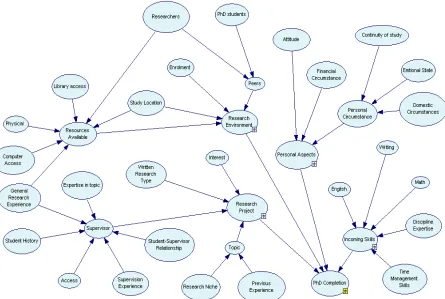
The first step in constructing a Bayesian Network is the development of a conceptual model of the factors and their interactions. This is depicted as a graphical model, or network, of nodes (representing the factors) and directed arrows (representing the interactions between the nodes). The final outcome (timely PhD completion) is called the terminal node.
The second step of the BN typically involves categorizing each node into a (small) number of states, for example high/low, 0-10/10-20/20+, good/medium/bad. The thresholds for the states are chosen to be meaningful in the context of the problem.
In the third and last step of the construction of the BN, each node is quantified by attaching probabilities to each state of the node. The probabilities are conditional on the states of the nodes feeding into it (as determined by the directed arrows in the network).
A characteristic of the BN is that quantification of a node in the BN depends only on a subset of the network. Thus the whole problem is collapsed into a series of local analyses. Moreover, a variety of sources can be used for quantification of a node, including data, simulation models, statistical or mathematical models, results from literature or previous studies, expert knowledge, and so on. This ability to integrate diverse data is arguably one of the strengths of the BN approach. An iterative approach to designing a BN is described by Johnson et al. (2010).
Once completed, the conditional probabilities ‘flow through’ the BN to provide an overall probability for each level of the terminal (outcome) node. The network can then be interrogated to identify the major factors influencing the outcome. Moreover, it can be employed to assess the impact of ‘evidence’ and evaluate scenarios, where these are represented by setting one or several of the nodes in the BN to specified levels.
B. Conceptual BN model.
financial status. Subjects were unable to quantify the impact of environments other than the current one, based on their own experience.
C. Quantification.
The conceptual BN was translated to the software package Genie for probabilistic quantification. Five participants quantified the BN model. The first (A1) was a former domestic doctoral student, the second (A2) a current domestic PhD student, and the third (A3) a current international student. The fourth participant (B1) was a supervisor of these doctoral students, and the fifth (C1) was the manager of the university research students’ centre.
The network was quantified by each participant independently, with guidance from two of the coauthors. The guidance provided was in the form of a structured statement describing a Bayesian Network, giving definitions of the nodes, and providing an example of how to complete the required conditional probability tables. The statement was provided to all participants.
Participants were taken through each external node and asked to quantify the probability of each node being in the positive state. For internal nodes, participants were asked to complete the underlying conditional probability tables. For illustration, an example question that was asked of a subject in order to quantify the network is as follows: ‘if the factors that directly influence this node are all conducive, what is the probability of this factor being conducive”. As previously stated, the definitions of relevant nodes and states (conducive, not conducive) had been defined for the subject. The probabilities provided by the subject were then confirmed through statements such as, ‘this value would indicate that in x out of 10 times, or for x out of 10 students, this factor would be conducive, given that all of the input nodes are conducive’. Similar questions were asked for the other combinations of states making up the conditional probability tables. The subject was then invited to evaluate the full set of probabilities for consistency and relative magnitude. This process was repeated for all nodes in the network. Where subjects found this process difficult, they were alternatively asked to weight the importance of each of the input nodes. The weights were then standardized to equal 1, and used as coefficients in a linear regression with indicator variables representing the input nodes. The outputs of the regression model were used as inputs into the conditional probability tables for the node under consideration.
D. Analysis and Interrogation.
Final probabilities depicted in the output node were recorded as representations of each participant’s perceived probability of timely completion. Internal nodes feeding directly into the model were independently interrogated to determine their effect on the stated probability in the output node. Finally, each node was interrogated independently to determine its final effect on the output node in order to determine any unexpected effects.
III. Results.
A. Overall network structure.
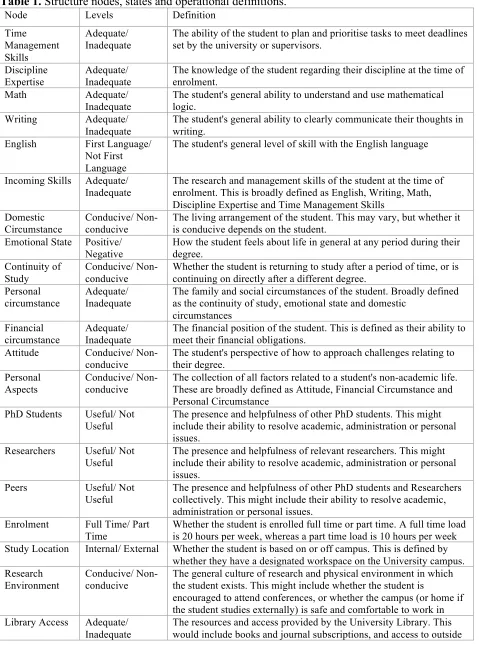
each. Four internal nodes feed directly into the outcome node, each with their own network of factors influencing their state. Table 1 provides a full list of all included nodes with their possible states and operational definitions.
Table 1. Structure nodes, states and operational definitions.
Node Levels Definition
Time Management Skills
Adequate/ Inadequate
The ability of the student to plan and prioritise tasks to meet deadlines set by the university or supervisors.
Discipline Expertise
Adequate/ Inadequate
The knowledge of the student regarding their discipline at the time of enrolment.
Math Adequate/
Inadequate
The student's general ability to understand and use mathematical logic.
Writing Adequate/
Inadequate
The student's general ability to clearly communicate their thoughts in writing.
English First Language/
Not First Language
The student's general level of skill with the English language
Incoming Skills Adequate/ Inadequate
The research and management skills of the student at the time of enrolment. This is broadly defined as English, Writing, Math, Discipline Expertise and Time Management Skills
Domestic Circumstance
Conducive/ Non-conducive
The living arrangement of the student. This may vary, but whether it is conducive depends on the student.
Emotional State Positive/ Negative
How the student feels about life in general at any period during their degree.
Continuity of Study
Conducive/ Non-conducive
Whether the student is returning to study after a period of time, or is continuing on directly after a different degree.
Personal circumstance
Adequate/ Inadequate
The family and social circumstances of the student. Broadly defined as the continuity of study, emotional state and domestic
circumstances Financial
circumstance
Adequate/ Inadequate
The financial position of the student. This is defined as their ability to meet their financial obligations.
Attitude Conducive/
Non-conducive
The student's perspective of how to approach challenges relating to their degree.
Personal Aspects
Conducive/ Non-conducive
The collection of all factors related to a student's non-academic life. These are broadly defined as Attitude, Financial Circumstance and Personal Circumstance
PhD Students Useful/ Not Useful
The presence and helpfulness of other PhD students. This might include their ability to resolve academic, administration or personal issues.
Researchers Useful/ Not Useful
The presence and helpfulness of relevant researchers. This might include their ability to resolve academic, administration or personal issues.
Peers Useful/ Not
Useful
The presence and helpfulness of other PhD students and Researchers collectively. This might include their ability to resolve academic, administration or personal issues.
Enrolment Full Time/ Part Time
Whether the student is enrolled full time or part time. A full time load is 20 hours per week, whereas a part time load is 10 hours per week Study Location Internal/ External Whether the student is based on or off campus. This is defined by
whether they have a designated workspace on the University campus. Research
Environment
Conducive/ Non-conducive
The general culture of research and physical environment in which the student exists. This might include whether the student is
encouraged to attend conferences, or whether the campus (or home if the student studies externally) is safe and comfortable to work in Library Access Adequate/
Inadequate
libraries.
Physical Adequate/
Inadequate
The physical resources of the University, such as car parks, lecture halls and study space.
Computer Access
Adequate/ Inadequate
The availability and appropriateness of computer -based resources and assistance. This includes physical hardware such as desktop and laptop computers as well as software licences.
General Research Experience
Adequate/ Inadequate
The supervisor's previous experience in academic research at the time of enrolment. This could be defined by the number of publications produced or the length of time actively involved in research. Resources
Available
Adequate/ Inadequate
The general availability of resources related to the completion of a Research Higher Degree. This is broadly defined as Library Access, Physical resources, Computer access and General Research
Experience.
Interest High/ Low The student's interest in their thesis topic Written
Research type
Publication/ Standard Report
The type of thesis submission the student nominates. Publication required that all sections of the thesis consist of published papers, while a standard report is approved by a panel.
Expertise in topic
Adequate/ Inadequate
The knowledge of the supervisor regarding their expertise in the specific thesis subject at the time of enrolment. This might be
determined by number of papers published on the subject, or length of time spent researching the substantive area.
Student History Mostly Successful/ Mostly Unsuccessful
The success record of the supervisor regarding previous postgraduate students. This is determined by the number of students completing on time divided by the number of students supervised.
Access Adequate/
Inadequate
The availability of the supervisor for meetings, comments and feedback. This is determined largely by the student's need to access the supervisor.
Supervision Experience
Adequate/ Inadequate
The experience of the supervisor with supervising postgraduate students. This may be judged by the number of students previously supervised or the length of time spent actively supervising students.
Student-supervisor history
Positive/ Negative
The relationship and history between the student and supervisor prior to enrolment. This may include any personal or academic
relationships within or without the context of the research higher degree.
Supervisor Helpful/ Not Helpful
The helpfulness and timeliness of the supervisors comments and feedback. This may be judged by the comprehensiveness, relevance and correctness of comments.
Research Niche Specific/ General The specificity of the student's chosen thesis topic. This may be determined by the number of substantive areas in which the student considers their work relevant or the breadth of literature review (as judged by the number of publications and journals included) required to establish a theoretical base.
Previous Experience
Adequate/ Inadequate
The student's previous experience with their research topic. This may include study in the area, but may also include relevant research or industry roles previously held by the student.
Topic Conducive/
Non-conducive
The topic of the student's thesis in relation to their experience. This is broadly defined as the Research Niche of the thesis and Previous Experience of the student
Research Project
Conducive/ Non-conducive
B. Overall probability of timely completion.
[image:9.612.68.535.223.261.2]The output showed a perceived probability of timely PhD completion in Statistics at QUT ranging from 68% to 79% (Table 2). Amongst students, the domestic current student perceived the highest probability of timely completion (79%), followed by the current international student. The supervisor perceived the second lowest probability of timely completion (70%), and the former domestic student perceived the lowest probability (68%). The research manager (C1) held the most optimistic overall view of the probability of timely completion (80%); although this was still within keeping with the other estimates, it was higher by 10% than the supervisor (B1).
Table 2. Final outcome probability of timely completion of a PhD based upon user beliefs.
Network A1 A2 A3 B1 C1
Probability 0.68 0.79 0.72 0.70 0.80
C. Most influential factors.
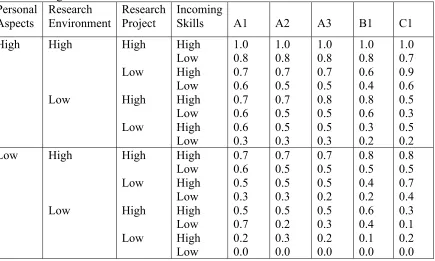
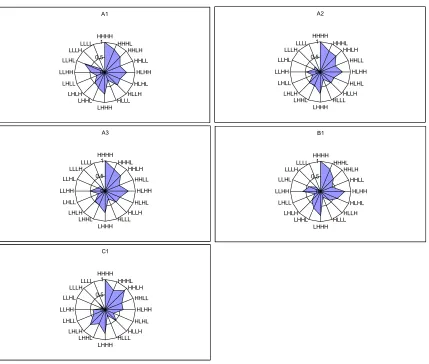
The most influential factors were found to be those feeding directly into the terminal node (timely completion). Results of the interrogation of these nodes are presented in Table 3 and depicted as radar plots in Figure 2.
These analyses revealed that all four factors contribute substantially to the probability of timely completion. Moreover, while low levels of one or two of the identified factors can deplete the probability to around 0.5 (a 50/50 chance of timely completion), there is almost unanimous agreement that low levels of more than two factors reduces this probability to less than 0.5.
The largest differences in the probabilities awarded to the different combinations of factors were observed between the supervisor (B1) and research manager (C1). Compared with the research manager, the supervisor showed much greater concern about timely completion for low levels of the research project, either alone when all other factors were at high levels, or with low levels of personal aspects when the other two factors were at high levels. In contrast, the research manager showed greater concern than the supervisor when the research environment was a low level, either alone with all other factors were at high levels, or paired with low levels of incoming skills and/or personal aspects.
Table 3. Relative influence of direct internal nodes on outcome of interest (timely completion), scaled to range between 0 and 1.
Personal Aspects Research Environment Research Project Incoming
Skills A1 A2 A3 B1 C1
High High
Low High Low High Low High Low High Low High Low High Low 1.0 0.8 0.7 0.6 0.7 0.6 0.6 0.3 1.0 0.8 0.7 0.5 0.7 0.5 0.5 0.3 1.0 0.8 0.7 0.5 0.8 0.5 0.5 0.3 1.0 0.8 0.6 0.4 0.8 0.6 0.3 0.2 1.0 0.7 0.9 0.6 0.5 0.3 0.5 0.2 Low High
Low High Low High Low High Low High Low High Low High Low 0.7 0.6 0.5 0.3 0.5 0.7 0.2 0.0 0.7 0.5 0.5 0.3 0.5 0.2 0.3 0.0 0.7 0.5 0.5 0.2 0.5 0.3 0.2 0.0 0.8 0.5 0.4 0.2 0.6 0.4 0.1 0.0 0.8 0.5 0.7 0.4 0.3 0.1 0.2 0.0 IV. Discussion.
This BN analysis revealed the following answers to the three main questions posed in this study. First, despite their different perspectives, there was general agreement among the participants in our study that the overall likelihood of timely PhD completion was around 0.7 to 0.8; that is, that on average just under one student in four will not graduate within the given period. The current domestic student (A2) rated their probability of timely completion as the highest, followed the current international student (A3) and the supervisor (B1). The former domestic PhD student (A1) was the most pessimistic about timely completion.
Across all participants, the Research Project was the most important factor impacting on timely completion, followed by the Research Environment. Interestingly, Incoming Skills and Personal Aspects were judged to be equally the least important.
Of course, it is not possible to make any general statements or inferences based on this small sample. However, the study does highlight that students and engaged staff can indeed develop a complex systems model for timely PhD completion, and then quantify it based on their expert judgment. The study also demonstrates that the quantitative outputs are useful for answering questions about PhD completion, including the likelihood of timely completion and the impact of factors contributing to this outcome. Finally, the outputs of a BN can facilitate understanding and decision-making about PhD matters by students, supervisors and university management.
state cannot be objectively measured. Notwithstanding this, these are important factors, and a BN approach allows these to be included and quantified at a high level.
Figure 2. Radar plots of relative influence of factors directly influencing the target outcome (timely completion); probabilities are as displayed in Table 1. Factors are Personal Aspects, Research Environment, Research Project and Incoming Skills. Hence ‘HHHH’ refers to high levels of all factors, HLLL refers to high level of Personal Aspects and low levels of other factors, and so on.
It is noted that the study reported in this paper has focused on factors perceived to be important contributors to timely PhD completion and consequently has provided perceived probabilities of completion through the Bayesian Network analysis. These perceptions could lay the groundwork for further modeling of actual factors and completion rates, and the parallels between the perceived and actual Networks. There were three reasons why this was not pursued as part of the present study. First, perceptions are important in their own right, since they lead to a deeper understanding of the human aspects of the problem and can thus contribute strongly to behavioural and management change frameworks. Second, not all of the factors identified in the study have unequivocal objective metrics that are routinely collected by Universities. Third, confidentiality concerns constrained a more objective analysis, particularly for the defined group of interest in this study. This motivates a larger future study that would address all three of these
issues. Such a study could comprise students and supervisors from a wider range of disciplines, to both generate the network structure and quantify them.
Almost 30 years ago, Abedi and Benkin (1984) described research into reasons contributing to timely completion of degrees as “charitably sparse” (p.4). Twenty years later, Maher, Ford and Thompson (2004) argued that empirical research in this field could still be described as such. There has been considerable literature on the topic in the intervening years, and it is hoped that the present study contributes to our growing understanding of timely completion as a complex system.
Acknowledgement
The models described in this paper were created using the GeNIe modelling environment developed by the Decision Systems Laboratory of the University of Pittsburgh and available at http://genie.sis.pitt.edu/.
References
Abedi, J., & Benkin, E. (1984). The effects of students’ academic, financial, and demographic variables on time to the doctorate. Research in Higher Education, 27(1), 3-14.
Almond, R.G., DiBello, L.V., Moulder, B., & Zapata Rivera, J.D. (2007). Modeling diagnostic assessments with Bayesian networks. Journal of Educational Measurement,44 (4), 341-359.
Bair, C., & Hanworth, J. (2005). Doctoral student attrition and persistence: A meta-synthesis of research. Higher Education: Handbook of Theory and Research, 19, 481-534.
Barnes, B.J., & Austin, A.E. (2009). The role of doctoral advisors: A look at advising from the advisors perspective. Innovative Higher Education,33(5), 297-315.
Carmona, C., Castillo, G., & Millan, E. (2008). Designing a dynamic Bayesian network for modeling students’ learning styles. ICALT, 346-350.
Council of Graduate Schools Ph.D. Completion Program (2009). Ph.D. Completion and Attrition: Findings from Exit Surveys of Ph.D. Completers. Monograph. Released Sept. 2009.
Devenish, R., Dyer, S., Jefferson, T., Lord, L., van Leeuwen, S., & Fakerley, V. (2009). Peer to peer support: The disappearing work in the doctoral student experience. Higher Education Research and Development, 28(1), 59-70.
Isaac, P.D., Quinlan, S.V., & Walker, M.M. (1992). Faculty perspectives of the doctoral dissertation. The Journal of Higher Education, 63 (3), 241-268.
Maher, M.A., Ford, M.E., & Thompson, C.M. (2004). Degree progress of women doctoral students – factors that constrain, facilitate and differentiate. The Review of Higher Education, 27 (3), 385-408.
Millan, E. Loboda, T., & Perez-de-la-Crus, J.L. (2010). Bayesian networks for student model engineering. Computers and Education, 55 (4), 1663-1693.
Mislevy, R.J., Almond, R.G., Yan, D., & Steinberg, L.S. (2000). Bayes nets in educational assessment: Where the numbers come from. In K.B. Laskey & H. Prade (Eds), Proceedings of the Fifteenth Conference on Uncertainty in Artificial Intelligence, pp. 437-446, San Francisco: Morgan Kaufmann.
Muszynski, S.Y., & Akamatsu, T.J. (1991). Delay in completion of doctoral dissertations in clinical psychology. Professional Psychology: Research and Practice, 22 (2), 119-123.
Pearl, J. (2000). Causality: Models, Reasoning, and Inference. Cambridge University Press.
Rodwell, J. (2008). Predictors of timely doctoral student capabilities by type of attendance; The utility of a pragmatic approach. Journal of Higher Education Policy and Management,30 (1), 65-76.
Seagram, B.C., Gould, J., & Pyke, S.W. (1998). An investigation of gender and other variables on time to completion of doctoral degrees. Research in Higher Education, 39 (3), 319-335.
de Valero, Y.F. (2001). Departmental factors affecting time-to-degree and completion rates of doctoral students at one land-grant research institution. Journal of Higher Education, 72 (3), 341-367.
Witte, J., & James, W.B. (1998). Cohort partnerships: A pragmatic approach to doctoral research. New Directions for Adult and Continuing Education, 79, 53-62.