Work-Focused Services in
Children’s Centres Pilot:
Final Report
Department for Work and Pensions
Research Report No 772
Work-Focused Services in
Children’s Centres Pilot:
Final Report
Rachel Marangozov and Helen Stevens
or write to the Information Policy Team, The National Archives, Kew, London TW9 4DU, or email: [email protected].
This document/publication is also available on our website at: http://research.dwp.gov.uk/asd/asd5/rrs-index.asp
Any enquiries regarding this document/publication should be sent to us at:
Department for Work and Pensions, Commercial Support and Knowledge Management Team, Upper Ground Floor, Steel City House, West Street, Sheffield S1 2GQ
First published 2011.
ISBN 978 1 908523 19 8
iii
Contents
Acknowledgements ... viii
The Authors ... ix
Abbreviations ...x
Glossary of terms ... xii
Summary ...1
1 Introduction ...9
1.1 Background to the pilot ...9
1.2 About the work-focused services in children’s centres pilot ... 10
1.2.1
Pilot aims, provision and target groups ... 10
1.3 Aims and objectives of the evaluation ... 11
1.4 Our evaluation methodology ... 11
1.4.1
Selection of case studies ... 12
1.4.2
Waves 1 and 2 of qualitative research with children’s centre users
(summer 2009 and 2010) ... 12
1.4.3
Waves 1 and 2 of case study research with pilot staff (autumn/winter
2009 and 2010) ... 13
1.4.4
Waves 1 and 2 of the survey of children’s centre users (January 2009
and 2011) ... 14
1.4.5
The comparison study ... 14
1.5 Management Information ... 14
1.5.1
DWP administrative data ... 14
1.5.2
Work-Focused Services in Children’s Centres clerical data
(pilot funded work-focused provision) ... 15
1.5.3
Children’s centre activity data ... 15
1.5.4
Use of the MI and clerical data ... 15
1.6 Summary of key findings from the baseline and interim reports ... 16
1.6.1
Summary of findings from the baseline evaluation report ... 16
1.6.2
Summary of findings from the interim evaluation report ... 17
1.7 Overview of this report ... 18
2 Pilot activities and delivery ... 19
2.1 Pilot activities ... 19
2.1.1
Core activities ... 19
2.1.2
Core activities across the case study sites and over time ... 22
2.1.3
Demand and uptake of activities ... 23
2.2 Governance and Jobcentre Plus line management ... 28
2.3 Pilot location and room for the Jobcentre Plus Personal Adviser ... 29
2.3.1
Key facilitators of pilot delivery ... 29
3 The role of the Jobcentre Plus Personal Adviser ... 31
3.1 A new approach to the ‘traditional’ Jobcentre Plus Personal Adviser role ... 31
3.2 Successes and strengths of the Jobcentre Plus Personal Adviser role ... 31
3.2.1
Jobcentre Plus Personal Advisers are more accessible ... 31
3.2.2
Jobcentre Plus Personal Advisers are empathetic and understanding ... 32
3.2.3
Jobcentre Plus Personal Advisers are friendly and approachable ... 32
3.2.4
Jobcentre Plus Personal Advisers are trustworthy ... 33
3.2.5
Jobcentre Plus Personal Advisers are knowledgeable and helpful ... 33
3.2.6
Jobcentre Plus Personal Advisers have more time to help customers ... 34
3.3 Constraints and challenges to the Jobcentre Plus Personal Adviser role ... 35
3.3.1
Balancing work-focused services with engagement and outreach
activities ... 35
3.3.2
The role of targets ... 36
4 Engagement ... 38
4.1 Methods of engagement ... 38
4.1.1
Outreach in children’s centres ... 38
4.1.2
Outreach in the community ... 39
4.1.3
Advertising and marketing ... 40
4.1.4
Word-of-mouth ... 40
4.1.5
Referrals from partner organisations ... 40
4.2 Key facilitators ... 41
4.3 Challenges to engagement and outreach ... 43
v
5 Partnership working ... 45
5.1 Partnership working between Jobcentre Plus and children’s centres ... 45
5.1.1
A better understanding of each other’s organisation ... 46
5.1.2
A greater number of cross referrals ... 46
5.1.3
Joining up of partner networks and expertise ... 47
5.1.4
Jobcentre Plus Personal Advisers fully integrated into the children’s
centre ... 48
5.2 Wider partnership working ... 48
6 Key learning and critical success factors ... 50
6.1 Many children’s centres can be ideal venues for hosting work-focused services
targeted at poor households ... 50
6.2 Some children’s centre settings offer more suitable venues than others ... 51
6.3 Flexibility is critical to the success of the Jobcentre Plus Personal Adviser role ... 51
6.4 Continuity of the Jobcentre Plus Personal Adviser role facilitates engagement .... 51
6.5 Recruiting the ‘right’ Jobcentre Plus Personal Adviser is key... 52
6.6 It takes time to embed work-focused services in a multi-agency setting ... 53
6.7 ‘Hands-on’ commitment by key partners facilitates integrated service delivery ... 54
6.8 Management and performance structures need to facilitate
integrated working ... 55
6.9 Key learning and its relevance to other, similar outreach settings and
delivery models ... 56
7 Perceived outcomes and impacts ... 58
7.1 Effective engagement of the target groups ... 58
7.2 Increased take-up of Jobcentre Plus services in children’s centres ... 59
7.3 Stronger partnership working between Jobcentre Plus and children’s centres ... 60
7.4 Parents are closer to work ... 62
7.4.1
Aspiration-related outcomes ... 62
7.4.2
Attitudinal changes towards Jobcentre Plus and work ... 63
7.4.3
Employment-related outcomes ... 64
7.5 The profile of pilot children’s centres and their users is more work-focused ... 65
7.6 Integrated service delivery and better outcomes for parents ... 68
7.7 Additional skills, knowledge and customers for Jobcentre Plus ...70
7.8 The potential to reduce child poverty ... 70
8 Conclusion ... 72
Appendix
A fuller set of results and analysis from the survey of children’s
centre users ... 75
List of tables
Table 1.1
Sources of the MI and clerical data ... 16
Table 2.1
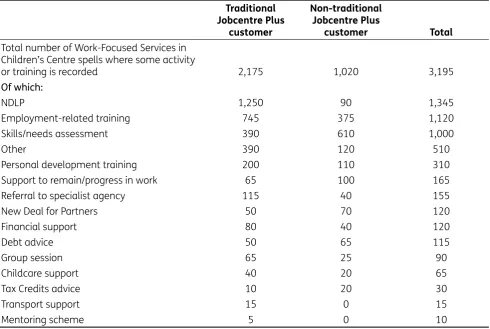
Training and activity by customer type ... 26
Table 2.2
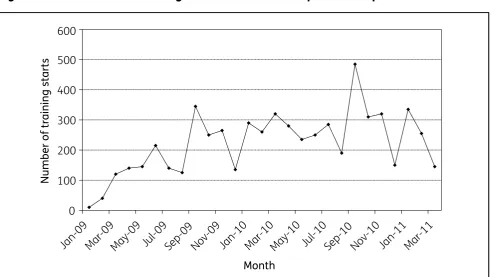
Total number of training or activity starts ... 27
Table 7.1
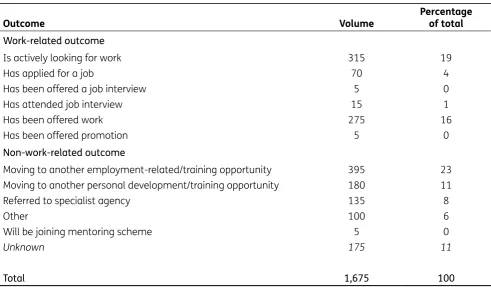
Pilot outcomes from the MI ... 64
List of figures
Figure 2.1
Preferred site for Jobcentre Plus services (%) ... 23
Figure 2.2
Reasons for favouring Jobcentre Plus services at children’s centre sites (%) ... 24
Figure 2.3
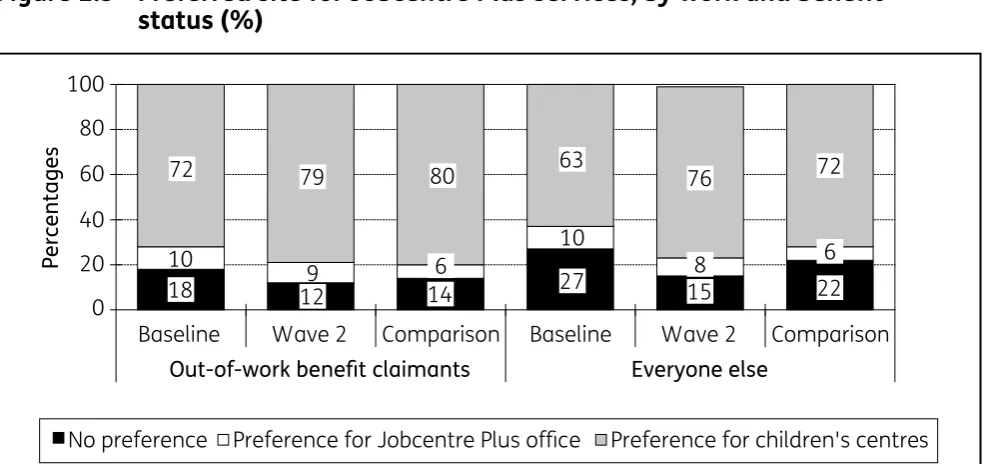
Preferred site for Jobcentre Plus services, by work and benefit status (%) ... 25
Figure 2.4
Number of training starts over the life span of the pilot ... 27
Figure 7.1
Current users of Jobcentre Plus Services at Children’s Centre, gender,
partner status, benefit status, number of children (%) ... 59
Figure 7.2
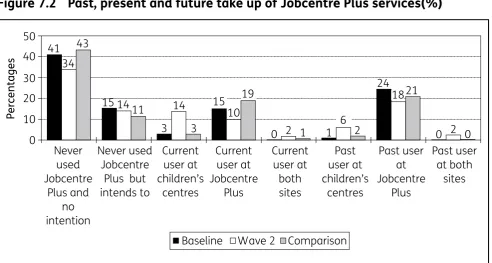
Past, present and future take up of Jobcentre Plus services(%) ... 60
Figure 7.3
Respondent’s employment status, not working (%) ... 65
Figure 7.4
Looking for work at time of survey (%) ... 66
Figure 7.5
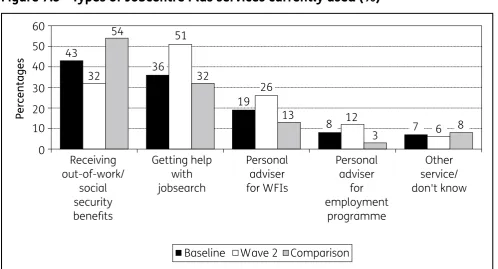
Types of Jobcentre Plus services currently used (%) ... 67
Figure 7.6
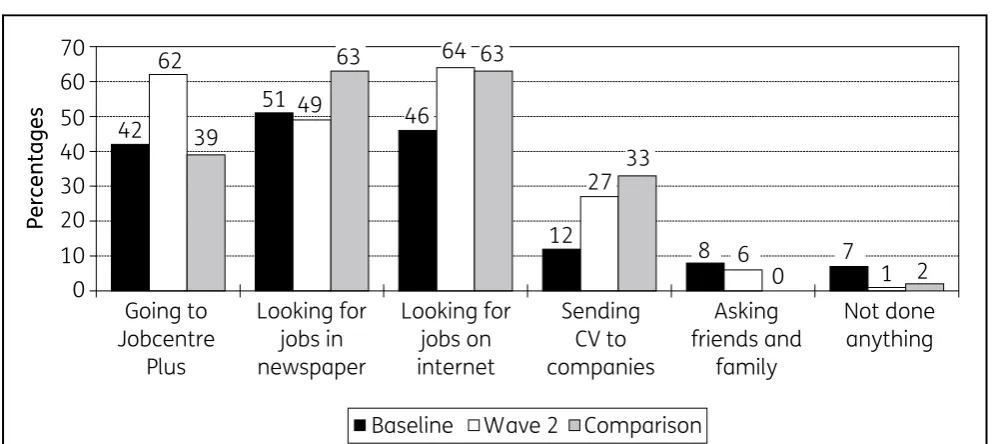
Job searching strategies among those looking for work (%) ... 68
Figure 7.7
Usual reason for visiting the children’s centre (%) ... 69
Figure A.1 Demographic distribution of respondents, gender and partner status (%) ... 75
Figure A.2 Demographic distribution of respondents, age and ethnic background (%) .... 76
Figure A.3 Number of dependent children among respondents (%) ... 77
Figure A.4 Respondent’s housing circumstances (%) ... 78
Figure A.5 Partner’s current employment status, working (%) ... 79
Figure A.6 Partner’s current employment status, not working (%) ... 79
Figure A.7 Respondent’s employment status, working (%) ... 80
Figure A.8 Respondent’s employment status, not working (%) ... 81
vii
Figure A.10 Employment status by caring responsibilities (%) ... 83
Figure A.11 In receipt of benefits or tax credits – respondents or their partners (%) ... 84
Figure A.12 Weekly household income of survey respondents (%) ... 85
Figure A.13 Usual reason for visiting the children’s centre (%) ... 86
Figure A.14 Past, present and future take up of Jobcentre Plus services (%) ... 87
Figure A.15 Current users of Jobcentre Plus services at children’s centre, gender, partner
status, benefit status, number of children (%) ... 88
Figure A.16 Current users of Jobcentre Plus services at children’s centre, age and
ethnic background (%) ... 89
Figure A.17 Types of Jobcentre Plus services currently used (%) ... 90
Figure A.18 Job searching strategies among those looking for work (%) ... 91
Figure A.19 Job searching strategies among those looking for work, out of work and
claiming benefit entitlements (%) ... 92
Figure A.20 Job searching strategies among those looking for work, everyone else (%) .... 92
Figure A.21 Preferred site for Jobcentre Plus services (%) ... 93
Figure A.22 Preferred site for Jobcentre Plus services, by work and benefit status (%) ... 94
Figure A.23 Reasons for favouring Jobcentre Plus services at children’s centre sites (%) ... 95
Figure A.24 Reasons for favouring Jobcentre Plus services at Jobcentre Plus office (%) ... 96
Acknowledgements
The Institute for Employment Studies (IES) research team would like to acknowledge the many staff within the pilot areas who contributed their experience and perceptions so usefully to the research, and likewise those children’s centre users who took part in our interviews and survey.
IES would also like to thank those local authorities which agreed to be ‘comparison sites’ for our research study, even though they were not part of the pilot. Jobcentre Plus, local authority and children’s centre staff in these local authorities gave up their time to participate in our research and to help organise the survey of children’s centre users.
IES would like to thank Sharon Gibbens and the rest of the research team at GfK NOP for their work in undertaking both waves of the survey of children’s centre users and the survey of the children’s centre users at the comparison sites.
ix
The Authors
The Authors
Rachel Marangozov is a Senior Research Fellow at the Institute for Employment Studies (IES), where she specialises in the employment of minority ethnic groups and migrant workers.
Abbreviations
AAT Adviser Achievement Tool
ADAPT Adviser Development, Achievement and Performance Tool
ADF Adviser Discretionary Fund
CA Carers Allowance
CAB Citizens Advice Bureau
CAF Common Assessment Framework
CAPI Computer Assisted Personal Interviewing
CRB Criminal Records Bureau
CTB Council Tax Benefit
CTC Child Tax Credit
DLA Disability Living Allowance
DWP Department for Work and Pensions
ESA Employment Support Allowance
ESOL English for Speakers of Other Languages
HB Housing Benefit
HMRC Her Majesty’s Revenue and Customs
IAG Information, Advice and Guidance
IB Incapacity Benefit
IS Income Support
IT Information Technology
JSA Jobseeker’s Allowance
LAMRA Labour Market Recruitment Adviser
LMS Labour Market System
MI Management Information
NDLP New Deal for Lone Parents
xi
SROI Social Return on Investment
TfC Together for Children
WFIs Work Focused Interviews
WPLS Work and Pensions Longitudinal Study
WTC Working Tax Credit
Glossary of terms
Traditional Jobcentre Plus Customers who are the main claimant of a benefit or are the
customers partner in a couple benefit claim.
Non-traditional Jobcentre Plus Customers who are neither the main claimant of a benefit nor
1
Summary
Introduction
This report presents final findings from the evaluation of the ‘work-focused services in children’s centres’ pilot. The main components of the evaluation have been:
• two waves of case study interviews with pilot staff and some children’s centre users (autumn/ winter 2009 and 2010);
• two waves of in-depth qualitative interviews with children’s centre users, both those who had and had not used the pilot (summer 2009 and 2010);
• two waves of a survey of children’s centre users conducted in all the pilot children’s centres (a ‘baseline’ survey in January 2009 and a wave two survey in 2011);
• a comparison study that involved nine children’s centres in three non-pilot local authorities so that any trends in take-up or attitudes could be linked to the pilot. The comparison study involved both case study research (autumn/winter 2010) and a survey of children’s centre users (January 2010). A baseline and interim evaluation report have already been published.1 This final report builds
on all the findings from these previous evaluation reports and research components, as well as Management Information (MI).
The work-focused services in children’s centre pilot
At the end of 2007, the Government set up the Child Poverty Unit to bring together key officials in the Department for Work and Pensions (DWP), the then Department for Children, Schools and Families and HM Treasury. The Work-Focused Services in Children’s Centres Pilot was one of a suite of Child Poverty Pilots that were announced in 2008, which aimed to build up the evidence base of what works in tackling child poverty.
The aim of the pilot was to test whether children’s centres can offer an effective means of engaging parents in labour market activity, moving them closer to work and ultimately into employment. While the pilot was not linked to the achievement of specific employment outcomes or targets, the aim was to increase engagement with a variety of services and activities which had that as their eventual goal.
The ten local authorities chosen to participate in the pilot were: • Blackpool;
• Ealing;
• Kingston-upon-Hull; • Lambeth;
1 Marangozov, R. (2009). Work-focused services in children’s centres pilot: evaluation baseline
report. Department for Work and Pensions (DWP) Research Report No. 602; Marangozov, R. and Stevens, H. (2010). Work-focused services in children’s centres pilot: Interim report. DWP Research Report No. 677.
• Nottingham City; • Redcar and Cleveland; • Sandwell;
• Somerset; • Southampton; • Westminster.
Pilot activities and delivery
All pilot sites delivered the five core elements of pilot provision: Jobcentre Plus provision, packages of support and bespoke services, partnership working, integrating the Jobcentre Plus Personal Adviser into the children’s centres, and identifying and engaging customers. Some activities were prioritised over others depending on local demographics and customer demand, the children’s centre’s footfall, the availability of other local provision and the need profile of the local community.
Across almost all sites, there was an early focus on engagement and outreach activities at the start of the pilot to raise awareness of the service among children’s centre staff, partner organisations and parents. However, as the pilot progressed, and this awareness increased, Jobcentre Plus Personal Advisers tended to dedicate more time to delivering work-focused activities and bespoke support to customers.
Demand for the pilot has been high, with the vast majority of children’s centre users in the pilot and comparison sites stating in our survey that they would prefer to access Jobcentre Plus services in the children’s centre, as opposed to the Jobcentre Plus office. Over the life of the pilot there were over 6,300 starts to the pilot by more than 5,800 individuals2, with 50 per cent of pilot participants
undertaking specific work-related activities or training.3 When considering both Jobcentre Plus
and bespoke packages of work-focused support, the most popular provision was for skills/needs assessments and employment-related training. Employment-related training was most popular among traditional Jobcentre Plus customers while skills/need assessments were most popular among non-traditional Jobcentre Plus customers. In terms of Jobcentre Plus provision, the pilot led to an increased take-up of New Deal for Lone Parents (NDLP); over 40 per cent of eligible4 pilot
participants who had taken up some form of activity had joined NDLP.
That only half of pilot participants had undertaken training while on the pilot reflects the pilot’s emphasis on engagement and outreach activities (particularly among those who would not normally access Jobcentre Plus services), the high levels of hand-holding required by some
customers (much of which could not formally be recorded as a pilot activity), and, to a lesser extent the physical capacity of some children’s centres to host on-site training. Data on activities held by the children’s centres demonstrated that across the pilot areas there were often 1,500 to 2,000 attendees at events each quarter, both outreach and work focused. From these there were often referrals for further support to the Personal Adviser, as well as from the advisers to the children’s centre for registration.
2 Some individuals may have started the pilot more than once if they exited and then rejoined
during the lifetime of the pilot.
3 Data from the pilot MI. Due to a data collection issue data on pilot funded work-focused
provision is missing from one pilot area and so data on this will be an undercount.
3
The use of discretionary funds provided through the pilot was a key facilitator of pilot delivery and enabled areas to tailor support and plug gaps in provision to meet specific needs that were not being met by mainstream services. Another key facilitator to pilot delivery was effective engagement and outreach by the Jobcentre Plus Personal Adviser, which enabled advisers to build trusting relationships with parents and guarantee sufficient take-up of the service.
The role of the Jobcentre Plus Personal Adviser
Overall, the pilot areas successfully integrated Jobcentre Plus Personal Advisers into the children’s centres. Customers reported that advisers were accessible, empathetic and understanding, friendly and approachable, trustworthy, knowledgeable and helpful, and had more time to dedicate to them in comparison to their experiences at the Jobcentre Plus office. The flexibility of this role was key to its success with customers and pilot staff alike.
Continuing challenges for the role of Jobcentre Plus Personal Advisers were twofold. Firstly, some advisers found it difficult to manage the tension within the role itself: that of balancing work-focused activities with less structured, ad-hoc engagement and outreach activities. Secondly, a very small number of advisers found themselves having to work to targets set by Jobcentre Plus line managers, even though the pilot was not linked to targets. Neither of these issues proved detrimental to the role, but they did highlight the importance of having management structures in place that would facilitate integrated service delivery and support the Jobcentre Plus Personal Adviser in achieving this.
Partnership working
Partnership working was strong between Jobcentre Plus and children’s centres, while partnership working with other local providers tended to be more limited in some areas. This was partly because of the delays in pilot start-up and the time it took to establish effective working relationships.
Partnership working between Jobcentre Plus and children’s centres grew much stronger over time, as the pilot developed and this was evident in four key ways:
• a greater understanding of each other’s organisation and working practices; • a greater number of referrals between the two organisations;
• the joining-up of partner organisation networks and expertise;
• the full integration of Jobcentre Plus Personal Advisers into the children’s centres.
There were also greater linkages between Jobcentre Plus and key Sure Start partner organisations working on-site, as well as greater partnership working with the local authority in some areas. With the exception of training and education providers, partnership working with a wider range of local partner organisations and providers remained limited, and the pilot drew on these networks on an ad-hoc basis, depending on customer needs. This did not present a problem for most of the pilot areas, mainly because the children’s centres were already serving as hubs for multiple support services (of most relevance to families with young children), and so the need to seek out wider provision or establish formal partnerships was not necessary.
Engagement
Outreach was one of the most successful elements of the pilot. Through a variety of outreach methods the pilot successfully engaged a mix of traditional and non-traditional Jobcentre Plus customers. Pilot MI shows that around 60 per cent of pilot starts were known to be lone parents
in receipt of benefit and around 30 per cent were non-traditional Jobcentre Plus customers. The latter figure is particularly encouraging as many of this group would be parents from low income households and generally not in contact with Jobcentre Plus.
Of those traditional Jobcentre Plus customers who were in receipt of benefits as the main claimant, 85 per cent were in receipt of Income Support (IS), 11 per cent were in receipt of Jobseeker’s
Allowance (JSA) and two per cent were in receipt of Incapacity Benefit (IB) or Employment and Support Allowance (ESA) – again indicating good reach into the target groups. Partners of benefit claimants comprised four per cent of all pilot participants.5
Most of those engaged in the pilot were also from low-income households. Income information was collected for non-traditional Jobcentre Plus customers at the household level. The pilot MI shows that, for those for whom we have the data, around 70 per cent of non-traditional Jobcentre Plus customers earned under £20,000 gross annual household income, with one in five earning under £10,000.6
As the baseline report highlighted, successful engagement of these target groups reflects both the demography of the children’s centres and their reach into some of the most deprived communities. However, since then, evidence from the qualitative research and survey findings have shown that much of this engagement can also be confidently attributed to the success of the Jobcentre Plus Personal Advisers in proactively making themselves approachable, accessible and trustworthy to parents.
Key learning and critical success factors
This report draws out several key learning points for the successful delivery of work-focused services in children’s centres:
• Children’s centres can be ideal venues for hosting work-focused services targeted at poor households.
• Flexibility is critical to the success of the Jobcentre Plus Personal Adviser role in allowing for a more personalised and tailored service which meets the needs of the target group.
• Recruiting the ‘right’ Jobcentre Plus Personal Adviser, with the right mix of relevant skills, is key to facilitating engagement and partnership working.
• It takes time to embed work-focused services in a multi-agency setting. The experience of the pilot demonstrates that it takes at least nine months for an initiative like this to bed-in, and at least one year to establish effective working relationships with key partner organisations. • ‘Hands-on’ commitment by key partner organisations facilitates integrated service delivery. • Management and performance structures need to facilitate integrated working. Jobcentre Plus
and children’s centre managers have to support integrated working, both in practical terms but also in terms of sharing the pilot’s aims. Performance structures need to be flexible enough to account for the fact that integrated working takes time to establish, job outcomes are likely to be a longer-term prospect for many of the hardest-to-reach, and that important areas of work such as partnership working do not lend themselves easily to quantitative measurement.
5 Data from the pilot MI
6 Data from the pilot MI. We only have this information for 34 per cent of non-traditional
5
Many of these critical success factors are not just limited to outreach work in children’s centres, but could be applied in wider settings.
Pilot perceived outcomes and impacts
The pilot had a number of outcomes and observable impacts:• Effective engagement of the target groups: Around 60 per cent of pilot participants were lone parents in receipt of benefit and around 30 per cent were non-traditional Jobcentre Plus customers. Many parents in this latter group were not working due to childcare commitments and were more likely to be potential second earners where only one member of the household was in paid employment. The pilot MI shows that, for those where we have the data, around 70 per cent of non-traditional Jobcentre Plus customers were from low-income households.
• Increased take-up of Jobcentre Plus services in children’s centres: At the baseline survey of
children’s centre users, only three per cent of parents reported that they were using Jobcentre Plus services at the children’s centre. Two years later, in the wave two survey, this figure had jumped to 14 per cent.
• Stronger partnership working between Jobcentre Plus and children’s centres: This was evidenced by positive feedback from pilot staff in most areas, a number of referrals between the two
organisations, and attitudinal changes towards Jobcentre Plus among children’s centres staff. • Parents are closer to work: Perceived, attitudinal outcomes achieved include increased levels
of confidence, aspirations, better awareness of work-focused opportunities and options, and attitudinal changes towards Jobcentre Plus and work. In this way, the pilot made significant progress in preparing parents for work, in getting parents to think about work and in linking them into wider support and provision which they might need in the interim period. There is also indicative evidence from both qualitative and MI that the pilot moved participants closer to the labour market and moved some into paid employment.
• The profile of the children’s centres and their users is more work-focused: Over the course of the pilot, there was a decrease in the number of centre users who reported that they were not working because they were looking after the home and/or family (from 51 to 46 per cent). Overall, more pilot centre users at W2 reported that they were looking for work, than centre users in the comparison sites, particularly among parents out of work and claiming benefit entitlements (38 per cent, compared to 25 per cent). Engagement with Jobcentre Plus services also became more work-focused over the course of the pilot, with 51 per cent of children’s centre users reporting that they used Jobcentre Plus to receive help with jobsearch at W2, compared to 36 per cent at the baseline survey, and 32 per cent at the comparison survey.
• Integrated service delivery and better outcomes for parents: More joined up services meant that parents had better access to services on one site, and this meant that they were often dealt with more quickly. Referrals between Jobcentre Plus and children’s centres services also meant that parents’ issues were not addressed in isolation from each other, but were tackled more holistically.
• Additional skills, knowledge and customers for Jobcentre Plus: Jobcentre Plus gained new skills and knowledge via its Jobcentre Plus Personal Advisers. These included not just professional and personal skills, but also important local knowledge about support and provision in the wider community which they might not have known about from their work in the Jobcentre Plus office. Being embedded in children’s centre settings also gave Jobcentre Plus access to customer groups that were not in touch with its services, those who had little prior contact with Jobcentre Plus, and those who had little awareness as to the Jobcentre Plus services available.
Conclusions and recommendations
In light of the findings and conclusions set out in this research report, this section makes the following conclusions and recommendations to DWP, to Jobcentre Plus, to local authorities and to children’s centres.
1. Children’s centres are potentially ideal venues for an enhanced Jobcentre Plus offer to reach families through joined-up services
Children’s centres have been a substantial investment over the past two decades and the
Government’s ongoing commitment to the Sure Start programme is based on solid evidence that the early years are when the greatest difference can be made to a child’s life chances.7 In many
areas, they have successfully cut through silos in public services delivery to become hubs where several services can be accessed on site through more joined-up service delivery.
For these reasons alone, children’s centres are good venues for hosting an enhanced Jobcentre Plus offer (beyond the core offer currently offered by children’s centres). However, they also offer good reach into the target communities of lone parents, potential second earners and low-income households. They are also established and trusted environments in which to engage parents, many of whom are not in touch with Jobcentre Plus services. Finally, there is more than sufficient demand for the service and this is demonstrated in a four-fold increase in the take-up of the pilot’s services in children’s centres over time.
The pilot children’s centres were chosen primarily on the basis of those based in the most deprived wards, or those with reach into the most deprived communities. While this should remain a key factor in determining which children’s centres could be suitable sites for work-focused services, local areas should also consider a wider range of factors, such as the children’s centre’s capacity to host the service and whether it has sufficient footfall. This will ensure that any future provision is targeted effectively and efficiently, at a time when both Jobcentre Plus and children’s centres are under pressure from public spending cuts.
While children’s centres emerge as potentially ideal venues for the co-location of Jobcentre Plus provision, recent evidence from the results of a similar pilot suggest that Jobcentre Plus outreach targeted at disadvantaged families need not necessarily be restricted to children’s centres.8 There is
potential for local areas to consider co-locating Jobcentre Plus provision in similar outreach settings, such as primary schools and other early years settings.
2. Jobcentre Plus are well positioned to deliver work-focused services in children’s centres
The evidence from this pilot indicates that Jobcentre Plus is ideally placed to deliver work-focused support in children’s centres. This is not just because many areas already have strong partnership working between Jobcentre Plus and local authorities. The ‘added value’ of having Jobcentre Plus as one of the lead delivery agencies is its advisers’ specialist knowledge of benefits, better-off calculations and tax credits. In some areas, they have also brought with them contacts and links with Jobcentre plus provision, as well as knowledge of local job vacancies.
7 Allen, G. (2011). Early Intervention: The next steps. Cabinet Office.
8 Marangozov, R. and Dewson, S. (2011). Study of School Gates Employment Support Initiative.
7
3. There is a clear case for strengthening the Jobcentre Plus offer in children’s centres to encompass dedicated outreach provision
In the space of two years, integrated service delivery has had a number of key achievements: • successfully recruited and integrated Jobcentre Plus Personal Advisers in almost all of the
children’s centres;
• engaged a significant proportion of non-traditional Jobcentre Plus customers (30 per cent of pilot starts are neither benefit claimants nor the partner of a benefit claimant);
• increased the take-up of Jobcentre Plus services in the pilot children’s centres by four-fold, and actively referred parents onto other relevant services where necessary;
• engaged many parents who have faced complex and multiple barriers to work;
• delivered work-focused activity in an integrated way, alongside children’s centre services and services from other key children’s centre partner organisations;
• delivered intensive, personalised and tailored support – much of which cannot be captured in formal pilot data – to remove some of the toughest barriers to employment. This includes attitudinal barriers to work (and to Jobcentre Plus in some cases), low levels of confidence and motivation, and getting parents to think about and prepare for employment in the medium to long term if work is not an option in the short term alongside their primary childcare responsibilities.
In deciding whether to continue such provision, Jobcentre Plus district managers do not just need to take into account the significant outcomes listed above, but also their wider organisational obligations under the Child Poverty Act (2010) and the core messages in the Child Poverty Strategy, published in April 2011. As part of the latter, the Government is committed to strengthening links between services by encouraging the co-location of services, such as employment support with children’s centres and other services.9 This is part of a clear emphasis on early years’ intervention
and whole-family approach to tackling child poverty which runs throughout the Child Poverty Strategy. As part of the Child Poverty Act, Jobcentre Plus, alongside local authorities and other key partner organisations, have a duty to work together to tackle child poverty, which includes supporting parents into employment, and learning and skills opportunities to maximise their income.
4. Children’s centre staff and managers need to have child poverty at the forefront of their thinking and understand that employment can provide a route out of it
Evidence from the pilot shows that it is simply not enough to co-locate Jobcentre Plus services in children’s centres. A major factor in determining pilot success is also whether children’s centre managers understand the role that employment can play in providing a route out of poverty, and more generally, their ‘frontline’ role in helping to address it. Most of the managers in this pilot were aware of this, but where they were not, pilot implementation and delivery was slower, more difficult, and at times, strained.
Where children’s centre managers have demonstrated their understanding of employment as a route out of child poverty, it is important that this is communicated to all staff so that the message filters down the organisational chain to ensure that service delivery on the ground reflects this understanding.
9 DWP and Department for Education (2011). A new approach to child poverty: Tackling the
causes of disadvantage and transforming families’ lives.
5. Lessons from the pilot evaluation should be used to inform future local delivery and approaches to tackling child poverty
At the time of conducting the final stage research, most pilot areas were already aware of the pilot’s positive impact and its outcomes. As a result, many areas reported that they had plans to continue Jobcentre Plus outreach in their children’s centres, albeit on a reduced basis. This is encouraging, and the lessons drawn out in this evaluation are intended to help shape and inform future plans to continue this kind of provision at a local level.
Lessons and outcomes drawn out in this evaluation report are also intended to help shape and inform future local approaches to child poverty. The experiences from this pilot demonstrate a clear potential to reduce child poverty through:
• positive employment-related outcomes; • effective engagement of the target groups;
• increased take-up of Jobcentre Plus services in children’s centres;
• effective co-location of Jobcentre Plus services in children’s centres and more integrated service delivery as a result;
• positive attitudinal and aspirational changes among pilot participants;
9
1 Introduction
This chapter starts by outlining the policy and research background to the pilot and is followed by a discussion about the pilot itself – the pilot aims, rationale and provision. The chapter then goes on to provide an overview of the evaluation methodology, before providing a brief summary of the key findings from the baseline and interim evaluation reports. The chapter concludes by outlining the structure and content of this final report.
1.1
Background to the pilot
The importance of Jobcentre Plus involvement in children’s centres has been highlighted in the past through the Harker (2006) and Freud (2007) reports, the review of the child poverty strategy, and recent Welfare Reform Green Papers.10 The core offer of children’s centres includes the requirement
for links with Jobcentre Plus. However, previous research by Dench et al. (2008) has shown that, although a considerable amount of Jobcentre Plus activity takes place within children’s centres, it tended to be relatively limited in scope and patchy, ranging from simply providing leaflets and information, to vacancy boards and telephone or computer contact points, and one-off events, such as job fairs.11 This sits in contrast to more recent evidence showing a high level of interest among
children’s centre users for advice and support around adult training and education.12 The greatest
impact on customers’ engagement and take-up of employment-related services has been observed in the minority of centres where there has been a Jobcentre Plus Adviser available, whether through outreach activities or through funded sources such as the Neighbourhood Renewal Fund. Providing such a resource is costly, however, and Dench et al. (2008) argued that there was scope for a ‘minimum offer’ consisting of leaflets and vacancy boards, and an ‘enhanced offer’ in those areas which appear to offer most potential for beneficial impact on parental employment rates and reductions in child poverty, which might include a linked Jobcentre Plus Personal Adviser.
As part of the Child Poverty Strategy, which was published in April 2011, the coalition Government has committed to strengthening links between services by encouraging the co-location of services, such as employment support with children’s centres and other services.13 This is part of a clear
emphasis on early years’ intervention and whole-family approaches to tackling child poverty which runs throughout the Child Poverty Strategy.
10 Harker, L. (2006), Delivering on Child Poverty: what would it take? Department for Work and
Pensions (DWP); Freud, D. (2007). Reducing Dependency, increasing opportunity: options for the future of welfare to work. DWP.
11 Dench, S., Aston, J., James, L. and Foster, R. (2008). Jobcentre Plus and Children’s Centres. DWP
Research Report No. 485.
12 Marangozov, R. (2009). Work-focused services in children’s centres pilot: evaluation baseline
report. DWP Research Report No. 602; Thornton, A. and Dalziel, D. (2009). Sure Start Children’s Centres Survey of Parents. Department for Children, Schools and Families Research Report No. 083.
13 DWP and Department for Education (2011). A new approach to child poverty: Tackling the
causes of disadvantage and transforming families’ lives.
1.2
About the work-focused services in children’s centres pilot
At the end of 2007, the Government set up the Child Poverty Unit to bring together key officials in the DWP, the Department for Children, Schools and Families and HM Treasury. The work-focused services in children’s centres pilot was one of a suite of Child Poverty Pilots that were announced in 2008, which aimed to build up the evidence base of what works in tackling child poverty.1.2.1
Pilot aims, provision and target groups
The aim of the pilot was to test whether children’s centres could offer an effective means of engaging parents in labour market activity, moving them closer to work and ultimately into employment. Previous research has highlighted the potential for a more comprehensive model of work-focused support to be provided in children’s centres (above and beyond children’s centres core offer to have links with Jobcentre Plus). While the pilot was not linked to the achievement of specific employment outcomes or targets, the aim was to increase engagement with a variety of services and activities which have this as their eventual goal.
This pilot provided for a dedicated Jobcentre Plus Personal Adviser in each of three children’s centres in ten local authority areas. The long-term vision was for the Jobcentre Plus Personal Adviser to be seen as part of the children’s centre staff. Each pilot area offered a common core set of services, consistent across the ten local authority areas. This would be supplemented by services or delivery mechanisms designed to support local parents into the labour market, as well as by pilot-specific discretionary funding to enhance existing Jobcentre Plus provision that was already in place. Core services included: outreach to those not using the centre and to those using the centre but not using Jobcentre Plus services; providing lone parent adviser services such as New Deal for Lone Parents (NDLP); and offering services to those outside the traditional Jobcentre Plus contact group, such as potential second earners. An important part of the role was awareness raising, via seminars, events and training for children’s centre users and centre staff, and the development of partnership working arrangements.
The ten local authority areas selected to participate in the pilot were: • Blackpool;
• Ealing;
• Kingston-upon-Hull; • Lambeth;
• Nottingham City; • Redcar and Cleveland; • Sandwell;
11
1.3
Aims and objectives of the evaluation
The evaluation ran from December 2008 to March 2011. Key aims of the evaluation were to assess: • Impact14 on take-up of work-focused services within children’s centres, both by those already
accessing centre services and those who accessed them for the first time as a result of the pilot. • Engagement with groups of children’s centre users not normally accessing such services, such as
partners of people who were on benefits or in low-paid work.
• Any observed impact on customers’ attitudes to Jobcentre Plus services, and to work and training, which might affect future take-up of opportunities.
• Any observed impact on the understanding and communication of key messages about
employment and child poverty by children’s centre staff – to what extent were these now ‘owned’ by all stakeholders?
• Development of partnership working between Jobcentre Plus Personal Advisers and children’s centre staff, and the extent to which the Personal Adviser role and services became integrated into the children’s centre core service offer.
There were three key outputs as part of the pilot evaluation. The first was a baseline report, which contained findings from the baseline survey and from the initial (familiarisation) phase of the evaluation.15 The second was the interim report, which detailed interim progress of the pilot from
in-depth qualitative work and case study research.16 The third is this final report, which pulls together
the findings from the different strands of the evaluation, including the Management Information data, to draw its conclusions and policy recommendations.
1.4
Our evaluation methodology
This evaluation was a mixed methods impacts study, designed to capture both qualitative and quantitative aspects of the pilot’s progress over the course of the pilot (just over two years). This section details our methodology, the main components of which are summarised below:
• ‘Familiarisation’ visits to all of the pilot children’s centres along with interviews with key pilot staff at the start of the pilot. This was accompanied by a review of the pilot bids and of labour market and demographic statistics to provide baseline information about the pilot areas.
• Two waves of in-depth, qualitative research with children’s centre users. The first wave was
conducted in June/July 2009 and the second wave (follow-up interviews) was conducted with the same children’s centre users in June/July 2010.
14 This evaluation does not comprise a formal impact assessment. The assessment of impact
relies on comparison areas rather than control areas. It will not be possible to provide a quantitative measure of impact, but instead an assessment of added value in terms of types of customers seen and support provided.
15 Marangozov, R. (2009). Work-focused services in children’s centres pilot: evaluation baseline
report. DWP Research Report No. 602.
16 Marangozov, R. and Stevens, H. (2010). Work-focused services in children’s centres pilot: Interim
report. DWP Research Report No. 677, p. 53.
• Two waves of in-depth, case study interviews with pilot staff and partner organisations in ten case study locations. The first wave was conducted in October – December 2009 and the second wave was conducted in October – December 2010. In the second wave of case study interviews, staff from three non-pilot local authority sites were interviewed (the comparison sites), to gain some comparative insights against which to assess the overall impact of the pilot. Interviewees included staff from children’s centres, Jobcentre Plus and the local authority in each of the three comparison sites.
• Discussion groups with children’s centre users in the ten case study locations (October – December 2009).
• Two waves of a survey of children’s centre users conducted in all the pilot children’s centres. The first wave (baseline) was conducted at the start of the pilot, in January 2009, and the second wave was conducted towards the end of the pilot in January 2011. In January 2011, an additional nine children’s centres across three comparison sites were also included in the survey, in order to provide comparative data against which to assess the overall impact of the pilot on levels of take-up and attitudinal change.
The qualitative research with children’s centre users involved both pilot customers and those not accessing the pilot. The case study research involved interviews with a range of pilot staff in each of the pilot areas, including children’s centre managers and deputies, Jobcentre Plus Personal Advisers, Jobcentre Plus line managers and District Managers, Jobcentre Plus Childcare Partnership Managers, local authority leads for the pilot, and in some cases other children’s centre staff who were closely involved in pilot delivery.
1.4.1
Selection of case studies
The selection of the ten case studies was intended to give the evaluation team a sufficiently diverse spread of case study sites from which to conduct the longitudinal depth interviews with centre staff, centre users and key partner organisations in years one and two. A list of the most important criteria for selection was drawn up, based on the familiarisation visits in year one, the background information on the children’s centres and local authorities, and the original pilot bids. These criteria included:
• centres with varying levels of (pre-pilot) Jobcentre Plus resource; • more established children’s centres and newer builds;
• consolidated children’s centre sites and those spread across more than one location; • urban and rural contexts, as well as pockets of deprivation;
• centres that appeared to have different approaches in how they planned to use their Jobcentre Plus Personal Adviser in year one (integrated approaches versus other less integrated approaches).
1.4.2
Waves 1 and 2 of qualitative research with children’s centre users
(summer 2009 and 2010)
The qualitative research with children’s centre users was carried out in June and July 2009. The first wave of longitudinal depth interviews were with 61 children’s centre users across the ten case study sites.
Interviews explored a number of issues, including: • current and previous labour market attachment; • family characteristics;
13
The second wave of the qualitative research with children’s centre users was carried out in June and July 2010. Thirty-six of the original 61 parents participated in this second wave, the aim of which was to explore, in-depth, the longer-term impact of the pilot on these participants. Interviews explored a number of issues, including:
• use of the pilot since wave one, and reasons for any change; • change in personal circumstances;
• current attitudes towards training and work, and reasons for any change.
Participants received £20 as a thank you for taking part in the interviews and were advised that this was a gift which did not affect any benefits they might be receiving.
1.4.3
Waves 1 and 2 of case study research with pilot staff (autumn/winter
2009 and 2010)
The first wave of case study research was carried out between October and December 2009, with the aim of exploring the experiences and perceptions of the pilot from both within and outside the children’s centres and sharing good practice to guide future delivery of the pilot. The case studies explored the following issues:
• to what extent services were being delivered in accordance with the core model, and how the flexible elements of funding were being deployed;
• staff experiences and perceptions of working together on delivering work-focused services; • the response of other organisations, such as Primary Care Trusts and local authorities, to the pilot; • how key messages about poverty and employment were being communicated to staff and to
pilot customers;
• customers’ perceptions of how the pilot had impacted on their attitudes and employment-seeking behaviours;
• stakeholder perceptions of changes in customers’ attitudes and outcomes to date, and factors underpinning this.
Sixty-four stakeholders across the ten case study sites were interviewed, including pilot staff, pilot partner organisations, Together for Children (TfC) staff17, local authorities, and other childcare and
employment support service providers. A discussion group with children’s centre users in each of the case study sites was also undertaken (avoiding those who had already been engaged in the longitudinal depth interviews), and each participant was paid £20 as a thank you for their participation.
Forty-two of the original 64 interviewees in wave one were then re-interviewed in the second wave of case study research carried out between October and December 2010. Interviewees in this second wave were asked to reflect on their experiences and views of working on the pilot and any key changes in pilot delivery.
17 TfC supported the delivery of the pilot in the ten local authority areas. Their role was to develop
project plans and costs, and to provide specialist programme management support. TfC also provided ongoing advice and support to the pilot areas.
1.4.4
Waves 1 and 2 of the survey of children’s centre users (January 2009
and 2011)
The survey of children’s centre users in the pilot areas was intended to gauge any changes in the levels of take-up or attitudinal changes to work and training as a result of the pilot. Wave 1 (baseline survey) was carried out in January 2009 and involved face-to-face interviews at all the pilot
children’s centres using Computer Assisted Personal Interviewing (CAPI). Exactly the same process and questions were used for wave two of the survey, conducted two years later in January 2011. In total, 1,177 and 1,123 interviews were carried out in the baseline survey and the wave two survey respectively.
Most of the data from these surveys are included in the main body of the report, where they relate to key findings. However, a fuller set of the survey results are presented in the Appendix, and there are references to this more comprehensive set of data in parts of this report.
1.4.5
The comparison study
The purpose of the comparison study was to see whether the increased Jobcentre Plus provision in pilot areas could be linked to definable trends in take-up and attitudinal change. The comparison study was intended to contextualise the findings from the pilot areas to gauge whether some of the pilot outcomes were attributable to the pilot, or would have occurred in its absence.
Three non-pilot local authorities were chosen as appropriate comparison sites based on the fact that they offered the best possible match to the pilot local areas, in terms of:
• levels of deprivation; • demography;
• levels of economic activity.
The comparison study research was undertaken in nine children’s centres across these three comparison sites, and in the most deprived wards. The research consisted of both a survey and qualitative interviews. Between October and December 2010, a total of 13 in-depth interviews were held with children’s centre managers, Jobcentre Plus district managers and Jobcentre Plus Personal Advisers in the comparison sites. In January 2011, a survey of children’s centre users was also undertaken in the nine children’s centres. This involved the same processes and questions as the survey of children’s centre users in the pilot sites (see Section 1.4.4).
Taken together, the findings from both the survey and qualitative interviews in the comparison sites provided the research team with sufficient context in which to assess the outcomes and impact of the pilot.
1.5
Management Information
Throughout the report we draw upon pilot Management Information (MI) to supplement the
evaluation findings. Unlike the survey of children’s centre users, the MI only covers pilot participants. The MI is comprised of a number of elements, outlined below.
1.5.1
DWP administrative data
15
This data covers all parents that have participated in the work-focused services pilot (6,345 starts for over 5,800 individuals)18.
To consider work-related outcomes following participation in the pilot, DWP need to draw upon Her Majesty’s Revenue and Customs (HMRC) employment data. However, this data is not stable or complete for at least six months. Furthermore, time delays in the collation of DWP benefits data mean that pilot outcome information is not of publishable quality at the time this report was produced. Consequently, DWP are unable to present employment entry and benefit off-flows information within this report, but a one-off DWP publication on the pilot outcomes may follow in late 2011.
1.5.2
Work-Focused Services in Children’s Centres clerical data
(pilot funded work-focused provision)
Within the report we also draw upon a clerical data collection completed by each Personal Adviser which recorded all work-focused pilot support participants had received outside that conventionally available through Jobcentre Plus support (the work-focused elements of the packages of support and bespoke services provided within the pilot).
For traditional Jobcentre Plus customers, information was collected on the support they received directly as a result of the adviser being in the children’s centre rather than the Jobcentre Plus office and on work-focused activities they could only take part in as a result of pilot funding. For non-traditional Jobcentre Plus customers, tax credits/household income information was collected with information regarding any pilot funded provision they participated in.
While the administrative data holds a record for each pilot participant, it is important to note that we only have clerical information for participants who received additional support outside of that conventionally available through Jobcentre Plus. Core Jobcentre Plus provision is captured within the LMS administrative data. The clerical data therefore represents only 27 per cent of all pilot participants.
In addition, due to a data collection issue, clerical data for one pilot area is missing. Therefore, all information sourced from this data will be an undercount based on only nine areas.
1.5.3
Children’s centre activity data
Quarterly activity templates were completed by each children’s centre, detailing the activities that were undertaken as part of the pilot. This extends beyond the pilot funded work-focused provision detailed in the clerical data, to include more general engagement events for parents as part of the children’s centre. The data also covers the number of parents engaging in the events, and referrals in both directions between the Personal Adviser and children’s centre following participation from parents. Children’s centre activity data covers all ten pilot areas.
1.5.4
Use of the MI and clerical data
Elements of the MI are referenced throughout the report, both individually and in conjunction, to provide figures on the pilot (alongside the qualitative and survey elements of the evaluation referred to previously). How each MI/clerical data source is used in the report is summarised in Table 1.1.
18 Some individuals may have started the pilot more than once if they exited and then rejoined
during the lifetime of the pilot.
Table 1.1 Sources of the MI and clerical data
Data on pilot participants Data source
Pilot starts LMS administrative data
Benefit status LMS administrative data
Demographic characteristics LMS administrative data
Income data for non-traditional Jobcentre Plus customers Clerical data
Work-focused activities and training LMS administrative data and clerical data combined
Employment-related outcomes Clerical data
As outlined previously, as HMRC employment data is not stable or complete at the current time, and due to time delays in the collation of DWP benefit data, DWP are unable to provide pilot outcome information on employment starts and benefit off-flows. The report does ,however, present outcomes recorded within the clerical data to provide an illustration of pilot outcomes. However, there is no clerical data for one pilot area, and of the remainder, 11 per cent of outcomes are missing. Therefore, the outcomes presented in this report will not be representative of the pilot as a whole and should be considered as indicative only.
1.6
Summary of key findings from the baseline and interim
reports
The evaluation of this pilot has already produced two reports, prior to this one. This section summarises the key findings from these two reports to contextualise the content of this report.
1.6.1
Summary of findings from the baseline evaluation report
The baseline report set the scene for the pilot and evaluation, drawing on the first round of a survey of children’s centre users (a baseline survey), familiarisation visits to each of the pilot children’s centres and a review of each of the local authority bids.
The pilot local authorities and children’s centres
It was evident from the baseline findings that the pilot local authorities and children’s centres were well positioned to deliver to their target communities. This was borne out by the demographic and labour market profiles of the pilot local authorities and children’s centres. For example, all of the pilot local authorities were ranked within the top 75 most deprived local authority districts in England, and in most of the reach areas of the children’s centres a high proportion of children aged under five were in workless households – as high as 30 to 40 per cent in many wards.
Pilot approaches and early implementation experiences
17
The baseline findings also indicated that a great deal of the success of the pilot hinged upon the role and the skills of the Jobcentre Plus Personal Adviser and the support they received from children’s centre staff. This was particularly the case in the task of engaging children’s centre users, promoting work-focused services and facilitating multi-agency working.
Other key findings
The baseline user survey showed that there was more than sufficient demand for both work-focused services and for having this service located on site, at the children’s centre. Importantly, this demand was particularly strong among those children’s centre users who were out of work and claiming benefit entitlements.
1.6.2
Summary of findings from the interim evaluation report
The interim report provided more detailed findings on the progress of the pilots since the baseline evaluation report. It was based on qualitative research with children’s centre users (wave 1); in-depth interviews with pilot staff and partner organisations (wave 1 case study research); and discussion groups with children’s centre users – all of which took place across ten case study sites 11 to 12 months after the pilot went ‘live’.
Pilot delivery
Overall, the interim report found that pilot delivery had been largely successful over the first year and that the Jobcentre Plus Personal Advisers had settled into their new roles well. Challenges had centred around implementation issues, which delayed pilot start-up. These were delays in Criminal Record Bureau (CRB) checks being completed for the Jobcentre Plus Personal Advisers, technical problems with implementing Jobcentre Plus IT in the children’s centres and a lack of capacity among some Jobcentre Plus line managers to devote time to the pilot and support the Jobcentre Plus Personal Advisers. In addition to these issues, the interim report found that Jobcentre Plus Personal Advisers continued to grapple with the unstructured and ad-hoc demands of their job role and how to manage the target-orientated expectations of their role among their line managers.
Partnership working
The interim report identified that effective partnership working between children’s centres and Jobcentre Plus was characterised by the following features:
• flexibility on both sides to make the pilot work;
• regular communications between the Jobcentre Plus Personal Adviser and the children’s centre manager;
• referrals between children’s centre staff and partner organisations, and the Jobcentre Plus Personal Adviser;
• joining up partner networks and contacts;
• prior understanding of each other’s organisational cultures;
• shared expectations of the Jobcentre Plus Personal Adviser role and pilot outcomes; • physical space to accommodate the Jobcentre Plus Personal Adviser.
The interim report found that the range of partner organisations involved in the pilots had been quite limited in some areas. Many pilot staff felt that this was because it took time to build up effective working relationships with partner organisations and staff, and that this kind of work had been hindered by the delays in pilot start-up and implementation.
Engagement and outreach
Findings from the interim report showed that engagement and outreach had been largely successful. Most areas had actively engaged parents through a variety of methods, and word-of-mouth and referrals from partner organisations were proving particularly successful methods. Factors which facilitated engagement were found to be:
• the informal nature of engagement;
• easier physical access to the children’s centre (as opposed to the Jobcentre Plus office); • a more comfortable environment offered by the children’s centre;
• the continuity of the Jobcentre Plus Personal Adviser role; • the privacy offered by many children’s centre sites.
Factors which were found to constrain engagement and outreach were low levels of children’s centre users in some areas, a lack of physical space within children’s centres for the Jobcentre Plus Personal Adviser to engage with parents, cases of potential fraud, transient local communities and language barriers for non-English speaking parents.
Pilot outcomes
Two key outcomes were identified by the interim report. Firstly, most case study areas had delivered personalised, flexible and often intensive support for customers to meet their needs and respond to their circumstances. Secondly, many pilot areas had improved access to, and awareness of, work-focused services among children’s centre users by successfully engaging them (both traditional and non-traditional Jobcentre Plus customers). Pilot participants had benefited from both these achievements, with many reporting increased levels of confidence; increased awareness of
opportunities and options around employment, training and childcare; and access to job preparation skills and support.
1.7
Overview of this report
This report draws primarily on the findings from the final stage research, which consists of new findings from:
• the second wave of in-depth qualitative interviews with children’s centre users who were interviewed in the first round of interviews in 2009;
• the second wave of case study research with pilot staff;
• the second wave of the survey of children’s centre users in all the pilot children’s centres; • the comparison study.
There are references throughout this report to findings from the baseline and interim report, for comparative purposes.
19
2 Pilot activities and delivery
This chapter outlines the core activities provided in the pilot sites and discusses what factors determined which activities were prioritised over others. The chapter then details the demand and uptake of activities, drawing on qualitative evidence, findings from the surveys of children’s centre users and the pilot Management Information (MI). Finally, this chapter concludes by detailing some of the practical issues with regards to pilot delivery, as well as the key facilitators.2.1
Pilot activities
This pilot provided for a dedicated Jobcentre Plus Personal Adviser in each of the three children’s centres in ten local authority areas, as well as pilot-specific discretionary funding to enhance Jobcentre Plus provision. The long-term vision was for the Jobcentre Plus Personal Adviser to be co-located and fully integrated into the children’s centre. It was intended that each pilot area would offer a set of core services, consistent across the ten local authority areas. These would then be supplemented by services or delivery mechanisms designed to support local parents into the labour market.
2.1.1
Core activities
The interim report detailed the five core elements of delivery common to the approaches of the pilot local authorities. The following section provides a brief recap of these core activities and details any changes in the activities since the interim research.
As discussed in the introduction, where details of work-focused activities have been referred to using the MI, they concern both Jobcentre Plus provision and the bespoke packages of work-focused support.
Jobcentre-Plus provision
Jobcentre Plus provision continued to be delivered in all of the pilot children’s centres and included a range of activities to support parents towards employment. These activities included delivering: • New Deal for Lone Parents (NDLP);
• information, advice and guidance (IAG); • job search;
• job preparation;
• better-off calculations and queries regarding tax credits or benefits.
As the pilot progressed, most areas tended to spend less time conducting mandatory work-focused interviews for lone parents and partners, and more time engaging a caseload of customers on a voluntary basis. It would seem that the emphasis on advisers engaging parents and integrating into the children’s centre environment in the pilot guidance was a key driver to this decision in many areas, as it was felt that a focus on Work Focused Interviews (WFIs) would mean less time for outreach and engagement activities.
Another important activity across most pilot areas was that of disseminating job vacancies and training opportunities, and hosting group information sessions (often with partner organisations).
Alongside these activities, many Jobcentre Plus Personal Advisers also spent a proportion of their time identifying and signposting to local support for parents with specific needs, such as high levels of debt or a lack of basic skills (see following section on Partnership working). They also spent a significant proportion of their time on bespoke support for parents, which could not always be easily categorised as a work-focused activity, but which proved critical for ensuring that parents achieved the ‘smaller steps’ towards work, such as greater confidence or self-esteem. This support is described in more detail below.
Packages of support and bespoke services
Packages of support and bespoke services were intended to offer pilot areas a degree of flexibility needed to work with customers who might have multiple and complex barriers to employment. Throughout the course of the pilot, discretionary funds were valuable in financing some of this, particularly with regards to specialist help and training. Training courses included English language courses; team building; National Vocational Qualifications (NVQs) in first aid, food hygiene, health and safety; IT courses and motivational and confidence-building courses. Workshops and regular sessions on CV writing and interview techniques were also common across the pilot areas. In addition to this, wider support was often drawn into the pilot by careers advisers, counsellors, and other partner agencies. Much of the work-focused bespoke services provision has been captured in the clerical data.
The second wave of the case study research has shown that Jobcentre Plus Personal Advisers spent more time on bespoke support as the pilot progressed past the first operational year. This tended to include fairly intensive and quite time-consuming support, usually on a one-to-one basis. This support cannot easily be identified as ‘work-focused’ in nature, but has proven important in moving parents closer to work, or considering work. Examples most often cited by Jobcentre Plus Personal Advisers include discussing childcare supp