
Transitions: not the destination but the journey
214
0
0
Full text
(2) Transitions not the destination but the journey. A thesis submitted with exhibition in fulfillment of the requirements for the award of the degree of. MASTER OF CREATIVE ARTS at JAMES COOK UNIVERSITY by MELISSA WATERS B.A (Monash University) 2009 SCHOOL OF CREATIVE ARTS.
(3) Statement of Access. I, the undersigned, author of this work, understand that James Cook University will make this thesis available for use within the University Library and, via the Australian Digital Theses network, for use elsewhere. I understand that, as an unpublished work, a thesis has significant protection under the Copyright Act and; I do not wish to place any further restriction on access to this work.. Signature Date. ii.
(4) Electronic Copy. I, the undersigned, the author of this work, declare that the electronic copy of this thesis provided to the James Cook University Library is an accurate copy of the print thesis submitted, within the limits of the technology available.. Signature. Date. iii.
(5) Statement of Sources. Declaration. I declare that this thesis is my own work and has not been submitted in any form for another degree or diploma at any university or other institution of tertiary education. Information derived from the published or unpublished work of others has been acknowledged in the text and a list of references is given.. Signature. Date. iv.
(6) Acknowledgements. I wish to thank the following people for their assistance in enabling me to achieve the final result – it has been a lengthy process that has been another journey across time, borders and perceptions.. Firstly, my sincere appreciation goes to Professor Diana Davis, my Supervisor, for her support, encouragement and guidance over the years and particularly for keeping me on track with the thesis. My thanks also extend to Professor Anneke Silver, my first Supervisor, for her viewpoints on my artwork and my progress. Her feedback was essential in stimulating me to look at alternative paths.. Sasi Victoire assisted not only with an opening talk at my exhibition Transitions – a Case. for Leaving, but she has also been a great friend who has guided me and set me right on general assumptions we make when dealing with people from other countries.. Thanks also go to Margaret Genever, lecturer in Visual Arts at James Cook University, Cairns who opened the exhibition and Louise Doyle, the then Director of Cairns Regional Gallery.. While the majority of the overseas trips involved travelling solo, no journey or research thesis can be achieved without the support of family, friends, artists, other travellers, and strangers including those that I have met along the way over the past six years and for which I am most grateful.. v.
(7) Abstract Transitions: not the destination but the journey is derived not only from a personal interest in journeys but from a research imperative to explore the pivotal role of journeys. Through the various corporeal and cognitive evolutionary phases, do journeys determine the ways in which these states stimulate the artist’s creative processes? For the orientation of the research my priority is a personal exploration from an artist’s encounter with place rather than tourism.. The research probes personal pivotal journeys made by the artist over a three-year period. When in transit, what influences does this state exert on mental processes and subsequent creative outcomes? These journeys and consequent transitions, together with the movement and space between departure and arrival, constitute the areas of study. The artist seeks to probe the inspirational qualities of and correlation between journeys and art by portraying the perspectives, motivations and phases contained within mental and physical stages of journeys.. Areas of enquiry source material from the literature of art, artists, travel and philosophy. The research materials derived from the journeys include; diaries, sketches, photographs, as well as books, articles and other written material. These materials are the basis for the art production in which paper and paper-based products are the chosen material for the exhibition.. vi.
(8) While there are many reasons for travel, artists’ perspectives and books to read, confining this research to journeys, artists and literature relevant to the theme of transitions, became the focus of this project.. The research has clarified the potential and actual roles played by personal perceptions in determining our responses to environments. Perceptions are coloured by our culture while travel and movement allow the opportunity to examine and reappraise long held and often unquestioned views.. The artist’s responses to the subject of travel and movement are linear while the research process is perceived as circular, as its feedback loop has brought the artist back to where she started, albeit now questioning the validity of her perceptions. How she sees the world is reflected back to personal questioning, relating to how she sees herself within the world and how others perceive her and her art.. The exhibition responses were the outcomes of the research, for art requires viewer’s reactions to complete the dialogue. Whether it is a positive or negative response, the response has encouraged viewers to think about themselves, the art and the stages of journeys and their reactions to these.. Examining journeys, rather than destinations, assisted in gaining knowledge and experience about the journeys influential impact on artists. Further directions in art are planned to explore the range of paper products, processes and mark making. With all art, it is the relationship between the art and the viewer that completes the cycle.. vii.
(9) TABLE OF CONTENTS CHAPTER 1 DEPARTURES. 1.1. Introduction. 1. 1.2. Defining journeys. 3. 1.3. Historical precursors. 4. 1.3.1. Migratory Journeys. 5. 1.3.2. Religious Journeys. 6. 1.3.2.1 Crusades. 7. 1.3.2.2 Pilgrimages. 8. 1.3.3. Exploratory and Expansive Journeys. 1.3.4. Journeys of the Modern Age. 12. 1.4. Rationale for and Aims of the Study. 13. 1.5. Organisation of the Thesis. 17. 1.5.1 Part One. 17. 1.5.2. 18. Part Two. 9. CHAPTER 2 THE JOURNEY. 2.1. Travel and Art. 20. 2.1.1. Diverse Views. 21. 2.1.2. New Visions. 22. 2.1.3. Art and the exotic - Paul Gauguin (1848 - 1903). 26. 2.1.4. Art in the Urban Environment - Jeffrey Smart (1921 - ). 28. 2.1.5. Art and Europe - Brett Whitely (1939 - 1992). 31. viii.
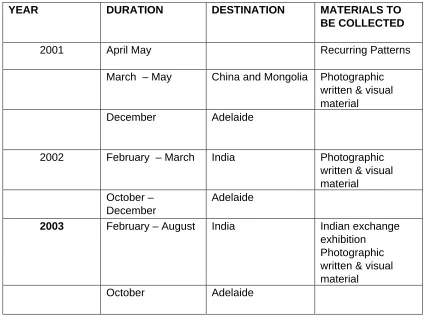
(10) 2.1.6 2.2. Art and Migration - Hossein Valamanesh (1949 -). 34. Creative Pathways. 36. 2.2.1. Eclectic Art – Baggage. 36. 2.2.2. Exhibition Departures – Encounters and Journeys. 39. 2.2.3. Television - Culinary travels and travelogues. 41. 2.2.4. Travel writing - a literary genre. 42. 2.2.5. Philosophical & Spiritual Journeys. 47. CHAPTER 3 ART AND THE JOURNEY. 3.1.. 3.2.. Inspiration and Motivation. 51. 3.1.1. The Creative Process. 52. 3.1.2. Artists Exploring Travel and Movement. 53. 3.1.3. Rosalie Gascoigne (1917 – 1999) and Andy Goldsworthy (1956 - ). 56. Artist and the Journey. 60. 3.2.1. Migrants. 60. 3.2.2. Recurring Patterns. 64. 3.2.3. Artist Exchanges. 67. 3.2.3.1. China. 68. 3.2.3.2. India. 69. CHAPTER 4 ESSENTIAL BAGGAGE – METHODOLOGY. 4.1. The Map: Realizing the Aims. 71. 4.2. Planned Journeys 2001 – 2003. 71. 4.3. Preparation. 72 ix.
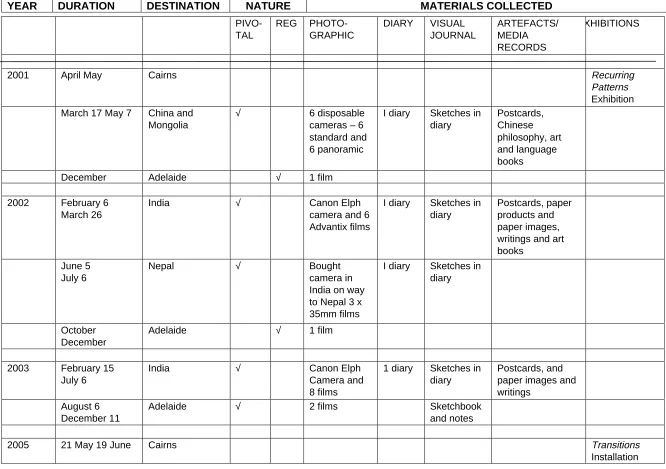
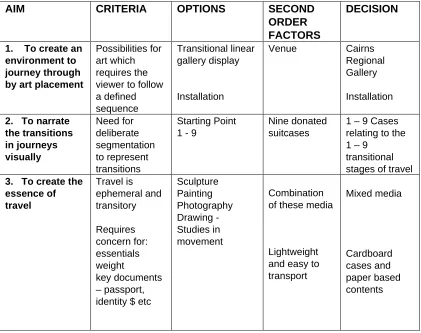
(11) 4.4. 4.5. 4.6. 4.7. Documentation. 75. 4.4.1. Through the Lens. 75. 4.4.2. Diary/Journal Records. 75. 4.4.3. The Visual Journal. 76. 4.4.4. Artefacts and Media Records. 76. Implementation of the Plan. 77. 4.5.1 Journeys Actually Taken. 77. Description of Data Set. 80. 4.6.1. Photographic Documentation. 80. 4.6.2. Diary/Journal Records and Visual Documentation. 81. 4.6.3. Material Collected. 81. Planning the Artwork. 81. 4.7.1. Criteria and Options. 82. 4.7.2. Choosing the Visual Format. 83. 4.7.3. Factors impacting on Art and Journeys. 87. CHAPTER 5. 5.1. 5.2. PERSONAL JOURNEYS - PROTEAN STATES. The Pivotal Nature of Journeys. 89. 5.1.1. The Destinations. 89. 5.1.2. The Rationale versus the Actuality. 94. 5.1.3. Art Exposure. 96. 5.1.4. Encounters en route. 102. 5.1.5. Pivotal Transitions. 105. Evaluating the Data. 106. 5.2.1. 107. Visual Records x.
(12) 5.2.2 5.3. 6.2. 111. Cognitive Processes towards Art Production. 112. 5.3.1. Suitcases. 113. 5.3.2. Movement. 116. CHAPTER 6. 6.1. Written Records. ON THE ROAD. Implementing the Visual Structure. 118. 6.1.1. 118. Accessing the Cases. Case Foundations. 120. 6.2.1. A Case for Leaving. 122. 6.2.2. A Case for Essentials and Extraneous Baggage. 124. 6.2.3. A Case for Movement. 127. 6.2.4. A Case for the Exotic/Erotic. 130. 6.2.5. A Case for the Alien. 132. 6.2.6. A Case for Connections. 134. 6.2.7. A Case for Boundaries. 135. 6.2.8. A Case for Change. 136. 6.2.9. A Case for Transformation. 139. 6.3. Completing the Cases. 140. 6.4. The Catalogue Layout. 141. 6.5. The Exhibition Opening. 142. CHAPTER 7. 7.1. TRANSITIONS – THE EXHIBITION. The Invitations. 144 xi.
(13) 7.2. The Catalogue. 144. 7.3. The Cases in the Gallery: Utilizing the Space. 145. 7.4. Exhibition Opening. 147. 7.5. The Exhibition. 153. CHAPTER 8 ON REFLECTION. 8.1. The Journey’s End: Achieving Aims. 175. 8.2. The Research Trajectory. 177. 8.2.1. Limitations and Variations. 179. 8.3. The Art Outcomes. 182. 8.4. Future Directions: Art and Research. 186. 8.4.1. 186. Unpacking the Cases. BIBLIOGRAPHY. 190. APPENDICES. 195. Appendix A. Gallery Layout. Appendix B. Invitation. Appendix C. Catalogue. Appendix D. Curriculum Vitae. Appendix E. Talk and Speeches. Appendix F. Review. Appendix G. Comments Book. xii.
(14) List of Tables. 4.2.1. Planned Journeys 2001 - 2003. 72. 4.5.1. Actual Journeys Undertaken. 79. 4.7.1. Criteria and Options. 83. xiii.
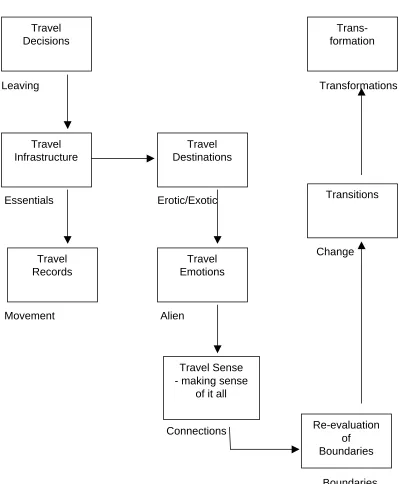
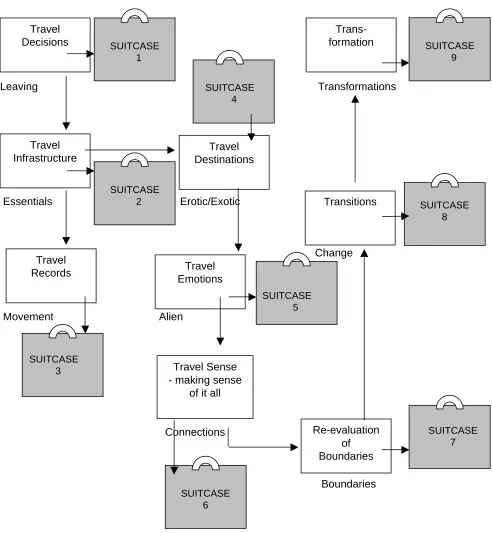
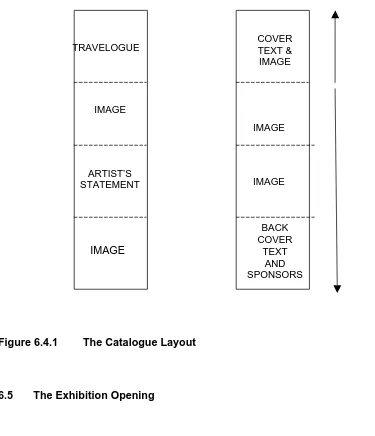
(15) List of Figures 4.3.1. Schematic Analysis of the Parameters of Journeying. 74. 5.3.1. Parameters and seven cases. 114. 6.2.1. Parameters and the nine cases. 121. 6.4.1. Catalogue Layout. 142. xiv.
(16) List of Plates PLATE 1.3.1. Ancient Footprints, Photograph The Explorers, 1996. p.7. 1.3.2. The footprint left by man’s first step on the moon. Photograph The Explorers, 1996 p.7. 1.3.3. 5. 5. Crusades, painting Histoire du Voyage et Conquéte de Jerusalem, 1337 . Bibliothèque Nationale The Oxford Illustrated history of the Crusades, 1995. 8. 1.3.4. Mecca, thirteen century manuscript Knowledge Encyclopedia, 1979.. 9. 1.3.5. Arab Traders from a thirteenth century manuscript. University Atlas of Australia, 1979. p. 29. 11. 2.1.1. Paul Gauguin, The Siesta, 1894, Canvas, Gauguin, 1975. p. 59. 27. 2.1.2. Jeffery Smart. Cahill Expressway, 1962. Art and Australia, 2000 p.529. 2.1.3. 29. Brett Whiteley, Summer Field Painting III 1962, Brett Whiteley, 1995 plate.16. 2.1.4. 32. Hossein Valamanesh, Holy war: forgotten key / hand of history, 1987. Hossein Valamanesh, 2001 p.10. 2.1.5. 34. Hossein Valamanesh, Recent arrival, 1988. Art Gallery of South Australia. Hossein Valamanesh, 2001 p. 16. 35. 2.2.1. Sharon Pacey, Baggage invitation 2001. 38. 2.2.2. Sharon Pacey, Baggage invitation 2001. 38. 2.2.3. Juanita Fitzpatrick, Sustain from Departures – Encounters 2000 www.uow.edu.au/crearts/events/Departures/departures.html. 40. 2.2.4. The Cairns Post, Food for Thought 2002 cover. 42. 2.2.5. Alain De Botton, The Art of Travel, 2002 Cover. 44. 2.2.6. Caroline Greenwald, Amber wings in frozen clouds, 1982 from Map series Paperwork, 1982. p.45. 3.1.1. 49. Umberto Boccioni, Unique Forms of Continuity in Space,1913 Modern Sculpture - A concise History, 1985. Plate 117 p. 118. xv. 55.
(17) List of Plates continued 3.1.2. Rosalie Gascoigne, Inland Sea 1986, Rosalie Gascoigne The Art Gallery of New South Wales, 1998 Plate 9 p.31. 3.1.3. Andy Goldsworthy, Pebbles around a hole 1987 Andy Goldsworthy, 1990, p.7. 3.1.4. 57. 59. Andy Goldsworthy, Early morning calm 1988 Andy Goldsworthy, 1990, p. 84. 59. 3.2.1. Joe’s Car 1987 Give Me 5 exhibition, Digital image on paper. 62. 3.2.2. Butts 2001, Recurring Patterns exhibition. 66. 3.2.3. Fingerprint 2001, Recurring Patterns exhibition. 66. 5.2.1. Chinese mirrored windows diary sketches. 109. 5.2.2. Bus and train travel diary sketches. 110. 5.2.3. An amazing place Indian Installation 2002. 111. 6.1.1. Donated cases. 119. 6.2.1. A Case for Leaving - Interior. 123. 6.2.2. Case – Interior design. 127. 6.2.3. Movement studies. 128. 7.3.1. Gallery Space View 1. 146. 7.3.2. Gallery Space View 2. 147. 7.4.1. Melissa Waters, Artist’s talk prior to the Opening. 149. 7.4.2. Sasi Victoire presenting her speech. 150. 7.4.3. Louise Doyle, Director of the Cairns Regional Gallery, Exhibition Opening. 151. 7.4.4. Margaret Genever, Opening Speaker. 152. 7.5.1. Exhibition Text. 153. 7.5.2. A Case for Leaving. 154. 7.5.3. A Case for Leaving – detail. 155. 7.5.4. A Case for Leaving – detail. 156. 7.5.5. A Case for Essentials and Extraneous Baggage. 157. 7.5.6. A Case for Essentials and Extraneous Baggage. 158. 7.5.7. A Case for Essentials and Extraneous Baggage – maps. 158. 7.5.8. A Case for Essentials and Extraneous Baggage – maps. 160. 7.5.9. A Case for Movement. 161 xvi.
(18) List of Plates continued 7.5.10. A Case for Movement. 162. 7.5.11. A Case for Exotic/Erotic. 163. 7.5.12. A Case for Exotic/Erotic – detail. 164. 7.5.13. A Case for Exotic/Erotic – detail In Transit. 164. 7.5.14. A Case for the Alien (3 masks). 165. 7.5.15. A Case for the Alien. 166. 7.5.16. A Case for Connections. 167. 7.5.17. A Case for Connections. 168. 7.5.18. A Case for Connections – detail. 169. 7.5.19. A Case for Connections. 170. 7.5.20. A Case for Boundaries. 171. 7.5.21. A Case for Change. 172. 7.5.22. A Case for Change – book. 172. 7.5.23. A Case for Transformation. 173. 7.5.24. A Case for Transformation – detail. 174. 8.4.1. Cases 2. 189. xvii.
(19) CHAPTER 1. 1.1. DEPARTURES. Introduction. If journeys drive one, why do they do so? Indeed this research stems from a personal exploration of journeys that have long been a contemplative part of my life - from daily trips to work, yearly trips to family or travel overseas. They represent a space in the hectic pace of life that allows for reflection, briefly leaving behind issues and concerns for the duration of the journey. The period of movement is influential through relinquishing distractions to be able to view our surroundings anew or for the first time.. For the present research, journeying for learning and pleasure are the main motivators and areas of interest as these are the avenues through which to gain knowledge and experience and which have influenced other artists as well as one’s own arts practice. There is thus the potential to place more emphasis on the actual processes of journeying, and the transitions and transformations that take place in this process, than on exploring the end result or destination.. Within this general ambit exists a related interest in words; the balance of opposites, for example, in movement and stagnation, in transformation and conformity, in departure (the first step) and destination (the last step). The person who travels in the physical sense compared to one who stays home, is not necessarily the richer for it. This does not mean that the one who stays home has not had the opportunity to travel in the imagination through books, art and other contemporary media. Thus cognitive. 1.
(20) journeys can be a supplement to and / or a substitute for physical journeys. Nevertheless, viewing places on television or at the movies is a vastly different experience to that of actual immersion in a place.. The words - journey, transition, transformation, movement, migration and destinationare of particular importance in understanding the stages and sequence of events in travels that overlap, merge or run concurrently. The words themselves have intersecting meanings. Passage can mean journey, transition and movement and all can encompass changes or processes from one place or state to another. While I have used nouns here, the meanings can change if the words are verbs. For example the word move as a verb has many other meanings; it can lead, inspire and influence or advocate, recommend and urge. The words themselves conjure up powerful metaphorical, allegorical, philosophical and iconic associations with life processes and rites of passage.. Many of these terms can be seen as representative of the passage of life or the. journey of life from birth to death. Changes such as childhood to puberty, puberty to adulthood and adulthood to old age are seen as rites of passage or transformations from one defined state to the next. Similarly, there are journeys of the soul, spiritual and cognitive journeys that signify explorations of our inner needs, emotions and learning from life’s experiences.. 2.
(21) All words are linguistic labels for the states and stages in life’s processes that can be traced over a lifetime, or many lifetimes or confined, as in this research, to a circumscribed time period.. 1.2. Defining journeys. A journey is a distance travelled in a specified time; it has a beginning, movement and a destination. It can be cyclic, one way, or open ended, as in the case of tourists and migrants. While the journey is the actual act of travelling or the movement between two places, the destination is the outcome, journey’s end. Hence between these two points is the transition, a protean state of movement that is influential in bringing about transformations. These transformations can be influenced by reflection and contemplation in the state of transition and can result in alterations or shifts in vision, thinking or directions taken.. Movement is the connection that describes the intrinsic and basic processes of all of the above. All movement brings about changes as one moment flows into another moment, so that movement creates a flowing momentum from the past into the present and forward into the future. Destination is the journey’s end but not necessarily the cessation of movement except at the end of life’s journey as in the death of the individual.. 3.
(22) 1.3. Historical precursors. From the time that, as infants, we start to crawl, we endeavour to explore our surroundings in order to make sense of the environments around us. We develop in these environments and learn to adapt accordingly when given various experiences. We are able to modify our behaviour as we encounter different environments. Therefore exploration in the infant years is primarily a learning experience focused on coming to terms with the expanse and limitations of our physical and cultural worlds. Adult explorers are voluntary wanderers in search of discoveries, which can be personal ones, getting to know more about oneself, or those of significance to humanity, as in space travel.. Alberto Salza, a contemporary Italian anthropologist, wrote in the prologue to The. Explorers (1996):. At Laetoli in northern Tanzania I saw a series of foot prints left by a hominid walking north over three and a half million years ago ... then in the July of 1969, television brought the extraordinary image of a human foot stepping onto the surface of the moon right into my living room. The two footprints, so distant in both time and space seemed to me to be very closely related. It would appear that since time immemorial the human species has been fascinated by travel and the exploration of his world. (Novaresio, 1996: 6). Plates 1.3.1 and 1.3.2 are taken from the book The Explorers and show foot prints across time; those on the left are those of early man (or a woman) and. 4.
(23) child in Africa and the foot print on the right is from Neil Armstrong, the astronaut who first set foot on the moon on 21 July 1969.. Plate 1.3.1 Ancient footprints Photograph Novaresio, 7. Plate 1.3.2 The first footprint on the moon Photograph Novaresio, 7. These have become footprints etched in time.. 1.3.1. Migratory Journeys. In the early history of man, migration or journeys were nomadic wanderings caused by environmental influences: to follow the game, the fruiting trees, roots and grains in season, those products on which their existence depended. With domesticated animals, nomads moved to greener pastures or to where there was a water supply or food available. Nomads like Australian Aborigines live within huge territories and survive on their land by knowing how to find where the water holes are and where fruit, seeds and roots can be collected at different seasons. Their territory is as familiar to. 5.
(24) them as city streets are to urban dwellers. Aboriginal art depicts the landmarks and mythology of their territories.. 1.3.2. Religious Journeys. Throughout history there have been religious journeys beginning with the crusades and morphing into pilgrimages to sacred / holy places.. Invasions and trade led to expanded territories and created fertile ground for the spread of culture and religion to the inhabitants. Whether the indigenous beliefs were replaced through pressure from the invaders, or the new beliefs were adapted into the existing belief systems, was dependent on the missionary zeal of conquerors and traders. Many invaders, such as the Romans in England, did not invade and depart, but set up bases for trade within the country, built houses and settled so that old faiths survived but intermingled with the new beliefs of the invaders. Later Muslim, Buddhist and Christian religious leaders and faithful followers travelled and spread their faith through trade and the expansion of their spheres of dominance. Later still, believers of a certain faith travelled to religious sites of significance, to convert the inhabitants of new lands, or regain territory that had been invaded by others not of that faith.. 6.
(25) 1.3.2.1 Crusades. Crusades were undertaken during the period from the eleventh to the thirteenth centuries, the crusaders being Christian Europeans who invaded Palestine - the Holy Land - to reclaim holy Christian sites from the Islamic people who had occupied the area for three hundred years. For centuries, Christian pilgrims had journeyed from Europe to the Holy Land to visit such religious sites as the ancient city of Jerusalem where many important events in the life of Jesus had taken place.. Exploration had religious motivations connected to the expansion of empires where countries became exposed to the Buddhist, Hindu, Muslim and Christian religions of the invading forces. Missionaries, monks and religious travellers journeyed to remote areas to convert local inhabitants to the faiths and philosophies of numerous religious sects. Sometimes the religions were successful in ousting the indigenous faith and beliefs but at other times the religion was only partially absorbed into the myths and beliefs of the original culture. In Plate 1.3.3 the painting, Histoire du Voyage et. Conquête de Jerusalem, (1337) depicts European crusaders fighting the Arab Muslims to reclaim Jerusalem as a Christian city.. 7.
(26) Plate 1.3.3. 1.3.2.2. Unknown artist, Histoire du Voyage et Conquête de Jerusalem (1337) painting Smith, Front Cover.. Pilgrimages. A pilgrimage is a religious journey and pilgrimages are undertaken by devotees who consider their destination sacred. Pilgrimages to Mecca, (see Plate1.3.4) the home of Mohammed and the chief shrine of Islam, is a required journey by all Muslims at least once in their lives. Pilgrims tell of their journeys, and the actions of divine beings, through story, painting and ballads, as, for example, in The Canterbury Tales by Geoffrey Chaucer (1342 - 1400). The pilgrim sees the pilgrimage as a religious mission that may be achieved over a short period in their life or over the length of their lifetime.. There are pilgrimages made, even in the present day for many people, to places that hold strong spiritual and religious significance. Historical holy and sacred sites are. 8.
(27) connected to saints, gods, important religious events, people and unexplained phenomena.. Plate 1.3.4. Unknown artist Mecca thirteen century manuscript Paton, 193. Plate 1.3.3, by an unknown artist, shows the followers of Islam making pilgrimage to Mecca, Mohammed’s birthplace. The object revered is the Ka’aba, which contains the sacred Black Stone, which, according to tradition, fell from heaven.. 1.3.3. Exploratory and Expansive Journeys. Exploration and trade are essentially linked with expanding empires for it was trade between different countries that opened up areas for exploration. The earliest recorded explorers were the Egyptians who, from 2500 BC, made journeys south, by boat, to new lands with rich resources. The Minoans in Crete and the Phoenicians in Tyre. 9.
(28) developed ships for defence and traded with countries around the Mediterranean and West Africa. The Greeks followed the Phoenicians while Alexander the Great’s epic journey through Persia to India greatly enlarged the knowledge of the known world, for he took surveyors, recorded the countries through which he passed, and sent home many natural history specimens. In China under the Han emperors, around 200 BC, ambassadors travelled widely in search of trade and allies and paved the way for the caravans that carried food, silks and spices from China to India and on to Europe. The spread of Mohammedanism enabled Arab traders and travellers to journey from the Atlantic to the Pacific and into Africa. The reports and information they brought back were used to write descriptive books and maps. Mohammedanism inspired the Arab conquests of the seventh and eighth centuries and spread the religion west to Spain and east to India. The Arabs established trade routes on land and sea and were known to be skilled navigators. Plate 1.3.5 shows Arab merchants from a thirteenth century manuscript.. 10.
(29) Plate 1.3.5. Unknown artist Arab Traders, (circa thirteen century) University Atlas of Australia Phillips, 29. Vikings and Northmen established settlements and trade routes along rivers through eastern Europe, Russia and traded with Central Asia. The Great Age of Discovery (1400 – 1800) was the period during which travellers and explorers investigated the regions of Asia, Africa, America and the Pacific. Marco Polo (1254 – 1324), Ghengis Khan (c.1162 – 1227), Vasco da Gama (1460 – 1524), Christopher Columbus (1451 – 1506), Ferdinand Magellan (1480 – 1521), Francis Drake (c.1540 – 1596), James Cook (1728 – 1779) and others filled in the blanks on the world maps as they explored these continents.. 11.
(30) 1.3.4. Journeys of the Modern Age. The motivations for modern day journeys are exploration, tourism, migration and refuge. Contemporary explorations include space travel and ocean depths. Personal challenges of endurance such as mountain climbing and white water rafting have become tourist activities. There is also the continuing search for the exotic.. Population movements are generally the result of political, cultural, religious or economic pressures. There are internal migrations too within countries, from country to cities and vice versa, to take advantage of improved economic, social or lifestyle conditions. Mass migration of people in the modern age, to escape poverty, war, injustice and persecution, has created increasing numbers of refugees around the world.. While exploration continues and tourists plan and anticipate their travels, migrants and refugees are embarking on a one-way trip which can have unknown outcomes. The journey is not one taken for pleasure but is a necessity in seeking a better environment in which to live. Migrants go through the processes of migrating to another country; obtaining passports, visas and the government requirements that allow them to settle in the new country. On the other hand, refugees are forced by circumstances over which they have no control to flee their country by any means to seek safety and security.. 12.
(31) While tourists are learning about other cultures, customs and different environments by choice, migrants and refugees are people trying to cope with cultural changes as they adapt to the new life of their adoptive country. Often they risk everything to escape harsh regimes, wars and poverty.. In Australia, internal movements are often lifestyle choices involving re-location to a suitable place or determined by employment. Peter Murphy, a professor in Planning and Urban development at the University of NSW wrote in his paper, Sea Change: Re-. Inventing Rural and Regional Australia (2002), that there is a steady movement from rural and regional areas to the city for young people where there are many more opportunities for work. There is also a reverse movement as people seek affordable home ownership and a rural lifestyle.. 1.4. Rationale for and Aims of the Study. My own interest in journeys is to test the premise that, for artists, the transitions bought about through movement have an inspirational influence on both their life and art. For this research I have made a deliberate division in journeys to distinguish between pivotal and regular journeys. Pivotal journeys are ones that are distinguished by oneoff events, incidents and places that result in changes, physical and / or mental. A pivotal journey is one that has influenced personal changes of direction or has been transformative through reflection or events that have transpired. Regular journeys are generally ones that are familiar over a period of time and can be of influence through etching journeys, by their repetitive nature, on our respective psyches.. 13.
(32) Some journeys are planned, some are anticipated and some may or may not be pivotal, nor are these different journeys mutually exclusive. Regular journeys, on the other hand, are repetitive: daily, weekly or yearly occurrences that, unless associated with a particular event or incident, are rarely remembered. A regular journey is one that has no transformative outcome. Of course this is debatable. Even if there seems to be no discernable effect, you have been away and potentially influenced by different life experiences from those at home. Both pivotal and regular journeys have the possibility to be inspirational, albeit in different ways.. There are marked differences between routine trips and other journeys. Some routine journeys involve travelling back and forward to work; for example, my travel from Mareeba to Cairns, a round trip of two hours, permits a period of time for reflection. I am in automatic mode while driving and this is a state that is conducive to contemplation and, at times, a heightened awareness of the country through which I am travelling. So there are gaps in awareness of the actual mechanics of driving because this is a familiar journey and the drive is a common ritual. The appraisal of the changes in the environment through which I am passing is determined by whether there are other things on my mind, the time of the day, the weather conditions and whether or not I am in a hurry.. This time for reflection or daydreaming is created by the gap between home and work, which is away from phones and other distractions, a period of time out. Still there is a marked distinction between driving on your own and being driven. As a passenger, or. 14.
(33) with someone else in the car, there is an onus on you to communicate and be sociable and therefore less time to allow for the flow of inner thoughts and ideas and awareness of outer stimuli.. Lifetime tracks are all the journeys I have made over the period of my life. The tracks extend to the paths I have made away from the familiar tracks, the circular journeys taken to places further afield to see new environments which have generally been for pleasure. Alternative paths are the detours or tributaries that branch off from the planned and expected tracks and these are often brought about by an event that creates a change in the direction of the journey.. On a planned overseas journey, for example, there is an overall heightened awareness before leaving as the trip is outside the normal routine of the everyday. Exploring new areas can be challenging and daunting but is largely determined by the purpose and expectations of the journey. The leaving or getting away is a very important part of the journey. The preparations and anticipation provide a generally hectic time but once on the plane or train, all the worries of work and home can be left behind. This is a transition stage from letting go of home concerns that clears the mind to allow for the absorption of new sights, ideas and events. Journeys are highlighted by a selection of remembered events that stand out from the rest because of incidents that have happened in a certain place or time. It is interesting to note the reason why we retain images of certain places. This can vary from viewer to viewer, and no two people have the same remembered thoughts in relation to a place or event.. 15.
(34) Most journeys have positive and negative elements that, on reflection, can be part of the transformation process. This is usually determined by our anticipations of the journey before we have started and negative incidents on the journey will often influence a reappraisal of the motivations for taking the journey in the first place.. Focusing on journeys will augment the understanding that, for many contemporary artists and writers, travel is and has been a source of reflection and inspiration which has consequently, at times, subtly shifted and re-directed the path of their lives and art.. Hence the research will examine personal journeys to highlight the process of transition and transformation that take place during the period from departure until arrival at a destination. All journeys that are taken from choice, rather than those that are taken for survival, provide opportunities for periods of elucidation on the journey of life and reflection on the directions that we undertake in the future. The fact that journeys are undertaken for a myriad of reasons determines the outcomes, yet all journeys can provide the opportunity for a personal exploration of one’s own persona to learn more about oneself as well as the world around one. The orientation of the research is not from a tourist’s perspective but from an artist’s encounter with place.. Hence the aims of the study are twofold:. 1.4.1. To explore the pivotal role of journeys, through the corporeal and cognitive. evolutionary phases of contemplation, anticipation, transitions and reflection in stimulating the artistic creative processes.. 16.
(35) 1.4.2. 1.5. To create visual artistic narratives of pivotal journeys.. Organisation of the Thesis. The thesis, Transitions not the destination but the journey, is organized into two main areas that contain the introduction, background and motivations for the journeys, and the research while the second section encompasses the creative development, the exhibition, outcomes and reflections on what has been achieved.. 1.5.1. Part One - Introduction, the historical and inspirational background to. journeys and the parameters of the research. This section establishes the background to journeys, the historical precursors, the creative influences including the research and parameters of the project. The introduction acknowledges the fact that there are many reasons for travel, artists’ perspectives and that literature is a vast arena for exploration, therefore a need for confining the artists and journeys relevant to the theme of transitions and the focus of this project. Material is sourced with reference to Western art, European, American, Australian (non Indigenous) and Asian art.. Chapter One incorporates an introduction to the research and defines journeys through historical travels to the modern day. This is followed by the background that inspired the research and the types of journeys that are undertaken.. 17.
(36) Chapter Two researches the relationship between art and travel by artists. This chapter explores a variety of travelogues through exhibitions, television, travel writing, philosophical and spiritual writings.. Chapter Three looks from the past to the present day to research journeys through art history and artists. The artists chosen are those whose artwork relate to the focus of the project and show discernable influences from journeys. The background material for my reference is a wealth of art, literature and media that relates to journeying. Examination of the events and encounters that bring about changes during journeys can determine the effect on artists and art and the focus is how they are affected by what they see and experience.. Chapter Four furnishes the plan for the proposed journeys, the recording methods of the journeys and the resulting creative framework for the development of the art and the exhibition. The decision-making processes determine the choices made for the visual format and materials that will be used for the artwork. The documentation methods both record the journeys and are determined by the creative influences during travel and the artist’s perception.. 1.5.2. Part Two - Artistic Development, the Exhibition and Reflections. The second section, Chapters Five to Eight, is based around the concepts, research and decision making for the artwork and its production. The development of ideas are derived from the personal explorations of journeys to be undertaken over the project. 18.
(37) timeframe, the selection of materials and artistic format being determined by creative and practical decisions. The materials chosen to create the artwork relate to the influential stages.. Chapter Five presents the series of journeys and influential encounters and events during travel. The documentation and recording processes are part of the project research that creates the basis for the art production.. In Chapter Six, the choice of cases and contents for the exhibition map the physical, emotional and cognitive processes of travel. The cases and contents are determined by the sequential flow of journeys, from leaving to arrival, and which encompasses the baggage of who we are. Chapter Seven records the physical exhibition, the opening and guest speakers, the sequence of art that provides a journey through the gallery space, and the individual artworks.. The final Chapter, Chapter Eight, looks retrospectively at the journeys, the research, the exhibition and then at the future directions or choices that may be taken in regard to creative work. The contemplation and reflection on art and travel, combined with the knowledge gained through the influential stages of journeys, have and will continue to influence the subsequent directions taken in my artistic development.. 19.
(38) CHAPTER 2 THE JOURNEY. 2.1. Travel and Art. The relationship between travel and art has a long history, although the focus here is on modern artists from the 1800s and 1900s. Physically travelling for a variety of reasons, the work of these artists is influenced by travel; their unique perspectives and diverse media in recording travel are explored.. There are strong interconnections between travel and art that provide stimuli for new ways of seeing and exploring new ways of creative endeavour. In Australia, early English artists depicted the new and alien environment of Australia, its strangeness to them and the unfamiliarity of its flora, fauna and inhabitants. They saw it with European eyes. A background of European tradition influenced how they perceived the new environment they encountered. Today, travelling overseas for artists is more accessible than in the past. Originally in the late 19th and early 20th Century this was necessary in order to gain the recognition for their art, which was difficult to achieve in Australia.. Now many Australian artists take up residencies in overseas countries often with the assistance of arts funding from the Australia Council’s Artist in Residence program or alternatively they can seek residencies in different countries over the internet. Artists are seeking to learn and consequently be influenced by different cultures. It is through art that a wider vision and awareness of the world is gained. Changes in art movements in the Western world have influenced successive generations of artists.. 20.
(39) This can be seen in the art of Paul Gauguin (1848 - 1903), where the bold use of colours and images he used to depict the lifestyle of the native people of the tropical island of Tahiti, has changed our perceptions of art and consequently influenced following generations of artists.. While travellers have recorded new sights and places in their art, photography is the more immediate recording process used today. Nevertheless travelling artists look at and redefine their art through learning new and different methods, styles and techniques from arts practice in other countries. Here in Australia, Australian indigenous art is different, exotic and alien for white Australians. It derives from a totally different perspective from the ones with which we are familiar; we may enjoy it but we do not necessarily understand it. Nevertheless Indigenous art has influenced many Australian artists, an example is the well-known artist Margaret Preston (1883 – 1963).. 2.1.1. Diverse views. Journeys are a metaphor for life, the journey from birth to death of all natural things. Metaphors for the passage of life encompass both natural and man-made images: trees, streams, rivers, highways, pathways, roads, tracks, tributaries, seas, oceans and mountains. How we make sense of that journey comes as the complex interaction between the physical journey of the body, the philosophical journey of the soul and the cognitive journey of the mind. Journeys have been documented in a variety of ways through art, diaries, poetry and stories. The majority of these have been documented. 21.
(40) for example, the book compiled by Susan Kurosawa The Joy of Travel (1995) or Eric Chaline’s book on Zen and the Art of Travel (2000).. There are diverse ways of seeing the experiences of travel and varied ways of recording those experiences so that no two people are likely to depict personal perspectives of journeys in the same way. Consequently the outcomes of the influences of transitions and transformations will vary with each individual artist. Of interest is the nature and difference of these views. The Indian writer Gita Mehta (1943-) wrote in her book Karma Kola – Marketing the Mystic East (1979):. The speed of jet travel appears to have eliminated the distinctions between geography and philosophy. Or those between history and mythology. Which means that although one can get anywhere, one is packing all the wrong things for simple survival, let alone for having a lovely time.. ...Exploration appears to be a hazardous undertaking. Columbus discovered America looking for India. The Beatles discovered India escaping from America. Both journeys were exhausting and it could be argued that the Beatles encountered no fewer monsters on their way. (Mehta, 1993: 19 & 66). 2.1.2. New Visions. Artists have traditionally taken journeys for a variety of reasons. Examining the broader reasons that motivate people to travel provides a backdrop to understanding why so many artists journey and seek new horizons.. 22.
(41) Focal artists for this research are discussed in the following two sections; artists who travelled and recorded their travels and the creative ways that travel and cultures are portrayed through the contemporary media of art, television and literature.. The basis for the choices of the artists; Paul Gauguin, Jeffrey Smart, Brett Whiteley and Hossein Valamanesh, are based on the criteria that the artists are from a variety of backgrounds and, apart from Hossein from Iran, the artists are from English speaking or European countries. Their art has been influenced by travel and encounters with other cultures and their art indicates a unique, outstanding vision. They are artists that have influenced my own arts practice.. The following artists’ experiences illustrate the types of motivations for travel that have concerned us in the modern age, that of learning about and experiencing new environments. It is important to note that selecting the artists is based on my vision and aesthetic preferences gained from a background and learning in Western culture and traditions. The majority of the artists chosen, likewise, have a foundation in Western art and culture and live or have lived in or near Australia. They have produced both two and three-dimensional work. They have provided ongoing influence to artists up until the present day and have been influenced by Eastern and Asian art. Australia is located, geographically, in the Asian region, though it is debatable whether the country is thought of as an Asian country by the rest of Asia because of our European migrant population and a culture that has swamped the indigenous culture.. 23.
(42) The first four artists have been markedly influenced, in different ways, by the journeys that they have undertaken. Paul Gauguin travelled from Europe to the exotic paradise of the Pacific, the islands of Tahiti, while Jeffrey Smart and Brett Whiteley both travelled from Australia to Europe to experience European art, and reconnect with their European heritage. Jeffrey Smart travelled around Europe and studied in Paris and returned to Italy in 1962 to live. He regards himself as an Australian living abroad. Hossein Valamanesh, an Iranian migrant, melds his cultural heritage with the Australian environment.. While in India in 2003, I read with interest an article entitled Nomad Aesthetic in an Art. India magazine (2002), where a group of Indian artists and writers discussed the theme of artists and travel. The following epitomizes what drives many artists to explore new places.. Throughout history, nomads have either created pathways where none existed before, or resuscitated forgotten routes. In this sense, nomads and those described as artists have a lot in common. Nomads and artists both require the constant challenge of unknown destinations.. Art practice, or any practice with images, ideas, forms, words and sounds, is a vocation not dissimilar to the nomadic imperative to wander at will and come upon new horizons.. It is the function of art to forge new paths for meaning on unchartered territories, to make us intimate with unprecedented thought, feeling and sensibilities as well as to rediscover old questions in new settings. The art object that does not lead towards a radical reconsideration of lived experience, or of the questions that animate our engagements with the. 24.
(43) world, remains at best an ornament, a detail in the decoration of banality. (Sengupta, 2002: 31). The three artists based in the Pacific region have a unique vision, which stands out strongly from other artists of their time. While they have taken divergent paths, they nevertheless, have a convergence of vision and the direction of their art. In Brian Castro’s book (1999), Looking for Estrellita, he sums up what the artists have transferred from their eyes to their art that speaks of a fresh and different vision – they have a broader vision and an adept approach in recording their vision to the viewer:. We need, in effect, to seek out a new conception of reality. In a book on the Belgian painter René Magritte (1898–1967), Michael Foucault speaks of the heteroclite, which he defines as things laid, placed or arranged in sites so very different from one another that it is impossible to find a common place beneath them all. A painting of a pipe is not the same as the word pipe, nor is it the object ‘pipe’, but it remains a painting. Similarly, language, culture, form and style are not wrought of the same mechanistic principle in which everything we judge is based upon ourselves or yoked to a standard, unquestioned representation or translation of peoples, landscapes and histories. After all, true creativity is the bringing together of new unities... to be aware, firstly, of origins and then the uniting of previously existing but totally unconnected concepts and forms. (Castro, 1999: 157). Paul Gauguin (1848 - 1903) travelled twice to Tahiti because he was determined to change his life and art through living a more simplified lifestyle. He was looking for the exotic and the different, a change from his home environment. In their book Gauguin. 25.
(44) (1975), Daniel Wildenstein and Raymond Cogniat acknowledge Gauguin’s time in Tahiti as influencing and changing his art. Brett Whiteley (1939 - 1992), like many Australian artists, wished to work and study overseas to see at first hand the masters in Italy and to work with contemporary artists in London, Europe and America. This was a stage in his early career that was influenced by Australian colours but combined with influences of Renaissance painters, modern and contemporary European and American artists. Hossein Valamanesh’s (1949 - ) art has the strong connection to his homeland, Iran, which he fuses with the Australian environment in subtle but poignant images.. Gauguin, Whiteley and Valamanesh are all well known artists who have viewed and depicted their world through art with markedly different visions. I would argue that these have been influenced, enhanced, transformed and redefined by the travel or journeys they have undertaken.. 2.1.3. Art and the exotic - Paul Gauguin (1848 - 1903). Paul Gauguin wished for independence and freedom at a time when France, he felt, had a stifling bourgeois social order. He wished for a life of simplicity where he could develop freely without restrictions and thus seek new ways of expression to portray this simplicity in his art. Gauguin made two trips to Tahiti in 1891 - 1893 and 1895 and remained there until his death in 1903. But the paradise that he sought did not yield the idyllic life that he had envisaged and he was plagued by ill health and financial worries. While impressionist in origin, his work in Tahiti broke free of the artistic shackles of the time and was both new and original in its vivid colours and simplified. 26.
(45) designs (Plate 2.1.1). Still, he found that, even in exotic places, there was no escape from money worries and the constraints of authority.. Plate 2.1.1. Paul Gauguin The Siesta 1894 Oil painting on canvas 35 x 45 3/4 in Wildenstein and Cogniat, 59. Gauguin was an artist interested in and influenced by sculpture from Africa and the South Pacific that was being shown in Europe in the 1800s. He wished to explore what he saw as a rawness of vision far removed from the European tradition of painting.. So from his earliest years Paul Gauguin began the wandering life which circumstances imposed on him and which, again and again, involved a marked break with the past. His whole life was checkered by abrupt and fateful changes, being sometimes of his own choosing and sometimes beyond his control. (Wildenstein and Cogniat, 1975: 14). In his travels within Europe and the South Pacific, Gauguin was not only wanting to break with the pressures and lifestyle in Europe and seek a simpler. 27.
(46) lifestyle; he was also seeking a simpler and more vivid art expression. He sought the exotic, the different, that he illustrated in his paintings and sculptures.. 2.1.4. Art in the Urban Environment – Jeffrey Smart (1921 - ). Art represents place, time and culture. In the modern day, as in the past, art greatly depended on social and cultural as well as environmental influences on the artist. Events that occur on journeys can bring about changes in directions for the artist and writer - transitions that will create diverse views and alternative paths of discovery.. Jeffrey Smart travelled around Europe in 1948 and he studied in Paris under Fernand Leger. Here he explored and painted the urban environment, the city apartments and the slum streets. In 1950 Jeffrey painted with Donald Friend, Michael Shannon and Jacqueline Hick where he lived on the island in the bay of Naples. He moved back to Sydney in 1951 and spent the next 12 years as art critic, arts compère for an ABC children’s program called the Argonauts, and as a drawing teacher at the National Art School before returning to Italy in 1962 where he has lived ever since.. Jeffery Smart and his paintings are concerned with the stark reality of the urban environment, incorporating roads and buildings often with a lone figure or two. They are reminiscent of Giorgio De Chirico’s city landscapes of the imagination and like De Chirico’s paintings, the lack of people suggests a time of day when the city has come to a stop. His work speaks of the isolation of the city and roads that may or may not lead somewhere.. 28.
(47) In Art and Australia, Prue Davidson (2000) wrote of Jeffery Smart’s painting Cahill. Expressway, (1962) that. This picture is also a pertinent example of nostalgic recognition where it is the right scene but the wrong time. It is like an insidious nightmare in which you recognize everything and the proportions are accurate, but everything is inside out, claustrophobic and disorientating. Be assured, if you enter the tunnel it will lead you nowhere, just as Smart’s autobahns and flights of stairs suggest, but do not promise, a destination. (Davidson, 2000: 529). Plate 2.1.2. Jeffrey Smart Cahill Expressway 1962 Oil on plywood 81.9 x 111.3 cm. Davidson, 529. As Jeffrey states much of his art has been influenced by glimpses as he is driving:. 29.
(48) …my paintings have their origins in a passing glance…Sometimes I’ll drive around for months…despair, nothing, nothing, then suddenly I will see something that seizes me: a shape, a combination of shapes, a play of light or shadows and I send up a prayer because I know I have the germ of a picture. (Hawley, 1993:109). In travel, change is clearly seen through physical movement and in the transitory nature of change, the fluidity between reality and illusion is alluded to in the paintings of Jeffrey Smart.. In her book Watching the Tree (2000), Adeline Yen Mah explores the writing of Zhang Zi’s Tao the Way (circa 300 BC) where change abides in all life processes.. Zhang Zi conceived of the cosmos as a stream in which one state succeeds another endlessly. Change is the only constant. Time never stops and no state can be retained. There is incessant transformation. However, while everything changes, for each action there is a reaction so that the cosmic balance remains the same. (Yen Mah, 2000: 39). In the magazine Art India, an article titled The Nomad Position (2002) Ranjit Hoskote wrote:. To accomplish this, artists, critics and curators in the nomad position, would launch tactical enterprises, operating the minor keys, embrace the improvisational and transitive. To phrase the situation in that archetypal language of replenishment-through-migrancy, Urdu, the habitus of the nomad lies somewhere between zameen and khwab. This continuous negotiation between territory and dream, in which both terms are in a condition of play and exchange, is the essence of the nomad aesthetic.. 30.
(49) Perhaps today's artistic, critical and curatorial nomads should recall one of the greatest monuments in history: the great black yurt-palace of Genghis Khan, which never stood too long in one place, but was dismantled, carried and re-established, wherever the Great Khan went. You will not find it in any museum: it is rebuilt in the imagination, each time someone thinks of it. (Hoskote, 2002: 28). 2.1.5. Art and Europe - Brett Whiteley (1939 - 1992). Travelling in the reverse direction, Australian artists travelled to England and Europe to further their art education as well as to experience at first hand their arts and cultural heritage. This trend has continued for artists over the years though latterly more for the inspiration in viewing the art of famous European artists and gaining knowledge of art practices and cultures of various countries.. In early 1960, after receiving an Italian Travelling scholarship, Brett Whitely, a Sydney based artist, spent ten months studying the great works of art. He based himself in Rome and Florence where he studied the paintings and developed an interest in late Byzantine and early Renaissance artists like Duccio, Uccello and Piero della Francesca.. In Summer Field Painting III (1962) (Plate 2.1.3) Brett Whiteley used the colours of the Australian desert in a scene that reads as an aerial view of the landscape that focuses on a brown oval shape, a dry lake or brown water. The shapes are reminiscent of the Australian landscape and its vastness.. 31.
(50) Plate 2.1.3. Brett Whiteley Summer Field Painting III 1962 Oil, tempera and collage 122 x 127.5cm Pearce, Plate 16. In Barry Pearce’s book Brett Whiteley - Art & Life (1995) he describes Brett’s creative life in the years during his time in Italy, France and London.. After moving to London, where he remained for the next seven years, Whiteley continued to combine these elements – the earthy colours of Australia, as reflected in the paintings of Russell Drysdale, and the ambience of Italian painting and architecture – with powerful hybrid forms of landscape and the female torso. Such paintings glowed with confident command of their visual sources while conveying an acute awareness of the current modes of abstraction. (Pearce, 2000: 56). In addition to Whiteley’s time in London, he also spent time in southern France when, newly married to Wendy Julius, his studies of her moved his work away from landscape and abstraction. His new work, back in London, was the sensuous and. 32.
(51) erotic forms in the bathroom series, the series of paintings on the John Christie murders and the zoo animal studies. Wendy had been his model and the inspiration for many of his nude paintings and sculptures. Following his stay in France, Whiteley travelled to Spain and New York before returning to London. When Whiteley was in Australia for a visit in 1965 he became interested in Australia’s Asian neighbours and the otherness of Eastern cultures in contrast to the Anglo Celtic heritage of early Australia.. After a two-year stay in New York, which he felt clearly showed the. madness of Western civilization, he returned to Sydney.. The journeys that Whiteley made influenced his art through seeing the diverse art of Europe and Asia but also seeing first hand the environments in which he lived and visited. For example, on the way back to England he stopped off in Calcutta and was shocked at the great contrast between the spiritualism of the East and the materialism of the West. He painted these influences and concepts in his works Calcutta (1966),. Tangier Postcard (1967), New York 2 (First Sensation of New York) 1968 and The American Dream (1968 – 69).. Whiteley later visited Fiji, Africa and Bali in his attempt to glimpse the unsullied states of paradise glimpsed by Baudelaire and Gauguin. Before these travels, however, he had become attracted to the hybrid energy of New York, which seemed to encapsulate the insanity of Western civilization at its most violent while projecting the possibilities of immense creative energy. (Pearce, 1995: 126). 33.
(52) 2.1.6. Art and Migration - Hossein Valamanesh (1949 - ). Migration is equated with movement and the word is used to describe the emigration of humans from one country to another. Hossein Valamanesh, an Iranian born artist, migrated to Australia in 1973 and now lives and works in Adelaide:. The last images I did before I left Iran were of people with desperately anxious faces. (Art Gallery of South Australia Catalogue, 2001: 10). The 1970 - 80s in Iran was a time when fear was widespread and those who spoke out, including artists, writers and poets, disappeared. His rare political works from 1987, (Plate 2.1.4) Holy war: forgotten key / hand of history shows the weapons of war of the past which reflect the futility of war and history’s tendency to repeat itself.. Plate 2.1.4 Hossein Valamanesh Holy war: forgotten key / hand of history 1987. Conté, crayon, pastel on paper, two components; 96 x 76 cm each. Art Gallery of South Australia, 10. 34.
(53) Like many immigrant artists the cultural transition from his native land to his adopted country was a difficult one but he found common ground in the similarity between the desert country in Iran and in Australia. References appeared to his country of birth in his work in the 1980s as he explored this sense of place. The human figure, silhouette or shadow, appears regularly in Hossein’s art as does the ladder, which relates to his sense of self and growth.. In the catalogue, Hossein Valamanesh - A Survey (2001) from the South Australian Gallery, there are examples of the early work of Hossein that express the feelings of dislocation and isolation of a new arrival. Recent arrival, (Plate 2.1.5) a 1988 lithograph depicts the silhouette or shadow, his signature motif, cast across the steps leading to a dwelling, the experience of the immigrant arriving at the unknown.. Plate 2.1.5. Hossein Valamanesh Recent arrival 1988. Lithograph on paper, 76.4 x 56.8 cm. Art Gallery of South Australia.16. 35.
(54) The immigrant experience as it relates to an artist’s work is a complex issue, as filmmaker and theorist Trinh T. Minh-Ha (2001), points out that. ...heterogeneous reality we all live today, in post modern times - a reality, therefore, that is not a mere crossing from one borderline to the other... but a reality that involves the crossing of an indeterminate number of borderlines, one that remain multiple in its hyphenation... To cut across boundaries and borderlines is to live aloud the malaise of categories and labels. (Minh-Ha, 2001: 16). 2.2.. Creative Pathways. 2.2.1. Eclectic art - Baggage – Transfer / Tranship. Contemporary art that specifically deals with journeys is varied and eclectic in its concepts, materials and formats. The art is varied due to place, time and cultural influences, as well as the particular vision of the artist.. Baggage was a series of installations and performances that worked on the theme of travel and the baggage we carry with us. The events aptly depicted the diverse visions of the artists that participated, not only through the use of media but also in the broad ranging interpretations on the theme. Sharon Pacey (1957 -), Creative Director of. Baggage – Transfer / Tranship, facilitated a cross art form, site specific project that was held at various Qantas airport baggage carousels across Australia. For this project, local Cairns KickArts artists, together with artists from the regions visited,. 36.
(55) produced a range of portable art forms responding to the theme of an interrogation of the baggage that we carry with us. The project ran from 1996 until September 11 2001.. Baggage – transfer/transship was an exciting project that engaged a captive audience as well as the local community in the airport terminals. Sharon wrote in the Baggage information kit in 1999:. Baggage-transfer/transship is an innovative, multilayered, multi artform exhibition presentation exploring the psychological, emotional, physical, cultural and political baggage we inherit and collect on our journey through space and time. Baggage happens live @ the airport and utilizes the baggage carousel to present a pastiche of visual art and performance art to the arriving passengers and the local community…The 1999 project offered contemporary indigenous artists an opportunity to develop new work with the assistance from The Aboriginal & Torres Strait Islander Arts Fund of the Australia Council and KickArts Collective Inc. This new work explores issues of personal and cultural identity – through the artist’s personal narrative. Black deaths in custody…migrations…the impact of past governments policy e.g. Aboriginal Protection Act…addictions, substance abuse, displacement, marginalization and celebration of family and indigenous culture and values. (Pacey, 1999: 8). The works encompassing on-site performances as well as meet and greet artists holding humorous and political placards for arriving passengers, were both humorous and serious. The baggage artworks, both sculptural and performance pieces moving on the baggage carousel, were diverse in their themes thus providing a unique visual. 37.
(56) experience for the public and passengers. Most participants, passengers and locals, joined in the fun of it all though some tired passengers, it was noted, were more concerned about retrieving their own luggage.. In September 2001, the last planned Baggage event to be held at the Cairns domestic terminal was cancelled due to security issues after the news that morning of the bombing of the Twin Towers in New York. Increased security at all airports means that there is little chance for airport events such as Baggage happening in the future.. The following Baggage invitations were from two different shows held in Cairns in 2001. The Baggage invitation on the right was held during the Centenary of Federation celebrations.. Plate 2.2.1. Sharon Pacey Baggage 2001 invitation 150 x 110mm. 38. Plate 2.2.2 Sharon Pacey Baggage 2001 invitation 150 x 110 mm.
(57) 2.2.2. Exhibition Departures – Encounters and Journeys. Departures – Encounters and Journeys was an exhibition in 2000 at the University of Wollongong. Liz Jeneid, a Senior Lecturer at the University of Wollongong, wrote in the introduced the exhibition thus:. This exhibition of the work of five Australian artists was made possible by an invitation from Fusako Tsuzuki, to exhibit work with Japanese paper artists in Paperworks 2002, in the Ino Paper Museum in Kochi, Japan in September 2002. In this current world political climate, friendship and communication between artists from different cultural backgrounds, seems to me to be a good and positive way to celebrate being part of a global community. We look forward to having an ongoing dialogue with these artists in Japan. (Jeneid, 2000: www.uow.edu.au/crearts/events/Departures/departures.html). While I was not able to visit the exhibition in person, images of the work and other documentation were available on the University of Wollongong website. This exhibition interested me both because of the subject matter and also the use of paper within the artworks. The work Sustain by Juanita Fitzpatrick (2002) were ethereal, containing paper dresses emerging from a series of suitcases. This exhibition was highly evocative of travel and seemed to capture the essence of the ephemeral quality of travel experiences. In describing her work Juanita Fitzpatrick states. 39.
(58) In the process of making this installation, I allowed the paper dresses to absorb and be stained by the coloured inks in their own unpredictable way. I surrendered control to the variability of the natural elements and time. The title of the installation, Sustain, combines two words, to suggest that it is my life experiences, particularly as a traveller who was based in Japan from 1996 to 1999, which have enriched my growth and development as an artist. (Fitzpatrick, 2000 www.uow.edu.au/crearts/events/Departures/departures.html). Plate 2.2.3 shows the dyed paper dresses floating above the series of suitcases and seeing this and the other images in the Departures exhibition were influential, in hindsight, in incorporating suitcases and the paper contents in my own art for the exhibition.. Plate 2.2.3. Juanita FitzpatrickSustain 2000 Japanese paper, dyes 5.5m x 50cm www.uow.edu.au/crearts/events/Departures/departures.html). 40.
(59) 2.2.3. Television - culinary travels and travelogues. A recent television phenomenon is the expansion of documentaries on the culinary culture from many lands. One of the first cooking programs on Australian television was David Parmenter’s Consuming Passions on ABC showcasing an enthusiastic chef who enjoys both cooking his own recipes and Australian wines. Since then chefs have travelled to different locations to celebrate and demonstrate the diverse culinary customs of a variety of countries, for example the Australian Greek chef - Aristos. Others demonstrate the variety of dishes from different locations in their own country for example the Italian chef - Steffano De Pieri in his program Gondola on the Murray. Other television chefs such as Rick Stein and his search for the perfect fish, Jamie Oliver teaching us to cook his pukka food and the SBS’s very popular The Food. Lovers Guide to Australia represent a winning combination of exotic places and inspiring food. These television shows are popular as many of the food products and culinary dishes have travelled to Australia with migrants and have subsequently enriched our contemporary diet. Apart from television there are a great variety of cooking, popular food books and magazines with recipes from different regions of the world.. In The Cairns Post in 2002 there was an article, Food for Thought, in the TV Extra about the two presenters, Maeve O’ Meara and Joanne Savill, (Plate 2.2.4) of SBS’s. Food Lovers’ Guide to Australia and the popularity of television cooking programs. Over the years they have explored the diversity of landscapes from the coast to the outback and from the city to the country to display and celebrate the variety of seasonal foods, food preparation and cooks.. 41.
(60) Plate 2.2.4 The Cairns Post TV Extra 2002 Cover image and 3. The availability of a great range of travel programs on television, which focuses not only on food, but also promotes places around the world, for example, SBS’s Global. Village, through nature and wildlife programs and travel packages. Travel programs target young thrill seekers wishing to take on challenging adventures. Televised travel programs are based on published travel books or books can result from the televised programs, for example Michael Palin’s and Dick Smith’s journeys. Re-enactments are also part of the travelogue where historic events and trips are recreated and filmed, for example the Beijing to Paris car race.. 2.2.4. Travel writing - a literary genre. Travel writing became an identifiable literary genre during early religious, exploratory and trade journeys. Early travel writers were Marco Polo’s journeys from the late. 42.
(61) 1200s and Geoffrey Chaucer’s Canterbury Tales from the 1300s. These works were often a blend of reality and mythology from which it is possible to gain historical, geographical and ethnological information. Today there are many travel books, as can be seen in bookshops and libraries, and while most locations have now been well documented, it is the writer’s vision of place that is ultimately important. Yet the majority of travel books concentrate on a particular destination and the adventures that happen when the author gets there, Dervla Murphy’s travel experiences in her book. Where the Indus is Young – Walking to Baltistan (1995) explores the people and the physical environment of a chosen section of a country. On the other hand Alain de Botton's (2001) book on The Art of Travel provides novel and interesting viewpoints on the motivations, complications and expectations of our travels. The cover of his book is familiar to those who look out the window of a plane; for many this is a time when one has left responsibilities behind and is looking forward to the journey. In this book he examines artists, writers and thinkers who have been inspired by travel and interrogates the reasons underpinning our wish to travel to certain locations in the first place. He writes of his anticipation of a particular trip:. Nothing was as I had imagined - surprising only if one considers what I had imagined. In the preceding weeks, the thought of the island had circled exclusively around three immobile mental images, assembled during the reading of a brochure and an airline timetable. The first was the beach with a palm tree against the setting sun. The second was of a hotel bungalow with a view through French doors into a room decorated with wooden floors and white bedlinen. And the third was of an azure sky. (de Botton, 2002: 12). 43.
(62) Plate 2.2.5 Alain de Botton The Art Of Travel Cover 2002 Book cover image. The tradition of solo travellers examining the people and physical environments, for example Freya Stark’s travels in the middle East, is continued in travel books in modern times with writers ranging from historical reconstructions of great and famous journeys as seen in the series of works by Tim Severin, (1940 -) to the more laconic and anecdotal journeys of Bruce Chatwin (1940 –1989). It is interesting to note that televised films of the travel experiences of Tim Severin in The Brendan Voyage (1982) and William Dalrymple (1967 - ) City of Djinns (1989) were disappointing, When reading we create our own image of the author and the countries they travel through, images which can be vastly different to the reality of the recorded travel documentary for television. With the book, an important part is our imagination in interpreting the experiences and characters. In travel writing, the author is the narrator behind the scenes compared to the film where the author is the protagonist and one can see their interactions with the environment.. 44.
(63) Other travel writers that have been influential over the years include Laurens Van der Post (1906 – 1996), Eric Newby (1919 – 2006), Paul Theroux (1941 - ), William Dalrymple (1967 - ), Peter Matthiessen (1927 - ) and Gavin Young (1928 – 2001). There are fewer female travel writers maybe because it has often been more difficult for a solo female traveller in certain regions in the past. This is generally not the case today e.g., Dame Freya Stark (1893 – 1993), Jan Morris (1926 - ), Dervla Murphy (1931 - ) and Robyn Davidson (1950 - ). There is a tradition of solo female travellers exploring new horizons although it has generally been English or European women of private means who have been able to travel to different locations or, alternatively, wives or daughters who accompanied husbands and fathers to foreign lands. For example Lady Mary Wortley Montagu (1689 – 1762) travelled to Turkey when her husband Edward was appointed Ambassador to Turkey in 1717. Lady Mary was a keen observer and adventurous tourist, who immersed herself in all things Turkish, learning the language, visiting harems and learning Turkish customs. She recorded her travels in the Turkish Embassy Letters that are contained in the three volumes. Letters and Works of Lady Mary Wortley Montagu (1837). Her travels and exploits were considered daring and revealing for a woman at the time.. I admire Dame Freya Stark since reading of her adventures in her book Valley of the. Assassins (first published in 1934) and particularly her courage in travelling alone in Arabian countries. She was one of the first European women travellers to travel through the Arabian deserts to places that not many other Europeans had travelled. She spoke fluent Arabic and several other languages and she wrote over two dozen books based on her travels. The quality of her work is in the description of places and people and the day to day hazards and achievements of travel that are a testament to. 45.
Figure
+4

Related documents
National Conference on Technical Vocational Education, Training and Skills Development: A Roadmap for Empowerment (Dec. 2008): Ministry of Human Resource Development, Department
In summary, the time path and rate of ICT uptake and performance effects differ across firms, even in similar circumstances, due to differences in: the implementation of
The purpose of this qualitative multiple case study was to explore strategies the leaders of ICT companies use to integrate a diverse workforce following cross-border M&As
We developed a prototype of an MSL core to MScala translator, which is extensible both in terms of adding new MSL features to be handled, as well as new optimization phases that
Main exclusion criteria were: botulinum toxin injections in the past 6 months, nerve stimulation therapy for OAB treatment except for successful PTNS treatment, obvious
Kao što smo videli u devetom poglavlju, zavisno od osobina ličnosti, emocionalni vampiri na pozicijama moći imaju različita očekivanja o tome kako treba da se ponašate
The aim of this study was to explore the relationships between science self-efficacy, gender, and academic achievement in genetics among form four (12th grade)
We then perform an exploratory factor analysis (EFA) on the transformed variables for each group of items in order to reduce the number of relevant dimensions. With the exception of
