STANDARDIZATION ON PURIFICATION PROCESS OF
LINGAM
The dissertation Submitted by
Dr. R. GNANASUNDARI M.D(S)
.
Under the Guidance of
Dr. P. SHANMUGAPRIYA M.D(S)
Lecturer, Department of Nanju Noolum Maruthuva Neethi Noolum, National Institute of Siddha, Chennai-47.
Dissertation Submitted to
The Tamil Nadu Dr. M.G.R. Medical University, Chennai – 32
For the partial fulfillment of the requirements to the Degree of
DOCTOR OF MEDICINE (SIDDHA)
BRANCH VI - DEPARTMENT OF NANJUNOOLUM
MARUTHUVA NEETHI NOOLUM
NATIONAL INSTITUTE OF SIDDHA
Chennai – 47
NATIONAL INSTITUTE OF SIDDHA
CHENNAI – 47
THE TAMIL NADU DR. M.G.R. MEDICAL
UNIVERSITY, CHENNAI – 32
A STUDY ON
“
STANDARDIZATION ON PURIFICATION PROCESS OF
LINGAM
”
(DISSERTATION SUBJECT)
For the partial fulfillment of the
Requirements to the Degree of
DOCTOR OF MEDICINE (SIDDHA)
BRANCH VI – NANJUNOOLUM MARUTHUVA
NEETHI NOOLUM DEPARTMENT
DECLARATION BY THE CANDIDATE
I hereby declare that this dissertation entitled “STANDARDIZATION ON
PURIFICATION PROCESS OF LINGAM” is a bonafide and genuine research
work carried out by me under the guidance of Dr. P. Shanmugapriya, M.D(S).,
Department of Nanju Noolum Maruthuva Neethi Noolum, National Institute of
Siddha, Chennai -47, and the dissertation has not formed the basis for the award of
any Degree, Diploma, Fellowship or another similar title.
Date: Signature of the Candidate
BONAFIDE CERTIFICATE
Certified that I have gone through the dissertation submitted by
Dr. R. GNANA SUNDARI (Reg No: 321416203) a student of final year MD (S)
Branch VI, Department of Nanju Noolum Maruthuva Neethi Noolum,,National
Institute of Siddha, Tambaram Sanatorium, Chennai-47, and the dissertation work
has been carried out by the individual only. This dissertation does not represent or
reproduce the dissertation submitted and approved earlier.
Place: Chennai-47
Date:
Name and Signature of the Guide, Name and Signature of the HOD,
Lecturer, Department of NanjuNoolum
Department of NanjuNoolum Maruthuva Neethi Noolum
Maruthuva Neethi Noolum National Institute of Siddha,
National Institute of Siddha, Tambaram Sanatorium,
Tambaram Sanatorium, Chennai-47.
Chennai-47.
Name and Signature of the Director,
National Institute of Siddha,
Tambaram Sanatorium,
ACKNOWLEDGEMENT
I thank God for giving me this opportunity and providing the strength and
energy to fulfill this commitment.
I would like to extend my thanks to Siddhars, because of their blessing to
complete this work
I thank my mother Mrs. Naranammal and my father Mr. Rama krishan for
giving me this opportunity and the blessings to fulfill this work
I express thank to my Daughter Panimalar for the support of this work
I express my sincere thanks to Secretary, Ministry of AYUSH, New Delhi.
I take this opportunity to express my gratitude and acknowledge the Vice
Chanceller, The Tamil Nadu Dr. M.G.R. Medical University, Chennai for
permitting me to do this study.
I express my sincere thanks to Prof. Dr. V. Bhanumathi , M.D(S),
Director i/c, National Institute of Siddha , Tambaram sanatorium,
Chennai -47 for this support in completing this work
I would like express my deep sense of gratitude to Prof. Dr. M. Murugesan,
M.D(S), Former Dean, National Institute of Siddha , Tambaram sanatorium,
Chennai -47 for this valuable guidance throughout my study.
I would like to express my sincere thanks to Dr. R. Mathavan M.D(S), Head
of the Department i/c, Dept. of Nanju Noolum Maruthuva Neethi Noolum,
National Institute of Siddha, Tambaram sanatorium, Chennai -47 for their
encouragement and valuable guidance throughout my entire study.
I would like to express my sincere thanks to Dr. R. Rengasundari M.D(S),
Associate Professor, National Institute of Siddha, Tambaram sanatorium,
Chennai -47 for their encouragement of my study.
I would like to express my sincere thanks to Dr. P. Shanmugapriya M.D(S),
Lecturer and my Guide, Department of Nanjunool, NIS, Chennai -47, gave her
insightful comments and constructive criticisms at different stages of my
research which were thought provoking and they helped me to focus my ideas.
I am grateful to her for holding me to a high research standard and enforcing
strict validations for each research result, and thus teaching me how to do
I express my sincere thanks to Lecturers Dr. S. Murugesan M.D(S), &
Dr. V. Manjari M.D(S) Dept. of Nanju Noolum Maruthuva Neethi Noolum,
National Institute of Siddha , Tambaram sanatorium, Chennai -47 for their
encouragement study.
I am thankful to Dr. D. Aravind MD(S) Associate professor, Dept. Of
Botany, National Institute of Siddha, chennai-47 and Dr. P. Sathiyarajeswaran,
Assistant Director (Scientist-2) i/c, Mrs. R. Shakila Research Officer
(Chemistry), Siddha Central Research Institute, Arumbakkam, Chennai-106
for their guidance for my drug authentication.
I thank Dr. A. Muthuvel, M.Sc, Ph.D (Biochemistry) Associate professor,
National Institute of Siddha, Chennai-47 for his guidance in doing chemical
studies.
My special acknowledgements to Mr. M.Subramanian, M.Sc.,(Statistics),
Senior Research Officer, National Institute of Siddha, Chennai-47, for his
valuable help in statistical analysis.
I thank the library clerk Mr.J.Rathinam Mrs.V.Kalpana and Mrs.
Rajamanonmani, library attendant of National Institute of Siddha, Tambaram
Sanatorium, Chennai-47, from where I derived much of the literary support.
I express my sincere thanks to Mr. S. Ponraj, Sub-Inspector of Police, C4
Police Station, Puthiyamputhoor, Thoothukudi District for his valuable
support in my study.
I deeply thanks to Mrs. Muthulakshmi and Mr. Pavunraj Ex-Army, for the
supporting and encouragement of study.
I express my grateful thanks to My Brother Dr. J. IndraKumar M.D(S), for
the supporting and encouragement of my study.
I would like my healthful thanks to Mr.A.H. Syed Haja M.com, MMS store,
Tambaram for the supporting and encouragement of my study.
I express my healthful thanks to Mr.S. Kuilanraj, M.Sc.,(IT), National
Institute of Siddha , Tambaram sanatorium, Chennai -47 for supporting to my
study.
I am deeply thanks to Mr. M. Aravindh B.E. for the supporting to my study.
I express my thanks to Data entry Brothers and Sisters , National Institute
of Siddha , Tambaram sanatorium, Chennai -47 for their cooperating my
I gratefully acknowledge the assistance provided by all other faculties and
staffs of NIS Chennai who rendered their cooperation throughout the course of
study.
I also thank all my friends who helped me throughout the study, without
CONTENTS
S.NO TITLE PAGE NO
1. INTRODUCTION
2. AIM AND OBJECTIVES
3. REVIEW OF LITERATURE
4. MATERIALS AND METHODS
4.1. TEST DRUG PREPARATION
4.2. QUALITATIVE ANALYSIS
4.3. QUANTITATIVE ANALYSIS
5. RESULTS
5.1. QUALITATIVE ANALYSIS
5.2. QUANTITATIVE ANALYSIS
6. DISCUSSION
7. SUMMARY
8. CONCLUSION
9. BIBLIOGRAPHY
1
INTRODUCTION
fy;Njhd;wp kz;;Njhd;whf; fhyj;Nj
Kd; Njhd;wpa %j;jFb jkpo;Fb
vd;w KJnkhopf;Nfw;g kpfTk; gok;ngUikAk; Mjp Njhw;wKk; cila jkpoupd; Kd;Ndhbfs; ekJ rpj;ju; ngUkfhd;fs;. rpj;ju; vd;w nrhy; rpj;jp vd;w nrhy;ypy;
,Ue;J cUthfpajhFk;. rpj;jp vd;why; mwpT,ifty;ypak;, if$Ljy;,
epiwNtWjy; vd;W nghUs;gLk;(1) ;
rpj;J vd;Dk; nrhy; njspe;j Qhdj;ijf; Fwpf;Fk;. Qhdk; ngw;wtu;fs; rpj;ju;fs; vdg; ngw;wdu;. rpj;jp ngWjy; vd;gJ Nahf epiyfspy; kpf cau;e;j epiyahFk;.(2)
Siddha System of Medicine is one of the classical systems of medicine consisting
of Herbal, Metal, Mineral and Animal origin. The noble Siddha system of medicine is
one among the excellent system of medicine found throughout the world. There are 32
types of internal and external medicine. It has its origin strictly belongs to southern part
of India. Siddha system of medicine not only deals with the treatment but also to prevent
and promote human health through principles of “Unave marunthu, marunthae unavu”(3)
This system has its own basic principle Vali, Azhal and Iyyam .
kpfpDk; FiwapDk; Neha;nra;Ak; EhNyhh;
tspKjyh vz;zpa %d;W. - jpUf;Fws; (941)
xUtDila czTk;, nray;fSk; msTf;F Nky; $bdhYk; Fiwe;jhYk;
kUj;Jt EhNyhh; tFj;j thjk;,gpj;jk;,fgk; Kjypa %d;Wk; Nehiar; nra;Ak(4) ;.
There are vast number of Herbo mineral preparations mentioned in Siddha
literatures. Siddhars successfully used their extensive knowledge of minerals, metals and
2
Each and every single drug or compound preparations has its own toxic effect.
There is a time hour need to analyze each drug and their toxic effect, in order to provide
safest and effective treatment to the people. Generally, toxins are of three kinds they are
Plant, animal and mineral origin (5).
Suddhi (Purification) of the raw drug is a process aimed at both purifications as
well as the efficacy of the raw drug. It usually involves processes like cleaning, frying,
soaking and grinding with herbal juices until impurities are removed. No medicinal
preparation is done without prior Suddhi process. This process helps raw material/crude
drugs (moolaporutkal) to lose their undesirable or toxic effect and thereby aid better
dosage efficacy (6).
Siddha system highlighted the proper purification of each raw drugs to have
effective medicinal preparations. Purification depicts the uniqueness of Siddha medicine.
The concept of Suddhi (purification) in Siddha is not only a process of detoxification, but
may also a process to enhance the potency and efficacy of the drug.
The word “ suddhi” means “getting rid of impurities as from ones of mineral and poisons
which are generally found mixed with other substances”.(7)
Accordingly the Siddhars used Chathru and Mithru Process to neutralize the
poisonous effects (8).
fd;kj;jhy; te;j gpzp ePf;f Ntz;b fUtwpe;J gz;bjNu fouf;NfsPu; td;knks;s ruf;Ftif Fzq;fsha;e;J
tskhd Rj;jp nra;J toq;fpNdhh;f;F jd;ktpsp NtUz;Nlh juzpkPJ jhf;fhd nrhh;f;fgjp jhs;fpl;lhNjh cd;kjkha; Kiwg;gprfp AjTk;Ngh;f;F
xU fhYk; Nkhl;rkpy;iy a+zpg;ghNu.
As said in this text, Siddhars has clearly emphasized the importance of
3
Lingam (Red sulphide of mercury) is widely used in our day today practice for
treating chronic disease, which comes under Panchasootham. Lingam is a mineral used
extensively in various Siddha formulations, with great therapeutic significance. It is the
major ingredient of many Siddha drugs like Linga Chenduram, Padiga Linga Thuvar,
Rasa Gandhi Mezhugu, and Jaathi Jambeera kuzhambu etc.
Lingam Suddhi is a process which has been purified according to the five ways of
purification contemplated in the Tamil medicine – cleaning the idol lingam according to
prescribed rules (10).
xd;whd ruf;Fr; Rj;jp
ahtUKiuf;ftpy;iy fd;whd ruf;Ff; nfy;yhq;
fu;kq;fs;;jPuh tpl;lhy; gd;whd kUe;J Nru;e;Jg;
gUfpby;gpzpahsu;f;Fk; ed;whdrpe;Jhuq;fs;
cl;gLk; ed;whfhNj”
- mfj;jpah; fz;k #j;jpuk;
There is a major need to analysis the chemical changes occurred during the
purification process of raw drugs scientifically. Being a Toxicology student, I want to
4
2. AIM AND OBJECTIVES
2.1 AIM:
To standardize the purification process of LINGAM.
2.2 OBJECTIVES
To analyze the physico-chemical properties of Lingam before and after
purification as per PLIM guideline.
To study the Quantitative analysis of Lingam before and after purification by
5
3. REVIEW OF LITERATURE
3.1 ,ypq;fk;
Njhw;wk;
rptd; jpupGuj;ij vupj;j fhyj;J new;wpf; fz;zpd; nghwp ,urkpUf;fpd;w
g+kpapy; gl;L ,yp;q;f ghrhz khapw;W vd;Wk;, ,J NkUTf;Ff; fpof;Nf
tq;fkpUf;fpd;w kiyapd; mbapy; ,urKk; nfe;jpAk; fl;b cz;lhapw;nwd;Wk; ,
,jd; gppw;g;G tuyhW $wg;gl;Ls;sJ. jw;fhyk; ek;khy; ifahsg;gl;L tUtJ itg;G; gh\hzq;fspd; fPo;f;$wg;gl;l rhjpypq;f gh\hzk; vd;W Nkw;$wpa tuyhw;wpy; njspayhk(11)
;.
NtWngau;
Mz;Fwp, ,q;Fypfk;, ,uhrk;, filtd;dp, fu;g;gk;, fypf;fk;, fhQ;rdk;
,fhuzk; ,rz;lfk; , rkurk; ,; rhdpak;,; nre;Jhuk; , kzpuhfk; , kpNyr;rk; , tdp
,td;dp(11)
Milahsk;, mUj;jhgj;jp, Mj;kypq;k;, Mz;Fwp, ,q;;Fypfk;, ,\;lypq;;fk;,
cgepljKg;gj;jpuz;bnshd;W(12)
tlnkhop
`pq;Fsh, jujh, kpNyr;r, kzpuhfh, mjpuf;jh, fw;fl, rPh;\;Nrhz, ghu[,
ru;kuQ;rd, kzpuhffu, uq;f, ,e;jpu NfhghUz; , mUz (13) .
,ypq;fj;jpd; tiffs;
6
cyhe;jh ,ypq;fk;
&kp ,ypq;fk;
khJis ,ypq;fk;
gk;gha; ,ypq;fk; my;yJ kprpwp ,ypq;fk;
ehl;L ,ypq;fk; my;yJ rPdh ,ypq;fk;
filfspy; jw;fhyj;jpy; cau;e;j ypq;fk; fpilg;gjpy;iy. mjdhy; filapy; tpw;fg;gl;l ,ypq;fkhdJ Jha;ik nra;ahj ruf;F vd;gjhy; gytif Neha;fs; Vw;gl VJthFk;(13);.
g+jk;;:
Mfhak;; (11)
nra;if:
cly; Njw;wp
Rit:
Rit fpilahJ
Fzk;:
,jw;Ff; fdj;jd;ikAk;, neUg;gpyplg; GifAe; jd;ikAk;, ePupy; fiuahj;
jd;ikAk; cz;L. thridAk; cUrpAk; fpilahJ. td;dp fu;g;gk; vd;Dk;, ,jd;
ngau; neUg;gpd; epwj;ijAk;, ntg;g tPupaj;ijAk; cilaJ vd;gJ tpsf;FtjhFk;(11)
.
ehjtpe;J ruf;F:
,ypq;fk; - ehj ruf;F
fy;Yg;G – tpe;J ruf;F
gifr;ruf;F:
7
el;Gr; ruf;F:
JUR
rhuk;
ntbAg;G
fy;Yg;G
ehfk;
nrk;G
juh
gpj;jis
rPdk;
fhe;jk;
nghJFzk;:
“NgjpRuQ; re;ep ngUtpuz ePnuhLj
fhjfb fhrq; fug;ghd;Gz;-Nzhj
TUtpypq;f rq;fjkha+fl;b Ak;;Nghq;
FUtpypq;f rq;fkj;ijf; nfhs;.”
“Mjp aujTUf; fhjyhw; rhjpypq;f
Nkhjp ypujFz Kw;Wlypw;-wPJGup
Fl;lq; fpue;jp nfhLQ;#iy thjKj
8
Njhw;wj;jpy; ghjur cUf;fhfpa rpte;j epwj;ijAila rhjpypq;fKk; , mJ
Nru;e;j kw;iwa kUe;JfSk; , me;j ,ur Fzj;ijf; nfhz;L Jd;gj;ij cz;L
gz;Zfpd;w Ngjp, Ruk;, re;epghjk;, jPuhGz;fs;, mjp%j;jpuk; , fhzhf;fbtplk; , fhrk;,
fug;ghd;, rpuq;F, nrhy;tjw;Fk; ghh;gjw;Fk; ntWg;Gj; Njhd;Wk; guT Ezhf;fha;f;
fpue;jp, Fl;lk;, fpue;jp, nfhLik nra;fpd;w #iy, thj Neha; KjypaitfisAk; kw;Wk; clypy; kiwe;J ,Uf;Fk; gpzpfisAk; ePf;Fk;.
“epyj;jpnyOe;jgpzp ePq;fhf; fpue;jp
ryj;JlNd #iyntb jhdfw;Wk; - gyj;jjhk;
rhjp;ypq;fj; jpd;Fzj;ijr;rhw;wpNdd; rd;dpKjy;
XJRuk; NghNk Xspe;J.”
nghUs;:
epyj;njOe; gpzp- gpUjptp g+j cWg;Gfspy; cz;lhk; Neha;fs;: ryg;gpzp-mg;G g+j cWg;Gfspy; cz;lhk; Neha;fs; jPUk;.
ruf;FfSf;nfy;yhk; ,ypq;fk; ,iwnadTk;, NkfNeha;fSf;F ekd;Nghd;wnjdTk; Gfd;wpUg;gij fPo;f;fz;l ghlyhy; mwpayhk;.
“,q;Fypfr; ruf;nfhd;Nw ruf;Ff;nfy;yh kpiw ahFk;”
“Nkftif tpidf;F ekdhd ypq;fk;”
,yp;q;fkhdJ ,urk; nfe;jfk; Mfpa ,uz;bd; Nru;f;ifahdjhifahy; ,J
kUj;Jtk;, thjnkd;Dk; ,Utiff;Fk; capuhjhukhdjhk;. ,jid Kiwg;gb Rj;jk; nra;J cgNahfpj;jhy; kw;nwy;yhr; ruf;Ffisg; ghu;f;fpYk; mjpf Nkyhd Fzj;ijj; jUnkd;gJ jpz;zk;(13).
rpte;j rhjpypq;fkhdJ ,ur nfe;jf cUf;fhifahy; me;j ,ur
Fzj;ijf;nfhz;L ngUq;fopr;ry;, twl;rp, rd;dpghjk; , mw;Gjg; Gz;, kpF%j;jpuk;,
fhzheQ;R,,Uky;,fug;ghd;, rpuq;F,Ezhf;fha;f;fpue;jp,kz;lyFl;lk; ,clw;Fj;jy; ,
thjNeha;, cly; mfNeha;fs; Kjypait jPUk;. euk;Gfs; KWf;Nfwp tPupaKz;lhFk;(14)
9
ntg;g tPupaKz;lhFk;@ eQ;R, Fl;lk;,rpte;jNeha;,; Njhy; Neha; Mfpait jPUk;;;;(15)
.
,uj;jk; Kjypaitfisg; ge;jg;gLj;Jk; , jPa ePiu twl;Lk; fhak;gl;l cWg;Gfspy; mRj;jePiu tplhky; jLf;Fk;. cl;bzkrk;ge;jkhd tPf;fq;fisf;
fiuf;Fk;; twl;Lr;nrhwp, ieg;Gr;nrhwp, Fl;lk;, jPapdhYz;lhd Gz; Kjypa
Neha;fSf;Fk; cgNahfg;gLk;. FiwNeha; , NkfNeha; ,Njhy;Neha;;
KjypaitfSf;F gad;gLj;jyhk;. fgNeha;fs; ,Rthr Neha;fs,; ,Uky; Neha;fs; KjypaitfSf;Fk; MFk;(13)
.
Njud; kUj;Jtg; ghujj;jpy; myW re;epf;F ,ypq;fj;jpd; Ml;rp $wg;gl;bUf;fpd;wJ(11)
.
VARIOUS PURIFICATION PROCESSES OF LINGAM (Siddha Materia Medica)
1.mopQ;rpy; gl;il xU tPir eWf;fp ,bj;J, 4 gb Gspj;j fhbapy; Nghl;L ,uT gdpapy; itj;J> kWehs; fhiy ed;wha; gpire;J fyf;fpajpy; xU gyk; ,ypq;fj;jijr; rPiyapy; fl;bapl;L Nky; rl;b %b> rPiy kz; nra;J cyh;j;jp gpwF gdpapy; itj;njLj;J mLg;Ngw;wp tpsf;F Nghy ePu; tw;Wk;gb vl;Lr; rhkk; vhpj;J vLj;Jj; Jilj;J> Kd;NghyNt Gsp fUizr; r%yk; fhbePu>; ed;dhup Ntu; fye;J fhb ePu; ,t;tpuz;bYk; jdpj;jdpaha; vhpj;njLf;f ,J Rj;jpahFk;. ,jid fPo; cs;s nra;Aypd; %yk; mwpayhk;.
nrhy;yf;Nfs;; Gyj;jpaNd kfNd ape;jj;
Jiwahd rhjpypq;f Rj;jpjhNd
nty;yf;Nf sopQ;rpy; Gspq;fUizNahL
Nkyhd ed;dhupf; fhbj; jz;zPu;
Gy;yf;Nf sjpNyhu; %d;Witfy;;
Gifahky; tpsf;fpnyup aOf;F ePq;Fk;
nty;yf;Nf ssTnjhbf; nfhd;;Nw tPir
10
2. gor;rhW> gRk;ghy;> Nkdpr;rhW ,;k;%d;iwAk; rkntil$l;b ,ypq;fj;jp;w;F
RUf;fpl;nlLf;f ,J Rj;jpahJk;.
3.; KiyghypYk;; vYkpr;rq;fdp ,uj;jpYk; KiwNa xt;nthU es; Cwitj;njLf;fr; Rj;jpahfk;. ,jid fPo;fz;l nra;Ayhy; mwpayhk;.
Kd;Drhjp ypq;fe; jd;id
Kiyg;ghyp Yhwitj;Nj
gpd;dUew; rk;gPuj;jpd;
ngUq;fdpr; rhw;wpw; Rj;jp.
rhjpypq;fj;ij Kiyg;ghypYk; vYkpr;rq;fdp ,urj;jpYk; KiwNa xt;nthU ehs; Cwitj;njLf;fr; Rj;jpahFk;.
4. rhjpypq;ff;ij xU fl;bahf thq;fp Ntisr;rhW Fg;igNkdpr;rhW
kpsFjf;fhspr;rhW gdq;fs;S ifahd; rhW gor;rhW ghy; fw;whio rhW Cwitj;J ePhpy; fOtp vLf;f Rj;jpahFk; vd;gij fPo;f;fz;l mbfshy; mwpayhk;.
Vnjd;W Nghfhky; rhjpypq;f
kpjkhf xUfl;bahf thq;fp
%njd;W Rj;jpg z;z tifiaf;NfS
tskhdij Ntis Fg;igNkdp
Nghnjd;w kpsF jf;fhsp t];J
Gdpjkhk; gdq;fs;S neUg;G ifahd;;
#njd;w gor;rhW fyrj;jpd;ghy;
11
5. ,ypq;fj;ij Rz;zePu; , g+rzpf;fha; ePu,; Mtpd;ghy,; murk;gl;il fpahoj;jpy; 3 ehs; Ntfitj;J vLf;f Rj;jpahFk; vd;gij fPo;f;fz;l nra;Ayhy; mwpayhk;.
mtpj;jpLtha; Rz;zePu; g+rzpf;fha; ePhpy;
Mtpd;ghy; murk;gl;ilf; fpahoj;jhYk;
mtpj;jpLtha; %d;W jpdk; Cwg;Nghl;L
muRuh vLj;jplNt Rj;jpahFk;
mtpj;jpl;Lr; rhjpypq;fQ; Rj;jpNfS
mg;gNd Fg;gpitg;ig nehWf;fpe;jl;b
mtpj;jpLtha; gor;rhw;wpy; Kiyg;ghy; jd;dpy;
12
,ypq;f eQ;Rf; Fwp Fzk;(11)
thab, cz;zhf;F, Fuy;tis, ngUq;Fly; Kjypad nte;j gRk;Gz;zhfpg; gUj;jpg;g+itf; frf;fp ntapypy; ,l;lhw;NghypUf;Fk;. thapy; fhuk;
glKbahJ. czT, ePu; Kjypad mUe;Jtjw;Fk,; NgRtjw;Fk; tUj;jj;ijf;
nfhLf;Fk;. thapy; nfl;;l ehw;wk; tPrp, Ritnfl;L, tapw;wpy; vupr;riyAk; cz;L
gz;Zk;. Ckpo;ePu; nfl;l gdq;fs;isg; NghyTk; , fhbj; jz;zPiug; NghyTk; ,
ntz;ikahfTk; , Fok;ghfTk; fhzg;gLk;.
eQ;R KwpT:
rhjpf;fha; , thy;kpsF, nrk;gUj;jpNtu;g;gl;il, fw;fz;L ,itfisj; jdpj;jdp xt;nthU tuhfndil vLj;J Kiwg;gb FbePupl;L ,UNtis xU kz;lyk; mUe;jptu ,ypq;fj;jpd; eQ;R Fwp Fzk; jPUk;;(11)
.
,ypq;fk; NrUk; kUe;Jfs;:
,ypq;f urfw;g+u nkOF
msT : gzntil (488kpfp)
mDghdk;: nty;yk;
jPUk; Neha;fs; : #jfj; jpul;rp jPUk;
,ypq;fr;nre;Jhuk;
msT : muprp vil (65 kpfp)
mDghdk;: Njd;
jPUk; Neha;fs;: Fspu; Ruk; thj fgg; gpzpfs; Nkf Neha;fs;
rz;l urgw;gk;
msT : gzntil (488kpfp)
mDghdk;: ey;ynty;yk;
13
gbf ypq;fj;Jtu;
msT:; 3-5 Fd;wp (390-650 kpfp)
mDghdk;: nea; my;yJ ntz;nza;
jPUk; Neha;fs;: rPjNgjp,,uj;jNgjp, Cop Ruj;Jld; $ba Ngjp(11)
m\;lgaputf; Fspif
msT: kpsfsT(65kpfp)
mDghdk;: Kiyg;ghy;
jPUk; Neha;fs;: 64 Ruq;fs;
Mde;j gaputk;
msT : Fd;wpasT (130kpfp)
mDghdk;: jf;f mDghdk;
jPUk; Neha;fs;: rPjhq;f rd;dp jPUk;
,uhkghzk;
msT : gawsT
mDghdk;: jha;g;ghy;
jPUk; Neha;fs;: gy Ruq;fs;
,uh[uhN[];tuk;
msT: Fd;wpasT (130kpfp)
mDghdk;: jpupfLF FbePu;
jPUk; Neha;fs;: 13 tif rd;dpfs;
,ypq;f g+gjp
msT: gawsT
mDghdk;: jf;f mDghdk;
14
vkjz;l Fspif msT: gawsT
mDghdk;: Njd;
jPUk; Neha;fs;: 80 thAf;fs; ,Ruq;fs; Njhlk,; tpf;fy;; gf;fthjk; , Fd;kk;
fNzrf; Fspif
msT: cSe;jsT (65kpfp)
mDghdk;: jpg;gpyp#uzj;jpld; Njd;
jPUk; Neha;fs;: rfy Ruq;fs;
fghl khj;jpiu
msT: ,ye;ij tpijasT
mDghdk;: Njd;
jPUk; Neha;fs;: fopr;ry;
Nfhlh#upf; Fspif msT: rpWgaW
mDghdk;:mWfd; Ntu; FbePu;
jPUk; Neha;fs;: ntl;il
tre;j FRkhfuk;
msT: gdpg;gawsT
mDghdk;: jf;f mDghdk;
jPUk; Neha;fs;: rpWePu;Neha;fs,; Jk;ky; , Vg;gk;
tpjhuz taputk;
mst: Fd;wpasT
mDghdk;: jpupfLFf; FbePu;
15
tp\;Z rf;fu khj;jpiu
msT: Fd;wpasT (130kpfp)
mDghdk;: ,Q;rpePu;
jPUk; Neha;fs;: tpf;fy;,Nrhig, rd;dp 13, Vg;gk;
Fq;Fkg;g+ khj;jpiu
msT: gawsT
mDghdk;: Njd; Kiyghy;
jPUk; Neha;fs;: IaFd;kk;,tpau;it
etfz;l g+gjp
msT : Fd;wpasT
mDghdk;: ,Q;rpr;rhW
thiy rpe;jhkz
msT: gawsT
mDghdk;: Njd; my;yJ ,Q;rpr;rhW
jPUk; Neha;fs;: Ruk;
ee;jp ,ypq;f nkOF
msT: miu Kjy; xU Fd;wp vil (65-130kpfp)
jPUk; Neha;fs;: gf;f#iy(18)
,ypq;ff; fl;L
msT: miu Kjy; 1 Fd;wp
mDghdk;: ,Q;rpr;rhW
16
,ypq;ftPur;nre;Jhuk;
msT: miy Kjy; xU Fd;wp vil (65-130kpfp)
mDghdk;: gidnty;yk;
jPUk; Neha;: Ruk; ,re;ep
[Pthf;fpdp ,ypq;fr;nre;Jhuk;
msT: miu Kjy; xU Fd;wp vil (65-130kpfp)
mDghdk;: Njd;. nea;
jPUk; Neha;: NkfthA
jd;te;jpup nre;Jhuk;
msT: miu Kjy; xU Fd;wp vil (65-130kpfp)
mDghdk;: gidnty;yk;
jPUk; Neha;: Mwhj ,uzq;fs;. Foptpuzq;fs;
Nkhfypq;fr; nre;Jhuk;
msT: miu Kjy; xU Fd;wp vil (65-130kpfp)
mDghdk;: nea;.
jPUk; Neha;: Ruk;
,uFuhkghzr; nre;Jhuk;
msT: xU Fd;wp vil
mDghdk;: ,Q;rpr; rhW
jPUk; Neha;: thj Ruk;
Xktd;dp nre;Jhuk;
msT: miu Kjy; xU Fd;wp vil (65-130kpfp)
mDghdk;: nea;
17
,ypq;f gw;gk;
msT: miu Kjy; xU Fd;wp vil (65-130kpfp)
mDghdk;: ghNyL
jPUk; Neha;: jhJf;FiwT
,ypq;fr; Rz;zk;
msT: miuKjy; xU muprp vil (65-130kpfp)
mDghdk;: gidnty;yk;
jPUk; Neha;: thA Neha;
,ypq;fg; gjq;fk;
msT: miu Kjy; xU Fd;wp vil (65-130kpfp)
mDghdk;: Rf;F
jPUk; Neha;: Nkf thA,Nkf#iy
,yF ,ypq;f khj;jpiu
msT: miu Kjy; xU khj;jpiu
mDghdk;: ,Q;rpr; Rurk;
jPUk; Neha;: vy;yh tpj Ruk;
khh;j;jhz;l igutk; msT: 1 khj;jpiu
mDghdk;: Rf;Ff;FbePu;
jPUk; Neha;: Ruj;NjhL $ba Rthr Neha;fs;
t[;[pufz;lf ypq;;fnkOF
msT: miu Kjy; xU Fd;wp vil(65-130kpfp)
mDghdk;: gidnty;yk;
18
tpOrp ,ypq;f nkOF
msT: 1 Kjy; 2 Fd;wp vil (130-260kpfp)
mDghdk;: gid nty;yk;
jPUk; Neha;fs;: er;Rfopr;ry;,irj;jpak;;
fdf ,ypq;f nkOF
msT: miu Kjy; xU Fd;wp vil (65-130kpfp)
mDghdk;: ru;f;fiu
jPUk; Neha;fs;: njhilthio, khu;Gtyp
thA uh[ ,ypq;fnkOF
msT: 1 Kjy; 2 Fd;wp vil (130-260kpfp)
mDghdk;: Rf;Ff; FbePu;
jPUk; Neha;fs;: mz;l thA cUj;jpu thA
mg\p ypq;fnkOF
msT: miu Kjy; 2 Fd;wp vil(65-130kpfp)
mDghdk;: ntz;nza;
jPUk; Neha;fs;: Nghf rf;jp,kdcw;rhfk;(19)
ekdhr nkKF
msT: Kjy; xU Fd;wp vil (65-130kpfp)
mDghdk;: gidnty;yk;
jPUk; Neha;: Fd;kk;. #jf thA(20)
,ypq;f nkOF
msT: 110 kp.fpuhk;
mDghdk;: jf;f mDghdk;
jPUk; Neha;fs;: tapw;wpapy; cs;s #jf;fl;L,mOf;F ntspahFk;. eQ;Rf;;nfhb ntspNaw;Wk;(21)
19
f];Jhup khj;jpiu
msT:; cOe;jsT (65 kpfp)
mDghdk;: Jsrp rhW
jPUk; Neha;fs;: Ruk;
,ytq;fhjp Fspif
msT: cSe;jsT(65 kpfp)
mDghdk;: jf;f mDghdk;
jPUk; Neha;fs;: vj;jifa RuKk; Nghk;
jhk;g+y khj;jpiu
msT: cSe;jsT(65 kpfp)
mDghdk;: jf;f mDghdk;
jPUk; N+eha;fs;: ,uj;j gupRj;jk;
Nrhlr khj;jpiu
msT: kpsfsT (65 kpfp)
mDghdk;: jz;zPu;
jPUk; Neha;fs;: Ruk;
tp\Ngjp rq;fhuzp
msT: JtiuasT
mDghdk;: Njd;
jPUk; Neha;fs;:Ngjp
ypq;f khj;jpiu
msT: kpsfsT(65kpfp)
mDghdk;: Mthuk; ,iyr; rhW
20
rpuhzpNfrup Fspif
msT: cSe;jsT (65 kpfp)
mDghdk;: Njd;. nea;
jPUk; Neha;fs;: rfy Neha;fs;
Xzhd; ijyk; msT: 3-6 Jsp;
mDghdk;: Kiyg;ghy;
jPUk; Neha;fs;:,sk;gps;is thjk; , typg;G
,ypq;f ijyk; msT: 1-2 Jsp;
mDghdk;: ru;f;fiu
jPUk; Neha;fs;: jhJ G\;b FiwT jPUk;(22) ;
,ypq;f nkOF
msT: gzntil(488kpfp)
mDghdk;: Njd;
jPUk; Neha;fs;: fpue;jp, Fl;lk; ,fug;ghd; , fhrk;
,ypq;f urfw;g+u nkKF
msT: gzntil
mDghdk;: fUg;Gf; fl;b
jPUk; Neha;: tapw;Wtyp . #jfj; jpul;rp(23)
RfNgjp Nghpr;rd; Fok;G
msT: miu Kjy; xU Fd;wp vil
mDghdk;: jf;f mDghdk;
21
ghyRuf; Fspif
msT: rpWgapW
mDghdk;: fLf;fha;FbePu;
22
MERCURIC SULPHIDE (Cinnabar, HgS)
NAMES IN DIFFERENT LANGUAGES:
English : Cinnabar
Tamil : Lingam
Telgu : Ingileekam
Malayalam : Chayilam
Hindi : Sinjraph
Metals are a unique class of toxicants in that their chemical form may be changed
as a result of environmental conditions, and these different physical forms may
significantly affect toxicity. Many metals (Essential metals) are needed (Very low
concentrations) as cofactors for normal biochemical functions. A significant source of
metal contamination in the environment is through the burning of fossil fuels, mining,
smelting and discharge domestic and industrial wastes.
Some metals such as beryllium and mercury are directly hazardous such that even
minimal exposure may adversely affect human health. Major toxic metals are Mercury,
Lead Cadmium, Arsenic, Beryllium and Nickel (25).
Mercury is a unique element found naturally in the environment in several forms.
Metallic mercury, Mercuric sulphide, Mercuric chloride and methyl mercury are the most
common form of mercury that is found in nature. At room temperature, elemental (or
23
mercury, mercury vapor is one form of mercury that is released into the environment as a
result of natural processes. Mercury can also exist as a cation having an oxidation state of
+1(mercurous) or +2 (mercuric) (26).
Compounds of Mercury
Mercuric Oxide ( Sipichand ) (HgO)
Mercuric Chloride (Perchloride of Mercury, Corrosive Sublimate) (HgCl2)
Mercuric Iodide (HgI2)
Mercuric Cyanide, Hg(CN)2
Mercuric Nitrate (Hg(No3)2)
Mercuric Sulphide (Cinnabar, Hingul, Rassindoor, heenasindoor/Singarf)
(HgS)
Mercuric Sulphate (HgSo4)
Mercuric Methide (Mercury Dimethyl) (Hg(CH3)2)
Mercurous Chloride (Subchloride of Mercury, Calomel) (Hg2Cl2)
Subsulphate of Mercury (Turpeth mineral )
Mercuric Sulphide (Cinnabar, Hingul, Ras sindoor, Cheenasindoor or
Singarf) (HgS)
Mercuric sulphate occurs as the chief ore of mercury and is artificially prepared as
a red, crystalline powder, which is then known as the pigment vermillion. It is regarded
non-poisonous, but its vapors are poisonous. Cases of acute poisoning have occurred
from its use as a fumigant. Chronic poisoning has also occurred from it having been used
to color vulcanized rubber meant for artificial teeth. Its use in tattoos on man is known to
have caused pruritus and nodular swellings following exposure to the sun(27).
Cinnabar Description
Cinnabar is the naturally occurring mineral with mercury in combination with
sulphur, and is red in color so called red mercury sulphide. Cinnabar ores are the major
source for metallic mercury production. It is insoluble in water. Cinnabar –gold was used
24
Distribution
Cinnabar is the most common mercury and is the chief ore of that metal. It is
mined extensively for the production of mercury. Aesthetic crystals of Cinnabar,
especially those from China, are very popular among mineral collectors. Cinnabar has
been historically used as a vermilion pigment.
Cinnabar is essentially found in all mineral extraction localities that yield
mercury, notably Almadén (Spain); Puerto Princesa (Philippines); New Almaden
(California); Hastings Mine and St. John's Mine, Vallejo, California; Idrija (Slovenia);
New Idria (California); Giza, Egypt; Moschellandsberg near Obermoschelin (29)
Physical Character of Cinnabar
Hill system formula: Hg1S1
Melting point: 344oc (red to black form)
Boiling point: 580oC
Density: 8.170
Colour is a bright scarlet or cinnamon red to a brick red.
Luster is adamantine to submetallic in darker specimens
Transparency crystals are translucent to transparent
Crystal system is trigonal; 32
Crystal Habits: individual, well formed large crystals are scarce; crusts and
crystal that are found tend to be the six sided trigonal scalenohedrons that
appear to have opposing three sided pyramids. It also forms modified
rhombohedrons, prismatic and twinned crystals as described above.
Cleavage is perfect in three directions, forming prisms
Fracture is uneven to splintery
Hardness is 2-2.5
Streak is red
Associated Minerals are realgar, pyrite, dolomite, quartz, stibnite, and
mercury.
Best Field Indications are crystal habits, density, cleavage, softness and
25 Chemical properties:
1. Mercuric sulphide is heated with the current of air or with the addition of iron or quick
lime it produced mercury.
Hgs +O2 Hg+SO2
Hgs +Fe Hg FeS
4HgS + 4CaO 4Hg+3CaS+CaSO4
2. Mercuric sulphide is dissolves in aqua forms HgCl2
3HgS+3HNO3+6HCl 3HgCl2+4H2O+3S+2NO
3. Action of boiling conc.H2SO4 is obtained.
HgS+2H2SO4 HgSO4 +2H2O+SO2+S
4. Reduction
2HgS+2Na2CO3 2Hg+2Na2S +2CO2+O2(29)
Pharmacological actions:
It has sedative and hypnotic effects
Cinnabar is chemically inert with a relatively low toxic potential when taken
orally (30).
Toxicity:
Cinnabar is insoluble and poorly absorbed from the gastrointestinal tract.
Absorbed mercury from cinnabar is mainly accumulated in the kidneys, resembling the
disposition pattern of inorganic mercury . Heating cinnabar results in release of mercury
26 Toxic symptoms of Lingam:
Loss of taste
Difficulty in eating and drinking water
Ulcers in the buccal floor, uvula (base of the mouth) inner portion of the
tongue, larynx and large intestine, foul odour from the mouth
Discharge of viscous
Whitish saliva
Difficult to speak
Burning sensation in the stomach are the toxic features of red sulphide of
mercury (11)
Chronic poisoning
Metalic taste in the mouth
Gingivitis, glossitis, salivation, loosening of the teeth, blue line in the
gum,
Loss of the weight, anaemia and lymphocytosis, constipation or diarrhea,
jaundice, photophobia, restricted field vision (31).
Antidote for Red sulphide of mercury:
Nutmeg (Myristica fragrans)
Cubeb pepper (Piper cubeba)
Root bark of red cotton tree (Gossypium arbireum)
Sugar candy
27
RECENT RESEARCH ABOUT RED SULPHIDE OF MERCURY
1. Action of cinnabar in promoting blood circulation and intelligence:
Cinnabar Bhasma is good for mentality and strongly promotes good blood
circulation. It is a Rasayana. It is used in rheumatism, fevers, urinary diseases, and liver
and spleen diseases (32).
2. Neurotoxicity reported for low dose of cinnabar in mice:
Low-dose of cinnabar during the perinatal and developmental stages results
in irreversible and severe injuries of the neurotoxicity in offspring, and NOx and
Na+/K+-ATPase activities may exist potential and useful biomarkers for neurotoxicity-induced by low-doses of mercuric compounds(33).
3. Importance of cinnabar containing preparations in traditional system
of medicine:
.Cinnabar-containing preparations have been used extensively in Indian and
Chinese systems of medicine for treatment of chronic ailments like syphilis, high fever,
pneumonia, insomnia, nervous disorders, deafness, and paralysis of the tongue. Contrary
to Western medicine, which does not promote the use of mercury due to its toxic effects,
Indian and Chinese traditional practitioners believe that mercury-based formulations have
potent therapeutic efficacy, while there is no toxicity due to the unique and repeated
28
3.2 vYkpr;ir
NtWngau;:
Njrpgok;
rk;gPuk;
,uhrfdp
mkph;jgiy(35)
mKJiw
KfNrhjp
mk;Gthrpdp
thd;kPfgyk;
mk;GNfruk;
,ypFrk;
mupryk;
khUjhgfk;
fUzk;
mUzk;(36)
Njhw;wk;:
vYkpr;ir vg;NghJk; vq;NfAk; fpilf;fpw gokhFk;. cztpy; kz%l;lTk; kUe;jhfTk; gad;gLtJ kl;Lkpd;wp kq;fyj;ij Fwpf;Fk; xd;whf tpohf;fspYk; Nfhtpy;fspYk; tpsq;FfpwJ(36)
. Rkhu; 8-10 mb cauk; tsUk;. ,iy Nkw;Gwk; gRikAlDk; rpW Gs;spfisAk; cilajha; ,Uf;Fk;;. ,g;Gs;spfspy; vz;nza; epiwe;jpUf;fpwJ. ,r;nrb KOikAk; ePz;L gRikAs;sjhd Kl;fs; epiwe;jpUf;Fk;. ,jd; goj;jpd; Njhy; rw;W kQ;rs; epwkhTk; vz;nza;fye;j Gs;spfisAilajhfTk; xUtpj ey;y kzKilajhfTk; ,Uf;Fk;. cl;ghfk; RisfisahfTk; ,urk; mjpf Gspg;GilajhfTk; ,Uf;Fk;. fhahf ,Uf;Fk;NghJ gr;ir epwkhf ,Uf;Fk;(37)
;.
Rit:
Gspg;G
jd;ik:
29
gpupT:
fhu;g;G
nra;if
Fspu;r;rpAz;lhf;fp
nghJFzk;
,J kaf;fk; the;jp tha;f;Fkl;ly; ePu;Ntl;if ntwp fz;Nzha; fhJtyp ,itfis Nghf;Fk; efr;Rw;Wf;Fk; ed;ik jUk;.
jhfk; FjfNeha; jhohr; rpypgjNeha;
Ntfq;nfhs;; cd;khjk; tPWgpj;jk; - khfz;Nzha;
fd;dNdha; the;jpAk; Nghq;; fl;Lthjpj;njhopypy;
kd;ndYkpr;ir rq;fdpia tho;j;J
Fzk;:
kyge;jKs;s vYkpr;rk; goj;jhy; jhfk;, efr;Rw;W, ahidf;fhy,; cd;khjk;
, gpj;jk; , fz;Nzha; , fhJtyp , tkdk; ,tw;iw ePf;Fk;.
vYkpr;irurj;ij cgNahf;fpf;Fk; Kiw:
vYkpr;ir ,urj;Jld; rpwpJ jz;zPu; Nrh;j;J fyf;fp nfhLf;f khu;g;G vupr;ry;; jPUk;.
gor;rhw;Wf;Fr; rkdsT jz;zPh; tpl;L fyf;fp tha;nfhg;gspj;J tu tpuzq;fs; MWk;;.
Neu;thstpj;J, fhl;lhkzf;Fg; gUg;G ,itfshy; msT fle;J Ngjpahdhy; 2 mTd;]; vYkpr;rk;gor;;rhw;iwf; fQ;fpapy; Nru;j;Jf; nfhLf;f mjd; Ntfj;ij Kwpf;Fk;(38)
ehf;F g+r;rpfis nfhy;yf;$baJ vYkpr;rk; gor;rhW rf;jp tha;e;jJ(39) .
jpdk; 50 ky;yp gUf %l;Ltyp FiwAk;. vYk;Gf;F cWjpiaj;jUk;. rhw;iw Nkhupy; fye;J gUf ,uj;j mOj;jk; FiwAk;;
30
fhak; gl;l ,lj;jpy; rhWtpl ,uj;jk; tUtJ epw;Fk;
vYkpr;irr; rhWld; rh;f;fiuf; fye;J rhg;gpl;L tu kQ;rs; fhkhiy . fz;Nzha;. Muk;g ahidf;fhy; Fzg;gLk(40)
;.
,Uja typf;F:
vYkpr;rk;gok; 5 rhW gpope;Jnfhz;L mjpy; Nuh[h nkhf;Fj;Jhs;. Re;jdj;Jhs; [hjpf;fha;j;Jhs; tiff;F xU &gh vil fhtpf;fy; xU tuhfndil $l;bf; fyf;fp itj;Jf;nfhz;L xU Ntis xU ^gh vil Grpj;Jtu ,Uja gak; neQ;R Jbg;G ,itfs;; ePq;Fk;(41)
.
tof;F:
Ruj;jpy; cz;lhf;Fk; the;jpfl;Fk; tha;f;Fkl;lYf;Fk; ,g;goj;jpdhy; nra;ag;gLk; rhjp rk;gPuf;Fok;G ew;gaidj; jUk;.
Nfhzj; JisAq; FwpAisAk; nfhf;fhfpy;
Nfhzj; JisAq; FUisNghw; - Nfhzr;
rlkjpAz; khwhkw; rk;gpuf;; fw;gQ;
rlkjpAz; khwhkw; rz;(42)
nray;jpwd; Ntjpg;nghUs;fs;:
ePUldhd vYkpr;irr; rhw;wpy; 30f;Fk; Nkw;gl;;;l vspjpy; MtpahFk; vz;nza;fs; ,Ug;gJ fz;lwpag;gl;lJ.,jpy; My;f`hy;fs;. My;bi`Lfs;. v];lu;fs;. i`bNuhfhh;gd;fs;. fPNlhd;fs; .Mf;irLfs;. rpl;upf; mkpyk;. rpl;uhy;. nlh;gpd;fs; Nghd;witfs; cs;sd(43)
.
vYkpr;irapy; cs;s rj;Jfs;:
itl;lkpd; rp. V.gp
Rz;zhk;Gr;rj;J
,Uk;Gr;rj;J
ru;f;fiu
gh];gu];
rpl;upf; mkpyk;
khypf; mkpyk;
31
vYkpr;irapy; cs;s rj;Jfspd; msTfs;;:
itl;lkpd; V. caph;rj;J - 7 kpy;yp fpuhk;
itl;lkpd; gp1. caph;rj;J - 6 kpy;yp fpuhk;
itl;lkpd; rp capu;rj;J - 19 kpy;yp fpuhk;
Rz;zhk;Gr;rj;J - 26 ky;yp fpuhk;
,Uk;Gr;rj;J - 0.1 ky;yp fpuhk;(44)
vYkpr;rk; gok; gad;ghL
vYkpr;ir rhW Rit ePuhf gad;gLfpwJ. Ntdpy; ntg;gk; Fiwa ,jid vy;NyhUk; mUe;Jfpd;wdu;. fl;L Nrhw;wpy; ,J Kjd;ikahdJ. tpUe;J rpwg;gJk; ,jdhy; jhd;. fUTw;w ngz;zpd; ir czT ,jd; fl;Lr; NrhWjhd;.
gpj;jk; jiyr;Rw;W igj;jpak; ,uj;j mOj;jk; the;jp tapw;Nwhl;lk; . nrupahik. Grp ,d;ik Mfpa vy;yhtw;iwAk; ,J Nghf;Fk;. rhw;iw cyh;j;jpg; nghb nra;J cg;ghf tpw;gid nra;fpd;wdh;.
jiyf;Fj; Nja;j;J Fspj;jhy; gQ;RNghy; Kb ,Uf;Fk;. mOf;FNghFk;. fz;zpw;Fk; ey;yJ. igj;jpak; FzkhfptpLk(45);.
gtog;gw;gj;ij ,r;rhw;Wld; Nrh;j;J rPjr;fopr;ry;. mjprhufopr;ry;. ngUq;fopr;rYf;F nfhLf;f jPUk;
fopr;rYf;F kUe;J nfhLj;J mlq;fhj fopr;rYk;,the;jpAk; Neupl;lhy; rPuf;ij Njd;tpl;L tWj;J vYkpr;rhWld; fye;J ePu;tpl;L nfhLf;f fopr;ry; the;jp clNd epw;Fk(46);.
Rj;jp KiwfSf;F vYkpr;rk; gor;rhW
fLif vYkpr;rk; gor; rhw;wpy; Cwitj;J vLf;f Rj;jpahk;.
frj;jpg;gpypia vYkpr;rk; gor; rhw;wpy; Cwitj;J vLf;f Rj;jpahk;.
Ckj;jk; tpijia vYkpr;rk; gor; rhw;wpy; Cwitj;J vLf;f Rj;jpahk;.
,Uk;ig eWf;fp vYkpr;rk; gor; rhw;wpy; Cwitj;J vLf;f Rj;jpahk;.
fhe;jj;ij Nkhu; fhb kw;Wk; vYkpr;rk; gor; rhw;wpy; jdpjjdpNa; Cwitj;J vLf;f Rj;jpahk;.
32
mupjhuj;ij Jzpapy; sKbe;J Mtpd; ePu; vYkpr;rk; gor;rhW goa fhb ,tw;wpy; jdpj;jdpNa xUrhkk; Njhsve;jpukhf vupj;J vLf;f Rj;jpahFk;(47)
.
eQ;R FwpFzk;:
vYkpr;rk; rhW kpFjpahf gad;gLj;jpdhy; jiy ,jaj;jpYs;s euk;Gfs; Fly; vd;Dkptw;wpw;Ff; nfLjy; tpistpf;Fk;.
eQ;R KwpT:
Njd; , ru;f;fiu, cg;G, ehw;gl;il, NghPr;rk;gor;rk; rhW, KUq;ifg;gl;ilr; rhW vd;gd Kwpg;GfshFk;(48)
;.
vYkpr;rk; gorhW NrUk; kUe;Jfs;
mar;nre;Jhuk;
msT: gzntil (488 kpfp)
jPUk; Neha;fs;: cl;bzk; gpuNkfk; ntl;il rafhrk;
nrhh;zg;gw;gk;
msT : gzntil(488kpfp)
jPUk;Neha;fs;: thj gpj;j rpNyw;gd fhrk;. Nkfk;
jhkpugw;gk;
msT: gzntil(488kpfp)
jPUk; Neha;fs;: Fd;kk;, tpg;GUjp
nghd;dhpjhu gw;gk;
msT: gzntil(488kpfp)
jPUk; Neha;fs;: fpue;jp Gz,. fz;l khiy, ehyhk;Kiwf;fha;ry;.
rpNyhf;fpa rpe;jhkzp
msT: miu gzntil (488kpfp)
33
rd;dpthj itutd;
msT: cSe;jsT(65kpfp)
jPUk; Neha;fs;: rd;dp, <is ,,Uky; , tpl Ruk;
nrhh;j;njz;iza;j; ijyk;
msT: 1.33 kp.yp
jPUk; Neha;fs; : thjk; 80 , typg;G ,re;ep(49)
Nfrup ,Nyfpak;
msT: 1-2 tuhfd;
jPUk; Neha;fs;: gpj;jk; , md;dntWg;G, tapw;Wtyp, gpj;j thA
rhjp rk;gPuf; Fok;G ;
msT: fhy; Kjy; 1 Fd;wp
34
CITRUS LEMON
BOTANICAL CLASSIFICATION:
Kingdom – Plantae, Angiosperms, Eudicots, Rosids
Order – Sapindales
Family – Rutaceae
Genus – Citrus
Species – C. limon
Binomial name - Citrus × limon
DIFFERENT NAME IN LEMON
English: Lemon, Lime
Gujarat: Limbu, Motu limbu
Hindi: Nimbu
Kannadam: Nimbe
Malayalam: Cherunakaram
Tamil: Elumicahi
35 Description
Much branched thorny shrub leaves ovate, Petiole slightly winged. Flowers are
white, axillary, solitary or clustered. Fruits oblong or ovoid, Bright yellow with terminal
nipple, pericarp thick and seeds many.
Distribution
Throughout India, Cultivated in plains and hills in area upto 1,200m elevation.
Habit – cultivatd in India, the terminal in the C.P., Kumaon and Northern India.
Varieties- Two kind of limes are found in the Indian market. The lemon though
belonging to the same stock.
Parts Used- Rind of the ripe fruits and expressed juice of the ripe fruits.
Constituents- A pale yellow volatile oil derived on either by distillation or by simple
expression from the fresh outer part of the pericarp or finely grated rind of the fruit.
Lemon is richer in juice and citric acid than lime. The average amount of citric acid
available from 100 c.c.pf lemon juice is 3-7 percent.
Action:
Stomachic and carminative
Oil:
It is bitter, aromatic, stomachic and carminative n doses of from 2 to 4 drops but
is rarely employed in this form.
Juice:
The expressed strained juice of the ripe fruit is a valuable antiscorbutic and refrigerant ,
36 Bark:
It is used as febrifuge and seeds as a vermifuge. Pulp is exceedingly acid
Medicinal Uses of Lemon Juice
Lemon Juice and gun powder is applied topically for scabies.
Juice of the baked lemon is an excellent remedy for cough when mixed with an
equal quantity of sugar or honey and taken in tea spoonful doses.
Fresh lemon juice is recommended to be taken in the evening for the relief of
dyspepsia with vomiting and bilious headaches.
Preserved with sugar or honey lemons are recommended for sore throat and are
considered to act as detergent they are administered before purgatives to prepare
the body for them and afterwards to check excessive action.
Lemon plays an important part in perfumery also. The quality of Indian lemon
peel is almost equal to the Sicilian variety and it has been estimated that if
extraction of lemon oil is attempted from the Indian lemon Peel, It will not be a
failure commercially (51).
The fruits in the form of pickles is useful in hypertrophy of spleen.. Lemon peel is
stomachic and carminative. Oil of lemon is stimulant and rubifacient when applied
externally. Lemon juice is one of the best remedies for scurvy and serves as a refrigerant
in febrile and inflammatory affections, acute rheumatism, dysentery and diarrhea . The
fruit is digestive carminative, stomachic, laxative, anthelmintic, stimulant, antiseptic and
37 Nutritional value per 100 g of Lemon Juice
Energy - 129 kcal
Carbohydrates - 10.9 g
Protien - 1.5 g
Fiber - 1.3 g
Calcium - 90 g
Phosphors - 20mg
Iron - 0.3mg
Thymine - 0.02mg
Riboflavin - 0.03,mg
Vitamin C - 64 mg
Energy - 59 Kcal (53)
RECENT RESEARCHES ABOUT LEMON JUICE:
1. Diuretic and Anti -Hypertension Activity
Lemon juice is of value in Hypertension and Urinary diseases if used in the form
of reconstituted Lemon drink (from Powder packet. Traditionally lemon juice has a vast
number of uses including its anti-oxidant properties, anxiolytic, antidepressant effect as
well as diuretic potential(54).
2. Health and Medicinal properties of lemon
Vitamin C present in the Lemon Juice. So it cures Scurvy. Lime juice and its oil
are very beneficial for skin when consumed orally or applied externally. Lime juice has
an irresistible scent which waters the mouth and thus aids primary digestion. Primarily,
the ample of acids present in lime helps clear the excretory system by washing and
cleaning off the tracts, just like some acids are used to clean floor and toilets. An
overdose of lime juice with salt also acts as an excellent purgative without any side
38
3. Antibacterial Activity of Fruits against Escherichia coli
The Lemon Juice contains Antibacterial Activity against E.coli. ƒ More organisms
can undoubtedly be analyzed for this antibacterial activity. Numerous fruits are
unquestionably utilized to prevent foodborne illness diseases(56).
4.Lemon Polyphenols Suppress Diet-induced Obesity
Feeding with lemon polyphenols suppressed body weight gain and body fat
accumulation by increasing peroxisomal β-oxidation through up-regulation of the
mRNA level of ACO (acetyl CoA oxidase) in the liver and white adipose tissue, which
was likely mediated via up-regulation of the mRNA levels of the peroxisome proliferator
activated receptor-α (PPARα) (57).
39
SUDDHI
kUe;J nghUl;fs; kUe;Jfspy; Nru;f;fg;gLtjw;F Kd; Rj;jk; nra;ag;gl;L kUe;Jfspy; Nru;f;fg;gl Ntz;Lk;.
Nru;f;fg;gLk; kUe;J nghUl;fSf;F Vw;g ruf;Ffspd; Jha;ik nra;Kiwfs; khWgLk;. Kiwahfj; Jha;ik nra;ag;glhky; kUe;Jfs; jahupf;fg;gLkhdhy; mk;kUe;Jjfs; Nehiaf;Fzkhf;fhjNjhL kUe;Jz;gtu;fSf;F NtW tifahd gpd; tpisTfis Vw;gLj;jf; $Lk;. vdNt Kiwahfj; Jha;ik nra;tJ mtrpakhFk;(58)
;.
kUe;J Kjpatw;wpy; Fw;wk; ePf;Fif Rj;jp vdg;ngWk;. kUe;Jf;fhfg; ghlhzk; Kjypawtw;iwr; Rj;jpnra;jy; kpfTk; Kf;fpakhdjhFk;;;. ,g;nghUl;fisr; Rj;jkhf;Fjy; Rj;jpfupj;jy; vdg;ngWk;;(59)
.
Kd;Drhjp ypq;fe;jd;id
Kiyg;ghypYhwitj;Nj
gpd;dUew; rk;gPuj;jpd;
ngUq;fdpr; rhw;wpw; Rj;jp.
nrhy;yf;Nfs; Gyj;jpad; kfNd ,e;jj;
Jiwahd rhjpypq;f Rj;jpjhNd
nty;yf;Nf sopQ;rpy;Gspaq; fUiz NahL
Nkyhd ed;dhupf; fhbj; jz;zPu;
Gy;yf;Nf sjpyjpNyhu; %d;W itfy;
Gifahky; tpsf;fPnyup mOf;F ePq;Fk;
nty;yf;Nf ysTnjhbf;; nfhd;w tPir
ntWe; jz;zPu; ehYgb tpj khNk.
CwNt ypq;fkJ Rj;jpahFk;
40
tpopNuhk ypq;fj;Jf;F
gd;whf gor;rhw;NwhL
gUfpa ghYq;$l;b
jd;whf Nkdpr; rhW
%d;iwAk; rkdhr; Nru;j;J
Jz;lhf ypq;fj;Jf;F
RUf;fplr; Rj;jp ahr;Nr (c.k.thflk; 80) (61)
Suddi process means not only purification but also involves the detoxification and
enhancement of the efficacy of the drugs. There seems no toxic substance among the
creations of God, i.e., the syanergistic and immobile objects of the world. But each and
every substance has the twin actions of good and bad, therefore if we remove the bad
aspect in a substance, there remains the good aspect.
“All things are poisons and nothing is without poison
Solely the dose determines that a thing is not a poison”- Paracelsus
From the above it is clear that every substance is unstable for health if it is not
purified and freed from its toxic properties. On contrary to this some dreadful diseases
are cured by the snake poison. Therefore before we take any substance we should
ascertain whether the substance is suitable purified or not purified from its toxicity.
41 Siddha Toxicology:
The Siddha literature insists that for any medicine preparation, the evil effects of
the following are to be noted and weeded out primarily. It starts from purification.
1. PORUT PAARVAI- PHYSICAL PURIFICATION: Assessing the worthiness of
substance:
The substance should be ascertained whether it is a real one.
Whether it has been prepared afresh to be beneficial for the intended time
and season.
2. PORUT THUIMAI- CHEMICAL PURIFICATION: Assessing the purity of the
substance:
Whether it has been properly purified strictly
Whether the substance purified is qualified for consumption
Whether the dosage is suitable for consumption
Whether the antagonist of substance is avoided
Whether the diet regimen is followed
Even if it is a poisonous substance whether its beneficial effects have been
retained.
It is our primary responsibility to protect out health by curing the disorders caused
by the toxins of the substances as well as to prevent the occurrence of toxicity(8).
Purification process is getting rid of impurities as from ones of minerals and
poisons which are generally found mixed with other substance(7).
In Siddha system, purification process was very much concentrated for the
preparation of medicine. Our system of purification process has its unique nature as it
removes the toxic materials with out interfering the therapeutic efficacy. Siddhars
explained different purification methods in their literatures for different compounds of
herbals, metals, minerals and animal origin. The following are the various process of
42 Various Purification Processes
Simple washing with water
Grinding with various juices
Heat treatment with liquids
Soaking in cow’s urine
Boiling withcow’s milk/goat milk
Frying with cow’s ghee
Soaking in butter milk
Simple frying
Boiling in thula yanthiram
Removing the outer skin
Removing the inner nuts
Removing the cotyledons
By Pudam process
In addition to these, there are several other processes and combination of any two
or more above mentioned processes were described in our texts(62)
OBJECTIVE OF SUDDI
To enhance safety and potency of a drug
To produce synergistic effect with other metal and mineral proparations as
forumalation.
Elimination of physical and chemical impurities which are not desired
Elimination or reduction of toxicity of the drug
To make material into suitable form for further processing
Ensure unique and favourale physic-chemical changes.
43
RECENT RESEARCH ABOUT PURIFICATION
The smell of sulphur in before purification is pungent in nature, after it was turned
to odor less(63).
Purification process will invariably alters the pH drug and media used for
purification purpose. During purification process of by frying pH of raw drug change
from 8.1 to 7 .9(64).
Lingapathangam (LP) is a mercury based herbo-mineral drug used in Siddha
Medicine for the management of chronic autoimmune arthritis. This study was conducted
to prepare LP as per traditional literature, evaluate chemical composition and to study the
sub-acute toxicity of the LP in rats(65).
LingaChendhuram (LC) is a traditional Siddha Sastric formulation used in the
management of fever. It is prepared through the special oxidation of purified Lingam
44
4. MATERIALS AND METHODS
4.1 Selection of the test drug
The test drug Lingam was selected for the purification process.
Ingredients of Lingam Purification:
Lingam – (Red sulphide of Mercury)
Lemon – (Citrus limon)
Procurement of the Raw drug:
Lingam was procured from the reputed country shop in Chennai. Lemon was
purchased from Local Market in Chennai.
Identification and Authentication of the raw drug:
The mineral drug was identified and authenticated by Pharmacologist in Siddha
Central Research Institute (SCRI) Arumbakkam Chennai. The herb was identified and
authenticated by Botanist, National Institute of Siddha, Chennai (Voucher No:
NISMB2372016)
Purification process of Lingam
35gm of Lingam was taken. Ground well with 350 gm of Lemon juice and dried
in sunlight. The above process was repeated for 10 times. Every time fresh lemon Juice
was added.( 13). This purified Lingam was prepared at National Institute of Siddha,
Gunapadam Lab.
45
PURIFICATION PROCESS OF LINGAM
UNPURIFIED LINGAM LEMON JUICE
46 ANALYTICAL STUDY OF LINGAM
The Lingam was subjected to the following analytical studies like
physico-chemical analysis, Biophysico-chemical analysis, and Quantitative analysis by using sophisticated
instruments.
4.2 QUALITATIVE ANALYSIS:
The Unpurified Lingam (L1) and Purified Lingam (L2) purification were
subjected to Physico-chemical analysis. This study was done at The TamilNadu Dr.
M.G.R. Medical University, Guindy, Chennai and Bureau Veritas Consumer Products
Services (India) Pvt. Limited. Chennai.
4.2.1 PHYSICO –CHEMICAL ANALYSIS
The Physico - chemical parameters of unpurified lingam and purified lingam were
studied by the following Proceduces
Colour
About 5 gm of Unpurified Lingam (L1) and Purified Lingam (L2) samples
were taken in a clean glass and tested for its colour by viewing visually
Odour
About 5 gm of Unpurified Lingam (L1) and Purified Lingam (L2) samples
were placed in separately in 100ml of beaker and tested for its odour by wafting
the air above the beaker
Moisture Content:
An accurately weighed 3g of Unpurified Lingam ( L 1) and Purified Lingam(L2)
formulation powder was taken in a tarred glass bottle. The crude drug was heated at
1050C in an oven till a constant weight. Percentage moisture content of the sample was
47 Calculation:
Loss in weight of test drug
Percentage of loss on drying at 105ºC = --- x 100
Weight of test drug taken
Determination of total ash:
Weighed accurately 2g of Unpurified Lingam( L1) and Purified Lingam (L2)
formulation powder was added in crucible at a temperature 500-6000C in a muffle
furnace till carbon free ash was obtained. It was calculated with reference to the air dried
drug.
Calculation:
Weight of the ash
Percentage of total ash = --- x 100
Weight of test drug taken
Determination of acid insoluble ash:
Ash above obtained, was boiled for 5min with 25ml of 1M Hydrochloric acid and
filtered using an ash less filter paper. Insoluble matter retained on filter paper was washed
with hot water and filter paper was burnt to a constant weight in a muffler furnace. The
percentage of acid insoluble as was calculated with reference to the air dried powdered
drug.
Calculation:
Weight of the acid-insoluble residue
Percentage of acid-insoluble ash = --- x 100
48 Determination of water soluble ash:
Total ash 1g was boiled for 5min with 25ml water and insoluble matter collected
on an ash less filter paper was washed with hot water and ignited for 15min at a
temperature not exceeding 4500C in a muffle furnace. Difference in weight of ash and
weight of water.
Determination of water soluble Extractive:
1gm of air dried drug, coarsely powered Unpurified Lingam( L1) and Purified
Lingam (L2) was macerated with 100ml of distilled water in a closed flask for
twenty-four hours shaking frequently. Solution was filtered and 25 ml of filtrated was evaporated
in a tarred flat bottom shallow dish, further dried at 1000 C and weighted. The percentage
of water soluble extractive was calculated with reference to the air dried drugs.
Calculation:
Weight of the extract 100
Percentage of water soluble extract = --- x 100
Weight of sample taken 25
Determination of alcohol soluble extractive:
1 gm. of air dried drugs, coarsely powdered Unpurified Lingam ( L1) and Purified
Lingam (L2) was macerated with 100 ml. alcohol in closed flask for 24 hrs. With
frequent shaking. It was filtered rapidly taking precaution against loss of alcohol. 25ml of
filtrate was then evaporated in a tarred flat bottom shallow dish, dried at 1000C and weighted. The percentage of alcohol soluble extractive was calculated with reference to
49 Calculation:
Weight of the extract 100
Percentage of alcohol soluble extract = --- x 100
Weight of sample taken 25
Determination of pH
The pH of the Unpurified Lingam (L1) and Purified Lingam (L2) was estimated
as per the method prescribed in the Indian standard (IS)APHA 4500 H+A,B. The
procedure was done at Bureau Veritas, Chennai 32. One gram of the test drug was taken
into a 100ml graduated cylinder containing about 50 ml of water. The cylinder was
shaken vigorously for two minutes and the suspension was allowed to settle for hour at
25ºC to 27ºC, then 25 ml of the clear aqueous solution was transfered in to a 50 ml
50
4.2.2 BIOCHEMICAL EVALUATION TEST DRUG
Experimental procedure:
5 g of Unpurified Lingam (L1) and Purified Lingam (L2) were taken in a 250 ml
of clean beaker and 50ml of distilled water was added to it. Then it was boiled well for
about 10 min. Then it is allowed to cool and filtered in a 100 ml volumetric flask and
made up to 100 ml with distilled water. This preparation is used for the qualitative
analysis of acidic/ basic radicals and biochemical constituents in it. The biochemical
analysis of Lingam was done at Biochemistry Lab, National Institute of Siddha, Chennai
-47
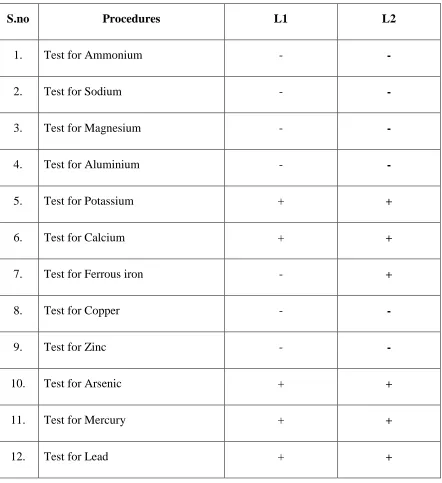
A Preliminary test for Copper, Sodium, Silicate and Carbonate:
S.No CHEMICAL TEST OBSERVATION INFERENCE
1. Appearance of sample Brick red in colour
2.
Test for Silicate:
a. A little (500mg) of the sample is
shaken well with distilled water.
b. A little (500mg) of the sample is
shaken well with con. HCl/Con. H2So4
Sparingly not
soluble
Absence of
Silicate
3.
Action of Heat:
A small amount (500mg) of the sample is
taken in a dry test tube and heated gently
at first and then strong.
White fumes not
evolved
Absence of
Carbonate
4.
Flame Test:
A small amount (500mg) of the sample is
made into a paste with con. HCl in a
watch glass and introduced into
non-luminous part of the Bunsen flame.
Bluish green flame
not appeared.
Absence of
51
5.
Ash Test: A filter paper is soaked into a
mixture of sample and dil. cobalt nitrate
solution and introduced into the Bunsen
flame and ignited.
Yellow colour
flame not appeared
Absence of
Sodium
TEST FOR ACID RADICALS
S.No CHEMICAL TEST OBSERVATION INFERENCE
1.
Test For Sulphate:
2ml of the above prepared extract was taken
in a test tube and 2ml of 4% dil. ammonium
oxalate solution was added.
Presence of Cloudy
appearance Sulphate present
2.
Test For Chloride:
2ml of the above prepared extracts was
added with 2ml of dil-HNO3 until the
effervescence ceases off. Then 2 ml of
silver nitrate solution was added.
Absence of Cloudy
appearance
Chloride
Absent
3.
Test For Phosphate:
2ml of the extract was treated with 2ml of
con.HNo3 and 2ml of dil.ammonium
molybdate solution.
Absence of Yellow
precipitate Phosphate absent
4.
Test For Carbonate:
2ml of the extract was treated with 2ml dil.
magnesium sulphate solution
Absence of Cloudy
appearance Carbonate absent
5.
Test For Nitrate:
1gm of the substance was heated with
copper turning and concentrated H2SO4 and
viewed the test tube vertically down.
Brown gas was not
52
6.
Test For Sulphide:
1gm of the substance was treated with 2ml
of con. HCL
Rotten Egg Smell
was not evolved Sulphide absent
7.
Test For Fluoride & Oxalate:
2ml of extract was added with 2ml of dil.
Acetic acid and 2ml dil.calcium chloride
solution and heated.
Absence of Cloudy
appearance
fluoride and
oxalate were
absent
8.
Test For Nitrite:
3drops of the extract was placed on a filter
paper, on that-2 drops of dil.acetic acid and
2 drops of dil.Benzidine solution were
placed.
Characteristic
changes not appeared Nitrite absent
TEST FOR BASIC RADICALS
S.No CHEMICAL TEST OBSERVATION INFERENCE
1. Test For Lead:
2ml of the extract was added with 2ml of
dil.potassium iodine solution.
Yellow
Precipitate was
obtained.
Lead Present
2.
Test For Copper:
One pinch (50mg) of substance was made
into paste with con. HCl in a watch glass
and introduced into the non-luminuous part
of the flame.
Blue colour
precipitate was
not formed.
53
3.
Test For Aluminium:
In the 2ml of extract dil.sodium hydroxide
was added in 5 drops to excess.
Yellow colour
was not formed
Aluminium
absent
4.
Test For Iron:
a.To the 2ml of extract add 2ml of dil.
ammonium solution
b.To the 2ml of extract 2ml thiocyanate
solution and 2ml of con HNo3 is added
Red colour was
formed
Iron Present
5.
Test For Zinc:
In 2ml of the extract dil.sodium hydroxide
solution was added in 5 drops to excess
and dil.ammonium chloride was added.
White precipitate
was not formed Zinc absent
6.
Test For Calcium:
2ml of the extract was added with 2ml of
4% dil.ammonium oxalate solution
Cloudy
appearance was
formed
Calcium present
7.
Test For Magnesium:
In 2ml of extract dil.sodium hydroxide
solution was added in drops toexcess.
white precipitate
not formed
Magnesium
absent
8.
Test For Ammonium:
In 2ml of extract 1 ml of Nessler's reagent
and excess of dil.sodium hydroxide
solution were added.
Brown colour not
formed
Ammonium
absent
9.
Test For Potassium:
A pinch (25mg) of substance was treated
with 2ml of dil.sodium nitrite solution and
then treated with 2ml of dil.cobalt nitrate
in 30% dil.glacial acetic acid.
Yellowish
precipitate
formed
Potassium
54
10.
Test For Sodium:
2 pinches (50mg) of the substance was
made into paste by using HCl and
introduced into the blue flame of Bunsen
burner.
Yellow colour
flame not
appeared
Sodium absent
11.
Test For Mercury:
2ml of the extract was treated with 2ml of
dil.sodium hydroxide solution.
Yellow precipitate
formed Mercury present
12.
Test For Arsenic:
2ml of the extract was treated with 2ml of
dil.sodium hydroxide solution.
Brownish red
precipitate
formed
Arsenic present
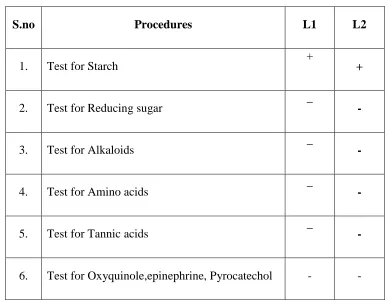
OTHER CONSTITUENTS
S.No CHEMICAL TEST OBSERVATION INFERENCE
1.
Test For Starch :
2ml of extract was treated with weak
dil.iodine solution
Blue colour
developed Starch present
2.
Test For Reducing Sugar:
5ml of Benedict's qualitative solution was
taken in a test tube and allowed to boil for
2 minutes and added 8 to 10 drops of the
extract and again boil it for 2 minutes.
The was no
specific change in
colour
Reducing sugar
55
3.
Test For The Alkaloids:
a) 2ml of the extract is treated with
2ml of dil.potassium lodide
solution.
b) 2ml of the extract is treated with
2ml of dil.picric acid.
Reddish brown
precipitation not
formed
Yellow
precipitation not
formed
Alkaloid
Absent
4.
Test For Tannic Acid:
2ml of extract was treated with 2ml of
dil.ferric chloride solution
Black precipitate
not formed
Tannic acid
absent
5.
Test For Unsaturated Compound:
In the 2ml of extract 2ml of dil.Potassium
permanganate solution was added.
Potassium
permanganate was
colourised
unsaturated
compounds
absent
6.
Test For Amino Acid:
2 drops of the extract was placed on a filter
paper and dried well, then 20ml of Biurette
reagent was added in it.
Violet colour not
developed
Amino acids