RESEARCH
Cloning, expression and activity
of ATP-binding protein in
Bacillus thuringiensi
s
toxicity modulation against
Aedes aegypti
Guo‑hui Zhao
1, Jian‑nan Liu
1, Xiao‑hua Hu
1, Khadija Batool
1, Liang Jin
1, Chen‑xu Wu
1, Juan Wu
1, Hong Chen
1,
Xiao‑yan Jiang
1, Zhao‑hui Yang
1, Xian‑hui Huang
1, En‑jiong Huang
2, Xiao‑Qiang Yu
3,4, Xiong Guan
1and Ling‑ling Zhang
1*Abstract
Background: Bacillus thuringiensis israelensis (Bti) is a widely used mosquitocidal microbial pesticide due to its high toxicity. ATP‑binding proteins (ABP) are prevalently detected in insects and are related to reaction against Bti toxins. However, the function of ABP in mosquito biocontrol is little known, especially in Aedes aegypti. Therefore, this study aimed to clarify the function of ABP in Ae. aegypti against Bti toxin.
Results: Aedes aegypti ABP (GenBank: XM_001661856.2) was cloned, expressed and purified in this study. Far‑western blotting and ELISA were also carried out to confirm the interaction between ABP and Cry11Aa. A bioassay of Cry11Aa was performed both in the presence and absence of ABP, which showed that the mortality of Ae. aegypti is increased with an increase in ABP.
Conclusions: Our results suggest that ABP in Ae. aegypti can modulate the toxicity of Cry11Aa toxin to mosquitoes by binding to Bti toxin. This could not only enrich the mechanism of Bt toxin, but also provide more data for the bio‑ control of this transmission vector.
Keywords: Aedes aegypti, ATP‑binding protein, Biocontrol, Bti, Interaction
© The Author(s) 2019. This article is distributed under the terms of the Creative Commons Attribution 4.0 International License (http://creat iveco mmons .org/licen ses/by/4.0/), which permits unrestricted use, distribution, and reproduction in any medium, provided you give appropriate credit to the original author(s) and the source, provide a link to the Creative Commons license, and indicate if changes were made. The Creative Commons Public Domain Dedication waiver (http://creat iveco mmons .org/ publi cdoma in/zero/1.0/) applies to the data made available in this article, unless otherwise stated.
Background
Mosquitoes, such as Anopheles, Aedes and Culex, are important infectious medium in transmitting various tropical diseases. Global health problems associated with mosquito-borne diseases put hundreds of millions of people at risk [1–3]. For example, Aedes spp. are the causative agent for dengue hemorrhagic fever and Zika virus [4, 5]. The attempt to control and early detection of these infections becomes a global public health issue [4]. However, there are no valid vaccines or medicines avail-able presently. Vector control is the main method for pre-venting the spread of these diseases [2, 6, 7].
Presently, mosquitoes are mostly controlled by chemi-cal pesticides. However, traditional chemichemi-cal pesticides can cause environmental pollution and human health problems. Furthermore, it is easy for insect resistance to develop [8]. Nowadays, biological pesticides, in particu-lar microbiological pesticides, are increasingly promoted due to being more environmentally friendly and having higher specificity, less influence on non-target organ-isms and inducing less resistance. Hence, microbiocon-trol is regarded as one of the best means of conmicrobiocon-trol, and the application of entomopathogens to control mosquito populations is particularly effective [9].
Bacillus thuringiensis (Bt) is a Gram-positive bacterium used worldwide in biological control due to its high spec-ificity to insects and low impact on the environment [10]. It can produce some pore forming toxins (PFTs, including Cry toxin and Cyt toxin) in its sporulation phase, which play an important role in the process of killing insects [11,
Open Access
*Correspondence: [email protected]
1 State Key Laboratory of Ecological Pest Control for Fujian and Taiwan
Crops & School of Life Science, Fujian Agriculture and Forestry University, Fuzhou 350002, China
12]. They are toxic to more than 3000 species of insect in different orders, including Lepidoptera, Coleoptera and Diptera, etc. Bacillus thuringiensis israelensis (Bti) is widely used for its high toxicity against mosquitoes. It can produce a composite mosquitocidal crystal protein containing Cry2, Cry4, Cry10, Cry11, Cyt1 and Cty2 [13–
15]. Among them, Cry11Aa can be activated by hydroly-sis with proteinase in the mosquito midgut, and displays high toxicity to larvae of Aedes and Culex, but low tox-icity against Anopheles gambiae [9, 15]. Once mosquito larvae have been exposed to the toxin, the activated toxin can bind to specific receptors to form an oligomer in the brush border membrane vesicles (BBMV) of the midgut [16–18], including the alkaline phosphatase (ALP), amin-opeptidase N (APN), cadherin and ATP-binding cassette (ABC) transporters [9]. Oligomerization of toxins and insertion of toxin oligomers into the midgut epithelial cells cause perforation and cell death [16, 18]. However, some details in this process are still unclear, especially about the interaction of toxin and receptor [19]. Recently, the resistance of Bt toxin, which can diminish the toxicity in many insects, has drawn the public eye. As reported with organophosphate insecticides, some third-part pro-teins besides toxins and receptors can also be related to the insect resistance [8]. Because of the similar binding site, galectin could make Caenorhabditis elegans resistant to Cry5Ba toxin by binding to the receptors such as lipids and glycolipids [20]. In our previous work, we found that galectin-14 of Aedes aegypti can compete with Cry11Aa by binding to some of the Cry receptors, such as ALP1 [21]. Galectin-6 was also found to interact with ALP1 to affect the toxicity of Cry (unpublished results). C-type lectin can help Anopheles gambiae prevent Plasmodium infection via humoral immunity [22]. C-type lectin-20 was also found to interact with ALP1 to reduce Cry toxic-ity in Ae. aegypti [23]. Resistance can also be induced by the mutation of ATP-binding cassette (ABC) transporter in Heliothis virescens [24–28].
ABP is a large group of proteins that can hydrolyze ATP to provide energy for the transmembrane trans-port process. Recently, ABP was retrans-ported to play a role in the pathology of insects reacting to Bt toxin. A single amino acid mutation in ABP was found to improve the resistance of Bombyx mori against Bt toxin [29]. After an amino acid was inserted in ABP C2, the modified gene was expressed in the Sf9 cell. Bioassays showed that the modified ABP was less sensitive to Cry1A toxin in B. mori than the control ABP without modification [30]. After ABP G was silenced by RNAi, Plutella xylos-tella was found to be less sensible to the Cry toxin. As peroxidase C was found to be a Cry1Ab-binding protein in Spodoptera exigua [19], ABP in Cx. quinquefascia-tus was also found to change the toxicity of Cry11Aa by
interacting with this toxin [31]. These results all show that ABP might relate to the mechanism of Cry toxin against insects.
However, the function of ABP in mosquito biocontrol is still unclear, especially in Ae. aegypti. The aim of the present study was to clarify the function of ABP in Ae. aegypti against Bti toxin.
Methods
Mosquitoes, bacterial strains, antibodies and plasmids
Aedes aegypti Haikou strain was supplied by the Fujian International Travel HealthCare Center and maintained in our laboratory in an environment-controlled room at approximately 28 °C and 85% RH with a photoperiod of 14 h light and 10 h dark. The Cry11Aa recombinant Bt strain was kindly provided by Dr Sarjeet Gill, University of California, Riverside, CA, USA. Escherichia coli JM109 and BL21 were preserved in the Key Laboratory of Eco-logical Pest Control for Fujian and Taiwan Crops, Fujian Agriculture and Forestry University, and cultivated in Luria–Bertani (LB) liquid medium (10 g/l tryptone, 5 g/l yeast extract, 10 g/l NaCl, pH 7.2). Bt LLP29 was iso-lated and preserved in our previous work [32]. The rabbit polyclonal antibody against biotin, goat-anti-rabbit-AP-conjugated polyclonal antibody and the streptavidin horse-radish peroxidase (HRP) conjugate were purchased from Beyotime (Shanghai, China). The polyclonal anti-body against Cry11Aa was produced in rabbits using purified recombinant Cry11Aa as an antigen [31]. The pMD18-T and pET-32a plasmids were purchased from TaKaRa (Dalian, China) and Novogene (Beijing, China), respectively.
Acquisition of the ABP gene
Total RNA was extracted from Ae. aegypti using an E.Z.N.A.® Total RNA Kit I (Omega Norcross, GA, USA),
then reverse-transcribed using a PrimeScript®1stStrand
Cloning, expression and purification of ABP
In order to clone the ABP gene in Ae. aegypti, the puri-fied PCR product was ligated with pMD-18T and then transformed into E. coli JM109 as described [31, 33]. Recombinant plasmid was digested with NdeI/SalI and then ligated into the Pet-32 (+) expression vec-tor [31, 33]. The PCR product of ABP from the recom-binant plasmid was also sequenced by Sangon Biotech. The recombinant ABP was transformed into competent E. coli BL21 cells to express recombinant ABP. A blank Pet-32 (+) plasmid was also transformed into com-petent E. coli BL21 to express thioredoxin, which was used as a negative control in the subsequent experi-ments. After being induced by 0.5–1 mM isopropyl-β-d-1-thiogalactopyranoside (IPTG), the target protein was purified using a Protein ISO Ni-NTA Resin reagent kit (TransGen Biotech,Beijing, China) and then further labeled using EZ-Link-NHS-Biotin (Thermo Fisher Sci-entific, Waltham, MA, USA), both according the respec-tive manufacturer’s instructions. Then, sodium dodecyl sulfate polyacrylamide gel electrophoresis (SDS-PAGE) was carried out to check the recombinant purified ABP [33]. Thioredoxin was also extracted using the same method.
Cry11Aa protein preparation
The preparation of Cry11Aa protein from the recom-binant Bt strain was carried out using the method described by Chen et al. [33–35]. The polyclonal anti-bodies against Cry11Aa protein were produced in rab-bits using purified recombinant Cry11Aa. The secondary antibody goat-anti-rabbit-AP-labeled was detected using a BCIP/NBT alkaline phosphatase assay kit (Beyotime, Nanjing China).
Western blot
In order to detect the recombinant proteins, western blot was carried out as follows. The biotinylated ABP and purified Cry11Aa were separated by 10% SDS-PAGE and transferred to a polyvinylidene fluoride (PVDF) membrane, which was further blocked with PBSM (PBS + 0.05% skim milk) for 2 h at 37 °C, and washed with PBST (PBS + 0.05% Tween-20). The membrane was then detected by the primary rabbit polyclonal antibody to biotin for ABP (1:3000) or the primary rabbit polyclonal antibody (1:3000) for Cry11Aa. The goat-anti-rabbit-AP-conjugated polyclonal antibody (1:3000) was used as the secondary antibody. All antibodies were diluted by PBS with 1% skim milk. A BCIP/NBT alkaline phosphatase assay kit was used to visualize the result, following the manufacturer’s instructions [14, 34, 35].
Far‑western blot
Far-western blot was used to detect the binding char-acterization between ABP and Cry11Aa protein. The biotinylated ABP and Cry11Aa were separated by 10% SDS-PAGE and transferred to a PVDF membrane. After being blocked with 5% dry skim milk in PBS for 2 h at 37 °C, the membrane with biotinylated ABP was then probed with the purified Cry11Aa protein (4 ng/ml, dis-solved in PBS (pH 7.4) containing 0.1% BSA) overnight at 4 °C with gentle rocking, and then washed three times with PBST. The membrane was then incubated with pri-mary rabbit polyclonal antibody to Cry11Aa (1:3000) and goat-rabbit-AP-conjugated polyclonal anti-body (1:3000) was used to detect Cry11Aa. After wash-ing 3 times with PBST and PBS buffer, the bindwash-ing of the interacting protein was checked by a BCIP/NBT alkaline phosphatase assay kit.
At the same time, the membrane with Cry11Aa was also incubated by biotinylated ABP (4 ng/ml), follow-ing probed by the primary rabbit polyclonal antibody (1:3000) to biotin and the secondary goat-anti-rabbit-AP-conjugated polyclonal antibody (1:3000). A BCIP/NBT alkaline phosphatase assay kit was used to visualize the binding protein following the manufacturer’s instructions [23].
Enzyme‑linked immunosorbent assay (ELISA)
To further understand the interaction between ABP and Cry11Aa, the purified recombinant ABP, Cry11Aa and thioredoxin were biotinylated with EZ-Link-NHS-Biotin following the manufacturer’s instructions. ELISA was then carried out as follows. Four micrograms of ABP or Cry11Aa was coated with ELISA buffer (Na3CO3, pH 9.6) in 96-well plate overnight at 4 °C, and then washed 3 times with PBS. ELISA buffer was only added to uncoated wells as a negative control. The increased con-centration of Cry11Aa, biotinylated ABP or the control biotinylated thioredoxin (0 to 1280 nM) in 100 μl PBST were supplied to the protein-coated wells and further incubated for 2 h at 37 °C. The plates were then washed 3 times with 100 μl of PBST, and the bound biotinylated Cry11Aa, biotinylated ABP or thioredoxin were detected by incubation of the plates with the streptavidin horse-radish peroxidase (HRP) conjugate antibody (1:3000) for 2 h. After washing with 100 μl of PBST for 3 times, the chromogenic regent kit EL-TMB P0209 (Beyotime BiotechNanjing China) was used for the development of color. Absorbance was checked at 450 nm on a Multis-kan™ GO Microplate Spectrophotometer (Thermo Fisher
Bioassays
For bioassays with the purified ABP and Cry11Aa, third-instar Ae. aegypti larvae were fed with purified Cry11Aa protein (2.0 μg/ml) or a mixture of the purified Cry11Aa protein (2.0 μg/ml) and ABP (0, 1.0, 2.0, 3.0 or 4.0 μg/ml) in 30 ml of dechlorinated water. Thioredoxin was used as the negative control. Each treatment was replicated 3 times. The survival rates of the mosquito larvae were recorded after 12, 24 and 48 h [36]. The data of bioassays were further analyzed by IBM SPSS Statistics v.19.0.
Results
Cloning the ABP gene
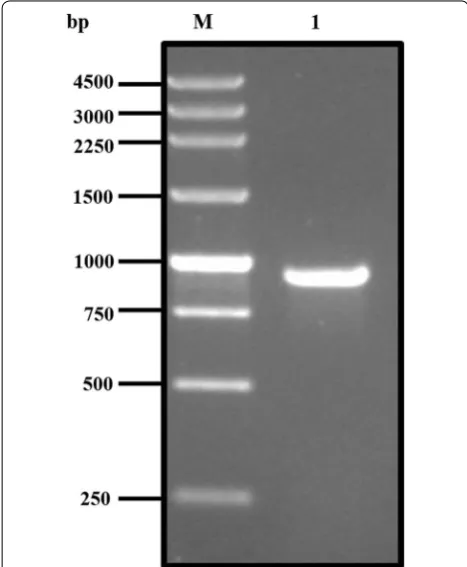
The PCR result showed that the full length ABP gene (GenBank: XM_001661856.2) has an open reading frame (ORF) of 915 bp encoding 304 amino acids (Fig. 1). The product was then purified and ligated into the clon-ing vector pMD-18T plasmid. After beclon-ing transformed to JM109, positive colonies were obtained, and the sequence was confirmed by Sangon Biotech. The target fragment was also detected after the recombinant plas-mid was digested by NdeI and SalI restriction endonu-clease (Fig. 2). The plasmid was then sequenced and the result showed a high homology (up to 99%) with the ini-tial ATP-binding protein gene. All of these results show
that the gene of the ATP-binding protein was successfully cloned.
Expression and detection of ABP and Cry11Aa
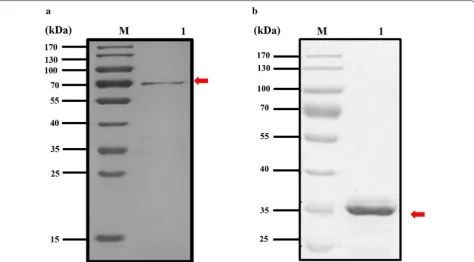
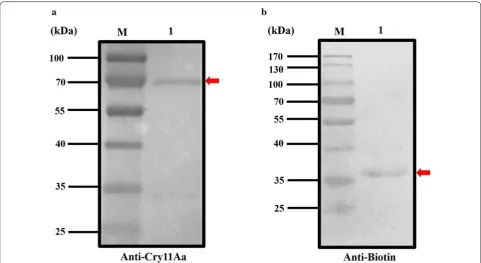
Cry11Aa crystal was expressed and purified from the recombined Bt strain that showed a 72 kDa band (Fig. 3a) in SDS-PAGE. Western blot also showed the 72 kDa band detected by the Cry11Aa specific antibody. From this, it can be concluded that Cry11Aa was expressed success-fully (Fig. 4a). Meanwhile, the ABP gene was expressed in a prokaryotic expression system by ligating with the PET-32a expression vector. The PET-32a vector plasmid was digested with NdeI and SalI prior to ligation with digested ABP gene from the ABP-pMD-18T recombi-nant plasmid. After the recombirecombi-nant plasmid was trans-formed into E. coli BL21, the positive clones that were confirmed by PCR and enzyme digestion were selected. The sequence was also confirmed by Sangon Biotech. After being induced by 0.5–1 mM IPTG, the expressed ABP was purified using a Protein ISO Ni-NTA Resin rea-gent kit and labeled with EZ-Link-NHS-Biotin. The result of SDS-PAGE showed a 35 kDa band (Fig. 3b). The west-ern blot also showed that ABP with a 35 kDa band was also detected by rabbit polyclonal antibody against biotin (Fig. 4b).
Fig. 1 PCR product of ATP‑binding protein. Lane M: 100 bp plus DNA ladder; Lane 1: PCR product of ATP‑binding protein
[image:4.595.305.538.85.342.2] [image:4.595.56.290.413.697.2]Effect on toxicity of Cry11Aa by ABP
In order to estimate the function of ABP in Cry11Aa tox-icity, a bioassay against Ae. aegypti was carried out. The survival rate against Cry11Aa was recorded after 12, 24 and 48 h with the presence and absence of ABP. Results showed an obvious drop in the survival rate with increas-ing concentrations of ABP (Fig. 5); from this it can be deduced that ABP might enhance the toxicity of Cry11Aa toxin.
Interaction of ABP and Cry11Aa
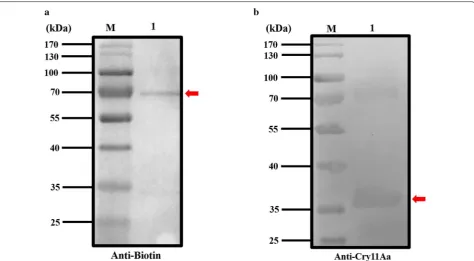
To test whether ABP could bind with Cry11Aa, the pre-sent study used western blot and far-western blot. After Cry11Aa was separated by SDS-PAGE and incubated with biotinylated ABP, the target band of 72 kDa was detected by specific rabbit polyclonal antibody against biotin (Fig. 6a); no band was detected after Cry11Aa was probed with the negative control thioredoxin. Simi-larly, when ABP was incubated with Cry11Aa, a band of 35 kDa could be detected by the specific antibody against Cry11Aa (Fig. 6b). These results show that ABP and Cry11Aa could bind to each other.
ELISA was also carried out to further confirm the binding interaction between Cry11Aa and ABP. With an increasing concentration of biotinylated ABP used, more biotinylated ABP was found to bind with the
immobilized Cry11Aa. The highest affinity was detected at a concentration of ABP of 1280 nM (Fig. 7a). Similarly, more Cry11Aa also bound to the immobilized ABP with an increased concentration of Cry11Aa and the bind-ing condition was saturated when the concentration of Cry11Aa was up to 640 mM (Fig. 7b). In the negative control, both Cry11Aa and ABP were unable to bind with thioredoxin (Fig. 7). All of these results demonstrate that ABP can interact with Cry11Aa.
Discussion
ABP is a large group of proteins that can be a transmem-brane transporter with the help of ATP hydrolyzation. A significant amount of research shows that ABP plays a vital role in species of Lepidoptera such as Bombyx mori [29, 30], Plutella xylostella [37] and Helicoverpa armig-era [38]. It was even found to interact with Cry11Aa and affect the toxicity of Cry11Aa against Cx. quinquefascia-tus in our previous study [33]. However, there is limited research about the function of ABP in Aedes. Therefore, identification of the relationship between ABP of Aedes and Cry11Aa toxin can greatly enrich the knowledge of Bt mechanism.
In the present study, the ABP gene of Ae. aegypti was cloned and expressed to analyze the relationship between ABP from Ae. aegypti and Cry11Aa toxin from
[image:5.595.63.538.88.350.2]Bti. Similar to Cx. quinquefasciatus, ABP in Ae. aegypti was found to bind with Cry11Aa toxin. The toxicity of Cry11Aa toxin can be enhanced by ABP through its interaction with this toxin [33]. Although the detailed mechanism of ABP in enhancing the toxicity of Cry11Aa needs further study, our results indicate that ABP can bind effectively to Cry11Aa protein, similar to ALP and APN [9]; the toxicity of Cry11Aa can be influ-enced by this binding characterization in Ae. aegypti. ABP may be a factor that can interact with the toxin to
form a composite to strengthen the toxicity or influence the physiological process in Ae. aegypti [33]. In order to further understand its function, ABP can be further silenced. Some other proteins in the mosquito midgut could also be tested to see whether they can alter the toxicity of Bt toxins. Such results could not only greatly enrich the knowledge of Bt mechanism, but also con-tribute to the discovery of new toxin receptors in pests, which could provide more data for the creation of new bio-pesticides.
Fig. 4 Western Blot analysis of Cry 11Aa and ATP‑binding protein. a Western blot analysis of the expressed protein (Lane M: protein molecular weight markers; Lane 1: purified Cry11Aa). b Western blot analysis of the expressed protein (Lane M: protein molecular weight markers; Lane 1: purified biotinylated ATP‑binding protein)
[image:6.595.57.539.87.350.2] [image:6.595.61.539.406.561.2]Conclusions
Mosquitoes play an important role in many infectious diseases. ABP is detected in many insects (includ-ing mosquitoes) related to the process of the Bti toxin reaction, which is widely used in mosquito biocon-trol. In order to clarify the function of ATP-binding
protein in Ae. aegypti against Bti toxin, the ABP gene of Ae. aegypti (GenBank: XM_001661856.2) was cloned, expressed and purified. Furthermore, results of far-western blot and ELISA showed an interaction between ABP and Cry11Aa. Our bioassay also showed that the mortality of Ae. aegypti increased with more the ABP added. Our results suggest that ABP in Ae. aegypti can
Fig. 6 Far‑western blot analysis of Cry 11Aa and ATP‑binding protein. a Far‑western blot analysis (Lane M: protein molecular weight markers; Lane 1: purified Cry11Aa probed with biotinylated ATP‑binding protein). b Far‑western blot analysis (Lane M: protein molecular weight markers; Lane 1: purified ATP‑binding protein probed with Cry11Aa)
[image:7.595.62.537.87.348.2] [image:7.595.66.539.405.581.2]modulate the toxicity of Cry11Aa toxin to the mosquito by binding to the Bti toxin.
Abbreviations
ABC transporters: ATP‑binding cassette transporters; Bt: Bacillus thuring-iensis; Bti: Bacillus thuringiensis israelensis; ALP: alkaline phosphatase; APN: aminopeptidase‑N; LB: Luria–Bertani; Trx: thioredoxin; PCR: polymerase chain reaction; SDS‑PAGE: sodium dodecyl sulfate polyacrylamide gel electrophore‑ sis; IPTG: isopropyl‑β‑d‑1‑thiogalactopyranoside; ELISA: enzyme‑linked immu‑
nosorbent assay; PBS: phosphate‑buffered saline; PBS‑T: phosphate‑buffered saline containing Tween‑20.
Acknowledgements
All authors gratefully acknowledge Dr Sarjeet Gill, University of California, Riverside for providing the Cry11Aa recombinant Bt strain used in this study.
Authors’ contributions
XQY and LLZ conceived and designed the experiments. GHZ, JNL, XYJ, XHH, CXW, KB, ZHY and XHH performed the experiments. GHZ, XHH and LLZ analyzed the data and wrote the manuscript. JW, HC, EJH, XG, XQY and LLZ revised the paper. All authors read and approved the final manuscript.
Funding
This work was funded by the National Program of China (Grant Numbers 2017YFE0121700, 2017YFE0122000 and 2017YFD0200400), the National Natu‑ ral Science Foundation of China (NSFC, Grant Number 31301724), the National Institute of Health (Grant Number AI117808), the Foreign Cooperative Project of Fujian Province (Grant Number 2018I0023), the Science and Technology Project of Fuzhou (Grant Number 2018‑G‑70), the Open Project Funds of State Key Laboratory of Pathogen and Biosecurity (SKLPBS1838) and Key Laboratory of Green Control of Insect Pests in Fujian Province (PTJH1700701), and the Special Fund for Scientific and Technological Innovation of Fujian Agricul‑ ture and Forestry University (Grant Numbers CXZX2017136, CXZX2017306, CXZX2017214 and KF2015064‑65).
Availability of data and materials
Data supporting the conclusions of this article are included within the article. The raw data are available from the corresponding author upon request. The sequence of the ATP‑binding protein used in this paper refers to the NCBI GenBank accession number XM_001661856.2.
Ethics approval and consent to participate
This study was conducted in accordance with the recommendations set forth in the Animal Ethics Procedures and Guidelines of the People’s Republic of China. The experiment rabbits were maintained in an enriched environment of the animal laboratory, Fujian Academy of Medical Sciences, China. All animal experiments were carried out according to the Animal Administration and Ethics Committee of Fujian Agriculture and Forestry University (China). All efforts were made to minimize the number of animals used and their suffering.
Consent for publication Not applicable.
Competing interests
The authors declare that they have no competing interests.
Author details
1 State Key Laboratory of Ecological Pest Control for Fujian and Taiwan
Crops & School of Life Science, Fujian Agriculture and Forestry University, Fuzhou 350002, China. 2 Fujian International Travel HealthCare Center,
Fuzhou 350001, China. 3 Guangzhou Key Laboratory of Insect Development
Regulation and Application Research, Institute of Insect Science and Tech‑ nology & School of Life Sciences, South China Normal University, Guang‑ zhou 510631, China. 4 Division of Cell Biology and Biophysics, University
of Missouri‑Kansas City, Kansas City, MO 64110, USA.
Received: 27 December 2018 Accepted: 9 June 2019
References
1. Turell MJ, Dohm DJ, Sardelis MR, Oquinn ML, Andreadis TG, Blow JA. An update on the potential of north American mosquitoes (Diptera: Culici‑ dae) to transmit West Nile virus. J Med Entomol. 2005;42:57–63. 2. Zhang LL, Wu SQ, Peng Y, Li MW, Sun LY, Huang EJ, et al. The potential
of the novel mosquitocidal Bacillus thuringiensis strain LLP29 for use in practice. J Vector Ecol. 2011;36:458–60.
3. Ben‑Dov E. Bacillus thuringiensis susbsp. israelensis and its dipteran‑spe‑ cific toxins. Toxins (Basel). 2014;6:1222–43.
4. Eivazzadeh‑Keihan R, Pashazadeh‑Panahi P, Mahmoudi T, Chenab KK, Baradaran B, Hashemzaei M, et al. Dengue virus: a review on advances in detection and trends—from conventional methods to novel biosensors. Mikrochim Acta. 2019;186:329.
5. Epelboin Y, Talaga S, Epelboin L, Dusfour I. Zika virus: an updated review of competent or naturally infected mosquitoes. PLoS Negl Trop Dis. 2017;11:e0005933.
6. Zhang Q, Hua G, Adang MJ. Effects and mechanisms of Bacillus thuring-iensis crystal toxins for mosquito larvae. Insect Sci. 2017;24:714–29. 7. Zhao L, Alto BW, Duguma D. Transcritional profile for detoxification
enzymes AeaGGT1 and AqeGGT2 from Aedes aegypti (Diptera: Culicidae) in response to larvicides. J Med Entomol. 2017;54:878–87.
8. Paiva MH, Lovin DD, Mori A, Melo‑Santos MA, Severson DW, Ayres CF. Identification of a major quantitative trait locus determining resistance to the organophosphate temephos in the dengue vector mosquito Aedes aegypti. Genomics. 2016;107:40–8.
9. Likitvivatanavong S, Chen J, Bravo A, Soberón M, Gill SS. Cadherin, alkaline phosphatase, and aminopeptidase N as receptors of Cry11Ba toxin from Bacillus thuringiensis subsp. jegathesan in Aedes aegypti. Appl Environ Microbiol. 2011;77:24–31.
10. Stalinski R, Laporte F, Despres L, Tetreau G. Alkaline phosphatases are involved in the response of Aedes aegypti larvae to intoxication with Bacillus thuringiensis subsp. israelensis Cry toxins. Environ Microbiol. 2016;18:1022–36.
11. Schnepf E, Crickmore N, Van Rie J, Lereclus D, Baum J, Feitelson J, et al. Bacillus thuringiensis and its pesticidal crystal proteins. Microbiol Mol Biol Rev. 1998;62:775–806.
12. Vallet‑Gely I, Lemaitre B, Boccard F. Bacterial strategies to overcome insect defences. Nat Rev Microbiol. 2008;6:302–13.
13. Berry C, O’Neil S, Ben‑Dov E, Jones AF, Murphy L, Quail MA, et al. Complete sequence and organization of pBtoxis, the toxin‑coding plasmid of Bacillus thuringiensis subsp. israelensis. Appl Environ Microb. 2002;68:5082–95.
14. Zhang LL, Huang EJ, Tang BZ, Guan X, Gelbic I. Mosquito cell line C6/36 shows resistance to Cyt1Aa6. Indian J Exp Biol. 2012;50:265–9.
15. Ben‑Dov E. Bacillus thuringiensis subsp. israelensis and its dipteran‑specific toxins. Toxins. 2014;6:1222–43.
16. Bravo A, Gill SS, Soberon M. Mode of action of Bacillus thuringiensis Cry and Cyt toxins and their potential for insect control. Toxicon. 2007;49:423–35.
17. Gomez I, Pardo‑Lopez L, Munoz‑Garay C, Fernandez LE, Perez C, Sanchez J, et al. Role of receptor interaction in the mode of action of insecti‑ cidal Cry and Cyt toxins produced by Bacillus thuringiensis. Peptides. 2007;28:169–73.
18. Palma L, Muñoz D, Berry C, Murillo J, Caballero P. Bacillus thuringiensis toxins: an overview of their biocidal activity. Toxins. 2014;6:3296–325. 19. Lu KY, Gu YQ, Liu XP, Lin Y, Yu XQ. Possible insecticidal mechanisms medi‑
ated by immune response related Cry‑binding proteins in the midgut juice of Plutella xylostella and Spodoptera exigua. J Agric Food Chem. 2017;65:2048–55.
20. Ideo H, Fukushima K, Gengyo‑Ando K, Mitani S, Dejima K, Nomura K, et al. A Caenorhabditis elegans glycolipid‑binding galectin functions in host defense against bacterial infection. Biol Chem. 2009;284:26493–501. 21. Zhang LL, Hu XH, Wu SQ, Batool K, Chowdhury M, Lin Y, et al. Aedes
•fast, convenient online submission
•
thorough peer review by experienced researchers in your field
• rapid publication on acceptance
• support for research data, including large and complex data types
•
gold Open Access which fosters wider collaboration and increased citations maximum visibility for your research: over 100M website views per year
•
At BMC, research is always in progress.
Learn more biomedcentral.com/submissions
Ready to submit your research? Choose BMC and benefit from:
22. Yassine HA. Functional interactions between C‑type lectins and clip‑ domain serine protease homologs in A. gambiae immune responses. Ph.D. Thesis, American University of Beirut; 2013.
23. Batool K, Alam I, Zhao GH, Wang JX, Xu J, Yu XQ, et al. C‑type lectin‑20 interacts with ALP1 receptor to reduce Cry toxicity in Aedes aegypti. Toxin. 2018;10:390.
24. Gahan LJ, Pauchet Y, Vogel H, Heckel DG. An ABC transporter mutation is correlated with insect resistance to Bacillus thuringiensis Cry1Ac toxin. PLoS Genet. 2010;6:e1001248.
25. Liu CX, Xiao YT, Li XC, Oppert B, Tabashnik BE, Wu KM. Cis‑mediated down‑regulation of a trypsin gene associated with Bt resistance in cotton bollworm. Sci Rep. 2014;4:7219.
26. Park Y, Gonzalez‑Martinez RM, Navarro‑Cerrillo G, Chakroun M, Kim Y, Ziarsolo P, et al. ABCC transporters mediate insect resistance to multiple Bt toxins revealed by bulk segregant analysis. BMC Biol. 2014;12:46. 27. Wu Y. Detection and mechanisms of resistance evolved in insects to Cry
toxins from Bacillus thuringiensis. Adv Insect Physiol. 2014;47:297–342. 28. Qi WP, Ma XL, He WY, Chen W, Zou MM, Gurr GM, et al. Characterization
and expression profiling of ATP‑binding cassette transporter genes in the diamondback moth, Plutella xylostella (L.). BMC Genom. 2016;17:760. 29. Atsumi S, Miyamoto K, Yamamoto K, Narukawa J, Kawai S, Sezutus H, et al.
Single amino acid mutation in an ATP‑binding cassette transporter gene causes resistance to Bt toxin Cry1Ab in the silkworm, Bombyx mori. Proc Natl Acad Sci USA. 2012;109:E1591–8.
30. Tanaka S, Miyamoto K, Noda H, Jurat‑Fuentes JL, Yoshizawa Y, Endo H, et al. The ATP‑binding cassette transporter subfamily C member 2 in Bombyx mori larvae is a functional receptor for Cry toxins from Bacillus thuringiensis. FEBS J. 2013;280:1782–94.
31. Zhang LL, Zhao GH, Hu XH, Liu JN, Li MW, Batool K, et al. Cry11Aa inter‑ acts with the ATP‑binding protein from Culex quinquefasciatus to improve the toxicity. J Agric Food Chem. 2017;65:10884–90.
32. Zhang LL, Huang EJ, Lin J, Gelbic I, Zhang QL, Guan Y, et al. A novel mos‑ quitocidal Bacillus thuringiensis strain LLP29 isolated from the phylloplane of Magnolia denudata. Microbiol Res. 2010;165:133–41.
33. Chen JW, Aimanova K, Gill SS. Functional characterization of Aedes aegypti alkaline phosphatase ALP1 involved in the toxicity of Cry toxins from Bacillus thuringiensis subsp. israelensis and jegathesan. Peptide. 2017;98:78–85.
34. Chen JW, Aimanova KG, Pan S, Gill SS. Identification and characteriza‑ tion of Aedes aegypti aminopeptidase N as a putative receptor of Bacillus thuringiensis Cry11A toxin. Insect Biochem Mol. 2009;39:688–96. 35. Chen JW, Likitvivatanavong S, Aimanova KG, Gill SS. A 104 kDa Aedes
aegypti aminopeptidase N is a putative receptor for the Cry11Aa toxin from Bacillus thuringiensis subsp. israelensis. Insect Biochem Mol Biol. 2013;43:1201–8.
36. World Health Organization. WHO specifications and evaluations for public health pesticides Bacillus thuringiensis subspecies israelensis strain AM65‑52. Geneva: World Health Organization; 2007.
37. Guo Z, Kang S, Zhu X, Xia J, Wu Q. Down‑regulation of a novel ABC transporter gene (Pxwhite) is associated with Cry1Ac resistance in the diamondback moth, Plutella xylostella, (L.). Insect Biochem Mol Biol. 2015;59:30–40.
38. Zhou Z, Wang Z, Liu Y, Liang G, Shu C, Song F, et al. Identification of ABCC2 as a binding protein of Cry1Ac on brush border membrane vesicles from Helicoverpa armigera by an improved pull‑down assay. Microbiologyopen. 2016;5:659–69.
Publisher’s Note