SHORT REPORT
Development and application of an
indicator assessment tool for measuring health
services accreditation programs
Virginia Mumford
1*, David Greenfield
1, Anne Hogden
1, Deborah Debono
1, Kevin Forde
2, Johanna Westbrook
3and Jeffrey Braithwaite
1Abstract
Background: Hospital accreditation programs are internationally widespread and consume increasingly scarce health resources. However, we lack tools to consistently identify suitable indicators to assess and monitor accredita-tion outcomes. We describe the development and validaaccredita-tion of such a tool.
Results: Using Australian accreditation standards as our reference point we: reviewed the research evidence for potential indicators; looked for links with existing external indicators; and assessed relevant state and federal poli-cies. We allocated provisional scores, on a five point Likert scale, to the five accountability criteria in the tool: research; accuracy; proximity; no adverse effects; and specificity. An expert panel validated the use of the purpose designed indicator assessment tool. The panel identified hand hygiene compliance rates as a suitable process indicator, and hospital acquired Staphylococcus aureus infection (SAB) rates as an outcome indicator, with the hypothesis that improved hand hygiene compliance rates and lower SAB rates would correlate with accreditation performance.
Conclusions: This new tool can be used to identify, analyse, and compare accreditation indicators. Using infection control indicators such as hand hygiene compliance and SAB rates to measure accreditation effectiveness has merit, and their efficacy can be determined by comparing accreditation scores with indicator outcomes. To verify the tool as a robust instrument, testing is needed in other health service domains, both in Australia and internationally. This tool provides health policy makers with an important means for assessing the accreditation programs which form a critical part of the national patient safety and quality framework.
Keywords: Quality indicators, Healthcare acquired infection, Accreditation, Hand hygiene
© 2015 Mumford et al. This article is distributed under the terms of the Creative Commons Attribution 4.0 International License (http://creativecommons.org/licenses/by/4.0/), which permits unrestricted use, distribution, and reproduction in any medium, provided you give appropriate credit to the original author(s) and the source, provide a link to the Creative Commons license, and indicate if changes were made. The Creative Commons Public Domain Dedication waiver (http://creativecommons.org/ publicdomain/zero/1.0/) applies to the data made available in this article, unless otherwise stated.
Background
Health services accreditation programs are designed to strengthen quality and safety improvement efforts through compliance with clinical and organisational standards. Accreditation programs have been widely adopted with over 27 country specific hospital accredi-tation agencies active in a 2009 survey [1], and several international agencies providing cross-border accredi-tation services. However, the evidence for accrediaccredi-tation improving patient safety and quality is mixed [2–4]. An
Australian study showed accreditation improved organi-sational measures [5], and a European study indicated that external assessment systems are associated with better clinical outcomes [6]. Other work has shown a transient effect [7], or no effect on clinical outcomes [8]. One of the difficulties in assessing the research and the range of findings is the lack of a comprehensive frame-work by which to analyse and compare the costs and ben-efits of accreditation programs. To meet this need and as part of the Accreditation Collaborative for the Conduct of Research, Evaluation and Designated Investigations through Teamwork (ACCREDIT) research partnership [9–11], we established a framework for evaluating the costs and benefits of hospital accreditation [12]. Our
Open Access
*Correspondence: [email protected]
1 Centre for Clinical Governance Research, Australian Institute of Health Innovation, UNSW, Sydney, Australia
purpose designed SIQNS framework comprises five dis-crete activities: (1) Scope and objectives; (2) Identify costs and benefits; (3) Quantify costs and benefits; (4) calculate Net social benefits; and (5) Sensitivity analysis.
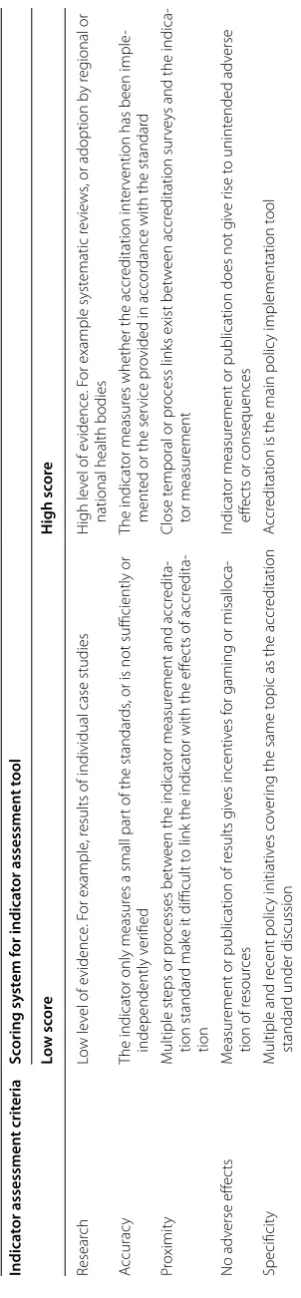
There are a number of indicators that have been vali-dated and accepted for measuring patient safety and quality in healthcare [13]. However, one of the additional challenges in measuring the effectiveness of accredita-tion is in identifying indicators for the outcomes or ben-efits that can be linked specifically to the accreditation process. We therefore developed an indicator assess-ment tool to identify, compare and evaluate the suitabil-ity of either process or outcome indicators in hospital accreditation as part of our SIQNS framework. This tool incorporated the four accountability criteria used by The Joint Commission (the main United States health ser-vices accreditation agency) to measure improvements in the clinical processes of care [14]. These were: level of research evidence underpinning the indicator; accu-racy of the indicator in measuring implementation of the standard; proximity of the standard and indicator; and the potential for adverse effects or unintended con-sequences. We adapted these criteria to assess accredi-tation and added an additional criterion, specificity, to account for the difficulties of isolating the effects of accreditation from other quality and safety interventions (Table 1).
The aim of this study is to describe the development and validation of a purpose designed indicator assess-ment tool in identifying indicators for hospital accredi-tation performance. An expert panel assessed the tool using hand hygiene compliance rates and Staphylococcus aureus (SAB) rates to illustrate the selection process and assess the suitability of these indicators in assessing the impact of accreditation on patient safety and quality of care.
Research methods Study setting and process
This study takes the health service accreditation stand-ards for Australian hospitals as its reference point. We reviewed the ten National Safety and Quality Health
Service (NSQHS) Standards developed by the Austral-ian Commission on Safety and Quality in Health Care (ACSQHC) and introduced in early 2013 [15]. In addi-tion, we reviewed the accreditation standards within the Evaluation and Quality Improvement Program (EQuIP), issued and maintained by the Australian Council for Healthcare Standards (ACHS) [16, 17]. We convened an expert panel to assess the tool, using two key indicators to demonstrate the selection process.
Indicator selection
We focused on the first three NSQHS standards: Stand-ard 1 Governance for safety and quality in health service organisations; Standard 2 Partnering with consumers; and Standard 3 Preventing and controlling healthcare associ-ated infections [15]. For each standard we reviewed the research evidence; looked for links with existing exter-nal indicators; and reviewed relevant state and federal policies in Australia. Given the recent introduction of the NSQHS Standards we also checked that the pre-exist-ing EQuIP accreditation standards contained relevant content for retrospectively comparing indicators with accreditation outcomes [16, 17].
Evaluation of accreditation indicators
Four researchers from the ACCREDIT team assessed potential indicators against the five criteria in our indi-cator assessment tool during a series of four evaluation meetings. The researchers were experienced in a wide range of clinical and health services research expertise including: qualitative and quantitative methods; patient safety and quality; and organisational culture. Each cri-terion was allocated a score ranging from low to high on a five point Likert scale (Table 2). For example, high scores were allocated to the research criterion for evi-dence based on a systematic review, or acceptance by a national or international health body. A low score in research would be allocated where evidence was weak, for example from individual case studies. Since the cri-teria are measuring different aspects of each standard, these scores were considered separately and not used to create an overall score.
Table 1 Indicator assessment tool—criteria explanation Indicator assessment criteria Explanation
Research What is the evidence that compliance with the accreditation standard affects the indicator? Accuracy How accurate is the indicator in terms of measuring compliance with the accreditation standard? Proximity How close is the link between the standard and the indicator? Is there a causal chain?
No adverse effects What is the risk of avoiding adverse effects?
[image:2.595.57.535.643.727.2]Table 2 I ndic at or assessmen t t ool—sc or e allo ca tion e xamples Indica tor assessmen t crit eria Sc oring sy st em f or indica tor assessmen t t ool Lo w sc or e H igh sc or e Resear ch Lo w le
vel of e
vidence
. F
or example
, r
esults of individual case studies
H
igh le
vel of e
vidence
. F
or example syst
ematic r
evie
ws
, or adoption b
y r
eg
ional or
national health bodies
A
ccurac
y
The indicat
or only measur
es a small par
t of the standar
ds
, or is not sufficiently or
independently v
er
ified
The indicat
or measur
es whether the accr
editation int
er
vention has been imple
-ment
ed or the ser
vice pr
ovided in accor
dance with the standar
d Pr oximit y M ultiple st
eps or pr
ocesses bet
w
een the indicat
or measur
ement and accr
edita
-tion standar
d mak
e it difficult t
o link the indicat
or with the eff
ec
ts of accr
edita
-tion
Close t
emporal or pr
ocess links exist bet
w
een accr
editation sur
ve
ys and the indica
-tor measur ement No adv erse eff ec ts M easur
ement or publication of r
esults g
iv
es incentiv
es f
or gaming or misalloca
-tion of r
esour
ces
Indicat
or measur
ement or publication does not g
iv e r ise t o unint ended adv erse eff ec
ts or consequences
Specificit
y
M
ultiple and r
ecent polic
y initiativ
es co
ver
ing the same t
opic as the accr
editation
standar
d under discussion
A
ccr
editation is the main polic
y implementation t
[image:3.595.228.379.86.737.2]Review and assessment of indicator tool
We next convened an expert panel to validate the results of our prototype indicator assessment tool building on meth-ods adopted for assessing quality indicators in primary health care [18]. This panel comprised seven experienced, Australian based researchers working on accreditation and quality outcomes, as well as three high profile international healthcare quality and safety experts from Spain and the United Kingdom. The panel session comprised a 2 h meet-ing with all members present in person. Our panel mem-bers averaged 12.7 years in health services research and a total authorship of more than 1000 health research publica-tions. We presented the panel with a description of the tool, the indicative scores allocated by the ACCREDIT team, the rationale for those scores, and the research evidence for the indicators. We used an evidence-based consensus approach to synthesise the results of the panel [18]. The tool was additionally endorsed by an ACCREDIT Steering Committee comprising accreditation agency senior execu-tives, health quality bodies, and health service managers.
Results
Indicator selection
We focused on Standard 3 relating to hospital acquired infection. This was partly due to the specificity of the interventions that could be mapped across the ACHS and NSQHS Standards. In addition, infection control processes have become increasingly important as infections acquired during a hospital stay are a major cause of morbidity and result in significant costs in terms of increased length of stay and additional treatment [19]. Standard 3 comprises six main topics: governance and systems; patient management; infection prevention and control strategies; antimicrobial stewardship; cleaning, disinfecting and sterilisation; and communicating with patients and carers [20]. Hand hygiene compliance rates and Staphylococcus aureus bacteraemia (SAB) incidence rates in the Australian acute care sector are routinely collected and published, and we selected these indicators to test our indicator assessment tool.
Hand hygiene programs in Australian hospitals, based on World Health Organization recommendations
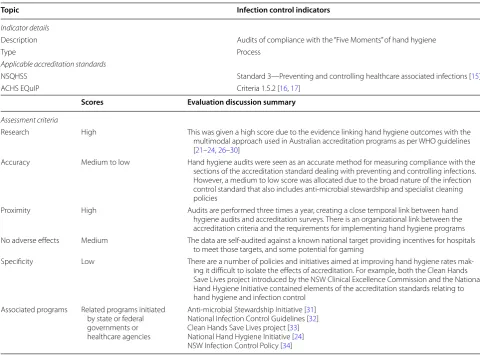
Table 3 Expert panel’s evaluation of hand hygiene compliance as a process indicator
Topic Infection control indicators
Indicator details
Description Audits of compliance with the “Five Moments” of hand hygiene
Type Process
Applicable accreditation standards
NSQHSS Standard 3—Preventing and controlling healthcare associated infections [15]
ACHS EQuIP Criteria 1.5.2 [16, 17]
Scores Evaluation discussion summary
Assessment criteria
Research High This was given a high score due to the evidence linking hand hygiene outcomes with the multimodal approach used in Australian accreditation programs as per WHO guidelines [21–24, 26–30]
Accuracy Medium to low Hand hygiene audits were seen as an accurate method for measuring compliance with the sections of the accreditation standard dealing with preventing and controlling infections. However, a medium to low score was allocated due to the broad nature of the infection control standard that also includes anti-microbial stewardship and specialist cleaning policies
Proximity High Audits are performed three times a year, creating a close temporal link between hand hygiene audits and accreditation surveys. There is an organizational link between the accreditation criteria and the requirements for implementing hand hygiene programs No adverse effects Medium The data are self-audited against a known national target providing incentives for hospitals
to meet those targets, and some potential for gaming
Specificity Low There are a number of policies and initiatives aimed at improving hand hygiene rates mak-ing it difficult to isolate the effects of accreditation. For example, both the Clean Hands Save Lives project introduced by the NSW Clinical Excellence Commission and the National Hand Hygiene Initiative contained elements of the accreditation standards relating to hand hygiene and infection control
Associated programs Related programs initiated by state or federal governments or healthcare agencies
[image:4.595.56.537.372.735.2][21], take a multimodal approach, and are in line with best practice internationally [22]. This approach incorporates a number of organisational and safety components including: staff education, appropriate infrastructure; compliance monitoring; and commu-nicating with patients. This broad approach to qual-ity improvement reflects the goals of the accreditation program within an overarching safety and quality framework [6].
The ACSQHC has recommended that hand hygiene programs in Australia are repeatedly monitored using both process indicators (compliance rates) and outcome indicators (infection rates) [23]. Auditors trained by Hand Hygiene Australia (the agency tasked by ACSQHC to implement the program) monitor hand hygiene activ-ity against the total number of potential “moments” for hand hygiene. These five “moments” comprise: before touching a patient; before a procedure; after a procedure or body fluid exposure risk; after touching a patient; and after touching a patient’s surroundings [24]. The national target is a compliance rate of 70 % and results are publicly reported three times a year, providing readily accessible indicator data [24]. SAB rates are reported on a monthly basis, with a national target incidence rates of <2 per 10,000 inpatient bed days [25].
Indicator evaluation
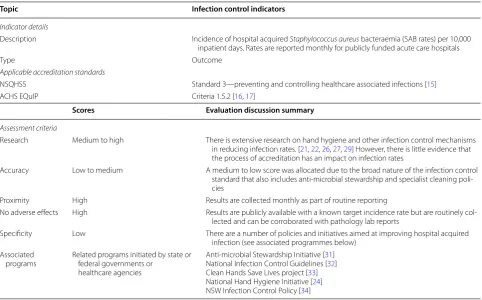
The panel collectively reviewed the five criteria, assessed the evidence and interim evaluation provided, and awarded each a score ranging from low to high. The scores varied, with higher scores for research and prox-imity to lower scores for specificity. The results and rationale for the allocated scores for hand hygiene com-pliance rates are shown in Table 3, and those for SAB rates are shown in Table 4.
Tool and indicator validation
The expert panel endorsed the indicator assessment tool and its suitability for assessing process and outcome indicators for accreditation. The panel determined that hand hygiene would be suitable as a process indicator for hospital accreditation and should be assessed against accreditation outcomes. The higher scores for research and proximity were critical in this consideration and pro-vide both face and content validity for the tool [18]. The panel also recommended investigating SAB rates as an outcome indicator based on higher scores for research, proximity, and no adverse effect. The lower scores for specificity and accuracy were noted for both of these indicators. The panel recommended using the systematic approach embedded within the tool to widen the topics
Table 4 Expert panel’s evaluation of SAB rates as an outcome indicator
Topic Infection control indicators
Indicator details
Description Incidence of hospital acquired Staphylococcus aureus bacteraemia (SAB rates) per 10,000 inpatient days. Rates are reported monthly for publicly funded acute care hospitals
Type Outcome
Applicable accreditation standards
NSQHSS Standard 3—preventing and controlling healthcare associated infections [15] ACHS EQuIP Criteria 1.5.2 [16, 17]
Scores Evaluation discussion summary
Assessment criteria
Research Medium to high There is extensive research on hand hygiene and other infection control mechanisms in reducing infection rates. [21, 22, 26, 27, 29] However, there is little evidence that the process of accreditation has an impact on infection rates
Accuracy Low to medium A medium to low score was allocated due to the broad nature of the infection control standard that also includes anti-microbial stewardship and specialist cleaning poli-cies
Proximity High Results are collected monthly as part of routine reporting
No adverse effects High Results are publicly available with a known target incidence rate but are routinely col-lected and can be corroborated with pathology lab reports
Specificity Low There are a number of policies and initiatives aimed at improving hospital acquired infection (see associated programmes below)
Associated
programs Related programs initiated by state or federal governments or healthcare agencies
[image:5.595.57.540.427.727.2]covered and include a range of indicators from across the accreditation standards.
Discussion and conclusions
Our validated indicator assessment tool can be used to systematically identify process and outcome indicators in order to assess their suitability as indicators of accredita-tion performance in Australian hospitals [35]. This study focused on the infection control standard to illustrate the application of the tool. Further validation with a broader range of healthcare workers and across all ten NSQHS standards is merited. Identifying indicators of accredi-tation performance provides health policy makers with an important means for assessing a critical part of the patient safety and quality framework, both for monitor-ing the effect of current accreditation programs and in assessing their development. Testing is needed to ensure applicability of the tool in international and domestic accreditation programs across the acute, primary and aged care health domains.
Abbreviations
ACCREDIT: accreditation collaborative for the conduct of research, evaluation and designated investigations through teamwork; ACHS: Australian Council of Healthcare Standards; ACSQHC: Australian Commission on Safety and Quality in Health Care; EQuIP: Evaluation and Quality Improvement Program NSQHS standards: national safety and quality health service standards; NSW: new south wales; SIQNS: a framework for evaluating the costs and benefits of health services accreditation (scope, identify, quantify, net social benefit calculation, and sensitivity); WHO: World Health Organization.
Authors’ contributions
VM coordinated the study and drafted the manuscript. JB and JW initiated the study by proposing the original study and securing funding for the work. DG and JB contributed to the study design, assisted with drafting the manuscript, and organised the expert panel. KF, DD, and AH assisted with drafting the manuscript. All authors read and approved the final manuscript.
Author details
1 Centre for Clinical Governance Research, Australian Institute of Health Innovation, UNSW, Sydney, Australia. 2 School of Public Health and Commu-nity Medicine, UNSW, Sydney, Australia. 3 Centre for Health Systems and Safety Research, Australian Institute of Health Innovation, UNSW, Sydney, Australia.
Acknowledgements
We would like to thank the ACCREDIT team and international advisory board for their participation in the expert panel.
Compliance with ethical guidelines
Competing interests
The authors declare that they have no competing interests.
Received: 11 February 2014 Accepted: 12 August 2015
References
1. Shaw CD, Braithwaite J, Moldovan M, Nicklin W, Grgic I, Fortune T, Whit-taker S. Profiling health-care accreditation organizations: an international survey. Int J Qual Health Care. 2013;25(3):222–31.
2. Mumford V, Forde K, Greenfield D, Hinchcliff R, Braithwaite J. Health services accreditation: what is the evidence that the benefits justify the costs? Int J Qual Health Care. 2013;25(5):62–6.
3. van Harten WH, Casparie TF, Fisscher OAM. Methodological considera-tions on the assessment of the implementation of quality management systems. Health Policy. 2000;54(3):187–200.
4. Flodgren G, Pomey M, Taber S, Eccles M. Effectiveness of external inspec-tion of compliance with standards in improving healthcare organisainspec-tion behaviour, healthcare professional behaviour or patient outcomes. Cochrane database of systematic reviews (Online). 2011;11. 5. Braithwaite J, Greenfield D, Westbrook J, Pawsey M, Westbrook M,
Gib-berd R, Naylor J, Nathan S, Robinson M, Runciman B, et al. Health service accreditation as a predictor of clinical and organisational performance: a blinded, random, stratified study. Qual Saf Health Care. 2010;19(1):14–21. 6. Lilford RJ, Chilton PJ, Hemming K, Girling AJ, Taylor CA, Barach P.
Evaluat-ing policy and service interventions: framework to guide selection and interpretation of study end points. BMJ. 2010;341:c4413.
7. Al Tehewy M, Salem B, Habil I, El Okda S. Evaluation of accreditation program in non-governmental organizations’ health units in Egypt: short-term outcomes. Int J Qual Health Care. 2009; 21(3):183–189.
8. Salmon J, Heavens J, Lombard C, Tavrow P. The impact of accreditation on quality of hospital care: Kwa-Zulu Natal Province, Republic of South Africa. Bethesda: USAID; 2003.
9. Braithwaite J, Westbrook J, Johnston B, Clark S, Brandon M, Banks M, Hughes C, Greenfield D, Pawsey M, Corbett A, et al. Strengthening organizational performance through accreditation research-a framework for twelve interrelated studies: the ACCREDIT project study protocol. BMC Res Notes. 2011;4(1):390.
10. Hinchcliff R, Greenfield D, Moldovan M, Pawsey M, Mumford V, Westbrook JI, Braithwaite J. Evaluation of current Australian health service accredita-tion processes (ACCREDIT-CAP): protocol for a mixed-method research project. BMJ Open. 2012;2(4):e001726.
11. Greenfield D, Hinchcliff R, Moldovan M, Mumford V, Pawsey M, Westbrook JI, Braithwaite J. A multimethod research investigation of consumer involvement in Australian health service accreditation programmes: the ACCREDIT-SCI study protocol. BMJ Open. 2012;2(5):e002024.
12. Mumford V, Greenfield D, Hinchcliff R, Moldovan M, Forde K, Westbrook JI, Braithwaite J. Economic evaluation of Australian acute care accreditation (ACCREDIT-CBA (Acute)): study protocol for a mixed-method research project. BMJ Open. 2013;3(2):e002381.
13. Agency for Healthcare Research and Quality. ARHQ quality indicators toolkit for hospitals: how to improve hospital quality and safety. Rockville: AHRQ; 2012.
14. Chassin MR, Loeb JM, Schmaltz SP, Wachter RM. Accountability meas-ures—using measurement to promote quality improvement. N Engl J Med. 2010;363(7):683–8.
15. Australian Commission on Safety and Quality in Health Care (ACSQHC). National safety and quality health service standards. Sydney: ACSQHC; 2012.
16. Australian Council on Healthcare Standards. The ACHS EQuIP 4 guide : part 2—standards. Sydney: ACHS; 2007.
17. Australian Council on Healthcare Standards (ACHS). EQuIP5 standards and criteria. Sydney: ACHS; 2010.
18. Campbell SM, Braspenning J, Hutchinson A, Marshall M. Research meth-ods used in developing and applying quality indicators in primary care. Qual Saf Health Care. 2002;11(4):358–64.
19. Commission Productivity. Public and private hospitals: research report. Canberra: Productivity Commission; 2009.
20. Australian Commission on Safety and Quality in Health Care. Safety and quality improvement guide, standard 3: preventing and controlling healthcare associated infections. Sydney: AACSQHC; 2012.
21. World Health Organization. A guide to the implementation of the WHO multimodal hand hygiene improvement strategy. Geneva: WHO; 2009. 22. Gould DJ, Moralejo D, Drey N, Chudleigh JH. Interventions to improve hand hygiene compliance in patient care. Cochrane Database of System-atic Reviews (Online). 2010(9). Art. No. CD005186.
24. Hand Hygiene Australia. Hand Hygiene Australia manual: 5 moments for hand hygiene. 3rd ed. Heidelberg: Commonwealth of Australia; 2013. 25. Australian Institute of Health and Welfare. Staphylococcus aureus
bacteraemia in Australian public hospitals 2013–2014: Australian hospital statistics. Health services seres No. 59 Cat. No. HSE 155. Canberra: AIHW; 2014.
26. World Health Organization. WHO guidelines on hand hygiene in health care: a summary. First global patient safety challenge—clean care is safer care. Geneva, Switzerland: World Health Organisation; 2009.
27. Pfoh E, Dy S, Engineer C. Interventions to improve hand hygiene compli-ance: making health care safer II: an updated critical analysis of the evidence for patient safety practices. Rockville: Agency for Healthcare Research and Quality; 2013.
28. European Union Network for Patient Safety and Quality of Care. Safe clinical practice: multimodal intervention to increase hand hygiene compliance. 2013.
29. Pittet D, Allegranzi B, Sax H, Dharan S, Pessoa-Silva CL, Donaldson L, Boyce JM. Evidence-based model for hand transmission during patient care and the role of improved practices. Lancet Infect Dis. 2006;6(10):641–52.
30. Pincock T, Bernstein P, Warthman S, Holst E. Bundling hand hygiene interventions and measurement to decrease health care-associated infections. Am J Infect Control. 2012;40(4 Suppl):S18–27.
31. Duguid M, Cruickshank M. Antimicrobial Stewardship in Australian hospi-tals. Sydney: Australian Commision on Safety and Quality in Health Care; 2010.
32. NHMRC. Australian guidelines for the prevention and control of infection in healthcare. Canberra: Commonwealth of Australia; 2010.
33. Pantle A, Fitzpatrick K. Clean Hand save lives: final report of the NSW hand hygiene campaign. Sydney: Clinical Excellence Commission; 2007. 34. Clinical Excellence Commission. Infection Control Policy. Doc No
PD2007_036. Sydney: NSW Health; 2007.
35. Mumford V, Greenfield D, Hogden A, Debono D, Gospodarevskaya E, Forde K, Westbrook J, Braithwaite J. Disentangling quality and safety indicator data: a longitudinal, comparative study of hand hygiene com-pliance and accreditation outcomes in 96 Australian hospitals. BMJ Open. 2014;4(9):e005284.
Submit your next manuscript to BioMed Central and take full advantage of:
• Convenient online submission
• Thorough peer review
• No space constraints or color figure charges
• Immediate publication on acceptance
• Inclusion in PubMed, CAS, Scopus and Google Scholar
• Research which is freely available for redistribution