COMMENTARY
The need for a network to establish
and validate predictive biomarkers in cancer
immunotherapy
Giuseppe V. Masucci
1*, Alessandra Cesano
2, Alexander Eggermont
3, Bernard A. Fox
4, Ena Wang
5,
Francesco M. Marincola
6, Gennaro Ciliberto
7, Kevin Dobbin
8, Igor Puzanov
9, Janis Taube
10, Jennifer Wargo
11,
Lisa H. Butterfield
12, Lisa Villabona
1, Magdalena Thurin
13, Michael A. Postow
14,15,16, Paul M. Sondel
17,
Sandra Demaria
18, Sanjiv Agarwala
19and Paolo A. Ascierto
20*Abstract
Immunotherapies have emerged as one of the most promising approaches to treat patients with cancer. Recently, the entire medical oncology field has been revolutionized by the introduction of immune checkpoints inhibitors. Despite success in a variety of malignancies, responses typically only occur in a small percentage of patients for any given histology or treatment regimen. There are also concerns that immunotherapies are associated with immune-related toxicity as well as high costs. As such, identifying biomarkers to determine which patients are likely to derive clinical benefit from which immunotherapy and/or be susceptible to adverse side effects is a compelling clinical and social need. In addition, with several new immunotherapy agents in different phases of development, and approved thera-peutics being tested in combination with a variety of different standard of care treatments, there is a requirement to stratify patients and select the most appropriate population in which to assess clinical efficacy. The opportunity to design parallel biomarkers studies that are integrated within key randomized clinical trials could be the ideal solu-tion. Sample collection (fresh and/or archival tissue, PBMC, serum, plasma, stool, etc.) at specific points of treatment is important for evaluating possible biomarkers and studying the mechanisms of responsiveness, resistance, toxicity and relapse. This white paper proposes the creation of a network to facilitate the sharing and coordinating of samples from clinical trials to enable more in-depth analyses of correlative biomarkers than is currently possible and to assess the feasibilities, logistics, and collated interests. We propose a high standard of sample collection and storage as well as exchange of samples and knowledge through collaboration, and envisage how this could move forward using banked samples from completed studies together with prospective planning for ongoing and future clinical trials.
© The Author(s) 2017. This article is distributed under the terms of the Creative Commons Attribution 4.0 International License (http://creativecommons.org/licenses/by/4.0/), which permits unrestricted use, distribution, and reproduction in any medium, provided you give appropriate credit to the original author(s) and the source, provide a link to the Creative Commons license, and indicate if changes were made. The Creative Commons Public Domain Dedication waiver (http://creativecommons.org/ publicdomain/zero/1.0/) applies to the data made available in this article, unless otherwise stated.
Introduction
Concept 1. The need for biomarker discovery and validation in cancer immunotherapy
Immunotherapies have emerged as one of the most promising approaches to treat patients with cancer.
Recently, the entire medical oncology field has been revo-lutionized by the introduction of immune checkpoint inhibitors, including T cell inhibitory receptors such as cytotoxic T-lymphocyte-associated antigen 4 (CTLA-4) and programmed cell death-1 (PD-1) or its ligand (PDL-1). However, despite well documented success in a vari-ety of malignancies, responses typically only occur in a small percentage of patients for any given histology or treatment regimen. There are also concerns associated with immune-related toxicity and the high cost of immu-notherapies. Because of this, identifying biomarkers to determine those patients that are most likely to derive clinical benefit from different immunotherapies and
Open Access
*Correspondence: [email protected]; [email protected]; [email protected]
1 Department of Oncology-Pathology, Karolinska Institutet, 171 76 Stockholm, Sweden
20 Melanoma. Cancer Immunotherapy and Innovative Therapy Unit, Istituto Nazionale Tumori Fondazione “G. Pascale”, Via Mariano Semmola, 80131 Naples, Italy
those who are more prone to develop adverse side effects is a compelling clinical and social need. Moreover, with several new immunotherapy agents in different phases of development, and approved therapies being evaluated in various combinations with different standard of care treatments, there is an urgent requirement to stratify patients and select the most appropriate populations in which to assess clinical efficacy.
Because of the complexity of the immune response, tumor heterogeneity and patient diversity, it is unlikely that a single biomarker will be sufficient to predict clini-cal outcomes in response to the spectrum of immune-targeted therapies. Biomarkers which are correlated with clinical outcome can be identified at molecular (genetics, epigenetics, metagenomics, proteomic, metabolomics, etc.), cellular and tissue levels. Before a candidate bio-marker and/or new technology can be used for treatment decisions in a clinical setting, several steps are necessary to demonstrate its clinical validity. The discovery and assessment of biomarkers using cutting edge technolo-gies across different clinical studies is a fundamental step in maximizing data generation. Collaborative efforts to combine clinical trial samples and data will empower data analysis and the significance of any biomarkers identified.
A biomarker with clinical relevance requires rigor-ous validation which can be separated into several sequential steps: assessment of basic assay perfor-mance (analytical validation); characterization of the assay performance with regard to its intended use (clinical validation); validation in clinical trials that ensures that the assay performs robustly according to predefined specifications (fit-for-purpose) and the establishment of definitive acceptance criteria for clinical use (validation of clinical utility). The fit-for purpose approach (an umbrella term used to describe distinct stages of the validation process) for biomarker development and validation addresses the proper assay tailored to meet the intended purpose of the biomarker. The Society for Immunotherapy of Can-cer (SITC) Immune Biomarkers Task Force convened to address this need in this two-volume series; pre-analytical and pre-analytical (Volume I) as well as clinical and regulatory (Volume II) aspects of the validation process as applied to predictive biomarkers for cancer immunotherapy [1, 2].
Clinical study design in which biomarker analysis is one of the primary objectives/endpoints needs to be pro-moted. A good example of such a study was CA184-004 (NCT00261365), a phase II trial to determine predictive markers of response to ipilimumab (MDX-010). In this study, the primary endpoint was to identify candidate
markers predictive of response and/or serious toxicity to ipilimumab. Tissue and blood samples were collected at different time points from enrolled patients and the subsequent biomarker analyses generated interesting data. The findings of this study could have been consid-ered as the first evidence for biomarker association with outcome, and could potentially have been confirmed and prospectively validated in subsequent studies. However, study results can often not sufficiently meet expectations or may be contradictory, which may be in part due to the constraints of underpowered cohort size, variables in the time and type of sample collection, and differences in procedures, data generation and tools used at differ-ent sites. The opportunity to design parallel biomarker studies that are integrated as key components of impor-tant randomized clinical trials could offer a solution. Sample collection (fresh and/or archival tissue, PBMC, serum, plasma, stool, etc.) at specific stages of treatment is important to evaluate possible biomarkers and to study mechanisms of response, resistance, toxicity and relapse. Such studies would be helpful in the design and development of upcoming therapies. At present, several research institutes around the world, including many at which the authors of this article are based, are collect-ing tumor, blood, serum and faecal samples to investi-gate prognostic and predictive biomarkers and to better understand the complex immunobiology of patients and their cancers.
Biomarker discovery is a fundamental objective in the design of many clinical trials. Therefore, the incor-poration of correlative biomarker studies using state-of-the-art technologies within clinical trials in order to maximize data generation is required. The challenge at this stage is that most completed or ongoing clinical trials have not sufficiently incorporated biomarker assessment into their design. There is a need for an international joint effort to maximize data, information and knowledge generation from existing and completed clinical trials and to design clinical trials that will better address these important issues.
Concept 2. The proposal of an international cancer immunotherapy biomarker consortium
There are a number of compelling arguments for the establishment of an international cancer immuno-therapy biomarker consortium, which are summarized below.
1. To maximize the potential of novel biomarker dis-covery using samples from multi-institutional clini-cal practice and cliniclini-cal studies and will offer a new breadth of experience and expertise to biomarker studies.
2. To allow streamlined sample access by developing online registration, biobanking, and the inventory and tracking of archived samples in order to best utilize samples existing after designated trials com-pleted.
3. To set up and share standard operating procedures (SOPs) to harmonize future sample collection pro-cessing and banking.
4. To improve access to samples by initiating a new patient sample registry or by joining forces with existing international clinical trial patient registries with available clinical data and biological sample collection, including storage conditions and inven-tory information.
5. To provide support/guidelines in correlative study design.
6. To engage and leverage with cancer societies, pharma and biotech companies, and government institutes in order to improve the development of biomarkers.
7. To accelerate biomarker development by bringing together groups from around the world that can col-laborate from proof-of-concept to validation. More-over, the experience of the immunoscore worldwide project, coordinated by SITC, is an important exam-ple of an ‘honest broker’ approach for coordinating a specific study and data sharing [3].
8. To reinforce the concept of a stable-standing con-sortium which would be able to take a short, inter-mediate and long-term view towards biomarker development for more effective care of patients with cancer.
In order to emphasize the point 4# proposal above and to have data on as large a group of patients as possible, it would be very beneficial to have a stable-standing consor-tium among the major contributing institutions, societies and research centers. Recently, a consortium organized by The University of Tubingen was able to collect sam-ples from several different institutions and obtain results from a large number of patients treated with Ipilimumab
or an anti-PD-1 (Nivolumab or Pembrolizumab) [4]. The worldwide Immunoscore project is another good exam-ple of a effective consortium that was successful at vali-dating a previously described biomarker [3].
Concept 3. The challenges in biomarker discovery
A series of challenges are confronted when a project of this magnitude is proposed:
1. Limited or fragmented resources.
2. Insufficient numbers of patients per cohort.
3. Inclusion of patients with diverse treatment history (previous antitumoral treatment), histological and radiographic conditions.
4. Limited and/or suboptimal correlative study design due to funding and/or regulatory constraints.
5. Heterogeneity in the types of biological samples with different time points of collection, storage condi-tions, platforms used for data generation, lab-driven SOPs and data analysis algorithms and tools.
6. Heterogeneity in the clinical data collected and the length of follow-up,
7. Lack of international joint initiatives. 8. Potential intellectual property.
showed similar efficacy across different clinical trials and the problem may be in the IHC assay and the ‘immuno-logical’ characterization/criteria used to evaluate PD-L1 positivity. However, the FDA recently (11th May 2017) approved the combination of chemotherapy with pem-brolizumab for first-line treatment of NSCLC regardless of PD-L1 expression, confirming the need for predictive biomarkers [7].
Over 10 years ago, the FDA issued important guid-ance that all drugs should be accompanied by a com-panion diagnostic (CDx). Industry has applied a thorough understanding of biology and the immune system to develop robust and meaningful biomarkers. While industry may believe that leveraging biomark-ers and companion diagnostics are critical to precision medicine, developing them is challenging and expen-sive and therefore has been less of a priority. On the other hand, the introduction of Pembrolizumab in clinical trials should be an example to others. Indus-try efforts might be helped by strategic partnerships with academic institutions in order to identify rel-evant clinical biomarkers. For example, the processes of detecting reproducible, predictive biomarkers and developing robust companion diagnostics substan-tially benefit from the correlation to genomics and complex tissue analysis data. This includes the analy-sis of spatial relationships between immune cells host-ing the tumour environment and the development of highly sensitive, precise, quantifiable and reproducible assays. These issues are challenging, time-consuming and need large investment. Pursuing a thorough, evi-dence-based and scientifically-driven drug discovery and development program is the desired long-term goal. However, funds to support these programs could be used for more short-term plans such as recruiting additional patient groups into a clinical trial in order to meet regulatory objectives.
At present, the best example of a truly successful and important immune-oncology predictive biomarker is mismatch repair deficiency: Cancer patients with microsatellite instability high (MSI-H) tumors inde-pendent of the tissue of origin benefit from immu-notherapy with PD-1 inhibitors [8]. In particular, in colorectal cancer, MSI-H patients experience up to 50% or higher responses, while few if any responses are seen in MSI-low (L) colorectal cancer patients. Clinical dem-onstration of this concept has led to a recent approval by the FDA. We believe that these two examples of sin-gle predictive biomarkers (i.e. PD-L1 and MSI) will be the exception and not the rule and that we will have to search for the integration of several different biomark-ers. This will amplify the challenge and will require a highly coordinated effort across multiple institutions.
Patient inclusion and statistical considerations according to the study design
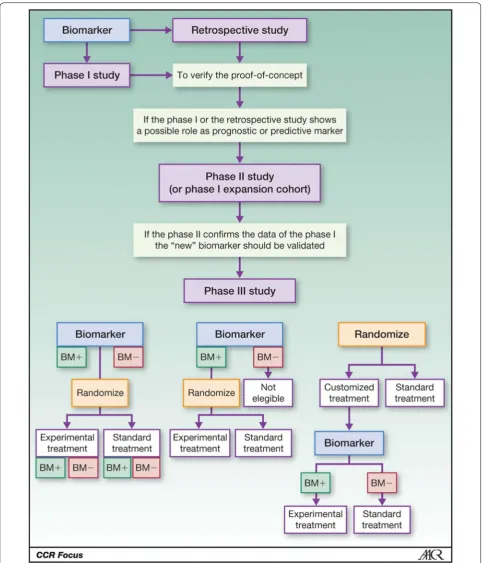
The development and implementation of appropriate biomarker assays to study T cells and other cells in the microenvironment is an essential companion objective for clinical trials that seek to evaluate immunothera-peutic agents, particularly when used in combination. In principle, the efficacy of a compound (in this case immune-targeted agents) is at least partially dependent on the presence of the target in the tumor. In an ideal scenario, when complete information on predictive fac-tors and proper selection of patients can be obtained in the early phases of drug development (phase I–II stud-ies), the conduct of subsequent phase III studies could be optimized. Unfortunately, this ideal scenario rarely occurs. The clinical immune-oncology research commu-nity is dealing with several key questions, including; (a) what metrics are best for biomarker evaluation in phase III studies, (b) what primary and secondary endpoints should ne assessed, and (c) what are the statistical prop-erties of various metrics. When planning a phase III trial comparing an experimental treatment with the standard, we often have evidence supporting a predictive role of a biomarker, whereas patients with the absence of such expression should not respond. In such a scenario, dif-ferent strategies are theoretically possible (see Fig. 1): (i) a ‘randomize all’ strategy, i.e. randomization between standard and experimental treatment without selection, possibly with stratification based on biomarker status (in this case, ‘stratified trial design’ or ‘treatment-marker interaction design’); (ii) ‘targeted’ design, i.e. randomiza-tion between standard and experimental treatment only in patients selected according to the status of the marker (also called ‘enrichment design’); and (iii) ‘customized’ strategy (also called ‘marker-based strategy’), i.e. ran-domization between a standard arm in which the treat-ment is the same for all patients, and a personalized arm in which treatment is chosen on the basis of the marker status of each patient.
Methods
To address these challenges, a systematic approach involving a multi-institutional effort could help identify and develop robust, standardized biomarkers and related clinical data that support the selection and testing of promising therapeutic approaches and combinations. The diversity of reagents and platforms that are being used to assess the immune systems of humans and data report-ing procedures are not consistent. This hampers data reproducibility among laboratories, which may prevent meaningful interpretations across studies and could lead to selection of different intent-to-treat (ITT) populations. Most of the assays being used involve high-throughput multi-parametric ‘signatures’ that require considerable statistical and bioinformatic efforts for proper algorithm development and robust data interpretation. The requi-site capabilities are not available to all investigators assay-ing immune biomarkers and are not consistently beassay-ing accomplished in academic or clinical laboratories due to resource constraints. This issue must be addressed to ensure that biomarker measurements using high-quality, validated assays can be compared between clinical trials. The use of different assays, if there are standards or ref-erence materials available, could allow for evaluation and comparison of performance across the assays and across different sites. There is no current system that can easily integrate analyses across different clinical trials.
Different approaches to overcome these limitations and to address different technical and logistical challenges have evolved in the process of biomarker standardization.
a. A central laboratory approach is able to provide integrated testing, sample management, and data-management services; therefore, it may be able to supply efficient and reliable biomarker testing and data delivery as part of comprehensive biomarker characterization. A small, integrated network of labo-ratories with specific expertise in an array of molecu-lar and cellumolecu-lar approaches, testing blood and tumor samples, would be able to support coordinated and standardized biomarker investigation, sample sharing and data sharing.
b. An alternative approach that facilitates the compa-rability and integration of data across multiple labo-ratories is assay harmonization (proficiency panel-driven SOPs, approaches and troubleshooting). Harmonization of biomarker assays enforces iden-tical reagents and/or protocols across laboratories and the establishment of assay-specific protocols in individual laboratories. The harmonization process involves the participation of multiple laboratories in a consortium-based iterative testing process to iden-tify the variables crucial for assay performance, with
data sharing and sometimes centralized analysis. The ‘Immunoscore’ validation initiative is an example of this approach.
c. An example that addresses comparability of approach across multiple IHC-based PD-L1 tests was addressed by the Blueprint Project developed by four pharmaceutical companies (Bristol-Myers Squibb, Merck & Co. Inc., AstraZeneca PLC, and Genentech, Inc.) [9].
The network
Samples associated with clinical outcomes from clinical practice or clinical studies are an enormous resource for the identification of biomarkers that is often underuti-lized. We propose developing an International Immuno-therapy Biomarkers Consortium to overcome barriers to the use of these samples and associated clinical informa-tion and to optimize the informainforma-tion that can be learned from them. This can help the development of biomark-ers from proof-of-concept to validation. Moreover, the experience of the Immunoscore worldwide project coordinated by SITC is an important example of how to work in this field. The network should be a permanent consortium with a virtual biobank that can be accessed as soon as an investigator from the Consortium has a sci-entifically valid idea. Suggestions for such a consortium include:
1. A survey to establish the need and willingness of dif-ferent institutions to participate with time, reagents, and sample sets. This would involve development of a subcommittee to explore issues and strategies for sharing licensing and royalty income for IPs devel-oped from the consortium with centers who partici-pate in providing tissue samples and scientific exper-tise.
2. A database and registry of ongoing international clin-ical trials; clinclin-ical information including outcome; survey of sample type and availability; clinical and experimental data have already been completed [4]. This exercise will help identify gaps, unify standards and understand the willingness of participants. 3. A committee to propose overall direction and
iden-tify projects to pursue, based on data-based informa-tion and sample availability. Other responsibilities of this committee would include:
a. Announcing survey results and providing data-base access to all participants.
b. Requesting proposals from participants and the broader community.
possibility to have exclusive rights to develop companion diagnostics).
d. Review proposals and grant-selected projects with sample access for phase I discovery up to phase III validation studies. The consortium will develop policies and procedures to ensure that samples will be used in the most effective, ethical way and to maximize data generation and knowledge generation using state-of-the-art methodology germline and somatic genetic anal-ysis (SNP, NGS, CNV, TCR).
i. Epigenetics (transcription, methylation, miRNA, splicing variation, fusion transcripts, transcription regulation).
ii. Proteomics (serum/plasma protein profiling, cytokine assays, antibody screen, exosome analysis,
iii. Metabolomic profiling. iv. Microbiome/virome analysis.
v. Flow cytometry, Single cell network analysis, sorted cells, functional and phenotypic profiling.
vi. Evaluation of the tumor and relationship of immune cells with image analysis and machine learning (Mul-tiplex IHC, Immunoscore, CyTOF).
vii. Pharmacogenomics. viii. ImmunoPET.
e. Monitor project progression and outcome. f. Present updates to the consortium at
interna-tional meetings.
g. Publish results of discovery as a consortium in an open access journal and make databases available in format similar to TCGA.
h. Coordinate biomarker validation.
Objectives
Objectives of this consortium are outlined below.
• The creation of a database of available samples, with linked key information would be a top priority. This effort could start with the trial titles/therapeutics tested and basic trial design, number of patients, timepoints and the nature of biospecimens obtained, for a first review.
• Every participant would keep the samples on site but provide the information on this centralized database. An app that facilitates the collection of the data preserving the deidentified nature of the information is essential. This could also be designed to allow a relevant search engine to find samples based on specific characteristics.
• A committee would evaluate proposals after samples have been identified that may be suitable for a spe-cific project.
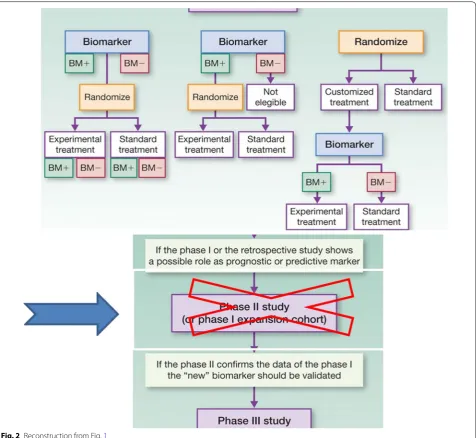
• A network of bioinformaticians would be established with the purpose of developing new algorithms capa-ble to interpret and integrate data coming from the analysis of different parameters/biomarkers (Fig. 2).
• A task force should be created with the intent to facilitate the discovery and development of predictive biomarkers.
Discussion
The main goal of this white paper is to develop the frame-work for a netframe-work of institutes with widespread sharing of available samples and clinical data. This will facilitate the exchange of knowledge and collaboration in suggest-ing upcomsuggest-ing clinical trials.
There are ongoing projects that could be partners such as the Foundation for the NIH Biomarker Consortium, in which projects are discussed among biomarker spe-cialists, but then funded through collaborative industry funding in a ‘pre-competitive space’ where companion diagnostics are not yet ready to be developed by indi-vidual companies. In addition, the four existing working groups of the SITC Immunotherapy Biomarkers Task Force (http://sitc.sitcancer.org/about-sitc/initiatives) cur-rently consist of a broad array of expertise in standardi-zation and validation of biomarkers, new technologies, systematic high throughput approaches and baseline and tumor-focused biomarkers. In concert with these central-ized steering committees, the involved academic centers that have clinical trials and individual biomarker exper-tise, would discuss what they have banked and what pro-jects could be performed together.
The concept of a network of collaborating biomarker discovery/validation efforts raises the critical question of potential mechanisms for financing this effort. Several initiatives are already emerging in this arena. In spring 2017 in the USA, the NCI initiated an effort that is sup-ported with funds from the Beau Biden Cancer Moon-shot Initiative (through peer review and NCI-support) for four separate laboratory centers to function as Clini-cal Immunotherapy Monitoring and Assessment Centers (CIMACs). However, the CIMAC laboratories network will serve NCI clinical trials in immunotherapy and would not have the capacity to integrate with other clini-cal trial networks/consortia. Perhaps in the future with
more funding and expanded infrastructure this would be possible. These laboratory networks will engage in sepa-rate yet integsepa-rated laboratory activities using established and innovative platforms to evaluate both biomarkers and other surrogate endpoints for ongoing and future NCI sponsored cancer immunotherapy studies. This network could serve as an important model for correla-tive study infrastructure in other clinical trial networks and expanded interactions and coordination with other immune-oncology clinical laboratories for assessment and monitoring of biomarkers, at a global level.
[image:8.595.62.539.87.525.2]participate in correlative biomarker science in clinical trials and also post-trial analyses in a systematic manner. This consortium could be very closely connected with clinical trials in immunotherapy including existing net-works (e.g. the NCI supported Cancer Immunotherapy Trial Network, CITN) and all other ongoing trials in the US and Europe. Most trials will likely be small cohort studies. The consortium could combine several types of trials and analyze them across studies in an interdiscipli-nary approach. It is important to keep in mind possible bottlenecks. For instance, the US National Clinical Tri-als Network (NCTN, formerly the cooperative groups) has been attempting to develop a shared database across multiple specimen banks for some time and has found it to be a very complex task. Different institutes track dif-ferent sample parameters and sharing any patient identi-fiers will be a concern with regard to privacy regulations. This is an issue that might be solved by applying similar parameters to categorize samples collected at each insti-tution. Another example is the database for the pediat-ric brain cancer consortium, run at CHOP (Children’s Hospital of Philadelphia) using RedCap software with restricted consortium-only access [10]. While this is fea-sible, it requires expertise and personnel with dedicated effort.
In order to maintain solid communication and up-to-date information flow, the consortium could have monthly discussions and generate white papers summa-rizing promising data and outlining validation that could become high priority research initiatives to be taken on by the consortium or by other larger clinical trial groups with the capacity for such larger studies.
There are many important details that will require resolution in order to initiate a functional consortium able to pursue even a fraction of the objectives identified as important in this report. Moving forward will ben-efit from face-to-face discussions among a committed group of stakeholders, consisting of immune-oncology researchers with expertise in preclinical testing, clini-cal trials, and state-of-the-art laboratory evaluations of preclinical and clinical immunotherapy regimens. Convening a full-day workshop of such stakeholders, potentially at a SITC meeting, or a separate meeting of worldwide leaders in immune-oncology, may provide the time, focus, discussions, and interactions needed to help convert some of the helpful goals and concepts pre-sented here into a prioritized action plan that might help promote this vision and enable additional next steps to proceed.
Authors’ contributions
GM and PAA prepared the manuscript collaboratively with input and approval of All the other Authors. All Authors read and approved the final manuscript.
Author details
1 Department of Oncology-Pathology, Karolinska Institutet, 171 76 Stockholm, Sweden. 2 NanoString, Inc, 530 Fairview Avenue N, Seattle, WA 98109, USA. 3 Gustave Roussy Cancer Institute, 114 Rue Edouard Vaillant, Villejuif/Paris-Sud, France. 4 Robert W. Franz Cancer Center, Earle A. Chiles Research Institute, Providence Portland Medical Center, 4805 NE Glisan, Portland, OR 97213, USA. 5 Research Branch, Division Chief of Translational Medicine at Sidra Medical and Research Center, Doha, Qatar. 6 Abbvie Corp. Redwood City, California, IL 94063, USA. 7 IRCCS IRCCS Istituto Nazionale Tumori Regina Elena, via Elio Chianesi 53, Rome, Italy. 8 Department of Epidemiology and Biostatistics, College of Public Health, The University of Georgia, 101 Buck Road, Athens, GA 30602, USA. 9 Melanoma Section Department of Medicine, CSC Building Roswell Park Cancer Institute, Elm & Carlton Streets, 915, Buffalo, NY 14263, USA. 10 Department of Dermatology, Johns Hopkins University SOM, 600N. Wolfe Street Blalock 907, Baltimore, MD 21287, USA. 11 Department of Surgical Oncology, Division of Surgery, The University of Texas MD Anderson Cancer Center, Houston, TX, USA. 12 Department of Medicine, Surgery and Immunol-ogy, University of Pittsburgh Cancer Institute, 5117 Centre Avenue, Pittsburgh, PA 15213, USA. 13 National Cancer Institute, Cancer Diagnosis Program, DCTD, National Institutes of Health, 9609 Medical Center Drive, Bethesda, MD 20892, USA. 14 Melanoma and Immunotherapy Oncology Service, Memorial Sloan Kettering Cancer Center, New York, NY, USA. 15 Weill Cornell Medical College, New York, NY, USA. 16 Sarcoma Oncology Service, Memorial Sloan-Kettering Cancer Center, New York, NY, USA. 17 Departments of Pediatrics, Human Oncology and Genetics, University of Wisconsin, 4159 WIMR Building, 1111 Highland Ave Madison, WI, USA. 18 Department of Radiation Oncology and Pathology, Weill Cornell Medicine, 1300 York Avenue, Box 169, New York, NY 10065, USA. 19 St. Luke’s University Hospital and Temple University, Beth-lehem, USA. 20 Melanoma. Cancer Immunotherapy and Innovative Therapy Unit, Istituto Nazionale Tumori Fondazione “G. Pascale”, Via Mariano Semmola, 80131 Naples, Italy.
Acknowledgements
GV Masucci corresponding author thanks the King Gustaf V Jubilee Fund (part of the Radiumhemmets fonds), in Stockholm, Sweden for the contribution to this publication.
Competing interests
AE: honoraria (sab membership) actelion, agenus, bms,gsk, haliodx, incyte, isa pharmaceuticals, msd, nektar, novartis, pfizer, sanofi; BAF, Scientific Advisory Board: Argos, Bayer, Bristol-Myers Squibb, Definiens, Janssen/Johnson & John-son, MedImmune/AstraZeneca, PerkinElmer, PrimeVax, Viralytics; Research Support: Definiens, Janssen/Johnson & Johnson, MedImmune/AstraZeneca, OncoSec, PerkinElmer; Co-founder and ownership interest, UbiVac; IP: consult-ant Amgen, Roche, Nektar. Research support Amgen, Nektar; MAP reports honoraria from merck and bms and has served on an advisory board for novartis, merck, bms, and array biopharma. He has received a research grant from bms. MAP would like to acknowledge that this manuscript was funded in part through the nih/nci cancer center support grant p30 ca008748; SDM Consultant/Honoraria (Lytix Biopharma, Eisai, EMD Serono; and PAA has/had a consultant/advisory role for BMS, Roche-Genentech, MSD, Array, Novartis, Amgen, Merck Serono, Pierre Fabre, Incyte. He also received research funds from BMS, Roche-Genentech, Array. The other authors declare that they have no competing interests.
Availability of supporting data Not applicable.
Consent for publication Not applicable.
Ethical approval and consent to participate Not applicable.
Funding Not applicable.
Publisher’s Note
• We accept pre-submission inquiries
• Our selector tool helps you to find the most relevant journal • We provide round the clock customer support
• Convenient online submission • Thorough peer review
• Inclusion in PubMed and all major indexing services • Maximum visibility for your research
Submit your manuscript at www.biomedcentral.com/submit
Submit your next manuscript to BioMed Central
and we will help you at every step:
Received: 21 August 2017 Accepted: 25 October 2017
References
1. Masucci GV, Cesano A, Hawtin R, Janetzki S, Zhang J, Kirsch I, Dobbin KK, Alvarez J, Robbins PB, Selvan SR, et al. Validation of biomarkers to predict response to immunotherapy in cancer: volume I—pre-analytical and analytical validation. J Immunother Cancer. 2016;4:76.
2. Dobbin KK, Cesano A, Alvarez J, Hawtin R, Janetzki S, Kirsch I, Masucci GV, Robbins PB, Selvan SR, Streicher HZ, et al. Validation of biomarkers to pre-dict response to immunotherapy in cancer: volume II—clinical validation and regulatory considerations. J Immunother Cancer. 2016;4:77. 3. Galon Jerome, Mlecnik Bernhard, Marliot Florence, Fang-Shu Ou, Bifulco
Carlo Bruno, Lugli Alessandro, Zlobec Inti, Rau Tilman T, Hartmann Arndt, Masucci Giuseppe V, et al. Validation of the Immunoscore (IM) as a prognostic marker in stage I/II/III colon cancer: Results of a worldwide consortium-based analysis of 1,336 patients. J Clin Oncol. 2016;34:3500. 4. Weide B, Martens A, Hassel JC, Berking C, Postow MA, Bisschop K, Sime-one E, Mangana J, Schilling B, Di Giacomo AM, et al. baseline biomarkers for outcome of melanoma patients treated with pembrolizumab. Clin Cancer Res. 2016;22:5487–96.
5. Buyse M, Sargent DJ, Grothey A, Matheson A, de Gramont A. Biomarkers and surrogate end points[mdash]the challenge of statistical validation. Nat Rev Clin Oncol. 2010;7:309–17.
6. Larkin J, Chiarion-Sileni V, Gonzalez R, Rutkowski P, Cowey J-JGCL, Lao CD, Schadendorf D, Ferrucci PF, Smylie M, Dummer R, et al. Overall survival results from a phase III trial of nivolumab combined with ipilimumab in treatment-naïve patients with advanced melanoma (CheckMate 067). AACR, Annual meeting 2017; Abstract Number CT075.
7. Reck M, Rodríguez-Abreu D, Robinson AG, Hui R, Csőszi T, Fülöp A, Gottfried M, Peled N, Tafreshi A, Cuffe S, et al. Pembrolizumab versus chemotherapy for PD-L1–positive non–small-cell lung cancer. N Engl J Med. 2016;375:1823–33.
8. Xiao Y, Freeman GJ. The microsatellite instable (MSI) subset of colorectal cancer is a particularly good candidate for checkpoint blockade immu-notherapy. Cancer Discov. 2015;5:16–8.
9. Hirsch FR, McElhinny A, Stanforth D, Ranger-Moore J, Jansson M, Kulangara K, Richardson W, Towne P, Hanks D, Vennapusa B, et al. PD-L1 immunohistochemistry assays for lung cancer: results from phase 1 of the blueprint PD-L1 IHC assay comparison project. J Thorac Oncol. 2017;12:208–22.