malaria elimination
Moonen
et al.
M E T H O D O L O G Y
Open Access
A framework for assessing the feasibility of
malaria elimination
Bruno Moonen
1,2*, Justin M Cohen
1, Andy J Tatem
3,4, Jessica Cohen
5, Simon I Hay
6, Oliver Sabot
1,
David L Smith
3,7Abstract
The recent scale-up of malaria interventions, the ensuing reductions in the malaria burden, and reinvigorated dis-cussions about global eradication have led many countries to consider malaria elimination as an alternative to maintaining control measures indefinitely. Evidence-based guidance to help countries weigh their options is thus urgently needed. A quantitative feasibility assessment that balances the epidemiological situation in a region, the strength of the public health system, the resource constraints, and the status of malaria control in neighboring areas can serve as the basis for robust, long-term strategic planning. Such a malaria elimination feasibility assess-ment was recently prepared for the Minister of Health in Zanzibar. Based on the Zanzibar experience, a framework is proposed along three axes that assess the technical requirements to achieve and maintain elimination, the operational capacity of the malaria programme and the public health system to meet those requirements, and the feasibility of funding the necessary programmes over time. Key quantitative and qualitative metrics related to each component of the assessment are described here along with the process of collecting data and interpreting the results. Although further field testing, validation, and methodological improvements will be required to ensure applicability in different epidemiological settings, the result is a flexible, rational methodology for weighing differ-ent strategic options that can be applied in a variety of contexts to establish data-driven strategic plans.
Background
During the Global Malaria Eradication Programme (GMEP) and the decade that followed, 37 countries with endemic malaria succeeded in eliminating transmission [1]. Since 1978, however, only nine more countries have reached this goal, while most malaria-endemic countries have aimed for control, not elimination [2]. Recently, some of the countries that halved their malaria cases between 2000 and 2008 [1] are revising their strategic plans and are considering elimination as an alternative to maintaining control measures indefinitely. In the wake of Bill and Melinda Gates’2007 commitment to global malaria eradication [3,4], officials from many countries where elimination was considered infeasible during the GMEP because of high endemicity and poor infrastructure [5-7], including Nigeria [8], Ghana [9], Tanzania [10], and Kenya [11], have announced plans to eliminate malaria. It has been argued that premature
commitment to elimination may be counterproductive as it could divert limited resources and negatively impact efforts to reduce the high burden of malaria [3,12,13]. There is thus an urgent need for clear, evi-dence-based guidance to assess whether elimination represents a realistic goal in a given region.
Weighing elimination today is different from the beginning of the GMEP era, when the impact of eradica-tion programs essentially was taken for granted. The spectacular early success of the GMEP in Europe [5,6,14,15] was not replicated elsewhere, however, and the early timelines and cost estimates proved overly optimistic [7]. The GMEP adapted by recommending that countries assess the feasibility of such an undertak-ing through “a preliminary study to accumulate and analyze the information required for realistic pro-gramme planning” before embarking on a costly and potentially ineffective campaign [16,17]. These studies were intended to “cover not only technical and opera-tional aspects but also a wider sphere, with a view to elucidating the socio-economic implications of malaria
eradication within the context of the overall
* Correspondence: [email protected] 1Clinton Health Access Initiative, Boston, USA
Full list of author information is available at the end of the article
development plan of the country and its human and financial resources” [14]. Current World Health Organi-zation (WHO) guidelines continue to recommend asses-sing the feasibility of elimination, but they only propose a qualitative assessment using a checklist of technical and operational pre-conditions and provide no guidance on how to quantitatively assess key epidemiological fac-tors that define the feasibility of achieving and maintain-ing elimination [18].
In this paper, a framework for assessing the feasibility of elimination in a given region is described that is based on literature accumulated during the GMEP and updated by the experience of conducting the first con-temporary malaria elimination feasibility assessment in Zanzibar [19]. This framework, and the methods pro-posed, will need to be further evaluated and adapted as necessary to ensure its suitability in different eco-epide-miological settings. The goal is to provide malaria pro-grammes with the basis for a practical blueprint for making an evidence-based decision. Unlike the GMEP, eliminating countries today cannot expect their
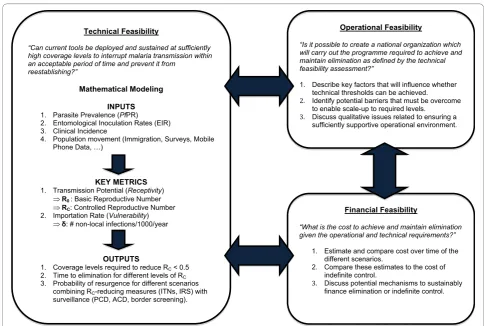
neighbors to eliminate malaria, so they must consider requirements both for interrupting transmission and remaining malaria-free despite continued importation of infections [20]. The proposed framework is comprised of three axes: the technical requirements to achieve and maintain elimination, the operational capacity of the malaria programme and the public health system to meet those requirements, and the financial feasibility of funding the necessary programmes over time (Figure 1). However, this paper prioritizes technical feasibility as no quantitative metrics have previously been offered for its assessment while previous discussions of operational [18,20,21] and financial feasibility [22-24] are more extensive. The ultimate goal of this exercise is to edu-cate decision-makers about their options and the likely consequences of their decisions.
Framework
Technical feasibility
[image:3.595.54.539.356.682.2]Elimination is technically feasible if current tools can be deployed and sustained at sufficiently high coverage
levels to interrupt malaria transmission within an accep-table period of time and prevent it from reestablishing [25]. Current WHO guidance avoids directly evaluating technical feasibility by instead stating that a prerequisite for an elimination attempt is “demonstrated technical feasibility of malaria elimination in similar eco-epide-miological settings in the recent past” [18]. However, the fact that elimination has not been achieved in sub-Saharan Africa means another approach to assess its feasibility is required. Here, the updated technical feasi-bility assessment is based on an assembly of data sources and a stratification of risk across the region of interest according to key metrics related to local trans-mission potential and the importation of infections from the outside. Mathematical models are then used to esti-mate the time to eliminate malaria in relation to trans-mission reductions that are expected at various intervention effective coverage levels. The same metrics also inform planning for a post-elimination transition and programmatic reorientation to remain malaria free.
Key metrics
To assess the technical feasibility of achieving and main-taining elimination in a particular region, two key fac-tors must be assessed: the transmission potential and the importation rate[26]. These two quantities, histori-cally also called“receptivity”and“vulnerability”, interact
to comprise the malariogenic potential, or overall malaria risk, and are defined in Appendix 1.
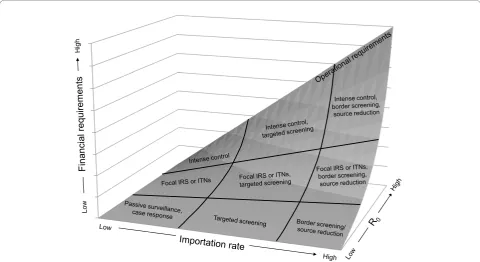
In general, a higher transmission potential will require higher coverage levels to interrupt transmission and control outbreaks, while a greater importation rate will set expectations about the frequency of outbreaks and resources required to prevent reemergence. For exam-ple, if transmission potential is very low, a modest level of control measures and modest costs may be sufficient to halt endemic transmission regardless of the importa-tion rate; such situaimporta-tions resemble Europe and other places where the GMEP was successful. If importation and transmission potential are each very large, however, the technical requirements for achieving elimination may be prohibitively high, given the operational con-straints and the financial requirements (Figure 2). Although WHO guidelines emphasize the importance of these factors [18,27], specific instruction on how they should be quantified has never been given. Accordingly, the following specific metrics to quantify each of these key factors are proposed below.
Transmission potential metrics
[image:4.595.57.538.417.679.2]Maximum, or “intrinsic”, transmission potential is ide-ally measured at the pre-control level, and it is repre-sented by the epidemiological parameter R0, the basic reproductive number [28-30]. R0 describes the number
of human malaria cases that would arise from a single malaria case if all control measures were removed and if malaria immunity had completely waned. It therefore determines the rate of increase in the number of cases during a malaria epidemic over time, or alternatively, the proportional reductions in transmission required to eliminate malaria from its pre-control level [31,32]. R0 in any population is determined by a complex combina-tion of factors that describe how hospitable a particular region is for malaria, including the ecology and effi-ciency of mosquito vector species [33], and the socioe-conomic characteristics of its inhabitants [14,28,34]. R0 is also important for post-elimination planning since it describes the magnitude of potential resurgence if inter-ventions are scaled back.
Most populations are now under some form of malaria control. Under control, transmission potential is measured by the controlled reproductive number, called RC. This number describes the number of infections that each infected person will generate under a given level of control activities and given immunity [35], and is always smaller than the intrinsic potential. Transmis-sion potential can be rapidly reduced from its intrinsic baseline through vector control interventions and prompt and effective treatment [36-38]. If RC is less than one, then malaria will be eliminated on timelines that depend, to a large extent, on the value of RC [39]. Importantly, both R0 and RC can change over time. Changes in transmission potential are attributed to RC if they involve changes in insecticide-treated net (ITN) ownership or usage, indoor residual spraying (IRS) cov-erage, the potency of the insecticides, or the way people access health clinics. Changes in R0 occur if they would have happened regardless of interventions, such as transformations in climate, development, or land-use.
These metrics can be inferred from one of several field measures of the intensity of transmission [28,29], albeit with uncertainty, including the parasite rate (PR) [40], the entomological inoculation rates (EIR) [41,42], or direct measures of vectorial capacity [43,44]. Measuring vectorial capacity directly is challenging and difficult to implement at scale, so in most cases R0 and RC must be calculated from PR or EIR using mathematical models [28,29]. Mathematical transmission models incorporat-ing classical transmission parameters like the number of bites a human receives per day, the percent of bites that infect a mosquito, the duration of human infection, and the survival time of the mosquito can convert field-based measures of transmission into R0or RC[28].
A first step of conducting a technical feasibility assess-ment thus will involve collating available malaria surveys from both the past and present. This information allows calculation of these transmission metrics and provides valuable insight into how transmission has changed over
time and what can realistically be expected in the future. Historical PR or EIR surveys conducted before control measures were implemented can be used to estimate R0, unless the epidemiology has changed due to other fac-tors. Many surveys appropriate for R0 calculation were conducted during GMEP, since a general epidemiologi-cal survey was considered to be the first step of an elim-ination programme [25]. Contemporary parasitological or entomological surveys at current levels of control measures can also be used to calculate RC [35], and by estimating the effect of existing intervention effective coverage levels, it is then possible to back-estimate R0. The presence of vector control measures will result in lowered vectorial capacity [43], with the magnitude of their influence dependent upon the effective coverage of interventions and the vector species present [45]. Some vectors feed or rest outdoors, so they are more difficult to control with existing vector interventions. Databases describing the local distribution of vector populations therefore will inform all aspects of planning [35].
Importation metrics
As long as current transmission potential (i.e., RC) is above zero, the importation of malaria parasites by infected individuals or mosquitoes will result in some local transmission; imported malaria and RC thus jointly influence the difficulty of reaching a defined end goal. An infection can be imported into a given region in one of four ways: 1) human residents acquire malaria while travelling outside the region, then return; 2) infected humans immigrate into the region (and, like residents, are thus likely to remain in the region throughout their infectious period); 3) infected humans travel through the region (and are thus likely to spend a shorter period of time in the region while infectious); or 4) infected mos-quitoes migrate into the region. All these pathways lead to risk of locally-acquired infections, and so the impor-tation rate should be summarized in terms of the num-ber of infections that originated somewhere else, represented here asδ. Malaria importation rates are ide-ally expressed at an annual rate of incoming infections per 1,000 population. In many countries contemplating elimination (especially those sharing land-borders with highly endemic regions), as well as those who have eliminated, δis likely to be quite high [46], and it will lead to low levels of malaria transmission unless RC = 0 [47]. As with transmission potential, the importation rate can change seasonally because of migration and transmission patterns in neighboring regions and annually because of instability or changes in tourism or immigration patterns.
estimate δfor the islands of Zanzibar [19]. One method involves collecting data on the entry routes through which humans (or mosquitoes) travel into the region of interest and the number that travel through those routes, including roads, bus routes, and airplane traffic. New data sources, such as mobile phone usage data - a proxy measure for population movement - appear pro-mising for the future, especially in areas where coverage and ownership are high [48]. Other methods or data are then required to estimate the fraction of those indivi-duals infected with parasites and their contribution to onwards transmission. The risk of a resident from the region bringing home an infection from a visited ende-mic area, for example, can be calculated based upon the force of infection in the visited region (which can be identified from existing transmission maps [49]) as well as the time spent there. Imported malaria plays an increasingly important role in transmission as endemi-city declines, so in low endemic areas, the travel his-tories of malaria cases can help to estimate δas well as RC[47]. Robust approaches to estimatingδwill continue to be improved by opportunities offered by combining geographical information systems, spatial statistics [49], and the increasing ability to quantify and evaluate the epidemiological impact of human transport systems [46,50,51].
Interpretation
Measures of the transmission potential and the importa-tion rate provide the raw data for evaluating whether elimination should be deemed technically feasible or not. During the GMEP, such determination came in the form of observations regarding the success of pilot pro-jects [25]. Over time, these observational approaches may again prove useful as experience in relevant settings dictates what values of R0 or importation are too high to permit successful elimination. Limited experience with elimination in most of the world, meanwhile, suggests that the historical precedent approach is inappropriate. Instead the technical feasibility of interrupting transmis-sion and preventing reemergence may be simulated with mathematical models. These models require clearly defined endpoints to interpret the outcomes and to set thresholds for“failure” when running simulations. It has been argued that“zero local transmission” might not be the most appropriate operational definition for elimina-tion and that different endpoints will need to be defined [47].
Is it technically possible to achieve elimination?
Endemic malaria transmission will eventually cease as long as RC is reduced to <1 throughout the region, although for elimination within a reasonable timeframe, it will be necessary to reduce it to below 0.5 [39]; pro-jected timelines to elimination depend on population size and many other factors, but simulations suggest
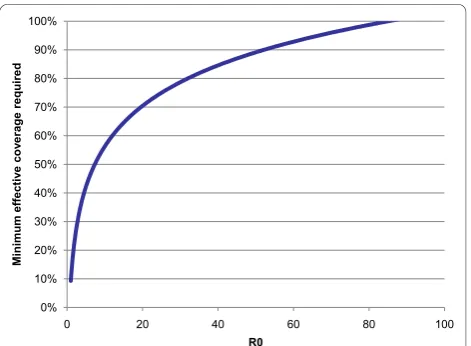
that elimination would take approximately 12.6 years in a population of a million if RC were 0.5 compared to 25.2 years if it were 0.75 [39]. The higher the intrinsic transmission potential, the greater the reduction in transmission required to depress it to these levels. This can be done by increasing coverage intensity and/or usage of existing interventions, or by deploying addi-tional interventions. At sufficiently high potential, even total coverage with all currently available interventions may fail to achieve elimination; in other words, elimina-tion is technically infeasible at those levels. Figure 3 depicts how the fraction of the population that must be completely protected by ITNs for elimination increases with R0, according to one recently published mathemati-cal model [35] (other models may produce different but analogous curves).
The effective coverage levels depicted in Figure 3 may correspond to any intervention that results in the pro-tection of individuals from infection, such as ITNs, IRS, or (when it is available) a vaccine. Future research will be necessary to differentiate the effects of different inter-ventions or combinations thereof. Although the effects of control measures that act on different components of the transmission pathway, such as larval control, ITNs, or anti-malarial drugs, are known to combine their effect multiplicatively [52], it is less clear how the effect of different interventions acting on the same compo-nent, like ITNs and IRS, varies; additional questions sur-round how that effect changes when they are used in combination. Recent research indicates that there may be an additional protective effect when combining IRS with ITNs [53], but more investigation is needed.
[image:6.595.305.541.509.682.2]Projected timelines to elimination must come with a set of caveats as existing data may provide only limited
information about whether RC is sufficiently low throughout the region of interest; for example, local foci in which RC remains very high are likely to occur and to require particular attention [21]. Notably, actual time-lines for elimination will depend on the ability to deal with these foci; an initial assessment of timelines can be modified as it becomes possible to stratify risk at higher spatial resolution. In these foci, it will be necessary to intensify control measures, while maintaining minimum effective coverage levels elsewhere to keep RC < 1. This important threshold determines if malaria transmission is decreasing or increasing within the region, and thus provides vital information on the minimal required cap-abilities of the elimination programme that will set the standards for assessing operational and financial feasibility.
Is it technically possible to remain malaria-free?
Assuming it is determined to be technically feasible to eliminate malaria, the next question is whether it is technically possible to prevent its reemergence. Clearly, it is theoretically possible to remain malaria-free by sim-ply maintaining the same high effective coverage levels that achieved elimination, but it is highly unlikely that this would be cost-effective compared with the lower effective coverage levels and comparable benefits of achieving controlled low-endemic malaria (CLM). Instead, an optimum package of interventions required to maintain elimination should be identified and evalu-ated, taking into account the rate at which infections are imported,δ, and the probability of each imported infec-tion leading to onwards transmission, RC. A simple con-sideration of the probability of a given level of local transmission occurring givenδand RCis possible using branching processes [47], and maximum values for the two parameters can be calculated that yield what is deemed to be an acceptable risk of a given level of transmission (e.g., a goal of maintaining <1% risk of 5 or more cases occurring in a given year).
Although branching processes describe the strength of post-elimination control measures required to keep malaria occurrence at acceptable levels, such simple models yield little precise information with which to assess operational and financial feasibility. A more robust and flexible assessment involves simulation models of outbreak and control to evaluate specific protocols and the potential of preventing reemergence given the joint risk of importation and transmission. It is thus recommended that simulation models be used to make predictions about the risk of malaria reemer-gence following elimination given specified levels of importation and transmission potential. Simulation will allow for the testing of different control strategies or scenarios in a population into which malaria is spora-dically imported by varying the levels of several
important drivers in different combinations and exam-ining their impact.
Post-elimination planning should consider at least three specific scenarios: first, control measures like ITNs or IRS are permanently maintained so as to ensure low levels of RC and thus defend against importation; sec-ond, surveillance and outbreak control capacity are strengthened while scaling back vector control to achieve cost-savings [6]; and third, depending on the geographical context, border screening or reduction of importation at its source is implemented to decrease the demands on other systems. For outbreak control, an important quantity is the fraction of all infections recog-nized by passive case detection and promptly treated with effective medication required to maintain elimina-tion. It is also important to develop and simulate proto-cols about active or reactive case detection to estimate the number of teams that screen around high-risk areas or observed infections required to ensure sufficiently low risk of resurgence. These analyses will yield quanti-tative measures of how elimination may be maintained with different combinations of active and passive case detection and transmission- and importation-lowering activities. Over time, it is expected that these methods will be refined and increasingly linked to the operational and financial feasibility components, allowing direct esti-mation of the minimal and most cost-effective combina-tion of intervencombina-tions that can prevent reemergence.
Operational feasibility
Operational feasibility has been defined as“an estimate of the applicability, in time and space, of technical methods under existing geographical, social, and cli-matic conditions,” and “a government’s potential to develop the organizational structure required to carry
out a national anti-malaria programme” [54]. It
achieving and sustaining elimination can be achieved in a particular context. Secondly, potential barriers that must be overcome to enable scale-up to required levels need to be discussed. Lastly, an operational feasibility assessment should discuss qualitative issues related to ensuring a sufficiently supportive operational environ-ment [18].
Is it operationally possible for elimination to be achieved?
The technical feasibility assessment defines the mini-mum fraction of the population that must be effectively protected from infection to achieve a value of RC that leads to elimination. To assess the operational feasibility of achieving these effective coverage levels, both the characteristics of the transmission-reducing tools used and the capacity of the malaria programme and the health system must be considered. These factors do not need to be perfect, but they should meet minimum requirements to provide the area under consideration and its malaria programme with the opportunity to meet required technical thresholds.
First, a realistic measure must be made of the effective coverage that can be achieved within the population of interest. Surveys of 13 sub-Saharan African countries in 2008 found median household ownership of ITNs of 56%, with a wide range of 8%-82% [1]. Achieving high levels of effective coverage by an intervention like ITNs is made more challenging in very rural regions with poor transportation infrastructure. Net coverage is high-est where nets can be distributed for free through mass campaigns [55], so a programme’s ability to mount such campaigns may be an important determinant of realistic effective coverage rates. An individual is effectively pro-tected if there is no chance that transmission will occur. The effectiveness of an ITN, for example, will depend upon how often individuals actually sleep under the nets, whether the nets develop holes, and if the insecti-cide remains effective (over time, the protective effect may decrease as the result of weakened insecticide effec-tiveness and/or resistance even if overall coverage levels remain unchanged). While achieving high population coverage might be relatively easy to achieve, ensuring high usage levels has, according to data from the WHO Malaria World Report, been more challenging [1]. The fraction of the population covered by interventions is multiplied by the probability of the intervention being effective to yield the effective coverage of that interven-tion. Taking these factors and the degree of success of previous distribution campaigns into account, a realistic maximum effective coverage by each intervention should be estimated.
The fraction of the population actually protected by control measures is the relevant measure that should be compared directly with the required effective coverage levels described by the technical assessment to
determine the operationally feasibility of those levels. In places where vectors are unaffected by ITNs, other stra-tegies must be considered. Given a maximum current household ownership of ITNs of 82% in sub-Saharan African countries where data is available, and assuming that an ITN is used and maintained appropriately in 80% of cases, effective coverage is at most 66% in these countries. True effective coverage may be significantly lower, since household ownership reflects only that at least one net is owned and does not mean that all indi-viduals in that household own nets. In certain areas or difficult to reach populations with low usage levels it will, therefore, be operationally challenging to achieve the effective coverage levels estimated to achieve elimi-nation. In addition, a recent top-up campaign in Bots-wana demonstrated that even with strong IEC/BCC, additional gains, both in terms of coverage and usage, after the initial successful scale-up are comparatively much harder to achieve (A Tatarsky, personal commu-nication). Sufficiently high effective coverage levels by nets alone can thus be operationally infeasible. However, sufficient effective coverage levels may still be achievable with combinations of measures, like IRS with ITNs.
Is it operationally possible to prevent reemergence following elimination?
The technical feasibility assessment produces a set of scenarios under which elimination may be sustained over time. Such scenarios can vary key drivers including maintenance of vector control measures, levels of sur-veillance, and importation-reducing activities. The operational assessment must determine which, if any, of these scenarios is achievable, taking into account the operational capacity of the malaria programme and the health system in general. The operational assessment should differentiate scenarios that are operationally chal-lenging and politically unattractive from those deemed completely infeasible.
A post-elimination scenario involving maintenance of net coverage in perpetuity may prove to be a technically viable solution to avoiding resurgence, but an operational assessment would need to weigh the benefits -obviating the need for any importation-reducing activities or, potentially, greatly strengthened surveillance -against the operational challenges: a need for continual distribution campaigns, fatigue on the part of politicians and the populace once malaria is no longer an observa-ble public health proobserva-blem, the probability of eventual resistance to insecticides, and the lack of a perception that the country is malaria-free due to the continued use of protective measures.
compensate. A perfect surveillance system that promptly detects and eliminates all new infections would in the-ory suffice to avoid resurgence regardless of the prevail-ing transmission potential. However, case detection methods have inherent limitations in detecting infec-tions, especially asymptomatic infections [56].
The proportion of infections passively detected depends mainly on health seeking behavior, testing rates at the visited facility, and the sensitivity of the test used [57]. Each of these factors thus must be assessed in turn. Population-based surveys of treatment seeking behaviors should be used to evaluate whether geographi-cal, financial or social barriers to diagnosis and treat-ment exist that would limit the capacity of the health system to pick up and eliminate new infections before they can cause onward transmission, thereby creating foci of infection where elimination will either never be achieved or easily reemerge. For a disease that will be extremely rare, it will be essential to keep the popula-tion informed on the importance of prompt health-seek-ing behaviour for all fevers and, where necessary, the continuous use for preventive measures. In addition the community can actively participate in surveillance activ-ities for elimination [58-61] and the operational feasibil-ity will, therefore, be influenced by the level of involvement by the local population and the IEC/BCC activities required to keep them informed and moti-vated. Minimum levels of human resources, training, and supply management will be required to ensure suffi-cient testing rates. While it is unlikely that elimination can be achieved nor maintained in settings where the health system is totally failing, health systems do not need to be perfect to reach effective levels of case detec-tion and treatment.
It may be operationally difficult to influence some of these factors, especially in settings with a weak overall health system. In addition, the technical assessment may reveal that even very high levels of passive case detec-tion (PCD) might not be sufficient to maintain elimina-tion in places where potential transmission or importation of infections is high. In these cases, achiev-ing required case detection levels will likely necessitate complementing PCD with some form of active case detection. Depending on the context, reactive screening around an index case, screening of high risk groups, or border screening might be most appropriate [57], but determining the feasibility of these strategies requires evaluating the availability of intensive human resources and other implementation challenges, including the need for robust reporting systems.
If achieving the necessary levels of surveillance is deemed operationally infeasible, it may be possible to offset these requirements by reducing the importation rate. Again, the operational feasibility of such an
approach will vary by context; border screening, for example, will be a viable option for island settings where entry points are few and often controlled but operationally infeasible in countries with long porous borders. Cross-border initiatives may prove a more effective means of reducing importation at its source for such countries [23].
Regardless of the scenario, it is essential to verify the strength and operational capacity of the malaria pro-gramme. For most programmes this will require a deep human resource pool and the ability to shift competen-cies towards a stronger emphasis on surveillance and epidemiology skills. An empowered programme with flexible resources that can mount a swift response when cases are reported will be a key factor of any elimination attempt’s operational feasibility. Some of the activities necessary to reduce transmission and avoid resurgence will also benefit from an enabling legal environment. Legislation can be used to impose compliance with cer-tain essential activities on both individuals and busi-nesses, though enforcement should be a last resort. Any elimination effort will benefit from a clear legal frame-work especially for activities such as blood screening or the compulsory spraying of private dwellings that could potentially be an infringement on individual privacy or a population’s human rights [19].
Financial feasibility
If sustained resources were limitless, elimination would be a universal goal. However, most malaria endemic regions face funding constraints, donor instability, insuf-ficient human resources, and competing pressing health priorities. The economic value of malaria elimination relative to other strategies thus becomes open to discus-sion. Determining the feasibility and desirability of an elimination programme requires a thorough understand-ing of how much elimination will cost relative to alter-native options, such as attempting to maintain CLM [47]. The financial component of the feasibility assess-ment examines these questions through analysis of the estimated costs of an elimination programme under a variety of scenarios and exploration of the challenges and potential solutions involved in sustainably securing the required finances.
CLM [47]. However, the challenges of such an exercise are “fraught with difficulties” [17]. The benefits of malaria elimination beyond its direct effect on morbidity and mortality are broad-reaching and difficult to enu-merate or quantify; eliminating malaria may have
posi-tive effects on tourism, education, workforce
productivity, health system reach, and performance and foreign investment, but a reliable estimation of these myriad effects and comparison with their values under the alternative of a continued control programme is a major challenge. In the likely event that it is not possible to conduct such a comprehensive analysis, it should focus on a robust financial comparison of elimination and CLM accompanied by qualitative judgments of the potential non-health benefits generated by elimination.
To do so, it is necessary to compare the potential cost of the programme if the goal is control with the alterna-tive expenditure required to achieve and sustain elimi-nation. Because elimination will be more expensive in the short-term, this comparison should take a medium-to long-term view medium-to present an accurate picture of cumulative and annual costs over time, as determined to be policy-relevant by local decision-makers. Most cur-rent planning occurs on five-year budgeting cycles [40], so an appropriate long-term cost estimate for a control programme will need to be devised. Ideally, this estimate should represent an optimized control package of inter-ventions rather than one that simply seeks to achieve universal access with all available tools, since the relative attractiveness of elimination will differ depending upon the cost of its alternative. In the absence of such an optimized cost estimate, it may be assumed less robustly that the currently budgeted costs of maintaining CLM (for example, from recent Global Fund proposals) will remain relatively stable over time and, assuming that drugs and insecticides remain effective, are mainly influ-enced by population growth. Analyses of recent or con-temporary elimination programs have found that the average annual cost of achieving elimination is substan-tially greater than that of CLM and that elimination programs are unlikely to generate cumulative financial savings [23,24]. However, these analyses also found con-siderable variation in costs between country contexts, emphasizing the importance of conducting a robust financial analysis to assess elimination feasibility.
The costs of achieving the required intervention effec-tive coverage levels to reach elimination and the neces-sary package of interventions for the scenarios that describe sustaining it thereafter should be determined according to the associated operational requirements. As with the budget for CLM, it is important to ensure a comprehensive set of costs covering such categories as personnel, consumables, equipment, travel, and training. Both budgets must be consistent in how they
incorporate costs that may be shared by the general public health system; for example, ensuring access to health facilities may be required, but such an activity is not malaria-specific and thus may be excluded from or only partially accounted in the programme budgets.
Approximating costs for scaling up activities to required levels may prove challenging, especially since little empirical evidence may be available to understand how marginal costs may increase with coverage (increas-ing coverage of an intervention will likely require a greater outlay of resources to move from 90% to 95% than from 20% to 25%) and how the costs of different interventions interact with one another (i.e., if there are synergies that generate cost efficiencies). Additionally, considerable uncertainty is likely to exist around costs required post-elimination. Predicting how factors like importation or intrinsic transmission potential may change over the next several decades is not possible with any degree of certainty, meaning that the level and combination of interventions required to sustain elimi-nation may be very uncertain. It is important to capture as much of this uncertainty as possible through scenario analyses, with corresponding examination of whether qualitatively different conclusions are reached about the relative annual and cumulative costs of elimination and control. If elimination is not cumulatively cost-saving over the time horizon of interest in all possible scenar-ios, it will be important for decision-makers to judge whether the cost increase is outweighed by other expected benefits.
successful applications for large-scale programs [62]. There are more cases of domestic governments taking steps to ensure sustained funding for certain health issues. The US government, for example, has employed targeted taxes to ensure sufficient ongoing resources to support those affected by immunization adverse events and “black lung” disease [63,64]. Financing solutions, however, are heavily dependent on the political and eco-nomic context and the health issue and so will need to be analyzed and developed distinctly in each region.
Conclusion
The framework presented here represents a flexible, evi-dence-driven process for assessing strategic options and allocating limited resources efficiently once scale-up of malaria control has been achieved. It has been applied to help inform the decision-making process in Zanzibar [19], and future adaptation will continue to refine and improve these methodologies as they are applied in other regions. Because discussions of elimination today involve a concept very different from the 3-5 year time-limited campaign of GMEP, strategies must be planned as long-term, sustainable endeavors rather than quick outlays of resources. A nuanced approach to technical, operational, and financial feasibility is needed to account for the complexity of the system under consideration; an assessment that states elimination is impossible due to weakness in a single component - for example, a weak health system, a historically high level of endemi-city, or a lack of precedent in similar regions - may miss offsetting strengths or advantages. In turn, a finding that elimination could be theoretically achieved in an area with current tools may fail to account for insurmounta-ble operational obstacles or unrealistically high costs. A careful planning process that has considered not only whether elimination can technically be accomplished and sustained, but also whether it is operationally plau-sible and financially supportable over many years is thus of the utmost importance.
While existing guidance for assessing the overall feasi-bility of elimination is qualitative in nature [18], this fra-mework provides a quantitative approach that forms the basis of the technical assessment and at the same time complements and informs the more qualitative compo-nents of the operational assessment. Specific, quantifi-able metrics like the rate at which infections are imported into the region, the probability of each imported infection leading to onwards transmission, and the additional monetary costs of elimination over con-trol are essential to allow rigorous assessment of the fea-sibility of these endeavours. Although exact feafea-sibility thresholds for each of these metrics will need updating as this framework is refined, they permit a evidence-based means of evaluating the amount of effort required
to achieve and maintain elimination. They also provide a quantitative basis for elimination scenario planning that can be used to determine the ideal mix of activities required to achieve and maintain elimination.
Following the admission that GMEP was unlikely to succeed in countries with weak public health infrastruc-tures and highly endemic malaria in the early 1970s, support for the campaign quickly unraveled. Countries today may be tempted to declare the laudable goal of eliminating malaria from their borders, but they must bear in mind the perils of failing to achieve such pro-mises. Rather than encouraging politically expedient, short-term elimination attempts, the global malaria community must foster an approach in which all coun-tries recognize the importance of deliberate, careful eva-luation and planning. Malaria elimination is a long-term enterprise, and robust strategic planning will be vital to permit it to succeed.
Appendix 1. Definitions of key terms
Eradication refers to the permanent reduction to zero of the worldwide incidence of infection [18].
Eliminationrefers to a state where interventions have interrupted endemic transmission and limited onward transmission from imported infections below a threshold at which risk of reestablishment is minimized [47].
Controlled low-endemic malaria refers to a state
where interventions have reduced endemic malaria transmission to such low levels that it does not consti-tute a major public health burden, but at which trans-mission would continue to occur even in the absence of importation [47].
Parasite Rate (PR) refers to the proportion of the
population found to carry asexual blood-stage parasites [65].
Entomological Inoculate Rate (EIR)refers to the rate at which people are bitten by infectious mosquitoes [66]. Transmission potential refers to the propensity for malaria parasites to spread through the population; or in quantitative terms, the number of incident malaria cases that would arise from each malaria case within a defined area or focus [26].
Intrinsic transmission potential refers to the maxi-mum number of incident malaria cases per case that would occur in the absence of all control measures and immunity [47].
Effective coveragerefers to the fraction of the popu-lation that is fully protected by a malaria intervention; it is thus distinct from “coverage” in the general sense, which refers only to the distribution of control measures but not necessarily whether they will successfully pre-vent malaria transmission in every case. For example, 100% net coverage will correspond to a lower effective coverage assuming some fraction of nets are improperly treated, contain holes, or are not slept under every night [35].
Acknowledgements
DLS, AJT, JC, OS, BM and JMC acknowledge support from the Bill & Melinda Gates Foundation. DLS acknowledges funding from the RAPIDD program of the Science & Technology Directorate, Department of Homeland Security, and the Fogarty International Center, National Institutes of Health. BM is part of the Global Health Group (GHG) of the University of California, San Francisco and acknowledges funding from ExxonMobil. SIH is funded by a Senior Research Fellowship from the Wellcome Trust (#079091). The authors gratefully acknowledge the Zanzibar Malaria Control Program for supporting the Malaria Elimination Feasibility Assessment of 2009, for which many of the concepts in this framework were developed.
Author details
1Clinton Health Access Initiative, Boston, USA.2Global Health Group, University of California, San Francisco, California, USA.3Emerging Pathogens Institute, University of Florida, Gainesville, USA.4Department of Geography, University of Florida, Gainesville, USA.5Harvard School of Public Health, Harvard University, Boston, MA, USA.6Spatial Ecology and Epidemiology Group, Tinbergen Building, Department of Zoology, University of Oxford, South Parks Road, Oxford, UK.7Department of Biology, University of Florida, Gainesville, USA.
Authors’contributions
BM and SIH conceived of this framework. DLS, JMC, AJT, JC, OS and BM developed the methodology. BM, JMC and DLS drafted the manuscript. All authors read and approved the final manuscript.
Competing interests
BM, JMC, JC, and OS work within or assist the malaria control programme at the Clinton Health Access Initiative, which is supporting malaria elimination in southern Africa. BM, OS, SIH, and DLS serve as members of the Malaria Elimination Group. AJT declares that he has no competing interests.
Received: 24 August 2010 Accepted: 11 November 2010 Published: 11 November 2010
References
1. WHO:World Malaria Report2009 [http://www.who.int/malaria/ world_malaria_report_2009], Accessed 27 April 2010. 2. Mendis K, Rietveld A, Warsame M, Bosman A, Greenwood B,
Wernsdorfer WH:From malaria control to eradication: The WHO perspective.Trop Med Int Health2009,14:802-809.
3. Roberts L, Enserink M:Malaria: did they really say ... eradication?Science 2007,318:1544-1545.
4. Gates M:Malaria Forum Keynote Address.[http://www.gatesfoundation. org/speeches-commentary/Pages/melinda-french-gates-2007-malaria-forum. aspx].
5. Gramiccia C, Beales P:The recent history of malaria control and eradication.Malaria: Principles and Practice of MalariologyEdinburgh, London, Melbourne, New York: Churchill Livingstone; 1998, 1335-1378. 6. World Health Organization:WHO Expert Committee on Malaria: sixth report
Geneva: World Health Organization; 1957.
7. Nájera JA:Malaria control: achievements, problems and strategies. Parassitologia2001,43:1-89.
8. Kaiser Global Health Reporting:“Nigerian Government Committed To Eradicating Malaria”President Yar’Adua says.Daily Reports2008 [http:// www.kaisernetwork.org/daily_reports/rep_index.cfm?DR_ID = 55940]. 9. Ghana seeks to eliminate malaria. The Medical News2009 [http://www.
news-medical.net/news/20090805/Ghana-seeks-to-eliminate-malaria.aspx]. 10. Tanzania hopes to eradicate Malaria by 2015, health official says
following release of global malaria map. The Medical News2009 [http:// www.news-medical.net/news/2009/03/30/47566.aspx].
11. Njagi D:Kenya hopeful it can eliminate malaria.Science and Development Network: Health Malaria2009 [http://www.scidev.net/en/health/malaria/ news/kenya-hopeful-it-can-eliminate-malaria.html].
12. Lines J, Schapira A, Smith T:Tackling malaria today.BMJ2008, 337:869-869.
13. Snow RW, Marsh K:Malaria in Africa: progress and prospects in the decade since the Abuja Declaration.The Lancet2010,376:137-139. 14. World Health Organization:WHO Expert Committee on Malaria: fourteenth
reportGeneva: World Health Organization; 1968.
15. World Health Organization:The World Health Organization and malaria eradicationGeneva: World Health Organization; 1956.
16. World Health Organization:Malaria control in countries where time-limited eradication is impracticable at present: report of a WHO interregional conferenceGeneva: World Health Organization; 1974.
17. World Health Organization:WHO Expert Committee on Malaria: sixteenth reportGeneva: World Health Organization; 1974.
18. World Health Organization:Malaria elimination: a field manual for low and moderate endemic countriesGeneva: World Health Organization; 2007. 19. Zanzibar Malaria Control Programme:Malaria elimination on Zanzibar: A
feasibility assessmentZanzibar Malaria Control Programme, Ministry of Health and Social Welfare; 2009.
20. Cohen JM, Smith DL, Vallely A, Taleo G, Sabot O:Holding the Line. Shrinking the Malaria Map: A Prospectus on Malaria EliminationGlobal Health Group, Global Health Sciences, University of California, San Francisco; 2009.
21. World Health Organization Regional Office for the Eastern Mediterranean: Guidelines on the elimination of residual foci of malaria transmissionGeneva: World Health Organization; 2007.
22. Mills A, Lubell Y, Hanson K:Malaria eradication: the economic, financial and institutional challenge.Malar J2008,7(Suppl 1):S11.
23. Feachem R, Phillips A, Targett G:Shrinking the Malaria Map.A Prospectus on Malaria EliminationGlobal Health Group, Global Health Sciences, University of California San Francisco; 2009.
24. Sabot O, Cohen JM, Hsiang M, Kahn J, Basu S, Tang L, Zheng B, Gao Q, Zou L, Tatarsky A, Aboobakar S, Usas J, Barrett S, Cohen JL, Jamison DT, Feachem RGA:Costs and financial feasibility of malaria elimination. Lancet2010,376:1604-1615.
25. Pampana E:Textbook of Malaria Eradication.Oxford University Press, London;, 2 1969.
26. Moonen B, Barrett S, Tulloch J, Jamison DT:Making the Decision.Shrinking the Malaria Map: A Prospectus on Malaria EliminationGlobal Health Group, Global Health Sciences, University of California, San Francisco; 2009. 27. World Health Organization Regional Office for the Eastern Mediterranean:
Guidelines on prevention of the reintroduction of malariaGeneva: World Health Organization; 2007.
28. Smith DL, McKenzie FE, Snow RW, Hay SI:Revisiting the basic
reproductive number for malaria and its implications for malaria control. PLoS Biol2007,5:e42.
29. Dietz K:The estimation of the basic reproduction number for infectious diseases.Statistical Methods in Medical Research1993,2:23-41.
30. Macdonald G:The epidemiology and control of malaria.Oxford University Press, Oxford; 1957.
31. Macdonald G:The analysis of malaria epidemics.Trop Dis Bull1953, 50:871-889.
32. MacDonald G:Epidemiological Basis Of Malaria Control.Bull World Health Organ1956,15:613-626.
34. Nájera JA:Prevention and control of malaria epidemics.Parassitologia 1999,41:339-347.
35. Smith DL, Hay SI, Noor AM, Snow RW:Predicting changing malaria risk after expanded insecticide-treated net coverage in Africa.Trends Parasitol 2009,25:511-6.
36. Killeen G, McKenzie F, Foy B, Schieffelin C, Billingsley P, Beier JC:The potential impact of integrated malaria transmission control on entomologic inoculation rate in highly endemic areas.Am J Trop Med Hyg2000,62:545-551.
37. Mendez F, Munoz A, Plowe CV:Use of the area under the curve to characterize transmission potential after antimalarial treatment.Am J Trop Med Hyg2006,75:640-644.
38. Smith D, Ellis McKenzie F:Statics and dynamics of malaria infection in Anopheles mosquitoes.Malar J2004,3:13.
39. Smith DL, Hay SI:Endemicity response timelines for Plasmodium falciparum elimination.Malar J2009,8:87.
40. Hay SI, Smith DL, Snow RW:Measuring malaria endemicity from intense to interrupted transmission.Lancet Infect Dis2008,8:369-378.
41. Drakeley C, Schellenberg D, Kihonda J, Sousa CA, Arez AP, Lopes D, Lines J, Mshinda H, Lengeler C, Armstrong Schellenberg J, Tanner M, Alonso P:An estimation of the entomological inoculation rate for Ifakara: a semi-urban area in a region of intense malaria transmission in Tanzania.Trop Med Int Health2003,8:767-774.
42. Nájera JA:A critical review of the field application of a mathematical model of malaria eradication.Bull World Health Organ1974,50:449-457. 43. Garrett-Jones C:Prognosis for interruption of malaria transmission
through assessment of the mosquito’s vectorial capacity.Nature1964, 204:1173-1175.
44. Garrett-Jones C:The human blood index of malaria vectors in relation to epidemiological assessment.Bull World Health Organ1964,30:241-261. 45. Le Menach A, Takala S, McKenzie FE, Perisse A, Harris A, Flahaut A,
Smith DL:An elaborated feeding cycle model for reductions in vectorial capacity of night-biting mosquitoes by insecticide-treated nets.Malar J 2007,6:10.
46. Tatem AJ, Smith DL:International population movements and regional Plasmodium falciparummalaria elimination strategies.Proc Natl Acad Sci USA2010,107:12222-12227.
47. Cohen JM, Moonen B, Snow RW, Smith DL:How absolute is zero? An evaluation of historical and current definitions of malaria elimination. Malar J2010,9:213.
48. Tatem AJ, Qiu Y, Smith DL, Sabot O, Ali AS, Moonen B:The use of mobile phone data for the estimation of the travel patterns and imported Plasmodium falciparumrates among Zanzibar residents.Malar J2009, 8:287.
49. Hay SI, Guerra CA, Gething PW, Patil AP, Tatem AJ, Noor AM, Kabaria CW, Manh BH, Elyazar IRF, Brooker S, Smith DL, Moyeed RA, Snow RW:A world malaria map:Plasmodium falciparumendemicity in 2007.PLoS Med2009, 6:e1000048.
50. Tatem A, Rogers D, Hay S:Estimating the malaria risk of African mosquito movement by air travel.Malar J2006,5:57.
51. Tatem AJ, Hay SI, Rogers DJ:Global traffic and disease vector dispersal. Proc Natl Acad Sci USA2006,103:6242-6247.
52. Koella JC:On the use of mathematical models of malaria transmission. Acta Trop1991,49:1-25.
53. Kleinschmidt I, Schwabe C, Shiva M, Segura JL, Sima V, Mabunda SJA, Coleman M:Combining indoor residual spraying and insecticide-treated net interventions.Am J Trop Med Hyg2009,81:519-524.
54. World Health Organization:WHO Expert Committee on Malaria: fifteenth reportGeneva: World Health Organization; 1971.
55. Noor AM, Kirui VC, Brooker SJ, Snow RW:The use of insecticide treated nets by age: implications for universal coverage in Africa.BMC Public Health2009,9:369.
56. Pull JH:Malaria surveillance methods, their uses and limitations.Am J Trop Med Hyg1972,21:651-657.
57. Moonen B, Cohen JM, Snow RW, Slutsker L, Drakeley C, Smith DL, Abeyasinghe RR, Rodriguez MH, Maharaj R, Tanner M, Targett G: Operational strategies to achieve and maintain malaria elimination. Lancet2010,376:1604-1615.
58. Ruebush TK, Zessig R, Klein RE, Godoy HA:Community participation in malaria surveillance and treatment ii. evaluation of the volunteer collaborator network of Guatemala.Am J Trop Med Hyg1992,46:261-271.
59. Deressa W, Olana D, Chibsa S:Community participation in malaria epidemic control in highland areas of southern Oromia, Ethiopia.Ethiop J Health Dev2005,19(1):3-10.
60. Betanzos-Reyes AF, Rodríguez MH, Duran-Arenas LG, Hernández-Avila JE, Méndez-Galván JF, Velázquez Monroy OJ, Coyner RT:Comparative analysis of two alternative models for epidemiological surveillance in the Mexican Malaria Control Program.Health Policy2007,80:465-482. 61. Oum S, Chandramohan D, Cairncross S:Community-based surveillance: a
pilot study from rural Cambodia.Trop Med Int Health2005,10:689-973. 62. Lane C, Glassman A:Smooth and predictable aid for health: a role for innovative financing?SSRN eLibrary2008 [http://papers.ssrn.com/sol3/ papers.cfm?abstract_id=1324975], (Accessed 21 October 2010).
63. Drake B, Tieman A:National Childhood Vaccine Injury Act of 1986: Using Tax Revenues to Assure Vaccine Availability.Public Budgeting and Finance 1994,14:54-64.
64. Lazzari S:The Black Lung Excise Tax on Coal.Congressional Research Service ReportWashington DC; 2004.
65. Smith DL, Guerra CA, Snow RW, Hay SI:Standardizing estimates of the Plasmodium falciparum parasite rate.Malar J2007,6:131.
66. Dietz K:Mathematical models for transmission and control of malaria. Principles and Practice of MarariologyEdinburgh, London, Melbourne, New York: Churchill Livingstone; 1988.
doi:10.1186/1475-2875-9-322
Cite this article as:Moonenet al.:A framework for assessing the feasibility of malaria elimination.Malaria Journal20109:322.
Submit your next manuscript to BioMed Central and take full advantage of:
• Convenient online submission
• Thorough peer review
• No space constraints or color figure charges
• Immediate publication on acceptance
• Inclusion in PubMed, CAS, Scopus and Google Scholar
• Research which is freely available for redistribution