R E S E A R C H
Open Access
A randomized, blinded, controlled USA
field study to assess the use of fluralaner
topical solution in controlling feline flea
infestations
Cheyney Meadows
*, Frank Guerino and Fangshi Sun
Abstract
Background:Fleas are a common ectoparasite of domestic cats and there is a need for novel treatments that
improve feline flea control.
Methods:This investigator-blinded, multi-center randomized, positive-controlled study evaluated the flea control in cats provided by a single owner-applied treatment with a fluralaner topical formulation compared with a positive control. Households with up to five healthy cats, all at least 12 weeks of age and weighing at least 1.2 kg (2.6 lb), were randomized in an approximate 3:1 ratio of fluralaner to positive control. All cats in households randomized to the positive control group were dispensed three treatments, at 4-week intervals, of a commercial formulation of fipronil/(S)-methoprene. All cats in households randomized to the fluralaner group were dispensed an initial treatment at enrollment and a second treatment at week 12 for an additional 3-week observation of treatment safety. One primary cat with at least five live fleas at enrollment was randomly selected within each household. Flea counts were performed on all primary cats at 4-week intervals through week 12. Efficacy measurement was based on reduction in flea counts from baseline. Treatment was considered effective at weeks 4, 8 and 12 if mean live flea count reductions were 90% or greater and statistically significantly different (P≤0.05) from counts at enrollment. Results:In 18 investigational veterinary clinics across 11 USA states, 116 households (224 cats) were randomized to receive topical fluralaner and 45 households (87 cats) were randomized to the fipronil-methoprene combination. Fluralaner was demonstrated to be effective at 4 weeks (99.1% flea count reduction), 8 weeks (99.5%), and 12 weeks (99.0%), and all reductions were significantly different from the enrollment count (allP< 0.0001). The fipronil-methoprene combination was < 90% effective at each post-treatment assessment, with peak efficacy of 75.4% at 12 weeks (allP< 0.0001). No treatment-related serious adverse events were reported in either group.
Conclusions:Owner-applied fluralaner topical treatment was safe in cats and was highly effective in killing fleas over the subsequent 12 weeks.
Keywords:Bravecto, Fluralaner, Fleas, Fipronil-methoprene, Cats
* Correspondence:[email protected] Merck Animal Health, Madison, NJ, USA
Background
Infestation of cats with the fleaCtenocephalides feliscan be a cause of irritation, leading to pruritus, erythema, excoriations arising from self-mutilation through scratching, and development of papules to produce the condition of feline miliary dermatitis [1]. The rapid ac-cumulation of large-scale flea challenge in any household can be attributed to several factors: the ability of an adult female flea to produce as many as 50 eggs per day; the potentially short flea life-cycle which can be com-pleted in as little as 12 to 14 days; and optimal condi-tions of humidity and temperature that favor a short flea prepatent period [2]. Thus, absence of adherence to an effective flea control program in cats can quickly lead to a household flea problem.
Fleas have been incriminated as the main vector of cat to human transmission of Bartonella species, including Bartonella felis, the causative agent of cat scratch disease [3]. Fleas have also been shown to be carriers of other potentially zoonotic organisms, including Rickettsia felis
and Rickettsia typhi, and the cestode Dipylidium
cani-num. This tapeworm requires rigorous flea treatment for control, rather than reliance solely on direct cestodicidal chemotherapy [3–5]. Effective flea control is therefore important to reduce the challenge this parasite presents to household pets and their human cohabitants.
The isoxazolines represent a novel family of antipara-sitics that provide safe and effective tick and flea protec-tion for dogs. Fluralaner (Bravecto®; Merck Animal Health) is the only isoxazoline that provides 12 weeks of immediate and persistent flea and tick efficacy for dogs [6–9]. Field studies in the USA, Europe and Australia demonstrated the safety and efficacy of orally adminis-tered fluralaner for reducing flea and tick infestations on dogs [10–12]. A recent study showed that under field conditions, a topical fluralaner formulation provides a level of flea control in dogs that aligns with that pro-vided by the oral product [13].
To date, no isoxazoline has been shown to be safe and effective for cats. Fluralaner topical solution has favor-able pharmacokinetics in cats and can provide an easily administered option for flea and tick control on cats [14]. A field study was therefore designed to assess the flea control efficacy of topical fluralaner dispensed to cat owners for at-home administration in the USA.
The primary objective of this positive-controlled, ran-domized, single-blinded study was to investigate the clin-ical safety and efficacy of topclin-ical fluralaner to treat and control natural flea infestations for at least 12 weeks (84 days). The results were compared to a group treated with a positive control at 4-week intervals and followed for 12 weeks (84 days) using a commercial formulation of fipronil/(S)-methoprene (Frontline® Plus for Cats; Merial). Following the 12 week efficacy evaluation, cats treated
with fipronil-methoprene combination were off the study; cats assigned to topical fluralaner were administered a sec-ond dose of fluralaner and followed for 3 more weeks (through Day 105, week 15) for safety observations.
Methods
The study protocol, finalized in early 2013, used then-current guidelines for evaluating flea and tick parasiti-cides [15]. It also complied with Good Clinical Practice (VICH GL9) and the International Guiding Principles for Biomedical Research Involving Animals. Written in-formed consent was obtained from each owner for all household cats prior to the commencement of any screening activities. Enrollment eligibility included households that had no more than five cats, all of which were at least 12 weeks of age, weighed at least 1.2 kg (2.6 lb), and were in generally good health as determined by a veterinary examination prior to enrollment; and at least one cat in the household had a minimum of five live fleas counted prior to enrollment. There were no breed or gender restrictions, but households with preg-nant or lactating cats were not eligible for enrollment. Households in which the cats had exposure to non-confined pets, other than cats, that could harbor fleas (e.g. dogs) were not eligible. There were also restrictions on the pre-enrollment/historical use of any approved (in the USA, as this was a USA study) flea control medica-tions or products, based on the approved label duration. Products labeled for 12-week use had a minimum 84-day washout, products labeled for monthly use had a minimum 30-day washout, products labeled for use every 2 weeks had a minimum 14-day washout, and products labeled for weekly use had a 7-day washout.
At each of the 18 participating investigational veterin-ary clinics, enrolled households were randomly assigned between two treatment groups in a 3:1 (fluralaner topi-cal:fipronil-methoprene combination) ratio. No single clinic was permitted to contribute more than 40% of the households that participated in the study in either treat-ment group. The treattreat-ment groups were:
1. Fluralaner topical solution for cats was dispensed for owner administration on Day 0. The efficacy assessment phase of the study lasted for 12 weeks. A second fluralaner topical solution dose was
2. Fipronil/(S)-methoprene spot-on solution (Frontline® Plus for Cats; Merial Limited, Duluth, GA), was dis-pensed for application once every 28 days for three doses. A minimum of 33 households were targeted for enrollment into this group. The fipronil-methoprene combination (containing 9.8% fipronil and 11.8% (S)-methoprene) remained in its commer-cial packaging containing a volume of 0.5 ml.
At each site, households were assigned to treatment according to a randomized complete block design, with order of entry into the study as the blocking factor and assignment of cats to treatment within blocks in a ratio of 3:1 of fluralaner-treated to fipronil-methoprene-treated. A primary cat from each household was ran-domly selected from cats with at least five live fleas. Sep-arate randomization tables were provided to each site for assignment of households to treatment group and se-lection of the primary cat. All cats within an enrolled household were assigned to the same treatment group.
Each clinic had at least one dispensing administrator who had access to randomization tables and was respon-sible for dispensing all treatments to owners. Adminis-trators did not participate in the collection or recording of flea count data or the assessment of flea allergy dermatitis (FAD). Study personnel who participated in the collection or recording of flea count data or the as-sessment of FAD through the final visit were blinded to treatment assignment.
All treatments were administered at home by cat owners, who were not blinded. For households random-ized to the fluralaner group, owners were provided in-structions on application, including parting the hair and placing the tip on the skin at the base of the skull and squeezing out the contents onto one or more spots in amounts that would limit risk of run-off from any one spot. After administration, the owner was instructed to observe the cat to determine if any of the solution ran or dripped off the animal during or immediately follow-ing treatment. Owners of cats randomized to the fipronil-methoprene group were instructed to dose ac-cording to label directions.
Enrollments were completed during the first clinic visit, during which treatments were dispensed and blood and urine samples collected for baseline clinical path-ology data. Owners were required to bring their cats into the clinic for recheck visits approximately 4, 8, and 12 weeks after enrollment (on Days 28 [± 2], 56 [± 3], and 84 [± 3]). Blood and urine samples were collected for clinical pathology data for all cats at week 12. House-holds assigned to fipronil-methoprene were off study after the week 12 visit. For households randomized to the fluralaner group, cats were also rechecked for assess-ments of safety (including a 3rd blood and urine sample
collection for clinical pathology) and signs of FAD on week 15 (Day 105 [± 3], 3 weeks after the second flurala-ner treatment).
From enrollment until week 12 (Day 84) of the study, owners were asked to avoid any premises treatments for environmental flea control, either in their house or on their property. No concomitant treatments for flea and/ or tick infestations were permitted, and the investigator or designee was asked to observe an adequate washout period (consistent with any USA-approved labeling) for any such treatments received prior to enrollment. Con-comitant treatments for disorders other than flea and tick infestations were permitted, if they were not ex-pected to interfere with assessments of flea and tick in-festations. For example, treatments for prevention and control of internal parasite infestations (including heart-worm and gastrointestinal parasites) were permitted, if any product used was not labeled for flea or tick control. Treatment that could affect assessment of signs of FAD (for example steroids, antihistamines, creams, ointments, baths, etc.) was permissible. However, data from any such treated cat were subsequently excluded from the analysis of FAD clinical signs. Grooming, bathing, swim-ming, and other water activities were permitted during the study, with some exceptions. To avoid any effect on recovery of fleas and ticks, grooming and bathing were disallowed within 72 h before any scheduled recheck visit through week 12 (Day 84). In addition, bathing, swimming, and other water activities were not allowed for 72 h after application of any study treatment.
Owners were instructed to observe their cats for any adverse events and to document such observations in a study-provided diary and to report them as soon as they occurred or at the next scheduled visit. Flea counting was conducted in clinics by blinded personnel, using a flea comb to perform a full-body flea count for at least 10 min; live fleas were counted, removed, and placed in a soap solution. After this 10 min period the flea counter was permitted to stop when they were confident that all fleas had been recovered.
Examinations at each visit included a veterinarian’s as-sessment of the presence of six signs of FAD (erythema, alopecia, papules, scales, crusts, and excoriations) and their severity (mild, moderate, severe). Pruritus observa-tions were recorded by owners and reported.
The primary efficacy endpoint was based on reduction in mean flea counts compared to baseline, with house-hold as the experimental unit, represented by one pri-mary cat.
Efficacy assessment
point was based on a comparison to baseline according to the formula:
Percent efficacy¼ 1−Dx D0
100
where D0= mean live flea count at baseline of primary
cats; and Dx= mean live flea count on Day x (x = 28
[4 weeks], 56 [8 weeks] or 84 [12 weeks]) of primary cats.
Both geometric means and arithmetic means were compared using the live flea counts and log-transformed live flea counts (log[live flea count + 1]) for each house-hold (represented by one primary cat). A mixed linear model with repeated measures was used for the analysis. The model included treatment, visit and treatment*visit as fixed effects, site as a random effect and household as the subject with repeated measures. A Kenward-Rogers adjustment was used to determine the denominator de-grees of freedom for hypothesis testing. Akaike’s Infor-mation Criterion (AIC) was used as the criterion to select the covariance structure for repeated measures. Least squares means were used for comparisons and for the log-transformed data, the least squares means were back transformed to obtain the estimates of geometric mean live flea counts. Within each treatment group, the live flea counts at each post-treatment visit (Day 28, 56 and 84) were compared with that at the baseline (Visit 1). At each visit, live flea counts were compared between the two treatment groups. Two-sided t-tests at a 5% level of significance were used for all pairwise compari-sons. SAS version 9.3 was the primary software used for analysis. Treatment was considered effective at a given time point if the mean (geometric or arithmetic) live flea count reduction was 90% or greater and significantly dif-ferent (P≤0.05) from baseline [15].
Numbers and percentages of primary cats that showed at least 90% reduction in flea burden, as well as the numbers and percentages of primary cats with zero fleas counted in each treatment group at each visit were cal-culated. A non-parametric asymptotic approach was used to test the differences of the percentages between treatment groups. The non-parametric analyses were performed using StatXact version 9. The study was only designed to perform statistical comparisons of the flea counts. Signs of FAD and AEs were only examined de-scriptively. Thus, no P-values were presented for these outcomes.
Results
Between May and December 2013, 311 cats from 161 households were enrolled at 18 sites across 11 states: Alabama (one site), Florida (two sites), Illinois (two sites), Maine (one site), Louisiana (two sites), Missouri
(one site), New Jersey (one site), Pennsylvania (three sites), Rhode Island (one site), Tennessee (one site), and Texas (three sites). There were 116 households (i.e. 116 primary cats) with a total of 224 cats randomized to the topical fluralaner group (43.1% were single-cat house-holds), and 45 households with a total of 87 cats ran-domized to the fipronil-methoprene combination group (40.0% single-cat households). Gender distribution, age ranges, and body weights were generally similar between the groups (Table 1). The youngest cats enrolled in the study were 12 weeks of age in the fluralaner group and 13 weeks of age in the fipronil-methoprene group; 10.7% of fluralaner cats and 11.5% of fipronil-methoprene cats were less than 26 weeks. Several breeds were enrolled, but the most common breeds were domestic shorthair cats (64.7% of fluralaner cats and 75.9% of fipronil-methoprene cats), domestic long hair cats (15.2 and 3.4%), domestic medium hair cats (6.7 and 2.3%), and Siamese pure and crossbreeds (2.7 and 9.2%). Other breeds observed in lower frequencies (less than 5% of ei-ther treatment group) included pure and crossbreeds Siamese, Ragdoll, Himalayan, Persian, Manx, Bengal, Maine Coon, and Turkish Angora.
In both treatment groups, primary cats occasionally missed visits during this field study, and therefore did not have flea count data generated. In the fluralaner group, there were there were eight primary cats that missed at 8 weeks and nine primary cats that missed at 12 weeks. In the fipronil-methoprene combination group, there were four primary cats that missed at 4 weeks, six primary cats that missed at 8 weeks, and nine primary cats that missed at 12 weeks. In addition, flea count data were collected, but excluded from flea ef-ficacy calculations in both groups for reasons including inaccurate dosing, bathing prior to flea count, insecti-cidal treatment of the household, and/or administration of other insecticides to the cat. In the fluralaner group, flea count data were excluded from two primary cats at 4 weeks, from two primary cats at 8 weeks, and from two primary cats at 12 weeks. In the fipronil-methoprene combination group, flea count data were ex-cluded from one primary cat at 4 weeks, from one pri-mary cat at 8 weeks, and from two pripri-mary cats at 12 weeks.
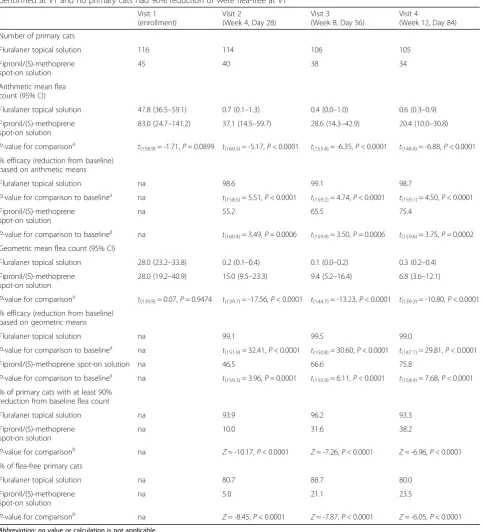
individual fluralaner-treated primary cats with 0 fleas de-tected (i.e. a 100% reduction) were 80.7% at 4 weeks, 88.7% at 8 weeks, and 80.0% at 12 weeks. The maximum 12-week flea count on a primary cat in the fluralaner group was 11 fleas. This was the only one of 105 fluralaner-treated primary cats with a 12-week burden of 10 or more fleas.
At each post-treatment assessment of the fipronil-methoprene combination group, geometric mean flea count reductions from baseline were significant (all
P≤0.0001), but at no point did they reach 90%
(46.5% at 4 weeks, 66.6% at 8 weeks, and 75.8% at 12 weeks). Similarly, arithmetic mean flea count re-ductions from baseline were significant (P≤0.0006), but at no point did they reach 90% (55.2% at 4 weeks, 65.5% at 8 weeks, and 75.4% at 12 weeks). The per-centages of individual fipronil-methoprene-treated pri-mary cats with a≥90% reduction in flea burden from baseline were 10.0% at 4 weeks, 31.6% at 8 weeks, and 38.2% at 12 weeks. The percentages of individual fipronil-methoprene-treated primary cats with 0 fleas detected (i.e. a 100% reduction) were 5.0% at 4 weeks, 21.1% at 8 weeks, and 23.5% at 12 weeks. In six
fipronil-methoprene combination product-treated
households, the counts at 12 weeks were higher than at enrollment, and at least one clinic in each of
Ala-bama, Illinois, Louisiana, Maine, and Missouri
identified a primary fipronil-methoprene-treated cat with at least 20 fleas-single cat households repre-sented 70% of the primary cats with at least 20 fleas at 12 weeks.
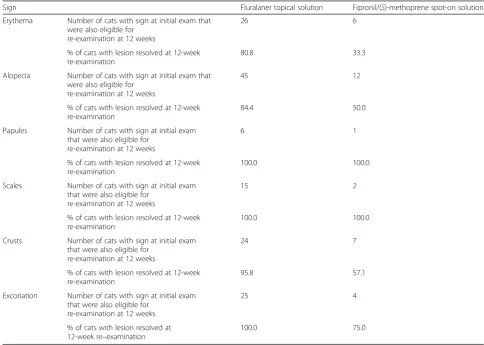
In both groups, there was improvement in all signs of flea allergy dermatitis (Table 3). The most common manifestation of FAD observed in study cats was alope-cia, which at enrollment was recorded for 60 of 224 (26.8%) cats in the fluralaner group and 18 of 84 (21.4%) cats in the fipronil-methoprene combination group. At 12 weeks, the percentage of eligible cats in which this sign was seen to have resolved was 84.4% in the flurala-ner and 50.0% in the fipronil-methoprene combination group.
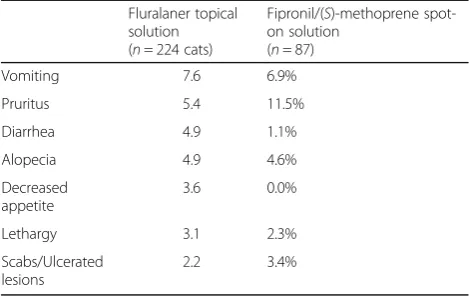
Across the 12 weeks of the study in all cats of both treatment groups and for an additional 3 weeks follow-ing the second treatment of fluralaner-treated cats, there were no serious adverse events. All adverse events were unremarkable throughout the study. A review of study records and owner diaries showed the most common ad-verse event in each group to be vomiting, affecting 7.6%
of fluralaner-treated cats and 6.9% of
fipronil-methoprene-treated cats. Other adverse events occurred at generally similar rates in both groups, although prur-itus was reported in 11.5% of fipronil-methoprene-treated cats and 5.4% of fluralaner-fipronil-methoprene-treated cats; diarrhea
and decreased appetite were reported in more
fluralaner-treated cats (4.9 and 3.6%, respectively) than fipronil-methoprene-treated cats (1.1 and 0.0%, respect-ively) (Table 4).
Both groups underwent a detailed blood count and blood and urine analysis and the results were unremark-able, with no evidence suggesting a pathologic trend, and only occasional isolated departures from normal ref-erence ranges in blood and urine analyses. There were no clinically relevant differences between the results of the two groups.
Discussion
This 12-week field study found that a single topical administration of fluralaner provided a greater than
99% (by geometric mean; ≥ 98.6% by arithmetic
[image:5.595.56.291.110.364.2]mean) flea control efficacy over 12 weeks. Under equivalent field challenge conditions, flea control effi-cacy never exceeded 90% in the positive control group treated three times with a fipronil/(S )-metho-prene combination. The results of this field study in cats align with the results of three similarly designed studies in dogs - two investigating the chewable flura-laner formulation, and one investigating the use of the same topical formulation used in this study [10, 11, 13]. In all of the dog fluralaner field studies, a single treatment/application has resulted in a > 99% reduction in geometric mean live flea counts within Table 1Demographics of enrolled cats and distribution of
numbers of cats in each household Fluralaner topical solution (n= 224)
Fipronil/(S)-methoprene spot-on solution (n= 87)
Age (years)
Mean (SD) 5.0 (4.40) 4.7 (4.30)
Range 0.2a–16.9 0.2b–19.4
Weight (lb)
Mean (SD) 9.7 (3.20) 10.2 (3.86)
Range 2.6–16.9 2.6–25.3
Gender Female, Intact 27 (12.1%) 7 (8.0%)
Female, Spayed
93 (41.5%) 35 (40.2%)
Male, Intact 15 (6.7%) 13 (14.9%)
Male Neutered 89 (39.7%) 32 (36.8%)
Distribution of household sizes (no. of cats)
1 50 (43.1%) 18 (40.0%)
2 40 (34.5%) 21 (46.7%)
3 15 (12.9%) 1 (2.2%)
4 6 (5.2%) 1 (2.2%)
5 5 (4.3%) 4 (8.9%)
a
In the fluralaner group, the youngest cats enrolled were 12 weeks of age; 24 (24/224 = 10.7%) were less than 26 weeks of age
b
one month, and sustained flea count reductions of > 99% through 12 weeks post-treatment.
Both fluralaner and fipronil-methoprene combination products were well tolerated in this study. There were no detectable effects of either product on clinical
pathology tests (baseline and week 12 for fipronil-methoprene cats; baseline, week 12, and week 15 for fluralaner cats).
[image:6.595.58.542.103.636.2]There are few published reports of clinical field studies that focus on flea control measures in cats, with only Table 2Flea count data for primary cats in the fluralaner topical and fipronil/(S)-methoprene groups. No efficacy comparison was performed at V1 and no primary cats had 90% reduction or were flea-free at V1
Visit 1 (enrollment)
Visit 2
(Week 4, Day 28)
Visit 3
(Week 8, Day 56)
Visit 4
(Week 12, Day 84)
Number of primary cats
Fluralaner topical solution 116 114 106 105
Fipronil/(S)-methoprene spot-on solution
45 40 38 34
Arithmetic mean flea count (95% CI)
Fluralaner topical solution 47.8 (36.5–59.1) 0.7 (0.1–1.3) 0.4 (0.0–1.0) 0.6 (0.3–0.9)
Fipronil/(S)-methoprene spot-on solution
83.0 (24.7–141.2) 37.1 (14.5–59.7) 28.6 (14.3–42.9) 20.4 (10.0–30.8)
P-value for comparisona
t(158.9)= -1.71,P= 0.0899 t(160.5)= -5.17,P< 0.0001 t(155.8)= -6.35,P< 0.0001 t(148.4)= -6.88,P< 0.0001 % efficacy (reduction from baseline)
based on arithmetic means
Fluralaner topical solution na 98.6 99.1 98.7
P-value for comparison to baselinea na t(158.5)= 5.51,P< 0.0001 t(159.2)= 4.74,P< 0.0001 t(159.1)= 4.50,P< 0.0001 Fipronil/(S)-methoprene
spot-on solution
na 55.2 65.5 75.4
P-value for comparison to baselinea na
t(160.4)= 3.49,P= 0.0006 t(159.9)= 3.50,P= 0.0006 t(159.6)= 3.75,P= 0.0002 Geometric mean flea count (95% CI)
Fluralaner topical solution 28.0 (23.2–33.8) 0.2 (0.1–0.4) 0.1 (0.0–0.2) 0.3 (0.2–0.4)
Fipronil/(S)-methoprene spot-on solution
28.0 (19.2–40.9) 15.0 (9.5–23.3) 9.4 (5.2–16.4) 6.8 (3.6–12.1)
P-value for comparisona t(139.9)= 0.07,P= 0.9474 t(139.7)= -17.56,P< 0.0001 t(144.7)= -13.23,P< 0.0001 t(139.3)= -10.80,P< 0.0001 % efficacy (reduction from baseline)
based on geometric means
Fluralaner topical solution na 99.1 99.5 99.0
P-value for comparison to baselinea na
t(151.9)= 32.41,P< 0.0001 t(150.8)= 30.60,P< 0.0001 t(147.1)= 29.81,P< 0.0001
Fipronil/(S)-methoprene spot-on solution na 46.5 66.6 75.8
P-value for comparison to baselinea na
t(159.3)= 3.96,P= 0.0001 t(155.9)= 6.11,P< 0.0001 t(158.4)= 7.68,P< 0.0001 % of primary cats with at least 90%
reduction from baseline flea count
Fluralaner topical solution na 93.9 96.2 93.3
Fipronil/(S)-methoprene spot-on solution
na 10.0 31.6 38.2
P-value for comparisonb na
Z= -10.17,P< 0.0001 Z= -7.26,P< 0.0001 Z= -6.96,P< 0.0001 % of flea-free primary cats
Fluralaner topical solution na 80.7 88.7 80.0
Fipronil/(S)-methoprene spot-on solution
na 5.0 21.1 23.5
P-value for comparisonb na Z= -8.45,P< 0.0001 Z= -7.87,P< 0.0001 Z= -6.05,P< 0.0001
Abbreviation:navalue or calculation is not applicable a
P-value for comparison of model least squares means parameter estimates bP
one in which enrollments were from cat-only (i.e. no dogs) households [16]. In that study, cats received two sequential monthly treatments with orally admin-istered spinosad or topically applied selamectin. At the final assessment 30 days after the second treat-ment (Day 60), arithmetic mean flea count reductions from pre-treatment levels were 98.7 and 98.2% in the spinosad and selamectin groups, respectively, with 91.0 and 87.9% of cats in each group free of fleas. Those efficacy findings align with observations for fluralaner single-treatment efficacy at 8 weeks in this study, although the fipronil-methoprene group efficacy results reported here appear to lag behind other treatments.
The flea control efficacy observed in this study follow-ing treatment with a fipronil-methoprene combination product was inconsistent. Six primary cats treated with fipronil-methoprene combination had flea counts that were higher at 12 weeks than at enrollment; five owners withdrew from the study prior to 12 weeks because of perceived inefficacy; and, 23.5% of primary cats were flea free while 38.2% had a 90% or greater reduction in flea count at week 12. These observations are consistent with
47.8
0.7 0.4 0.6
83.0
37.1
28.6
20.4 98.6% 99.1% 98.7%
55.2%
65.5%
75.4%
0% 20% 40% 60% 80% 100%
0 20 40 60 80 100
Baseline 4 Weeks 8 Weeks 12 Weeks
% Reduction vs Baseline
Arithmetic Mean Flea Counts
Fluralaner Fipronil-methoprene Fluralaner Fipronil-methoprene
[image:7.595.58.289.88.251.2]Fig. 1Arithmetic mean flea counts and percent reduction from baseline to weeks 4, 8 and 12 for topical fluralaner or fipronil/(S )-methoprene-treated cats (bars indicate arithmetic flea counts; lines indicate percentage reductions from baseline)
Table 3Summary of alleviation in each sign of flea allergy dermatitis in cats
Sign Fluralaner topical solution Fipronil/(S)-methoprene spot-on solution
Erythema Number of cats with sign at initial exam that were also eligible for
re-examination at 12 weeks
26 6
% of cats with lesion resolved at 12-week re-examination
80.8 33.3
Alopecia Number of cats with sign at initial exam that were also eligible for
re-examination at 12 weeks
45 12
% of cats with lesion resolved at 12-week re-examination
84.4 50.0
Papules Number of cats with sign at initial exam that were also eligible for
re-examination at 12 weeks
6 1
% of cats with lesion resolved at 12-week re-examination
100.0 100.0
Scales Number of cats with sign at initial exam
that were also eligible for re-examination at 12 weeks
15 2
% of cats with lesion resolved at 12-week re-examination
100.0 100.0
Crusts Number of cats with sign at initial exam
that were also eligible for re-examination at 12 weeks
24 7
% of cats with lesion resolved at 12-week re-examination
95.8 57.1
Excoriation Number of cats with sign at initial exam that were also eligible for
re-examination at 12 weeks
25 4
% of cats with lesion resolved at 12-week re–examination
[image:7.595.54.539.387.732.2]previous reports describing inadequate fipronil flea con-trol efficacy [13, 17, 18], and to the potential need for further investigation into explanations for this weaker than expected performance.
FAD clinical signs resolved in most fluralaner-treated cats, an observation that is consistent with results following fluralaner treatment of FAD af-fected dogs. In this field study the diagnosis of FAD was based exclusively on clinical signs and it is pos-sible that some of the clinical signs observed at en-rollment were not caused by flea bites. Studies using more detailed diagnostic methods in dogs have observed a greater response following effective flea treatment [12, 19].
Conclusions
In conclusion, a single topical administration of flurala-ner to cats is well tolerated and highly effective in con-trolling flea infestations on cats for 12 weeks following administration under typical household conditions.
Abbreviation
FAD:Flea allergy dermatitis
Acknowledgments
The authors thank the veterinarians and staff at the study sites for their efforts in recruiting and working with the patients in this study. The authors also thank Allyson L Smith of Merck Animal Health and Carole Therrien and staff at The Veterinary Consultancy LLC for their work with the study sites.
Funding
The study was funded by Merck Animal Health.
Availability of data and materials
Data from this clinical study are proprietary and maintained by Merck Animal Health.
Authors’contributions
CM participated in the design of the study and was responsible for its coordination and conduct and manuscript preparation. FG conceived of the study and participated in its design. FS participated in the design of the study and performed the statistical analyses. All authors read and approved the final manuscript.
Competing interests
CM, FG, and FS are all employees of Merck Animal Health.
Consent for publication Not applicable.
Ethics approval and consent to participate
As this study was conducted in client-owned cats, Owner Consent was com-pleted by Owners of all cats prior to participation in the study. At one partici-pating study site, which was a veterinary college, the study protocol and Owner Consent were reviewed through a Privately Owned Animal Protocol (POAP) review checklist, which included Institutional Animal Care and Use Committee (IACUC) protocol approval and approval of the Owner Consent.
Received: 29 June 2016 Accepted: 5 January 2017
References
1. Marsella R. Hypersensitivity disorders. In: Scott DW, Miller WH, Griffin CE, editors. Muller and Kirk’s small animal dermatology. 7th ed. St. Louis: Elsevier; 2013. p. 363–431.
2. Blagburn BL, Dryden MW. Biology, treatment and control of flea and tick infestations. Vet Clin Small Anim. 2009;39:1173–200.
3. Breitschwerdt EB. Bartonellosis: one health perspectives for an emerging infectious disease. ILAR J. 2014;55:46–58.
4. Nogueras MM, Pons I, Ortuño A, Miret J, Pla J, Castellà J, et al. Molecular detection ofRickettsia typhiin cats and fleas. PLoS One. 2013;8(8), e71386. 5. Bowman DD. Georgi’s parasitology for veterinarians. 10th edn. St. Louis:
Elsevier; 2014.
6. Taenzler J, Wengenmayer C, Williams H, Fourie J, Zschiesche E, Roepke RK, et al. Onset of activity of fluralaner (BRAVECTO™) againstCtenocephalides felison dogs. Parasit Vectors. 2014;7:567.
7. Dryden MW, Smith V, Bennett T, Math L, Kallman J, Heaney K, et al. Efficacy of fluralaner flavored chews (Bravecto) administered to dogs against the adult cat flea,Ctenocephalides felis felisand egg production. Parasit Vectors. 2015;8:364. Erratum in: Parasit Vectors. 2015;8:405.
8. Taenzler J, Liebenberg J, Roepke RK, Heckeroth AR. Prevention of transmission ofBabesia canisbyDermacentor reticulatusticks to dogs treated orally with fluralaner chewable tablets (Bravecto™). Parasit Vectors. 2015;8:305. 9. Wengenmayer C, Williams H, Zschiesche E, Moritz A, Langenstein J, Roepke
RK, et al. The speed of kill of fluralaner (Bravecto™) againstIxodes ricinus
ticks on dogs. Parasit Vectors. 2014;7:525.
10. Meadows C, Guerino F, Sun F. A randomized, blinded, controlled USA field study to assess the use of fluralaner tablets in controlling canine flea infestations. Parasit Vectors. 2014;7:375.
11. Rohdich N, Roepke RK, Zschiesche E. A randomized, blinded, controlled and multi-centered field study comparing the efficacy and safety of Bravecto (fluralaner) against Frontline (fipronil) in flea- and tick-infested dogs. Parasit Vectors. 2014;7:83.
12. Fisara P, Shipstone M, von Berky A, von Berky J. A small-scale open-label study of the treatment of canine flea allergy dermatitis with fluralaner. Vet Dermatol. 2015;26:417–e98. 13. Meadows C, Guerino F, Sun F. A randomized, blinded, controlled USA field
study to assess the use of fluralaner topical solution in controlling canine flea infestations. Parasit Vectors. 2017. (In press).
14. Klip S, Ramirez D, Allan MJ, Roepke RK. Comparative pharmacokinetics of fluralaner in dogs and cats following single topical or intravenous administration. Parasit Vectors. 2016;9:296.
15. Marchiondo AA, Holdsworth PA, Green P, Blagburn BL, Jacobs DE. World Association for the Advancement of Veterinary Parasitology (W.A.A.V. P) guidelines for evaluating the efficacy of parasiticides for the treatment, prevention, and control of flea and tick infestation on dogs and cats. Vet Parasitol. 2007;145:332–44.
16. Paarlberg TE, Wiseman S, Trout CM, Kee EA, Snyder DE. Safety and efficacy of spinosad chewable tablets for treatment of flea infestations of cats. J Am Vet Med Assoc. 2013;242:1092–8.
17. Dryden MW, Ryan WG, Bell M, Rumschlag AJ, Young LM, Snyder DE. Assessment of owner-administered monthly treatments with oral spinosad or topical spot-on fipronil/(S)-methoprene in controlling fleas and associated pruritus in dogs. Vet Parasitol. 2013;191:340–6.
[image:8.595.56.291.110.258.2]18. Dryden MW, Payne PA, Smith V, Chwala M, Jones E, Davenport J, et al. Evaluation of indoxacarb and fipronil (s)-methoprene topical spot-on Table 4Percent of cats experiencing most common adverse
events reported during the study Fluralaner topical solution (n= 224 cats)
Fipronil/(S)-methoprene spot-on solutispot-on
(n= 87)
Vomiting 7.6 6.9%
Pruritus 5.4 11.5%
Diarrhea 4.9 1.1%
Alopecia 4.9 4.6%
Decreased appetite
3.6 0.0%
Lethargy 3.1 2.3%
Scabs/Ulcerated lesions
formulations to control flea populations in naturally infested dogs and cats in private residences in Tampa FL, USA. Parasit Vectors. 2013;6:366. 19. Fisara P, Sargent RM, Shipstone M, von Berky A, von Berky J. An open,
self-controlled study on the efficacy of topical indoxacarb for eliminating fleas and clinical signs of flea-allergy dermatitis in client-owned dogs in Queensland, Australia. Vet Dermatol. 2014;25:195–e49.
• We accept pre-submission inquiries
• Our selector tool helps you to find the most relevant journal • We provide round the clock customer support
• Convenient online submission • Thorough peer review
• Inclusion in PubMed and all major indexing services • Maximum visibility for your research
Submit your manuscript at www.biomedcentral.com/submit