Contributions, Commerce,
Conscience
by
Anne Valeria Bailey
Submitted in fulfilment of the requirements
For the degree of Doctor of Philosophy
ii
Anne Valeria Bailey, October 2008
This thesis contains no material which has been accepted for the
award of any other degree in any tertiary institution. To the best of my knowledge and belief, the thesis contains no material previously
published or written by another person, except where due
acknowledgment is made in the text of the thesis.
iii
were a highly unusual global group. With an elite component, they went far beyond the normal range of colonial Wesleyan Methodist establishments. They have slipped through the net as regards their rightful
place in history. What is being rescued from obscurity is this Society, which passed through initial missionary and strategising moves to
community involvement, consecration of wealth, status, commercial success, banking involvement and then finally political involvement. It is
argued that, in the short time frame designated, it was unusual for a first generation Wesleyan Methodist group to have achieved so much. The thesis is presented in two parts.
For an understanding of the Launceston Wesleyan Methodists, the first part lays out the background of the formation of the Wesleyan
Methodist Society, showing the varied influences that came to bear on John Wesley’s patchwork of developing theology, as well as Wesley’s
evangelical economic principles. These economic principles are shown to have altered in the early nineteenth century with the rise of the Wesleyan
Methodist middle class man. With the rise of evangelical international missionary enterprise, Wesleyan men of commerce understood that they had to consecrate their wealth to fund missionary endeavours of the
Society. The Wesleyan Methodist mission trajectory to the South Seas is discussed with the failed early colonial missions of Sydney and Hobart.
The second part details successful missionary endeavours towards the developing merchant town of Launceston. These endeavours began
with the coming of Philip Oakden in 1833, and the forming of an elite within the Society who were prepared to shoulder financial responsibility.
The Wesleyan Methodist spirit of egalitarianism in a penal situation is discussed, with a demographic study as well as a discussion of the global shift in liturgy. The Wesleyan Methodist conscience is explained through
an examination of a particular spiritual diary. The acquisition of status is explained through land and property ownership, jury list membership and
iv
Australia (the predecessor to the ANZ Bank). Political involvement for the
Wesleyan Methodists in the 1840s is charted giving regard to the Teetotal Society and some growing resentments which led to the formation of the
London Agency and Anti-Transportation Leagues, both of which had considerable Wesleyan Methodist input.
The thesis contributes to the body of knowledge regarding
world-wide Wesleyan Methodist establishments before 1850. It is the first time that a group of Australian colonial Wesleyan Methodists has been
examined in such detail for their contributions and achievements. The thesis concludes that the Launceston Wesleyan Methodists, 1832-49 were
v
support. Firstly Professor Michael Bennett, my associate supervisor for his
initial readiness to see and envisage the possibilities of the topic. To Dr. Stefan Petrow my supervisor, for his always prompt replies to an offshore
student, and the time and thought he gave to the project. His detailed knowledge of Tasmanian history was invaluable. To both Professor
Bennett and Dr. Petrow I extend my thanks for facilitating the funding I received from the University of Tasmania under the Graduate Research Support Scheme. This enabled one visit to Hobart for research and
another to the Mitchell Library in Sydney. I would like to thank Professor Michael Roe for his helpful comments regarding the thesis and to Dr.
Richard Ely for supplying some pertinent references.
I found the Archives Office of Tasmania to be always helpful and
courteous and cooperative in digital photography projects. As well, I would like to thank the staff of the Tasmaniana Library for permission to
use original heritage photographs and acknowledge their always pleasant approach. Emilia Ward of the Special/Rare Collections of the University of Tasmania gave me considerable assistance, as did the Document Delivery
Services and Maryanne Gustus at Flexible Library Services in Launceston. Their prompt services were appreciated.
I would like to acknowledge the assistance of the staff at the Joint Theological Library in Melbourne (now the Dalton McCaughey Library),
and also the staff of the Sugden Library, Queens College, University of Melbourne.
I appreciated the ongoing interest of the staff of the Uniting Church of Australia Archives, and I would also like to acknowledge the helpful comments of Dr. Gareth Lloyd and Dr. Peter Nockles of the John Rylands
University Library of Manchester.
I am grateful to my son James for his endless borrowing of books
vi
ending support and encouragement. I am indebted to him for assuming the domestic load for three years and for never faltering in his belief in the
vii
Abstract iii
Acknowledgments v
Contents vii
List of Tables viii
List of Illustrations and Maps ix
Maps xi
Abbreviations xv
Part 1
Introduction 2
1 Background 23
2 Wesleyan Methodist Plantings in Sydney,
New South Wales and Hobart, Van Diemen’s Land
75
Part 2
3 Launceston Development 119
4 Composition, Consolidation, Consecration
of Wealth, Independence and Outreach
162
5 Status, Commercial Interests, Banking 217
6 Background to Spiritual Diary Writing, The
Spiritual Diary of One Launceston Wesleyan Methodist
290
7 Temperance, and Political Pressure,
Further Philanthropy
330
8 Simmering Resentments, Rights, Political
Agitation and Anti-Transportation
362
Conclusion 411
Biographical Appendix 421
viii
Demographic Study of the Egalitarian Spirit of Wesleyan Methodist Society.
168–170
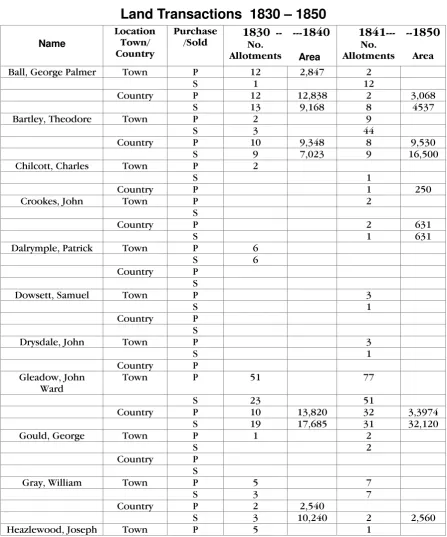
Table 1 Land Transactions of Wesleyan Methodists
1830-1850.
222–3
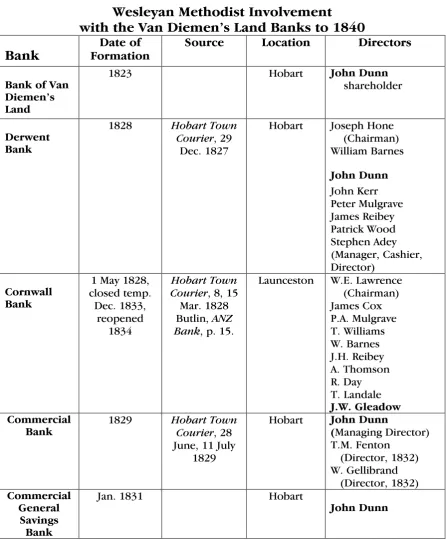
Table 2 Wesleyan Methodist Involvement with Van
Diemen’s Land Banks to 1840.
256–8
ix
Australia Map xi
Van Diemen’s Land (Tasmania)
Map xii
Bass Strait Map xiii
North East Tasmania Map xiv
John Wesley Stipple Line Engraving after John Jackson. National Portrait Gallery, London.
1
Wesleyan Chapel and Mission Premises, Launceston, Tasmania
Engraving taken from Rev. William Moister, A History of Wesleyan Missions in all Parts of the World, from their Commencement to the Present Time, (London, 1871), p. 304.
179
Plan of the Wesleyan Methodist Launceston Circuit, 1839
Printed by Henry Dowling, Launceston; Records of Tasmanian Methodist Church, Archives Office of Tasmania.
195
Portrait of Philip Oakden, circa 1840.
Original in hands of family descendant, copy in Archives Office of Tasmania.
234
Photograph of Henry Reed, 1 January 1870.
Photographic Image Collection, Archives Office of Tasmania.
238
Photograph of John Gleadow
Tasmaniana Library Heritage Image Collection
242
Croyden House, Launceston. Site of First Union Bank.
S.J. Butlin, Australia and New Zealand Bank, (London, 1961), p. 22.
255
Prospectus of the Union Bank of Australia.
ANZ Bank Group Archives, Melbourne. 280
Union Bank of Australia
Launceston Examiner, April 1838. Advertisement.
285
Henry Jennings circa 1880.
x
John Crookes Tasmaniana Library Heritage Image
Collection.
353
Photograph of Theodore Bartley
from Yvonne A. Phillips, Bartley of Kerry Lodge, a Portrait of a Pioneer in Van Diemen’s Land, 1987.
399
Quarterly Ticket 1875 for John Gleadow
Records of Tasmanian Methodist Church, Archives Office of Tasmania.
xi
General Map of Australia
1788)
Adelaide
(Settlement 1836)
Port Phillip
(Melbourne) (Settlement
1835)
Van Diemen’s Land (Tasmania)
xii
Van Diemen’s Land (Tasmania)
Hobart
Launceston
Macquarie Harbour Circular Head
xiii
xiv
North East Tasmania
TamarRiver Launceston
George Town
Chudleigh
Westbury
Campbell Town
Ross Mersey
River
Perth
Longford
xv
AJCP Australian Joint Copying Project
ANZ Australia and New Zealand Bank
AOT Archives Office of Tasmania
CO Colonial Office
LWMMS Launceston Wesleyan Methodist Missionary Society
M Microfilm
ML Mitchell Library, Sydney
NS Non State Record
NSW New South Wales
PROV Public Record Office Victoria
SLV State Library of Victoria
SPCK Society for the Promotion of Christian Knowledge
THRA Tasmanian Historical Research Association
THRAP&P Tasmanian Historical Research Association Papers & Proceedings
UBA Union Bank of Australia
UTAS University of Tasmania
VDL Van Diemen’s Land
VIC Victoria
WMMC Wesleyan Methodist Missionary Committee
Introduction
Histories of Methodism worldwide do not incorporate the Australian colonial experience of groups and establishments. This has been left to
local authors. Leading British historian David Hempton emphasises the need for individual studies of small group Wesleyan Methodist
establishments and makes a plea ‘for sophisticated local studies showing what the Methodist message was, and how it was heard and
appropriated’.1 He sees this type of study as a counterbalance to the larger histories which lack the finer detail. In this thesis, it is argued that
between 1832 and 1849 the Launceston Wesleyan Methodist group in Van Diemen's Land with its elite component, though numerically small, went far beyond the range of Wesleyan Methodist colonial establishments. What
is being pinpointed and rescued from historical obscurity, is a highly unusual, globally networked, self-reliant, Wesleyan Methodist society,
which passed through the initial missionary and strategising moves to community participation, consecration of wealth, status, commercial
success, banking involvement and then finally political connections.
It will be argued that in the short time frame designated, it was unheard of for a Wesleyan Methodist group to have achieved so much,
particularly in the areas of banking and political involvement. These were not normally pre-eminent concerns for Wesleyan Methodists, particularly
not in a first generation group. Other Wesleyan Methodist groups, for example Nova Scotia, needed two generations to have achieved so much.
Allan B. Robertson’s study of Wesleyan Methodist businessmen in Nova Scotia also noted that Methodist merchants of Nova Scotia ‘have not
received the attention their influence should merit’.2 The behaviour of the Launceston Wesleyan Methodist elite was sufficiently startling for them to have been given more regard by historians. The study commences in 1832
because that year details the early tentative moves of the successful
1 David Hempton, The Religion of the People: Methodism and Popular Religion 1750-1900 (London, 1996), p. 28.
2
mission into Launceston.3 This study ends in 1849 as by then many of the Launceston Wesleyan Methodist elite had dispersed and gone their separate ways. Although the dynamic group had evaporated and
fragmented by 1849, their influence and achievements lasted much longer. The biographical appendix will demonstrate that the dispersal of the
group was due to movements to Port Phillip and abroad, mainly for insolvency, death and further commercial opportunities. As well, there
were withdrawals from the Launceston Wesleyan Methodist Society.
The normal Wesleyan missionary spirit, rigorous mental attitude and whirlwind energy will be shown to be intertwined with dynamic
entrepreneurial, commercial and community interaction. At the same time, we must acknowledge the duality which Wesleyan Methodists had
inherited from John Wesley, the constraint of the Stewardship of Wealth followed by the Consecration of Wealth. Hempton’s question about what
it was in the local conditions that enabled Wesleyan Methodists to make gains, is a springboard for the thesis. It was, of course, a fact that Van
Diemen's Land was a penal colony where at any given time half the population were convicts or ex-convicts. This situation initially produced a strong egalitarian spirit in the Wesleyan Methodists and later political
pressure towards Anti-Transportation.
The contribution of this thesis will be to show that this group were
significantly unusual in their achievements. They have slipped through the net as regards their rightful place in Wesleyan Methodist historiography.
No attempt has been made to accord to this small but potent group recognition of their contributions to the life of Launceston, as well as
recognition of the forces that drove them. Up to the present, no colonial Australian Wesleyan Methodist group has been examined so closely for its socio-economic political connections and achievements, together with the
underbelly of its behaviour. There has been no appreciation of what a powerful group they were in Launceston, Van Diemen's Land, in the
period detailed. This thesis will address the question of how the
eminence of the Launceston Wesleyan Methodists of 1832-1849 came about.
Historiography
Various histories in Australia have been written about the Wesleyan Methodists as pious groups, and biographical studies have been written
about individual Wesleyan Methodists such as Philip Oakden, Henry Reed and Walter Powell, the latter acknowledging commercial and spiritual
contributions. No Australian historians have written about the Launceston Wesleyan Methodists in anything but a chronological and uncritical style,
with an understandably biased and commemorative emphasis. As Hempton writes, ‘Methodist history can no more be brought to life by the celebratory interests of its staunchest defenders, than by savage attacks’.4
Tasmanian Church histories by the Rev. C.C. Dugan, R.D. Pretyman and M.E.J. Stansall emphasise the ministerial and chapel circuit development
without exploring the contributory role of the Launceston Wesleyan Methodist elite of that period.5 These partisan Wesleyan Methodist
historians could have augmented their histories with more detailed background of the inherited forces and values that drove the actions of the
group and also given an understanding of the penal circumstances which surrounded them. It is possible that these explanations were not forthcoming because the audience for these histories was already
indoctrinated into the behaviour and surrounding circumstances of the Wesleyan Methodists. Although Lester Hovenden’s thesis about
Methodism in Launceston 1864-1891 is outside the parameters of this thesis, it does acknowledge the energetic contributions of such figures as
John Gleadow, Isaac Sherwin and John Crookes who remained active into the late nineteenth century.6
4 Hempton, Religion of the People, p. 197.
5 C.C. Dugan, A Century of Tasmanian Methodism: 1820-1920 (Hobart, 1920); C.C. Dugan, The Story of the Paterson Street Church, Launceston (Launceston, 1932); R.D. Pretyman, comp., A Chronicle of Methodism in Van Diemen's Land: 1820-40
(Melbourne, 1970); M.E.J. Stansall et. al., Tasmanian Methodism: 1820-1975 (Launceston, 1975).
Further, the Australian Wesleyan Methodist Magazine The Spectator, sees the group as a strong force with a high profile and connections to public influence, but fails to develop the idea, particularly that of their
commercial influence.7 However, it is reassuring to note that The Spectator recognised the Launceston Methodists as being politically in the forefront
of the anti-transportation fight. The hint of prosperity is also repeated by Alex Tyrell when he quotes the Rev. Joseph Orton as referring to his
‘brethren and opulent friends at Launceston’.8 Patricia Grimshaw’s review of A Sphere of Benevolence asks for ‘a fuller insight into Orton’s personal relationships and greater detail on the private aspects of his public
performances’.9 This thesis produces a slice of that insight into Orton, particularly into his handling of the Crookes case and the liturgy struggle.
Individual Launceston Wesleyan Methodists have also been discussed for their personal achievements. One such case is Sir Hudson Fysh’s book
about his grandfather, Henry Reed, where he concentrated upon Reed’s achievements without positioning him in a strong group.10 Another book
about Henry Reed, by his widow Margaret Reed, is slanted and sanctimonious, without any elaboration of his commercial activities, except for the telling reference to the day in 1831 when Henry Reed met
Mr. Buckle, a leading London metropolitan merchant, and how ‘this small circumstance had a great bearing on his future success’.11 It concentrates
on conversion, Evangelical experience and good works, though it does refer to Reed’s strong objections to debt, as well as the Stewardship of
Riches as understood by the Wesleyans. Additionally, in this book, the publication of some of Henry Reed’s correspondence from the 1860s to
1870s gives an excellent and incidental look into Henry Reed’s mind; the tenor of these letters is carried along the same lines as the general
7History of the Launceston Circuit, The Methodist History of Victoria and Tasmania, Reprinted from the Spectator Special Issues, 1899-1900, Melbourne, 1935.
8 Alex Tyrell, A Sphere of Benevolence: the Life of Joseph Orton, Wesleyan Methodist Missionary: 1795-1842 (Melbourne, 1993).
9 Patricia Grimshaw, Review of ‘Alex Tyrrell, A Sphere of Benevolence: The Life of Joseph Orton, Wesleyan Methodist Missionary, 1795-1842 (Melbourne, 1993)’, Journal of Imperial and Commonwealth History, Vol. 23, No. 1, 1995, pp. 171-2.
10 Hudson Fysh, Henry Reed, Van Diemen’s Land Pioneer, by his grandson Hudson Fysh (Hobart 1973).
anxieties and constraints which governed the Wesleyan Methodists.12 As in many Wesleyan Methodist memorials, the spiritual assessment has been skilfully adjusted by Mrs. Reed to suit her requirements.
In the wider historical field in Tasmania, Lloyd Robson13 has viewed the Wesleyan Methodists’ role as mainly endeavour in the field of hospitals
and gaols, whilst admitting to ‘their large prosperous numbers’.14 Hartwell, in his economic history,15 has ignored the commercial
contributions of men such as Henry Reed and Philip Oakden in favour of the Hentys as the only viable merchants in Launceston. Philip Oakden’s part in establishing the Union Bank of Australia has been thoroughly
defined in An Early Tasmanian Story,16 as well as his Wesleyan Methodism, and much less so in Butlin.17 Frank Broeze highlights the
importance the Union Bank of Australia played in the economic life of Launceston, Hobart and surrounding areas of Port Phillip, but does not
highlight the Wesleyan Methodist connection of Philip Oakden.18 However, Broeze does note and understand the pious Evangelical
connections common to other directors of the Union Bank of Australia. Colin White’s review of Mr. Brooks and the Australian Trade emphasises that ‘it is a traditional business history, more descriptive than theoretical,
but a major addition to the body of relevant case studies…it also has the value of highlighting the serious principal – agent problem created by
distance, and it unfolds the history in terms of commodity exchange between Britain and the colonies’.19 It is the understanding of the
commodity exchange that is of value to this thesis. Surprisingly, John West
12 Ibid, Chapter 10.
13 Lloyd Robson, AHistory of Tasmania, Vol. 1 (Melbourne, 1983). 14 Robson, History, p. 283.
15 R.M. Hartwell, The Economic Development of Van Diemen’s Land: 1820-50 (Melbourne, 1954).
16 Anne Bailey and Robin Bailey, An Early Tasmanian Story with the Oakdens, Cowies, Parramores, Tullochs and Hoggs (Melbourne 2004), Chapter 5.
17 S.J.Butlin, Foundations of the Australian Monetary System (Sydney, 1953), pp. 271-4. 18 Frank Broeze, Mr. Brooks and the Australian Trade: Imperial Business in the
Nineteenth Century (Melbourne, 1993), p. 100.
does not bother to highlight the founding of the Union Bank in his History of Tasmania or pinpoint individual Wesleyans.20
Michael Roe in Quest for Authority in Eastern Australia: 1835 – 1851 quotes Henry Reed as being described by the Rev. Nathaniel Turner as a ‘wonderful trophy of saving mercy’,21 and he confines his views on the
Launceston Wesleyan Methodist group to commenting on a liturgical dispute with the Rev. J. Orton.22 Admittedly, it is difficult in wider histories
to focus on small groups, and John Barrett in That Better Country23 is only able to comment in generalities. Despite a strong Methodist background, he does not seem aware of the strength of early Launceston Wesleyan
Methodism and focuses more on educational contributions and generalised inter-faith disagreements.
Alison Head’s excellent thesis on the Wesleyan Methodists of Port Phillip, 1836-50, is confined mainly to the British Wesleyan Missionary
Society background of the Port Phillip establishment as well as the founding of the Buntingdale Aboriginal Mission. Its parameters do not
extend to the sponsorship and encouragement from the Launceston Wesleyan Methodists in the period 1836 onwards.24 Renate Howe in her article on the social composition of the Wesleyan Church in Victoria
during the nineteenth century does make the corroborative statement ‘that successful Wesleyan business-men saw conflict between the business
world and their religion'.25 She refers briefly to Walter Powell as the epitome of the successful Wesleyan Methodist business man; nevertheless,
she does not make the connection that Powell was nurtured in the cradle of Launceston Wesleyan Methodism between 1836 and 1844. This gave
him the impetus, precepts and guidelines to become a successful businessman in Port Phillip. The Rev. Irving Benson also praises Walter
20
John West, History of Tasmania: with Copious Information Respecting the Colonies of New South Wales, Victoria, South Australia &, &, & (Launceston, Tasmania, 1852). 21 Michael Roe, Quest for Authority in Eastern Australia: 1835-51 (Melbourne, 1965), p.
128.
22 Roe, Quest for Authority, p. 131.
23 John Barrett, That Better Country, the Religious Aspect of Life in Eastern Australia (Melbourne, 1966).
24 Janet Alison Head, ‘Wesleyan Methodists in Port Phillip: 1836-50’, unpublished MA Thesis, LaTrobe University, 1990.
Powell as a spiritual Wesleyan Methodist merchant noted for his generosity and philanthropy, without comprehending the forces that shaped him.26 He does refer to Benjamin Gregory’s book about Walter
Powell, The Thorough Business Man27, which, for this thesis, is an important reference tool. Not only are Walter Powell’s Wesleyan Methodist
business principles discussed, but they are backed up by extracts from his spiritual diary commencing in 1846. Barrie Dyster’s article on the Port of
Launceston before 185128 is another attempt to acknowledge the opportunistic commercial expertise of Henry Reed and Philip Oakden in the Launceston business world. Nevertheless, he does not seem aware of
their Wesleyan Methodism and the part and influence it played in their business matters and success.
When we turn our attention to British histories of Wesleyan Methodism, we find more useful works, though there is not a large field of
publications about Wesleyan Methodist groups and individuals and their commercial success. There is of course the tradition of publishing
memorials and biographies in The Methodist Magazine in the 1800s where prominent deceased lay people are praised for their diligence, active generosity and philanthropy to the Methodist Connexion. Gareth Lloyd
comments that ‘their sponsorship was often out of proportion to their numbers’.29
George J. Stevenson’s book City Road Chapel of 1872,30 with the considerable anecdotal material and biographical detail of its members, is
another example of the persuasive, entrenched approach that celebrated success in commerce, followed closely by philanthropy. One such
example quoted was Walter Mariott, a stockbroker, 1783-1815, who for many years gave away half his income to the Wesleyan Methodist cause.31 The City Road Chapel and its predecessor John Wesley’s Old Foundry had
26 C. Irving Benson, A Century of Victorian Methodism (Melbourne, 1935). 27
Benjamin Gregory, The Thorough Business Man: Memoirs of Walter Powell Merchant (Melbourne and London, 1871).
28 Barrie Dyster, ‘The Port of Launceston before 1851’, The Great Circle, Journal of the Association of Maritime History, Vol. 3, 1981, pp. 103 – 4.
29 Dr. Gareth Lloyd (Methodist Archives and Research Centre, John Rylands Library, Manchester University), Personal Communication 2 April 2005.
a congregation and connection with considerable links to the business community and Lloyd considers that the book is particularly valuable because details are included that Stevenson obviously received from eye
witnesses, rather than documentary sources.32
Geoffrey Milburn’s Piety, Profit and Paternalism33 gives an excellent picture of Wesleyan Methodists in business in the north of England. It is readily possible from this work to compare similar attitudes and actions in
the Launceston Wesleyan Methodist group. Milburn describes a Wesleyan Methodist Pocket Book, 1813, with the double page spread of a biblical text on the left page and weekly cash account on the right. He calls this
‘piety on the left, profit on the right’.34 This was in the spirit of the Launceston group. Milburn also refers to ‘the frankly accepted
accommodation between Methodism and the market place’,35 but he does highlight ‘the fruitful tension’ under which the Wesleyan Methodists
existed. He discusses the ever present need in the Methodist Connexion of philanthropy and the Stewardship of Riches. In other words he refers to
the Sword of Damocles which hung over the heads of Wesleyan Methodists. He further traces the rise of the commercial middle class in the north east of England, particularly in the nineteenth century, and
discusses the Wesleyan Methodist groups who contributed so much in ‘leadership, financial liberality, administrative guidance and practical
stimulation’.36
Milburn’s large groups of intertwined Wesleyan Methodist
businessmen were often enormously wealthy in comparison to the elite Wesleyan Methodist group in Launceston, who were operating on a
smaller scale, but in the same spirit and ethos. It is significant in Milburn’s study that, in the forty-six Wesleyan Methodist families, only two were connected to banking; these were the Skinner family of Stockton-on-Tees
and Thomas Thompson of Hull. The rest of the families covered the normal range of ship owners, colliery owners, builders, drapers, bakers
32 Dr. Gareth Lloyd, personal communication, 2 April 2005.
33 Geoffrey Milburn, Piety Profit and Paternalism: Methodists in Business in the North East of England, 1760-1923 (Bunbury, Cheshire, 1983).
and manufacturers. Generally, it seems the Wesleyan Methodists were not involved to a great extent in banking in England in the 19th century, however in Cornwall, Wesleyan Methodist William Carne and his son
Joseph were an exception. William Carne was a personal friend of John Wesley and the principal supporter of Wesleyanism in his own
neighbourhood.37He was a partner in the Angarrack tin smelting works near Hayle, and he and Joseph were partners in the bank of Batten and
Carne in Pemzance.38 Stevenson’s book revealed much the same situation of manufacturing mix with a heavy dose of involvement in Friendly Union Benefit societies. Further, Stevenson’s book does not suggest the level of
anxiety associated with the giving and the generosity which Milburn emphasises so strongly. Stevenson confines himself merely to citing the
unstinting financial support. His brief in 1872 was to keep up the ‘moral tithing’ approach for Wesleyan Methodism, whereas Milburn’s later task in
1983 was to examine and dissect the Wesleyan Methodist north eastern community.
A small connection to banking in a minor way was John Wesley’s Lending Stock which gave an interest free loan to start up a business. This is detailed in James Lackington’s memoir,39 where he describes his rise to
wealth as a bookseller from the initial Wesleyan Methodist loan. Such charitable Wesleyan Methodist loans from a small credit union bear little
relation to the Launceston Wesleyan involvement in second tier imperial banking and serve to demonstrate the large gulf which separated the two.
They point to the degree of financial sophistication to which the Launceston Wesleyan Methodists had risen in being involved in the Union
Bank of Australia.
William Arthur’s book about Samuel Budgett, the successful merchant of Kingswood Hill, Bristol,40 is an example of the type of
Wesleyan Methodist merchant similar to the Launceston men, Reed,
37 Obituary, William Carne: 1754-1836, West Briton, 8 July 1836.
38Oxford Dictionary of National Biography (On-Line Edition, 2006), Carne, John, 1789-1844; Twiggs Corrected List of the Country Bankers of England and Wales, 1830. 39 James Lackington, Memoirs of the first forty years of the life of James Lackington:
Bookseller, written by himself (London, 1791).
Oakden and Powell. Written as a salutary example of the ideal Wesleyan economic man lifted ‘above the trammels of commercial selfishness’, it is said by the author to bring ‘religion and business into closer union’.41 It
has the added weight of covering the dual concepts of commercial success monitored by the inner self. As in the Walter Powell memoir, the approach
has an affinity with the partisan and sanctimonious attitude of Wesleyan Methodists. It does, however, delineate the qualities of character which
were peculiar to Wesleyan Methodist businessmen and it would be applicable to the Launceston Wesleyan Methodist members. These were vigour, moral tone, piety, systematisation and prompt payment; the book
also expounds the convenient Wesleyan theme that ‘commerce does much to bind men to men and nation to nation by the solid tie of commercial
interests and finally the errands of Christianity’.42 The book is particularly interesting for the convenient rationalisation regarding successful
commerce which must have been current in the period, and which would have been popular with the Launceston group. The idea was commerce
becomes the imprint of God’s great law of brotherhood, and was a system of mutual service.
An important aspect of Arthur’s book is the section 09 on ‘The Inner
Life of Samuel Budget’. It is composed from remaining fragments of Budgett’s diary. There is the same tried and true formula of other
Wesleyan and Non–conformist diaries. The familiar resolutions, the failures and the monitoring of the conscience are all present. These
entries date from 1823 to 1843 and show, as Arthur writes, ‘the rising merchant knew he had a judge above, and keenly searched his thoughts,
words and deeds for offences against his law’.43 The law was, of course, the rules and precepts of Wesleyan Methodism. The type of questions Budgett was asking himself were, ‘Have I indulged in spiritual and bodily
sloth’, and ‘Have I laboured to do whatsoever I did to the Glory of God’? Arthur infers that, while prosperity was setting in strongly for Budgett, he
was liable to be overcome in the heat of his driving plans, hence the need for watchfulness and self examination. It will be shown later in this thesis
that the same words could be applied to Henry Jennings of the Launceston Wesleyan community. He was voicing the same concerns in his spiritual diary 1836-39, and travelling the same path as Budgett. The
William Arthur biography goes some way to understanding the globally transferred values of Wesleyan Methodism with its commercial principles
and controls. It also portrays the man of business struggling with the temptations of trade and impelled by a nature eager for commercial
progress, who finds himself too engrossed by earthly things.
Another one of many such histories of specific Wesleyan groups who enjoyed some success in commerce is Methodism in Macclesfield, Cheshire, the centre of the silk button trade.44 Here is the well worn theme of a small but fervent group who attained a certain degree of prosperity
through diligence and watchfulness. John Wesley described them in 1787 ‘as a people close to God in spite of many increasing riches. If they
continue it will be the only instance I have known for half a century’. 45 The author cites many examples of holy living and holy death, but the
group emerges as pedestrian, lacking the flair and vitality of the later 1830-40’s Launcestonians.
Vitality and flair are, however, apparent in Allen B. Robertson’s study
of the Halifax Methodist merchants, 1815-55.46 In this case, second and third generation Nova Scotian Wesleyan Methodist businessmen shared
the same dynamic energy as the first generation Launceston community but, in the main, diverted their energies to education and politics. As in
Launceston, they were a small group, but, as Robertson stresses, ‘their compactness lent itself to the formation of a strong group identity’.47 He
also discusses the social activism of the group. Similarly to Launceston, this did not negate the undivided pursuit of the holy; ‘rather the faith arrived at, or meditated on privately, assisted one to interact with
like-minded members of society at large’.48 One senses the similarities, the dynamics of both groups, ‘the coexistence of religious and secular
pursuits; the emphasis on the methodical seeking out of perfection, whilst
44 Benjamin Smith, Methodism in Macclesfield (London 1875). 45 Ibid, p. 203.
46 Robertson, John Wesley's Nova Scotia Business Men. 47 Ibid, p. 33.
not denying the realities of living in an imperfect world’.49 By the 1840s, the Wesleyan Methodists of Nova Scotia had ‘developed a growing sense of their part as a chosen people’.50 There was a sense of this also in the
leaders of the Launceston Wesleyan Methodist group, given the type of society into which they had come. At that time they were catapulted into
the political arena of the transportation question and responded vigorously. The Launceston community, though later arrived, certainly had
the presence of what Robertson refers to as ‘movers and shakers’ in the Wesleyan Methodist Nova Scotian community, whose members functioned in the upper levels of the socio-economic world. As Hempton writes, ‘It is
only when the complexity has been laid bare that the precise pattern of cultural brokerage between Methodism and its secondary environment
can begin to be understood’.51
An interesting perspective of Canadian and Australian religious
colonial experience is discussed by Mark Hutchinson, when he comments that ‘Canada and Australia were invisible to one another in their colonial
experience… and religious historiography has followed this line in development, generally’.52 Hutchinson argues however, ‘that there is a wider context in which the religious life of these two post-colonial
countries developed; their life had remarkable similarities…and the presence of a cultural lens between the two countries is important
because the mutual invisibility has caused us to overlook one another as a potential way of seeing one another’.53 It is in this understanding that
Robertson’s work about the Nova Scotia Wesleyan Methodist business men is utilised in this thesis.
Primary Sources
Bearing in mind the advice of historian John Tosh ‘that the relationship between the historian and his sources is one of give and
49 Ibid, p. 148.
50 Ibid, p. 149.
51 Hempton, Religion of the People, p. 198.
52 Mark Hutchinson, ‘Up from Downunder: An Australian View of Canadian
Evangelicalism’, in G.A. Rawlyk (ed.), Aspects of Canadian Evangelical Experience (Montreal, 1997), p. 22.
take’,54 it is still reasonable to state that the strength of this thesis lies in the extraordinary amount of wide ranging primary sources available to support the work and provide a convincing basis for expressed opinions.
The sources were not for the greater part overwhelming or contradictory, but illuminating and supportive.
When the Uniting Church of Australia was formed in 1977 with the merger of the Congregational, Methodist and most of the Presbyterian
churches, the records of the Tasmanian Methodist Church were deposited in the Archives Office of Tasmania (AOT). The AOT holds in excess of 4,000 items from this transfer from the Methodist Church. The items
relating to the Launceston, Hobart and Midlands circuits have been invaluable, though, understandably, there are gaps in the early colonial
years. Similarly, the Australian Joint Copying Project (AJCP) microfilm records, covering all available correspondence and related records with
the Wesleyan Methodist Missionary Society (WMMS) in London and Manchester have provided a valuable resource. These would normally only
have been available by visits to The National Archives in London and the Manchester Archives Research Centre at John Rylands Library, University of Manchester. These records provide an excellent view of the often severe
attitude of the Wesleyan Methodist Missionary Society to their ministerial brethren working in the South Seas Mission on their colonial stations.
These records also highlight the often impossible demands made on the Wesleyan Methodist ministers and the continuing parlous financial state of
the missions. Some seven ministerial diaries held across the Uniting Church Archives in Melbourne, the Mitchell Library in Sydney and the AOT
also provide a valuable and insightful background and a good counterbalance to the Wesleyan Methodist Missionary Society correspondence.
The spiritual diary of Launceston Wesleyan Methodist Henry Jennings, held in the Jennings Papers, State Library of Victoria, provided a
basis for the chapter on spiritual diary writing. This diary of Henry Jennings follows the pattern that Brown and Shannon refer to in their
discussion on spiritual autobiographies as primary sources; they state that
‘conversion, the moment of spiritual rebirth, marks the start of the story which then continues on through various stages of trial and renewal’.55Other original diaries from the seventeenth century onwards
are also commented on. Wesleyan Methodist Philip Oakden’s 1833 ‘Journal of a Voyage from London to Circular Head and Launceston’ plus
his business Letter Book 1833-38 and the considerable amount of his personal correspondence, sourced from descendants are vital documents.
His business letter book, in particular, conveys a strong sense and understanding of the firm commercial principles of a Wesleyan Methodist business man, and the bias is unashamedly commercial, without any
spiritual overtones, as would be expected. This source counts as being very reliable. Some personal and commercial correspondence of Henry
Reed was obtained through access to the Hudson Fysh papers deposited in the State Library of Tasmania, Launceston Branch. In particular, many
of Henry Reed’s letters reveal his sincerity and devoutness in matters spiritual and unconscious business attitudes.
Further original correspondence dealing with John Leake, Henry Reed, John Crookes, Philip Oakden, Walter Powell and the Mather family was located in the University of Tasmania Special/Rare Collections.
Additionally, the contemporary letter diary of Launceston dissenter George Best gives an unvarnished and critical opinion of the Wesleyan Methodists
against the background of the town.56 The diary provides material for a balanced interpretation of the Wesleyan Methodists. Its very bias and
prejudice are of value in itself.
A valuable commercial primary source are the records held in the
ANZ Bank Archives in Melbourne of the Union Bank of Australia. All early correspondence and reports from the Colonial Inspector regarding the progress of the Union Bank are available and provide an insight into the
setting up of the bank in Launceston, as well as its cautious behaviour
55 Victoria Bissell Brown and Timothy J. Shannon, Going to the Source: The Bedford Reader in American History (Boston, 2004), Vol. 1, p. 224.
during the economic depression in Van Diemen's Land. The Methodist Magazine of the period gives a sense of current Wesleyan Methodist religious opinion in Britain and the importance of their missionary
endeavours. Other relevant Launceston newspapers such as the Launceston Examiner, the Launceston Advertiser, the Cornwall Chronicle and the Teetotal Advocate give contemporary access to the current mentality and attitudes towards events, as well as positioning the
Wesleyan Methodist Society within the growing Launceston community. As Brown and Shannon say, ‘as with modern newspapers, an important source of revenue in colonial newspapers was advertising’,57 and it is in
these advertisements that a wealth of primary source information was discovered, particularly in the movements and commercial transactions of
the Wesleyan Methodists; ship arrivals and departures, real estate sales, auctions, insolvency notices, all assisted in composing a pattern of
existence.
Other official Tasmanian records in the Archives Office of Tasmania
significantly contribute to the thesis; these were the Bounty Immigration records, Insolvency archive material, Wesleyan Methodist wills and the Index of Tasmanian Convicts. The Van Diemen's Land 1842-1844 Census
summary statistics, originally published in 1845 and republished by the Australian Bureau of Statistics, were obtained from the State Library of
Victoria. These all put flesh on the bones of the Wesleyan Methodists. The land records of the Wesleyan Methodist group obtained from the Land
Titles Office, Hobart, were an excellent pointer to establishing status within the group.
Structure of Thesis
The thesis is divided into two parts, Part 1 provides the essential background to the thesis, and Part 2 considers the contributions made by
the Launceston Wesleyan Methodists.
Part 1
Chapter 1 It will be necessary for the background chapter to be
substantial to convey an understanding of the people who were Wesleyan
Methodists. This chapter represents a reference text for understanding the Launceston Wesleyan Methodists 1832-49. The background will commence with the founding of the Wesleyan Methodist Society with its
roots and developing theology in the Evangelical Revival, Arminianism, the German Pietist movement and other influences. Its progress into a society
which incorporated a respectable, affluent, middle class in the early nineteenth century will then be charted. To understand the behaviour and
ethics of the Launceston Wesleyan Methodists, John Wesley’s own economic views will be explained in all their limitations of the period in
which they were formed. It will be shown how connexional economic teaching changed after Wesley’s death in 1791, finally reaching an accommodation with the temporal world and moving to the
understanding that a wealthy philanthropic stewardship element was necessary for the survival of the Society. Spirituality and economics
became one and the stewardship had a duality attached to it. The formation of the Wesleyan Methodist Missionary Society (WMMS) will be
discussed, with its taking of Wesley’s economic theory to the higher dimension of consecrated wealth, the necessity for influential benevolent Wesleyan Methodist laymen, and the mind shift of the Wesleyan
Methodists from the poor to the missionary outreach.
Chapter 2 will discuss the Evangelical influences which supported early
Anglican chaplaincy into Port Jackson / Sydney, and which was followed with the introduction of the Wesleyan Methodists. The foundation of the
early Wesleyan Methodist Society is discussed with reference to some important members. The difficulties of the mission will be highlighted
with reasons for its failure, and the chapter will take the outreach to Hobart, Van Diemen's Land, which had its own penal and emancipist
Part 2
Chapter 3 will discuss Lieutenant Governot Arthur’s support for and collaboration with the Wesleyan Methodists. The early development of
Launceston will be described and the type of society into which the Wesleyan Methodists came; its penal background, its economic potential,
and its future as a trading port, with strong merchant interest and connections will be considered. The first failed Wesleyan Methodist
mission will be discussed, as also the successful Wesleyan Methodist establishment of 1834. Specific references will be made to the emerging
Wesleyan Methodist elite, such figures as Isaac Sherwin, John Gleadow, Henry Reed, Theodore Bryant Bartley and Philip Oakden. An understanding will be highlighted that the development of Launceston
and Wesleyan Methodism were to run in tandem.
Chapter 4 discusses the social composition of the Launceston Wesleyan
Methodist Society and the egalitarian response of the elite to the large penal element in the Society. The strategising of the Wesleyan Methodist Society is examined with its various institutions and rituals. This
examination leads through to the topics of revival, enthusiasm and consecration of wealth. There is a short discussion on the self-help ethos
in other Launceston churches and inter-denominational benevolence. The power of the Wesleyan Methodist elite is demonstrated by discussion of
their struggle with the Rev. Joseph Orton over usage of the liturgy and their subsequent success will point to a subtle shift in colonial Wesleyan
Methodism, which issued out of the global missionary experience. The emergence of John Crookes, later to be a strong member of the elite, is introduced and the topic of consecration of wealth is extended by
demonstrating the support shown by the Launceston Wesleyan Methodists for the new Port Phillip mission.
Chapter 5 initially establishes the growing status of the Wesleyan
Methodist elite by land and property ownership, jury involvement and philanthropic and civil involvement. Individual commercial interests of the
second rung Wesleyan Methodists. The chapter moves into a discussion of Wesleyan Methodist involvement in banking, with the crowning achievement of Philip Oakden in founding the Anglo Imperial Bank, the
Union Bank of Australia.
Chapter 6 centres on the Spiritual Diary of Launceston Wesleyan
Methodist, Henry Jennings. The chapter begins with a discussion of the evolution of spiritual diary writing. Henry Jennings’ diary is discussed in relation to two main dialogues with a third lesser dialogue. The two main
dialogues centre around Jennings’ spiritual advancement and his temporal financial concerns. The discussion of the third and lesser dialogue
involves Jennings’ proselytising and its resultant successes and failures. An attempt has been made to include examples of other diaries to reinforce
the discussion.
Chapter 7 traces the temperance and teetotal movements with their British roots to early formation in Launceston, Van Diemen's Land. The
Wesleyan Methodist involvement in the Teetotal Society is discussed with particular emphasis on the Wesleyan Methodist president, Isaac Sherwin,
and the egalitarian and secular nature of the Society is also highlighted. The important feature of this chapter is to show that the Teetotal Society
was a body which provided a political training ground. This was a political involvement that tried to influence the issue of public house licences and
consequently the retail alcohol trade. John Crookes’ rise to greater status is shown through his philanthropic involvement alongside other Wesleyan Methodists in the 1840s. This status was to provide a background for
Crookes’ later political role in Chapter 8 with the anti-transportation saga.
Chapter 8 initially raises the entry of Wesleyan Methodists into the world
of politics in Van Diemen's Land, based on precipitating factors which challenged their rights. Grievances such as discontinuance of the assignment system, the introduction of probation gangs, the labour
the Wesleyan Methodists that they had to act for themselves and be involved in the political stirrings and influences of the day. The strong and definitive role of the Wesleyan Methodist contribution to the
establishment of the London Agency is discussed along with the firm aims of the Agency in the reform of the transportation system, removal of duties
on English grain and representative legislature. The call for the total abolition of transportation is shown to have been accelerated by growing
irritation with the probation gangs and the associated perceived moral dangers. The political presence of the Launceston Wesleyan Methodists within the anti-transportation movement is extracted from the overall
involvement and highlighted. The chapter concludes in 1849 with the fragmentation of the Wesleyan Methodist elite group, but later defining
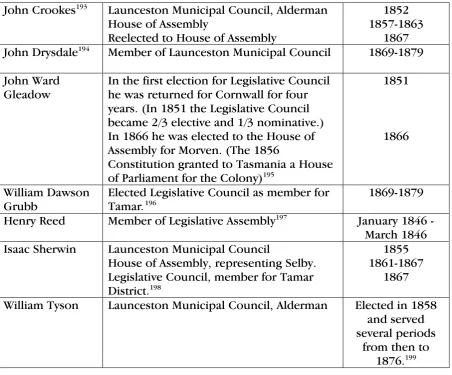
political victories are detailed briefly for a continuum. A chart of mature electoral political positions for the Wesleyan Methodists is illustrated to
show their final political progress and involvement. A biographical appendix explains and defines the movements of the Launceston
Wesleyan Methodist group, to give an understanding of why the group dispersed, and to answer any queries as to later movements.
Limitations of Thesis
This thesis is confined to the Wesleyan Methodist group in
Launceston Van Diemen's Land for the period defined and does not propose to incorporate the Primitive Methodists or the United Free
Methodists, who finally achieved union with the Wesleyan Methodists in 1902. Both groups arrived in Tasmania in the 1850s and fall outside the
parameters of this thesis. The thesis does not attempt to discuss, at any length, the Wesleyan Methodist involvement with Aborigines. The New South Wales Wesleyan Methodist involvement has been treated elsewhere,
and the Buntingdale Mission in Port Phillip has been well covered in Alison Head’s M.A. thesis ‘The Wesleyan Methodists in Port Phillip,
1836-50’. There was no involvement of the Launceston Wesleyan Methodists with Van Diemen's Land Aborigines as they were nearly decimated by the
support to the Aboriginal mission at Port Phillip at the behest of Lieutenant-Governor Arthur. The thesis does not attempt to discuss female Wesleyan Methodist involvement. Such discussion would not add to the
argument of this thesis because women were not involved in commercial, political or public life. Women certainly formed a quarter of the class
leadership in the Launceston Wesleyan Methodist Society, and records show that Georgiana Oakden, wife of Philip Oakden, continued being a
class leader well into the last part of the nineteenth century. Records contain references to women assisting in making collections, as well as references to admittance to the Society, and notes of some
misdemeanours. Though it may be inappropriate to exclude them, the judgement was made that it could not further the argument of the thesis.
No extra emphasis has been placed on ministerial achievements. It is considered, in this context, that the ministers were creatures of the
Wesleyan Methodist Conference in London, with an already formed set of current denominational attitudes. As this thesis argues, it was to be the
Chapter 1
Background
Introduction to Background, Chapter 1
There is a vast body of literature related to John Wesley’s theology, as well as his connection to such movements as the Evangelical Revival, the
French Revolution and the Industrial Revolution, and many other social and political events. The body of literature can be a minefield and it is easy
to be diverted by the magnitude of side issues so beloved of Methodist historians. It is thus important to narrow the literature into specific areas
and channels in order to chart a clear, logical path to the argument.
It is, first and foremost, important to see the chapter as providing
some background understanding of nineteenth century Wesleyan Methodist ethics. It is important to demonstrate that Wesley’s theology did not develop in a vacuum; it was the result of many interacting influences.
It is proposed to highlight Wesley’s developing theology, placed against the international movement of the Evangelical Revival, and then take it
through the influences of Arminianism, devotional literature and the strong moulding influences of German Pietism and the Moravians. It will
be shown how the final theology of Justification, Sanctification and Christian Perfection was developed and how it was dovetailed into the
evangelical economic theory of Wesley, how the spirituality and economics became one. It is important to understand the bones and sinews of the theology in order to comprehend the later behaviour and
contributions of the Launceston Wesleyan Methodists.
Establishment of the Methodist Society will follow with its complex
structure and Wesley’s communitarian bias will be discussed as well as the tandem progress and rise of the New Dissent. Wesley’s anxiety about The
Stewardship of Riches and obligations to the poor will lead through the Industrial Revolution to Methodist separation from the Anglican Church. Discussion will then move to the dawning of the nineteenth century with
with a duality in relation to The Stewardship of Riches. Emphasis will be
placed on the fact that Methodists saw themselves as a force for order.
The all-important formation of the Wesleyan Methodist Missionary Society (hereafter WMMS) will be discussed as a background to
understanding the Wesleyan Methodist missionary outreach and the demands placed on the shoulders of the Wesleyan Methodist middle-class
economic man.
The slowness of the Wesleyan Methodists in legalising their
missionary structure in the late eighteenth century, which was the result of Dr. Thomas Coke’s single-handed missionary enterprise, will be discussed.
The reorganisation of the WMMS in 1813 will be traced alongside the growing evangelical support. The inclusion of the influential Wesleyan laymen of commerce, in order to fund the endeavour, will be evaluated
alongside the Rev. Richard Watson’s theory of benevolence and consecrated wealth. This theory of consecrated wealth shifted Wesley’s
economic theory to a higher dimension. Other features to be explored will be the shift of emphasis from the poor to the ‘heathen”, and the new label
of respectability gained by the Wesleyan Methodists in their missionary endeavours. Contemporary political and social events with their
interaction are not examined in any detail. Another facet of the emphasis is to show that Methodism was just another segment of the Evangelical Revival playing its part as one of the building blocks, neither exaggerating
or underestimating its part as is often done.1 Langford contends that, ‘there is an obvious danger in giving Wesley and his followers more
significance in the second quarter of the eighteenth century than they deserve. They are not an appropriate starting point for the Evangelical
Revival.2 Of necessity in the background, there will be a loose
1 On an opposing note, John Kent’s work Religion in Eighteenth Century Britain, starts
his work with, ‘One of the persistent myths of modern British History is the myth of the so called evangelical revival’. Kent sees a distinction between primary religion and secondary theologies and the trappings of ecclesiastical institutions which developed around it. He sees Methodism as a religious sub-culture taking an advantage of the religious climate of the time. (‘Review article’, Barrie Tabraham, Journal of Ecclesiastical History, Vol. 55, No. 2, April 2004, p. 326.)
2 Paul Langford, A Polite and Commercial People: England 1727-83 (Oxford, 1989), p.
chronological thread running through to show the progression of
formation.
There is not a vast body of Methodist histories referring to Wesley’s economic theology. In general it receives passing and un-detailed
references. The writers who have developed the theme are Kathleen MacArthur, Charles Elliott, John Walsh, Robert Wearmouth, Theodore
Jennings, Wellman J. Warner, Kurt Samuelsson, Thomas Madron and John R. Tyson. The background chapter has made considerable use of their
works. The part of the background chapter relating to the Evangelical Protestant Awakening and German Pietism may appear lengthy, but it is
felt that it was warranted to demonstrate its legacy to Wesleyan Methodism.
Eighteenth Century
The Centenary Book of Wesleyan Methodism3 published in 1839
presents the core of Wesleyanism with this description of John and
Charles Wesley:
Having obtained by the simple exercise of faith in Christ, not only the abiding witness of the pardoning and adopting mercy of God, but also the purity of Heart which they had long unsuccessfully endeavoured to obtain by righteousness and law, they were astonished at their former errors and longed to make known the great salvation which is thus attainable by all. Before this period, they served God because they feared Him; now they loved Him from a joyous assurance that He had first loved them. 4
3 Thomas Jackson, Centenary Book of Wesleyan Methodism: A Brief Sketch of the Rise,
Progress and Present State of the Methodist Societies throughout the World (London, 1839).
4 This publication was reviewed in The Wesleyan Methodist Magazine in January 1839,
Vol. xviii, 3rd series, p45., The Arminian Magazine, was first published by John Wesley
This was John Wesley’s underlying precept and conviction, and on
this he built a religious force underpinned with ethics. How had John Wesley arrived at this conviction? What influences had come to bear upon him? The Methodist Society regarded 24 May 1738 as the day Wesley was
converted with the Aldersgate experience, hence the Centenary Celebration in 1838.5
Wesley’s birth in 1703 heralded the dawn of the eighteenth century. England was developing the empire with its colonies, and consequent
expansion of colonial trade, but there were ‘inherited economic problems passed on from the seventeenth century, including the beginning of the
enclosure process as one of the steps of agriculture improvement’.6
Mercantilism was arising and chartered companies were seeking trade in new lands. A lack of economic unity was evidenced in bad roads and
transportation and riots were common. There was low agricultural profitability and there was no sign of industrial investment opening out.
The population was beginning to climb, but was set back by the lethal epidemics that struck it regularly. Not until 1740 did the population start
to rise steadily. Porter feels that ‘during the first forty years of the eighteenth century, society and the economy remained in self adjusting
equilibrium’.7 Kathleen MacArthur also refers to precarious means of communication8 at this period, but it will be shown later that poor communication did not diminish the discussion of religious ideas. The
unpropertied man was economically helpless. However, Porter points out that ‘the enclosure system also boosted rural output. It was a shot in the
arm for the economy, though a blow to land workers’.9 Some clergy
5 Wesley had a strong transforming experience at a society meeting at Aldersgate on 24
May 1738, where he felt his heart strangely warmed, that he did trust in Christ and that assurance was given that his sins had been taken away. (Roy Hattersley, A Brand From the Burning: The Life of John Wesley (London, 2002), pp. 136-7.) This was to be the core Methodist belief in the ‘felt experience of conversion’. It was something ‘the recipient felt and sensed’; Richard Beresford Roy, ‘A Reappraisal of Wesleyan Methodist Mission in the First Half of the Nineteenth Century, as Viewed Through the Ministry of the Rev. John Smithies (1802-1872)’, PhD Thesis (Edith Cowan University, Perth, W.A., 2006), pp. 192, 200.
6 Kathleen Walker MacArthur, The Economic Ethics of John Wesley (New York, 1935), p.
35.
7 Roy Porter, English Society in the Eighteenth Century (London, 1982), pp. 220-30. 8 MacArthur, Economic Ethics, p. 36.
became powerful as a land owning class because of land enclosure and
there was always the ongoing problem with absentee parsons. The eighteenth century Anglican Church was unspiritual and quite unable to deal with the situation. Populations were shifting, but new churches were
not set up to cope with the change.10 Parish boundaries were not redrawn.
Evangelical Situation, Arminianism and Holy Club
The early period of the eighteenth century produced many religious
societies. These religious societies did much good with their offer of fellowship. The Society for Promoting Christian Knowledge (SPCK)
emphasised the spread of religious education, charity schools and religious literature. Ward writes that ‘the SPCK was originally intended by Thomas Bray to put down Quakerism at home and dissent generally in
America’.11 Piety was encouraged by a variety of small religious societies which were devoted to holy living and more controversially good works.
According to Brown-Lawson, ‘the Society for the Reformation of Manners rooted out wickedness in the community with the doubtful methods of
employing informers’.12
The church was challenged by the chilling movement of rationalism
such as the Deists who opposed all forms of Christianity. However there were other powers at work. The Anglican Evangelicals were church men, gospel men committed to the concept of the new birth, personal religion
and salvation by faith. They felt that God’s grace effected salvation and once saved, man was justified, regarded by God as having never sinned.
Also the work of the Holy Spirit was seen to be important to conversion. Bebbington sees evangelicalism as ‘consisting of all those strands of
Protestantism that have not been either too high in churchmanship or too broad in theology to qualify for acceptance. It has spanned the gulf
between the Established Church and Nonconformity’.13 Ranged on the
10 Albert Brown-Lawson, John Wesley, the Anglican Evangelicals of the Eighteenth
Century: a study in cooperation and separation with special reference to the Calvinistic Certainties (Edinburgh, 1994), p. 9.
11 W.R. Ward, The Protestant Evangelical Awakening (Cambridge, 1992), p. 302. 12 Brown-Lawson, John Wesley, pp. 11, 12.
13 David W. Bebbington, Evangelicalism in Modern Britain: A History from the 1730s to